


Abstract
Porphyrin-based photosensitizers have attracted considerable attention for photodynamic applications due to their ability to generate reactive oxygen species upon light irradiation. However, the development of stable and efficient photosensitizing systems remains an important challenge. In this work, a conjugated porphyrin polymer was developed through the oxidative polymerization of carbazolyl substituents incorporated into a 5,15-bis [4-(9-carbazolyl)phenyl]-10,20-bis(pentafluorophenyl)porphyrin (TPPF10CBZ). The resulting polymer, P-TPPF10CBZ, was characterized by spectroscopic and photophysical techniques to evaluate its structural and optical properties. Its ability to generate singlet oxygen and its photostability were also investigated, providing insights into its potential as a robust porphyrin-based photosensitizer for future photodynamic applications.
1. Introduction
Porphyrin-based photosensitizers (PSs) have attracted considerable attention in photodynamic inactivation (PDI) of pathogenic microorganisms owing to their intense absorption in the visible region, high singlet oxygen (O2(1Δg)) quantum yields, and structural versatility [1,2]. However, monomeric porphyrins often suffer from aggregation, photobleaching, and limited processability in solid or supported formats, which restricts their use in practical antimicrobial materials. Conjugated porphyrin polymers have emerged as an attractive strategy to overcome these limitations, since polymerization can preserve the intrinsic photophysical properties of the porphyrin macrocycle while improving structural stability, photostability, and potential for device integration [3,4].
Among the building blocks available for oxidative polymerization, carbazole-based units are particularly attractive due to their high redox stability, strong UV absorption, and efficient charge-transport properties, which have made them widely used in optoelectronic devices such as transistors, light-emitting diodes, biosensors, and photovoltaic systems [5]. Iron(III) chloride (FeCl3) is commonly employed as an efficient oxidizing agent for the polymerization of carbazole derivatives, generating conjugated networks through oxidative C–C or C–N coupling between carbazolyl units [6]. Beyond their optoelectronic relevance, carbazole derivatives also display valuable biological properties, including antimicrobial, antitumoral, antioxidant, and anti-inflammatory activity [7,8].
The present work describes the synthesis and photophysical/photodynamic characterization of a new conjugated porphyrin polymer, P-TPPF10CBZ, obtained through the oxidative polymerization of the carbazolyl substituents of 5,15-di(4-(9-carbazolylphenyl))-10,20-di(pentafluorophenyl)porphyrin (TPPF10CBZ) using FeCl3 as the oxidizing agent. The polymer was characterized by UV–visible absorption and steady-state and time-resolved fluorescence spectroscopy, and its ability to generate singlet oxygen and to withstand photobleaching was evaluated, to assess its potential as a robust porphyrin-based photosensitizer for PDI applications.
2. Materials and Methods
2.1. Equipment and Chemical Agents
All reagents were obtained from Sigma-Aldrich (Milwaukee, WI, USA) and used without further purification. Thin-layer chromatography (TLC) plates coated with silica gel (250 μm) were purchased from Analtech (Newark, DE, USA). Absorption spectra were carried out on a Shimadzu UV-2401PC spectrometer (Shimadzu Corporation, Tokyo, Ja-pan). Time-resolved experiments and the determination of fluorescence lifetimes (τ) were performed using a FluoTime 300 fluorescence spectrophotometer (PicoQuant, Berlin, Germany).
2.2. Synthesis
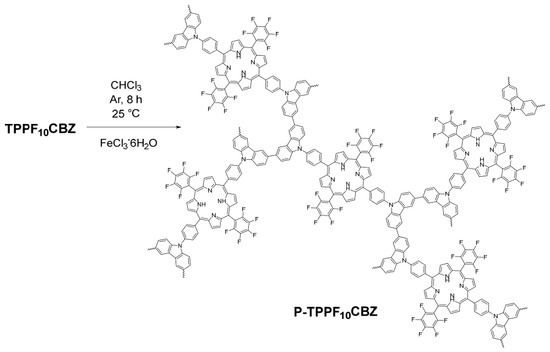
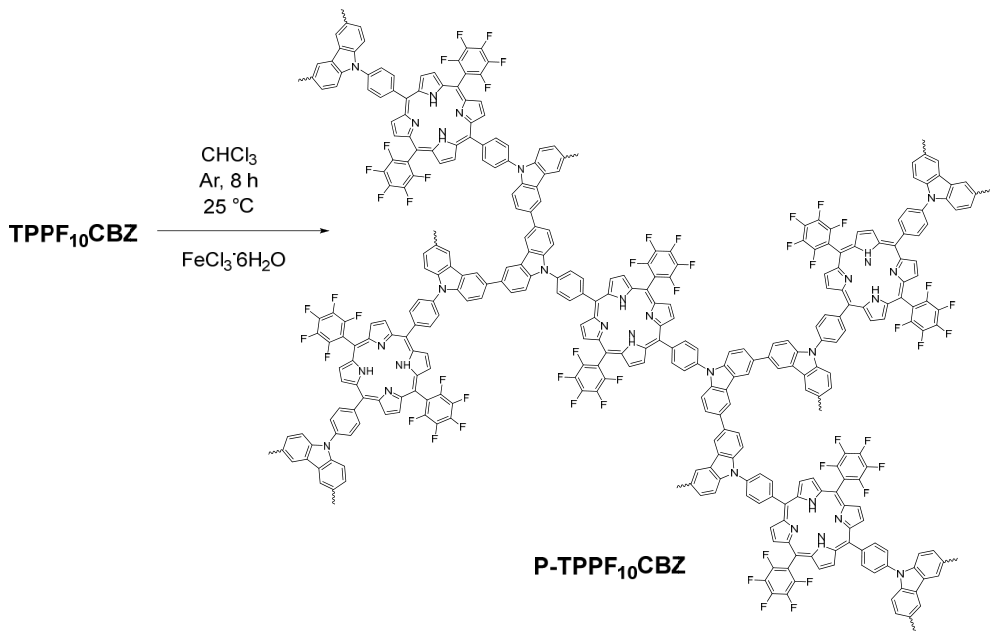
5,15-di(4-(9-carbazolylphenyl))-10,20-di(pentafluorophenyl)porphyrin (TPPF10CBZ) was synthesized following a previously described methodology [9]. P-TPPF10CBZ was synthesized by oxidative polymerization of TPPF10CBZ with FeCl3 using anhydrous chloroform (CHCl3) as the solvent at room temperature under an Ar atmosphere for 8 h [6]. The progress of the reaction was monitored by TLC (silica gel, dichloromethane (DCM)/triethylamine (TEA) 99:1) until the complete disappearance of TPPF10CBZ was observed. The polymer was purified by washing with methanol (MeOH) and subsequent centrifugation, yielding the final product P-TPPF10CBZ [4].
2.3. Spectroscopic Studies
Absorption and fluorescence spectra were performed in a quartz cell of 1 cm path length using N,N-dimethylformamide (DMF) at room temperature. The fluorescence quantum yields (ΦF) of the conjugates were calculated by comparison of the area below the corrected emission spectra with that of the reference [10]. Fluorescence lifetimes (τ) were acquired in TCSPC mode using a PicoHarp 300 module (minimum time resolution of 4 ps), and data were analyzed with EasyTau 2 software, considering the instrument response function (IRF) of a diluted Ludox scattering solution [11]. Photooxidation of 9,10-dime-thylanthracene (DMA) was used to determine singlet molecular oxygen production (ΦΔ) in DMF [12].
3. Results and Discussion
3.1. Synthesis of P-TPPF10CBZ
P-TPPF10CBZ was synthesized by oxidative polymerization of the carbazolyl substituents of TPPF10CBZ (Figure 1). The monomer was dissolved in anhydrous CHCl3, and solid FeCl3 was added in a 4:1 molar ratio relative to the porphyrin. The reaction was carried out at room temperature under an Ar atmosphere with constant stirring. Reaction progress was monitored by TLC (siliga cel, DCM/TEA 99:1), and completion of the coupling reaction was confirmed by the disappearance of the monomer spot. The solvent was removed under reduced pressure and the resulting solid was resuspended in MeOH. The polymer was isolated by centrifugation and the product was washed repeatedly with MeOH, affording P-TPPF10CBZ in high yield. Oxidative coupling between carbazolyl units generated a conjugated polymeric network while preserving the integrity of the porphyrin macrocycles.
Figure 1.
Synthesis and idealized chemical structure of P-TPPF10CBZ.
3.2. Spectroscopic Properties
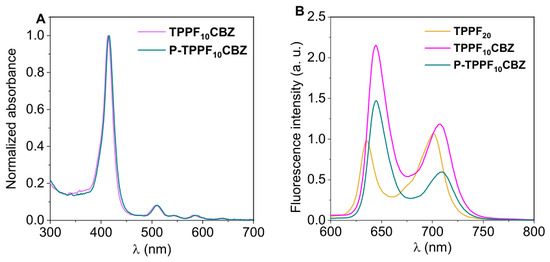
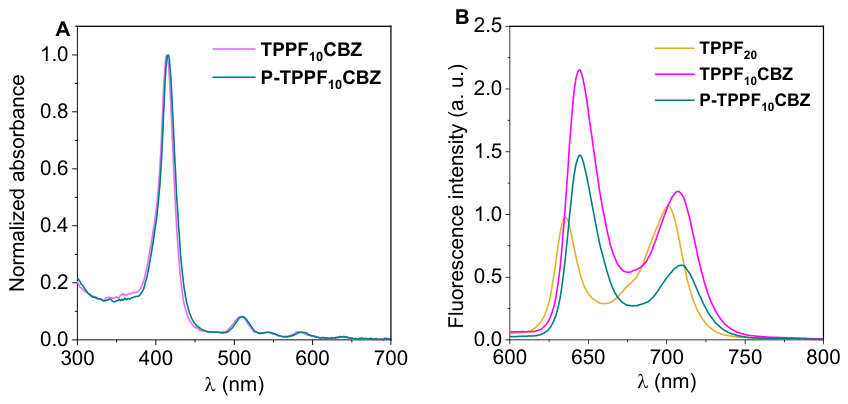
All the spectroscopic properties of the PSs are summarized in Table 1. The optical properties of P-TPPF10CBZ were compared with those of the monomer TPPF10CBZ using DMF as a solvent. The polymer displayed an intense Soret absorption band at 418 nm and four Q bands of lower energy between 500 and 700 nm (Figure 2A). These transitions are typical of meso-tetraphenyl free-base porphyrin derivatives with D2h-symmetry [13]. Fluorescence emission spectra of TPPF10CBZ, P-TPPF10CBZ, and the reference porphyrin TPPF20 are shown in Figure 2B. The polymer exhibited two emission bands centered at 645 and 710 nm, assigned to the Qx(0-0) and Qx(0-1) transitions characteristic of meso-substituted free-base porphyrins [10,12]. Both absorption and fluorescence emission spectra closely resembled that of the monomer, indicating that the spectroscopic identity of the porphyrin units is conserved within the polymer even though they form part of a highly conjugated system. Furthermore, P-TPPF10CBZ showed a ΦF slightly lower than that of its constitutive monomer (Table 1) in agreement with values reported for structurally related tetrapyrrolic macrocycles [14]. Finally, time-resolved fluorescence measurements demonstrated that TPPF10CBZ displayed a monoexponential decay for both emission bands (τ ≈ 10.5–10.6 ns), typical of rigid meso-tetraarylporphyrins with negligible aggregation in DMF [15]. In contrast, the decay profiles of P-TPPF10CBZ were best fitted by a biexponential function, with a major long-lived component (τ1 ≈ 10.55–10.58 ns) essentially identical to the monomer lifetime, and a minor short-lived component (τ2 ≈ 1.3–1.6 ns).
Table 1.
Spectroscopic and photodynamic properties of TPPF10CBZ and P-TPPF10CBZ in DMF.
Figure 2.
(A) UV-visible absorption spectra of TPPF10CBZ (magenta solid line) and P-TPPF10CBZ (teal solid line) and (B) fluorescence emission spectra (λexc = 416 nm) of TPPF20 (orange solid line), TPPF10CBZ (magenta solid line), and P-TPPF10CBZ (teal solid line) in DMF.
3.3. O2(1Δg) Production
The ability of P-TPPF10CBZ to photosensitize the generation of O2(1Δg) was evaluated in DMF by monitoring the photooxidation of 9,10-dimethylanthracene (DMA), followed spectrophotometrically as the decrease in probe absorbance at 378 nm under irradiation at 416 nm. Both TPPF10CBZ and P-TPPF10CBZ showed a high capacity to generate O2(1Δg) in DMF. The singlet oxygen quantum yield of P-TPPF10CBZ (ΦΔ = 0.87 ± 0.04) was comparable to that of the monomeric porphyrin (ΦΔ = 0.93 ± 0.05), indicating that polymerization does not significantly compromise the photodynamic efficiency of the porphyrin units. These results support that polycarbazole-containing PSs are efficient O2(1Δg) generators and promising candidates for PDI applications [16].
4. Conclusions
A new conjugated porphyrin polymer, P-TPPF10CBZ, was successfully synthesized by oxidative polymerization of the carbazolyl substituents of TPPF10CBZ using FeCl3 as the oxidizing agent. UV–visible and fluorescence spectroscopy confirmed that the porphyrin units retain their characteristic absorption and emission profiles after polymerization, with only a slight decrease in ΦF. Photodynamic assays showed that P-TPPF10CBZ efficiently generates O2(1Δg), comparable to the parent monomer. These results suggest that P-TPPF10CBZ possesses strong potential as a PS for photodynamic inactivation of pathogenic microorganisms.
Author Contributions
M.B.B.: Conceptualization, methodology, formal analysis, investigation, data curation, writing—original draft, and visualization; M.E.M.: validation, writing—review and editing, visualization, supervision, and funding acquisition; E.N.D.: validation, writing—review and editing, visualization, supervision, project administration, and funding acquisition. All authors have read and agreed to the published version of the manuscript.
Funding
This work was supported by SECYT-UNRC (PPI C612) and CONICET of Argentina (PIET-R 29820250100009CO).
Institutional Review Board Statement
Not applicable.
Informed Consent Statement
Not applicable.
Data Availability Statement
The original contributions presented in this study are included in the article. Further inquiries can be directed to the corresponding author.
Acknowledgments
M.E.M. and E.N.D. are Scientific Members of CONICET. M.B.B. thanks CONICET for the research fellowship.
Conflicts of Interest
The authors declare no conflicts of interest.
Abbreviations
The following abbreviations are used in this manuscript:
| PS | Photosensitizer |
| PDI | Photodynamic Inactivation |
| O2(1Δg) | Synglet Oxygen |
| TLC | Thin-layer chromatography |
| DCM | Dichloromethane |
| TEA | Triethylamine |
| MeOH | Methanol |
| DMF | N,N-dimethylformamide |
| IRF | Instrument response function |
| DMA | 9,10-dime-thylanthracen |
References
- Amos-Tautua, B.M.; Songca, S.P.; Oluwafemi, O.S. Application of Porphyrins in Antibacterial Photodynamic Therapy. Molecules 2019, 24, 2456. [Google Scholar] [CrossRef] [Scilit] [PubMed]
- López, M.; Gsponer, N.S.; Heredia, D.A.; Durantini, E.N. Chlorin-based photodynamic antimicrobial glass surfaces for the eradication of Staphylococcus aureus. Surf. Interfaces 2025, 66, 106575. [Google Scholar] [CrossRef] [Scilit]
- Bekkar, F.; Bettahar, F.; Moreno, I.; Meghabar, R.; Hamadouche, M.; Hernáez, E.; Vilas-Vilela, J.L.; Ruiz-Rubio, L. Polycarbazole and Its Derivatives: Synthesis and Applications. A Review of the Last 10 Years. Polymers 2020, 12, 2227. [Google Scholar] [CrossRef] [Scilit] [PubMed]
- Ballatore, M.B.; Pérez, M.E.; Santamarina, S.C.; Durantini, J.E.; Milanesio, M.E.; Durantini, E.N. Photodynamic Polymers Constituted by Porphyrin Units as Antibacterial Materials. Photochem 2022, 2, 891–904. [Google Scholar] [CrossRef] [Scilit]
- Durantini, J.E.; Otero, L.A.; Funes, M.; Durantini, E.N.; Fungo, F.; Gervaldo, M.A. Electrochemical oxidation-induced polymerization of 5,10,15,20-tetrakis [3-(N-ethylcarbazoyl)] porphyrin. Formation and characterization of a novel electroactive porphyrin thin film. Electrochim. Acta 2011, 56, 4126–4134. [Google Scholar] [CrossRef] [Scilit]
- Siove, A.; Adês, D. Synthesis by oxidative polymerization with FeCl3 of a fully aromatic twisted poly(3,6-carbazole) with a blue-violet luminescence. Polymers 2004, 45, 4045–4049. [Google Scholar] [CrossRef] [Scilit]
- Shakir, M.; Noor-e-Iram, M.S.; Al-Resayes, S.I.; Khan, A.A.; Baig, U. Electrical Conductivity, Isothermal Stability, and Ammonia-Sensing Performance of Newly Synthesized and Characterized Organic–Inorganic Polycarbazole–Titanium Dioxide Nanocomposite. Ind. Eng. Chem. Res. 2014, 53, 8035–8044. [Google Scholar] [CrossRef] [Scilit]
- Bezgin Carbas, B. Disruptive Electrochromic Materials: Carbazole-Based Conjugated Polymers. ACS Appl. Polym. Mater. 2025, 7, 4051–4076. [Google Scholar] [CrossRef] [Scilit]
- Leon Jaramillo, J.C.; Boarini, M.B.; Bongiovanni Abel, S.; Cometto, F.P.; Mondino, T.M.; Milanesio, M.E.; Durantini, E.N.; Otero, L.A.; Gervaldo, M.A.; Durantini, J.E. Fluorinated Porphyrin Electropolymer Films for Efficient and Stable Pseudocapacitive Energy Storage. Batter. Supercaps 2026, 9, e202500893. [Google Scholar] [CrossRef] [Scilit]
- Santamarina, S.C.; Heredia, D.A.; Durantini, A.M.; Durantini, E.N. Porphyrin Polymers Bearing N,N′-Ethylene Crosslinkers as Photosensitizers against Bacteria. Polymers 2022, 14, 4936. [Google Scholar] [CrossRef] [Scilit] [PubMed]
- Theiss, T.; Cappellari, M.V.; Nguyen, T.; Kösters, J.; Hepp, A.; Strassert, C.A. Tridentate C^N^N ligands as cyclometalated luminophores for phosphorescent Pt(II) complexes—A case study concerning the influence of the substitution pattern and the co-ligands on the excited state properties. J. Organomet. Chem. 2024, 1008, 123003. [Google Scholar] [CrossRef] [Scilit]
- Boarini, M.B.; Gsponer, N.S.; Milanesio, M.E.; Durantini, E.N. Porphyrin- polyethylenimine conjugates as photodynamic polymers to eliminate Staphylococcus aureus and Escherichia coli. Eur. Polym. J. 2023, 200, 112512. [Google Scholar] [CrossRef] [Scilit]
- Pérez, M.E.; Durantini, J.E.; Reynoso, E.; Alvarez, M.G.; Milanesio, M.E.; Durantini, E.N. Porphyrin–Schiff Base Conjugates Bearing Basic Amino Groups as Antimicrobial Phototherapeutic Agents. Molecules 2021, 26, 5877. [Google Scholar] [CrossRef] [Scilit] [PubMed]
- Pucelik, B.; Paczyński, R.; Dubin, G.; Pereira, M.M.; Arnaut, L.G.; Dąbrowski, J.M. Properties of halogenated and sulfonated porphyrins relevant for the selection of photosensitizers in anticancer and antimicrobial therapies. PLoS ONE 2017, 12, e0185984, Correction in PLoS ONE 2018, 13, e0191777. [Google Scholar] [CrossRef] [Scilit] [PubMed]
- Jhonsi, M.A.; Kathiravan, A.; Renganathan, R. An investigation on fluorescence quenching of certain porphyrins by colloidal CdS. J. Lumin. 2009, 129, 854–860. [Google Scholar] [CrossRef] [Scilit]
- Pandey, V.; Jain, D.; Pareek, N.; Gupta, I. Pd(II) porphyrins: Synthesis, singlet oxygen generation and photoassisted oxidation of aldehydes to carboxilic acids. Inorganica Chim. Acta 2020, 502, 119339. [Google Scholar] [CrossRef] [Scilit]

Disclaimer/Publisher’s Note: The statements, opinions and data contained in all publications are solely those of the individual author(s) and contributor(s) and not of MDPI and/or the editor(s). MDPI and/or the editor(s) disclaim responsibility for any injury to people or property resulting from any ideas, methods, instructions or products referred to in the content. |
© 2026 by the authors. Licensee MDPI, Basel, Switzerland. This article is an open access article distributed under the terms and conditions of the Creative Commons Attribution (CC BY) license.