


Abstract
The increasing demand for sustainable and renewable alternatives to petroleum-based raw materials in pigment synthesis has encouraged the exploration of naturally occurring bio-based compounds. In the present study, eugenol, a naturally occurring phenolic compound derived from plant sources, was utilized as a coupling component for the synthesis of azo pigments through diazotization and azo-coupling reactions. Five structurally different azo pigments were successfully synthesized and comprehensively characterized using Fourier Transform Infrared Spectroscopy (FTIR), Differential Scanning Calorimetry (DSC), Thermogravimetric Analysis (TGA), and Scanning Electron Microscopy (SEM) to evaluate their chemical structure, thermal stability, and surface morphology. The synthesized pigments were subsequently incorporated individually into epoxy coating formulations at pigment loadings of 0.5, 1, 5, and 10 wt% to investigate their suitability as environmentally friendly anticorrosive pigments. The performance of the pigmented epoxy coatings was assessed through electrochemical impedance spectroscopy (EIS), corrosion resistance testing, and mechanical property evaluations. In addition, the antimicrobial activity of the pigment-containing coatings was examined to determine their potential for multifunctional protective applications. The results demonstrate that eugenol-derived azo pigments exhibit excellent compatibility with epoxy coatings and significantly influence the coatings’ corrosion protection, mechanical performance, and antimicrobial properties, highlighting their potential as sustainable bio-based pigments for advanced protective coating applications. The study gives a sustainable alternative to the antimicrobial coating from naturally derived sources.
1. Introduction
Azo dyes are an important class of synthetic organic colorants and represent one of the most widely used groups of dyes in industry. They are characterized by the presence of one or more azo groups (–N=N–), which act as the main chromophoric units responsible for their intense colors. Depending on their chemical structure, azo dyes can be classified as monoazo, disazo, trisazo, and polyazo compounds. Their structural flexibility, ease of synthesis, wide range of colors, and good stability have contributed to their extensive use in textiles, paints, coatings, plastics, paper, printing inks, cosmetics, pharmaceuticals, and other industrial products [1,2,3,4]. The classical synthesis of azo dyes generally involves the diazotization of a primary aromatic amine, followed by an azo-coupling reaction with an electron-rich aromatic compound. The reaction conditions and the nature of the diazonium salt and coupling component can be varied to obtain compounds with different colors, solubilities, thermal properties, and functional characteristics [1,5,6].
Another important limitation of conventional colorant production is its dependence on petroleum-derived chemical feedstocks. Petroleum-based aromatic compounds have traditionally been used as starting materials for the synthesis of many industrial chemicals, including dyes and pigments. Since petroleum is a finite resource, increasing attention is being directed towards renewable resources obtained from plants and other biological sources [7,8]. Biomass-derived compounds can provide useful alternatives to fossil-based chemicals because many of them contain functional groups and aromatic structures that can be chemically modified to produce value-added materials. In particular, naturally occurring phenolic compounds are attractive candidates because their activated aromatic rings can participate in electrophilic substitution and azo-coupling reactions with diazonium salts [9,10]. The use of plant-derived phenolic compounds in azo synthesis therefore provides an interesting route for developing colorants from renewable resources while introducing additional functional groups into the final molecules.
Therefore, the present study focuses on the synthesis and characterization of eugenol-derived azo pigments prepared through diazotization and azo-coupling reactions. Five structurally different azo pigments were synthesized using eugenol as the coupling component. The synthesized pigments were characterized by Fourier transform infrared spectroscopy (FTIR), differential scanning calorimetry (DSC), thermogravimetric Analysis (TGA), and antimicrobial activity to investigate their chemical structure, thermal behavior, and assess their potential for antimicrobial coating applications. The pigments were subsequently incorporated into epoxy coatings at different concentrations to evaluate their potential as bio-based functional pigments for anticorrosive applications. The resulting coatings were evaluated in terms of corrosion protection, mechanical properties, and scanning electron microscopy (SEM) analysis for surface morphology. This approach aims to explore the potential of eugenol as a renewable building block for the preparation of azo pigments and multifunctional protective coating systems.
2. Materials and Methods
2.1. Materials
Eugenol, 4-nitroaniline, 3-nitroaniline, 4-bromoaniline, 4,4′-oxydianiline, and 4-chloroaniline were used as starting materials for the synthesis of eugenol-based azo pigments. Sodium hydroxide (NaOH), hydrochloric acid (HCl), and sodium nitrite (NaNO2) were used for the diazotization and azo-coupling reactions. All chemicals were purchased from S. D. Fine-Chem. Ltd., Vadodara, Gujarat, India, and were used as received without further purification. Araldite epoxy resin and hardener were purchased from Godadiya Enterprises, Mumbai, India.
Different aromatic amines were selected to prepare azo pigments with varied structures. Eugenol was used as the bio-based coupling component, while the aromatic amines served as diazo components. The structural differences were expected to affect the chemical, thermal, morphological, and functional properties of the resulting pigments.
2.2. Synthesis of Eugenol-Based Azo Pigments
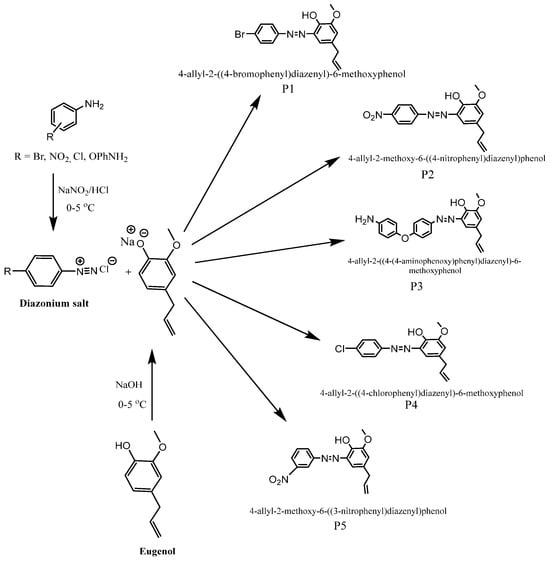
The corresponding amine (20 mmol) was dissolved in distilled water (15 mL), followed by the addition of hydrochloric acid (5.7 mL, 30%). The solution was cooled to 0–5 °C, and an aqueous solution of sodium nitrite (NaNO2, 20 mmol) was added dropwise with continuous stirring while maintaining the temperature at 0–5 °C. The resulting diazonium salt solution was then treated gradually with a solution of eugenol (4-allyl-2-methoxyphenol, 20 mmol) in 10% aqueous NaOH (50 mL) under vigorous stirring at 0–5 °C. Dilute aqueous sodium bisulfite solution was subsequently added until the mixture was neutral. The precipitated product was collected by filtration, washed thoroughly with distilled water, and dried to constant weight. Figure 1 illustrates the synthetic route used for the preparation of azo compounds P1–P5.
Figure 1.
Synthesis of Eugenol-Derived Azo-pigments P1 to P5.
2.3. Preparation of Pigmented Epoxy Coatings
The epoxy coatings were prepared using epoxy resin as the binder and synthesized azo pigments P1P5 as colorants. Each pigment was separately incorporated into the epoxy resin at concentrations of 0.5, 1, 5, and 10 wt.%. The mixtures were thoroughly stirred and sonicated using a Hielscher UP400S ultrasonic sonicator (Germany) at 100 W for 20 min to ensure uniform dispersion of the pigments. A stoichiometric amount of amine curing agent was then added and gently mixed for approximately 5 min. The resulting mixtures were diluted with a suitable solvent to obtain the desired coating consistency. The prepared coatings were then applied separately onto mild steel panels and allowed to cure before further testing.
3. Results and Discussion
3.1. Characterizations of Eugenol-Based Azo Pigments
3.1.1. FTIR Characterization
The FTIR spectra of the synthesized eugenol-based azo pigments P1–P5 are shown in Figure S1. FTIR analysis was used to identify the main functional groups and confirm the formation of the azo linkage. The characteristic –N=N– stretching bands were observed at 1479, 1483, 1442, 1440, and 1415 cm−1 for P1, P2, P3, P4, and P5, respectively, confirming the presence of the azo group. The phenolic –OH stretching bands appeared at 3469.94, 3361.93, 3387, 3523.95, and 3481.51 cm−1 for P1–P5, respectively. The differences in these values may be due to the effect of the different substituents on the aromatic rings and their influence on hydrogen bonding. Characteristic bands of the substituents were also observed. P1 showed a C–Br band at 663.51 cm−1, while P4 showed a band corresponding to C–Cl. The –NO2 group in P5 showed a characteristic band at 1559.5 cm−1. Overall, the FTIR results confirmed the presence of the expected functional groups and supported the formation of the eugenol-based azo pigments.
3.1.2. DSC Analysis
DSC analysis was carried out to study the thermal behavior of the synthesized eugenol-based azo pigments P1–P5, and the results are shown in Figure S2. Each pigment was analyzed using a single heating cycle from room temperature to 300 °C. P1 showed an endothermic peak at 118–129 °C, which may be due to the removal of physically adsorbed water, followed by another endothermic event at 170–206 °C. P2, P3, and P4 showed similar endothermic transitions in the range of 82–103 °C, while P2 also showed an exothermic peak near 201 °C. P5 showed a different thermal response, with an initial transition at 57.4 °C and a main transition at 216 °C. These results indicate that P5 has a different thermal behavior compared with the other pigments.
3.1.3. TGA
The results of TGA are shown in Figure S3. The TGA profiles of P1–P5 showed differences in their thermal stability. A small weight loss below 150 °C may be due to moisture or volatile substances. P1 and P5 showed faster degradation between 170 and 250 °C and left only about 16–18% residue at 580–590 °C. P2 and P3 showed broader degradation and retained about 52% and 49% residue, respectively. P4 showed the highest thermal stability, with about 65% residue at 580–590 °C. Overall, the thermal stability followed the order P4 > P2 > P3 > P1 ≈ P5. The higher stability of P4 may be due to its more thermally stable structure and greater char formation.
3.1.4. Antimicrobial Assay
The antimicrobial activity of the synthesized azo pigments P1–P5 was investigated against the Gram-positive bacterium Staphylococcus aureus and the Gram-negative bacterium Escherichia coli using the agar diffusion method. As shown in Figure S4, none of the tested compounds (P1–P5) produced a distinct zone of inhibition around the corresponding test positions against either of the bacterial strains. The absence of visible growth inhibition indicates that P1–P5 did not exhibit significant antibacterial activity at the tested concentration of 100 µg/mL. Both S. aureus and E. coli therefore showed no apparent susceptibility to the investigated azo pigments under the experimental conditions. Overall, the results suggest that P1–P5 possess negligible or no measurable antibacterial activity at 100 µg/mL.
3.2. Evaluation of Pigment Coating Properties
Figure S5 presents the digital photographs of the epoxy coatings containing 0.5, 1, 5, and 10 wt.% of the synthesized azo pigments P1–P5. The photographs demonstrate the visual appearance and color characteristics of the coatings at different pigment concentrations.
3.2.1. SEM Analysis of Pigment Coatings
SEM was used to study the surface morphology of neat epoxy and the epoxy coatings containing P1–P5, as shown in Figure S6. The neat epoxy showed a smooth and uniform surface, whereas the pigment-containing coatings showed a more granular texture, confirming the presence of the pigments in the epoxy matrix. P1, P2, P3, and P5 showed fairly uniform pigment distribution with no significant agglomeration, indicating good dispersion in the epoxy matrix. The P4 coating showed a more granular and slightly heterogeneous surface but without large pigment aggregates. Overall, the SEM results suggest good compatibility and dispersion of the synthesized azo pigments in the epoxy coatings.
3.2.2. Mechanical Testing
Epoxy coatings containing 0.5, 1, 5, and 10 wt.% of the synthesized azo pigments P1–P5 were evaluated for adhesion, pencil hardness, flexibility, impact resistance, and gloss. The results are summarized in Table S1. The mechanical properties of the pigmented coating panels were evaluated according to the reported method [11].
Adhesion: The adhesion of the coatings to the substrate was evaluated using the cross-hatch method. All coatings exhibited excellent adhesion, with no significant effect of either the type or concentration of the pigment. This indicates strong bonding between the pigments and the epoxy binder, resulting in excellent adhesion of the coated films.
Pencil Hardness: The hardness of the coatings was determined using the pencil hardness test. All epoxy coatings containing the synthesized pigments exhibited excellent hardness, with a hardness value of 6H. No significant variation in hardness was observed with changes in pigment type or concentration.
Flexibility: The flexibility of the coated metal panels was evaluated using the conical mandrel bending test. All epoxy coatings containing the synthesized pigments exhibited excellent flexibility, and no cracks or detachment of the coating film were observed after bending. The results indicate good flexibility and adhesion of the coating films to the metal substrate.
Impact Resistance: Impact resistance was evaluated to investigate the ability of the coating films to withstand rapid deformation caused by falling-ball impact. The dissipation of energy within the coating film during impact determines its resistance to mechanical deformation. All coatings exhibited noticeable variations in impact resistance with changes in pigment concentration, indicating that the concentration of the synthesized azo pigments influence the mechanical performance of the epoxy coatings.
Gloss Measurement: The gloss of the coated panels was measured at 85° using a digital gloss meter. As the pigment concentration increased from 0.5 to 10 wt.%, a gradual decrease in gloss was observed. The gloss of the pigmented coatings reflects the nature of their surface; coatings with higher gloss generally possess smoother surfaces, whereas coatings with lower gloss exhibit relatively rougher surfaces. The gloss is influenced by several factors, including the degree of pigmentation, particle size, and specific surface area of the pigment particles.
3.2.3. Chemical Resistance
Acid and alkali resistance: Epoxy coatings with 0.5, 1, 5, and 10 wt.% synthesized azo pigments P1, P2, P3, P4 and P5 have been tested for chemical resistance test. The results are summarized in Table S2. The chemical resistance of coated substrates was determined by acid and alkali resistance. Mild steel panels were coated with epoxy pigmented coating pigments P1, P2, P3, P4 and P5 at different concentrations. The coated substrates were dipped in 5% NaOH and 5% HCl solutions for 24 h. Coated panels were observed at 6 and 24h. In case of acid resistance loss of gloss, blistering and delamination was observed in all sample coatings, indicating poor acid resistance. Compared to the acid medium, the weight loss in the NaOH medium was very low, which indicated that there was no direct contact between the surface and the medium. In case of alkali resistance loss of gloss was very less, slightly blistering and no delamination and was observed after 24h. As compared to acid resistance, alkali resistance of sample coatings was good. So pigments show good alkali resistance.
Salt Spray Corrosion Resistance: Salt spray testing was performed to evaluate the anticorrosive performance of epoxy coatings containing 5 wt.% of azo pigments P1, P3, and P5. The coated panels were exposed to a 5% NaCl solution in a salt spray chamber at 35 °C for 240 h. The panels were visually examined before and after exposure for signs of corrosion, blistering, cracking, or coating deterioration. The comparative appearance of the coated panels before and after salt spray exposure is shown in Figure S7.
4. Conclusions
This study investigated the synthesis, characterization, and performance of eugenol-based azo pigments P1–P5 for potential use in protective epoxy-polyamine coatings. The pigments were synthesized through diazotization followed by azo-coupling reactions and characterized using FTIR, DSC, and TGA. FTIR confirmed the formation of the azo linkage, while thermal analysis showed moderate thermal stability with differences related to the chemical structure of the pigments.
The antimicrobial evaluation showed no measurable antibacterial activity against the tested bacterial pathogens under the conditions used. The pigments were successfully incorporated into epoxy-polyamine coatings at 0.5, 1, 5, and 10 wt.%. The resulting coatings exhibited good adhesion, pencil hardness, flexibility, and overall mechanical performance, although some variation in impact resistance was observed with pigment type and concentration. The coatings also showed better resistance to alkaline media than acidic media. Salt-spray testing in 5% NaCl further demonstrated the protective performance of selected coatings under saline conditions. Overall, the results indicate that eugenol-based azo pigments P1–P5 can be effectively incorporated into epoxy-polyamine coatings and show potential as bio-based functional pigments for protective coating applications.
Supplementary Materials
The following supporting information can be downloaded at https://www.mdpi.com/article/10.3390/chemproc2026022180/s1, Figure S1. FTIR spectra of eugenol-based azo-pigments P1–P5. Figure S2. DSC analysis of eugenol-based azo-pigments P1–P5. Figure S3. TGA analysis of eugenol-based azo-pigments P1–P5. Figure S4. Antibacterial activity of azo-pigments P1–P5 against S. aureus and E. coli. Figure S5. Digital photographs of epoxy coatings prepared with different concentrations (0.5, 1, 5, and 10 wt.%) of the synthesized azo-pigments P1–P5. Figure S6. SEM micrographs showing the surface morphology of neat epoxy and epoxy coatings containing 10 wt.% synthesized azo-pigments P1–P5. Figure S7. Photographs of neat epoxy and epoxy coatings containing 5 wt.% azo-pigments P1, P3, and P5 before and after 240 h salt spray exposure in 5% NaCl solution at 35 °C. Table S1: Coating properties of epoxy films containing synthesized azo-pigments P1–P5. Table S2: Results of chemical resistance test.
Author Contributions
V.P. conceived and designed the research project and drafted the manuscript. R.P. assisted with sample analysis through spectroscopic characterization, interpreted the results, and contributed to manuscript preparation. L.J. carried out the experimental work and assisted with data collection. S.V.P. and S.R.P. designed the experimental approach, supervised the execution of the study, compiled and analyzed the resulting data, and contributed to the finalization of the manuscript. B.V.M. conducted the antimicrobial studies and contributed to the writing and revision of the manuscript. All authors have read and agreed to the published version of the manuscript.
Funding
This research received no external funding.
Institutional Review Board Statement
Not applicable.
Informed Consent Statement
Not applicable.
Data Availability Statement
The data presented in this study are available on request from the corresponding author.
Acknowledgments
The authors gratefully acknowledge the Department of Science and Technology (DST), New Delhi, for providing financial support under the Waste Management Technology (WMT) project of the Technology Transfer Division (TTD) through the project grant DST/TDT/WMT/Agwaste/2021/09(G) & (C).
Conflicts of Interest
The authors declare no conflicts of interest.
References
- Benkhaya, S.; M’rabet, S.; El Harfi, A. Classifications, Properties, Recent Synthesis and Applications of Azo Dyes. Heliyon 2020, 6, e03271. [Google Scholar] [CrossRef] [Scilit] [PubMed]
- Merino, E. Synthesis of Azobenzenes: The Coloured Pieces of Molecular Materials. Chem. Soc. Rev. 2011, 40, 3835–3853. [Google Scholar] [CrossRef] [Scilit] [PubMed]
- Gürses, A.; Açıkyıldız, M.; Güneş, K.; Gürses, M.S. Dyes and Pigments; Springer: Cham, Switzerland, 2016. [Google Scholar] [CrossRef] [Scilit]
- Zollinger, H. Color Chemistry: Syntheses, Properties, and Applications of Organic Dyes and Pigments, 3rd ed.; Wiley-VCH: Weinheim, Germany, 2003. [Google Scholar]
- Shankarling, G.S.; Deshmukh, P.P.; Joglekar, A.R. Process Intensification in Azo Dyes. J. Environ. Chem. Eng. 2017, 5, 3302–3308. [Google Scholar] [CrossRef] [Scilit]
- Shah, H.U.R.; Ahmad, K.; Naseem, H.A.; Parveen, S.; Ashfaq, M.; Aziz, T.; Shaheen, S.; Babras, A.; Shahzad, A. Synthetic Routes of Azo Derivatives: A Brief Overview. J. Mol. Struct. 2021, 1244, 131181. [Google Scholar] [CrossRef] [Scilit]
- Patil, R.; Jadhav, L.; Borane, N.; Mishra, S.; Patil, V. Nano-dispersible azo pigments from lignin: A new synthetic approach and epoxy-polyamine composite coating. Pigment Resin Technol. 2023, 52, 400–412. [Google Scholar] [CrossRef] [Scilit]
- Cherubini, F. The Biorefinery Concept: Using Biomass Instead of Oil for Producing Energy and Chemicals. Energy Convers. Manag. 2010, 51, 1412–1421. [Google Scholar] [CrossRef] [Scilit]
- Shahidi, F.; Ambigaipalan, P. Phenolics and Polyphenolics in Foods, Beverages and Spices: Antioxidant Activity and Health Effects—A Review. J. Funct. Foods 2015, 18, 820–897. [Google Scholar] [CrossRef] [Scilit]
- Ulanowska, M.; Olas, B. Biological Properties and Prospects for the Application of Eugenol—A Review. Int. J. Mol. Sci. 2021, 22, 3671. [Google Scholar] [CrossRef] [Scilit] [PubMed]
- Patil, R.; Jadhav, L.; Borane, N.; Mishra, S.; Patil, S.; Patil, V. Industrial Waste Lignosulphonate to Functionalized Azo Pigments: An Application to Epoxy-Polyamine Composite Coating. Biomass Convers. Biorefin. 2024, 14, 21069–21083. [Google Scholar] [CrossRef] [Scilit]
Disclaimer/Publisher’s Note: The statements, opinions and data contained in all publications are solely those of the individual author(s) and contributor(s) and not of MDPI and/or the editor(s). MDPI and/or the editor(s) disclaim responsibility for any injury to people or property resulting from any ideas, methods, instructions or products referred to in the content. |
© 2026 by the authors. Licensee MDPI, Basel, Switzerland. This article is an open access article distributed under the terms and conditions of the Creative Commons Attribution (CC BY) license.