


Abstract
This research developed a plant extract-based sunscreen aligning with SDGs 3, 12, and 14. Tomato (Solanum lycopersicum) and green tea (Camellia sinensis) extracts were obtained via Soxhlet extraction (hexane) and ethanolic maceration, respectively, with functional groups confirmed by Fourier-Transform Infrared Spectroscopy. Combined with physical mineral filters (zinc oxide and titanium dioxide) and selected excipients, a stable O/W emulsion was formulated. Physicochemical tests confirmed stability (pH 6.85, density 1.062 g/mL, viscosity 5263 mPa·s, centrifugation, thermal stress). Microbiological analyses met COVENIN 2130:1998 standards. In vivo testing demonstrated effective sun protection, while sensory evaluations confirmed excellent overall acceptance, yielding a safe, sustainable photoprotective formulation.
1. Introduction
Sunscreen has become an essential daily skin protection tool worldwide to mitigate the harmful effects of ultraviolet radiation (UVA and UVB), which triggers reactive oxygen species (ROS) generation, cellular DNA damage, erythema, photoaging, and skin cancer [1]. However, conventional commercial sunscreens rely heavily on synthetic chemical filters, such as oxybenzone and octinoxate, that pose severe threats to marine ecosystems, inducing coral bleaching, reproductive inhibition, and reef degradation [2,3,4,5], while also posing potential human health risks [4]. In response, several coastal jurisdictions, such as Hawaii, have banned these harmful ingredients [6].
While botanical extracts rich in secondary metabolites, such as aromatic polyphenols and flavonoids, offer promising antioxidant, anti-inflammatory, and photoprotective properties [7,8,9], they generally fail to achieve the required sun protection factor (SPF) thresholds when used as standalone agents [10,11]. Consequently, combining plant antioxidants with physical mineral filters, specifically zinc oxide and titanium dioxide, has emerged as a synergistic strategy to deliver broad-spectrum UV defense [12].
Building upon this approach, this research aims to formulate and evaluate a stable, plant-extract-based sunscreen combined with mineral physical filters. Specifically, this study addresses whether incorporating botanical antioxidants alongside inorganic filters can produce a formulation that achieves an adequate SPF rating while ensuring long-term physical stability and microbiological safety. By substituting controversial synthetic compounds with natural active ingredients to protect both human health and marine ecosystems, this research aligns directly with Sustainable Development Goals 3 (Good Health and Well-being), 12 (Responsible Consumption and Production), and 14 (Life Below Water).
2. Materials and Methods
2.1. Component Selection
Raw materials were selected using a multicriteria decision matrix with a scoring scale from 1 to 5. Relative weights were assigned based on their technical significance. The criteria considered for plant species were: photoprotective efficacy, antioxidant capacity, skin compatibility, raw material availability, and compound safety. Excipients and physical filters were selected based on technical functionality, non-toxicity, skin benefits, and chemical compatibility.
2.2. Extraction Protocols of Plant Extracts
Soxhlet Extraction: Following Irala-Rivera et al. [13] and Cardona et al. [14], samples were cut (0.3–0.5 cm), oven-dried at 50 °C for 68 h, and ground. The matrix was extracted 4 times using HPLC-grade hexane at 67 °C (11 cycles over 4 h) with the flask covered in aluminum foil due to compound photosensitivity. The solvent was evaporated under reduced pressure at 33 °C and 95 rpm until a viscous extract was obtained.
Maceration: Following Sarwa et al. [15] and Nurwaini et al. [10], raw material was ground in a porcelain mortar and macerated with ethanol (1:4 matrix-to-solvent ratio) for 21 days in darkness. The mixture was filtered (Whatman No. 1) and concentrated under reduced pressure at 35 °C.
FTIR Characterization: Functional groups were identified using an FTIR spectrometer (Anton Paar Lyza 7000, Anton Paar, Graz, Austria) equipped with a diamond crystal ATR accessory (400 cm−1–4000 cm−1, 36 scans).
2.3. Sunscreen Development
Oil-in-water (O/W) emulsions were developed following Robles et al. [16] using a high-speed homogenizer at 7500 rpm. To select the final formulation, preliminary screening tests were performed:
- pH: Measured in triplicate using a calibrated pH meter (Ohaus) in a 1:10 aqueous dilution.
- Droplet Size: Samples were observed under an optical microscope (10×, SWIFT SW380, SWIFT, Schertz, TX, USA). Quantitative image analysis was conducted in MATLAB R2026a using a conversion factor of 0.60 μm/pixel calibrated via a Neubauer chamber.
- Centrifugation: Tested in duplicate by centrifuging 6.0 g of sample at 3000 rpm for 30 min [17].
- Physical Appearance: Organoleptic attributes (color, consistency, odor, texture, application) were visually assessed following Calderón et al. [18].
2.4. Quality Control Methodologies
2.4.1. Physicochemical Characterization
Preliminary tests (pH, droplet size, centrifugation, physical appearance) were repeated on the final formulation. Additional characterizations included:
- Apparent Density: Determined in triplicate using a 10 mL glass pycnometer.
- Thermal Stress: Samples (3.0 g) underwent a heat–cold–heat cycle (40 °C for 48 h, followed by 4 °C for 48 h) and were inspected for phase separation [19].
- Apparent Viscosity: Measured using a digital rotational viscometer (NDJ-8S, spindle #4) at 25 °C across angular velocity sweeps [20].
2.4.2. Microbiological Testing
Total coliforms, mesophilic aerobes, and molds/yeasts were quantified using 3M™ Petrifilm™ plates (3M Company, St. Paul, MN, USA) according to COVENIN 2130:1998 standards [21].
2.4.3. In Vivo Photoprotective Efficacy
Photoprotective performance under natural solar radiation was evaluated using an adaptation of ISO 24444:2019 [22]. Healthy volunteers without skin lesions were classified using the Fitzpatrick skin phototype scale. Participants’ forearms were cleaned with ethanol and divided into two test sites: Zone A (treated with 2 mg/cm2 of sunscreen) and Zone B (untreated control). Both zones were exposed to natural sunlight for 30 min during peak irradiance (12:30 pm–1:00 pm). After exposure, the forearms were cleaned, and participants rested in a protected indoor area for 20 min prior to visual and photographic evaluation of cutaneous reactions (erythema or pigmentation).
2.4.4. Sensory Evaluation
Consumer acceptability (appearance, texture, spreadability, aroma, skin feeling) was evaluated using a structured Google Forms survey.
3. Results and Discussion
3.1. Component Selection Outcomes
Several botanical candidates were evaluated against the aforementioned criteria, prioritizing photoprotective efficacy and dermatological safety. Tomato (Solanum lycopersicum) and green tea (Camellia sinensis) were selected as bioactive agents due to their superior scoring (4.45/5.00 and 4.35/5.00, respectively) over alternative candidates such as Moringa oleifera and Theobroma cacao. Tomato extract provides lycopene and carotenoids to mitigate oxidative stress [23,24], while green tea polyphenols and catechins act as UV-absorbing and ROS-scavenging agents [24,25]. The remaining formulation components were selected based on stability, compatibility, and skin performance (Table 1).
Table 1.
Excipients and UV filters selected for the sunscreen formulation.
3.2. Extraction Yields and FTIR Characterization
Soxhlet extraction of tomato (Solanum lycopersicum) using hexane yielded 3.1 ± 0.6%, which correlates with the reported literature where lower oleoresin recovery corresponds to higher lycopene extraction efficiency [14]. Green tea (Camellia sinensis) extraction with ethanol yielded 62.6 ± 0.2%, consistent with reported solid–liquid macerations [15].
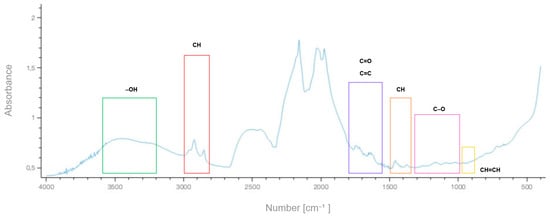
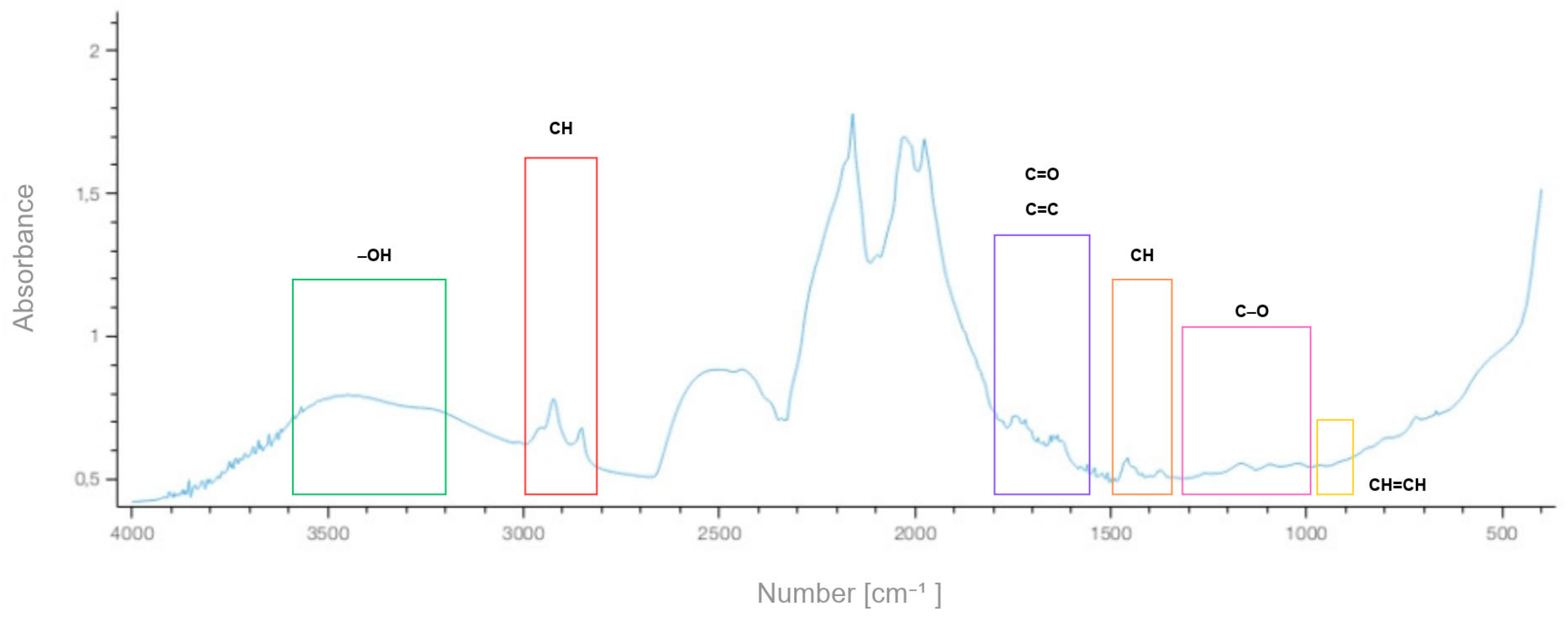
FTIR spectroscopy confirmed key functional groups in both extracts. For tomato (Figure 1), the spectrum revealed a broad O–H stretching band at 3600 cm−1 and 3200 cm−1 (green box), aliphatic C–H stretching at ~2920 cm−1 and 2860 cm−1 from carotenoids (red box), carbonyl C=O and conjugated double bonds at 1800 cm−1–1500 cm−1 (purple box), alkyl bending at ~1480 cm−1 (orange box), C–O–C vibrations at 1300 cm−1–1000 cm−1 (fuchsia box), and a characteristic trans C–H deformation at ~970 cm−1 attributed to lycopene (yellow box) [33].
Figure 1.
Spectroscopy analysis (FTIR) of tomato extract.
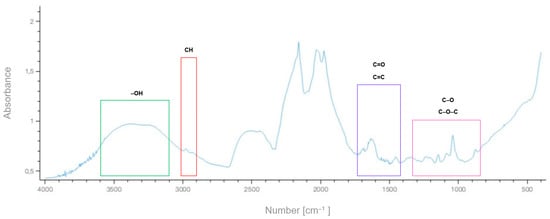
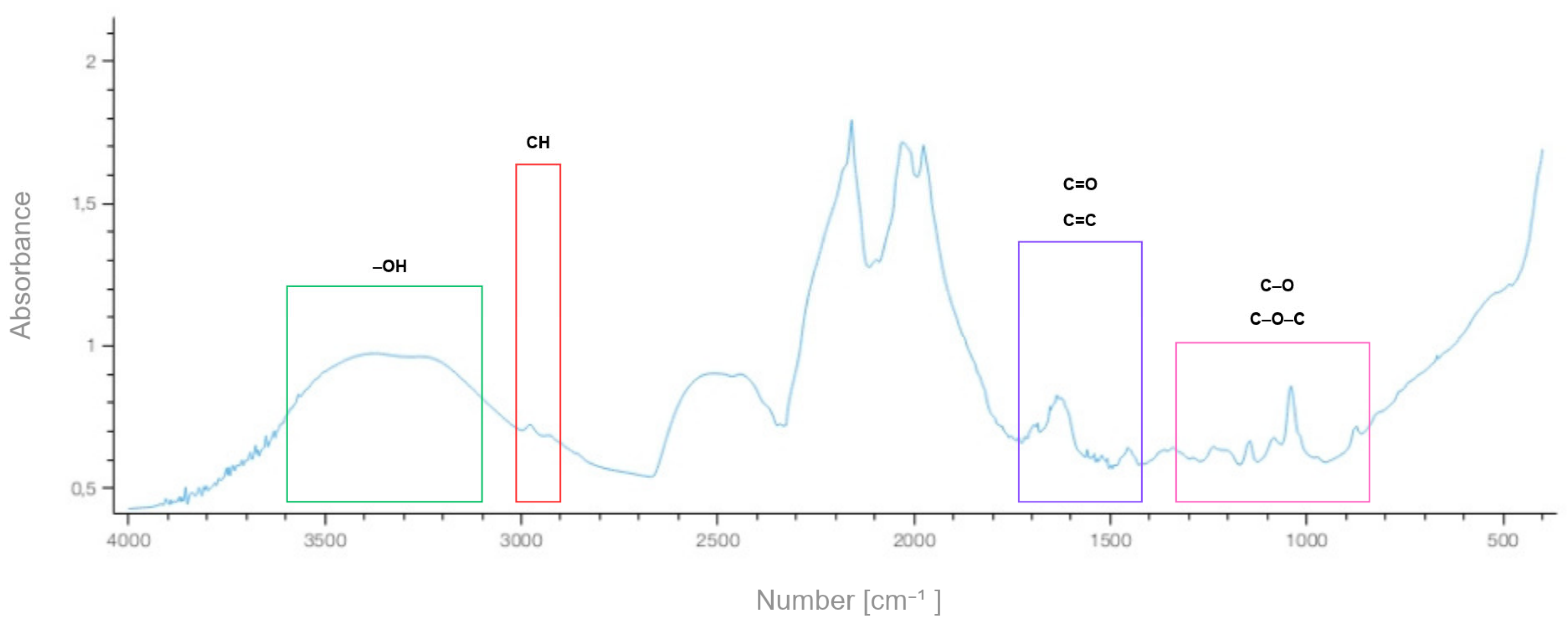
For green tea (Figure 2), the spectrum showed intense O–H stretching at 3600 cm−1–3100 cm−1 (green box), weak aliphatic C–H stretching at ~2970 cm−1 (red box), aromatic C=C ring and C=O stretching at 1750 cm−1–1400 cm−1 corresponding to caffeine and catechins (purple box), and C–O stretching at 1300 cm−1–900 cm−1 (fuchsia box) [34]. Peaks in the 2300 cm−1–1900 cm−1 region represent ATR diamond crystal background absorption [35].
Figure 2.
Spectroscopy analysis (FTIR) of green tea extract.
3.3. Sunscreen Development and Optimization
To establish the final sunscreen formulation, six iterations (M1-M6) were conducted. Initial trials revealed technical challenges, including physical instability and intense white cast (M1). These issues were solved by adjusting the oil phase and optimizing the ZnO and TiO2 ratio. Additionally, dimethicone was incorporated to reduce stickiness (M3), and citric acid was omitted in the final iteration (M6) to prevent a neutralization reaction with ZnO. The final emulsion successfully integrated the botanical extracts with mineral filters, achieving optimal stability, neutral pH (6.85), and an appropriate droplet size (D50 = 4.53 μm).
3.4. Quality Control Characterization
3.4.1. Physicochemical Properties
The formulation had a pH of 6.85, well within the established parameters for cosmetic products (5.00–7.00), and an apparent density of 1.062 g/mL ± 0.001 at 20 °C.
Droplet size analysis via MATLAB image processing (N = 575) revealed a unimodal distribution with positive skewness and a peak value of ~3.00 μm. The fitted cumulative curve (R2 = 0.9927) yielded values of D10 = 2.44 μm, D50 = 4.53 μm, and D90 = 9.98 μm, resulting in a Span of 1.66. The predominance of fine droplets within these ranges confirms adequate homogeneity, which enhances the physical stability of the emulsion.
Regarding centrifugation stability, the emulsion remained completely stable, showing no signs of instability such as phase separation, creaming, or coalescence.
In the thermal resistance evaluation, the formulation preserved its original color and odor, maintaining its consistency without alterations at 40 °C; similarly, no differences were detected in any evaluated properties at 4 °C.
Finally, an apparent viscosity of 5263 mPa·s was determined at 25 °C and 60 rpm. Rheological analysis across varying angular velocities demonstrated a progressive decrease in viscosity with increasing shear rate, characteristic of pseudoplastic (shear-thinning) fluid behavior. This represents a highly desirable profile for topical formulations.
3.4.2. Microbiological Quality Assessment
The microbiological analysis yielded negative results for total coliforms, as well as molds and yeasts. However, microbial growth was observed in the mesophilic aerobic count, resulting in an average value of 34 CFU, equivalent to 340 CFU/g. Nevertheless, this value falls within the range permitted by the ISO 17516 (2014) standard for cosmetic products (≤1 × 10³ CFU/g).
3.4.3. In Vivo Photoprotective Efficacy Results
The in vivo efficacy evaluation was conducted with 14 volunteers (10 females, 4 males; aged 21–65 years), categorized according to the Fitzpatrick scale into Type I (phototypes I-II, n = 3) and Type II (phototypes III-IV, n = 11). Despite environmental irradiance fluctuations caused by intermittent cloud cover during testing, the control zone exhibited greater erythema/pigmentation than the protected area in most cases.
Quantitative colorimetric analysis performed via MATLAB (utilizing RGB and CIELAB color spaces) [21] confirmed these visual findings by measuring total color difference (ΔE) and luminosity variation (ΔL). Results revealed positive ΔL values in both groups (18.22 for Type I and 34.04 for Type II), confirming skin brightening/protection in the treated area and a statistically distinct visual difference (ΔE) relative to the control.
3.4.4. Sensory Profile and Acceptability
The sensory evaluation was conducted with a panel of 31 volunteers (19 females, 12 males) exhibiting a predominantly young demographic profile. Overall, the sensory properties of the sunscreen achieved highly satisfactory acceptance. Key physical attributes included superior spreadability (87.1% rating it as “easy to spread”), a light/creamy texture, a non-sticky post-application feeling (77.4%), and minimal white cast (80.7% reporting slight, imperceptible, or no white residue). Although the scent was rated as neutral or pleasant by 80.6% of participants, qualitative feedback from a subset noted a “plasticine/playdough”-like smell attributed to natural lipid components such as grape seed oil and shea butter. Nevertheless, 74.5% of the panel reported a positive purchase/use intention, consolidating the overall product rating within the “Good” to “Very Good” categories.
4. Conclusions
This study successfully developed a stable O/W natural sunscreen combining Solanum lycopersicum and Camellia sinensis extracts with inorganic filters (ZnO/TiO2). FTIR spectroscopy confirmed the retention of key carotenoid and polyphenol functional groups. Through six iterative cycles, the final M6 formulation achieved optimal stability, neutral pH (6.85), uniform droplet size (D50 = 4.53 μm), and microbiological safety (COVENIN 2130:1998). In vivo solar screening (adapted ISO 24444:2019) verified its efficacy in preventing UV-induced erythema, while sensory testing showed high consumer acceptability.
Author Contributions
Conceptualization, S.F.; Methodology, S.F.; Validation, M.A.R.; Investigation, S.F.; Writing—Original Draft, S.F.; Writing—Review and Editing, M.A.R.; Visualization, S.F.; Supervision, M.A.R. All authors have read and agreed to the published version of the manuscript.
Funding
This research received no external funding.
Institutional Review Board Statement
Not applicable.
Informed Consent Statement
Informed consent was obtained from all subjects involved in the study.
Data Availability Statement
The data presented in this study are available on request from the corresponding author.
Acknowledgments
We express our gratitude to Universidad Metropolitana for making its facilities available for the execution of this research.
Conflicts of Interest
The authors declare no conflicts of interest.
References
- American Cancer Society. Available online: https://www.cancer.org/cancer/risk-prevention/sun-and-uv/uv-radiation.html (accessed on 26 May 2026).
- Danovaro, R.; Bongiorni, L.; Corinaldesi, C.; Giovannelli, D.; Damiani, E.; Astolfi, P.; Greci, L.; Pusceddu, A. Sunscreens Cause Coral Bleaching by Promoting Viral Infections. Environ. Health Perspect. 2008, 116, 441–447. [Google Scholar] [CrossRef] [Scilit] [PubMed]
- Schneider, S.L.; Lim, H.W. Review of environmental effects of oxybenzone and other sunscreen active ingredients. J. Am. Acad. Dermatol. 2019, 80, 266–271. [Google Scholar] [CrossRef] [Scilit] [PubMed]
- DiNardo, J.C.; Downs, C.A. Can oxybenzone cause Hirschsprung’s disease? Reprod. Toxicol. 2019, 86, 98–100. [Google Scholar] [CrossRef] [Scilit] [PubMed]
- He, T.; Tsui, M.M.; Mayfield, A.B.; Liu, P.; Chen, T.; Wang, L.; Fan, T.; Lam, P.K.; Murphy, M.B. Organic ultraviolet filter mixture promotes bleaching of reef corals upon the threat of elevated seawater temperature. Sci. Total Environ. 2023, 876, 162744. [Google Scholar] [CrossRef] [Scilit] [PubMed]
- Raffa, R.B.; Pergolizzi, J.V., Jr.; Taylor, R., Jr.; Kitzen, J.M.; NEMA Research Group. Sunscreen bans: Coral reefs and skin cancer. J. Clin. Pharm. Ther. 2018, 44, 134–139. [Google Scholar] [CrossRef] [Scilit] [PubMed]
- Cefali, L.C.; Ataide, J.A.; Moriel, P.; Foglio, M.A.; Mazzola, P.G. Plant-based active photoprotectants for sunscreens. Int. J. Cosmet. Sci. 2016, 38, 346–353. [Google Scholar] [CrossRef] [Scilit] [PubMed]
- He, H.; Li, A.; Li, S.; Tang, J.; Li, L.; Xiong, L. Natural components in sunscreens: Topical formulations with sun protection factor (SPF). Biomed. Pharmacother. 2021, 134, 111161. [Google Scholar] [CrossRef] [Scilit] [PubMed]
- Li, L.; Chong, L.; Huang, T.; Ma, Y.; Li, Y.; Ding, H. Natural products and extracts from plants as natural UV filters for sunscreens: A review. Anim. Models Exp. Med. 2023, 6, 183–195. [Google Scholar] [CrossRef] [Scilit] [PubMed]
- Nurwaini, S.; Alianti, L.; Sari, D.A.P.; Utami, W. Development of sunscreen products containing green tea leaf extract. Int. J. Appl. Pharm. 2021, 13, 30–33. [Google Scholar] [CrossRef] [Scilit]
- Sopyan, I.; Gozali, D.; Tiassetiana, S. Formulation of tomato extracts (Solanum lycopersicum L.) as a sunscreen lotion. Natl. J. Physiol. Pharm. Pharmacol. 2017, 8, 453–458. [Google Scholar] [CrossRef] [Scilit]
- Koch, W.; Zagórska, J.; Marzec, Z.; Kukula-Koch, W. Applications of Tea (Camellia sinensis) and Its Active Constituents in Cosmetics. Molecules 2019, 24, 4277. [Google Scholar] [CrossRef] [Scilit] [PubMed]
- Irala-Rivera, N.F.; Cruz-Casillas, F.C.; Villanueva-Maciel, G.; Ochoa-Zermeño, S.; Rivas Arreola, M.J. Extracción de licopeno a partir de residuos de jitomate por método con solventes. Investig. Y Desarro. EN Cienc. Y Tecnol. DE Aliment. 2020, 5, 743–747. [Google Scholar]
- Cardona, E.; Ríos, L.A.; Restrepo, G.M. Extracción del carotenoide licopeno del tomate chonto (Lycopersicum esculentum). VITAE Rev. DE LA Fac. DE Quím. Farm. 2006, 13, 44–53. [Google Scholar]
- Sarwa, K.K.; Rudrapal, M.; Debnath, M. Extraction of Green Tea Leaves: The use of Different Methods, their Optimization and Comparative Evaluation. Biosci. Biotechnol. Res. Asia 2013, 10, 383–386. [Google Scholar] [CrossRef] [Scilit]
- Robles Madrigal, P.; Morales Sánchez, L.A.; Morales Sánchez, V. ELABORACIÓN DE PROTECTOR SOLAR ORGÁNICO. Humanid. Tecnol. Y Cienc. Del Inst. Politécnico Nac. 2025, 3, 1–6. Available online: http://revistaelectronica-ipn.org/ResourcesFiles/Contenido/34/CIENCIA_34_001418.pdf (accessed on 27 March 2026).
- Mawazi, S.M.; Ann, J.; Othman, N.; Khan, J.; Alolayan, S.O.; Al thagfan, S.S.; Kaleemullah, M. A Review of Moisturizers; History, Preparation, Characterization and Applications. Cosmetics 2022, 9, 61. [Google Scholar] [CrossRef] [Scilit]
- Calderón, A.; Maurette, C.; Rodríguez, M.; Martínez, G. Producción de un protector solar humectante con componentes naturales. Innov. Y Conoc. Horiz. DE Investig. EN LA Educ. Super. 2024, 1, 91–99. [Google Scholar]
- Organización de las Naciones Unidas para el Desarrollo Industrial. Available online: https://www.unido.org/sites/default/files/files/2019-02/ONUDI_Gu%C3%ADa%20de%20Estabilidad_FINAL%20(003).pdf (accessed on 7 April 2026).
- Maru, A.D.; Lahoti, S.R. Formulation and Evaluation of Moisturizing Cream containing Sunflower Wax. Int. J. Pharm. Pharm. Sci. 2018, 10, 54–59. [Google Scholar] [CrossRef] [Scilit]
- COVENIN 2130:1998; Cosméticos. Métodos Microbiológicos. FONDONORMA: Caracas, Venezuela, 1998.
- Altuve, M.; Testi, A. Propuesta para la Formulación de un Protector Solar sólido en Barra. Bachelor’s Thesis, Universidad Metropolitana, Caracas, Venezuela, 2025. [Google Scholar]
- Majalekar, P.P.; Nalawade, V.; Kokare, N.; Patil, S.S.; Pawar, K.; Lokapure, S.; Disuza, J.; Maske, P.; Pawar, S.; Malavi, S. Study on anti-solar activity of Solanum lycoperisium and Pisum sativum fruit. Int. J. Phytopharm. 2020, 10, 5501. [Google Scholar] [CrossRef]
- Rao, M.J.; Duan, M.; Zhou, C.; Jiao, J.; Cheng, P.; Yang, L.; Wei, W.; Shen, Q.; Ji, P.; Yang, Y.; et al. Antioxidant Defense System in Plants: Reactive Oxygen Species Production, Signaling, and Scavenging During Abiotic Stress-Induced Oxidative Damage. Horticulturae 2025, 11, 477. [Google Scholar] [CrossRef] [Scilit]
- Yan, Z.; Zhong, Y.; Duan, Y.; Chen, Q.; Li, F. Antioxidant mechanism of tea polyphenols and its impact on health benefits. Anim. Nutr. 2020, 6, 115–123. [Google Scholar] [CrossRef] [Scilit] [PubMed]
- Wróblewska, M.; Winnicka, K. Emollients with natural emulsifier Olivem 1000 as topical formulations for urea or sodium hyaluronate. Acta Pol. Pharm. 2024, 80, 977–990. [Google Scholar] [CrossRef] [Scilit] [PubMed]
- Maanikuu, P.M.I.; Peker, K. Medicinal and Nutritional Benefits from the Shea Tree- (Vitellaria paradoxa). J. Biol. Agric. Healthc. 2017, 7, 51–57. [Google Scholar]
- Kamienik, A.; Wojtyła, P.; Wargala, E.; Walasek-Janusz, M. Grape seed oil (Vitis vinifera seed oil) as a beneficial cosmetic raw material. In Wybrane Zagadnienia z Zakresu Produkcji Surowców, Żywności i Kosmetyków; Uniwersytet Przyrodniczy w Lublinie: Lublin, Poland, 2023; pp. 47–52. [Google Scholar]
- Furtado, I.F.S.P.C.; Sydney, E.B.; Rodrigues, S.A.; Sydney, A.C.N. Xanthan gum: Applications, challenges, and advantages of this asset of biotechnological origin. Biotechnol. Res. Innov. 2022, 6, e202204. [Google Scholar] [CrossRef] [Scilit]
- Ashland. Available online: https://www.ashland.com/industries/personal-and-home-care/hair-care/euxyl-pe-9010-preservative (accessed on 23 March 2026).
- Nivea. Available online: https://www.nivea.co.uk/advice/skin/glycerin (accessed on 1 May 2026).
- Sales de Oliveira Pinto, C.A.; Azevedo Martins, T.E.; Miliani Martinez, R.; Batello Freire, T.; Robles Velasco, M.V.; Rolim Baby, A. Vitamin E in human skin: Functionality and topical products. In Vitamin E in Health and Disease-Interactions, Diseases and Health Aspects; IntechOpen: London, UK, 2021. [Google Scholar]
- Bunghez, I.R.; Raduly, M.; Doncea, S.; Aksahin, I.; Ion, R.M. Lycopene determination in tomatoes by different spectral techniques (UV-VIS, FTIR and HPLC). Dig. J. Nanomater. Biostructures 2011, 6, 1349–1356. [Google Scholar]
- Giorgini, E.; Notarstefano, V.; Foligni, R.; Carloni, P.; Damiani, E. First ATR-FTIR Characterization of Black, Green and White Teas (Camellia sinensis) from European Tea Gardens: A PCA Analysis to Differentiate Leaves from the In-Cup Infusion. Foods 2023, 13, 109. [Google Scholar] [CrossRef] [Scilit] [PubMed]
- Specac. Available online: https://specac.com/theory-articles/choosing-the-right-atr-crystal/ (accessed on 30 May 2026).

Disclaimer/Publisher’s Note: The statements, opinions and data contained in all publications are solely those of the individual author(s) and contributor(s) and not of MDPI and/or the editor(s). MDPI and/or the editor(s) disclaim responsibility for any injury to people or property resulting from any ideas, methods, instructions or products referred to in the content. |
© 2026 by the authors. Licensee MDPI, Basel, Switzerland. This article is an open access article distributed under the terms and conditions of the Creative Commons Attribution (CC BY) license.