


Abstract
Diosgenin is a steroidal sapogenin abundant in Dioscorea spp. and a natural substrate of great importance for the semisynthetic production of bioactive compounds. Modification of the spirostane skeleton through oxidative ring opening (A or B) yields secosteroids, conformationally flexible analogs of brassinosteroids and ecdysteroids, with potential as synthetic phytohormones, therapeutic agents, and ecdysis modulators for insect control. We present the synthesis and characterization of a family of secospirostanes (types A and B) derived from diosgenin, using two complementary methodological approaches: (i) phase-transfer catalysis (PTC) with KMnO4/TEBA/CH2Cl2 to obtain A-secoacids and cis diols, and (ii) oxidative ring-opening mediated by natural bentonite and m-chloroperbenzoic acid for the synthesis of B-secospirostanes with an unusual C3=C4-C5=O conjugated system. All compounds were characterized by FTIR, 1H NMR, and 13C NMR, and preliminarily evaluated in vitro as plant growth promoters in radish (Raphanus sativus) hypocotyls and cotyledons. The preliminary results reveal that (25R)-5,6-seco-3-en-5-oxo-spirostan-6-oic acid (B-seco) acts as a selective auxin inhibitor, while methyl (25R)-2,3-seco-6-oxo-5α-spirostan-2,3-dioate (A-seco diester) exhibits dual-promoting activity (cytokinin and auxin) at nanomolar concentrations. In terms of eco-sustainable green chemistry, the A-seco synthesis successfully replaces highly toxic, costly OsO4 and N-methylmorpholine N-oxide with a low ecological impact PTC system utilizing aqueous solutions. Concurrently, the B-seco pathway substitutes aggressive reagents with a naturally occurring, reusable mineral clay under mild thermal conditions (50 °C), offering clean, alternative processes for producing bioactive agrochemicals.
1. Introduction
Diosgenin [1,2], a steroidal sapogenin abundant in Dioscorea spp. and other species, is one of the most accessible and cost-effective steroidal raw materials for the synthesis of bioactive compounds: brassinosteroid-type plant growth promoters, blatellastanosides, ecdysteroids, and gelling agents [3,4,5,6].
A recurring challenge in the preparation of functional seco-steroids [7] is the reliance on OsO4 and N-methylmorpholine N-oxide (Upjohn dihydroxylation), which are costly and highly toxic reagents [8]. Phase-transfer catalysis (PTC) with potassium permanganate (KMnO4) represents an ecologically favorable alternative: it operates in biphasic aqueous-organic systems with minimal environmental impact, facilitates manipulation, and improves yields without resorting to chlorinated solvents on a large scale [9,10]. Furthermore, natural bentonite clays exhibit surface acidic properties (Brønsted and Lewis) capable of promoting epoxide ring-opening and rearrangements under mild conditions [11,12]. Ecuadorian bentonite from the Santa Elena Deposits (80% montmorillonite, Cevallos Laboratory), without hydrothermal activation, has shown promising catalytic activity in organic steroid synthesis. In this work, we integrate, under a unified molecular vision, two complementary synthetic routes—A-seco via PTC and B-seco via epoxide ring-opening with bentonite/MCPBA—to obtain a diversified family of seco spirostanes with the spirostanic fragment intact and differentiated biological activity on plant growth.
Ecuador’s national agrochemical system does not design or produce complex molecular systems or multifunctional formulations locally to promote plant growth and is therefore entirely dependent on the international market. The lack of strategies and programs for synthesizing derivatives with potential biological activity, like plant growth promoters, limits agricultural production and food and technological sovereignty, and generates high costs when acquiring these compounds from foreign suppliers. In this context, the search for new bioactive derivatives with auxin-like and cytokinin-like activity, starting from native, commercially accessible natural resources—such as botanical biomass, agro-industrial waste, and botanical extracts—as well as the strategic use of all existing chemical resources, reactants and analytical infrastructure, is a national priority. One of the key areas, both conceptually and methodologically, is the use of steroidal derivatives of botanical origin [13].
Consequently, steroidal sapogenins and diosgenin have emerged as raw materials of exceptional importance and accessibility. Diosgenin ((25R)-spirost-5-en-3β-ol) possesses an oxygenated function at C-22, and its natural analogs share a biosynthetic relationship with polyhydroxylated steroids bearing side chains—compounds with widely recognized hormonal activity in the plant kingdom as phytohormones.
Study Objective: The primary objective of this study is to report the utilization of diosgenin—a commercially available steroidal sapogenin (from Ecuador)—as a versatile starting substrate for synthesizing bioactive A, B- seco-spirostan derivatives. These compounds are evaluated for their potential hormonal effect (promoting activity).
2. Materials and Methods
2.1. General Experimental Procedures
All reagents, KBr, KMnO4, deuterated chloroform (CDCl3), chloroform, dichloromethane, silica gel, vanillin, pyridine, acetic anhydride, acetic acid, perchloric acid, hydrochloric acid, meta-chloroperbenzoic acid, peracetic acid, p-toluenesulfonic acid, CrO3, Na2SO3, Na2SO4, Na2CO3, KHCO3, TEBA (tri-ethyl-butyl ammonium chloride), 2-methyl tetrahydrofuran, butanone, were purchased from Sigma-Aldrich Chemie GmbH/Merck KGaA (Darmstadt, Germany) and used as received unless otherwise specified. Solvents of technical grade were dried and distilled prior to use. Diosgenin was generously provided by the Central University of Ecuador, Faculty of Chemistry (Prometheus Program 2012–2018) and was twice recrystallized from 95% hot ethanol (under reflux), and the resulting solution was decolorized with activated charcoal and cooled down, slowly, to room temperature (m.p. 201 °C).
Bentonite (2.0 Kg, Santa Elena Deposit-Dos Bocas Formation, 80% montmorillonite) was kindly provided by Cevallos Laboratories (Applied Chemistry for Life), Guayaquil, Ecuador.
2.2. Determination of Melting Points (m.p.)
Melting points (m.p.) of the synthesized compounds were determined using an Electrothermal 9100 capillary oven (Electrothermal Engineering Ltd., London, UK, 2005 model), with a temperature resolution of ±0.1 °C, and are reported uncorrected.
2.3. FTIR Spectroscopy
Infrared spectra were recorded on a Philips Analytical FTIR PU-9600 spectrophotometer (Burladingen, Germany) using potassium bromide (KBr) discs at 25 °C.
2.4. NMR Spectroscopy
Nuclear Magnetic Resonance (NMR) spectra were acquired on a BRUKER AC-250 spectrometer (Bruker Physik-AG, Karlsruhe, Germany) operating at 250 MHz for 1H and 62.9 MHz for 13C at 25 °C. Proton chemical shifts (δ) are reported in parts per million (ppm) relative to tetramethylsilane (TMS, δ = 0.0 ppm) as an internal standard in CDCl3 solvent. Carbon chemical shifts (13C δ) are referenced to the central peak of CDCl3 at 77.03 ppm.
2.5. Chromatographic Techniques
Reaction progress and synthetic methodologies were monitored by thin-layer chromatography (TLC) utilizing pre-coated silica gel plates (0.25 mm thickness). Visualization was achieved using a developer solution comprising 1% vanillin in 50% perchloric acid. The separation and subsequent purification of the synthesized compounds were performed via column chromatography (CC) over Silica gel 60 (Merck, 70–230 mesh ASTM). Elution was carried out using mixtures of n-hexane and ethyl acetate (v/v), optimized for each derivative, in the v/v range:
- hexane/ethyl acetate at a rate of 4:1 (v/v).
- hexane/ethyl acetate at a rate of 8:1 (v/v).
- hexane/ethyl acetate at a rate of 1:4 (v/v).
2.6. Experimental Protocols
2.6.1. Starting Materials: General Protocols
Synthesis of (25R)-Spirost-5-en-3β-ol, 3-Acetate (I)
Diosgenin (5.0 g, 12.0 mmol) was dissolved in anhydrous pyridine (100 mL), and acetic anhydride (50 mL) was added. The reaction mixture was stirred at room temperature for 24 h. Subsequently, the mixture was poured onto ice water, and the resulting precipitate was collected by vacuum filtration. The solid was washed thoroughly with dilute hydrochloric acid (HCl) followed by distilled water to afford compound I (5.2 g, 95% yield). m.p. 195–196 °C. FTIR (KBr, ν, cm−1): 2975, 1735 (C=O, acetate), 1457, 1393, 1050, 990, 958, and 891 (spiroketal system).
Synthesis of (25R)-5,6-Epoxy-spirostan-3β-ol, 3-Acetate (II)
To a stirred solution of compound I (5.0 g, 10.96 mmol) in CHCl3 (20 mL) at room temperature, meta-chloroperbenzoic acid (m-CPBA; 3.0 g, 17.53 mmol) was added. After stirring for 30 min, the mixture was diluted with additional CHCl3 (25 mL) and washed successively with aqueous solutions of Na2SO3 and Na2CO3, and finally with water. Theorganic layer was dried over anhydrous Na2SO4 and concentrated in vacuo to yield a mixture of α/β epoxides II (4.39 g, 85% total yield). m.p. 207–209 °C. FTIR (KBr, ν, cm−1): 2944, 1731, 1456, 1304, 1243, 1040, 974, and 897. 1H NMR (δ, ppm): 0.68 (s, C-18 CH3); 0.78 (d, C-27 CH3); 0.90 (d, C-21 CH3); 1.06 (s, C-19 CH3); 1.98 and 1.99 (s, acetate CH3); 2.97 and 3.07 (d, H-6); 3.39 (m, H2-26); 4.35 (m, H-16); 4.71 and 4.93 (m, H-3).
Synthesis of (25R)-5α-Hydroxy-spirostan-3β-ol-6-one, 3-Acetate (III)
A solution of epoxide mixture II (4.0 g, 8.47 mmol) in acetone (30 mL) was treated with an aqueous solution of CrO3 (2.3 g, 23 mmol in 5 mL H2O). The reagent was added dropwise such that the reaction mixture was maintained under gentle reflux. Upon completion, the mixture was poured into ice water. The resulting solid precipitate was filtered, washed with water, and recrystallized from methanol to furnish the ketol III (3.71 g, 90% yield). m.p. 280–283 °C. FTIR (KBr, ν, cm−1): 3386, 2951, 1709, 1453, 1241, 1049, 977, 898. 1H NMR (δ, ppm): 0.71 (s, C-18 CH3; d, C-27 CH3); 0.81 (s, C-19 CH3); 0.82 (d, C-21 CH3); 2.01 (s, acetate CH3); 3.49 (m, H2-26); 3.58 (s, OH); 4.41 (m, H-16); 5.01 (m, H-3).
Synthesis of (25R)-Spirost-5-en-3β-ol, 3-p-Toluenesulfonate (IV)
To a solution of diosgenin (5.0 g, 12.0 mmol) in anhydrous pyridine (70 mL), tosyl chloride (TsCl; 5.9 g, 31.2 mmol) was added. The reaction mixture was stirred at room temperature for 20 h. It was then poured into an ice-cold 5% aqueous KHCO3 solution. The resulting tosylate precipitate was collected by suction filtration, washed thoroughly with water, and recrystallized from a petroleum ether/ethyl acetate mixture to yield compound V (6.0 g, 87.5% yield). M.p. 174 °C. FTIR (KBr, ν, cm−1): 1588, 1360, 1170, 980, 920, 899, and 860.
Synthesis of (25R)-3α,5-Cyclo-spirostan-6β-ol (V)
A mixture comprising tosylate IV (500 mg, 0.80 mmol), potassium acetate (KOAc; 490 mg), acetone (10 mL), and water (2 mL) was heated under reflux for 20 h. The mixture was cooled, poured into ice water, and the precipitating solid was filtered and purified by column chromatography to afford the i-steroid V (230 mg, 65% yield). M.p. 166 °C. FTIR (KBr, ν, cm−1): 3473, 1444, 1368, 1072, 1050, 970, 920, 896, and 854.
Synthesis of (25R)-3α,5-Cyclo-spirostan-6-one (VI)
Water (15 mL) and NaHCO3 (1.47 g, 17.6 mmol) were added to a solution of tosylate IV (5.0 g, 8.8 mmol) in 2-butanone (90 mL). The mixture was heated at reflux with stirring for 5 h, then cooled to 5 °C. Jones reagent (8 N CrO3 in H2SO4, 2 mL) was added dropwise, and stirring continued for 3 h at 5 °C. A 15% aqueous NaCl solution (15 mL) was added. The organic phase was separated, washed with NaHCO3 (15 mL) and NaCl solutions (15 mL), dried over MgSO4, and concentrated in vacuo. The crude product was purified by column chromatography to yield ketone VI (80% yield).
2.6.2. Studied Compounds: General Methodologies
Synthesis of (25R)-5α-Spirost-2-en-6-one (1A)
Ketone VI (2.5 g, 6.06 mmol) was dissolved in dimethylformamide (DMF, 10 mL) and treated with p-toluenesulfonic acid (p-TsOH; 40 mg) and NaBr (50 mg). The mixture was stirred at reflux for 3 h. Upon cooling to room temperature, ethyl acetate (25 mL) was added. The organic phase was washed with aqueous NaHCO3 (3 × 15 mL), followed by NaCl (5 mL) and water. After drying over Na2SO4 and concentration in vacuo, column chromatography provided the alkene 1A (1.87 g, 75% yield). m.p. 203–204 °C. FTIR (KBr, ν, cm−1): 2949, 1708, 1455, 1381, 1054, 996, 897. 1H NMR (δ, ppm): 0.71 (s, C-19 CH3); 0.77 (s, C-18 CH3); 0.96 (d, C-21 CH3); 2.3 (m, H-7β, H-5α); 3.4 (m, H2-26); 4.4 (m, H-16); 5.6 (m, H-2, H-3).
Synthesis of 2A, 3A (PTC)
KMnO4 (0.51 g, 3.2 mmol) dissolved in CH2Cl2 (40 mL) containing TEBA-Cl (0.77 g, 3.2 mmol) was added dropwise to a solution of 1A (1.3 g, 3.2 mmol) in CH2Cl2 (20 mL) cooled to 0–5 °C with vigorous stirring. The mixture was maintained for 40 min to 1 h until MnO2 formed. A total of 3% NaOH (30 mL) was added, and the mixture was stirred under N2 at room temperature for 12 h. Conventional phase separation and washing followed.
Compound 2A: mp 224–225 °C; IR: 3400 (νOH), 1710 (νC=O) cm−1; 1H NMR (200 MHz): δ 2.68 (dd, H-5α, J = 12.6, 2.9 Hz), 3.75 (m, H-2), 4.04 (m, H-3), 4.41 (m, H-16). Yield 37%.
Compound 3A: mp 187–187.6 °C; IR: 3450 (νOH), 1699, 1654 (νC=O) cm−1; 1H NMR (200 MHz): δ 3.42 (m, H-26a), 4.42 (q, H-16). Yield: 51%.
Synthesis of 4A (esterification). MeOH/H+: mp 153.9–154.6 °C; IR: 1740, 1713 (νC=O ester); 1H NMR: δ 3.655 and 3.67 (s, 2× OCH3), 4.40 (m, H-16). Yield: 78%.
Synthesis of 2B, 3B and 4B: Epoxide Ring-Opening (Ecuadorian bentonite)
To 1B (epoxide II, 100 mg, 2 mmol) in butanone (100 mL) was added natural Ecuadorian bentonite (1.55 g, Santa Elena Deposit-Dos Bocas Formation, 80% montmorillonita; beneficiated without hydrothermal treatment). The reaction mixture is gently refluxed (50 °C) for 4 h. Filtration of the clay solid, washing with cold solvent (2 × 10 mL), and evaporation by vacuum distillation.
Compound 2B (ceto-hydroxy derivative III): mp 280–283 °C; IR: 3450 (νOH), 1735, 1708 (νC=O) cm−1; 1H NMR (250 MHz): δ 3.48 (m, H-2β), 3.59 (m, H-2β), 4.40 (m, H-16α), 5.02 (m, H-3α). Yield: 86–90%.
Synthesis of 3B (MCPBA). 2B (1 g, 2.04 mmol) in CHCl3 (50 mL); MCPBA (1.5 g) added portionwise over 1 h; reflux 6 h; wash-dry-distill. Compound 3B: mp 135.6–136.3 °C; IR: 3576 (νOH carboxylic), 1701 (νC=C cyclic), 1667 (νC=O conjugated), 1639 (νC=O acid) cm−1; 1H NMR (250 MHz): δ 1.12 (s, CH3-19), 2.29 (t, 2H-7), 5.884 (qq, H-4), 6.799 (m, H-3). Yield: 64%.
Compound 4B: Oil; IR: 1785, 1701 (νC=O), 1669 (νC=C) cm−1; δ 3.59 (s, OCH3). Yield: 58%.
3. Results and Discussion
In Ecuador, at present, from a pedagogical perspective, there are no programs at research centers or universities focused on the synthesis and structural modification of steroid derivatives or on the strategic use of molecular systems isolated from native botanical sources (phytosterols and steroidal sapogenins, such as diosgenin and hecogenin). This considerably limits the development of research on using these resources as raw materials for synthesizing high-value-added steroid derivatives intended to design formulations with plant growth-promoting activity for increasing production of field crops and plant biotechnology. In this context, and considering the existence of stored expired chemical reagents, projects are being initiated from an eco-sustainable green chemistry perspective to strategically reuse these resources by applying, on a laboratory scale, techniques historically recognized in steroid chemistry, with the aim of strengthening students’ molecular and logical–structural understanding in the fields of applied organic chemistry and the chemical basis of plant physiology within the Ecuadorian national context [14].
Oxidation of organic substrates is one of the most important processes on an industrial and laboratory scale [15], where the application of catalytic conditions (heterogeneous or homogeneous) defines the selectivity and yield of the process. One of the most important reactions in organic synthesis and industrial organic chemistry is the oxidation of alcohols (I and II) to their carbonyl derivatives (aldehydes and ketones) and the oxidation of alkene functionality, including steroidal ones. This transformation of functionalities, via heterogeneous or homogeneous catalysis or not, using conventional procedures or not, constitutes one of the fundamental synthetic organic reactions of applied green eco-sustainable chemistry in the fundamental fields of technological development for minimizing environmental impact, such as pharma, agrochemistry, petrochemistry, and fine chemistry [16,17,18].
3.1. Synthetic Pathways and Efficiency
3.1.1. Synthesis of A-Seco Spirostanes (PTC Route)
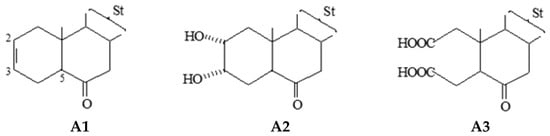
The starting substrate (25R)-5α-spirost-2-en-6-one (1A), prepared from diosgenin according to the protocol of Aburatani and Mori [19], with modifications from the Green Science Laboratory (74% yield), was subjected to the catalytic system KMnO4/TEBA-Cl in biphasic CH2Cl2 (0–5 °C, N2 atmosphere, 18 h, 3% aqueous NaOH) following Ogino’s technique with modifications [20,21,22]. The stereoselective oxidation of the Δ2 double bond of compound 1A by the osmic-steroid-like intermediate of MnO4− activated by the tetrabutylammonium cation [23] predominantly leads to cis-diol 2A [(25R)-2α,3α-dihydroxy-5α-spirostan-6-one, 37% yield]. The low selectivity—with simultaneous formation of overoxidation products—explains the moderate yield of the diol; this is the limiting step and the main candidate for optimization.
Continued oxidative treatment in the same biphasic system leads to A-seco diacid 3A [(25R)-2,3-seco-5α-6-oxo-spirostan-2,3-dioic acid, 51%], whose classical esterification with MeOH/H+ provides A-seco dimethyl ester 4A [(25R)-2,3-seco-5α-6-oxo-spirostan-2,3-dioate, 78%].
The sequence is depicted in Figure 1.
Figure 1.
Structural sequence of compounds generated via A-seco spirostanes (PTC Route). St = spirostan fragment of diosgenin.
Green Chemistry Perspective: The PTC route eliminates the need for stoichiometric OsO4 and NMO, replacing them with KMnO4—a cheaper, less toxic, and more environmentally benign oxidant. The biphasic CH2Cl2/water system allows for facile separation and recovery of the aqueous phase. However, the use of CH2Cl2 remains a concern from a sustainability standpoint. Future optimization should consider replacing CH2Cl2 with greener alternatives such as ethyl acetate or 2-MeTHF, which have favorable environmental, health, and safety profiles. The Atom Economy (AE) for the conversion of 1A to 2A is moderate, as the oxidation adds two hydroxyl groups without incorporating all atoms of the oxidant into the product. The E-factor for this step, including solvent waste, is estimated to be in the range of 50–100, typical of fine chemical batch processes. Process Mass Intensity (PMI) could be significantly reduced by recycling the aqueous phase and minimizing solvent volumes [24].
3.1.2. Synthesis of the Unusual B-Seco Spirostane (Epoxide Route)
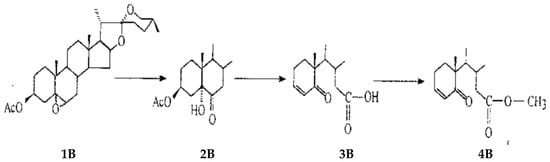
Substrate (25R)-3β-acetoxy-5α,6-epoxy-spirostane (1B) was subjected to oxidative ring-opening with Jones reagent or natural Ecuadorian bentonite (1.55 g per mmol of substrate; butanone, reflux, 50 °C, 8 h). Both methods converge to hydroxyketone 2B [(25R)-3β-acetoxy-5α-hydroxy-spirostan-6-one, 86–90% yield with bentonite], representing the highest-yield example of this series.
Treatment of 2B with meta-chloroperbenzoic acid (MCPBA, 1.5 equiv.) in CHCl3 at reflux (6 h) produces, via a Baeyer–Villiger-type ring expansion [25] and cleavage of the C5–C6 bond, B-seco acid 3B [(25R)-5,6-seco-3-en-5-oxo-spirostan-6-oic acid, 64%]. A remarkable structural feature is the in situ formation of the conjugated C3=C4 double bond by acid hydrolysis of the 3β-acetoxy group (pH 2.5–3 imposed by bentonite or MCPBA in CHCl3) with subsequent dehydration to the thermodynamically more stable alkene, conjugated with the C5 carbonyl (extended enone system). Esterification of 3B with MeOH/H2SO4 gives methyl ester 4B (58%).
The sequence is depicted in Figure 2.
Figure 2.
Structural sequence of compounds generated via B-seco spirostanes (Epoxide Route).
Green Chemistry Perspective: The use of natural Ecuadorian bentonite as a heterogeneous catalyst is a cornerstone of this route. Bentonite is a low-cost, locally available, and reusable clay mineral with tunable surface acidity and high specific surface area [26]. Its application eliminates the need for stoichiometric toxic reagents (e.g., Jones reagent, Cr(VI)) and allows for simple filtration and recycling, including a low footprint. Recent reviews highlight bentonite’s role in sustainable heterogeneous catalysis for organic reactions, including oxidations and ring-openings [27,28]. The E-factor for the bentonite-catalyzed step is significantly lower than for the Jones oxidation due to reduced metal waste. However, the subsequent MCPBA step introduces a stoichiometric oxidant and generates m-chlorobenzoic acid as waste. Alternative oxidants such as aqueous H2O2 with catalytic amounts of a metal catalyst or enzyme-based Baeyer–Villiger monooxygenases (BVMOs) should be explored to further green this transformation.
3.2. Spectroscopic Characterization
FTIR. The bands in the 1350–850 cm−1 region present in all spectra, characteristic of C–C and C–O stretching vibrations of the spiroketalic system, confirm the integrity of rings E–F throughout both synthetic routes. The 25R configuration is corroborated in all compounds because the band at 899–894 cm−1 is approximately twice as intense as that at 920–915 cm−1, according to Marker’s criteria.
1H and 13C NMR. The evolution of C-2 and C-3 signals constitutes the fingerprint of the A-seco route: from δ 126.1/127.2 ppm (C sp2, olefin in 1A) → δ 68.2/68.3 ppm (C sp3, diol in 2A) → δ 172.9/175.2 ppm (carboxylic carbonyls in 3A). The downfield shift in H-5α in compound 2A (δ 2.68 ppm as dd, 3J axial-axial = 12.6 Hz, J axial-equatorial = 2.9 Hz) is deshielded by 0.38 ppm relative to the olefinic substrate 1A due to the –I effect of the 3α axial hydroxyl. For the B-seco series, the signals of H-3 and H-4 at δ 6.80 and 5.88 ppm (dienone system) in 3B/4B confirm the enonic C3=C4–C5=O system, with C5 at δ 208.9/207.7 ppm and C6 (carboxyl) at δ 175.9/172.8 ppm. The representative signals used to evaluate the reaction sequence and characterize the products are detailed in Table 1.
Table 1.
13C NMR chemical shifts (δ, ppm; CDCl3; 62.5 MHz) of the synthesized derivatives *.
3.3. Biological Activity: Raphanus sativus Bioassay: Preliminary Results
In a Raphanus sativus (Radish) Bioassay, the biological activity of steroidal sapogenin derivatives focuses primarily on plant growth-stimulating effects, functioning analogously to natural plant steroid hormones (brassinosteroids). Under the conditions studied, this assay was based on the following concepts: Brassinosteroid Mimicry: Natural brassinosteroids regulate plant growth and development. Due to their close structural similarities to natural steroidal sapogenins (such as diosgenin), synthetic sapogenin derivatives serve as highly effective growth-stimulating analogs. Hypocotyl Elongation: In vitro bioassays utilizing Raphanus sativus seedlings demonstrate that specific derivatives induce a significant increase in the length of seedling hypocotyls compared to untreated control groups. Key Potentially Active Compounds with different structural moieties: Seco-structure and an increased number of oxygen atoms, conserving the main geometries in the side chain and steroidal core [29].
Bioassays were performed on hypocotyls (LH) and cotyledons (PC) of Raphanus sativus (PS-9 and YEM varieties) at four concentrations (10−3, 10−4, 10−5, 10−6 mg/mL), with 24-epibrassinolide and homobrassinolide as standards, according to the standard protocol (48 h germination; 72 h incubation under artificial light at 25 °C; n = 10 hypocotyls/plate, 3 replicates).
The results are shown in Table 2.
Table 2.
Biological activity of the synthesized seco-spirostanes.
Stimulation of hypocotyl length by 4A (auxin pattern) and cotyledon weight (cytokinin pattern) is consistent with mechanisms described for 2,3-seco brassinosteroid analogs. The potent antiauxin inhibition of 3B at 10−6 mg/mL on hypocotyls, with no effect on cotyledons, suggests selective interference with cell elongation receptors (auxin action), in line with antiauxin effects reported for some steroidal δ-lactones [30]. The contrast between 3A (inactive) and 3B (potent inhibitor), with structures differing only in the location of the seco cleavage (ring A vs. ring B) and the presence of the conjugated enone system in 3B, highlights the importance of functionalization of the A/B region for biological activity.
4. Conclusions
PTC (KMnO4/TEBA-Cl/CH2Cl2) allows the preparation of A-seco spirostanes 3A (51%) and 4A (78%) with simple operation and low ecological impact, constituting a real alternative to OsO4 for the synthesis of seco-steroids at the laboratory scale. From a green chemistry perspective, this route avoids highly toxic osmium reagents and enables the use of a biphasic system that facilitates product isolation. However, solvent substitution (CH2Cl2 → greener alternatives) and oxidant recovery should be pursued to improve E-factor and PMI.
Ecuadorian bentonite without hydrothermal treatment, a low-cost local resource, is an effective and renewable catalyst for the oxidative ring-opening of steroidal epoxides, with yields of 86–90% for 2B. This represents a significant advance in heterogeneous catalysis for steroid chemistry, aligning with green chemistry principles of waste reduction and catalyst recyclability. The spirostanic fragment (rings E–F) is preserved in all products, unequivocally confirmed by IR (diagnostic bands of the 25R series). This is crucial for maintaining the structural integrity required for brassinosteroid-like activity.
The differentiated biological activity of diester 4A (stimulator: auxin + cytokinin) and B-seco acid 3B (potent antiauxin inhibitor, 10−6 mg/mL) demonstrates that the location of the seco cleavage and the nature of the resulting functional groups qualitatively determine the type of phytohormonal response. This finding underscores the value of seco-steroids as molecular probes for plant hormone receptor studies. Preliminary SAR data support the relevance of continuing research toward A/B-seco hybrid analogs with greater structural diversity in the cleavage region, with a view to developing low-cost agrochemicals based on local resources. The integration of green metrics (AE, E-factor, and PMI) into future optimization studies will be essential for translating these laboratory-scale findings into sustainable processes.
Author Contributions
Conceptualization, J.E.T.M.; methodology, J.E.T.M.; formal analysis, J.W.M.T.; investigation, J.E.T.M. and J.W.M.T.; data curation, J.W.M.T.; writing—original draft preparation, J.E.T.M.; writing—review and editing, J.W.M.T.; project administration, J.W.M.T.; funding acquisition, J.W.M.T. All authors have read and agreed to the published version of the manuscript.
Funding
This study was supported in part by the Prometheus Project Ecuador (‘Chemical Bioprospecting of Tropical Biodiversity’ 2014–2018) and the Project ‘Applied Chemical Ecology for Sustainable Development’ (Universidad Técnica de Esmeraldas, Ecuador, Grant Num: 0012-2019-2023-Chemical Engineering Division).
Institutional Review Board Statement
Not applicable.
Informed Consent Statement
Not applicable.
Data Availability Statement
Data supporting reported results are stored at the Green Science Laboratory, Quito, Ecuador, and are available from the corresponding author upon reasonable request.
Acknowledgments
The authors acknowledge the Green Science Laboratory and IT Learning Consulting for logistical and analytical support during this research. J.E.T.M and J.W.M.T have consented to the acknowledgement.
Conflicts of Interest
The authors declare no conflicts of interest. There are no potential commercial interests arising from the work presented.
References
- Semwal, P.; Mitra, S.; Emran, T.B.; Sharifi-Rad, J.; Calina, D.; Cho, W.C. Diosgenin: An Updated Pharmacological Review and Therapeutic Perspectives. Oxid. Med. Cell Longev. 2022, 2022, 1035441. [Google Scholar] [CrossRef] [Scilit] [PubMed]
- Pathak, N.; Negi, A.S. Plant based steroidal and triterpenoid sapogenins: Chemistry on diosgenin and biological aspects. Eur. J. Med. Chem. 2024, 279, 116915. [Google Scholar] [CrossRef] [Scilit] [PubMed]
- Lafont, R.; Balducci, C.; Dinan, L. Ecdysteroids. Encyclopedia 2021, 1, 1267–1302. [Google Scholar] [CrossRef] [Scilit]
- Chakraborty, N.; Ganguly, R.; Sarkar, A.; Dasgupta, D.; Sarkar, J.; Acharya, K.; Burachevskaya, M.; Minkina, T.; Keswani, C. Multifunctional Role of Brassinosteroids in Plant Growth, Development, and Defense. J. Plant Growth Regul. 2025, 44, 2627–2640. [Google Scholar] [CrossRef] [Scilit]
- Ахрем, А.А.; Кoвганкo, Н.В. Экдистерoиды. Химия и биoлoгическая активнoсть; Наука и техника: Минск, Russia, 1989; pp. 1–325. (In Russian) [Google Scholar]
- Mori, K.; Nakayama, T.; Sakuma, M. Synthesis of some analogues of blattellastanoside A, the steroidal aggregation pheromone of the German cockroach. Bioorg. Med. Chem. 1996, 4, 401–408. [Google Scholar] [CrossRef] [Scilit] [PubMed]
- Singh, R.; Panda, G. An overview of synthetic approaches for heterocyclic steroids. Tetrahedron 2013, 69, 2853–2884. [Google Scholar] [CrossRef] [Scilit]
- Gao, Y. Osmium Tetroxide–N-Methylmorpholine N-Oxide. In Encyclopedia of Reagents for Organic Synthesis; John Wiley & Sons, Ltd.: London, UK, 2001. [Google Scholar] [CrossRef] [Scilit]
- Wang, C.H.; Liu, C.-F.; Rao, G.-W. Green Application of Phase-Transfer Catalysis in Oxidation: A Comprehensive Review. Mini-Rev. Org. Chem. 2020, 17, 405–411. [Google Scholar] [CrossRef] [Scilit]
- Spannring, P.; Pieter, C.A.; Bruijnincx, B.; Weckhuysen, M.; Gebbink, B.K. Transition metal-catalyzed oxidative double bond cleavage of simple and bio-derived alkenes and unsaturated fatty acids. Catal. Sci. Technol. 2014, 4, 2182–2209. [Google Scholar] [CrossRef] [Scilit]
- Rabiei, K. Recent Application of Clay-Based Heterogeneous Catalyst in Organic Reactions. J. Inorg. Organomet. Polym. 2025, 35, 4263–4284, Correction in J. Inorg. Organomet. Polym. 2025, 35, 6111. [Google Scholar] [CrossRef] [Scilit]
- Nagendrappa, G.; Chowreddy, R.R. Organic Reactions Using Clay and Clay-Supported Catalysts: A Survey of Recent Literature. Catal. Surv. Asia 2021, 25, 231–278. [Google Scholar] [CrossRef] [Scilit]
- Gonzalez Alarcón, L.D.; Cárdenas Vizcaíno, L.P.; Mosquera Tayupanta, T. Productos naturales en Ecuador: Revisión fitoquímica y análisis. In Productos Naturales: Investigación Y Perspectivas En Ecuador, 1st ed.; Mosquera, T., Ed.; Editorial Abya-Yala: Quito, Ecuador, 2022; pp. 191–215. [Google Scholar] [CrossRef] [Scilit]
- Tacoronte Morales, J.E. Personal Communication, 2024.
- Ning, J.; Stahl, S. (Eds.) Green Oxidation in Organic Synthesis; John Wiley & Sons Ltd.: Sussex, UK, 2019; p. 543. [Google Scholar] [CrossRef] [Scilit]
- Backvall, J.-E. (Ed.) Modern Oxidation Methods, 2nd ed.; Wiley-VCH Verlag & Co. KGaA: Weinheim, Germany, 2010; p. 48319. [Google Scholar]
- Salvador, J.; Silvestre, S.; Moreira, V. Catalytic Oxidative Processes in Steroid Chemistry: Allylic Oxidation, β-Selective Epoxidation, Alcohol Oxidation and Remote Functionalization Reactions. Curr. Org. Chem. 2006, 10, 2227–2257. [Google Scholar] [CrossRef] [Scilit]
- Silvestre, S.; Silva, M.; Jorge, A.R.; Salvador, J. Green Oxidative Chemical Processes Applied to Steroid Chemistry. Recent Highlights. In Green Nanotechnology—Overview and Further Prospects; Larramendy, M., Soloneski, S., Eds.; IntechOpen: London, UK, 2016; pp. 35–56. [Google Scholar] [CrossRef] [Scilit] [PubMed]
- Aburatani, M.; Takeuchi, T.; Mori, K. A simple synthesis of steroidal 3α, 5-cyclo-6-ones and their efficient transformation to steroidal 2-en-6-ones. Synthesis 1987, 1987, 181–183. [Google Scholar] [CrossRef] [Scilit]
- Ogino, T.; Kazunori, M. Homogeneous Permanganate Oxidation in non-aqueous organic solution. Selective oxidations of olefins into 1,2-diols or aldehydes. Chem. Lett. 1979, 8, 443–446. [Google Scholar] [CrossRef] [Scilit]
- Min, W.; Jiping, M.; Huifang, L.; Nengchao, L.; Zhitong, Z.; Feng, W. Sustainable Productions of Organic Acids and Their Derivatives from Biomass via Selective Oxidative Cleavage of C-C Bond. ACS Catal. 2018, 8, 2129–2165. [Google Scholar] [CrossRef] [Scilit]
- SguangShuang, L.; Weihao, Z. A Minireview of Phase-Transfer Catalysis and Recent Trends. Biomed. J. Sci. Tech. Res. 2022, 45, 36691–36702. [Google Scholar] [CrossRef] [Scilit]
- Lee, D.G. Structures and Reaction Mechanisms of Manganese Oxidants; Wiley: New York, NY, USA, 2010. [Google Scholar] [CrossRef] [Scilit]
- Raju, A.; Jothish, S.; Sakthivel, K.; Mishra, S.; Gana, R.J.; Kikushima, K.; Dohi, T.; Singh, F.V. Recent advances in metal-catalysed oxidation reactions. R. Soc. Open Sci. 2025, 12, 241215. [Google Scholar] [CrossRef] [Scilit] [PubMed]
- Borah, J.M.; Chowdhury, P. Expedited Baeyer–Villiger oxidation of steroidal ketones by microwave irradiation. Steroids 2011, 76, 1341–1345. [Google Scholar] [CrossRef] [Scilit] [PubMed]
- Kurmangaliyeva, A.; Akhmetova, F.; Kareshova, Z.; Yermukhanova, S.; Kupeshova, A.; Satayeva, S.; Iskakov, R. Modified Bentonite Catalysts: Structure–Property Relationships, Modification Strategies, and Perspectives for Waste Valorization into Hydrogen-Rich Products. Catalysts 2026, 16, 653. [Google Scholar] [CrossRef] [Scilit]
- Castro, A.; Claudio, G.; França, D.; Wallison de Oliveira Martins, W.O.; Fonseca, M.A. Bentonite in sustainable heterogeneous catalysis for organic reactions: An Update. J. Environ. Chem. Eng. 2026, 2, 122010. [Google Scholar] [CrossRef] [Scilit]
- Hidayatullah, M.; Wibiyan, S.; Mohadi, R.; Lesbani, A. Evaluation of Natural Zeolite and Bentonite as Catalysts in Cyclohexanone Oxidation with Hydrogen Peroxide. Indones. J. Mater. Res. 2025, 3, 93–100. [Google Scholar] [CrossRef] [Scilit]
- Durán, A.G.; Calle, J.M.; Butrón, D.; Pérez, A.J.; Macías, F.A.; Simonet, A.M. Steroidal Saponins with Plant Growth Stimulation Effects; Yucca schidigera as a Commercial Source. Plants 2022, 11, 3378. [Google Scholar] [CrossRef] [Scilit] [PubMed]
- Gao, J.; Zhuang, S.; Zhang, W. Advances in Plant Auxin Biology: Synthesis, Metabolism, Signaling, Interaction with Other Hormones, and Roles under Abiotic Stress. Plants 2024, 13, 2523. [Google Scholar] [CrossRef] [Scilit] [PubMed]

Disclaimer/Publisher’s Note: The statements, opinions and data contained in all publications are solely those of the individual author(s) and contributor(s) and not of MDPI and/or the editor(s). MDPI and/or the editor(s) disclaim responsibility for any injury to people or property resulting from any ideas, methods, instructions or products referred to in the content. |
© 2026 by the authors. Licensee MDPI, Basel, Switzerland. This article is an open access article distributed under the terms and conditions of the Creative Commons Attribution (CC BY) license.