


Abstract
New representatives of the (Z)-3-{[(2-hydroxy-5-methylphenyl)amino]methylidene}-5-arylfuran-2(3H)-thione series were obtained in 85–92% yields via the transamination of 3-[(dimethylamino)methylidene]-5-arylfuran-2(3H)-thiones with 2-amino-4-methylphenol. The composition, structure, and configurational features of the (Z)-3-{[(2-hydroxy-5-methylphenyl)amino]methylidene}-5-arylfuran-2(3H)-thiones were characterized by elemental analysis and IR and NMR (1H, 13C NMR, HSQC, HMBC, NOESY 2D) spectroscopy.
1. Introduction
There is currently growing interest in enamine systems—specifically, dimethylaminomethylidene derivatives [1,2,3,4]—due to their high reactivity [5,6], which stems from the presence of a readily leaving dimethylamino group. The presence of an additional reaction center in the form of a thiocarbonyl group enables the modification of these compounds in various ways. Compounds containing a furan moiety possess unique physicochemical properties, allowing them to serve as the basis for numerous pharmaceutical and therapeutic agents [7,8,9,10].
2. Materials and Methods
2.1. Physical Measurements
Reaction progress monitoring, characterization, and identification of the obtained compounds were carried out using TLC, elemental analysis, and IR and NMR spectroscopy.
Melting points were determined using a Stuart™ SMP10 instrument (Cole-Parmer, Stone, Staffordshire, UK) in open capillaries. TLC analysis was conducted on Alugram® Sil G UV-254 plates (Macherey-Nagel, Düren, Germany), eluent—hexane:acetone:ethyl acetate (2:1:2); developer—UV radiation. Elemental analysis was done on an Elementar Vario MICRO cube CHNS analyzer (Elementar Analysensysteme GmbH, Hanau, Germany). The FTIR spectra were recorded using KBr pellets on a Nicolet 6700 FT-IR spectrophotometer (Thermo Scientific, Waltham, MA, USA) in the 4000–40 cm−1 range with a spectral resolution of 4 cm−1. NMR spectra were recorded on a Varian 400 spectrometer at 30 °C (400 MHz). TMS was used as the internal standard.
2.2. Synthesis and Characterization of Compounds 3a–c
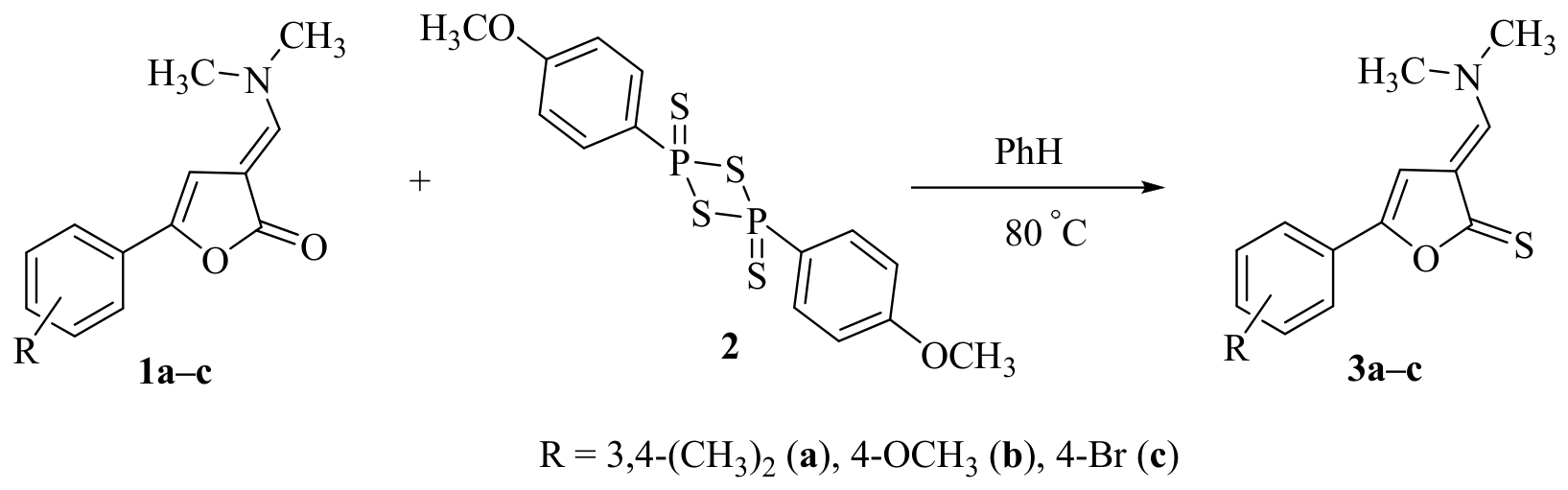
A mixture of 1 mmol of the corresponding 3-[(dimethylamino)methylidene]-5-arylfuran-2(3H)-one (1a–c) and 1 mmol of Lawesson’s reagent (2) in 10 mL of benzene is placed in a flat-bottomed flask equipped with a reflux condenser and heated at 80 °C with constant stirring for 30 min. The resulting precipitate is filtered off, washed with benzene, and purified by recrystallization from EtOH.
- 3-[(Dimethylamino)methylidene]-5-(3,4-dimethylphenyl)furan-2(3H)-thione (3a)
Yellow crystals, yield 0.21 g (82%), mp 214–215 °C; FTIR ν, cm−1: 1629 (C=C), 1340 (CH3), 1215 (C=S); 1H NMR (400 MHz, acetone-d6): δ 2.26 (d, 6H, J = 8.0 Hz, CH3). 3.47 (s, 3H, CH3), 3.54 (s, 3H, CH3), 7.10 (s, 1H, CHFu), 7.15 (d, 1H, J = 8.0 Hz, Ar), 7.40 (d, 1H, J = 8.0 Hz, Ar), 7.48 (d, 1H, J = 8.0 Hz, Ar), 8.05 (s, 1H, CHexocyclic); 13C NMR (100 MHz, acetone-d6): δ 18.7 (CH3), 39.7 (CH3), 47.4 (CH3), 54.8 (CH3), 100.8 (4-Fu), 114.7 (3-Fu), 121.0, 124.6, 127.4, 129.8, 136.3, 136.76, 151.7 (5-Fu), 154.6 (C=C), 198.6 (C=S). Anal. Calcd. for C15H17NOS: C: 69.46%; H: 6.61%; N: 5.40%; S: 12.36%; Found: C: 69.89%; H: 6.07%; N: 5.91%; S: 12.82%.
- 3-[(Dimethylamino)methylidene]-5-(4-methoxyphenyl)furan-2(3H)-thione (3b)
Yellow crystals, yield 0.20 g (77%), mp 215–217 °C; FTIR ν, cm−1: 1631 (C=C), 1345 (CH3), 1211 (C=S); 1H NMR (400 MHz, acetone-d6): δ 3.44 (s, 3H, CH3), 3.52 (s, 3H, CH3), 3.96 (s, 3H, OCH3), 7.10 (s, 1H, CHFu), 7.15 (d, 1H, J = 8.0 Hz, Ar), 7.28 (d, 1H, J = 8.0 Hz, Ar), 7.40 (d, 1H, J = 8.0 Hz, Ar), 7.48 (d, 1H, J = 8.0 Hz, Ar), 8.05 (s, 1H, CHexocyclic); 13C NMR (100 MHz, acetone-d6): δ 39.8 (CH3), 47.3 (CH3), 55.2 (OCH3), 100.8 (4-Fu), 114.9 (3-Fu), 121.1, 124.8, 127.2, 129.8, 136.5, 136.1, 151.8 (5-Fu), 154.5 (C=C), 198.7 (C=S). Anal. Calcd. for C14H15NOS: C: 64.34%; H: 5.79%; N: 5.36%; S: 12.27%; Found: C: 64.86%; H: 6.31%; N: 5.97%; S: 12.79%.
- 3-[(Dimethylamino)methylidene]-5-(4-bromophenyl)furan-2(3H)-thione (3c)
Yellow crystals, yield 0.21 g (68%), mp 201–203 °C; FTIR ν, cm−1: 1621 (C=C), 1341 (CH3), 1210 (C=S); 1H NMR (400 MHz, acetone-d6): δ 3.51 (s, 3H, CH3), 3.58 (s, 3H, CH3), 7.30 (s, 1H, CHFu), 7.45 (d, 2H, J = 8.0 Hz, Ar), 7.72 (d, 2H, J = 12.0 Hz, Ar), 8.11 (s, 1H, CHexocyclic); 13C NMR (100 MHz, acetone-d6): δ 39.9 (CH3), 47.8 (CH3), 102.8 (4-Fu), 114.5 (3-Fu), 125.0, 128.9, 150.1 (5-Fu), 155.1 (C=C), 198.7 (C=S). Anal. Calcd. for C13H12NOSBr: C: 50.33%; H: 3.90%; N: 4.52%; S: 10.33%, Br: 25.76%; Found: C: 50.85%; H: 4.31%; N: 5.03%; S: 10.85%, Br: 26.21%.
2.3. Synthesis and Characterization of Compounds 5a–c
A flat-bottomed flask equipped with an air condenser and a magnetic stirrer is charged with 1 mmol of the corresponding 5-aryl-3-[(dimethylamino)methylidene]furan-2(3H)-thione (3a–c), 1 mmol of 2-amino-4-methylphenol (4), and 25 mL of isopropyl alcohol. The reaction mixture is stirred for 60 min at 80 °C. The resulting precipitate is filtered off, washed with isopropyl alcohol, air-dried, and recrystallized from toluene.
- (Z)-3-{[(2-hydroxy-5-methylphenyl)amino]methylidene}-5-(3,4-dimethylphenyl)furan-2(3H)-thione (5a)
Red crystals, yield 0.30 g (88%), mp 208–210 °C; FTIR ν, cm−1: 3433 (NH), 3181 (OH), 1643 (C=C), 1007 (C=S); 1H NMR (400 MHz, DMSO-d6): δ 2.29 (s, 3H, CH3), 2.41 (s, 6H, 2CH3), 6.81–6.89 (m, 2H, Ar), 7.54–7.64 (m, 3H, Ar), 7.06 (d, J = 5.0 Hz, 1H, Ar), 7.13 (s, 1H, CHFu), 9.05 (d, J = 12.0 Hz, 1H, CHexocyclic), 10.48 (s, 1H, OH), 13.21 (d, J = 14.0 Hz, 1H, NH); 13C NMR (100 MHz, DMSO-d6): δ 19.2 (CH3), 20.2 (CH3), 20.8 (CH3), 106.8 (4-Fu), 116.2 (3-Fu), 121.9, 125.4, 126.2, 126.9, 127.6, 128.3, 129.5, 131.5, 132.7, 145.4 (C=C), 148.4, 150.7 (5-Fu), 188.0 (C=S). Anal. Calcd. for C20H19NO2S: C: 71.19%; H: 5.68%; N: 4.15%; S: 9.50%; Found: C: 71.31%; H: 5.62%; N: 4.09%; S: 9.58%.
- (Z)-3-{[(2-hydroxy-5-methylphenyl)amino]methylidene}-5-(methoxyphenyl)furan-2(3H)-thione (5b)
Red crystals, yield 0.29 g (85%), mp 211–213 °C; FTIR ν, cm−1: 3437 (NH), 3171 (OH), 1639 (C=C), 1007 (C=S); 1H NMR (400 MHz, DMSO-d6): δ 2.27 (s, 3H, CH3), 3.76 (s, 3H, OCH3), 6.80–6.87 (m, 2H, Ar), 7.57–7.62 (m, 4H, Ar), 7.05 (d, J = 5.0 Hz, 1H, Ar), 7.13 (s, 1H, CHFu), 8.99 (d, J = 12.0 Hz, 1H, CHexocyclic), 10.42 (s, 1H, OH), 13.26 (d, J = 14.0 Hz, 1H, NH); 13C NMR (100 MHz, DMSO-d6): δ 20.6 (CH3), 106.3 (4-Fu), 116.8 (3-Fu), 121.2, 125.3, 125.9, 126.1, 127.4, 128.2, 129.7, 131.3, 132.6, 145.2 (C=C), 148.8, 150.5 (5-Fu), 189.1 (C=S). Anal. Calcd. for C19H17NO3S: C: 67.24%; H: 5.05%; N: 4.13%; S: 9.45%; Found: C: 67.32%; H: 5.15%; N: 4.01%; S: 9.50%.
- (Z)-3-{[(2-hydroxy-5-methylphenyl)amino]methylidene}-5-(bromophenyl)furan-2(3H)-thione (5c)
Red crystals, yield 0.36 g (92%), mp 217–218 °C; FTIR ν, cm−1: 3435 (NH), 3176 (OH), 1645 (C=C), 1003 (C=S); 1H NMR (400 MHz, DMSO-d6): δ 2.36 (s, 3H, CH3), 6.85–6.92 (m, 2H, Ar), 7.56–7.62 (m, 4H, Ar), 7.02 (d, J = 5.0 Hz, 1H, Ar), 7.09 (s, 1H, CHFu), 8.94 (d, J = 12.0 Hz, 1H, CHexocyclic), 10.40 (s, 1H, OH), 13.22 (d, J = 14.0 Hz, 1H, NH); 13C NMR (100 MHz, DMSO-d6): δ 20.9 (CH3), 106.6 (4-Fu), 116.4 (3-Fu), 121.1, 125.7, 126.1, 126.6, 127.9, 128.6, 129.5, 131.1, 132.4, 145.5 (C=C), 148.5, 150.3 (5-Fu), 188.2 (C=S). Anal. Calcd. for C18H14BrNO2S: C: 55.68%; H: 3.63%; Br: 20.58%; N: 3.61%; S: 8.26%; Found: C: 55.73%; H: 3.67%; Br: 20.46%; N: 3.74%; S: 8.15%.
3. Results and Discussion
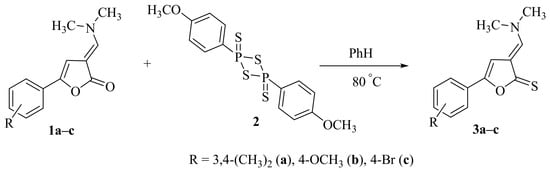
In the first stage of the work, 3-[(dimethylamino)methylidene]-5-arylfuran-2(3H)-thiones (3a–c) were obtained in 68–82% yields via the selective thionation of 3-[(dimethylamino)methylidene]-5-arylfuran-2(3H)-ones (1a–c) with Lawesson’s reagent (2) (Scheme 1).
Scheme 1.
Synthesis of 3-[(dimethylamino)methylidene]-5-arylfuran-2(3H)-thiones.
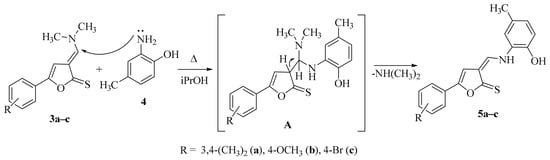
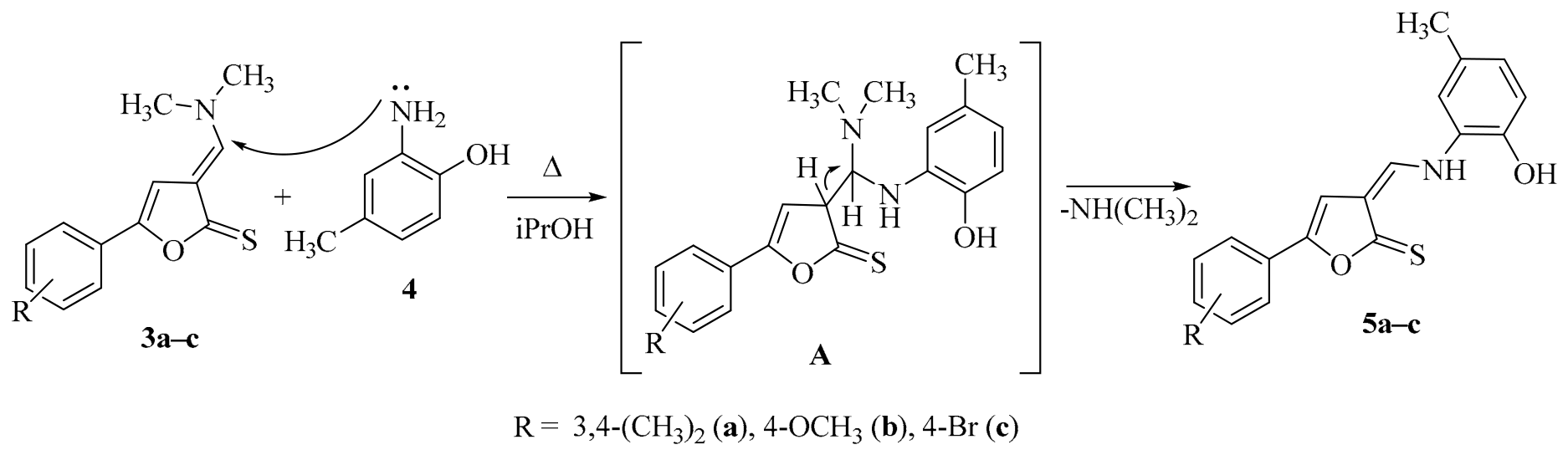
Continuing our work on expanding the series of aminomethylidenefuran-2(3H)-thiones [1,11], we subjected 3-[(dimethylamino)methylidene]-5-(3,4-dimethylphenyl)furan-2(3H)-thione (3a), 3-[(dimethylamino)methylidene]-5-(4-methoxyphenyl)furan-2(3H)-thione (3b), and 3-[(dimethylamino)methylidene]-5-(4-bromophenyl)furan-2(3H)-thione (3c) to a transamination reaction with 2-amino-4-methylphenol (4). Isopropyl alcohol was used as the solvent, following the conditions established for reactions involving 1,2-phenylenediamine and 2-aminophenol. This process yielded (Z)-3-{[(2-hydroxy-5-methylphenyl)amino]methylidene}-5-arylfuran-2(3H)-thiones (5a–c) in 85–92% yields (Scheme 2).
Scheme 2.
Synthesis of (Z)-3-{[(2-hydroxy-5-methylphenyl)amino]methylidene}-5-arylfuran-2(3H)-thiones.
The structure of products 5a–c was established based on IR, 1H and 13C NMR, HSQC, and HMBC spectroscopic data, as well as NOESY experiment. The IR spectrum of compounds 5a–c exhibits characteristic absorption bands corresponding to the thiocarbonyl group of the furan-2(3H)-thione ring at 1003–1007 cm−1 and the C=C double bond at 1639–1645 cm−1; the NH group corresponds to an absorption band at 3433–3437 cm−1, while the OH group corresponds to a band at 3171–3181 cm−1.
NMR spectroscopy established that the transamination of substrates 3a–c proceeds with the formation of compounds 5a–c as the isomer with the Z-configuration of the C=C double bond. This is confirmed by the downfield shift in the NH group proton signal (13.21 ppm (5a), 13.26 ppm (5b), 13.22 ppm (5c)) and by the observed SSCC (J = 14.0 Hz) for the proton involved in the formation of an intramolecular NH···S hydrogen bond.
The NOESY 2D experiment also confirmed the existence of (Z)-3-{[(2-hydroxy-5-methylphenyl)amino]methylidene}-5-arylfuran-2(3H)-thiones (5a–c) as the Z-isomer. In the NOESY spectra of compounds 5a–c, cross-peaks are observed that correspond to the spatial proximity of (1) the proton at the exocyclic C=C bond and the proton of the furan-2(3H)-thione ring; (2) the protons of the NH and OH groups. Furthermore, no spatial correlation was detected in the NOESY spectra between the proton of the furan-2(3H)-thione ring and the proton of the NH group.
4. Conclusions
The transamination reaction of 3-[(dimethylamino)methylidene]-5-arylfuran-2(3H)-thiones with an aromatic amine—2-amino-4-methylphenol—was investigated; the process proceeds as a Michael addition followed by the elimination of a dimethylamine molecule, yielding the corresponding (Z)-3-{[(2-hydroxy-5-methylphenyl)amino]methylidene}-5-arylfuran-2(3H)-thiones. It has been established that the newly obtained compounds exist as the Z-isomer.
Author Contributions
Conceptualization, Z.V.D. and E.M.A.; methodology, A.A.K.; software, Z.V.D.; validation, Z.V.D., A.A.K. and E.M.A.; formal analysis, Z.V.D.; investigation, A.A.K.; resources, E.M.A.; data curation, E.M.A.; writing—original draft preparation, Z.V.D.; writing—review and editing, E.M.A.; visualization, E.M.A.; supervision, A.Y.Y.; project administration, A.Y.Y. All authors have read and agreed to the published version of the manuscript.
Funding
This research received no external funding.
Institutional Review Board Statement
Not applicable.
Informed Consent Statement
Not applicable.
Data Availability Statement
The original contributions presented in this study are included in the article. Further inquiries can be directed to the corresponding author.
Conflicts of Interest
The authors declare no conflicts of interest.
Abbreviations
The following abbreviations are used in this manuscript:
| NMR | Nuclear Magnetic Resonance |
| HMBC | Heteronuclear Multiple Bond Correlation |
| HSQC | Heteronuclear Single Quantum Coherence |
| DMSO | Dimethyl Sulfoxide |
| TMS | Tetramethylsilane (NMR standard) |
| TLC | Thin-layer chromatography |
| FTIR | Fourier Transform Infrared Spectroscopy |
| SSCC | Spin–spin coupling constant |
| NOESY | Nuclear Overhauser Effect Spectroscopy |
References
- Tikhomolova, A.S.; Mamleeva, Z.V.; Egorova, A.Y. An efficient synthesis of (E)-3-[(dimethylamino)methylidene]furan-2(3H)-thiones and transamination reactions thereof. Chem. Heterocycl. Comp. 2024, 60, 138–142. [Google Scholar] [CrossRef] [Scilit]
- Ledenyova, I.V.; Kartavtsev, P.A.; Stolpovskaya, N.V.; Shikhaliev, K.S. Synthesis of N,N-dimethylaminomethylene derivatives of 3-mesyl(tosyl)pyrazolo [5,1-c][1,2,4]triazines and their nucleophile-induced transformations. Russ. Chem. Bull. 2024, 73, 1342–1351. [Google Scholar] [CrossRef] [Scilit]
- Tikhomolova, A.S.; Yegorova, A.Y. Synthesis and structural features of new push-pull enamines, 5-aryl-3-[(dimethylamino)methylidene]furan-2(3H)-ones. Russ. Chem. Bull. 2024, 73, 2291–2297. [Google Scholar] [CrossRef] [Scilit]
- Khodjaniyazov, K.U.; Makhmudov, U.S.; Kutlimuratov, N.M. Synthesis and X-ray crystal structure of (E)-9-(N,N-Dimethylaminomethylidene)-8,9-dihydropyrido [2,3-d]pyrrolo [1,2-a]pyrimidin-5(7H)-one. J. Basic Appl. Res. 2016, 2, 382–385. [Google Scholar]
- Yang, J.-N.; Wang, D.-L.; Qian, J.-H. A Simple Approach Synthesis of Benzo[b]Pyrazolo-[3,2-h][1,6]Naphthyridin-1(2H)-Ones. Heterocycles 2017, 94, 55–58. [Google Scholar] [CrossRef] [Scilit]
- Miele, M.; Iwasita, E.I.C.; D’Annibale, A.; Alcántara, A.R.; Castoldi, L.; Pace, V. Eschenmoser’s salts: From design to applications in organic synthesis. Org. Chem. Front. 2026, 13, 7831–7864. [Google Scholar] [CrossRef] [Scilit] [PubMed]
- Arzyamova, E.M.; Yegorova, A.Y. Synthesis, crystal structure and evaluation of antibacterial activity of new hybrid systems containing furan-2-one and chromen-4-thione fragments. Phosphorus Sulfur Silicon Relat. Elem. 2025, 200, 164–173. [Google Scholar] [CrossRef] [Scilit]
- Saeid, H.; Al-sayed, H.; Bader, M. A Review on Biological and Medicinal Significance of Furan. Alq. J. Med. App. Sci. 2023, 6, 44–58. [Google Scholar] [CrossRef]
- Arce-Ramos, L.; Castillo, J.-C.; Becerra, D. Synthesis and Biological Studies of Benzo[b]furan Derivatives: A Review from 2011 to 2022. Pharmaceuticals 2023, 16, 1265. [Google Scholar] [CrossRef] [Scilit] [PubMed]
- Patel, P.; Shakya, R.; Vishakha; Asati, V.; Kurmi, B.D.; Verma, S.K.; Gupta, G.D.; Rajak, H. Furan and benzofuran derivatives as privileged scaffolds as anticancer agents: SAR and docking studies (2010 to till date). J. Mol. Struct. 2024, 1299, 137098. [Google Scholar] [CrossRef] [Scilit]
- Tikhomolova, A.S.; Yegorova, A.Y. Transamination of 3-[(Dimethylamino)methylidene]-5-arylfuran-2(3H)-thiones with the Participation of 1,2-Phenylenediamine. Chem. Proc. 2024, 16, 31. [Google Scholar] [CrossRef] [Scilit]
Disclaimer/Publisher’s Note: The statements, opinions and data contained in all publications are solely those of the individual author(s) and contributor(s) and not of MDPI and/or the editor(s). MDPI and/or the editor(s) disclaim responsibility for any injury to people or property resulting from any ideas, methods, instructions or products referred to in the content. |
© 2026 by the authors. Licensee MDPI, Basel, Switzerland. This article is an open access article distributed under the terms and conditions of the Creative Commons Attribution (CC BY) license.