


Abstract
Hepatitis B virus (HBV) infection remains a major global health burden, underscoring the urgent need for new and effective antiviral agents. HBV polymerase is a key therapeutic target because it is essential for viral replication. In this study, 40 sulfonamide derivatives were investigated as potential inhibitors of HBV polymerase using an integrated in silico drug design approach combining molecular docking, 3D-QSAR modeling, and ADMET prediction. Molecular docking studies were performed to evaluate the binding affinity and interaction modes of compounds within the active site of HBV polymerase. The results demonstrated favorable binding modes, characterized by strong hydrogen bonds and hydrophobic interactions with key residues involved in enzymatic function. The developed 3D-QSAR model showed high statistical reliability, with a coefficient of determination (R2) of 0.92 for the training set and a cross-validated coefficient (Q2) of 0.63, along with good external predictive ability for the test set (Q2 = 0.80), indicating robust predictive performance. Analysis of the contour maps identified critical steric and electrostatic features governing biological activity, providing valuable insights for rational molecular optimization. Based on these findings, new compounds were proposed. These results highlight the effectiveness of integrating 3D-QSAR modeling with molecular docking to identify, design, and optimize potent HBV polymerase inhibitors.
1. Introduction
Hepatitis B virus (HBV) infection remains a major threat to global public health, affecting over 250 million people worldwide and causing chronic liver diseases such as cirrhosis and hepatocellular carcinoma [1]. Current clinical therapeutic regimens, primarily based on pegylated interferon-alpha and nucleos(t)ide analogues (NAs) like entecavir and tenofovir, effectively suppress viral replication by targeting the HBV reverse transcriptase polymerase. However, these therapies rarely achieve a complete functional cure due to the persistence of covalently closed circular DNA (cccDNA) in infected hepatocytes and the frequent emergence of drug-resistant viral strains during long-term treatment [2]. Consequently, there is an urgent need to explore alternative therapeutic targets to develop novel antiviral agents with distinct mechanisms of action.
Among the emerging therapeutic targets, the HBV core protein (HBc) plays an indispensable role in the viral life cycle. HBc dimerizes and self-assembles to form the icosahedral nucleocapsid, which packages pregenomic RNA (pgRNA) and the viral polymerase for reverse transcription, while also facilitating the transport of mature capsids to the nucleus to maintain cccDNA pools [3]. Small-molecule HBV capsid assembly modulators (CAMs) have gained significant attention because they can interfere with HBc self-assembly or destabilize capsids, thereby suppressing viral replication without inducing cross-resistance to conventional polymerase inhibitors [4].
To accelerate the rational design and optimization of potent HBV capsid assembly modulators, computer-aided drug design (CADD) techniques offer an efficient and cost-effective strategy [5]. In this study, we performed an integrated in silico investigation on a dataset of 40 sulfonamide derivatives using molecular docking, atom-based three-dimensional quantitative structure–activity relationship (3D-QSAR) modeling, and ADMET profiling [6]. Molecular docking was executed against the crystal structure of the HBV core protein (PDB ID: 5T2P) to delineate key binding interactions within the active site. The 3D-QSAR model, constructed using the PHASE module in Schrödinger, provided quantitative insights into the hydrophobic, steric, and electronic features required for optimal biological activity. Based on the contour map analyses and binding energy profiles, four new sulfonamide derivatives (M1–M4) were rationally designed and evaluated for their binding affinity and pharmacokinetic properties. The workflow and findings presented herein offer valuable guidelines for the structural optimization of novel HBV capsid assembly modulators.
2. Materials and Methods
2.1. Dataset Collection
For this study, a structurally diverse group of 40 sulfonamide derivatives were selected (Table 1) that have been reported in the literature as modulators of Hepatitis B Virus (HBV) capsid assembly [6]. The EC50 values were converted to their negative logarithmic form using the formula pEC50 = −log10 (EC50) to perform QSAR modeling [7].
Table 1.
Experimental data of studied compounds, including EC50, pEC50exp, pEC50pred, and residual values.
2.2. Ligand Preparation
The 2D chemical structures of 40 inhibitors were initially drawn using the 2D sketcher module in Maestro. Subsequently, their 3D geometries were generated using the LigPrep module in Maestro [8].
2.3. Molecular Docking
The crystal structure of the hepatitis B virus (HBV) core protein in complex with ligand SBA-R01 (PDB ID: 5T2P) was retrieved from the RCSB Protein Data Bank. Protein preparation was conducted using the Protein Preparation Wizard in Schrödinger [9]. A receptor grid was generated based on the co-crystallized ligand to define the binding pocket of the HBV core protein. All ligands were docked into this active site using Glide Extra Precision (XP) mode [10]. The docking protocol assessed binding poses and computed Glide docking scores to estimate ligand affinity and key interactions with active site residues [11].
2.4. Atom-Based 3D-QSAR
An atom-based 3D-QSAR study was performed using the PHASE module of Schrödinger [12]. The dataset comprising 40 compounds was randomly divided into a training set (80%) and a test set (20%). A grid spacing of 1 Å was applied to generate the atom-based descriptors [13]. Partial Least Squares (PLS) regression was employed. Based on this, three PLS factors were selected for the final QSAR model [14].
2.5. ADME Prediction
Compounds resulting from molecular docking were further evaluated for their pharmacokinetic profiles using the QikProp module of Schrödinger [15]. This ADME analysis provided essential physicochemical and pharmacokinetic parameters. These parameters helped assess the drug-likeness and developability of the compounds [16].
3. Results and Discussion
3.1. Docking Analysis
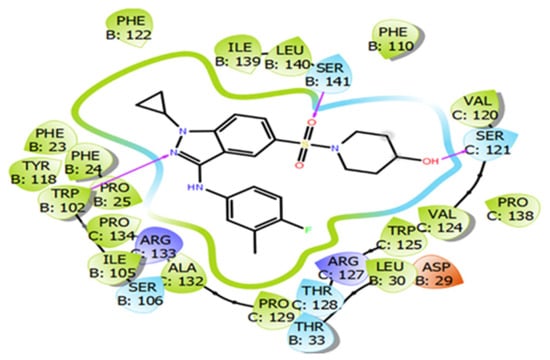
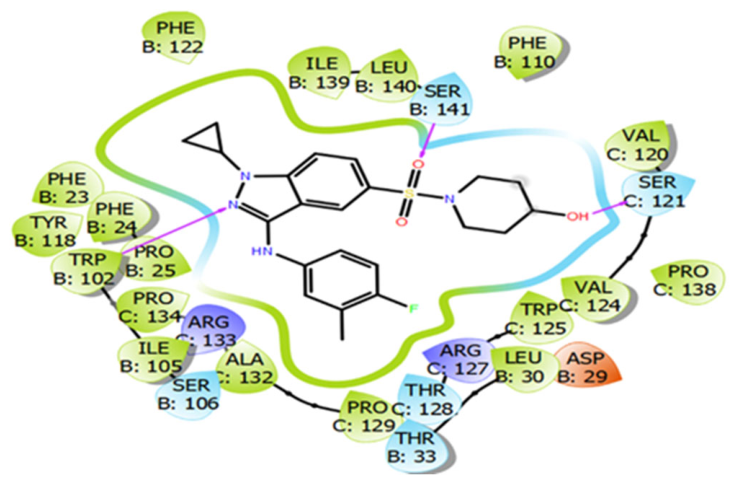
Molecular docking was conducted using Glide XP to explore the binding mechanisms and non-covalent interactions of the 40 sulfonamide derivatives within the active site of the HBV core protein (PDB ID: 5T2P). Among the evaluated dataset, Compound 14 demonstrated the highest binding affinity, exhibiting an XP-Gscore of −8.923 kcal/mol and a Glide Emodel score of −94.665 kcal/mol, which strongly correlates with its high experimental potency (pEC50 = 7.50, EC50 = 0.03 µM). It formed key hydrogen bond with residues TRP102, SER141, and SER121, which contributed to its stable positioning within the active site (Figure 1).
Figure 1.
Two-dimensional interaction diagrams of compound 14, within the active site of the target protein (PDB ID: 5T2P).
3.2. Atom-Based 3D-QSAR Model Analysis
An atom-based 3D-QSAR model was built using the PHASE module on aligned docking poses. The dataset (N = 40) was divided into a training set (n = 32) and a test set (n = 8). A Partial Least Squares (PLS) regression analysis yielded an optimal 3-factor PLS model. The statistical parameters evaluating the robustness and predictive power of the model are summarized in Table 2. The 3-factor PLS model displayed excellent internal fitting and statistical reliability, evidenced by a high coefficient of determination (R2 = 0.92), cross-validated correlation (R2cv = 0.63), low standard deviation (SD = 0.13), and a high variance ratio (F = 173.9, P = 4.55 × 10⁻²¹). Furthermore, the model exhibited robust external predictive power for the test set compounds, with a predictive correlation coefficient Q2 = 0.80 and a low RMSE = 0.11.
Table 2.
Summary of 3D-QSAR PLS statistical parameters.
The field contribution breakdown for the optimal 3D-QSAR model (Table 3) reveals that hydrophobic interactions are the predominant driving force governing antiviral potency, contributing 58.1% to the total activity variance. Electron-withdrawing group contributions (33.1%) and hydrogen bond donor properties (6.3%) play crucial secondary roles.
Table 3.
Field Contribution Summary of Atom-Based 3D-QSAR Model.
3.3. Contour Maps Analysis
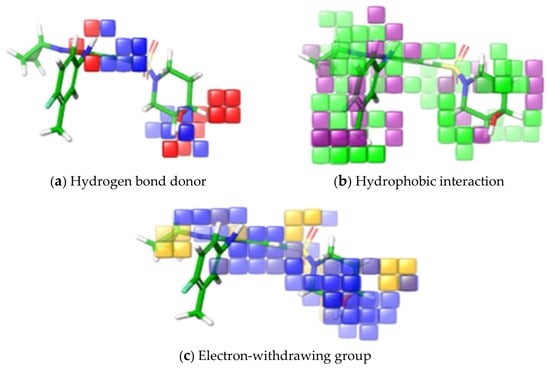
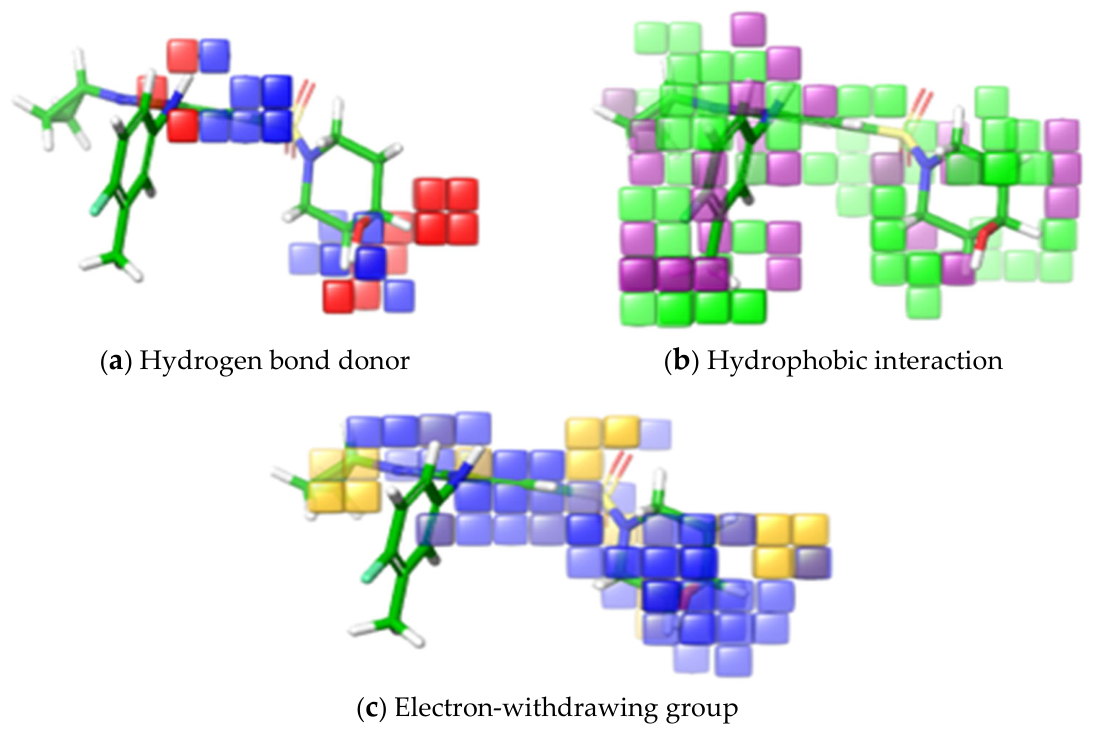
Analysis of 3D contour maps on Compound 14 provided actionable structural insights for rational drug optimization (Figure 2).
Figure 2.
3D-QSAR contour maps mapped onto Compound 14. (a) H-bond donor (blue: favorable, red: unfavorable). (b) Hydrophobic (green: favorable, purple: unfavorable). (c) Electron-withdrawing (blue: favorable, yellow: unfavorable).
H-Bond Donor Contours (Figure 2a): Blue regions around the sulfonamide NH moiety emphasize the necessity of retaining hydrogen-bond donating capability to interact with SER141.
Hydrophobic Contours (Figure 2b): Green-shaded regions around the distal aromatic substituent indicate that bulky, lipophilic groups significantly enhance inhibitory potency. Purple contours highlight steric constraints where lipophilic substitution reduces activity.
Electron-Withdrawing Contours (Figure 2c): Blue cubes indicate regions where electron-deficient or halogenated substituents improve binding, aligning with the observed activity enhancement in halogen-substituted sulfonamides.
3.4. Docking of Newly Designed Inhibitors
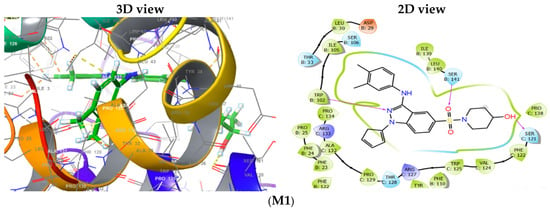
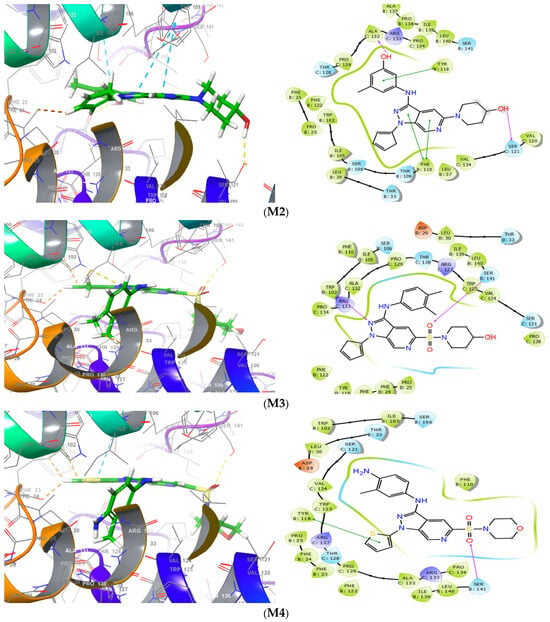
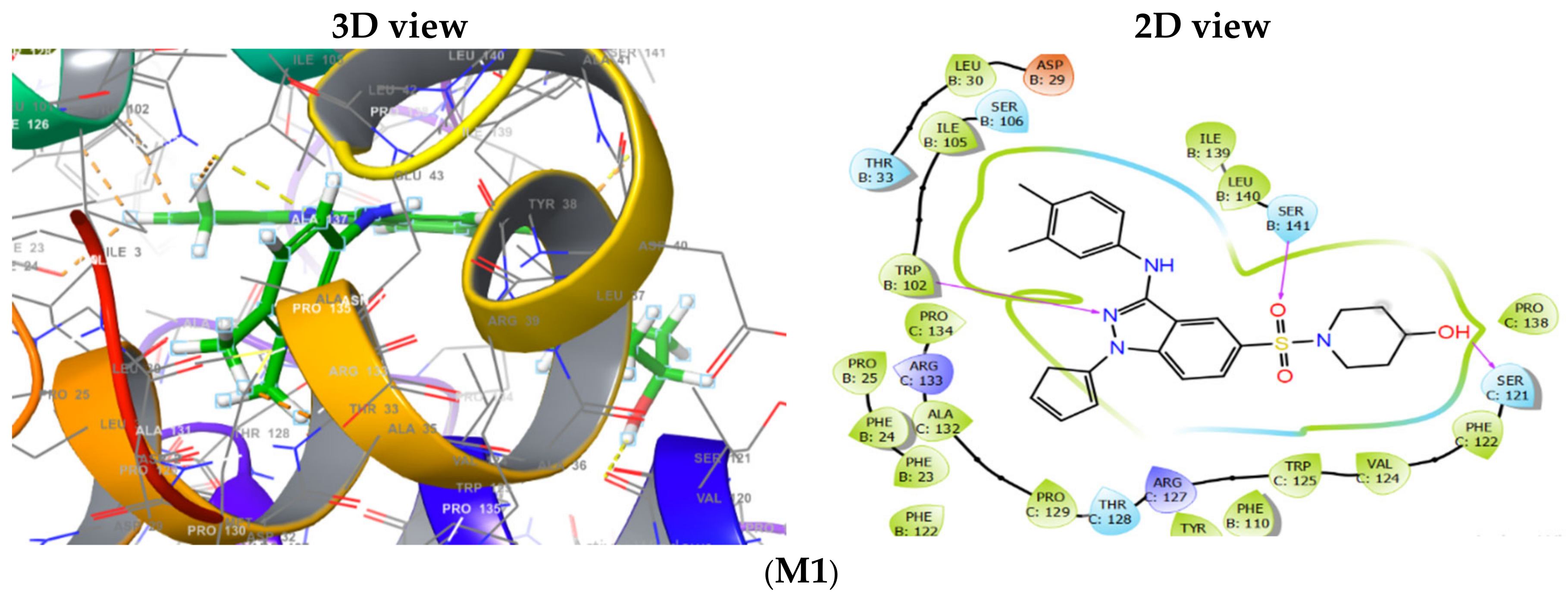
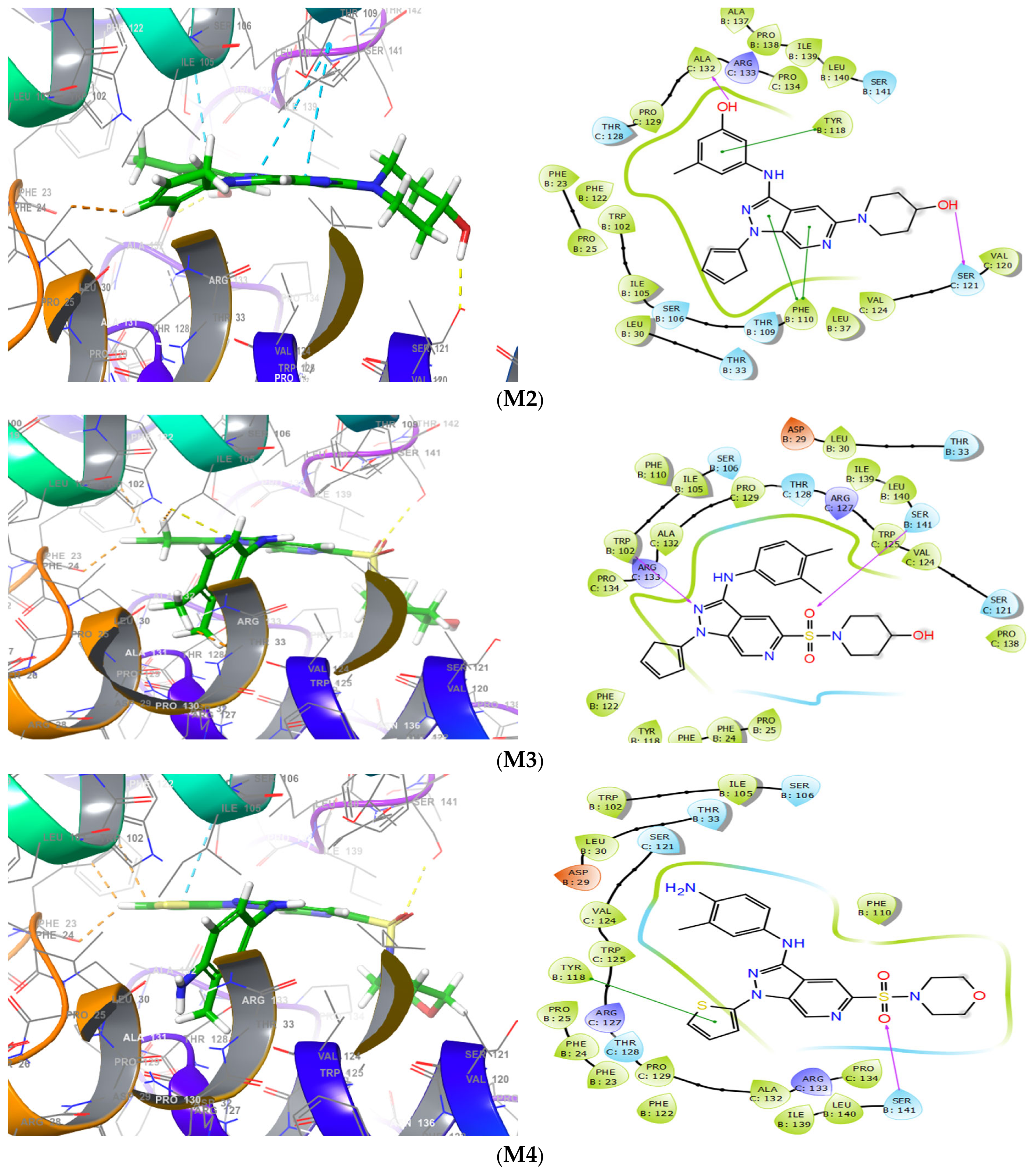
Guided by the 3D-QSAR contour maps and docking interaction profiles, four novel sulfonamide derivatives (M1–M4) were designed by introducing specific hydrophobic and electron-withdrawing modifications. The designed molecules were docked into the HBV core protein binding site (PDB ID: 5T2P) (Figure 3). The resulting docking scores, Glide Emodel energies, key binding residues, and predicted pEC50 values for compounds M1-M4 are detailed in Table 4.
Figure 3.
2D and 3D Interaction Diagrams of Designed Inhibitors with HBV Protein Binding Site.
Table 4.
Docking Scores, Glide Emodel energies, and predicted pEC50 values of newly designed compounds M1–M4.
3.5. ADME Predictions
In silico pharmacokinetic evaluation using QikProp confirmed that designed compounds M1–M4 possess favorable drug-likeness parameters.
4. Conclusions
In this study, an integrated in silico workflow combining molecular docking, atom-based 3D-QSAR modeling, and ADMET prediction was successfully applied to investigate 40 sulfonamide derivatives as modulators of Hepatitis B Virus (HBV) capsid assembly. The optimal 3-factor PLS 3D-QSAR model exhibited high statistical validity. Molecular docking into the HBV core protein structure (PDB ID: 5T2P) identified essential hydrogen-bonding networks with TRP102, SER141, and SER121. Based on quantitative structure-activity insights, four novel analogs (M1–M4) were rationally designed. ADME predictions confirmed excellent drug-likeness and oral pharmacokinetic potential for all designed analogs.
Author Contributions
Conceptualization, A.L. and A.B.; methodology, A.L.; software, A.L.; validation, A.L.; formal analysis, A.L.; investigation, A.B.; resources, A.L.; data curation, A.B.; writing—original draft preparation, A.B.; writing—review and editing, A.B. and A.L.; visualization, A.L.; supervision, A.B.; project administration, A.L.; funding acquisition, A.B. All authors have read and agreed to the published version of the manuscript.
Funding
This research received no external funding.
Institutional Review Board Statement
Not applicable.
Informed Consent Statement
Not applicable.
Data Availability Statement
The data supporting reported results are available within the article.
Conflicts of Interest
The authors declare no conflict of interest.
References
- Durantel, D.; Zoulim, F. New antiviral targets for innovative treatment concepts for hepatitis B virus and hepatitis delta virus. J. Hepatol. 2016, 64, S117–S131. [Google Scholar] [CrossRef] [Scilit]
- Li, Y.; Hwang, N.; Snedeker, A.; Lemon, S.M.; Noe, D.; Sun, L.; Clement, J.A.; Zhou, T.; Tang, L.; Block, T.; et al. “PROTAC” modified Dihydroquinolizinones (DHQs) that causes degradation of PAPD-5 and inhibition of hepatitis a virus and hepatitis B virus, in vitro. Bioorganic Med. Chem. Lett. 2024, 102, 129680. [Google Scholar] [CrossRef] [Scilit]
- Hu, Y.; Zhang, Y.; Jiang, W. Targeting hepatitis B virus-associated nephropathy: Efficacy and challenges of current antiviral treatments. Clin. Exp. Med. 2025, 25, 57. [Google Scholar] [CrossRef] [Scilit]
- Fanning, G.C.; Zoulim, F.; Hou, J.; Bertoletti, A. Therapeutic strategies for hepatitis B virus infection: Towards a cure. Nat. Rev. Drug Discov. 2019, 18, 827–844. [Google Scholar] [CrossRef] [Scilit]
- Zhang, S.; Golbraikh, A.; Oloff, S.; Kohn, H.; Tropsha, A. A Novel Automated Lazy Learning QSAR (ALL-QSAR) Approach: Method Development, Applications, and Virtual Screening of Chemical Databases Using Validated ALL-QSAR Models. J. Chem. Inf. Model. 2006, 46, 1984–1995. [Google Scholar] [CrossRef] [Scilit]
- Wang, C.; Pei, Y.; Wang, L.; Li, S.; Jiang, C.; Tan, X.; Dong, Y.; Xiang, Y.; Ma, Y.; Liu, G. Discovery of (1H-Pyrazolo[3,4-c] pyridin-5-yl) sulfonamide Analogues as Hepatitis B Virus Capsid Assembly Modulators by Conformation Constraint. J. Med. Chem. 2020, 63, 6066–6089. [Google Scholar] [CrossRef] [Scilit]
- De Borja, J.R.; Cabrera, H.S. In Silico Drug Screening for Hepatitis C Virus Using QSAR-ML and Molecular Docking with Rho-Associated Protein Kinase 1 (ROCK1) Inhibitors. Computation 2024, 12, 175. [Google Scholar] [CrossRef] [Scilit]
- Laoud, A.; Ali-Rachedi, F.; Ferkous, F. Discovery of New Inhibitors of Enoyl-ACP Reductase via Structure-Based Virtual Screening. Phys. Chem. Res. 2023, 11, 459–469. [Google Scholar] [CrossRef]
- Laoud, A.; Belafriekh, A.; Alaqarbeh, M. N-Phenyl-3-sulfamoyl-benzamide derivatives as anti-Hepatitis B virus agent candidates. Integrated computational studies. J. Serbain Chem. Soc. 2025, 90, 1175–1187. [Google Scholar] [CrossRef] [Scilit]
- Fattouche, M.; Belaidi, S.; Abchir, O.; Al-Shaar, W.; Younes, K.; Al-Mogren, M.M.; Chtita, S.; Soualmia, F.; Hochlaf, M. ANN-QSAR, Molecular Docking, ADMET Predictions, and Molecular Dynamics Studies of Isothiazole Derivatives to Design New and Selective Inhibitors of HCV Polymerase NS5B. Pharmaceuticals 2024, 17, 1712. [Google Scholar] [CrossRef] [Scilit]
- Belafriekh, A.; Laoud, A.; Alaqarbeh, M.; Zafar, I.; El Mchichi, L.; Shafiq, S. Combined 3D-QSAR, Molecular Docking, Molecular Dynamics, and Retrosynthesis Analysis of Novel Covalent KRASG12C Inhibitors. ChemistrySelect 2026, 11, e05932. [Google Scholar] [CrossRef] [Scilit]
- Dutkiewicz, Z.; Mikstacka, R. Molecular Docking Study and 3D-QSAR Model for Trans-Stilbene Derivatives as Ligands of CYP1B1. Int. J. Mol. Sci. 2025, 26, 1002. [Google Scholar] [CrossRef] [Scilit]
- Belafriekh, A.; Laoud, A.; Elmchichi, L.; Bouachrine, M. In Silico Approach for Developing New Anti-Tuberculosis Drug Candidates: 3D-QSAR, Molecular Docking and ADME Studies of Pretomanid Derivatives. Phys. Chem. Res. 2024, 12, 729–743. [Google Scholar] [CrossRef]
- Abchir, O.; Khedraoui, M.; Nour, H.; Yamari, I.; Errougui, A.; Samadi, A.; Chtita, S. Integrative Approach for Designing Novel Triazole Derivatives as α-Glucosidase Inhibitors: QSAR, Molecular Docking, ADMET, and Molecular Dynamics Investigations. Pharmaceuticals 2024, 17, 261. [Google Scholar] [CrossRef] [Scilit]
- Laoud, A.; Ferkous, F.; Maccari, L.; Maccari, G.; Saihi, Y.; Kraim, K. Identification of novel nt-MGAM inhibitors for potential treatment of type 2 diabetes: Virtual screening, atom-based 3D-QSAR model, docking analysis and ADME study. Comput. Biol. Chem. 2018, 72, 122–135. [Google Scholar] [CrossRef] [Scilit]
- Baassi, M.; Moussaoui, M.; Rajkhowa, S.; Soufi, H.; Daoud, R.; Belaaouad, S. Structure-Guided Design of Novel Diarylpyrimidine-Based NNRTIs Through a Comprehensive In Silico Approach: 3D-QSAR, ADMET Evaluation, Molecular Docking, and Molecular Dynamics. Pharmaceuticals 2025, 18, 1854. [Google Scholar] [CrossRef] [Scilit]

Disclaimer/Publisher’s Note: The statements, opinions and data contained in all publications are solely those of the individual author(s) and contributor(s) and not of MDPI and/or the editor(s). MDPI and/or the editor(s) disclaim responsibility for any injury to people or property resulting from any ideas, methods, instructions or products referred to in the content. |
© 2026 by the authors. Licensee MDPI, Basel, Switzerland. This article is an open access article distributed under the terms and conditions of the Creative Commons Attribution (CC BY) license.