


Abstract
Hydroperoxides are widely used as effective initiators of radical-chain processes. These compounds are sources of free radicals in polymerization processes and in the oxidation of organic compounds. Various catalytic systems are often used to regulate the reactivity of hydroperoxides. Quaternary ammonium salts are effective, environmentally friendly catalysts for the radical decomposition of hydroperoxides and peroxides. The catalytic effect of quaternary ammonium salts in hydroperoxide decomposition reactions is due to the formation of the intermediate complex ‘hydroperoxide–catalyst’. The quaternary ammonium salt anion plays a key role in the chemical activation of the hydroperoxide, and therefore the nature of this anion directly determines the rate of the decomposition reaction. The paper presents the results of theoretical studies of the molecular geometry, electronic structure and NMR spectra parameters of intermediate associates of tert-butyl hydroperoxide with halide anions of quaternary ammonium salts (Cl−, Br−, I−). The main markers of intermolecular interactions were the bond lengths, the torsion angles of the hydroperoxide fragment, and the chemical shift of the hydroperoxide group protons.
1. Introduction
Organic hydroperoxides are fundamental reagents and highly efficient initiators in a vast array of radical-chain chemical processes [1,2,3,4]. However, the spontaneous or thermal homolysis of hydroperoxides is often characterized by a lack of selectivity and requires harsh reaction conditions. Consequently, the development and optimization of catalytic systems capable of regulating reactivity and kinetic parameters of hydroperoxide decomposition are crucial tasks.
Among various catalytic agents, quaternary ammonium salts are remarkably prominent and environmentally friendly catalysts [5,6]. The catalytic phenomenon in these systems is based on the rapid formation of a highly reactive supramolecular complex ‘hydroperoxide–catalyst’ [6,7]. Due to the extremely short lifetime of the intermediate ‘hydroperoxide–catalyst’ complex, establishing its most probable structural configuration remains an exceptionally challenging task. To overcome this limitation, quantum chemical calculations are widely utilized to provide comprehensive insights into the structural, electronic, and NMR parameters of different molecular systems [6,8,9,10]. Consequently, molecular modeling data provide a valuable addition to experimental research. The synergistic combination of experimental methods and quantum chemical modeling ensures a deeper understanding of hydroperoxide decomposition mechanisms.
This paper presents a comprehensive theoretical study focused on the molecular geometry, electronic structure, and NMR spectral parameters of the intermediate associates formed by tert-butyl hydroperoxide (CH3)3CO–OH and various halide anions of quaternary ammonium salts (Cl−, Br−, I−). A comparative analysis with our previous experimental data made it possible to evaluate the applicability of the associate model that accounts only for the anion action.
2. Methods
Quantum chemical calculations were carried out using a combined approach at the MP2/6-31+G(d,p)//LANL2DZ level of theory because the studied intermediate associates contain both light elements (C, H, O) and heavy atoms (halogens). Magnetic shielding constants were calculated by the gauge-independent atomic orbital (GIAO) method [11]. Tetramethylsilane (TMS) was used as a standard, for which full optimization of molecular geometry and calculation of magnetic shielding tensors (χ) were performed using the same level of theory and basis set (MP2/6-31+G(d,p)). All calculations were carried out by Orca 6.0.0 software [12].
Experimental NMR 1H spectra of the tert-butyl hydroperoxide and tert-butyl hydroperoxide–Et4NBr solutions were recorded on a Bruker Avance instrument (Bruker BioSpin GmbH, Rheinstetten, Germany) (400 MHz) in CD3CN and discussed in our recent publications [6,7].
3. Results and Discussion
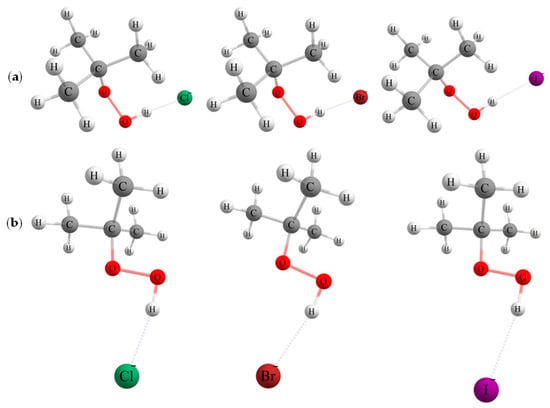
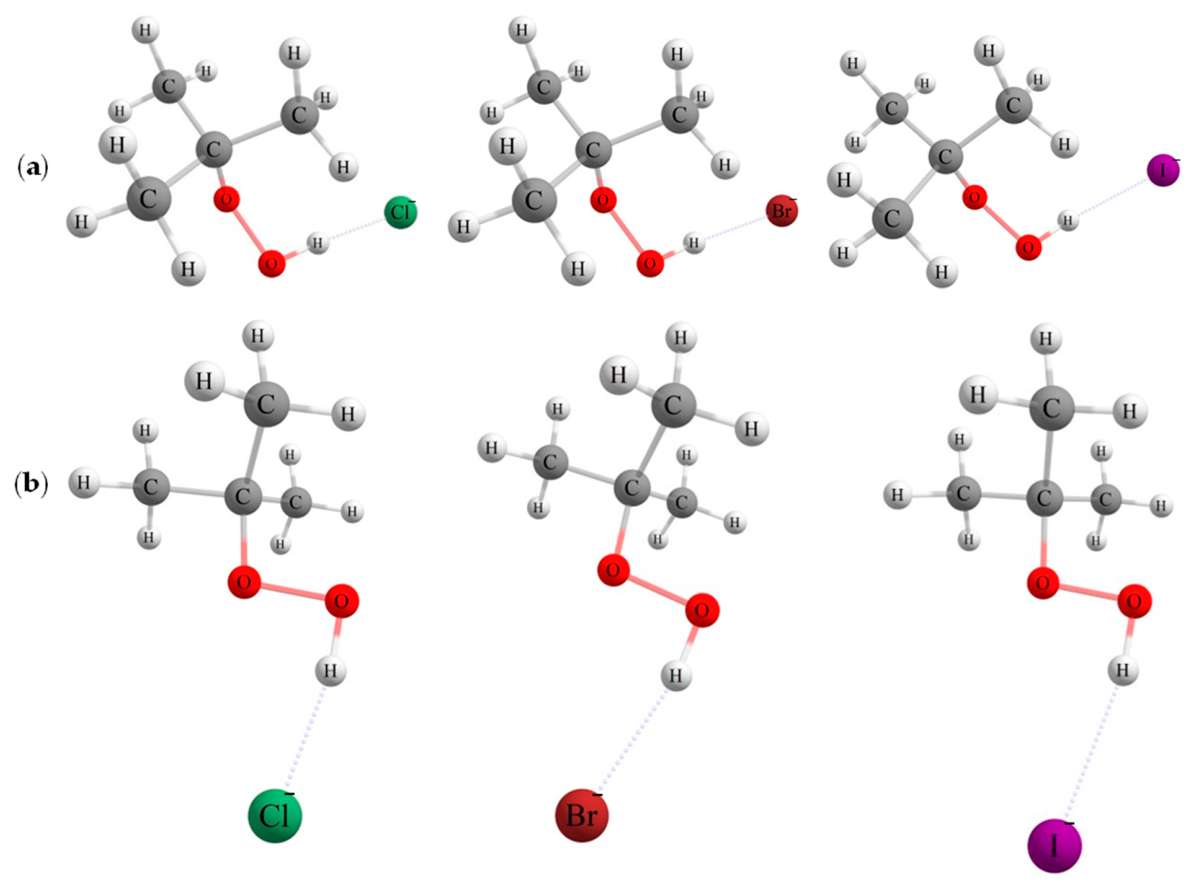
Quantum chemical calculations were used to study the structural features, electronic structure and NMR spectra parameters of (CH3)3CO–OH…Hal− associates, where Hal− is Cl−, Br−, or I−. To comprehensively evaluate the conformational flexibility of the hydroperoxide structure and its impact on the parameters of the intermediate associates, molecular models with both clinal and anti-periplanar conformations of the hydroperoxide fragment were used. Structural models of associates of tert-butyl hydroperoxide with halide anions of quaternary ammonium salts (Cl−, Br−, I−) are shown in Figure 1.
Figure 1.
Structural models of (CH3)3CO–OH…Hal− associates: (a) clinal and (b) anti-periplanar conformations of the hydroperoxide fragment (C–O2–O1–H).
Associative interactions of tert-butyl hydroperoxide with halide anions lead to a structural reorganization of the hydroperoxide fragment (Table 1). Specifically, the O–H bond length increases for both the clinal and anti-periplanar conformations of the studied associates. The anti-periplanar conformation shows a wider range of bond stretching, reaching its maximum value of about 1.020 Å for the (CH3)3CO–OH…Cl−. Compared to the free hydroperoxide, the O–O peroxide bond shortens by ca. 0.01 Å in the clinal conformations, whereas it lengthens by 0.007 Å in the anti-periplanar states. Concurrently, the value of the ∠C–O–O–H torsion angle shifts from 124.4° in the isolated molecule to 98.0°, 99.4°, 102.1°, and 180.0° in the associates. It is also worth noting that the redistribution of electron density on the atoms of the hydroperoxide fragment does not lead to complete charge transfer from the halide anions to the hydroperoxide, while the molecular integrity of the peroxide framework is maintained across all calculated associates.
Table 1.
Parameters of molecular geometry and electronic structure of (CH3)3CO–OH and its associates with Cl−, Br−, I−.
The O–H…Hal− ion-molecular interaction induces significant changes in the 1H and 13C chemical shifts (δ) of the (CH3)3CO–OH…Hal− associates (Table 2).
Table 2.
Chemical shifts of 1H, 13C nuclei of (CH3)3CO–OH and associates (CH3)3CO–O–H…Hal−.
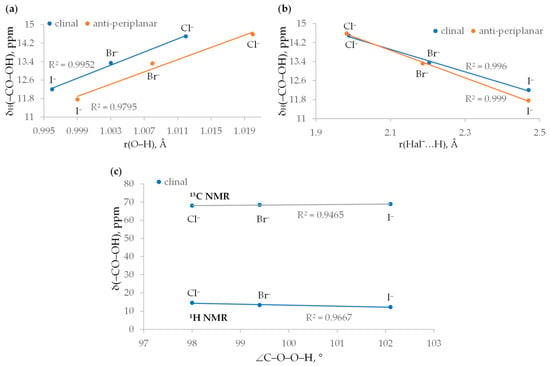
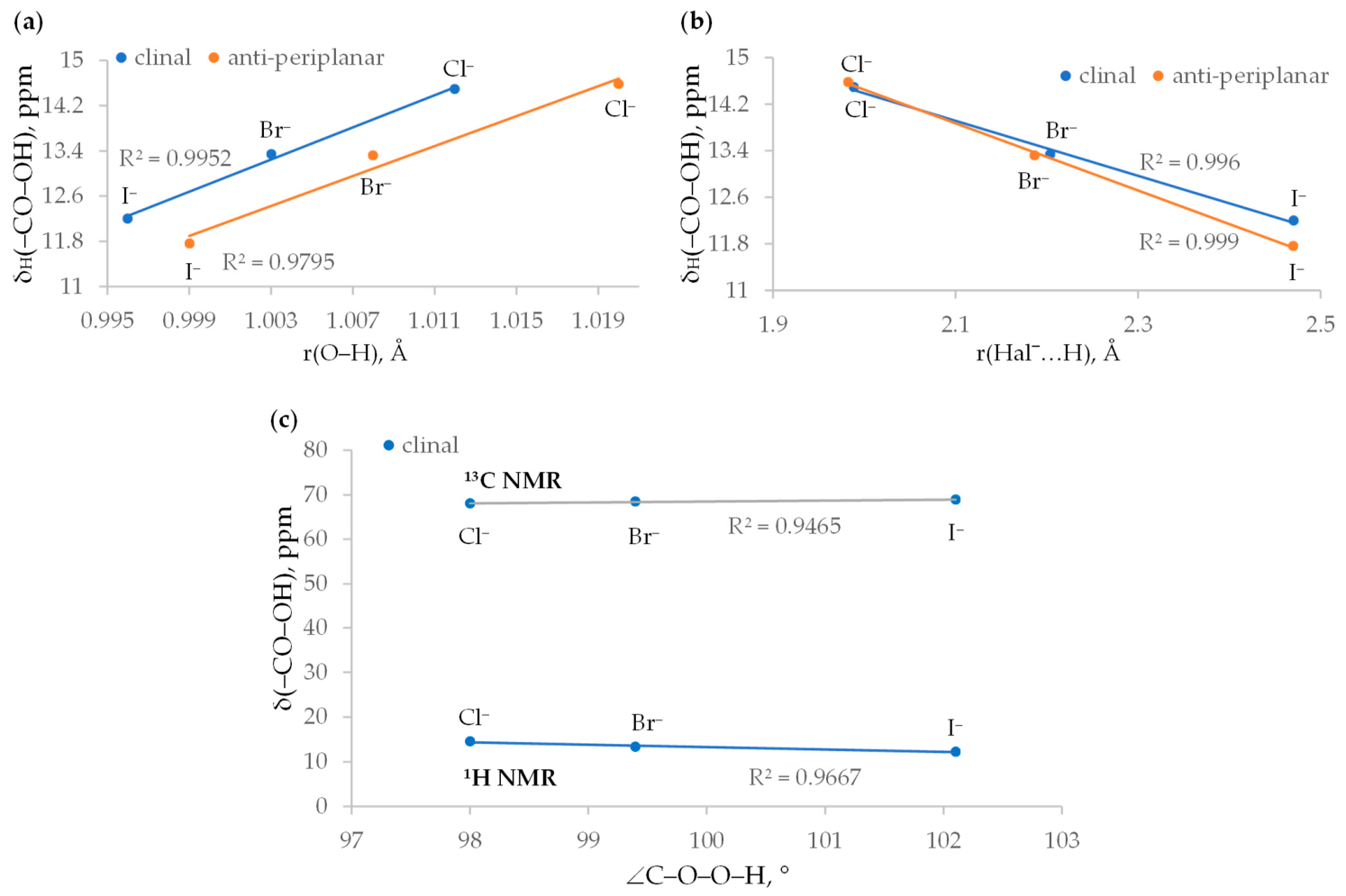
Based on the calculated data, the dependencies of the 1H and 13C NMR chemical shifts of the hydroperoxide group on the molecular geometry parameters of the intermediate associates of tert-butyl hydroperoxide with Hal− were established (Figure 2). The elongation of the O–H bond leads to a systematic downfield shift of the hydroperoxide group proton for both conformations (Figure 2a). The linear correlation confirms that the higher proton chemical shift value is directly caused by hydroperoxide activation. The nature of the halide anions determines the overall behavior of associates.
Figure 2.
Structure–spectral correlations for the clinal (blue lines) and anti-periplanar (orange lines) conformations of the tert-butyl hydroperoxide associates with halide anions (Cl−, Br−, I−): (a) Correlation between the O–H bond length and the 1H NMR chemical shift of the –CO–OH group. (b) Correlation between the Hal−…H bond length and the 1H NMR chemical shift of the –CO–OH group. (c) Correlation between the ∠C–O–O–H dihedral torsion angle and the 1H NMR chemical shift of the –CO–OH group and the 13C NMR chemical shift of the –CO–OH group.
An inverse correlation is observed when plotting the chemical shift value of the hydroperoxide group proton against the Hal−…H hydrogen bond length (Figure 2b). The shortening of the intermolecular hydrogen bond and the closer spatial approach of the halide anion to the reactive site led to a downfield shift of the hydroperoxide proton. This dependence (Figure 2b) shows that the electrostatic impact of the anion is highly distance-dependent: a closer approach of the halogen causes stronger proton deshielding in both conformations of hydroperoxide. Figure 2c illustrates the impact of the ∠C–O–O–H dihedral angle and the halide anion nature on the 1H and 13C NMR chemical shifts of the hydroperoxide group. In the 1H NMR spectra (Figure 2c), the chemical shift increases in the order I− < Br− < Cl−. Conversely, the 13C NMR chemical shifts demonstrate the exact inverse trend, increasing in the raw Cl− < Br− < I−. Concurrently, the transition from the clinal to the anti-periplanar conformation shifts the entire 13C dependence upfield by approximately 2.45–2.73 ppm (Table 2).
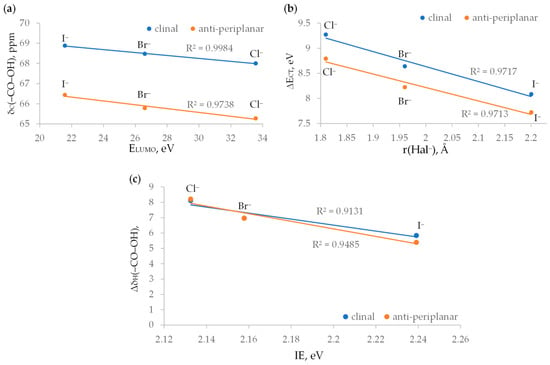
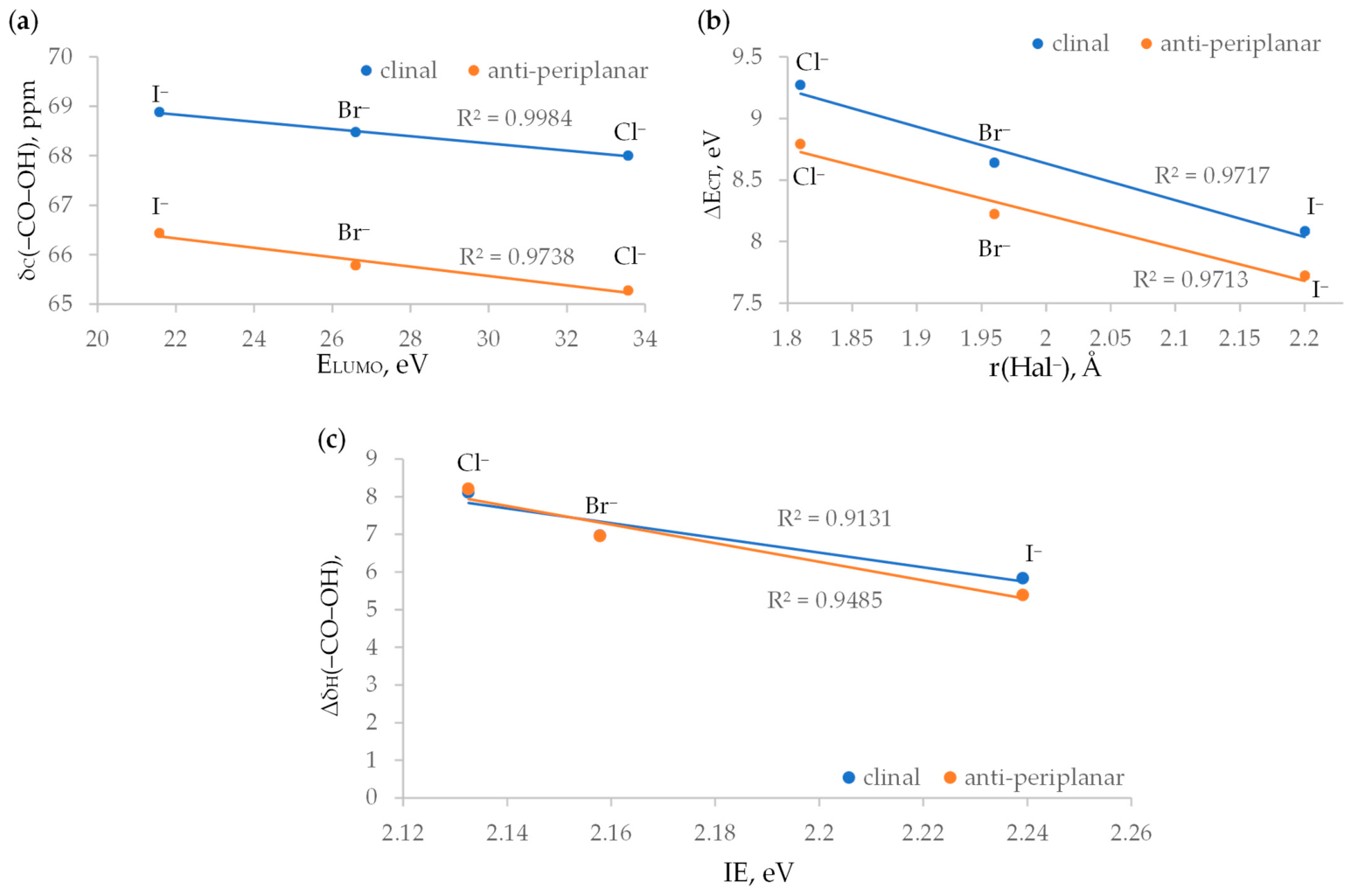
Based on the quantum chemical data, the spectral–electronic dependencies were established to evaluate the interplay between the conformation and the halide nature within the intermediate associates (Figure 3).
Figure 3.
Spectral–electronic correlations for the clinal (blue lines) and anti-periplanar (orange lines) conformations of the tert-butyl hydroperoxide intermediate associates with halide anions (Cl−, Br−, I−): (a) Dependence of the 13C NMR chemical shift of the –CO–OH group on the calculated ELUMO energy. (b) Dependence of the charge-transfer energy gap ΔECT on the halide ionic radius [13]. (c) Dependence of the Δδ 1H NMR chemical shift of the –CO–OH group on the ionization energy (vertical).
As shown in Figure 3a, the 13C NMR chemical shift of the –CO–OH group in the studied associates smoothly decreases as the energy of the lowest unoccupied molecular orbital (ELUMO) of the isolated anion increases. Within both conformations of the hydroperoxide fragment, the (CH3)3CO–OH…I− possess the lowest ELUMO values and exhibit the highest δC(–CO–OH) shifts, whereas the chloride associates display the exact opposite behavior.
The halide size has an impact on the electronic characteristics of the studied associates (Figure 3b). The charge-transfer energy gap (ΔECT = ELUMO − EHOMO) systematically decreases with the increasing ionic radius [13] of the halide anion in the order Cl− > Br− > I−. This trend indicates that the softer and more polarizable iodide anion significantly narrows the energy gap between the interacting orbitals, whereas the smaller chloride anion yields a wider gap. The anti-periplanar conformation consistently maintains lower ΔECT values than the clinal conformation, confirming its higher propensity for orbital interactions. The ΔECT values (Figure 3b) clearly indicate that no direct electron transfer from the halide anion to the hydroperoxide occurs during the associate formation and confirm that the interaction is limited to classical intermolecular hydrogen bonding.
The difference between the 1H chemical shifts of the hydroperoxide fragment in studied associates and the free hydroperoxide (Δδ) demonstrates a linear descending trend with the growth of the ionization energy (IE) and a decrease in the donor ability of the anion (Figure 3c). The chloride associates cause the maximum proton deshielding, resulting in the highest δH(–CO–OH) values (Table 2). The almost coinciding lines in Figure 3c show that the nature of the halogen dominates the proton chemical shift, while the conformation plays a secondary role.
In our previous research [6,7], the interaction of tert-butyl hydroperoxide with tetraalkylammonium bromides in acetonitrile was studied by experimental 1H and 13C NMR spectroscopy. The calculated and experimental values for the difference between the 1H and 13C chemical shifts of the (CH3)3CO–OH···Br− associates and the free hydroperoxide (Δδ) are presented in Table 3. A comparative analysis of these experimental and calculated data revealed that in hydroperoxide–quaternary ammonium salt complexation, taking only the impact of the halide anion into account is insufficient, as there is no clear agreement between the corresponding values. Consequently, it is necessary to consider the combined effect of both the quaternary ammonium cation and anion, as well as the influence of the solvent, during the formation of hydroperoxide–quaternary ammonium salt complexes.
Table 3.
The calculated and experimental values for the difference between the 1H and 13C chemical shifts of the (CH3)3CO–OH···Br− associates and the free hydroperoxide.
4. Conclusions
A comprehensive quantum chemical study of the intermediate associates formed by tert-butyl hydroperoxide and halide anions (Cl−, Br−, I−) was carried out by a combined approach at the MP2/6-31+G(d,p)//LANL2DZ level of theory. It has been found that the associative interactions of tert-butyl hydroperoxide with halide anions induce a significant structural reorganization of the hydroperoxide fragment within frameworks in the two types of associates considered. The O–H bond length systematically increases for both clinal and anti-periplanar conformations, reaching its maximum activation at 1.020 Å in the case of (CH3)3CO–OH···Cl−. A profound stereoelectronic effect was discovered for the O–O bond: it shortens in the clinal conformation but lengthens in the anti-periplanar one. Clear linear correlations were established between the geometric parameters and NMR chemical shifts. Higher chemical shift values are directly coupled with shorter intermolecular distances and a higher degree of hydroperoxide fragment activation. In the 1H NMR spectra, the nature of the halogen dominates the trend while the conformation plays a secondary role. Conversely, the 13C NMR chemical shifts of the –CO–OH group are under conformational control, shifting upfield by 2.45–2.73 ppm upon transition of the hydroperoxide fragment to the anti-periplanar conformation. The calculated charge-transfer energy gap ΔECT values confirm that no direct electron transfer occurs during associate formation. A comparative analysis of calculated chemical shifts with previous experimental data proves that in hydroperoxide–quaternary ammonium salt complexation, accounting for the halide anion alone is insufficient. To adequately describe the real system, it is fundamentally necessary to consider the combined effect of the quaternary ammonium cation, the anion, and the explicit influence of the solvent.
Author Contributions
Conceptualization, Y.V.B., E.V.R. and N.A.T.; methodology, Y.V.B., E.V.R. and N.A.T.; software, Y.V.B., E.V.R. and N.A.T.; validation, Y.V.B., E.V.R. and N.A.T.; formal analysis, Y.V.B., E.V.R. and N.A.T.; investigation, Y.V.B., E.V.R. and N.A.T.; resources, Y.V.B., E.V.R. and N.A.T.; data curation, Y.V.B., E.V.R. and N.A.T.; writing—original draft preparation, Y.V.B.; writing—review and editing, E.V.R. and N.A.T.; visualization, Y.V.B., E.V.R. and N.A.T.; supervision, N.A.T.; project administration, Y.V.B. and E.V.R. All authors have read and agreed to the published version of the manuscript.
Funding
This research received no external funding.
Institutional Review Board Statement
Not applicable.
Informed Consent Statement
Not applicable.
Data Availability Statement
The data supporting the findings of this study are available within the paper and from the corresponding author upon request.
Conflicts of Interest
The authors declare no conflicts of interest.
References
- Shamnad, A.; Nayak, K.H.; Babu, B.P. Metal-Free bisamidation of N-tosylhydrazones with carboxylic acids promoted by tetrabutylammonium iodide and tert-butyl hydroperoxide. J. Org. Chem. 2024, 89, 6545–6554. [Google Scholar] [CrossRef] [Scilit] [PubMed]
- Varala, R.; Seema, V.; Hussein, M.; Alam, M.M.; Beda, D.P. Tert-butyl hydroperoxide (TBHP): Recent progress in C−H functionalization and heteroatom-heteroatom bond formations. ChemistrySelect 2024, 9, e202401937. [Google Scholar] [CrossRef] [Scilit]
- Turovskij, N.; Raksha, E.; Eresko, A.; Berestneva, Y. Anion effect on the cumene hydroperoxide decomposition in the presence of Cu(II) 1,10-phenanthrolinates. J. Organomet. Chem. 2020, 922, 121371. [Google Scholar] [CrossRef] [Scilit]
- Ajjou, A.N.; Rahman, A. Water-soluble copper complex catalyzed solvent-free green oxidation of alkylarenes with tert-butyl hydroperoxide. Mod. Res. Catal. 2013, 2, 36–41. [Google Scholar] [CrossRef]
- Pai, Z.P.; Chesalov, Y.A.; Berdnikova, P.V.; Uslamin, E.A.; Yushchenko, D.Y.; Uchenova, Y.V.; Khlebnikova, T.B.; Baltakhinov, V.P.; Kochubey, D.I.; Bukhtiyarov, V.I. Tungsten peroxopolyoxo complexes as advanced catalysts for the oxidation of organic compounds with hydrogen peroxide. Appl. Catal. A Gen. 2020, 604, 117786. [Google Scholar] [CrossRef] [Scilit]
- Turovskij, N.A.; Berestneva, Y.V.; Raksha, E.V.; Zubritskij, M.Y.; Grebenyuk, S.A. NMR study of the complex formation between tert-butyl hydroperoxide and tetraalkylammonium bromides. Monatshefte Chem. 2014, 145, 1443–1448. [Google Scholar] [CrossRef] [Scilit]
- Turovskij, N.A.; Berestneva, Y.V.; Raksha, E.V.; Opeida, I.A.; Zubritskij, M.Y. Complex formation of hydroperoxides with Alk4NBr according to NMR spectroscopy data. Russ. Chem. Bull. 2014, 63, 1717–1721. [Google Scholar] [CrossRef] [Scilit]
- Nurullina, N.M.; Usmanova, Y.K.; Karalin, E.A.; Elimanova, G.G.; Kharlampidi, K.h.E. Crown ether complexes with alkaline earth metal chlorides as catalysts for the decomposition of isopropylbenzene hydroperoxide. Kinet. Catal. 2023, 64, 403–411. [Google Scholar] [CrossRef] [Scilit]
- Fedorov, S.V.; Krivdin, L.B. Computational NMR of carbohydrates: 1. Glucopyranoses. Magn. Reson. Chem. 2022, 61, 162–168. [Google Scholar] [CrossRef] [Scilit] [PubMed]
- Semenov, V.A.; Krivdin, L.B. DFT computational schemes for 1H and 13C NMR chemical shifts of natural products, exemplified by strychnine. Magn. Reson. Chem. 2020, 58, 56–64. [Google Scholar] [CrossRef] [Scilit] [PubMed]
- Pulay, P.; Hinton, J.F.; Wolinski, K. Efficient implementation of the GIAO method for magnetic properties: Theory and application. In Nuclear Magnetic Shieldings and Molecular Structure; NATO ASI Series; Tossell, J.A., Ed.; Springer: Dordrecht, The Netherlands, 1993; Volume 386, pp. 243–262. [Google Scholar] [CrossRef] [Scilit]
- Neese, F.; Wennmohs, F.; Becker, U.; Riplinger, C. The ORCA quantum chemistry program package. J. Chem. Phys. 2020, 152, 224108. [Google Scholar] [CrossRef] [Scilit] [PubMed]
- Shannon, R.D. Revised effective ionic radii and systematic studies of interatomic distances in halides and chalcogenides. Acta Crystallogr. Sect. B Struct. Crystallogr. Cryst. Chem. 1976, 32, 751–767. [Google Scholar] [CrossRef] [Scilit]

Disclaimer/Publisher’s Note: The statements, opinions and data contained in all publications are solely those of the individual author(s) and contributor(s) and not of MDPI and/or the editor(s). MDPI and/or the editor(s) disclaim responsibility for any injury to people or property resulting from any ideas, methods, instructions or products referred to in the content. |
© 2026 by the authors. Licensee MDPI, Basel, Switzerland. This article is an open access article distributed under the terms and conditions of the Creative Commons Attribution (CC BY) license.