


Abstract
This study presents a structural screening and molecular electrostatic potential (MEP) computational analysis of various organoboronic acids as effective co-formers in pharmaceutical crystal engineering. The strong predictability of dimeric B(OH)2 homosynthons allows for precise control of molecular self-assembly within the crystal structure. Concurrently, the presence of the boron atom imparts significant biomedical importance to these systems due to its documented efficacy in boron neutron capture therapy (BNCT) and non-enzymatic diagnostic glucose sensors for diabetes management. By developing multi-component co-crystals, boronic acids play a key role in improving critical pharmaceutical parameters, such as aqueous solubility, bioavailability, and overall drug absorption. In this work, we analyze their binding behavior with a diverse array of active pharmaceutical ingredients (APIs) through the lens of various xanthine derivatives (caffeine and theophylline) and nitrofurazone. The successful co-crystallization with these molecules demonstrates the broad compatibility of boronic structures. Conversely, despite highly favorable theoretical predictions for donor–acceptor compatibility, systematic laboratory screening revealed that co-crystallization with other well-known APIs, such as paracetamol and amikacin, fails, leading exclusively to the isolation of the unreacted starting materials. Therefore, by comparing successful structures and collecting data from the resulting negative outcomes, this study provides a systematic approach for the evaluation and selection of future co-formers.
1. Introduction
Contemporary pharmaceutical crystal engineering is built on the foundation of commercially available, predictable multi-component crystalline materials, such as co-crystals, solvates, and salts of active pharmaceutical substances [1,2,3]. Central to progress in this area is understanding, manipulating, and controlling all non-covalent interactions (i.e., hydrogen bonds) that can modify the physicochemical parameters of commercially available active pharmaceutical ingredients (APIs) without altering their covalent bonding structure [4]. Organoboronic acids possess a good hydrogen-bonding profile among the wide variety of supramolecular building blocks (synthons) available to researchers [5]. The –B(OH)2 geometry of boronic acid derivatives is known for the fact that they can simultaneously act as both donors and acceptors. However, the systematic assessment of organoboronic acids as functional co-formers with various pharmaceutical compounds continues to be an active and constantly evolving area of research [6]. The mastery of these weak intermolecular forces leads to the precise spatial arrangement of molecules and can have a favorable effect on lattice stability, dissolution rates, and the overall bioavailability of the APIs [7]. Herein, we present data on the supramolecular potential of several boronic acid derivatives and the investigation of synthon competition, as well as providing insight into the steric and electronic factors that affect the successful formation of co-crystals. To establish a more reliable screening model within this domain, it is essential to map both successful pathways and their physical limits. Therefore, this study expands upon structural transferability by contrasting the successful multi-component structures of these boronic acid derivatives with xanthine matrices (caffeine and theophylline) and nitrofurazone against negative data obtained from unsuccessful co-crystallization attempts with paracetamol and amikacin. Beyond traditional design, organoboronic acids also attract interest in broader biomedical research, where the boron atom finds significant utility in fields such as boron neutron capture therapy (BNCT) [8] and non-enzymatic diagnostic glucose sensors for diabetes [9]. Within the specific scope of pharmaceutical crystal engineering, however, our interest lies in utilizing these co-formers to obtain new co-crystals of active pharmaceutical ingredients. The main goal of this concise report is to give a detailed structural summary and comparative analysis of our previously developed multi-component systems, as well as our newly established constraints and negative crystallization outcomes. The particular toxicity profile of some organoboronic acids and their limitations might create constraints in their practical pharmaceutical applications, especially in connection with conventional oral routes of administration. Nevertheless, the inherent versatility of their chemistry is beneficial in developing specialized biomedical applications. Besides conventional crystal engineering, boron is successfully applied in Boron Neutron Capture Therapy (BNCT) as a selective radiation therapy agent, as well as in creating supersensitive non-enzymatic glucose biosensors for diabetes management. In terms of solid-state applications, these compounds as co-formers can be utilized for adjusting properties such as water solubility, selectivity, and stability without compromising the structure of the active pharmaceutical ingredient (API).
2. Methodology and Data Sources
To systematically evaluate the structural compatibility and competitive mechanisms in obtaining co-crystals of organic boronic acids, a synchronized theoretical and experimental approach was implemented in this study. The methodology encompasses the following stages:
- Crystallographic Data Mining—A comparison of the structural coordinates and hydrogen bonding characteristics of phenylboronic acid and its analogue compounds using the Cambridge Structural Database (CSD) [10] was made by examining both published crystallographic data and experimental crystal structures.
- Review of System—The structural properties of multi-component systems were compiled from our previous studies to assess synthon behavior [11,12]. Concurrently, this systematic review was extended to include the crystalline phases from our unsuccessful crystallization attempts involving paracetamol and amikacin [13].
- Distribution of Weak Interactions—To evaluate the feasibility of co-crystallization, a visual structural analysis of the functional groups within the active pharmaceutical ingredient (API) molecules was performed. This selection process was based on identifying specific donor and acceptor sites capable of forming competitive hydrogen bonds with the –B(OH)2 group of the organic boronic acids, with the resulting patterns correlated against the distributions shown in molecular electrostatic potential (MEP) maps [14]. This synchronized correlation serves to visually map and refine the specific donor–acceptor coordinates required for consistent synthon prediction, thereby ensuring high reproducibility of the computational screening.
3. Results and Discussion
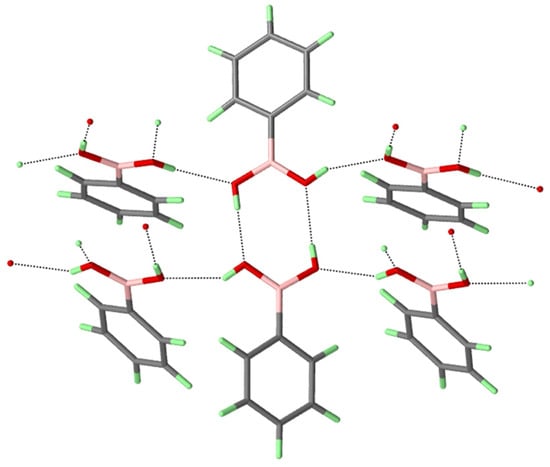
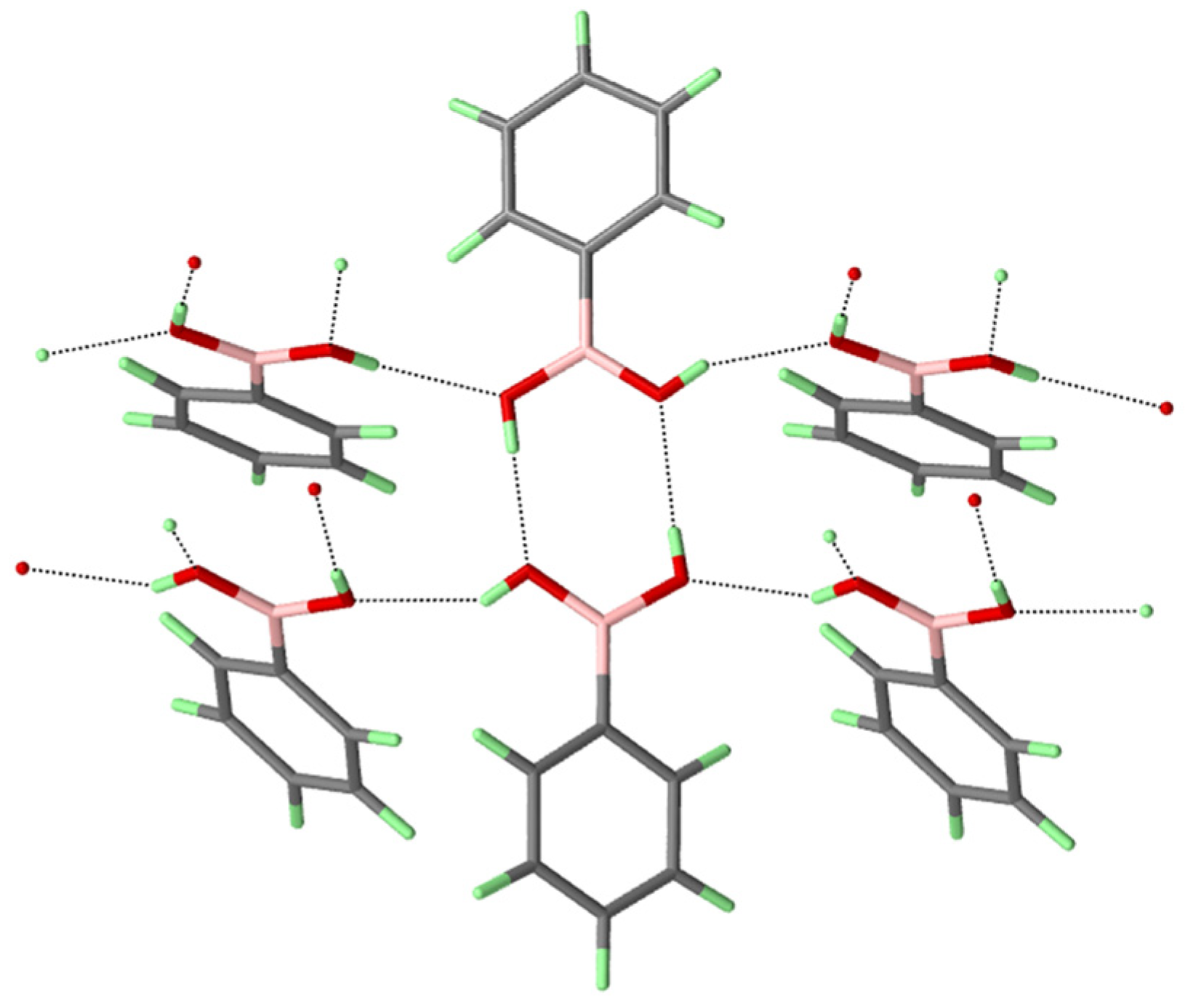
The structural screening data outlined in this study highlights both the predictable and flexibly multifunctional nature of the boronic acid moiety as a functional group for pharmaceutical crystal engineering. It has previously been established that the competitive balance between homosynthon molecular arrangement and heterosynthon formation is highly dependent upon stoichiometry, various solvents, and the specific physicochemical characteristics of the active pharmaceutical ingredient (API) itself. When investigating the bonding patterns formed by xanthine-based multi-component systems, it is evident that the spatial-electronic requirements of each component greatly affect how they will combine. Conversely, mapping the boundaries of these multi-component design pathways requires a systematic comparison against unsuccessful systems, which clarifies why certain donor–acceptor combinations fail to achieve successful co-crystallization under identical conditions. To ensure greater clarity regarding the screening scope, the specific organoboronic acids evaluated are phenylboronic acid, 4-chlorophenylboronic acid, and 3-carboxyphenylboronic acid. Within this baseline framework, phenylboronic acid itself shows a strong tendency toward self-association in the Iba2 space group, driven by characteristic dimeric O–H…O homosynthons, as shown in Figure 1 [15].
Figure 1.
Double O–H…O hydrogen-bonded homosynthon framework of clean phenylboronic acid crystallizing in the orthorhombic space group Iba2.
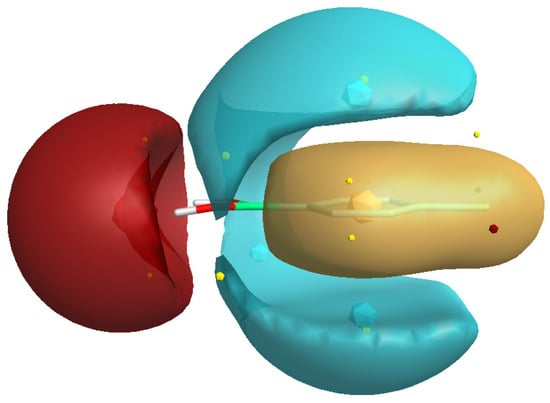
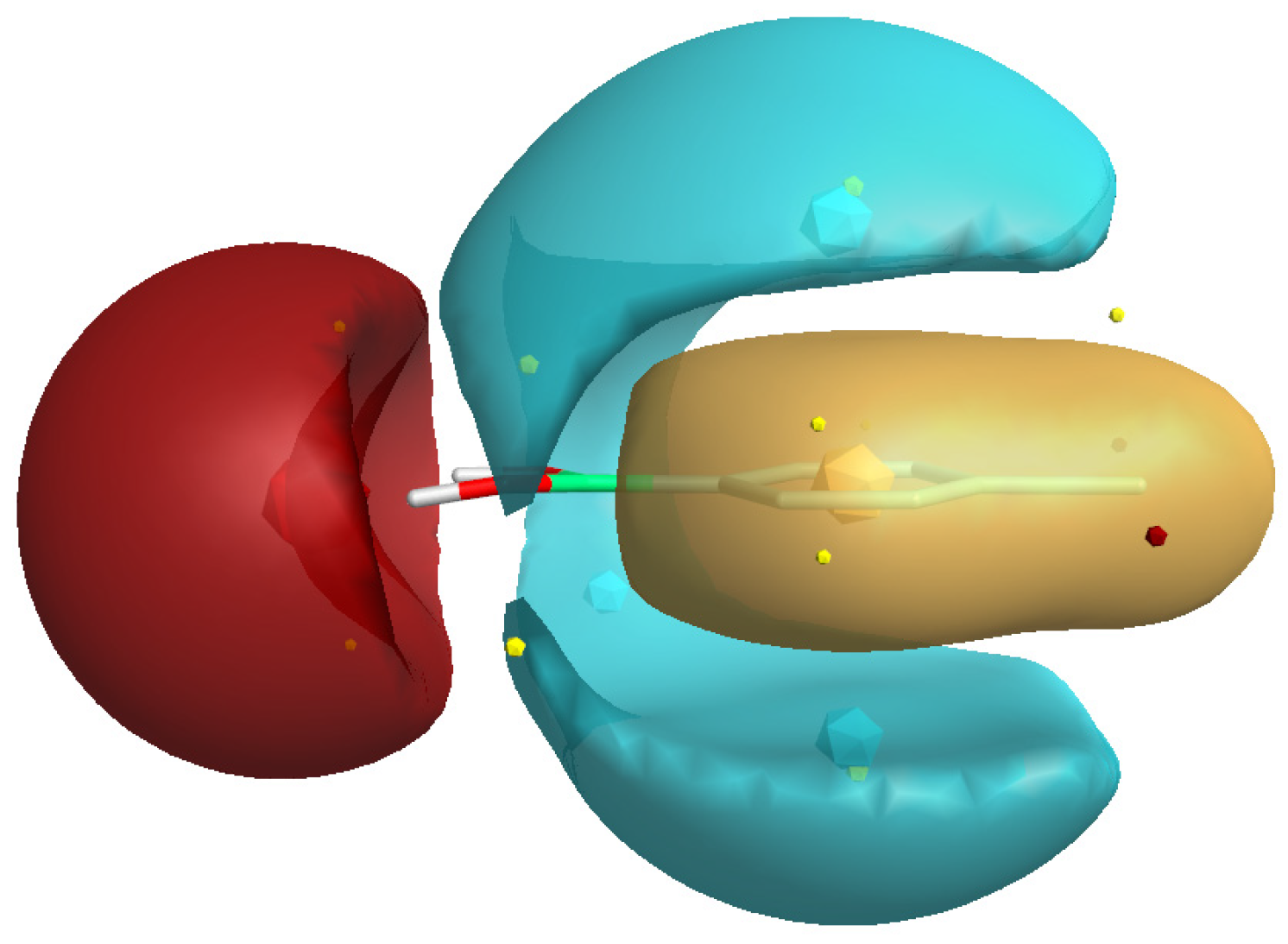
The molecular electrostatic potential (MEP) surfaces provide a detailed look at how substituents influence electronic distribution, adding context to the initial visual structural design. Noticeable differences are observed across various molecular moieties that influence the co-crystallization process. For example, as shown in Figure 2, the hydroxyl groups involved in hydrogen bonding serve as particularly strong potential donors. On the other hand, the aromatic core plays a role in shaping the crystal architecture and also affects secondary interactions through its π-charge distribution. These distinct molecular moieties complement each other within the supramolecular framework to direct the orientation of the functional co-formers.
Figure 2.
4-chlorophenylboronic acid: red highlights a potential hydrogen bond interaction, yellow represents the hydrophobic moiety, and blue indicates a negative π-charge.
The structural behavior of 4-chlorophenylboronic acid with caffeine and nitrofurazone, as well as 3-carboxyphenylboronic acid with theophylline, has already been thoroughly characterized in our previous investigations [11,12]. These multi-component systems demonstrated that the boronic acid dimers possess significant strength alongside a specific steric balance, which determines whether the homosynthon will dissociate or associate around the primary chains of the active pharmaceutical ingredient (API). However, the transferability of these supramolecular models to other pharmaceutical matrices has its clear physical limits. To define the scope of this design, these successful models were compared with our new screening data on paracetamol and amikacin, where heterosynthon formation was prevented [13]. Although heterosynthons are crucial in crystal engineering, this brief report focuses on transferability via dimeric B(OH)2 homosynthons. Detailed heterosynthon analyses are available in our cited papers [11,12,13].
4. Conclusions
Structural information regarding the mechanisms of crystal engineering based on several organic boronic acids has been provided, focusing on the structural behavior of the dimeric homosynthons across various active pharmaceutical ingredients. We have clarified the molecular and structural properties required to enable multi-component alignment, establishing the criteria that must be employed when selecting co-formers in order to refine and improve future designs of crystallization parameters for new multi-component pharmaceutical phases. Ultimately, the strong structural predictability of dimeric homosynthons provides a reliable design path, whereas mapping unsuccessful outcomes defines the thermodynamic limits of these systems. These synthesized insights lay a solid baseline for selecting future co-formers with optimized solubility and stability profiles.
Author Contributions
Conceptualization, V.D.; methodology, V.D.; formal analysis, V.D. and M.G.; investigation, V.D.; writing—original draft preparation, V.D.; writing—review and editing, V.D. and M.G. All authors have read and agreed to the published version of the manuscript.
Funding
This research received no external funding.
Institutional Review Board Statement
Not applicable.
Informed Consent Statement
Not applicable.
Data Availability Statement
Data sharing is not applicable to this article as no new datasets were generated during the current study. All analyzed crystallographic data were retrieved from the Cambridge Structural Database (CSD) or compiled from the cited previous publications [11,12,13].
Acknowledgments
The authors acknowledge the administrative and technical support provided by the Institute of Mineralogy and Crystallography, Bulgarian Academy of Sciences.
Conflicts of Interest
The authors declare no conflicts of interest.
Abbreviations
The following abbreviations are used in this manuscript:
| API | Active Pharmaceutical Ingredient |
| CSD | Cambridge Structural Database |
| MEP | Molecular Electrostatic Potential |
References
- Almarsson, Ö.; Zaworotko, M.J. Crystal engineering of the composition of pharmaceutical phases. Do pharmaceutical co-crystals represent a new path to improved medicines? Chem. Commun. 2004, 40, 1889–1896. [Google Scholar] [CrossRef] [Scilit] [PubMed]
- Desiraju, G.R. Crystal engineering: A brief overview. J. Chem. Sci. 2010, 122, 667–675. [Google Scholar] [CrossRef] [Scilit]
- Schultheiss, N.; Newman, A. Pharmaceutical Cocrystals and Their Physicochemical Properties. Cryst. Growth Des. 2009, 9, 2950–2967. [Google Scholar] [CrossRef] [Scilit] [PubMed]
- Shan, N.; Zaworotko, M.J. The role of cocrystals in pharmaceutical science. Drug Discov. Today 2008, 13, 440–446. [Google Scholar] [CrossRef] [Scilit] [PubMed]
- Rodríguez-Cuamatzi, P.; Arillo-Flores, O.I.; Bernal-Uruchurtu, M.I.; Höpfl, H. Theoretical and experimental evaluation of homo-and heterodimeric hydrogen-bonded motifs containing boronic acids, carboxylic acids, and carboxylate anions: Application for the generation of highly stable hydrogen-bonded supramolecular systems. Cryst. Growth Des. 2005, 5, 167–175. [Google Scholar] [CrossRef] [Scilit]
- Fujita, N.; Shinkai, S.; James, T.D. Boronic acids in molecular self-assembly. Chem. Asian J. 2008, 3, 1076–1091. [Google Scholar] [CrossRef] [Scilit] [PubMed]
- Blagden, N.; de Matas, M.; Gavan, P.T.; York, P. Crystal engineering of active pharmaceutical ingredients to improve solubility and dissolution rates. Adv. Drug Deliv. Rev. 2007, 59, 617–630. [Google Scholar] [CrossRef] [Scilit] [PubMed]
- Zheng, D.; Han, G.; Lemus, O.D.M.; Podgorsak, A.; Webster, M.; Li, F.; Zhou, Y.; Jung, H.; Yoon, J. Boron Neutron Capture Therapy: A Technology-Driven Renaissance. Cancers 2026, 18, 498. [Google Scholar] [CrossRef] [Scilit] [PubMed]
- Li, X.; Liu, Z.; Liu, K.; Wang, C.; Liu, Z.; Xu, X. Advances in Clinical Trials of Boron Neutron Capture Therapy. Research 2026, 9, 0988. [Google Scholar] [CrossRef] [Scilit] [PubMed]
- Groom, C.R.; Bruno, I.J.; Lightfoot, M.P.; Ward, S.C. The Cambridge Structural Database. Acta Crystallogr. B Struct. Sci. Cryst. Eng. Mater. 2016, 72, 171–179. [Google Scholar] [CrossRef] [Scilit] [PubMed]
- Dyulgerov, V.; Nikolova, R.P.; Dimova, L.T.; Shivachev, B.L. 3-Carboxyphenylboronic acid-theophylline (1/1). Acta Crystallogr. E 2012, 68, 02320. [Google Scholar] [CrossRef] [Scilit] [PubMed]
- Dyulgerov, V.; Sbirkova-Dimitrova, H.; Iliev, K.; Shivachev, B. The Co-Crystallization of 4-Halophenylboronic Acid with Aciclovir, Caffeine, Nitrofurazone, Theophylline, and Proline in Function of Weak Interactions. Crystals 2023, 13, 468. [Google Scholar] [CrossRef] [Scilit]
- Dyulgerov, V. Co-crystallization Attempts of Paracetamol and Amikacin with Organic Boronic Acids. Pharmakeftiki 2026, 38, 122–130. [Google Scholar]
- Politzer, P.; Murray, J.S. The fundamental nature and role of the electrostatic potential in atoms and molecules. Theor. Chem. Acc. 2002, 108, 134–142. [Google Scholar] [CrossRef] [Scilit]
- Rettig, S.J.; Trotter, J. Crystal and Molecular-Structure of Phenylboronic Acid, C6h5b(Oh)2. Can. J. Chem. 1977, 55, 3071–3075. [Google Scholar] [CrossRef] [Scilit]
Disclaimer/Publisher’s Note: The statements, opinions and data contained in all publications are solely those of the individual author(s) and contributor(s) and not of MDPI and/or the editor(s). MDPI and/or the editor(s) disclaim responsibility for any injury to people or property resulting from any ideas, methods, instructions or products referred to in the content. |
© 2026 by the authors. Licensee MDPI, Basel, Switzerland. This article is an open access article distributed under the terms and conditions of the Creative Commons Attribution (CC BY) license.