


Abstract
We report the results of ab initio calculations of the lattice parameters and thermal expansion coefficients α(T) of calcite-type FeBO3 and CrBO3 borates. The calculated parameters were complemented by experimental data for these borates. Other thermodynamic properties, namely the isochoric heat capacity CV, the Debye temperature θD, and the Grüneisen parameter γ, were also calculated. The calculations were performed using two approaches. The first uses the quasi-harmonic Debye model, which provides thermodynamic properties from elastic constants via the Debye–Grüneisen formalism. In the second approach, thermodynamic properties were obtained based on the calculated phonon density of states.
1. Introduction
Controlling the coefficient of thermal expansion (CTE) is one of the pressing challenges in modern materials science. Materials with low thermal expansion (LTE) are in demand for the development of precision optical, electronic and composite devices, where thermal deformations can lead to functional failure and degradation. According to the classification by Roy et al. [1], materials with low thermal expansion are defined as those with an average linear CTE <α> ≤ 8 × 10⁻⁶ K−1. Among various compound classes, borates are of particular interest due to their rich crystal chemistry and combination of optical, magnetic and nonlinear properties [2,3,4]. A key challenge remains the lack of experimental thermal expansion data for most members of the MBO3 series. The first experimental investigations of polycrystalline FeBO3 by high-temperature powder X-ray diffraction (93–1173 K) revealed low average expansion (<α> = 8 × 10⁻⁶ K−1) and anomalies in lattice parameters near TN [5,6]. Information on thermal expansion of CrBO3 is based on experimental (<α> = 6 × 10⁻⁶ K−1 over 295–903 K) and density functional theory (DFT) calculations predicting low positive expansion (α = 15 × 10−6 K–1 at 300 K) [7,8]. In contrast, information on the thermal expansion of Ga and Al borates has been limited to density functional theory (DFT) calculations: their mechanical and thermal properties have been studied primarily through first-principles, which revealed thermal expansion values equal to 21 and 18 × 10−6 K−1 at 300 K, respectively [9,10,11].
Here, we present ab initio density functional theory (DFT) calculations performed for FeBO3 and CrBO3 complemented by experimental data for these borates. This synergistic approach enables direct verification of theoretical predictions against experimental benchmarks, provides deeper insight into the magnetostructural mechanisms governing thermal expansion and assesses the series potential for developing materials with tunable properties for optical applications.
2. Computational Details
All calculations were performed within density functional theory (DFT) as implemented in the Vienna Ab Initio Simulation Package (VASP version 6.4) [12], accessed through the MedeA computational environment (Materials Design, Inc., San Diego, CA, USA). The exchange–correlation energy was described using the generalized gradient approximation in the PBEsol parametrization (GGA-PBEsol) [13], which is specifically optimized for accurate description of equilibrium lattice constants in solids. Interactions between valence electrons and ionic cores were treated within the projector augmented-wave (PAW) method. The plane-wave kinetic energy cutoff was set to 600 eV. Brillouin zone sampling was performed on a Monkhorst–Pack k-point grid with a spacing of 0.2 Å−1 in reciprocal space. The convergence threshold for the self-consistent electronic iterations was set to 10−8 eV. Full structural relaxation was carried out allowing all degrees of freedom to vary simultaneously: atomic fractional coordinates, lattice parameters, and cell shape. The geometry was considered converged when all residual forces fell below 0.001 eV/Å.
Both CrBO3 and FeBO3 adopt the calcite-type rhombohedral structure (space group R-3c, No. 167). To assess the influence of electron correlation and magnetism on equilibrium structures, we performed three distinct structural optimization protocols for each compound: (i) GGA-PBEsol calculation in a nonmagnetic mode without the Hubbard correction (DFT calculation), (ii) GGA-PBEsol+U calculation in a nonmagnetic mode with the Hubbard correction (DFT+U calculation), and (iii) a spin-polarized GGA-PBEsol+U calculation with explicit antiferromagnetic ordering and the Hubbard correction (AFM DFT+U calculation). The Hubbard correction was included within the simplified rotationally invariant Dudarev formalism, applying an effective on-site Coulomb parameter Ueff = U − J to the 3d states of the transition-metal cations. For FeBO3 we used Ueff(Fe 3d) = 5 eV, and for CrBO3 Ueff(Cr 3d) = 3 eV. In the AFM DFT+U calculations, Fe3+ and Cr3+ were constrained in a two-sublattice G-type antiferromagnetic configuration consistent with the calcite-type lattice, with high-spin initial moments assigned to symmetry-inequivalent metal sites and a compensated net magnetization in the unit cell.
Lattice dynamics were studied using the finite-displacement supercell method as implemented in the MedeA Phonon module [14]. In this approach, atomic force constants are obtained from the forces induced by small symmetry-inequivalent displacements of atoms in a supercell, after which the dynamical matrix is constructed and diagonalized to yield phonon frequencies across the Brillouin zone. The phonon density of states (PDOS), g(ω), was subsequently used to derive thermodynamic quantities within the harmonic approximation.
Thermodynamic properties, including the isochoric heat capacity CV, the Debye temperature θD, the Grüneisen parameter γ, and the thermal expansion coefficient α(T), were obtained from two complementary approaches. The first is the quasi-harmonic Debye model, implemented within the MT-Elastic module of MedeA [15,16], which provides thermodynamic properties from elastic constants via the Debye–Grüneisen formalism. The second approach uses the calculated phonon density of states. Within the harmonic approximation, the lattice heat capacity at constant volume is evaluated using the expression:
where d is the number of degrees of freedom in the unit cell, g(ω) is the normalized phonon density of states, ħ is the reduced Planck constant, kB is the Boltzmann constant, and T is the absolute temperature.
3. Results
Both CrBO3 and FeBO3 crystallize in the trigonal R-3c structure (space group No. 167), which is isostructural with calcite (CaCO3). In this structure, the transition-metal cation (Cr3+ or Fe3+) occupies the octahedrally coordinated 6b Wyckoff site, while B3+ occupies a trigonal-planar 6a site bonded to three equivalent oxygen atoms. The oxygen atoms bridge the metal-centered octahedra and the BO3 triangular units, forming a three-dimensional network.
The relaxed lattice parameters and fractional coordinates obtained after full structural optimization are summarized in Table 1 and Table 2, respectively. The experimental values of lattice parameters at 295 K from ref. [8] are also provided in the last column in Table 1. It is clearly seen that taking into account both electron correlation and magnetism effects leads to more reliable calculation results. Note that the observed deviations of lattice parameters are within the typical 1–2% range expected for GGA-PBEsol(+U) calculations on 3d transition-metal oxides and borates [17,18]. The results of AFM DFT+U optimization were mainly used to calculate the properties of CrBO3 and FeBO3. However, DFT+U calculation results for FeBO3 are also presented to distinguish the impact of antiferromagnetic ordering on the obtained thermodynamic parameters. It should also be noted that considering the antiferromagnetic ordering has a more pronounced effect on the c parameters of the crystal lattice. It shows strong magnetostriction in these borates, which has a notable influence on the lattice parameters.
Table 1.
Optimized crystal lattice parameters of CrBO3 and FeBO3 obtained using three different structural optimization protocols. Relative deviations of calculated values in percentages are shown in square brackets.
Table 2.
Fractional atomic coordinates in the optimized structures of CrBO3 and FeBO3 calculated with AFM magnetic ordering and using Hubbard U values of 3 and 5 eV, respectively, in R-3c symmetry.
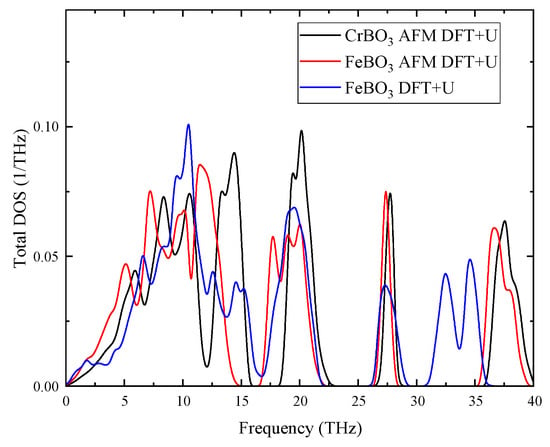
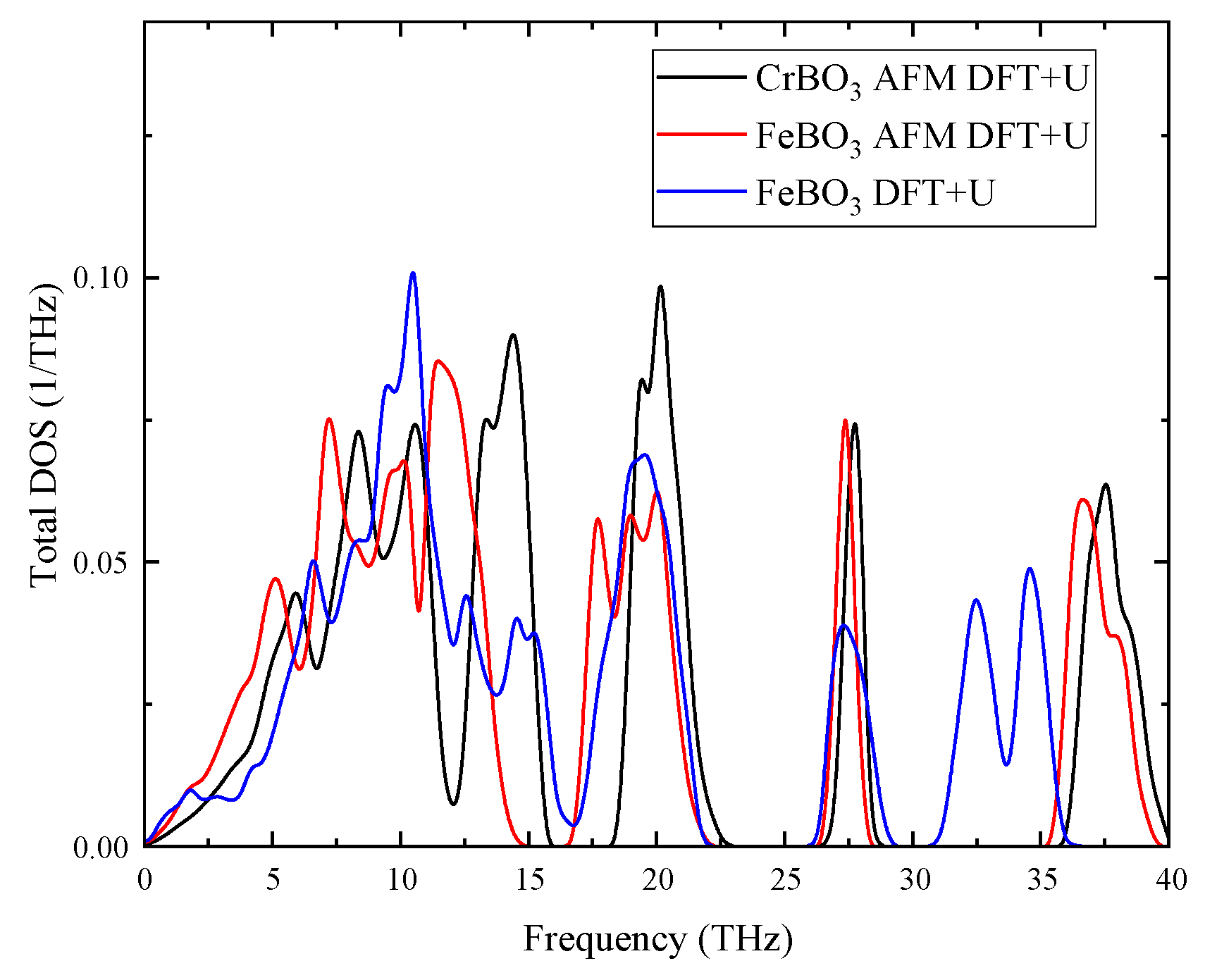
The total phonon density of states (PDOS) calculated for CrBO3 and FeBO3 are presented in Figure 1. The PDOS of both compounds exhibits a characteristic separation into low-frequency (up to 15 THz) bands associated primarily with the heavy transition-metal sublattice (Fe3+ and Cr3+ correspondingly) and high-frequency (starting from 18 THz) optical branches attributed to the internal vibrations of the stiff BO3 units. In general, the phonon density of states of CrBO3 has a higher frequency character compared to FeBO3, which is probably explained by the lighter Cr3+ ions compared to Fe3+ ions. In Figure 1, the PDOS calculated for the nonmagnetic DFT+U relaxed FeBO3 structure is shown as well. The most pronounced difference between the two PDOS calculated for FeBO3 may be observed in the position of the highest energy optical branch. Accounting for AFM ordering in calculations also leads to a small shift of the low-frequency band in the FeBO3 PDOS to the lower frequencies, probably due to increased lattice parameter values.
Figure 1.
Total phonon density of states for CrBO3 AFM DFT+U calculation (black) and FeBO3 (red—AFM DFT+U calculation; blue—nonmagnetic DFT+U calculation) calculated using the finite-displacement supercell method.
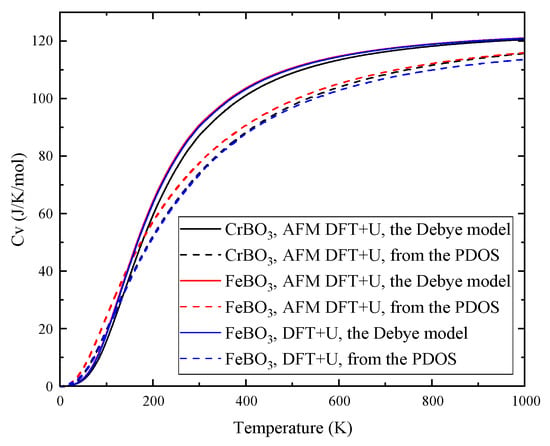
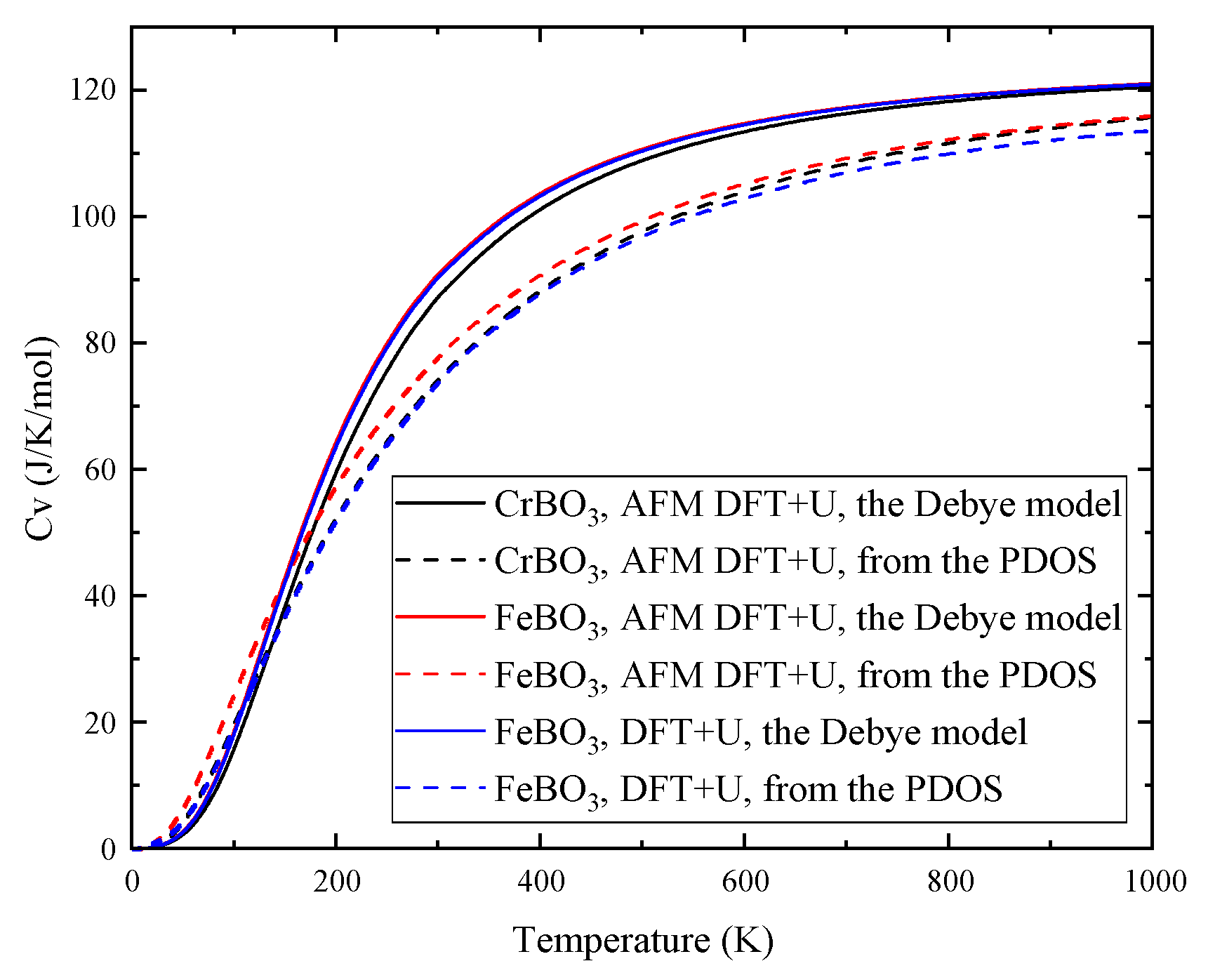
The temperature dependence of the isochoric heat capacity CV for CrBO3 and FeBO3, calculated using both the quasi-harmonic Debye model and the phonon-DOS-based approach (Equation (1)), is displayed in Figure 2. At low temperatures, both compounds exhibit the characteristic T3 dependence predicted by the Debye model. As temperature increases, CV approaches the classical Dulong–Petit limit. Interestingly, the isochoric heat capacities calculated for the nonmagnetic (DFT+U) and antiferromagnetic (AFM DFT+U) FeBO3 structures using the quasi-harmonic Debye model are almost identical. However, the heat capacities obtained using the calculated phonon density of states (PDOS) differ slightly: the isochoric heat capacity (CV) of the magnetic FeBO3 structure is higher than that of the nonmagnetic structure. This difference is due to the observed deviation of the PDOS of FeBO3 in the nonmagnetic structure from that calculated for the antiferromagnetic structure, as was noted above (Figure 1).
Figure 2.
Calculated isochoric heat capacity CV as a function of temperature for CrBO3 AFM DFT+U calculation (black) and FeBO3 (red—AFM DFT+U calculation; blue—nonmagnetic DFT+U calculation). Solid lines correspond to values obtained within the quasi-harmonic Debye model; dashed lines represent results derived from the phonon density of states via Equation (1).
The Debye temperature θD and Grüneisen parameter γ, extracted from the MT-Elastic quasi-harmonic Debye model calculations, are listed in Table 3. The Debye temperature of CrBO3 is higher relative to FeBO3, which is consistent with the calculated phonon DOS (Figure 1). The higher value of γ for FeBO3 (1.6129 vs. 1.5876 for CrBO3) suggests stronger volume–frequency coupling in this iron borate. At the same time, the isothermal bulk modulus B of CrBO3 is higher than that obtained for FeBO3, which indicates a more rigid crystalline structure of CrBO3. The calculated values of B agree with the experimental values and compressibility systematics for borates [19]. In the case of DFT+U calculations, the Debye temperature, the Grüneisen parameter, and the isothermal bulk modulus values of FeBO3 are found to be higher compared with the AFM DFT+U calculation results.
Table 3.
Calculated Debye temperature θD, Grüneisen parameter γ, and isothermal bulk modulus B for CrBO3 and FeBO3 obtained from the quasi-harmonic Debye model.
The volumetric thermal expansion coefficient αV is obtained from the isochoric heat capacity via the Debye–Grüneisen relation:
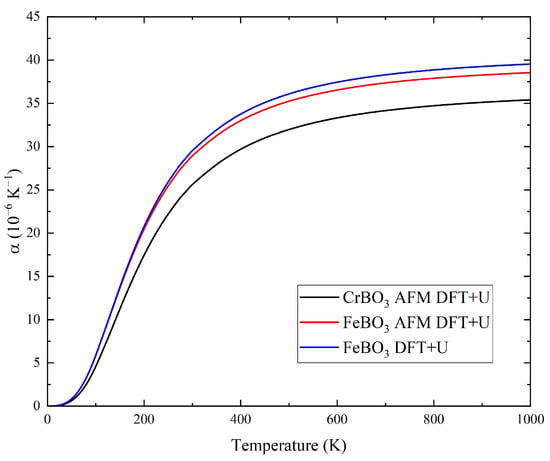
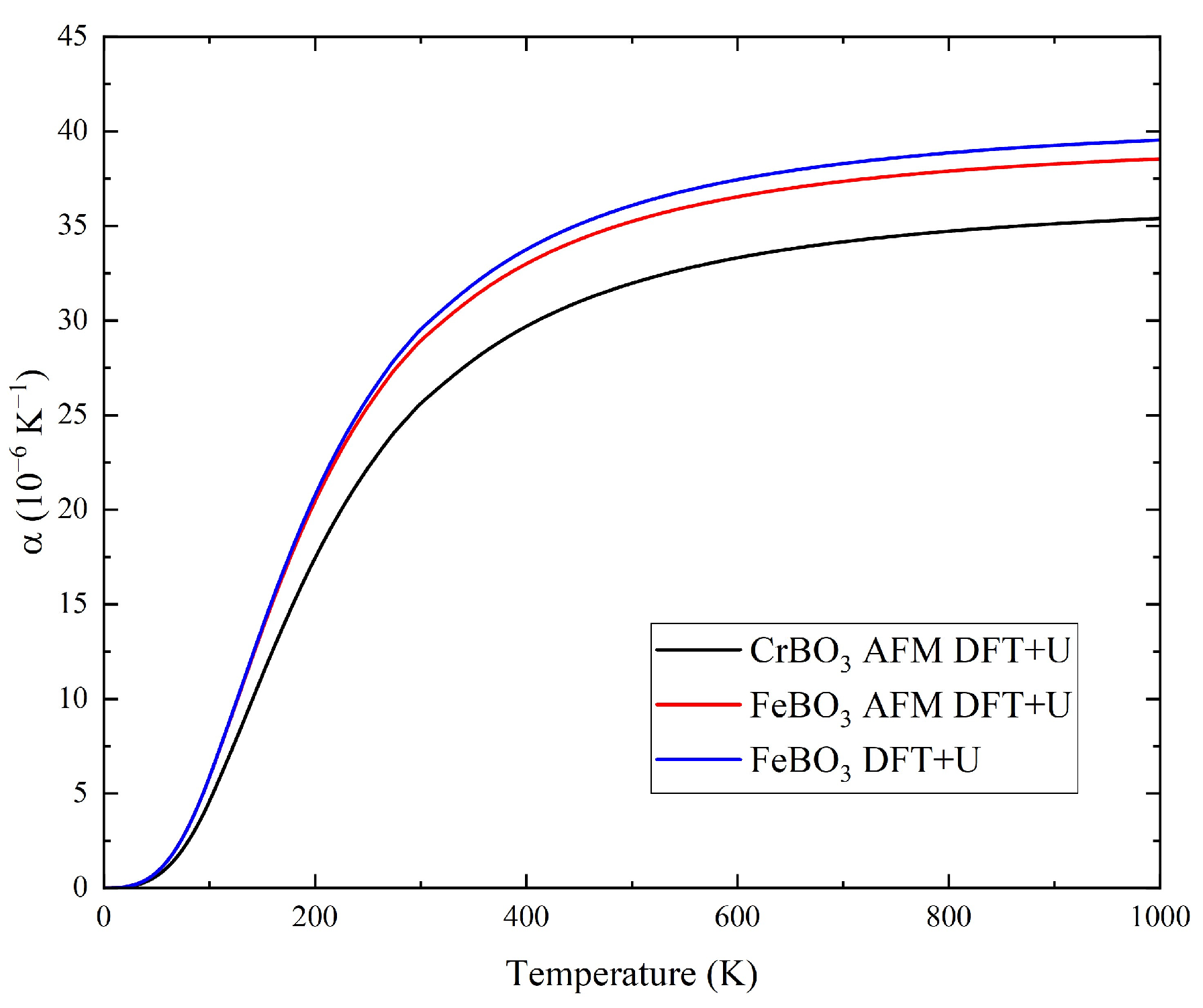
where γ is the Grüneisen parameter, B is the isothermal bulk modulus, and V0 is the equilibrium unit cell volume. The temperature dependence of the volumetric thermal expansion coefficient α(T), evaluated within the quasi-harmonic Debye model, is shown in Figure 3. At low temperatures, for both borates α rises steeply from near zero, approaching a roughly constant value at high temperatures, as expected within the quasi-harmonic approximation. Our calculation results show that the thermal expansion of FeBO3 is higher compared to CrBO3, which is also consistent with experimentally obtained results [8]. Since the BV0 product is nearly constant for borates [19], higher α(T) for FeBO3 is due to higher values of the Grüneisen parameter γ (Table 3) and the isochoric heat capacity CV (Figure 2) compared with CrBO3.
Figure 3.
Temperature dependence of the volumetric thermal expansion coefficient for CrBO3 AFM DFT+U calculation (black) and FeBO3 (red—AFM DFT+U calculation; blue—nonmagnetic DFT+U calculation), obtained within the quasi-harmonic Debye model.
Thermal expansion of FeBO3 evaluated within the nonmagnetic DFT+U calculation is somewhat more than that obtained within the AFM DFT+U calculation. The main reason for this is the smaller equilibrium volume of the nonmagnetic structure, which leads to the increase in α(T) since α(T)~1/V0. However, the γ/B ratio for the AFM DFT+U structure of FeBO3 is a little more than for the nonmagnetic DFT+U structure. We suppose that this originates from the stepwise drop of α(T) at the magnetic transition temperature (Neel temperature) observed experimentally [8].
4. Conclusions
In this work, the results of an ab initio study of structural and thermodynamic properties of two calcite-type borates, CrBO3 and FeBO3, were reported. The crystal structure parameters were obtained for both borates under full structural relaxation. Using these optimized structures, Debye temperature θD, Grüneisen parameter γ, and isothermal bulk modulus B values for CrBO3 and FeBO3 were calculated. The isochoric heat capacity CV(T) curves were obtained using two approaches: (i) the quasi-harmonic Debye model, and (ii) the calculated phonon density of states. Using the calculated values, the thermal expansion coefficient α(T) was evaluated based on the Debye–Grüneisen relation. Calculated values were complemented by experimental data for these borates.
Author Contributions
Conceptualization, M.D.K. and A.L.Z.; methodology, M.D.K. and A.L.Z.; software, M.D.K. and A.L.Z.; validation, M.D.K., A.L.Z., Y.P.B., N.V.K., F.G.V. and R.S.B.; formal analysis, M.D.K., A.L.Z., Y.P.B. and N.V.K.; investigation, M.D.K., A.L.Z., Y.P.B., Y.S.G., N.V.K., M.G.K., F.G.V. and R.S.B.; data curation, M.D.K., A.L.Z. and Y.P.B.; writing—original draft preparation, M.D.K. and A.L.Z.; writing—review and editing, M.D.K., A.L.Z., Y.P.B., Y.S.G., N.V.K., M.G.K., F.G.V. and R.S.B.; visualization, M.D.K. and A.L.Z.; supervision, A.L.Z., Y.P.B., N.V.K., F.G.V. and R.S.B.; project administration, M.D.K. and Y.P.B.; funding acquisition, M.D.K. and Y.P.B. All authors have read and agreed to the published version of the manuscript.
Funding
This work was supported by the Russian Science Foundation (project 25-73-00080), https://rscf.ru/project/25-73-00080/ (accessed on 9 July 2025).
Institutional Review Board Statement
Not applicable.
Informed Consent Statement
Not applicable.
Data Availability Statement
The raw data supporting the conclusions of this article will be made available by the authors on request.
Conflicts of Interest
The authors declare no conflicts of interest. The funders had no role in the design of the study; in the collection, analyses, or interpretation of data; in the writing of the manuscript; or in the decision to publish the results.
References
- Roy, R.; Agrawal, D.K.; McKinstry, H.A. Very Low Thermal Expansion Coefficient Materials. Annu. Rev. Mater. Sci. 1989, 19, 59–81. [Google Scholar] [CrossRef]
- Bubnova, R.S.; Filatov, S.K. High-Temperature Borate Crystal Chemistry. Z. Für Krist.-Cryst. Mater. 2013, 228, 395–428. [Google Scholar] [CrossRef] [Scilit]
- Mutailipu, M.; Poeppelmeier, K.R.; Pan, S. Borates: A Rich Source for Optical Materials. Chem. Rev. 2020, 121, 1130–1202. [Google Scholar] [CrossRef] [Scilit]
- Sanglay, G.D.D.; Garcia, J.S.; Palaganas, M.S.; Sorolla, M., II; See, S.; Limjuco, L.A.; Ocon, J.D. Borate-Based Compounds as Mixed Polyanion Cathode Materials for Advanced Batteries. Molecules 2022, 27, 8047. [Google Scholar] [CrossRef] [Scilit]
- Biryukov, Y.P.; Filatov, S.K.; Vagizov, F.G.; Zinnatullin, A.L.; Bubnova, R.S. Thermal Expansion of FeBO3 and Fe3BO6 Antiferromagnets Near the Neel Temperature. J. Struct. Chem. 2018, 59, 1980–1988. [Google Scholar] [CrossRef] [Scilit]
- Biryukov, Y.P.; Bubnova, R.S.; Dmitrieva, N.V.; Filatov, S.K. Thermal Behavior of Antiferromagnets FeBO3 and Fe3BO6 at Negative Temperatures. Glass Phys. Chem. 2019, 45, 147–149. [Google Scholar] [CrossRef] [Scilit]
- Yang, D.; Li, Y. Unraveling Low Thermal Expansion of CrBO3 via Atomic Scale Analysis: Flexible CrO6 Octahedron vs Rigid BO3 Triangle Group. J. Appl. Phys. 2025, 138, 095104. [Google Scholar] [CrossRef] [Scilit]
- Biryukov, Y.P.; Zinnatullin, A.L.; Shablinskii, A.P.; Gokhfeld, Y.S.; Avdontceva, M.S.; Cherosov, M.A.; Kazak, N.V.; Krzhizhanovskaya, M.G.; Kuznetsov, M.D.; Ugolkov, V.L.; et al. Tunable Negative and Low Thermal Expansion in Magnetic Calcite-Type Fe1−xCrxBO3 (x = 0.0, 0.14, 1.0) Borates: A Comprehensive in Situ Study. J. Mater. Chem. C 2026, 14, 12504–12519. [Google Scholar] [CrossRef] [Scilit]
- Wu, H.; Ma, H.; Zhang, X.; Chen, L.; Wang, X.; Li, H. First-Principles Study of the Mechanical and Thermal Properties of Borates MBO3 (M = Sc, Al, Ga) under High Pressure. Vacuum 2026, 248, 115160. [Google Scholar] [CrossRef] [Scilit]
- Yang, D.; Tang, Y.; Xia, H.; Yin, K.; Li, Y. Unraveling Superior Elasticity and Controlled Thermal Expansion in Trigonal MBO3 (M=Al, Ga) with Isolated [BO3] Group: A Theoretical Perspective. Eur. J. Inorg. Chem. 2024, 27, e202400379. [Google Scholar] [CrossRef] [Scilit]
- Wu, H.; Ma, H.; Zhang, X.; Chen, L.; Chen, S.; Li, H. First-Principles Prediction of Mechanical, Electrical, and Optical Properties in Borates MBO3 (M = Sc, Al, Ga, Ti). Phys. Scr. 2025, 100, 095907. [Google Scholar] [CrossRef] [Scilit]
- Kresse, G.; Furthmüller, J. Efficient Iterative Schemes forAb InitioTotal-Energy Calculations Using a Plane-Wave Basis Set. Phys. Rev. B 1996, 54, 11169–11186. [Google Scholar] [CrossRef] [Scilit]
- Perdew, J.P.; Burke, K.; Ernzerhof, M. Generalized Gradient Approximation Made Simple. Phys. Rev. Lett. 1996, 77, 3865–3868. [Google Scholar] [CrossRef] [Scilit]
- Parlinski, K.; Li, Z.Q.; Kawazoe, Y. First-Principles Determination of the Soft Mode in Cubic ZrO2. Phys. Rev. Lett. 1997, 78, 4063–4066. [Google Scholar] [CrossRef] [Scilit]
- Le Page, Y.; Saxe, P. Symmetry-General Least-Squares Extraction of Elastic Data for Strained Materials from Ab Initio Calculations of Stress. Phys. Rev. B 2002, 65, 104104. [Google Scholar] [CrossRef] [Scilit]
- Suter, U.W.; Eichinger, B.E. Estimating Elastic Constants by Averaging over Simulated Structures. Polymer 2002, 43, 575–582. [Google Scholar] [CrossRef] [Scilit]
- Hinuma, Y.; Hayashi, H.; Kumagai, Y.; Tanaka, I.; Oba, F. Comparison of Approximations in Density Functional Theory Calculations: Energetics and Structure of Binary Oxides. Phys. Rev. B 2017, 96, 094102. [Google Scholar] [CrossRef] [Scilit]
- He, L.; Liu, F.; Hautier, G.; Oliveira, M.J.T.; Marques, M.A.L.; Vila, F.D.; Rehr, J.J.; Rignanese, G.-M.; Zhou, A. Accuracy of Generalized Gradient Approximation Functionals for Density-Functional Perturbation Theory Calculations. Phys. Rev. B 2014, 89, 064305. [Google Scholar] [CrossRef] [Scilit]
- Santamaría-Pérez, D.; Gomis, O.; Sans, J.A.; Ortiz, H.M.; Vegas, Á.; Errandonea, D.; Ruiz-Fuertes, J.; Martinez-Garcia, D.; Garcia-Domene, B.; Pereira, A.L.J.; et al. Compressibility Systematics of Calcite-Type Borates: An Experimental and Theoretical Structural Study on ABO3 (A = Al, Sc, Fe, and In). J. Phys. Chem. C 2014, 118, 4354–4361. [Google Scholar] [CrossRef] [Scilit]

Disclaimer/Publisher’s Note: The statements, opinions and data contained in all publications are solely those of the individual author(s) and contributor(s) and not of MDPI and/or the editor(s). MDPI and/or the editor(s) disclaim responsibility for any injury to people or property resulting from any ideas, methods, instructions or products referred to in the content. |
© 2026 by the authors. Licensee MDPI, Basel, Switzerland. This article is an open access article distributed under the terms and conditions of the Creative Commons Attribution (CC BY) license.