


Abstract
Background/Objectives: Orforglipron and danuglipron are oral small-molecule glucagon-like peptide-1 (GLP-1) receptor agonists with different clinical development trajectories. We evaluated their efficacy and safety separately, without assuming comparative equivalence. Methods: PubMed, Embase, CENTRAL, Web of Science, trial-register and citation searches were conducted to 17 September 2026 (PROSPERO CRD420261508176). Eligible phase 2/3 randomized trials were synthesized by molecule, phase, population, comparator and estimand. Targeted phase 3 orforglipron 36 mg versus placebo meta-analyses used restricted maximum likelihood (REML), with DerSimonian–Laird, common-effect and modified Hartung–Knapp–Sidik–Jonkman (mHKSJ) sensitivity analyses. Safety outcomes were analyzed as risk ratios where compatible arm-level counts were available. Results: Of 505 database records, 286 remained after deduplication. Thirteen eligible trials were identified from the bibliographic evidence and one additional eligible trial, ACHIEVE-4, from register/sponsor sources (14 trials: 11 orforglipron and three danuglipron). Three phase 3 trials contributed to each principal placebo-controlled efficacy meta-analysis (599 participants randomized to 36 mg; 909 to placebo). The pooled glycated hemoglobin (HbA1c) difference was −1.14 percentage points (95% confidence interval [CI] −1.25 to −1.02; mHKSJ −1.40 to −0.88; I2 = 0%). The corrected body-weight difference was −6.39 percentage points (95% CI −7.38 to −5.39; mHKSJ −8.58 to −4.20; I2 = 29.3%). Danuglipron phase 2 trials reported glycemic and weight reductions, with substantial tolerability-related discontinuation in several arms. A later sponsor-reported probable liver injury occurred outside the three included danuglipron trials. Conclusions: Orforglipron reduced HbA1c and body weight versus placebo in the analyzed phase 3 trials. Danuglipron showed efficacy signals in separate phase 2 evidence. Indirect differences in trial designs, follow-up, estimands and attrition preclude conclusions of equivalent efficacy or comparative hepatic safety. Dosing, titration, tolerability and hepatic events are possible contributors to the different development trajectories; their causal contributions were not established by this review.
1. Introduction
Type 2 diabetes (T2D) and obesity affect a substantial and growing proportion of the global population and frequently coexist, compounding cardiometabolic risk [1,2]. Glucagon-like peptide-1 (GLP-1) receptor agonists are established, effective therapies for both conditions, but nearly all currently available agents are peptides that require subcutaneous injection; the one approved oral peptide formulation, semaglutide, requires strict fasting conditions before and after administration to ensure adequate absorption [3]. These administration requirements are associated with reduced treatment persistence and adherence in real-world settings [4], and have motivated the development of oral small-molecule GLP-1 receptor agonists that, being non-peptides, are not subject to gastrointestinal proteolytic degradation and can in principle be formulated for simple, unrestricted oral dosing [5].
Two oral small-molecule GLP-1 receptor agonists considered in this review have followed different clinical development trajectories. Orforglipron advanced through phase 3 trials in type 2 diabetes and obesity, including active-comparator studies, and received US approval for chronic weight management [6]. Danuglipron development was discontinued in April 2025 after a probable drug-induced liver injury (DILI) in a later dose-optimization program [7]. This regulatory context is described separately from the randomized trial evidence and does not establish comparative efficacy or safety.
The available evidence warrants synthesis, but the two molecules have not been compared in a head-to-head randomized trial. Differences between their programs include development phase, dose-escalation schedules, populations, follow-up, handling of treatment discontinuation and evidence available for uncommon hepatic events. Existing PROSPERO registrations address related questions across the wider oral GLP-1 receptor agonist class [8,9,10]. The present review evaluates each molecule separately and considers the development trajectories as context rather than as an outcome for causal attribution.
Our objectives were to summarize efficacy and safety of orforglipron and danuglipron in adults with type 2 diabetes and/or obesity; conduct targeted, within-molecule meta-analyses where clinically and methodologically compatible contrasts were available; and identify the limits of inference from the separate clinical development programs. We did not undertake a formal indirect comparison or network meta-analysis of the two drugs.
2. Methods
This systematic review was conducted in accordance with the Preferred Reporting Items for Systematic Reviews and Meta-Analyses (PRISMA) 2020 statement [11] and was prospectively registered on PROSPERO (registration number CRD420261508176).
2.1. Eligibility Criteria
We included phase 2/3 randomized trials of orforglipron or danuglipron at any dose or formulation in adults with type 2 diabetes and/or overweight or obesity. Placebo, active-comparator and randomized dose-comparison designs were eligible. Phase 1, non-randomized, mechanistic and secondary reports were not counted as independent eligible trials. Reports of the same trial were linked to avoid counting participants twice. Publication status was not an exclusion criterion: eligible sponsor-reported evidence was retained, with its source and limitations explicitly identified.
2.2. Information Sources and Search Strategy
We searched PubMed, Embase, CENTRAL and Web of Science through 17 September 2026 without language restrictions (Table S1). ClinicalTrials.gov and reference lists were additional sources. During revision, source documents were checked to validate existing trial identifiers, data and source provenance; this check was not represented as a new, fully rerun systematic search. For ACHIEVE-4, the sponsor report dated 16 April 2026 was already available before the search cutoff and is now correctly included as an eligible non-pooled source [12]. The original ATTAIN-1 supplementary safety table and the pre-cutoff posted results for ACHIEVE-J (first posted 30 June 2026) were retrieved during revision to complete previously missing descriptive safety counts [13].
2.3. Study Selection and Data Extraction
The supplied screening record was reviewed by trial identifier and publication type. For this revision, treatment-effect estimates, confidence levels, treatment duration, estimands and arm-level sample sizes contributing to the meta-analyses were checked against primary reports. Randomized sample sizes are reported for efficacy contrasts and treated sample sizes for safety outcomes; they are not interchangeable. Data extraction and checks were conducted by one reviewer with a second check as described in the registered workflow. The reproducible analysis inputs, sources and calculations are supplied in Dataset S2.
2.4. Risk of Bias Assessment
Risk of bias was assessed using the revised Cochrane risk-of-bias tool (RoB 2) across the five standard domains [14]. The principal placebo-controlled phase 3 efficacy results used treatment-regimen estimands; judgments refer to the results being synthesized rather than merely to trial labels. For phase 2 danuglipron, attrition and censoring after treatment discontinuation limit interpretation. Results without a placebo or active-molecule comparator (ACHIEVE-J) are described as randomized dose-comparison evidence, without an assessment of a placebo-controlled effect. The topline ACHIEVE-4 report does not permit a complete domain-level RoB 2 judgment.
2.5. Data Synthesis
Data were organized by molecule, development phase, population, comparator, dose, follow-up and estimand. In accordance with the registered phase-stratified approach, phase 2 evidence was presented separately from phase 3 evidence. The targeted phase 3 meta-analyses selected one 36 mg orforglipron versus placebo contrast per trial, avoiding repeated use of a shared placebo arm. This dose-specific restriction was an analytic choice, not a restriction in the registered eligibility criteria, and does not summarize the entire dose–response relation. The presence of a dulaglutide arm in the phase 2 T2D trial does not invalidate its placebo contrast; the previous explanation to that effect has been removed. Phase 2 efficacy is now reported separately. Across-molecule contrasts, active-comparator trials and weight-maintenance trials were not combined with the placebo-controlled phase 3 treatment-initiation contrasts.
Adjusted treatment differences were pooled using generic inverse-variance restricted maximum likelihood (REML) random-effects models; SE = (upper CI − lower CI)/(2 × 1.959964) for reported 95% CIs. Randomized N is descriptive and does not enter the weight calculation. Wald 95% CIs are accompanied by DerSimonian–Laird [15] and common-effect estimates, ordinary HKSJ and modified HKSJ analyses using t(k − 1) and variance scale max [1,Q_RE/(k − 1)], and leave-one-out analyses. We report Q, I2 and tau2, recognizing that their estimation is unreliable with few studies. The original two-trial weight subset is retained as a sensitivity analysis; the corrected main analysis includes the previously omitted, extractable ACHIEVE-1 weight contrast. Published 90% CIs for danuglipron are labeled as 90% CIs and are not silently treated as 95% CIs. Safety log-risk ratios and their sampling variances were calculated from treated arm counts; a 0.5 correction was applied to all four cells only when a zero cell occurred. Safety was pooled separately for the three phase 3 T2D placebo comparisons, with other phases, populations, comparators, maintenance/rescue designs and danuglipron titration cohorts tabulated separately. Hepatic events were described by trial and source rather than pooled as a common DILI risk. This restores part of the planned safety synthesis; residual non-pooling is declared and justified by these specific differences. The primary efficacy Grading of Recommendations Assessment, Development and Evaluation (GRADE) assessment [16] concerns the selected placebo contrasts, not equivalence between molecules. For outcomes not amenable to quantitative pooling, we followed the Synthesis Without Meta-analysis (SWiM) reporting guidance [17]. Analyses were reproduced in Python (version 3.15.2) with NumPy (version 2.5.4) and SciPy (version 1.18.1); executable code is provided in Dataset S2. Few-study interpretation follows contemporary Cochrane guidance [18].
3. Results
3.1. Study Selection
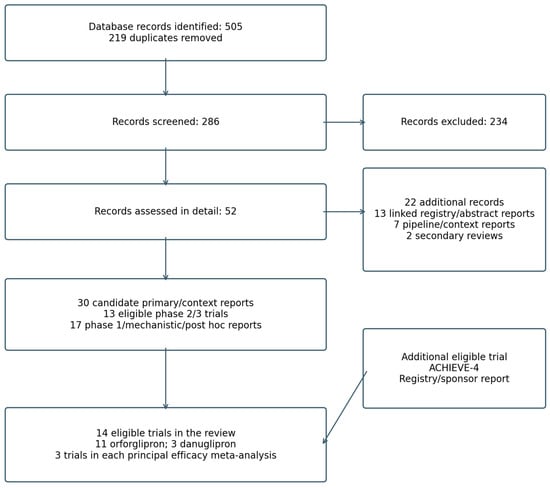
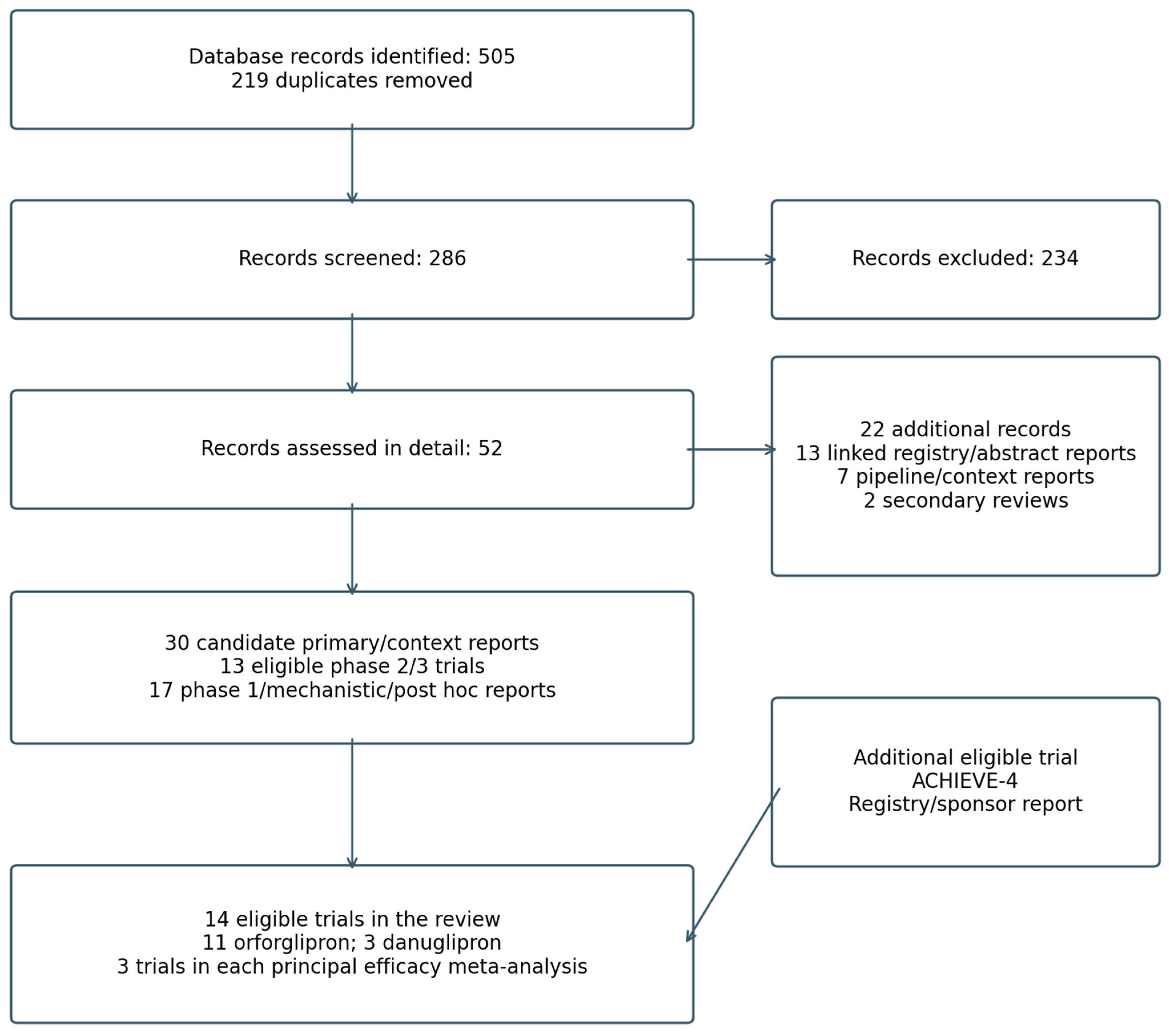
The search identified 505 database records: PubMed 79, Embase 149, CENTRAL 150 and Web of Science 127. After 219 duplicates were removed, 286 records were screened; 234 were excluded, and 52 were assessed in detail. The supplied screening file classified these 52 as 30 candidate core reports, 13 linked register/abstract reports, seven pipeline/context reports and two secondary reviews. Trial-level reclassification of the 30 candidate reports identified 13 eligible phase 2/3 trials and 17 phase 1, mechanistic or secondary reports. These record categories are retained explicitly rather than described as 30 independent randomized trials.
One additional eligible trial, ACHIEVE-4 (NCT05803421), was identified through register/sponsor sources. Its 16 April 2026 sponsor report already provided efficacy, and cardiovascular, results [12]. It is therefore included as a non-pooled eligible trial, bringing the review to 14 trials (11 orforglipron; three danuglipron). Its titrated insulin-glargine comparator, maximum-tolerated-dose regimen, sponsor-only reporting at the search cutoff and efficacy-estimand results distinguish it from the phase 3 fixed-dose placebo contrasts. The original statement that no HbA1c or weight estimates were available was incorrect. The 17 contextual reports and linked reports of existing trials do not add independent trial participants.
The principal efficacy meta-analyses each contain three phase 3 trials of orforglipron 36 mg versus placebo: ACHIEVE-1, ATTAIN-2 and ACHIEVE-5. Other eligible trials contribute individual estimates or a narrative synthesis; describing all of them as pooled trials would be inaccurate. Figure 1 distinguishes record-level selection from trial-level inclusion.
Figure 1.
Record disposition and trial-level inclusion. The additional ACHIEVE-4 report is from register/sponsor searching. Linked and contextual reports are not counted as independent trials.
3.2. Study and Participant Characteristics
The placebo-controlled phase 3 initiation trials differed clinically: ACHIEVE-1 enrolled participants with early T2D treated with diet/exercise (40 weeks), ATTAIN-2 enrolled participants with overweight/obesity and T2D using diet/exercise alone or oral antihyperglycemic therapy (72 weeks), and ACHIEVE-5 added orforglipron to titrated insulin glargine, with or without metformin and/or an SGLT2 inhibitor (40 weeks). ATTAIN-1 enrolled participants without diabetes and was analyzed separately. ACHIEVE-2 and ACHIEVE-3 had active comparators. ATTAIN-MAINTAIN evaluated a switch after injectable-associated weight loss. ACHIEVE-J randomized Japanese participants among three orforglipron doses. Two phase 2 orforglipron trials and three phase 2 danuglipron trials provide separate early-development evidence. Table 1 distinguishes total trial enrollment from the selected contrasts used in pooling.
Table 1.
Eligible trials and their contribution to synthesis. N is total randomized enrollment unless otherwise specified; it is not the denominator of an individual dose comparison.
3.3. Risk of Bias
The three phase 3 placebo-controlled trials contributing to the HbA1c and T2D weight meta-analyses were judged low risk for these treatment-regimen results. ATTAIN-1 was judged to have some concerns for missing outcomes. Active-comparator open-label trials were judged to have some concerns, although HbA1c and measured weight are objective endpoints. Severe attrition and on-treatment censoring limit danuglipron efficacy estimates; DAN-01 and DAN-05 were judged as high risk, and DAN-04 had some concerns. The phase 2 orforglipron judgments were retained as some concerns. ACHIEVE-4 topline evidence and the dose-comparison ACHIEVE-J study are described separately from placebo-effect judgments (Table 2).
Table 2.
RoB 2 judgments for the 12 trials with a full reported placebo or active-molecule comparison.
3.4. Efficacy: Glycemic Control (HbA1c)
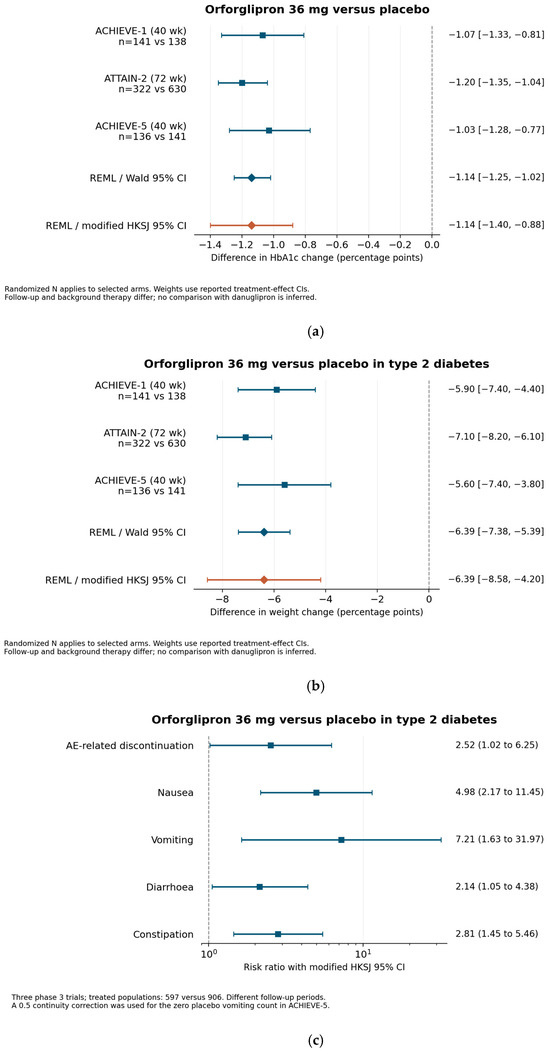
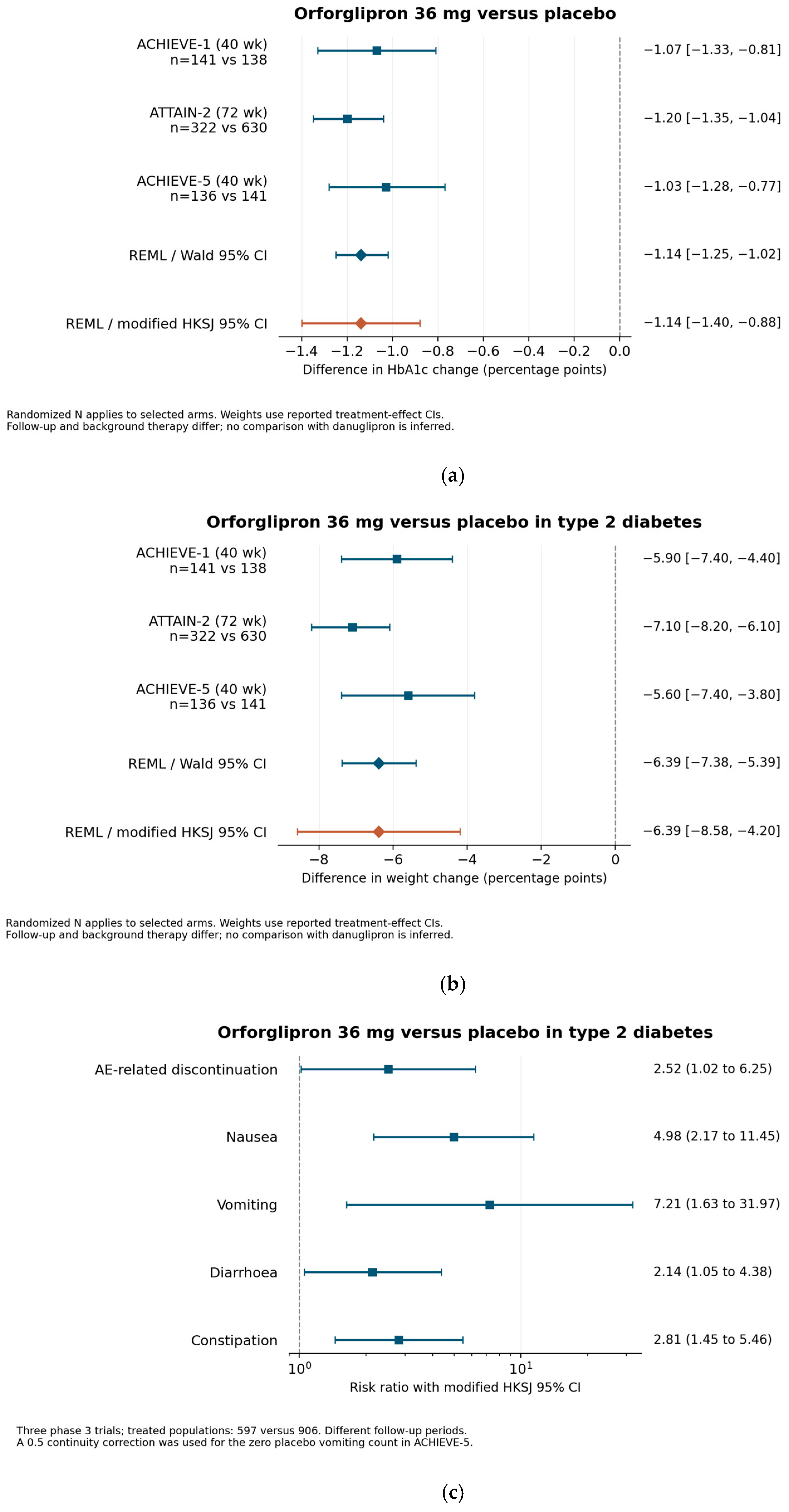
For orforglipron 36 mg versus placebo, the three-trial HbA1c estimate was −1.14 percentage points (REML/Wald 95% CI −1.25 to −1.02; modified HKSJ 95% CI −1.40 to −0.88; Q = 1.57, df = 2, p = 0.457; I2 = 0%; tau2 = 0). DerSimonian–Laird and common-effect results were identical at reported precision (Figure 2a and Table S2). The selected randomized arms contained 599 orforglipron and 909 placebo participants (total 1508), not the 2718 participants enrolled across all dose groups. I2 = 0% does not establish clinical homogeneity or equivalence. Against active comparators, separate trial estimates favored orforglipron 36 mg versus dapagliflozin 10 mg (−0.75 percentage points, 95% CI −0.96 to −0.55) and oral semaglutide 14 mg (−0.44, −0.62 to −0.26). For danuglipron, the 120 mg twice-daily DAN-04 contrast was −1.16 percentage points versus placebo (90% CI −1.47 to −0.86); DAN-05 reported reductions across titration groups but was not pooled with DAN-04, because the selected dose, titration and follow-up differed, and a compatible adjusted treatment-difference CI was not extracted for that contrast. No orforglipron–danuglipron equivalence inference is made.
Figure 2.
(a) Selected placebo-controlled phase 3 HbA1c contrasts with randomized arm sizes and REML summary estimates. Wald and modified HKSJ 95% CIs are shown. (b) Corrected T2D body-weight meta-analysis including ACHIEVE-1, ATTAIN-2 and ACHIEVE-5. Effects are differences in percent change from baseline, expressed in percentage points. (c) Phase 3 T2D safety risk ratios for orforglipron 36 mg versus placebo. Modified HKSJ 95% CIs are shown. Treated sample sizes differ from efficacy randomized sample sizes. In panels (a) and (b), squares represent trial-specific treatment differences, horizontal lines indicate their 95% confidence intervals, and diamonds represent pooled estimates; the blue and reddish lines distinguish the Wald and modified HKSJ summaries. In panel (c), squares show pooled risk ratios and horizontal lines show modified HKSJ 95% confidence intervals. HbA1c, glycated hemoglobin; CI, confidence interval; REML, restricted maximum likelihood; HKSJ, Hartung–Knapp–Sidik–Jonkman; T2D, type 2 diabetes; AE, adverse event.
3.5. Efficacy: Body Weight
The corrected T2D body-weight synthesis includes ACHIEVE-1 (−5.9 percentage points, 95% CI −7.4 to −4.4), ATTAIN-2 (−7.1, −8.2 to −6.1) and ACHIEVE-5 (−5.6, −7.4 to −3.8). All are treatment-regimen contrasts of orforglipron 36 mg versus placebo. REML yielded −6.39 percentage points (Wald 95% CI −7.38 to −5.39; modified HKSJ 95% CI −8.58 to −4.20; Q = 2.83, df = 2, p = 0.243; I2 = 29.3%; tau2 = 0.269), based on 1508 participants in the selected randomized arms (Figure 2b). The previous omission of the extractable ACHIEVE-1 weight result has been corrected. The original two-trial subset gave −6.54 (Wald CI −7.96 to −5.11), but its modified HKSJ interval was −15.77 to 2.70; this sensitivity result is retained explicitly. Background therapy and follow-up differences are plausible contributors to variation, not demonstrated explanations. ATTAIN-1 remains separate: −9.10 percentage points versus placebo (95% CI −10.10 to −8.10), with 730 versus 949 randomized participants, not all 3127 enrolled. Separate active-comparator weight differences were −4.4 percentage points versus dapagliflozin and −2.8 versus oral semaglutide. Danuglipron DAN-01 cohort 3 reported −12.9 percentage points versus concurrent placebo at 200 mg twice daily (90% CI −16.2 to −9.5), and DAN-04 reported −4.17 kg (90% CI −5.15 to −3.18). These estimates differ in population, unit, follow-up, estimand and attrition, and are not ranked across molecules.
3.6. Certainty of Evidence (GRADE)
GRADE assessments concern the specified orforglipron 36 mg placebo contrasts (Table 3). HbA1c certainty was rated high for a reduction within the included populations: contributing results were low risk, all sensitivity CIs excluded no effect and the analysis did not depend on total trial enrollment. This does not imply high certainty for comparative efficacy against danuglipron or for long-term clinical outcomes. T2D weight certainty was rated moderate, with one level deducted for uncertainty in the consistency and transportability of an average effect across background therapies and 40- versus 72-week follow-up. The corrected I2 = 29.3% was not treated as proof of homogeneity. The original two-study sensitivity demonstrates the fragility of small-subset precision. ATTAIN-1 certainty was rated moderate because of missing-outcome concerns; inconsistency cannot be assessed from a single trial. Formal GRADE judgments were not extended to the new exploratory safety pools or sponsor-only estimates.
Table 3.
GRADE summary of findings for primary efficacy contrasts. N counts the selected randomized treatment and comparator arms.
3.7. Safety and Tolerability
Safety is presented by trial and arm in Table 4 and Dataset S2. For the three phase 3 T2D placebo comparisons, treated denominators were 141 versus 138 (ACHIEVE-1), 321 versus 628 (ATTAIN-2) and 135 versus 140 (ACHIEVE-5). REML risk ratios for AE-related treatment discontinuation were 2.52 (Wald 95% CI 1.66 to 3.81; modified HKSJ 1.02 to 6.25). Corresponding modified HKSJ intervals were 4.98 (2.17 to 11.45) for nausea, 7.21 (1.63 to 31.97) for vomiting, 2.14 (1.05 to 4.38) for diarrhea and 2.81 (1.45 to 5.46) for constipation (Figure 2c). These are crude risks over different follow-up periods, not incidence-rate ratios. The ATTAIN-2 safety table includes follow-up/death-related discontinuations and its counts differ from the treatment-period flowchart; this definition is retained explicitly. Other populations, phases, active comparators and maintenance/rescue designs are reported separately. For danuglipron, AE-related discontinuation is distinguished from all-cause treatment discontinuation: in DAN-05 obesity, these were 54.5% and 72.7%, respectively. Laboratory abnormalities and clinical DILI are also distinguished. Trial reports of ATTAIN-1 and ATTAIN-2 included hepatic events with alternative causes; absence of adjudicated drug-related injury does not mean no liver-related events occurred. The external pooled orforglipron hepatic analysis [32] is an overlapping secondary analysis, not an additional independent cohort. The probable danuglipron liver injury was sponsor-reported in later once-daily dose-optimization studies [7], outside the three included phase 2 trials. These evidence sources do not permit a comparative hepatic risk estimate. For ATTAIN-1, individual gastrointestinal event counts are now supplied from Supplementary Table S7 of the original ATTAIN-1 trial report [20]. For ACHIEVE-J, the registry reports participant counts through week 54 for nausea, vomiting, diarrhea and constipation; none of these four preferred terms appears in the serious-event table. Registry terminology and timing are retained explicitly [13].
Table 4.
Trial-specific safety summary. Percentages refer to AE-related treatment discontinuation, not all-cause attrition. Detailed counts are in Dataset S2.
3.8. Trials Not Amenable to Pooling
The phase 2 orforglipron T2D trial [28] included a valid placebo contrast despite its additional dulaglutide arm. At 26 weeks, the combined 36 mg cohorts had an HbA1c difference of −1.60 percentage points versus placebo (95% CI −1.96 to −1.25) and a weight difference of −7.4 percentage points (−9.4 to −5.4). These on-treatment phase 2 estimates were reported separately from treatment-regimen phase 3 estimates. The phase 2 obesity trial [27] enrolled 272 participants and reported weight reductions of 9.4% to 14.7% across doses versus 2.3% with placebo at 36 weeks; titration subcohorts were retained in the arm-level safety data. ATTAIN-MAINTAIN [25] concerned continued maintenance after injectable therapy and allowed rescue treatment; its initial clinical state and estimand differ from initiation trials even though additional absolute-weight outcomes were also reported. ACHIEVE-J [26] randomized 401 participants among 3, 12 and 36 mg doses without a placebo or active-molecule arm; AE-related discontinuations were 7/132, 11/135 and 19/134. ACHIEVE-4 [12] is retained as eligible sponsor-reported evidence. The sponsor-reported efficacy-estimand differences at 52 weeks were −0.66 percentage points for HbA1c (95% CI −0.74 to −0.58) and −10.42 percentage points for weight (−10.92 to −9.93) versus insulin glargine. Its MACE-4 result met non-inferiority criteria, not cardiovascular superiority. No pooled numerical estimate spanning these distinct designs was constructed.
4. Discussion
4.1. Principal Findings
Orforglipron 36 mg reduced HbA1c and body weight versus placebo in three phase 3 trials. The corrected weight meta-analysis includes the previously omitted ACHIEVE-1 result, and both principal efficacy estimates retained CIs excluding no effect under modified HKSJ analysis. Safety pooling in the same T2D trial stratum found more gastrointestinal events and AE-related discontinuations with orforglipron than placebo. These averages cover different background therapies and follow-up durations. Danuglipron showed efficacy signals in separate phase 2 trials, accompanied by substantial discontinuation in some dose/titration groups. The programs cannot establish equal efficacy, a safety ranking or the causal contribution of a particular pharmacological feature to development success.
4.2. Divergent Clinical Trajectories: A Mechanistic and Pharmacological Perspective
Dosing frequency, escalation speed, target dose, exposure, tolerability and hepatic events are plausible contributors to the observed development trajectories. Their effects cannot be separated from differences in trial population, phase, duration and missing-data assumptions in these studies. In particular, twice-daily danuglipron phase 2 tolerability results should not be conflated with the later once-daily dose-optimization setting in which the sponsor reported probable DILI [7]. No randomized evidence in this review isolates dosing frequency as a cause of discontinuation. Likewise, a negative adjudicated DILI finding in an overlapping orforglipron safety analysis [32] does not establish a lower comparative hepatic risk. Reports concerning other small-molecule candidates [33,34] provide development context only; they do not prove a class-wide hepatic mechanism.
4.3. Positioning Relative to Existing and Concurrent Evidence
The present review differs from registrations addressing the wider oral GLP-1 receptor agonist class [8,9,10] by organizing the evidence for these two molecules separately and documenting the limits of cross-program interpretation. Targeted meta-analyses answer defined within-molecule placebo questions. They do not replace a direct trial or a valid formal indirect comparison, and the review makes no claim that the two molecules have equivalent pharmacodynamic efficacy.
4.4. Strengths and Limitations
This review’s strengths include registered eligibility criteria, the availability of original reports for the principal pooled comparisons, explicit mapping of selected randomized and safety populations, and reproducible sensitivity analyses. The revision also identifies corrections to the initial extraction and synthesis rather than treating those corrections as prospectively specified decisions.
This review’s limitations include the very small number of trials per meta-analysis, uncertain estimation of between-study variance, differences in follow-up and background treatment, and the dose-specific scope of the principal analyses. I2 = 0% cannot establish clinical comparability. Phase 2 and phase 3 estimands differ; severe attrition and on-treatment censoring are particularly important for danuglipron. The body-weight correction, additional safety pooling and expanded sensitivity analyses were implemented during revision, not prespecified in the registration. The original two-study weight subset is reported because it demonstrates how few-study intervals can include no effect even when individual trials favor treatment. Crude safety risks over 40 and 72 weeks are not directly standardized for exposure. DILI is too uncommon and the evidence sources too asymmetric for a reliable comparative conclusion. Source validation during revision was not a complete new systematic search; evidence emerging after 17 September 2026 was not silently added as if available at baseline. Remaining differences from planned synthesis are disclosed in Table S3. The trial-level surrogate outcomes do not establish comparative long-term cardiovascular, renal or hepatic benefit.
5. Conclusions
Orforglipron reduced HbA1c and body weight versus placebo in the selected phase 3 trials, with higher risks of gastrointestinal events and AE-related treatment discontinuation. Danuglipron showed glycemic and weight effects in separate phase 2 evidence. These data neither establish equivalence between the molecules nor quantify comparative hepatic risk. Dosing, titration, tolerability and hepatic events may have contributed to their different development trajectories, but the causal explanations remain unproven.
Supplementary Materials
The following supporting information can be downloaded at https://www.mdpi.com/article/10.3390/diabetology7120230/s1, Table S1, original electronic search strategies; Supplementary Methods and Tables S2–S4, sensitivity analyses, protocol deviations and source provenance; Dataset S2, revised efficacy inputs, arm-level safety counts, safety risk-ratio inputs, sensitivity outputs and executable Python analysis. The PRISMA checklist is supplied separately.
Author Contributions
Conceptualization, A.M.L. and E.C.; methodology, A.M.L. and O.A.O.; investigation and literature search, A.M.L.; data curation and extraction, A.M.L. and P.V.; formal analysis, P.V., L.G. and B.A.; validation, P.V. and L.G.; writing—original draft preparation, A.M.L.; writing—review and editing, P.V.; visualization, B.A.; supervision, E.C., O.A.O. and B.A.; project administration, E.C. All authors have read and agreed to the published version of the manuscript.
Funding
This research received no external funding.
Institutional Review Board Statement
Not applicable. This systematic review used previously published and publicly available trial-level evidence and involved no new recruitment of participants.
Informed Consent Statement
Not applicable.
Data Availability Statement
The revised trial-level input tables and reproducible aggregate-data analysis code are provided in Dataset S2. Blank event counts mean not extracted from the available source, not zero. Sources are identified by DOI and table/page. Original reports and contextual sponsor statements are cited separately.
Acknowledgments
During preparation of this manuscript, the authors used ChatGPT (OpenAI; GPT-5.6 during manuscript preparation in September 2026 and GPT-6 during revision in November 2026) for data extraction assistance, preparation of tables and figures, the graphical abstract, and language editing. During revision, AI-assisted source checks and aggregate-data analyses were used to identify and correct extraction and reporting errors. The authors are responsible for reviewing the revised source data, analyses and text and for the final content of the publication.
Conflicts of Interest
The authors declare no conflicts of interest.
References
- World Health Organization. Obesity and Overweight; World Health Organization: Geneva, Switzerland, 2025; Available online: https://www.who.int/news-room/fact-sheets/detail/obesity-and-overweight (accessed on 16 November 2026).
- American Diabetes Association Professional Practice Committee. Pharmacologic approaches to glycemic treatment: Standards of care in diabetes—2025. Diabetes Care 2025, 48, S181–S206. [Google Scholar] [CrossRef] [Scilit] [PubMed]
- Bækdal, T.A.; Breitschaft, A.; Donsmark, M.; Maarbjerg, S.J.; Søndergaard, F.L.; Borregaard, J. Effect of various dosing conditions on the pharmacokinetics of oral semaglutide, a human glucagon-like peptide-1 analogue in a tablet formulation. Diabetes Ther. 2021, 12, 1915–1927. [Google Scholar] [CrossRef] [Scilit] [PubMed]
- Cooke, C.E.; Lee, H.Y.; Tong, Y.P.; Haines, S.T. Persistence with injectable antidiabetic agents in members with type 2 diabetes in a commercial managed care organization. Curr. Med. Res. Opin. 2010, 26, 231–238. [Google Scholar] [CrossRef] [Scilit] [PubMed]
- Drucker, D.J. Mechanisms of action and therapeutic application of glucagon-like peptide-1. Cell Metab. 2018, 27, 740–756. [Google Scholar] [CrossRef] [Scilit] [PubMed]
- Eli Lilly and Company. FDA Approves Lilly’s Foundayo™ (orforglipron), the Only GLP-1 Pill for Weight Loss That Can Be Taken Any Time of Day Without Food or Water Restrictions. News Release, 1 April 2026. Available online: https://investor.lilly.com/news-releases/news-release-details/fda-approves-lillys-foundayotm-orforglipron-only-glp-1-pill (accessed on 16 November 2026).
- Pfizer Inc. Pfizer Provides Update on Oral GLP-1 Receptor Agonist Danuglipron. Press Release, 14 April 2025. Available online: https://www.pfizer.com/news/press-release/press-release-detail/pfizer-provides-update-oral-glp-1-receptor-agonist (accessed on 16 November 2026).
- PROSPERO CRD420261490084. Comparative 36-Week Efficacy and Tolerability of Oral Nonpeptide Small-Molecule GLP-1 Receptor Agonists in Adults with Overweight or Obesity Without Type 2 Diabetes: A Systematic Review and Network Meta-Analysis. Available online: https://www.crd.york.ac.uk/PROSPERO/view/CRD420261490084 (accessed on 16 November 2026).
- PROSPERO CRD420261484384. Oral GLP-1 Receptor Agonists in Type 2 Diabetes: A Systematic Review and Network Meta-analysis of Efficacy and Safety. Available online: https://www.crd.york.ac.uk/PROSPERO/view/CRD420261484384 (accessed on 16 November 2026).
- PROSPERO CRD420261469734. Comparative Efficacy and Safety of Oral Peptide Versus Non-Peptide GLP-1 Receptor Agonists in Adults with Type 2 Diabetes Mellitus: A Systematic Review and Network Meta-analysis of Randomized Controlled Trials. Available online: https://www.crd.york.ac.uk/PROSPERO/view/CRD420261469734 (accessed on 16 November 2026).
- Page, M.J.; McKenzie, J.E.; Bossuyt, P.M.; Boutron, I.; Hoffmann, T.C.; Mulrow, C.D.; Shamseer, L.; Tetzlaff, J.M.; Akl, E.A.; Brennan, S.E.; et al. The PRISMA 2020 statement: An updated guideline for reporting systematic reviews. BMJ 2021, 372, n71. [Google Scholar] [CrossRef] [Scilit] [PubMed]
- Eli Lilly and Company. ACHIEVE-4, the Longest Phase 3 Study of Lilly’s Foundayo (orforglipron) to Date, Reaffirmed Its Cardiovascular and Overall Safety Profile as Well as Consistent Improvements Across Key Measures of Cardiometabolic Health. Sponsor Press Release. 16 April 2026. Available online: https://lilly.gcs-web.com/news-releases/news-release-details/achieve-4-longest-phase-3-study-lillys-foundayo-orforglipron (accessed on 16 November 2026).
- ClinicalTrials.gov. NCT06010004: A Long-Term Safety Study of Orforglipron (LY3502970) in Participants with Type 2 Diabetes (ACHIEVE-J). Available online: https://clinicaltrials.gov/study/NCT06010004?tab=results (accessed on 5 November 2026).
- Sterne, J.A.C.; Savović, J.; Page, M.J.; Elbers, R.G.; Blencowe, N.S.; Boutron, I.; Cates, C.J.; Cheng, H.Y.; Corbett, M.S.; Eldridge, S.M.; et al. RoB 2: A revised tool for assessing risk of bias in randomised trials. BMJ 2019, 366, l4898. [Google Scholar] [CrossRef] [Scilit] [PubMed]
- DerSimonian, R.; Laird, N. Meta-analysis in clinical trials. Control Clin. Trials 1986, 7, 177–188. [Google Scholar] [CrossRef] [Scilit] [PubMed]
- Guyatt, G.H.; Oxman, A.D.; Vist, G.E.; Kunz, R.; Falck-Ytter, Y.; Alonso-Coello, P.; Schünemann, H.J. GRADE: An emerging consensus on rating quality of evidence and strength of recommendations. BMJ 2008, 336, 924–926. [Google Scholar] [CrossRef] [Scilit] [PubMed]
- Campbell, M.; McKenzie, J.E.; Sowden, A.; Katikireddi, S.V.; Brennan, S.E.; Ellis, S.; Hartmann-Boyce, J.; Ryan, R.; Shepperd, S.; Thomas, J.; et al. Synthesis without meta-analysis (SWiM) in systematic reviews: Reporting guideline. BMJ 2020, 368, l6890. [Google Scholar] [CrossRef] [Scilit] [PubMed]
- Deeks, J.J.; Higgins, J.P.T.; Altman, D.G.; McKenzie, J.E.; Veroniki, A.A.; Simmonds, M. (Eds.) Chapter 10: Analysing data and undertaking meta-analyses. In Cochrane Handbook for Systematic Reviews of Interventions; Cochrane: London, UK, 2019; Available online: https://www.cochrane.org/authors/handbooks-and-manuals/handbook/current/chapter-10 (accessed on 5 November 2026).
- Rosenstock, J.; Hsia, S.; Nevarez Ruiz, L.; Eyde, S.; Cox, D.; Wu, W.-S.; Liu, R.; Li, J.; Landó, L.F.; Denning, M.; et al. Orforglipron, an oral small-molecule GLP-1 receptor agonist, in early type 2 diabetes. N. Engl. J. Med. 2025, 393, 1065–1076. [Google Scholar] [CrossRef] [Scilit] [PubMed]
- Wharton, S.; Aronne, L.J.; Stefanski, A.; Alfaris, N.F.; Ciudin, A.; Yokote, K.; Halpern, B.; Shukla, A.P.; Zhou, C.; Macpherson, L.; et al. Orforglipron, an oral small-molecule GLP-1 receptor agonist for obesity treatment. N. Engl. J. Med. 2025, 393, 1796–1806. [Google Scholar] [CrossRef] [Scilit] [PubMed]
- Horn, D.B.; Ryan, D.H.; Giljanovic Kis, S.; Alves, B.; Mu, Y.; Kim, S.G.; Aberle, J.; Bain, S.C.; Allen, S.; Sarker, E.; et al. Orforglipron, an oral small-molecule GLP-1 receptor agonist, for the treatment of obesity in people with type 2 diabetes (ATTAIN-2): A phase 3, double-blind, randomised, multicentre, placebo-controlled trial. Lancet 2025, 406, 2927–2944. [Google Scholar] [CrossRef] [Scilit] [PubMed]
- Welch, M.; Forst, T.; Jia, W.; del Pino, P.O.; Denning, M.; Wu, W.-S.; Li, J.; Liu, R.; Eifu, M.; Chen, Y.; et al. Orforglipron compared with dapagliflozin in adults with type 2 diabetes and inadequate glycaemic control with metformin (ACHIEVE-2): A multicentre, randomised, non-inferiority, open-label, phase 3 trial. Lancet 2026, 408, 125–140. [Google Scholar] [CrossRef] [Scilit] [PubMed]
- Rosenstock, J.; Yabe, D.; Cox, D.; Li, J.; Denning, M.; Wu, W.-S.; Liu, R.; Zhao, Y.; Manghi, F.P.; Abalos, F.; et al. Efficacy and safety of once-daily oral orforglipron compared with oral semaglutide in adults with type 2 diabetes (ACHIEVE-3): A multinational, multicentre, non-inferiority, open-label, randomised, phase 3 trial. Lancet 2026, 407, 1147–1160. [Google Scholar] [CrossRef] [Scilit] [PubMed]
- Giorgino, F.; D’Souza, S.; Ludwig, L.; Kiyosue, A.; Ibriga, H.; Rha, H.; Denning, M.; Wu, W.-S.; Landó, L.F.; Tobian, J. Orforglipron added to titrated insulin glargine in type 2 diabetes: The ACHIEVE-5 randomized clinical trial. JAMA 2026, 336, 389–399. [Google Scholar] [CrossRef] [Scilit] [PubMed]
- Aronne, L.J.; Horn, D.B.; le Roux, C.W.; Chao, A.M.; Ho, W.; Halpern, B.; Griffin, R.; Xie, C.; Valderas, E.G.; Lee, C.J.; et al. Orforglipron for maintenance of body weight reduction: The double-blind, randomized phase 3b ATTAIN-MAINTAIN trial. Nat. Med. 2026, 32, 1–9. [Google Scholar] [CrossRef] [Scilit] [PubMed]
- Yabe, D.; Shiraiwa, T.; Ugai, H.; Takeuchi, M.; Suzuki, R. Long-term safety of oral orforglipron in Japanese participants with type 2 diabetes (ACHIEVE-J): A multicentre, randomised, open-label, parallel-group phase 3 trial. Lancet Diabetes Endocrinol. 2026, 14, 841–855. [Google Scholar] [CrossRef] [Scilit] [PubMed]
- Wharton, S.; Blevins, T.; Connery, L.; Rosenstock, J.; Raha, S.; Liu, R.; Ma, X.; Mather, K.J.; Haupt, A.; Robins, D.; et al. Daily oral GLP-1 receptor agonist orforglipron for adults with obesity. N. Engl. J. Med. 2023, 389, 877–888. [Google Scholar] [CrossRef] [Scilit] [PubMed]
- Frias, J.P.; Hsia, S.; Eyde, S.; Liu, R.; Ma, X.; Konig, M.; Kazda, C.; Mather, K.J.; Haupt, A.; Pratt, E.; et al. Efficacy and safety of oral orforglipron in patients with type 2 diabetes: A multicentre, randomised, dose-response, phase 2 study. Lancet 2023, 402, 472–483, Corrections in Lancet 2023, 402, 774, and Lancet 2024, 403, 2786.. [Google Scholar] [CrossRef] [Scilit] [PubMed]
- Buckeridge, C.; Cobain, S.; Bays, H.E.; Matsuoka, O.; Fukushima, Y.; Halstead, P.; Tsamandouras, N.; Sherry, N.; Gorman, D.N.; Saxena, A.R. Efficacy and safety of danuglipron (PF-06882961) in adults with obesity: A randomized, placebo-controlled, dose-ranging phase 2b study. Diabetes Obes. Metab. 2025, 27, 4915–4926. [Google Scholar] [CrossRef] [Scilit] [PubMed]
- Saxena, A.R.; Frias, J.P.; Brown, L.S.; Gorman, D.N.; Vasas, S.; Tsamandouras, N.; Birnbaum, M.J. Efficacy and safety of oral small molecule glucagon-like peptide 1 receptor agonist danuglipron for glycemic control among patients with type 2 diabetes: A randomized clinical trial. JAMA Netw. Open 2023, 6, e2314493. [Google Scholar] [CrossRef] [Scilit] [PubMed]
- Saxena, A.R.; Frias, J.P.; Gorman, D.N.; Lopez, R.N.; Andrawis, N.; Tsamandouras, N.; Birnbaum, M.J. Tolerability, safety and pharmacodynamics of oral, small-molecule glucagon-like peptide-1 receptor agonist danuglipron for type 2 diabetes: A 12-week, randomized, placebo-controlled, Phase 2 study comparing different dose-escalation schemes. Diabetes Obes. Metab. 2023, 25, 2805–2814. [Google Scholar] [CrossRef] [Scilit] [PubMed]
- Wharton, S.; Stefanski, A.; Chen, J.; Rao, G.; Twum, E.A.; Denning, M. Hepatic safety of orforglipron in adults with obesity or overweight and/or type 2 diabetes: A pooled analysis of the orforglipron phase 3 clinical trials. Diabetes Obes. Metab. 2026, 28, 8347–8358. [Google Scholar] [CrossRef] [Scilit] [PubMed]
- Amin, N.B.; Frederich, R.; Tsamandouras, N.; Haggag, A.Z.; Schuster, T.; Zmuda, W.; Palmer, A.; Vasas, S.; Buckley, G.; Smith, T.R.; et al. Evaluation of an oral small-molecule glucagon-like peptide-1 receptor agonist, lotiglipron, for type 2 diabetes and obesity: A dose-ranging, phase 2, randomized, placebo-controlled study. Diabetes Obes. Metab. 2025, 27, 215–227. [Google Scholar] [CrossRef] [Scilit]
- Rosenstock, J.; Lingvay, I.; Ryan, D.; Jastreboff, A.M.; Kushner, R.; Acosta, A.; Blevins, T.C.; Choi, M.; Holmes, F.L.; Smith, T.; et al. Oral small molecule GLP-1 receptor agonist aleniglipron in people with overweight or obesity: A randomized, double-blind, placebo-controlled phase 2b trial. Nat. Med. 2026, 32, 2941–2947, Correction in Nat. Med. 2026, 32, 3095. https://doi.org/10.1038/s41591-026-04532-1. [Google Scholar] [CrossRef] [Scilit] [PubMed]

Disclaimer/Publisher’s Note: The statements, opinions and data contained in all publications are solely those of the individual author(s) and contributor(s) and not of MDPI and/or the editor(s). MDPI and/or the editor(s) disclaim responsibility for any injury to people or property resulting from any ideas, methods, instructions or products referred to in the content. |
© 2026 by the authors. Licensee MDPI, Basel, Switzerland. This article is an open access article distributed under the terms and conditions of the Creative Commons Attribution (CC BY) license.