


Abstract
Background/Objectives: The Novel Aberdeen Sexual Function Improvement Index (SFI-I) is a simple single-item questionnaire specifically tailored for women with urinary incontinence (UI). The objective of the study was to describe for the first time the Aberdeen SFI-I and to assess its effectiveness in identifying changes in sexual function among women undergoing surgical treatment for SUI. Methods: A secondary analysis of data from the Single Incision Mini-Slings (SIMS) study was undertaken. Pearson correlation analyses were used to examine associations between the SFI-I and changes in the PISQ-IR scores, as well as the Patient Global Impression of Improvement (PGI-I). Results: The analysis included 596 women. Among these participants, 118, 101, and 102 completed the SFI-I and the PISQ-IR at 15, 24, and 36 months, respectively. Moderate positive correlations were identified between the SFI-I and PGI-I, ranging from 0.342 to 0.435, indicating that changes in SFI-I and PGI-I tended to occur in the same direction. The inverse correlation between the SFI-I and PISQ-IR, ranging from −0.588 to −0.518, indicates that improvements detected by one instrument are consistently reflected by the other. Diagnostic performance measures showed specificity values between 0.733 and 0.871 and positive predictive values between 0.844 and 0.900, demonstrating that improvement on the SFI-I is a strong indicator of improvement on the PISQ-IR. Conclusions: The newly developed Aberdeen SFI-I is a promising, short, and patient-friendly tool that reliably reflects patients’ perceptions of the impact of SUI surgery on sexual function, which would be specifically valuable where detailed assessment of individual sexual function domains is not required. Further comprehensive psychometric evaluation encompassing reliability, responsiveness, and the determination of clinically meaningful thresholds is required.
1. Introduction
Female stress urinary incontinence (SUI) is a highly prevalent disorder that affects millions of women globally and has a substantial impact on physical health and quality of life [1]. SUI is characterized by involuntary leakage of urine during activities that increase abdominal pressure, such as coughing, sneezing, or physical exertion. SUI often coexists with sexual dysfunctions, including dyspareunia, orgasm disorders, pain during intercourse, and arousal issues [2,3,4]. This dual burden significantly impacts the psychological and emotional well-being of affected women [5].
Currently, several validated sexual function assessment questionnaires are used in research of pelvic floor disorders [Appendix B], including SUI and pelvic organ prolapse (POP) [6]. The Female Sexual Function Index (FSFI) [7], a 19-item questionnaire, covers six domains: desire, arousal, lubrication, orgasm, satisfaction, and pain. Although it provides detailed information, its length can be burdensome for respondents, potentially leading to fatigue and incomplete responses. The Pelvic Organ Prolapse/Urinary Incontinence Sexual Questionnaire (PISQ-12) [8] is relatively short. It can be reported on an item basis. It consists of 12 items and primarily focuses on physical and emotional aspects; this questionnaire is validated for the total score, but not validated for each sexual domain. PISQ-IR is a disease-specific questionnaire, developed based on the PISQ-12, to assess sexual function in both sexually active and inactive women with pelvic floor dysfunction (PFD). PISQ-IR has replaced PISQ-12 and is seen as comprehensive and validated, but also long and complex. Women would value the different aspects of sexual life (pain, orgasm, incontinence, pleasure, etc.) differently. These variations limit the use of current sexual function questionnaires in clinical practice and research settings.
The newly developed Aberdeen Sexual Function Improvement Index (SFI-I) is a novel single-item questionnaire developed for women with urinary incontinence. It uses a seven-point scale to capture women’s overall perceived change in sexual function compared with their pre-intervention status. Conceptually, the SFI-I was designed to mirror global impression measures such as the PGI-I, enabling women to integrate the aspects of sexual function most relevant to them into a single overall judgment of change. Although patients were not directly involved in item wording during development, the question structure was informed by established global outcome measures widely used in uro-gynecological research. This design aims to minimize respondent burden, improve completion rates, and provide a patient-centered assessment of perceived change in sexual function following intervention.
Aim: We aimed to test the ability of the Aberdeen SFI-I questionnaire to assess postoperative overall changes in sexual function and sexual experience among women undergoing surgical treatment for SUI.
The study objectives were
- To describe the SFI-I as an assessment tool of women’s sexual function following intervention at different follow-up time points;
- To explore the correlation of SFI-I and PGI-I following surgical treatment of SUI at various time points;
- To determine the correlation between SFI-I and change in PISQ-IR scores from baseline and at the follow-up time points.
2. Materials and Methods
2.1. Study Design and Study Participants
This study was designed as an exploratory psychometric assessment, with the aim of generating preliminary evidence concerning the measurement properties of the Sexual Function Improvement Index (SFI-I). Data for this secondary analysis were obtained from the Single-Incision Mini-Slings (SIMS) trial, a multicenter randomized controlled trial comparing single-incision mini-slings with standard mid-urethral slings for the surgical management of female stress urinary incontinence. The trial was conducted between February 2014 and September 2017 and enrolled 600 women across 21 UK hospitals. Due to post-randomisation exclusions, 596 women were included in the analysis [9].
In the SIMS trial, half of the participants received the PISQ-IR. In this study, we are interested in the relationship between the SFI-I and the change in the PISQ-IR, such as the correlation between the two. Assuming no relationship between the SFI-I and change in the PISQ-IR, 300 participants would make it possible to detect a correlation of −0.168, and for 100 participants, it would be possible to detect a correlation of −0.289. Therefore, the study had adequate power to detect a relationship between the SFI-I and PISQ-IR.
Data were collected at baseline and at 15-, 24-, and 36-month follow-up and included PISQ-IR to assess women’s ‘sexual function’. Women also completed PGI-I and SFI-I at all follow-up time points. To be in this sub-study, participants needed to complete both the PISQ-IR and SFI-I at the same time point; thus, 134 women were in this study (Appendix A). The PISQ-IR can be seen as an invasive questionnaire, and due to non-completion levels and the requirement to also answer the SFI-I question at the same follow-up time point, in this sub-study, the number of participants included were around 20% of the SIMS trial.
Ethical approval for the SIMS trial was granted by the North of Scotland Research Ethics Committee [9]. This study was reported in accordance with the STARD checklist [9].
2.2. Outcomes
Aberdeen Sexual Function Improvement Index (SFI-I) was developed based on the PGI-I, as a single-item questionnaire to measure the participant’s perceived overall change in SF following intervention. The PGI-I is a global index that is a validated questionnaire to rate the patients’ overall assessment for outcomes following treatments of UI [10]. It is a 7-point scale with the following options: very much better = 1, much better = 2, a little better = 3, no change = 4, a little worse = 5, much worse = 6, very much worse = 7. Typically, these responses are analyzed using ordered logistic regression. The PISQ-IR includes 21 items, and domain scores can be calculated using either mean scoring or transformed summation [11]. For the sexually active scale, the summary score is calculated by summing the valid item responses and dividing by the number of valid responses. A response is considered valid if at least half of the items in the sexually active scale are completed. Higher scores indicate better sexual function [12].
The change from baseline to the 15-, 24-, and 36-month follow-up points on the PISQ-IR was obtained. Pearson correlations were used to evaluate the relationship between SFI-I and both PISQ-IR change scores and PGI-I results. The SFI-I is dichotomized to success and failure, where success is a response of very much better, much better, or better. The correlations used the full 7-point scale on the SFI-I. Although the SFI-I is ordinal, responses were dichotomised for diagnostic accuracy analyses to align with binary definitions of improvement used in previous patient-reported outcome studies. Success on the PISQ-IR is an increase from baseline, while PISQ-IR failure is no change or a decrease. The diagnostic accuracy of the SFI-I is analyzed by comparing success on the SFI-I to improvement on the PISQ-IR (any increase from baseline).
A range of diagnostic accuracy measures is used. These are sensitivity, specificity, positive predictive value, negative predictive value, positive likelihood ratio, negative likelihood ratio, diagnostic odds ratio, and area under the curve. The diagnostic odds ratio is obtained from a logistic regression of PISQ success with a fixed effect for SFI-I success.
3. Results
3.1. Ratio/Percentages of Improvement of SFI-I in Different Time Points
Our results showed that 372/519 (71.6%), 346/471 (73.4%), and 323/485 (66.6%) respondents completed the SFI-I at 15-, 24-, and 36-month follow-up, respectively. The women’s responses are shown in Table 1.
Table 1.
Percentage of improvement in SFI-I at different time points.
Women reporting no change in their SF on SFI-I were comparable over the 3 time points: 45%, 47%, and 48% at 15-, 24-, and 36-month follow-up, respectively. There was a numerical decrease in women reporting improvement in SF, 45%, 42%, and 37% at 15-, 24-, and 36-month follow-up, respectively (Table 1).
3.2. Correlations Between PGI-I Scores and Changes in SFI-I and PISQ-IR
There are positive correlations between the SFI-I and PGI-I (Table 2), in the range 0.342 to 0.435. As lower SFI-I changes and lower PGI-I values indicate improvements, a positive correlation indicates that SFI-I and PGI-I both improved together.
Table 2.
Correlations of PGI-I with SFI-I and PISQ-IR change.
The correlations between PISQ-IR change and PGI-I are in the range from −0.290 to −0.253. PISQ-IR improvements indicate positive changes, and lower PGI-I scores also indicate improvements; so, a negative correlation indicates that both improve together (Table 2).
3.3. SFI-I Outcomes Across Different Time Points in Women Completing Both Questionnaires
Table 3 shows that 118, 101, and 102 respondents completed both SFI-I and PISQ-IR at 15-, 24-, and 36-month follow-up, respectively. Of these respondents, 52%, 45%, and 39% reported a level of improvement in their sexual function on SFI-I at different time points (Table 3).
Table 3.
SFI-I outcomes in the women who completed both SFI-I and PISQ-IR at different time points.
3.4. Correlations Between Responses on SFI-I and PISQ-IR Change at Different Time Points
Table 4 shows correlations between responses on SFI-I and PISQ-IR change at the three follow-up time points in the range from −0.588 to −0.518. As higher PISQ-IR changes and lower SFI-I values are improvements, a negative correlation indicates that both PISQ-IR and SFI-I improved together.
Table 4.
Diagnostic accuracy of SFI-I compared to changes in PISQ-IR scores.
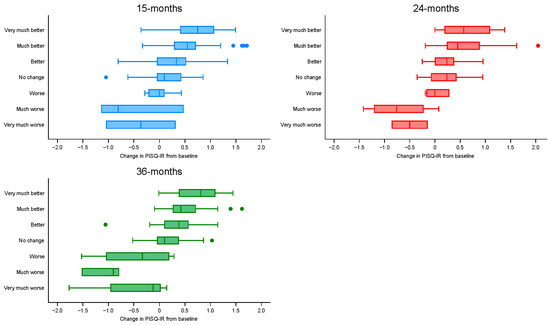
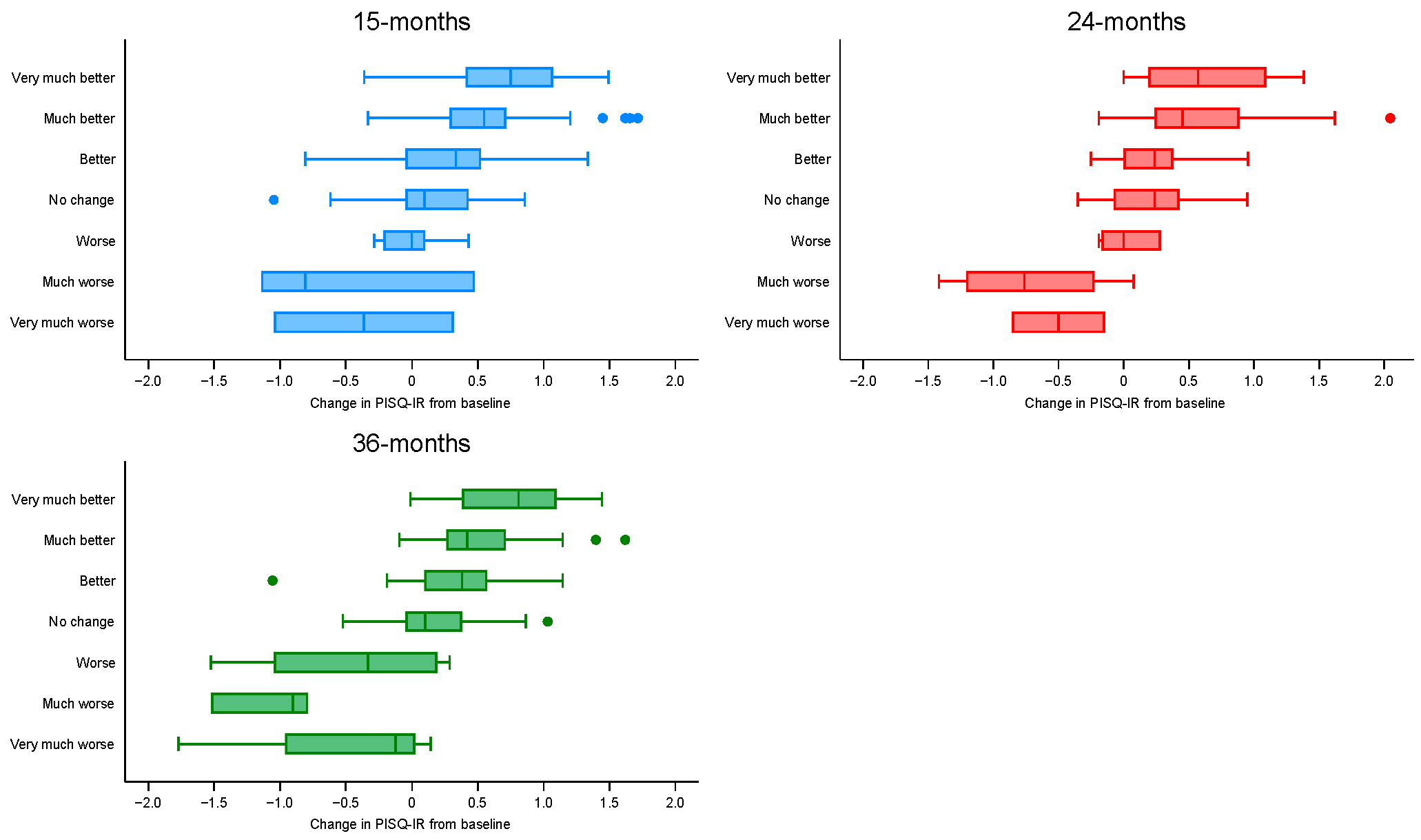
Figure 1 shows box plots of the PISQ-IR change from baseline split by the SFI-I response at each of the three time points. In all three plots, there is a consistent pattern of the box plots moving to the right as the SFI-I outcome improves and increases on the vertical axis.
Figure 1.
Relationship between changes in PISQ-IR scores and women’s outcomes on the SFI-I.
Sensitivities between 0.5 and 0.6 showed that the SFI-I correctly identifies between 50% and 60% of women who improved on the PISQ-IR. Therefore, it is not as sensitive as would be preferred, i.e., if a participant improved on PISQ-IR, there is a 40–50% probability they had no improvement on SFI-I. This is also shown in the range of negative predictive values. In other words, there is 60% disagreement in the negative predictive value, where 60% of the women who did not report improvement on the SFI-I still showed improvement in their PISQ-IR scores.
The higher specificity and positive predictive values show that the SFI-I correctly identifies between 73% and 87% of women who did not improve on the PISQ-IR. In addition, between 84% and 90% of those who improve on the SFI-I also improve on the PISQ-IR. This relatively strong agreement indicates that if a participant reports improvement on SFI-I, it is very likely that they had improvement in PISQ-IR scores.
The ideal value for the positive likelihood ratio and OR is 10. The observed diagnostic odds ratios are in the range of four to seven. This means a participant who improves on the SFI-I is between four and seven times more likely to have improved on the PISQ-IR than if they did not improve on the SFI-I. The reverse is also the case, and a participant who does not improve on the SFI-I is between four and seven times more likely to have not improved on the PISQ-IR than if they improved on the SFI-I. This indicates the results of the SFI-I are four to seven times more likely to be consistent with PISQ-IR changes.
The area under the curve AUC values in the range 0.63 to 0.69 shows that the SFI-I is close to the 0.7 acceptability threshold [13]. PISQ-IR may show improvement in the scores, indicating improvement in sexual function, while women rate no improvement when asked for their perception of their overall sexual function.
4. Discussion
This paper presents the development and preliminary evaluation of the Aberdeen Sexual Function Improvement Index (SFI-I), a single-item questionnaire assessing changes in sexual function in women undergoing surgery for stress urinary incontinence. The concept of a concise, patient-centered outcome measure is clinically important and particularly useful in studies where lengthy sexual function questionnaires may reduce response rates. Another strength is the use of data from the SIMS multicenter randomized trial.
The development of the SFI-I was driven by the need for a practical, patient-friendly, and efficient tool that can be easily integrated into clinical and research settings. By focusing on a single question, the SFI-I simplifies the assessment process, making it more accessible and less burdensome for patients. Also, it avoids asking intimate questions that may be a barrier for some to complete. Our findings indicate that the SFI-I was well accepted by participants, as evidenced by a high completion rate of approximately 70%. The SFI-I showed a stronger correlation with the PGI-I than the PISQ-IR did. Post-intervention improvement on the SFI-I was highly predictive of corresponding improvement in PISQ-IR scores.
Interestingly, 60% of women who did not report improvement on the SFI-I still demonstrated improvement in their PISQ-IR scores. In other words, PISQ-IR may show improvement in a woman’s sexual function while the woman may not report an improvement when asked for their perception of their overall sexual function on SFI-I. This may suggest that the new SFI-I does not reliably identify women who experience improvements in sexual function according to PISQ-IR scores. However, the more likely explanation is that it more accurately reflects women’s own perceptions of changes in their sexual function after the intervention. Detailed sexual function questionnaires, including PISQ-IR, give equal weight for different sexual function domains in their overall score, hence may overestimate the improvement in women’s sexual function. In reality, women will weigh their priorities differently with regard to sexual function, i.e., some women may give more weight to the avoidance of pain or gaining better orgasm or avoidance of coital incontinence. This concept was clearly demonstrated in the SIMS study results. At 15 months, the rate of dyspareunia was 17.2% for SIMS and 5.5% for SMUS. This gives an adjusted RD 11.8, 95% CI 3.5 to 20.1; p = 0.008. At 36 months, the rates were 11.7% for SIMS and 4.8% for SMUS (RD: 7.0; 95% CI: 1.9 to 12.1; p = 0.010). For coital incontinence at both 15 and 36 months, the rates were 11% in the SIMS group and 4.8% in the SMUS group (RD 6.0, 95% CI –0.9 to 12.9; p = 0.084). Hence, clearly dyspareunia and coital incontinence were more likely to be described by women following the mini-slings procedures compared to mid-urethral slings at almost all time points. However, PISQ-IR scores showed improvements compared to baseline in both groups, with no significant differences between mini-slings and mid-urethral slings at all time points.
Similarly, in women with prolapse, Altman et al. compared anterior mesh repair to native tissue repair in women with POP and assessed the impact on sexual function using PISQ-12 [14]. They reported that the mean PISQ-12 scores at 1-year follow-up were modestly improved as compared with baseline scores and were similar in the two groups. However, pain during sexual intercourse was threefold higher in one study arm (after transvaginal mesh surgery; p = 0.07). In both the above large multicenter RCTs, PISQ-12 and PISQ-IR have shown significant improvement in sexual function following the interventions, missing the fact that significantly more women in one arm of each RCT reported dyspareunia and/or coital incontinence.
Women with improvements in SFI-I were more likely (4–7 times) to have had a successful outcome for their surgery with regard to SUI, i.e., very/much improved on PGI-I. However, not all women with successful PGI-I outcomes reported improvement in SFI-I. Allameh et al. (2021) showed that women who received surgical treatment of SUI reported significant improvements in sexual health [15]. Similarly, non-surgical interventions like pelvic floor muscle training have been shown to enhance sexual satisfaction by strengthening the pelvic floor muscles, reducing incontinence episodes, and improving overall sexual confidence [16]. Interestingly, other research reached different results with approximately 30–40% of women reporting persistent sexual dysfunction even after effective SUI management [17].
Clinical trials are the foundation of evidence-based medicine. Ensuring participant retention in these trials is vital for maintaining research integrity and quality, as well as for keeping studies within budget and on schedule [18]. Our study shows that the Aberdeen SFI-I is a valid and patient-friendly tool for the patient-reported assessment of sexual function following SUI interventions that will reduce patient burden in both clinical and research settings. However, the authors have not determined the responsiveness of the measure, nor the minimum clinical difference (MCD), which might be listed as a weakness of the study.
5. Conclusions
The Aberdeen SFI-I appears to capture patients’ overall perception of the impact of stress urinary incontinence (SUI) surgery on sexual function. The observed moderate sensitivity, variable correlations with related measures, strong specificity, and positive predictive values suggest that the SFI-I is a promising patient-friendly tool for assessment of overall sexual function following SUI surgery, where detailed assessment of individual domains is not required. Further comprehensive psychometric evaluation encompassing reliability, responsiveness, and the determination of clinically meaningful thresholds is required.
Author Contributions
Conceptualization, M.A.-F., D.C., A.M. and S.I.N.; methodology, M.A.-F., D.C. and A.M.; formal analysis, D.C. and S.I.N.; investigation, D.C.; resources D.C.; data curation, D.C. and M.A.-F.; writing—original draft preparation S.I.N., A.M. and D.C.; writing—review and editing, M.A.-F., D.C., A.M. and S.I.N.; visualization, M.A.-F., D.C., A.M. and S.I.N.; supervision, M.A.-F.; project administration, M.A.-F. All authors have read and agreed to the published version of the manuscript.
Funding
This research received no external funding.
Institutional Review Board Statement
This study is a secondary analysis of data from a previously published, ethically approved randomized controlled trial that was conducted in accordance with all applicable regulatory and ethical requirements; therefore, no additional institutional review board approval was required for the present analysis.
Informed Consent Statement
The present study is a secondary analysis of previously collected and published data; therefore, no additional consent was required.
Data Availability Statement
The data used in this study are derived from a secondary analysis of a large randomized controlled trial, and the original individual-level data are not publicly available.
Conflicts of Interest
The authors declare no conflicts of interest.
Abbreviations
The following abbreviations are used in this manuscript:
| MCD | Minimum Clinical Difference |
| FSFI | Female Sexual Function Index |
| I-QoL | Incontinence Quality of Life |
| MUI | Mixed Urinary Incontinence |
| PFD | Pelvic Floor Dysfunction |
| PGI-I | Patient Global Improvement Index |
| PISQ-12 | Pelvic Organ Prolapse/Urinary Incontinence Sexual Questionnaire |
| POP | Pelvic Organ Prolapse |
| QOL | Quality of Life |
| RCT | Randomized Controlled Trial |
| SFI-I | Sexual Function Improvement Index |
| SIMS | Single-Incision Mini-Slings |
| SUI | Stress Urinary Incontinence |
| UUI | Urge Urinary Incontinence |
Appendix A
Table A1.
Baseline Characteristics of the SIMS Trial Participants.
Appendix B
Table A2.
A Concise Overview of Various Questionnaires Related to Incontinence.
References
- Haylen, B.T.; Freeman, R.M.; Lee, J.; Swift, S.E.; Cosson, M.; Deprest, J.; Dwyer, P.L.; Fatton, B.; Kocjancic, E.; Maher, C.; et al. International Urogynecological Association (IUGA)/International Continence Society (ICS) joint terminology and classification of the complications related to native tissue female pelvic floor surgery. Neurourol. Urodyn. 2012, 31, 406–414. [Google Scholar] [CrossRef] [Scilit] [PubMed]
- Su, C.C.; Sun, B.Y.; Jiann, B.P. Association of urinary incontinence and sexual function in women. Int. J. Urol. 2015, 22, 109–113. [Google Scholar] [CrossRef] [Scilit] [PubMed]
- Salonia, A.; Zanni, G.; Nappi, R.E.; Briganti, A.; Dehò, F.; Fabbri, F.; Colombo, R.; Guazzoni, G.; Di Girolamo, V.; Rigatti, P.; et al. Sexual dysfunction is common in women with lower urinary tract symptoms and urinary incontinence: Results of a cross-sectional study. Eur. Urol. 2004, 45, 642–648. [Google Scholar] [CrossRef] [Scilit] [PubMed]
- Coksuer, H.; Ercan, C.M.; Haliloğlu, B.; Yucel, M.; Cam, C.; Kabaca, C.; Karateke, A. Does urinary incontinence subtypes affect sexual function? Eur. J. Obstet. Gynecol. Reprod. Biol. 2011, 159, 213–217. [Google Scholar] [CrossRef] [Scilit] [PubMed]
- Sen, I.; Onaran, M.; Aksakal, N.; Acar, C.; Tan, M.O.; Acar, A.; Bozkirli, I. The impact of urinary incontinence on female sexual function. Adv. Ther. 2006, 23, 999–1008. [Google Scholar] [CrossRef] [Scilit] [PubMed]
- Constantine, M.L.; Pauls, R.N.; Rogers, R.R.; Rockwood, T.H. Validation of a single summary score for the Prolapse/Incontinence Sexual Questionnaire–IUGA revised (PISQ-IR). Int. Urogynecol. J. 2017, 28, 1901–1907. [Google Scholar] [CrossRef] [Scilit] [PubMed]
- Rosen, C.; Brown, J.; Heiman, S.; Leiblum, C.; Meston, R.; Shabsigh, D.; Ferguson, R.; D’Agostino, R. The Female Sexual Function Index (FSFI): A multidimensional self-report instrument for the assessment of female sexual function. J. Sex Marital. Ther. 2000, 26, 191–208. [Google Scholar] [CrossRef] [Scilit] [PubMed]
- Rogers, R.G.; Kammerer-Doak, D.; Villarreal, A.; Coates, K.; Qualls, C. A new instrument to measure sexual function in women with urinary incontinence or pelvic organ prolapse. Am. J. Obstet. Gynecol. 2001, 184, 552–558. [Google Scholar] [CrossRef] [Scilit] [PubMed]
- Abdel-Fattah, M.; MacLennan, G.; Kilonzo, M.; Assassa, R.P.; McCormick, K.; Davidson, T.; McDonald, A.; N’Dow, J.; Wardle, J.; Norrie, J. The SIMS trial: Adjustable anchored single-incision mini-slings versus standard tension-free midurethral slings in the surgical management of female stress urinary incontinence. A study protocol for a pragmatic, multicentre, non-inferiority randomised controlled trial. Br. Med. J. Open 2017, 7, e015111. [Google Scholar] [CrossRef] [Scilit]
- Rockwood, T.H.; Constantine, M.L.; Adegoke, O.; Rogers, R.G.; McDermott, E.; Davila, G.W.; Domoney, C.; Jha, S.; Kammerer-Doak, D.; Lukacz, E.S.; et al. The PISQ-IR: Considerations in scale scoring and development. Int. Urogynecol. J. 2013, 24, 1105–1122. [Google Scholar] [CrossRef] [Scilit] [PubMed]
- Abrams, P.; Avery, K.; Gardener, N.; Donovan, J. ICIQ Advisory Board. The international consultation on incontinence modular questionnaire. J. Urol. 2006, 175, 1063–1066. [Google Scholar] [CrossRef] [Scilit] [PubMed]
- Yalcin, I.; Bump, R.C. Validation of two global impression questionnaires for incontinence. Am. J. Obstet. Gynecol. 2003, 189, 98–101. [Google Scholar] [CrossRef] [Scilit] [PubMed]
- Hosmer, D.W.; Lemeshow, S. Applied Logistic Regression; John Wiley and Sons: New York, NY, USA, 2000; pp. 47–90. [Google Scholar]
- Altman, D.; Väyrynen, T.; Engh, M.E.; Axelsen, S.; Falconer, C. Anterior colporrhaphy versus transvaginal mesh for pelvic-organ prolapse. N. Engl. J. Med. 2011, 12, 1826–1836. [Google Scholar] [CrossRef] [Scilit] [PubMed]
- Allameh, F.; Zadeh Modarres, S.; Pooladgar, P.; Alahyari, S.; Alaedini, M.; Nasiri, M. Sexual function before and after mid-urethral sling procedure for stress urinary incontinence. J. Obstet. Gynecol. India 2021, 71, 609–614. [Google Scholar] [CrossRef] [Scilit]
- Ferreira, C.H.; Dwyer, P.L.; Davidson, M.; De Souza, A.; Ugarte, J.A.; Frawley, H.C. Does pelvic floor muscle training improve female sexual function? A systematic review. Int. Urogynecol. J. 2015, 26, 1735–1750. [Google Scholar] [CrossRef] [Scilit]
- Barber, M.D.; Visco, A.G.; Wyman, J.F.; Fantl, J.A.; Bump, R.C. Continence Program for Women Research Group. Sexual function in women with urinary incontinence and pelvic organ prolapse. Obstet. Gynecol. 2002, 99, 281–289. [Google Scholar] [CrossRef] [Scilit] [PubMed]
- Walters, S.J.; dos Anjos Henriques-Cadby, I.B.; Bortolami, O.; Flight, L.; Hind, D.; Jacques, R.M.; Knox, C.; Nadin, B.; Rothwell, J.; Surtees, M.; et al. Recruitment and retention of participants in randomised controlled trials: A review of trials funded and published by the United Kingdom Health Technology Assessment Programme. Br. Med. J. Open 2017, 7, e015276. [Google Scholar] [CrossRef] [Scilit] [PubMed]

Disclaimer/Publisher’s Note: The statements, opinions and data contained in all publications are solely those of the individual author(s) and contributor(s) and not of MDPI and/or the editor(s). MDPI and/or the editor(s) disclaim responsibility for any injury to people or property resulting from any ideas, methods, instructions or products referred to in the content. |
© 2026 by the authors. Licensee MDPI, Basel, Switzerland. This article is an open access article distributed under the terms and conditions of the Creative Commons Attribution (CC BY) license.