
Aberdeen Sexual Function Improvement Index (SFI-I): A Novel Brief Questionnaire for Evaluating Sexual Function in Women with Stress Urinary Incontinence


Abstract
1. Introduction
- To describe the SFI-I as an assessment tool of women’s sexual function following intervention at different follow-up time points;
- To explore the correlation of SFI-I and PGI-I following surgical treatment of SUI at various time points;
- To determine the correlation between SFI-I and change in PISQ-IR scores from baseline and at the follow-up time points.
2. Materials and Methods
2.1. Study Design and Study Participants
2.2. Outcomes
3. Results
3.1. Ratio/Percentages of Improvement of SFI-I in Different Time Points
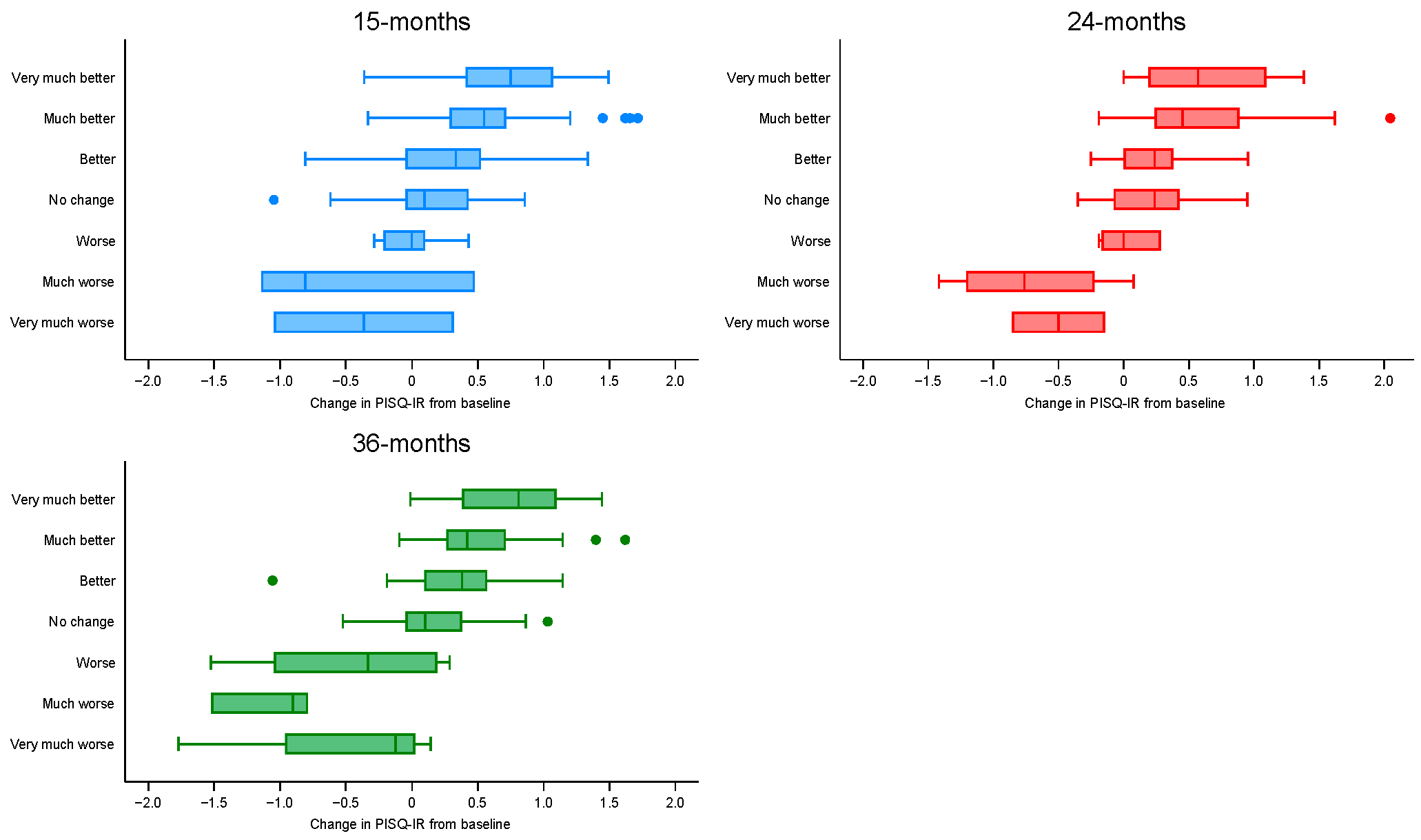
3.2. Correlations Between PGI-I Scores and Changes in SFI-I and PISQ-IR
3.3. SFI-I Outcomes Across Different Time Points in Women Completing Both Questionnaires
3.4. Correlations Between Responses on SFI-I and PISQ-IR Change at Different Time Points
4. Discussion
5. Conclusions
Author Contributions
Funding
Institutional Review Board Statement
Informed Consent Statement
Data Availability Statement
Conflicts of Interest
Abbreviations
| MCD | Minimum Clinical Difference |
| FSFI | Female Sexual Function Index |
| I-QoL | Incontinence Quality of Life |
| MUI | Mixed Urinary Incontinence |
| PFD | Pelvic Floor Dysfunction |
| PGI-I | Patient Global Improvement Index |
| PISQ-12 | Pelvic Organ Prolapse/Urinary Incontinence Sexual Questionnaire |
| POP | Pelvic Organ Prolapse |
| QOL | Quality of Life |
| RCT | Randomized Controlled Trial |
| SFI-I | Sexual Function Improvement Index |
| SIMS | Single-Incision Mini-Slings |
| SUI | Stress Urinary Incontinence |
| UUI | Urge Urinary Incontinence |
Appendix A

| Not in SFI-I Sub-Study | In SFI-I Sub-Study | |
|---|---|---|
| n= 172 | n= 134 | |
| Age | 54.2 (12.0); [n= 172] | 47.2 (8.4); [n= 134] |
| BMI | 29.0 (5.7); [n= 167] | 27.5 (4.6); [n= 134] |
| Pad test weight (g) | 57.3 (41.5); [n= 104] | 49.0 (83.4); [n= 111] |
| ICIQ UI short form score | 15.0 (3.3); [n= 162] | 13.6 (3.3); [n= 133] |
| ICIQ FLUTS filling score | 5.2 (2.6); [n= 162] | 4.1 (2.4); [n= 131] |
| ICIQ FLUTS voiding score | 2.0 (2.0); [n= 163] | 1.7 (2.0); [n= 134] |
| ICIQ FLUTS incontinence score | 11.8 (2.8); [n= 162] | 10.3 (3.1); [n= 131] |
| ICIQ FLUTS QOL score | 49.1 (11.1); [n= 158] | 44.8 (10.7); [n= 132] |
| Parity | 2.4 (0.9); [n= 169] | 2.3 (0.9); [n= 134] |
| EQ-5D-3L | 0.810 (0.233); [n= 158] | 0.887 (0.184); [n= 133] |
| PISQ-IR sexual functioning | 3.1 (0.6); [n= 44] | 3.4 (0.6); [n= 134] |
| Pelvic floor muscle training in the last 2 years | 146/172 (84.9%) | 119/134 (88.8%) |
| Clinical diagnosis | ||
| Stress urinary incontinence | 40/172 (23.3%) | 33/134 (24.6%) |
| Urodynamic diagnosis | ||
| Urodynamic stress incontinence | 127/172 (73.8%) | 109/134 (81.3%) |
| Mixed incontinence | 21/172 (12.2%) | 14/134 (10.4%) |
Appendix B
| Outcome | Description | Range | Interpretation |
|---|---|---|---|
| ICIQ UI SF | ICIQ urinary incontinence short form score | 0–21 | Higher scores mean poorer outcomes |
| ICIQ FLUTS filling | ICIQ female lower urinary tract symptoms filling score questionnaire | 0–16 | Higher scores mean poorer outcomes |
| ICIQ FLUTS voiding | ICIQ female lower urinary tract symptoms voiding score questionnaire | 0–12 | Higher scores mean poorer outcomes |
| ICIQ FLUTS incontinence | ICIQ female lower urinary tract symptoms incontinence score questionnaire | 0–20 | Higher scores mean poorer outcomes |
| ICIQ FLUTS QOL | ICIQ female lower urinary tract symptoms quality of life score questionnaire | 19–76 | Higher scores mean poorer outcomes |
| PISQ-IR | Pelvic Organ Prolapse/Urinary Incontinence Sexual Questionnaire, IUGA-Revised questionnaire | 1–4.71 | Higher scores indicate better sexual function |
References
- Haylen, B.T.; Freeman, R.M.; Lee, J.; Swift, S.E.; Cosson, M.; Deprest, J.; Dwyer, P.L.; Fatton, B.; Kocjancic, E.; Maher, C.; et al. International Urogynecological Association (IUGA)/International Continence Society (ICS) joint terminology and classification of the complications related to native tissue female pelvic floor surgery. Neurourol. Urodyn. 2012, 31, 406–414. [Google Scholar] [CrossRef] [Scilit] [PubMed]
- Su, C.C.; Sun, B.Y.; Jiann, B.P. Association of urinary incontinence and sexual function in women. Int. J. Urol. 2015, 22, 109–113. [Google Scholar] [CrossRef] [Scilit] [PubMed]
- Salonia, A.; Zanni, G.; Nappi, R.E.; Briganti, A.; Dehò, F.; Fabbri, F.; Colombo, R.; Guazzoni, G.; Di Girolamo, V.; Rigatti, P.; et al. Sexual dysfunction is common in women with lower urinary tract symptoms and urinary incontinence: Results of a cross-sectional study. Eur. Urol. 2004, 45, 642–648. [Google Scholar] [CrossRef] [Scilit] [PubMed]
- Coksuer, H.; Ercan, C.M.; Haliloğlu, B.; Yucel, M.; Cam, C.; Kabaca, C.; Karateke, A. Does urinary incontinence subtypes affect sexual function? Eur. J. Obstet. Gynecol. Reprod. Biol. 2011, 159, 213–217. [Google Scholar] [CrossRef] [Scilit] [PubMed]
- Sen, I.; Onaran, M.; Aksakal, N.; Acar, C.; Tan, M.O.; Acar, A.; Bozkirli, I. The impact of urinary incontinence on female sexual function. Adv. Ther. 2006, 23, 999–1008. [Google Scholar] [CrossRef] [Scilit] [PubMed]
- Constantine, M.L.; Pauls, R.N.; Rogers, R.R.; Rockwood, T.H. Validation of a single summary score for the Prolapse/Incontinence Sexual Questionnaire–IUGA revised (PISQ-IR). Int. Urogynecol. J. 2017, 28, 1901–1907. [Google Scholar] [CrossRef] [Scilit] [PubMed]
- Rosen, C.; Brown, J.; Heiman, S.; Leiblum, C.; Meston, R.; Shabsigh, D.; Ferguson, R.; D’Agostino, R. The Female Sexual Function Index (FSFI): A multidimensional self-report instrument for the assessment of female sexual function. J. Sex Marital. Ther. 2000, 26, 191–208. [Google Scholar] [CrossRef] [Scilit] [PubMed]
- Rogers, R.G.; Kammerer-Doak, D.; Villarreal, A.; Coates, K.; Qualls, C. A new instrument to measure sexual function in women with urinary incontinence or pelvic organ prolapse. Am. J. Obstet. Gynecol. 2001, 184, 552–558. [Google Scholar] [CrossRef] [Scilit] [PubMed]
- Abdel-Fattah, M.; MacLennan, G.; Kilonzo, M.; Assassa, R.P.; McCormick, K.; Davidson, T.; McDonald, A.; N’Dow, J.; Wardle, J.; Norrie, J. The SIMS trial: Adjustable anchored single-incision mini-slings versus standard tension-free midurethral slings in the surgical management of female stress urinary incontinence. A study protocol for a pragmatic, multicentre, non-inferiority randomised controlled trial. Br. Med. J. Open 2017, 7, e015111. [Google Scholar] [CrossRef] [Scilit]
- Rockwood, T.H.; Constantine, M.L.; Adegoke, O.; Rogers, R.G.; McDermott, E.; Davila, G.W.; Domoney, C.; Jha, S.; Kammerer-Doak, D.; Lukacz, E.S.; et al. The PISQ-IR: Considerations in scale scoring and development. Int. Urogynecol. J. 2013, 24, 1105–1122. [Google Scholar] [CrossRef] [Scilit] [PubMed]
- Abrams, P.; Avery, K.; Gardener, N.; Donovan, J. ICIQ Advisory Board. The international consultation on incontinence modular questionnaire. J. Urol. 2006, 175, 1063–1066. [Google Scholar] [CrossRef] [Scilit] [PubMed]
- Yalcin, I.; Bump, R.C. Validation of two global impression questionnaires for incontinence. Am. J. Obstet. Gynecol. 2003, 189, 98–101. [Google Scholar] [CrossRef] [Scilit] [PubMed]
- Hosmer, D.W.; Lemeshow, S. Applied Logistic Regression; John Wiley and Sons: New York, NY, USA, 2000; pp. 47–90. [Google Scholar]
- Altman, D.; Väyrynen, T.; Engh, M.E.; Axelsen, S.; Falconer, C. Anterior colporrhaphy versus transvaginal mesh for pelvic-organ prolapse. N. Engl. J. Med. 2011, 12, 1826–1836. [Google Scholar] [CrossRef] [Scilit] [PubMed]
- Allameh, F.; Zadeh Modarres, S.; Pooladgar, P.; Alahyari, S.; Alaedini, M.; Nasiri, M. Sexual function before and after mid-urethral sling procedure for stress urinary incontinence. J. Obstet. Gynecol. India 2021, 71, 609–614. [Google Scholar] [CrossRef] [Scilit]
- Ferreira, C.H.; Dwyer, P.L.; Davidson, M.; De Souza, A.; Ugarte, J.A.; Frawley, H.C. Does pelvic floor muscle training improve female sexual function? A systematic review. Int. Urogynecol. J. 2015, 26, 1735–1750. [Google Scholar] [CrossRef] [Scilit]
- Barber, M.D.; Visco, A.G.; Wyman, J.F.; Fantl, J.A.; Bump, R.C. Continence Program for Women Research Group. Sexual function in women with urinary incontinence and pelvic organ prolapse. Obstet. Gynecol. 2002, 99, 281–289. [Google Scholar] [CrossRef] [Scilit] [PubMed]
- Walters, S.J.; dos Anjos Henriques-Cadby, I.B.; Bortolami, O.; Flight, L.; Hind, D.; Jacques, R.M.; Knox, C.; Nadin, B.; Rothwell, J.; Surtees, M.; et al. Recruitment and retention of participants in randomised controlled trials: A review of trials funded and published by the United Kingdom Health Technology Assessment Programme. Br. Med. J. Open 2017, 7, e015276. [Google Scholar] [CrossRef] [Scilit] [PubMed]

| Time Points | Very Much Better, n (%) | Much Better, n (%) | A Little Better, n (%) | No Change, n (%) | A Little Worse, n (%) | Much Worse, n (%) | Very Much Worse, n (%) |
|---|---|---|---|---|---|---|---|
| 15 months n= 372 | 42 (11.3%) | 83 (22.3%) | 43 (11.6%) | 167 (44.9%) | 18 (4.8%) | 9 (2.4%) | 10 (2.7%) |
| 24 months n= 346 | 37 (10.7%) | 63 (18.2%) | 46 (13.3%) | 165 (47.7%) | 11 (3.2%) | 14 (4.0%) | 10 (2.9%) |
| 36 months n = 323 | 34 (10.5%) | 52 (16.1%) | 35 (10.8%) | 155 (48.0%) | 22 (6.8%) | 16 (5.0%) | 9 (2.8%) |
| Correlation Coefficient Value | ||
|---|---|---|
| Time Points | SFI-I | PISQ-IR Change |
| 15 Months | 0.344 | −0.253 |
| 24 Months | 0.435 | −0.250 |
| 36 Months | 0.342 | −0.290 |
| Time Points | Very Much Better, n (%) | Much Better, n (%) | A Little Better, n (%) | No Change, n (%) | A Little Worse, n (%) | Much Worse, n (%) | Very Much Worse, n (%) |
|---|---|---|---|---|---|---|---|
| 15 months n = 118 | 12 (10.2%) | 38 (32.2%) | 11 (9.3%) | 47 (39.8%) | 5 (4.2%) | 3 (2.5%) | 2 (1.7%) |
| 24 months n = 101 | 6 (6.0%) | 28 (27.7%) | 11 (10.9%) | 45 (44.6%) | 5(5.0%) | 4 (4.0%) | 2 (2.0%) |
| 36 months n = 102 | 7 (6.9%) | 20 (19.6%) | 13 (12.8%) | 46 (45.1%) | 9(8.8%) | 3 (3.0%) | 4 (3.9%) |
| Time Points | Correlation-Coefficient Value | ||||||
| 15 Months | −0.518 | ||||||
| 24 Months | −0.550 | ||||||
| 36 Months | −0.588 | ||||||
| Variables | 15 Months | 24 Months | 36 Months |
|---|---|---|---|
| Sensitivity | 0.602 (0.514,0.691) | 0.551 (0.454, 0.648) | 0.507 (0.410, 0.604) |
| Specificity | 0.733 (0.654,0.813) | 0.781 (0.701, 0.862) | 0.871 (0.806, 0.936) |
| Positive predictive value | 0.869 (0.808,0.930) | 0.844 (0.774, 0.915) | 0.900 (0.842, 0.958) |
| Negative predictive value | 0.386 (0.298,0.474) | 0.446 (0.350, 0.543) | 0.436 (0.339, 0.532) |
| Positive likelihood ratio | 2.26 (1.22,4.19) | 2.52 (1.26, 5.01) | 3.93 (1.53, 10.09) |
| Negative likelihood ratio | 0.54 (0.29,0.76) | 0.58 (0.42, 0.79) | 0.57 (0.43, 0.74) |
| Diagnostic odds ratio | 4.16 (1.67,10.40) | 4.38 (1.67, 11.47) | 6.94 (2.20, 21.90) |
| Area under the curve | 0.627 (0.551,0.704) | 0.666 (0.572, 0.760) | 0.690 (0.605, 0.772) |
Disclaimer/Publisher’s Note: The statements, opinions and data contained in all publications are solely those of the individual author(s) and contributor(s) and not of MDPI and/or the editor(s). MDPI and/or the editor(s) disclaim responsibility for any injury to people or property resulting from any ideas, methods, instructions or products referred to in the content. |
© 2026 by the authors. Licensee MDPI, Basel, Switzerland. This article is an open access article distributed under the terms and conditions of the Creative Commons Attribution (CC BY) license.
Share and Cite
Nipa, S.I.; Cooper, D.; Mostafa, A.; Abdel-Fattah, M. Aberdeen Sexual Function Improvement Index (SFI-I): A Novel Brief Questionnaire for Evaluating Sexual Function in Women with Stress Urinary Incontinence. Uro 2026, 6, 15. https://doi.org/10.3390/uro6020015
Nipa SI, Cooper D, Mostafa A, Abdel-Fattah M. Aberdeen Sexual Function Improvement Index (SFI-I): A Novel Brief Questionnaire for Evaluating Sexual Function in Women with Stress Urinary Incontinence. Uro. 2026; 6(2):15. https://doi.org/10.3390/uro6020015
Chicago/Turabian StyleNipa, Shamima Islam, David Cooper, Alyaa Mostafa, and Mohamed Abdel-Fattah. 2026. "Aberdeen Sexual Function Improvement Index (SFI-I): A Novel Brief Questionnaire for Evaluating Sexual Function in Women with Stress Urinary Incontinence" Uro 6, no. 2: 15. https://doi.org/10.3390/uro6020015
APA StyleNipa, S. I., Cooper, D., Mostafa, A., & Abdel-Fattah, M. (2026). Aberdeen Sexual Function Improvement Index (SFI-I): A Novel Brief Questionnaire for Evaluating Sexual Function in Women with Stress Urinary Incontinence. Uro, 6(2), 15. https://doi.org/10.3390/uro6020015