


Abstract
Background: Emerging evidence indicates that the liver plays a key role in spinal cord injury (SCI) pathophysiology. Method: This study reanalysed published proteomic datasets from rat models and patients with SCI using bioinformatics and literature/database searches. The aim was to identify liver-specific molecular signatures in SCI blood samples and to link these to severity and neurological recovery at various time points (acute/sub-acute and chronic). Results: Across species, a high proportion of injury severity and neurological recovery-associated proteins were linked to liver function. Notably, non-improvers exhibited prolonged sub-acute proinflammatory responses. These changes were not restricted to classical acute-phase reactants but reflected coordinated alterations in hepatic metabolic and synthetic pathways. Pathway analysis consistently highlighted Liver X Receptor /Retinoic X Receptor (LXR/RXR), complement system/cascade and DHCR24 signalling pathways, with predicted directional changes linked to recovery status. Several proteins were identified and categorised as markers of liver dysfunction, metabolic function, complement/coagulation factors and/or acute-phase proteins. Alpha-2-HS-glycoprotein (AHSG) and afamin (AFM) were commonly dysregulated across species datasets, suggesting conserved roles in inflammation and lipid metabolism. Further associations with liver pathologies such as fibrosis and cirrhosis, particularly in non-improvers, were identified. Conclusion This work builds on emerging evidence of hepatic involvement in SCI by providing cross-species, time-resolved proteomic support for altered liver-associated protein output following injury. Together, these findings underscore the central role of hepatic responses in SCI, highlighting liver-associated proteins and pathways as candidate biomarkers that may aid in stratifying recovery trajectories and informing clinical prognostication.
1. Introduction
Insult to the spinal cord often results in the transient or permanent disruption of motor, sensory, and autonomic pathways below the level of injury. The severity and symptoms of a spinal cord injury (SCI) vary depending on the spinal level of the injury and whether the injury is complete or incomplete [1]. Traffic and road accidents have previously been reported to be the leading causes of SCI [2,3,4], but non-traumatic spinal injuries are increasing in prevalence. In particular, non-traumatic SCI is affecting those over 60, who are more likely to have pre-existing medical conditions at the time of injury [5,6]. Globally, it has been estimated that 909,000 cases of SCI occurred in 2019 [7]. In 2016, it was estimated that the average lifetime cost of an SCI in the UK was £1.12 million [8]. Both estimates are likely to have significantly increased in recent years.
Following a SCI, it can be difficult to predict the long-term neurological recovery for some patients. Even individuals presenting with the same level of injury severity demonstrate heterogeneous outcomes, particularly individuals with incomplete injuries as categorised by the American Spinal Injury Association (AIS). There is a need to be able to predict neurological outcome early after injury, such that patients can be stratified to the most suitable care pathways [9]. Therefore, several studies have profiled SCI biofluids to identify prognostic biomarkers [9,10]. Several studies have focused on neural structural markers such as neurofilament light (NFL) and glial fibrillary acidic protein (GFAP), as well as neuroinflammatory markers, including cytokines, chemokines and immune mediators [11,12]. Others have highlighted systemic liver function indicators that link to neurological outcomes in patients with SCI [13,14,15,16,17]. Additionally, evidence is growing, primarily in animal models, that dysregulated liver function pre- and post-SCI can exacerbate some of the deleterious mechanisms that inhibit attempted neural tissue repair/regeneration/sparing [18,19]. In rodent models, the liver is inflamed at chronic time points after SCI (>6 months) [19]. Further, the global obesity crisis means the likelihood of sustaining a SCI whilst having an altered metabolic status is increased [14], whilst in older patients, ‘inflammaging’ also negatively impacts liver function [20].
Clinically, there remains a need to enhance outcome prediction for patients with SCI, especially those with incomplete injuries and whose clinical picture is obscured by spinal shock. Additional analysis of human samples collected longitudinally is needed to unlock the complex interplay between liver dysfunction and SCI neurological recovery [13,14,18,19,21]. Proteomic datasets profiling blood samples collected following SCI in humans and rodents (with complete or contusion injuries) provide a valuable resource for scrutinising the liver-specific consequences of a SCI and subsequent neurological recovery [21,22]. Therefore, this study utilises previous proteomic datasets and a bioinformatic approach to identify novel liver-specific molecular signatures (indicative of liver function/dysfunction) following SCI.
2. Materials and Methods
2.1. Rodent SCI Proteomic Datasets
Proteomic data were collected via a previously published study by Hulme et al., 2021 [22], publicly available from the PRIDE repository (PXD021137). Briefly, a contusion or a complete transection injury was induced in male Wistar rats. In the first study, rats were subjected to either a contusion SCI or a sham injury, in which all aspects of the surgery were performed except for the spinal cord impaction, and then blood was collected at 1 day or 7 days post-injury. The injury was made using the Infinite Horizon impactor (Precision Scientific Instrumentation, Lexington, KY, USA), with 175 kdyn of force, at the C6 level [23]. In the complete SCI model, male Wistar rats were subjected to a complete transection (thoracic T9) of the spinal cord or a sham injury, and blood was collected at 14 days or 16 weeks post-SCI [24].
All experimental procedures were approved by the Ethical Review Panel of the University of Glasgow and a Project Licence to carry out the work was subsequently granted by the UK Home Office under the Animals (Scientific Procedures) Act 1986 (PPL No 70/8168; Licence granted 3 August 2009). Animals were kept under appropriate light and temperature conditions, with food and water available ad libitum. Bloods from these rodent models were subjected to isobaric tagging for relative and absolute quantitation (iTRAQ) proteomics. The proteomic analysis of contusion injury compared two pairs of biological groups (each individual group, n = 5): 1-day post-SCI and 1-day post-sham-injury; 7-day post-SCI and 7-day post-sham injury. For the complete injury analysis, the two pairs of groups were (each individual group, n = 8): 14-day post-SCI and 14-day post-sham injury; 16-week post-SCI and 16-week post-sham injury. Detailed methodology of the iTRAQ proteomic analysis is reported previously in full. Briefly, detected proteins were reported using a protein confidence threshold corresponding to an Unused ProtScore greater than 0.05 based on peptides automatically selected by ProteinPilot (v4.5). For each protein group, the accession number corresponds to the representative protein selected by the ProGroup algorithm. These files were then analysed using ProteinPilot software, and proteins were taken forward based on a ≥2 unique peptide identification and a false discovery rate (FDR; p < 0.05) [22].
2.2. Analysis of Liver-Associated Proteins in Rat Proteomic Datasets
Rat model datasets provided the unique opportunity to assess liver-associated changes, which were differentially regulated solely as a response to SCI and not trauma alone, via comparison with matched sham groups. Proteins that were differentially abundant (≥±2.0 FC; p < 0.05) between biological groups of interest, i.e., SCI vs. shams at matched time points, were evaluated to determine their association with the liver. Protein names and the term ‘liver’ were searched using PubMed to identify papers that measured these proteins either within the liver or in association with altered liver function. Additionally, the protein accessions were searched using UniProt (Release 2025_02) to determine the proteins’ function and expression patterns recorded from The Human Protein Atlas, along with the associated Tau specificity score (an indicator of the specificity of gene expression across cells or tissues; 0 indicates expression across all cell/tissue types, and 1 indicates expression in a single cell/tissue). Proteins were then categorised as follows: liver dysfunction biomarkers, metabolic markers, complement/coagulation factors and/or acute-phase proteins.
2.3. Analysis of Liver-Associated Pathways in Rat Proteomic Datasets
Proteins that were significantly (p < 0.05) altered between the rat models of SCI and their corresponding sham counterparts were considered for bioinformatics analysis. Prior to the pathway enrichment and topological analysis using tools in Ingenuity Pathway Analysis (IPA; Qiagen, Redwood City, CA, USA; 2025 Summer Release, build released 11 July 2025; Version 145030503), ortholog mapping was carried out, as the IPA knowledge base is mostly built from human data and literature. This step enabled a more robust comparison between the rat and human datasets. Rat proteins were mapped to human orthologous genes using Ensembl Compara via the Ensembl BioMart interface (Ensembl release 115) [R] [25]. Rat protein identifiers (Entrez Gene ID) were linked to their corresponding gene identifiers, and orthology annotations retrieved from Ensembl Compara for rat–human comparisons. The corresponding human orthologs were extracted along with Ensembl gene IDs, gene names, homology type, and orthology confidence scores. Only one-to-one orthologs (ortholog_one2one) were retained prior to analysis using IPA. Entries lacking an annotated ortholog or showing one-to-many or many-to-many relationships were excluded to minimise ambiguity.
From the IPA analysis, canonical pathways which were differentially affected between SCI and sham-injured rats at each of the time points of this study were determined. A right-tailed Fisher’s Exact Test was used to calculate a p-value determining the probability that each canonical pathway assigned to that dataset is due to chance alone; significance was deemed where p < 0.05. Since multiple pathways were tested for in each analysis, the Benjamini–Hochberg (B-H) method was used to control the FDR, with p < 0.05 considered significant. The resulting pathways were a graphical representation of the molecular relationships between proteins, where proteins are represented as nodes, and the biological relationship between two nodes is represented as an edge (line). All edges were supported by at least one reference from the literature, from a textbook, or canonical information stored in the Ingenuity Knowledge Base, all supporting an in vivo or in vitro observation of a protein:protein or protein:DNA interaction (as opposed to a merely predicted interaction from in silico experimentation). Z-score activation predictions were provided to indicate the match between the expected and observed directional relationship in the dataset. Z-scores ≥ 2 or ≤−2 were predictive of significantly activated or inhibited pathways, respectively.
The top 10 pathways that were most significantly associated with the differentially abundant proteins in each pair-wise group comparison (SCI versus sham at each time-point) were studied to determine any association between proteins altered due to SCI and liver function. Additionally, hepatic toxicity functions were identified using IPA, which were significantly (p < 0.05) associated with the differentially abundant proteins for each group comparison.
2.4. Human SCI Proteomic Datasets
Human proteomic datasets were derived from the study published by Harrington et al. (2024) and are publicly available on the PRIDE database at identifiers PXD035025 and PXD035072 [16]. In this study, human plasma samples were collected from patients following SCI within 2 weeks of injury (acute time point) and at approximately 3 months post-injury (sub-acute time point). These patients had all been treated conservatively, using acute physiological conservative management [26]. These included individuals with AIS grade C injuries who experienced an AIS grade conversion (improvers; n = 10) or who remained a grade C (non-improvers; n = 7) at 12 months post-injury. Plasmas were subjected to two different proteomic analyses, one using iTRAQ labelling and the other using a label-free quantification with the ProteoMinerTM normalisation approach. Detailed methods of the human proteomic analyses and data handling are included previously in full, and the repositories for the scripts can be found online [27]. Briefly, raw mass spectrometry data were analysed using OpenMS (v2.6.0) and downstream statistical analysis performed using the MSstats package in the programming language R. For the iTRAQ analysis, IDFilter was used to filter to a peptide score of 0.05. Bayesian score estimation and protein inference were performed with Epifany and the following flags: greedy group resolution, removing proteins without evidence and retaining all peptide-spectrum matches rather than only the best match per spectrum. Decoy entries were removed, and a 5% FDR was applied at the protein group level. Finally, IDConflictResolver was used to resolve ambiguous annotations of features with peptide identifications before quantification with ProteinQuantifier. For the label-free analysis, the PeptideIndexer tool was used to annotate the identified peptides with their corresponding proteins. PeptideIndexer and PSMFeatureExtractor were applied for annotation purposes. For peptide-level score estimation and filtering, PercolatorAdapter was used, applying q-values as the scoring metric and specifying trypsin as the digestion enzyme. Peptides were then filtered to a score threshold of 0.01 using IDFilter. Subsequently, IDScoreSwitcher was used to replace the q-value with the posterior error probability (PEP) score, defined such that lower scores indicate higher confidence. Finally, ProteomicsLFQ was used for downstream processing, applying a 5% protein-level FDR threshold and restricting analysis to targeted features only. In the case of missing data, those with #NA in rows were removed. For cases where samples had less than 5% missing values, minimum values were generated per protein and imputed. Missing values were imputed using minimum value imputation, whereby all missing entries were replaced with the smallest observed non-missing value within each variable. Differentially abundant proteins between biological groups of interest were defined based on p-values < 0.05 and fold changes of ≥±2.0 for both proteomic analyses [16].
2.5. Analysis of Liver-Associated Proteins in Both Human Proteomic Datasets
Differentially abundant proteins (≥±2.0 FC; p < 0.05) between SCI groups of interest were evaluated as follows:
- AIS grade C Improvers, Acute vs. AIS grade C Non-improvers, Acute;
- AIS grade C Improvers, Sub-acute vs. AIS grade C Non-improvers, Sub-acute;
- AIS grade C Improvers, Acute vs. AIS grade C Improvers, Sub-acute;
- AIS grade C Non-improvers, Acute vs. AIS grade C Non-improvers, Sub-acute.
Protein abundance and associated functions were determined as described for the rat analysis. Throughout, iTRAQ and label-free data were analysed separately.
2.6. Analysis of Liver-Associated Pathways in Human Proteomic Datasets
Proteins that were significantly (p < 0.05) altered between the comparisons listed in Section 2.5 were analysed using the pathway enrichment and topological analysis tools in IPA, as with the rat datasets, to identify and visualise the canonical pathways which were differentially affected between AIS grade C improvers and AIS grade C non-improvers at both the acute and sub-acute time points, and which were differentially affected between the acute and sub-acute time points for improvers and non-improvers. Then, as previously described in the rat analysis, the top 10 pathways most significantly associated with the differentially abundant proteins and hepatic toxicity were studied. Throughout, iTRAQ and label-free data were analysed separately.
2.7. Rat:Human Comparisons
The rat (following ortholog mapping) and human liver-associated proteomics datasets and pathways were compared to evaluate similarities and differences. For the proteomics analysis, the overlap in identified proteins and their abundance patterns were examined. Likewise, for the pathway analysis, there was a focus on pathways identified as common to both species. Finally, the top hepatotoxicity-related functions identified in the rat and human datasets were compared. IPA (Qiagen, CA, USA; 2025 Summer Release, build released 11 July 2025; Version 145030503) compared our observed protein abundance patterns against curated toxicity-associated pathways, from which liver toxicity pathways were assessed. Terms relating to cancer were omitted, as were any pathways which were associated with just one differentially abundant protein.
A summary workflow of the rodent and human proteomic and bioinformatic analyses is included in the Supplementary Material.
3. Results
3.1. Rat Proteomic Datasets
3.1.1. Liver-Associated Proteins in Rat Proteomic Datasets
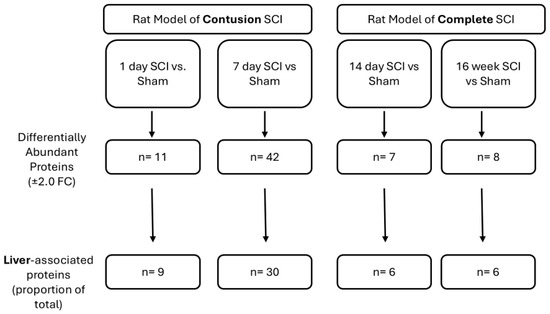
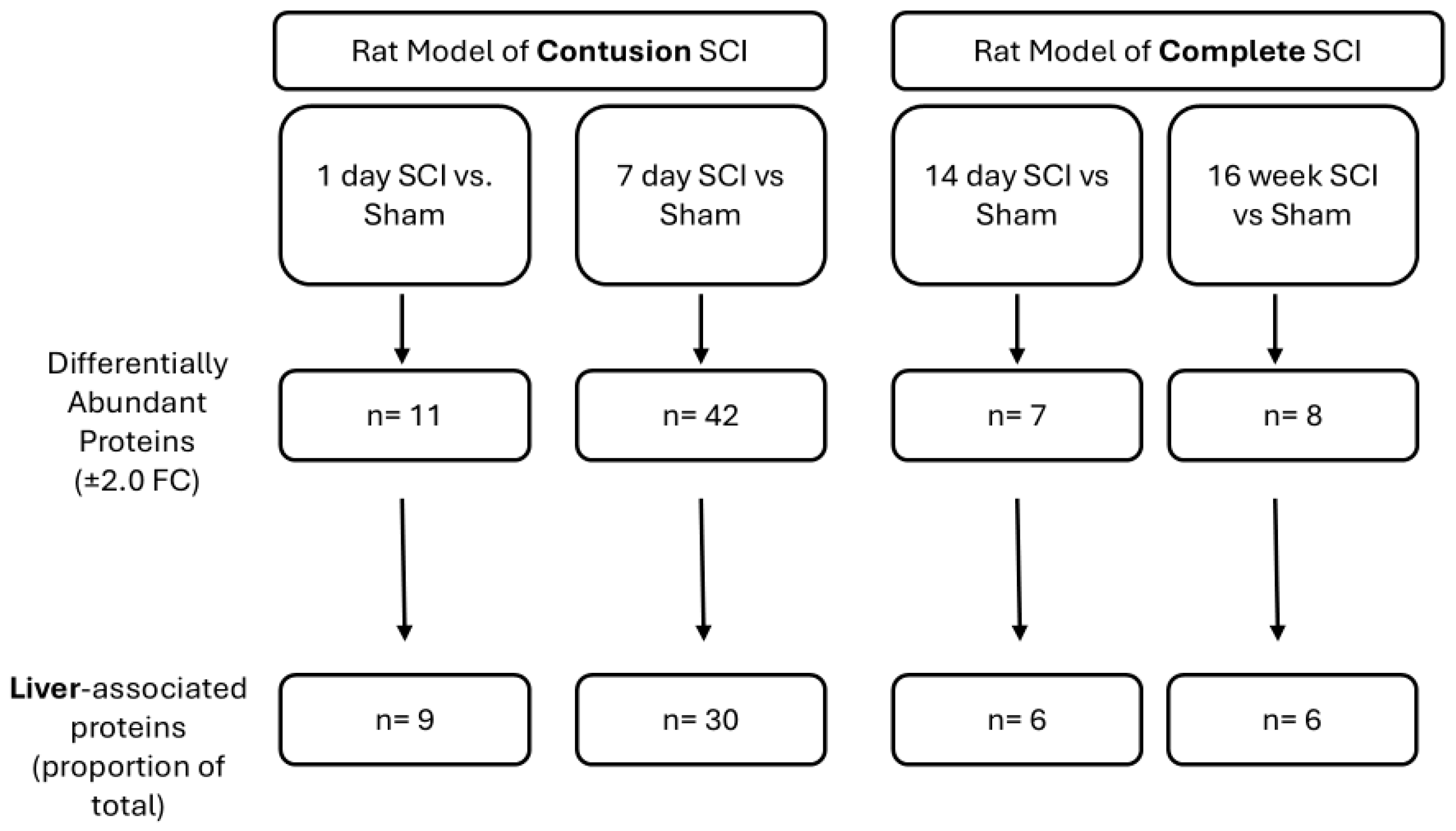
Figure 1 demonstrates the proportion of differentially abundant proteins within group comparisons that had associations with the liver. In the contusion and complete rodent models, the proportion of liver-associated differentially abundant proteins was highest within the first two weeks of injury. The majority of these proteins were synthesised in the liver, with a number being associated with liver disease or being markers of liver dysfunction (Table 1 and Supplementary Table S1). Each time point is compared to a sham surgery performed at the same time. This results in four different comparisons: 1-day contusion SCI against sham injury, 7-day contusion SCI against sham injury, 14-day contusion SCI against sham injury, and 16-week contusion SCI against sham injury. This comparison reveals which proteins are differentially abundant due to SCI and accounts for some effects of surgery.
Figure 1.
Proteins that were differentially abundant between SCI (contusion or complete) and matched sham-injured rats (p < 0.05; ≥±2.0 FC) at different time points post-SCI, assessed using UniProt and PubMed to determine any association with the liver.
Table 1.
Summary of liver-associated proteins with a Tau specificity score of ≥0.8 which were differentially abundant (±2.0 fold; p < 0.05) in rat blood following either a contusion or complete spinal cord injury compared to sham injuries. Biological roles of each protein are coded as follows: liver dysfunction—a; metabolic marker—b; complement/coagulation factor—c; and acute-phase protein—d.
Ortholog mapping to human genes of all significantly altered proteins (converted to their relevant genes) following either a contusion or complete SCI compared to sham injury in the rat models identified 38 one-to-one orthologs (Supplementary Table S14). Only these proteins were used for the downstream bioinformatics analysis with IPA, since the knowledge base of this software is built mainly from human data and literature. From these 38 proteins, 15 were found to be liver-associated with a tau cut-off (>0.8) for liver specificity (highlighted in bold in Table 1), whilst all 27 liver-associated proteins found to map to human orthologs are highlighted in Supplementary Table S1.
3.1.2. Liver-Associated Pathways in Rat Proteomic Datasets
Several canonical pathways were predicted to be significantly altered across SCI and sham bloods at different time points (Supplementary Tables S2–S5). From the top 10 most significantly associated for each comparison, ten were relevant to the liver, with nine pathways identified across multiple groups (Table 2). In particular, IPA analysis suggested directional inhibition of the complement system, DHCR24 signalling and Liver X Receptor/Retinoic X Receptor (LXR/RXR) (z-score ≤ −2.0) in rats at 7 days following a contusion injury (Table 2). These findings suggest a decrease in the inflammatory and lipid-metabolism responses following a contusion-type injury in rats and at this time point post-injury.
Table 2.
Canonical pathways identified as having a strong liver relevance from the top 10 significantly impacted pathways for each comparison. Coloured z-scores indicate significantly predicted pathway activation or inhibition (z-score ≥ ±2.0): blue = downregulated; Significance (p < 0.05) of altered proteins (matched to human orthologs (one-to-one) only) on pathways was corrected by Benjamini–Hochberg Multiple Testing, and the overlap is the ratio of significantly altered proteins within each comparison/number of total proteins known to be associated with the relevant pathway. Pathways are listed in alphabetical order. * indicates that the pathway was not in the top 10 significantly impacted for the relevant comparison. Molecules associated with each pathway are listed in Supplementary Tables S2–S5.
IPA results are based on publicly available datasets and reflect inference-based predictions of pathway activity rather than direct measurements; therefore, reported “activation” or “inhibition” should be interpreted as predicted directional trends.
3.2. Human Proteomic Datasets
3.2.1. Liver-Associated Proteins in Human Proteomic Datasets
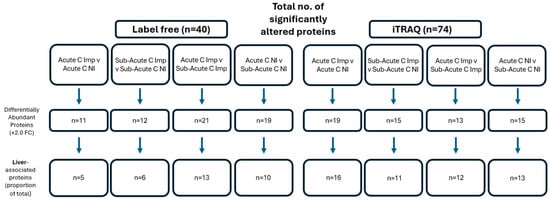
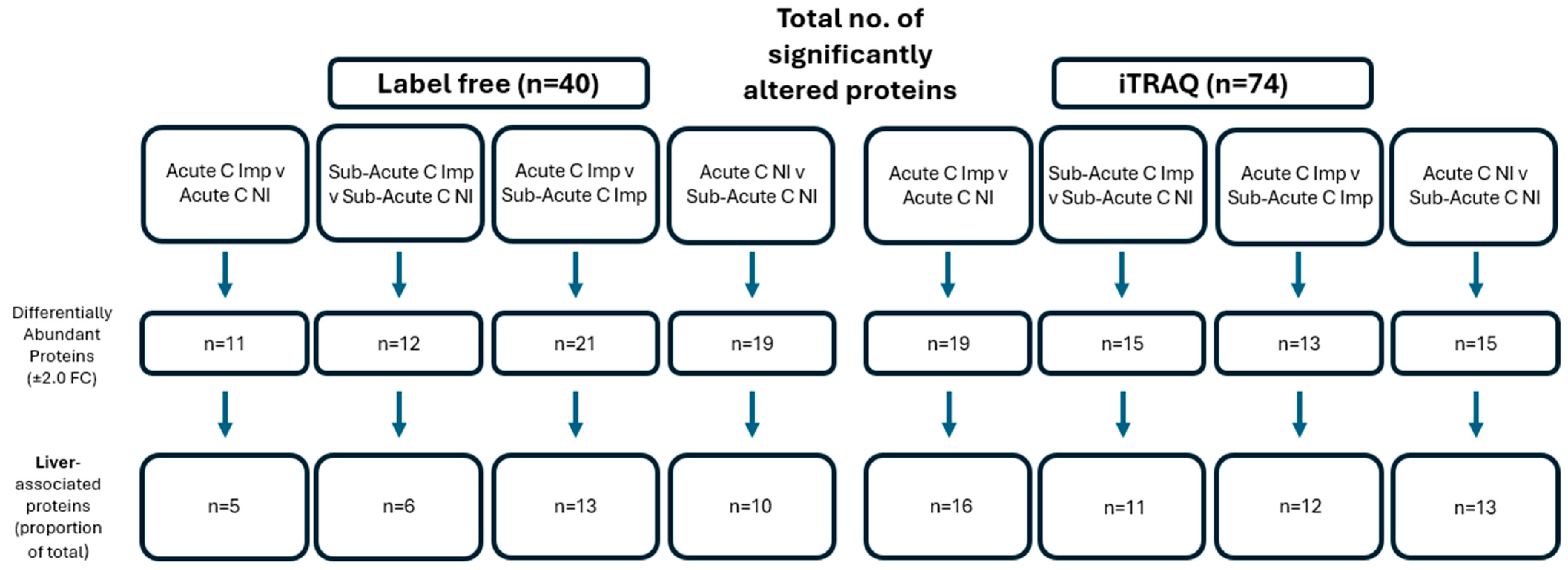
This analysis identified 103 significantly differentially abundant proteins for consideration from our chosen cohorts (AIS C improvers and AIS C non-improvers) (Figure 2), with 11 proteins being common to both label-free and iTRAQ datasets. Following filtering of the dataset (±2-fold change applied), a high proportion of proteins (>70%) were found to be associated with liver-related processes/origins (Table 3 and Supplementary Table S1). It was noted that the iTRAQ methodology generated more unique differentially expressed proteins between the groups of interest, with a higher percentage being liver-associated compared to the ProteoMinerTM and label-free methodology. In both datasets, the highest proportion of liver-related proteins was identified in the plasma of patients who improved following an AIS grade C injury when differentially expressed proteins were compared between acute and sub-acute time points.
Figure 2.
Proteins that were differentially abundant (p < 0.05; ≥±2.0 FC) between individuals initially graded an AIS C who demonstrated improved (Imp) or no improved (NI) neurological recovery at 12 months post-injury compared to baseline at different time points post-SCI were assessed to determine any association with liver using UniProt and PubMed searches. Bloods were collected at acute (within 2 weeks) or sub-acute (within 3 months) of timepoints following SCI. Proteins that were uniquely identified using label-free quantitation and iTRAQ proteomics were considered independently.
Table 3.
Summary of liver-associated proteins with a Tau specificity score of ≥0.8 which are differentially abundant (±2.0 fold) in human blood from patients that improved (Imp) compared to those that maintained (Non-Imp) their initial AIS C spinal cord injury at 12 months post-injury, with plasmas collected at the acute (≤2 weeks post-injury) or sub-acute (3 months post-injury) timeframe post-injury. (Positive fold change = increase in acute/decrease in sub-acute or an increase in Imp/decrease in Non-Imp; negative fold change = decrease in acute/increase in sub-acute or a decrease in Imp/increase in Non-Imp; INF = infinity (indicates a large-fold-change between comparisons and typically relates to a protein that was not detected in one comparator); L = label-free proteomic analysis; I = iTRAQ method of proteomic analysis). Roles are coded as follows: liver dysfunction—a; metabolic marker—b; complement/coagulation factor—c; and acute-phase protein—d.
3.2.2. Liver-Associated Pathways in Human Proteomic Datasets
Across all human proteomic comparisons, several canonical pathways were predicted to be significantly altered (Supplementary Tables S6–S13). Focusing on the top 10 most significantly impacted pathways in the iTRAQ data, nine were commonly identified across multiple groups (Table 4). However, only Acute Phase Response signalling, the Coagulation System, Complement Cascade, DHCR24 signalling pathway, Formation of Fibrin Clot, Intrinsic Prothrombin Activation and LXR/RXR were suggested to be directionally inhibited as indicated by a z-score ≤ −2.0 (Table 4). Proteins associated with each pathway are listed in Supplementary Tables S6–S9.
Table 4.
Canonical pathways identified as having a strong liver relevance from the top 10 significantly impacted pathways following iTRAQ proteomic analysis for each comparison in the human dataset. Coloured z-scores indicate significantly predicted pathway activation or inhibition (z-score ≥ ±2.0): blue = downregulated; Significance (p < 0.05) of altered proteins on pathways was corrected by Benjamini–Hochberg Multiple Testing, and the overlap is the ratio of significantly altered proteins within each comparison/number of total proteins known to be associated with the relevant pathway. Pathways are listed in alphabetical order. * indicates that the pathway was not in the top 10 significantly impacted for the relevant comparison. Molecules associated with each pathway are listed in Supplementary Tables S6–S13.
Of these pathways, five were predicted to be directionally inhibited (Acute Phase Response, Coagulation System, complement cascade, Formation of Fibrin Clot, and Intrinsic Prothrombin Activation) when AIS C improvers were compared to AIS C non-improvers at the acute phase following an SCI (Table 4), suggesting that these pathways are less active in improvers or potentially more active in non-improvers and may indicate persistant systemic activation of liver-associated pathways in non-improvers. Additionally, DHCR24 signalling and LXR/RXR activation were predicted to be directionally inhibited when the AIS C improvers were compared between the acute and sub-acute phases (Table 4). These findings suggest that lipid metabolic and cholesterol regulatory pathways are becoming more prevalent during recovery in improvers. Finally, the Coagulation System was predicted to be directionally inhibited when AIS C improvers were compared to AIS C non-improvers at the sub-acute phase, suggesting a persistent activation of the Coagulation System in non-improvers.
The top 10 most significantly impacted pathways associated with each comparison following label-free analysis were also examined, of which seven were commonly identified across groups (Table 5). When a z-score ≥ 2.0 was considered, none of the pathways was significantly predicted to be directionally changed (Table 5). The proteins associated with each pathway are listed in Supplementary Tables S10–S13.
Table 5.
Canonical pathways identified as having a strong liver relevance from the top 10 significantly impacted pathways following label-free proteomic analysis for each comparison in the human dataset. Coloured z-scores indicate significantly predicted pathway activation or inhibition (z-score ≥ ±2.0). Significance (p < 0.05) of altered proteins on pathways was corrected by Benjamini–Hochberg Multiple Testing, and the overlap is the ratio of significantly altered proteins within each comparison/number of total proteins known to be associated with the relevant pathway. Pathways are listed in alphabetical order. * indicates that the pathway was not in the top 10 significantly impacted for the relevant comparison.
3.3. Liver-Focused Comparison of Proteomic Datasets from Rat and Human Projects
3.3.1. Similarly Dysregulated Liver-Associated Proteins
A number of differentially abundant proteins (Tau ≥ 0.8) were commonly identified across both rodent and human proteomic datasets (Table 6 and Supplementary Table S1). The majority were identified when comparing human datasets with the analysis of the rat contusion model of SCI compared to sham injury at 7 days post-injury. At this sub-acute time point in the rodent model, proteins that were also differentially abundant between human improvers and non-improvers at an acute time point were complement component 9 (C9), fibrinogen gamma chain (FGG) and complement component 6 (C6), and at a sub-acute time point were afamin (AFM), c4b-binding protein alpha chain (C4BPA), and C6. Plasma kallikrein was also altered at the sub-acute time point in both species. Additionally, alpha-2-HS-glycoprotein (AHSG) was decreased at 14 days following complete SCI compared to sham and was increased in human improvers compared to non-improvers in the acute timeframe. There are inherent limitations when comparing proteins across species, and to mitigate these, only rat proteins that were matched to human orthologs (one-to-one) were used for these comparisons.
Table 6.
Differentially abundant liver-related proteins with a Tau specificity score of ≥0.8 which were commonly identified across rat and human proteomic (iTRAQ or label-free) datasets. Only proteins whose corresponding genes had a one-to-one ortholog relationship with human genes were considered.
3.3.2. Directionally Consistent Differentially Regulated Pathways Common to Rat and Human Datasets
In both rat (based on one-to-one orthologs) and human datasets, several canonical pathways (Table 2, Table 4 and Table 5) were found to be significantly impacted and common across all comparisons, but in particular, the LXR/RXR pathway was significantly predicted to be directionally changed in both the rat and iTRAQ human datasets. This directionally significant change in the LXR/RXR pathway was found in the rat contusion model of SCI at 7 days post-injury (z-score of = −3.000) when compared to its corresponding sham, and in the human improver iTRAQ dataset when protein abundance between acute and sub-acute time points was compared (z-score of = −2.111). This predicted inhibition of the LXR/RXR pathway appears to be a consistent biological finding in the early stages of a SCI, with the human data predicting a shift to activation in the sub-acute phase. This shift with time was not observed when no improvement in humans occurred and may be an important consideration for the future.
Another pathway showing a predicted directional impact across rat and human datasets was the complement system/cascade. In the human iTRAQ dataset, complement pathways were predicted across all groups; however, the complement cascade was only predicted to be inhibited in AIS C improvers (acute) compared with AIS C non-improvers (acute) (z-score = −2.887). In the rat dataset, the complement system was also predicted to be inhibited in the 7-day injury group compared with the sham (z-score = −2.646). Again, these findings suggest a different complement response in human non-improvers in the acute phase following a SCI.
DHCR24 signalling was significantly associated with the differentially abundant proteins across all rat comparisons and all comparisons in the human iTRAQ dataset, with a directional change being predicted in the rat contusion model of SCI at 7 days post-injury when compared to the sham (z-score of = −2.828) and in the human AIS C improvers when the acute levels were compared with sub-acute levels (z-score = −2.111). Similarly to the predictions for the LXR/RXR pathway, the predicted inhibition of DHCR24 signalling appears to be a consistent biological finding in the early stages of a SCI, with the human data predicting a shift to activation in the sub-acute phase. Again, this shift with time was not observed when no improvement in humans occurred and suggests a potential underlying difference between responders and non-responders.
3.3.3. Hepatotoxicity Analysis of Rat and Human Proteomic Datasets
Using IPA, the impact of a SCI on liver toxicity was assessed. In both rat models (based on those that demonstrated a one-to-one homology with human genes) and the human datasets, cirrhosis, fibrosis, and hyperplasia/hyperproliferation were significantly associated with the differentially abundant proteins across multiple time points post-SCI (Table 7). Interestingly, protein changes in the rat contusion model linked to cirrhosis, fibrosis and hyperplasia/hyperproliferation showed an increase in both number and significance from day 1 to day 7 post-injury, potentially highlighting systemic and metabolic changes post-SCI with time. From the human datasets, protein changes were also linked to cirrhosis, fibrosis and hyperplasia/hyperproliferation, but also included inflammation/hepatitis and necrosis/cell death. These findings suggest that there are differences in protein expression linked to these conditions, both with time post-SCI and with response to injury.
Table 7.
Summary of the top 5 liver diseases and pathologies which are significantly associated with differentially abundant proteins (only proteins whose corresponding genes had a one-to-one ortholog relationship with human genes were considered) between SCI and matched sham injury or between human SCI severity groups. p-values and (number of molecules) associated with each disease and pathology are reported. Any associations based on just one molecule were omitted.
4. Discussion
This study provides evidence that liver-associated proteins and pathways are significantly altered following SCI in both rodent models and human patients, and that these systemic responses are potentially associated with neurological recovery. Across blood proteome datasets, a strikingly high proportion of differentially abundant proteins in SCI versus sham animals or human SCI improvers versus non-improvers were linked to the liver. Importantly, several pathways, including LXR/RXR signalling, the complement pathway (system and cascade) and cholesterol biosynthesis (DHCR35 signalling), were consistently impacted across species and recovery groups.
Current epidemiological trends seen in SCI cohorts indicate an increasing number of SCIs being sustained due to ageing and frailty [5,6]. This demographic shift introduces additional complexity, as aged patients are more likely to present with pre-existing disorders and comorbidities that contribute to metabolic complications [28,29]. Further, with these pre-existing conditions, there is an increased complexity of medication regimens/burden, which also links to alterations in liver function [21,30,31,32,33]. In parallel with ageing, populations in high-income countries are also experiencing rising rates of diabetes, largely attributable to dietary and lifestyle factors [34]. It is acknowledged that patients with SCI experience hepatic dysfunction, but the role of this dysfunction in driving secondary injury and its impact on neurological recovery are insufficiently understood. Patients with SCI also commonly present with polytrauma, which further complicates the interpretation of liver-associated biomarker shifts post-SCI [13,16,21]. This raises the question, do patients who have a pre-existing liver condition experience poorer neurological outcomes following SCI [35,36]?
Rodent models of SCI offer a valuable experimental platform to elucidate the association between spinal cord tissue damage and liver function without the added effects of polytrauma or comorbidities. These systems allow for controlled investigation into the effects of SCI in isolation. This approach, combined with clinical analyses, is increasingly utilised to disentangle the multifactorial influences on post-SCI neurological recovery. Previously, we reported on predictors of SCI improvement using both patient characteristics, SCI impact measures, and blood proteins measured through routine and laboratory-based methods [16,21]. In combination with modelling and bioinformatics analyses, liver proteins and liver-associated molecular pathways/functions are consistently identified across published studies as predictors of SCI neurological outcome [13,14,15,16,17,19,21].
From the rat data analyses in the current study, the liver-associated proteins and both liver-associated molecular pathways and liver toxicity are shown to be altered following contusion or complete injuries. In particular, the highest number of differentially expressed liver-associated proteins was not detected immediately following a contusion injury, but a week later, when compared to sham. In contrast, the complete injury rat model was found to have lower numbers of differentially expressed liver-associated proteins in the blood compared to the sham at longer timeframes post-injury. Other authors have identified a similar association between SCI and altered liver function in rodents, indicated by an upregulation of certain genes (such as ceramides) and an increase in hepatic cytokines, specifically in the liver tissue, over the time course of the injury [17].
In the human datasets generated from both proteomic techniques (iTRAQ and label-free), at least half of the proteins discovered were linked to the liver, with the most associations in the iTRAQ data. The difference in these findings is likely due to an additional step in the label-free methodology, where ProteoMiner™ is used to enhance the detection of low-abundance proteins, as it can result in the loss of high-abundance proteins [37]. We have previously shown that a combination of these techniques provides the most comprehensive evaluation of the proteome [38].
There were multiple liver proteins that were commonly highlighted in both the rat (mapped orthologs to human genes) and human datasets, which may serve as candidate biomarkers of SCI neurological outcome. These include Alpha-2-HS-glycoprotein (AHSG) and afamin (AFH). AHSG is a liver-derived glycoprotein that functions as a negative acute-phase protein and is downregulated during inflammation and liver dysfunction. Blood AHSG levels were found to be reduced in rats following a complete SCI at 14 days, compared to sham. In humans, during the acute phase following an AIS C injury, AHSG levels were increased in those who improved compared to those who did not, suggesting that a decrease in AHSG (potentially linked with increased inflammation) may be associated with a poorer outcome for patients with SCI. Previously published preclinical studies performed a bile duct ligation (BDL), a commonly used model of hepatic inflammation, combined with SCI to investigate whether pre-existing liver inflammation exacerbates outcomes following SCI. In this study, hepatic AHSG levels were significantly increased in animals subjected to reversible BDL (rBDL) combined with SCI, compared to those that had rBDL or SCI separately. AHSG was also shown to have a ~2-fold and ~2.5-fold increase in the serum of the SCI and SCI with rBDL groups. This pattern was again observed when the CSF of these rodents were analysed, showing increases when comparing SCI, SCI with rBDL and shams. This research also suggested that an altered circulating level of AHSG might be a mediator of exacerbated post-SCI spinal cord inflammation [14,15]. Our study suggests that the role of AHSG identified in rodent models may be conserved in humans and highlights the need for further study of AHSG following SCI to elucidate its contribution to neurological outcomes.
AFM, a vitamin E-binding glycoprotein primarily expressed in the liver, represents another biomarker of interest and was found to be reduced in rats following a contusion SCI at 7 days, compared to sham. In humans, during the sub-acute phase, patients who experienced an AIS C injury and did not show improvement experienced increased levels of AFM compared to patients who improved, suggesting that a relative increase in AFM may be associated with poorer outcomes for patients with SCI. Studies have suggested that increased levels of AFM are linked to multiple disease states, such as cancer, but also non-alcoholic fatty liver disease (NAFLD) [39,40]. Many of the proteins highlighted in this study are traditionally characterised as liver-enriched or hepatically synthesised; however, they are not exclusively liver-derived. In the setting of systemic inflammation following SCI, multiple tissues, including immune and endothelial compartments, may contribute to their circulating levels. Accordingly, our data supports a potential contribution of hepatic pathways but does not establish liver specificity.
Although several common canonical pathways associated with liver function were found to be significantly associated with impacted proteins across both rat and human comparisons, only the LXR/RXR, complement (cascade and system) and DHCR24 signalling pathways were significantly predicted to be directionally changed in both rats and humans. Alterations in complement, DHCR24 signalling and LXR/RXR activation may influence SCI recovery as these pathways can modulate inflammation, with extended inflammation typically being detrimental for SCI recovery [41,42,43]. These pathways also impact metabolism, especially cholesterol and glucose, which again may influence SCI recovery [44,45]. For LXR/RXR, it was noted that there was a predicted directional inhibition between the rat contusion model at 7 days (c.f. sham) and the human improvers at the acute timeframe (c.f. improvers at the sub-acute timeframe), indicating that lipid metabolism may become more active in improvers with time post-injury. For the complement pathways, the rat data indicated an inhibition at 7-day post-injury (c.f. sham), whereas in humans, a significant directional change was found when improvers were compared against non-improvers during the acute phase. These observations are consistent with other studies showing that complement activity can have stage-dependent effects: knockout of early components such as Cq, FB, and C3 reduces tissue damage and sometimes improves recovery, whereas deficiency or antagonism of later components like C6 and C5aR can impair recovery [46,47,48,49,50]. This finding is reflected in the human dataset when interrogating C6 in more detail. Hence, the improver group had a greater abundance of C6 at the sub-acute stage, whereas in the acute phase, the non-improvers had a greater abundance. The DHCR24 pathway was predicted to be significantly inhibited in the rat contusion model at day 7 (c.f. sham), whilst in humans, a predicted significant inhibition was only found in improvers when levels at the acute phase were compared to those in the non-acute phase, indicating greater activation in the sub-acute phase. Together, these findings indicate that these predicted changes to the LXR/RXR, complement, and DHCR24 signalling pathways represent a consistent systemic response to a SCI. Overall, these findings suggest a shift from an inflammatory response in the acute phase in AIS C improvers to metabolic activation in the sub-acute phase. These pathways are strongly associated with liver-mediated systemic metabolism and suggest that recovery involves a broad systemic adaptation beyond the local injury site. Whether this difference plays a direct role in patient recovery is unknown and would only be addressed in future work with mechanistic studies, for example.
A healthy immune response is associated with a rapid acute-phase response. Liver dysfunction can severely impact the immune response, with conditions like liver cirrhosis, hepatitis and fatty liver disease resulting in reduced complement production and fewer acute-phase proteins. Liver dysfunction can also lead to chronic inflammation via damaged hepatocytes’ release of Damage-Associated Molecular Patterns (DAMPs), systemic inflammation from Kupffer cell overactivation and the release of pro-inflammatory cytokines, such as TNF-α and IL-6 [51]. The liver toxicity analysis presented (focusing on just the iTRAQ data) revealed differentially abundant proteins relating to non-improvers at the sub-acute time point (compared to acute levels), which were associated with liver cirrhosis and liver inflammation/hepatitis. In addition, liver hyperplasia/hyperproliferation was consistently found to be impacted across most rat and all human comparison groups. Liver hyperplasia/hyperproliferation seems to be an early response to a SCI, and may contribute to the development of liver cirrhosis in SCI. Together, this provides a strong body of evidence to support an association between SCI and liver damage/disease, which warrants further causal investigation.
There are several potential limitations of using rodent SCI model systems; for example, secondary physiological factors, such as nutrient absorption and muscle atrophy, can only be partially controlled. All rodents, across all experiments (sham or SCI), had access to low-level food and long waterspouts ad libitum. The bladders of all the rodents were manually expressed 3 times a day until spontaneous voiding returned (typically day 6–7). While uptake of food and liquid was not measured, faeces were monitored to ensure uptake was occurring. As this experimental data was re-analysed retrospectively, only procedures and controls reported at the time can be evaluated. All rodents would have experienced a drastic reduction in locomotor capacity, with contusion injury model subjects expected to regain some locomotor function; however, this was not quantified or reported [14,22].
In both humans and rodents, it is expected that muscle mass will decrease due to reduced movement post-SCI [22,47]. It remains possible, for example, that some patients in the non-improver groups had underlying liver conditions (undiagnosed before SCI) that contributed to poorer recovery following SCI. The human datasets were derived from relatively small, retrospective heterogeneous cohorts, and the proteomic methods (iTRAQ vs. label-free) introduced differences in sensitivity for detecting liver-associated proteins.
While rodent models allow controlled comparisons of SCI versus sham, their translatability to the human condition is inherently limited. Although protein isoforms or post-translational modifications may be present to best address variability between species, proteins from the rat datasets were compared through their corresponding genes to human orthologs. Only rat proteins that could be mapped one-to-one to a human ortholog (one-to-many or those lacking an annotated ortholog were discounted) were included in the downstream bioinformatics analyses, especially since the IPA software is curated mostly on human-based literature and experimentation. With the ortholog mapping, the gene is being assessed, not the protein, and it was assumed that one-to-one ortholog mapping of the associated genes resulted in proteins with a similar function; however, species differences might still exist.
Although outputs derived from IPA are useful, they are typically inference-based, hypothesis-generated predictions of pathway activity. Therefore, references to pathway “activation” or “inhibition” denote predicted directional associations based on the observed proteomic signature, rather than direct or causal evidence of pathway modulation. This distinction is particularly important, given the modest sample size and biological heterogeneity inherent to plasma proteomics. Furthermore, pathway analyses rely on curated databases, which may bias interpretations toward well-studied proteins and interactions. Notably, both the human and rodent data sample numbers were small, limiting the statistical power to perform pathway analysis; therefore, independent datasets are required to validate findings.
5. Conclusions
Examining cross-species data suggests concordance of liver-associated proteins and pathways that support the view that hepatic responses may be integral to SCI outcomes. These findings suggest that monitoring liver function and protein signatures after SCI could improve prognostic accuracy, and that therapeutic strategies aimed at modulating hepatic inflammation, lipid metabolism, or innate immunity may enhance recovery. Future work should focus on longitudinal human studies with larger cohorts and functional validation of key proteins. Additionally, mechanistic investigations into liver–spinal cord crosstalk are required, ideally using cell models of SCI to allow for stricter experimental control. In particular, modulation of key molecules such as AFM and AHSG could clarify their role in limiting or facilitating neurological recovery, while further exploration of liver-associated pathways (e.g., LXR/RXR signalling and the complement system/cascade) may highlight potential therapeutic and prognostic targets. By including comparative analyses of rodent models, we strengthen the interpretation that the proteins and pathways identified are specifically linked to SCI pathology rather than confounded by lifestyle-related factors in human patients.
Overall, this study highlights the liver as a potential player in SCI pathophysiology, with specific hepatic-associated proteins and pathways emerging as putative biomarkers that may open up new avenues for novel multi-organ targeted interventions.
Supplementary Materials
The following supporting information can be downloaded at: https://www.mdpi.com/article/10.3390/livers6030038/s1, Table S1: Table of liver justification of proteins, Table S2: Rat Contusion Day 1, Table S3: Rat Contusion Day 7,Table S4: Rat Complete Day 14, Table S5: Rat Complete week 16, Table S6: iTRAQ Hu ACI v SACI, Table S7: iTRAQ Hu ACNI v SACNI, Table S8: iTRAQ Hu ACI v ACNI, Table S9: iTRAQ Hu SACI v SACNI, Table S10: LF Hu ACI v SACI, Table S11: LF Hu ACNI v SACNI, Table S12: LF Hu ACI v ACNI, Table S13: LF Hu SACI v SACNI, Table S14: Ortholog Analysis.
Author Contributions
Conceptualisation, C.H.H. and K.T.W.; methodology, M.G., S.J.B., G.M.B.H., J.S.R. and C.H.H.; formal analysis, M.G., S.J.B., G.M.B.H. and C.H.H.; investigation, M.G., S.J.B., C.H.H. and K.T.W.; resources, K.T.W.; data curation, M.G., S.J.B., G.M.B.H., J.S.R. and C.H.H.; writing—original draft preparation, M.G.; writing—review and editing, S.J.B., G.M.B.H., J.S.R., C.H.H., S.C.B. and K.T.W.; visualisation, M.G., S.J.B. and C.H.H.; supervision, C.H.H., S.J.B. and K.T.W.; project administration, K.T.W.; funding acquisition, K.T.W. and C.H.H. All authors have read and agreed to the published version of the manuscript.
Funding
We would like to thank the Institute of Orthopaedics and Midlands Centre for Spinal Injuries for supporting this work through RPG160 and Keele University for funding the PhD studentship via a Faculty Doctoral Fellowship. The sponsors had no involvement in the study design, data collection, and interpretation or preparation of the manuscript. This study has been delivered through the National Institute for Health and Care Research (NIHR) Birmingham Biomedical Research Centre (BRC). The views expressed are those of the author(s) and not necessarily those of Keele University, the MRC, the NIHR or the Department of Health and Social Care. For open access, the author has applied the Creative Commons Attribution (CC-BY) licence to any accepted author manuscript version arising from this submission.
Institutional Review Board Statement
All experimental procedures were approved by the Ethical Review Panel of the University of Glasgow, and a Project Licence to carry out the work was subsequently granted by the UK Home Office under the Animals (Scientific Procedures) Act 1986 (PPL No 70/8168; Licence granted 3 August 2009).
Informed Consent Statement
Blood samples were taken from patients with SCI who had provided informed consent and in accordance with ethical approval provided by the National Research Ethics Service (NRES) Committee North West Liverpool East (11/NW/0876, 21 December 2011). This is a broad ethics, which allows for a broad range of analyses, including proteomic analysis, on these patient samples.
Data Availability Statement
Data will be made available upon request to the corresponding author.
Conflicts of Interest
The authors declare no conflicts of interest.
References
- Kirshblum, S.C.; Burns, S.P.; Biering-Sorensen, F.; Donovan, W.; Graves, D.E.; Jha, A.; Johansen, M.; Jones, L.; Krassioukov, A.; Mulcahey, M.; et al. International Standards for Neurological Classification of Spinal Cord Injury (Revised 2011). J. Spinal Cord Med. 2011, 34, 535–546. [Google Scholar] [CrossRef] [Scilit]
- Bagnall, A.-M.; Jones, L.; Richardson, G.; Duffy, S.; Riemsma, R. Effectiveness and Cost-Effectiveness of Acute Hospital-Based Spinal Cord Injuries Services: Systematic Review. Health Technol. Assess. 2003, 7, 1–92. [Google Scholar] [CrossRef] [Scilit] [PubMed]
- Liu, Y.; Yang, X.; He, Z.; Li, J.; Li, Y.; Wu, Y.; Manyande, A.; Feng, M.; Xiang, H. Spinal Cord Injury: Global Burden from 1990 to 2019 and Projections up to 2030 Using Bayesian Age-Period-Cohort Analysis. Front. Neurol. 2023, 14, 1304153. [Google Scholar] [CrossRef] [Scilit] [PubMed]
- Savic, G.; DeVivo, M.J.; Frankel, H.L.; Jamous, M.A.; Soni, B.M.; Charlifue, S. Causes of Death after Traumatic Spinal Cord Injury—A 70-Year British Study. Spinal Cord 2017, 55, 891–897. [Google Scholar] [CrossRef] [Scilit] [PubMed]
- Kim, H.S.; Lim, K.-B.; Kim, J.; Kang, J.; Lee, H.; Lee, S.W.; Yoo, J. Epidemiology of Spinal Cord Injury: Changes to Its Cause Amid Aging Population, a Single Center Study. Ann. Rehabil. Med. 2021, 45, 7–15. [Google Scholar] [CrossRef] [Scilit]
- Lu, Y.; Shang, Z.; Zhang, W.; Pang, M.; Hu, X.; Dai, Y.; Shen, R.; Wu, Y.; Liu, C.; Luo, T.; et al. Global Incidence and Characteristics of Spinal Cord Injury since 2000–2021: A Systematic Review and Meta-Analysis. BMC Med. 2024, 22, 285. [Google Scholar] [CrossRef] [Scilit]
- Ding, W.; Hu, S.; Wang, P.; Kang, H.; Peng, R.; Dong, Y.; Li, F. Spinal Cord Injury: The Global Incidence, Prevalence, and Disability from the Global Burden of Disease Study 2019. Spine 2022, 47, 1532–1540. [Google Scholar] [CrossRef] [Scilit]
- McDaid, D.; Park, A.-L.; Gall, A.; Purcell, M.; Bacon, M. Understanding and Modelling the Economic Impact of Spinal Cord Injuries in the United Kingdom. Spinal Cord 2019, 57, 778–788. [Google Scholar] [CrossRef] [Scilit]
- Mputu Mputu, P.; Beauséjour, M.; Richard-Denis, A.; Mac-Thiong, J.-M. Early Predictors of Neurological Outcomes After Traumatic Spinal Cord Injury: A Systematic Review and Proposal of a Conceptual Framework. Am. J. Phys. Med. Rehabil. 2021, 100, 700. [Google Scholar] [CrossRef] [Scilit]
- Hulme, C.H.; Brown, S.J.; Fuller, H.R.; Riddell, J.; Osman, A.; Chowdhury, J.; Kumar, N.; Johnson, W.E.; Wright, K.T. The Developing Landscape of Diagnostic and Prognostic Biomarkers for Spinal Cord Injury in Cerebrospinal Fluid and Blood. Spinal Cord 2017, 55, 114–125. [Google Scholar] [CrossRef] [Scilit]
- Fraussen, J.; In’t Veld, S.G.J.G.; van Laake-Geelen, C.C.M.; Depreitere, B.; Deckers, J.; Peuskens, D.; Cornips, E.M.J.; Bamps, S.; Teunissen, C.E.; Somers, V. Longitudinal Plasma Biomarker Profiles Predict Neurological Outcome in Traumatic Spinal Cord Injury. Ann. Neurol. 2025, 97, 1180–1189. [Google Scholar] [CrossRef] [Scilit]
- Liu, Z.; Gao, H.; Man, Y.; Zhang, X.; Chen, L.; Yang, M.; Jing, Y.; Li, J. Serum Biomarkers in the Diagnosis and Prognosis of Traumatic Spinal Cord Injury: A Systematic Review and Meta-Analysis. J. Neurorestoratology 2025, 13, 100227. [Google Scholar] [CrossRef] [Scilit]
- Brown, S.J.; Harrington, G.M.B.; Hulme, C.H.; Morris, R.; Bennett, A.; Tsang, W.-H.; Osman, A.; Chowdhury, J.; Kumar, N.; Wright, K.T. A Preliminary Cohort Study Assessing Routine Blood Analyte Levels and Neurological Outcome after Spinal Cord Injury. J. Neurotrauma 2020, 37, 466–480. [Google Scholar] [CrossRef] [Scilit] [PubMed]
- Goodus, M.T.; Carson, K.E.; Sauerbeck, A.D.; Dey, P.; Alfredo, A.N.; Popovich, P.G.; Bruno, R.S.; McTigue, D.M. Liver Inflammation at the Time of Spinal Cord Injury Enhances Intraspinal Pathology, Liver Injury, Metabolic Syndrome and Locomotor Deficits. Exp. Neurol. 2021, 342, 113725. [Google Scholar] [CrossRef] [Scilit] [PubMed]
- Goodus, M.T.; Alfredo, A.N.; Carson, K.E.; Dey, P.; Pukos, N.; Schwab, J.M.; Popovich, P.G.; Gao, J.; Mo, X.; Bruno, R.S.; et al. Spinal Cord Injury-Induced Metabolic Impairment and Steatohepatitis Develops in Non-Obese Rats and Is Exacerbated by Premorbid Obesity. Exp. Neurol. 2024, 379, 114847. [Google Scholar] [CrossRef] [Scilit]
- Bernardo Harrington, G.M.; Cool, P.; Hulme, C.; Fisher-Stokes, J.; Peffers, M.; Masri, W.E.; Osman, A.; Chowdhury, J.R.; Kumar, N.; Budithi, S.; et al. A Comprehensive Proteomic and Bioinformatic Analysis of Human Spinal Cord Injury Plasma Identifies Proteins Associated with the Complement Cascade and Liver Function as Potential Prognostic Indicators of Neurological Outcome. J. Neurotrauma 2025, 42, 292–306. [Google Scholar] [CrossRef] [Scilit] [PubMed]
- Sauerbeck, A.D.; Laws, J.L.; Bandaru, V.V.R.; Popovich, P.G.; Haughey, N.J.; McTigue, D.M. Spinal Cord Injury Causes Chronic Liver Pathology in Rats. J. Neurotrauma 2015, 32, 159–169. [Google Scholar] [CrossRef] [Scilit]
- DiSabato, D.J.; Marion, C.M.; Mifflin, K.A.; Alfredo, A.N.; Rodgers, K.A.; Kigerl, K.A.; Popovich, P.G.; McTigue, D.M. System Failure: Systemic Inflammation Following Spinal Cord Injury. Eur. J. Immunol. 2024, 54, e2250274. [Google Scholar] [CrossRef] [Scilit]
- Goodus, M.T.; McTigue, D.M. Hepatic Dysfunction after Spinal Cord Injury: A Vicious Cycle of Central and Peripheral Pathology? Exp. Neurol. 2020, 325, 113160. [Google Scholar] [CrossRef] [Scilit]
- Lin, Y.; Li, Q.; Liang, G.; Xiao, N.; Yang, J.; Yang, X.; Zhang, H.; Zhang, C.; Liu, A. Overview of Innate Immune Cell Landscape in Liver Aging. Int. J. Mol. Sci. 2023, 25, 181. [Google Scholar] [CrossRef] [Scilit]
- Harrington, G.M.B.; Cool, P.; Hulme, C.; Osman, A.; Chowdhury, J.R.; Kumar, N.; Budithi, S.; Wright, K. Routinely Measured Hematological Markers Can Help to Predict American Spinal Injury Association Impairment Scale Scores after Spinal Cord Injury. J. Neurotrauma 2021, 38, 301–308. [Google Scholar] [CrossRef] [Scilit] [PubMed]
- Hulme, C.H.; Fuller, H.R.; Riddell, J.; Shirran, S.L.; Botting, C.H.; Osman, A.; Wright, K.T. Investigation of the Blood Proteome in Response to Spinal Cord Injury in Rodent Models. Spinal Cord 2022, 60, 320–325. [Google Scholar] [CrossRef] [Scilit]
- Hosseinzadeh, S.; Lindsay, S.L.; Gallagher, A.G.; Wellings, D.A.; Riehle, M.O.; Riddell, J.S.; Barnett, S.C. A Novel Poly-ε-Lysine Based Implant, Proliferate®, for Promotion of CNS Repair Following Spinal Cord Injury. Biomater. Sci. 2020, 8, 3611–3627. [Google Scholar] [CrossRef] [Scilit]
- Williams, J.A.; Huesa, C.; Turunen, M.J.; Oo, J.A.; Radzins, O.; Gardner, W.; Windmill, J.F.C.; Isaksson, H.; Tanner, K.E.; Riddell, J.S.; et al. Time Course Changes to Structural, Mechanical and Material Properties of Bone in Rats after Complete Spinal Cord Injury. J. Musculoskelet. Neuronal Interact. 2022, 22, 212–234. [Google Scholar] [PubMed]
- Dyer, S.C.; Austine-Orimoloye, O.; Azov, A.G.; Barba, M.; Barnes, I.; Barrera-Enriquez, V.P.; Becker, A.; Bennett, R.; Beracochea, M.; Berry, A.; et al. Ensembl 2025. Nucleic Acids Res. 2025, 53, D948–D957. [Google Scholar] [CrossRef] [Scilit]
- Kumar, N.; Osman, A.; Chowdhury, J.R. Traumatic Spinal Cord Injuries. J. Clin. Orthop. Trauma 2017, 8, 116–124. [Google Scholar] [CrossRef] [Scilit]
- H-Mateus/Sci-Proteomics-Paper. Available online: https://github.com/H-Mateus/sci-proteomics-paper/tree/main (accessed on 27 February 2026).
- López-Otín, C.; Blasco, M.A.; Partridge, L.; Serrano, M.; Kroemer, G. Hallmarks of Aging: An Expanding Universe. Cell 2023, 186, 243–278. [Google Scholar] [CrossRef] [Scilit]
- Bellary, S.; Kyrou, I.; Brown, J.E.; Bailey, C.J. Type 2 Diabetes Mellitus in Older Adults: Clinical Considerations and Management. Nat. Rev. Endocrinol. 2021, 17, 534–548. [Google Scholar] [CrossRef] [Scilit] [PubMed]
- Lutz, M. Metamizole (Dipyrone) and the Liver: A Review of the Literature. J. Clin. Pharmacol. 2019, 59, 1433–1442. [Google Scholar] [CrossRef] [Scilit]
- Chlorzoxazone. In LiverTox: Clinical and Research Information on Drug-Induced Liver Injury; National Institute of Diabetes and Digestive and Kidney Diseases: Bethesda, MD, USA, 2012.
- Muscle Relaxants. In LiverTox: Clinical and Research Information on Drug-Induced Liver Injury; National Institute of Diabetes and Digestive and Kidney Diseases: Bethesda, MD, USA, 2012.
- Karsten Dafonte, K.; Weber, L.; Chmielewski, F.; Böhmer, A.M.; Lutz, P.; Hartmann, G.; Jaehde, U.; Coenen, M. Dose Recommendations for Common Drugs in Patients with Liver Cirrhosis: A Systematic Literature Review. Clin. Drug Investig. 2023, 43, 475–502. [Google Scholar] [CrossRef] [Scilit]
- Morse, L.R.; Field-Fote, E.C.; Contreras-Vidal, J.; Noble-Haeusslein, L.J.; Rodreick, M.; Shields, R.K.; Sofroniew, M.; Wudlick, R.; Zanca, J.M. Meeting Proceedings for SCI 2020: Launching a Decade of Disruption in Spinal Cord Injury Research. J. Neurotrauma 2021, 38, 1251–1266. [Google Scholar] [CrossRef] [Scilit]
- Sterner, R.C.; Sterner, R.M. Immune Response Following Traumatic Spinal Cord Injury: Pathophysiology and Therapies. Front. Immunol. 2023, 13, 1084101. [Google Scholar] [CrossRef] [Scilit]
- Alizadeh, A.; Dyck, S.M.; Karimi-Abdolrezaee, S. Traumatic Spinal Cord Injury: An Overview of Pathophysiology, Models and Acute Injury Mechanisms. Front. Neurol. 2019, 10, 282. [Google Scholar] [CrossRef] [Scilit] [PubMed]
- Jankovska, E.; Svitek, M.; Holada, K.; Petrak, J. Affinity Depletion versus Relative Protein Enrichment: A Side-by-Side Comparison of Two Major Strategies for Increasing Human Cerebrospinal Fluid Proteome Coverage. Clin. Proteom. 2019, 16, 9. [Google Scholar] [CrossRef] [Scilit] [PubMed]
- Hulme, C.H.; Wilson, E.L.; Fuller, H.R.; Roberts, S.; Richardson, J.B.; Gallacher, P.; Peffers, M.J.; Shirran, S.L.; Botting, C.H.; Wright, K.T. Two Independent Proteomic Approaches Provide a Comprehensive Analysis of the Synovial Fluid Proteome Response to Autologous Chondrocyte Implantation. Arthritis Res. Ther. 2018, 20, 87. [Google Scholar] [CrossRef] [Scilit]
- Pitkänen, N.; Finkenstedt, A.; Lamina, C.; Juonala, M.; Kähönen, M.; Mäkelä, K.-M.; Dieplinger, B.; Viveiros, A.; Melmer, A.; Leitner, I.; et al. Afamin Predicts the Prevalence and Incidence of Nonalcoholic Fatty Liver Disease. Clin. Chem. Lab. Med. (CCLM) 2022, 60, 243–251. [Google Scholar] [CrossRef] [Scilit] [PubMed]
- Dieplinger, H.; Dieplinger, B. Afamin—A Pleiotropic Glycoprotein Involved in Various Disease States. Clin. Chim. Acta 2015, 446, 105–110. [Google Scholar] [CrossRef] [Scilit]
- Li, Z.; Hou, X.; Liu, X.; Ma, L.; Tan, J. Hyperbaric Oxygen Therapy-Induced Molecular and Pathway Changes in a Rat Model of Spinal Cord Injury: A Proteomic Analysis. Dose Response 2022, 20, 15593258221141579. [Google Scholar] [CrossRef] [Scilit]
- Chang, A.; Dias Abeyagunawardene, S.; Zheng, X.; Jin, H.; Wang, Q.; Xu, J. Identification of Differentially Expressed Genes in Spinal Cord Injury. Genes 2025, 16, 514. [Google Scholar] [CrossRef] [Scilit]
- Rebhun, J.; Madorsky, J.G.; Glovsky, M.M. Proteins of the Complement System and Acute Phase Reactants in Sera of Patients with Spinal Cord Injury. Ann. Allergy 1991, 66, 335–338. [Google Scholar]
- Hu, H.; Xia, N.; Lin, J.; Li, D.; Zhang, C.; Ge, M.; Tian, H.; Mei, X. Zinc Regulates Glucose Metabolism of the Spinal Cord and Neurons and Promotes Functional Recovery after Spinal Cord Injury through the AMPK Signaling Pathway. Oxid. Med. Cell. Longev. 2021, 2021, 4331625. [Google Scholar] [CrossRef] [Scilit] [PubMed]
- Triplet, E.M.; Scarisbrick, I.A. Statin Use Is Associated with Reduced Motor Recovery after Spinal Cord Injury. Spinal Cord Ser. Cases 2021, 7, 8. [Google Scholar] [CrossRef] [Scilit] [PubMed]
- Lukomska, A.; Ciesielski, P.; Ratajczak, M.Z.; Kucia, M. Dual Role of Complement in Neuronal Repair. Front. Immunol. 2025, 16, 1712452. [Google Scholar] [CrossRef] [Scilit] [PubMed]
- Su, D.; Hooshmand, M.J.; Galvan, M.D.; Nishi, R.A.; Cummings, B.J.; Anderson, A.J. Complement C6 Deficiency Exacerbates Pathophysiology after Spinal Cord Injury. Sci. Rep. 2020, 10, 19500. [Google Scholar] [CrossRef] [Scilit]
- Nascimento, D.; Ferreira, A.; Cruz, C.D. Immune Activation Following Spinal Cord Injury: A Review Focused on Inflammatory Changes in the Spinal Cord. Int. J. Mol. Sci. 2025, 26, 9624. [Google Scholar] [CrossRef] [Scilit]
- Swarts, E.A.; Brennan, F.H. Evolving Insights on the Role of Microglia in Neuroinflammation, Plasticity, and Regeneration of the Injured Spinal Cord. Front. Immunol. 2025, 16, 1621789. [Google Scholar] [CrossRef] [Scilit]
- Carpanini, S.M.; Torvell, M.; Morgan, B.P. Therapeutic Inhibition of the Complement System in Diseases of the Central Nervous System. Front. Immunol. 2019, 10, 362. [Google Scholar] [CrossRef] [Scilit]
- Kostallari, E.; Schwabe, R.F.; Guillot, A. Inflammation and Immunity in Liver Homeostasis and Disease: A Nexus of Hepatocytes, Nonparenchymal Cells and Immune Cells. Cell. Mol. Immunol. 2025, 22, 1205–1225. [Google Scholar] [CrossRef] [Scilit]

Disclaimer/Publisher’s Note: The statements, opinions and data contained in all publications are solely those of the individual author(s) and contributor(s) and not of MDPI and/or the editor(s). MDPI and/or the editor(s) disclaim responsibility for any injury to people or property resulting from any ideas, methods, instructions or products referred to in the content. |
© 2026 by the authors. Licensee MDPI, Basel, Switzerland. This article is an open access article distributed under the terms and conditions of the Creative Commons Attribution (CC BY) license.