


Abstract
Cerium dioxide (CeO2) is used as a non-radioactive analog for selected studies of fluorite-type nuclear fuel materials. Ce release from commercial CeO2 powder and sol–gel-derived CeO2 pellets was investigated in batch experiments conducted for approximately 100 days under an argon atmosphere with an oxygen concentration below 1 ppm. Experiments were performed in ultrapure water, a Volvic aqueous solution containing approximately 1 mM bicarbonate, and a synthetic bicarbonate-rich solution containing 20 mM NaHCO3 and 10 mM NaCl. The solids were characterized by X-ray diffraction, scanning electron microscopy, gas adsorption and laser diffraction. The powder had a BET surface area of 5.93 m2·g−1, whereas the pellets had a BET surface area of approximately 0.70 m2·g−1 and a relative density of 80.6 ± 3.5% of the theoretical density. Ce concentrations increased during the initial stage of the experiments and changed more slowly thereafter. The powder released substantially more Ce than the pellets in ultrapure water, whereas this difference was reduced or reversed in the bicarbonate-containing media. Across aqueous media with increasing bicarbonate concentrations, accompanied by changes in pH and ionic strength, Ce release did not increase proportionally with bicarbonate concentration. Differences between filtered and ultrafiltered samples indicated an operationally defined ultrafiltration-retained fraction, but direct evidence for colloid formation was not obtained. BET-normalized apparent release rates indicated that the measured surface area alone could not account for the differences between powder and pellets. PHREEQC calculations indicated undersaturation with respect to the Ce-bearing phases considered, subject to the assumptions inherent in the thermodynamic database and the imposed redox conditions. The results support the use of CeO2 for investigating selected microstructural and interfacial processes in tetravalent fluorite-type oxides, while highlighting the limitations of extrapolating these results to redox-sensitive UO2 alteration.
1. Introduction
The long-term management of spent nuclear fuel (SNF) and high-level radioactive waste remains one of the major scientific and technological challenges associated with nuclear energy production. Deep geological repositories (DGRs) are widely considered the most feasible solution for the long-term isolation of radioactive materials from the biosphere, relying on a multibarrier concept that combines the fuel or waste form, the canister, engineered barrier materials and the surrounding host rock [1,2,3]. The long-term performance of this system depends in part on the stability of the fuel matrix and on the rate at which radionuclides are released after water reaches the waste form [1,4,5].
After repository closure, water ingress may eventually reach the fuel following saturation and chemical evolution of the engineered barriers and, ultimately, canister failure. The timing of water ingress, which may occur over thousands to hundreds of thousands of years, and the composition of the contacting water will depend on the repository design, host-rock properties, barrier performance and water–rock interactions [6,7]. Under the reducing conditions expected in many repository concepts, UO2 dissolution is generally slow because uranium remains predominantly in the sparingly soluble U(IV) state. Nevertheless, fuel-matrix dissolution remains an important part of long-term source-term and performance assessments. The release of uranium and fission products may also be affected by radiolysis, hydrogen generated by iron corrosion, surface oxidation and the formation of secondary uranium-bearing phases [3,5,8,9,10,11].
Experiments with irradiated fuel require specialized hot-cell facilities, radiological controls, complex analytical procedures, strict safety protocols and substantial financial resources, thereby limiting the scope of systematic experimental programs. Non-radioactive surrogate materials can provide a practical alternative for investigating selected processes associated with oxide-fuel alteration, provided that the analogy is defined for a specific property or mechanism rather than assumed to be universal.
Among these surrogates, cerium dioxide (CeO2) has received considerable attention because it shares the fluorite crystal structure of UO2 [12,13,14,15,16] or PuO2 [15,17,18,19,20], and also exhibits several relevant structural and defect-chemical features [19,21,22]. Accordingly, CeO2 has been used in studies of fuel fabrication, corrosion, and dissolution processes [15,16]. Nevertheless, differences in aqueous redox chemistry and surface speciation mean that CeO2 should not be regarded as a direct analog of SNF behavior. Its usefulness is instead property- and process-specific, particularly for investigating selected structural, microstructural and interfacial phenomena in fluorite-type oxides.
Previous studies have shown that CeO2 dissolution is affected by crystallographic defects, grain boundaries and other energetically reactive surface features. These features should be distinguished from porosity and BET surface area. Defects and grain boundaries describe structural or interfacial properties of the solid, whereas BET analysis measures the surface accessible to gas adsorption under specific experimental conditions. The BET area may therefore differ from the aqueous reactive surface, particularly in porous or sintered ceramics [12,23].
The physical form of the solid is therefore an important consideration when comparing dissolution data. Powders expose external particle surfaces and may contain fractured or defect-rich regions, whereas sintered pellets contain grains, pore walls, grain boundaries and interconnected or isolated pores. In a porous pellet, the accessibility of these internal surfaces may depend on pore size, pore connectivity, wetting and local solution composition. Comparison of a commercial powder with porous pellets therefore provides a means of assessing whether BET-normalized release rates provide a reliable basis for comparing materials with different morphologies.
Groundwater chemistry can also affect oxide alteration. Bicarbonate and carbonate concentrations in repository-relevant waters depend on the host-rock mineralogy, CO2 availability, water–rock interactions and the evolution of the engineered barrier system. Values may range from sub-millimolar concentrations to several tens of millimolar in groundwater and pore-water systems, although the composition is site-specific [24,25,26,27,28]. The Volvic mineral water used in this study was selected to represent repository-relevant groundwater chemistry based on the composition reported by Guittonneau et al. [29]. Carbonate species can influence radionuclide mobility by complexing dissolved metal ions [30,31]. This effect is particularly important for uranium because oxidation of U(IV) to U(VI) produces uranyl species that form stable aqueous carbonate complexes. Carbonate complexation can therefore increase U(VI) solubility and enhance the transport of uranium in oxidizing or partially oxidizing waters [32,33,34,35,36,37]. The effect of bicarbonate on CeO2 is expected to differ because Ce(IV) is strongly hydrolyzed and does not exhibit aqueous speciation analogous to that of U(VI). The response of CeO2 to bicarbonate-containing solutions under low-oxygen, near-neutral to mildly alkaline conditions remains comparatively poorly constrained.
This study has three objectives: first, to determine how Ce release and BET-normalized apparent release rates differ between the commercial powder and the sol–gel-derived pellets; second, to examine how Ce release varies across aqueous media spanning different bicarbonate concentrations, pH values and ionic strengths; and third, to assess whether differences between filtered and ultrafiltered concentrations, together with thermodynamic calculations, can help constrain the relative contributions of truly dissolved and ultrafiltration-retained Ce species. Dissolution experiments were performed using commercial CeO2 powder and sol–gel-derived pellets exposed to ultrapure water, a commercial Volvic mineral water and a bicarbonate-rich synthetic solution under an argon atmosphere with an oxygen concentration below 1 ppm. The comparison of a commercial CeO2 powder with a sol–gel-derived pellet was intended to represent two markedly different microstructural states. Whereas the powder is dominated by external particle surfaces, the pellet contains internal porosity, grain boundaries, and pore-wall interfaces generated during sintering. This comparison provides a basis for evaluating the influence of microstructure and surface accessibility on Ce release. The results are then used to assess the usefulness and limitations of CeO2 as a surrogate material for nuclear fuel research.
2. Materials and Methods
2.1. Materials
CeO2 samples were investigated in two physical forms: (1) a commercial powder (99.9%, Alfa Aesar, Haverhill, MA, USA); and (2) sintered pellets prepared from sol–gel-derived microspheres according to the procedure reported in [38,39,40,41]. Briefly, droplets of a cerium-containing feed solution were introduced into an ammonia bath, where they underwent gelation to form spherical gel particles. The gel-derived microspheres were calcined, compacted in a cylindrical die, and sintered under controlled conditions optimized to stabilize Ce(IV), ensuring consistent microstructure. The synthesis route has been described previously for analogous actinide and surrogate materials [38,39]. Air sintering was used to favor Ce(IV) stabilization while minimizing reduction to Ce(III) during thermal treatment. The resulting pellets, approximately 6 mm in diameter, were cut with a diamond saw into discs with parallel faces, thicknesses of 1.3–1.5 mm, and masses of approximately 0.21 g.
The materials were characterized using a suite of complementary analytical techniques. Crystalline phases and lattice parameters were determined by X-ray diffraction (XRD) using a Philips X’Pert MPD diffractometer (Philips Analytical, Almelo, The Netherlands) equipped with Cu-Kα radiation (λ = 0.15406 nm), with phase identification based on the ICDD database [42]. Microstructural observations were obtained by scanning electron microscopy (SEM) using a JEOL JSM-6335F field-emission microscope (Tokyo, Japan) operated at 10 kV for pellets and a JEOL JSM-6400 microscope operated at 20 kV for powders. Specific surface area was measured by N2 adsorption at 77 K using the Brunauer–Emmett–Teller (BET) method and a Micromeritics ASAP 2020 instrument [43]. Surface topography of the pellets was examined by atomic force microscopy (AFM, Bruker Nanoscope IIIA, Billerica, MA, USA). Particle size distributions were determined by laser diffraction (Malvern Mastersizer 2600, λ = 633 nm, Malvern, UK). Pellet density was determined using the Archimedes immersion method and is reported as ρArch. Relative density was calculated as %TD = 100 · ρArch/ρth, where ρth is the theoretical density calculated from the XRD lattice parameter. Total porosity was calculated from the geometric density according to Ptotal (%) = 100 · (1 − ρgeom/ρth), where ρgeom is the geometrical density.
2.2. Dissolution Experiments
Batch dissolution experiments were performed at 25 ± 3 °C inside an argon-filled glovebox, where the oxygen concentration was maintained below 1 ppm throughout the experimental period. The selected temperature corresponds to a standard laboratory reference condition widely used in dissolution studies of fluorite-type surrogate materials, facilitating direct comparison with previously published datasets. The low oxygen concentration corresponds to groundwater conditions commonly considered in repository performance studies. Prior to the experiments, both the aqueous solutions and the reactor vessels were pre-equilibrated under argon. Glass reactors were kept sealed except during sampling.
Three aqueous systems were used: (i) ultrapure water (18.2 MΩ·cm, initial pH 5.7); (ii) a commercial Volvic mineral water (pH 8, approximately 1 mM HCO3−, ionic strength I = 0.002 M) [29]; and (iii) a synthetic bicarbonate-rich solution containing 20 mM NaHCO3 and 10 mM NaCl (pH 8.9 and I = 0.03 M). The composition of the aqueous media is summarized in Supplementary Information Table S1. These media were selected to span different bicarbonate concentrations, pH values and ionic strengths, thereby allowing the combined influence of aqueous composition on Ce release to be assessed.
Blank experiments containing the corresponding aqueous solutions but no CeO2 were conducted in parallel. Cerium concentrations in blank reactors were below the corresponding method detection limits. The method detection limits were 10−13 M in ultrapure water, 6 · 10−12 M in Volvic and 10−10 M in bicarbonate-rich solution, respectively. The initial solution volume was adjusted to maintain a comparable BET-normalized surface-area-to-volume ratio (S/V) among the different experiments. Based on the measured BET surface areas, the initial S/V ratio was approximately (5.5 ± 0.3) · 104 m−1 and increased slightly to (6.1 ± 0.3) · 104 m−1 over the course of the experiments owing to the progressive decrease in solution volume caused by sampling. Experiments were continued for approximately 100 days to evaluate medium-term dissolution behavior and to capture both the initial release stage and the subsequent decrease in release rates associated with surface evolution. Duplicate tests were conducted for each experimental condition.
At selected time points, aliquots of 3.3–3.7 mL were collected from each reactor. The pH and redox potential were measured inside the glovebox using freshly collected aliquots using an 808 Titrando system (Metrohm) equipped with a combined Ag/AgCl pH electrode and a platinum-ring redox electrode. Approximately 1.5 mL of each aliquot was filtered through a 0.22 µm membrane filter (GHP Acrodisc, Pall, Port Washington, NY, USA), while a second aliquot of approximately 1.5 mL was subjected to ultrafiltration using an Amicon Ultra-4 3 kDa device (Millipore, 1–2 nm, Burlington, MA, USA). The resulting fractions were acidified with 10% HNO3 and subsequently analyzed by ICP-MS (Thermo Fischer Sci ICAP-Qc, Bremen, Germany, with QCell and KED modes), with an intrinsic analytical uncertainty of ±15%.
The difference between the concentrations in the 0.22 µm-filtered and ultrafiltered fractions was used to estimate an operationally defined ultrafiltration-retained Ce fraction. This fraction may include nanoparticles, colloids, polymeric hydrolysis products, aggregates or membrane-associated species; it was therefore not interpreted as a direct measurement of colloidal Ce.
Because multiple aliquots were removed from each reactor during the experiments, a sampling-volume correction was applied to all concentration and release-rate calculations. At each sampling time ti, the remaining solution volume (Vi) was calculated by subtracting the cumulative sampled volume from the initial reactor volume. Dissolved Ce concentrations were then corrected to account for the cumulative removal of Ce in previous aliquots using a standard mass-balance correction. The corrected concentration at sampling time ti was calculated according to Equation (1):
where Ci is the measured concentration in the aliquot taken at time ti (mol·L−1), Vi is the solution volume remaining at time ti (L), Cj is the corrected concentration measured at the preceding sampling time tj and ΔVj is the volume removed during that sampling event (L). This correction accounts for the progressive decrease in solution volume and the cumulative removal of dissolved Ce during sampling, thereby preventing underestimation of cumulative Ce release.
The corrected concentrations were used to calculate cumulative Ce release and BET-normalized apparent release rates. The cumulative BET-normalized apparent release rate (RL, mol·m−2·d−1) was calculated from the corrected cerium concentrations according to Equation (2) [32].
where S is the total BET-derived surface area (m2). The surface-area-to-volume ratio was recalculated at each sampling time assuming constant specific surface area.
After the dissolution experiments, powder samples were recovered by filtration, whereas pellet specimens were removed directly from the reactor vessels. All solids were subsequently dried at room temperature and characterized by XRD.
2.3. Modeling and Thermodynamic Calculations
Aqueous speciation and saturation index calculations were performed using PHREEQC Version 3 [44,45]. The calculations used a thermodynamic database derived from the SKB 95-35 compilation developed for rare earth elements and radionuclide performance assessment studies [46]. Because dissolved Ce oxidation states were not determined experimentally, the calculations considered both Ce(III) and Ce(IV) aqueous species, including hydrolysis species (comprising CeOH3+, Ce(OH)22+, Ce(OH)3+ and ultimately Ce(OH)4(aq)), aqueous carbonate and bicarbonate complexes (CeCO3+, Ce(CO3)2− and CeHCO32+), and redox equilibria between Ce(III) and Ce(IV). Saturation indices were calculated for CeO2(s), Ce(OH)3(am), Ce(OH)3(s), Ce2O3(cr), Ce2(CO3)3·8H2O(s).
Thermodynamic calculations were performed using the experimentally measured final solution compositions after approximately 100 days of reaction for each aqueous medium, including pH and bicarbonate concentration. Although carbonate and bicarbonate complexes were included in the calculations, they were not predicted to dominate aqueous Ce speciation in these experiments. Redox conditions were imposed through the pe parameter to approximate the experimental environment. The experimental Ce concentrations used in the calculations correspond to the filtered samples. Because the oxidation state of dissolved cerium was not determined experimentally, all concentrations are reported as total dissolved Ce.
3. Results
3.1. Surface Characteristics
The physicochemical characteristics of the investigated CeO2 materials are summarized in Table 1.
Table 1.
Physicochemical characteristics of the CeO2 powder and pellets.
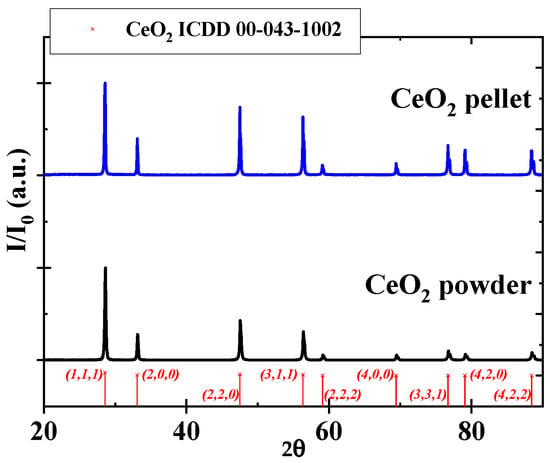
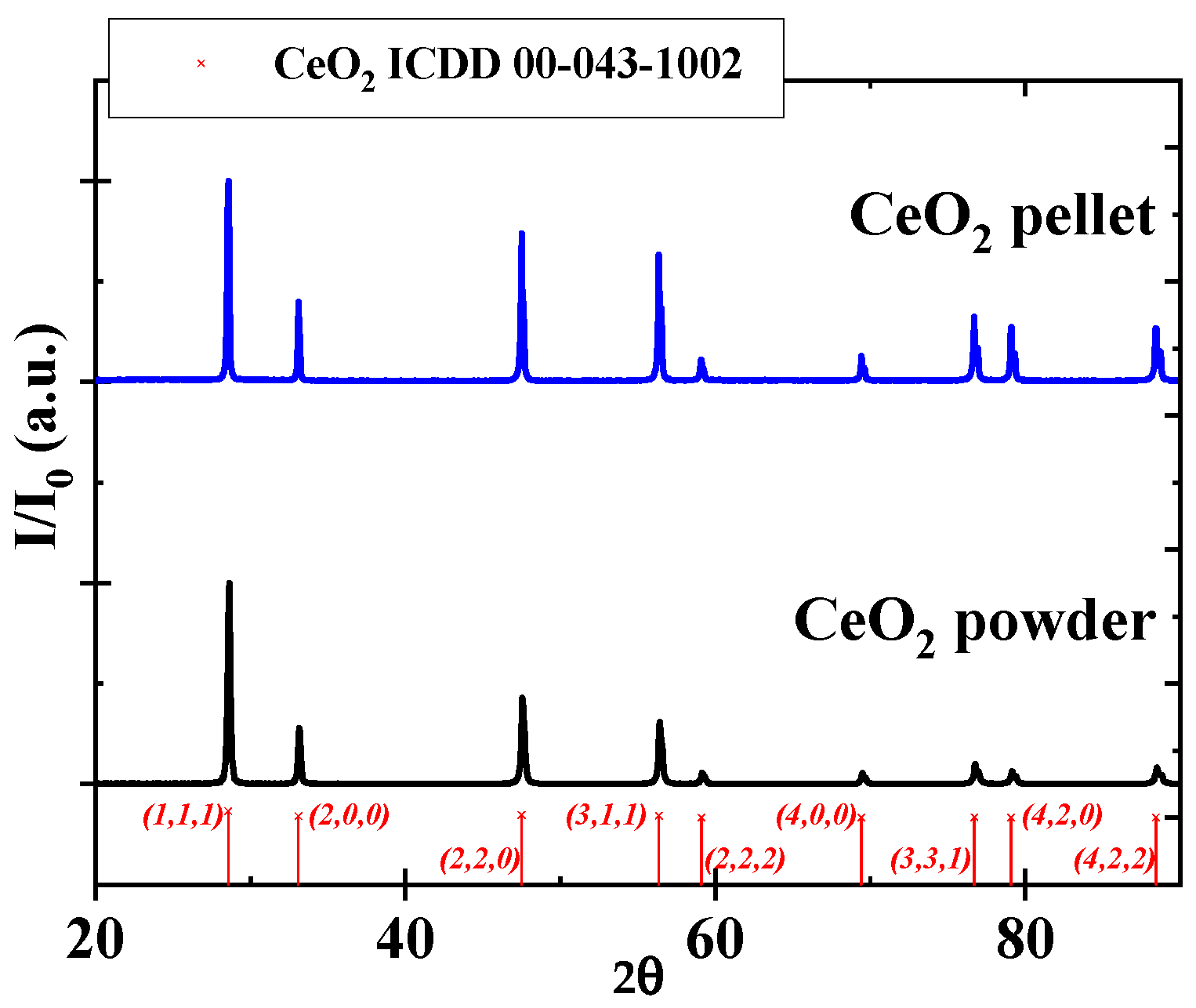
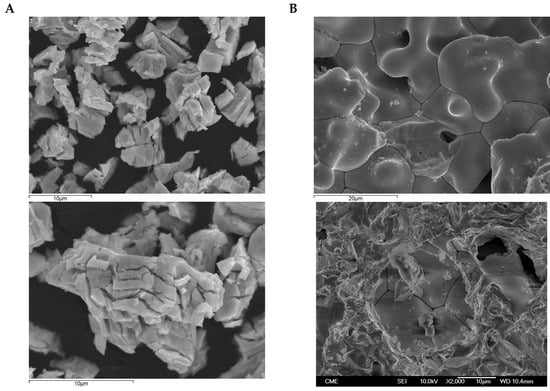
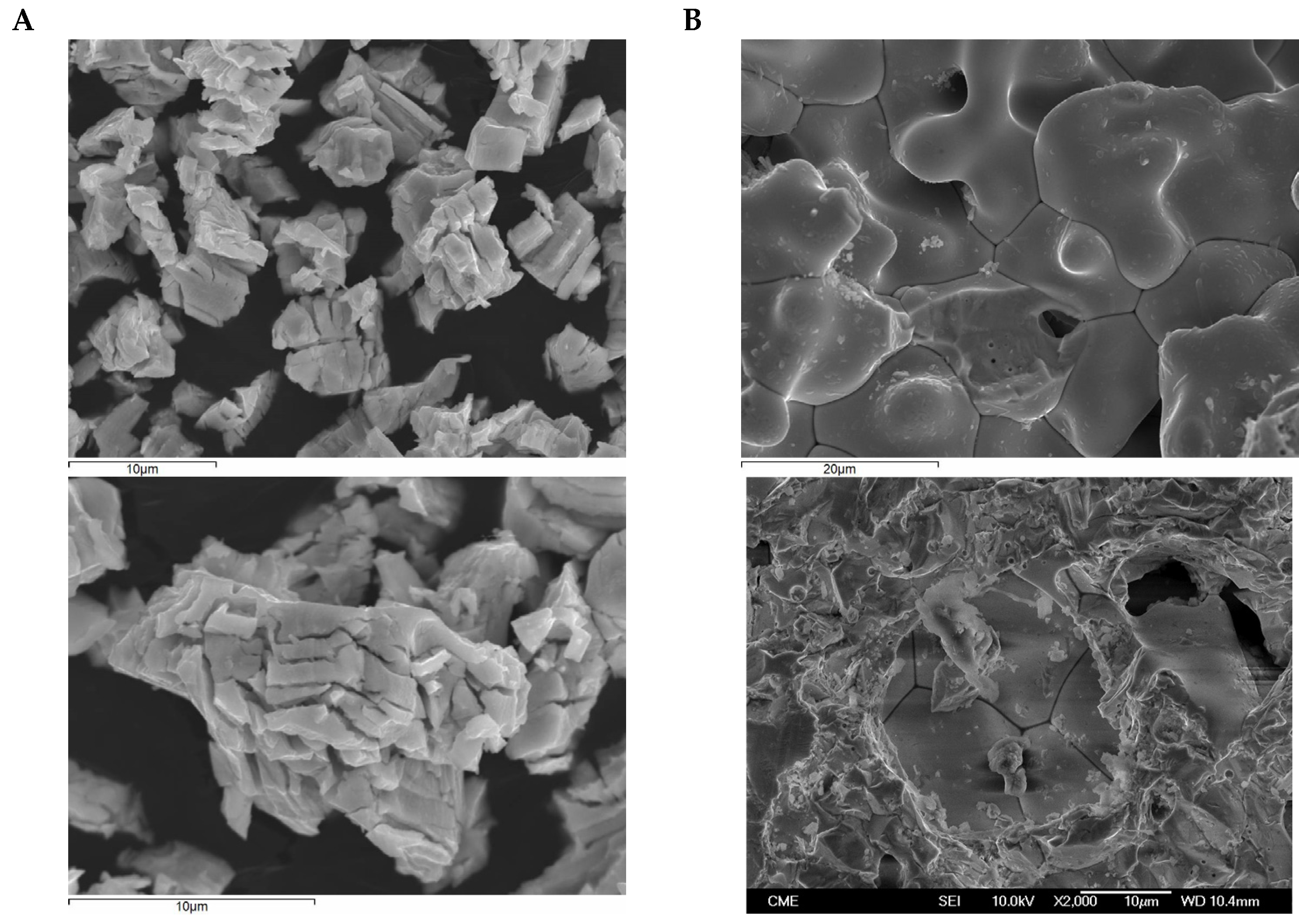
Both materials exhibited the characteristic fluorite structure of CeO2, with no additional crystalline phases detected by XRD within the instrumental detection limits (Figure 1). The measured lattice parameters were 5.40985 ± 0.00007 Å for the powder and 5.4111 ± 0.0003 Å for the pellets, consistent with reported values for stoichiometric CeO2 (5.411 Å) (CeO2 (ICDD PDF-2 #00-043-1002) [47]. No significant differences in lattice parameters were observed between the two materials. The commercial powder had a BET surface area of 5.93 ± 0.01 m2·g−1 and a median particle diameter, D(0.5,v) of 19.1 ± 0.1 μm. SEM observations revealed irregular faceted particles with localized microcracks and evidence of preferential crystal growth (Figure 2A). The sol–gel-derived pellets consisted of grains with an average size of approximately 20 μm embedded within a heterogeneous porous microstructure (Figure 2B).
Figure 1.
XRD patterns of the investigated CeO2 materials compared to fluorite-type CeO2 ICDD PDF-2 file 00-043-1002.
Figure 2.
SEM micrographs of (A) commercial CeO2 powder particles (A,B) a pellet prepared from the sol–gel-derived material.
Density measurements performed on the pellets using the Archimedes immersion method yielded an average bulk density of 5.8 ± 0.3 g·cm−3, corresponding to approximately 80% of the theoretical density of CeO2. This relatively low density is consistent with the presence of residual porosity after sintering. Based on the experimental lattice parameter, the theoretical density of CeO2 was calculated as 7.23 g·cm−3. Using the geometric density of the pellets, a total porosity of 25.3 ± 2.1% was estimated. This value confirms the presence of a significant fraction of pores generated during the sol–gel fabrication process.
The pellet had a BET surface area of approximately 0.7 m2·g−1, approximately one order of magnitude lower than that of the commercial powder. Its total porosity was approximately 25%. The combination of relatively high total porosity and low BET surface area suggests that a substantial fraction of the pore volume may be associated with relatively large pores [48,49]. Pore-size-distribution measurements would be required to test this interpretation. Surface characterization by AFM revealed a heterogeneous surface topography across the scanned areas, with height variations of approximately 2–3 μm over lateral dimensions of about 15 μm. Three-dimensional AFM images (Supplementary Information Figure S1) showed pronounced surface roughness and significant local relief features. Because the analyzed surfaces were obtained by diamond-saw sectioning of the pellets, part of the observed roughness may originate from sample preparation in addition to intrinsic microstructural features. Additional pore characterization would, however, be required to establish the origin of the observed surface characteristics.
3.2. Dissolution Behavior
Throughout the experiments, pH and redox conditions (expressed as pe) were monitored to evaluate the chemical evolution of the systems under inert conditions. Detailed pH and pe data are provided in Supplementary Information Figure S2.
In ultrapure water, the pellet systems showed a progressive increase in pH from the initial value of approximately 5.7 to near-neutral conditions (pH ~7.5). Most of this increase occurred during the initial stages of the experiment. In contrast, only minor pH variations were observed for the powder systems and for experiments performed in bicarbonate-containing media. The Volvic solution remained mildly alkaline throughout the experiment (pH ≈ 8.5), while pH values in the bicarbonate-rich solution remained stable between 8.9 and 9.0. The redox conditions remained relatively stable in all systems. Measured pe values were close to 6 in most experiments and slightly higher (~6.5) in ultrapure-water pellet systems.
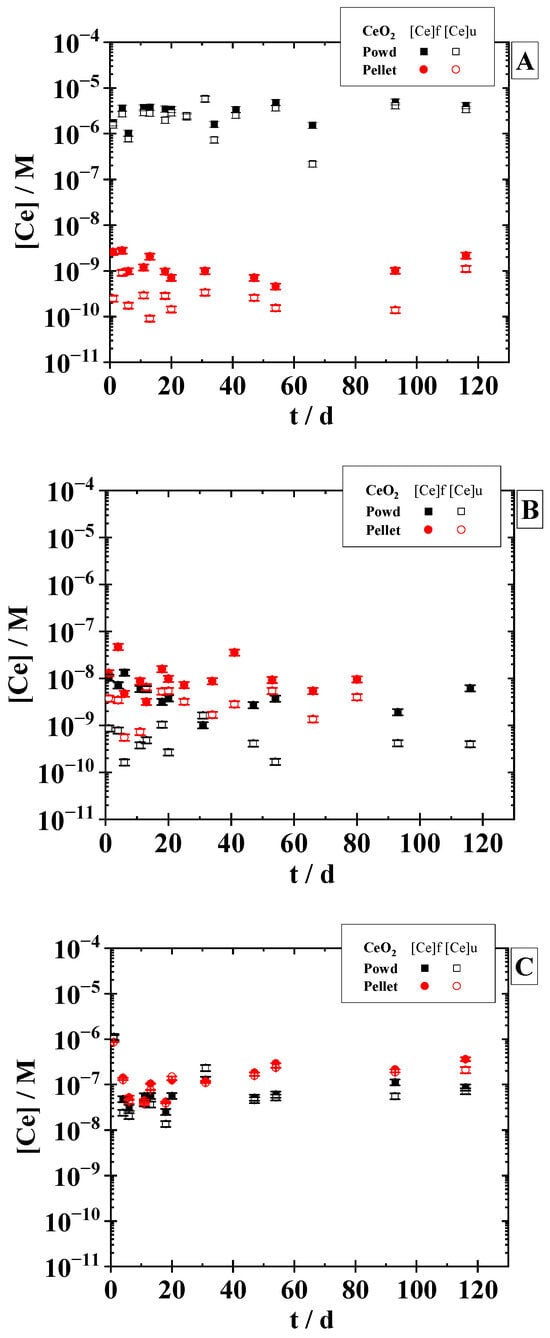
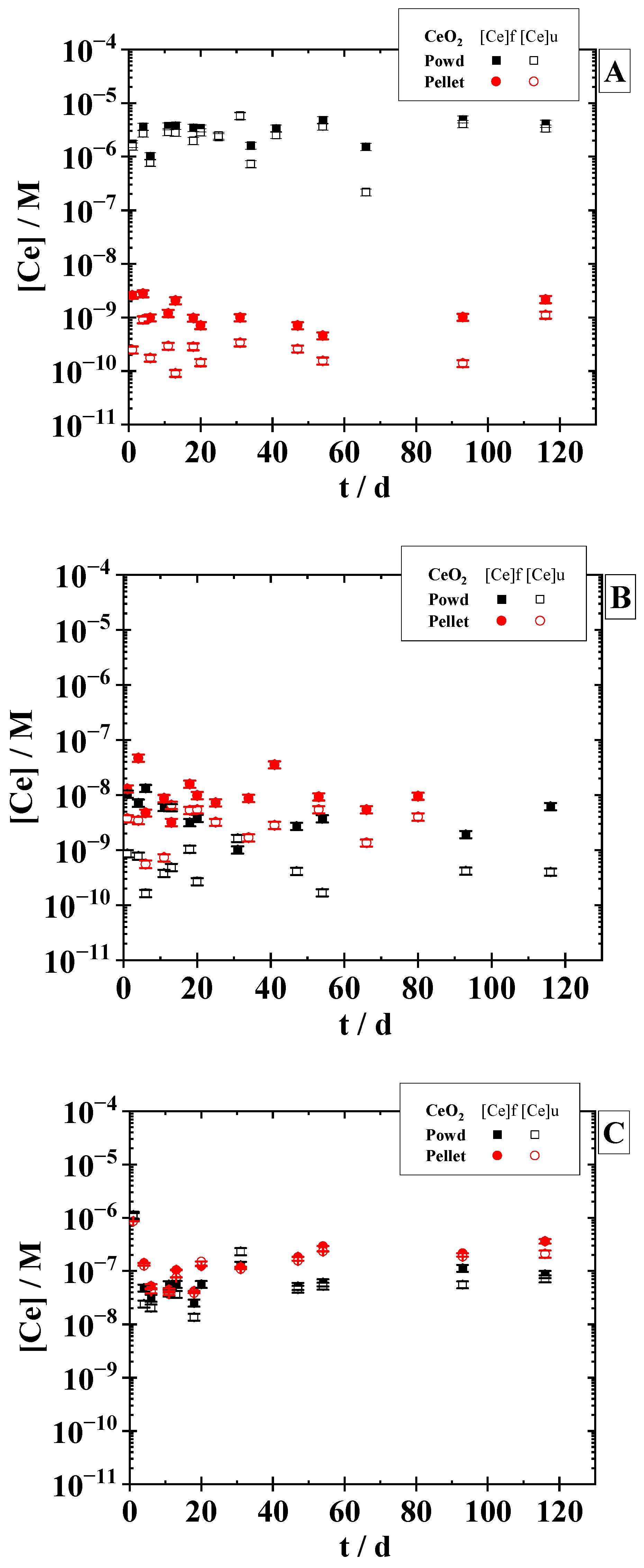
The evolution of dissolved cerium concentrations is shown in Figure 3 for the three media, and the final values are reported in Table 2. The analytical sensitivity of the ICP-MS method varied slightly among the aqueous media because of matrix effects. Detection limits for Ce were below 10−13 M in ultrapure water, 6 · 10−12 M in the Volvic water and 10−10 M in the bicarbonate-rich medium. All Ce concentrations reported in this work were well above the corresponding detection limits, ensuring reliable quantification throughout the dissolution experiments.
Figure 3.
Evolution of Ce concentration in the filtered and ultrafiltered fractions during dissolution experiments performed with CeO2 powder and sintered pellets in ultrapure water (A), Volvic solution (B) and bicarbonate-rich solution (C) at room temperature under an inert atmosphere.
Table 2.
Final Ce concentrations after approximately 100 days of dissolution as a function of aqueous medium, physical form (powder or pellet) and sample treatment (filtered or ultrafiltered).
Filtered Ce concentrations varied markedly with both the aqueous medium and the physical form of the material (Figure 3, Table 2). In ultrapure water, the highest Ce release was observed for the powder. After approximately 100 days, the final filtered concentrations were 2 · 10−6 M and 1 · 10−9 M for powders and pellets, respectively. In Volvic water, the corresponding concentrations were 4 · 10−9 M and 8 · 10−9 M. Final filtered concentrations were 4 · 10−9 M for the powder and 8 · 10−9 M for the pellets. In the bicarbonate-rich solution, the corresponding concentrations were 2.9 · 10−7 M for the pellets and 9 · 10−8 M for the powder.
Comparison of filtered and ultrafiltered Ce concentrations revealed substantial differences among aqueous media and material forms (Figure 3). The proportion of Ce retained during ultrafiltration varied slightly throughout the experiments, indicating that a considerable fraction of released Ce was associated with species larger than the nominal ultrafiltration cutoff. In ultrapure water, the powder exhibited relatively low and variable retained fractions, ranging from 0 to ~40%. By contrast, the pellets consistently displayed much higher retained fractions, varying between 50 and 90%. The highest retained fractions were generally observed during the early stages of the experiments, whereas lower values became more common at longer reaction times. Volvic water produced the largest ultrafiltration-retained fractions of all investigated systems. For the powder, values ranged from 67 to 90%. The pellets showed similarly high values, ranging from 40 to 90%. In several measurements, more than 90% of the released Ce was retained during ultrafiltration. Overall, lower retained fractions were observed in the bicarbonate-rich solution. Values ranged from 0 to 40% for the powder and pellets. These data indicate that the proportion of ultrafiltration-retained Ce varied with aqueous composition and material form.
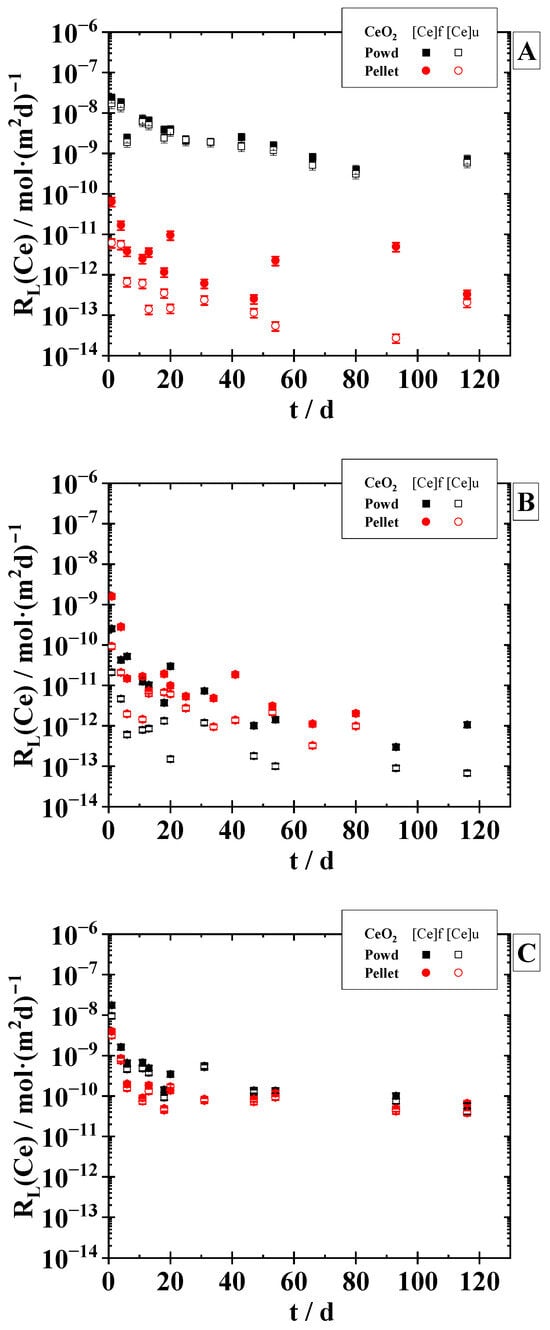
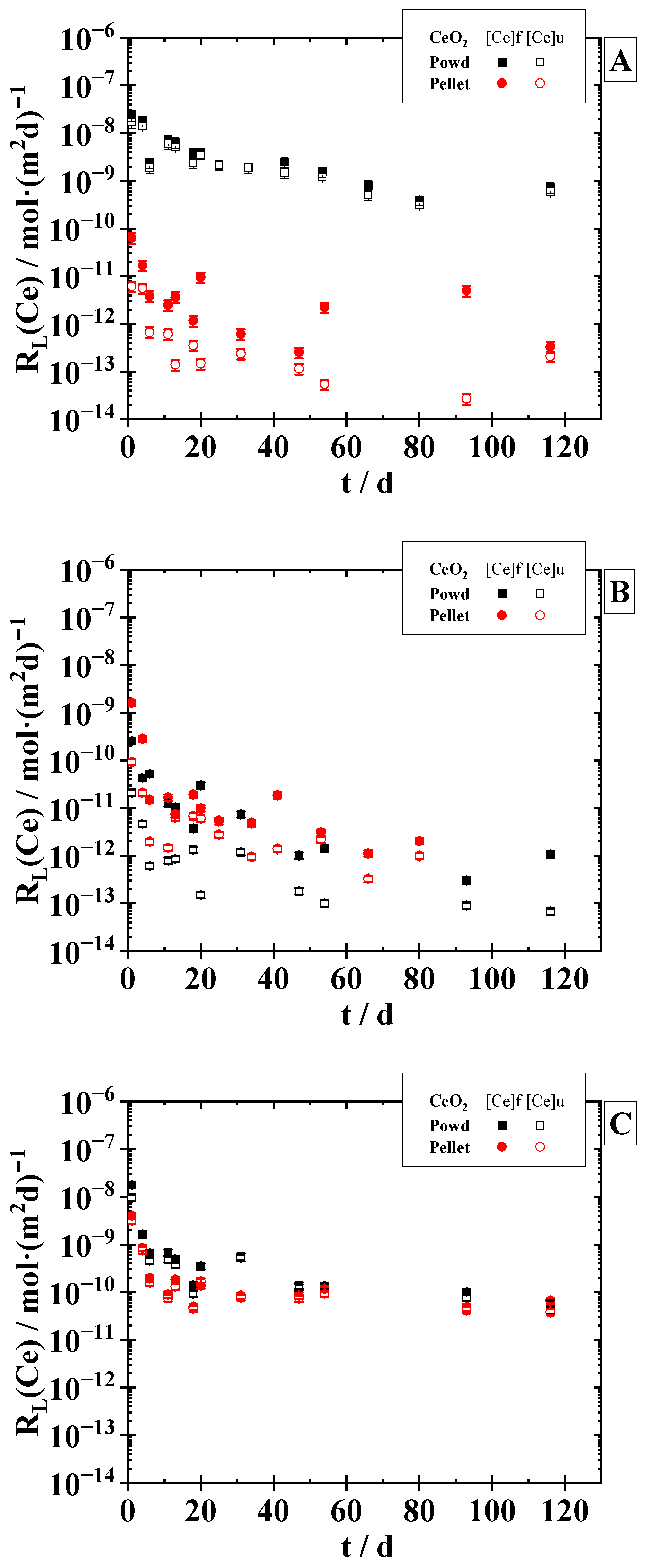
The surface-normalized dissolution rates (RL), calculated from the measured Ce concentrations, BET surface area and solid loading, are presented in Figure 4. Table 3 and Table 4 summarize the surface-normalized dissolution rates calculated from filtered and ultrafiltered Ce concentrations, respectively. Final RL values correspond to the cumulative apparent release rate calculated at the three final sampling times.
Figure 4.
Evolution of the normalized dissolution rate (RL) of Ce in ultrapure water (A), Volvic water (B) and bicarbonate-rich solution (C) (T = 25 ± 3 °C) for CeO2 samples in powder form and as sintered pellets.
Table 3.
BET-normalized apparent Ce release rates (RL) calculated from filtered Ce concentrations. Minimum, maximum, mean, and final values are reported in mol m−2 d−1.
Table 4.
BET-normalized apparent Ce release rates (RL) calculated from ultrafiltered Ce concentrations. Minimum, maximum, mean, and final values are reported in mol m−2 d−1.
In all systems, the highest apparent release rates were observed during the early stages of the experiments, followed by a progressive decline with time. This decrease was particularly pronounced in ultrapure water, where filtered RL values for the powder decreased from a maximum of 10−8 mol·m−2·d−1 to a final value of 10−9 mol·m−2·d−1. Similar temporal trends were observed for the pellet systems and for calculations based on ultrafiltered concentrations.
After normalization to BET surface area, the differences between powders and pellets became markedly smaller than those observed for dissolved Ce concentrations alone. In Volvic water and bicarbonate-rich solution, pellets exhibited final RL values of ~10−10 and 10−9 mol·m−2·d−1, respectively, despite possessing a BET surface area approximately one order of magnitude lower than that of the powder. These results indicate that BET surface area alone did not fully account for the observed release. Differences between the filtered and ultrafiltered fractions were generally most apparent in ultrapure water, whereas both fractions produced similar RL values in the Volvic and bicarbonate-rich media.
Comparison of diffraction peak positions, relative intensities and peak widths before and after reaction showed no measurable changes within instrumental uncertainty (Supplementary Information Figure S3). All detectable reflections were assigned to fluorite-type CeO2, and no secondary crystalline phases were identified within the detection limits of the measurement. Furthermore, SEM examination did not reveal major surface restructuring, grain dissolution, or extensive corrosion features; no major morphological alteration was detected by SEM under the investigated conditions (Supplementary Information Figure S4).
4. Discussion
4.1. Material Form and Ce Release
The low dissolved Ce concentrations measured throughout the experiments are consistent with the low solubility and strong tendency toward hydrolysis generally reported for tetravalent cerium phases under near-neutral and alkaline conditions [12,20,21]. Over approximately 100 days, concentrations remained in the nanomolar to micromolar range, indicating limited measurable release despite continuous exposure to the aqueous solutions.
The two CeO2 material forms exhibited different Ce-release behavior, particularly in ultrapure water. In this medium, the commercial powder released substantially more Ce than the pellets. After approximately 100 days, the filtered Ce concentration for the powder was 2 · 10−6 M, compared with 10−9 M for the pellets. The corresponding ultrafiltered concentrations were 2.0 · 10−6 M and 5.0 · 10−10 M, respectively. The powder therefore released approximately three orders of magnitude more Ce than the pellets in ultrapure water. In the Volvic-type and bicarbonate-rich solutions, the difference between the two materials was smaller and reversed for the final filtered concentrations. In Volvic water, filtered Ce concentrations were 4.0 · 10−9 M for the powder and 8 · 10−9 M for the pellets. In the bicarbonate-rich solution, filtered concentrations were 9 · 10−8 M for the powder and 2.9 · 10−7 M for the pellets. Under these conditions, the pellets released slightly more Ce than the powder despite having a lower BET surface area.
The BET-normalized apparent release rates, RL, calculated from the filtered concentrations, followed a similar pattern. In ultrapure water, the maximum RL for the powder was 2 · 10−8 mol·m−2·d−1, compared with 4 · 10−9 mol·m−2·d−1 for the pellets. In the Volvic mineral water, the maximum RL for the pellets was approximately 2 · 10−8 mol·m−2·d−1, two orders of magnitude higher than the maximum value for the powder. In the bicarbonate-rich solution, the maximum RL for the pellets was around 10−6 mol·m−2·d−1, again exceeding the corresponding value for the powder. These observations indicate that BET surface area alone is insufficient to predict Ce release. The powder had a BET surface area of 5.93 m2·g−1, whereas the pellets had approximately 0.70 m2·g−1. The higher normalized rates measured for the pellets in the Volvic and bicarbonate-rich media are consistent with a contribution from aqueous-accessible pore surfaces, grain boundaries or other reactive interfaces that may not be adequately represented by N2-BET surface area. However, the present data do not allow these contributions to be quantified separately. Water penetration into the pellet pore network may also have generated local chemical conditions that differed from those in the bulk solution.
In all media, the apparent release rates were highest during the early stages and decreased with time. This pattern is consistent with a population of initially more reactive surface sites followed by a lower-release regime, although changes in surface state, solution chemistry and mass transport may also contribute [12,20,50].
4.2. Solution Composition
The three aqueous media differed simultaneously in bicarbonate concentration, pH, ionic strength and, in the case of Volvic water, the concentrations of several additional dissolved constituents. Differences in Ce release therefore reflect the combined effects of solution composition rather than an independently resolved effect of bicarbonate. In ultrapure water, the pH increased from approximately 5.7 to 7.5 in the pellet systems, whereas only minor changes were observed in the powder systems. The origin of this pH shift in the pellet systems was not directly resolved. Surface protonation/deprotonation reactions, differences in accessible interfacial area and transport within the porous structure may all contribute [20]. The Volvic water remained mildly alkaline (pH ≈ 8.5), and the bicarbonate-rich solution remained between pH 8.9 and 9.0. The measured pe values were close to 6 in most systems and slightly higher in the ultrapure-water pellet systems.
The effect of bicarbonate therefore cannot be separated from the effects of pH and ionic strength. The Volvic water contained approximately 1 mM HCO3− and an ionic strength of 0.002 M, whereas the bicarbonate-rich solution contained 20 mM NaHCO3 and 10 mM NaCl, with an ionic strength of 0.03 M. Increasing bicarbonate concentration was therefore accompanied by increases in pH and ionic strength. Accordingly, the response of CeO2 to bicarbonate cannot be attributed to bicarbonate concentration alone.
Within this experimental design, bicarbonate-containing solutions did not produce a consistent increase in Ce release. Relative to ultrapure water, filtered Ce concentrations decreased for the powder but increased for the pellets. This contrast suggests that the response depended on both material form and solution composition. Ce(IV) hydrolysis is strongly favored under near-neutral to alkaline conditions, and carbonate complexes may have contributed to Ce mobility, although their contribution appears secondary within the concentration range investigated [21].
The higher bicarbonate concentration was not accompanied by a proportional increase in Ce release. This behavior differs from UO2 and some ThO2 systems, in which carbonate complexation can increase dissolution by stabilizing aqueous U(VI) or Th(IV) species [12,20,23,51,52,53].
4.3. Ultrafiltration-Retained Ce
Comparison of the filtered and ultrafiltered samples showed that a fraction of the released Ce was retained during ultrafiltration. The magnitude of this ultrafiltration-retained fraction varied with solution composition and material form. No systematic relationship was observed between total dissolved Ce concentration and the magnitude of the ultrafiltration-retained fraction.
In ultrapure water, the retained fraction for the powder ranged from approximately 0 to 40%, whereas for the pellets it exceeded 90% at the end of the experiment. In this medium, a strong dependence on material form was observed. One possible explanation is a greater contribution of aggregated Ce-bearing species in the pellet systems; however, their size, composition and origin were not directly characterized.
In the bicarbonate-rich solution, the retained fraction was lower overall, ranging from 0 to 40% for both materials. This pattern may indicate that the bicarbonate-rich medium favored smaller dissolved species or reduced the formation and persistence of larger Ce-bearing aggregates.
The largest retained fractions occurred in Volvic water. For the powder, values ranged from 67 to 90%, whereas values for the pellets ranged from 40 to 90%. These results are consistent with the formation or stabilization of Ce-bearing particulate species in this medium. Several mechanisms could account for these observations. Nanoparticles may have detached from reactive surface regions, or dissolved Ce may have undergone hydrolysis followed by precipitation of secondary Ce(IV) oxyhydroxide or oxide nanoparticles. The pronounced hydrolysis tendency of tetravalent cerium under neutral and alkaline conditions supports this interpretation. Similar behavior has been reported for Ce(IV), Th(IV), and Pu(IV), all of which exhibit strong hydrolysis and a tendency for intrinsic colloid formation [21,51,53,54,55]. Because no direct characterization was performed, the retained fraction may comprise intrinsic Ce-bearing colloids, particles released from the solid, hydrolysis products or larger aggregates formed in solution.
The particularly high retained fractions observed in Volvic water suggest that groundwater chemistry exerts an additional influence. Dissolved silica, calcium, magnesium, bicarbonate and other ions (Supplementary Table S1) may affect nucleation processes, colloidal stability and particle aggregation. The differences among the three media indicate that the proportion of ultrafiltration-retained Ce varied with solution composition and material form.
Because no direct characterization of the retained fraction was performed, the nature of the retained species cannot be determined conclusively. The retained fraction may comprise intrinsic Ce-bearing colloids, nanoparticles released from the solid surface, hydrolysis products, or larger aggregates formed in solution. Consequently, the term ultrafiltration-retained Ce is preferred over colloidal Ce throughout this work. Direct characterization using transmission electron microscopy, dynamic light scattering, nanoparticle tracking analysis or single-particle ICP-MS would be required to determine the size, composition and origin of the retained species.
4.4. Thermodynamic Calculations
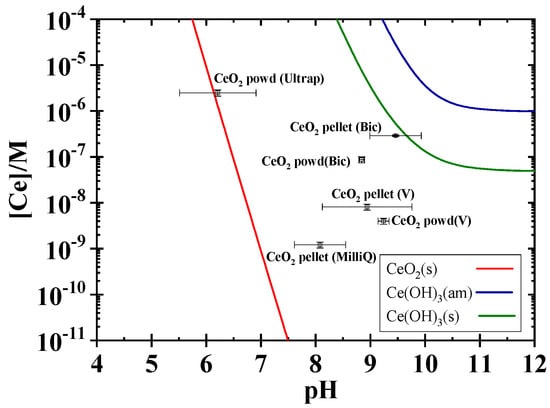
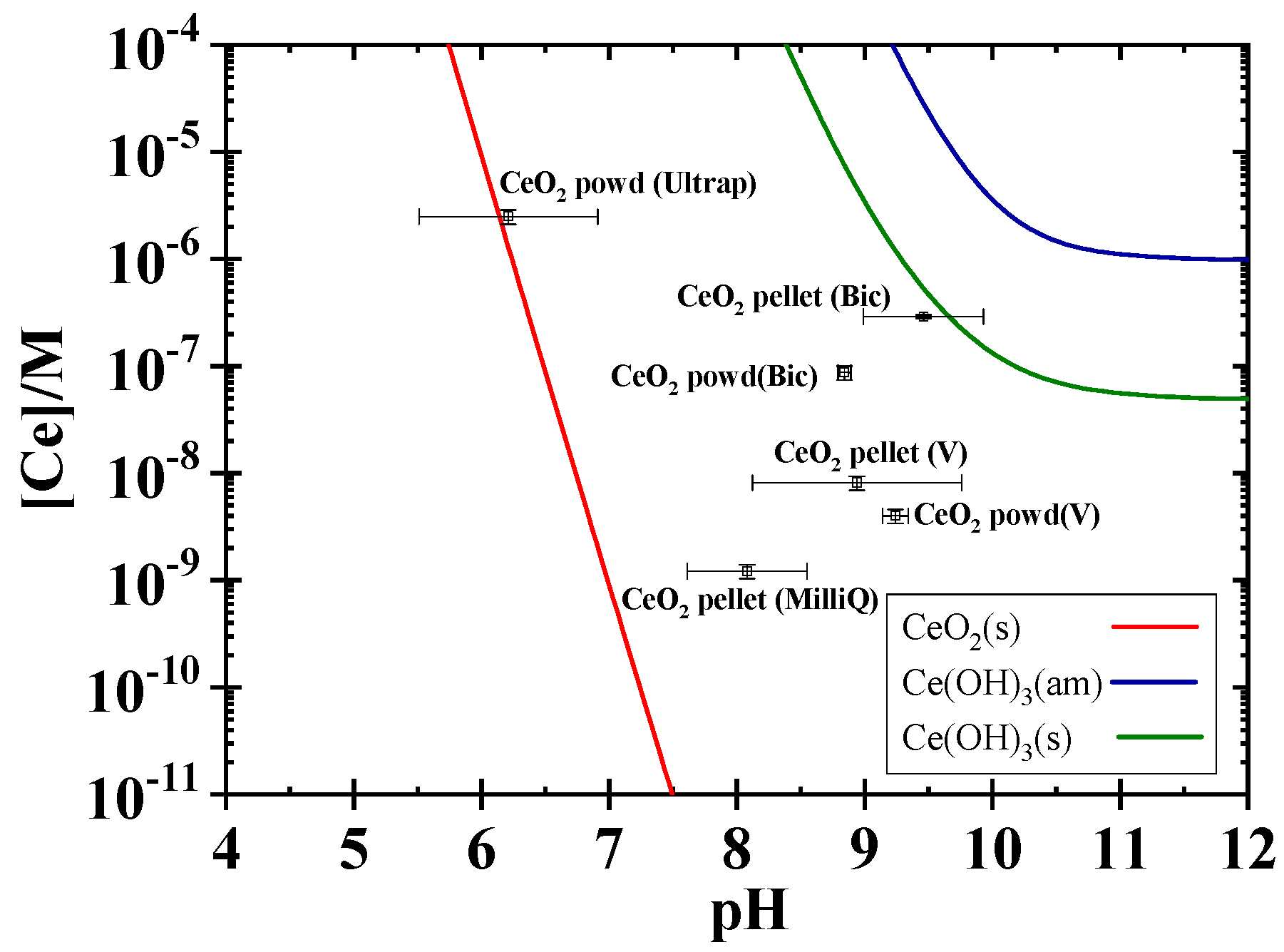
Aqueous speciation and saturation indices were calculated using PHREEQC Version 3 and a thermodynamic database derived from the SKB 95-35 compilation (Figure 5).
Figure 5.
Measured Ce concentrations in the aqueous solutions compared with PHREEQC-calculated solubility curves for the Ce-bearing solid phases considered potentially controlling under the investigated pH conditions.
The measured Ce concentrations were below the equilibrium concentrations calculated for the selected Ce-bearing phases. The calculated saturation indices were negative for all phases considered, indicating that the solutions were undersaturated with respect to those phases under the assumptions of the selected database and the specified pH and pe conditions. This interpretation depends on the thermodynamic constants, activity model, phase selection and pe values used in the calculations. The calculations do not indicate that precipitation of the selected phases controlled the measured Ce concentrations. Carbonate complexes may occur but appear to exert a less pronounced effect on solubility than in uranyl systems. Within the tested range of pH, ionic strength and bicarbonate concentration, no dramatic increase in Ce release was observed.
Several limitations should be noted. First, the oxidation state of dissolved Ce was not determined experimentally. The calculations therefore considered both Ce(III) and Ce(IV) species, but the speciation remains uncertain because of the complex redox and hydrolysis chemistry of cerium in aqueous systems [21,40,56]. Second, the pe values used in the calculations were imposed to represent the experimental environment rather than derived from direct measurement of the Ce(III)/Ce(IV) redox couple. Finally, the calculations used final solution compositions and did not account for speciation changes during the experiments. The calculated negative saturation indices indicate undersaturation with respect to the selected phases under the specified database, activity model, pH and pe conditions. They do not identify a unique rate-controlling mechanism. The calculations indicate that the results are consistent with surface-controlled release while the bulk solution remains undersaturated, but kinetic, transport and phase-selection uncertainties cannot be excluded.
4.5. Implications for Surrogate Use
CeO2 is useful as a non-radioactive material for selected studies of tetravalent fluorite-type oxides, particularly those involving microstructure, grain boundaries, hydrolysis and solid–water interfacial reactions [21,56]. Nevertheless, the suitability of CeO2 depends strongly on the specific actinide and process under consideration. While differences in electronic structure and redox chemistry prevent a direct one-to-one correspondence, the present results provide insight into processes relevant to the behavior of ThO2, UO2, NpO2, PuO2, and potentially AmO2 under repository conditions.
The analogy with UO2 is primarily structural rather than chemical. Both materials crystallize in the fluorite structure and therefore share similarities in lattice properties, grain-boundary evolution and microstructural response. However, their aqueous behavior differs fundamentally because uranium can be readily oxidized to U(VI), leading to the formation of highly stable uranyl-carbonate complexes [5,32,34,57]. This process commonly results in substantial increases in uranium solubility and dissolution rates in bicarbonate-containing waters. The comparatively weak influence of bicarbonate observed in the present experiments reflects the absence of an equivalent dissolution-enhancing mechanism in the Ce(IV) system. Although studies performed directly with UO2, including depleted uranium materials, provide the most representative information on spent fuel dissolution, the interpretation of the observed behavior is often complicated by uranium redox transformations [58], radiolytic effects [59] and uranyl-carbonate complexation [34]. As demonstrated in this work, CeO2 cannot reproduce these processes and should therefore not be regarded as a direct surrogate for uranium fuel dissolution. Nevertheless, because CeO2 shares the fluorite crystal structure of UO2 while remaining largely insensitive to oxidation-driven dissolution pathways, it provides a useful system for investigating the influence of grain boundaries, porosity, surface defects and microstructural heterogeneity separately from redox-controlled processes. This approach is consistent with previous studies of fuel fabrication, sintering behavior, microstructural evolution and dissolution phenomena relevant to fluorite-type nuclear materials [5,20,34,60,61].
The relationship between CeO2 and ThO2 is somewhat different. Thorium exists almost exclusively as Th(IV) in aqueous systems and exhibits low solubility together with extensive hydrolysis. In this respect, CeO2 and ThO2 show broadly comparable aqueous chemistry, particularly regarding the formation of hydrolyzed species and intrinsic colloids at near-neutral and alkaline pH. Previous studies have shown that both systems can be strongly influenced by hydrolysis and by the formation of particulate species that contribute to apparent dissolved concentrations. The filtered–ultrafiltered differences observed in the present work are therefore qualitatively consistent with behavior previously reported for Th(IV) systems [53,62,63,64,65]. Carbonate can significantly enhance Th(IV) solubility through hydroxo-carbonate complexes, in contrast to the weaker response observed for Ce(IV) under similar conditions [66,67].
The closest analog among tetravalent actinide oxides considered here is likely to be PuO2. Both compounds crystallize in the fluorite structure and are dominated by the +IV oxidation state under environmentally relevant conditions. In addition, Ce(IV) and Pu(IV) exhibit similarly low solubility, extensive hydrolysis and a tendency to form polymeric and colloidal species in aqueous systems [20,21,68,69,70]. As a result, CeO2 has frequently been employed as a surrogate for investigating dissolution mechanisms, colloid formation and surface reactivity of Pu(IV)-bearing materials without the experimental constraints associated with plutonium handling. These similarities make the present results qualitatively relevant to selected studies of Pu(IV)-bearing oxides [21,68,69,71].
CeO2 also shares important features with AmO2 and NpO2 when these actinides remain in the tetravalent state. All three oxides adopt fluorite-related structures and exhibit low aqueous solubility associated with strong hydrolysis reactions [21,37]. Accordingly, CeO2 may provide useful information regarding matrix stability, microstructural effects and surface-controlled release processes for these materials. However, the analogy is less robust than for PuO2 because both americium and neptunium can readily undergo redox transformations under environmental conditions. In particular, Np(V) is often the thermodynamically favored aqueous species in groundwater systems, while Am may coexist in both the +III and +IV oxidation states. Consequently, CeO2 cannot fully reproduce the redox-driven behavior that frequently controls the mobility of neptunium and americium in disposal environments [21,56,72,73].
The suitability of CeO2 as a surrogate for investigating fluorite-type actinide materials is most evident for processes involving tetravalent, low-solubility fluorite-type oxides, although quantitative extrapolation remains uncertain. Its relevance is greatest for Pu(IV) and, to a lesser extent, for Th(IV), Am(IV) and Np(IV) systems. Conversely, caution is required when extrapolating CeO2 behavior to materials whose long-term alteration is dominated by redox transformations or strong carbonate complexation, particularly UO2 and Np-containing systems. Consequently, the dissolution trends observed here are likely more representative of intrinsically tetravalent systems than of redox-sensitive uranium dioxide. The results also suggest that microstructural factors may substantially influence long-term radionuclide release. They also demonstrate that BET surface area alone is insufficient to describe Ce release from materials with different morphologies and fabrication histories. Microstructural attributes such as porosity, pore connectivity and grain-boundary density should therefore be considered in future comparative studies of fluorite-type ceramic waste forms in repository performance assessments.
5. Conclusions
Commercial CeO2 powder and sol–gel-derived pellets exhibited different Ce-release behavior over approximately 100 days, and the difference depended on solution composition. In ultrapure water, the powder produced higher Ce concentrations and apparent release rates than the pellets. In Volvic water and bicarbonate-rich solution, the pellets produced similar or higher final filtered concentrations and BET-normalized apparent release rates despite their lower BET surface area. These results show that BET surface area alone did not account for the observed release.
Ce release did not vary systematically with bicarbonate concentration across the three investigated media. Because bicarbonate concentration, pH, ionic strength and solution composition varied simultaneously, the contribution of bicarbonate cannot be isolated. The two material forms nevertheless responded differently to changes in aqueous composition, indicating that solution chemistry and material characteristics interact to control measured Ce release. This response differs from that reported in the literature for oxidized UO2 or ThO2 systems, where carbonate complexation strongly enhances dissolution through stabilization of aqueous U(VI) or Th(IV) species. Differences between filtered and ultrafiltered concentrations indicate an operationally defined ultrafiltration-retained Ce fraction, but the nature of this fraction remains unknown.
Ce release rates were highest during the early stages of the experiments and decreased with time. PHREEQC calculations indicated undersaturation with respect to the selected Ce-bearing phases under the specified database, pH and pe assumptions.
CeO2 is useful as a non-radioactive surrogate for selected studies of microstructure, hydrolysis and interfacial release in tetravalent fluorite-type oxides. Its behavior should not be quantitatively extrapolated to oxidative UO2 dissolution or to redox-sensitive Np and Am systems.
Future work should focus on direct investigation into dissolved and particulate cerium speciation to clarify release mechanisms. Comparative studies involving CeO2, ThO2 and UO2 under identical experimental conditions would also help determine the extent to which the mechanisms identified here can be generalized to actinide-bearing materials relevant to radioactive waste management.
Supplementary Materials
The following supporting information can be downloaded at: https://www.mdpi.com/article/10.3390/jne7040063/s1, Table S1. Composition of the aqueous media used in the dissolution experiments, Figure S1. Three-dimensional AFM surface profile of a CeO2 pellet obtained in contact mode over a scan area of 14.94 × 14.94 μm2, Figure S2. Evolution of pH and measured redox potential, expressed as pe, in ultrapure water, Volvic solution and bicarbonate-rich solution for CeO2 powder and pellet systems, Figure S3. XRD patterns of CeO2 powder (A) and pellets (B) after exposure to the investigated aqueous media. All detectable reflections were assigned to fluorite-type CeO2; no secondary crystalline phase was detected within the instrumental resolution, and Figure S4. SEM images of CeO2 powder (A) and pellets (B) after exposure to the investigated aqueous media.
Author Contributions
Conceptualization, N.R.-V., J.Q. and J.C.; methodology, N.R.-V.; investigation, N.R.-V., A.M.-P., E.I., H.G.; formal analysis, N.R.-V., A.M.-P., E.I., H.G. and J.Q.; writing—original draft preparation, N.R.-V.; writing—review and editing, A.M.-P., H.G., J.C., E.I. and J.Q.; supervision, J.Q.; funding acquisition, J.Q. All authors have read and agreed to the published version of the manuscript.
Funding
This research is part of the grant PID2021-124913OA-I00, IONMAT project, funded by MICIU/AEI/10.13039/501100011033/ and by ERDF/EU.
Data Availability Statement
The data presented in this study are available on request from the corresponding author (the data are not publicly available due to privacy).
Acknowledgments
The authors thank CIEMAT for providing experimental facilities and technical support. The authors gratefully acknowledge J.M. Cobo, S. Fernández-Carretero, L. Serrano, S. Durán and L. Gutiérrez (CIEMAT) for their assistance with sample analysis using BET, ICP-MS and XRD. The authors also thank JRC for supplying the CeO2 pellets. The authors thank J.M. Elorrieta Baigorri (CIEMAT) for her support and valuable comments.
Conflicts of Interest
The authors declare no conflicts of interest.
Abbreviations
The following abbreviations are used in this manuscript:
| AFM | Atomic Force Microscopy |
| BET | Brunauer–Emmett–Teller |
| DGR | Deep Geological Repository |
| FEG-SEM | field-emission gun scanning electron microscope |
| ICP-MS | inductively coupled plasma mass spectrometry |
| PHREEQC | Geochemical speciation and reaction-path calculation code |
| SEM | Scanning Electron Microscopy |
| SNF | Spent Nuclear Fuel |
| S/V | Surface-Area-To-Volume Ratio |
| XRD | X-ray diffraction |
References
- Unokiwedi, O.P.; Gao, J.; Bethune, T.; Awolayo, A.N. Deep geological repositories—A review of design concepts, near-field evolution, and their implications for nuclear waste containment. J. Environ. Radioact. 2025, 289, 107750. [Google Scholar] [CrossRef] [Scilit]
- International Atomic Energy Agency (IAEA). Status and Trends in Spent Fuel and Radioactive Waste Management; IAEA Nuclear Energy Series No. NW-T-1.14; International Atomic Energy Agency: Vienna, Austria, 2025. [Google Scholar]
- Spahiu, K. State of the Knowledge Report—Spent Nuclear Fuel Domain 3.1.1; EURAD—European Joint Programme on Radioactive Waste Management: Châtenay-Malabry, France, 2021; Grant Agreement n° 847593. [Google Scholar]
- Rodríguez-Villagra, N.; Bonales, L.J.; Milena-Pérez, A.; Galán, H. A snapshot review on uranyl secondary phases formation in aqueous systems. MRS Adv. 2023, 8, 207–213. [Google Scholar] [CrossRef] [Scilit]
- Shoesmith, D.W. Used Fuel and Uranium Dioxide Dissolution Studies—A Review; NACE International: Toronto, ON, Canada, 2007. [Google Scholar]
- International Atomic Energy Agency (IAEA). Geological Disposal Facilities for Radioactive Waste; International Atomic Energy Agency: Vienna, Austria, 2011. [Google Scholar]
- OECD/NEA. Geological Disposal of Radioactive Waste: Review of Developments in the Last Decade; OECD Publishing: Paris, France, 1999. [Google Scholar]
- Quiñones, J.; Cobos, J.; Arocas, P.P.D.; Rondinella, V.V. Modelling of the (U1-y238Puy)O2+x leaching behaviour in deionised water under anoxic conditions. In Scientific Basis for Nuclear Waste Management XXVII; Oversby, V.M., Werme, L.O., Eds.; Materials Research Society: Warrendale, PA, USA, 2004; Volume 807, pp. 409–414. [Google Scholar]
- Merino, J.; Cera, E.; Bruno, J.; Quiñones, J.; Casas, I.; Clarens, F.; Giménez, J.; de Pablo, J.; Rovira, M.; Martínez-Esparza, A. Radiolytic modelling of spent fuel oxidative dissolution mechanism. Calibration with UO2 dynamic leaching experiments. J. Nucl. Mater. 2005, 346, 40–47. [Google Scholar] [CrossRef] [Scilit]
- Ollila, K. Influence of Radiolysis on UO2 Fuel Matrix Dissolution Under Disposal Conditions—Literature Study; Posiva Oy: Olkiluoto, Finland, 2011. [Google Scholar]
- Puranen, A.; Evins, L.-Z.; Barreiro, A.; Roth, O.; Spahiu, K. Very high burnup spent fuel corrosion & leaching under hydrogen conditions. J. Nucl. Mater. 2022, 572, 154027. [Google Scholar] [CrossRef] [Scilit]
- Corkhill, C.L.; Bailey, D.J.; Tocino, F.Y.; Stennett, M.C.; Miller, J.A.; Provis, J.L.; Travis, K.P.; Hyatt, N.C. Role of Microstructure and Surface Defects on the Dissolution Kinetics of CeO2, a UO2 Fuel Analogue. ACS Appl. Mater. Interfaces 2016, 8, 10562–10571. [Google Scholar] [CrossRef] [Scilit]
- Popel, A.; Le Solliec, S.; Lampronti, G.; Day, J.; Petrov, P.; Farnan, I. The effect of fission-energy Xe ion irradiation on the structural integrity and dissolution of the CeO2 matrix. J. Nucl. Mater. 2017, 484, 332–338. [Google Scholar] [CrossRef] [Scilit]
- Patnaik, S. Comparative analysis of temperature dependent properties of commercial nuclear fuel pellet and surrogates undergoing cracking: A review. Ceram. Int. 2020, 46, 24765–24778. [Google Scholar] [CrossRef] [Scilit]
- Kim, H.S.; Joung, C.Y.; Lee, B.H.; Oh, J.Y.; Koo, Y.H.; Heimgartner, P. Applicability of CeO2 as a surrogate for PuO2 in a MOX fuel development. J. Nucl. Mater. 2008, 378, 98–104. [Google Scholar] [CrossRef] [Scilit]
- Stennett, M.C.; Corkhill, C.L.; Marshall, L.A.; Hyatt, N.C. Preparation, characterisation and dissolution of a CeO2 analogue for UO2 nuclear fuel. J. Nucl. Mater. 2013, 432, 182–188. [Google Scholar] [CrossRef] [Scilit]
- Tyagi, A.; Ambekar, B.; Mathews, M.D. Simulation of lattice thermal expansion behaviour of Th1−xPuxO2 (0.0≤x≤1.0) using CeO2 as a surrogate material for PuO2. J. Alloys Compd. 2002, 337, 277–281. [Google Scholar] [CrossRef] [Scilit]
- Gaillard, J.; Venault, L.; Calvet, R.; Del Confetto, S.; Clavier, N.; Podor, R.; Odorico, M.; Pellequer, J.-L.; Vigier, N.; Moisy, P. Effect of hydration and thermal treatment on ceria surface using non-intrusive techniques. J. Nucl. Mater. 2014, 444, 359–367. [Google Scholar] [CrossRef] [Scilit]
- Beaudoux, X.; Virot, M.; Chave, T.; Leturcq, G.; Jouan, G.; Venault, L.; Moisy, P.; Nikitenko, S.I. Ultrasound-assisted reductive dissolution of CeO2 and PuO2 in the presence of Ti particles. Dalton Trans. 2016, 45, 8802–8815. [Google Scholar] [CrossRef] [Scilit]
- Montaigne, T.; Szenknect, S.; Broudic, V.; Imbert, P.-H.; Tocino, F.; Martin, C.; Miserque, F.; Jégou, C.; Dacheux, N. Oxidative dissolution of (U,Ce)O2 materials in aqueous solutions containing H2O2. npj Mater. Degrad. 2023, 7, 34. [Google Scholar] [CrossRef] [Scilit]
- Marsac, R.; Réal, F.; Banik, N.L.; Pédrot, M.; Pourret, O.; Vallet, V. Aqueous chemistry of Ce(iv): Estimations using actinide analogues. Dalton Trans. 2017, 46, 13553–13561. [Google Scholar] [CrossRef] [Scilit]
- Sims, H.E.; Orr, R.M. Radiation chemical processes in the water layer on the surface of PuO2. Front. Nucl. Eng. 2024, 3, 1294584. [Google Scholar] [CrossRef] [Scilit]
- Corkhill, C.L.; Myllykylä, E.; Bailey, D.J.; Thornber, S.M.; Qi, J.; Maldonado, P.; Stennett, M.C.; Hamilton, A.; Hyatt, N.C. Contribution of Energetically Reactive Surface Features to the Dissolution of CeO2 and ThO2 Analogues for Spent Nuclear Fuel Microstructures. ACS Appl. Mater. Interfaces 2014, 6, 12279–12289. [Google Scholar] [CrossRef] [Scilit]
- McGrady, J.; Kumagai, Y.; Watanabe, M.; Kirishima, A.; Akiyama, D.; Kimuro, S.; Ishidera, T. A Raman spectroscopy study of bicarbonate effects on UO2+x. J. Nucl. Sci. Technol. 2023, 60, 1586–1594. [Google Scholar] [CrossRef] [Scilit]
- Olsson, D.; Aydogan, H.; Jonsson, M. The influence of bicarbonate concentration and ionic strength on peroxide speciation and overall reactivity towards UO2. RSC Adv. 2024, 14, 16248–16254. [Google Scholar] [CrossRef] [Scilit]
- Stober, I.; Giovanoli, F.; Wiebe, V.; Bucher, K. Deep hydrochemical section through the Central Alps: Evolution of deep water in the continental upper crust and solute acquisition during water–rock-interaction along the Sedrun section of the Gotthard Base Tunnel. Swiss J. Geosci. 2022, 115, 9. [Google Scholar] [CrossRef] [Scilit]
- Riba, O.; Evins, L. Initial State-of-the-Art Report of Deliverable D8.1 of the European Partnership EURAD-2; EC Grant agreement n:101177718; EURAD-2: Châtenay-Malabry, France, 2025. [Google Scholar]
- Giménez, J.; Clarens, F.; Casas, I.; Rovira, M.; de Pablo, J.; Bruno, J. Oxidation and dissolution of UO2 in bicarbonate media: Implications for the spent nuclear fuel oxidative dissolution mechanism. J. Nucl. Mater. 2005, 345, 232–238. [Google Scholar] [CrossRef] [Scilit]
- Guittonneau, C.; Gin, S.; Godon, N.; Mestre, J.; Dugne, O.; Allegri, P. A 25-year laboratory experiment on French SON68 nuclear glass leached in a granitic environment—First investigations. J. Nucl. Mater. 2011, 408, 73–89. [Google Scholar] [CrossRef] [Scilit]
- Zhang, C.-L.; Wang, J.; Kaufhold, S.; Liu, Y.; Czaikowski, O.; Pingel, J.; Schäfer, T.; Kouhail, Y.; Bouby, M.; Heberling, F.; et al. Experimental Basis. In Thermo-Hydro-Mechanical-Chemical (THMC) Processes in Bentonite Barrier Systems; Shao, H., Wang, J., Schäfer, T., Zhang, C.-L., Geckeis, H., Nagel, T., Düsterloh, U., Kolditz, O., Shao, H., Eds.; Springer Nature: Cham, Switzerland, 2024; pp. 41–90. [Google Scholar]
- Jedináková-Křižová, V. Migration of radionuclides in the enviroment. J. Radioanal. Nucl. Chem. 1998, 229, 13–18. [Google Scholar] [CrossRef] [Scilit]
- Rodríguez-Villagra, N.; Fernández-Carretero, S.; Milena-Pérez, A.; Bonales, L.; Gutiérrez, L.; Cobos, J.; Galán, H. Impact of dopants and leachants on modern UO2-based fuels alteration under final storage conditions: Single and joint effects. J. Nucl. Mater. 2025, 606, 155635. [Google Scholar] [CrossRef] [Scilit]
- Rodríguez-Villagra, N.; Riba, O.; Milena-Pérez, A.; Cobos, J.; Jimenez-Bonales, L.; Fernández-Carretero, S.; Coene, E.; Silva, O.; Duro, L. Dopant effect on the spent fuel matrix dissolution of new advanced fuels: Cr-doped UO2 and Cr/Al-doped UO2. J. Nucl. Mater. 2022, 568, 153880. [Google Scholar] [CrossRef] [Scilit]
- de Pablo, J.; Casas, I.; Giménez, J.; Molera, M.; Rovira, M.; Duro, L.; Bruno, J. The oxidative dissolution mechanism of uranium dioxide. I. The effect of temperature in hydrogen carbonate medium. Geochim. Cosmochim. Acta 1999, 63, 3097–3103. [Google Scholar] [CrossRef] [Scilit]
- Ekeroth, E.; Roth, O.; Jonsson, M. The relative impact of radiolysis products in radiation induced oxidative dissolution of UO2. J. Nucl. Mater. 2006, 355, 38–46. [Google Scholar] [CrossRef] [Scilit]
- Hansson, N.L.; Jonsson, M.; Ekberg, C.; Spahiu, K. Modelling radiation-induced oxidative dissolution of UO2-based spent nuclear fuel on the basis of the hydroxyl radical mediated surface mechanism: Exploring the impact of surface reaction mechanism and spatial and temporal resolution. J. Nucl. Mater. 2023, 578, 154369. [Google Scholar]
- Guillaumont, R.; Fanghänel, T.; Fuger, J.; Grenthe, I.; Neck, V.; Palmer, D.A.; Rand, M.H. Update on the Chemical Thermodynamics of Uranium, Neptunium, Plutonium, Americium and Technetium; Elsevier: Amsterdam, The Netherlands, 2003; Volume 5. [Google Scholar]
- Fernández, A.; Haas, D.; Konings, R.J.M.; Somers, J. Fuel/Target concepts for transmutation of actinides. In Proceedings of the the 6th Information Exchange Meeting on Actinide and Fission Product Partitioning and Transmutation, Madrid, Spain, 11–13 December 2000. [Google Scholar]
- Haas, D.; Somers, J.; Renard, A.; Fuente, A.L. Feasibility of the fabrication of americium targets. In Proceedings of the Fifth OECD/NEA Information Exchange Meeting on Actinide and Fission Product Partitioning and Transmutation, SCK-CEN, Mol, Belgium, 25–27 November 1998. [Google Scholar]
- Fernandez, A.; Konings, R.J.M.; Somers, J.; Haas, D. Fabrication of CERamic-CERamic composites pellets for the transmutation of actinides. J. Mater. Sci. Lett. 2003, 22, 119–121. [Google Scholar] [CrossRef] [Scilit]
- Fernández, A.; Haas, D.; Konings, R.J.M.; Somers, J. Transmutation of Actinides. J. Am. Ceram. Soc. 2002, 85, 694–696. [Google Scholar] [CrossRef] [Scilit]
- JCPDS–ICDD. PCPDFWIN, version 2.02; International Centre for Diffraction Data: Newtown Square, PA, USA, 1999. [Google Scholar]
- Brunauer, S.; Emmet, P.; Teller, E. Adsorption of gases in multimolecular layers. J. Am. Chem. Soc. 1938, 60, 309–319. [Google Scholar] [CrossRef] [Scilit]
- Quiñones, J.; Villagra, N.R.; Iglesias, E.; Nieto, J.M.; Palomo, C.; Esparza, A.M. Evaluación de las Concentraciones Máximas de Radionucleidos en las Inmediaciones al Término Fuente; Ciemat: Madrid, Spain, 2009. [Google Scholar]
- Parkhurst, D.L.; Appelo, C.A.J. PHREEQC (Version 3)—A Computer Program for Speciation, Batch-Reaction, One-Dimensional Transport, and Inverse Geochemical Calculations; U.S. Geological Survey (USGS): Reston, VA, USA, 2013. [Google Scholar]
- Spahiu, K.; Bruno, J. A Selected Thermodynamic Database for REE to Be Used in HLNW Performance Assessment Exercises; SKB Technical Report; Swedish Nuclear Fuel and Waste Management Co.: Stockholm, Sweden, 1995; Volume TR-95-35. [Google Scholar]
- Grier, D.; McCarthy, G. ICDD Grant-in-Aid 1991; International Center for Diffraction Data: Newtown Square, PA, USA, 1994. [Google Scholar]
- Chu, X.; Chung, W.; Schmidt, L.D. Sintering of Sol—Gel-Prepared Submicrometer Particles Studied by Transmission Electron Microscopy. J. Am. Ceram. Soc. 1993, 76, 2115–2118. [Google Scholar] [CrossRef] [Scilit]
- Phonthammachai, N.; Rumruangwong, M.; Gulari, E.; Jamieson, A.; Jitkarnka, S.; Wongkasemjit, S. Synthesis and rheological properties of mesoporous nanocrystalline CeO2 via sol–gel process. Colloids Surf. A Physicochem. Eng. Asp. 2004, 247, 61–68. [Google Scholar] [CrossRef] [Scilit]
- Hours, C.; Claparede, L.; Reynier-Tronche, N.; Viallard, I.; Podor, R.; Dacheux, N. Dissolution of (U,Th)O2 heterogeneous mixed oxides. J. Nucl. Mater. 2023, 586, 154658. [Google Scholar] [CrossRef] [Scilit]
- Baes, C.F.; Mesmer, R.S. The Hydrolysis of Cations; John Wiley & Sons: New York, NY, USA, 1976. [Google Scholar]
- OECD/NEA. Thermodynamic Sorption Modelling in Support of Radioactive Waste Disposal Safety Cases: NEA Sorption Project Phase III; OECD Publishing: Paris, France, 2012. [Google Scholar]
- Östhols, E.; Bruno, J.; Grenthe, I. On the influence of carbonate on mineral dissolution: III. The solubility of microcrystalline ThO2 in CO2-H2O media. Geochim. Cosmochim. Acta 1994, 58, 613–623. [Google Scholar] [CrossRef] [Scilit]
- Knopp, R.; Neck, V.; Kim, J.I. Solubility, hydrolysis and colloid formation of Plutonium(IV). Radiochim. Acta 1999, 86, 101–108. [Google Scholar] [CrossRef] [Scilit]
- Neck, V.; Müller, R.; Bouby, M.; Altmaier, M.; Rothe, J.; Denecke, M.A.; Kim, J.-I. Solubility of amorphous Th(IV) hydroxide—Application of LIBD to determine the solubility product and EXAFS for aqueous speciation. Radiochim. Acta 2002, 90, 485–494. [Google Scholar] [CrossRef] [Scilit]
- Tracy, C.L.; Lang, M.; Pray, J.M.; Zhang, F.; Popov, D.; Park, C.; Trautmann, C.; Bender, M.; Severin, D.; Skuratov, V.A.; et al. Redox response of actinide materials to highly ionizing radiation. Nat. Commun. 2015, 6, 6133. [Google Scholar] [CrossRef] [Scilit]
- Neck, V.; Kim, J.I. Solubility and hydrolysis of tetravalent actinides. Radiochim. Acta 2001, 89, 1–16. [Google Scholar] [CrossRef] [Scilit]
- Shoesmith, D.W. Fuel corrosion processes under waste disposal conditions. J. Nucl. Mater. 2000, 282, 1–31. [Google Scholar] [CrossRef] [Scilit]
- Eriksen, T.E.; Shoesmith, D.W.; Jonsson, M. Radiation induced dissolution of UO2 based nuclear fuel—A critical review of predictive modelling approaches. J. Nucl. Mater. 2012, 420, 409–423. [Google Scholar] [CrossRef] [Scilit]
- García-Gómez, S.; Giménez, J.; Casas, I.; Llorca, J.; De Pablo, J. Gd2O3 Doped UO2(s) Corrosion in the Presence of Silicate and Calcium under Alkaline Conditions. Inorganics 2023, 11, 469. [Google Scholar] [CrossRef] [Scilit]
- Fernandez, S.; Nieto, M.I.; Cobos, J.; Moreno, R. CeO2 pellet fabrication as spent fuel matrix analogue. J. Eur. Ceram. Soc. 2016, 36, 3505–3512. [Google Scholar] [CrossRef] [Scilit]
- Altmaier, M.; Neck, V.; Denecke, M.A.; Yin, R.; Fanghaenel, T. Solubility of ThO2*H2O(am) and formation of ternary Th(IV) hydroxide-carbonate complexes in NaHCO3-Na2CO3-NaOH-NaCl solutions: The effect of ionic strength. Radiochim. Acta 2006, 94, 495–500. [Google Scholar]
- Dumpala, R.M.R.; Sahu, M.; Nagar, B.K.; Raut, V.V.; Raje, N.H.; Rawat, N.; Subbiah, J.; Saxena, M.K.; Tomar, B.S. Accountancy for intrinsic colloids on thorium solubility: The fractionation of soluble species and the characterization of solubility limiting phase. Chemosphere 2021, 269, 129327. [Google Scholar] [CrossRef] [Scilit]
- Altmaier, M.; Neck, V.; Fanghänel, T. Solubility and colloid formation of Th(IV) in concentrated NaCl and MgCl2 solution. Radiochim. Acta 2004, 92, 537–543. [Google Scholar] [CrossRef] [Scilit]
- Walther, C.; Fuss, M.; Büchner, S. Formation and hydrolysis of polynuclear Th(IV) complexes—A nano-electrospray mass-spectrometry study. Radiochim. Acta 2008, 96, 411–425. [Google Scholar] [CrossRef] [Scilit]
- Kim, S.S.; Baik, M.H.; Choi, J.W.; Shin, H.S.; Yun, J.I. The dissolution of ThO2(cr) in carbonate solutions and a granitic groundwater. J. Radioanal. Nucl. Chem. 2010, 286, 91–97. [Google Scholar] [CrossRef] [Scilit]
- Myllykylä, E.; Lavonen, T.; Stennett, M.; Corkhill, C.; Ollila, K.; Hyatt, N. Solution composition and particle size effects on the dissolution and solubility of a ThO2 microstructural analogue for UO2 matrix of nuclear fuel. Radiochim. Acta 2015, 103, 565–576. [Google Scholar] [CrossRef] [Scilit]
- Neck, V.; Altmaier, M.; Fanghänel, T. Solubility of plutonium hydroxides/hydrous oxides under reducing conditions and in the presence of oxygen. C. R. Chim. 2007, 10, 959–977. [Google Scholar] [CrossRef] [Scilit]
- Walther, C.; Rothe, J.; Brendebach, B.; Fuss, M.; Altmaier, M.; Marquardt, C.M.; Büchner, S.; Cho, H.-R.; Yun, J.-I.; Seibert, A. New insights in the formation processes of Pu(IV) colloids. Radiochim. Acta 2009, 97, 199–207. [Google Scholar] [CrossRef] [Scilit]
- Neill, T.S.; Morris, K.; Harrison, S.; Apps, P.; Bryan, N.; Parry, S.; Mosselmans, J.F.W.; Cibin, G.; Rigby, B.; Livens, F.R.; et al. Nanoparticulate and colloidal uranium and plutonium in spent nuclear fuel storage pond effluents. J. Hazard. Mater. 2025, 489, 137629. [Google Scholar] [CrossRef] [Scilit]
- Nästrén, C.; Fernandéz-Carretero, A.; Somers, J. Synthesis Route for the Safe Production of Targets for Transmutation of Plutonium and Minor Actinides. Nucl. Technol. 2013, 181, 331–336. [Google Scholar] [CrossRef] [Scilit]
- Chatterjee, S.; Bryan, S.A.; Casella, A.J.; Peterson, J.M.; Levitskaia, T.G. Mechanisms of neptunium redox reactions in nitric acid solutions. Inorg. Chem. Front. 2017, 4, 581–594. [Google Scholar] [CrossRef] [Scilit]
- Sadergaski, L.R.; Andrews, H.B.; Gilson, S.E.; Parkison, A.J. Quantifying neptunium oxidation states in nitric acid through spectroelectrochemistry and chemometrics. Front. Nucl. Eng. 2023, 2, 1323372. [Google Scholar] [CrossRef] [Scilit]

Disclaimer/Publisher’s Note: The statements, opinions and data contained in all publications are solely those of the individual author(s) and contributor(s) and not of MDPI and/or the editor(s). MDPI and/or the editor(s) disclaim responsibility for any injury to people or property resulting from any ideas, methods, instructions or products referred to in the content. |
© 2026 by the authors. Licensee MDPI, Basel, Switzerland. This article is an open access article distributed under the terms and conditions of the Creative Commons Attribution (CC BY) license.