


Abstract
This study presents a sequential neutronic–thermal screening of Zircaloy-4, SS316, and two idealized multicomponent cladding compositions in a generic PWR-like fuel-rod model under beginning-of-life conditions. Neutron-transport calculations were performed using KENO-VI within the SCALE Code System for three parametric fuel compositions containing 4, 5, and 16 wt.% 235U, followed by an independent steady-state analytical thermal analysis at prescribed average linear heat rates of 10, 15, and 20 kW m−1. The calculated neutronic quantity is denoted by and represents the multiplication eigenvalue of the complete mirror-bounded model; it is not identified as either the conventional infinite-lattice factor or the effective multiplication factor of a reactor core. Zircaloy-4 produced the highest among the executed material definitions. The idealized AlMgZnCuMn model, represented using natural copper, produced the closest calculated response to Zircaloy-4. The independent thermal model showed that the assigned high thermal conductivity of the AlMgZnCuMn composition reduced the local temperature difference and thermal gradient across the cladding, with K/(kW/m), 87.5% below the Zircaloy-4 value. The results demonstrate a model-specific trade-off between multiplication response and local cladding heat transfer. The analysis is a first-order screening of the adopted computational definitions rather than a prediction of complete SMR fuel performance.
1. Introduction
The growing demand for reliable low-carbon energy systems has reinforced the role of nuclear power in strategies for reducing greenhouse-gas emissions while maintaining continuous and high-density electricity generation [1]. Nuclear energy currently supplies approximately 9% of global electricity, while ongoing developments in advanced reactor technologies seek further improvements in safety, fuel utilization, operational flexibility, and economic performance [2,3].
Within this context, Small Modular Reactors (SMRs) have received increasing attention because of their modular construction, flexible deployment, and potential for enhanced passive safety and reduced upfront capital requirements. Pressurized Water Reactor (PWR)-type SMRs retain much of the technological basis of conventional PWRs while introducing more compact and integrated designs. Their intended operating strategies, including extended fuel cycles and high availability, maintain stringent requirements for materials exposed to the reactor-core environment [4,5].
Following the Fukushima Daiichi accident, considerable research has also been directed toward Accident Tolerant Fuel (ATF) concepts intended to increase safety margins under normal, transient, and accident conditions [6,7]. Fuel cladding is a central component of these concepts because it provides the primary barrier separating the fuel and fission products from the reactor coolant. Candidate cladding materials must therefore satisfy multiple and sometimes competing requirements, including low neutron absorption, adequate heat transfer, mechanical integrity, coolant compatibility, corrosion and oxidation resistance, and stability under irradiation [8].
Zirconium-based alloys provide a useful reference for this comparison because of their favorable neutron economy and established performance in light-water reactors [9,10,11]. Stainless steels constitute another relevant class of structural materials, but their elemental composition generally results in a larger neutronic penalty than zirconium alloys. More recently, multi-principal-element and high-entropy alloy concepts have expanded the range of compositions considered for nuclear applications because their chemical complexity offers opportunities for tailoring mechanical, thermal, corrosion, and irradiation-related properties [12,13]. In this study, AlMgZnCuMn and NbNiTiZrCo are considered as exploratory multi-component cladding compositions and compared with Zircaloy-4 and SS316 under a common modeling framework. Copper in the AlMgZnCuMn model was introduced using the natural elemental composition processed by SCALE.
The replacement of a reference cladding material involves an inherent neutronic–thermal trade-off. Changes in elemental composition and number density modify neutron absorption and therefore the multiplication characteristics of the fuel system, whereas differences in thermal conductivity alter the temperature drop required to transfer heat through the cladding. These effects should be distinguished because a material with favorable heat-conduction characteristics does not necessarily provide favorable neutron economy, and vice versa. Although candidate claddings have been investigated using neutronic, thermal, and thermomechanical approaches [14,15,16], systematic comparisons of conventional and emerging multi-component materials under consistent geometry, fuel composition, and prescribed thermal loading remain useful for identifying these competing effects [17,18].
The present work addresses this problem through a sequential neutronic–thermal screening of Zircaloy-4, SS316, and two idealized multicomponent cladding compositions in a hypothetical PWR-like fuel-rod configuration under beginning-of-life (BOL) conditions. The model was not developed to reproduce a particular commercial or proposed SMR core. Instead, it provides a common computational framework for isolating the relative effects of cladding composition under identical geometry, boundary conditions, and prescribed thermal loading. Neutronic calculations were performed using KENO-VI within the SCALE Code System, whereas the thermal assessment was conducted independently using prescribed linear heat rates.
This methodology is intentionally sequential rather than iteratively coupled. Its purpose is to isolate the influence of cladding substitution on the neutronic response and steady-state thermal behavior before introducing the additional feedback mechanisms required in a full multiphysics treatment. The comparison therefore focuses on neutron economy, enrichment response, cladding temperature drop, and radial and axial thermal behavior. The resulting framework provides a first-order basis for identifying neutronic–thermal trade-offs among the candidate materials, while recognizing that complete cladding qualification would additionally require mechanical, chemical, irradiation, and transient-performance assessments.
2. Materials and Methods
A sequential neutronic–thermal methodology was adopted to compare the candidate cladding materials under controlled modeling conditions. The neutronic calculations were performed using the KENO-VI module of the SCALE Code System, version 6.1 (Oak Ridge National Laboratory, Oak Ridge, TN, USA), whereas the thermal response was evaluated independently using an analytical steady-state heat-transfer model.
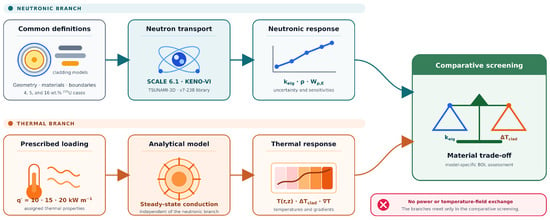
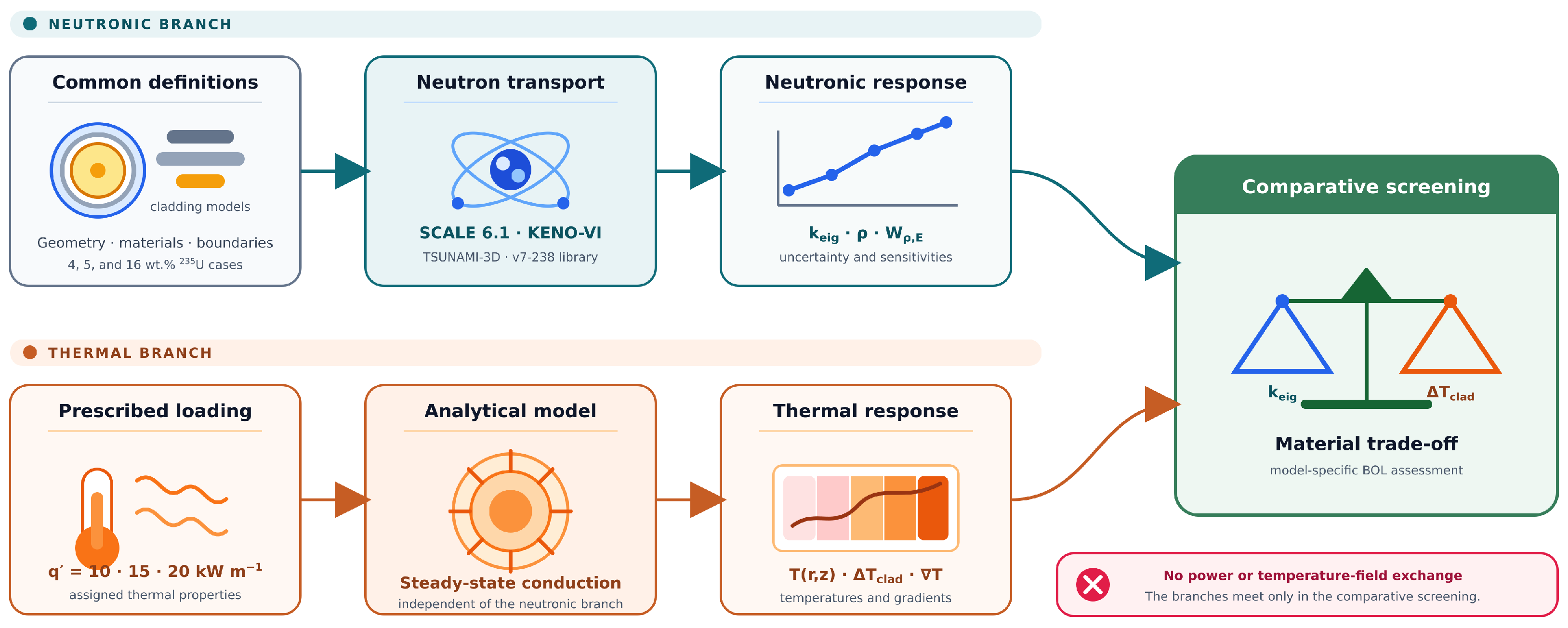
The methodology comprised three main stages. First, the fuel configuration, material compositions, nuclear-data treatment, and calculation conditions were defined. Second, Monte Carlo calculations were performed to evaluate the effects of cladding composition and 235U enrichment on the neutron multiplication response, while nuclear-data sensitivities were evaluated using the TSUNAMI-3D module implemented in SCALE version 6.1. Third, the thermal response was calculated independently using prescribed linear heat rates common to all cladding materials. The overall computational workflow is summarized in Figure 1.
Figure 1.
Computational workflow adopted for the sequential neutronic and analytical thermal assessment of the candidate cladding materials. The upper blue–teal pathway represents the neutronic branch, whereas the lower orange pathway represents the thermal branch. Rectangular boxes identify the successive modeling and calculation stages, and arrows indicate the direction of the computational workflow. Both branches converge only at the comparative screening stage, shown in green. The red crossed-circle symbol emphasizes that no power or temperature-field exchange occurs between the two branches. The icons and plots are schematic and do not represent quantitative results.
No iterative exchange of power, temperature, moderator density, or power-distribution fields was performed between the neutronic and thermal calculations. In particular, the multiplication eigenvalue obtained from KENO-VI was not used to determine linear heat rate, rod power, or volumetric heat generation. The methodology therefore constitutes a first-order comparative screening rather than a coupled neutronic–thermal simulation.
2.1. Neutronic Model
The neutronic calculations were performed using the TSUNAMI-3D sequence of SCALE 6.1 with KENO-VI as the Monte Carlo neutron-transport solver. The v7-238 v7-238 is the exact library identifier used in the SCALE input files. Its meaning has been defined at first occurrence, and the formatting has been made consistent throughout the manuscript. library, corresponding to the 238-group ENDF/B-VII.0 nuclear-data library, was used for neutron transport and nuclear-data sensitivity calculations.
KENO-VI solves the fundamental neutron multiplication eigenvalue problem for the specified geometry, material definitions, and boundary conditions. In the present work, the calculated quantity is denoted by and is defined as the multiplication eigenvalue of the complete mirror-bounded computational model. This notation is used to avoid identifying the result either with the conventional infinite-lattice multiplication factor, , or with the effective multiplication factor of a finite reactor system with physical leakage, .
The TSUNAMI-3D coefficients should not be confused with the finite-difference enrichment-response quantities introduced later. The former quantify the sensitivity of the multiplication eigenvalue to evaluated nuclear data, whereas the latter quantify changes caused by modifying the fuel enrichment. The principal computational settings used in the neutronic calculations are summarized in Table 1.
Table 1.
Principal computational settings adopted in the neutronic calculations.
Only computational parameters directly verified from the archived SCALE input and output records are reported. Parameters not explicitly recoverable from the original calculation records were not reconstructed retrospectively. Representative input and output files are retained as supplementary computational records for reproducibility.
2.1.1. Material Specifications
Three parametric UO2 fuel-composition cases were evaluated. As shown in Table 2, the 235U mass fraction was assigned values of 4, 5, and 16 wt.%, while the 234U fraction was retained at 0.005407837 wt.% and the 238U fraction was adjusted to close the uranium mass balance.
Table 2.
Parametric uranium isotopic compositions used in the executed neutronic calculations. These cases represent the adopted computational definitions and not specified commercial enrichment vectors.
These compositions reproduce the fuel definitions contained in the executed SCALE calculations. They should not be interpreted as representative industrial enrichment vectors, particularly for the nominal 16 wt.% 235U case. In an actual enrichment process, the 234U fraction and, depending on feedstock and processing history, the 236U fraction may vary with enrichment. The present cases therefore constitute a controlled parametric variation of the modeled 235U fraction rather than a reconstruction of physically consistent commercial enriched-uranium vectors.
Because the same uranium definition was applied to all cladding materials within each fuel-composition case, comparisons among claddings at a fixed modeled 235U fraction remain internally consistent. However, the calculated variation between the 4, 5, and 16 wt.% cases also contains the limitations of the simplified uranium isotopic treatment. Consequently, the finite-difference enrichment responses reported below should be interpreted as model-specific parametric responses and not as enrichment worths directly applicable to physically manufactured LEU or HALEU fuel.
Light water and helium were defined using the corresponding SCALE standard-composition treatments. The moderator temperature was 570 K, whereas helium was assigned a temperature of 400 K. The moderator density used in the reported reference calculations was taken directly from the corresponding executed SCALE inputs.
The material definitions adopted for the four cladding configurations are summarized in Table 3. Zircaloy-4 and SS316 were generated using the SCALE standard-composition processor. The two multicomponent configurations were introduced as user-defined equal-weight compositions, with each constituent assigned a mass fraction of 20 wt.%.
Table 3.
Cladding-material definitions adopted in the neutronic model. Elemental fractions are expressed in wt.%.
Zircaloy-4 and SS316 were generated using the SCALE standard-composition processor rather than by manually specifying individual nuclides. Accordingly, the elemental isotopic distributions for these two reference materials were assigned automatically by SCALE using the natural-abundance definitions associated with the employed v7-238 nuclear-data library. No isotope-specific enrichment was imposed on any constituent of Zircaloy-4 or SS316.
The elemental fractions reported in Table 3 do not, by themselves, completely specify the isotope-dependent neutron-transport model. Therefore, the elemental and nuclide identifiers contained in the executed SCALE inputs are reported explicitly in Table 4. Identifiers ending in 000 invoked the corresponding natural elemental composition available to the SCALE composition-processing sequence, whereas isotope-specific identifiers assigned the complete elemental contribution to the indicated nuclide.
Table 4.
Elemental identifiers and isotopic treatments used in the executed SCALE definitions of the user-defined multicomponent cladding models.
For the natural elemental definitions, the isotope-specific atom densities were generated by the SCALE composition-processing sequence using the natural isotopic distributions associated with the employed v7-238 nuclear-data library. For the isotope-specific identifiers, the entire mass fraction assigned to the corresponding element was represented by the indicated nuclide.
For copper, input identifier 29000 invoked the natural elemental definition. The complete 20 wt.% copper contribution was therefore distributed between 63Cu and 65Cu according to the natural isotopic composition supplied by the employed SCALE processing sequence and nuclear-data library. No isotope-specific copper enrichment or substitution was applied.
The explicit isotope definitions of Al, Mn, Nb, and Co do not represent artificial isotopic enrichment because these elements are naturally monoisotopic. Likewise, Cu, Mg, Zn, Ni, Ti, and Zr were represented using their natural elemental definitions. Therefore, neither user-defined model contains an artificially enriched elemental contribution.
For the user-defined material models, the atomic number density of constituent i was related to its prescribed mass fraction according to Equation (1):
where is the bulk material density, is Avogadro’s constant, is the prescribed elemental mass fraction, and is the molar mass associated with the corresponding elemental or isotope-specific definition.
The AlMgZnCuMn and NbNiTiZrCo models should therefore be interpreted as idealized multicomponent compositions for comparative neutronic screening. Phase constitution, precipitation, segregation, and manufacturing-dependent microstructural effects were not represented.
2.1.2. Geometrical Model and Boundary Conditions
Mirror boundary conditions were applied to the external surfaces of the complete modeled domain. These conditions suppress net neutron current across the external boundaries. However, the computational domain retains the explicitly represented axial moderator regions and its internal heterogeneous geometry. Therefore, the calculated eigenvalue is not identified here as the conventional infinite-lattice multiplication factor, .
Throughout this work, the result is denoted by and represents the fundamental multiplication eigenvalue of the complete mirror-bounded model. It should not be interpreted as the of a complete reactor core or as a direct measure of reactor criticality. Because geometry, boundary conditions, material temperatures, and moderator conditions were maintained consistently among the cladding cases, differences in at a fixed fuel-composition case provide a controlled comparison of the effects of cladding substitution within the adopted computational model.
The elementary fuel-rod unit consisted of cylindrical UO2 fuel surrounded by a helium-filled gap and metallic cladding. The fuel radius was 0.455 cm, the gap outer radius was 0.465 cm, and the cladding outer radius was 0.5375 cm.
The fuel, gap, and cladding regions extended over an active height of 80 cm. The surrounding moderator cell had a total axial height of 110 cm, resulting in 15 cm moderator regions above and below the active fuel column.
The adopted dimensions define a generic comparative PWR-like fuel-rod model and were not intended to reproduce a specific commercial or proposed SMR design. In particular, the 80 cm active length, 1.430 cm elementary-cell width, 110 cm total axial domain, and mirror boundary conditions are modeling choices used to establish a common reference configuration for material screening. The principal dimensions of the elementary fuel-rod unit are summarized in Table 5. The unit consisted of cylindrical UO2 fuel surrounded by a helium-filled gap and metallic cladding.
Table 5.
Principal dimensions of the elementary fuel-rod unit.
Consequently, the calculated quantities should be interpreted as responses of the adopted computational configuration rather than as predictions of full-core SMR performance. Core-level effects such as assembly heterogeneity, control systems, soluble boron, burnable absorbers, core leakage, power redistribution, and fuel-management strategy were not represented.
The elementary rod units were incorporated into the array structure defined in the KENO-VI model, together with the explicitly represented moderator and structural regions. Mirror boundary conditions were applied to the external surfaces of the complete modeled domain.
Although the reflective boundary conditions suppress net neutron leakage through the external surfaces, the model retains the explicitly represented axial moderator regions and internal heterogeneous geometry. Consequently, the calculated eigenvalue is reported as of the complete mirror-bounded configuration rather than as the conventional infinite-lattice multiplication factor .
Because the geometry, boundary treatment, moderator arrangement, and remaining reference conditions were maintained consistently among the compared cladding cases, differences in at a fixed parametric fuel-composition case provide a controlled measure of the relative neutronic effect of cladding substitution within the adopted model.
2.1.3. Simulation Matrix and Model Scope
The investigated fuel-composition cases, including the nominal 16 wt.% 235U case, were selected to broaden the parametric range of the screening analysis. They do not represent a licensing proposal, a specified fuel product, or the fuel-management strategy of a particular PWR or SMR design.
The four cladding models were compared using parametric fuel-composition cases containing 4, 5, and 16 wt.% 235U. For each comparison, the same geometrical model, nuclear-data library, boundary treatment, and neutronic calculation procedure were employed. The resulting 12-case neutronic simulation matrix is summarized in Table 6.
Table 6.
Neutronic simulation matrix used for the comparative analysis.
The analysis was restricted to fresh-fuel BOL conditions. Fuel depletion, fission-product accumulation, corrosion, hydrogen uptake, irradiation-induced dimensional changes, and time-dependent evolution of material properties were outside the scope of the present model.
2.2. Enrichment Response and Finite-Difference Analysis
For each cladding model, the parametric response to the modeled 235U mass fraction was evaluated from the multiplication eigenvalues calculated for the 4, 5, and 16 wt.% fuel-composition cases. Reactivity was calculated using Equation (2):
The corresponding reactivity in pcm was obtained from Equation (3):
For an enrichment interval , the change in reactivity was calculated using Equation (4):
The average parametric reactivity response over the interval was then defined according to Equation (5):
The quantity defined in Equation (5) has units of . The , , and wt.% intervals were evaluated. Because these quantities are constructed from discrete enrichment states, they represent finite-difference responses rather than local differential sensitivities.
Because the adopted uranium vectors retain a fixed 234U fraction, the response defined by Equation (5) characterizes only the executed parametric fuel definitions. It should not be interpreted as an enrichment worth for a physically representative LEU or HALEU vector.
A normalized finite-difference enrichment response was additionally calculated using the mean state of each enrichment interval as the normalization reference, as defined in Equation (6):
where , , and the mean enrichment and reactivity states are given by Equation (7):
The interval-centered normalization in Equations (6) and (7) avoids assigning either endpoint as the reference state and provides a dimensionless finite-difference measure of the relative enrichment response. The coefficient should not be confused with the nuclear-data sensitivity coefficients calculated using TSUNAMI-3D.
2.3. Analytical Thermal Model
The thermal analysis was performed independently of the neutronic calculations. Average linear heat rates of 10, 15, and were prescribed as common thermal loading conditions for all candidate cladding materials. These values were not derived from , fuel enrichment, reactivity, or any other neutronic quantity. The prescribed average linear heat rates and their corresponding peak linear heat rates and total rod powers are summarized in Table 7.
Table 7.
Prescribed thermal loading conditions used in the analytical fuel-rod model.
At each prescribed heat rate, the fuel-rod geometry, fuel thermal conductivity, effective gap conductance, coolant temperature, and external convective heat-transfer coefficient were held constant among the cladding configurations. The cladding thermal conductivity was therefore the principal material-dependent thermal parameter in the comparative analytical model. The AlMgZnCuMn label is used consistently in the neutronic and thermal analyses. The neutron-transport model used natural elemental copper, whereas the thermal calculation used the assigned bulk conductivity of the idealized elemental AlMgZnCuMn composition and did not resolve isotope-dependent thermal properties.
2.3.1. Axial Heat-Rate Distribution
The total rod power over the active fuel height, m, was calculated using Equation (8):
2.3.2. Radial Heat-Transfer Model
At each axial position, the local linear heat rate defined by Equation (9) was used in the radial heat-transfer calculations. The coolant-to-cladding temperature difference was calculated using Equation (11):
The temperature difference across the cladding was calculated according to Equation (12):
The fuel–cladding gap was represented by an effective conductance, with the corresponding temperature difference given by Equation (13):
For uniform volumetric heat generation and constant UO2 thermal conductivity, the fuel centerline-to-surface temperature difference was calculated using Equation (14):
The interface temperatures were obtained sequentially from the coolant to the fuel centerline using Equations (11)–(14). The fuel temperature profile follows the analytical parabolic solution for a uniformly heated cylinder, whereas the cladding temperature distribution follows the logarithmic cylindrical conduction solution.
2.3.3. Axial Thermal Reconstruction
The axial thermal response was reconstructed by replacing the average heat rate in the radial heat-transfer relations with the local prescribed value from Equation (9). Consequently, the axial shape of the thermal response is imposed by the prescribed sinusoidal heat-rate distribution, whereas differences among the cladding materials arise primarily from their thermal conductivities.
The radial and axial domains were discretized only for numerical evaluation and graphical representation of the analytical solutions.
2.4. Thermal Finite-Difference Response
The response of a thermal quantity Y to the prescribed average linear heat rate was evaluated using the dimensional finite-difference coefficient defined in Equation (15):
Equation (15) was evaluated over the 10–15, 15–20, and 10–20 intervals.
The corresponding normalized finite-difference response was calculated using Equation (16):
when the normalization was mathematically defined. Here, and , whereas and denote the prescribed average linear heat rate and the corresponding thermal quantity at the reference state of the evaluated interval.
Under the fixed-geometry and constant-property assumptions of the present analytical model, quantities directly proportional to are expected to satisfy Equation (17):
The dimensional response in Equation (15) quantifies the magnitude of the material-dependent thermal behavior, whereas the normalized coefficient in Equation (16) characterizes its proportional response to changes in the prescribed linear heat rate.
Fuel enrichment was not an input variable in the analytical thermal model. Likewise, , reactivity, parametric fuel-composition response, and TSUNAMI-3D nuclear-data sensitivities were not used to determine the prescribed heat rate or temperature field.
3. Results
3.1. Effect of Cladding Material on Fuel-Rod Mass
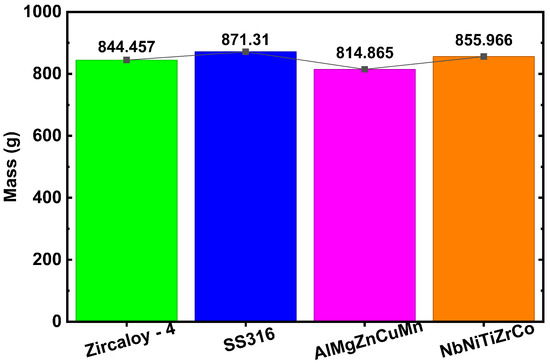
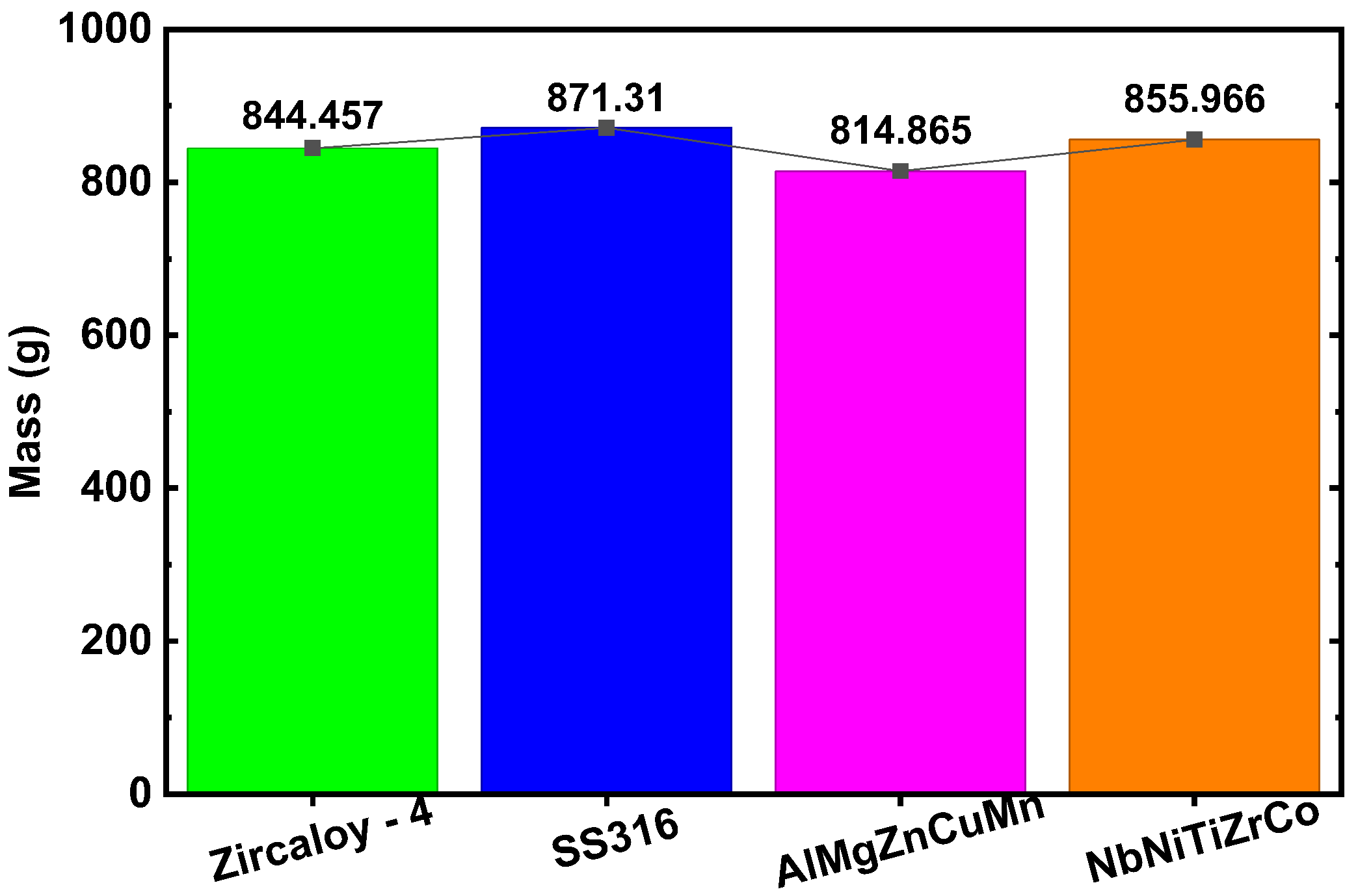
Figure 2 compares the calculated total fuel-rod masses for the four cladding configurations. Because the fuel, gap, and cladding dimensions were maintained identical, the differences among the configurations arise from the densities assigned to the candidate cladding materials.
Figure 2.
Calculated total fuel-rod mass for the four cladding configurations. All configurations have identical geometry; therefore, the mass differences arise from the cladding-material densities adopted in the model.
The calculated masses and their differences relative to Zircaloy-4 are summarized in Table 8. SS316 produces the heaviest configuration, with a total mass of 871.310 g, whereas AlMgZnCuMn produces the lightest, with 814.865 g. The difference between these limiting cases is 56.445 g, corresponding to approximately 6.93% of the mass of the lightest configuration.
Table 8.
Calculated fuel-rod masses for the investigated cladding materials and differences relative to Zircaloy-4.
Although these differences are moderate at the single-rod level, they may become relevant when propagated to assembly-scale structural loading and handling requirements. Such effects require dedicated mechanical analyses and are outside the scope of the present study.
Rod mass is not used as a predictor of neutronic or thermal performance. The neutronic response is determined by the modeled material compositions, processed atomic number densities, geometry, and nuclear interaction data, whereas the thermal response depends on the prescribed thermophysical properties and heat-transfer conditions. The mass comparison is therefore included only as an additional engineering descriptor of the investigated configurations.
3.2. Effect of Enrichment and Cladding Composition on the Neutronic Response
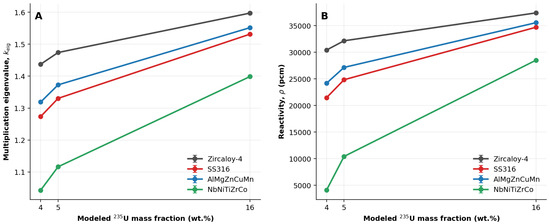
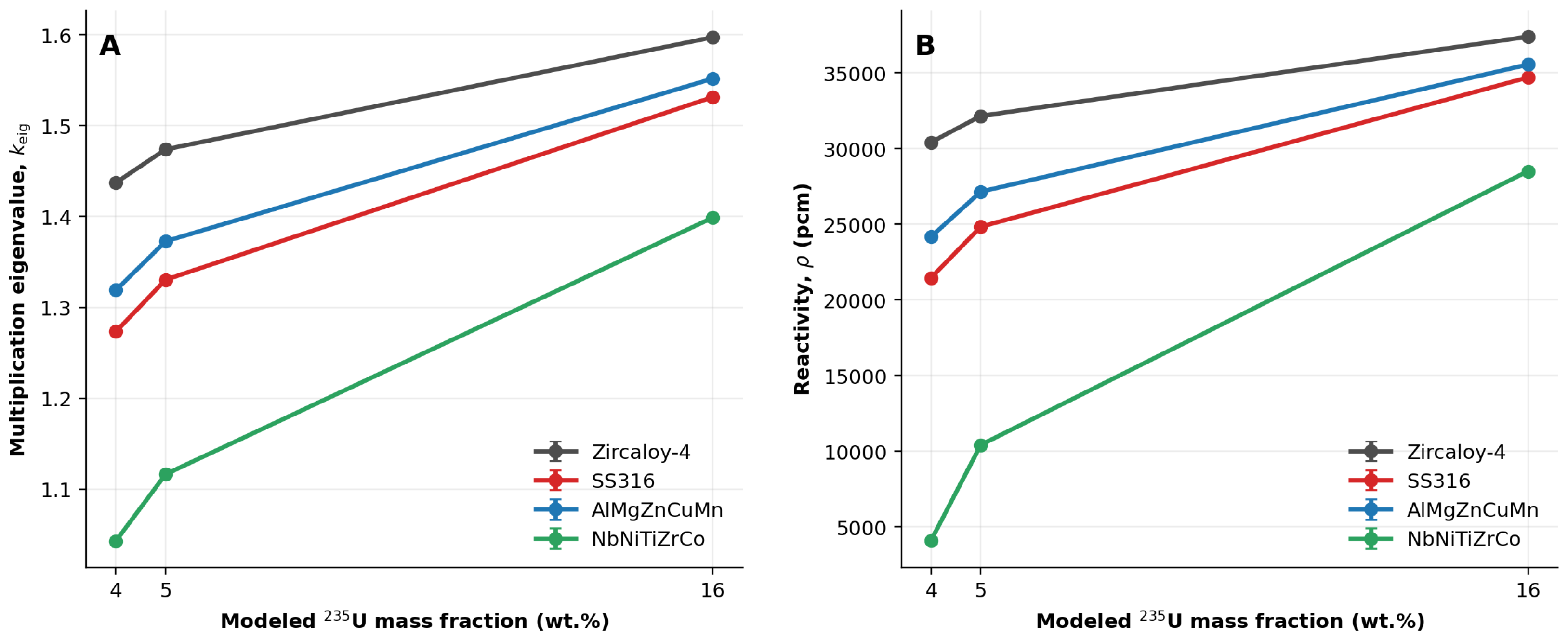
Figure 3 presents the multiplication eigenvalue, , and the corresponding reactivity for the four cladding models in the parametric fuel-composition cases containing 4, 5, and 16 wt.% 235U. Each plotted point represents an independent KENO-VI calculation for the complete mirror-bounded configuration previously described. The connecting lines are included only to facilitate visualization of the enrichment dependence and do not represent additional simulated enrichment conditions.
Figure 3.
Neutronic response as a function of 235U enrichment for the cladding configurations: (A) multiplication eigenvalue, , of the complete mirror-bounded model and (B) corresponding reactivity, . Error bars represent one-standard-deviation Monte Carlo uncertainties. The values at 4, 5, and 16 wt.% correspond to independent neutron-transport calculations; connecting lines are included only as visual guides.
The numerical multiplication eigenvalues and their associated one-standard-deviation Monte Carlo uncertainties are reported in Table 9.
Table 9.
Calculated multiplication eigenvalues, , and one-standard-deviation Monte Carlo uncertainties for the investigated cladding configurations and parametric fuel-composition cases.
Both and reactivity increase monotonically with the modeled 235U mass fraction for all four configurations. At each investigated fuel-composition case, Zircaloy-4 exhibits the highest multiplication eigenvalue, followed by AlMgZnCuMn, SS316, and NbNiTiZrCo.
The Monte Carlo uncertainties remain of the order of , whereas the differences among the candidate configurations are substantially larger. For example, at 16 wt.% 235U, where Zircaloy-4 and AlMgZnCuMn exhibit their closest absolute multiplication responses, . The corresponding combined one-standard-deviation uncertainty is .
The difference therefore corresponds to approximately 18 combined standard deviations. Even for the closest pair of configurations, the material-dependent separation is consequently much larger than the Monte Carlo statistical uncertainty. Similar or larger statistical separations occur at the lower enrichment levels.
These results show that the ordering among the executed computational definitions observed in Figure 3 is statistically distinguishable within the precision of the present Monte Carlo calculations. The AlMgZnCuMn model consistently provides the closest multiplication response to Zircaloy-4 among the executed definitions, whereas NbNiTiZrCo produces the largest reduction in . The AlMgZnCuMn result corresponds to the natural-copper definition documented in Table 4.
These differences represent the combined effect of the complete material definitions employed in the SCALE calculations. The multiplication eigenvalues alone do not permit the observed response to be assigned quantitatively to individual nuclides or reaction channels; consequently, no nuclide-specific mechanism is inferred from the eigenvalue comparison presented here.
Parametric Fuel-Composition Reactivity Response
The dependence of reactivity on the modeled 235U mass fraction was further quantified using the average parametric reactivity response, , calculated directly from the multiplication eigenvalues reported in Table 9. The , , and wt.% intervals were evaluated.
The resulting values are summarized in Table 10.
Table 10.
Average parametric reactivity response to the modeled 235U mass fraction, calculated from the multiplication eigenvalues reported in Table 9.
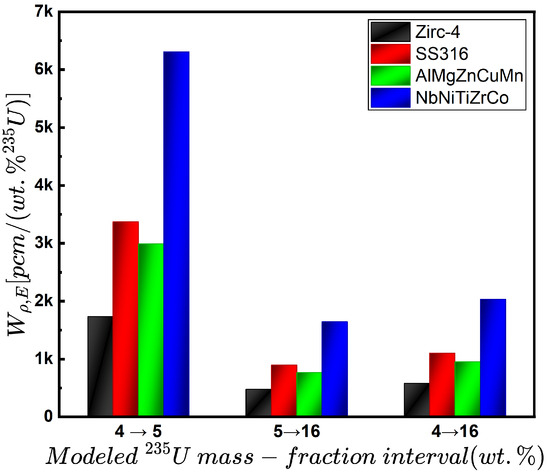
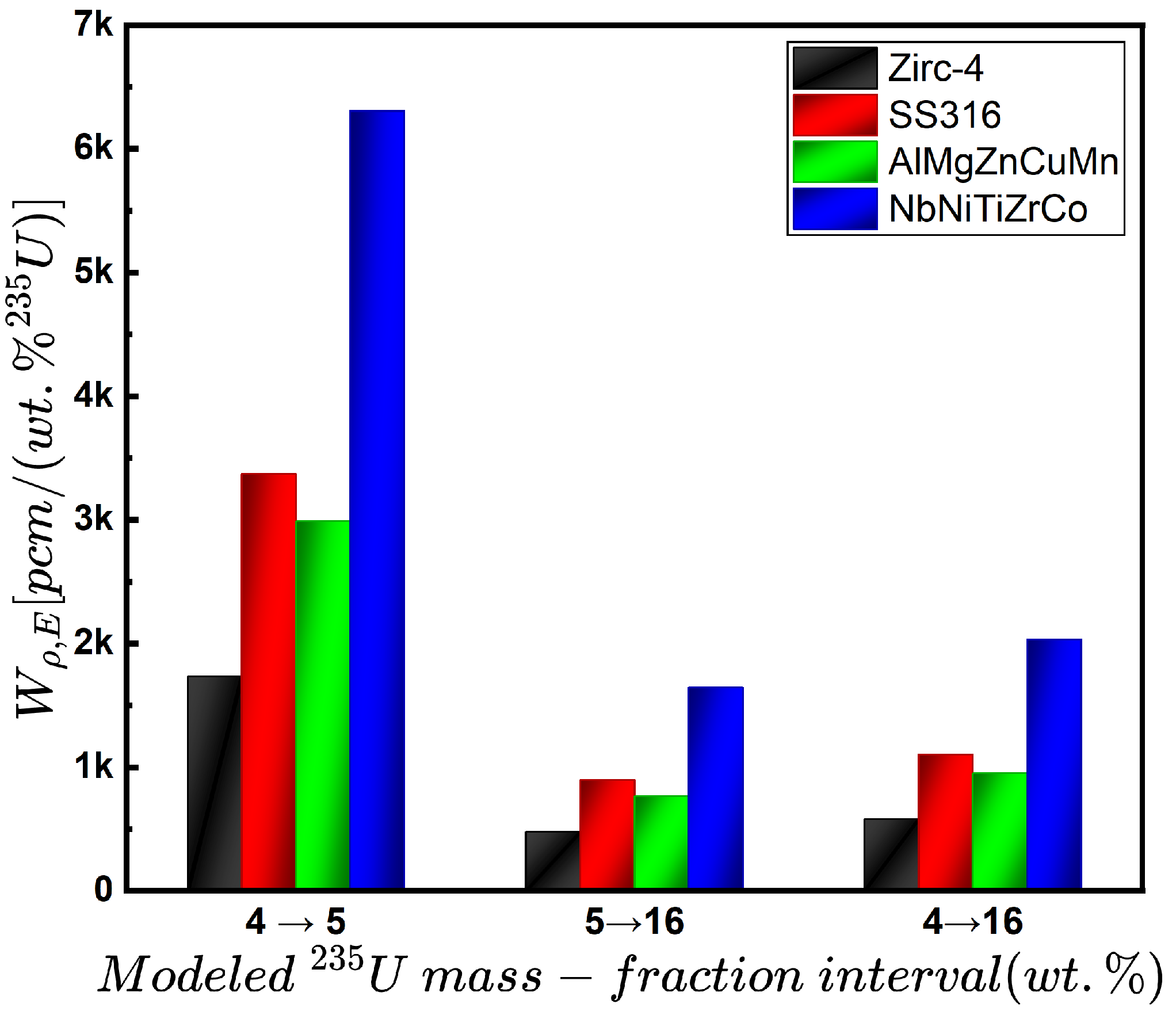
As shown in Figure 4, the largest average parametric reactivity response occurs over the wt.% interval for every cladding configuration. The values decrease substantially over the wt.% interval, demonstrating that the average reactivity increase per unit change in modeled 235U mass fraction is not constant over the investigated range.
Figure 4.
Average parametric reactivity response, , for the cladding configurations over the , , and wt.% 235U intervals. Each bar represents a finite-difference response calculated from the reactivity values at the endpoints of the corresponding interval.
The material ordering for is opposite to that observed for the absolute multiplication response. Zircaloy-4, which exhibits the highest , presents the smallest parametric response in all three intervals. NbNiTiZrCo, in contrast, exhibits the lowest but the largest , reaching 6304.82 pcm/(wt.% 235U) between 4 and 5 wt.%. AlMgZnCuMn and SS316 exhibit intermediate responses.
Absolute multiplication response and the parametric reactivity response therefore describe different characteristics of the modeled system. A high indicates a comparatively large reactivity change per unit change in modeled 235U mass fraction over a specified interval; it does not imply a higher multiplication eigenvalue or superior absolute neutronic performance.
The large value obtained for NbNiTiZrCo should therefore be interpreted as a stronger fuel-composition-dependent reactivity response within the adopted model. Increasing the modeled 235U fraction partially compensates for its lower multiplication response, but the configuration remains below the other material models in absolute throughout the investigated composition range.
The wt.% values lie closer to those obtained over the wt.% interval because 11 of the 12 percentage points comprising the full interval occur between 5 and 16 wt.%. Consequently, the full-range finite-difference average is dominated by the response over the broader high-enrichment interval.
To complement the dimensional parametric response, a normalized finite-difference response, , was evaluated. For each enrichment interval, the normalization was performed using the mean enrichment and mean reactivity of the two endpoint states,
such that
This definition provides an interval-centered relative response and avoids arbitrarily assigning either endpoint as the normalization state. The resulting values are presented in Table 11.
Table 11.
Normalized finite-difference response to the modeled 235U mass fraction for the investigated cladding configurations.
The normalized results preserve the same general material ordering observed for . Zircaloy-4 exhibits the smallest normalized response, whereas NbNiTiZrCo exhibits the largest. For NbNiTiZrCo, decreases from 3.905 over the wt.% interval to 0.887 over wt.%, with a full-range value of 1.246.
The comparatively large value obtained for NbNiTiZrCo at low enrichment requires particular care because the normalization depends on the magnitude of the interval-averaged reactivity. A comparatively small mean reactivity increases the normalized coefficient. Consequently, should not be interpreted as a multiplicative performance advantage; it indicates a large fractional reactivity response over the corresponding enrichment interval.
Taken together, , , and provide complementary descriptions of the neutronic behavior. The multiplication eigenvalue characterizes the absolute response of the modeled configuration, whereas the finite-difference quantities characterize its absolute and relative responses to the modeled 235U mass fraction. Because the 234U fraction was held fixed, neither nor should be interpreted as the enrichment response of a physically manufactured LEU or HALEU vector.
Among the investigated alternatives, AlMgZnCuMn remains closest to Zircaloy-4 in absolute multiplication response, whereas NbNiTiZrCo exhibits the strongest fuel-composition-dependent response within the adopted parametric definitions.
All quantities discussed in this subsection are exclusively neutronic and were not used to prescribe the linear heat rate, rod power, or temperature field in the thermal analysis.
3.3. Thermal Response to Prescribed Linear Heat Rate
The thermal calculations were performed independently of the neutronic results. Average linear heat rates of 10, 15, and 20 kW/m were prescribed identically for all four cladding materials. Consequently, none of the thermal results presented below is associated with a particular parametric 235U fuel-composition case, , or reactivity value.
This distinction is essential because enrichment does not determine absolute power in a neutron multiplication eigenvalue calculation. The three thermal loading conditions therefore represent independent prescribed heat-rate cases rather than enrichment-dependent reactor-power states.
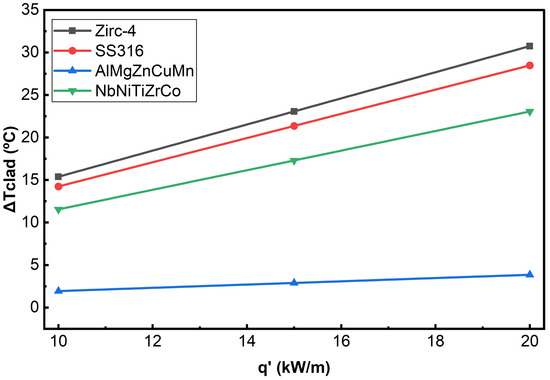
Figure 5 presents the temperature difference between the inner and outer cladding surfaces, , as a function of the prescribed average linear heat rate. For all materials, increases linearly over the investigated range, although its magnitude differs substantially among the candidate materials.
Figure 5.
Temperature difference across the cladding, , as a function of the prescribed average linear heat rate. The thermal loading conditions are independent of fuel enrichment and of the neutron multiplication calculations.
The corresponding values are summarized in Table 12. Temperature differences are reported in kelvin; their numerical magnitudes are identical to those expressed in degrees Celsius.
Table 12.
Temperature difference across the candidate cladding materials at the investigated average linear heat rates.
Zircaloy-4 exhibits the largest temperature difference across the cladding throughout the investigated heat-rate range, followed by SS316 and NbNiTiZrCo. AlMgZnCuMn exhibits a substantially smaller temperature difference, increasing from only 1.92 to 3.84 K between 10 and 20 kW/m.
Because geometry and heat rate are identical among the material cases, this ordering results from the different thermal conductivities assigned to the cladding materials in the analytical model. A higher thermal conductivity requires a smaller radial temperature difference to transport the same heat flow through a layer of fixed geometry.
The slope of the response was quantified using together with the corresponding normalized finite-difference response, as summarized in Table 13.
Table 13.
Dimensional and normalized response of the cladding temperature difference to prescribed linear heat rate.
The dimensional coefficient distinguishes the four thermal responses directly. Relative to Zircaloy-4, the slope is reduced by 7.4% for SS316, 25.0% for NbNiTiZrCo, and 87.5% for AlMgZnCuMn. The Zircaloy-4 response is therefore approximately eight times that of AlMgZnCuMn.
The normalized coefficient remains approximately equal for all four configurations. This does not imply equivalent thermal performance; rather, it reflects the linear dependence of on under the fixed-geometry and constant-property assumptions of the model.
3.4. Radial Temperature and Temperature-Gradient Distributions
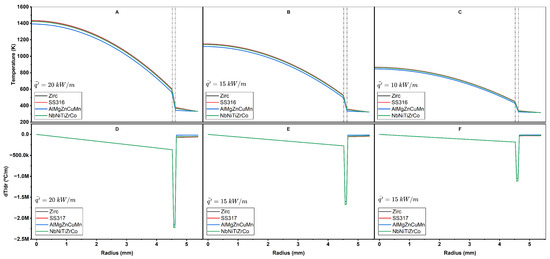
Figure 6 presents the steady-state radial temperature distributions and corresponding temperature gradients for the prescribed average linear heat rates of 20, 15, and 10 kW/m. These panels represent thermal-loading cases and should not be interpreted as corresponding to the 4, 5, and 16 wt.% enrichment conditions used in the neutronic analysis.
Figure 6.
Steady-state radial thermal response of the fuel rod at prescribed average linear heat rates of 20, 15, and 10 : (A–C) absolute radial temperature distributions in K and (D–F) corresponding radial temperature gradients in . Panels (A,D), (B,E), and (C,F) correspond to average linear heat rates of 20, 15, and 10 , respectively. The two vertical gray dashed reference lines indicate the fuel–gap interface ( mm) and the gap–cladding interface ( mm). The thermal cases are independent of fuel enrichment.
The radial temperature profiles exhibit the characteristic behavior of an internally heated cylindrical fuel pellet. The maximum absolute temperature occurs at the centerline and decreases toward the fuel surface as heat is conducted radially outward. Under the constant-property assumptions adopted for UO2, the fuel-region profile follows the expected parabolic dependence.
Increasing the prescribed heat rate raises the absolute temperature field while preserving its characteristic spatial form. At 20 kW/m, the calculated centerline temperatures are approximately 1400–1430 K, depending on the cladding material. At 15 and 10 kW/m, they decrease to approximately 1110–1150 K and 830–860 K, respectively.
A pronounced temperature difference occurs across the fuel–cladding gap. Because the gap is represented by a lumped effective conductance rather than a spatially resolved gas domain, this temperature change represents the thermal resistance assigned to the gap and should not be interpreted as a resolved helium-temperature profile.
The influence of cladding material is most evident within the cladding region. Zircaloy-4 exhibits the largest inner-to-outer cladding temperature difference, followed by SS316 and NbNiTiZrCo, whereas AlMgZnCuMn exhibits the smallest.
Changes in the cladding thermal resistance also shift the upstream absolute temperature level. A lower cladding resistance reduces the inner cladding temperature required to conduct the prescribed heat flow, and this difference propagates through the gap and fuel. Nevertheless, the corresponding changes in fuel centerline temperature remain much smaller than the complete fuel-to-coolant temperature rise because the fuel, gap, and coolant-side thermal resistances remain unchanged.
The radial-gradient curves provide a complementary interpretation. Within the fuel, symmetry requires at the centerline, and the gradient magnitude increases toward the fuel surface. Because fuel geometry, properties, and heat generation are common to the four material cases, the fuel-region gradient curves remain essentially coincident at a given heat rate.
The apparent large gradient associated with the gap reflects the lumped effective conductance used in the model and should not be interpreted as a locally resolved gas gradient.
Within the cladding, higher conductivity requires a smaller temperature gradient for the same heat flow. AlMgZnCuMn therefore exhibits the smallest gradient magnitude, followed by NbNiTiZrCo, SS316, and Zircaloy-4.
Increasing the prescribed linear heat rate increases the magnitude of the radial gradients without changing their characteristic spatial dependence. Thus, cladding substitution has a strong effect on the local thermal response of the cladding but a more limited influence on the complete fuel temperature field.
3.5. Axial Variation in the Cladding Temperature Difference
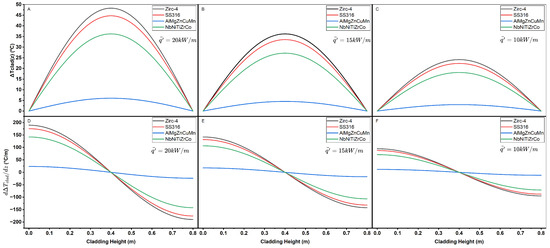
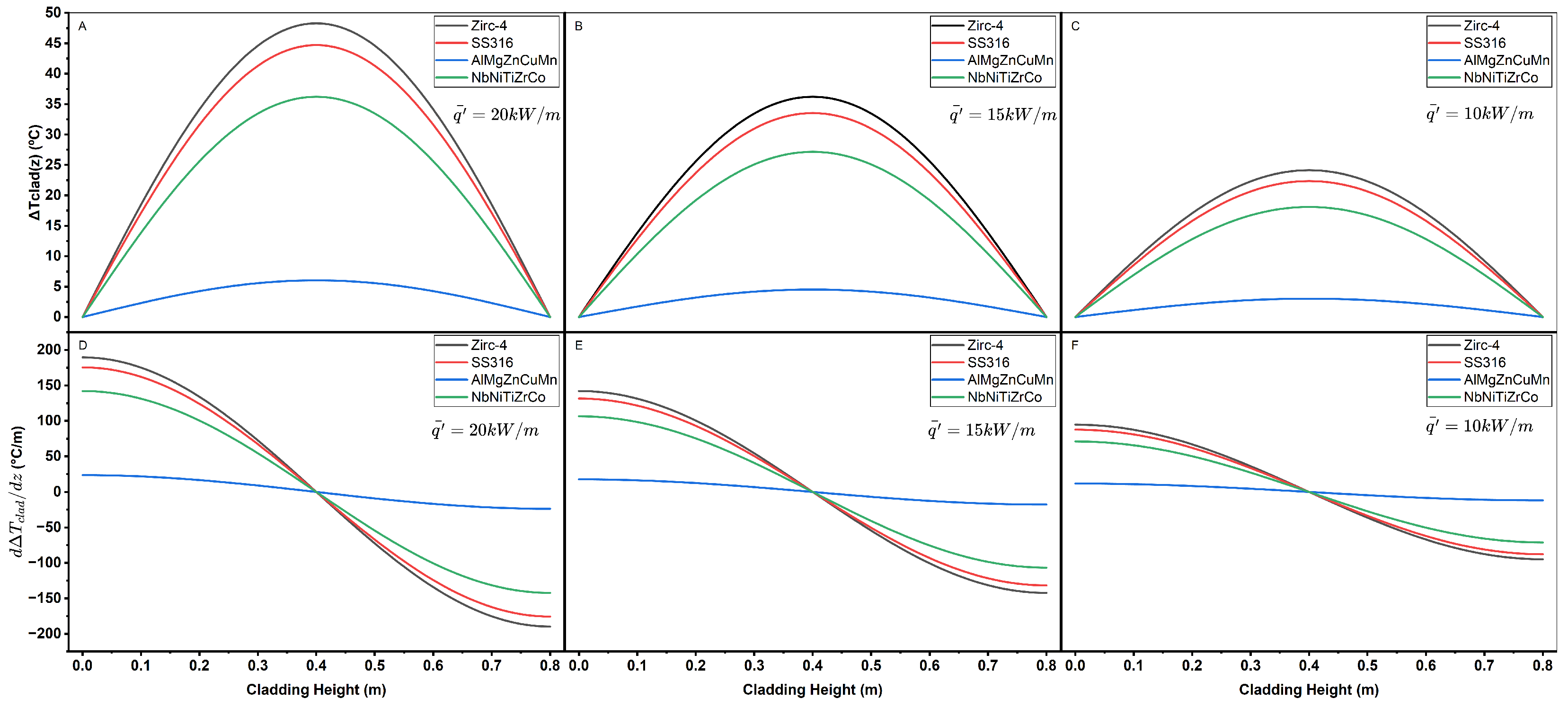
The axial analysis was constructed from the sinusoidal heat-rate distribution prescribed independently in the analytical thermal model. Figure 7 presents the resulting axial variation in and its derivative, .
Figure 7.
Axial variation in the cladding temperature difference at prescribed average linear heat rates of 20, 15, and 10 : (A–C) and (D–F) . The axial distributions arise from the prescribed sinusoidal thermal loading and are not KENO-VI fission-power distributions.
For all materials and loading conditions, follows the prescribed sinusoidal heat-rate distribution. The temperature difference approaches zero at the ends of the idealized active region and reaches its maximum at the axial midplane, m.
The symmetric axial form is therefore a direct consequence of the analytical heat-rate assumption rather than an independently calculated neutronic power distribution.
The material ordering identified in the radial analysis is preserved along the complete active length. At an average linear heat rate of , the maximum midplane cladding temperature differences are approximately 48.29 K for Zircaloy-4, 44.70 K for SS316, 36.22 K for NbNiTiZrCo, and 6.03 K for AlMgZnCuMn. The peak values for all materials and prescribed loading conditions are summarized in Table 14.
Table 14.
Peak axial cladding temperature differences at the fuel-rod midplane for the prescribed average linear heat rates.
These midplane values exceed the corresponding temperature differences calculated using the average linear heat rate because the prescribed sinusoidal profile gives at the axial midplane, as defined in Equation (10).
Panels D–F present , which describes the axial variation in the temperature difference across the cladding wall. It should not be interpreted as the axial temperature gradient of either cladding surface.
The derivative is positive below the midplane, vanishes at the location of maximum , and becomes negative above the midplane, yielding the expected antisymmetric form.
At , the maximum derivative magnitudes are approximately for Zircaloy-4, for SS316, for NbNiTiZrCo, and for AlMgZnCuMn. The axial analysis therefore reinforces the radial results: thermal conductivity primarily changes the magnitude of the cladding thermal response, whereas the axial shape is imposed by the prescribed heat-rate distribution.
No axial coolant energy balance or progressive coolant heating is included in this reconstruction. Consequently, the calculated axial behavior should not be interpreted as a complete thermal-hydraulic prediction of an operating fuel rod.
3.6. Integrated Neutronic–Thermal Assessment
The combined results reveal a model-specific trade-off between multiplication response and cladding heat-transfer behavior. Zircaloy-4 produces the highest within the modeled configurations, whereas the AlMgZnCuMn definition produces the lowest assigned cladding thermal resistance and the closest absolute neutronic response to Zircaloy-4 among the executed alternatives. The neutronic comparison for this composition uses the natural-copper definition reported in Table 4.
Table 15 summarizes the principal quantities directly evaluated in this study. No qualitative ratings of mechanical strength, corrosion resistance, irradiation tolerance, or accident tolerance are included because these properties were not calculated or experimentally measured in the present work.
Table 15.
Integrated comparison of the cladding material models based only on the neutronic and steady-state thermal metrics evaluated in this study.
Zircaloy-4 provides the highest multiplication eigenvalue throughout the investigated parametric composition range, but its assigned thermal conductivity results in the largest temperature difference across the cladding among the four configurations.
The AlMgZnCuMn model exhibits the lowest combined numerical thermal resistance and the closest multiplication response to Zircaloy-4 among the executed definitions. This comparison corresponds to the natural-copper definition used in the executed SCALE input. Its assigned thermal conductivity of 120 produces the smallest cladding temperature difference and gradient. Its dimensional response to linear heat rate is 87.5% lower than that of Zircaloy-4.
SS316 produces only a modest thermal improvement relative to Zircaloy-4 while exhibiting a larger reduction in multiplication eigenvalue. NbNiTiZrCo produces a larger thermal improvement than SS316, but this is accompanied by the lowest and the strongest fuel-composition-dependent reactivity response among the investigated configurations.
These results emphasize that local cladding thermal behavior and complete fuel-rod thermal behavior should be distinguished. Increasing cladding thermal conductivity directly reduces the temperature difference and gradient across the cladding, but its influence on the fuel temperature is moderated by conduction within UO2, the effective gap resistance, and the coolant-side boundary condition.
Within the restricted BOL neutronic and steady-state thermal metrics, the AlMgZnCuMn model yields the closest multiplication response to Zircaloy-4 among the executed alternatives and the smallest analytical cladding thermal resistance. This model-specific result corresponds to the natural-copper AlMgZnCuMn definition used in the executed calculations, but does not constitute qualification for fuel-cladding service.
Mechanical integrity, corrosion and oxidation behavior, irradiation stability, creep, fuel and coolant compatibility, fabrication feasibility, and transient performance remain outside the present analysis and require independent evaluation before any candidate can be considered suitable for Accident Tolerant Fuel applications.
The sequential methodology therefore serves as a first-order screening framework for identifying relative neutronic–thermal trade-offs prior to higher-fidelity coupled thermal-hydraulic, thermomechanical, irradiation-dependent, and transient analyses.
4. Summary and Conclusions
This study performed a comparative neutronic and steady-state thermal screening of Zircaloy-4, SS316, and two idealized multicomponent cladding compositions in a generic PWR-like fuel-rod model under beginning-of-life conditions. The adopted geometry and boundary conditions were intended to provide a common comparative framework and do not reproduce a particular commercial or proposed SMR design.
The neutron-transport calculations showed that cladding composition affects the multiplication eigenvalue of the adopted mirror-bounded model. The calculated quantity was consistently denoted by and should not be interpreted as either the conventional infinite-lattice multiplication factor or the effective multiplication factor of a complete reactor core. Zircaloy-4 produced the highest among the executed material definitions. The AlMgZnCuMn model produced the closest response to Zircaloy-4, followed by SS316, whereas NbNiTiZrCo produced the lowest multiplication eigenvalues.
The finite-difference fuel-composition analysis provided complementary information to the absolute multiplication eigenvalues. Zircaloy-4 exhibited the lowest average parametric reactivity response, , whereas NbNiTiZrCo exhibited the largest values over all investigated intervals. The normalized response, , followed the same general trend. These results demonstrate that absolute neutron economy and enrichment response are distinct quantities: a configuration with lower absolute reactivity may exhibit a larger reactivity change per unit increase in enrichment. Consequently, the high enrichment response of NbNiTiZrCo should not be interpreted as superior neutronic performance, but rather as a stronger dependence of its reactivity on the modeled 235U mass fraction. Because 234U was held fixed, these finite-difference quantities are specific to the adopted parametric uranium definitions and are not enrichment worths for representative LEU or HALEU vectors.
The independent thermal analysis revealed a different material ordering. Because the same prescribed linear heat rates and cladding geometry were used for all configurations, the differences in cladding temperature response were governed primarily by the assigned thermal conductivity. The idealized AlMgZnCuMn thermal-property model exhibited the lowest temperature difference across the cladding and the smallest dimensional response to linear heat rate, K/(kW/m), corresponding to an 87.5% reduction relative to Zircaloy-4. NbNiTiZrCo exhibited an intermediate thermal response, while SS316 remained comparatively close to Zircaloy-4.
The radial and axial analyses confirmed that this thermal advantage is most pronounced locally within the cladding. Higher cladding conductivity reduces both the temperature difference and the associated spatial gradients required to transfer the prescribed heat load. However, the resulting changes in the overall fuel temperature field are considerably smaller because conduction through the UO2 fuel, the effective fuel–cladding gap resistance, and the coolant-side boundary condition also contribute to the total thermal resistance. The axial response further showed that cladding material mainly modifies the magnitude of the thermal response, whereas its spatial form is controlled by the prescribed sinusoidal heat-rate distribution.
The normalized thermal response remained approximately equal for all candidate materials. This result does not indicate equivalent thermal performance; rather, it reflects the proportional dependence of the cladding temperature difference on linear heat rate under the fixed-geometry and constant-property analytical formulation. The dimensional thermal response is therefore the more useful quantity for distinguishing the candidate materials within the present model.
Considering the calculated neutronic and thermal metrics together, no material definition simultaneously maximized the multiplication eigenvalue and minimized the local cladding thermal resistance. Zircaloy-4 remained the reference with the highest calculated , whereas the idealized AlMgZnCuMn case exhibited the lowest analytical cladding thermal resistance and the closest multiplication-eigenvalue response to Zircaloy-4 among the executed alternatives.
This result applies to the specific natural-copper AlMgZnCuMn computational definition used in the study. The neutronic comparison therefore does not contain an isotope-specific copper substitution. Nevertheless, the model remains an idealized equal-weight elemental composition and does not represent experimentally measured phase constitution, microstructure, or irradiation performance. A physically supported uranium isotopic vector is also required before the fuel-composition response can be generalized beyond the present parametric study.
The principal limitations of the present study arise from the use of fresh-fuel BOL conditions and a steady-state analytical thermal model with fixed geometry and temperature-independent thermophysical properties. Fuel depletion, Doppler feedback, moderator-temperature and density feedback, axial coolant heating, temperature-dependent thermal conductivity, nonlinear gap behavior, thermomechanical interaction, and irradiation-induced material evolution were not included. Likewise, corrosion, high-temperature oxidation, creep, mechanical integrity, fuel–cladding and coolant compatibility, and fabrication feasibility were outside the scope of the present analysis.
Future work should therefore extend the present screening through temperature-dependent material properties, burnup-dependent neutronic calculations, moderator and fuel-temperature feedback, and numerical thermal-hydraulic modeling with an explicit coolant energy balance. Subsequent developments should also incorporate iterative neutronic–thermal-hydraulic coupling, thermomechanical behavior, irradiation-induced degradation, corrosion and oxidation kinetics, and transient conditions. These extensions would allow the candidates identified by the present first-order assessment to be evaluated under progressively more representative reactor conditions.
Author Contributions
Conceptualization, T.J.L.; methodology, T.J.L. and S.N.M.; software, T.J.L. and P.H.P.M.d.S.; validation, S.d.O.V. and S.N.M.; formal analysis, T.J.L. and P.H.P.M.d.S.; investigation, T.J.L.; data curation, T.J.L.; writing—original draft preparation, T.J.L. and P.H.P.M.d.S.; writing—review and editing, T.J.L., S.d.O.V., S.N.M. and P.H.P.M.d.S.; visualization, T.J.L. and P.H.P.M.d.S.; supervision, S.d.O.V. and S.N.M. All authors have read and agreed to the published version of the manuscript.
Funding
This study was financed in part by the National Council for Scientific and Technological Development–Brazil (CNPq), Grant No. 195946/2025-1. Pedro Henrique Poubel Mendonça da Silveira acknowledges support from the Carlos Chagas Filho Foundation for Research Support of the State of Rio de Janeiro (FAPERJ), Grant No. E-26/202.081/2025.
Data Availability Statement
The data supporting the findings of this study are available within the article. Additional calculation inputs and processed data are available from the corresponding author upon reasonable request.
Acknowledgments
We extend our deepest gratitude to the Military Institute of Engineering (IME) for their invaluable technical support and access to facilities that significantly contributed to the advancement of this research.
Conflicts of Interest
The authors declare no conflicts of interest.
Abbreviations
The following abbreviations and code designations are used in this manuscript:
| ATF | Accident-tolerant fuel |
| BOL | Beginning of life |
| ENDF/B-VII.0 | Evaluated Nuclear Data File, release B-VII.0 |
| HALEU | High-assay low-enriched uranium |
| KENO-VI | Three-dimensional Monte Carlo neutron-transport and criticality code |
| within SCALE | |
| LEU | Low-enriched uranium |
| PWR | Pressurized water reactor |
| SCALE | Standardized Computer Analyses for Licensing Evaluation |
| SMR | Small modular reactor |
| SS316 | Type 316 stainless steel |
| TSUNAMI-3D | Tools for Sensitivity and Uncertainty Analysis Methodology Implementation |
| in Three Dimensions | |
| pcm | Per cent mille; in dimensionless reactivity |
| wt.% | Weight percent |
References
- Hjelmeland, M.; Nøland, J.K.; Backe, S.; Korpås, M. The role of nuclear energy and baseload demand in capacity expansion planning for low-carbon power systems. Appl. Energy 2025, 377, 124366. [Google Scholar] [CrossRef] [Scilit]
- Li, W.; Wu, Z.; Deng, C.; Wu, J. Analysis of a new on-site semi-passive design to improve the safety of Generation II/II+ Pressurized water reactors. Ann. Nucl. Energy 2025, 217, 111370. [Google Scholar] [CrossRef] [Scilit]
- Ali, M.; Samour, A.; Soomro, S.A.; Khalid, W.; Tursoy, T. A step towards a sustainable environment in top-10 nuclear energy consumer countries: The role of financial globalization and nuclear energy. Nucl. Eng. Technol. 2025, 57, 103142. [Google Scholar] [CrossRef] [Scilit]
- Hou, Y.; Jin, Y.; Chen, P.; Zhang, C.; Chen, B.; Xiang, Y. Evaluation of the combined generation IV nuclear reactor and copper-chlorine cycle for the production of hydrogen and power using thermodynamics. Energy 2025, 328, 136654. [Google Scholar] [CrossRef] [Scilit]
- Nighoskar, A.; Chaurasia, P.; Singh, N. Advancing nuclear energy forecasting: Exploring regression modeling techniques for improved accuracy. Nucl. Eng. Technol. 2025, 57, 103144. [Google Scholar] [CrossRef] [Scilit]
- Steinbrueck, M.; Waeckel, N.; Jasiulevicius, A. Accident Tolerant Fuel: An Update Report 2020–2023; Technical Report; Advanced Nuclear Technology International: Mölnlycke, Sweden, 2024. [Google Scholar]
- Li, Y.; You, E.; Wang, T.; Xing, D.; Xu, J.; Zhang, H. Developments, challenges and prospects in thermal-hydraulic research on accident tolerant fuel. Heliyon 2024, 10, e38999. [Google Scholar] [CrossRef] [Scilit]
- Zhao, Y.; Zeng, Q.; Lu, Z.; Zheng, J.; Xue, J.; Liao, Y. Thermomechanical Analysis of UO2 Fuel Rods with SiC_f/SiC Composite Cladding under Normal and Accident Conditions. Nucl. Eng. Technol. 2026, 58, 104553. [Google Scholar] [CrossRef] [Scilit]
- Abrudeanu, M.; Cimpoesu, N.; Paunoiu, M.G.S.; Galatanu, A.; Galatanu, M.; Popa, F.; Jinga, A.G.; Pirvu, I.C.; Haeussler, A.; Stefanoiu, R.; et al. Comparative Study on Heat Transfer Through Three Candidate Alloys for Fuel Element Cladding. Appl. Sci. 2026, 16, 800. [Google Scholar] [CrossRef] [Scilit]
- Kumar, P.; Rajak, D.K.; Hussain, M. Advanced Coating and Cladding Technologies; CRC Press: Boca Raton, FL, USA, 2026. [Google Scholar]
- Islam, S.; Haque, J.M. A comparative study and design optimization of potential cladding materials for gas cooled fast reactor: Neutronics, radiation shielding, and thermal hydraulics analysis. Prog. Nucl. Energy 2025, 185, 105741. [Google Scholar] [CrossRef] [Scilit]
- Sadeghi, M.; Niroumand, B. Design and characterization of a novel MgAlZnCuMn low melting point light weight high entropy alloy (LMLW-HEA). Intermetallics 2022, 151, 107658. [Google Scholar] [CrossRef] [Scilit]
- Polukhin, V.; Estemirova, S.K.; Kurbanova, E. Multicomponent Alloys and Laminated Composite Nanomaterials for Hydrogen Technologies. Russ. Metall. (Met.) 2023, 2023, 1040–1063. [Google Scholar] [CrossRef] [Scilit]
- Novellino, V.N.; Anistratov, D.Y. Multi-level hybrid Monte Carlo/deterministic methods for particle transport problems. J. Comput. Theor. Transp. 2026, 1–34. [Google Scholar] [CrossRef] [Scilit]
- Guo, J.; Liu, Z.; He, Q.; Huang, D.; Cao, L.; Wu, H. A simulation approach for start-up without secondary neutron sources of Hualong One: A Monte-Carlo-deterministic framework. Nucl. Eng. Technol. 2025, 57, 103546. [Google Scholar] [CrossRef] [Scilit]
- Li, X.; He, M.; Meng, D.; Xu, C.; Zhao, C. Neutronic Analysis of Complex Reactor Core Based on Monte Carlo-Deterministic Coupling Approach. In International Conference on Nuclear Engineering; Springer: Berlin/Heidelberg, Germany, 2025; pp. 543–553. [Google Scholar]
- Özkul, İ.; Güler, Ö.; Kavaz, E.; Kalay, E.; Güler, S.H.; ALMisned, G.; Tekin, H. Engineering Ti-Zr-Hf high-entropy alloys (HEA) with rare-earth and boron additives for microstructure-controlled mixed-field radiation shielding: Fabrication, physical, structural and experimental γ-ray & fast-n shielding properties. J. Alloys Compd. 2026, 1057, 186744. [Google Scholar] [CrossRef] [Scilit]
- Ozdemir, H.C.; Hinte, C.; Nazarahari, A.; Barienti, K.; Canadinc, D.; Maier, H.J. Comparison on microstructure and mechanical properties of refractory high entropy alloys of the Hf-Mo-Nb-Ta-Ti-Zr system. J. Vac. Sci. Technol. A 2025, 43, 063202. [Google Scholar] [CrossRef] [Scilit]

Disclaimer/Publisher’s Note: The statements, opinions and data contained in all publications are solely those of the individual author(s) and contributor(s) and not of MDPI and/or the editor(s). MDPI and/or the editor(s) disclaim responsibility for any injury to people or property resulting from any ideas, methods, instructions or products referred to in the content. |
© 2026 by the authors. Licensee MDPI, Basel, Switzerland. This article is an open access article distributed under the terms and conditions of the Creative Commons Attribution (CC BY) license.