


Abstract
This study characterized changes in the structural, thermal, and hydration-related properties of potato starch recovered after high-speed shearing. Native starch was compared with starch recovered after homogenization at 8000 rpm for 5 min from dispersions prepared at initial starch concentrations of 100, 200, and 300 g/L. The recovered starches retained the granular morphology and the characteristic B-type crystalline pattern of potato starch. The median particle diameter decreased from 40.99 µm in native starch to 16.25, 16.04, and 16.44 µm in starch recovered from the 100, 200, and 300 g/L dispersions, respectively. Relative crystallinity showed a slight decrease, from 27.4% in native starch to 25.5, 25.8, and 26.3% after processing. FTIR spectra showed no new absorption bands, indicating preservation of the characteristic starch spectral features. Thermogravimetric analysis showed reduced mass loss between 50 and 120 °C, associated with water release, in treated starches (8.2–8.5%) compared with native starch (12.0%). The temperature of maximum mass-loss rate increased from 299.9 °C to 313.1, 313.4, and 309.8 °C, while the remaining mass at 430 °C decreased from 22% to 8–11%. Compared with native starch, the recovered samples exhibited higher water activity and water absorption index, lower solubility and no significant differences in moisture content or water retention capacity. Overall, the results indicate that starch recovered after high-speed shearing exhibited predominantly physical modifications affecting particle size distribution, thermal response, and hydration behavior, while preserving its crystalline pattern.
1. Introduction
The potato (Solanum tuberosum L.) is one of the most important food crops worldwide because of its nutritional value, role as a staple food, and versatility for processed and industrial applications [1,2]. Potato tubers provide carbohydrates, vitamins, minerals, and dietary fiber, making them an accessible raw material for food and non-food uses [1]. Starch is their main reserve carbohydrate. Reported starch contents range from 13.19 to 21.86% in fresh tubers and from 67.2 to 79.4% on a dry-matter basis [3,4,5].
Potato starch is technologically relevant because it differs from many cereal starches in granule size, hydration capacity, and pasting behavior [6]. It is generally characterized by large granules, high swelling power, high viscosity, good paste clarity, and high water-retention capacity [7,8]. It also tends to gelatinize at lower temperatures than several cereal starches, although this behavior varies with cultivar and processing conditions [7,8,9]. These properties explain its use in foods as a thickener, gelling agent, texture modifier, and viscosity-control ingredient [10,11], as well as in paper, textiles, pharmaceutical systems, biomedical materials, biodegradable packaging, edible films, hydrogels, tablets, 3D printing, and controlled-release systems [11,12,13]. However, native potato starch may show limited stability under heat, shear, and acidic conditions, high retrogradation or syneresis in some systems, high viscosity which can complicate processing, and variability associated with cultivar and growing conditions [5,6]. These limitations support the need for strategies able to adjust functionality while preserving starch as a bio-based ingredient.
Starch modification is widely used to adjust the technological performance of starch-based ingredients, particularly their hydration behavior, thermal response, particle-size distribution, and stability during processing [14,15]. Although chemical modification remains an effective route to tailor starch functionality, physical treatments have gained relevance because they can improve starch functional properties without requiring chemical reagents, thereby avoiding residual reactants and reaction by-products and reducing the need for subsequent purification steps, which may offer environmental and technological advantages [14].
Among these treatments, high-speed shearing is particularly attractive because it generates intense velocity gradients, turbulence, and particle–particle interactions that may alter starch granules at different structural levels [15,16,17]. This process has been studied as a physical route to modify starch granules and starch dispersions from several botanical sources. Reported effects include granule disruption, surface alteration, fragmentation, reduced particle size, loss of crystalline order, molecular degradation, changes in solubility and swelling, and modifications in rheological behavior [16,18,19]. For example, high-shear treatment has been associated with surface changes, carbohydrate removal, reduced crystallinity, and increased swelling and solubility in cassava starch [16]. Other studies have shown that shear-intensive processes can disrupt crystalline structure and reduce molecular weight, indicating that mechanical energy may affect both granular and molecular levels of starch organization [15,20]. In corn starch, shear processing has been reported to modify the properties of native starch and derived gels or films [18], and high-speed shear has also been evaluated as a pretreatment before octenylsuccinic anhydride modification [20].
Studies on the structural, thermal, and hydration-related properties of potato starch processed using high-speed shearing remain limited. Wu et al. [21] studied potato starch nanoparticles prepared by combining high-speed shearing with precipitation and showed that particle-size reduction affected solubility, swelling, rheological behavior, and digestibility-related properties. However, their work focused on nanoparticles obtained through a combined process, not on native starch granules recovered after mechanical shearing alone.
The present study addresses this gap by characterizing starch from Diacol Capiro (R12) potatoes after high-speed homogenization at 8000 rpm for 5 min from aqueous dispersions prepared at initial starch concentrations of 100, 200, and 300 g/L.
The treated starches were compared with native starch using particle-size analysis, scanning electron microscopy, X-ray diffraction, FTIR spectroscopy, thermogravimetric analysis, and hydration-related functional measurements. This approach provides insight into how the physical, structural, thermal, and hydration-related characteristics of potato starch recovered after high-speed homogenization vary across initial starch concentrations, distinguishing responses that remain consistent across the evaluated conditions from those that differ among starch loadings.
2. Materials and Methods
2.1. Starch Isolation
Starch was isolated from Diacol Capiro (R12) potato tubers (Solanum tuberosum L.) acquired from a local market in Duitama, Boyacá, Colombia. The tubers were processed using an Wurden electric pulp extractor (model WJE-DCSS, Falabella S.A., Santiago, Chile). The starch-containing slurry was filtered, and the starch was recovered by sedimentation at 4 °C for 2 h. The recovered material was dried in a forced-air oven (Memmert, model UF110, Schwabach, Germany) at 50 °C, milled using an electric grinder (Cuisinart, model DCG-20BKN, Stamford, CT, USA), and passed through a 170-mesh sieve with an approximate opening of 88 µm. The amylose content of the isolated starch, determined by the iodine-binding method, was 18.96 ± 1.6% (w/w).
2.2. High-Shear Treatments
The high-speed shearing protocol was designed with reference to previous studies [16,22]. Native potato starch was weighed into pre-tared 250 mL beakers at 15, 30, or 45 g, and 150 mL of distilled water was added. These formulations corresponded to initial starch loadings of 100, 200, and 300 g/L, respectively. The dispersions were stirred at 350 rpm for 1 h at room temperature and then treated in the same beakers at 8000 rpm for 5 min using a T25 digital ULTRA-TURRAX® rotor–stator homogenizer equipped with an S 25 N–25 F dispersing tool (IKA-Werke GmbH & Co. KG, Staufen, Germany) under ambient conditions. According to the manufacturer, the tool has a 25 mm stator, an 18 mm rotor, and a 0.5 mm rotor–stator gap. The rotor tip speed, calculated as Vtip = (π × D × N)/60, was 7.54 m/s.
The treated dispersions were centrifuged at 3000 rpm for 10 min. The recovered starch was dried in a forced-air oven (UN 50, Memmert GmbH + Co. KG, Schwabach, Germany) at 50 °C for 5 h. The dried starch was ground using an A 11 analytical mill (IKA-Werke GmbH & Co. KG, Staufen, Germany), passed through a No. 170 sieve with a nominal aperture of 88 µm and stored in airtight bags. Three independent batches were prepared at each starch loading (n = 3).
Native starch served as the reference to evaluate changes associated with the overall modification process, consistent with the approach reported by Shahbazi et al. [18]. A non-sheared control subjected to the same dispersion, resting, decantation, centrifugation, drying, and milling steps was not prepared.
The nominal specific energy inputs, estimated by multiplying the homogenizer’s rated electrical input power by the homogenization time and dividing by the dispersion mass [12], were 1455, 1333, and 1231 kJ kg−1 for the 100, 200, and 300 g/L dispersions, respectively. The samples were identified according to the initial starch concentration of the dispersion before homogenization: native starch, 100 g/L, 200 g/L, and 300 g/L.
2.3. Microscopy and Particle Size Analysis
Granule morphology was examined by scanning electron microscopy (SEM) using an EVO MA 10 scanning electron microscope (Carl Zeiss, Oberkochen, Germany). Samples were mounted on aluminum stubs using double-sided adhesive tape and coated with a thin layer of platinum prior to imaging. The images were acquired in secondary-electron mode at an accelerating voltage of 20 kV and working distances of 10–11 mm.
The particle-size distribution of starch granules was determined by laser diffraction using a particle size analyzer (Sync, Microtrac MRB, wet operation with FlowSync module, Montgomeryville, PA, USA) according to Daza et al. [23]. Starch samples were dispersed in distilled water before analysis. The refractive indices of water and starch were set at 1.33 and 1.53, respectively. Before measurement, the dispersions were sonicated in the equipment at 25% power for 60 s to reduce aggregation. Each measurement consisted of three instrumental runs of 30 s. The reported volume percentiles d10, d50 and d90 denote diameters below which 10%, 50% and 90% of the measured particle volume occurs.
2.4. X-Ray Diffraction (Xrd)
X-ray diffraction patterns were obtained using a D8 ADVANCE diffractometer (Bruker, Billerica, MA, USA) equipped with Ni-filtered Cu-Kα1 radiation (λ = 1.5406 Å). The instrument was operated at 40 kV and 40 mA. Diffractograms were recorded over a 2θ range of 5–40°, using a step size of 0.02035° and a counting time of 0.8 s per step.
Relative crystallinity was determined using OriginPro 2018 SR1 (version 9.5.1.195, OriginLab Corporation, Northampton, MA, USA), following the procedure described by Medina-Jaramillo et al. [24]. The background and broad amorphous envelope were delineated manually. The crystalline contribution (Ac) corresponded to the integrated area of the diffraction peaks above the amorphous envelope, whereas the amorphous contribution (Aa) corresponded to the area between this envelope and the background. Both contributions were integrated over the full 2θ range of 5–40°. Relative crystallinity (%) was calculated as Ac/(Ac + Aa) × 100.
2.5. Fourier-Transform Infrared Spectroscopy (Ftir)
FTIR spectra were recorded using a Nicolet 380 Fourier-transform infrared spectrometer (Thermo Scientific Inc., Madison, WI, USA) equipped with an attenuated total reflectance (ATR) accessory. Measurements were performed over the spectral range of 4000–500 cm−1, with a resolution of 4 cm−1 and 40 scans per spectrum. Spectra were baseline-corrected by drawing a straight line, using OMNIC software (version 5.1, Thermo Fisher Scientific, Madison, WI, USA).
2.6. Thermogravimetric Analysis (Tga)
Thermogravimetric analysis was performed using an SDT 2960 thermogravimetric analyzer (TA Instruments, New Castle, DE, USA). The weight loss was evaluated from 50 to 430 °C at a heating rate of 10 °C min−1 under a nitrogen stream.
2.7. Moisture Content and Water Activity
The moisture content of the samples was determined gravimetrically by drying pre-weighed samples in an oven at 105 °C until a constant weight was reached. Water activity (aw) values were measured using an AquaLab Serie 3 TE apparatus (Decagon Devices, Inc., Pullman, WA, USA).
2.8. Water Retention Capacity, Water Solubility, and Water Absorption Index (WAI)
Water retention capacity (WRC) and water solubility (WS) were determined as reported in a previous work [25]. Briefly, 1 g of starch was dispersed in 10 mL of distilled water and homogenized using a vortex mixer for 2 min. The suspension was allowed to stand at room temperature for 30 min and subsequently centrifuged at 3500 rpm for 25 min. The supernatant was carefully decanted, and the tube was maintained in an inverted position for 10 min to remove excess water. The hydrated residue was then weighed. WRC was calculated using Equation (1) and expressed as grams of water retained per gram of initial starch (g/g):
where mr is the mass of the hydrated residue (g) and ms is the initial sample mass (g).
Water solubility (WS) was determined using the supernatant obtained after centrifugation. The supernatant was transferred to a previously weighed beaker and dried at 105 °C for 2 h. After cooling to room temperature, the beaker was weighed, and the mass of dried soluble solids was determined by difference. WS was calculated using Equation (2) and expressed as the percentage of dried soluble solids relative to the initial starch mass (% w/w):
where mss is the mass of dried soluble solids recovered from the supernatant (g) and ms is the initial sample mass (g).
The water absorption index (WAI) was determined gravimetrically at room temperature using a procedure adapted from Barua et al. [25]. Approximately 0.5 g of starch was dispersed in 20 mL of distilled water. After hydration and centrifugation, the supernatant was carefully removed, and the hydrated sediment was weighed. WAI was calculated using Equation (3) and expressed as grams of hydrated sediment per gram of initial starch (g/g):
where mh is the mass of the hydrated sediment (g) and ms is the initial sample mass (g).
2.9. Statistical Analysis
Data are presented as mean ± standard deviation from three independently prepared processing batches (n = 3). These were analyzed by one-way analysis of variance (ANOVA), followed by Tukey’s honestly significant difference test, using Minitab Statistical Software version 16 (Minitab, Inc., State College, PA, USA). Differences were considered statistically significant at p < 0.05.
3. Results and Discussion
3.1. Granule Morphology and Particle Size Distributions
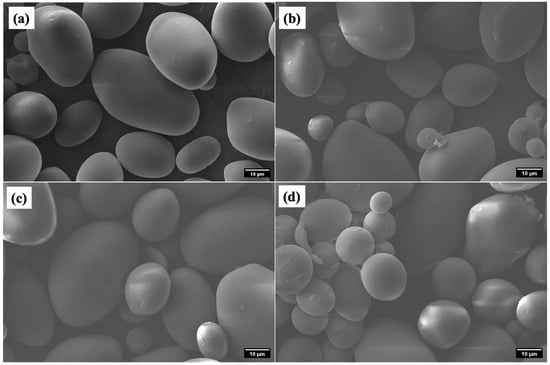
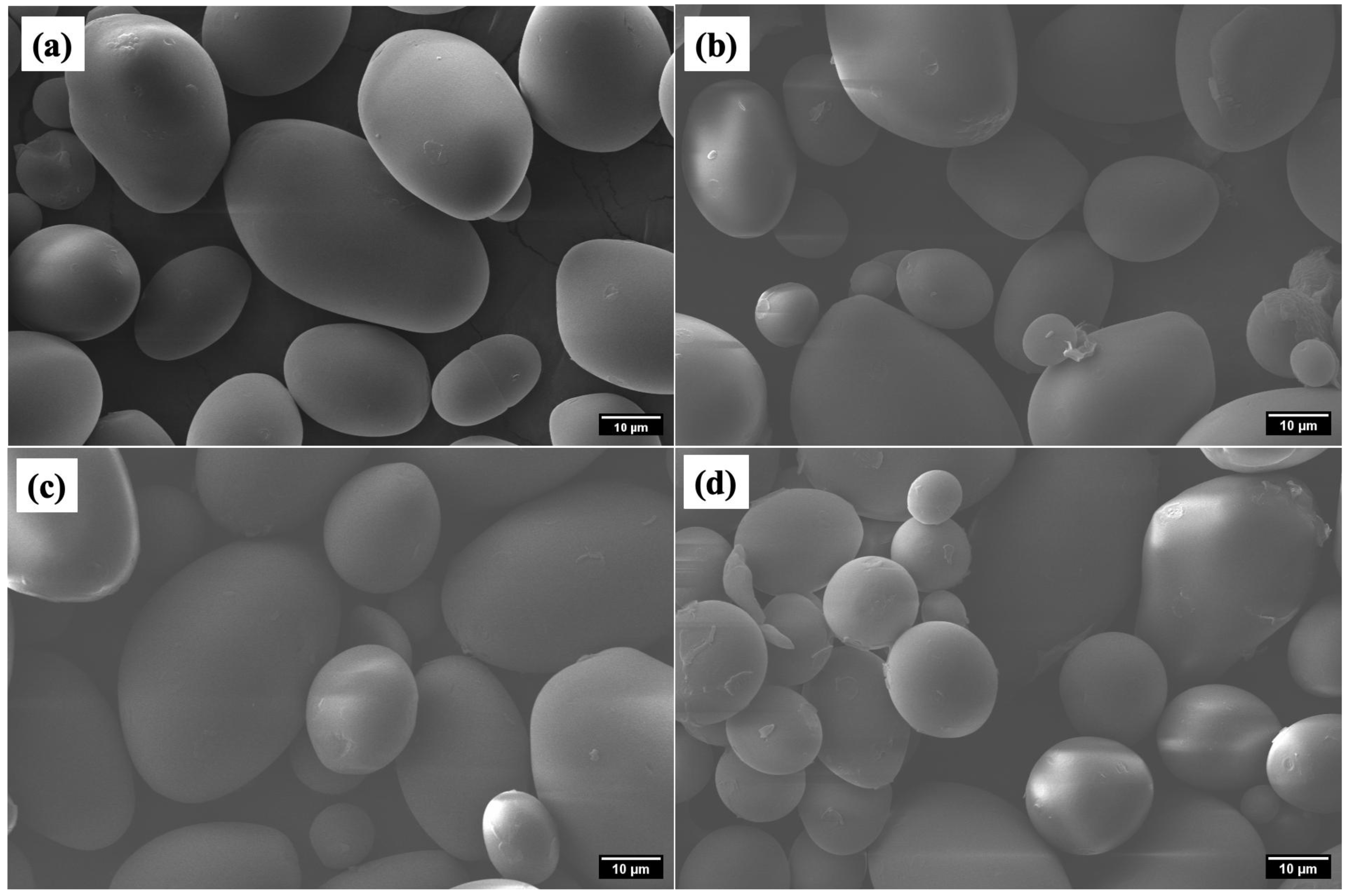
SEM micrographs showed potato starch granules with the typical rounded-to-ellipsoidal morphology, continuous outlines, and predominantly smooth surfaces (Figure 1a–d), consistent with previous works [7]. At 300 g/L, some granules had irregular edges and small, flake-like structures on their surfaces (Figure 1d). These features may correspond to superficial granule material partially separated from the granule surface by the mechanical action of high-speed shearing. The presence of these features at 300 g/L is consistent with local surface alteration promoted by mechanical shear and particle–particle interactions in the more concentrated dispersion. Surface changes under high-speed shear have also been reported for starches from other botanical sources [15,18].
Figure 1.
SEM micrographs of native potato starch (a) and starch recovered after homogenization at initial starch concentrations of 100 g/L (b), 200 g/L (c) and 300 g/L (d).
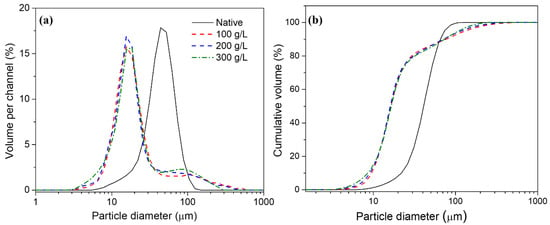
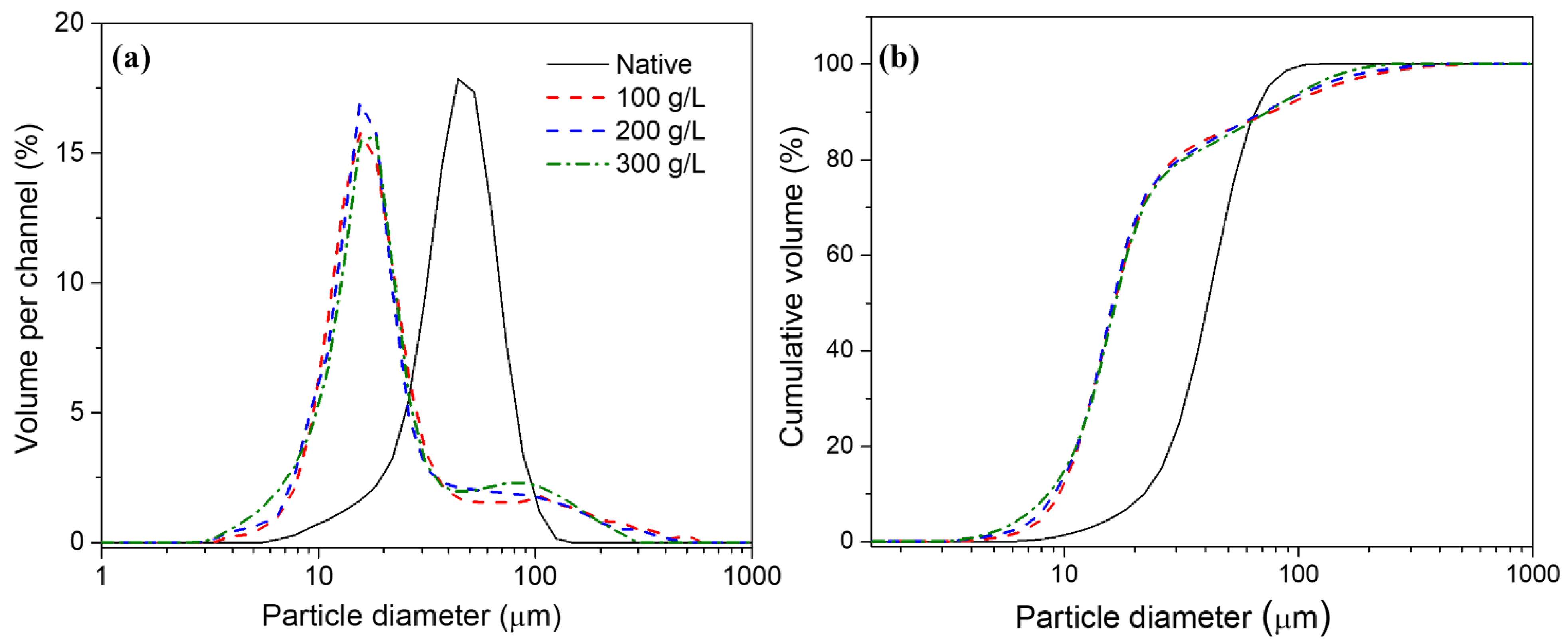
Figure 2 shows the particle size distribution of native and treated potato starch. Native starch exhibited a unimodal distribution, whereas the main peaks of the treated samples were located at smaller particle diameters (Figure 2a). Additional coarse populations were identified in the 100 and 300 g/L samples, with characteristic diameters of 91.83 and 78.32 µm and contributions of 16.5% and 18.2% to the measured particle volume, respectively.
Figure 2.
Differential volume distributions (a) and cumulative volume distributions (b) of native potato starch and starch recovered after homogenization at 8000 rpm for 5 min from dispersions prepared at initial starch loadings of 100, 200, and 300 g/L.
Native starch exhibited d10, d50, and d90 values of 21.92, 40.99, and 64.76 µm, respectively (Figure 2b). These percentiles describe the diameters below which 10%, 50%, and 90% of the particle volume occur. For the 100, 200, and 300 g/L samples, d10 decreased to 9.58, 9.08, and 8.58 µm, respectively, and d50 decreased to 16.25, 16.04, and 16.44 µm. In contrast, d90 increased to 76.20, 70.71, and 73.24 µm, respectively. The approximately 60% reduction in median particle diameter was therefore accompanied by an increase in d90, indicating a redistribution of particle sizes rather than a uniform reduction throughout the population. Coarse particles were also present at 200 g/L, although they did not form a distinct secondary peak.
The lower d10 and d50 values were consistent with partial granule fragmentation during processing. Kaur et al. [22] similarly observed small particles and granular fragments in kidney bean starch subjected to high-speed shearing at 15.000 rpm for 2–8 min.
The higher d90 values may reflect agglomeration of granules or fragments during recovery and drying or preferential loss of fine particles during starch recovery, which could increase the relative contribution of coarse particles to the measured volume. Augustin et al. [26] also proposed possible reagglomeration during repeated microfluidization of previously heated and sheared high-amylose maize starch, suggesting that size reduction and reassociation can coexist under mechanical processing.
Selective recovery could additionally have influenced the relative proportions of the measured size fractions. Fine particles remaining in the supernatant after centrifugation could have been discarded, increasing the relative contribution of coarse particles in the recovered starch. This mechanism would affect the measured percentiles without requiring the formation of new coarse particles.
3.2. X-Ray Diffraction Profiles
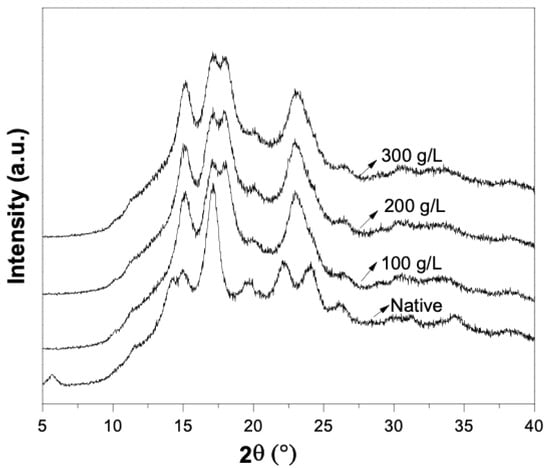
Figure 3 shows the X-ray patterns of native and treated starches. All samples retained the characteristic reflections of a B-type crystalline pattern, with main signals in the regions near 15°, 17–18°, and 22–24° 2θ (Figure 3). This behavior suggests that the treatment did not induce a complete loss of crystalline order or a clear transition to a different crystalline polymorph. However, some changes in peak resolution and band shape after treatment were observed.
Figure 3.
X-ray diffraction patterns of native potato starch and starch recovered after homogenization at initial starch concentrations of 100 g/L, 200 g/L and 300 g/L.
Native starch showed a resolved low-angle reflection at 5.66° 2θ, which was not clearly detected in the treated samples. In the 14–16° 2θ region, native starch showed a broader and shouldered band centered at 14.96° 2θ, whereas the treated samples showed one main contribution at 15.17–15.19° 2θ.
A more evident change occurred in the 16–19° 2θ region. Native starch showed one dominant maximum at 17.17° 2θ, while the treated samples showed two distinguishable contributions at approximately 17.1–17.2° and 17.9–18.0° 2θ. In contrast, the 20–25° 2θ region showed the opposite behavior. Native starch presented several resolved contributions, mainly at 22.11° and 24.12° 2θ, with an additional weak signal near 19.69° 2θ. After treatment, these features were less clearly resolved, appearing as one broader band centered at approximately 22.9–23.1° 2θ.
The observed differences in band resolution across different angular regions may be related to a nonuniform diffraction response, which is compatible with alterations in semicrystalline organization. The rotor–stator system generates intense velocity gradients, turbulence, and repeated particle–particle and particle–wall interactions. These mechanical stresses could influence the organization of semicrystalline regions within starch granules.
The relative crystallinity was 27.4% for native starch and 25.5, 25.8, and 26.3% for starch recovered after homogenization at 8000 rpm for 5 min from dispersions prepared at initial starch loadings of 100, 200, and 300 g/L, respectively. These values indicated a slight decrease in estimated relative crystallinity after processing.
3.3. Infrared Spectra Analysis
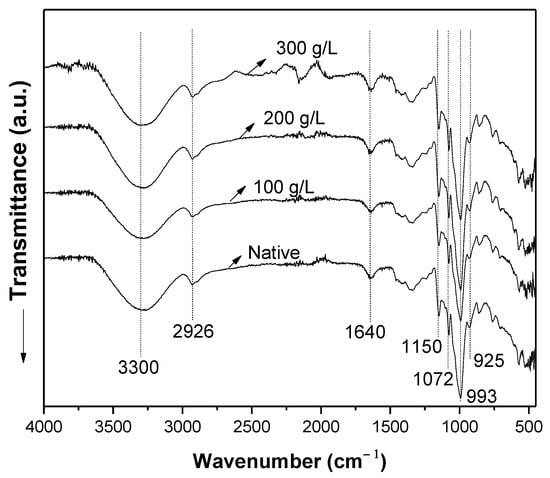
Native and treated potato starches showed characteristic FTIR bands, including the broad O–H stretching band around 3300 cm−1, C–H stretching near 2926 cm−1, H–O–H bending of associated water around 1640 cm−1, and the carbohydrate fingerprint region between 1200 and 900 cm−1 (Figure 4) [24]. No new absorption bands were detected in the treated samples, indicating retention of the characteristic starch spectral features.
Figure 4.
Infrared spectra of native potato starch and starch recovered after homogenization at initial starch concentrations of 100 g/L, 200 g/L and 300 g/L.
Within the fingerprint region, bands near 1150 and 1072 cm−1, associated with C–O and C–O–C vibrations, were observed in all samples. The bands near 993 and 925 cm−1 were associated with deformation vibrations involving C–OH and CH2 groups characteristic of starch [27].
Overall, the spectra showed preservation of the main starch vibrational features throughout processing.
3.4. Thermogravimetric Profiles
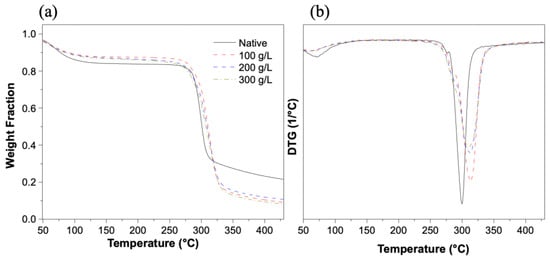
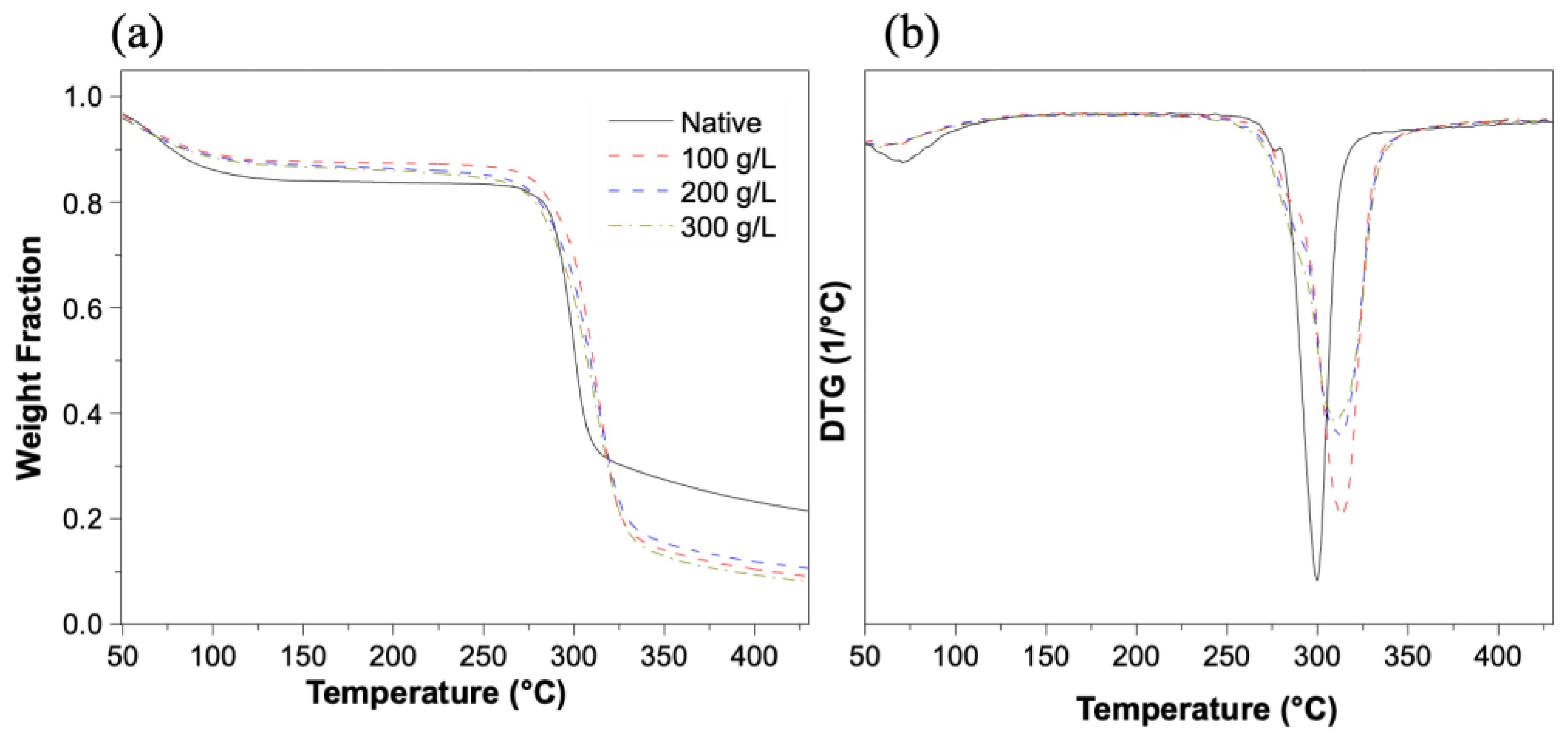
Thermogravimetric analysis showed differences in the thermal response of native and recovered potato starches (Figure 5). The first mass-loss region, observed between 50 and 120 °C, was associated with the release of physically retained water. Native starch showed a higher mass loss in this region (12.0 ± 0.8%) than the treated samples, which showed similar values at 100, 200, and 300 g/L (8.2 ± 0.1, 8.2 ± 0.7, and 8.5 ± 0.8%, respectively).
Figure 5.
Thermogravimetric analysis of native starch and starch recovered after homogenization at initial starch concentrations of 100 g/L, 200 g/L and 300 g/L: (a) TGA curves and (b) DTG curves.
The main degradation event occurred between 250 and 350 °C and corresponded to the thermal decomposition of the starch matrix. The temperature of maximum mass-loss rate, obtained from the DTG curves, shifted from 299.9 ± 0.3 °C for native starch to 313.1 ± 0.8, 313.4 ± 0.1, and 309.8 ± 0.7 °C for starch recovered after homogenization at 8000 rpm for 5 min from dispersions prepared at initial starch loadings of 100, 200, and 300 g/L, respectively. This shift indicated that the most rapid stage of mass loss occurred at a higher temperature in the recovered samples.
At 430 °C, the treated samples showed lower remaining mass than native starch. The remaining mass decreased from 22 ± 1% for native starch to 9 ± 4, 11 ± 7, and 8 ± 1% for the 100, 200, and 300 g/L samples, respectively. This behavior could reflect differences in the formation or persistence of carbonaceous material. The potential selective removal of soluble components or fine particles during starch recovery could also have modified the composition of the recovered fractions.
The combination of a higher temperature of maximum mass-loss rate and lower remaining mass at 430 °C indicated that processing altered different aspects of the thermal decomposition process. While the DTG peak showed the temperature at which mass loss occurred most rapidly, the remaining mass reflected the cumulative losses up to the selected temperature.
3.5. Hydration Properties
Potato starch recovered after processing showed differences in hydration-related properties compared with native starch (Table 1). Water activity increased after treatment, whereas moisture content did not differ significantly among samples.
Table 1.
Hydration properties of native and high-speed-sheared potato starch.
Water retention capacity was not significantly affected by the treatment. However, solubility decreased in all treated samples compared with native starch. This parameter should be interpreted as the soluble fraction released under the assay conditions rather than complete molecular dissolution of starch granules. The decrease in solubility suggests that the processing reduced the amount of starch material leached into the aqueous phase. This behavior may be associated with post-shearing aggregation, reassociation of starch chains, or structural reorganization that limits water penetration and amylose leaching [1,2,5,7,10,11,12].
The water absorption index (WAI) was higher in the recovered starch samples than in native starch. This behavior could be associated with the decrease in median particle diameter consistent with partial fragmentation, which could have increased the surface area accessible to water. Concurrently, associations among granules and fragments could have contributed to water retention within interparticle spaces. These effects could help explain the higher WAI without requiring greater expansion of individual granules. Potential reassociation of accessible starch chains during recovery and drying could additionally have restricted their release into the aqueous phase while allowing water uptake by the recovered material.
4. Conclusions
This study identified physical, structural, thermal, and hydration-related changes in potato starch recovered after high-speed homogenization and assessed how these responses varied with initial starch concentration. The treatment preserved the main granular identity, B-type crystalline arrangement, and characteristic FTIR bands, while producing changes in size distribution, thermal behavior, and hydration properties.
The decrease in median particle diameter, accompanied by higher d90 values, revealed a redistribution involving both fine and coarse particle fractions. Differences among starch loadings were evident in the distinct coarse-particle populations observed at 100 and 300 g/L and in water activity, which decreased with increasing initial concentration. Median particle diameter remained similar across recovered samples, while water absorption index and water solubility did not differ significantly among starch loadings. The temperature of maximum mass-loss rate increased from approximately 300 °C in native starch to 310–313 °C in the treated samples, indicating that the most rapid stage of thermal decomposition occurred at higher temperatures after processing. At the same time, the lower remaining mass at 430 °C indicated greater cumulative mass loss by this temperature.
This approach may be relevant for applications requiring adjustment of particle size, hydration behavior, and thermal response. The study also provided a basis for future work on additional shearing intensities, the contributions of individual processing stages, other botanical sources, and performance in specific food and material systems.
Author Contributions
Conceptualization, A.L.-C.; methodology, C.M.-J. and A.L.-C.; software, C.M.-J. and A.L.-C.; validation, C.M.-J., V.S.E.; A.L.-C.; formal analysis, A.L.-C.; investigation, C.M.-J. and A.L.-C.; resources, C.M.-J., V.S.E.; A.L.-C.; data curation, C.M.-J. and A.L.-C.; writing—original draft preparation, C.M.-J. and A.L.-C.; writing—review and editing, C.M.-J. and A.L.-C.; visualization, A.L.-C. and C.M.-J.; supervision, A.L.-C.; project administration, A.L.-C.; funding acquisition, A.L.-C. All authors have read and agreed to the published version of the manuscript.
Funding
This research was supported by the Universidad Pedagógica y Tecnológica de Colombia; by ICETEX and Minciencias through Project 82561, “TUBERPRO: VALORIZACIÓN INTEGRAL DE RAICES Y TUBÉRCULOS PARA LA OBTENCIÓN DE BIOPOLÍMEROS, ALIMENTOS Y BIOPLÁSTICOS,” under Call 890–2020, “CONV. PARA EL FORTALECIMIENTO DE CTeI EN INST. DE EDUCACIÓN SUPERIOR PÚBLICAS”; and by the Oficina de Cooperació al Desenvolupament i Solidaritat (OCDS) of the Universitat de les Illes Balears (UIB), through the Direcció General de Cooperació i Immigració of the Govern de les Illes Balears (Project OCDS-REC2025/02).
Institutional Review Board Statement
Not applicable.
Data Availability Statement
The raw data supporting the conclusions of this article will be made available by the authors on request.
Acknowledgments
The authors thank the staff of the Scientific and Technical Services (SCT) of the Universitat de les Illes Balears for their technical assistance: Joan Cifre Bauzà (X-ray diffraction and thermogravimetric analysis) and José González Morey (laser diffraction).
Conflicts of Interest
The authors declare no conflicts of interest.
References
- Imran, S.; Qayyum, A.; Yang, X.; Zeng, Y.; He, X. A Panoramic Review on Phytochemistry, Pharmacological Potential, Health Benefits, and Versatility of Solanum tuberosum L. Not. Bot. Horti Agrobot. Cluj. Napoca. 2025, 53, 14080. [Google Scholar] [CrossRef] [Scilit]
- Saini, R.; Kaur, S.; Aggarwal, P.; Dhiman, A.; Suthar, P. Conventional and Emerging Innovative Processing Technologies for Quality Processing of Potato and Potato-Based Products: A Review. Food Control 2023, 153, 109933. [Google Scholar] [CrossRef] [Scilit]
- Ali, S.M.; Siddique, Y.; Mehnaz, S.; Sadiq, M.B. Extraction and Characterization of Starch from Low-Grade Potatoes and Formulation of Gluten-Free Cookies Containing Modified Potato Starch. Heliyon 2023, 9, e19581. [Google Scholar] [CrossRef] [Scilit]
- Wang, Y.; Xu, Y.; Wang, X.; Liu, H.; Liu, S. A Deep Learning-Based Algorithm for Online Detection and Evaluation of Starch Content in Multiple Potato Varieties. Food Control 2025, 177, 111452. [Google Scholar] [CrossRef] [Scilit]
- Lu, Z.; Yada, R.Y.; Liu, Q.; Li, X.Q.; Pinhero, R.G. Correlation of Physicochemical and Nutritional Properties of Dry Matter and Starch in Potatoes Grown in Different Locations. Food Chem. 2011, 126, 1246–1253. [Google Scholar] [CrossRef] [Scilit]
- Ubaid, M.; Ahmed, M.; Sheikh, M.A.; Kumar, A.; Vashisht, A. Potato Starch as a Next-Generation Biopolymer: Functionality, Modification, Sustainability, and Industrial Perspectives. Food Phys. 2026, 3, 100082. [Google Scholar] [CrossRef] [Scilit]
- Singh, N.; Singh, J.; Kaur, L.; Sodhi, N.S.; Gill, B.S. Morphological, Thermal and Rheological Properties of Starches from Different Botanical Sources. Food Chem. 2003, 81, 219–231. [Google Scholar] [CrossRef] [Scilit]
- Kringel, D.H.; El Halal, S.L.M.; Zavareze, E.D.R.; Dias, A.R.G. Methods for the Extraction of Roots, Tubers, Pulses, Pseudocereals, and Other Unconventional Starches Sources: A Review. Starch Stärke 2020, 72, 1900234. [Google Scholar] [CrossRef] [Scilit]
- Li, S.; Lin, J.; Yue, Q.; Li, X.; Zeng, J. Gelatinization and Gelling Properties of Blends of Wheat Starch and Potato Starch or Pea Starch. Mod. Food Sci. Technol. 2024, 40, 181–188. [Google Scholar] [CrossRef]
- Goemaere, O.; de Ketelaere, B.; Hanskens, J.; Pérez-Santaescolástica, C.; Fraeye, I. Comparison of the Technological Application Potential of Functional Ingredients for the Meat Industry Based upon a Novel Fast Screening Tool. Foods 2021, 10, 2078. [Google Scholar] [CrossRef] [Scilit]
- Lawton, J.W. Starch: Uses of Native Starch. Encycl. Food Grains Second Ed. 2015, 3–4, 274–281. [Google Scholar] [CrossRef] [Scilit]
- Medina-Jaramillo, C.; Coelho-Leandro, G.; Ayala-Valencia, G.; López-Córdoba, A. Starch-Based Biocomposites Reinforced with Cellulose Nanofibers from Potato Peel Byproducts. Sci. Rep. 2025, 15, 38412. [Google Scholar] [CrossRef] [Scilit]
- Singh, H.; Chaturvedi, S.; Singh, B.; Toor, B.S.; Sandhu, K.S. Evaluating the Potential of Potato (Solanum tuberosum) Starch as Functional Excipients in Tablet Formulation. Res. J. Pharm. Technol. 2025, 18, 4482–4490. [Google Scholar] [CrossRef] [Scilit]
- BeMiller, J.N. Physical modification of starch. In Starch in Food: Structure, Function and Applications, 3rd ed.; Nilsson, L., Ed.; Woodhead Publishing: Duxford, UK, 2024; pp. 79–96. [Google Scholar] [CrossRef] [Scilit]
- Wu, Y.; Shen, F.; Luo, J.; Huang, Q.; Luo, P. Effects of High-Speed Shear and Esterification Modification on Physicochemical and Structural Properties of Cassava Starch and Microencapsulation for Olive Oils. Curr. Res. Food Sci. 2026, 13, 101479. [Google Scholar] [CrossRef] [Scilit]
- Airlangga, B.; Puspasari, F.; Trisanti, P.N.; Juwari; Sumarno. Structural Properties Change of Cassava Starch Granule Induced by High Shear Mixer. Starch Stärke 2020, 72, 2000004. [Google Scholar] [CrossRef] [Scilit]
- Zhang, J.; Xu, S.; Li, W. High Shear Mixers: A Review of Typical Applications and Studies on Power Draw, Flow Pattern, Energy Dissipation and Transfer Properties. Chem. Eng. Process. Process Intensif. 2012, 57–58, 25–41. [Google Scholar] [CrossRef] [Scilit]
- Shahbazi, M.; Majzoobi, M.; Farahnaky, A. Impact of Shear Force on Functional Properties of Native Starch and Resulting Gel and Film. J. Food Eng. 2018, 223, 10–21. [Google Scholar] [CrossRef] [Scilit]
- Jia, R.; He, X.; McClements, D.J.; Qin, Y.; Xiong, L.; Dai, L.; Sun, Q. Control of Starch Gel Properties by Shear-Induced Disruption of Gelatinized Swollen Starch Granule Integrity. Food Hydrocoll. 2025, 168, 111528. [Google Scholar] [CrossRef] [Scilit]
- Wang, C.; He, X.; Fu, X.; Luo, F.; Huang, Q. High-Speed Shear Effect on Properties and Octenylsuccinic Anhydride Modification of Corn Starch. Food Hydrocoll. 2015, 44, 32–39. [Google Scholar] [CrossRef] [Scilit]
- Wu, X.; Xiao, Y.; Zhang, B.; Luo, F.; Lin, Q.; Ding, Y. Insights into the Relations between Particle Size and Physicochemical Properties of Starch Nanoparticles Prepared by Combining High-Speed Shearing with Precipitation. Starch Stärke 2022, 74, 2100122. [Google Scholar] [CrossRef] [Scilit]
- Kaur, S.; Kaur, A.; Singh, N.; Sodhi, N.S. Effect of Shearing on Functional Properties of Starches Isolated from Indian Kidney Beans. Starch Stärke 2013, 65, 808–813. [Google Scholar] [CrossRef] [Scilit]
- Daza, L.D.; Umaña, M.; Simal, S.; Váquiro, H.A.; Eim, V.S. Non-Conventional Starch from Cubio Tuber (Tropaeolum tuberosum): Physicochemical, Structural, Morphological, Thermal Characterization and the Evaluation of Its Potential as a Packaging Material. Int. J. Biol. Macromol. 2022, 221, 954–964. [Google Scholar] [CrossRef] [Scilit]
- Medina Jaramillo, C.; Estevez Areco, S.; Goyanes, S.; López Córdoba, A. Characterization of Starches Isolated from Colombian Native Potatoes and Their Application as Novel Edible Coatings for Wild Andean Blueberries (Vaccinium meridionale Swartz). Polymers 2019, 11, 1937. [Google Scholar] [CrossRef] [Scilit]
- Barua, S.; Luciano, G.; Ahmed, J.; Srivastav, P.P.; Vilgis, T.A. Physics of Starch System: Rheological and Mechanical Properties of Hydrothermally Modified Elephant Foot Yam Starch. Food Biophys. 2024, 19, 71–84. [Google Scholar] [CrossRef] [Scilit]
- Augustin, M.A.; Sanguansri, P.; Htoon, A. Functional Performance of a Resistant Starch Ingredient Modified Using a Microfluidiser. Innov. Food Sci. Emerg. Technol. 2008, 9, 224–231. [Google Scholar] [CrossRef] [Scilit]
- Da Silva Miranda Sechi, N.; Marques, P.T. Preparation and Physicochemical, Structural and Morphological Characterization of Phosphorylated Starch. In Proceedings of the Materials Research; Universidade Federal de Sao Carlos: São Carlos, Brazil, 2017; Volume 20, pp. 174–180. [Google Scholar]

Disclaimer/Publisher’s Note: The statements, opinions and data contained in all publications are solely those of the individual author(s) and contributor(s) and not of MDPI and/or the editor(s). MDPI and/or the editor(s) disclaim responsibility for any injury to people or property resulting from any ideas, methods, instructions or products referred to in the content. |
© 2026 by the authors. Licensee MDPI, Basel, Switzerland. This article is an open access article distributed under the terms and conditions of the Creative Commons Attribution (CC BY) license.