


Abstract
This work is focused on understanding how the properties of chitosan-g-poly(N,N-diethylacrylamide-co-N,N-dimethylacrylamide) and chitosan-g-poly(N,N-diethylacrylamide-co-N-ethylacrylamide) copolymers are affected by varying their compositions. Poly(N,N-diethylacrylamide), PDEAm, is a thermosensitive polymer with a reversible coil-to-globule transition in aqueous solution near the human body temperature. The transition temperature can be tuned by varying the amount of two more hydrophilic units: N-ethylacrylamide (NEAm) or N,N-dimethylacrylamide (DMAm). While the former can participate in hydrogen bonding as a proton donor or acceptor, the latter is only an acceptor and a very-well-known hydrophilic unit with no phase transition. The gelation process was followed by rheological measurements, showing the general features of the chemical gelation and the formation of a strong gel. A reaction autoacceleration was observed, which is interpreted by the high viscosity of the reaction mixture due to the presence of chitosan, although a greater effect was found in NEAm copolymers due to the higher hydrogen-bonding capacity of NEAm. A relationship was found between the compositions of both copolymers, the strength of the hydrogels, and the calculated pore size. The pore sizes range from 32 to 18 nm. Thermogravimetric analysis of the hydrogels showed the typical decomposition stages of polyacrylamides. Neither the temperature of the maximum decomposition rate nor the weight loss associated displayed a clear trend with the copolymer composition. There was an increment in the equilibrium swelling values with the content of NEAm units (from 16 to almost 28 g water/g polymer), but the copolymers with DMAm remained unaffected (swelling values around 23 g water/g polymer). The hydrogen-bonding interaction affected the gelation process and swelling behavior of the hydrogels. This can be explained by the greater ability of NEAm to form hydrogen bonds compared to DMAm.
1. Introduction
Although no single definition of a hydrogel exists, there is a general consensus that it is a polymeric network—either chemically or physically crosslinked—that is capable of absorbing large amounts of water. Hydrogels exhibit solid-like behavior [1] and, when deformed, their response is that of an elastic body [2]. The hydrogel polymeric matrix may be of natural origin, such as gelatin, or composed of polysaccharides, like chitosan or alginate. There is widespread interest in these polymeric materials, but they are of particular relevance in the biomedical field.
Chitosan is a linear polysaccharide mainly composed of glucosamine units and a minor fraction of N-acetylated glucosamine, linked all together by β(1→4) linkages. It can be obtained by the extensive deacetylation of chitin, which is the most widely available biopolymer after cellulose. The presence of amino and hydroxyl groups gives it polyelectrolyte properties and, at the same time, allows for its derivatization [3]. Chitosan-based hydrogels have been widely studied for their potential applications in the food industry [4], agriculture [5] and the biomedical field [6,7]. They may also be capable of responding to external stimuli, such as pH or temperature [8,9]. Some of their applications in biomedicine include drug delivery systems [10], 3D printing [11,12], tissue engineering [13] and wound-healing applications [14,15].
Poly(N,N-diethylacrylamide), PDEAm, is a thermosensitive polymer which has a reversible coil-to-globule transition in aqueous solution that occurs when the temperature rises above a critical value: the lower critical solution temperature (LCST). The phase transition is mediated by an equilibrium between the hydrophilic and hydrophobic interactions with the change in temperature, as well as hydrogen bonding. A known way to modulate the LCST is by tuning the amount of PDEAm with more hydrophilic units, like N-ethylacrylamide (NEAm) or N,N-dimethylacrylamide (DMAm) [16,17]. The former may form hydrogen bond interactions by accepting and donating the proton, and its polymers have a phase transition at around 71 °C [18], while the latter is soluble at any temperature and can only take part in hydrogen bonds by accepting a proton.
It is well known that water forms frozen patches or so-called icebergs around the non-polar segments of the macromolecule. This structuring of water molecules remains and surrounds non-polar segments of the polymer (hydrophobic hydration), keeping the polymer solvated below the LCST. Nevertheless, when the temperature is raised, there is an increase in polymer–polymer hydrophobic intercatenary interactions, giving rise to a coil-to-globule transition. This phase separation process involves both enthalpy and entropy changes [19]. Hydrogen bonding plays an important role in all these complex phenomena.
The focus of this work is to understand how the properties of chitosan-g-N-alkyl-substituted polyacrylamide hydrogels are affected by varying the compositions of chitosan-g-poly(DEAm-co-DMAm) and chitosan-g-poly(DEAm-co-NEAm) copolymers. These copolymers are composed of DEAm units with one of two more hydrophilic comonomer units: NEAm or DMAm. The former can participate in hydrogen bonding as a proton donor or acceptor and the latter only as an acceptor.
2. Experimental Part
2.1. Materials
Low-molecular-weight chitosan was acquired from Sigma-Aldrich (Merck KGaA, Darmstadt, Germany), and used without further purification. Its MV = 76,000 was estimated by viscometry [20], and the degree of deacetylation, 84.5%, was determined by potentiometric and conductimetric methods.
The monomers N,N-diethylacrylamide, DEAm (Tokyo Chemical Industry Co., Tokyo, Japan), N,N-dimethylacrylamide, DMAm (Sigma-Aldrich, Merck KGaA, Darmstadt, Germany), and N-ethylacrylamide, NEAm (Sigma-Aldrich, Darmstadt, Germany), were purified by vacuum distillation. The crosslinker N,N-methylenbisacrylamide, MBA (Sigma-Aldrich, Germany), ammonium persulfate, APS (Sigma-Aldrich, Darmstadt, Germany), N,N,N′,N′-tetramethylethylenediamine, TEMED (Sigma-Aldrich, Darmstadt, Germany), and methylene blue (Sigma-Aldrich, Darmstadt, Germany) were used as received. Type I ultrapure water with a conductivity lower than 0.05 μS cm−1 was used in all experiments.
2.2. Preparation of Chitosan-Based Bulk Copolymer Hydrogels
Two series of copolymer hydrogels (chitosan-g-poly(DEAm-co-DMAm) and chitosan-g-poly(DEAm-co-NEAm)) were synthesized with different nominal compositions of both comonomers: 0, 25, 50, 75, and 100 mol-% of DEAm. The synthesis procedure was based on that described by Bocourt-Povea et al. [21]. A 2.0% w/w chitosan solution in 0.1 M HCl was prepared in a Schlenk tube and stirred overnight at room temperature. The corresponding amounts of both N-akylacrylamide comonomers were successively dissolved in the chitosan solution along with the crosslinker, MBA, and the accelerator, TEMED. Quantities were calculated using the following ratios: comonomers:chitosan ≈ 5 g/g; APS = 0.7 mol-% of comonomers; TEMED:APS = 3 mol/mol; and MBA = 2.0 mol-% of comonomers. The mixture was degassed through four freeze–pump–thaw cycles under a high-purity argon atmosphere. The APS aqueous solution (c = 0.13 g/g) was added to the reaction mixture under agitation in an ice bath. Right after that, the mixture was poured into 5 mL ampules, sealed with caps, and placed in a thermostated bath at 20 °C for 24 h to polymerize (final pH ≈ 5). The obtained cylindrical hydrogels were cut into disc-shape slices of 14 mm diameter and 2 mm thickness, dialyzed against water for a week with regular changes of solvent, and dried at room temperature.
2.3. Fourier Transformed Infrared Spectroscopy (FTIR)
The infrared spectra from 4000 to 600 cm−1 were acquired using a Nicolet iS-50 spectrometer (Thermo Scientific, Madison, WI, USA) with an attenuated total reflectance (ATR) module. The dry hydrogel samples were analyzed by accumulation of 64 scans with a resolution of 2 cm−1.
2.4. Thermogravimetric Analysis
All samples of dry hydrogels were crushed into a fine powder prior to analysis. Approximately 12 mg per hydrogel sample was placed in an aluminum crucible and heated from 25 to 600 °C at a rate of 10 K min−1 under an air atmosphere. The thermogravimetric (TG) and derivative thermogravimetry (DTG) curves during the thermal degradation process were recorded in a Pyris 1 TGA (PerkinElmer, Waltham, MA, USA).
2.5. Scanning Electron Microscopy (SEM)
All hydrogel samples were swollen in water for 24 h, frozen in liquid nitrogen and lyophilized. Small portions of the recovered freeze-dried hydrogels were cut with a scalpel and located on a sample holder to be sputtered with gold. SEM was conducted with a JEOL JSM-5410LV microscope, operated at an acceleration voltage of 20 kV.
2.6. Rheological Measurements
Small-deformation oscillatory viscoelastic measurements were performed using an AR-G2 rheometer (TA Instruments, New Castle, DE, USA) operating with a cross-hatched stainless-steel plate–plate geometry (diameter: 40 mm; gap: 400 μm). The temperature control was achieved through a Peltier system.
The samples were prepared following a similar procedure as described above. A freshly prepared chitosan solution (2 wt.% in 0.1 M HCl) was mixed with the corresponding amounts of the comonomers, the crosslinker and the accelerator in a sealed container. The resulting mixture was submitted to four freeze–pump–thaw cycles under a high-purity argon atmosphere and kept in an ice bath until the APS was added—that moment was taken as the zero time of the reaction. Then, it was sonicated for 1–2 min to remove bubbles. The sample was then poured into the rheometer, taking care—as far as possible—to keep an argon atmosphere around it, until the upper geometry lowered down. A thin layer of low-viscosity silicone oil was quickly added around the periphery of the geometry plate to prevent the evaporation of the sample and isolate the reacting mixture from the atmosphere.
All experiments were conducted under isothermal conditions at 20 °C according to the following the protocol: (i) a time sweep: the gelation process was monitored by measuring the variation in the time of the storage (G′) and loss (G″) moduli at four frequencies, 1.00, 2.15, 4.64, and 10.00 rad·s−1, until both moduli reached an equilibrium plateau; and (ii) a frequency sweep over the frequency range between 0.1 and 100 rad·s−1. In all cases, a strain of 2.5% was used to keep the experiments within the linear viscoelastic region (as shown in Figure S1).
2.7. Swelling Measurements
Dried disc-shape hydrogels were weighed and placed in a temperature-controlled bath (20.0 ± 0.02 °C) to swell in water. Water uptake was measured gravimetrically as a function of time until the swelling equilibrium was achieved. The swelling degree, , was calculated by the equation:
where M0 and Mt are the weights of the dry and swollen hydrogel at a given time, t, respectively. All experiments were performed in triplicate, and the Wt values were averaged across the three measurements.
3. Results and Discussion
3.1. Synthesis
The radical polymerization of acrylic monomers in the presence of chitosan, Cs, can yield an interpenetrated graft copolymer in which the polyacrylic chains grow from the polysaccharide chains, but it is also possible to obtain homopolymer chains [22]. The decomposition of persulphate ions produces the sulphate radical, , which can react with water to generate the hydroxyl radical, [23]. These radicals (R·) can either attack the chitosan backbone to create a free macroradical that could further produce a grafted copolymer or a monomer molecule to yield a polyacrylic chain:
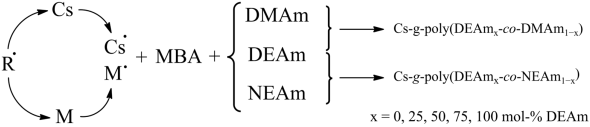
Meanwhile, the crosslinker, MBA, chemically crosslinks the system, joining up to four polyacrylic chains (Scheme S1). Hydrogels obtained by this way were strong and transparent in their swollen state at low temperatures and became opaque and suddenly shrank when heated due to the thermal phase transition.
3.2. Rheological Measurements During Gelation Process
The synthesis of these hydrogels involves the free-radical copolymerization of the N-alkyl acrylamide monomers and the crosslinker in the presence of chitosan to form a polymer network. As the reaction proceeds, a sol–gel transition takes place, and consequently, a remarkable change in the mechanical properties of the material is produced when it turns from liquid to solid-like behavior. This makes rheology a suitable technique to gain insight information about the gelation process.
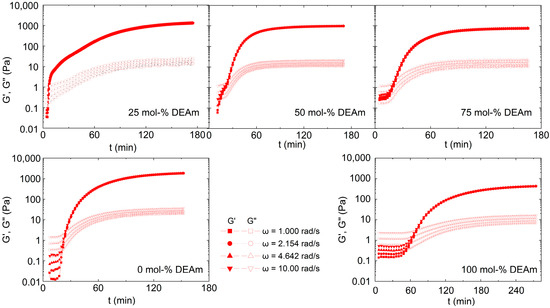
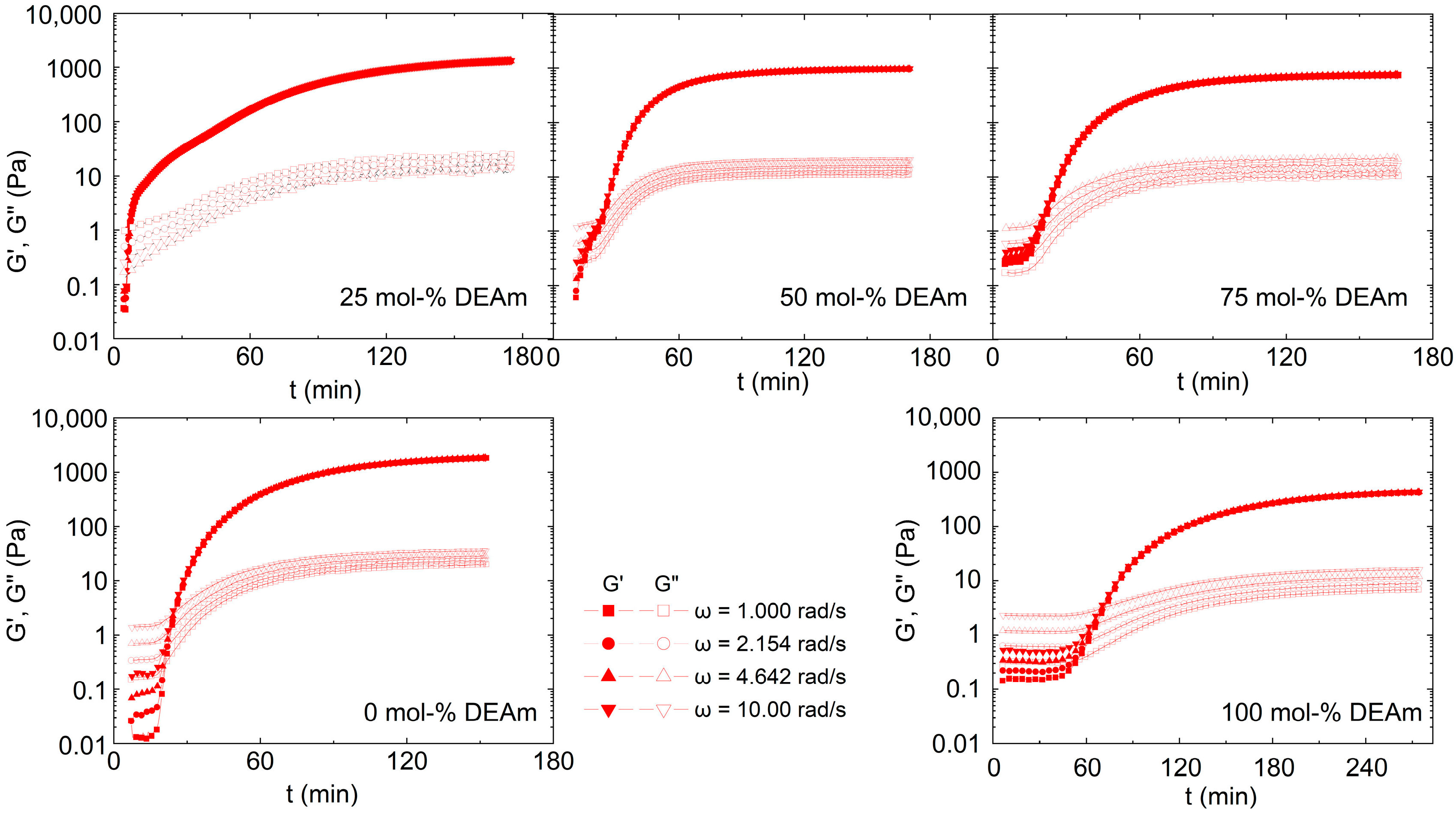
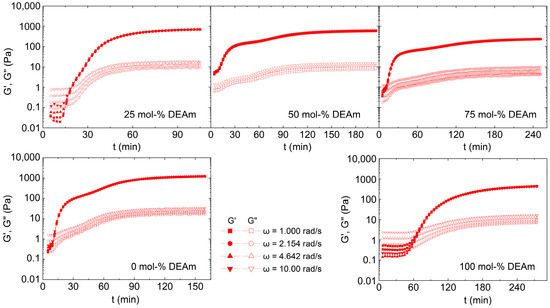
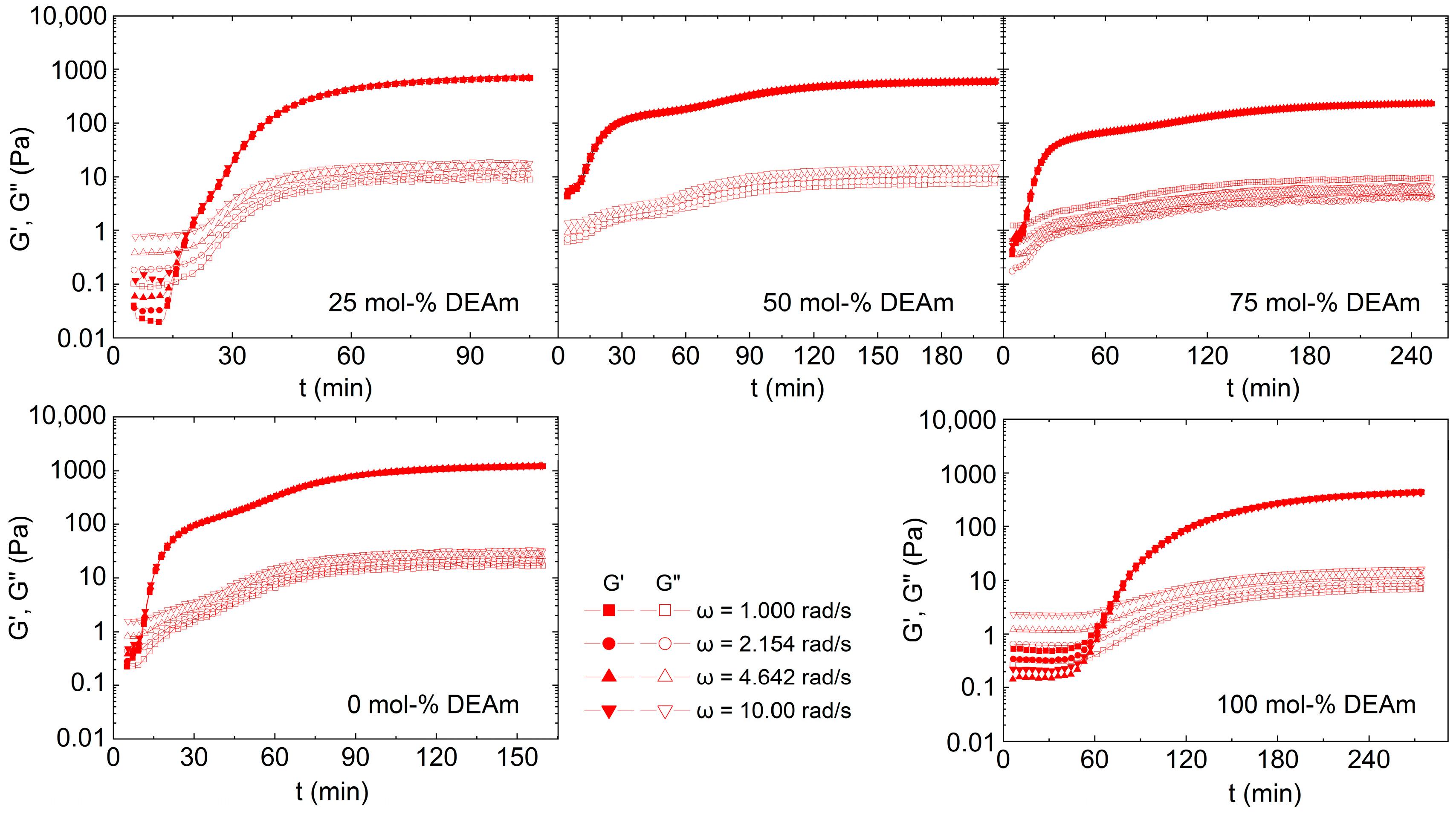
To study the gelation process at 20 °C, an oscillatory time-sweep experiment was first carried out. The variations in the storage (G′) and loss (G″) moduli with time are shown in Figure 1 and Figure 2 for DMAm- and NEAm-containing copolymers, respectively. In all cases, time zero was defined as the moment when the initiator was added to the reaction mixture. This time lag was then adjusted within the rheological data.
Figure 1.
Evolution of the storage (G′, closed symbols) and loss (G″, open symbols) moduli as a function of time during gelation of chitosan-g-poly(DEAm-co-DMAm) hydrogels at 20 °C; γ = 2.5%. The composition of the hydrogels and frequencies are specified inside the graph.
Figure 2.
Evolution of the storage (G′, closed symbols) and loss (G″, open symbols) moduli as a function of time during gelation of chitosan-g-poly(DEAm-co-NEAm) hydrogels at 20 °C; γ = 2.5%. The composition of the hydrogels and frequencies are specified inside the graph.
These curves showed the general rheological behavior of chemical gelation. All samples exhibited a short initial lag period in which the system kept a viscous performance or a pre-gel state (G″ > G′). At the onset of gelification, the storage modulus started to grow rapidly, indicating the transition to gel as the system approached the critical point [24,25].
Reaching the gel point, the mobility of the polymer segments becomes more constrained as the number of crosslinking nodes increases throughout the system, thereby increasing viscosity. This trend becomes more pronounced as it approaches the critical point. The gel point represents a critical state, wherein the crosslinked macromolecules grow to an infinite size within the boundaries of the container. As the gel spreads across the entire sample, replacing the sol fraction, the mechanical properties of the system gradually strengthen until they reach final equilibrium values once the polymer network has been fully formed.
In Figure 2, it can be seen that the G′ traces of the hydrogels with the NEAm comonomer exhibits two consecutive gelation steps. For the copolymer chitosan-g-poly(DEAm-co-DMAm) with 50 mol-% DEAm, it is barely noticeable, but it is certainly present. At first glance, it would appear that this is the typical gel effect of free-radical bulk polymerization, which is characterized by an autoacceleration of the polymerization rate and, most notably, a significant increase in temperature. However, this is not the case here, since the total monomer concentration is far from high (approximately 12% w/w, including chitosan) and, furthermore, there was no increase in temperature, which remained constant within a range of ±0.03 °C maximum, according to the rheometer records.
However, there is no doubt that polymerization undergoes autoacceleration. For that to happen, the rate of termination reactions must decrease, resulting in a predominance of the propagation reaction. In other words, there is a breakpoint in the steady-state assumption, leading to an increase in the global polymerization rate since its early gelation stages.
The underlying phenomenon is the same as in the gel effect: the diffusion of macromolecular radical species is significantly restricted. Even though there is an increase in the viscosity of the medium due to the progress of the polymerization, the main cause lies in the presence of chitosan in the reaction medium. The reptation of radical macromolecular species is limited due to two fundamental causes. First, the addition of chitosan to the solution gives the medium a high viscosity from the very beginning of radical polymerization. This is the main cause of the short gelation times that can be seen in Figure 1 and Figure 2, particularly during the first stages of gelation. The second reason is more specific and explains why it is mainly observed in the presence of N-ethylacrylamide. In this case, the inhibition of the chain reptation is greater, due to the hydrogen bonding between the hydroxyl groups of chitosan and the nitrogen of NEAm, with an available electron pair. Therefore, there is a “double” hindrance to the mobility of NEAm species, with a greater effect on the growing radical species. This implies that the terminal relaxation times of the polymer chains are remarkably high (including chitosan chains) so that diffusion is severely hindered, slowing down termination.
The presence of entanglements between the growing acrylamide chains themselves, and with the chitosan chains, cannot be ruled out either [26]. But again, this contributes to a worsening of diffusion in the reacting medium, making growing-chain reptation increasingly difficult.
The reaction seems to be slightly faster in the case of NEAm copolymers than in the case of DMAm copolymers. In order to quantitatively estimate critical gelation times, an attempt was made to apply the theory of Winter and Chambon [27], which was proposed and applied for chemical gelation processes. It assumes that at the gel point, the tan(δ) becomes independent of the frequency, and then the gel point can be identified by the crossing in a single point of the tan(δ) curves at various frequencies. Nevertheless, the gelation seems to be sufficiently rapid, making it impossible to apply this method to all systems. The crossover method was therefore applied. This method was proposed by Tung and Dynes [28] and has also been widely used to determine the gel time from rheological data [29,30]. It assumes that the gel time is equal to the time at which the curves of both viscoelastic moduli cross over, and the tan(δ) equals 1.
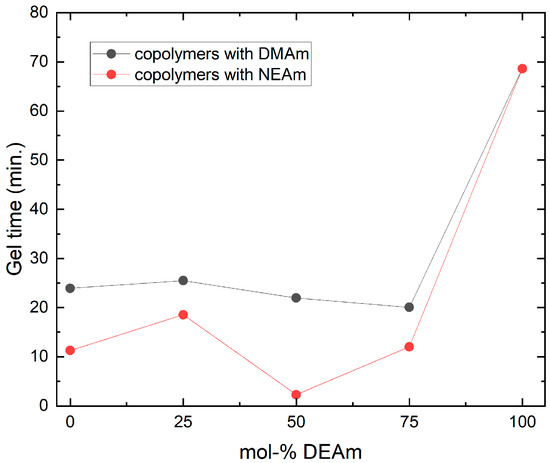
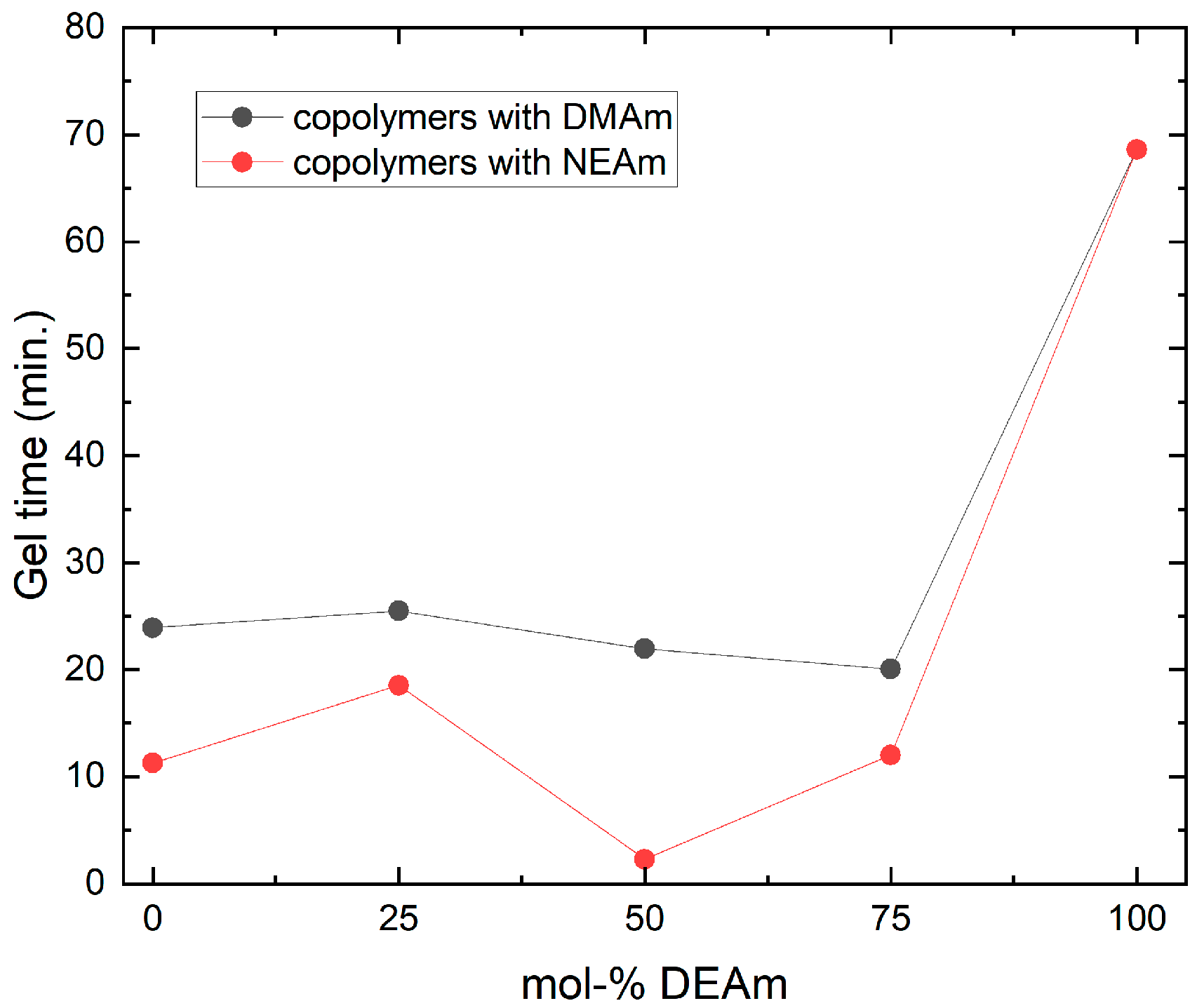
The gel times were then estimated using the crossover point at a frequency of 10 rad·s−1, as described by Tung and Dynes [28]. Figure 3 summarizes the gel times of all hydrogel samples. As can be seen, copolymers with NEAm polymerize relatively faster than those with DMAm. In a way, this is consistent with what was discussed before, in the sense that there is an autoacceleration of the polymerization in copolymers with NEAm because termination reactions are deeply depressed.
Figure 3.
Gel times as a function of the compositions of the hydrogels for both chitosan-g-poly(DEAm-co-DMAm) (black symbols) and chitosan-g-poly(DEAm-co-NEAm) (red symbols) copolymer hydrogels at 20 °C.
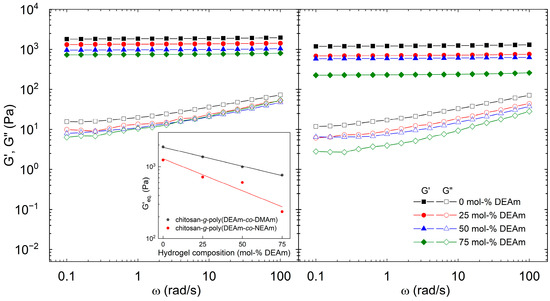
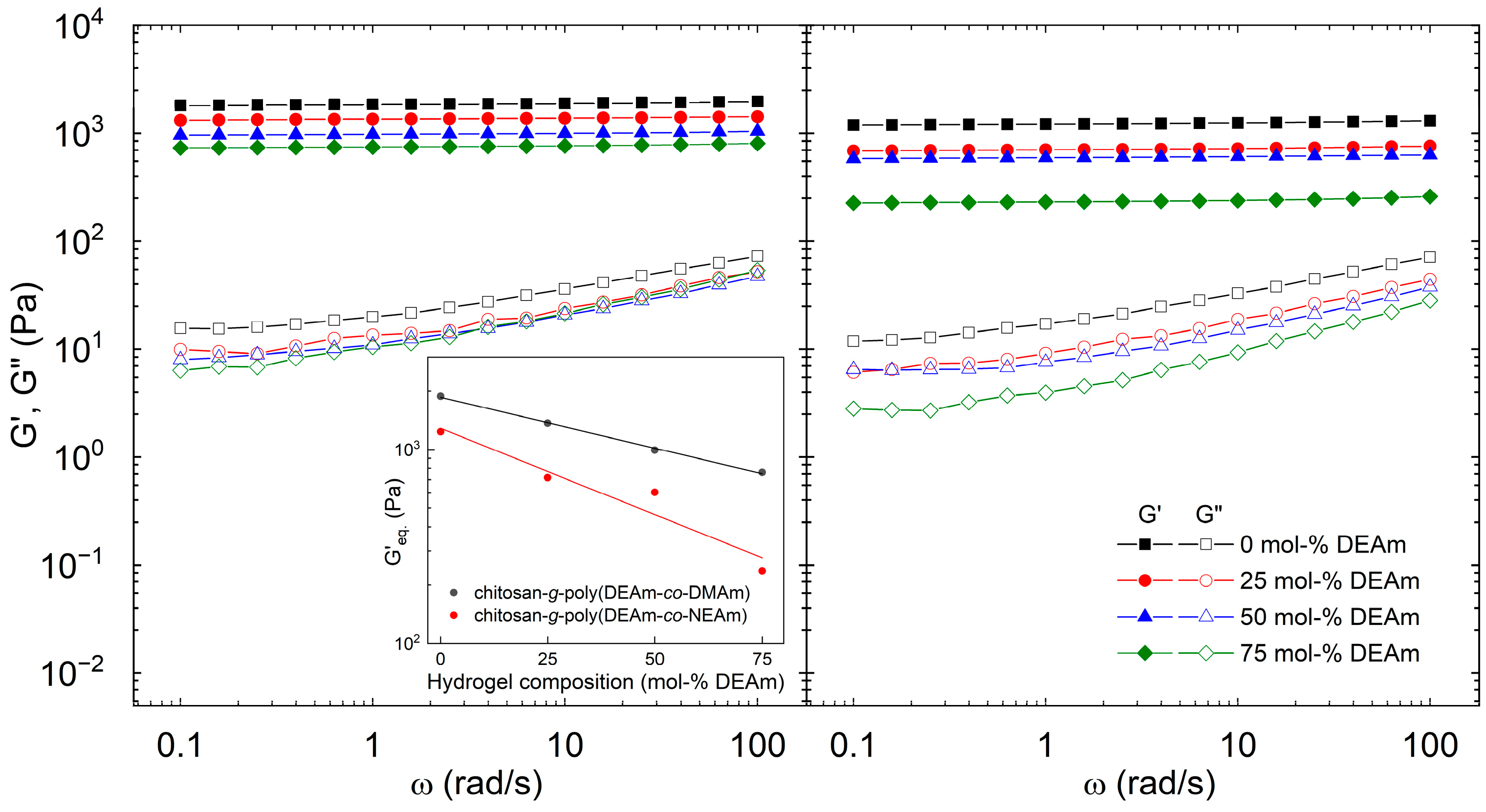
Once the gelation of the different hydrogels was completed, their mechanical spectra were registered, as illustrated in Figure 4. In all cases, the values of the storage modulus were approximately two orders of magnitude larger than those of the loss modulus and independent from the frequency within the limits of the experiment. This behavior confirmed the formation of a strong gel. In general, all materials exhibit similar viscoelastic properties, with a tendency for chitosan-g-poly(DEAm-co-DMAm) hydrogels to be stronger than those of chitosan-g-poly(DEAm-co-NEAm) copolymers.
Figure 4.
Mechanical spectra of both chitosan-g-poly(DEAm-co-DMAm) (left) and chitosan-g-poly(DEAm-co-NEAm) (right) copolymer hydrogels at 20 °C; γ = 2.5%. The dependence of the average storage modulus vs. the composition of the hydrogels is inset inside the graph.
At this point, a couple of physical considerations about the influence of free-radical polymerization on the mechanical and morphological properties of the resulting material are required. Regarding the first point, at higher gelation rates, the mechanical strength of the hydrogel decreases. As already discussed, if crosslinking increases more rapidly, the segmental mobility of the chains decreases and the three-dimensional structure of the hydrogel being formed “freezes”, resulting in lower elastic modulus values. With respect to the latter, it has been demonstrated that gels prepared by free-radical crosslinking typically exhibit a heterogeneous morphology. The crosslinker used has two vinyl groups, so its reactivity is doubled compared to the mono-vinyl monomer. Because of this, crosslinker molecules are added to the growing chains much more quickly than the monomer molecules. Regions of the network formed at the beginning of gelation are more prone to crosslinking than regions formed later [31,32]. From the inset graph (Figure 4), it is evident that for both types of copolymers, there is a clear trend toward a decrease in the storage modulus as the amount of DEAm increases. This highlights how the greater hydrophobicity and reduced ability of DEAm units to form intra- and interchain hydrogen bonds probably affect the mechanical properties of the material.
Since rheological measurements were performed in the region of linear viscoelasticity, the crosslink density, , of the polymer network could be estimated using the basic concepts of Flory’s rubber elasticity theory, according to the following expression:
where G′ is the average storage modulus obtained from mechanical spectra, T is the absolute temperature, and R is the universal gas constant. The crosslink density indicates the amount of crosslinked points per unit volume of hydrogel.
Then, the actual polymer network can be replaced with an equivalent ideal network composed of spheres with diameters that coincide with the average distance between crosslinking points, or the average network mesh size. The average network mesh size () can be calculated as [33,34]:
where NA is the Avogadro constant. This parameter characterizes the crosslinking process in the formed hydrogel and influences its diffusive properties. The estimated average mesh size values are very similar among both copolymer hydrogel samples and consistent with those reported for other chitosan-based hydrogels [25,35] (Table 1). It should be noted, in particular, that the mesh size increases as the proportion of DEAm units in the copolymer increases; in general, copolymers containing NEAm have larger mesh sizes. These dependencies are very evident in Figure S2. The mesh size of hydrogels is an important parameter because it directly affects the diffusion pattern during controlled release. Drug molecules diffuse quickly when the mesh size exceeds their hydrodynamic radius. However, when the mesh size is smaller, they are released slowly. Tuning the crosslink density allows hydrogels to be engineered for specific controlled-release applications [36,37].
Table 1.
Crosslink density and mesh size values of chitosan-g-poly(DEAm-co-DMAm) and chitosan-g-poly(DEAm-co-NEAm) copolymer hydrogels calculated from Equations (2) and (3).
3.3. Characterization of Chitosan-Based Hydrogels
3.3.1. Infrared Spectroscopy
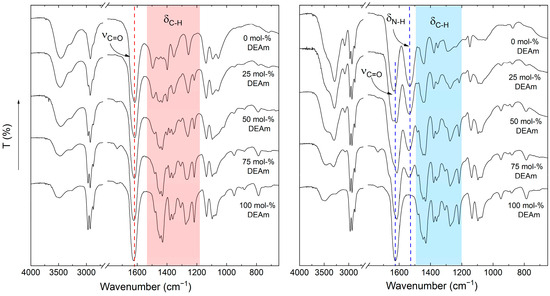
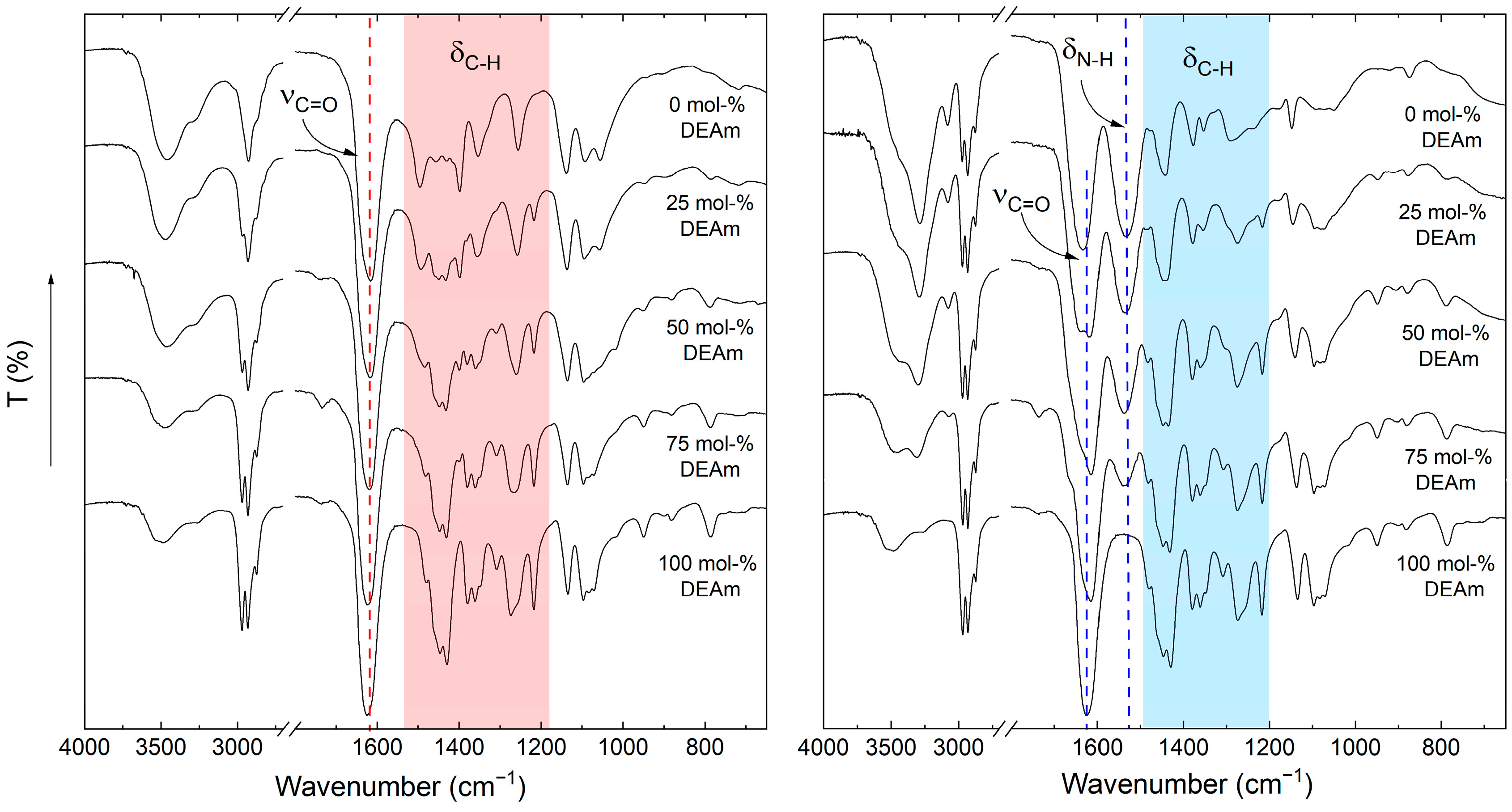
The infrared spectra of chitosan-g-poly(DEAm-co-DMAm) and chitosan-g-poly(DEAm-co-NEAm) copolymers are shown in Figure 5. The presence of the corresponding comonomer components was confirmed: DEAm and DMAm in the first case, and DEAm and NEAm in the other. For hydrogels with DMAm, the amide I band at 1620 cm−1, associated with the vibrations of the carbonyl (C=O) groups, showed no variation. However, in the spectra of hydrogels with NEAm, this band appears split into two components: one at 1639 cm−1 and the other at 1617 cm−1. This has been associated with hydrogen-bonding interactions between the carbonyl groups with residual water molecules and with the N-H groups from spatially neighboring NEAm units, respectively [38,39]. The contribution of chitosan to the strong amide I band found in all hydrogels cannot be ruled out either, as this is one of the main infrared signals of this polysaccharide.
Figure 5.
Infrared spectra of chitosan-g-poly(DEAm-co-DMAm) (left) and chitosan-g-poly(DEAm-co-NEAm) (right) copolymer hydrogels. The composition of the hydrogels is specified inside the graphs.
Some bands exhibited dependence on the copolymer composition, such as those in the 1550–1370 cm−1 range, as well as bands at 1220 cm−1 and 950 cm−1, in the spectra of the hydrogel series with DMAm. The intensity of these bands increased with the DEAm content. For hydrogels containing NEAm, the band at 1537 cm−1, which is associated with vibrations of the NH groups, also became stronger as the amount of NEAm in the hydrogel increased.
Bands observed in the region between 1000 and 1200 cm−1 are the characteristic signals of the glucopyranose rings and their skeletal vibrations, indicating the presence of chitosan in the hydrogels.
Overall, it can be concluded that in all cases, a complex hydrogel is formed in which the polysaccharide chains are chemically crosslinked within a network of acrylamide copolymer chains. The differences in the compositions of both sets of copolymers are evident in the intensity of some of the signals for each of the two hydrogels.
3.3.2. Thermogravimetric Analysis
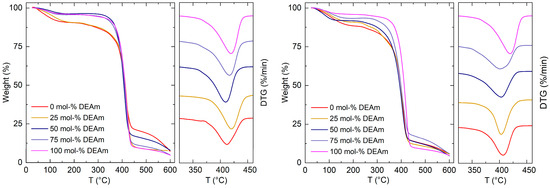
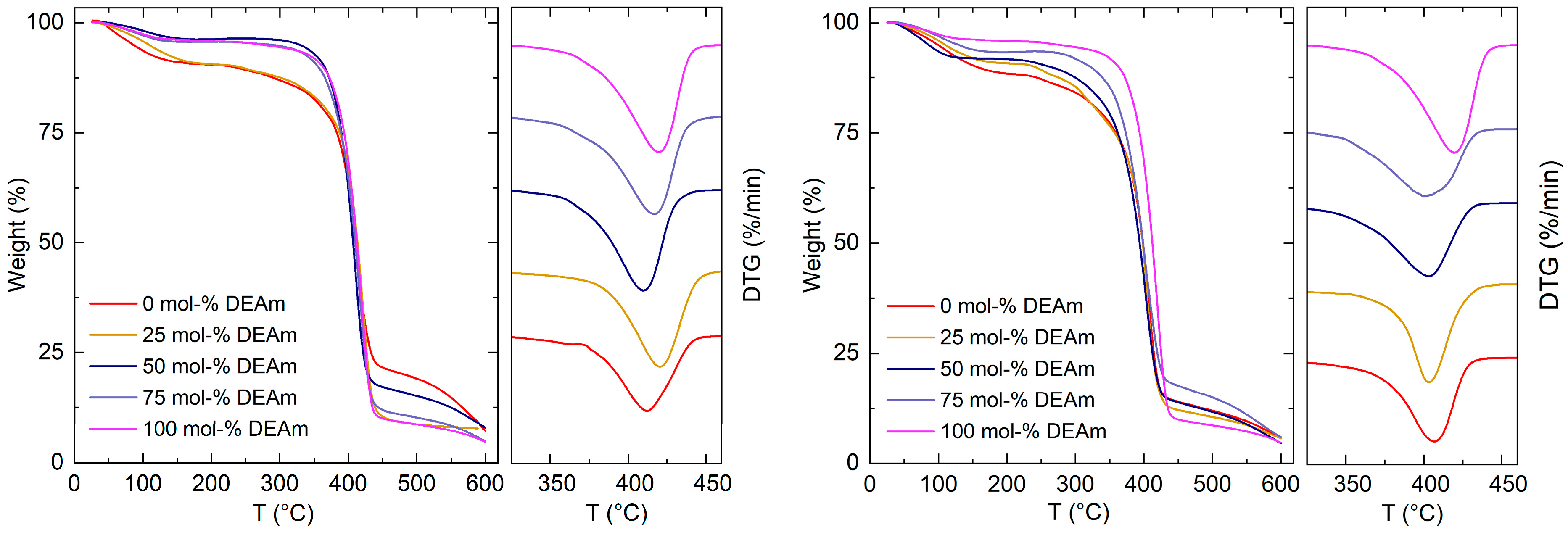
In Figure 6, the TG and DTG curves of both types of copolymer hydrogels are presented. It is interesting to note that the thermogravimetric curves of the three chitosan-g-homopolymers are very similar to each other and therefore also to those of both types of copolymers prepared. For these two series of chitosan-g-copolymers, three steps of thermal degradation can be clearly identified:
Figure 6.
TG and DTG curves of chitosan-g-poly(DEAm-co-DMAm) (left) and chitosan-g-poly(DEAm-co-NEAm) (right) copolymer hydrogels. The compositions of the hydrogels are specified inside the graphs.
- The first step in the interval from 25 to 200 °C is associated with the removal of absorbed water and is related to a weight loss of less than 10% in all samples (Table 2).
- A second stage, from 200/250 to 450 °C, corresponds to the decomposition of the N-alkyl-substituted acrylamide group with weight loss around 80–90% (dry basis, Table 2).
- The third one starts at 450 °C, but it is barely possible to detect the end of this stage within the temperature range used. This process could be attributed to the scission of acrylamide chains, yielding a residual mass (<10%) at 590 °C (dry basis).
Table 2.
Summary of weight losses per decomposition process in hydrogel samples.
First of all, it is striking to mention that none of the stages of thermal degradation of chitosan could be identified, which is most likely due to the fact that it accounts for only about 16% of the total weight of the samples. As noted above, the main stages of thermal degradation for both series of copolymers take place within the same temperature range, regardless of the type of co-grafted acrylamide employed. While there is a considerable amount of information in the literature regarding the thermal degradation mechanism of polyacrylamide, information on the N-alkyl-substituted acrylamides used in our materials is scarce—and no previous studies have been found for NEAm. In general, the main stage of thermal degradation is associated with the decomposition of acrylamide groups, during which the release of ammonia and the formation of cyclic imides between adjacent amide groups in the polymer chain, as well as between groups in different chains, have been observed. At temperatures above 450 °C, the dehydration of isolated amide groups is reported, with the elimination of various low-molecular-weight chemical species and the consequent scission of the polymer chains. Similar processes are expected to occur in N-alkyl-substituted acrylamide polymers, as evidenced by the high weight loss values during combustion processes above 250 °C.
In neither of the two copolymer systems is there a discernible trend in either the variation in the Tm or the weight loss associated with this degradation stage as a function of the copolymer composition. In the case of the DMAm and DEAm homopolymers, it can be observed that the former has a lower Tm than the latter, consistent with the findings reported by Silva et al. [40]. Hybrid hydrogels of N-isopropylacrylamide (NIPAm) with cellulose nanocrystals prepared by free-radical polymerization without a crosslinker exhibit thermal degradation curves very similar to those of these copolymers with chitosan [41].
Under these conditions, it was decided to calculate the apparent activation energies in accordance with the kinetic models proposed by Broido and Friedman [42,43]. These methods allow for a straightforward application of the concepts from the kinetic theory of gases to the thermal decomposition reactions of polymers under non-isothermal conditions. The former model considers a solid substance that undergoes pyrolysis, producing volatile compounds. It is assumed that (i) a major part of the measurable reaction occurs around the temperature of the maximum decomposition rate (Tm ± 10%), (ii) the pyrolysis process follows first-order kinetics (n = 1), (iii) the rate constant (k) has an Arrhenius-type dependence on temperature, and (iv) temperature varies linearly with time. The model equation can be written in the following form [44]:
Here, y is the fraction of molecules not yet decomposed at time, t, with respect to the total one and can be expressed as:
W0, Wt, and W∞ represent the initial, time-dependent, and final weights of the sample, respectively. Ea is the apparent activation energy, R is the ideal gas constant, HR is the heating rate, Z is the frequency factor, and Tm is the temperature of the maximum decomposition rate for the stage. It is noteworthy that the parameters evaluated here are only used for comparison among the main thermal degradation stages of the different hydrogel samples and are not related to any mechanistic point of view.
Equation (4) was applied to the main decomposition stage—from 250 to 450 °C—, where the main thermal degradation of the polyacrylamide chain took place. This yielded the linear plot of ln(ln(1/y)) versus 1/T, as shown in Figure S3, for the chitosan-g-poly(DEAm-co-NEAm) 50 mol-% DEAm hydrogel. The apparent activation energy was calculated from the slope of this plot for all samples.
Friedman’s model has also been developed to evaluate the kinetic parameters of degradation processes using experimental data obtained at a single heating rate. This model is the most used differential isoconversional method to estimate the activation energy of thermal degradation. It was developed on the assumption that the chemistry of thermal degradation is independent of temperature and depends only on the actual weight of the polymeric material at each moment. As in the former model, here, it is also supposed that the rate constant obeys the Arrhenius equation. In this case, the degree of conversion is defined as:
In this case, W0, Wt, and W∞ are the initial, time-dependent, and final weights of the sample and take values from 0 to 1. Given the Arrhenius dependence, the following will be obtained [43]:
After taking the derivative, we get:
and a plot of vs. allows for the straightforward calculation of the activation energy, as illustrated in Figure S4, for the chitosan-g-poly(DEAm-co-NEAm) 50 mol-% DEAm hydrogel.
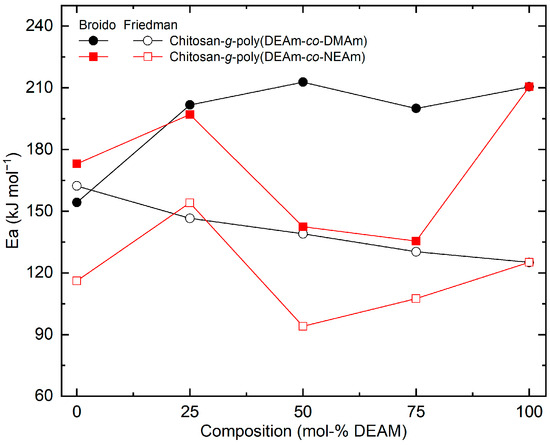
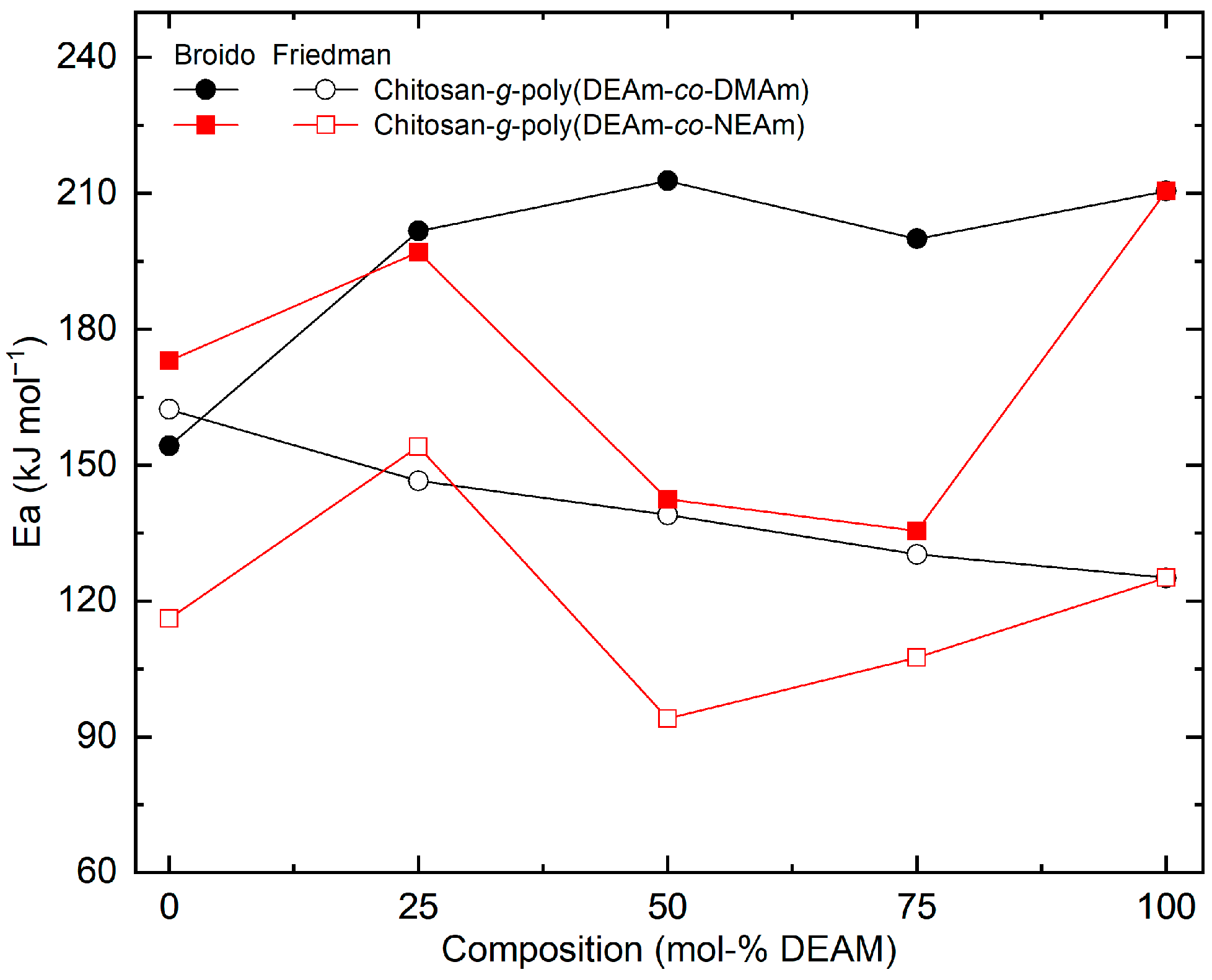
The values of the activation energies estimated by both methods are summarized and plotted against the copolymer compositions in Figure 7. The activation energies range from 90 to 210 kJ/mol, which is consistent with previously reported values for polyacrylamides [45,46,47]. In general, the values estimated by the model of Friedman are overall somewhat lower than those obtained by the model of Broido. NEAm copolymers appear to have slightly lower activation energy values than those containing DMAm. However, no clear trend in how these values vary with composition is observed for either hydrogel. This makes sense because, from the perspective of thermal decomposition, the degradation processes should be very similar for both copolymers—most likely because the chemical structures of all the component units of these copolymers are very much alike. The similarity in the shapes of the thermogravimetric curves supports this explanation.
Figure 7.
Variation in the apparent activation energy with the composition of hydrogels with NEAm and DMAm, estimated by the Broido and Friedman models [42,43].
3.3.3. Morphological Characterization by Scanning Electron Microscopy (SEM)
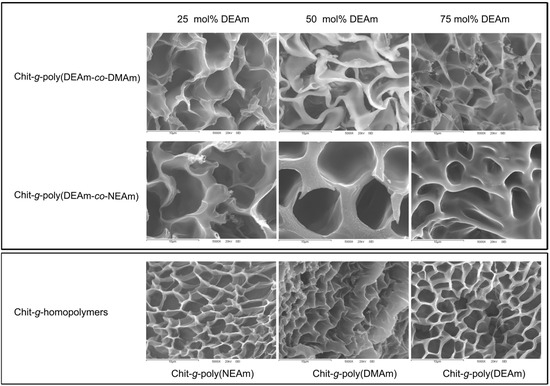
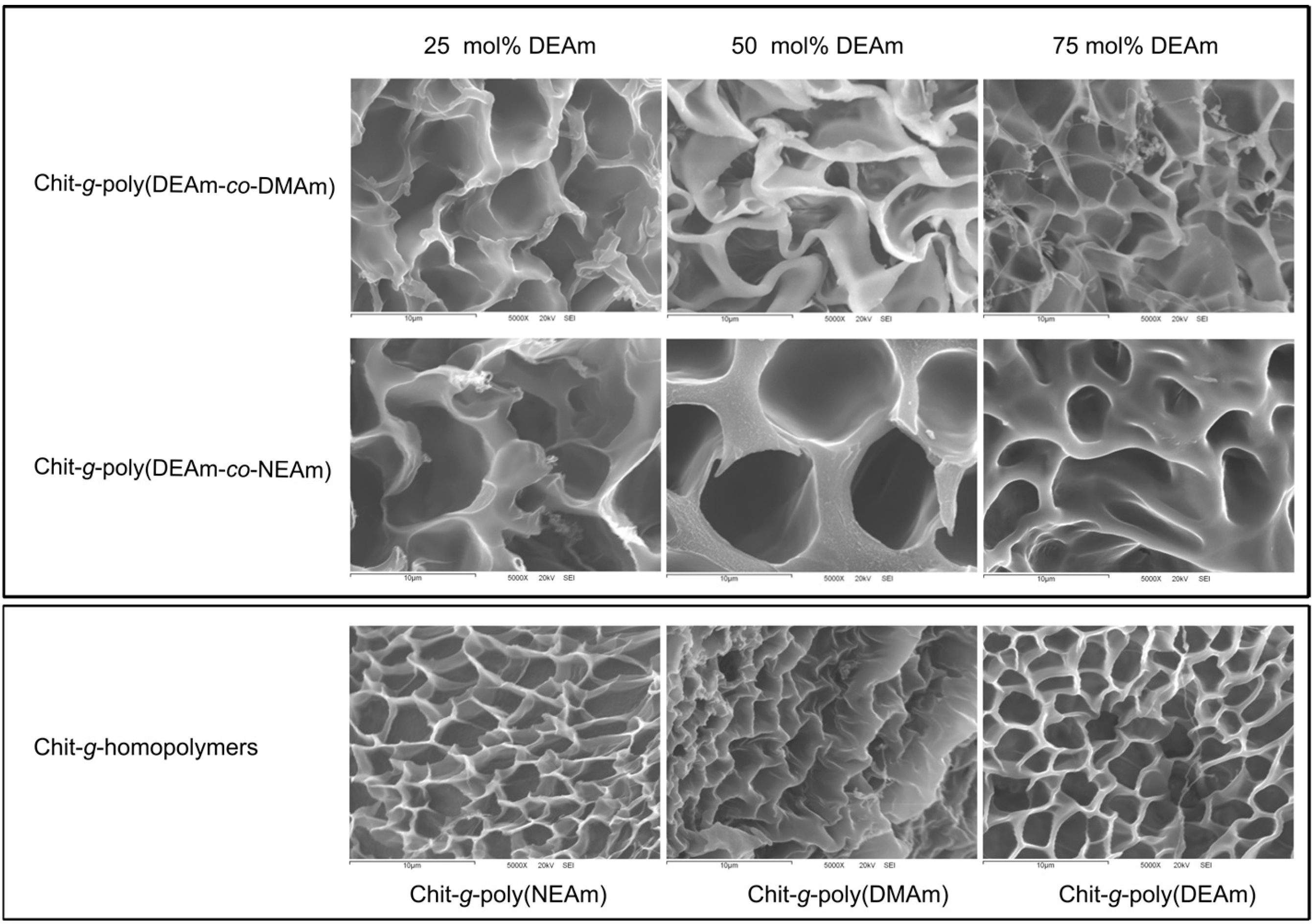
The hydrogels were also characterized by scanning electron microscopy. In all cases, a highly porous microstructure was found, which is expected for this type of material, as shown in Figure 8. Because hydrogels are composed of 90–99% water, sample preparation for conventional SEM requires severe dehydration and freezing procedures, but these procedures inevitably collapse and alter the native pore structure of hydrogels, leading to significant measurement artifacts. For this reason, an in-depth analysis of the microporous structure of the hydrogel does not seem relevant due to the inevitable impact of sample preparation for SEM. Therefore, we will limit ourselves to noting that the porous microstructure of the material seems to be relatively heterogeneous, with a high dispersion in pore sizes. This is consistent with the abovementioned non-homogeneous morphology of gels produced via free-radical polymerization with a crosslinker. Having said that, it is worth noting the correlation observed when comparing these morphological characteristics with the mesh size values obtained from rheological measurements (Table 1 and Figure S2).
Figure 8.
SEM micrographs from hydrogels based on chitosan grafted with poly(DEAm-co-DMAm), poly(DEAm-co-NEAm), and the corresponding homopolymers. Magnification: 5000×.
3.3.4. Swelling of Hydrogels
Swelling measurements are used to determine the capacity of a hydrogel to swell when exposed to a good solvent, in this case water. When a good solvent contacts a dry hydrogel, its molecules penetrate the matrix and diffuse throughout the polymer network, causing it to expand. The solvent diffusion into the hydrogel is driven by its lower chemical potential as compared to the bulk phase. As the polymer network swells, an elastic retractile force from the crosslinked network starts to grow until the equilibrium swelling is reached [48]. The swelling progress can be monitored by simple weight determinations at regular time intervals. The swelling is an important parameter, as it depends on the crosslinking of the membranes and controls the release of solutes from the hydrogel, among others.
The evolution of the diffusion process of the disk-shape hydrogels was modeled using the solution of the Fick equations for the case of sorption in a membrane of thickness 2l [49]. This model considers an initially uniform concentration (C0) of the diffusing substance inside the hydrogel, while the surfaces are at a constant concentration (C1). If D is the diffusion coefficient, the time-dependent swelling measurements can be fitted by the following equation [49,50]:
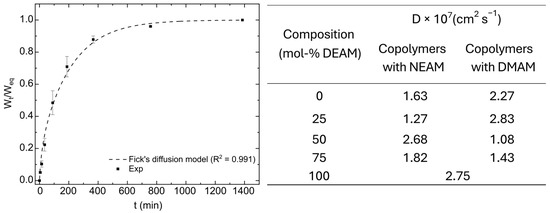
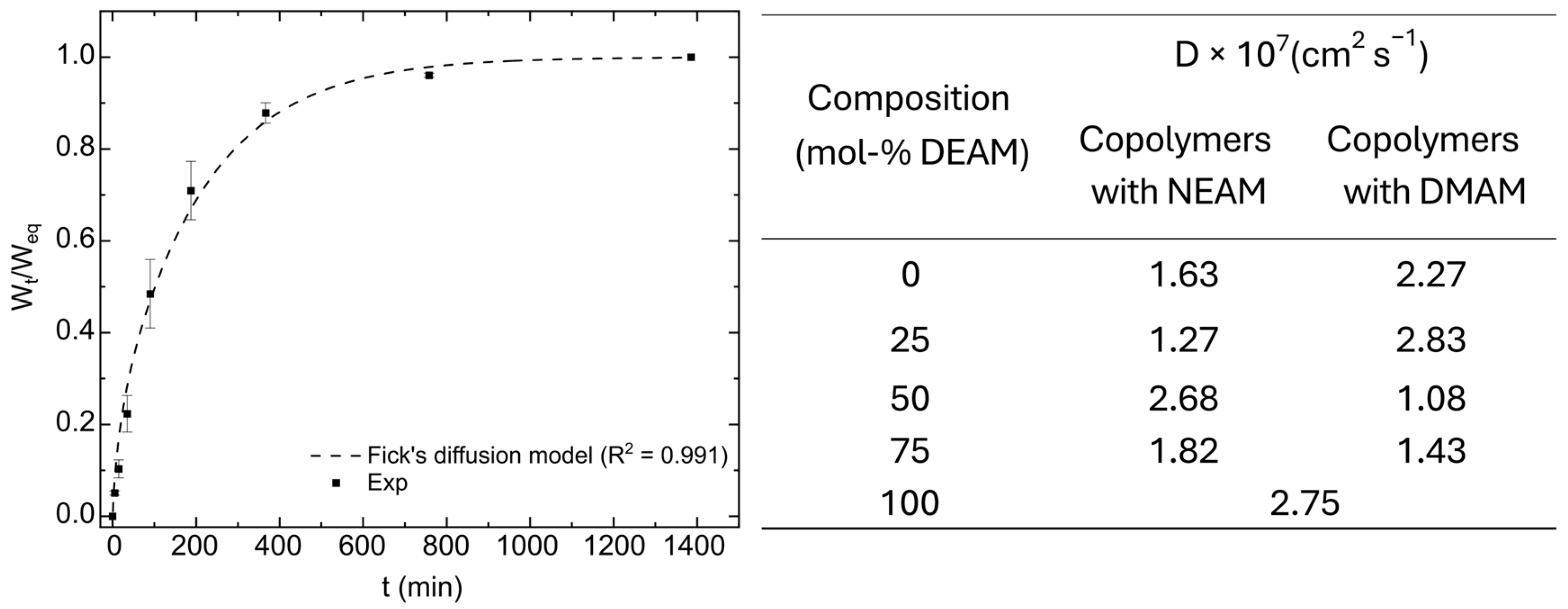
The equation was resolved for the initial 16 terms of the series to fit the swelling data by a non-linear fitting method with the ratio as the parameter to adjust. An example of the obtained curves is shown in Figure 9 (left) for the case of chitosan-g-poly(DEAm-co-NEAm) at composition 25 mol-% DEAm, along with the estimated diffusion coefficients for all studied hydrogels (Figure 9 (right)). As can be seen, all samples present similar values of the diffusion coefficient and are consistent with those reported for other chitosan-based hydrogels [50].
Figure 9.
(Left): Swelling measurements of chitosan-g-poly(DEAm-co-NEAm) at composition 25 mol-% DEAm. The dash line represents the fitted Fickean diffusion model. (Right) Values of the diffusion coefficients, D, estimated for the hydrogel samples from Equation (9).
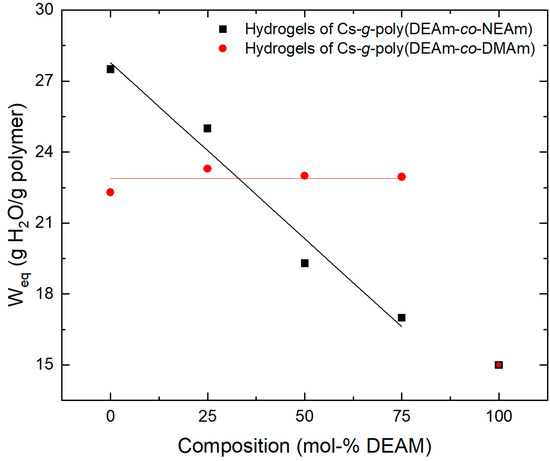
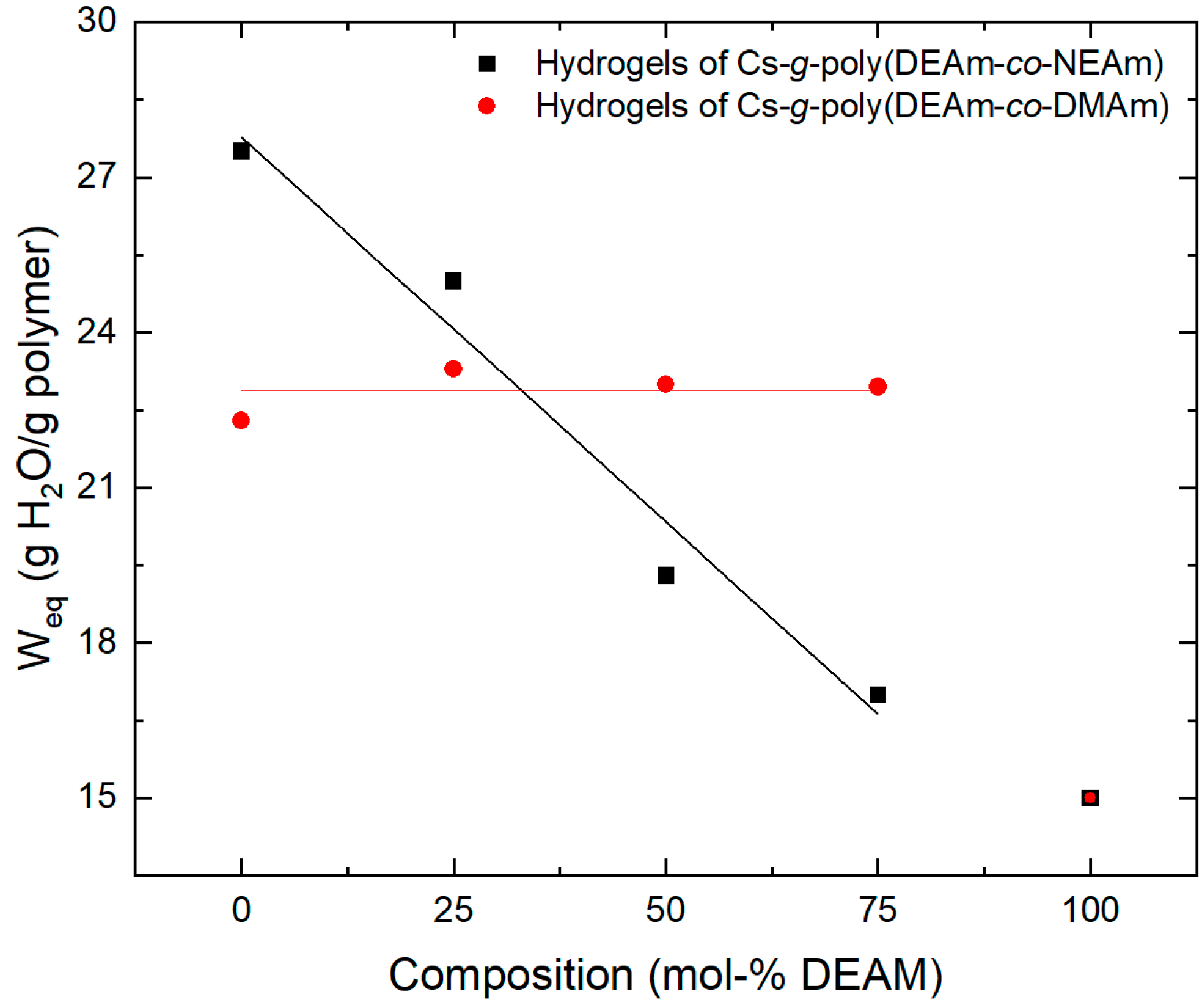
In Figure 10, the effect of the compositions of the copolymers on their equilibrium swelling values in water at 20 °C is presented. For chitosan-g-poly(DEAm-co-NEAm) materials, a clear increase in the equilibrium swelling of the hydrogels with the content of the more hydrophilic NEAm units was found, while in the case of chitosan-g-poly(DEAm-co-DMAm) hydrogels, the swelling equilibrium values remained unaffected by their composition. This difference between the two hydrogels could be explained by the ability of NEAm units to form hydrogen bonding with water involving both the carbonyl groups and –NH groups, instead of only implicating the carbonyl groups for DMAm.
Figure 10.
Effects of the composition on the equilibrium swelling of hydrogels from copolymers with DMAm and NEAm in water at 20 °C.
When comparing these materials to hybrid hydrogels containing cellulose nanocrystals and NIPAm [41], it can be seen that the swelling values of the latter are lower (maximum values near 10 g water/g polymer for hydrogels at 20 °C) than those obtained in this study for other N-alkyl-substituted polyacrylamides. However, alginate hydrogels containing NIPAm and polyethylene glycol exhibit slightly higher water swelling values at 25 °C (between 12 and 14 g water/g polymer) [51]. These results reveal that polysaccharide hydrogels containing NIPAm exhibit roughly similar swelling behavior to that of those prepared in this study.
Furthermore, it should be noted that chitosan-g-poly(DEAm-co-DMAm) copolymers are composed of DMAm units, which are highly hydrophilic, and DEAm units, which exhibit some hydrophobicity. The values of the logarithm of the octanol/water partition coefficient for these two compounds have been estimated to be −0.094 and 0.758, respectively, as calculated using Advanced Chemistry Development (ACD/Labs Software, 1994–2026). Therefore, it should be logical to expect that the equilibrium swelling would increase with the content of hydrophilic DMAm units, but this is not the case.
According to the classic Flory–Huggins theory, the equilibrium swelling is a function of the total change in the Gibbs free energy. For a neutral polymeric gel, this parameter is a balance between its mixing and retractile elastic components [48]:
When analyzing these results from a thermodynamic perspective, it appears that the change in the free energy of mixing is a factor that would decrease the swelling with the DEAm content. However, it should be mentioned that, at temperatures below the LCST (at 20 °C in this case), the hydrophobic groups of the DEAm units are prone to hydrophobic solvation. This process forces water molecules to form rigid, highly ordered cage-like structures (commonly known as icebergs) around the non-polar groups [52,53,54]. This is the main reason why the DEAm units are kept in solution, despite their moderate hydrophobicity. Another important factor to consider is that if the hydrogel is relatively crosslinked, as appears to be the case (see the mesh size values in Table 1), the elastic retractile force will prevent further swelling as the content of hydrophilic units increases. It is the combination of these two effects that results in the observed behavior of the swelling of the chitosan-g-poly(DEAm-co-DMAm) hydrogels not varying with composition.
In this study, it was possible to demonstrate how the unique properties of chitosan and N-alkyl-substituted polyacrylamide copolymers can be combined to create unique, smart hydrogels. Chitosan contributes its biocompatibility, pH responsiveness and excellent mechanical properties, while N-alkyl-substituted polyacrylamides add their well-known thermosensitivity to form gels capable of responding to both pH and temperature. These hydrogels are strategically important for designing thermosensitive materials with unique properties and remarkable applications in challenging fields such as biotechnology, pharmacy, and biomedicine.
4. Conclusions
This study analysed how the properties of chitosan-g-poly(N,N-diethylacrylamide-co-N,N-dimethylacrylamide) and chitosan-g-poly(N,N-diethylacrylamide-co-N-ethylacrylamide) copolymers are affected by their composition. Hydrogels with different comonomer compositions and their corresponding homopolymers were synthesized through radical polymerization, using N,N-methylenbisacrylamide as a crosslinker.
The gelation process was monitored by rheological measurements. The traces of viscoelastic moduli during gelation show the typical pattern of chemical gelation. The formation of a strong gel was assessed by mechanical spectra with high values of the storage modulus, which are frequency-independent. A reaction autoacceleration was detected, which is interpreted by the high viscosity of the reaction mixture due to the presence of chitosan, which limits the reptation of radical macromolecular species. Moreover, in the case of NEAm copolymerization, the inhibition of the chain reptation is significantly greater, due to the hydrogen bonding between the hydroxyl groups of chitosan and the nitrogen of NEAm, with an available electron pair. Therefore, for this copolymer, there is a “double” hindrance to the mobility of NEAm species, with a larger effect on the growing radical species. This implies that the terminal relaxation times of the polymer chains are remarkably high so that diffusion is severely hindered, slowing down termination, as compared with DMAm copolymers.
Thermogravimetric analysis of the hydrogels showed the typical decomposition stages of polyacrylamides. Neither the temperature of the maximum decomposition rate nor the weight loss associated displayed a clear trend with the copolymer composition. There was also an increment in the equilibrium swelling values with the content of NEAm units, but the copolymers with DMAm remained unaffected.
In summary, this comparative study of these two types of copolymers highlights the key role played by hydrogen bond interactions. These interactions influence the gelation process, the morphology and the swelling behavior of the hydrogels. This can only be explained by the greater ability of NEAm units to form hydrogen bonds compared to DMAm. In a forthcoming article, we will examine how this specific role of NEAm units in the formation of intra- and interchain hydrogen bonds also affects the phase transition characteristics of these hydrogels.
Supplementary Materials
The following supporting information can be downloaded at: https://www.mdpi.com/article/10.3390/polysaccharides7030088/s1, Scheme S1: Structure and composition of the chitosan-g-poly(DEAm-co-DMAm) and chitosan-g-poly(DEAm-co-NEAm) hydrogels; Figure S1: Strain sweep experiments performed on chitosan-g-poly(DEAm), chitosan-g-poly(DMAm) and chitosan-g-poly(DEAm-co-DMAm), 50 mol-% DEAm hydrogels. ω = 1.0 rad·s−1. G′, closed symbols, and G″, open symbols; Figure S2: Variation of the mesh size (as shown in Table 2) with the composition of the chitosan-g-poly(DEAm-co-DMAm), chitosan-g-poly(DEAm-co-NEAm) copolymers; Figure S3: Plot from Broido’s method applied to TG data for chitosan-g-poly(DEAm-co-NEAm), 50 mol-% DEAm, hydrogel. The temperature of maximum decomposition rate is marked with a dashed line; Figure S4: Plots at different conversion values calculated by the method of Friedman applied to TG data for chitosan-g-poly(DEAm-co-NEAm), 50 mol-% DEAm, hydrogel. The plots are shown with vertical offset to show the lines for different values of conversion as shown in the legend.
Author Contributions
Conceptualization, W.M.A.-M.; methodology, J.J.C.-H.; validation W.M.A.-M., J.L.-M. and C.P.-C.; formal analysis, W.M.A.-M.; investigation, J.J.C.-H. and L.S.-G.; data curation, J.J.C.-H.; writing—original draft preparation, J.J.C.-H. and W.M.A.-M.; writing—review and editing, J.J.C.-H., W.M.A.-M., C.P.-C. and J.L.-M.; visualization, J.J.C.-H. and W.M.A.-M.; supervision, W.M.A.-M. All authors have read and agreed to the published version of the manuscript.
Funding
This research received no external funding.
Institutional Review Board Statement
Not applicable.
Data Availability Statement
The original contributions presented in this study are included in the article/Supplementary Materials. Further inquiries can be directed to the corresponding author.
Acknowledgments
J.J.C.-H. acknowledges SECIHTI for his Ph.D. scholarship (998483). The authors are particularly indebted to M.R. Aguilar de Armas for her critical review of this paper, as well as for her insights and comments, which were invaluable in the preparation of this work. The authors are also especially grateful to Teresa del Castillo and Irela Santos-Sauceda from the Department of Polymers and Materials, University of Sonora, for providing the thermogravimetric analysis.
Conflicts of Interest
The authors declare no competing interests.
References
- Almdal, K.; Dyre, J.; Hvidt, S.; Kramer, O. Towards a Phenomenological Definition of the Term ‘Gel’. Polym. Gels Netw. 1993, 1, 5–17. [Google Scholar] [CrossRef] [Scilit]
- Flory, P.J. Introductory Lecture. Faraday Discuss. Chem. Soc. 1974, 57, 7–18. [Google Scholar] [CrossRef] [Scilit]
- Argüelles-Monal, W.M.; Lizardi-Mendoza, J.; Fernández-Quiroz, D.; Recillas-Mota, M.T.; Montiel-Herrera, M. Chitosan Derivatives: Introducing New Functionalities with a Controlled Molecular Architecture for Innovative Materials. Polymers 2018, 10, 342. [Google Scholar] [CrossRef] [Scilit] [PubMed]
- Manzoor, A.; Dar, A.H.; Pandey, V.K.; Shams, R.; Khan, S.; Panesar, P.S.; Kennedy, J.F.; Fayaz, U.; Khan, S.A. Recent Insights into Polysaccharide-Based Hydrogels and Their Potential Applications in Food Sector: A Review. Int. J. Biol. Macromol. 2022, 213, 987–1006. [Google Scholar] [CrossRef] [Scilit] [PubMed]
- Krasnopeeva, E.L.; Panova, G.G.; Yakimansky, A.V. Agricultural Applications of Superabsorbent Polymer Hydrogels. Int. J. Mol. Sci. 2022, 23, 15134. [Google Scholar] [CrossRef] [Scilit] [PubMed]
- Eivazzadeh-Keihan, R.; Noruzi, E.B.; Mehrban, S.F.; Aliabadi, H.A.M.; Karimi, M.; Mohammadi, A.; Maleki, A.; Mahdavi, M.; Larijani, B.; Shalan, A.E. Review: The Latest Advances in Biomedical Applications of Chitosan Hydrogel as a Powerful Natural Structure with Eye-Catching Biological Properties. J. Mater. Sci. 2022, 57, 3855–3891. [Google Scholar] [CrossRef] [Scilit]
- Segneanu, A.-E.; Bejenaru, L.E.; Bejenaru, C.; Blendea, A.; Mogoşanu, G.D.; Biţă, A.; Boia, E.R. Advancements in Hydrogels: A Comprehensive Review of Natural and Synthetic Innovations for Biomedical Applications. Polymers 2025, 17, 2026. [Google Scholar] [CrossRef] [Scilit] [PubMed]
- Hoang, H.T.; Jo, S.-H.; Phan, Q.-T.; Park, H.; Park, S.-H.; Oh, C.-W.; Lim, K.T. Dual pH-/Thermo-Responsive Chitosan-Based Hydrogels Prepared Using “Click” Chemistry for Colon-Targeted Drug Delivery Applications. Carbohydr. Polym. 2021, 260, 117812. [Google Scholar] [CrossRef] [Scilit] [PubMed]
- Argüelles-Monal, W.; Recillas-Mota, M.; Fernández-Quiroz, D. Chitosan-Based Thermosensitive Materials. In Biological Activities and Application of Marine Polysaccharides; Shalaby, E.A., Ed.; InTech: London, UK, 2017; pp. 279–302. [Google Scholar]
- Dattilo, M.; Patitucci, F.; Prete, S.; Parisi, O.I.; Puoci, F. Polysaccharide-Based Hydrogels and Their Application as Drug Delivery Systems in Cancer Treatment: A Review. J. Funct. Biomater. 2023, 14, 55. [Google Scholar] [CrossRef] [Scilit] [PubMed]
- Zamboulis, A.; Michailidou, G.; Koumentakou, I.; Bikiaris, D.N. Polysaccharide 3D Printing for Drug Delivery Applications. Pharmaceutics 2022, 14, 145. [Google Scholar] [CrossRef] [Scilit] [PubMed]
- Lin, Q.; Hu, Y.; Qiu, C.; Li, X.; Sang, S.; McClements, D.J.; Chen, L.; Long, J.; Xu, X.; Wang, J.; et al. Peanut Protein-Polysaccharide Hydrogels Based on Semi-Interpenetrating Networks Used for 3D/4D Printing. Food Hydrocoll. 2023, 137, 108332. [Google Scholar] [CrossRef] [Scilit]
- Wei, L.; Wang, X.; Fu, J.; Yin, J.; Hu, J. A Physically Cross-Linked Double Network Polysaccharides/Ca2+ Hydrogel Scaffold for Skeletal Muscle Tissue Engineering. Colloids Surf. A Physicochem. Eng. Asp. 2023, 668, 131410. [Google Scholar] [CrossRef] [Scilit]
- Aldakheel, F.M.; Mohsen, D.; El Sayed, M.M.; Alawam, K.A.; Binshaya, A.S.; Alduraywish, S.A. Silver Nanoparticles Loaded on Chitosan-g-PVA Hydrogel for the Wound-Healing Applications. Molecules 2023, 28, 3241. [Google Scholar] [CrossRef] [Scilit] [PubMed]
- Ragab, A.; El-Badry, N.; Tamer, N.; Naas, A.; Hamdy, A.; Tawakey, S.H.; Hassan, A.H.A.; Salim, A.I. Biodegradable Chitosan/PVA-Based Hydrogel Incorporating Green Synthesized Silver Nanoparticles for Wound Healing Applications. BMC Chem. 2025, 19, 190. [Google Scholar] [CrossRef] [Scilit] [PubMed]
- Coca-Hidalgo, J.J.; Recillas-Mota, M.; Fernández-Quiroz, D.; Lizardi-Mendoza, J.; Peniche-Covas, C.; Goycoolea, F.M.; Argüelles-Monal, W.M. Study of the Thermal Phase Transition of Poly(N,N-Diethylacrylamide-Co-N-Ethylacrylamide) Random Copolymers in Aqueous Solution. Polymers 2024, 16, 1575. [Google Scholar] [CrossRef] [Scilit] [PubMed]
- Liu, H.Y.; Zhu, X.X. Lower Critical Solution Temperatures of N-Substituted Acrylamide Copolymers in Aqueous Solutions. Polymer 1999, 40, 6985–6990. [Google Scholar] [CrossRef] [Scilit]
- Platé, N.A.; Lebedeva, T.L.; Valuev, L.I. Lower Critical Solution Temperature in Aqueous Solutions of N-Alkyl-Substituted Polyacrylamides. Polym. J. 1999, 31, 21–27. [Google Scholar] [CrossRef] [Scilit]
- Shinoda, K. “Iceberg” Formation and Solubility. J. Phys. Chem. 1977, 81, 1300–1302. [Google Scholar] [CrossRef] [Scilit]
- Rinaudo, M.; Milas, M.; Dung, P.L. Characterization of Chitosan. Influence of Ionic Strength and Degree of Acetylation on Chain Expansion. Int. J. Biol. Macromol. 1993, 15, 281–285. [Google Scholar] [CrossRef] [Scilit] [PubMed]
- Bocourt-Povea, M.; Argüelles-Monal, W.; Cauich-Rodríguez, J.V.; Pat, A.M.; Rivero, N.B.; Peniche-Covas, C. Interpenetrated Chitosan-Poly(Acrylic Acid-Co-Acrylamide) Hydrogels. Synthesis, Characterization and Sustained Protein Release Studies. Mater. Sci. Appl. 2011, 2, 509–520. [Google Scholar] [CrossRef]
- Jenkins, D.W.; Hudson, S.M. Review of Vinyl Graft Copolymerization Featuring Recent Advances toward Controlled Radical-Based Reactions and Illustrated with Chitin/Chitosan Trunk Polymers. Chem. Rev. 2001, 101, 3245–3274. [Google Scholar] [CrossRef] [Scilit] [PubMed]
- Borisov, I.M.; Luksha, R.S.; Rashidova, S.T. Kinetic Features of Ammonium Persulfate Decomposition in Aqueous Medium. Russ. Chem. Bull. 2015, 64, 2512–2513. [Google Scholar] [CrossRef] [Scilit]
- Niţă, L.E.; Chiriac, A.P.; Bercea, M.; Neamţu, I. In Situ Monitoring the Sol–Gel Transition for Polyacrylamide Gel. Rheol. Acta 2007, 46, 595–600. [Google Scholar] [CrossRef] [Scilit]
- Ruiz-Pardo, C.; Silva-Gutiérrez, L.; Lizardi-Mendoza, J.; López-Franco, Y.; Peniche-Covas, C.; Argüelles-Monal, W. Chitosan Hydrogels Based on the Diels–Alder Click Reaction: Rheological and Kinetic Study. Polymers 2022, 14, 1202. [Google Scholar] [CrossRef] [Scilit] [PubMed]
- Macosko, C.W. Rheology: Principles, Measurements, and Applications; Wiley-VCH, Inc.: New York, NY, USA, 1994. [Google Scholar]
- Winter, H.H.; Chambon, F. Analysis of Linear Viscoelasticity of a Crosslinking Polymer at the Gel Point. J. Rheol. 1986, 30, 367–382. [Google Scholar] [CrossRef] [Scilit]
- Tung, C.-Y.M.; Dynes, P.J. Relationship between Viscoelastic Properties and Gelation in Thermosetting Systems. J. Appl. Polym. Sci. 1982, 27, 569–574. [Google Scholar] [CrossRef] [Scilit]
- Félix, L.; Hernández, J.; Argüelles-Monal, W.M.; Goycoolea, F.M. Kinetics of Gelation and Thermal Sensitivity of N-Isobutyryl Chitosan Hydrogels. Biomacromolecules 2005, 6, 2408–2415. [Google Scholar] [CrossRef] [Scilit] [PubMed]
- Liao, W.; Zhang, Y.; Guan, Y.; Zhu, X.X. Gelation Kinetics of Thermosensitive PNIPAM Microgel Dispersions. Macromol. Chem. Phys. 2011, 212, 2052–2060. [Google Scholar] [CrossRef] [Scilit]
- Okay, O. Macroporous Copolymer Networks. Prog. Polym. Sci. 2000, 25, 711–779. [Google Scholar] [CrossRef] [Scilit]
- Funke, W.; Okay, O.; Joos-Müller, B. Microgels-Intramolecularly Crosslinked Macromolecules with a Globular Structure. In Microencapsulation Microgels Iniferters; DiMari, S., Funke, W., Haralson, M.A., Hunkeler, D., Joos-Müller, B., Matsumoto, A., Okay, O., Otsu, T., Powers, A.C., Prokop, A., et al., Eds.; Advances in Polymer Science; Springer: Berlin/Heidelberg, Germany, 1998; pp. 139–234. [Google Scholar]
- Pescosolido, L.; Feruglio, L.; Farra, R.; Fiorentino, S.; Colombo, I.; Coviello, T.; Matricardi, P.; Hennink, W.E.; Vermonden, T.; Grassi, M. Mesh Size Distribution Determination of Interpenetrating Polymer Network Hydrogels. Soft Matter 2012, 8, 7708–7715. [Google Scholar] [CrossRef] [Scilit]
- Schurz, J. Rheology of Polymer Solutions of the Network Type. Prog. Polym. Sci. 1991, 16, 1–53. [Google Scholar] [CrossRef] [Scilit]
- Montiel-Herrera, M.; Gandini, A.; Goycoolea, F.M.; Jacobsen, N.E.; Lizardi-Mendoza, J.; Recillas-Mota, M.; Argüelles-Monal, W.M. N-(Furfural) Chitosan Hydrogels Based on Diels–Alder Cycloadditions and Application as Microspheres for Controlled Drug Release. Carbohydr. Polym. 2015, 128, 220–227. [Google Scholar] [CrossRef] [Scilit] [PubMed]
- Moncure, P.J.; Simon, Z.C.; Millstone, J.E.; Laaser, J.E. Relationship between Gel Mesh and Particle Size in Determining Nanoparticle Diffusion in Hydrogel Nanocomposites. J. Phys. Chem. B 2022, 126, 4132–4142. [Google Scholar] [CrossRef] [Scilit] [PubMed]
- Li, J.; Mooney, D.J. Designing Hydrogels for Controlled Drug Delivery. Nat. Rev. Mater. 2016, 1, 16071. [Google Scholar] [CrossRef] [Scilit] [PubMed]
- Maeda, Y.; Nakamura, T.; Ikeda, I. Changes in the Hydration States of Poly(N-Alkylacrylamide)s during Their Phase Transitions in Water Observed by FTIR Spectroscopy. Macromolecules 2001, 34, 1391–1399. [Google Scholar] [CrossRef] [Scilit]
- Hashimoto, C.; Nagamoto, A.; Maruyama, T.; Kariyama, N.; Irisa, Y.; Ikehata, A.; Ozaki, Y. Hydration States of Poly(N-Isopropylacrylamide) and Poly(N,N-Diethylacrylamide) and Their Monomer Units in Aqueous Solutions with Lower Critical Solution Temperatures Studied by Infrared Spectroscopy. Macromolecules 2013, 46, 1041–1053. [Google Scholar] [CrossRef] [Scilit]
- Silva, M.E.S.R.e.; Dutra, E.R.; Mano, V.; Machado, J.C. Preparation and Thermal Study of Polymers Derived from Acrylamide. Polym. Degrad. Stab. 2000, 67, 491–495. [Google Scholar] [CrossRef] [Scilit]
- Zubik, K.; Singhsa, P.; Wang, Y.; Manuspiya, H.; Narain, R. Thermo-Responsive Poly(N-Isopropylacrylamide)-Cellulose Nanocrystals Hybrid Hydrogels for Wound Dressing. Polymers 2017, 9, 119. [Google Scholar] [CrossRef] [Scilit] [PubMed]
- Broido, A. A Simple, Sensitive Graphical Method of Treating Thermogravimetric Analysis Data. J. Polym. Sci. Part A-2 Polym. Phys. 1969, 7, 1761–1773. [Google Scholar] [CrossRef] [Scilit]
- Friedman, H.L. Kinetics of Thermal Degradation of Char-Forming Plastics from Thermogravimetry. Application to a Phenolic Plastic. J. Polym. Sci. Part C Polym. Symp. 1964, 6, 183–195. [Google Scholar] [CrossRef] [Scilit]
- Peniche-Covas, C.; Argüelles-Monal, W.; San Román, J. A Kinetic Study of the Thermal Degradation of Chitosan and a Mercaptan Derivative of Chitosan. Polym. Degrad. Stab. 1993, 39, 21–28. [Google Scholar] [CrossRef] [Scilit]
- Bauri, K.; Roy, S.G.; Arora, S.; Dey, R.K.; Goswami, A.; Madras, G.; De, P. Thermal Degradation Kinetics of Thermoresponsive Poly(N-Isopropylacrylamide-Co-N,N-Dimethylacrylamide) Copolymers Prepared via RAFT Polymerization. J. Therm. Anal. Calorim. 2013, 111, 753–761. [Google Scholar] [CrossRef] [Scilit]
- Vîlcu, R.; Irinei, F.; Ionescu-Bujor, J.; Olteanu, M.; Demetrescu, I. Kinetic Parameters Obtained from TG and DTG Curves of Acrylamide-Maleic Anhydride Copolymers. J. Therm. Anal. 1985, 30, 495–502. [Google Scholar] [CrossRef] [Scilit]
- Yang, M.-H. The Two-Stages Thermal Degradation of Polyacrylamide. Polym. Test. 1998, 17, 191–198. [Google Scholar] [CrossRef] [Scilit]
- Flory, P.J. Principles of Polymer Chemistry, 1st ed.; Cornell University Press: Ithaca, NY, USA, 1953. [Google Scholar]
- Crank, J. The Mathematics of Diffusion, 2nd ed.; Oxford University Press: Ithaca, NY, USA, 1975. [Google Scholar]
- Cárdenas, A.; Argüelles-Monal, W.; Goycoolea, F.M.; Higuera-Ciapara, I.; Peniche, C. Diffusion Through Membranes of the Polyelectrolyte Complex of Chitosan and Alginate. Macromol. Biosci. 2003, 3, 535–539. [Google Scholar] [CrossRef] [Scilit]
- Zhao, S.; Cao, M.; Li, H.; Li, L.; Xu, W. Synthesis and Characterization of Thermo-Sensitive Semi-IPN Hydrogels Based on Poly(Ethylene Glycol)-Co-Poly(ε-Caprolactone) Macromer, N-Isopropylacrylamide, and Sodium Alginate. Carbohydr. Res. 2010, 345, 425–431. [Google Scholar] [CrossRef] [Scilit] [PubMed]
- Frank, H.S.; Evans, M.W. Free Volume and Entropy in Condensed Systems III. Entropy in Binary Liquid Mixtures; Partial Molal Entropy in Dilute Solutions; Structure and Thermodynamics in Aqueous Electrolytes. J. Chem. Phys. 1945, 13, 507–532. [Google Scholar] [CrossRef] [Scilit]
- Shinoda, K.; Fujihira, M. The Analysis of the Solubility of Hydrocarbons in Water. Bull. Chem. Soc. Jpn. 1968, 41, 2612–2615. [Google Scholar] [CrossRef] [Scilit]
- Costas, M.; Patterson, D. Heat Capacities of Water + Organic-Solvent Mixtures. J. Chem. Soc. Faraday Trans. 1 1985, 81, 2381–2398. [Google Scholar] [CrossRef] [Scilit]

Disclaimer/Publisher’s Note: The statements, opinions and data contained in all publications are solely those of the individual author(s) and contributor(s) and not of MDPI and/or the editor(s). MDPI and/or the editor(s) disclaim responsibility for any injury to people or property resulting from any ideas, methods, instructions or products referred to in the content. |
© 2026 by the authors. Licensee MDPI, Basel, Switzerland. This article is an open access article distributed under the terms and conditions of the Creative Commons Attribution (CC BY) license.