1. Introduction
Polysaccharides are natural polymers that are highly attractive for modern, environmentally oriented materials science [
1]. The use of polysaccharides in the development of new functional polymer-based materials in recent years has resulted in an exciting growth in high-ranking publications and international patents, directly demonstrating the importance and relevance of the field [
2,
3,
4]. Chitosan is a natural, non-toxic polysaccharide. It is a copolymer of D-glucosamine and N-acetyl-D-glucosamine. The mole fraction of D-glucosamine units in chitosan depends on the degree of deacetylation (DD) and typically ranges from approximately 60 to 90% [
5]. Chitosan is a partially deacetylated derivative of chitin and is a renewable, biocompatible, biodegradable, and environmentally friendly polysaccharide, which makes it attractive for environmentally oriented materials science.
Layered double hydroxides (LDHs) are a broad class of inorganic compounds consisting of layers of di- and trivalent metal cations (M
2+ and M
3+) linked by bridging hydroxide ligands. The interlayer space of the LDHs is filled with water molecules and anions (A
n−). This results in the general formula of layered double hydroxides [M
2+1−xM
3+x(OH)
2]
x+(A
n−)
x/n × yH
2O. Layered double hydroxides (LDHs) are also known as anionic clays. LDHs possess a rich intercalation chemistry which determines their anion-exchange properties. A significant advantage of LDHs is their ease and low cost of production [
6]. LDHs also are attractive as catalysts [
7,
8], especially for those reactions that are not feasible without a metal center [
9,
10]. LDHs have also been employed as carriers not only for conventional drug molecules [
11], but also for more unconventional guest systems, including water-soluble fullerene derivatives [
12], the most prominent example being fullerenol [
13], as well as diverse heterocyclic compounds [
14,
15,
16], many of which are capable of forming strong intermolecular interactions [
17].
Both chitosan and LDH are materials with attractive sorption properties. In particular, chitosan and its numerous derivatives have shown high sorption capacity for heavy metal ions [
18,
19,
20], cationic and anionic organic dyes [
21,
22], pesticides [
23], and a number of other environmentally hazardous pollutants [
24]. LDHs are also known as effective sorbents mainly for anionic compounds [
25], but are also capable of sorbing cationic compounds, such as uranyl ion [
26], selenium oxo-anions [
27], parabens [
28], 2,4-dichlorophenol [
29], dyes [
30], and many other environmentally hazardous pollutants. Not surprisingly, in recent years, several composite sorbents have been obtained in which LDHs act as a filler distributed in a chitosan polymer matrix [
27,
28,
31,
32,
33]. More recent studies from 2022–2025 further confirm the rapid development of chitosan–LDH composite sorbents. Examples include CoAl-LDH@chitosan/Fe
3O
4 for Pb(II) and Cr(VI) adsorption [
32], Mg–Al LDH/chitosan and M
2+/Al LDH–chitosan composites for anionic dye adsorption [
30,
34], chitosan–LDH composites prepared on chitosan microspheres and LDH/chitosan composites for anionic dye removal [
31,
35], and LDH encapsulated with chitosan hydrogel-type sorbents [
36,
37]. Recent LDH-based systems for Cr(VI) adsorption also confirm the continuing relevance of LDH-containing materials for hexavalent chromium removal [
38,
39].
Papers focusing on the synthesis and characterization of chitosan-LDH composites describe composite preparation as a two-step process: (1) LDH synthesis and (2) LDH introduction into a chitosan solution, followed by precipitation and drying. In recent work, the post-synthetic incorporation of preformed LDH into chitosan matrices has generally been implemented through mixing, coating, encapsulation, crosslinking, or magnetic composite formation; these routes are effective but remain multistep and require separate preparation and handling of LDH particles. Chitosan is insoluble in organic solvents and is soluble only in water at acidic pH values. The introduction of LDH into an acidic chitosan solution should inevitably lead to partial destruction of the hydroxide structure by the acid, which is a significant drawback of this method. Thus, the limitation of previous strategies is not the formation of chitosan-LDH composites per se, but the absence of a single-stage procedure in which LDH particles are generated directly inside the chitosan-containing medium under alkaline coprecipitation conditions. However, the literature lacks data on a logical alternative approach to obtaining chitosan-LDH composites. In our opinion, such an approach would involve adding alkali to an acidic chitosan solution containing LDH precursors (soluble di- and trivalent metal salts), which logically should result in the in situ formation of small LDH particles and their coprecipitation with chitosan. We hypothesize that this approach will avoid damaging the hydroxide structure of LDH and will be significantly more convenient due to its single-step nature. The novelty of the present work lies in the direct one-pot in situ coprecipitation of Mg–Fe LDH within a chitosan matrix, rather than in a conventional physical combination of preformed LDH with chitosan. Therefore, in this study, we explored the potential of the proposed approach for synthesizing a chitosan composite with magnesium-iron LDH and investigated the sorption capacity of the resulting composite for chromate ions, i.e., hexavalent chromium, a hazardous environmental pollutant. We present a detailed discussion of the experiments and their results in the sections that follow below.
2. Materials and Methods
Crab chitosan (Glentham, Corsham, UK), magnesium nitrate hexahydrate, iron(III) nitrate nonahydrate, potassium chromate, and sodium hydroxide (Sigma Aldrich, St. Louis, MO, USA) were used in this study. Other reagents and solvents were obtained from commercial sources and used without further purification.
Mg/Fe LDH was prepared using the standard unified [
40] method, differing only in that we used 12.82 g Mg(NO
3)
2 × 6H
2O instead of 19.23 g in order to achieve a Mg/Fe ratio of 2/1.
Composite synthesis: 1.00 g of chitosan was dissolved in 30 mL of 1% acetic acid for 12 h with vigorous stirring. 0.100 g of magnesium nitrate hexahydrate and 0.0790 g of iron nitrate nonahydrate, dissolved in 10 mL of distilled water, were added to the resulting solution and stirred for 5 h. A solution of 0.30 g of sodium hydroxide in 10 mL of water was added dropwise over 10 min under vigorous stirring and pulsed ultrasound treatment. The resulting precipitate was separated by centrifugation, washed with distilled water to a neutral pH, dispersed in 15 mL of distilled water and lyophilized.
To study sorption equilibria, 0.150 g of sorbent was added to 12.00 mL of potassium chromate solution with concentrations ranging from 0.04046 to 2.1577 g/L. The reaction mixture was stirred at 293 K for 24 h and then centrifuged. The concentration of Cr(VI) in the supernatant was determined spectrophotometrically at 540 nm according to Vogel’s classical method for chromate/hexavalent chromium determination [
41]. This method was selected because it allows selective determination of Cr(VI), whereas atomic absorption spectroscopy determines total chromium unless additional speciation procedures are used. We used KFK-3 UV-Vis spectrophotometer with a 1 cm optical path length cuvette. Before measurements, calibration curves were prepared using standard K
2CrO
4 solutions in the relevant concentration range. Blank correction was applied, and only calibration curves with satisfactory linearity were used for quantitative determination. The equilibrium adsorption values q
e were calculated from the difference between the initial and equilibrium Cr(VI) concentrations according to the mass-balance equation: q
e = (C
0 − C
e)V/m, where C
0 is the initial Cr(VI) concentration, C
e is the equilibrium Cr(VI) concentration after sorption, V is the solution volume, and m is the mass of the sorbent. The experimental Q
max value was determined as the maximum q
e value reached in the plateau region of the adsorption isotherm.
To study the kinetics of sorption processes, 0.150 g of sorbent was added to 150.00 mL of K
2CrO
4 solution with an initial Cr(VI) concentration of 20 mg/L. The suspension was stirred at 298 K for 60 min. Aliquots of the suspension were taken at fixed time intervals of 2, 3, 4, 10, 15, 30, and 60 min. The sorbent particles were separated from the liquid phase by centrifugation, and the residual Cr(VI) concentration in the supernatant was determined spectrophotometrically at 540 nm using Vogel’s classical method for chromate/hexavalent chromium determination [
41]. The absorbance measurements were performed using a KFK-3 UV-Vis spectrophotometer with a 1 cm optical path length cuvette. The adsorption value at time t, q
t, was calculated according to the following equation: q
t = (C
0 − C
t)V/m, where C
0 is the initial Cr(VI) concentration, C
t is the Cr(VI) concentration at time t, V is the solution volume, and m is the mass of the sorbent.
The pH of the chromate solutions was measured before and after sorption experiments using a calibrated pH meter. No additional pH adjustment was performed during the sorption experiments. The pH values were in the range of 6.93–7.18 for both the equilibrium and kinetic studies. All adsorption experiments were performed in triplicate.
1H NMR spectra were recorded at the RUDN University Research and Educational Center using a JNM-ECA 600 spectrometer (JEOL, Tokyo, Japan, operating frequency 600 MHz, D
2O, CF
3COOH).
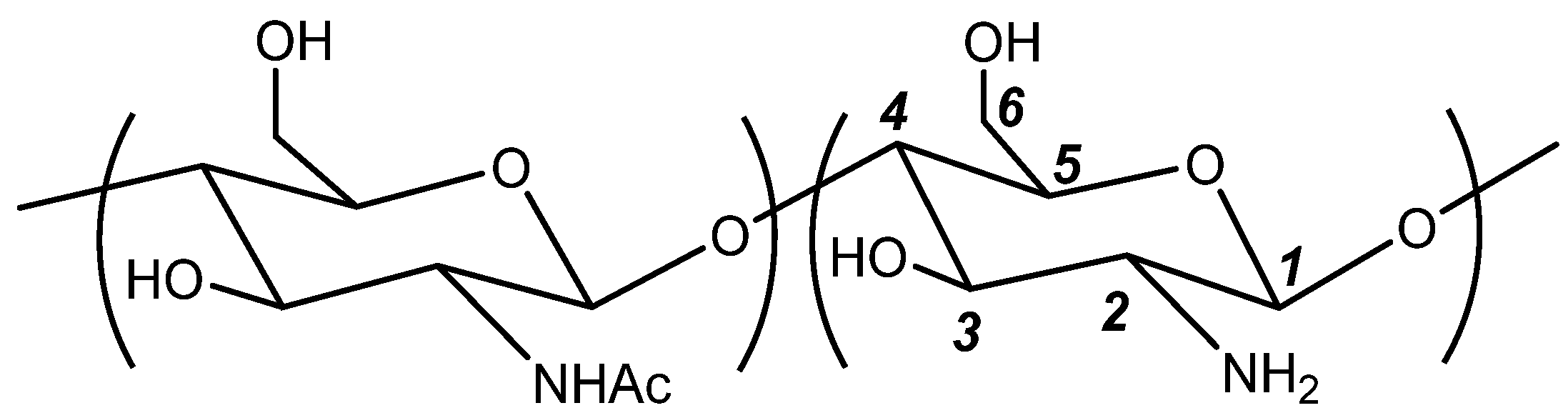
1H NMR spectroscopy was used to calculate the degree of deacetylation of chitosan based on the ratio of the integral intensities of the signals of different protons (for proton numbering, see
Figure 1):
where I
CH3 is integral intensity
N-acetyl protons, I
H2−H6 is sum of integral intensities H
2,3,4,5,6 protons.
Fourier-transform infrared spectra were recorded using an INFRASPEC FSM 2202 Fourier-transform infrared spectrometer (Infraspec, Saint Petersburg, Russia) with an ATR attachment in the range of 500–4000 cm
−1. Fourier-transform infrared spectra were used for quantitative determination of the degree of deacetylation. The degree of deacetylation of chitosan (DD) was calculated by the following empirical equation [
42,
43,
44]:
and
Molecular weight of chitosan
In accordance with the above equations, we calculated the values of viscometric constants for the starting chitosan k = 6.589 × 10⁻³ (mL/g) or 6.589 × 10⁻⁵ (dL/g); α = 0.88.
The viscosity-average molecular weight of chitosan was determined by capillary viscometry using glass viscometer VPZh-2 (d = 0.99 mm, K = 0.11962 mm
2/s
2) according to the method reported by Wang et al. [
45]. The measurements were performed in 0.2 M CH
3COOH/0.1 M CH
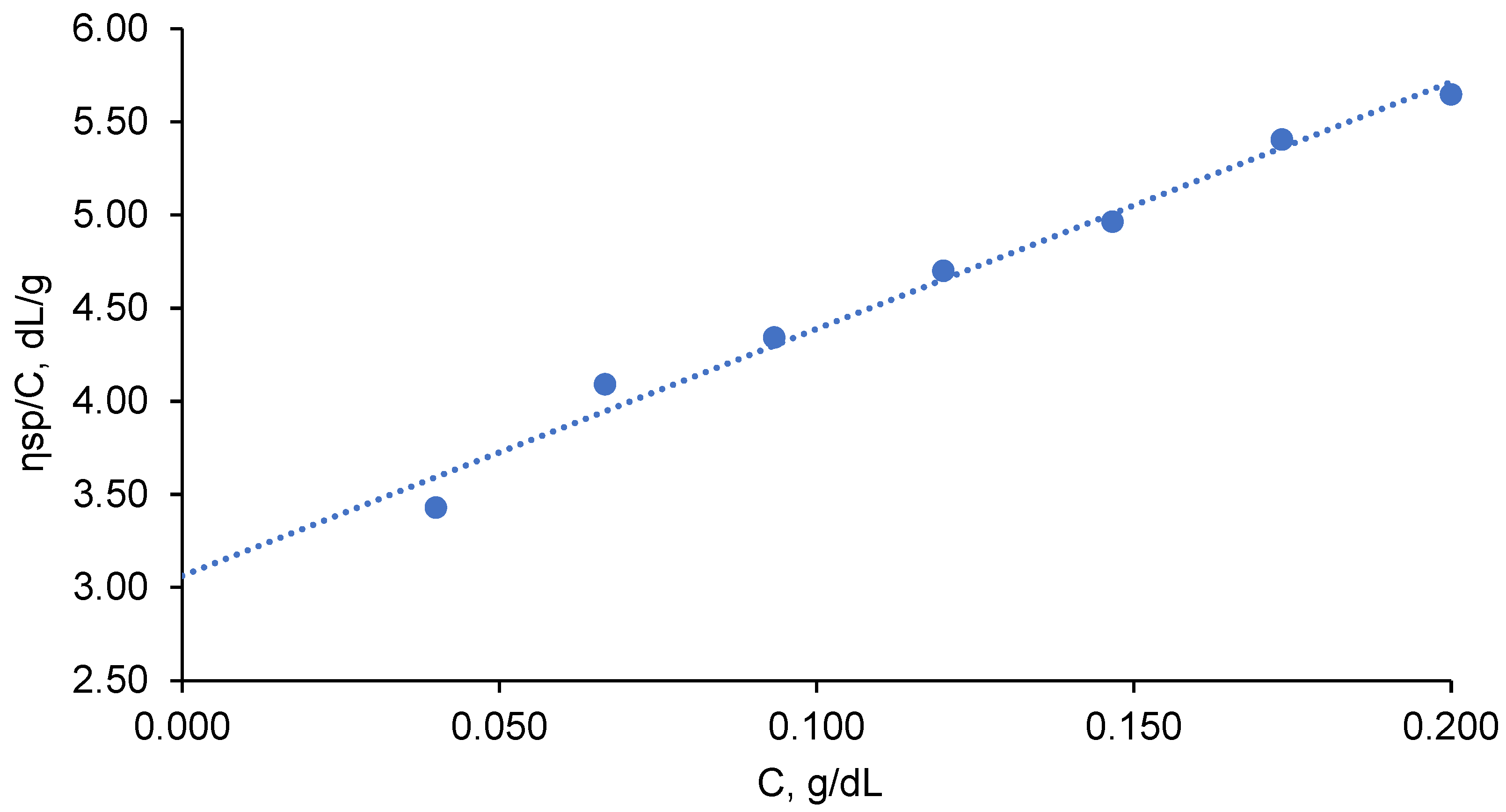
3COONa at 30 °C using chitosan solutions with an initial concentration of 0.20 g/dL. The relative viscosity was calculated from the flow times of the polymer solution and the solvent, and the reduced viscosity was plotted as a function of chitosan concentration. The intrinsic viscosity [η] was obtained by extrapolation of η
sp/C to zero concentration.
The viscosity-average molecular weight (M
η) was calculated using the Mark–Houwink–Sakurada equation:
where K and α are viscometric constants. For chitosan dissolved in 0.2 M CH
3COOH/0.1 M CH
3COONa at 30 °C, these constants were calculated as a function of the degree of deacetylation according to Wang et al. [
45]:
where DD% is the degree of deacetylation expressed in percent.
X-ray phase analysis was performed at the RUDN University Physical Chemistry and Chemical Institute Shared Use Center on a Tongda TDM-20 automatic X-ray diffractometer (Dandong Tongda Science & Technology Co., Ltd., Dandong, China) in step-scan mode (2θ angle range of 5° ÷ 50° with a scanning step of ∆2θ = 0.02°, exposure time of 3 s, Cu Kα radiation). Differential thermal/thermogravimetric analysis was performed on a TA Instruments SDT Q600 (TA Instruments, New Castle, DE, USA) in ceramic crucibles at a heating rate of 10 °C/min over a temperature range of 30 to 600 °C.
In simulated groundwater experiments, the composition of the simulated groundwater (SO42−, Cl−, HCO3−) was based on natural groundwater from Aprelevka (Moscow Region, Russia). The simulated groundwater was obtained by dissolving CaCl2 × 2H2O (103 mg), MgSO4 × 7H2O (64 mg), and sodium bicarbonate (70 mg) in 500.00 mL of distilled water. Simulated groundwater or distilled samples (1000 mL) were charged with 16 mg of K2CrO4 and 0.2, 0.5, or 1.0 g of composite chitosan/LDH. The sorption flasks were then gently shaken for 2 h at 293 K, followed by quantitative determination of hexavalent chromium spectrophotometrically at 540 nm using the method.
For recyclability assessment, 0.500 g of the chitosan/LDH composite was placed in a K
2CrO
4 solution (500.0 mL, 10 mg/L) and shaken at 293 K for 2 h, followed by quantitative determination of hexavalent chromium spectrophotometrically at 540 nm using the method described above [
41]. The chitosan/LDH composite was removed from the sorption mixture and treated by 500 mL of NaOH solution (1 mol/L) for 2 h at 293 K, followed by quantitative determination of hexavalent chromium as mentioned above.
Data treatment for adsorption isotherms and kinetic curves was performed by nonlinear least-squares fitting. The fit quality was evaluated using RMSE and R2 values calculated in the original experimental scales.
3. Results and Discussion
3.1. Characterization of Chitosan
In the first stage of this study, we thoroughly characterized the starting chitosan, as we intended to compare its sorption capacity with that of the chitosan/LDH composite. For this characterization, we used IR spectroscopy, 1H NMR spectroscopy, viscometric analysis, and X-ray diffraction.
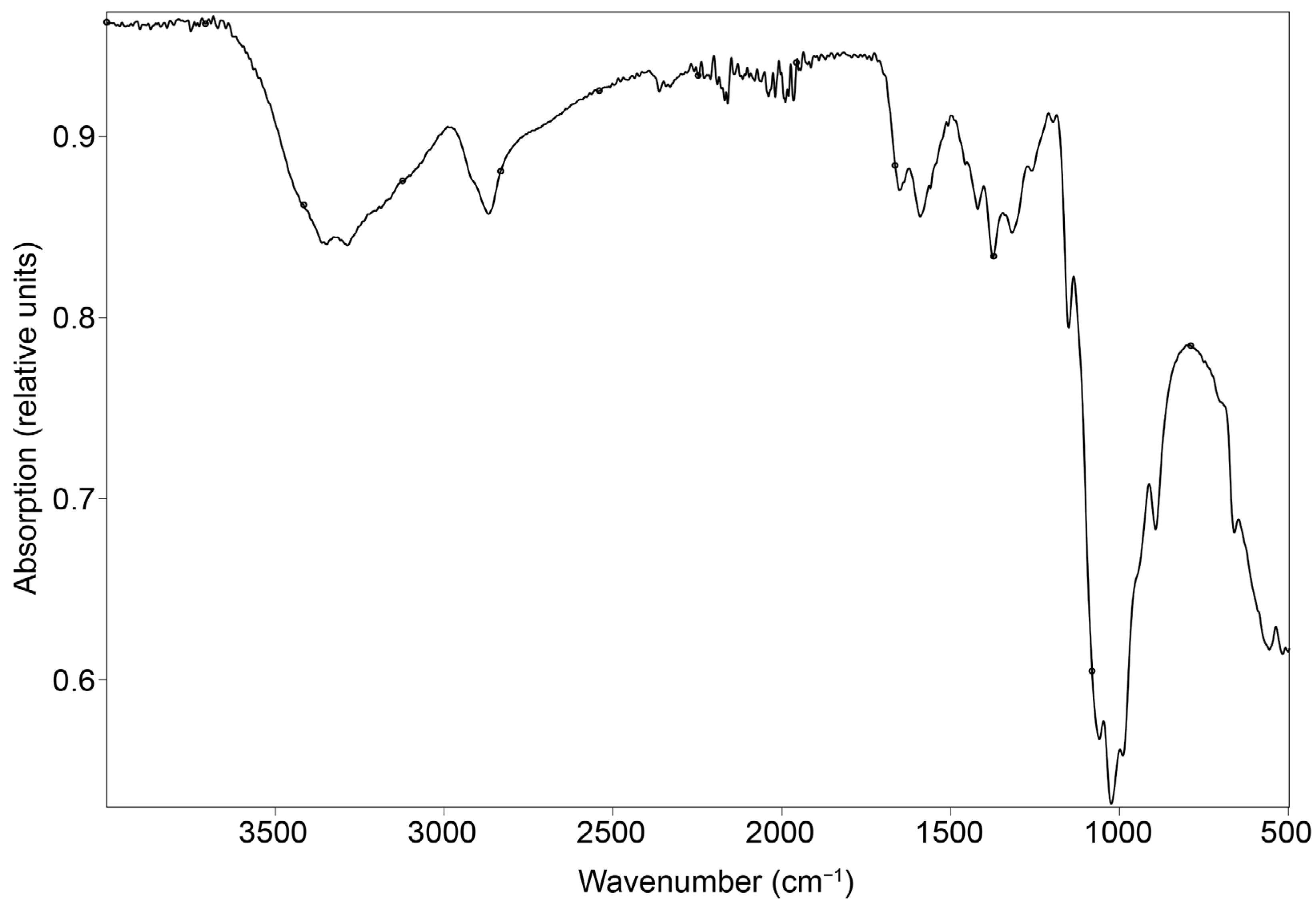
The IR spectrum of the starting chitosan contains characteristic bands of the stretching vibrations of hydroxyl groups and primary amino groups (ν
OH and ν
NH vibrations) at 3285 and 3356 cm
−1, as well as stretching vibrations of C–H bonds at 2869 cm
−1, which are typical for chitosan. The characteristic Amide I and Amide II bands appear at 1590 and 1652 cm
−1. The IR spectrum also displays the C–O–C vibration bands of the pyranose ring at 1060, 1024, and 989 cm
−1. The characteristic band of deformation vibrations of the hydroxyl groups appears at 1373 cm
−1, while wagging vibrations of the CH
2 moiety give the band at 1318 cm
−1. The IR spectrum of the starting chitosan is shown in
Figure 2. The assignment of characteristic bands to the corresponding characteristic groups in the IR spectrum of chitosan is presented in
Table 1.
IR spectroscopy can be successfully used to determine the degree of deacetylation (DD) of chitosan by empirical equations described in
Section 2. For the starting chitosan, the degree of deacetylation calculated using both empirical equations was about 92%.
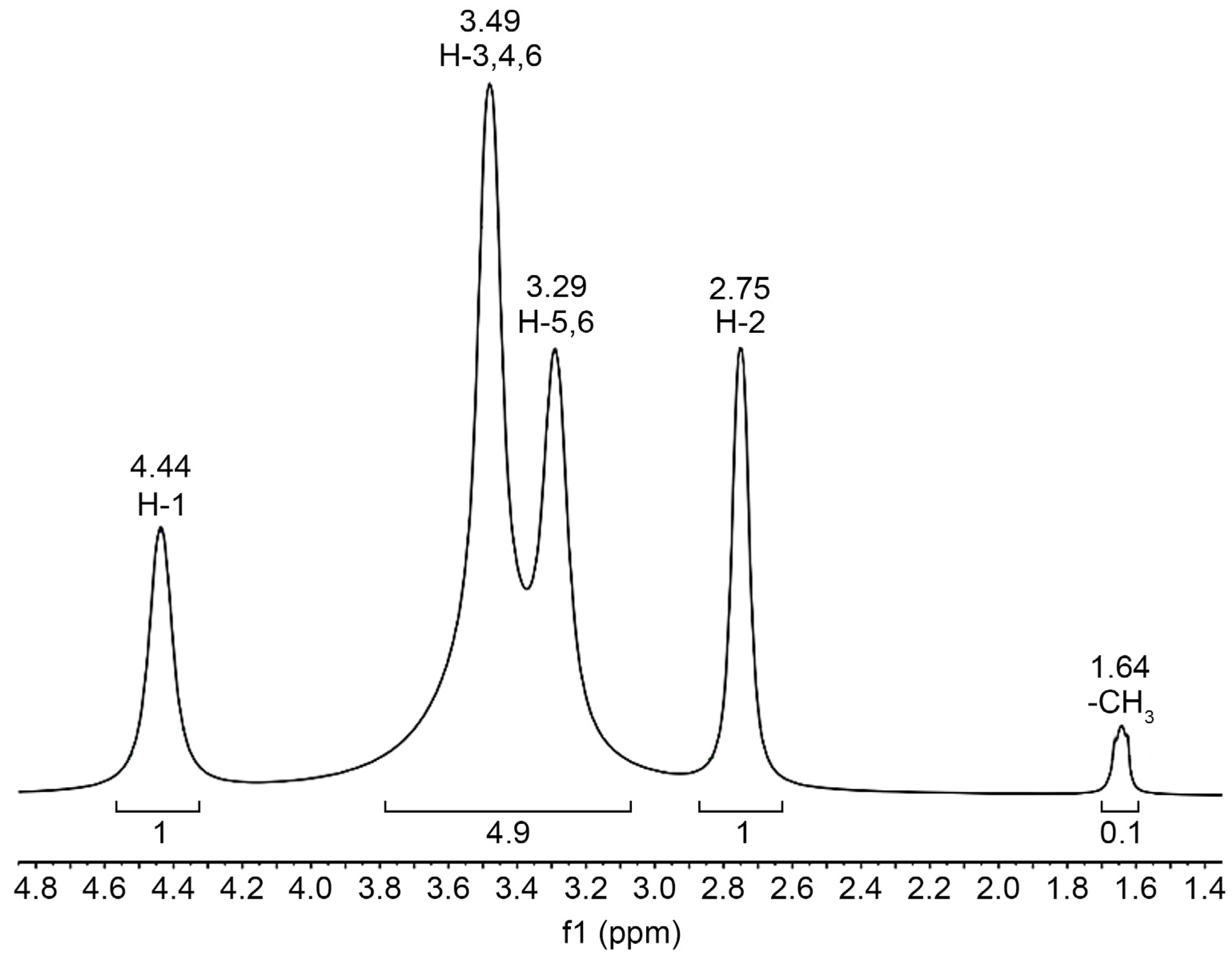
1H NMR spectroscopy can also be used to determine the degree of deacetylation of chitosan [
46,
47].
The starting chitosan was also characterized by
1H NMR spectroscopy.
Figure 3 displays the
1H NMR spectrum of chitosan with proton assignment, while
Figure 1 displays its formula with proton numbering. The results of NMR spectroscopic analysis also indicate a degree of deacetylation of the starting chitosan of approximately 92–93%.
Viscometry is one of the simplest methods in terms of equipment requirements and, at the same time one of the most informative for determining the molecular weight of a polymer [
48]. According to the empirical equations relating the degree of deacetylation to the viscometric constants (see
Section 2), we calculated the values of constants k and α for the starting chitosan (k = 6.589 × 10
−3 (mL/g) or 6.589 × 10
−5 (dL/g); α = 0.88).
Table 2 and
Figure 4 show the results of the viscometric study, and we used them to calculate the viscosity-average molecular weight of the starting polymer.
As a result of processing the experimental data, we found that the graph of the dependence of the reduced viscosity on the concentration of the chitosan solution is linear, and this allows us to determine the value of the intrinsic viscosity [η] by extrapolating according to condition = [η] at C→0. Thus, based on the experimental data, we found that [η] ≈ 3.0623 dL/g. According to the Mark–Kuhn–Houwink–Sakurada equation, we calculated the average viscosity molecular mass Mη = 201,219 Da ≈ 200 kDa.
3.2. Synthesis of LDH
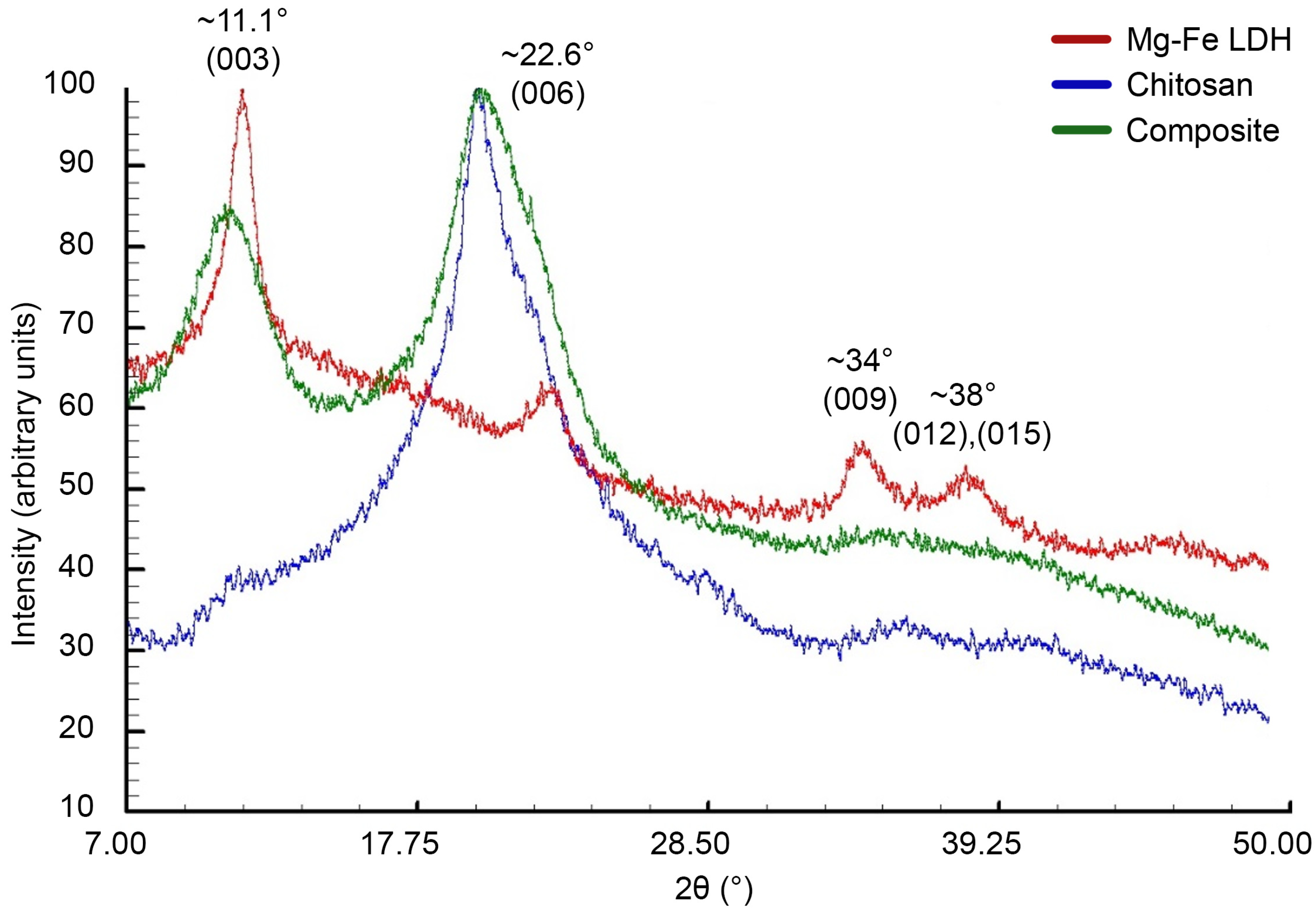
The hypothesis of this work was not only that coprecipitation from a chitosan solution containing magnesium and iron(III) ions by adding alkali would result in the formation of a chitosan/LDH composite, but also that the resulting composite would exhibit improved sorption properties compared to the starting chitosan and so-called “pure” LDH. To conduct the planned comparison, we synthesized “pure” magnesium-iron LDH The Mg/Fe ratio of 2.07 in the resulting LDH was confirmed by inductively coupled plasma mass spectrometry and was close to the desired Mg/Fe ratio of 2. X-ray phase analysis confirmed the formation of LDH, since the diffraction pattern of the obtained LDH (
Figure 5) contains a set of basal reflections typical for this class of compounds and is fully consistent with the literature data [
40] (basal reflections from planes (003), (006), (009), (012), (015)).
3.3. Preparation and Characterization of Chitosan Composite with Magnesium-Iron LDH
We prepared the chitosan composite with magnesium-iron LDH by coprecipitation, which results in two parallel processes:
(i) the conversion of chitosan from a soluble salt form to an insoluble base form (
Scheme 1);
(ii) the formation of an insoluble magnesium-iron LDH:
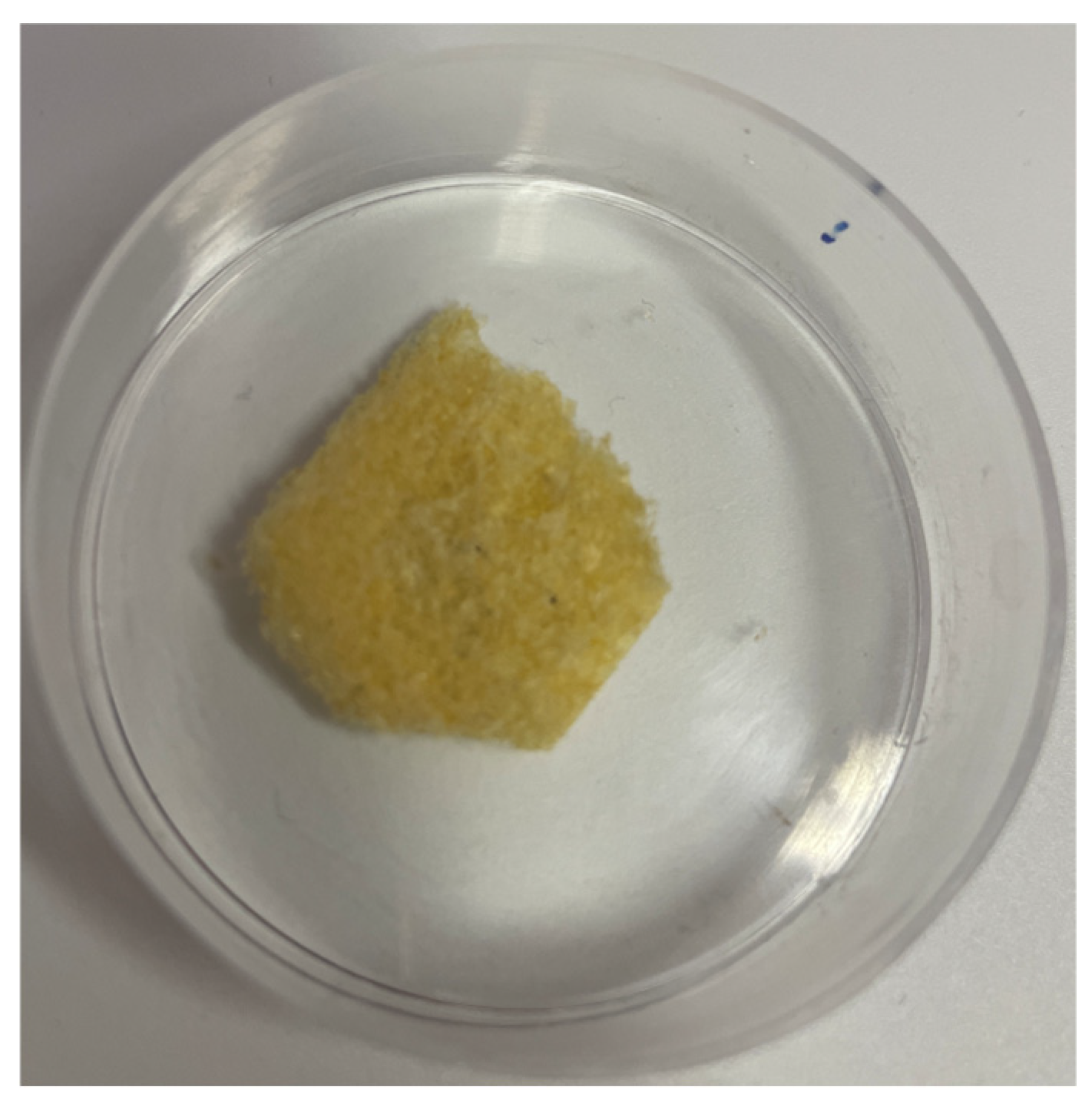
The resulting composite sample is characterized by visual macroscopic homogeneity and is a yellow-cream-colored porous material (
Figure 6).
We confirmed the presence of the LDH phase in the chitosan polymer matrix using X-ray diffraction analysis. The diffraction pattern of the resulting composite (
Figure 5) displays a broad peak characteristic of chitosan in the 2θ angle range from 19° to 22° corresponding to reflections ((200) and (201)) [
49], as well as peaks characteristic of magnesium-iron LDH, i.e., an intense peak at ca. 11.1° 2θ (reflection (003)), a peak as an asymmetric shoulder in the region of 22.6° 2θ (reflection (006)) and broader, less resolved signals at higher 2θ° values ~34° and 38° 2θ corresponding to reflections (009) and (012), (015) [
50].
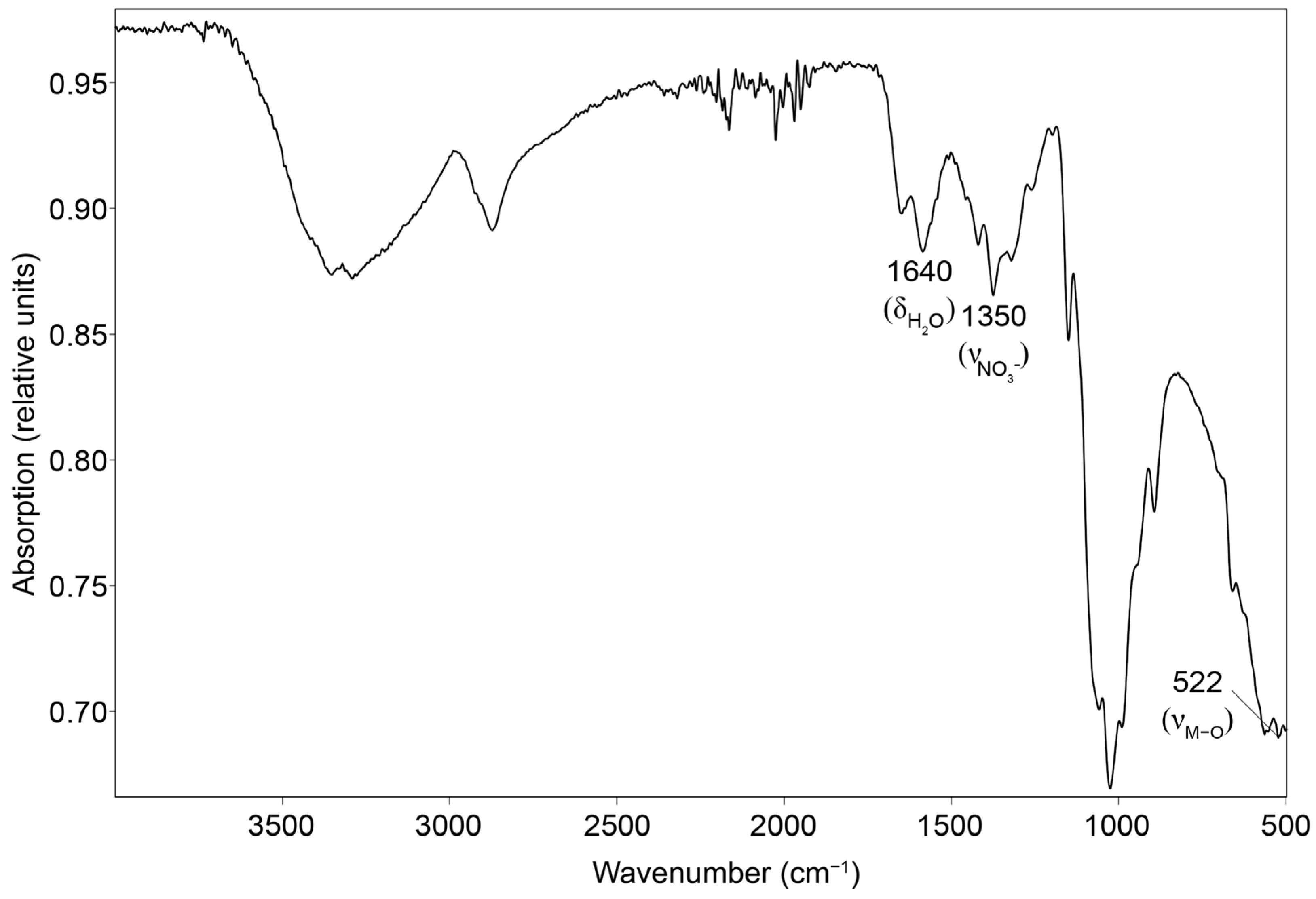
IR spectroscopy also confirms the composition of the resulting composite. The IR spectrum (
Figure 7) exhibits bands characteristic of chitosan, as well as bands typical of LDH: stretching vibrations of the nitrate ion at 1350 cm
−1, deformation vibrations of the water molecule at 1640 cm
−1, and characteristic vibrations of the metal–oxygen bond in the long-wavelength region of the spectrum (522 cm
−1).
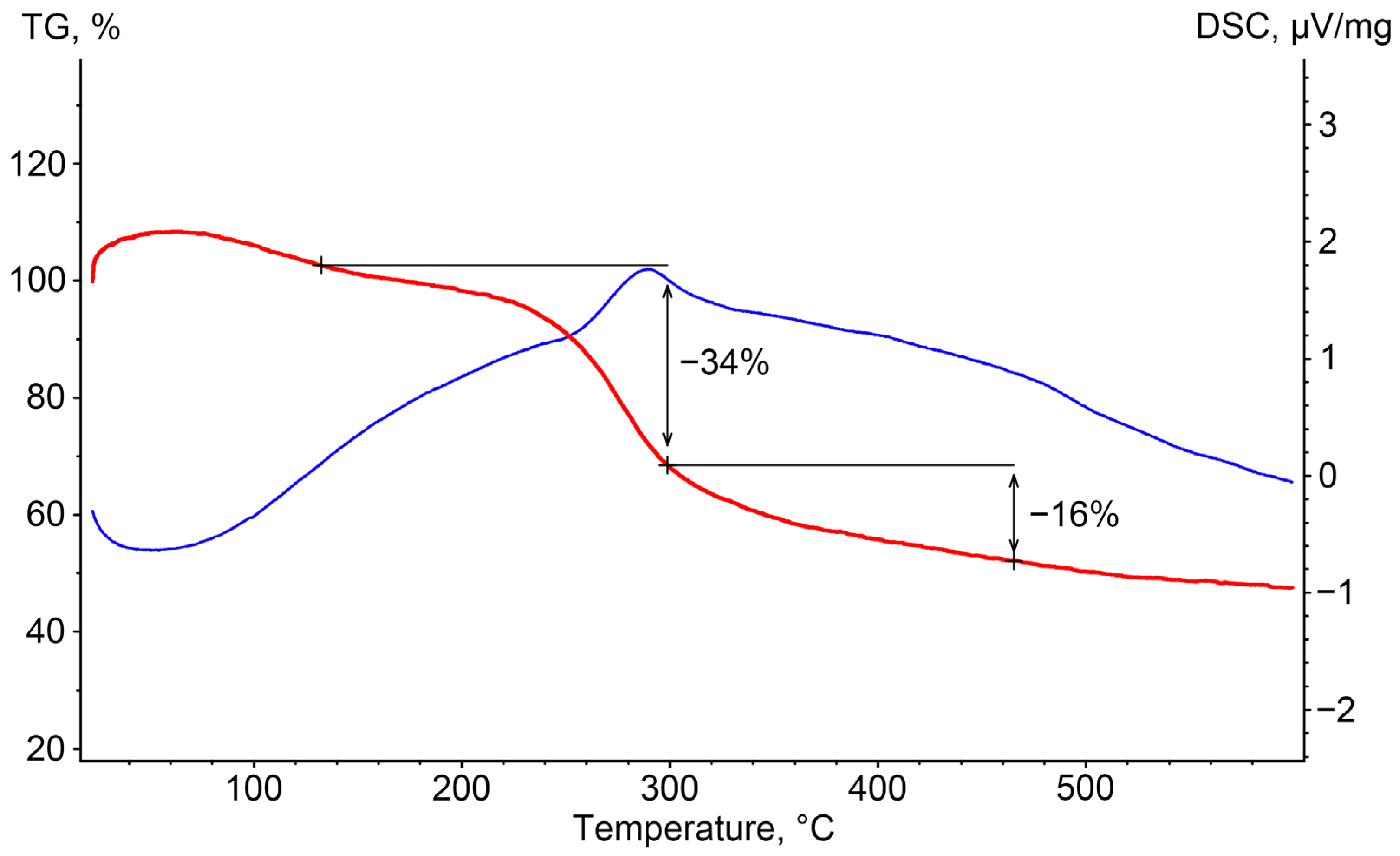
The TGA and DSC curves of the resulting chitosan/Mg–Fe LDH composite are shown in
Figure 8.
The apparent increase in mass observed below 100 °C should not be interpreted as a real mass-gain process or as a chemical transformation in the sample. Since no distinct DSC event is observed in this temperature region, this feature is most likely related to instrumental effects at the initial stage of the TG experiment. Therefore, this region was excluded from the mechanistic interpretation of the composite degradation.
The thermal behavior of pristine chitosan has been extensively described in the literature. Typically, chitosan exhibits an initial low-temperature mass loss associated with the removal of physically adsorbed and bound water, followed by the main degradation of the polysaccharide matrix beginning at approximately 240–250 °C and extending through the 250–350 °C region. This degradation includes dehydration, depolymerization, deacetylation, and cleavage of glycosidic bonds. These features of chitosan thermal degradation are consistent with previous TG/DSC and TG-coupled studies of chitosan [
51,
52,
53,
54]. In the present chitosan/Mg–Fe LDH composite, the thermal degradation proceeds mainly in two mass-loss stages. The first major mass-loss stage, observed at approximately 250–320 °C, can be attributed predominantly to the thermal degradation of the chitosan matrix. The second, more gradual mass-loss stage at higher temperatures is associated with further decomposition and carbonization of the organic residue, together with thermal transformations of the LDH component, including dehydroxylation of the hydroxide layers and decomposition/removal of interlayer nitrate species. Such multistep thermal behavior is typical for LDH-containing systems, in which dehydration, dehydroxylation, and interlayer-anion removal may occur in overlapping temperature regions [
55]. The mass losses in these two regions were approximately 34% and 16%, respectively. Compared with pristine chitosan, the chitosan/Mg–Fe LDH composite exhibits a broader degradation profile and a higher residual mass, which is consistent with the presence of the inorganic LDH phase and the formation of inorganic oxide/hydroxide residue after thermal treatment. The DSC curve does not contain sharp, well-resolved peaks that could be assigned to individual reactions. Instead, the broad DSC response reflects overlapping thermal processes accompanying degradation of the organic chitosan matrix and transformation of the inorganic LDH component.
We also used ICP analysis for a primary assessment of the amount of the Mg–Fe LDH component in the chitosan/Mg–Fe LDH composite. The Mg and Fe contents were 0.74 wt.% and 0.86 wt.%, respectively, corresponding to a Mg/Fe molar ratio of 1.98, which is close to the expected 2:1 ratio for Mg2Fe-LDH. Since the formation of the LDH phase was confirmed by X-ray diffraction and no separate crystalline Mg- or Fe-containing phases were detected, these ICP data were used to calculate the LDH-equivalent content. Assuming the formation of [Mg2Fe(OH)6](NO3) × nH2O, the composite contains approximately 4.1 wt.% of anhydrous Mg–Fe LDH equivalent, or approximately 4.5–5.0 wt.% when interlayer/structural water is considered.
The chitosan/Mg–Fe LDH composite is intrinsically heterogeneous because it consists of an organic chitosan matrix and an inorganic LDH phase. Therefore, complete molecular-level homogeneity cannot be expected for this type of material. However, the heterogeneity of the composite can be controlled at the preparation stage by maintaining fixed synthesis parameters, including the chitosan/Mg/Fe ratio, Mg/Fe precursor ratio, rate of alkali addition, stirring intensity, washing procedure, and drying conditions. In the present synthesis, NaOH was added dropwise under vigorous stirring and pulsed ultrasound treatment. These conditions were used to promote the in situ formation of small Mg–Fe LDH particles and their distribution within the precipitating chitosan matrix. As a result, the obtained composite was macroscopically homogeneous, while XRD and FTIR confirmed the formation of the LDH phase in the chitosan matrix. Batch-to-batch reproducibility of such composites can be monitored by ICP analysis of Mg and Fe contents, Mg/Fe molar ratio, characteristic LDH reflections in XRD, FTIR bands of the LDH component, and sorption performance.
3.4. Sorption Equilibria Study
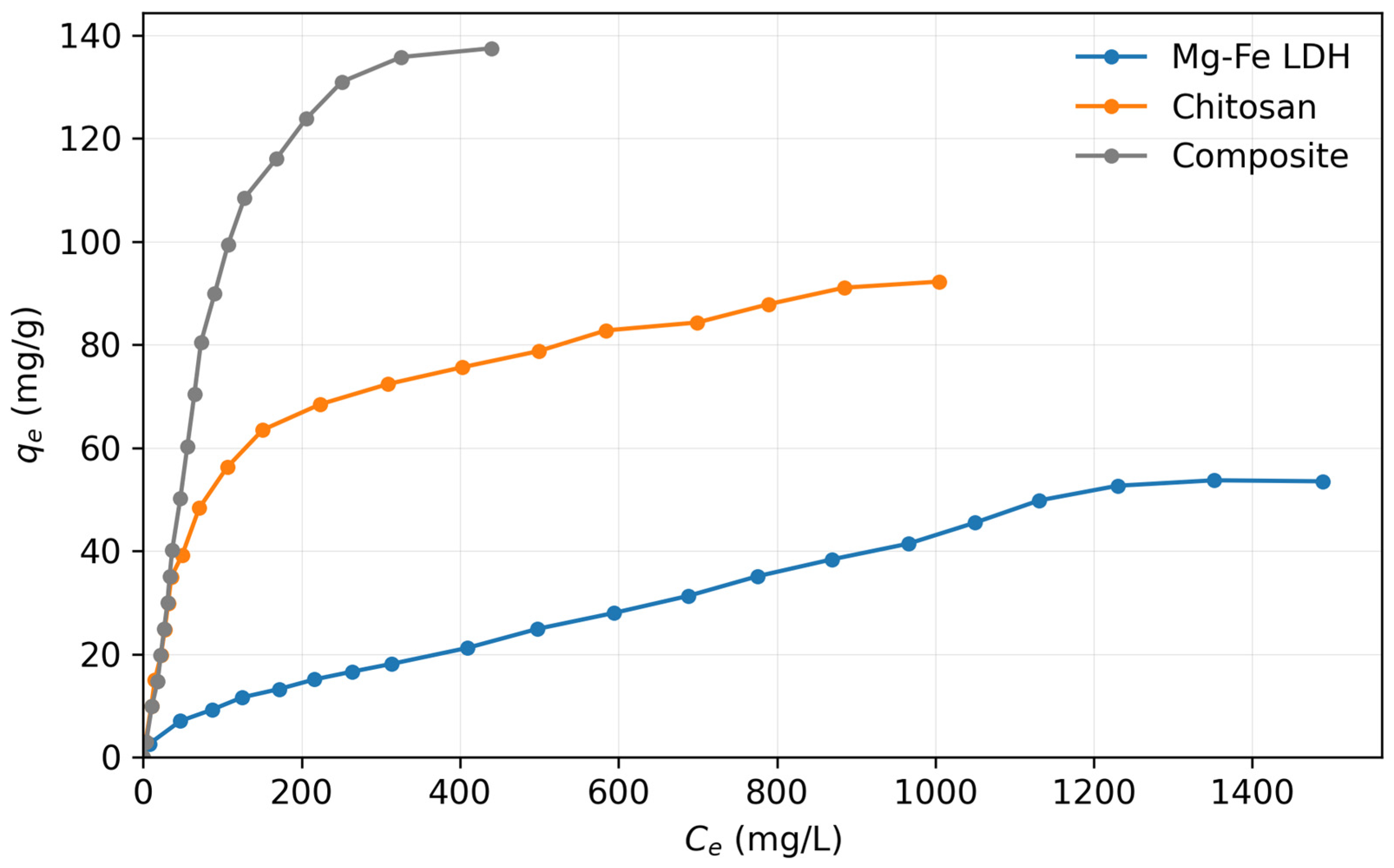
The sorption properties of the prepared composite toward hexavalent chromium (chromate anions) were assessed by studying sorption equilibria. We also compared the sorption capacity of the composite with that of the starting chitosan and “pure” magnesium–iron LDH. Fixed volumes of potassium chromate solutions with concentrations increasing from 0.04046 to 2.1577 g/L were added to the same amount of the sorbent. Upon reaching sorption equilibrium, we determined the equilibrium chromate concentration (C
e) and calculated the equilibrium adsorption value (q
e).
Figure 9 displays the adsorption isotherm as a function of q
e versus C
e.
An increase in the equilibrium chromate concentration results in an increase in the adsorption value, which gradually reaches a plateau. The experimental plateau adsorption capacity, Q
plateau,exp, was defined as the equilibrium adsorption value q
e reached in the plateau region of the experimentally measured adsorption isotherm. This value was calculated from the mass-balance equation described in
Section 2 and should not be confused with a model-derived Langmuir parameter. The Q
plateau,exp values were 137.4 mg/g for the synthesized chitosan/Mg–Fe LDH composite, 92.2 mg/g for chitosan, and 53.5 mg/g for magnesium–iron LDH. Thus, chitosan is a more effective sorbent than LDH, while the introduction of LDH into the chitosan polymer matrix results in the formation of a composite with a sorption capacity almost 50% greater than that of the starting chitosan.
These findings are consistent with recently reported data, where the authors demonstrated that the phenol sorption capacity increases in the series NiAl LDH–chitosan–Chitosan@NiAl LDH [
56]. However, the main difference in their work is in the method for producing the composite: the authors used the classical two-stage method, as described above in the Introduction. In our work, we propose a one-step method for synthesizing a chitosan–LDH composite (see
Section 3.3).
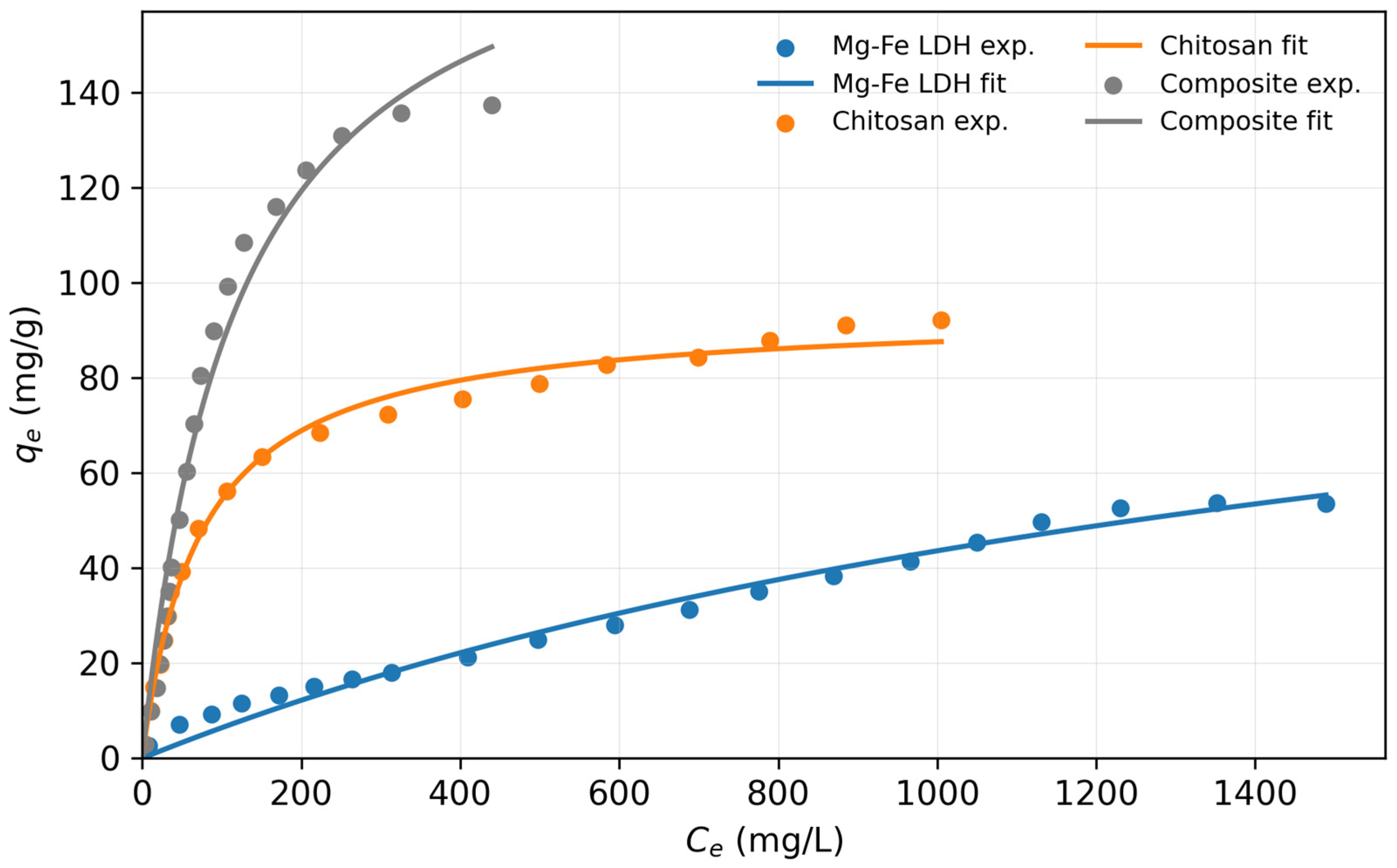
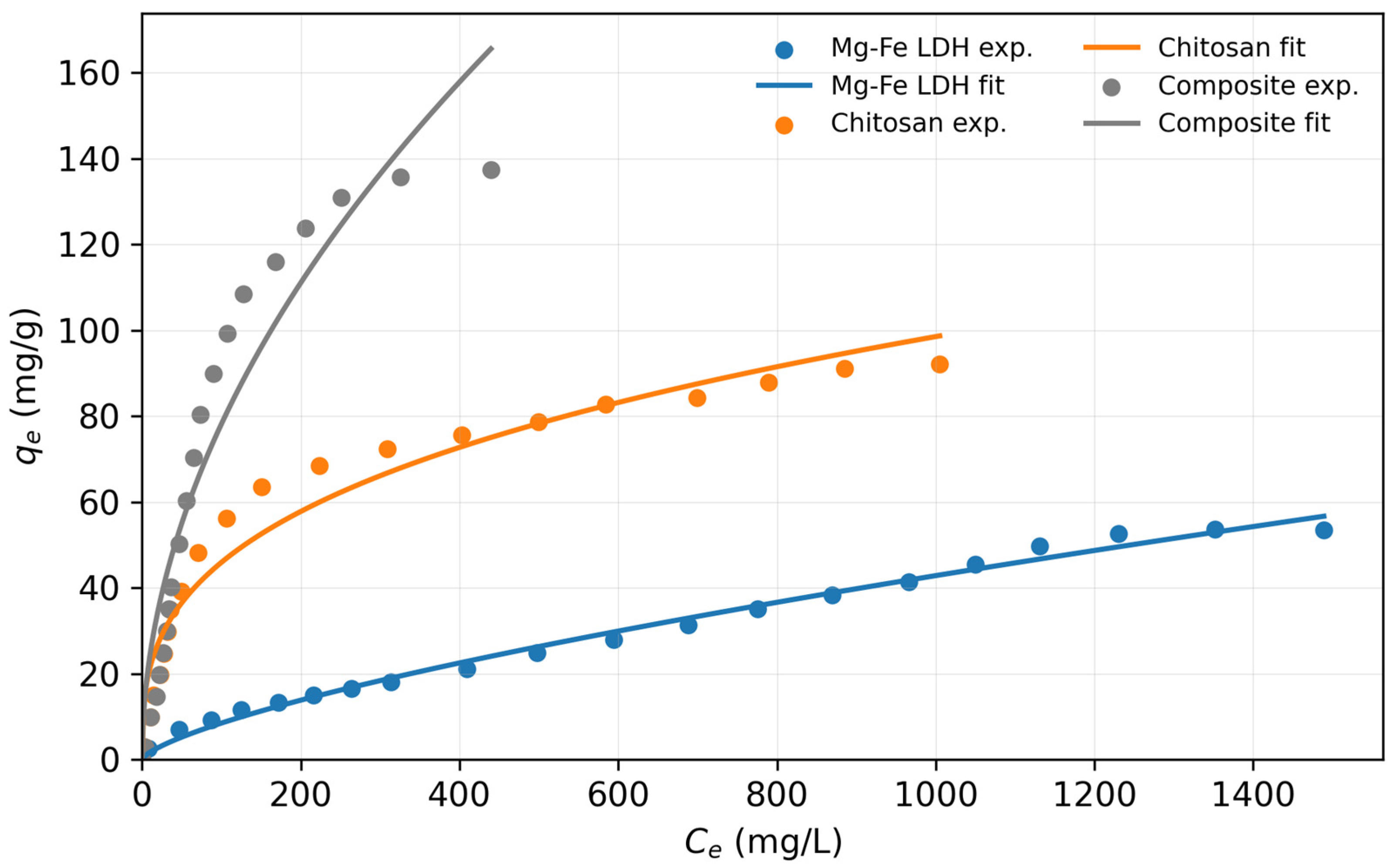
We analyzed the obtained equilibrium data using the classical Langmuir and Freundlich isotherms. The Langmuir isotherm is derived under specific assumptions, including adsorption on energetically equivalent sites and monolayer surface coverage. In contrast, the Freundlich isotherm is an empirical equation commonly used to describe adsorption on heterogeneous surfaces.
The Langmuir and Freundlich isotherm parameters were estimated by nonlinear least-squares fitting in the original q
e versus C
e coordinates. Linearized forms were not used for parameter estimation, because different linear transformations of adsorption isotherms lead to different optimization targets and may distort the statistical weight of experimental points. For both isotherms, the same objective function was minimized:
where q
e,i(exp) and q
e,i(calc) are the experimental and calculated equilibrium adsorption values, respectively. Equal weights were used for all experimental points (w
i = 1), and the same weighting scheme was applied to both the Langmuir and Freundlich isotherms. The quality of fitting was evaluated using the residuals calculated in the original q
e scale; RMSE and R
2 values are reported as additional descriptive statistics.
The Langmuir isotherm was written as:
where Q
l is the fitted Langmuir maximum adsorption parameter and K
l is the Langmuir affinity constant. The Freundlich isotherm was written as:
where K
F is the Freundlich constant and 1/
n is the heterogeneity parameter. The fitted curves are shown in
Figure 10 and
Figure 11, and the corresponding parameters are summarized in
Table 3. It should be emphasized that Q
plateau,exp is the experimentally observed plateau adsorption capacity, whereas Q
l is a fitted Langmuir parameter; therefore, these values should not be used interchangeably.
The nonlinear fitting results show that the suitability of the isotherms depends on the sorbent. For magnesium–iron LDH, the Freundlich isotherm provides the better description in the studied concentration range (RMSE = 1.61 mg/g, R2 = 0.9912) compared with the Langmuir isotherm (RMSE = 2.21 mg/g, R2 = 0.9835). For chitosan and the chitosan/Mg–Fe LDH composite, the Langmuir isotherm provides the better description: for chitosan, RMSE = 2.44 mg/g and R2 = 0.9936 for Langmuir versus RMSE = 6.58 mg/g and R2 = 0.9534 for Freundlich; for the composite, RMSE = 7.02 mg/g and R2 = 0.9770 for Langmuir versus RMSE = 13.76 mg/g and R2 = 0.9114 for Freundlich. Thus, the adsorption by magnesium–iron LDH is better described by the Freundlich isotherm, whereas adsorption by chitosan and the chitosan/Mg–Fe LDH composite is better described by the Langmuir isotherm under the conditions used in this study.
The Freundlich 1/n values are lower than 1 for all three sorbents, which is consistent with heterogeneous adsorption surfaces. The heterogeneity is expected for these systems since the composite combines both an organic polymer matrix and an inorganic LDH phase. The surface heterogeneity is a characteristic feature of the composite material rather than an indication of uncontrolled synthesis. Its degree is governed by the distribution of LDH particles in the chitosan matrix and can be minimized by controlling the coprecipitation conditions.
The relatively high concentration range used in the equilibrium adsorption experiments was selected intentionally to construct complete adsorption isotherms and reach the plateau region required for estimating the experimental adsorption capacity. These experiments were aimed at comparing the sorption capacities of the studied materials and fitting adsorption isotherms, rather than directly reproducing the concentration level of natural waters. The performance of the composite under more environmentally relevant conditions was evaluated separately in simulated groundwater containing competing inorganic anions.
3.5. Kinetics Studies
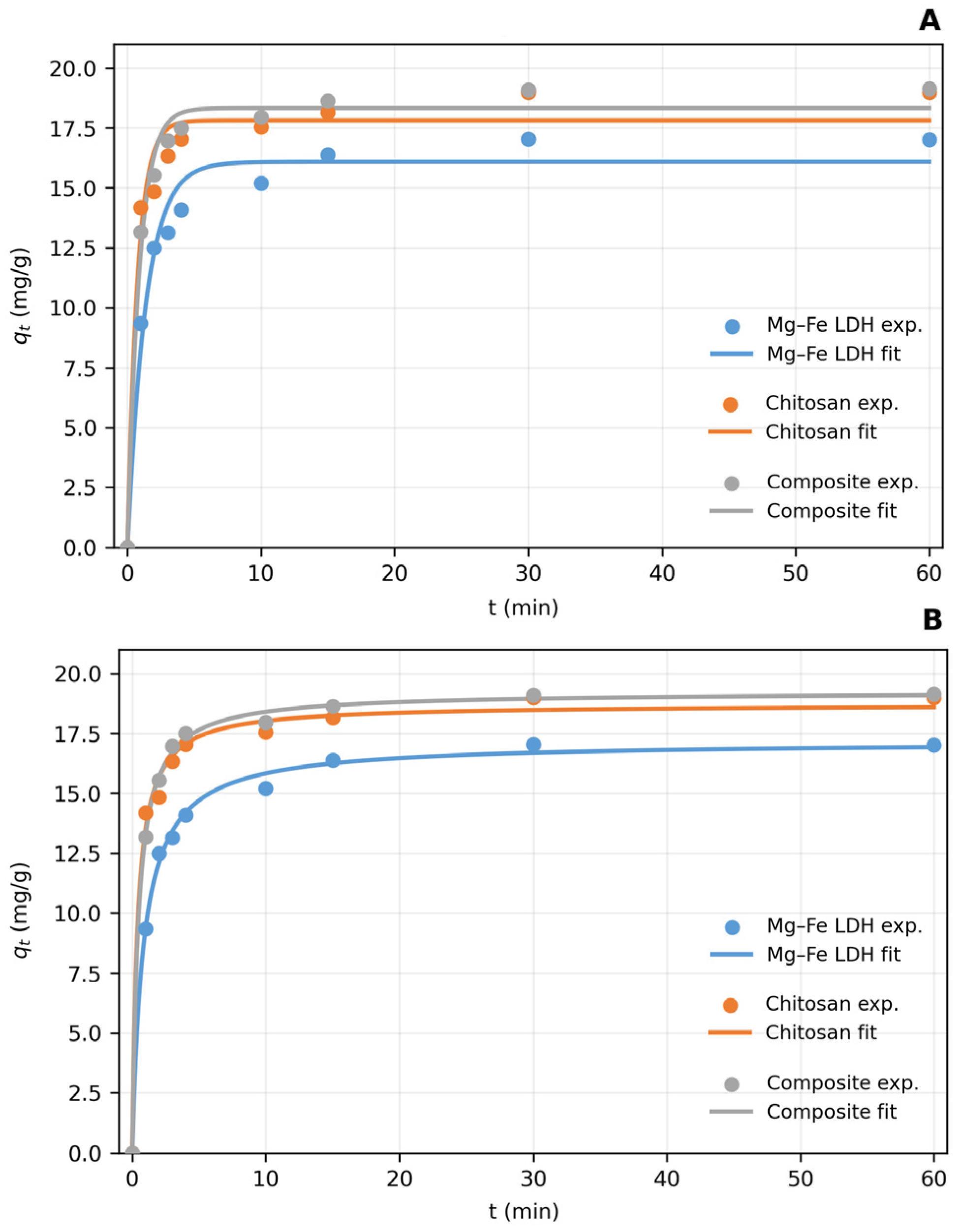
Along with sorption capacity, sorption rate is another important parameter of sorbent effectiveness. Sorbents with the highest sorption capacity typically have the highest sorption rate, but this relationship is not absolute. Therefore, each new sorbent should be studied not only in terms of sorption equilibria (a suitable model for describing the equilibria and experimentally determined sorption capacity) but also in terms of the kinetics of the sorption process (kinetics equation and rate constant). In this study, we evaluated the kinetics of the sorption process for three tested sorbents by quantifying the change in the adsorption value q
t over time (
Figure 12).
The kinetic curves (
Figure 12) for all tested sorbents show the absence of an induction period. Three main regions can be distinguished for each sorbent: (1) a very rapid increase in adsorption during the first minutes of contact, (2) a slower increase in q
t as the system approaches equilibrium, and (3) a plateau region. After 60 min, the experimental adsorption values were 17.03 mg/g for magnesium–iron LDH, 19.00 mg/g for chitosan, and 19.15 mg/g for the chitosan/Mg–Fe LDH composite. Thus, the adsorption value reached after 60 min increases in the series Mg–Fe LDH < chitosan < chitosan/Mg–Fe LDH composite.
The kinetic data were analyzed using the pseudo-first-order and pseudo-second-order kinetic equations. The parameters were estimated by nonlinear least-squares fitting in the original qt versus t coordinates. Linearized forms were not used for parameter estimation, because different linear transformations of kinetic equations lead to different optimization targets and may distort the statistical weight of experimental points.
For both kinetic equations, the same objective function was minimized:
where q
t,i(exp) and q
t,i(calc) are the experimental and calculated adsorption values at time t
i, respectively. Equal weights were used for all experimental points (w
i = 1), and the same weighting scheme was applied to both kinetic equations. The fitting quality was evaluated using the residuals calculated in the original q
t scale; RMSE and R
2 values are reported as descriptive statistics.
The pseudo-first-order equation was written as:
where q
e is the fitted equilibrium adsorption value and k
1 is the pseudo-first-order rate constant. The pseudo-second-order equation was written as:
where k
2 is the pseudo-second-order rate constant. The fitted curves are shown in
Figure 12, and the corresponding kinetic parameters are summarized in
Table 4.
The nonlinear fitting results show that the pseudo-second-order equation provides a better description of the chromate sorption kinetics for all tested sorbents. For magnesium–iron LDH, the pseudo-second-order equation gives RMSE = 0.30 mg/g and R2 = 0.9965, compared with RMSE = 0.84 mg/g and R2 = 0.9728 for the pseudo-first-order equation. For chitosan, RMSE decreases from 0.99 to 0.46 mg/g, and R2 increases from 0.9683 to 0.9932 when the pseudo-second-order equation is used. For the chitosan/Mg–Fe LDH composite, the pseudo-second-order equation gives the lowest RMSE value among all fits (0.20 mg/g) and the highest R2 value (0.9987).
The fitted qe values obtained from the pseudo-second-order equation are also close to the adsorption values reached experimentally after 60 min: 17.16 versus 17.03 mg/g for Mg–Fe LDH, 18.72 versus 19.00 mg/g for chitosan, and 19.24 versus 19.15 mg/g for the composite. In contrast, the pseudo-first-order equation underestimates the equilibrium adsorption values and gives systematically larger residuals. Thus, chromate sorption kinetics by the studied sorbents are better described by the pseudo-second-order equation. The composite combines the highest adsorption amount reached within the experiment with fast approach to the plateau region.
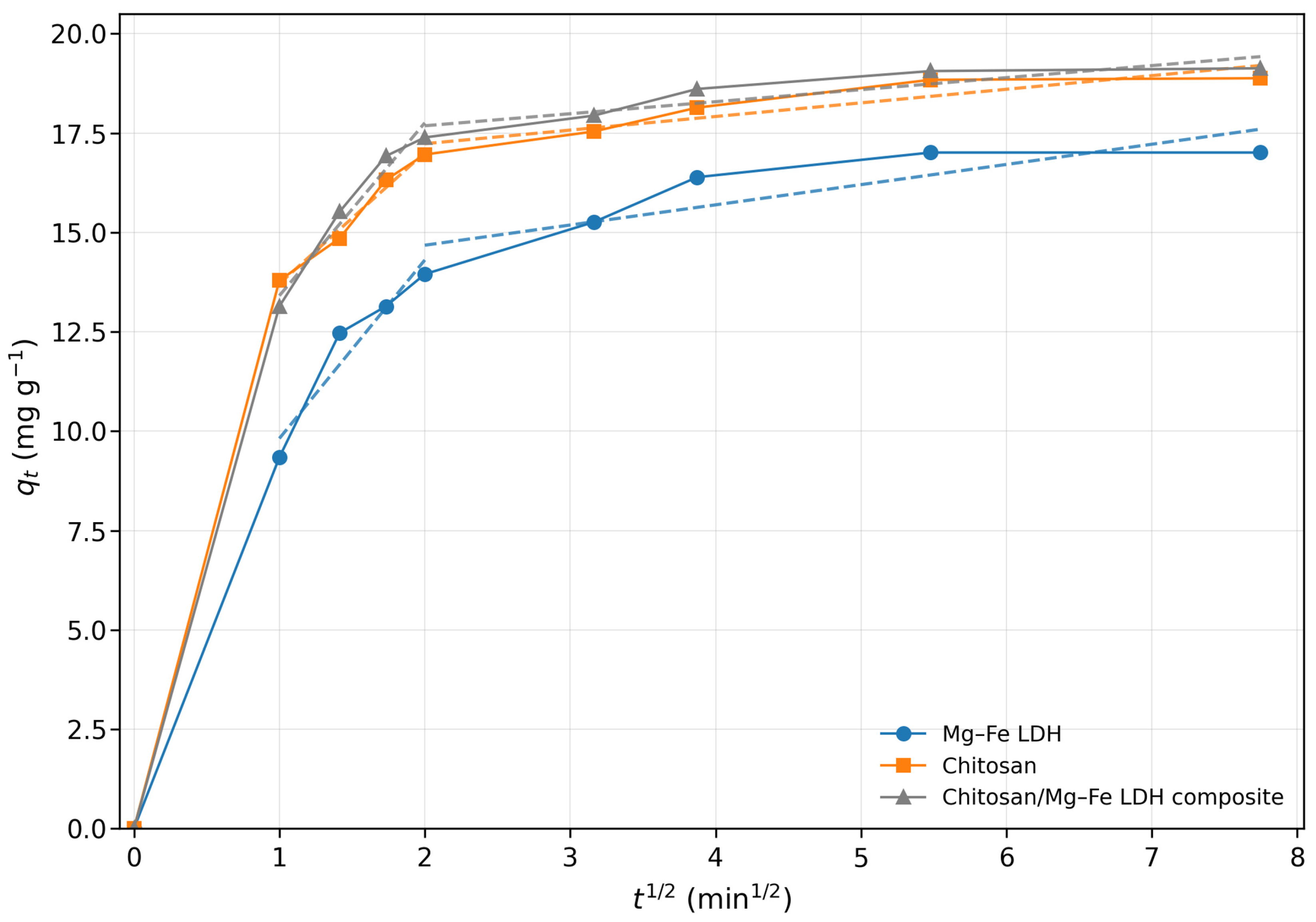
To further analyze the possible contribution of diffusion processes to chromate uptake, the kinetic data were additionally treated using the Weber-Morris intraparticle diffusion equation:
where k
id is the intraparticle diffusion rate constant and C is the intercept related to the boundary-layer effect. If intraparticle diffusion is the only rate-controlling step, the plot of q
t versus t
1/2 should be linear and pass through the origin. In the present case, the linear fitted portions of the plots did not pass through the origin and showed multi-stage behavior. This indicates that intraparticle diffusion contributes to the adsorption kinetics but is not the sole rate-controlling process. The chromate uptake proceeds through a rapid initial surface adsorption stage, followed by a slower diffusion-related stage and subsequent approach to equilibrium (
Figure 13).
The Weber-Morris parameters (
Table 5) confirm that chromate sorption proceeds through at least two kinetic regions.
In the initial region, the kid values are considerably higher than in the later region, which is consistent with rapid uptake by readily accessible external surface sites. In the second region, the lower kid values indicate slower diffusion-related uptake and gradual approach to equilibrium.
Thus, the Weber-Morris analysis supports a multistep adsorption mechanism. Since the fitted lines do not pass through the origin, intraparticle diffusion cannot be considered the only rate-controlling step for any of the studied sorbents. Instead, chromate adsorption is controlled by a combination of fast surface interaction/boundary-layer effects and slower diffusion-related processes, which is consistent with the kinetic curves and with the nonlinear pseudo-second-order fitting discussed above.
3.6. Efficiency of the Studied Sorbents in Groundwater
In the previous stages of this study, we identified the highest sorption capacity for the chitosan/LDH composite and recognized it as the clear leader. However, chromate sorption from groundwater has a number of unique characteristics and is typically less efficient than chromate sorption from its solution in distilled water. This is because chromate sorption from groundwater is complicated by the presence of various competing anions (sulfates, bicarbonates, chlorides, etc.). We evaluated the sorption capacity of the prepared chitosan/LDH composite in simulated groundwater, i.e., water that, in addition to CrO
42− anions (10 mg/L), also contains Cl
− (100 mg/L), HCO
3− (100 mg/L), and SO
42− (50 mg/L). Indeed, chromate anion sorption under these conditions should be significantly impaired, since the concentration of competing ions is 5–10 times higher than the concentration of CrO
42− anions. For control purposes, we accompanied sorption experiments with simulated groundwater with similar experiments using distilled water containing only CrO
42− anions (10 mg/L). The results demonstrating the difference in chromate sorption from distilled water, on the one hand, and from simulated groundwater, on the other, are summarized in
Table 6.
The results displayed in
Table 6 demonstrate that all tested sorbents are capable of capturing chromate anions not only from their solution in pure water but also from simulated groundwater, despite the latter having a concentration of competing anions up to 10 times higher than the concentration of hexavalent chromium.
In the case of capturing chromate ions from their solution in distilled water, we observed the following patterns. First, even the least effective sorbent (LDH), at its lowest concentration in the reaction mixture (0.20 g/L), is capable of capturing at least half of the hexavalent chromium. Furthermore, the low concentration of the sorbents (0.20 g/L) has a differential effect on their sorption capacity. The weakest sorbent (LDH) adsorbs 50% of chromate, while the more effective chitosan sorbent absorbs 1.46 times more chromate (chromate capture is 73%). The most effective sorbent (chitosan/LDH composite) absorbs 79% of chromate anions, which is 1.58 times higher than the corresponding result for pure LDH. In contrast, the high sorbent content (1.00 g/L) results in a leveling effect on their sorption effect: at a high sorbent concentration, their efficiency was maximum and ensured 100% capture of chromate anions.
In experiments with simulated groundwater, we observed significantly lower efficiency for all sorbents. Undoubtedly, the main reason for the decrease in sorption capacity is the presence of competing anions in concentrations higher than those of chromate [
57]. However, the decrease in sorption capacity of the tested sorbents is not uniform. The greatest decrease in sorption capacity is observed for the least effective sorbent (LDH), while the most effective sorbent (chitosan/LDH composite) reduces its sorption effect to a significantly lesser extent. For example, even at the highest (and therefore most favorable) sorbent concentration (1.00 g/L), the sorption effect in simulated groundwater decreases by 70% for LDH, by almost half for chitosan, and by only 18% for the chitosan/LDH composite. Based on the results of experiments with simulated groundwater, the chitosan/LDH composite is the clear leader and is capable of achieving the highest percentage of hexavalent chromium capture even under conditions of high concentrations of competing anions.
The simulated groundwater used in this work should be regarded as a simplified model system rather than a complete reproduction of real groundwater. Its main purpose was to evaluate the effect of common inorganic competing anions on chromate uptake. Therefore, the obtained results demonstrate the stability of chromate sorption in a competitive inorganic medium, while experiments with real groundwater samples containing natural organic matter and trace components should be considered as the next step toward practical validation.
3.7. Reusability of the Composite as a Chromate Sorbent
Effective composite sorbents are most attractive if they are recyclable. Recyclability is important for both environmental and industrial applications. Furthermore, recyclability allows not only for the removal of chromate from wastewater but also for its recovery and further concentration and use. In this study, we assessed the recyclability of the best-performing sorbent tested, i.e., chitosan/LDH composite. EDTA can typically be effectively used to remove chromate ions from chitosan-based sorbents. However, in this case, we consider this method impractical, as EDTA, a powerful chelator, can remove Mg2+ and Fe3+ ions from LDHs, thereby causing their partial destruction. Washing the sorbent with a strong acid also appears questionable, as the acid can not only disrupt the LDH structure but also lead to partial dissolution of the chitosan polymer matrix. We decided to remove chromate ions from the sorbent using a sodium hydroxide solution, which is safe for LDH and does not dissolve chitosan. Indeed, sodium hydroxide can cause minor deacetylation of chitosan, but under the experimental conditions, the probability of secondary deacetylation approaches zero. This is because more or less noticeable deacetylation is observed only at elevated temperatures, and at room temperature, this secondary process is dramatically slow.
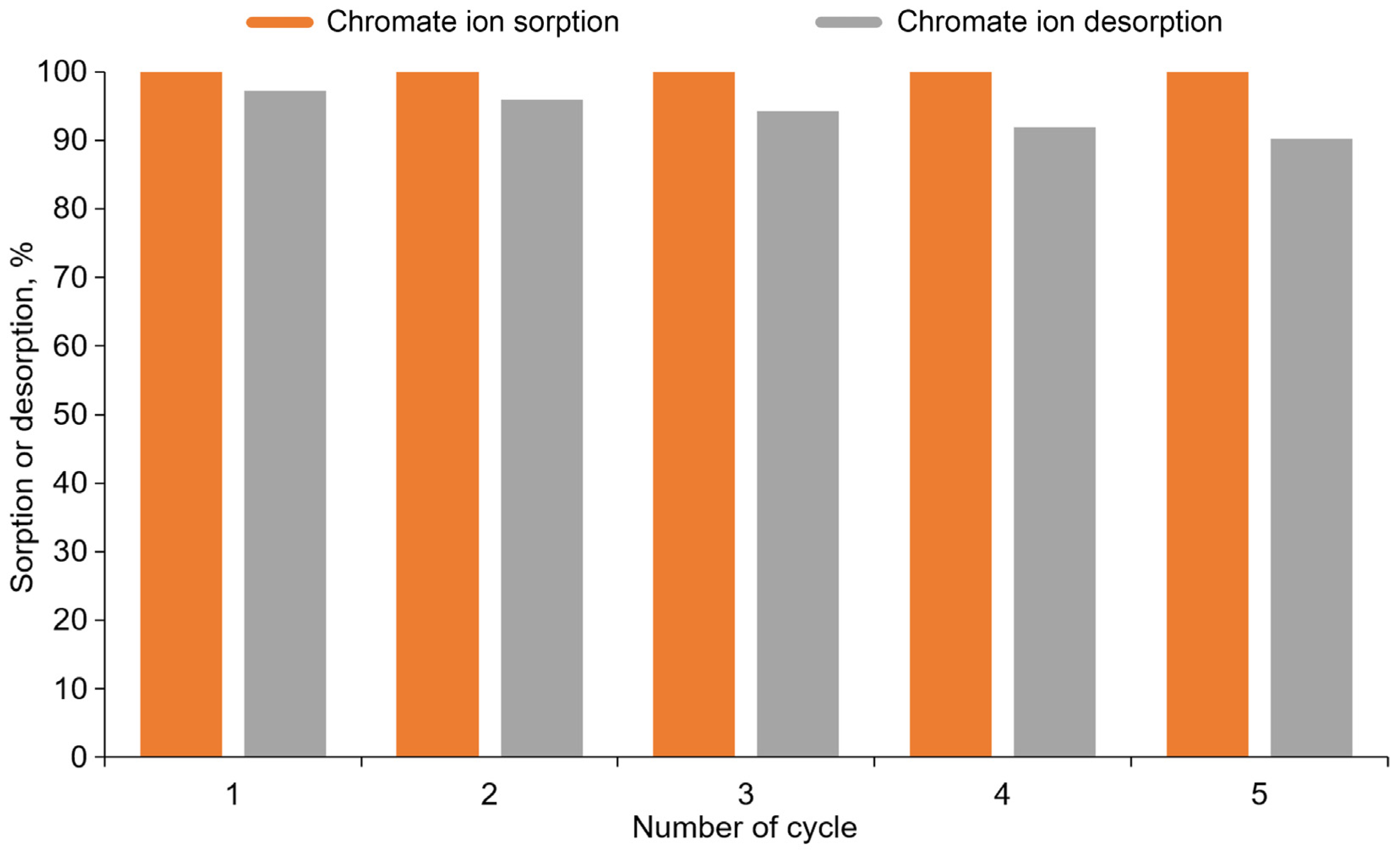
In our experiments, we performed sorption cycles followed by desorption (
Figure 14).
For sorption, we charged a vial with a K2CrO4 solution (10 mg/L) and the chitosan-LDH composite to achieve a concentration of 1.00 g/L. For desorption, we washed the sorbent with a 1 M NaOH solution.
The chitosan/LDH sorbent easily withstands five sorption/desorption cycles. During the first three cycles, chromate ion capture is exhaustive, reaching 100%. However, we did not observe complete chromate ion desorption: during the first three cycles, desorption slowly decreases from 97.3% to 94.3%. During the fourth and fifth cycles, a slightly greater decrease in desorption (to 90.3%) is observed; however, this does not affect the maintenance of 100% chromate ion sorption. These results demonstrate the pronounced recyclability of the chitosan/LDH composite.
The recyclability test was performed as a primary operational assessment rather than a full post-cycling structural stability study. The retained sorption performance indicates that NaOH regeneration restores the availability of sorption sites under the tested conditions. However, detailed post-cycle XRD, FTIR, and leaching analyses would be required to confirm structural and compositional stability after repeated use and will be addressed in future work.
4. Conclusions
In this work, a chitosan/Mg–Fe layered double hydroxide composite was successfully prepared by a one-pot alkaline coprecipitation method, in which the LDH phase was generated in situ within the chitosan matrix. The formation of the composite was confirmed by XRD, FTIR, thermal analysis, and ICP data, which indicated an LDH-equivalent content of approximately 4.1 wt.% on an anhydrous basis.
The obtained composite showed improved chromate sorption performance compared with both pristine chitosan and Mg–Fe LDH. The experimental plateau adsorption capacity reached 137.4 mg/g, whereas chitosan and Mg–Fe LDH showed 92.2 and 53.5 mg/g, respectively. Nonlinear isotherm fitting demonstrated that chromate adsorption by Mg–Fe LDH was better described by the Freundlich model, while adsorption by chitosan and the composite was better described by the Langmuir model. Kinetic analysis showed that the sorption process followed the pseudo-second-order equation, and Weber–Morris analysis indicated a multistep uptake mechanism involving both surface interaction and diffusion-related processes.
The composite also demonstrated good performance in simulated groundwater containing competing anions, removing 82% of Cr(VI) at a sorbent dosage of 1.0 g/L. In addition, it retained complete chromate uptake over five sorption/desorption cycles, although the desorption efficiency gradually decreased from 97.3% to 90.3%.
Overall, the proposed one-pot strategy provides a simple route to chitosan/LDH composite sorbents with enhanced chromate removal ability. However, further studies using real contaminated water samples, dynamic flow systems, extended cycling tests, and metal-leaching analysis are required to confirm the practical applicability and long-term stability of the material.



 ,
,