


Abstract
Obesity prevention and cardiometabolic risk reduction require sustained physical activity, dietary quality, and adequate sleep, yet working adults often face fragmented time, and time scarcity itself predicts less physical activity and less healthy eating. This evidence-informed narrative review proposes six actions—Move, Eat, Recover, Connect, Design, and Engage—as an implementation framework for obesity-relevant behaviours. Its distinctive element is a time-triggered menu of modes combined with a prespecified return path, applied with the same rules across domains. Each action has Standard, Reduced, and Minimum modes with operational time anchors; the mode steps down when available time falls below an anchor, the next occasion after a missed one is completed in at least the Minimum mode, and the default steps back up after consecutive completions. Sleep opportunity and meal adequacy are protected across modes. We position the framework against relapse prevention, coping planning, habit-based and small-change interventions, and adaptive interventions, and map its rules to the Behaviour Change Technique Taxonomy. We set out an outcome hierarchy from implementation to behavioural dose, energy balance, adiposity, and cardiometabolic risk, and propose an evaluation with arm-independent completion criteria and a co-primary dose-sensitive endpoint. Move, Eat, and Recover have the most direct links to energy balance; Connect and Engage have the least direct evidence. The integrated framework has not yet been tested.
1. Introduction
Obesity is a central driver of cardiometabolic disease. Excess adiposity, particularly visceral and ectopic fat, is associated with insulin resistance and type 2 diabetes, atherogenic dyslipidaemia, hypertension, and atherosclerotic cardiovascular disease [1,2,3,4]. These risk factors frequently cluster as metabolic syndrome, which the harmonized criteria define as the presence of at least three of five components: elevated waist circumference, elevated triglycerides, reduced HDL cholesterol, elevated blood pressure, and elevated fasting glucose [5]. Because these conditions share behavioural determinants, sustained physical activity, dietary quality, and adequate sleep are core targets for obesity prevention and cardiometabolic risk reduction.
Knowing these targets does not make them feasible. For working adults whose time is divided among employment, commuting, household obligations, and care, implementation requires available minutes, predictable opportunities, preparation, and manageable cognitive effort. Time scarcity is itself a determinant of these behaviours: in longitudinal Australian panel data, new episodes of time scarcity predicted reduced physical activity and less healthy eating among Australians aged 25–54 [6], and a meta-analysis of observational studies associated long working hours with weight gain and obesity [7]. The gap between recommendation and implementation is visible even in well-resourced programmes. In Japan, where a national health-check and health-guidance system reaches employees through employers and insurers, assignment to health guidance among men aged 40–74 years with central obesity was associated with a weight difference of only about 0.3 kg at one year; the association was no longer significant by years three to four, and blood pressure, HbA1c, and LDL cholesterol did not improve [8].
A common response is to add a programme: scheduled exercise, elaborate meal preparation, or formal stress management. Each may be valuable, yet each can become another obligation that is the first to be dropped when work intensifies. The practical question is therefore not only which behaviours prevent obesity, but how evidence-based behavioural targets can be kept up—and resumed after inevitable interruptions—when conventional delivery formats cannot be sustained.
This paper proposes an implementation framework of six actions—Move, Eat, Recover, Connect, Design, and Engage—that share one set of operating rules. Each action has Standard, Reduced, and Minimum modes anchored to the time available, a rule for stepping down when time is short, and a fixed rule for returning to the fuller mode. Move, Eat, and Recover act most directly on energy expenditure, energy intake, and the sleep-related regulation of intake; Design alters the food and activity environment; Connect and Engage are supports whose proposed roles—sustaining adherence and providing non-food sources of reward—rest on less direct evidence.
The paper has four aims: (1) to specify the framework’s decision rules and operational anchors so that it can be reported and replicated; (2) to position it against the approaches it most resembles and state what is new; (3) to set out the energy-balance pathway through which each action could affect adiposity, together with the strength and directness of the supporting evidence; and (4) to propose an evaluation in which the framework could fail. The framework is a proposal for testing, not an established obesity intervention.
2. Scope and Approach
2.1. Type of Review and Source Manuscripts
This article is an evidence-informed narrative review that integrates six domain-specific manuscripts developed by the authors: physical activity and sedentary behaviour [9]; meal architecture and dietary choice [10]; sleep, circadian regularity, and psychological detachment [11]; social connection as a potential non-food source of reinforcement [12]; immediate environmental cues and choice architecture [13]; and brief learning and leisure activities as alternative reinforcement [14]. All six are available as preprints [9,10,11,12,13,14]. The present article does not reproduce their content. It extracts a shared implementation architecture, specifies it operationally, and re-examines the evidence for each domain against obesity-relevant outcomes; the domain guides in Supplementary Materials S1–S6 are condensed from the source manuscripts. Reporting follows the SANRA criteria for narrative reviews [15]. This is not a systematic or scoping review: no independent screening, risk-of-bias assessment, or quantitative pooling was performed, and relevant evidence may have been omitted.
2.2. Identification of the Literature
The literature was identified in two stages. First, for the source manuscripts, we searched PubMed, Web of Science, and Google Scholar, between 18 July and 6 August 2026. The searches focused mainly on studies published from 2010 onwards and were supplemented by additional searches for earlier key studies, including foundational theoretical work. When several reviews or meta-analyses addressed the same question, the most recent was given priority. Second, during revision, we added the literature on (a) evidence linking each domain to energy intake, energy expenditure, or adiposity; (b) time scarcity, working hours, and health behaviour; and (c) intervention approaches that address lapses and resumption, namely relapse prevention, coping planning, habit-based and small-change interventions, and adaptive interventions. These sources were identified through targeted searches and reviewers’ suggestions, and each was checked against the original publication.
2.3. Selection of Evidence and Relevance to the Target Population
We gave priority, in order, to guidelines and consensus statements, systematic reviews and meta-analyses, randomized trials, and large prospective cohorts. Laboratory studies and single trials were used where they tested a mechanism directly, such as the substitution of food by non-food alternatives. Relevance to time-constrained working adults was judged on three criteria: whether participants were working-age adults, preferably employed or recruited in workplaces; how close the outcome lay to adiposity on the outcome hierarchy (Section 4.7); and whether the exposure could plausibly be delivered in short, modifiable time windows. Sources from other populations—older adults, people with diabetes, young people, or laboratory samples—were retained only when they addressed a mechanism not otherwise studied, and their population and design are reported in the evidence map in Section 4.7 so that readers can judge transferability.
2.4. Rationale for the Six Domains
The six domains were chosen to cover the behavioural determinants of energy balance and the conditions that make them feasible. Move, Eat, and Recover correspond to the behaviours with the most direct links to energy expenditure, energy intake, and the regulation of intake. Together with stress management and social connection, they also correspond to pillars of lifestyle medicine [16]. Design was included because the immediate environment determines much of the time and effort cost of each behaviour, and Engage because, under time scarcity, short leisure periods are the main place where non-food reinforcement can be made available [17]. Avoidance of risky substances, the remaining lifestyle-medicine pillar, was not included as a separate action because tobacco and alcohol reduction are not primarily limited by available time.
2.5. Handling of Inconsistent Evidence
We did not resolve inconsistencies by counting studies. Where findings diverged, we first checked whether they concerned different outcome levels, designs, or populations—for example, acute postprandial benefits of interrupting sitting in controlled experiments [18] alongside non-significant associations of sedentary breaks with metabolic syndrome in observational studies [19]—and restricted the claim to the level at which the evidence was consistent. Where a pooled estimate was imprecise or later corrected [20,21], we did not rely on the numerical estimate. The evidence map in Section 4.7 summarizes, for each action, the design and population of the cited evidence, the claim it supports, and what remains to be tested.
3. The Implementation Architecture
3.1. Preserve Function, Distinguish Form
A health recommendation typically combines a function—for example, raising energy expenditure or limiting energy-dense snacking—with a conventional form of delivering it, such as a scheduled gym session or a home-cooked meal. The framework keeps the function fixed and allows the form to change with the time available. Forms are not interchangeable in dose: a one-minute movement break interrupts sitting but does not deliver the fitness benefits of a full exercise session.
3.2. Reduce Avoidable Implementation Friction
Implementation friction denotes the practical costs that stand between intention and action: time, travel, preparation, equipment, scheduling, decision-making, social coordination, and perceived performance demands. The framework reduces avoidable friction by attaching actions to transitions already present in the day, such as the start of work, a meal, a meeting break, or the journey home, without claiming to remove biological dose requirements.
3.3. Three Modes: Dose-Scalable and Dose-Protected Elements
Each action has a Standard mode aligned as closely as possible with established guidance, a Reduced mode for constrained days, and a Minimum mode that keeps the cue–response link active when little time is available. Operational time anchors for each action are given in Section 3.4. In some actions, the modes scale the behavioural dose itself; Move, Connect, and Engage are dose-scalable. In others, the modes scale only the effort of delivery, while the health-relevant exposure is protected. In Recover, the sleep-opportunity target is the same in every mode and only the wind-down routine is shortened; in Eat, the modes reduce decision and preparation time, not nutritional adequacy, and a Minimum action never replaces a meal. Design actions are usually one-off changes whose effect persists, so their modes describe the size of the change. This distinction prevents the framework from legitimizing shorter sleep or poorer meals on busy days.
3.4. Mode-Switching and Restart Rules
Table 1 specifies the decision algorithm, which operates at two levels. At the occasion level, a time-triggered rule selects the mode for each planned occasion from the time available, so that a busy day produces a smaller action rather than no action. At the plan level, performance-triggered rules adjust the participant’s default mode over weeks: the default steps down after repeated misses and steps back up after a run of completions. A restart rule links the two levels. After any missed occasion, the next planned occasion of the same action, at the same cue, is completed in at least the Minimum mode, and the missed occasion is not made up. These rules turn return after interruption into an observable, prespecified behaviour rather than a permission. The time anchors to which these rules refer are listed for each action in Table 2.
In the default delivery format, the participant makes each switch, prompted by a brief cue at the planned time (a self-set reminder or an app notification), and records it in three taps: the mode intended, whether it was completed, and, if it was missed, whether the reason was lack of time. In digital delivery, the same rules can be executed by an algorithm that proposes the mode from logged data; available time then becomes a tailoring variable and the rules become decision rules in the sense used for adaptive interventions [22]. The thresholds proposed here—two consecutive misses for a step down and three consecutive completions for a step up—are initial values chosen for simplicity and are themselves candidates for optimization (Section 6.4). Supplementary Material S7 describes the intervention using the TIDieR checklist [23], including tailoring and planned modifications.
Table 1.
Mode-switching and restart rules (initial specification).
Table 2.
Operational anchors for the Standard, Reduced, and Minimum modes.
4. Six Actions and the Energy-Balance Pathway
4.1. Move: Activity and Sitting Interruption
Physical activity contributes to obesity prevention through energy expenditure and through effects on insulin sensitivity and fitness. The WHO 2020 guidelines recommend 150–300 min of moderate-intensity or 75–150 min of vigorous-intensity aerobic activity per week, plus muscle-strengthening activity on at least two days, and advise replacing sedentary time with activity of any intensity [25]. Importantly for this framework, the guidelines removed the earlier stipulation that aerobic activity be accumulated in bouts of at least 10 min, because activity of any bout duration is associated with better health outcomes [25]. The systematic review informing the 2018 US guidelines reached the same conclusion [26], and device-based data link brief bursts of vigorous incidental activity in daily life with lower mortality [27]. This gives the accumulation logic of the Reduced and Minimum modes a firmer basis. It does not make them equivalent to the Standard mode: total weekly volume remains the reference.
The evidence also distinguishes interrupting sitting from accumulating moderate-to-vigorous activity. Controlled experiments show that interrupting prolonged sitting with activity breaks lowers acute postprandial glucose and insulin responses [18], whereas a systematic review of observational studies found inverse associations of total and moderate-to-vigorous activity with metabolic syndrome but no significant associations for breaks in sedentary time [19]. Move therefore records sitting interruptions and activity volume separately (Supplementary Material S1).
For manual workers, more occupational walking or lifting is not an appropriate default. Occupational physical activity does not appear to confer the cardiovascular benefits of leisure-time activity [28], so the Move default for these workers emphasizes leisure-time moderate-to-vigorous and muscle-strengthening activity, and Recover is given higher priority after physically demanding shifts.
4.2. Eat: Feasible Meal Architecture
Eat targets energy intake and diet quality. It does not prescribe a diet; it sets individually appropriate targets and pre-selects feasible defaults for recurring contexts such as workplace lunches and purchased meals, using if–then plans [29] (Supplementary Material S2). A meta-analysis of 23 implementation-intention studies found stronger effects for increasing healthy food choices than for reducing unhealthy eating, with effects sensitive to the quality of outcome measures and control conditions [30]. Dietary fibre and low-glycaemic-index patterns provide the nutritional rationale for the default criteria [20,31], although the trial evidence for the latter comes from people with diabetes and the pooled cohort estimate for fibre and metabolic syndrome was imprecise (RR 0.86, 95% CI 0.70–1.06) [20].
Portion and package size provides the most direct link between meal defaults and energy intake. A Cochrane review found that people consume more food when offered larger portions, packages, or tableware [32]. Defaults that fix a smaller standard portion are therefore built into the Standard and Minimum modes. Outcomes should include energy intake and diet quality, not only the number of default choices made.
4.3. Recover: Sleep Opportunity and Stress Recovery
Sleep has the most direct obesity-relevant evidence among the actions beyond diet and activity. A meta-analysis of experimental studies found that partial sleep deprivation increased energy intake by about 385 kcal per day without a significant change in energy expenditure [33]. Conversely, in a randomized trial among adults with overweight, a personalized sleep-extension intervention delivered in their usual home environment increased sleep by about 1.2 h per night and reduced energy intake by about 270 kcal per day relative to control [34]. These findings make protection of sleep opportunity the central function of Recover and the reason it is dose-protected across modes.
The remaining evidence concerns recovery processes rather than intake. Micro-breaks have small beneficial effects on vigour and fatigue but no significant pooled effect on performance [35]; cognitive behavioural therapy for insomnia is a defined clinical treatment whose mechanisms do not transfer to generic brief relaxation [36]; and observational studies link social jetlag with selected metabolic parameters [37] and sleep duration with metabolic syndrome [21], without showing that brief recovery activities offset short sleep. (We do not use the pooled estimates in [21] because of a subsequent corrigendum.) These sources motivate the wind-down and detachment elements, not claims about adiposity.
Night-shift work is associated with overweight and obesity, particularly abdominal obesity [38]. For shift workers, Recover anchors sleep opportunity to the main sleep period after each shift rather than to clock time, and treats meal timing around night shifts as a joint Recover–Eat decision (Supplementary Material S3).
4.4. Connect: Accessible Social Contact
Connect has two proposed roles. The first is to support the other actions, and here there is direct obesity-relevant evidence: in a weight-loss trial, recruiting participants with friends and adding social-support training improved weight loss and its maintenance [39]. The second, more exploratory role is substitution, in which rewarding social contact competes with food as a source of reinforcement. Behavioural economics provides the theoretical basis, treating food choice as a function of the relative reinforcing value of food and of the non-food alternatives available [17]. In a laboratory test in young people, social interaction substituted for food—but with an unfamiliar peer, not with a friend [40]. Social epidemiology, by contrast, concerns broader relationship structures and long-term health [41,42] and does not test brief contact.
The same literature identifies an adverse pathway. People eat more when eating with friends than when eating alone [43], so a Connect action that becomes a shared snack or drink could raise energy intake. Connect actions are therefore food-free by default (a call, a walk together, a message), and any eating during or after contact is recorded (Supplementary Material S4). Contact is voluntary, opting out is an acceptable outcome, and the action is not a substitute for treatment of loneliness or mental-health conditions.
4.5. Design: Immediate Behavioural Environments
Design changes the immediate environment so that healthier responses require less time and effort and energy-dense snacking requires more. Positional nudges shift food selection [44], and workplace cafeteria and hospital food-environment interventions improve selected dietary behaviours, with limited evidence on long-term health effects [45,46]. A meta-analysis of digital food-ordering interventions found lower energy content of selected orders [47], although ordering is not consumption. The portion-size evidence [32] provides the clearest link to actual intake, so the Design menu gives priority to package, portion, and tableware changes alongside visibility and accessibility (Supplementary Material S5).
Design also conditions the other actions. In a laboratory choice study, sedentary activities, like fruits and vegetables, substituted for snack foods once the behavioural cost of obtaining the snacks increased [48]. This implies an interaction that the framework states as a testable hypothesis: food-free alternatives offered through Connect and Engage are more likely to displace snacking when Design has raised the effort required to obtain snacks (Proposition 4).
4.6. Engage: Learning and Leisure as Alternative Non-Food Reinforcement
Engage makes short, personally rewarding learning or leisure activities available at predictable transition points, such as the end of the working day, when eating is often prompted by reward seeking rather than hunger (Supplementary Material S6). Its theoretical basis is the behavioural-economic account of relative reinforcing value [17], together with evidence that food-cue reactivity and craving predict eating and weight gain [49] and the distinction between “liking” and “wanting” food rewards [50,51]. Direct tests of substitution exist only in the laboratory [48]; whether brief leisure displaces snacking among working adults in daily life has not been tested.
Two strands of evidence shape the Engage menu. First, in a longitudinal study of adults aged 50 and older, physical and creative leisure showed the most consistent favourable associations with later outcomes, whereas cognitive and community engagement were less consistently related [52]. Second, eating while distracted increases both immediate and later intake [53], and seated cognitive activities add to sedentary time. The Engage examples therefore favour physically active or creative leisure—walking while listening to music, dancing, sketching, playing an instrument, or gardening—over seated, screen-based tasks, and Engage activities are food-free.
4.7. Outcome Hierarchy and Evidence Map
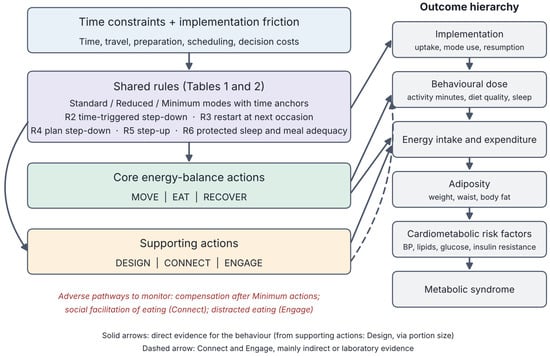
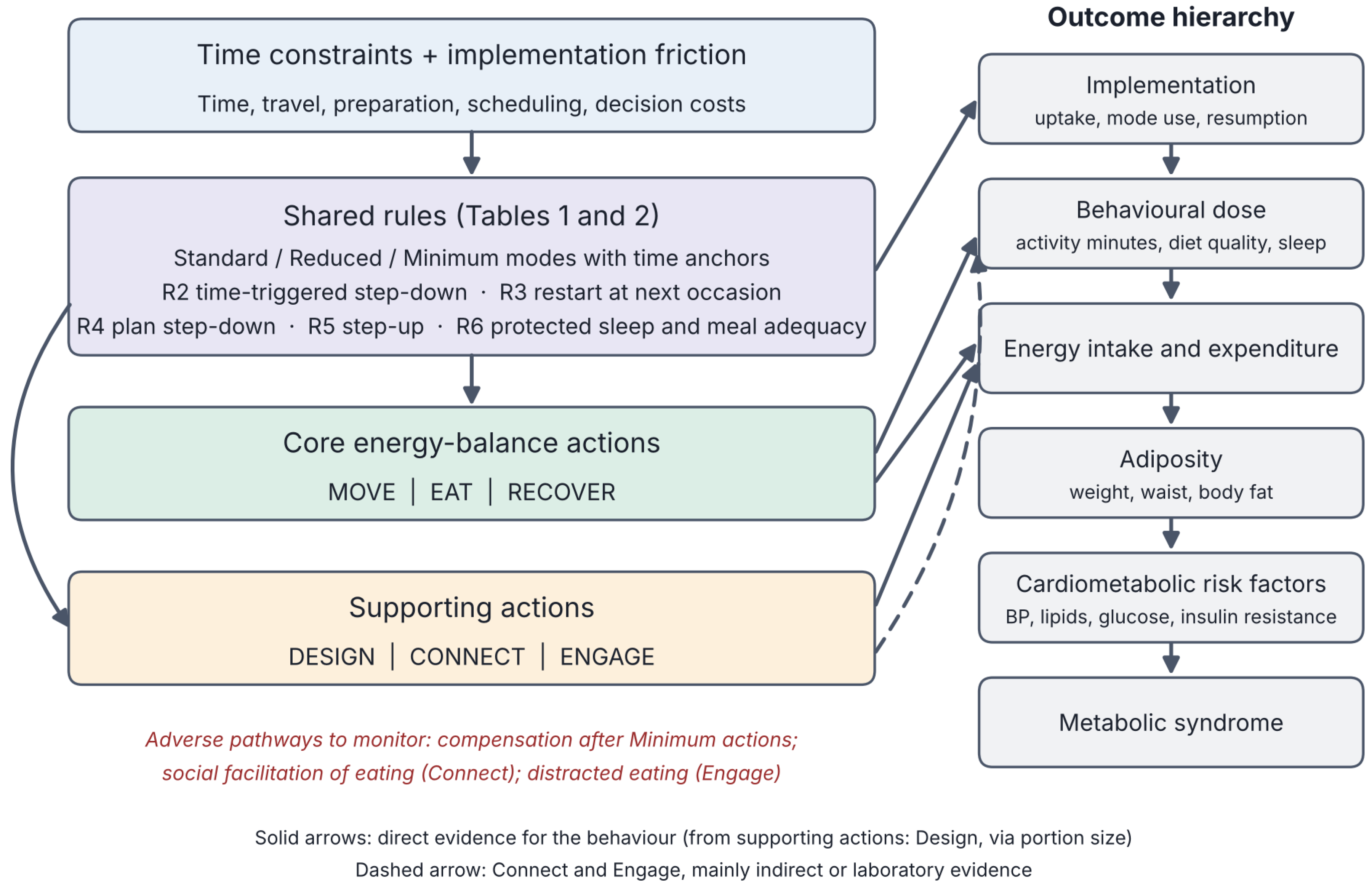
Figure 1 and Table 3 place the six actions on a common outcome hierarchy: implementation (uptake, mode use, resumption) → behavioural dose (activity minutes, diet quality, sleep duration) → energy intake and expenditure → adiposity (body weight, waist circumference, body fat) → cardiometabolic risk factors (blood pressure, lipids, glucose, insulin resistance) → metabolic syndrome. Move, Eat, and Recover have evidence at the energy-balance level. Design has evidence on selection and, for portion size, on consumption. Connect has evidence on weight-loss support but not on substitution, and Engage has mechanistic and laboratory evidence only. No study has yet linked the integrated framework to adiposity.
Figure 1.
Conceptual pathways and outcome hierarchy of the six-action framework. Time constraints and implementation friction are addressed by shared mode-switching and restart rules (Table 1), applied to the core energy-balance actions (Move, Eat, Recover) and the supporting actions (Connect, Design, Engage). Effects are hypothesized to pass along the outcome hierarchy on the right. Solid arrows indicate pathways with direct evidence for the behaviour; dashed arrows indicate pathways supported mainly by indirect or laboratory evidence. The figure is a conceptual model, not a validated causal model.
Table 3.
Evidence map: pathway to adiposity, design and population of cited evidence, and remaining questions.
5. Positioning, Boundaries, and Equity
5.1. Relation to Existing Behaviour-Change Approaches
The framework does not replace COM-B or the Behaviour Change Wheel, which explain behaviour through capability, opportunity, and motivation and link these to intervention functions [54]. Nor is maintenance a new theoretical domain: a review of 100 behaviour theories identified motives, self-regulation, resources, habits, and environmental and social influences as explanations of maintenance [55]. Within COM-B, time scarcity is a constraint on physical opportunity, and the framework is an implementation specification for that constraint. Table 4 compares it with the approaches it most resembles.
Table 4.
Comparison with related approaches.
Relapse prevention introduced the idea that a single lapse need not become a relapse, and that interpreting a lapse as total failure—the abstinence-violation effect—promotes relapse [56]. The framework adopts this reframing but adds a behavioural return path: a prespecified smaller version of the same action at the next occasion. Coping planning, in which people plan in advance how to deal with barriers and get back on track, increased physical activity in a randomized study among cardiac rehabilitation patients [57]; the framework differs by offering a standard, time-indexed menu instead of individually generated plans, which lowers the planning burden for people who are short of time. Habit-based interventions attach small behaviours to existing routines; in the Ten Top Tips trial, such advice delivered through primary care produced greater weight loss than usual care at three months, although the groups no longer differed at 24 months [58], and habit formation in daily life tolerates an occasional missed opportunity [59]. The Minimum mode is designed to keep this cue–response repetition going on constrained days. The small-changes approach holds that modest changes are more achievable and sustainable than large ones [60]; here, however, small actions are a floor for constrained days rather than the target, and the Standard mode remains aligned with guidelines. Finally, adaptive interventions and just-in-time adaptive interventions use tailoring variables and decision rules to adjust support [22]. The mode-switching rules are close analogues, with available time as the tailoring variable, but they can be operated by the participant without sensors.
Resumption after interruption has itself been tested. In a megastudy of 54 interventions among 61,293 gym members, the best-performing intervention offered small rewards for returning after a missed workout [61]. This supports resumption as a modifiable target, at least for exercise. The present framework pursues the same target without incentives, by lowering the threshold for the returning occasion.
What is new, therefore, is not any single technique but a specific combination: a time-triggered menu of modes with operational anchors, a prespecified restart rule and step-up rule, the same rule structure across six behavioural domains, and an explicit distinction between dose-scalable and dose-protected elements. Mapping each rule to the Behaviour Change Technique Taxonomy v1 (Table 1 and Table 2) [24] makes this combination reportable and replicable. It also defines the matched active comparator for Proposition 1: the same information, contact, goals, action planning, self-monitoring, and domain-specific techniques, but a single fixed mode without the switching and restart rules.
5.2. Boundaries: Dose, Compensation, and Displacement
Three boundaries apply across the framework and are stated here once. First, modes are implementation options, not equivalent doses; a Minimum action supports continuity and does not deliver the physiological effects of the Standard mode. Second, Minimum actions might license compensatory behaviour (“I have done my walk, so I can have the snack”), as described by the compensatory health beliefs model [62]; the evaluation therefore compares energy intake on days with and without Minimum-mode actions (Section 6.3). Third, participants might settle into the Minimum mode and so displace more effective behaviour; the step-up rule (Table 1, R5) and the co-primary dose endpoint (Section 6.2) are designed to limit and detect this. The framework complements, and does not replace, guideline-based preventive care or the clinical treatment of obesity.
5.3. Target Population, Selection, and Equity
Definition. “Time-constrained working adults” refers to employed adults who report that lack of time limits their health behaviours. For research use, we propose three complementary measures of time constraint: paid working hours plus commuting time (for example, 50 h or more per week combined); a perceived time-pressure scale; and, in a subsample, a time-use diary. One measure can define eligibility while the others describe the sample.
Level of prevention. The framework is designed for universal and selective prevention among employed adults, including those with overweight or central obesity identified through workplace health checks such as the Japanese specific health check and guidance system [8]. For people with diagnosed obesity, diabetes, or cardiovascular disease, it may complement but not replace clinical treatment.
Occupational differences. The examples in Supplementary Materials S1 and S5 assume office work. For manual workers, Move emphasizes leisure-time rather than additional occupational activity [28]; for night-shift workers, Recover anchors sleep to the main sleep period [38].
Selection and equity. The six actions are a menu, not six daily tasks: participants choose one to three actions according to their own barriers and priorities (Table 1, R1). The framework is most relevant when implementation friction is the main barrier. It cannot solve problems arising from insufficient income, unsafe housing, inaccessible neighbourhoods, unpredictable schedules, disability-related barriers, or organizational demands beyond individual control; in such settings, employer and policy change are prerequisites. Minimum actions must not be used to shift responsibility for structural constraints onto workers or to justify excessive workloads. Evaluations should test whether effects differ by occupational control, income, disability, caregiving, and shift work.
5.4. Illustrative Implementation Pathways
Consider an office worker who sits for most of the day and has little control over her working hours, and who selects Move and Eat. Her planned Move occasion is a 20-min brisk walk after her last meeting (Standard). On a day when a deadline leaves eight minutes, she walks for eight minutes (Reduced; R2). If she misses the walk entirely, her next occasion begins with at least one minute of brisk stair climbing at the same cue (R3), and the missed walk is not made up. After two consecutive misses, her default becomes Reduced (R4); after three completed Reduced walks it returns to Standard (R5). Her Eat default is a pre-selected lunch that meets two of three quality criteria in a standard portion, with a one-item swap as the Minimum. For a night-shift worker whose main problem is short daytime sleep, Recover protects the post-shift sleep period and uses a shortened wind-down on busy days without reducing sleep opportunity. These examples illustrate the rules; they are not tested protocols.
6. Testable Propositions and Evaluation Agenda
6.1. Propositions
Proposition 1 (resumption). Compared with an active programme matched for information, contact, goals, action planning, self-monitoring, and the domain-specific techniques in Table 2 but using a single fixed mode, adding the mode-switching and restart rules (Table 1) will shorten time to resumption after time-related interruptions and increase the proportion of weeks that meet an arm-independent behavioural threshold.
Proposition 2 (dose and energy balance). Mode switching will maintain or increase weekly behavioural dose (device-measured activity, sleep duration, diet quality) relative to the comparator. Any effect on energy intake, energy expenditure, and adiposity will depend on the dose achieved, not on the frequency of Minimum actions.
Proposition 3 (context). Effects will be larger where implementation friction, rather than structural constraint, is the main barrier, and will vary with working hours, shift work, occupational autonomy, and control over the immediate environment.
Proposition 4 (substitution; exploratory). Among participants who report reward-driven eating, food-free Connect or Engage alternatives offered at transition points will reduce snacking episodes relative to a matched control activity, and the reduction will be larger when Design has increased the effort needed to obtain snacks.
Proposition 5 (integration; exploratory). A selectable six-action menu will be more acceptable than a single-domain programme. Any added benefit of the menu, as distinct from the rules, requires a separate comparison.
Falsification. The central claim is not supported if, against the matched comparator, the rules fail to improve resumption or threshold-meeting weeks, or if they improve these endpoints while weekly behavioural dose falls or energy intake rises.
6.2. Endpoints
Because the intervention legitimizes Minimum actions while a fixed-mode comparator has no equivalent, an endpoint such as “any completed action” would favour the intervention by construction. Completion is therefore defined identically in both arms against an arm-independent behavioural threshold, measured objectively where feasible. We propose two co-primary endpoints: (a) the proportion of weeks in which the participant meets a prespecified threshold in each selected domain (for example, at least 75 min of device-measured moderate-to-vigorous activity, or mean actigraphy-measured sleep within 30 min of the individual target); and (b) a continuous, dose-sensitive measure in the same domain, such as weekly device-measured moderate-to-vigorous activity, mean sleep duration, or a diet-quality score from repeated 24-h recalls. Minimum actions count towards these endpoints only through the behaviour they actually produce.
Event-level resumption—reaching the threshold behaviour within seven days of a logged interruption, with three- and fourteen-day windows as sensitivity analyses—is a secondary, mechanistic endpoint. Groups are compared by intention to treat; analyses account for clustering of interruptions within participants, report the frequency of interruptions in each arm, and do not condition the primary comparison on interruptions occurring after randomization. Energy intake, body weight, waist circumference, and cardiometabolic risk factors are secondary outcomes in efficacy trials and primary outcomes only in an adequately powered confirmatory trial. Metabolic syndrome, defined by the harmonized criteria [5], is a distal clinical endpoint distinct from its individual components.
6.3. Minimizing Measurement Burden
Recording should not become an elaborate monitoring system. The minimum essential data set is three taps per planned occasion (mode intended; completed or missed; time-related reason, yes or no) and one weekly item on perceived burden. Behavioural dose is measured passively where possible—accelerometry for activity and sleep—and dietary intake by a small number of repeated 24-h recalls. Brief ecological momentary assessment (one or two items on snacking and craving at transition points) is used only in studies of Proposition 4 and only in sampled periods. To detect compensation, energy intake is compared between days with and without Minimum-mode actions, and compensatory health beliefs are measured at baseline and follow-up [62].
6.4. Staged Evaluation
Following the updated Medical Research Council framework for complex interventions [63], evaluation proceeds in stages with explicit progression criteria. Stage 1 is a feasibility study of the rules, anchors, and recording; progression could require, for example, retention of at least 80%, logging of at least 70% of planned occasions, and acceptable perceived burden. Stage 2 optimizes the intervention using the multiphase optimization strategy [64]: a factorial experiment can separate the contributions of the graded modes, the restart rule, and the six-domain menu; a sequential multiple assignment randomized trial (SMART) can compare variants of the decision rules, such as stepping down after two versus three misses [64]; and a micro-randomized trial can test momentary prompts for food-free alternatives under Proposition 4 [65]. Stage 3 is a randomized comparison with the matched active comparator on the co-primary endpoints. A confirmatory trial with adiposity as the primary outcome would require separate power calculations and at least 12 months of follow-up.
7. Limitations and Conclusions
This is a selective narrative synthesis. It may omit relevant evidence, does not grade certainty, and draws on studies that differ in population, design, and endpoint; several mechanisms rest on laboratory studies or on populations other than working adults (Table 3). The operational anchors and switching thresholds are initial specifications chosen for practicality, not empirically derived values, and may need recalibration for particular occupations and cultures. The strongest obesity-relevant evidence concerns the behaviours themselves—sleep, physical activity, and portion size—rather than the proposed delivery format, and the substitution pathways for Connect and Engage are the least supported.
The framework contributes a specified and testable implementation architecture for obesity-relevant behaviours under time constraints: a time-triggered menu of modes with a fixed restart rule, applied consistently across six domains and mapped to established behaviour-change techniques. It would be supported if, compared with a matched active programme, it improves resumption and threshold-meeting weeks while maintaining or increasing behavioural dose. It would be undermined if gains in resumption came at the cost of lower dose or higher energy intake. Effects on body weight, waist circumference, and cardiometabolic risk remain to be tested.
Supplementary Materials
The following supporting information can be downloaded at: https://www.mdpi.com/article/10.3390/obesities6060087/s1. The following supporting information accompanies this article: S1, Move; S2, Eat; S3, Recover; S4, Connect; S5, Design; S6, Engage (domain guides with operational anchors and decision rules); and S7, description of the intervention using the TIDieR checklist.
Author Contributions
Conceptualization, K.K., M.O. and Y.Y.; methodology, K.K., M.O. and Y.Y.; investigation, K.K.; writing—original draft preparation, K.K.; writing—review and editing, K.K., M.O. and Y.Y.; visualization, K.K.; validation, M.O.; supervision, Y.Y. All authors have read and agreed to the published version of the manuscript.
Funding
This research received no external funding.
Institutional Review Board Statement
Not applicable; this conceptual review reports no new research involving human participants.
Informed Consent Statement
Not applicable.
Data Availability Statement
No new data were created or analysed in this study. Data sharing is not applicable to this article.
Acknowledgments
During the preparation of this manuscript, ChatGPT (OpenAI; GPT-5.5) was used to assist with organization, language editing, and presentation of the conceptual framework, and Claude (Anthropic; Claude Opus 5.5) was used during revision to assist with language editing, reference checking, and redrawing Figure 1. The authors reviewed and edited all output and take full responsibility for the content.
Conflicts of Interest
The authors declare no conflicts of interest.
References
- Kahn, S.E.; Hull, R.L.; Utzschneider, K.M. Mechanisms linking obesity to insulin resistance and type 2 diabetes. Nature 2006, 444, 840–846. [Google Scholar] [CrossRef] [Scilit] [PubMed]
- Klop, B.; Elte, J.W.F.; Castro Cabezas, M. Dyslipidemia in obesity: Mechanisms and potential targets. Nutrients 2013, 5, 1218–1240. [Google Scholar] [CrossRef] [Scilit] [PubMed]
- Hall, J.E.; do Carmo, J.M.; da Silva, A.A.; Wang, Z.; Hall, M.E. Obesity-induced hypertension: Interaction of neurohumoral and renal mechanisms. Circ. Res. 2015, 116, 991–1006. [Google Scholar] [CrossRef] [Scilit] [PubMed]
- Powell-Wiley, T.M.; Poirier, P.; Burke, L.E.; Després, J.-P.; Gordon-Larsen, P.; Lavie, C.J.; Lear, S.A.; Ndumele, C.E.; Neeland, I.J.; Sanders, P.; et al. Obesity and cardiovascular disease: A scientific statement from the American Heart Association. Circulation 2021, 143, e984–e1010. [Google Scholar] [CrossRef] [Scilit] [PubMed]
- Alberti, K.G.M.M.; Eckel, R.H.; Grundy, S.M.; Zimmet, P.Z.; Cleeman, J.I.; Donato, K.A.; Fruchart, J.-C.; James, W.P.T.; Loria, C.M.; Smith, S.C., Jr. Harmonizing the metabolic syndrome: A joint interim statement of the International Diabetes Federation Task Force on Epidemiology and Prevention; National Heart, Lung, and Blood Institute; American Heart Association; World Heart Federation; International Atherosclerosis Society; and International Association for the Study of Obesity. Circulation 2009, 120, 1640–1645. [Google Scholar] [CrossRef] [Scilit] [PubMed]
- Venn, D.; Strazdins, L. Your money or your time? How both types of scarcity matter to physical activity and healthy eating. Soc. Sci. Med. 2017, 172, 98–106. [Google Scholar] [CrossRef] [Scilit] [PubMed]
- Zhu, Y.; Liu, J.; Jiang, H.; Brown, T.J.; Tian, Q.; Yang, Y.; Wang, C.; Xu, H.; Liu, J.; Gan, Y.; et al. Are long working hours associated with weight-related outcomes? A meta-analysis of observational studies. Obes. Rev. 2020, 21, e12977. [Google Scholar] [CrossRef] [Scilit] [PubMed]
- Fukuma, S.; Iizuka, T.; Ikenoue, T.; Tsugawa, Y. Association of the national health guidance intervention for obesity and cardiovascular risks with health outcomes among Japanese men. JAMA Intern. Med. 2020, 180, 1630–1637. [Google Scholar] [CrossRef] [Scilit] [PubMed]
- Kokubun, K.; Okamoto, M.; Yamakawa, Y. Reconfiguring physical activity for metabolic syndrome prevention among time-constrained working adults: Preserving core active ingredients while reducing implementation burden. Preprints 2026, 2026090170. [Google Scholar] [CrossRef] [Scilit]
- Kokubun, K.; Okamoto, M.; Yamakawa, Y. Meal architecture: An implementation framework for reconfiguring evidence-based dietary interventions for time-constrained working adults. Preprints 2026, 2026090167. [Google Scholar] [CrossRef] [Scilit]
- Kokubun, K.; Okamoto, M.; Yamakawa, Y. Reconfiguring sleep and stress management for metabolic syndrome prevention in time-constrained business professionals: Preserving functional core components while reducing temporal and cognitive burden. Preprints 2026, 2026090239. [Google Scholar] [CrossRef] [Scilit]
- Kokubun, K.; Okamoto, M.; Yamakawa, Y. Behavioural environmental theory of emotional eating: Time-adapted metabolic social connection as an immediate non-food reinforcement strategy. Preprints 2026, 2026090185. [Google Scholar] [CrossRef] [Scilit]
- Kokubun, K.; Okamoto, M.; Yamakawa, Y. Reconfiguring reinforcing opportunities: A behavioural framework for time-adapted environmental intervention in metabolic syndrome prevention. Preprints 2026, 2026090184. [Google Scholar] [CrossRef] [Scilit]
- Kokubun, K.; Okamoto, M.; Yamakawa, Y. Reconfiguring learning and hobby activities for metabolic syndrome prevention: A time-adapted non-food reward framework for business professionals. Preprints 2026, 2026090183. [Google Scholar] [CrossRef] [Scilit]
- Baethge, C.; Goldbeck-Wood, S.; Mertens, S. SANRA—A scale for the quality assessment of narrative review articles. Res. Integr. Peer Rev. 2019, 4, 5. [Google Scholar] [CrossRef] [Scilit] [PubMed]
- Lippman, D.; Stump, M.; Veazey, E.; Guimarães, S.T.; Rosenfeld, R.; Kelly, J.H.; Ornish, D.; Katz, D.L. Foundations of lifestyle medicine and its evolution. Mayo Clin. Proc. Innov. Qual. Outcomes 2024, 8, 97–111. [Google Scholar] [CrossRef] [Scilit] [PubMed]
- Carr, K.A.; Epstein, L.H. Choice is relative: Reinforcing value of food and activity in obesity treatment. Am. Psychol. 2020, 75, 139–151. [Google Scholar] [CrossRef] [Scilit] [PubMed]
- Gale, J.T.; Martin, H.; Haszard, J.J.; Peddie, M.C. The acute effects of interrupting prolonged sitting with regular activity breaks on postprandial glucose and insulin in adults: A systematic review and meta-analysis. Obes. Rev. 2026, 27, e70152. [Google Scholar] [CrossRef] [Scilit] [PubMed]
- Amirfaiz, S.; Shahril, M.R. Objectively measured physical activity, sedentary behavior, and metabolic syndrome in adults: Systematic review of observational evidence. Metab. Syndr. Relat. Disord. 2019, 17, 1–21. [Google Scholar] [CrossRef] [Scilit] [PubMed]
- Chen, J.P.; Chen, G.C.; Wang, X.P.; Qin, L.; Bai, Y. Dietary fiber and metabolic syndrome: A meta-analysis and review of related mechanisms. Nutrients 2018, 10, 24. [Google Scholar] [CrossRef] [Scilit] [PubMed]
- Xie, J.; Li, Y.; Zhang, Y.; Vgontzas, A.N.; Basta, M.; Chen, B.; Xu, C.; Tang, X. Sleep duration and metabolic syndrome: An updated systematic review and meta-analysis. Sleep Med. Rev. 2021, 59, 101451, Corrigendum in Sleep Med. Rev. 2023, 68, 101751. [Google Scholar] [CrossRef] [Scilit] [PubMed]
- Nahum-Shani, I.; Smith, S.N.; Spring, B.J.; Collins, L.M.; Witkiewitz, K.; Tewari, A.; Murphy, S.A. Just-in-time adaptive interventions (JITAIs) in mobile health: Key components and design principles for ongoing health behavior support. Ann. Behav. Med. 2018, 52, 446–462. [Google Scholar] [CrossRef] [Scilit] [PubMed]
- Hoffmann, T.C.; Glasziou, P.P.; Boutron, I.; Milne, R.; Perera, R.; Moher, D.; Altman, D.G.; Barbour, V.; Macdonald, H.; Johnston, M.; et al. Better reporting of interventions: Template for intervention description and replication (TIDieR) checklist and guide. BMJ 2014, 348, g1687. [Google Scholar] [CrossRef] [Scilit] [PubMed]
- Michie, S.; Richardson, M.; Johnston, M.; Abraham, C.; Francis, J.; Hardeman, W.; Eccles, M.P.; Cane, J.; Wood, C.E. The behavior change technique taxonomy (v1) of 93 hierarchically clustered techniques: Building an international consensus for the reporting of behavior change interventions. Ann. Behav. Med. 2013, 46, 81–95. [Google Scholar] [CrossRef] [Scilit] [PubMed]
- Bull, F.C.; Al-Ansari, S.S.; Biddle, S.; Borodulin, K.; Buman, M.P.; Cardon, G.; Carty, C.; Chaput, J.-P.; Chastin, S.; Chou, R.; et al. World Health Organization 2020 guidelines on physical activity and sedentary behaviour. Br. J. Sports Med. 2020, 54, 1451–1462. [Google Scholar] [CrossRef] [Scilit] [PubMed]
- Jakicic, J.M.; Kraus, W.E.; Powell, K.E.; Campbell, W.W.; Janz, K.F.; Troiano, R.P.; Sprow, K.; Torres, A.; Piercy, K.L.; 2018 Physical Activity Guidelines Advisory Committee. Association between bout duration of physical activity and health: Systematic review. Med. Sci. Sports Exerc. 2019, 51, 1213–1219. [Google Scholar] [CrossRef] [Scilit] [PubMed]
- Stamatakis, E.; Ahmadi, M.N.; Gill, J.M.R.; Thøgersen-Ntoumani, C.; Gibala, M.J.; Doherty, A.; Hamer, M. Association of wearable device-measured vigorous intermittent lifestyle physical activity with mortality. Nat. Med. 2022, 28, 2521–2529. [Google Scholar] [CrossRef] [Scilit] [PubMed]
- Holtermann, A.; Krause, N.; van der Beek, A.J.; Straker, L. The physical activity paradox: Six reasons why occupational physical activity (OPA) does not confer the cardiovascular health benefits that leisure time physical activity does. Br. J. Sports Med. 2018, 52, 149–150. [Google Scholar] [CrossRef] [Scilit] [PubMed]
- Gollwitzer, P.M.; Sheeran, P. Implementation intentions and goal achievement: A meta-analysis of effects and processes. Adv. Exp. Soc. Psychol. 2006, 38, 69–119. [Google Scholar] [CrossRef] [Scilit]
- Adriaanse, M.A.; Vinkers, C.D.W.; De Ridder, D.T.D.; Hox, J.J.; De Wit, J.B.F. Do implementation intentions help to eat a healthy diet? A systematic review and meta-analysis of the empirical evidence. Appetite 2011, 56, 183–193. [Google Scholar] [CrossRef] [Scilit] [PubMed]
- Chiavaroli, L.; Lee, D.; Ahmed, A.; Cheung, A.; Khan, T.A.; Blanco, S.; Mirrahimi, A.; Jenkins, D.J.A.; Livesey, G.; Wolever, T.M.S.; et al. Effect of low glycaemic index or load dietary patterns on glycaemic control and cardiometabolic risk factors in diabetes: Systematic review and meta-analysis of randomised controlled trials. BMJ 2021, 374, n1651, Correction in BMJ 2021, 374, n2114. [Google Scholar] [CrossRef] [Scilit] [PubMed]
- Hollands, G.J.; Shemilt, I.; Marteau, T.M.; Jebb, S.A.; Lewis, H.B.; Wei, Y.; Higgins, J.P.T.; Ogilvie, D. Portion, package or tableware size for changing selection and consumption of food, alcohol and tobacco. Cochrane Database Syst. Rev. 2015, 9, CD011045. [Google Scholar] [CrossRef] [Scilit] [PubMed]
- Al Khatib, H.K.; Harding, S.V.; Darzi, J.; Pot, G.K. The effects of partial sleep deprivation on energy balance: A systematic review and meta-analysis. Eur. J. Clin. Nutr. 2017, 71, 614–624. [Google Scholar] [CrossRef] [Scilit] [PubMed]
- Tasali, E.; Wroblewski, K.; Kahn, E.; Kilkus, J.; Schoeller, D.A. Effect of sleep extension on objectively assessed energy intake among adults with overweight in real-life settings: A randomized clinical trial. JAMA Intern. Med. 2022, 182, 365–374. [Google Scholar] [CrossRef] [Scilit] [PubMed]
- Albulescu, P.; Macsinga, I.; Rusu, A.; Sulea, C.; Bodnaru, A.; Tulbure, B.T. “Give me a break!” A systematic review and meta-analysis on the efficacy of micro-breaks for increasing well-being and performance. PLoS ONE 2022, 17, e0272460. [Google Scholar] [CrossRef] [Scilit] [PubMed]
- Altena, E.; Ellis, J.; Camart, N.; Guichard, K.; Bastien, C. Mechanisms of cognitive behavioural therapy for insomnia. J. Sleep Res. 2023, 32, e13860. [Google Scholar] [CrossRef] [Scilit] [PubMed]
- Bouman, E.J.; Beulens, J.W.J.; Groeneveld, L.; de Kruijk, R.S.; Schoonmade, L.J.; Remmelzwaal, S.; Elders, P.J.M.; Rutters, F. The association between social jetlag and parameters of metabolic syndrome and type 2 diabetes: A systematic review and meta-analysis. J. Sleep Res. 2023, 32, e13770. [Google Scholar] [CrossRef] [Scilit] [PubMed]
- Sun, M.; Feng, W.; Wang, F.; Li, P.; Li, Z.; Li, M.; Tse, G.; Vlaanderen, J.; Vermeulen, R.; Tse, L.A. Meta-analysis on shift work and risks of specific obesity types. Obes. Rev. 2018, 19, 28–40. [Google Scholar] [CrossRef] [Scilit] [PubMed]
- Wing, R.R.; Jeffery, R.W. Benefits of recruiting participants with friends and increasing social support for weight loss and maintenance. J. Consult. Clin. Psychol. 1999, 67, 132–138. [Google Scholar] [CrossRef] [PubMed]
- Salvy, S.-J.; Nitecki, L.A.; Epstein, L.H. Do social activities substitute for food in youth? Ann. Behav. Med. 2009, 38, 205–212. [Google Scholar] [CrossRef] [Scilit] [PubMed]
- Berkman, L.F.; Glass, T.; Brissette, I.; Seeman, T.E. From social integration to health: Durkheim in the new millennium. Soc. Sci. Med. 2000, 51, 843–857. [Google Scholar] [CrossRef] [Scilit] [PubMed]
- Holt-Lunstad, J.; Smith, T.B.; Layton, J.B. Social relationships and mortality risk: A meta-analytic review. PLoS Med. 2010, 7, e1000316. [Google Scholar] [CrossRef] [Scilit] [PubMed]
- Ruddock, H.K.; Brunstrom, J.M.; Vartanian, L.R.; Higgs, S. A systematic review and meta-analysis of the social facilitation of eating. Am. J. Clin. Nutr. 2019, 110, 842–861. [Google Scholar] [CrossRef] [Scilit] [PubMed]
- Bucher, T.; Collins, C.; Rollo, M.E.; McCaffrey, T.A.; De Vlieger, N.; Van der Bend, D.; Truby, H.; Perez-Cueto, F.J.A. Nudging consumers towards healthier choices: A systematic review of positional influences on food choice. Br. J. Nutr. 2016, 115, 2252–2263. [Google Scholar] [CrossRef] [Scilit] [PubMed]
- Naicker, A.; Shrestha, A.; Joshi, C.; Willett, W.; Spiegelman, D. Workplace cafeteria and other multicomponent interventions to promote healthy eating among adults: A systematic review. Prev. Med. Rep. 2021, 22, 101333. [Google Scholar] [CrossRef] [Scilit] [PubMed]
- Al-Tamimi, K.; van Herwerden, L.; Abdul, M.; Utter, J. Hospital-based food environment interventions to improve workforce dietary behaviour: A systematic literature review. Am. J. Lifestyle Med. 2025, 19, 616–625. [Google Scholar] [CrossRef] [Scilit] [PubMed]
- Wyse, R.; Jackson, J.K.; Delaney, T.; Grady, A.; Stacey, F.; Wolfenden, L.; Barnes, C.; McLaughlin, M.; Yoong, S.L. The effectiveness of interventions delivered using digital food environments to encourage healthy food choices: A systematic review and meta-analysis. Nutrients 2021, 13, 2255. [Google Scholar] [CrossRef] [Scilit] [PubMed]
- Goldfield, G.S.; Epstein, L.H. Can fruits and vegetables and activities substitute for snack foods? Health Psychol. 2002, 21, 299–303. [Google Scholar] [CrossRef]
- Boswell, R.G.; Kober, H. Food cue reactivity and craving predict eating and weight gain: A meta-analytic review. Obes. Rev. 2016, 17, 159–177. [Google Scholar] [CrossRef] [Scilit] [PubMed]
- Berridge, K.C. “Liking” and “wanting” food rewards: Brain substrates and roles in eating disorders. Physiol. Behav. 2009, 97, 537–550. [Google Scholar] [CrossRef] [Scilit] [PubMed]
- Alonso-Alonso, M.; Woods, S.C.; Pelchat, M.; Grigson, P.S.; Stice, E.; Farooqi, S.; Khoo, C.S.; Mattes, R.D.; Beauchamp, G.K. Food reward system: Current perspectives and future research needs. Nutr. Rev. 2015, 73, 296–307. [Google Scholar] [CrossRef] [Scilit] [PubMed]
- Bone, J.K.; Bu, F.; Sonke, J.K.; Fancourt, D. Leisure engagement in older age is related to objective and subjective experiences of aging. Nat. Commun. 2024, 15, 1499. [Google Scholar] [CrossRef] [Scilit] [PubMed]
- Robinson, E.; Aveyard, P.; Daley, A.; Jolly, K.; Lewis, A.; Lycett, D.; Higgs, S. Eating attentively: A systematic review and meta-analysis of the effect of food intake memory and awareness on eating. Am. J. Clin. Nutr. 2013, 97, 728–742. [Google Scholar] [CrossRef] [Scilit] [PubMed]
- Michie, S.; van Stralen, M.M.; West, R. The behaviour change wheel: A new method for characterising and designing behaviour change interventions. Implement. Sci. 2011, 6, 42. [Google Scholar] [CrossRef] [Scilit] [PubMed]
- Kwasnicka, D.; Dombrowski, S.U.; White, M.; Sniehotta, F.F. Theoretical explanations for maintenance of behaviour change: A systematic review of behaviour theories. Health Psychol. Rev. 2016, 10, 277–296. [Google Scholar] [CrossRef] [Scilit] [PubMed]
- Marlatt, G.A.; George, W.H. Relapse prevention: Introduction and overview of the model. Br. J. Addict. 1984, 79, 261–273. [Google Scholar] [CrossRef] [Scilit] [PubMed]
- Sniehotta, F.F.; Scholz, U.; Schwarzer, R. Action plans and coping plans for physical exercise: A longitudinal intervention study in cardiac rehabilitation. Br. J. Health Psychol. 2006, 11, 23–37. [Google Scholar] [CrossRef] [Scilit] [PubMed]
- Beeken, R.J.; Leurent, B.; Vickerstaff, V.; Wilson, R.; Croker, H.; Morris, S.; Omar, R.Z.; Nazareth, I.; Wardle, J. A brief intervention for weight control based on habit-formation theory delivered through primary care: Results from a randomised controlled trial. Int. J. Obes. 2017, 41, 246–254, Correction in Int. J. Obes. 2021, 45, 2137–2138. [Google Scholar] [CrossRef] [Scilit] [PubMed]
- Lally, P.; van Jaarsveld, C.H.M.; Potts, H.W.W.; Wardle, J. How are habits formed: Modelling habit formation in the real world. Eur. J. Soc. Psychol. 2010, 40, 998–1009. [Google Scholar] [CrossRef] [Scilit]
- Hill, J.O. Can a small-changes approach help address the obesity epidemic? A report of the Joint Task Force of the American Society for Nutrition, Institute of Food Technologists, and International Food Information Council. Am. J. Clin. Nutr. 2009, 89, 477–484. [Google Scholar] [CrossRef] [Scilit] [PubMed]
- Milkman, K.L.; Gromet, D.; Ho, H.; Kay, J.S.; Lee, T.W.; Pandiloski, P.; Park, Y.; Rai, A.; Bazerman, M.; Beshears, J.; et al. Megastudies improve the impact of applied behavioural science. Nature 2021, 600, 478–483. [Google Scholar] [CrossRef] [Scilit] [PubMed]
- Rabiau, M.; Knäuper, B.; Miquelon, P. The eternal quest for optimal balance between maximizing pleasure and minimizing harm: The compensatory health beliefs model. Br. J. Health Psychol. 2006, 11, 139–153. [Google Scholar] [CrossRef] [Scilit] [PubMed]
- Skivington, K.; Matthews, L.; Simpson, S.A.; Craig, P.; Baird, J.; Blazeby, J.M.; Boyd, K.A.; Craig, N.; French, D.P.; McIntosh, E.; et al. A new framework for developing and evaluating complex interventions: Update of Medical Research Council guidance. BMJ 2021, 374, n2061. [Google Scholar] [CrossRef] [Scilit] [PubMed]
- Collins, L.M.; Murphy, S.A.; Strecher, V. The multiphase optimization strategy (MOST) and the sequential multiple assignment randomized trial (SMART): New methods for more potent eHealth interventions. Am. J. Prev. Med. 2007, 32, S112–S118. [Google Scholar] [CrossRef] [Scilit] [PubMed]
- Klasnja, P.; Hekler, E.B.; Shiffman, S.; Boruvka, A.; Almirall, D.; Tewari, A.; Murphy, S.A. Microrandomized trials: An experimental design for developing just-in-time adaptive interventions. Health Psychol. 2015, 34, 1220–1228. [Google Scholar] [CrossRef] [Scilit] [PubMed]

Disclaimer/Publisher’s Note: The statements, opinions and data contained in all publications are solely those of the individual author(s) and contributor(s) and not of MDPI and/or the editor(s). MDPI and/or the editor(s) disclaim responsibility for any injury to people or property resulting from any ideas, methods, instructions or products referred to in the content. |
© 2026 by the authors. Licensee MDPI, Basel, Switzerland. This article is an open access article distributed under the terms and conditions of the Creative Commons Attribution (CC BY) license.