


Abstract
Background: Previous research has documented weight bias in some young children and suggested environmental influences. The present study focused on children’s own cognitive development. The aim was to test whether weight bias would differ according to children’s levels of theory of mind (ToM). Methods: One hundred and thirty-nine children (54% girls), aged four to six years, read a storybook that contained an assessment of ToM and required choices between story characters that differed in body weight. Children were also asked to give reasons for their choices. Children’s responses were coded by content and emotional valence. Results: Children showed significant weight bias against the character with obesity in pro- and anti-social story situations. A significantly greater proportion of children with high ToM showed weight bias, particularly in the pro-social scenario. Weight bias was evident in the reasons given for character choices with reference to character emotion being most common. There were no differences in these reasons by level of ToM. Conclusions: In contrast with what was hypothesised, it was those with a higher ToM who showed greater weight bias. Future research could examine whether children’s own exposure to weight bias influences this relationship and how this may change with age. Building understanding of how children’s own cognitive development interplays with the lived experience of societal weight bias will be important to those working in paediatric healthcare and education.
1. Introduction
People with lived experience of overweight or obesity are subject to social stigma and discrimination based on their weight and physical appearance [1]. This causes distress and challenges engagement with weight management. As a result, there have been calls to fundamentally change the narrative on obesity, portraying weight stigma as a human rights issue that impacts health promotion across the life-cycle and on a global scale [2]. This has supported consideration of whether we should be working towards a different and hopefully more meaningful approach to the definition of obesity [3]. In addition, there is discussion about how the media frames obesity, and how those with lived experience of obesity could be better protected in education and the workplace [4]. Fundamental to this is the language used when referring to people with a lived experience of obesity [5].
Preceding these moves for social change has been a history of research interest in when and how weight bias becomes expressed by children. It is important to better understand how and when children acquire the attitudes to body shapes that are fundamental to weight bias and its consequences [6] (Note the terms ‘weight bias’ and ‘stigma’ are often used interchangeably in this literature, although bias usually references the relative preference for a thinner body weight or shape over one that is overweight).
Children’s preference for thin body shapes and rejection of overweight has been documented since the 1960s. The early studies in the USA looked at perceptions of disability and showed the character drawn as overweight being the one that 10- and 11-year-olds liked least [7]. Researchers went on to use a matching technique to show children were more likely to link negative attributions to characters drawn as overweight and positive attributions to normal weight or thin characters [8]. This portrayal of stereotyping has continued, including research using more realistically drawn characters [9], adults dressing as average weight or overweight [10], and figures of different body shape in cartoon form [11].
Studies such as these share a confirmatory bias [12]. That is, they force children to make choices between drawings in terms of their desirability, or to label drawings as either good or bad. In so doing they neglect nuances likely in children’s perception. When rating scales are included alongside dichotomised choices, then overweight body shapes are rated as less preferred rather than completely rejected [13]. Overweight body shapes are rated lower than healthy weight body shapes on a range of personality characteristics but still above the scale mid-points. Accordingly, a choice away from a character drawn as overweight does not equate to their complete rejection, rather a preference relative to the other representation available.
There has been relatively less focus on how young children acquire weight bias than to its presence. One potential vehicle for acquisition is how overweight is represented in the media to which children are exposed. Content analyses show the expected negative stereotyping of characters with obesity in children’s cartoons and popular movies [14,15,16]. This is also apparent in some studies of children’s books [17]. Social modelling of weight bias has been documented through observing correspondence with parental attitudes toward body size [18,19,20,21]. Clear evidence of the expected influence of peers is harder to come by [22]. However, there is a robust literature documenting victimisation of youth with overweight by their peers [23,24,25] and the complexity of the relationship between victimisation and BMI [26].
Missing from the characterisation of acquisition has been attention to the children themselves, especially from a developmental perspective. Several studies have looked at age differences in weight bias [27]. The broad finding is that older Junior or Elementary school-age children are more likely to show weight bias than those younger or of pre-school (or pre-Kindergarten) age. This is generally interpreted through recognising children’s increasing awareness of social cues and in terms of their cognitive development from a Piagetian perspective [28].
One of the early developmental achievements made by young children is theory of mind (ToM). As a key phase of social perception development, this is likely very relevant to understanding emerging weight bias. In essence, ToM is an individual’s ability to reason about the thoughts, beliefs, and feelings of others in order to predict and understand their behaviours [29]. ToM therefore forms the basis of understanding others’ mental states, being a recognition that these may differ from our own. It provides a second and ‘other’ perspective and is key to understanding social interactions. Elements of ToM are apparent in most children by the age of 4–5 [30].
Understandably, there is huge variation in how ToM is shown both between individuals and in relation to different perspectives and behaviours. In terms of social development, then, the relationship is bidirectional. Children’s social experiences influence ToM development and vice versa, a reciprocity captured within Theory Theory [31].
Only one previous study has considered ToM in children and related this to weight bias. The judgements of 3- to 6-year-olds were considered in a story where one child was asked to share drawing materials with another [32]. The main story character in each scenario had what the authors referred to as ‘typically stigmatized characteristics’, being either overweight, in a wheelchair, or having an accent. Children were asked whether the main character would help the other child (by sharing art materials) and whether they were ‘nice’, ‘mean’, or ‘not nice or mean’. Children with higher ToM skills gave more favourable responses than those with lower ToM. Accordingly, higher ToM in this sample was associated with the absence of rejection, regardless of the ‘stigmatized characteristic’. The authors argued that ToM skills enable children to understand that features such as being overweight are unrelated to not wanting to help that person.
Our research with 4–6-year-olds has evidenced weight bias in both children’s pro- and anti-social actions [12]. In this study the character with overweight was helped first in only a third of the choices made compared with a normal weight peer. In addition, this character was more likely chosen as the target for anti-social action (being stolen from). What is currently unknown is whether children’s cognitive development, in this case their level of ToM, impacts on these choices, and secondly, what reasons children give for their decisions and whether these differ according to ToM. The aim of this study therefore was to examine weight bias in young children and compare those with high ToM to those with low ToM in their choices between story characters of different body shapes. We listened to the children’s reasons for making these choices, as we and others have in previous studies [12,22,33]. We also considered possible gender differences given findings of a slightly stronger relationship between ToM and pro-social behaviour in girls [34,35]. It was hypothesised that children with high ToM would show less weight bias in both pro- and anti-social situations, in line with the findings of Lapin & Boseovski [32].
2. Method
Participants
One hundred and thirty-nine children (63 boys and 76 girls) from seven primary schools in the north of England took part in the study. They were from Reception class or Year 1 of the national educational system in England and ranged in age from 4 to 6 years. These were state schools where families were of mainly low to middle socioeconomic status. All had parental consent for participation. Ethical approval for the study was granted by the University of Leeds, School of Medicine Research Ethics Committee (MREC18-042).
3. Materials
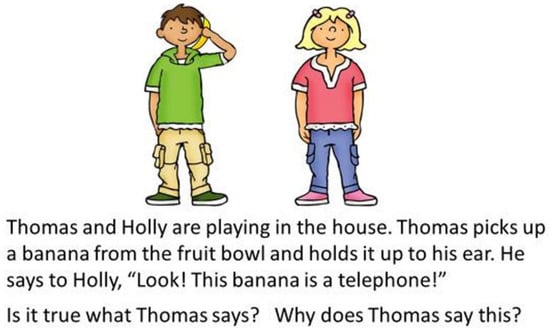
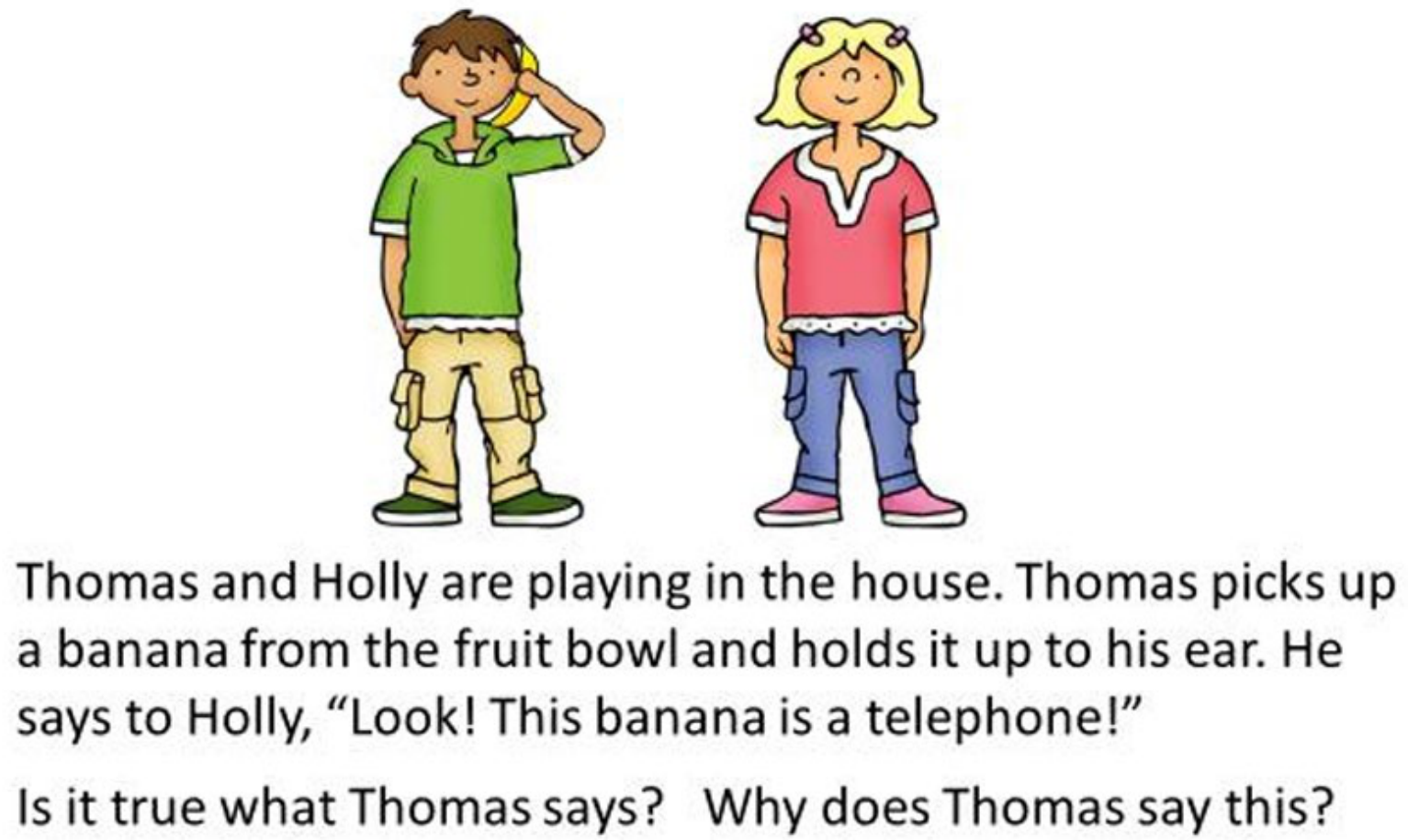
Storybooks. A picture book was created for this study. It featured professionally illustrated child characters used in previous studies [12,22]. There were four characters: a girl and a boy of healthy weight (Holly and Thomas), and a girl and boy with overweight (Alfina and Alfie). The first book section had two scenarios that have been used as part of a validated assessment of ToM, Happe’s Strange Stories [36]. The pretend and the lie stories were used with the healthy weight characters (Holly, Thomas) appearing in each (for example, see Figure 1 for the drawing of the lie story). After reading the story, children were asked, “Is it true what Holly (or Thomas) says?” and then, “Why did Holly (or Thomas) say this?”
Figure 1.
Story book page example (the lie story).
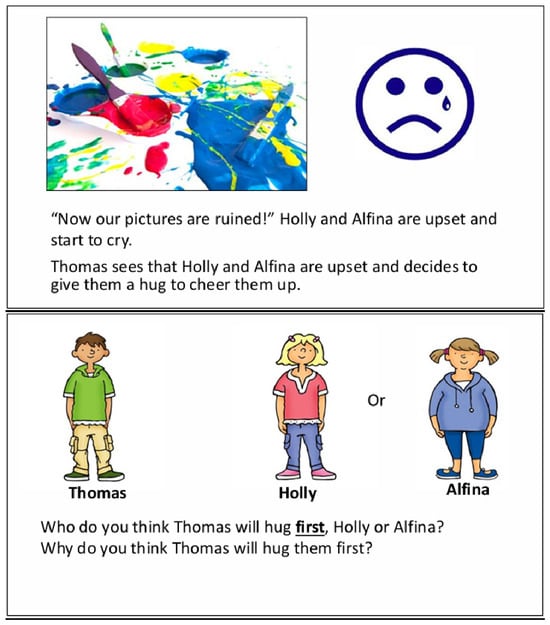
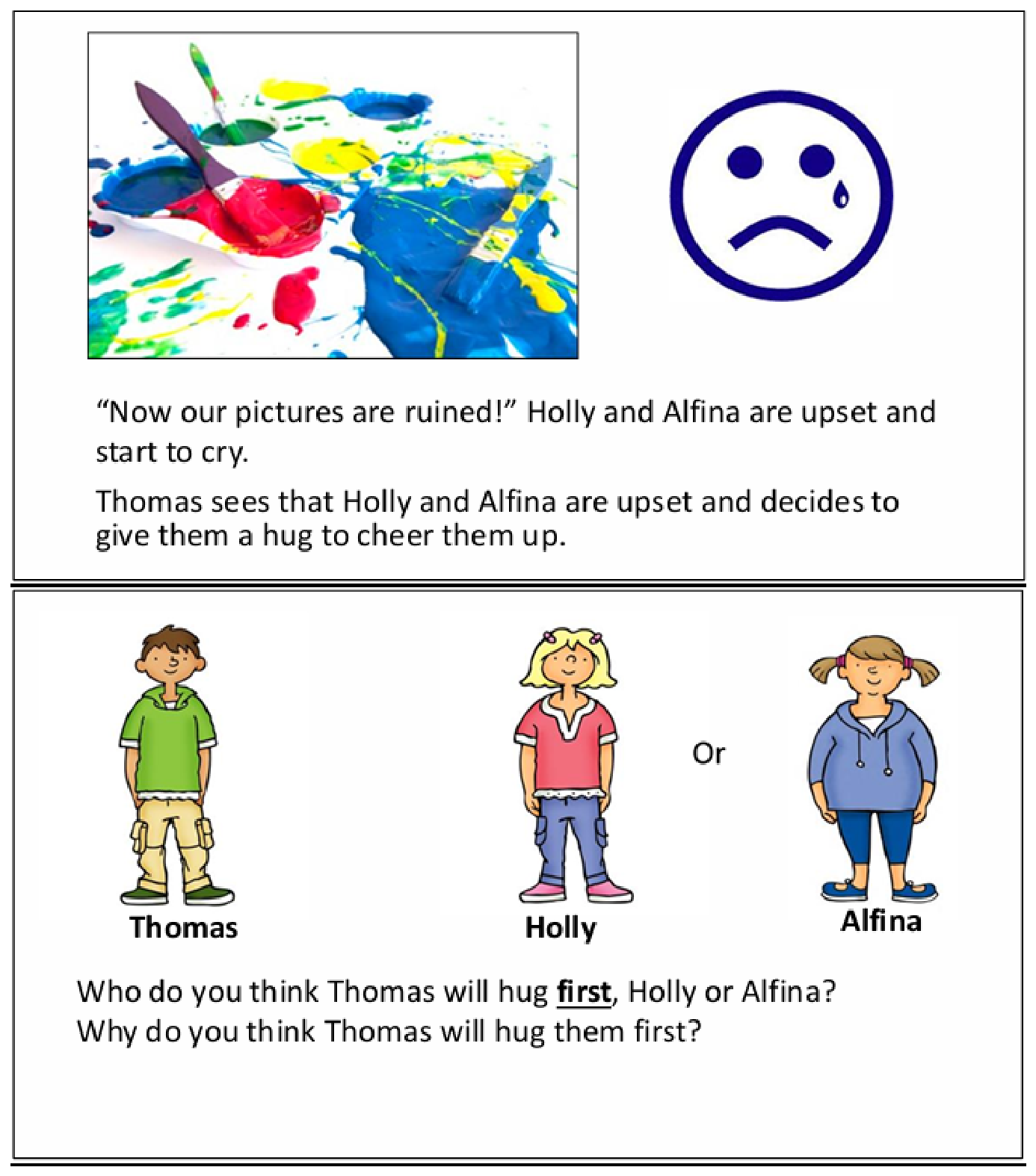
The second section of each book included two situations used previously to examine children’s understanding of pro-social behaviour [12]. The books were matched to the sex of the two characters that they had to choose between. Girls were shown ‘Holly’, and ‘Alfina’ who were using crayons to draw their pictures. Boys were shown ‘Thomas’ and ‘Alfie’ drawing pictures. Alfina and Alfie were drawn as overweight. The scenario examined comforting when the story characters Holly and Alfina were upset after paint had been spilt on their artwork. The children were asked to say who should be chosen to be comforted first, a character of healthy weight (Holly) or one with overweight (Alfina): “Who do you think Thomas will hug first, Holly or Alfina?” and then “Why do you think Thomas will hug them first?” (for boys it was Holly who had to choose between Thomas and Alfie). An example of this part of the storybook can be seen in Figure 2.
Figure 2.
Storybook example pages of the comforting scenario.
The last section was an anti-social scenario. It involved one of the children deciding to steal from another child having run out of stickers to complete their artwork. Girls were asked, “Who do you think Thomas will steal a sticker from, Holly or Alfina?”, and “Why do you think Thomas will steal from that girl?” Boys were asked whether Holly would steal from Thomas or Alfie.
Body size rating. The body figure scale by Collins [37] was used to estimate the body size of each participant. This pictorial scale features seven preadolescent figures of increasing body size. It has uncertain psychometrics for use by young children to indicate their own body size [38]. The body size of each participant was therefore estimated by the researcher and matched to one of the figures following the procedure of Charsley et al. [39].
3.1. Procedure
The researcher was introduced to the class. Children completed the storybook individually with the researcher in a quiet area of the classroom. Children’s assent was gained before they started reading. Children were encouraged to read the book aloud themselves, but the child often chose for the researcher to read. All sessions were audio recorded. Children were given a sticker to thank them for their participation.
3.2. Data Analysis
Children’s comments were transcribed from the audio recordings. Their answers to each of the ToM questions were scored 0–2 using the published system [36]. A score of 0 indicated that children did not show ToM in their response, 1 indicated reference to the underlying intention, and 2 when children’s responses indicated an understanding of intention. There were 2 scenarios and the total ToM scores ranged from 0 to 4. Children were grouped as high ToM (score 3–4) or low ToM (score 0–2). This was seen as a conservative way of separating children who showed good evidence of ToM from those who had no or limited ToM.
For the weight bias assessment, children’s character choices were recorded. Verbal responses were coded according to emotional valence, and classified as a positive, negative, or neutral emotional tone as per our previous work [12,22]. Positively coded responses were those that described the choice as fair, being responsive or helping (e.g., someone in distress), or liking the character in some way (including the way they looked). Negatively coded responses were those saying something negative about one of the characters, including comments on their appearance, body shape or weight, or that justified theft (e.g., in the stealing situation, saying that one character had more). Neutral responses included the character standing nearest to the one chosen, being similar in clothes or appearance, or any response that could not be clearly coded as positive or negative. Frequencies of positive, negative and neutral responses were calculated. In addition, the most common themes in children’s responses were identified. These fell into 4 broad groupings: reference to a character’s emotion, character appearance, a story feature, and ‘other’.
Two authors independently coded the children’s responses to the two scenarios. There was strong agreement on both coding frameworks; for the valence framework Cohen’s kappa = 0.98, p < 0.001, for the theme analysis kappa = 0.92, p < 0.001.
One-proportion z-score tests were used to compare the proportion needed to reject the null hypothesis, i.e., character choice being equally likely (at 50%). Z-scores were used to test whether there was a difference in the proportions observed between the low and high ToM groups.
4. Results
4.1. Character Choices
There was a clear weight bias in children’s pro- and anti-social choices. Weight bias was apparent in that, overall, 74% of children recommended comforting the character of healthy weight first (79.9%) and to steal from the character with overweight (68.3%; z = 8.04, p < 0.001; Table 1).
Table 1.
Character choices indicating weight bias made by children with low and high ToM, N (%).
There were also differences according to children’s ToM. Those with high ToM were significantly more likely to show weight bias across the two scenarios (79.0%) than those with low ToM (65.7%; difference in proportions z = 2.44, p = 0.015). Looking separately at the two scenarios, children with high ToM were more likely to show weight bias than those with low ToM in the comforting scenario (z = 2.07, p = 0.04). This was not statistically significant in the stealing scenario (z = 1.45, p = 0.15).
4.2. Children’s Reasoning
Across the two scenarios, in 32.0% of choices children either failed to give an answer or said, “don’t know”. Around a quarter gave no-response to both scenarios (27.0%), something more typical of younger children and those children with low ToM. Of the 189 reasons given, three were excluded because they related personally to the child providing the answer, rather than to the scenario, e.g., “I am called Thomas and I like it.”
Children’s reasons for choices were most frequently positive (42.5%), followed by neutral (31.7%), with the smallest proportion coded as negative (25.8%). Across the two scenarios, 48 negative comments were coded, significantly more after choosing the character with overweight (Alfie or Alfina) (n = 37, 77.1%, z = 3.76, p < 0.001). Boys and girls made similar proportions of negative comments (boys 27.4%, girls 24.5%, NS).
In total, 79 positive comments were made, with just 16 making positive comments related to choosing Alfie or Alfina (20.3%, z = 5.28, p < 0.001). Again, boys and girls made similar proportions of positive comments (boys 45.2%, girls 40.2%, NS).
Table 2 shows the emotional valence when the reasons in the two scenarios were considered separately. In the comforting scenario, there were similar and infrequent voicing of negative comments by children with low (3.7%) and high ToM (3.2%, z = 0.39, p = 0.70). Likewise, there was no difference in the proportion of positive comments (81.5 vs. 77.8%, z = 0.39, p = 0.70). In the stealing scenario, children with high ToM made marginally more negative comments (54.0% vs. low 33.3%, z = 1.96, p = 0.05). The small proportions of positive comments made by children in this scenario did not differ between low or high ToM groups (15.2 vs. 4.8%, z = 1.75, p = 0.08).
Table 2.
Frequency of emotionally valenced reasons given for character choices in children with low and high ToM, N (%).
Looking at the content of children’s comments by themes, the most common was reference to character emotion (39.8%, e.g., Holly: “She is sad”). This was followed by reference to a story feature (26.9%, e.g., Thomas: “They ruined his picture”), character appearance (19.3%, e.g., Holly: “She has hair clips in”), and ‘other’ (15.0%, e.g., Holly: “Because I do”). There were no significant differences between low or high ToM groups in terms of referring to character emotion (43.3 vs. 38.1%, z = 0.68, p = 0.50) or to character appearance (11.7 vs. 21.4%, z = 1.61, p = 0.11).
Across both scenarios, very few children’s reasons for choices were specific to body shape, size, or weight (n = 8 in total). Seven children made these references (5.0% of the total sample) with just one child speaking about body shape in both scenarios. Of the children who made comments about body shape, five were male, all were in Year 1 (the older year group), and five were in the high ToM group. Considering children’s own body weight, none were visually assessed as overweight (scoring 6 or 7). Of those scored at 5 (n = 15), only one child mentioned body shape in their reasoning for the comfort scenario.
5. Discussion
This is the first study that has examined in detail whether weight bias in children is related to the development of ToM, an important developmental cognitive achievement. We found clear evidence of weight bias in young children, consistent with our previous work on attitudes to pro-social behaviour in 5-year-olds [12]. In contrast with what was hypothesised, it was those children with a higher ToM that showed greater weight bias in their character choices, but less so in their verbal reasoning. Weight bias was most evident in the pro-social scenario (comforting) and less so in the anti-social scenario (stealing).
The broader literature on ToM suggests a significant but modest association between ToM and pro-social behaviour. In one meta-analysis that included 76 studies of children aged 2–12, those with higher ToM showed higher scores on pro-social assessments [34]. That is, those children scoring higher on ToM were those more likely to score higher on measures of pro-social behaviour. The association was significant but weak: r = 0.19. This was evident across all features of pro-social behaviour, namely helping, cooperating, and comforting. The association was slightly stronger in those aged 6 and older, and in girls. Separating cross-sectional and longitudinal studies and extending the age range of children (to 19 years) showed a slightly stronger association, but one that was not moderated by age, cultural background, or ToM assessment method [40]. Bidirectionality is possible in that while higher ToM facilitates pro-social behaviour, the rewards associated with being pro-social themselves facilitate ToM. And it is clear that ToM is just one facilitator of pro-social behaviour, and possibly not the most important [34].
Relating this back to the present study findings is challenging. However, the inclusion of an anti-social consideration could be helpful. The relationship of ToM with aggressive behaviour is small, negative, but robust [41]. It is further complicated when the impact of being victimised is included. For example, lower ToM in 5-year-olds has been related to higher reactive aggression, but only in those frequently victimised by their peers [42]. The reasoning is that children who lack the skills to consider another’s social cues must rely on their own recent experience of being victimised and are more likely to respond in an aggressive manner.
Proactive aggression may be different. Higher ToM skills are helpful in weighing up the risks and benefits in a social situation and anticipating how others will react. Accordingly, those with higher ToM skills who are victimised might use proactive aggression to improve their social standing within peers [42]. We know nothing of the teasing history of the children in the present study, nor any other aspect of their social history. In addition, personal experience of victimisation may not be necessary. Observation or social learning of what happens to those with overweight, in person or depicted in the media, may be sufficient. These are issues for potential future investigation.
While children with higher ToM were more likely to reject the character with overweight as the first to be comforted, the reasons they gave for this choice failed to show these differences in the negativity of reasons given. Instead, children’s choices were mainly expressed in a positive manner. It may be that children of this age struggle to verbalise their reasoning for the choices made in this scenario. It is possible that being within a school environment inhibited them from voicing negativity in social choices, something they perceived as against the school ethos. This does argue for conducting research in either a more neutral or familiar environment such as home. We note that Lapan & Boseovski [32] acknowledged that children with higher ToM were more likely themselves to display socially desirable responses in the presence of an experimenter. This may have been reinforced by their study taking place in a child development laboratory, an unfamiliar environment. Accordingly, environment is likely to affect children’s verbal reasoning, something to take account of in future research.
This research has a number of strengths. First, it focused on the children’s own cognitive development, which is something very much overlooked in this literature. Second, it used bespoke, high quality, professionally drawn materials in the storybooks that have been featured in several previous studies [12,13,22]. Third, it included both pro- and anti-social scenarios for children to consider. This builds a more complete picture of social choices. Similarly, asking children who they would help first reduces the tendency for confirmatory bias by implying that both characters would receive help in the end. Fourth, the research gave a voice to children by listening to what they said about the reasons for their choices. This distinctive approach is consistent with our previous work [12,22,39].
With regard to limitations, there was only one child in the study with a lived experience of overweight or obesity (as assessed at the time of the study). Recruiting children from a clinical service for obesity management to investigate ToM could address this. The study sample was small, particularly relative to the comparisons between high and low ToM scorers and between girls and boys. We also drew participants from a single area in the north of England. Generalisability is therefore questionable. Lastly, we used only part of the Happe’s Strange Stories assessment. There are over 200 different assessments for ToM in children [43]. Future research may wish to consider and use alternative, possibly multiple, assessments of ToM. In addition to the suggestions above regarding testing environment and victimisation history, future research could be done to better understand the chronology of ToM development [30] in its relationship with weight bias, including in real-life social situations [29].
In conclusion, the underlying rationale for an interest in children’s weight bias is threefold. First, early acquired weight bias sets in motion attitudes and behaviours that continue through to adulthood. Second, early expressed weight bias is a barometer of prevailing social attitudes. Children may be among the first to show changes or improvements in weight biases in the prevailing adult world. Third, understanding emerging weight bias is important for a better realisation of the challenges for children with a lived experience of obesity, at home, at school, and in healthcare settings. The present research confirms that children’s own cognitive development is important in understanding weight bias. A better understanding of how children’s cognitive development interplays with the lived experience of societal weight bias will be important to all those working in education and paediatric healthcare [44].
Author Contributions
C.R., G.L. and A.J.H. designed the study and were involved in data analysis. C.R. conducted the data collection. All authors have read and agreed to the published version of the manuscript.
Funding
This research did not receive any grant from funding agencies in the public, commercial, or not-for-profit sectors.
Institutional Review Board Statement
Ethical approval for the study was granted by the University of Leeds, School of Medicine Research Ethics Committee (MREC18-042), approval date: 24 January 2019.
Informed Consent Statement
All had parental consent for participation.
Data Availability Statement
Data are available on reasonable request.
Acknowledgments
This research was conducted in part fulfilment of CR’s doctoral training in Clinical Psychology at the University of Leeds. We thank the children, their parents, and the schools for taking part in this research. We are grateful to Phil Munroe for his fabulous character illustrations.
Conflicts of Interest
The authors declare no conflicts of interest. Outside of the submitted work: AJH reports receiving personal fees for advice from Slimming World (UK).
References
- Puhl, R.M.; Heuer, C.A. Obesity stigma: Important considerations for public health. Am. J. Public Health 2010, 100, 1019–1028. [Google Scholar] [CrossRef] [Scilit] [PubMed]
- Nutter, S.; Eggerichs, L.A.; Nagpal, T.S.; Salas, X.R.; Chea, C.C.; Saiful, S.; Ralston, J.; Barata-Cavalcanti, O.; Batz, C.; Baur, L.A.; et al. Changing the global obesity narrative to recognise and reduce weight stigma: A position statement from the World Obesity Federation. Obes. Rev. 2023, 25, e13642. [Google Scholar] [CrossRef] [Scilit] [PubMed]
- Rubino, F.; Cummings, D.E.; Eckel, R.H.; Cohen, R.V.; Wilding, J.P.H.; A Brown, W.; Stanford, F.C.; Batterham, R.L.; Farooqi, I.S.; Farpour-Lambert, N.J.; et al. Definition and diagnostic criteria of clinical obesity. Lancet Diabetes Endocrinol. 2025, 13, 221–262. [Google Scholar] [CrossRef] [Scilit] [PubMed]
- Brown, A.; Flint, S.W.; Batterham, R.L. Pervasiveness, impact and implications of weight stigma. eClinicalMedicine 2022, 47, 101408. [Google Scholar] [CrossRef] [Scilit] [PubMed]
- Obesity Action Alliance. Person-First Language. Available online: https://www.obesityaction.org/advocacy/what-we-fight-for/people-first-language (accessed on 27 August 2026).
- Haqq, A.M.; Kebbe, M.; Tan, Q.; Manco, M.; Salas, X.R. The complexity and stigma of pediatric obesity. Child. Obes. 2021, 17, 229–240. [Google Scholar] [CrossRef] [Scilit] [PubMed]
- Richardson, S.A.; Goodman, N.; Hastorf, A.H.; Dornbusch, S.M. Cultural uniformity in reaction to physical disabilities. Am. Sociol. Rev. 1961, 56, 241–247. [Google Scholar] [CrossRef] [Scilit]
- Staffieri, J.R. A study of social stereotypes of body image in children. J. Pers. Soc. Psychol. 1967, 7, 101–104. [Google Scholar] [CrossRef] [Scilit] [PubMed]
- Latner, J.D.; Simonds, M.; Rosewall, J.K.; Stunkard, A.J. Assessment of obesity stigmatization in children and adolescents: Modernising a standard measure. Obesity 2007, 15, 3078–3085. [Google Scholar] [CrossRef] [Scilit] [PubMed]
- Lehmkuhl, H.D.; Nabors, L.A.; Iobst, E. Factors influencing preschool-age children’s acceptance of models presented as overweight. Int. J. Pediatr. Obes. 2010, 5, 19–24. [Google Scholar] [CrossRef] [Scilit] [PubMed]
- Marx, J.M.; Kiefner-Burmeister, A.; Roberts, L.T.; Musher-Eizenman, D.R. Nothing alien about it: A comparison of weight bias in preschool-aged children’s ratings of non-human cartoons and human figures. Obes. Res. Clin. Pract. 2019, 13, 435–439. [Google Scholar] [CrossRef] [Scilit] [PubMed]
- Dearing, G.; Latchford, G.; Caterson, I.D.; Hill, A.J. Young children’s choices and thoughts about prosocial behavior towards others with overweight. Pediatr. Obes. 2024, 19, e13129. [Google Scholar] [CrossRef] [Scilit] [PubMed]
- Harrison, S.; Rowlinson, M.; Hill, A.J. No fat friend of mine: Young children’s responses to overweight and disability. Body Image 2016, 18, 65–73. [Google Scholar] [CrossRef] [Scilit] [PubMed]
- Klein, H.; Shiffman, K.S. Thin is “in” and stout is “out”: What animated cartoons tell viewers about body weight. Eat. Weight Disord. 2005, 10, 107–116. [Google Scholar] [CrossRef] [Scilit] [PubMed]
- Throop, E.M.; Skinner, A.C.; Perrin, A.J.; Steiner, M.J.; Odulana, A.; Perrin, E.M. Pass the popcorn: “Obesogenic” behaviors and stigma in children’s movies. Obesity 2014, 22, 1694–1700. [Google Scholar] [CrossRef] [Scilit] [PubMed]
- Howard, J.B.; Cockrell Skinner, A.; Ravanbakht, S.N.; Brown, J.D.; Perrin, A.J.; Steiner, M.J.; Perrin, E.M. Obesogenic behavior and weight-based stigma in popular children’s movies, 2012 to 2015. Pediatrics 2017, 140, e20172126. [Google Scholar] [CrossRef] [Scilit] [PubMed]
- Farago, F.; Savoy, S.; Xu, T.; He, Y. Body weight representations in children’s picturebooks. Contemp. Issues Early Child 2025, 26, 189–204. [Google Scholar] [CrossRef] [Scilit]
- Wolfenden, L.; McKeough, A.; Bowman, J.; Paolini, S.; Francis, L.; Wye, P.; Puhl, R. Experimental investigation of parents and their children’s social interaction intentions towards obese children. J. Paediatr. Child Health 2013, 49, 604–607. [Google Scholar] [CrossRef] [Scilit] [PubMed]
- Damiano, S.R.; Gregg, K.J.; Spiel, E.C.; McLean, S.A.; Wertheim, E.H.; Paxton, S.J. Relationships between body size attitudes and body image of 4-year-old boys and girls, and attitudes of their fathers and mothers. Int. J. Eat. Disord. 2015, 3, 16. [Google Scholar] [CrossRef] [Scilit] [PubMed]
- Speil, E.; Rodgers, R.F.; Paxton, S.J.; Wertheim, E.H.; Damiano, S.R.; Gregg, K.J.; McLean, S.A. “He’s got his father’s bias”: Parental influence on weight bias in young children. Br. J. Dev. Psychol. 2016, 34, 198–211. [Google Scholar] [CrossRef] [Scilit] [PubMed]
- Bensley, J.; Riley, H.O.; Bauer, K.; Miller, A.L. Weight bias among children and parents during very early childhood: A scoping review of the literature. Appetite 2023, 183, 106461. [Google Scholar] [CrossRef] [Scilit] [PubMed]
- Kilmurray, M.; Collins, S.C.; Caterson, I.D.; Hill, A.J. Is weight bias evident in peer interactions between young and older children? Obesity 2020, 29, 333–338. [Google Scholar] [CrossRef] [Scilit] [PubMed]
- Jansen, P.W.; Verlinden, M.; Berkel, A.D.-V.; Mieloo, C.L.; Raat, H.; Hofman, A.; Jaddoe, V.W.V.; Verhulst, F.C.; Jansen, W.; Tiemeier, H. Teacher and peer reports of overweight and bullying among young primary school children. Pediatrics 2014, 134, 473–480. [Google Scholar] [CrossRef] [Scilit] [PubMed]
- van Geel, M.; Vedder, P.; Tanilon, J. Are overweight and obese youths more often bullied by their peers? A meta-analysis on the correlation between weight status and bullying. Int. J. Obes. 2014, 38, 1263–1267. [Google Scholar] [CrossRef] [Scilit] [PubMed]
- Himmelstein, M.S.; Puhl, R.M.; Watson, R.J. Weight-based victimization, eating behaviors, and weight-related health in Sexual and Gender Minority Adolescents. Appetite 2019, 141, 104321. [Google Scholar] [CrossRef] [Scilit] [PubMed]
- van Geel, M.; Tanilon, J.; Vedder, P. A commentary on the association between weight status and bullying experiences among children and adolescents in schools: An up-dated meta-analysis. Child Abus. Negl. 2023, 143, 106268. [Google Scholar] [CrossRef] [Scilit] [PubMed]
- Paxton, S.J.; Damiano, S.R. The development of body image and weight bias in childhood. Adv. Child Dev. Behav. 2017, 52, 269–298. [Google Scholar] [CrossRef] [Scilit] [PubMed]
- Borzekowski, D.L.G. Considering children and health literacy: A theoretical approach. Pediatrics 2009, 124, S282–S288. [Google Scholar] [CrossRef] [Scilit] [PubMed]
- Byom, L.J.; Mutlu, B. Theory of mind: Mechanisms, methods, and new directions. Front. Hum. Neurosci. 2013, 7, 413. [Google Scholar] [CrossRef] [Scilit] [PubMed]
- Rakoczy, H. Foundations of theory of mind and its development in early childhood. Nat. Rev. 2022, 1, 223–235. [Google Scholar] [CrossRef] [Scilit]
- Lane, J.D.; Bowman, L.C. How children’s social tendencies can shape their theory of mind development: Access and attention to social information. Dev. Rev. 2021, 61, 100977. [Google Scholar] [CrossRef] [Scilit]
- Lapan, C.; Boseovski, J.J. Theory of mind and children’s trait attributions about average and typically stigmatized peers. Infant Child Dev. 2015, 25, 158–178. [Google Scholar] [CrossRef] [Scilit]
- Xu, T.; He, Y.; Savoy, S. Understanding childhood weight bias: Laying the foundation for promoting positive body image. J. Child. Educ. Soc. 2026, 7, 155–170. [Google Scholar] [CrossRef] [Scilit]
- Imuta, K.; Henry, J.D.; Slaughter, V.; Selcuk, B.; Ruffman, T. Theory of mind and prosocial behavior in childhood: A meta-analytic review. Dev. Psychol. 2016, 52, 1192–1205. [Google Scholar] [CrossRef] [Scilit] [PubMed]
- Rix, K.; Monks, C.P.; O’Toole, S. Theory of mind and young children’s behaviour: Aggressive, victimised, prosocial, and solitary. Int. J. Environ. Res. Public Health 2023, 20, 5892. [Google Scholar] [CrossRef] [Scilit] [PubMed]
- Happé, F.G.E. An advanced test of theory of mind: Understanding of story characters’ thoughts and feelings by able autistic, mentally handicapped, and normal children and adults. J. Autism Dev. Disord. 1994, 24, 129–154. [Google Scholar] [CrossRef] [Scilit] [PubMed]
- Collins, M.E. Body figure perceptions and preferences among preadolescent children. Int. J. Eat. Disord. 1991, 10, 199–208. [Google Scholar] [CrossRef] [Scilit]
- Hill, A.J. Body image assessment of children. In Body Image: A Handbook of Science, Practice, and Prevention; Cash, T.F., Smolak, L., Eds.; Guilford Press: New York, NY, USA, 2011; pp. 138–145. [Google Scholar]
- Charsley, J.S.; Collins, S.C.; Hill, A.J. The bigger picture: Young children’s perception of fatness in the context of other physical differences. Pediatr. Obes. 2018, 13, 558–566. [Google Scholar] [CrossRef] [Scilit] [PubMed]
- Qui, X.; Gao, M.; Zhu, H.; Li, W.; Jiang, R. Theory of mind, empathy, and prosocial behaviour in children and adolescents: A meta-analysis. Curr. Psychol. 2024, 43, 19690–19707. [Google Scholar] [CrossRef] [Scilit]
- Wang, Y.; Shang, S.; Xie, W.; Hong, S.; Liu, Z.; Su, Y. The relationship between aggression and theory of mind in children: A meta-analysis. Dev. Sci. 2022, 26, e13310. [Google Scholar] [CrossRef] [Scilit] [PubMed]
- Renouf, A.; Brendgen, M.; Seguin, J.R.; Vitaro, F.; Boivin, M.; Dionne, G.; Tremblay, R.E.; Perusse, D. Interactive links between theory of mind, peer victimisation, and reactive and proactive aggression. J. Abnorm. Child Psychol. 2010, 38, 1109–1123. [Google Scholar] [CrossRef] [Scilit] [PubMed]
- Beaudoin, C.; Leblanc, E.; Gagner, C.; Beachamp, M.H. Systematic review and inventory of theory of mind measures for young children. Front. Psychol. 2020, 10, 2905. [Google Scholar] [CrossRef] [Scilit] [PubMed]
- Braddock, A.; Browne, N.T.; Houser, M.; Blair, G.; Williams, D.R. Weight stigma and bias: A guide for pediatric clinicians. Obes. Pillars 2023, 6, 100058. [Google Scholar] [CrossRef] [Scilit] [PubMed]

Disclaimer/Publisher’s Note: The statements, opinions and data contained in all publications are solely those of the individual author(s) and contributor(s) and not of MDPI and/or the editor(s). MDPI and/or the editor(s) disclaim responsibility for any injury to people or property resulting from any ideas, methods, instructions or products referred to in the content. |
© 2026 by the authors. Licensee MDPI, Basel, Switzerland. This article is an open access article distributed under the terms and conditions of the Creative Commons Attribution (CC BY) license.