


Abstract
Obesity poses a significant challenge to societies and healthcare systems worldwide. Metabolic bariatric surgery (MBS) has emerged as a proven primary intervention for severe obesity. This cross-sectional study investigated the interplay between sociodemographic and psychological factors and their influence on attitudes toward eating and body mass index (BMI) among candidates undergoing MBS. Recruitment took place over a period of more than five years. Sociodemographic and BMI data were collected, and psychological evaluations were conducted using standardized self-report questionnaires and clinical interviews. Data were analysed using Pearson and Spearman correlations, multiple linear regression, and bootstrapped mediation analysis. After exclusion of those who did not meet surgical suitability criteria, declined participation, or had incomplete data, the study included 515 participants. Significant associations were found between lower educational attainment, unmarried status, and higher BMI. High neuroticism was linked to increased BMI, depression, and anxiety. Resilience was moderately negatively correlated with anxiety and depressive symptoms and showed a small but statistically significant indirect (partial mediating) effect on the relationship between neuroticism and anxiety or depressive symptoms, although its small magnitude and the cross-sectional design preclude causal interpretation. The findings demonstrate that several variables play substantial roles in eating attitudes and influence BMI in this population. Notably, resilience emerges as a significant psychological factor. However, further research is warranted to fully elucidate its role and impact. These insights provide valuable guidance for refining preoperative assessments.
1. Introduction
Metabolic bariatric surgery (MBS) has emerged as a well-established primary intervention for severely obese patients in recent years. Owing to the high prevalence of mental health comorbidities in this population, a thorough psychological evaluation constitutes an essential component of a candidate’s selection protocol [1] possibly contributing to optimal surgical outcomes [2].
The psychological determinants underlying the onset and maintenance of obesity have been extensively investigated in numerous studies and are recognized as vital [3,4,5]. In 2014, Hemmingsson proposed a developmental model of obesity that integrates multiple socioeconomic and psychological interacting factors across an individual’s lifespan, ultimately contributing to the emergence and maintenance of obesity [6]. The adverse physical and psychosocial consequences of obesity can, in turn, intensify psychological distress and maladaptive eating behaviors, perpetuating a self-reinforcing cycle of weight gain [7,8]. Moreover, specific personality traits may further exacerbate vulnerability to distress and the predisposition to psychological symptoms such as anxiety and depression, further sustaining this vicious cycle of emotional burden and obesity [9,10,11]. For example, high neuroticism has been associated with eating disorders, increased body mass index (BMI) and increased levels of anxiety and depression [12,13].
On the other hand, a series of protective psychological factors against developing obesity have been investigated, and resilience is thought to be important among them. Resilience is generally defined as the dynamic process of positively adapting to, managing, or recovering from stress, and it plays a multifaceted and clinically significant role in the psychological well-being of bariatric surgery candidates and patients [14,15]. Bariatric patients with higher resilience demonstrate lower symptoms of binge and disordered eating, anxiety, and depression [16]. Additionally, resilience functions as a buffer, particularly among bariatric surgery candidates, mediating the relationship between stressors such as insomnia and depressive outcomes [17]. Psychological resilience combines internal and external factors of adaptation, and its clinical importance is based on the hypothesis that higher presurgical resilience promotes more successful surgical treatment [18,19].
Building on the evidence presented above, this study sought to investigate two research questions as follows. Firstly, do we confirm in our sample correlations between psychological determinants, such as resilience, personality traits, anxiety/depressive symptoms, and/or BMI and eating attitudes? Are sociodemographic or psychological factors associated with eating attitudes or BMI, as shown in previous studies? And secondly is there a mediating effect of resilience on the relationship between personality traits and anxiety/depressive symptoms?
To the best of our knowledge, this study is the first to comprehensively examine all these factors together while also investigating the mediating role of resilience. A better understanding of the interaction of psychological determinants, especially resilience, with eating attitudes and obesity will help us better identify bariatric candidates to optimize postoperative outcomes.
2. Materials and Methods
- Procedures and participants
The study enrolled individuals who visited the Department of Obesity & Metabolic Diseases at a certified bariatric center for the preoperative assessment required to determine eligibility for MBS over a period of >5 years (May 2019–November 2024). Sociodemographic data were collected, and BMI (kg/m2) was measured at the initial assessment (baseline). The psychological/psychiatric evaluation included self-report questionnaires and clinical interviews conducted by both a psychologist and a psychiatrist.
Of the initial 697 participants, 515 were ultimately included in this study. The remaining 182 participants were excluded because they did not meet surgical suitability criteria (9), declined participation (49), or had incomplete data (124).
Ethical approval for the study was obtained from the Research Ethics Committee of the Hospital to which the Department of Obesity and Metabolic Diseases belongs. All participants received written information detailing the nature and purpose of the study, and written informed consent was obtained prior to participation.
- Measures
- -
- Resilience: The Connor–Davidson Resilience Scale (CD-RISC) is a widely used, 5-point Likert-scale (0–4) questionnaire for measuring resilience; it employs an original 25-item questionnaire [20] and a revised 10-item questionnaire (CD-RISC-10) [21]. The Greek CD-RISC-10 version has been previously validated in a Greek population and showed very good reliability (α = 0.85) [22], as it did in our study (α = 0.905).
- -
- Eating attitudes: The Eating Attitudes Test (EAT-26) [23] incorporates 26 items on a 4-point Likert scale (0–3) on which test takers indicate the extent of their agreement. Although the EAT-26 does not provide a specific diagnosis of eating disorders (EDs), studies have shown that it may be a valid screening instrument [24]. In our study, we used the Greek version of the EAT-26, whereby a cutoff score of 20 indicated a high risk of developing an ED, with good reliability in our study (α = 0.734) [25,26].
- -
- Depressive symptoms: The Patient Health Questionnaire-9 (PHQ-9) is a self-report scale used as a screening instrument for depressive episodes or as an indicator of depressive symptoms [27]. The PHQ-9 consists of 9 items regarding depressive symptom severity during the previous 2 weeks and uses a 4-point Likert scale (0–3). The severity of depressive symptoms is estimated using the total score, and a cutoff of 20 is considered indicative. In our study, we used the Greek PHQ-9, which has been previously validated with good reliability (α = 0.82) [28], as it was in our study (α = 0.829).
- -
- Anxiety symptoms: The Generalized Anxiety Disorder Scale (GAD-7) was used to measure the severity of anxiety symptoms within the past 2 weeks [29]. Each of the scale’s seven items is scored on a 4-point Likert scale (0–3). The total score ranges between 0 and 21, with higher scores indicating more severe anxiety symptoms. The cutoff point of 10 corresponds to anxiety symptoms, potentially indicating a clinically significant condition [30]; the scale exhibited good reliability in our study (α = 0.886).
- -
- Personality traits: The Eysenck Personality Questionnaire (EPQ) is an 84-item scale designed to measure dimensions of personality; individuals completing the questionnaire respond to a series of questions by indicating whether a statement is true or false for them [31]. In its original form, the EPQ was used to assess four dimensions: neuroticism, extraversion, psychoticism and Lie scale. The EPQ has been translated into Greek and standardized for the Greek population by Demetriou, whose version we used in our study [32].
Regarding ethical considerations and usage rights, official permission to use the Connor–Davidson Resilience Scale (CD-RISC-10) was requested from the copyright holders for the study. The Eating Attitudes Test (EAT-26) was used free of charge for research purposes, following completion of the standard permission request on the official platform. Finally, the Patient Health Questionnaire-9 (PHQ-9) and the Generalized Anxiety Disorder Scale (GAD-7) are public-domain instruments, and no formal permission was required for their administration. As far as the Greek translation of the EPQ is concerned, permission was given by the owner of the rights in Greece.
- Statistical analysis
Data are reported as the mean ± standard deviation and total numbers (percentages), where appropriate. The Kolmogorov-Smirnov test was used to assess normality. Relationships between psychosocial questionnaire scores were analyzed using either Pearson’s or Spearman’s correlation coefficients. To account for potential confounding clinical and demographic factors, multiple linear regression analyses were conducted using the enter method, incorporating all the variables simultaneously. The assumptions of linear regression (homoscedasticity, linearity, normality, independence of error terms, and multicollinearity) were verified. All the statistical tests were two-sided, with significance set at p < 0.05. Analyses were performed using the Statistical Package for Social Sciences Version 21.00 (SPSS, Chicago, IL, USA). Mediation analyses were performed using the SPSS PROCESS macro extension (version 3.5, Model 4), employing 5000 bootstrap resamples. The resilience score (CD-RISC-10) was tested as a potential mediating factor between EPQ-Neuroticism and both the PHQ-9 and the GAD-7, using 99% bias-corrected confidence intervals for statistical significance.
3. Results
- Demographic and clinical characteristics
As presented in Table 1, the participants had a mean age of 41.54 years. The sample included 208 males (40.4%) and 307 females (59.6%), with an average of 13.58 years of education. With respect to marital status, 54.8% were married, 36.9% were unmarried, 5.0% were divorced, and 3.3% were widowed. Clinical measures found a mean Connor–Davidson Resilience Scale (CD-RISC-10) score of 29.37 (±6.23), an Eating Attitudes Test (EAT-26) mean of 14.00 (±7.95), a Patient Health Questionnaire-9 (PHQ-9) mean of 8.50 (±5.61), and a Generalized Anxiety Disorder Scale (GAD-7) mean of 6.00 (±4.66). The mean Eysenck Personality Questionnaire (EPQ) scores were 2.83 for psychoticism, 10.67 for neuroticism, 13.12 for extraversion, and 10.40 for the Lie scale. Diagnoses were established according to DSM-IV-TR, the framework in routine clinical use in the participating service when the assessments were conducted. A total of 25.2% of those 515 candidates had an Axis I diagnosis, with the majority having anxiety, depression or an eating disorder, and 18.6% taking medication for their mental health conditions. A total of 29.8% of the 515 candidates fulfilled the criteria for an Axis II (personality) disorder.
Table 1.
Demographics and Clinical Characteristics of Patients.
- Correlations among psychometric questionnaires and BMI
Table 2 presents correlations between the psychometric measures and baseline BMI, highlighting the significant findings. The CD-RISC-10 scores were moderately and negatively correlated with the PHQ-9 (r = −0.336; p < 0.001), GAD-7 (r = −0.390; p < 0.001), and EPQ-Neuroticism (r = −0.472; p < 0.001) scores. There were weaker negative correlations with the EAT-26 and EPQ-Psychoticism scores and baseline BMI. EPQ-Neuroticism was moderately positively correlated with the EAT-26 (r = 0.400, p < 0.001) and strongly positively correlated with the PHQ-9 (r = 0.549, p < 0.001) and GAD-7 (r = 0.589, p < 0.001). All other variable correlations were negligible (r < ±0.2).
Table 2.
Correlation between psychometric questionnaires and BMI baseline.
- Regression analysis of eating attitudes (EAT-26)
Table 3 presents the regression findings for the EAT-26. A multiple regression model using the enter method was employed to identify the effects of demographic and clinical variables on the EAT-26 score. All regression assumptions were satisfied. The model explained 19.8% of the variance in EAT-26 scores [R2 = 0.198; F (7507) = 17.86, p < 0.001]. High EPQ-Neuroticism (R2 = 0.160; p < 0.001) and being female (R2 = 0.025; p < 0.001) were associated with high EAT-26 scores. We found that there was a statistically significant effect of neuroticism but no resilience score in relation to eating attitudes after the clinical and demographic variables were adjusted.
Table 3.
Multifactorial linear regression analysis of EAT-26.
- Regression analysis of a higher BMI baseline
Table 4 shows the regression analysis for a higher BMI baseline. Multiple regression using the enter method was used to examine the influence of demographic and clinical factors. All the model assumptions were met. The model accounted for 11.3% of the variance in baseline BMI [R2 = 0.113; F (5509) = 12.92, p < 0.001]. Being male (R2 = 0.052; p < 0.001), being unmarried (R2 = 0.029; p < 0.001), and having fewer years of education (R2 = 0.028; p < 0.001) were associated with a higher baseline BMI. The resilience score did not significantly affect higher BMI after adjustment.
Table 4.
Multifactorial linear regression analysis of BMI baseline.
- Mediating effect of resilience
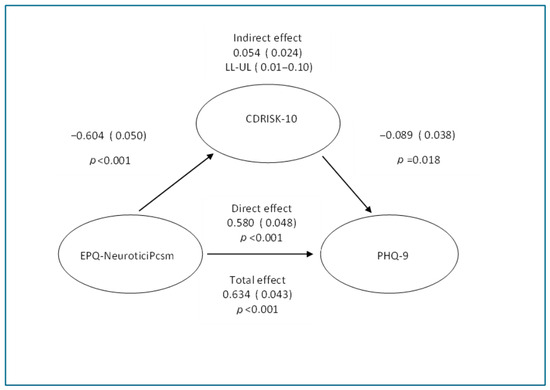
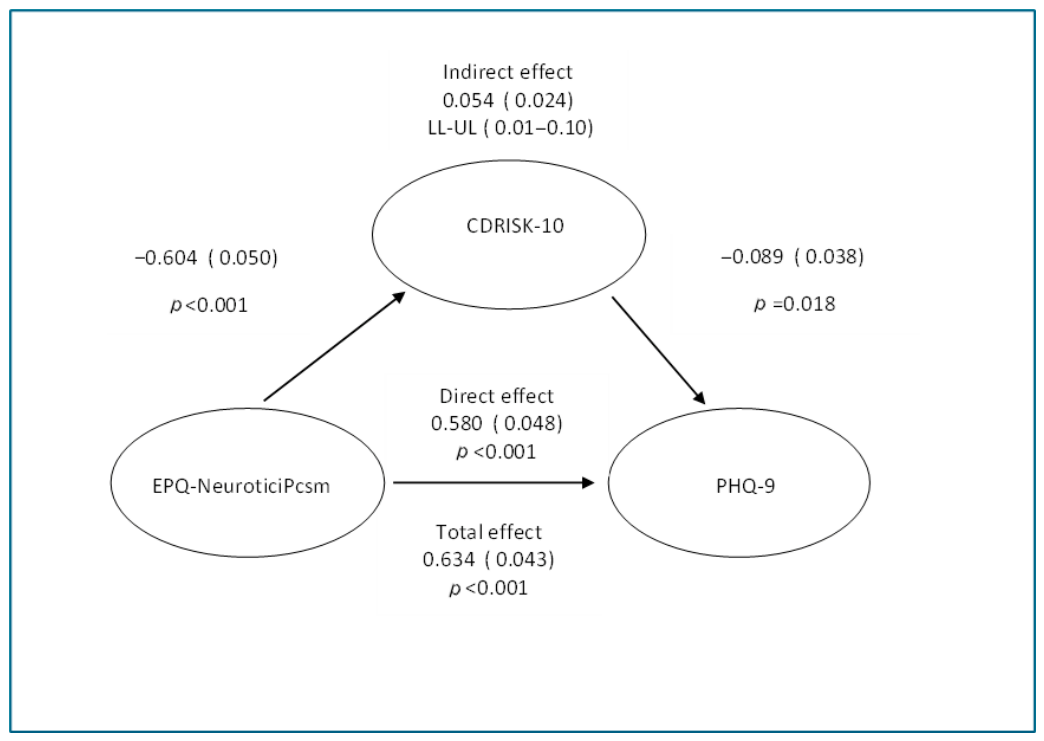
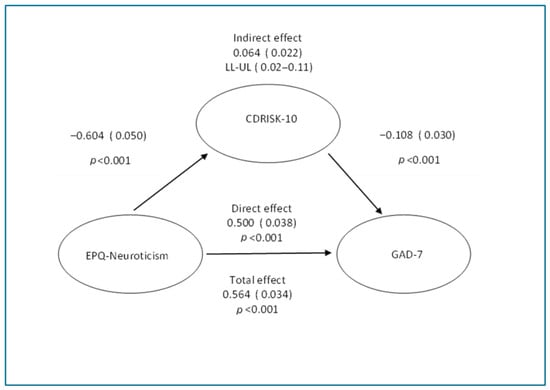
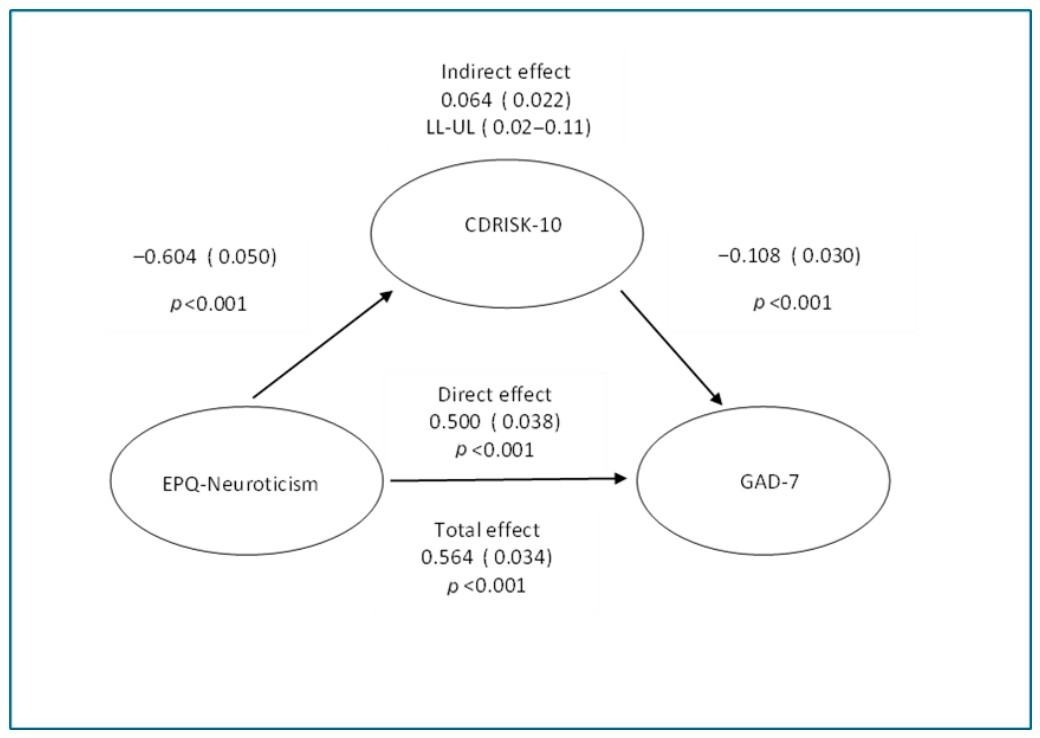
The potential mediating effect of the CD-RISC-10 score on the relationship between EPQ-Neuroticism and the PHQ-9 score was assessed (Figure 1). The indirect effect was small but statistically reliable, with a bootstrap confidence interval that excluded zero (Beta ± SE = 0.054 ± 0.024, t = 2.25, 99% CI: 0.01–0.10), whereas the direct effect of EPQ-Neuroticism on the PHQ-9 was substantially larger and significant (Beta ± SE = 0.580 ± 0.048, t = 12.08, p < 0.001). Similarly, mediation analysis of the relationship between EPQ-Neuroticism and GAD-7 through the CD-RISC-10 (Figure 2) revealed a small indirect effect whose confidence interval also excluded zero (Beta ± SE = 0.065 ± 0.022, t = 2.95, 99% CI: 0.02–0.10), alongside a much larger, significant direct effect of EPQ-Neuroticism on GAD-7 (Beta ± SE = 0.500 ± 0.038, t = 13.1, p < 0.001). Because the bootstrap confidence intervals for both indirect effects excluded zero (95% CI: [0.007, 0.101] and [0.015, 0.100]), these results indicate a statistically significant, albeit small, indirect effect, consistent with a weak partial mediation of the neuroticism–distress relationship by resilience. Given the small magnitude of the indirect effects relative to the substantial direct effects of neuroticism, and the cross-sectional design of the study, this partial mediation must be interpreted with caution: the temporal ordering presupposed by a mediation model cannot be established with cross-sectional data, so the indicated pathways remain hypothetical until tested in longitudinal designs [33,34].
Figure 1.
Mediating effect of CD-RISC-10 on the relationship between EPQ-Neuroticism and PHQ-9.
Figure 2.
Mediating effect of CD-RISC-10 on the relationship between EPQ-Neuroticism and GAD-7.
4. Discussion
Our findings confirmed a significant association between lower educational attainment and higher BMI. This pattern is in line with previous research suggesting an inverse association between higher BMI and lower education level [35]. The finding that education is significantly associated with obesity is encouraging because education is among the variables that should be most amenable to change. In line with the findings of previous studies, in our study, unmarried individuals had higher BMIs [36]. In a recent meta-analysis by Turnic et al., however, the results pointed in the opposite direction, and several explanatory hypotheses were discussed [37]. These hypotheses included the impact of shared household routines, psychological factors, such as stress eating, and the challenges married couples face in maintaining physical intimacy. The difference between the results of Turnic’s research and ours could be explained by the fact that we assessed MBS candidates and not just an overweight population.
Sex differences in eating attitudes were also notable. Women had significantly higher EAT-26 scores, which is consistent with the findings of Anversa [38], who reported sex differences in different types of overeating and discussed how physiological, endocrine and neural factors shape eating behavior. However, the correlation between BMI and maladaptive eating behaviors is stronger for men than for women, echoing the complexity of sex-related pathways in obesity risk [3,38]. Personality traits, such as high neuroticism, were also associated with increased BMI and linked to depression and anxiety in patients with obesity, suggesting difficulties in emotion regulation among candidates for MBS, phenomena that are well documented in relevant studies [39,40]. Preoperative assessment focusing on psychological profiles including personality traits can be essential for managing behavior changes and maximizing surgical benefits [41].
Regarding our second research question, the results indicated a small but statistically significant partial mediation, by resilience, of the effect of personality traits on anxiety and depression. We expected that resilience could act as a mediating factor between neuroticism and clinical parameters, as was the case for other conditions [16,39,42,43]. We presumed that in patients with higher neuroticism, resilience would counteract the negative effect of neuroticism on depression and anxiety and thereby actively buffer the impact of neuroticism on disordered eating and BMI [19,44]. In our study, resilience was moderately negatively correlated with anxiety and depressive symptoms, and a small but statistically significant indirect effect indicated that resilience partially mediated the impact of neuroticism on anxiety and depressive symptoms; given its small magnitude and the cross-sectional design, however, this pathway should be regarded as preliminary and hypothesis-generating, as its causal direction cannot be established [45]. Clinically, preoperative psychological evaluations that incorporate resilience assessment enable practitioners to identify patients at elevated risk for poor adherence and to design targeted interventions, even prior to surgery [19]. Strengthening resilience preoperatively may therefore optimize both mental health trajectories and sustained weight loss, underscoring the importance of integrating resilience-focused screening into standard bariatric care protocols.
From a clinical standpoint, these findings can help refine the preoperative psychological assessment of bariatric surgery candidates. The consistent association of high neuroticism with disordered eating attitudes, depression and anxiety suggests that brief personality screening could identify candidates who would benefit from closer psychological monitoring and targeted support before and after surgery, while the sociodemographic pattern observed—higher BMI among male, unmarried and less-educated candidates—may help direct counselling and follow-up resources to those at greater risk. Although resilience did not independently predict eating attitudes or BMI and its mediating effect was small, its moderate inverse association with anxiety and depressive symptoms indicates that it may still serve as a useful adjunctive screening marker rather than an established intervention target. Incorporating these brief instruments into routine evaluation is feasible and low-burden, although the clinical value of resilience-oriented interventions specifically should be confirmed in prospective studies before they are adopted as standard practice.
5. Limitations
The main weakness of our study is its cross-sectional design: a postoperative examination of our sample would increase the persuasive power of our results. In particular, mediation models presuppose a temporal sequence among variables that cannot be established with cross-sectional data; the indirect (mediating) effect of resilience reported here should therefore be regarded as hypothetical, no causal inference can be drawn, and the proposed pathways require confirmation in longitudinal studies. The regression models, although statistically significant, explained a relatively modest proportion of the variance in eating attitudes (19.8%) and baseline BMI (11.3%), indicating that much of the variance is attributable to factors not captured here. Variables such as socioeconomic indicators beyond educational level, obesity-related comorbidities (e.g., type 2 diabetes, hypertension, obstructive sleep apnea), the type of planned bariatric procedure, previous weight-loss attempts, childhood adversity, emotion regulation, emotional and uncontrolled eating, and broader dietary and health behaviours [46,47,48] were not available in our dataset and may act as important determinants or confounders; their omission should be borne in mind when interpreting the present associations. In addition, diagnoses were established using DSM-IV-TR and were not retrospectively re-coded to DSM-5. Other limitations of our study are its reliance on self-report measures, the absence of postoperative follow-up data, and possible selection bias. Future longitudinal designs with postoperative follow-up, including the assessment of binge eating disorder and body-composition trajectories [49], together with broader frameworks that incorporate personality traits and psychological flexibility [50], represent important directions for further research.
The mediating role of resilience, in particular, warrants cautious interpretation. The indirect effect, although statistically reliable, was small in absolute terms and accounted for only a minor portion of the total association between neuroticism and psychological distress, so resilience should not be regarded as a primary mechanism underlying this relationship. Estimates of mediation derived from cross-sectional data may also diverge from, and be biased relative to, those obtained in longitudinal designs, and unmeasured confounding of the resilience–distress pathway cannot be excluded. The present mediation findings should therefore be treated as exploratory and hypothesis-generating, requiring replication in prospective, longitudinal studies before any inferential or clinical weight is placed on them.
6. Conclusions
In this large cohort of metabolic bariatric surgery candidates, sociodemographic and psychological characteristics were meaningfully associated with eating attitudes and BMI. Lower educational attainment, unmarried status and male sex were independently associated with a higher baseline BMI, whereas female sex and higher neuroticism were independently associated with more disordered eating attitudes. Neuroticism emerged as the psychological characteristic most consistently linked to disordered eating attitudes, depression and anxiety. Although resilience was moderately and inversely correlated with anxiety and depressive symptoms, it did not independently predict eating attitudes or BMI in the adjusted models; it showed a small but statistically significant partial mediating effect on the relationship between neuroticism and psychological distress that, given its magnitude and the study’s cross-sectional design, should be interpreted with caution. These findings suggest that preoperative psychological assessment should pay particular attention to personality traits, especially neuroticism, whereas the clinical value of resilience-focused screening and intervention remains to be confirmed in prospective, longitudinal studies with postoperative follow-up.
Author Contributions
Conceptualization, E.N., M.S. and E.S.; methodology, M.S.; software, F.E.; validation, M.T. and P.S.; formal analysis, F.E. and P.S.; investigation, E.N., M.S. and A.A.; resources, E.N.; writing—original draft preparation, E.N.; writing—review and editing, all authors; supervision, V.P.B. and E.S.; project administration, E.N. All authors take full responsibility for the content of this publication. All authors have read and agreed to the published version of the manuscript.
Funding
This research received no external funding.
Institutional Review Board Statement
The study was conducted in accordance with the Declaration of Helsinki and approved by the Institutional Review Board and the Ethics Committee of Inter-Balkan Medical Center of Thessaloniki (protocol code 2512 and 16 April 2025).
Informed Consent Statement
Informed consent was obtained from all subjects involved in the study.
Data Availability Statement
Data can only be made available on reasonable request due to legal restrictions.
Conflicts of Interest
The authors declare no conflicts of interest that could have appeared to influence the work reported in this paper.
Abbreviations
The following abbreviations are used in this manuscript:
| MBS | Metabolic bariatric surgery |
| BMI | Body mass index |
| CD-RISC | Connor–Davidson Resilience Scale |
| EAT-26 | Eating Attitudes Test |
| PHQ-9 | Patient Health Questionnaire-9 |
| GAD-7 | Generalized Anxiety Disorder-7 scale |
| EPQ | Eysenck Personality Questionnaire |
References
- Eisenberg, D.; Shikora, S.A.; Aarts, E.; Aminian, A.; Angrisani, L.; Cohen, R.V.; De Luca, M.; Faria, S.L.; Goodpaster, K.P.; Haddad, A.; et al. 2022 American Society for Metabolic and Bariatric Surgery (ASMBS) and International Federation for the Surgery of Obesity and Metabolic Disorders (IFSO): Indications for Metabolic and Bariatric Surgery. Surg. Obes. Relat. Dis. 2022, 18, 1345–1356. [Google Scholar] [CrossRef] [Scilit]
- Sarwer, D.B.; Heinberg, L.J. A review of the psychosocial aspects of clinically severe obesity and bariatric surgery. Am. Psychol. 2020, 75, 252–264. [Google Scholar] [CrossRef] [Scilit] [PubMed]
- Weiss, F.; Barbuti, M.; Carignani, G.; Calderone, A.; Santini, F.; Maremmani, I.; Perugi, G. Psychiatric aspects of obesity: A narrative review of pathophysiology and psychopathology. J. Clin. Med. 2020, 9, 2344. [Google Scholar] [CrossRef] [Scilit] [PubMed]
- Marek, R.J.; Heinberg, L.J.; Lavery, M.; Rish, J.M.; Ashton, K. A Review of Psychological Assessment Instruments for Use in Bariatric Surgery Evaluations. Psychol. Assess. 2016, 28, 1142–1157. [Google Scholar] [CrossRef] [Scilit] [PubMed]
- Hadipour Lakmehsari, A.; Mento, C.; Scaramuzzino, C.; Arena, F.; Turiaco, F.; Muscatello, M.R.A.; Navarra, G.; Pandolfo, G.; Lombardo, C. Psychological Traits of Bariatric Surgery Candidates and Predictors of Outcomes. J. Pers. Med. 2025, 15, 215. [Google Scholar] [CrossRef] [Scilit] [PubMed]
- Hemmingsson, E. A new model of the role of psychological and emotional distress in promoting obesity: Conceptual review with implications for treatment and prevention. Obes. Rev. 2014, 15, 769–779. [Google Scholar] [CrossRef] [Scilit] [PubMed]
- Spinosa, J.; Christiansen, P.; Dickson, J.M.; Lorenzetti, V.; Hardman, C.A. From Socioeconomic Disadvantage to Obesity: The Mediating Role of Psychological Distress and Emotional Eating. Obesity 2019, 27, 559–564. [Google Scholar] [CrossRef] [Scilit] [PubMed]
- Taube-Schiff, M.; Van Exan, J.; Tanaka, R.; Wnuk, S.; Hawa, R.; Sockalingam, S. Attachment style and emotional eating in bariatric surgery candidates: The mediating role of difficulties in emotion regulation. Eat. Behav. 2015, 18, 36–40. [Google Scholar] [CrossRef] [Scilit] [PubMed]
- Lazarou, C.; Panagiotakos, D.B.; Panayiotou, G.; Matalas, A.L. Overweight and obesity in preadolescent children and their parents in Cyprus: Prevalence and associated socio-demographic factors—The CYKIDS study. Obes. Rev. 2008, 9, 185–193. [Google Scholar] [CrossRef] [Scilit] [PubMed]
- Luppino, F.S.; de Wit, L.M.; Bouvy, P.F.; Stijnen, T.; Cuijpers, P.; Penninx, B.W.J.H.; Zitman, F.G. Overweight, obesity, and depression: A systematic review and meta-analysis of longitudinal studies. Arch. Gen. Psychiatry 2010, 67, 220–229. [Google Scholar] [CrossRef] [Scilit] [PubMed]
- Lent, M.R.; Swencionis, C. Addictive personality and maladaptive eating behaviors in adults seeking bariatric surgery. Eat. Behav. 2012, 13, 67–70. [Google Scholar] [CrossRef] [Scilit] [PubMed]
- Buratta, L.; Pazzagli, C.; Delvecchio, E.; Cenci, G.; Germani, A.; Mazzeschi, C. Personality Features in Obesity. Front. Psychol. 2021, 11, 530425. [Google Scholar] [CrossRef] [Scilit] [PubMed]
- Gerlach, G.; Herpertz, S.; Loeber, S. Personality traits and obesity: A systematic review. Obes. Rev. 2015, 16, 32–63. [Google Scholar] [CrossRef] [Scilit] [PubMed]
- Mathieu, J.; Brunaud, L.; Reibel, N.; Moukah, D.; Witkowski, P.; Lighezzolo-Alnot, J.; Quilliot, D.; Ziegler, O. Low resilience in severe obesity: Marker of adverse childhood experiences and current psychological disorders. Eat. Weight Disord. 2022, 27, 3507–3519. [Google Scholar] [CrossRef] [Scilit] [PubMed]
- McGarrity, L.A.; Perry, N.S.; Derbidge, C.M.; Trapp, S.K.; Terrill, A.L.; Smith, T.W.; Ibele, A.R.; MacKenzie, J.J. Associations Between Approach and Avoidance Coping, Psychological Distress, and Disordered Eating Among Candidates for Bariatric Surgery. Obes. Surg. 2019, 29, 3596–3604. [Google Scholar] [CrossRef] [Scilit] [PubMed]
- McGarrity, L.A.; Terrill, A.L.; Martinez, P.L.; Ibele, A.R.; Morrow, E.H.; Volckmann, E.T.; Smith, T.W. The Role of Resilience in Psychological Health Among Bariatric Surgery Patients. Obes. Surg. 2022, 32, 792–800. [Google Scholar] [CrossRef] [Scilit] [PubMed]
- Si, J.; Zhang, Y.; Li, M.; Liu, T. Insomnia and depression among bariatric surgery patients: The chain mediating effect of resilience and anxiety. Front. Psychiatry 2025, 16, 1554239. [Google Scholar] [CrossRef] [Scilit] [PubMed]
- Neff, K.J.; Olbers, T.; le Roux, C.W. Bariatric surgery: The challenges with candidate selection, individualizing treatment and clinical outcomes. BMC Med. 2013, 11, 8. [Google Scholar] [CrossRef] [Scilit] [PubMed]
- Sisto, A.; Barone, M.; Giuliani, A.; Quintiliani, L.; Bruni, V.; Tartaglini, D.; Persichetti, P.; Tambone, V. The body perception, resilience, and distress symptoms in candidates for bariatric surgery and post bariatric surgery. Eur. J. Plast. Surg. 2022, 46, 417–425. [Google Scholar] [CrossRef] [Scilit]
- Connor, K.M.; Davidson, J.R.T. Development of a new Resilience scale: The Connor-Davidson Resilience scale (CD-RISC). Depress. Anxiety 2003, 18, 76–82. [Google Scholar] [CrossRef] [Scilit] [PubMed]
- Campbell-Sills, L.; Stein, M.B. Psychometric analysis and refinement of the Connor-Davidson Resilience Scale (CD-RISC): Validation of a 10-item measure of resilience. J. Trauma. Stress 2007, 20, 1019–1028. [Google Scholar] [CrossRef] [Scilit] [PubMed]
- Kyriazos, T.; Stalikas, A.; Kyriazos, T.; Stalikas, A. Psychometric Evidence of the 10-Item Connor-Davidson Resilience Scale (CD-RISC10, Greek Version) and the Predictive Power of Resilience on Well-Being and Distress. Open J. Soc. Sci. 2021, 9, 280–308. [Google Scholar] [CrossRef]
- Garner, D.M.; Olmsted, M.P.; Bohr, Y.; Garfinkel, P.E. The Eating Attitudes Test: Psychometric features and clinical correlates. Psychol. Med. 1982, 12, 871–878. [Google Scholar] [CrossRef] [Scilit] [PubMed]
- Papini, N.M.; Jung, M.; Cook, A.; Lopez, N.V.; Ptomey, L.T.; Herrmann, S.D.; Kang, M. Psychometric properties of the 26-item eating attitudes test (EAT-26): An application of rasch analysis. J. Eat. Disord. 2022, 10, 62. [Google Scholar] [CrossRef] [Scilit] [PubMed]
- Simos: Investigation of the Psychogenic Disturbances…—Μελετητής Google. 2025. Available online: https://scholar.google.com/scholar_lookup?title=Investigation+of+the+Psychogenic+Disturbances+in+Food+Intake+and+of+Preventive+Possibilities&author=Simos,+G.&publication_year=1996 (accessed on 19 October 2025).
- Douka, A.; Grammatopoulou, E.; Skordilis, E.; Koutsouki, D. Factor analysis and cut-off score of the 26-item eating attitudes test in a greek sample. Biol. Exerc. 2009, 5, 51. [Google Scholar] [CrossRef] [Scilit]
- Spitzer, R.L.; Kroenke, K.; Williams, J.B.W. Validation and utility of a self-report version of PRIME-MD: The PHQ Primary Care Study. J. Am. Med. Assoc. 1999, 282, 1737–1744. [Google Scholar] [CrossRef] [Scilit]
- Hyphantis, T.; Kotsis, K.; Voulgari, P.V.; Tsifetaki, N.; Creed, F.; Drosos, A.A. Diagnostic accuracy, internal consistency, and convergent validity of the Greek version of the patient health questionnaire 9 in diagnosing depression in rheumatologic disorders. Arthritis Care Res. 2011, 63, 1313–1321. [Google Scholar] [CrossRef] [Scilit] [PubMed]
- Spitzer, R.L.; Kroenke, K.; Williams, J.B.W.; Löwe, B. A brief measure for assessing generalized anxiety disorder: The GAD-7. Arch. Intern. Med. 2006, 166, 1092–1097. [Google Scholar] [CrossRef] [Scilit] [PubMed]
- Ruiz, M.A.; Zamorano, E.; García-Campayo, J.; Pardo, A.; Freire, O.; Rejas, J. Validity of the GAD-7 scale as an outcome measure of disability in patients with generalized anxiety disorders in primary care. J. Affect. Disord. 2011, 128, 277–286. [Google Scholar] [CrossRef] [Scilit] [PubMed]
- Eysenck, S.B.; Eysenck, H.J.; Barrett, P. A Revised Version of the Psychoticism Scale. Personal. Individ. Differ. 1985, 6, 21–29. [Google Scholar] [CrossRef] [Scilit]
- Demetriou, E. The Eysenck Personality Questionnaire: Standardization to the Greek population. Encephalos 1986, 23, 41–54. [Google Scholar]
- Hayes, A.F. Introduction to Mediation, Moderation, and Conditional Process Analysis a Regression-Based Approach (Methodology in the Social Sciences), 2nd ed.; The Guilford Press: New York, NY, USA; Scientific Research Publishing: Chengdu, China, 2018; Available online: https://www.scirp.org/reference/referencespapers?referenceid=3016713 (accessed on 11 March 2026).
- Gelman, A.; Stern, H. The difference between ‘significant’ and ‘not significant’ is not itself statistically significant. Am. Stat. 2006, 60, 328–331. [Google Scholar] [CrossRef] [Scilit]
- Hermann, S.; Rohrmann, S.; Linseisen, J.; May, A.M.; Kunst, A.; Besson, H.; Romaguera, D.; Travier, N.; Tormo, M.-J.; Molina, E.; et al. The association of education with body mass index and waist circumference in the EPIC-PANACEA study. BMC Public Health 2011, 11, 169. [Google Scholar] [CrossRef] [Scilit] [PubMed]
- Eik-Nes, T.T.; Tokatlian, A.; Raman, J.; Spirou, D.; Kvaløy, K. Depression, anxiety, and psychosocial stressors across BMI classes: A Norwegian population study—The HUNT Study. Front. Endocrinol. 2022, 13, 886148. [Google Scholar] [CrossRef] [Scilit]
- Turnic, T.N.; Jakovljevic, V.; Strizhkova, Z.; Polukhin, N.; Ryaboy, D.; Kartashova, M.; Korenkova, M.; Kolchina, V.; Reshetnikov, V. The Association between Marital Status and Obesity: A Systematic Review and Meta-Analysis. Diseases 2024, 12, 146. [Google Scholar] [CrossRef] [Scilit] [PubMed]
- Anversa, R.G.; Muthmainah, M.; Sketriene, D.; Gogos, A.; Sumithran, P.; Brown, R.M. A review of sex differences in the mechanisms and drivers of overeating. Front. Neuroendocrinol. 2021, 63, 100941. [Google Scholar] [CrossRef] [Scilit] [PubMed]
- Dahl, J.K.; Eriksen, L.; Vedul-Kjelsås, E.; Strømmen, M.; Kulseng, B.; Mårvik, R.; Holen, A. Depression, anxiety, and neuroticism in obese patients waiting for bariatric surgery: Differences between patients with and without eating disorders and subthreshold binge eating disorders. Obes. Res. Clin. Pract. 2012, 6, e139–e147. [Google Scholar] [CrossRef] [Scilit] [PubMed]
- Paans, N.P.G.; Bot, M.; Gibson-Smith, D.; Van der Does, W.; Spinhoven, P.; Brouwer, I.; Visser, M.; Penninx, B.W. The association between personality traits, cognitive reactivity and body mass index is dependent on depressive and/or anxiety status. J. Psychosom. Res. 2016, 89, 26–31. [Google Scholar] [CrossRef] [Scilit] [PubMed]
- Montorio, I.; Izal, M.; Bellot, A.; Rodríguez, J.; de Iceta, M. Personality Profiles Associated with Long-Term Success in Bariatric Surgery: 24-Month Follow-Up. Behav. Sci. 2023, 13, 797. [Google Scholar] [CrossRef] [Scilit] [PubMed]
- Ito, S.; Morishita, C.; Masuya, J.; Ono, M.; Honyashiki, M.; Higashi, S.; Tamada, Y.; Fujimura, Y.; Inoue, T. Moderating and Mediating Effects of Resilience Together with Neuroticism on Depressive Symptoms in Adult Volunteers. Neuropsychiatr. Dis. Treat. 2022, 18, 1751–1761. [Google Scholar] [CrossRef] [Scilit] [PubMed]
- Ghulam, A.; Bonaccio, M.; Costanzo, S.; Bracone, F.; Gianfagna, F.; de Gaetano, G.; Iacoviello, L. Psychological Resilience, Cardiovascular Disease, and Metabolic Disturbances: A Systematic Review. Front. Psychol. 2022, 13, 817298. [Google Scholar] [CrossRef] [Scilit] [PubMed]
- Zhang, Y.; Li, Y.; Jiang, T.; Zhang, Q. Role of body mass index in the relationship between adverse childhood experiences, resilience, and mental health: A multivariate analysis. BMC Psychiatry 2023, 23, 460. [Google Scholar] [CrossRef] [Scilit] [PubMed]
- Stewart-Knox, B.; Duffy, M.E.; Bunting, B.; Parr, H.; De Almeida, M.D.V.; Gibney, M. Associations between obesity (BMI and waist circumference) and socio-demographic factors, physical activity, dietary habits, life events, resilience, mood, perceived stress and hopelessness in healthy older Europeans. BMC Public Health 2012, 12, 1. [Google Scholar] [CrossRef] [Scilit] [PubMed]
- Kikuchi, J.L.D.; Carvalhal, M.M.d.L.; Inete, M.B.; Souza, Y.D.D.E.S.; Moraes, T.M.; Costa, R.L.V.; Gabbay, R.D.; Paracampo, C.C.P.; Gomes, D.L. Emotional Eating and Uncontrolled Eating as Risk Predictors for Disordered Eating Attitudes in Candidates for Bariatric Surgery Treated at a Public Hospital in the Amazon. Nutrients 2024, 16, 1600. [Google Scholar] [CrossRef] [Scilit] [PubMed]
- Gravina, D.; Violi, M.; Bordacchini, A.; Diadema, E.; Fantasia, S.; Simoncini, M.; Carmassi, C. Emotional Eating, Impulsivity, and Affective Temperaments in a Sample of Obese Candidates for Bariatric Surgery: Which Linkage? Brain Sci. 2025, 15, 372. [Google Scholar] [CrossRef] [Scilit] [PubMed]
- Maxim, M.; Soroceanu, R.P.; Vlăsceanu, V.I.; Platon, R.L.; Toader, M.; Miler, A.A.; Onofriescu, A.; Abdulan, I.M.; Ciuntu, B.-M.; Balan, G.; et al. Dietary Habits, Obesity, and Bariatric Surgery: A Review of Impact and Interventions. Nutrients 2025, 17, 474. [Google Scholar] [CrossRef] [Scilit] [PubMed]
- Delfino, H.B.P.; Pinhel, M.A.d.S.; Ferreira, F.C.; Nicoletti, C.F.; de Oliveira, S.T.P.; Baumgartner, L.B.B.; Welendorf, C.R.; Pastore, T.A.d.A.C.; Malek-Zadeh, C.H.; Watanabe, L.M.; et al. Anthropometric and Body Composition Changes over Five Years after Bariatric Surgery in Patients with Obesity, Diagnosed or Not Diagnosed with Binge Eating Disorder (BED) in the Preoperative Period. Obesities 2024, 4, 55–65. [Google Scholar] [CrossRef] [Scilit]
- Bar-Moshe-Lavi, L.; Hertz-Palmor, N.; Sella-Shalom, K.; Braun, M.; Pizem, N.; Shacham-Shmueli, E.; Rafaeli, E.; Hasson-Ohayon, I. Actor–Partner Effects of Personality Traits and Psychological Flexibility on Psychological Distress Among Couples Coping with Cancer. Behav. Sci. 2024, 14, 1161. [Google Scholar] [CrossRef] [Scilit] [PubMed]

Disclaimer/Publisher’s Note: The statements, opinions and data contained in all publications are solely those of the individual author(s) and contributor(s) and not of MDPI and/or the editor(s). MDPI and/or the editor(s) disclaim responsibility for any injury to people or property resulting from any ideas, methods, instructions or products referred to in the content. |
© 2026 by the authors. Licensee MDPI, Basel, Switzerland. This article is an open access article distributed under the terms and conditions of the Creative Commons Attribution (CC BY) license.