


Abstract
Hydrogen sulfide (H2S) is a toxic sulfur-containing by-product generated in refining, gas processing, and decomposition processes. Its electrochemical treatment under alkaline conditions offers a potential route for simultaneous hydrogen production and sulfide conversion. Although alkaline sulfide electrolysis has been investigated for several decades, quantitative information on the performance of industrial corrosion-resistant electrodes remains limited. In this work, industrial NiCrMo276 alloy electrodes were evaluated for hydrogen production in a batch alkaline sulfide electrolysis system. Graphite was used as a reference material in an initial electrode screening, in which NiCrMo276 exhibited a substantially higher current response under identical electrolysis conditions. Based on this screening, NiCrMo276 was selected for subsequent evaluation of the effects of applied cell voltage and NaHS concentration on the electrochemical response. At an applied cell voltage of 1.8 V and a NaHS:NaOH molar ratio of 1.25:1, hydrogen was produced at 200 mL h−1, corresponding to a current density of 33 mA cm−2 and a Faradaic efficiency of 92%. The specific electricity consumption was 52.4 kWh kg−1 H2. Complementary sulfur analyses indicated incomplete sulfide conversion and a marked evolution of the dissolved sulfur composition, particularly toward thiosulfate, although the measured sulfur distribution could not be attributed exclusively to electrochemical reactions. Post-electrolysis SEM–EDX observations showed that NiCrMo276 retained a relatively well-defined surface morphology, particularly at the cathode, while the graphite surface exhibited substantial intrinsic heterogeneity. Overall, the combination of high Faradaic efficiency, hydrogen productivity, and substantially higher current response than graphite highlights NiCrMo276 as a promising electrode material for alkaline sulfide electrolysis.
1. Introduction
Hydrogen sulfide (H2S) is a highly toxic byproduct generated in numerous industrial and environmental processes. It is present in crude oil and must be removed during refining operations [1]. H2S poses several hazards owing to its toxicity, flammability, and corrosive nature, requiring careful handling and treatment [2,3,4]. In addition to industrial sources, H2S is also naturally produced during the decomposition of seaweed, particularly sargassum [5], and in wastewater treatment plants [6], where emissions have become a growing public health concern in some regions. In most refineries, H2S is commonly treated through sulfur recovery processes such as the Claus process [7,8] or by combustion in flares, although alternative routes with lower environmental impact and added-value potential, including electrochemical approaches for simultaneous treatment and resource recovery, remain increasingly attractive.
Within the context of the energy transition, H2S may also be considered as a potential precursor for hydrogen production by electrolysis. Hydrogen is a carbon-free energy carrier suitable for industrial applications, mobility, and energy storage [9]. From a thermodynamic standpoint, the electrolysis of dissolved H2S is more favorable than conventional water electrolysis [10], requiring approximately 38 kJ·mol−1, whereas 241 kJ·mol−1 are required for the electrolysis of an equivalent amount of water. Practical water electrolysis systems generally operate at higher cell voltages than thermodynamic values because of activation, ohmic, and mass-transfer losses [11]. During electrolysis, hydrogen is generated at the cathode, while several oxidized sulfur species may be formed at the anode, ranging from polysulfides (Sn2−) to elemental sulfur (S0) and sulfate (SO42−) [12,13]. Elemental sulfur has numerous industrial and agricultural applications and benefits from an established market, making it an attractive target [14,15]. However, a major drawback is its possible deposition on the cathode surface during electrolysis, which may lead to electrode passivation [16,17,18]. Additional downstream operations may therefore be required to recover sulfur and preserve cathodic activity. By contrast, sulfate ions are highly soluble and may be generated when high-overpotential oxygen evolution anodes, such as boron-doped diamond electrodes, are used [19]. Although the cost of such materials has decreased with broader deployment, they remain expensive. Moreover, sulfate formation involves additional oxidation pathways and may reduce the energetic advantage generally associated with H2S electrolysis compared with water electrolysis. Potential–pH diagrams suggest that polysulfide species may be favored during sulfide oxidation under strongly alkaline conditions (pH > 13) [20]. Under these conditions, hydrogen sulfide is converted into sulfide species, ensuring efficient transfer of the initially gaseous H2S into the aqueous phase. Previous studies have reported the formation of polysulfides during alkaline sulfide electrolysis using nickel [21] and graphite [16] electrodes. Recent studies have renewed interest in electrochemical H2S conversion as a route for simultaneous hydrogen production and sulfur recovery, while emphasizing the need for electrode materials capable of operating in sulfide-rich alkaline environments [22,23,24,25,26].
Although alkaline sulfide electrolysis has been investigated for several decades, the choice of electrode material remains a key issue because of the chemically aggressive, sulfide-rich alkaline environment and the possible formation or deposition of sulfur species. Early studies demonstrated the feasibility of electrochemical H2S decomposition using conventional electrode materials, particularly graphite [16,17], while nickel electrodes have also been investigated for sulfide oxidation and polysulfide formation [21]. Boron-doped diamond has been explored as an alternative anodic material for the oxidation of dissolved H2S [19], and more recent studies have focused on advanced electrode configurations and operating strategies aimed at improving activity and mitigating sulfur-related deactivation [22,23,24,25,26]. Despite these developments, quantitative information on the use of commercially available industrial corrosion-resistant alloys for alkaline sulfide electrolysis remains limited.
NiCrMo276 (commercially known as Hastelloy C-276) was therefore selected in the present study as an industrially relevant candidate material. This Ni–Cr–Mo alloy is widely used in chemically aggressive environments, and its corrosion behavior in sulfide-containing media has been specifically investigated [27]. Its commercial availability and corrosion-resistant character make it particularly relevant for assessing whether an industrial alloy can combine practical material robustness with hydrogen-production performance under sulfide-rich alkaline electrolysis conditions. However, quantitative data on hydrogen production rate, Faradaic efficiency, and energy consumption using NiCrMo276 electrodes remain scarce.
The objective of the present study was therefore to assess the performance of industrial NiCrMo276 electrodes for hydrogen production via alkaline sulfide electrolysis. Graphite was used as a reference material in an initial electrode screening, after which NiCrMo276 was selected for detailed investigation of the effects of applied cell voltage and NaHS concentration, with particular emphasis on hydrogen production rate, Faradaic efficiency, and specific electricity consumption. Sulfur-species evolution and post-electrolysis electrode surfaces were additionally examined to complement the electrochemical performance assessment. This work thus provides quantitative experimental data on the use of an industrial corrosion-resistant alloy for hydrogen production in alkaline sulfide media.
2. Materials and Methods
2.1. Preparation and Titration of Solutions
Na2S/NaHS electrolyte solutions were prepared using two alternative methods, starting either from H2S gas (Gazdom, Ducos, France, 99%) or from commercial hydrated NaHS (Thermo Scientific, USA, stated purity 70–99%, NaHS·xH2O). Sulfide concentration was systematically verified by iodometric titration before and after each experiment. In the first method, gaseous H2S was bubbled into a 6 M solution prepared from NaOH pellets (VWR Chemical, Radnor, PA, USA), yielding a Na2S:NaOH composition of 1.2:2.4 M. The corresponding acid–base equilibria are given in Equations (1) and (2) [20]:
The residual hydroxide concentration remained sufficiently high to maintain a pH close to 14. Considering the value of pKa2, the equilibrium ratio [S2−]/[HS−] was therefore close to 10. In the second method, commercial hydrated NaHS was dissolved in distilled water to prepare a nominal 4 M solution, while NaOH pellets were separately dissolved in distilled water to obtain a 4 M NaOH solution. Both solutions were then mixed to reach the desired NaHS:NaOH concentration ratio. Because accurate control of the H2S gas flow rate proved difficult, the second method was subsequently preferred. Preparation from commercial hydrated NaHS enabled more precise concentration adjustment by weighing, with systematic confirmation by iodometric titration.
2.2. Electrochemical Setup and Measurements
Electrochemical experiments were carried out in a 250 mL glass cell equipped with a gas recovery system connected to an inert gas sampling bag (SUPEL™ INERT Gas Sampling Bag, Supelco, Bellefonte, PA, USA). The cell was sealed with a silicone stopper allowing the insertion of two or three electrodes, depending on the experimental configuration. Potential control was achieved using an OrigaFlex OGF01A potentiostat (Origalys, Rillieux-la-Pape, France). All experiments were conducted at ambient temperature (25 ± 2 °C) and atmospheric pressure.
For three-electrode measurements, potentials were recorded versus a Hg/HgO reference electrode (0.140 V vs. SHE, BioLogic, Seyssinet-Pariset, France), selected for its stability in strongly alkaline media [28].
Working and counter electrodes consisted of identical materials used as pairs, namely NiCrMo276 alloy electrodes (Hastelloy C-276, Haynes International, Saint-Ouen-l’Aumône, France) with an exposed area of 14.4 cm2, machined from a plate, or graphite electrodes (Nedstack, Arnhem, The Netherlands) with an exposed area of 12 cm2. Preliminary cyclic voltammetry was performed in a three-electrode configuration to identify the accessible potential window and guide subsequent electrolysis tests. For NiCrMo276 electrodes, voltammograms were recorded from the open-circuit potential (OCP) to +0.4 V vs. Hg/HgO and then scanned cathodically to −1.4 ± 0.2 V at a scan rate of 0.45 mV·s−1. The reverse scan was manually initiated when the cathodic current became excessively high. Three consecutive cycles were recorded for each condition.
Chronoamperometric electrolysis tests were carried out in a two-electrode configuration, where the reported applied voltage corresponds to the total cell voltage between anode and cathode. An initial electrode screening was performed using paired graphite or NiCrMo276 electrodes under identical electrolysis conditions. Based on this comparison, NiCrMo276 was selected for the subsequent evaluation of applied cell voltage (0.6–1.8 V) and NaHS concentration at constant NaOH concentration. The system was operated in batch mode without continuous feeding or removal of reactants and products. Test durations ranged from 10 min, which was sufficient to observe current trends without significant depletion of reactants, to 24 h for evaluating electrode performance during longer-duration electrolysis tests. Between experiments, electrode surfaces were systematically polished and cleaned to ensure reproducibility. All electrochemical measurements were performed in triplicate.
2.3. Product Quantification and Performance Calculations
Hydrogen production was quantified by volumetric gas collection under atmospheric pressure using the recovery system connected to the electrochemical cell. The composition of the collected gas was further analyzed using a 456-GC gas chromatograph (Scion Instruments, Goes, The Netherlands) equipped with a thermal conductivity detector (TCD). Two analytical channels were used to distinguish between light gases and permanent gases. The front TCD channel was dedicated to the detection of light gases such as hydrogen, whereas the middle TCD channel enabled the identification of permanent gases including nitrogen and oxygen. Unless otherwise specified, gas volumes were normalized to 298 K and 1 atm for calculation purposes. The corresponding molar hydrogen production rate was determined from the measured gas flow rate using the ideal gas law. Faradaic efficiency (FE) was calculated from the ratio between the experimentally measured hydrogen production rate and the theoretical hydrogen production rate calculated from the measured current:
where F is Faraday’s constant, n(H2) is the molar hydrogen production rate (mol·h−1), and I is the average current (A).
The specific electricity consumption (SEC) associated with hydrogen production was calculated as:
where V is the applied cell voltage (V), I the average current (A), and mH2 the hydrogen mass production rate (kg h−1). Energy efficiency was estimated by comparing the measured SEC value with the lower heating value (LHV) of hydrogen, taken as 33.33 kWh·kg−1. Hydrogen production and electrolysis performance measurements under the selected operating conditions were performed in three independent experiments, and the reported values correspond to mean values.
2.4. Sulfur Species Analysis
Sulfur-containing species in the electrolyte were characterized ex situ using complementary analytical techniques. Dissolved sulfur oxyanions, including thiosulfate (S2O32−), sulfite (SO32−), and sulfate (SO42−), were analyzed using an ICS5000+ ion chromatography system (Thermo Scientific Corp., Sunnyvale, CA, USA), while dissolved sulfide species (HS−/S2−) were determined by spectrophotometry using a SAFAS Monaco spectrophotometer (SAFAS, Monaco, Monaco). Total sulfur was measured using a 5800 VDV ICP-OES system (Agilent, Mulgrave, Victoria, Australia). Because sulfur species in strongly alkaline sulfide solutions may evolve after sampling, the analytical results were used to assess changes in sulfur-species distribution rather than to establish a complete sulfur mass balance.
2.5. Surface Characterization
Surface morphology and elemental composition of the electrodes were examined before and after electrolysis by scanning electron microscopy (SEM) coupled with energy-dispersive X-ray spectroscopy (EDX), using a JSM-7900F microscope (JEOL, Akishima, Tokyo, Japan) equipped with a Quantax microanalysis system (Bruker Nano GmbH, Berlin, Germany). Metallic and graphite electrodes were considered sufficiently conductive and were analyzed directly without surface metallization in order to preserve sample integrity. Prior to analysis, samples were rinsed with distilled water and dried under ambient conditions.
SEM observations were performed using secondary electron imaging at an accelerating voltage of 2 kV. EDX analyses were carried out at a working distance of 10 mm, using an accelerating voltage of 7 kV for graphite electrodes and 15 kV for metallic electrodes to optimize surface sensitivity and elemental detection. EDX measurements were used for comparative, semi-quantitative assessment of surface elemental composition and were not intended for quantitative sulfur speciation.
3. Results and Discussion
3.1. Electrochemical Behavior in Alkaline Sulfide Solutions
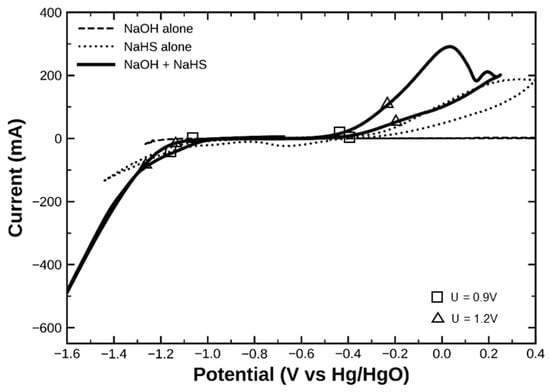
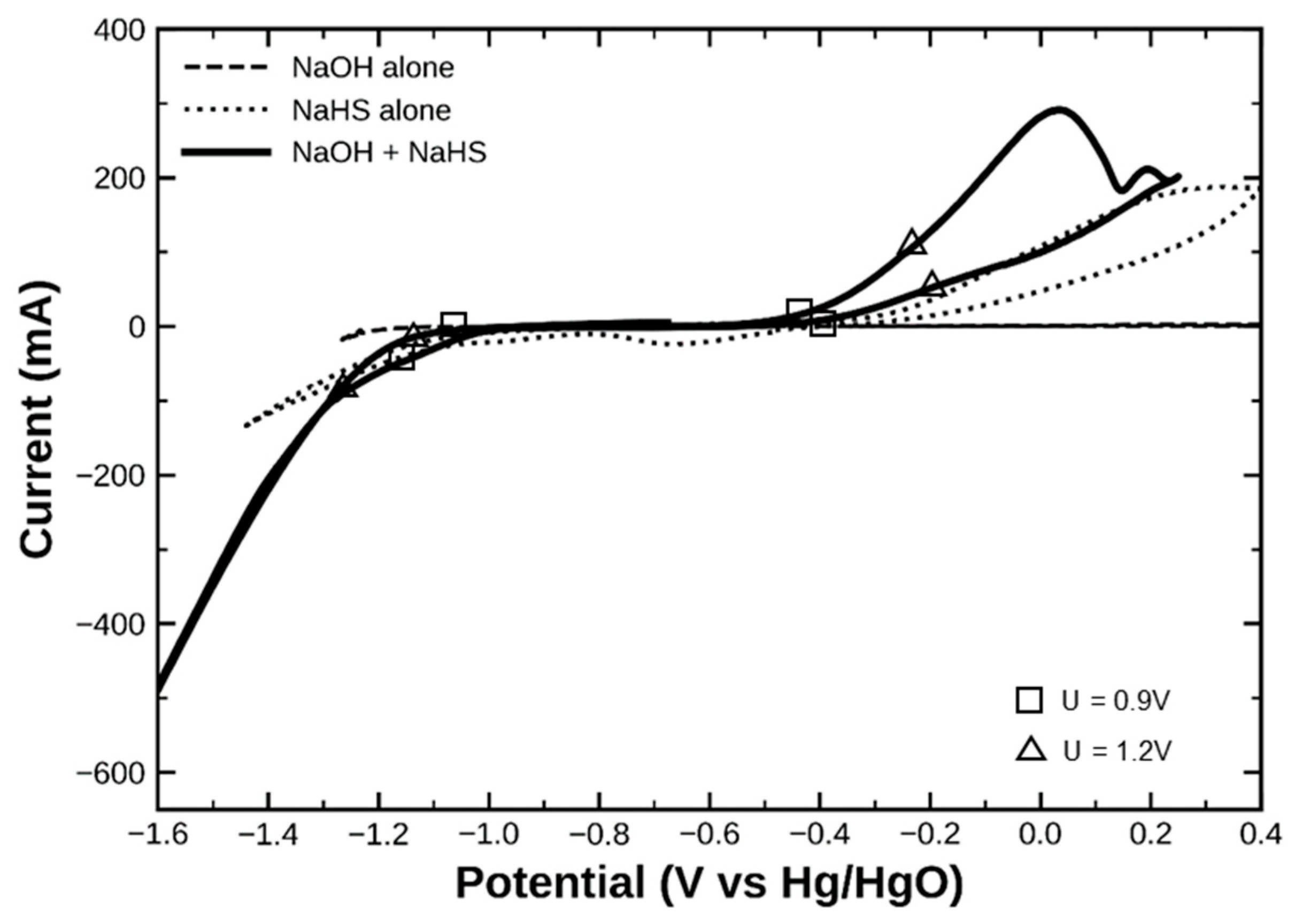
Cyclic voltammograms recorded on NiCrMo276 electrodes in NaOH, NaHS, and mixed NaOH/NaHS electrolytes are presented in Figure 1. Marked differences in current response were observed depending on electrolyte composition. In the absence of sulfide species (dashed line), no significant anodic current was detected, even at high potential differences between the working and counter electrodes, indicating negligible oxidation of the alkaline medium under the investigated conditions.
Figure 1.
Cyclic voltammograms recorded using a NiCrMo276 working electrode at 25 °C in (i) 2.4 M NaOH, (ii) 1.0 M NaHS, and (iii) 2.4 M NaOH + 1.2 M NaHS. Measurements were performed in a three-electrode configuration using Hg/HgO as the reference electrode at a scan rate of 0.45 mV s−1.
In the presence of 1.0 M NaHS alone (dotted line), a single anodic peak was observed at 0.386 V vs. Hg/HgO. A weaker cathodic peak was also detected during the reverse scan near −0.7 V vs. Hg/HgO. The marked asymmetry between the anodic and cathodic responses suggests that the oxidation process is only partially reversible under the investigated conditions. Given the measured pH of 11.55 ± 0.05 and the expected predominance of HS− under these conditions, the anodic response is consistent with sulfide-species oxidation, although assignment to a specific sulfur reaction cannot be established from voltammetry alone. Possible oxidation products reported for alkaline sulfide electrochemistry include elemental sulfur and soluble sulfur intermediates such as polysulfides [16,21], but these species were not directly identified from the voltammetric measurements performed in the present study.
For the mixed electrolyte containing 1.2 M sulfide and 2.4 M NaOH (solid line), two anodic peaks were observed at 0.033 and 0.195 V vs. Hg/HgO. No corresponding cathodic peaks were detected, again indicating predominantly irreversible oxidation processes. The measured pH was close to 14, corresponding to an estimated [S2−]/[HS−] ratio of approximately 10. The presence of two anodic features suggests that more than one oxidation process contributes to the electrochemical response in the strongly alkaline sulfide electrolyte. Their positions are consistent with oxidation processes involving the coexisting sulfide species; however, individual assignment of the peaks to S2−, HS−, or subsequent sulfur intermediates cannot be established from the present measurements.
In contrast to the NaHS-only electrolyte, no cathodic peak near −0.7 V vs. Hg/HgO was observed in the strongly alkaline mixed solution, indicating a different electrochemical response of the sulfur-containing species under these conditions. Strongly alkaline media have previously been associated with the formation of soluble sulfur species [20,21]; however, the nature of the species responsible for the present voltammetric response cannot be determined from CV alone.
On the cathodic branch, a sharp increase in reduction current was observed for potentials lower than approximately −1.05 V vs. Hg/HgO, consistent with the onset of the hydrogen evolution reaction. Visible gas evolution was observed at the electrode surface from approximately −1.2 V vs. Hg/HgO onward. Hydrogen was subsequently confirmed as the dominant gaseous product by GC analysis during the electrolysis experiments. Applied cell voltages of 0.9 and 1.2 V were subsequently investigated in the two-electrode electrolysis tests. Under these conditions, the control electrolyte containing NaOH alone showed negligible current response, indicating that oxygen evolution was limited within the investigated operating window.
3.2. Initial Screening of NiCrMo276 and Graphite Electrodes
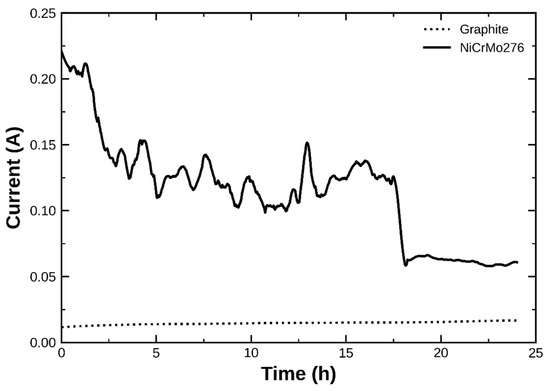
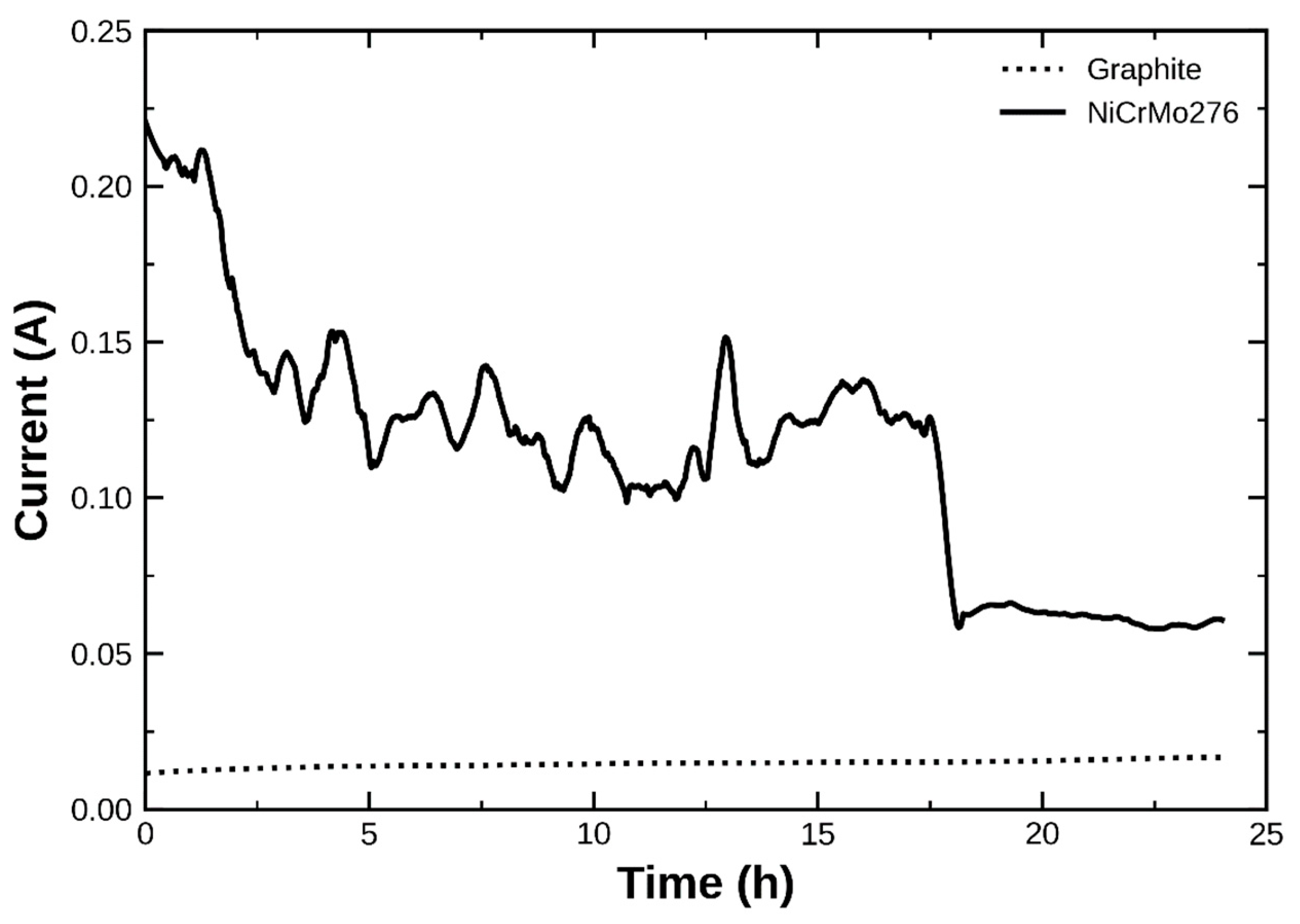
Both materials were tested as paired electrodes (anode and cathode of the same material) in chronoamperometric mode to compare their current response under identical alkaline sulfide electrolysis conditions. The corresponding current profiles are shown in Figure 2.
Figure 2.
Comparative chronoamperometric response of paired NiCrMo276 and graphite electrodes during alkaline sulfide electrolysis at an applied cell voltage of 1.0 V over 24 h. The exposed geometric electrode areas were 14.4 cm2 for NiCrMo276 and 12 cm2 for graphite.
During the 24 h experiments, NiCrMo276 exhibited a substantially higher current response than graphite throughout the test period. The current initially reached approximately 0.22 A, then progressively decreased and approached a quasi-steady value close to 0.06 A after about 17 h. Despite this decrease, the alloy maintained a markedly higher current level than graphite over the entire experiment. Transient current variations were observed during the first part of the experiment. Similar electrochemical oscillations have previously been reported during sulfide electro-oxidation [29]; however, their origin was not specifically investigated in the present study. By contrast, graphite displayed a nearly constant but much lower current response, close to 0.01 A over the full test duration. Although electrode areas slightly differed (14.4 cm2 for NiCrMo276 vs. 12 cm2 for graphite), the superior current response of NiCrMo276 remained evident even when considering geometric surface-area normalization. The average current recorded with NiCrMo276 was approximately one order of magnitude higher than that obtained with graphite, highlighting the strong influence of electrode material on the electrochemical response under alkaline sulfide electrolysis conditions. Under the investigated conditions, NiCrMo276 therefore exhibited a markedly higher electrochemical response than graphite.
The higher current response of NiCrMo276 is consistent with the known activity of nickel-based surfaces toward sulfide oxidation in alkaline media [21]. Differences in electrical conductivity and surface properties between the two electrode materials may also contribute to their different electrochemical responses. Although graphite did not outperform NiCrMo276, it remains of practical interest because of its low cost, chemical inertness, and widespread use in electrochemical sulfide treatment systems [30]. However, its lower current response under the tested conditions indicates a lower electrochemical activity than NiCrMo276 in the present configuration. Based on this direct experimental comparison, NiCrMo276 was selected as both the anode and cathode material for the subsequent electrolysis experiments.
3.3. Effect of Operating Parameters
The influence of operating parameters on alkaline H2S electrolysis performance was investigated using NiCrMo276 electrodes, with particular emphasis on applied cell voltage and electrolyte composition. These parameters affected the current response and, consequently, the achievable hydrogen production rate. The corresponding results are presented in Figure 3 and Figure 4.
Figure 3.
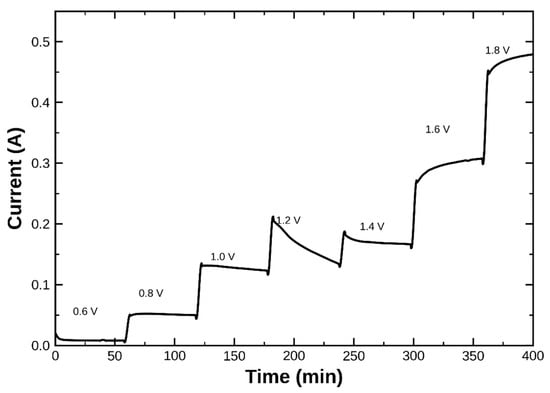
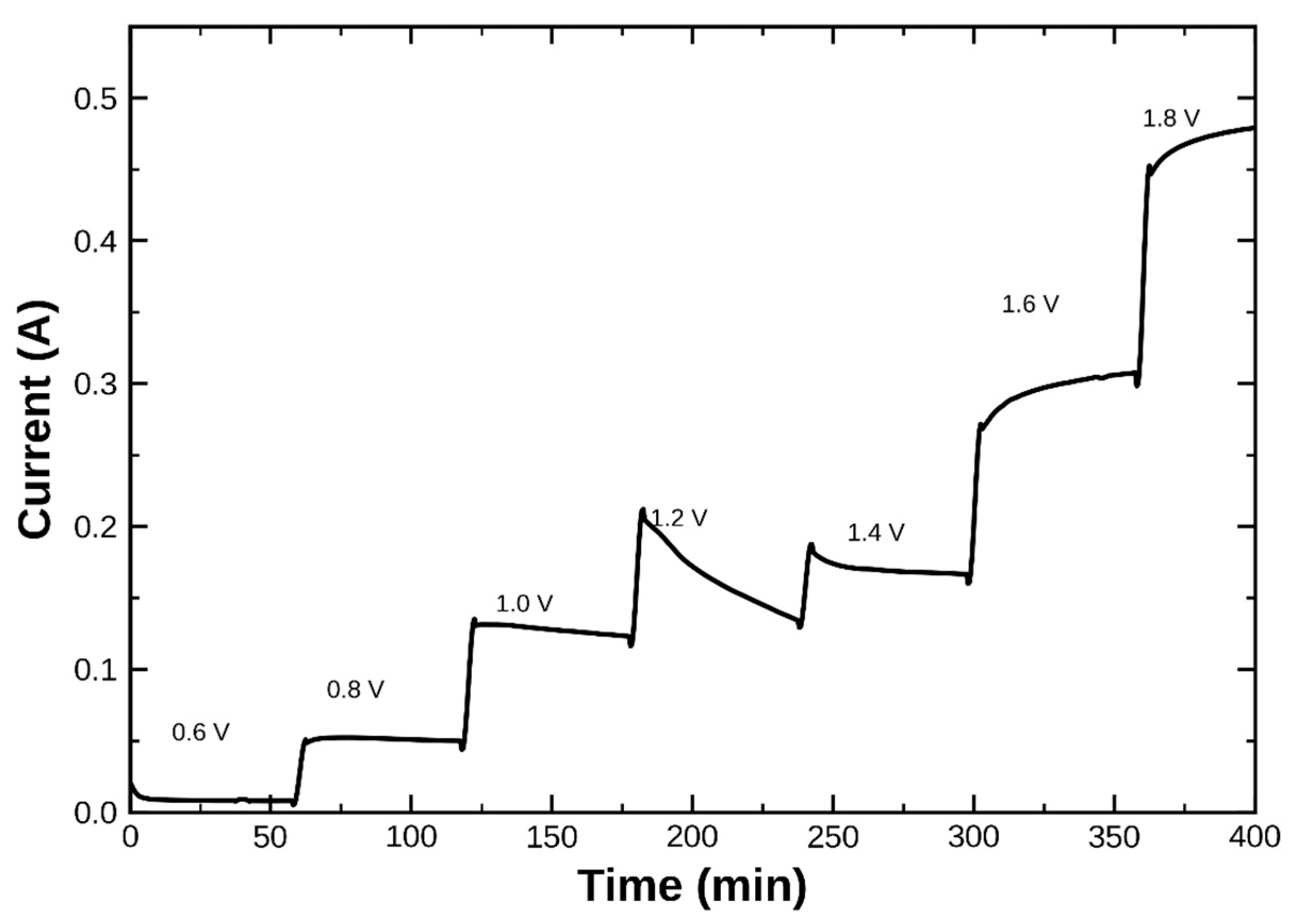
Chronoamperometric response of paired NiCrMo276 electrodes during alkaline H2S electrolysis under successive 0.2 V increases in applied cell voltage, from 0.6 to 1.8 V at 1 h intervals.
Figure 4.
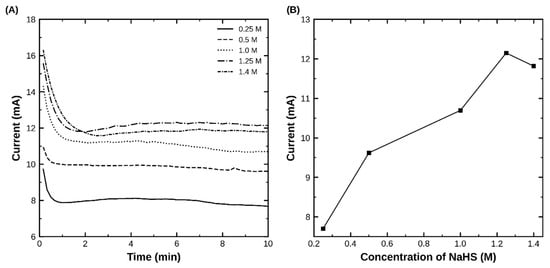
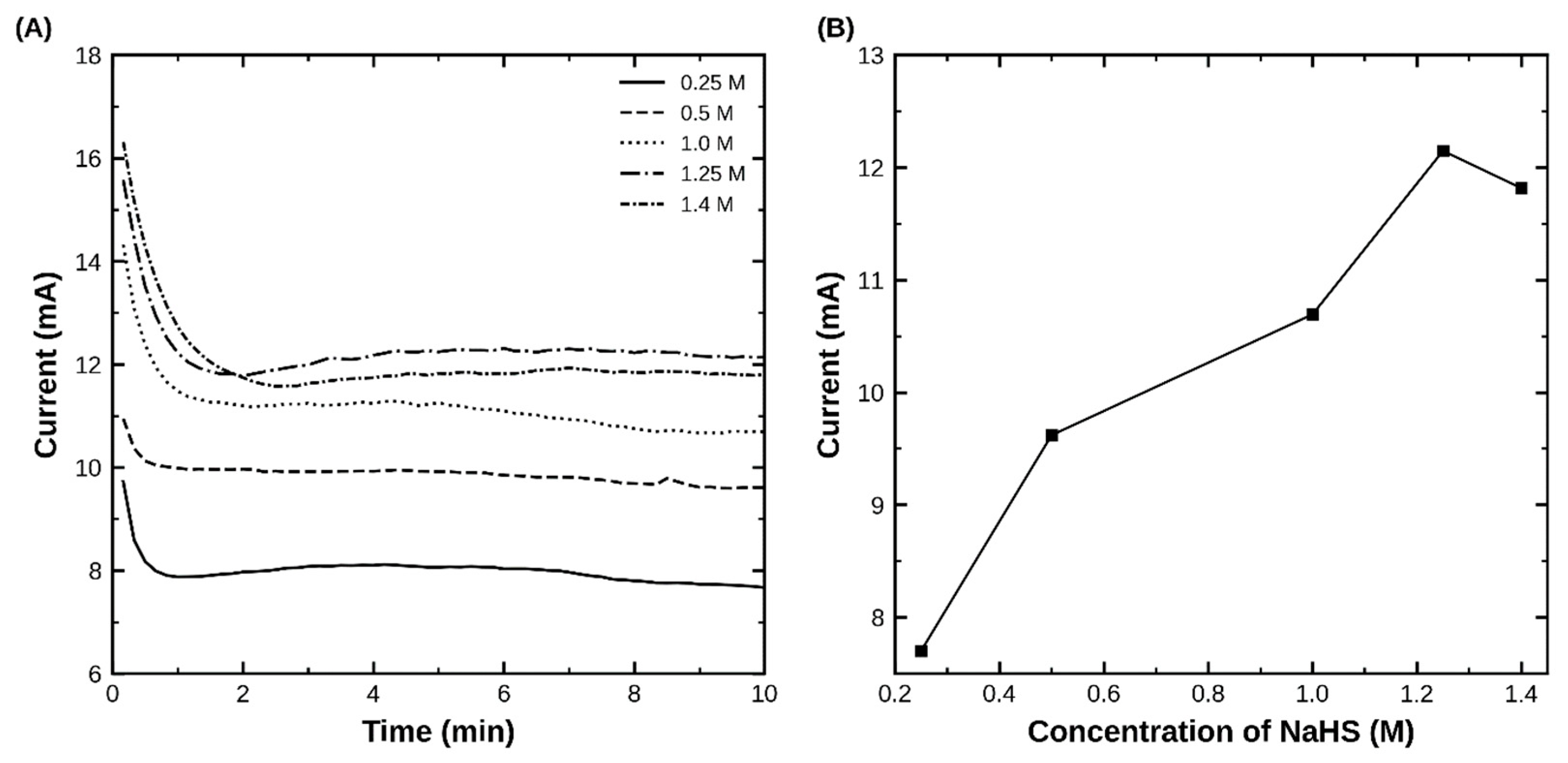
Effect of NaHS concentration on the electrochemical response of NiCrMo276 electrodes during alkaline sulfide electrolysis. (A) Current–time profiles obtained at NaHS concentrations ranging from 0.25 to 1.4 M at constant NaOH concentration. (B) Stabilized current as a function of NaHS concentration.
3.3.1. Effect of Applied Cell Voltage
The effect of applied cell voltage was investigated by progressively increasing the voltage from 0.6 to 1.8 V. As shown in Figure 3, increasing the cell voltage resulted in a progressive increase in current, although the relationship was not strictly linear. At low voltages (0.6–0.8 V), current densities remained below approximately 3.5 mA cm−2. Above 1.0 V, the current response increased more markedly, reaching approximately 12 mA cm−2 at 1.4 V, 21 mA cm−2 at 1.6 V, and 33 mA cm−2 at 1.8 V, consistent with an increase in the overall electrochemical reaction rate. Temporary current overshoots were observed immediately after some increases in cell voltage, followed by a partial decrease in current. These transient responses reflect the adjustment of the electrochemical system following the voltage steps. The highest tested voltage, 1.8 V, produced the highest current response, approaching 0.48 A under the investigated conditions. Accordingly, 1.8 V was retained for the subsequent hydrogen-production measurements.
3.3.2. Effect of NaHS Concentration
The influence of NaHS concentration on the electrochemical response was investigated while maintaining the NaOH concentration constant. As shown in Figure 4A, all NaHS concentrations exhibited an initial current decay followed by a comparatively stable response. Increasing the NaHS concentration from 0.25 to 1.25 M resulted in progressively higher stabilized currents, whereas a further increase to 1.4 M did not improve the current response. The initial current decay reflects the transient response of the electrochemical system following polarization.
The dependence of the stabilized current on NaHS concentration is summarized in Figure 4B. The current increased from approximately 7.7 mA at 0.25 M NaHS to 12.1 mA at 1.25 M, before decreasing slightly to approximately 11.8 mA at 1.4 M. The increase observed up to 1.25 M is consistent with greater availability of sulfide species for anodic oxidation, although changes in electrolyte conductivity may also contribute to the current response. The absence of a further increase at 1.4 M indicates that increasing NaHS concentration beyond 1.25 M did not provide an additional electrochemical benefit under the investigated conditions. The present measurements do not allow the respective contributions of mass transport, electrode kinetics, electrolyte conductivity, and interfacial processes to be distinguished.
Based on the highest stabilized current observed within the investigated concentration range, 1.25 M NaHS was selected for the subsequent hydrogen-production experiments. With the NaOH concentration maintained at 1.0 M, this composition corresponds to a NaHS:NaOH molar ratio of 1.25:1.
3.4. Hydrogen Production and Energy Performance
Hydrogen production performance was evaluated at an applied cell voltage of 1.8 V using NiCrMo276 electrodes and a NaHS:NaOH molar ratio of 1.25:1, corresponding to the conditions that provided the highest current responses within the investigated ranges. The current response measured over 60 min was reproducible across three independent experiments (Figure S1), providing the basis for quantitative assessment of hydrogen production and energy performance.
Hydrogen was produced at a rate of 200 mL h−1, corresponding to 8.17 mmol h−1 at 298 K and 1 atm. The average measured current was 0.475 A, corresponding to a geometric current density of 33 mA cm−2 based on an electrode area of 14.4 cm2. The corresponding Faradaic efficiency reached 92%, while the specific electricity consumption was 52.4 kWh kg−1 H2, corresponding to an energy efficiency of approximately 64% based on the lower heating value of hydrogen. The main hydrogen-production and energy-performance indicators obtained under these conditions are summarized in Table 1.
Table 1.
Electrochemical and energy performance of alkaline H2S electrolysis using NiCrMo276 electrodes at 1.8 V and a NaHS:NaOH molar ratio of 1.25:1.
The hydrogen production rate and current density demonstrate effective hydrogen generation using NiCrMo276 electrodes under the investigated conditions. The current density of 33 mA cm−2 at 1.8 V is within the range reported for planar nickel-based electrodes under laboratory-scale alkaline sulfide electrolysis conditions [16,17,21]. Higher current densities have been reported using more advanced configurations, including elevated temperatures, membrane-separated reactors, or structured high-surface-area electrodes [18,24,31,32]. These differences highlight the strong influence of electrode geometry and reactor configuration when comparing hydrogen-production performance across alkaline sulfide electrolysis systems.
The Faradaic efficiency of 92% indicates that hydrogen evolution accounted for most of the charge transferred at the cathode under the investigated conditions. Gas chromatography analysis confirmed hydrogen as the dominant gaseous product, with a measured purity exceeding 99% (Figure S2). No sulfur-containing gaseous species were detected within the analytical detection limits. The agreement between volumetric hydrogen measurement, Faradaic efficiency, and gas-phase analysis provides complementary evidence for effective hydrogen generation. The measured SEC of 52.4 kWh kg−1 H2 corresponds to an energy efficiency of approximately 64% on an LHV basis. This energy performance should be considered together with the voltage-dependent increase in current observed in Section 3.3.1. Increasing the applied cell voltage increased the current and therefore the hydrogen production capacity, but also increased the electrical power supplied to the cell. Consequently, 1.8 V represents the condition providing the highest current within the investigated voltage range rather than a demonstrated energetic optimum.
Taken together, the current density, hydrogen production rate, Faradaic efficiency, and specific electricity consumption provide a quantitative performance benchmark for industrial NiCrMo276 electrodes in alkaline sulfide electrolysis.
3.5. Sulfur Species Evolution
The sulfur composition of the electrolyte changed substantially following electrolysis. Sulfide species remained an important fraction of the dissolved sulfur, indicating incomplete conversion, while the relative contribution of oxidized sulfur species, particularly thiosulfate, increased with electrolysis time. Thiosulfate was already present before electrolysis at concentrations of approximately 16.7–18.0 g L−1, indicating that partial chemical oxidation of reduced sulfur species occurred before polarization, likely during solution preparation, storage, or transport. Following electrolysis, the thiosulfate concentration increased to 29.2 g L−1 after 7 h and 85.1 g L−1 after 30 h, while the HS−/S2O32− ratio decreased from 2.06 before electrolysis to 0.36 after 30 h. Sulfite concentrations also increased, reaching 1.98 and 3.48 g L−1 after 7 and 30 h, respectively, whereas sulfate remained below 0.1 g L−1. Thus, the main compositional change among the quantified sulfur oxyanions was associated with thiosulfate and, to a lesser extent, sulfite rather than sulfate.
Total sulfur in the liquid phase decreased from 38.4 g L−1 in the initial electrolyte to 34.1 g L−1 after 7 h and 26.9 g L−1 after 30 h, corresponding to apparent decreases of 9.8% and 29.9%, respectively. This decrease indicates that part of the initial sulfur was no longer recovered in the analyzed liquid phase. However, it cannot be directly assigned to elemental sulfur formation, since sampling and handling losses, possible separation of sulfur-containing solids, and analytical limitations may also contribute. The decrease should therefore be considered an apparent loss from the analyzed liquid phase rather than a quantitative sulfur-conversion yield.
The measured thiosulfate concentrations were also substantially higher than those expected from the transferred electrical charge. Even assuming that the transferred charge was entirely associated with sulfur conversion, maximum thiosulfate concentrations of approximately 1.8 and 4.7 g L−1 were calculated after 7 and 30 h, respectively, compared with measured values of 29.2 and 85.1 g L−1. This discrepancy indicates that the sulfur composition measured at the time of analysis cannot be attributed to electrochemical oxidation alone. Chemical transformations during sample storage, including oxidation by dissolved oxygen or air, likely contributed to the measured thiosulfate concentrations. Polysulfides have been reported as intermediates during alkaline sulfide electrolysis [16,21] and may contribute to subsequent transformations in solution. However, individual polysulfide species were not quantified in the present study. Overall, the analyses indicate incomplete sulfide conversion and a pronounced evolution of the dissolved sulfur composition toward thiosulfate, while showing that the sulfur species measured after storage cannot be assigned exclusively to electrochemical reactions.
3.6. Post-Electrolysis Surface Characterization
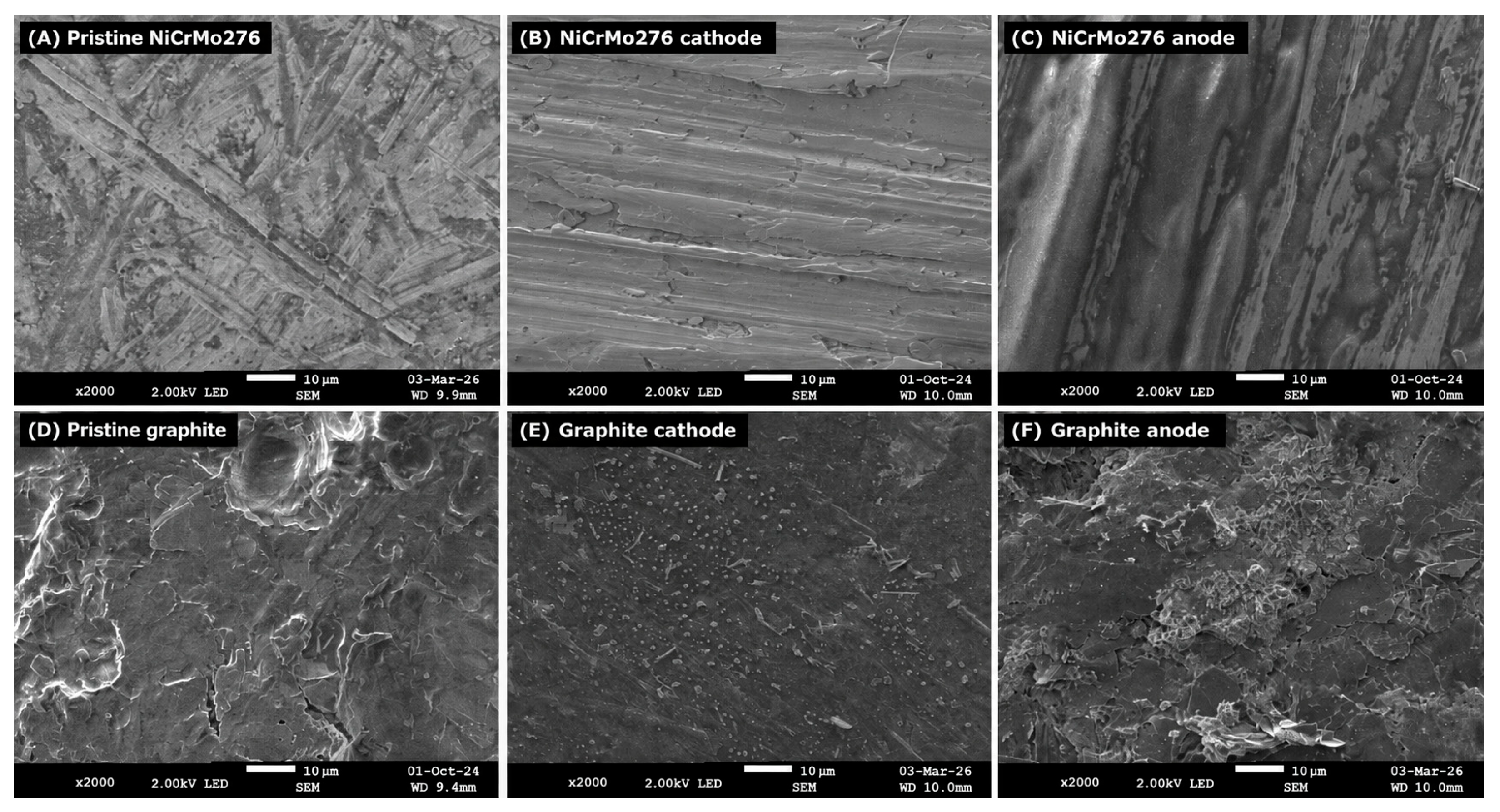
SEM observations revealed distinct surface morphologies depending on electrode material and, after electrolysis, electrode polarity (Figure 5).
Figure 5.
SEM micrographs of NiCrMo276 and graphite electrode surfaces before and after alkaline H2S electrolysis: (A) pristine NiCrMo276, (B) NiCrMo276 cathode after electrolysis, (C) NiCrMo276 anode after electrolysis, (D) pristine graphite, (E) graphite cathode after electrolysis, and (F) graphite anode after electrolysis. All micrographs were acquired at ×2000 magnification.
SEM observations of the pristine electrodes revealed markedly different initial surface morphologies (Figure 5A,D). The pristine NiCrMo276 surface exhibited a relatively uniform morphology with clearly visible polishing grooves (Figure 5A). After electrolysis, the NiCrMo276 cathode retained these characteristic polishing grooves and exhibited only limited superficial deposits (Figure 5B), indicating relatively limited morphological modification under cathodic operation. EDX analysis showed that the analyzed cathode surface remained dominated by the alloying elements Ni, Cr, and Mo, with 2.4 wt% oxygen and no sulfur detected in the analyzed area (Table 2).
Table 2.
Semi-quantitative EDX surface composition of NiCrMo276 and graphite electrodes after alkaline H2S electrolysis. ND = not detected.
The NiCrMo276 anode exhibited more pronounced surface modification than the cathode, with increased heterogeneity and localized roughened regions (Figure 5C). EDX analysis showed Ni, Cr, and Mo as the main metallic elements, together with 10.3 wt% Na and 8.1 wt% O, whereas sulfur was not detected in the analyzed area. The higher Na and O contents compared with the cathode are consistent with the presence of surface deposits and/or electrolyte-derived residues associated with anodic operation. The pristine graphite electrode already exhibited an intrinsically heterogeneous surface morphology (Figure 5D). After electrolysis, localized deposits were observed on the graphite cathode (Figure 5E), while the graphite anode displayed heterogeneous surface features and more pronounced deposits in the analyzed region (Figure 5F). EDX analysis detected sodium and oxygen on both graphite surfaces, together with trace amounts of sulfur (Table 2). These observations complement the electrochemical comparison between the two electrode materials presented in Section 3.2. For NiCrMo276, comparison with the pristine surface indicates that the cathode retained a relatively well-defined morphology, whereas more pronounced surface modification was observed at the anode. For graphite, the pristine electrode already exhibited substantial morphological heterogeneity, making it difficult to attribute the overall post-electrolysis surface texture exclusively to electrolysis. Nevertheless, localized deposits were observed on the graphite electrodes after electrolysis.
No sulfur was detected by EDX in the analyzed areas of the NiCrMo276 electrodes, whereas trace sulfur was detected on graphite. These observations characterize the post-electrolysis surface state of the electrodes under the investigated conditions, without implying long-term material stability or resistance to sulfur deposition.
4. Conclusions
This study demonstrates the feasibility of hydrogen production via alkaline sulfide electrolysis using industrial NiCrMo276 alloy electrodes. In the initial electrode screening, NiCrMo276 exhibited a substantially higher current response than graphite under identical electrolysis conditions and was therefore selected for detailed performance evaluation. At an applied cell voltage of 1.8 V and a NaHS:NaOH molar ratio of 1.25:1, hydrogen was produced at 200 mL h−1, with a current density of 33 mA cm−2 and a Faradaic efficiency of 92%. The corresponding specific electricity consumption was 52.4 kWh kg−1 H2.
Complementary sulfur analyses showed incomplete sulfide conversion and an evolution of the dissolved sulfur composition, particularly toward thiosulfate, although the measured sulfur distribution could not be attributed exclusively to electrochemical reactions. Post-electrolysis SEM–EDX observations further showed that NiCrMo276 retained a relatively well-defined surface morphology, particularly at the cathode, whereas the intrinsic heterogeneity of the graphite surface limited direct assessment of electrolysis-induced morphological changes. These complementary analyses provide additional insight into sulfur-species evolution and the post-electrolysis state of the electrodes without implying a complete sulfur reaction pathway or long-term material stability.
Overall, the combination of high Faradaic efficiency, hydrogen productivity, and substantially higher current response than graphite highlights NiCrMo276 as a promising electrode material for alkaline sulfide electrolysis. Importantly, these performances were achieved at ambient temperature using flat, commercially available alloy electrodes in a simple batch configuration. The present results provide a basis for the development of continuous electrolysis systems, where hydrogen productivity, sulfur-product management, and performance over extended operating periods can be further evaluated.
Supplementary Materials
The following supporting information can be downloaded at https://www.mdpi.com/article/10.3390/hydrogen7040153/s1, Figure S1: Current response recorded during hydrogen production measurements at an applied cell voltage of 1.8 V using NiCrMo276 electrodes. Values represent the mean of three independent experiments; error bars indicate standard deviation; Figure S2: Representative gas chromatograms of gaseous products collected during alkaline H2S electrolysis. (A) Front TCD channel showing hydrogen as the dominant gaseous product, with a measured purity exceeding 99%. (B) Middle TCD channel showing minor N2 and O2 signals attributed to ambient air contamination during sampling. No sulfur-containing gaseous species were detected within the analytical detection limits.
Author Contributions
Conceptualization, A.S., M.R., F.F., P.S. and F.R.; methodology, A.S., M.R., P.S. and F.R.; validation, M.R., F.F., P.S. and F.R.; investigation, A.S., M.R., P.S. and F.R.; resources, F.F. and F.R.; writing—original draft preparation, A.S.; writing—review and editing, M.R. and F.R.; visualization, A.S., M.R. and F.R.; supervision, M.R., F.F. and F.R.; project administration, F.F. and F.R.; funding acquisition, F.F. All authors have read and agreed to the published version of the manuscript.
Funding
This research was funded by the Association Nationale de la Recherche et de la Technologie (ANRT) through a CIFRE doctoral fellowship, in collaboration with Société Anonyme de la Raffinerie des Antilles (SARA), grant number 2022/1479.
Data Availability Statement
The data supporting the findings of this study are available from the corresponding author upon reasonable request.
Acknowledgments
ChatGPT (OpenAI, version 4) was used solely for language editing and improving the readability of the manuscript, and the specific model version was not recorded at the time of use. The authors reviewed and edited the output and take full responsibility for the content of the publication.
Conflicts of Interest
Authors Alexi Sellaman and Frédéric Ferrer were employed by Société Anonyme de la Raffinerie des Antilles. The authors declare that the research was conducted in the absence of any commercial or financial relationships that could be construed as a potential conflict of interest.
References
- Elmawgoud, H.A.; Elshiekh, T.M.; Abdelkreem, M.; Khalil, S.A.; Alsabagh, A.M. Optimization of petroleum crude oil treatment using hydrogen sulfide scavenger. Egypt. J. Pet. 2019, 28, 161–164. [Google Scholar] [CrossRef] [Scilit]
- Batterman, S.; Grant-Alfieri, A.; Seo, S.-H. Low level exposure to hydrogen sulfide: A review of emissions, community exposure, health effects, and exposure guidelines. Crit. Rev. Toxicol. 2023, 53, 244–295. [Google Scholar] [CrossRef] [Scilit] [PubMed]
- Aminuddin, M.S.; Bustam, M.A.; Johari, K. Latest technological advances and insights into capture and removal of hydrogen sulfide: A critical review. RSC Sustain. 2024, 2, 757–803. [Google Scholar] [CrossRef] [Scilit]
- Wen, X.; Bai, P.; Luo, B.; Zheng, S.; Chen, C. Review of recent progress in the study of corrosion products of steels in a hydrogen sulphide environment. Corros. Sci. 2018, 139, 124–140. [Google Scholar] [CrossRef] [Scilit]
- Resiere, D.; Kallel, H.; Florentin, J.; Banydeen, R.; Compton, K.; Gueye, P.; Mehdaoui, H.; Neviere, R. Sargassum seaweed in the Caribbean: A major public health problem still unsolved. J. Glob. Health 2023, 13, 03017. [Google Scholar] [CrossRef] [Scilit] [PubMed]
- Tian, L.; Han, C.; Zhang, J.; Ouyang, Y.; Xi, J. Development of an H2S emission model for wastewater treatment plants. J. Air Waste Manag. Assoc. 2021, 71, 1303–1311. [Google Scholar] [CrossRef] [Scilit] [PubMed]
- Pieplu, A.; Saur, O.; Lavalley, J.-C.; Legendre, O.; Nedez, C. Claus catalysis and H2S selective oxidation. Catal. Rev. 1998, 40, 409–450. [Google Scholar] [CrossRef] [Scilit]
- Bell, D.A.; Towler, B.F.; Fan, M. Sulfur recovery. In Coal Gasification and Its Applications; Elsevier: Amsterdam, The Netherlands, 2011; pp. 113–136. [Google Scholar] [CrossRef] [Scilit]
- Rambhujun, N.; Salman, M.S.; Wang, T.; Pratthana, C.; Sapkota, P.; Costalin, M.; Lai, Q.; Aguey-Zinsou, K.-F. Renewable hydrogen for the chemical industry. MRS Energy Sustain. 2020, 7, 33. [Google Scholar] [CrossRef] [Scilit] [PubMed]
- Kumar, M.; Nagaiah, T.C. Efficient production of hydrogen from H2S via electrolysis using a CoFeS2 catalyst. J. Mater. Chem. A 2022, 10, 7048–7057. [Google Scholar] [CrossRef] [Scilit]
- Carmo, M.; Fritz, D.L.; Mergel, J.; Stolten, D. A comprehensive review on PEM water electrolysis. Int. J. Hydrogen Energy 2013, 38, 4901–4934. [Google Scholar] [CrossRef] [Scilit]
- Nazari, F.; Türkmen, K.; Kalkan Burat, A.; Yavuz, N.; Sarioglan, A.; Yazici, M.S. Electrocatalytic splitting of low-concentration H2S in alkaline seawater using cobalt phthalocyanine. Int. J. Hydrogen Energy 2026, 231, 154909. [Google Scholar] [CrossRef] [Scilit]
- Chen, C.; Geng, X.; Liu, H.; Chen, Y.; Deng, X. Advances in Electrocatalytic Hydrogen Sulfide Splitting for Sulfur Recovery: From Reaction Mechanisms to Application. Catalysts 2025, 15, 1019. [Google Scholar] [CrossRef] [Scilit]
- U.S. Geological Survey. Mineral Commodity Summaries 2024: Sulfur; U.S. Geological Survey: Reston, VA, USA, 2024. [Google Scholar]
- Zaman, J.; Chakma, A. Production of hydrogen and sulfur from hydrogen sulfide. Fuel Process. Technol. 1995, 41, 159–198. [Google Scholar] [CrossRef] [Scilit]
- Anani, A.A.; Mao, Z.; White, R.E.; Srinivasan, S.; Appleby, A.J. Electrochemical production of hydrogen and sulfur by low-temperature decomposition of hydrogen sulfide in an aqueous alkaline solution. J. Electrochem. Soc. 1990, 137, 2703–2709. [Google Scholar] [CrossRef] [Scilit]
- Mao, Z.; Anani, A.; White, R.E.; Srinivasan, S.; Appleby, A.J. A modified electrochemical process for the decomposition of hydrogen sulfide in an aqueous alkaline solution. J. Electrochem. Soc. 1991, 138, 1299–1303. [Google Scholar] [CrossRef] [Scilit]
- Narendranath, J.; Manokaran, J.; Shanmuga Sundar, S.; Muruganantham, R.; Al Shoaibi, A.; Srinivasakannan, C.; Balasubramanian, N. Electrochemical recovery of hydrogen and elemental sulfur from hydrogen sulfide gas by two-cell system. Energy Sources Part A Recovery Util. Environ. Eff. 2023, 45, 9602–9615. [Google Scholar] [CrossRef] [Scilit]
- Triana, Y.; Tomisaki, M.; Einaga, Y. Oxidation reaction of dissolved hydrogen sulfide using boron-doped diamond. J. Electroanal. Chem. 2020, 873, 114411. [Google Scholar] [CrossRef] [Scilit]
- Pourbaix, M. Atlas of Electrochemical Equilibria in Aqueous Solutions, 2nd ed.; National Association of Corrosion Engineers: Houston, TX, USA, 1974. [Google Scholar]
- Yang, J.; Smulders, V.; Smits, J.J.T.; Mei, B.T.; Mul, G. Electrochemical oxidation of H2S on polycrystalline Ni electrodes. J. Appl. Electrochem. 2019, 49, 929–936. [Google Scholar] [CrossRef] [Scilit]
- Kim, K.; Lee, C. Recent progress in electrochemical hydrogen sulfide splitting: Strategies for enabling sulfur-tolerant anodic reactions. Chem. Eng. J. 2023, 469, 143861. [Google Scholar] [CrossRef] [Scilit]
- Velazquez-Rizo, M.; Cavazos Sepulveda, A.C. Low-temperature direct electrochemical splitting of H2S. Front. Chem. Eng. 2023, 4, 1087435. [Google Scholar] [CrossRef] [Scilit]
- Zhang, M.; Wang, Z.; Jiang, L.; Bo, X.; Cui, X.; Deng, D. Highly effective and durable integrated-chainmail electrode for H2 production through H2S electrolysis. Angew. Chem. Int. Ed. 2025, 64, e202502032. [Google Scholar] [CrossRef] [Scilit] [PubMed]
- Hou, Z.; Ma, Y.; Wu, Y.; Cao, W.; Guo, Z.; Wang, C. Pulsed electrolysis prevents sulfur poisoning for sustained sulfide valorization. Adv. Mater. 2026, 38, e73096. [Google Scholar] [CrossRef] [Scilit] [PubMed]
- Chen, Y.; Wen, M.; Ding, T.; Fan, R.; Liu, Q.; Liu, Z.; Peng, Z. Recent progress in electrochemical decomposition of hydrogen sulfide for sulfur recovery and hydrogen production. Front. Chem. 2025, 13, 1698815. [Google Scholar] [CrossRef] [Scilit] [PubMed]
- Zhang, J.; Li, B.; Li, Y.; Lu, J.; Wang, K.; Zhang, H. Effect of sulfide on corrosion behavior of stainless steel 316SS and Hastelloy C276 in sub/supercritical water. Int. J. Hydrogen Energy 2021, 46, 22222–22233. [Google Scholar] [CrossRef] [Scilit]
- Kawashima, K.; Márquez, R.A.; Son, Y.J.; Guo, C.; Vaidyula, R.R.; Smith, L.A.; Chukwuneke, C.E.; Mullins, C.B. Accurate potentials of Hg/HgO electrodes: Practical parameters for reporting alkaline water electrolysis overpotentials. ACS Catal. 2023, 13, 1893–1898. [Google Scholar] [CrossRef] [Scilit]
- Chen, A.; Miller, B. Potential oscillations during the electrocatalytic oxidation of sulfide on a microstructured Ti/Ta2O5–IrO2 electrode. J. Phys. Chem. B 2004, 108, 2245–2251. [Google Scholar] [CrossRef] [Scilit]
- Karlsen, V.B.; Dinamarca, C. Electrochemical and bioelectrochemical sulphide removal: A review. Rev. Environ. Sci. Biotechnol. 2024, 23, 989–1014. [Google Scholar] [CrossRef] [Scilit]
- Tsacheva, I.; Yazici, M.S.; Turutoglu, C.; Raikova, G.; Petrov, K.; Uzun, D. Recent Advancements in Electrode Materials for Hydrogen Production via Hydrogen Sulfide (H2S) Electrolysis. Hydrogen 2026, 7, 58. [Google Scholar] [CrossRef] [Scilit]
- Kong, W.; Mao, J.; Peng, Q.; Qin, S.; Shi, L.; Wu, A.; Xu, S.; Shi, J.; Liu, Y.; Ma, Y. Sustainable and efficient H2S electrolysis enhanced by acetate-based ionic liquid. Chem. Pap. 2025, 79, 7769–7785. [Google Scholar] [CrossRef] [Scilit]

Disclaimer/Publisher’s Note: The statements, opinions and data contained in all publications are solely those of the individual author(s) and contributor(s) and not of MDPI and/or the editor(s). MDPI and/or the editor(s) disclaim responsibility for any injury to people or property resulting from any ideas, methods, instructions or products referred to in the content. |
© 2026 by the authors. Licensee MDPI, Basel, Switzerland. This article is an open access article distributed under the terms and conditions of the Creative Commons Attribution (CC BY) license.