


Abstract
Oxygen carriers (OCs) are essential materials in chemical looping technologies for low-carbon hydrogen production; however, the environmental implications of their synthesis remain insufficiently explored. This study presents a gate-to-gate life cycle assessment (LCA) of a chamotte–nickel OC produced via wet impregnation, following ISO 14040/44 guidelines. The functional unit was defined as 1 kg of oxygen carrier (OC), with input material requirements including chamotte, nickel nitrate, and water, as part of the synthesis process. Environmental impacts were modelled using ReCiPe 2016 Midpoint (H). Environmental hotspots varied across impact categories, with wet impregnation and energy-intensive thermal processes showing substantial contributions, while transportation-related burdens were relevant in selected toxicity and resource-related categories. Wet impregnation contributed 38.93% to climate change, approximately 55.6% to ozone depletion, and approximately 95.6% to terrestrial acidification in the modelled inventory. Thermal treatments also contributed substantially to several impact categories, primarily because of their high electricity requirements. Hotspot analysis identified precursor selection, energy supply, and logistics as key drivers of environmental burdens. Qualitative mitigation options include precursor substitution, renewable-energy integration, energy-efficiency improvements, and industrial symbiosis; however, these alternatives were not quantitatively evaluated in the present LCA. These results offer actionable guidance for sustainable OC design and highlight the importance of integrating LCA into early-stage oxygen-carrier design to reduce the environmental burdens associated with material synthesis. Further assessment incorporating OC performance, lifetime, regeneration, and hydrogen yield would be required to determine the implications of these material-level improvements for the environmental performance of hydrogen production.
1. Introduction
The 2030 Agenda for Sustainable Development establishes universal access to affordable, reliable and modern energy as a global imperative under Sustainable Development Goal 7 (SDG 7). This goal underscores the urgency of strengthening energy security while reducing the environmental impacts associated with conventional energy systems [1]. However, the global energy sector remains predominantly dependent on fossil fuels, which continue to drive greenhouse gas (GHG) emissions and contribute significantly to climate change. According to the United Nations, energy production and consumption are responsible for nearly 60% of global GHG emissions, positioning the sector as one of the principal contributors to global climate change. In Colombia, this pattern persists: coal and oil account for approximately 77% of primary energy supply, while hydroelectricity, natural gas and emerging renewable sources contribute only 23% [2]. Such reliance poses environmental, economic and geopolitical risks, making energy diversification through low-carbon alternatives essential to ensure a secure, resilient and sustainable energy transition [3,4].
Hydrogen has emerged as a promising clean energy vector because its use does not generate direct CO2 emissions and it can be produced from various pathways, including electrolysis, fossil fuel reforming with carbon capture, and chemical looping processes. Despite its potential, hydrogen technologies still face challenges related to production efficiency, cost reduction, scalability and regulatory development [5]. Among the emerging routes for hydrogen production, chemical looping systems are gaining attention due to their inherent capacity for CO2 capture and their potential integration into circular low-carbon energy systems.
Chemical looping processes use solid oxygen carriers (OCs) that transfer lattice oxygen between an air reactor and a fuel reactor. In the air reactor, a metal oxide is regenerated; in the fuel reactor, the reduced metal oxide oxidizes the fuel and completes the redox cycle [6,7]. Although OCs do not participate directly in the chemical reactions, their stability, reactivity and durability strongly influence system performance. However, the synthesis of OCs can generate significant environmental burdens linked to raw material extraction, energy consumption and waste generation. However, the synthesis of OCs can generate environmental burdens associated with raw-material production, energy consumption, and material processing, making the production stage relevant when evaluating the overall environmental performance of chemical looping systems.
Oxygen-carrier development has therefore explored a broad range of active materials, including Fe-, Cu-, Mn-, and Ni-based systems, as well as supported and mixed-metal formulations. These alternatives involve different trade-offs among redox reactivity, oxygen-transfer capability, thermal stability, material availability, cost, and environmental burden. Iron- and manganese-based carriers are attractive because of their comparatively high availability, whereas copper- and nickel-based materials have been widely investigated because of their favorable redox characteristics. Nevertheless, the environmental implications of carrier selection depend not only on operational performance but also on precursor production, support materials, synthesis route, and the energy requirements of high-temperature processing.
The oxygen carrier considered in this study is synthesized using chamotte—a refractory ceramic derived from calcined clays—and nickel nitrate, which serves as the metal precursor for wet impregnation. Chamotte, composed primarily of silicon and aluminium oxides, provides thermal stability, mechanical resistance and structural properties suitable for dispersing active metal phases. Hydrated aluminium silicates, present in its composition, offer high surface area, ion-exchange capacity and adequate thermal durability, making them suitable supports for oxygen carrier applications [8]. Nickel nitrate (Ni(NO3)2), widely used in redox materials, decomposes during calcination to form nickel oxide (NiO), the active phase responsible for oxygen transport and redox reactions [9]. Nickel-based active phases supported on thermally stable materials have been investigated in the literature for chemical looping applications because of their redox and oxygen-transfer properties [8,9]. However, the operational performance of the specific chamotte–nickel OC assessed here was not evaluated as part of the present LCA.
Given the potential environmental burdens associated with precursor chemicals, thermal treatments and support materials, a structured evaluation method is needed to quantify impacts and identify improvement opportunities. Life Cycle Assessment (LCA), standardized under ISO 14040 and ISO 14044, provides a systematic framework to quantify environmental impacts across a product’s life cycle, from resource extraction to end-of-life [10,11]. LCA has been widely applied to renewable energy systems, such as photovoltaic modules [12], wind turbine components [13] and transition metal oxides for hydrogen production [14]. This approach supports eco-design, environmental trade-off analysis, industrial ecology and policy development [15,16,17].
In the context of chemical looping systems, LCA plays a critical role in assessing the sustainability of low-carbon hydrogen production pathways. Although these systems inherently facilitate CO2 capture, they still generate emissions during fuel oxidation and OC regeneration stages, highlighting the need for comprehensive environmental evaluation [18,19]. LCA enables the identification of hotspots related to material use, energy demand and OC synthesis, supporting informed decision-making regarding large-scale deployment [18].
Despite the growing application of LCA to hydrogen and chemical looping technologies [20], the environmental implications of oxygen-carrier synthesis at the material-production level remain comparatively underexplored. Previous research has predominantly addressed reactor performance, oxygen-transfer characteristics, redox stability, and the environmental performance of broader chemical-looping systems [8,21,22,23,24], while fewer studies provide process-resolved environmental information on the synthesis of the carrier material itself. This distinction is relevant because precursor production, support preparation, and energy-intensive thermal treatments may introduce environmental burdens before the OC enters the reactor. Assessing these synthesis-stage contributions can therefore complement conventional performance-based material selection and provide environmental information for the early design and optimization of oxygen carriers.
Therefore, the objective of this research is to conduct a gate-to-gate LCA of an oxygen carrier synthesized from chamotte and nickel nitrate via wet impregnation. The assessment aims to quantify the environmental impacts associated with OC synthesis, identify process-level environmental hotspots, and discuss potential improvement pathways within the defined manufacturing boundary. The specific contribution of this work is a process-resolved environmental assessment of chamotte-supported nickel OC synthesis that distinguishes the contributions of precursor use, support preprocessing, logistics, and energy-intensive thermal operations. By doing so, the study provides environmental information that can complement conventional technical criteria used during oxygen-carrier development and provides a transparent basis for identifying synthesis-stage improvement priorities. The study is positioned at the material-production level and does not assess the environmental performance of hydrogen generation itself. Although the investigated OC was developed within a broader research project focused on chemical looping for low-emission hydrogen production from biogas generated in wastewater treatment plants, the present LCA does not include OC utilization, regeneration, lifetime, oxygen-transfer performance, or hydrogen yield. Consequently, the results should be interpreted as evidence for improving the environmental performance of OC synthesis rather than as a direct assessment of cleaner hydrogen production. A preliminary version of this manuscript was posted on Research Square [25].
2. Materials and Methods
This study was conducted using technical information provided by the University of Antioquia and Sumicol S.A.S. (La Unión, Colombia). The oxygen carrier (OC) evaluated consists of two principal components: chamotte, produced industrially by Sumicol in La Unión (Antioquia, Colombia), and nickel nitrate, used as the active metal precursor in the wet impregnation stage. The environmental assessment was carried out following the methodological framework established in ISO 14040:2006 and ISO 14044 [10,11]. In accordance with these standards, the LCA was structured into four phases: (i) goal and scope definition, including the system boundaries and functional unit; (ii) life cycle inventory (LCI) development; (iii) life cycle impact assessment (LCIA); and (iv) interpretation, focusing on the identification of hotspots and opportunities for cleaner production. Beyond quantifying environmental burdens, the methodology was applied to identify leverage points for implementing circular strategies and improving process sustainability.
2.1. Definition of Scope, Functional Unit, and Boundaries
The objective of this study is to quantify the environmental impacts associated with the synthesis of a nickel–chamotte oxygen carrier produced via wet impregnation and to identify process-level hotspots that may guide improvement strategies. The assessment was defined as a gate-to-gate foreground study focused on the operations directly represented by available industrial and experimental inventory data. The system includes selected logistics and preprocessing operations associated with the chamotte support, namely clay transportation, mixing, homogenization, calcination, grinding, and screening, followed by wet impregnation and thermal treatment of the oxygen carrier. However, the assessment does not represent the complete cradle-to-gate production chain of chamotte. Clay extraction, infrastructure, capital equipment, and other upstream background processes for which no primary inventory data were available were excluded. Downstream stages such as OC use, regeneration, replacement, and end-of-life were also excluded.
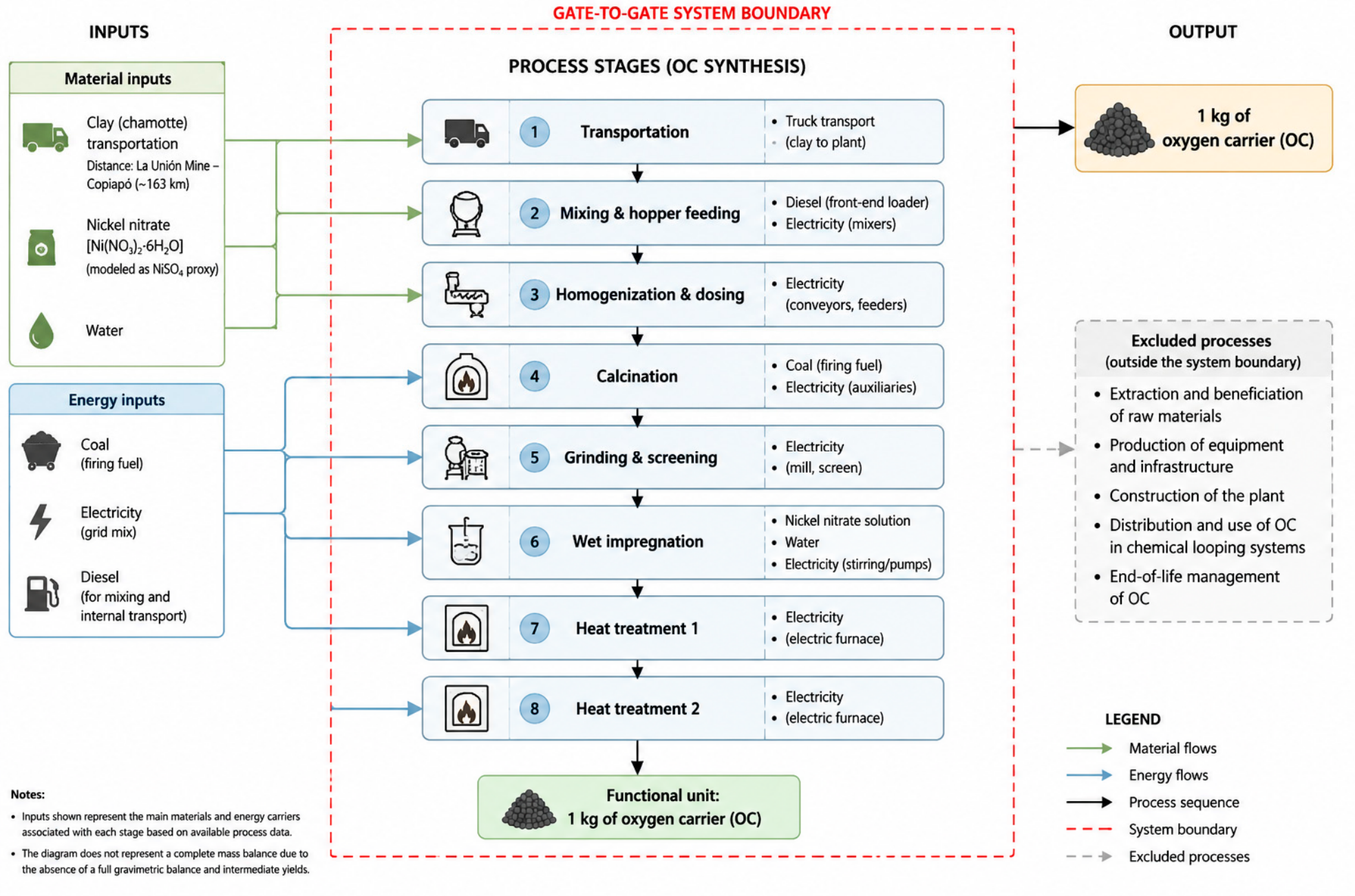
The functional unit (FU) was defined as 1 kg of oxygen carrier (OC) at the end of the synthesis process. All material and energy inputs were expressed relative to this reference flow for the purpose of the environmental assessment. The reported inputs, including 1.041 kg of nickel nitrate and 0.66 kg of water per functional unit, therefore represent process inventory requirements normalized to the production reference of 1 kg of OC and should not be interpreted as the final mass incorporated into the product. Water is used as a processing medium during wet impregnation and is subsequently removed during drying and thermal treatment, while nickel nitrate undergoes thermal decomposition during formation of the active nickel-containing phase. The available experimental inventory did not include a complete gravimetric mass balance documenting intermediate mass losses, final nickel loading, or process yield. Consequently, these parameters cannot be independently reconstructed from the LCI data and are not reported as measured outcomes of the present study. The system boundaries and major stages are summarized in the process flow diagram (Figure 1).
Figure 1.
Process flow diagram and system boundary of the gate-to-gate LCA for chamotte–nickel oxygen-carrier synthesis. Material and energy inputs associated with the modelled stages are shown within the system boundary; processes outside the dashed boundary are excluded from the assessment.
The functional unit was intentionally defined at the material-production level because the present assessment addresses OC synthesis rather than its subsequent operation in a chemical looping reactor. Accordingly, the system does not include OC utilization, regeneration, replacement frequency, oxygen-transfer capacity, cyclic stability, or hydrogen yield. The environmental results reported per kilogram of OC therefore cannot be converted into impacts per kilogram of hydrogen without additional performance and lifetime data that are outside the scope of the present inventory.
The flowchart distinguishes the principal material and energy inputs, modelled process stages, and exclusions within the gate-to-gate system boundary. Inventory flows are presented according to the available process data and should not be interpreted as a complete gravimetric mass balance.
The system included the following stages:
- (a)
- Transportation of clay: Raw clays from the La Unión and Llano Grande mining sites were transported using 18-ton dump trucks over distances of 0.7 km and 29 km, respectively.
- (b)
- Clay mixing and feeding: Clays were homogenized and loaded into a hopper using a diesel-powered front loader.
- (c)
- Homogenization and dosing: Mechanical disintegration, rotary filtration, and pellet extrusion were performed using electrically powered equipment.
- (d)
- Calcination: Pellets were calcined in tunnel kilns at 900–1000 °C for ~3 h, followed by forced-air cooling. Coal preparation included crushing, grinding, and moisture removal using an LPG-fired burner.
- (e)
- Grinding and screening: Calcined chamotte was milled and sieved to obtain the desired particle size.
- (f)
- Wet impregnation: Chamotte was impregnated with nickel nitrate and deionized water to form the active composite.
- (g)
- Thermal treatments: Two programmed heat treatments (100–800 °C) were carried out in an electric furnace to remove moisture and decompose the metal precursor.
All processes used potable water and industrial utilities supplied by the Sumicol pilot plant. Energy consumption for homogenization and dosing was provided directly by Sumicol.
2.2. Life Cycle Inventory (LCI) Modelling
The inventory flows associated with chamotte production should not be interpreted as a complete stoichiometric or cradle-to-gate representation of the refractory support. The study includes only those transportation and preprocessing operations for which primary industrial data were available and that could be attributed to the functional unit of 1 kg of oxygen carrier. Consequently, the clay-related inventory represents partial process burdens associated with the production of the chamotte used in the OC synthesis, rather than a complete mass-flow reconstruction of raw clay conversion into chamotte.
The material and energy flows included in the inventory were normalized to the functional unit following the process-based LCA approach adopted in this study. Accordingly, the resulting assessment should be interpreted as a foreground gate-to-gate evaluation with selected upstream logistics and preprocessing contributions, rather than as a complete cradle-to-gate assessment of the chamotte support.
This normalization approach is commonly applied in gate-to-gate LCA studies involving industrial intermediate materials, where upstream processing stages are partially represented through allocated inventory contributions rather than through complete mass-flow reconstruction [26].
2.2.1. Transportation of Clays
Clay transport was modelled using the SimaPro version 8.0.3.14 dataset transport, freight, lorry 3.5–7.5 t, EURO5 {RoW}|Alloc Def, U. Table 1 shows transported masses, distances, and corresponding ton·km entries.
Table 1.
Weight and distance travelled by clay from both mines to the plant.
2.2.2. Diesel Consumption During Clay Handling
Diesel use in mixing and feeding was modelled using diesel (loader), burned in building machine {GLO}|processing|Alloc Def, U, with a lower heating value of 42.4185 MJ/kg [27]. Inventory data are shown in Table 2.
Table 2.
Diesel energy per functional unit (FU).
2.2.3. Electricity Consumption in Homogenization and Dosing
For the homogenization and dosing stage, a Peruvian electricity dataset was used as a regional proxy because a directly compatible Colombian electricity dataset was not available in the database configuration used in the original model. Table 3 presents the electricity consumption associated with this stage. Table 3 presents electricity consumption for this stage.
Table 3.
Energy consumption of the homogenization and dosing stage.
The Peruvian electricity dataset was used as a regional proxy only for this specific operation, for which a directly compatible Colombian dataset was not available in the database configuration used in the original model. It should therefore not be interpreted as the electricity mix applied throughout the entire system. Colombian electricity data were used for other electricity-consuming operations when compatible inventory information was available. Nevertheless, the use of the Peruvian proxy introduces geographical representativeness uncertainty because differences in generation technologies and grid composition may affect electricity-related environmental burdens. A quantitative Colombia-versus-Peru electricity scenario was not performed in the original model; therefore, the magnitude of this effect cannot be determined from the present results and is acknowledged as a limitation.
2.2.4. Calcination Stage
Calcination was modelled using Colombian electricity [28] and thermal energy derived from coal and LPG. The following Ecoinvent datasets were used:
- Heat production, hard coal, industrial furnace 1–10 MW {RoW}|Alloc Def, U
- Heat, from liquefied petroleum gas {GLO}|propane extraction|Alloc Def, U
Energy flows are detailed in Table 4.
Table 4.
Energy consumption of different fuels during calcination.
2.2.5. Grinding, Screening, and Wet Impregnation
Grinding and screening were modelled using Colombian electricity [28]. Because a specific dataset for nickel nitrate (Ni(NO3)2) was not available in the Ecoinvent version used in this study, nickel sulfate (NiSO4) was adopted as a proxy to represent the upstream production burdens of the nickel-containing precursor. This substitution was necessary to retain the contribution of nickel production within the inventory; however, NiSO4 and Ni(NO3)2 are not chemically equivalent precursors and may differ in their upstream production routes and thermal decomposition emissions. In particular, the NiSO4 dataset does not explicitly represent nitrate-specific decomposition products potentially generated during subsequent thermal treatment. Therefore, the use of NiSO4 constitutes an inventory limitation and the results associated with precursor-related impacts should be interpreted accordingly.
Datasets used:
- nickel sulfate {GLO}|production|Alloc Def, U
- tap water, at user {RoW}|market for|Alloc Def, U
Experimental inventory data for impregnation were provided by the University of Antioquia.
2.2.6. Thermal Treatments
Heat treatment 1 corresponds to the initial drying stage, aimed at moisture removal and precursor stabilization, while Heat treatment 2 represents the final thermal stabilization stage, where the decomposition of the metal precursor and consolidation of the active phase occur.
Two heat treatments were conducted in a Nabertherm LHT 04/17 furnace (Nabertherm GmbH, Lilienthal, Germany) (maximum 1200 °C, ±5 °C accuracy, PID control). Colombian electricity was used [28]. Table 5 shows energy inputs for grinding, impregnation, and thermal processing.
Table 5.
Energy consumption in the OC production stages.
2.3. Life Cycle Impact Assessment (LCIA)
The LCIA was performed using the ReCiPe 2016 Midpoint (H) method [29], which follows the hierarchical cultural perspective. This method is widely applied in LCA of materials and energy systems due to its compatibility with ISO 14044 [30,31] and its comprehensive coverage of 18 midpoint impact categories, including climate change, human toxicity, particulate matter formation, ecotoxicity, eutrophication, water depletion, and fossil resource scarcity [32,33,34].
ReCiPe links process-level emissions with internationally recognized environmental indicators, enabling systematic hotspot identification and supporting decision-making regarding cleaner production strategies. This analytical capability is essential in green chemical engineering, as it highlights opportunities for precursor substitution, energy efficiency improvements, and renewable energy integration [35]. Its application aligns with principles of green chemistry and the circular economy, contributing to the development of sustainable material production systems [36,37].
3. Results and Discussion
3.1. LCIA Results and Interpretation
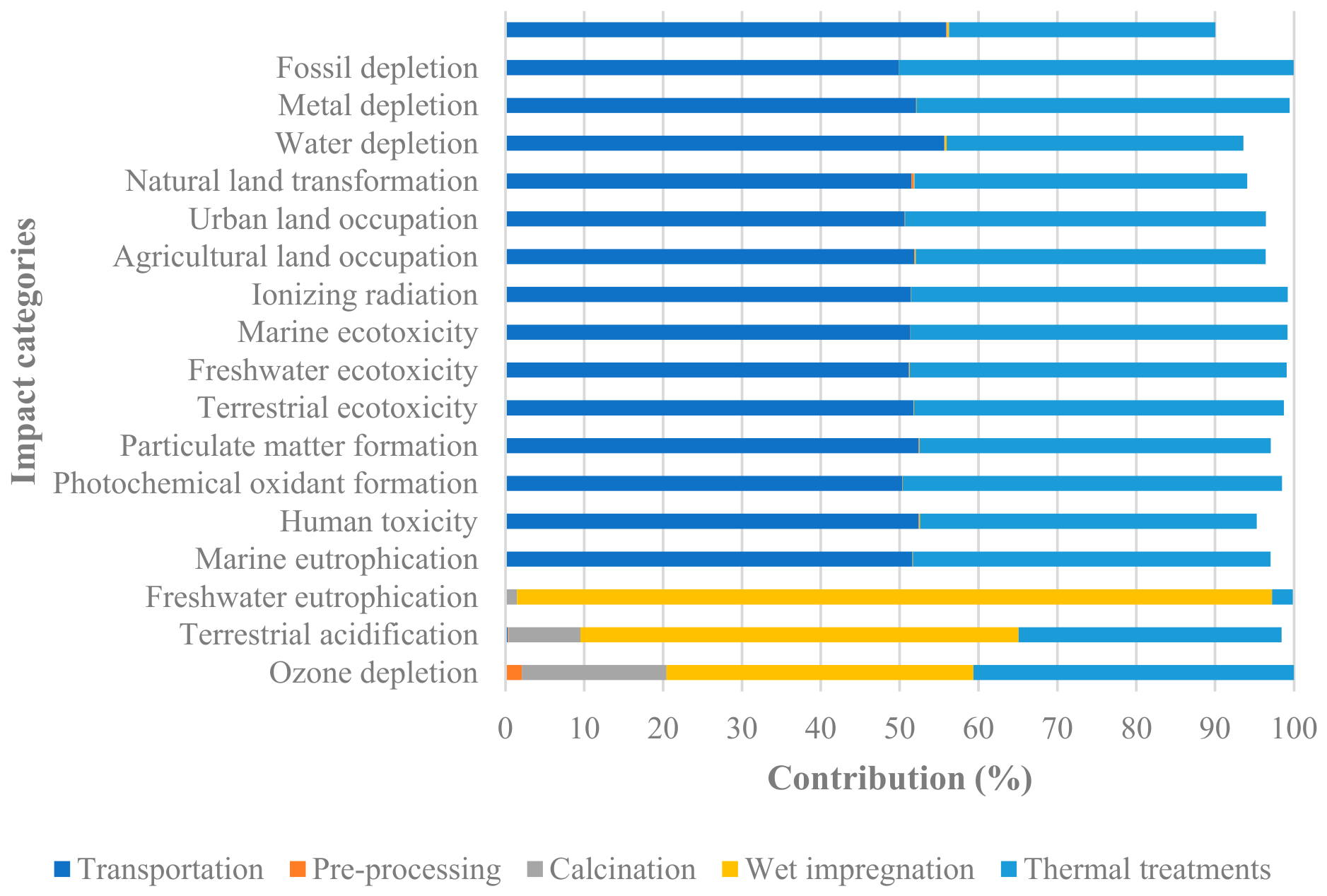
The life cycle impact assessment (LCIA) was performed for a functional unit of 1 kg of oxygen carrier (OC), considering the main material inputs involved in the synthesis process, including chamotte, nickel nitrate, and water. Environmental impacts were quantified across all stages of the OC manufacturing process, from raw material transport to final thermal treatments. Figure 2 shows the relative contribution of the main process stages to each impact category (expressed as percentages). This breakdown is essential for prioritizing mitigation strategies and guiding more sustainable synthesis pathways.
Figure 2.
Relative contribution of the main process stages to the LCIA impact categories for the production of 1 kg of oxygen carrier.
The results show that environmental contributions vary substantially across process stages and impact categories. Precursor-associated processes, energy-intensive thermal stages, and selected transportation-related contributions are relevant depending on the category considered. This finding emphasizes the importance of interpreting the environmental profile on a category-specific basis and of considering both foreground operations and upstream supply-chain burdens. The results provide a baseline for identifying process-level improvement opportunities within the defined OC synthesis system.
Due to the midpoint characterization approach adopted in ReCiPe 2016 [29], certain toxicity- and resource-related categories may exhibit comparatively high absolute values because they incorporate upstream emissions and resource extraction burdens associated with fuel production and industrial supply chains.
For clarity, individual process steps were aggregated into main process stages to highlight dominant environmental hotspots across impact categories.
The results show distinct contribution patterns across impact categories. Wet impregnation and thermal processes are particularly relevant for climate change and acidification, whereas transportation-related contributions are more pronounced in selected toxicity and resource-related categories.
These findings indicate that precursor-related processes, energy-intensive stages, and selected transportation activities contribute differently to the environmental profile depending on the impact category considered.
This behaviour highlights the importance of targeted mitigation strategies focusing on these key stages.
Table 6 summarizes the LCIA results for each production stage across the evaluated environmental categories. The contribution pattern varies substantially among impact categories, indicating that no single process stage can be identified as the dominant contributor across the entire environmental profile. Wet impregnation, calcination, thermal treatments, and selected transportation-related processes exhibit relevant contributions depending on the impact category considered. Climate change is predominantly associated with wet impregnation and high-temperature processing, whereas transportation-related contributions are more relevant in selected toxicity and resource-related categories. This stage-specific interpretation avoids generalizing hotspot dominance across impact categories and provides a more transparent basis for identifying improvement priorities.
Table 6.
Environmental impacts matrix with quantitative results of the LCA for each stage of OC synthesis.
Identifying these hotspots is key to targeting interventions such as precursor substitution, renewable energy adoption, heat-integration strategies, and lower-temperature calcination methods—all of which may contribute to reducing the environmental burden.
3.1.1. Transportation
The environmental relevance of transportation varied considerably among the evaluated impact categories. Based on the stage-level results reported in Table 6, transportation should not be interpreted as a uniformly dominant hotspot across the complete environmental profile. For climate change, for example, the combined contribution of the two clay-transport stages was approximately 0.14% of the total impact, substantially lower than the contributions from wet impregnation, calcination, and thermal treatments. Transportation-related burdens were comparatively more relevant in selected toxicity and resource-related categories represented by the background transportation datasets. These contributions are associated with fuel production, vehicle operation, and other upstream processes included in the transportation inventory rather than with direct emissions from the transported clay itself.
The marked variation among impact categories also indicates that transportation results should be interpreted on a category-specific basis. Accordingly, transportation is retained as a relevant logistics-related contribution in selected categories, but it is not considered a general dominant hotspot of the OC synthesis system.
3.1.2. Calcination with Coal Pulverization
Calcination contributed 18.32% to climate change, reflecting the energy requirements associated with coal-based firing at temperatures above 900 °C. Coal-based energy supply may also contribute to other impact categories through combustion-related and upstream fuel-production burdens represented in the inventory [38,39,40,41,42]. These results identify calcination as a relevant energy-intensive stage and support consideration of potential improvement options such as lower-impact energy sources and process-efficiency measures. However, these alternatives were not quantitatively evaluated in the present study.
3.1.3. Wet Impregnation
Wet impregnation contributed 38.93% to climate change, approximately 55.6% to ozone depletion, and 55.57% to terrestrial acidification in the modelled inventory. These contributions should be interpreted primarily as upstream burdens associated with the datasets used to represent precursor and energy inputs rather than as direct emissions experimentally measured during the wet-impregnation operation. Substances reported within the background inventory of the nickel-salt production dataset do not necessarily correspond to chemicals physically used or directly emitted during the experimental impregnation process, which involved nickel nitrate and water. Accordingly, the contribution of this stage reflects both foreground material requirements and background supply-chain burdens embedded in the selected proxy datasets. This distinction is important when interpreting precursor-related hotspots and constitutes a source of uncertainty in the present assessment.
3.1.4. Heat Treatments 1 and 2
Heat treatments contributed substantially to several impact categories because of their high electricity demand and the upstream burdens associated with the energy supply represented in the inventory [43,44]. In addition, thermal decomposition of nickel nitrate may generate nitrogen-containing emissions, including NOx and potentially N2O, as reported in the literature [45,46,47,48]. However, because nickel sulfate was used as the background proxy for nickel nitrate production, nitrate-specific decomposition emissions were not explicitly represented through the precursor dataset. Therefore, the present LCIA results should not be interpreted as a quantitative determination of NOx or N2O emissions generated by nickel nitrate decomposition. Rather, these emissions represent an additional potential environmental consideration associated with the actual precursor that should be addressed in future inventories using precursor-specific experimental or database information.
Consequently, the environmental relevance of the thermal-treatment stages demonstrated by the present model is primarily associated with their energy requirements, while the magnitude of nitrate-specific decomposition emissions remains uncertain.
3.1.5. Mitigation Strategies and Implementation Considerations
Based on the environmental hotspots identified within the defined gate-to-gate boundary, a set of potential mitigation strategies was considered for reducing the environmental burdens associated with OC synthesis. These strategies target precursor selection, energy consumption, and other manufacturing-related contributors identified or discussed in the assessment. They should be interpreted as qualitative improvement options for the OC production stage rather than as demonstrated reductions in the environmental impacts of hydrogen production. Their implementation and potential environmental benefits would require further technical and quantitative evaluation. Table 7 summarizes these strategies and their main implementation considerations.
Table 7.
Qualitative mitigation strategies for reducing environmental burdens associated with oxygen-carrier synthesis.
Among the proposed strategies, precursor substitution and energy-related improvements are particularly relevant because they target precursor- and energy-related burdens identified within the synthesis system. Literature suggests that replacing nitrogen-based precursors may help avoid nitrate-related decomposition emissions, while improvements in energy efficiency and lower-impact electricity supply may reduce burdens associated with high-temperature processing. These potential benefits were not quantified in the present study.
However, these strategies involve trade-offs between environmental benefits, technical feasibility, and economic considerations. For example, renewable energy integration may require additional infrastructure and investment, while precursor substitution must ensure that material performance is not compromised.
The mitigation strategies summarized in Table 7 are supported by previous studies highlighting the potential of precursor substitution, energy optimization, and emission control technologies to reduce environmental impacts in material synthesis processes.
Potential improvement pathways include the evaluation of alternative precursor systems, lower-energy synthesis routes, improved energy efficiency, and greater use of secondary material sources. The environmental effectiveness of these options would depend on the specific process configuration and should therefore be evaluated through dedicated comparative scenarios in future studies.
Reported studies suggest that these strategies may contribute to reducing CO2-equivalent emissions and air pollutants [49,50]. However, such estimates depend on process conditions, system boundaries, and implementation scale, and should therefore be interpreted as indicative rather than absolute values.
3.1.6. Practical Implications for Sustainable Production Systems
The hotspot analysis indicates that environmental considerations can be incorporated into oxygen-carrier development by focusing on precursor selection, energy demand, and material efficiency during synthesis. At the process-design level, the results support further evaluation of lower-impact electricity supply, improved thermal efficiency, alternative precursor systems, and secondary material sources. Because these alternatives were not quantitatively modelled in the present study, their implementation should be preceded by technical assessment and comparative environmental evaluation.
3.2. Comparison with Other Oxygen-Carrier Systems and Implications for Material Selection
To contextualize the results, it is important to compare the identified dominant environmental contributors with findings from previous LCA studies on oxygen carriers and hydrogen production systems [51]. Similar studies have reported that precursor production and high-temperature processes are among the main contributors to environmental impacts, particularly in climate change, toxicity, and resource depletion categories.
Previous studies have investigated Fe-, Cu-, Mn-, and Ni-based oxygen carriers as well as natural ores, mixed oxides, and supported formulations for chemical looping applications [46]. These materials exhibit different trade-offs between redox reactivity, oxygen-transfer capacity, thermal and mechanical stability, cost, availability, and environmental or health-related considerations [47,52]. Ni-based OCs have been widely investigated because of their favorable reactivity and catalytic characteristics, but nickel-containing materials also raise cost, toxicity, and environmental concerns. Fe-based materials have consequently received attention as lower-cost alternatives with comparatively lower health and environmental concerns, whereas Cu-based OCs offer high reactivity and oxygen-transfer capability but may present operational challenges such as agglomeration and attrition. Mn-based materials and natural ores constitute additional alternatives whose performance depends strongly on mineral composition and operating conditions [53,54,55].
To facilitate comparison with other oxygen-carrier systems reported in the literature, Table 8 summarizes relevant technological and environmental characteristics of commonly investigated metal-based OCs. The comparison is qualitative because direct numerical harmonization is not possible across studies using different functional units, system boundaries, precursor routes, operating conditions, and LCIA methods. Accordingly, the table is intended to contextualize the environmental and technological trade-offs associated with material selection rather than to establish a quantitative ranking among oxygen-carrier technologies.
Table 8.
Qualitative comparison of selected oxygen-carrier systems reported in the literature and the chamotte–nickel system investigated in the present study.
The comparison highlights that oxygen-carrier selection involves trade-offs between material availability, environmental burdens associated with precursor production, and operational characteristics reported in the literature. In this context, the present study does not demonstrate that chamotte–Ni is environmentally preferable to Fe-, Cu-, or Mn-based alternatives. Rather, it provides process-level environmental information for one specific synthesis route that can support future comparative assessments conducted under harmonized functional units and system boundaries.
For nickel-based OCs specifically, the favorable redox and catalytic characteristics reported in previous studies provide relevant technological context for the material investigated here. However, these operational properties were not experimentally evaluated for the specific chamotte–nickel OC within the present LCA and therefore cannot be used to offset or normalize the environmental impacts reported per kilogram of OC. Determining whether synthesis-stage burdens could be compensated by operational performance would require data on oxygen-transfer capacity, cyclic stability, OC lifetime, replacement rate, and hydrogen yield, together with an expanded functional unit linked to reactor performance. Such an assessment is outside the scope of the present gate-to-gate study.
The results obtained in this study are consistent with previous findings indicating that calcination, thermal treatments, and precursor-related processes can represent environmentally relevant stages in oxygen-carrier synthesis. Nevertheless, the present work contributes additional process-level resolution through a gate-to-gate assessment focused specifically on chamotte-supported nickel oxygen carriers, enabling the identification of targeted intervention points for cleaner production and energy optimization strategies.
Overall, the comparison with alternative oxygen-carrier systems highlights the need to consider environmental criteria alongside conventional technical requirements during material selection and synthesis-route development [56,57,58,59]. Within this context, the present gate-to-gate assessment provides process-level environmental information for chamotte–Ni synthesis and identifies precursor use, energy-intensive processing, and selected logistics and preprocessing operations as relevant considerations for future material and process optimization. Integrating this type of environmental information during early-stage oxygen-carrier development can support more informed material-selection decisions while avoiding claims of environmental superiority that would require harmonized comparative LCA and operational-performance data [60].
3.3. Qualitative Uncertainty and Inventory Limitations
The interpretation of the LCIA results is subject to several sources of uncertainty associated with inventory completeness, data representativeness, and modelling assumptions [61]. Because the original assessment did not include a formal stochastic uncertainty analysis or a systematic parametric sensitivity analysis, the magnitude of these uncertainties cannot be quantitatively estimated from the available model [62]. Consequently, the discussion presented in this section is qualitative and is intended to identify the assumptions that are most relevant when interpreting the results rather than to demonstrate statistical robustness [63].
A first source of uncertainty concerns the representation of the nickel-containing precursor. A specific Ecoinvent dataset for nickel nitrate was not available in the database version used in the study, and nickel sulfate was therefore adopted as a proxy for upstream nickel-precursor production. Although this approach retains upstream burdens associated with nickel production, differences between the production routes and chemical characteristics of the two salts may affect precursor-related impacts. Moreover, nitrate-specific decomposition emissions potentially generated during thermal treatment were not explicitly represented through the nickel-sulfate proxy. Precursor-related results should therefore be interpreted with caution.
A second source of uncertainty is the geographical representativeness of electricity data. A Peruvian electricity dataset was used as a regional proxy for a specific operation for which a compatible Colombian dataset was not available in the original model, whereas Colombian electricity data were used for other operations when available. Differences between national electricity-generation profiles may influence the environmental burdens attributed to electricity-consuming stages. Because no Colombia-versus-Peru electricity scenario was performed, the magnitude and direction of this influence cannot be quantified in the present study.
Inventory completeness represents an additional limitation. The available experimental data did not include a complete gravimetric mass balance documenting final nickel loading, material losses, or overall OC synthesis yield. Material and energy inputs were therefore treated as process inventory requirements normalized to the functional unit of 1 kg of OC rather than as a complete stoichiometric reconstruction of the synthesis process. In addition, the chamotte-related inventory represents selected transportation and preprocessing operations for which industrial data were available and does not constitute a complete cradle-to-gate inventory of chamotte production.
The interpretation of individual process contributions is also affected by the characteristics of the background datasets used to represent transportation, precursor production, electricity, and other upstream processes. Consequently, substances appearing in these background inventories should not automatically be interpreted as direct emissions from the foreground synthesis operations. This consideration is particularly relevant for the wet-impregnation and transportation stages, where upstream supply-chain burdens may influence individual impact categories.
Finally, the assessment is restricted to OC synthesis. Operational parameters such as oxygen-transfer capacity, cyclic stability, regeneration, replacement frequency, OC lifetime, and hydrogen yield were outside the system boundary. The results therefore characterize environmental burdens per kilogram of synthesized OC and cannot be directly translated into environmental impacts per kilogram of hydrogen produced.
Taken together, these limitations indicate that the LCIA results are most appropriately used for identifying potential process-level environmental hotspots within the defined synthesis boundary rather than for establishing statistically robust rankings or predicting the environmental performance of the OC during hydrogen production. Future studies should address these uncertainties using precursor-specific inventory data, complete experimental mass balances, geographically representative electricity datasets, and formal sensitivity or uncertainty analyses when the necessary primary data and modelling framework are available.
4. Conclusions
This gate-to-gate LCA identified distinct environmental contribution patterns across the synthesis stages of a chamotte–nickel oxygen carrier. For climate change, wet impregnation represented the largest individual contribution (38.9%), followed by the electricity-intensive thermal treatments and calcination, whereas transportation-related burdens were more relevant in selected toxicity and resource-related categories. The results therefore indicate that environmental hotspots are impact-category-dependent and should not be generalized across the complete environmental profile.
Within the defined synthesis boundary, the results identify precursor selection, energy demand, and selected logistics and preprocessing operations as relevant areas for environmental improvement. Potential measures include the evaluation of alternative precursors, improved energy efficiency, lower-impact electricity supply, and greater use of secondary material sources. These options were identified qualitatively and were not evaluated through alternative LCA scenarios; consequently, their environmental benefits should be regarded as potential improvement pathways rather than quantified reductions relative to the baseline system.
The findings provide a synthesis-stage environmental perspective that can complement conventional material-performance criteria during oxygen-carrier development. However, the present assessment does not provide evidence on the redox performance, oxygen-transfer capacity, cyclic stability, operational lifetime, regeneration behavior, or hydrogen yield of the investigated chamotte–nickel OC. Accordingly, the results should not be interpreted as demonstrating improved hydrogen-production performance or a lower environmental footprint per kilogram of hydrogen. Establishing such relationships would require experimental performance data and an expanded life-cycle assessment linking OC production with its use and replacement during chemical looping operation.
Limitations and Future Work
- Scope: This study is restricted to the synthesis stage of the oxygen carrier. OC utilization, oxygen-transfer performance, cyclic stability, regeneration, replacement frequency, operational lifetime, hydrogen yield, and end-of-life were outside the system boundary. Consequently, the environmental results expressed per kilogram of OC cannot be converted into impacts per kilogram of hydrogen. Future studies should expand the system boundary to include these operational and downstream stages when sufficient experimental performance data become available.
- Data & inventory completeness: The assessment relies partly on laboratory-scale inventory data. A complete experimental mass balance documenting final Ni loading, material losses, and OC synthesis yield was not available; consequently, the material inputs were treated as inventory requirements normalized to the functional unit rather than as a stoichiometric representation of the final OC composition. In addition, a nickel sulphate dataset was used as a proxy for Ni(NO3)2, introducing further inventory uncertainty.
- Electricity mix: A Peruvian electricity dataset was used as a regional proxy for a specific electricity-consuming operation, whereas Colombian electricity data were used where compatible inventory information was available. The proxy introduces geographical representativeness uncertainty, and no quantitative Colombia-versus-Peru electricity scenario was performed in the original model. Consequently, the influence of this assumption on the absolute LCIA results cannot be quantified in the present study and should be addressed through country-specific electricity scenarios in future assessments.
- Methodological extensions: Coupling LCA with techno-economic assessment, human health risk screening for Ni compounds, and prospective LCA under decarbonized grids will better inform scale-up decisions.
The present results should therefore be interpreted as an early-stage environmental assessment intended to support future process optimization and scale-up studies.
Author Contributions
Conceptualization, A.B.Q.; methodology, A.B.Q.; validation, G.I.C.P.; formal analysis, A.B.Q., L.M.A.R., S.C.G. and J.D.J.R.; investigation, A.B.Q., L.M.A.R., S.C.G. and J.D.J.R.; resources, A.B.Q. and L.F.R.P.; data curation, A.B.Q., L.M.A.R., S.C.G. and J.D.J.R.; writing—original draft preparation, A.B.Q. and G.I.C.P.; writing—review and editing, A.B.Q., L.M.A.R., S.C.G., J.D.J.R. and L.F.R.P.; visualization, A.B.Q., L.M.A.R., S.C.G., J.D.J.R. and L.F.R.P.; supervision, A.B.Q.; project administration, A.B.Q.; funding acquisition, A.B.Q. and L.F.R.P. All authors have read and agreed to the published version of the manuscript.
Funding
This research was funded by Ministry of Sciences from Colombia, code 1115-929-93266. PURE code from Universidad de Medellín 1262.
Data Availability Statement
The data supporting the findings of this study are available within the article. Additional data are available from the corresponding author upon reasonable request.
Acknowledgments
The authors would like to thank the University of Antioquia and Sumicol S.A.S. for providing the technical information, infrastructure, and support required for the development of this study. We also acknowledge the Faculty of Engineering at the University of Medellín for the academic guidance and resources that made this research possible.
Conflicts of Interest
The authors declare no conflicts of interest.
References
- Krupenev, D.; Pyatkova, N. Modeling the Interconnected Operation of Energy Systems for Energy Security Study Modeling the Interconnected Operation of Energy Systems for Energy Security Study in Today’s Context. 2024. Available online: https://cyberleninka.ru/article/n/modeling-the-interconnected-operation-of-energy-systems-for-energy-security-study-in-today-s-context (accessed on 4 September 2026).
- Unidad de Planeación Minero Energética. Plan Energético Nacional 2020–2050. 2019. Available online: https://www1.upme.gov.co/DemandaEnergetica/PEN_documento_para_consulta.pdf (accessed on 1 February 2025).
- Piekarski, M.; Grübel, K. The role of energy management system in the energy security of an enterprise. J. Ecol. Eng. 2025, 26, 377–393. [Google Scholar] [CrossRef] [Scilit] [PubMed]
- Bazilian, M.; Roques, F. Analytical Methods for Energy Diversity and Security; Elsevier Science: Amsterdam, The Netherlands, 2009. [Google Scholar] [CrossRef] [Scilit]
- Hosseini, S.E. Hydrogen fuel, a game changer for the world’s energy scenario. Int. J. Green Energy 2024, 21, 1366–1382. [Google Scholar] [CrossRef] [Scilit]
- Pröll, T. Fundamentals of chemical looping combustion and introduction to CLC reactor design. In Calcium and Chemical Looping Technology for Power Generation and Carbon Dioxide (CO2) Capture; Woodhead Publishing: Oxford, UK, 2015; pp. 197–219. [Google Scholar] [CrossRef] [Scilit]
- Zhang, R.; Yin, K.; Wei, R.; Ruan, J.; Yang, J.; Wang, S.; Wang, Y. Comprehensive analysis of life cycle energy consumption and environmental impact of hydrogen production process via plasma co-gasification of coal and biomass. Energy 2025, 324, 135976. [Google Scholar] [CrossRef] [Scilit]
- Adanez, J.; Abad, A.; Garcia-Labiano, F.; Gayan, P.; De Diego, L.F. Progress in chemical-looping combustion and reforming technologies. Prog. Energy Combust. Sci. 2012, 38, 215–282. [Google Scholar] [CrossRef] [Scilit]
- Hafizi, A.; Rahimpour, M.R.; Hassanajili, S. Hydrogen production by chemical looping steam reforming of methane over Mg promoted iron oxygen carrier: Optimization using design of experiments. J. Taiwan Inst. Chem. Eng. 2016, 62, 140–149. [Google Scholar] [CrossRef] [Scilit]
- ISO 14040:2006; Environmental Management—Life Cycle Assessment—Principles and Framework. ISO: Geneva, Switzerland, 2006. Available online: https://www.iso.org/standard/37456.html (accessed on 1 February 2025).
- ISO 14044:2006; Environmental Management—Life Cycle Assessment—Requirements and Guidelines. ISO: Geneva, Switzerland, 2006. Available online: https://www.iso.org/standard/38498.html (accessed on 1 February 2025).
- Nawaz, I.; Tiwari, G.N. Embodied energy analysis of photovoltaic (PV) system based on macro- and micro-level. Energy Policy 2006, 34, 3144–3152. [Google Scholar] [CrossRef] [Scilit]
- Raadal, H.L.; Vold, B.I.; Myhr, A.; Nygaard, T.A. GHG emissions and energy performance of offshore wind power. Renew. Energy 2014, 66, 314–324. [Google Scholar] [CrossRef] [Scilit]
- Uusitalo, V.; Soukka, R.; Ahola, J. Life cycle assessment of hydrogen production using transition metal oxide materials. J. Clean. Prod. 2022, 278. [Google Scholar]
- Cherubini, F.; Strømman, A.H. Life cycle assessment of bioenergy systems: State of the art and future challenges. Bioresour. Technol. 2011, 102, 437–451. [Google Scholar] [CrossRef] [Scilit] [PubMed]
- International Energy Agency (IEA). Global Energy Review: CO2 Emissions in 2021; IEA: Paris, France, 2022; Available online: https://www.iea.org/reports/global-energy-review-co2-emissions-in-2021 (accessed on 12 December 2025).
- UNEP/SETAC. Towards a Life Cycle Sustainability Assessment: Making Informed Choices on Products; United Nations Environment Programme: Paris, France, 2011. [Google Scholar]
- Boot-Handford, M.E.; Abanades, J.C.; Anthony, E.J.; Blunt, M.J.; Brandani, S.; Mac Dowell, N.; Fernández, J.R.; Ferrari, M.C.; Gross, R.; Hallett, J.P.; et al. Carbon capture and storage update. Energy Environ. Sci. 2013, 7, 130–189. [Google Scholar] [CrossRef] [Scilit]
- Chisalita, D.A.; Petrescu, L.; Galusnyak, S.C.; Cormos, C.C. Environmental evaluation of hydrogen production employing innovative chemical looping technologies—A Romanian case study. Int. J. Hydrogen Energy 2023, 48, 12112–12128. [Google Scholar] [CrossRef] [Scilit]
- Cormos, C.C.; Cormos, A.M.; Petrescu, L.; Dinca, C. Decarbonization of Fossil Energy-intensive Industrial Processes Using Innovative Calcium Looping Technology. Chem. Eng. Trans. 2021, 86, 937–942. [Google Scholar] [CrossRef] [Scilit]
- Cánovas, C.R.; Pérez-López, R.; Macías, F.; Chapron, S.; Nieto, J.M.; Pellet-Rostaing, S. Exploration of fertilizer industry wastes as potential source of critical raw materials. J. Clean. Prod. 2017, 143, 497–505. [Google Scholar] [CrossRef] [Scilit]
- Devi, N.; Sahoo, S.; Kumar, R.; Singh, R.K. A review of the microwave-assisted synthesis of carbon nanomaterials, metal oxides/hydroxides and their composites for energy storage applications. Nanoscale 2021, 13, 11679–11711. [Google Scholar] [CrossRef] [Scilit] [PubMed]
- Fong, Y.Y.; Abdullah, A.Z.; Ahmad, A.L.; Bhatia, S. Zeolite Membrane Based Selective Gas Sensors for Monitoring and Control of Gas Emissions. Sens. Lett. 2007, 5, 485–499. [Google Scholar] [CrossRef] [Scilit]
- Vijayaraghavan, J.; Zunaithur Rahman, D.; Thivya, J. Removal of Ni (II) Ions from Wastewater by Raw and Modified Plant Wastes as Adsorbents: A Review. Iran. J. Chem. Chem. Eng. 2022, 41, 174–206. [Google Scholar] [CrossRef]
- Balaguera Quintero, A.; Arboleda Ramírez, L.M.; Castaño Gil, S.; Jaramillo Restrepo, J.D.; Carvajal Peláez, G.I. Life Cycle Assessment of a Chamotte–Nickel Oxygen Carrier: Hotspot Identification and Implications for Cleaner Hydrogen Production. Res. Sq. 2026, preprint. [Google Scholar] [CrossRef] [Scilit] [PubMed]
- Guinee, J.B. Handbook on life cycle assessment operational guide to the ISO standards. Int. J. Life Cycle Assess. 2002, 7, 311–313. [Google Scholar] [CrossRef] [Scilit]
- Wan Ghazali, W.N.M.; Mamat, R.; Masjuki, H.H.; Najafi, G. Effects of biodiesel from different feedstocks on en-gine performance and emissions: A review. Renew. Sustain. Energy Rev. 2015, 51, 585–602. [Google Scholar] [CrossRef] [Scilit]
- XM. Generación del SIN. 2021. Available online: https://informeanual.xm.com.co/informe/pages/xm/21-generacion-del-sin.html (accessed on 1 February 2025).
- Huijbregts, M.A.J.; Steinmann, Z.J.N.; Elshout, P.M.F.; Stam, G.; Verones, F.; Vieira, M.; Zijp, M.; Hollander, A.; van Zelm, R. ReCiPe2016: A harmonised life cycle impact assessment method at midpoint and endpoint level. Int. J. Life Cycle Assess. 2017, 22, 138–147. [Google Scholar] [CrossRef] [Scilit]
- Rashid, M.I.; Benhelal, E.; Abbas, M.M. A Critical Analysis on Transformation of Renewable Energy to Green Chemicals: Opportunities and Challenges. ChemBioEng Rev. 2024, 11, 363–385. [Google Scholar] [CrossRef] [Scilit]
- Guo, Z.; Wang, A.; Wang, W.Y.; Zhao, Y.L.; Chiang, P.C. Implementing Green Chemistry Principles for Circular Economy Towards Sustainable Development Goals. Chem. Eng. Trans. 2021, 88, 955–960. [Google Scholar] [CrossRef]
- di Filippo, R.; Bursi, O.S.; di Maggio, R. Global warming and ozone depletion potentials caused by emissions from HFC and CFC banks due to structural damage. Energy Build. 2022, 273, 112385. [Google Scholar] [CrossRef] [Scilit]
- Rincón, E.M.; Espinosa, E.; Serrano, L.; Zuliani, A.; Cova, C.M.; Rincón, E.; Espinosa, E.; Serrano, L.; Zuliani, A. Paving the Way for a Green Transition in the Design of Sensors and Biosensors for the Detection of Volatile Organic Compounds (VOCs). Biosensors 2022, 12, 51. [Google Scholar] [CrossRef] [Scilit] [PubMed]
- Stefaniak, A.B.; Bowers, L.N.; Cottrell, G.; Erdem, E.; Knepp, A.K.; Martin, S.B.; Pretty, J.; Duling, M.G.; Arnold, E.D.; Wilson, Z.; et al. Towards sustainable additive manufacturing: The need for awareness of particle and vapor releases during polymer recycling, making filament, and fused filament fabrication 3-D printing. Resour. Conserv. Recycl. 2022, 176, 105911. [Google Scholar] [CrossRef] [Scilit] [PubMed]
- Ncube, A.; Mtetwa, S.; Bukhari, M.; Fiorentino, G.; Passaro, R. Circular Economy and Green Chemistry: The Need for Radical Innovative Approaches in the Design for New Products. Energies 2023, 16, 1752. [Google Scholar] [CrossRef] [Scilit]
- Das, U.; Nandi, C.; De, D.; Das, S.; Nandi, S.S. A Comparative Study on Methods used in Life Cycle Assessment of Coal-Fired Power Plant. Therm. Eng. 2024, 71, 617–630. [Google Scholar] [CrossRef] [Scilit]
- Adinugroho, T.P.; Ayuningtyas, U.; Anggraeni, P.; Febriansyah, H.; Susila, I.M.A.D.; Sasongko, N.A.; Darmayanti, N.T.E. Life cycle assessment of fly ash bottom ash in coal power plants: A review. IOP Conf. Ser. Earth Environ. Sci. 2022, 1108, 012035. [Google Scholar] [CrossRef] [Scilit]
- Wang, Y.; Pan, Z.; Zhang, W.; Borhani, T.N.; Li, R.; Zhang, Z. Life cycle assessment of combustion-based electricity generation technologies integrated with carbon capture and storage: A review. Environ. Res. 2022, 207, 112219. [Google Scholar] [CrossRef] [Scilit] [PubMed]
- Khoo, H.H.; Tan, R.B.H. Environmental Impact Evaluation of Conventional Fossil Fuel Production (Oil and Natural Gas) and Enhanced Resource Recovery with Potential CO2 Sequestration. Energy Fuels 2006, 20, 1914–1924. [Google Scholar] [CrossRef] [Scilit]
- Xu, S.; Li, Z.; Yang, Q.; Chu, G.; Zhang, J.; Zhang, D.; Zhou, H.; Gao, M. Comparative Life Cycle Assessment of Energy Consumption, Pollutant Emission, and Cost Analysis of Coal/Oil/Biomass to Ethylene Glycol. ACS Sustain. Chem. Eng. 2021, 9, 15849–15860. [Google Scholar] [CrossRef] [Scilit]
- Yousuf, M.U.; Siddiqui, M.A.; Kumar, M.; Umair, M. Life cycle assessment of lignite-fueled ultra-supercritical coal-fired power plant with evaluation of solar energy integration. Fuel 2025, 385, 134079. [Google Scholar] [CrossRef] [Scilit]
- Esquivel-Elizondo, S.; Walkowiak, B.; Sartzetakis, S.S.; Buma, B. Climate Impact of Direct and Indirect N2O Emissions from the Ammonia Marine Fuel Value Chain. Environ. Sci. Technol. 2025, 59, 9037–9048. [Google Scholar] [CrossRef] [Scilit] [PubMed]
- Chowdhury, H.; Chowdhury, T.; Hossain, N.; Chowdhury, P.; Salam, B.; Sait, S.M.; Mahlia, T.M.I. Exergetic sustainability analysis of industrial furnace: A case study. Environ. Sci. Pollut. Res. 2021, 28, 12881–12888. [Google Scholar] [CrossRef] [Scilit] [PubMed]
- Feix, T.; Hache, E. Cumulative Energy Demand and Global Warming Potential of metals and minerals production: Assessment, projections and mitigation options. Resour. Policy 2025, 102, 105516. [Google Scholar] [CrossRef] [Scilit]
- Lin, Y.; Mo, Y.; Fang, S.; Huang, Z.; Wei, G.; Zhao, Z.; Huang, H. A study on the chemical looping combustion of sewage sludge: The emission of NOx and its precursors. Fuel Process. Technol. 2022, 231, 107260. [Google Scholar] [CrossRef] [Scilit]
- Liu, J.; Li, F. Mixed oxides as multi-functional reaction media for chemical looping catalysis. ChemComm 2023, 59, 10–28. [Google Scholar] [CrossRef] [Scilit] [PubMed]
- Thorne, R.J.; Bouman, E.A.; Sundseth, K.; Aranda, A.; Czakiert, T.; Pacyna, J.M.; Pacyna, E.G.; Krauz, M.; Celińska, A. Environmental impacts of a chemical looping combustion power plant. Int. J. Greenh. Gas. Control 2019, 86, 101–111. [Google Scholar] [CrossRef] [Scilit]
- Verma, S.; Yadava, P.K.; Lal, D.M.; Mall, R.K.; Kumar, H.; Payra, S. Role of Lightning NOx in Ozone Formation: A Review. Pure Appl. Geophys. 2021, 178, 1425–1443. [Google Scholar] [CrossRef] [Scilit]
- Begum, W.; Rai, S.; Banerjee, S.; Bhattacharjee, S.; Mondal, M.H.; Bhattarai, A.; Saha, B. A comprehensive review on the sources, essentiality and toxicological profile of nickel. RSC Adv. 2022, 12, 9139–9153. [Google Scholar] [CrossRef] [Scilit] [PubMed]
- de Vries, W. Impacts of nitrogen emissions on ecosystems and human health: A mini review. Curr. Opin. Environ. Sci. Health 2021, 21, 100249. [Google Scholar] [CrossRef] [Scilit]
- Navajas, A.; Mendiara, T.; Gandía, L.M.; Abad, A.; García-Labiano, F.; de Diego, L.F. Life cycle assessment of power-to-methane systems with CO2 supplied by the chemical looping combustion of biomass. Energy Convers. Manag. 2022, 267, 115866. [Google Scholar] [CrossRef] [Scilit]
- Sun, H.; Wu, X.; Wang, X.; Liu, J.; He, G. End-of-life nickel recycling: Energy security and circular economy development. Resour. Policy 2024, 98, 105308. [Google Scholar] [CrossRef] [Scilit]
- De Vos, Y.; Jacobs, M.; Van Der Voort, P.; Van Driessche, I. Development of Stable Oxygen Carrier Materials for Chemical Looping Processes—A Review. Catalysts 2020, 10, 926. [Google Scholar] [CrossRef] [Scilit]
- Protasova, L.; Snijkers, F. Recent developments in oxygen carrier materials for hydrogen production via chemical looping processes. Fuel 2016, 181, 75–93. [Google Scholar] [CrossRef] [Scilit]
- Nguyen, N.M.; Alobaid, F.; Dieringer, P.; Epple, B. Biomass-Based Chemical Looping Gasification: Overview and Recent Developments. Appl. Sci. 2021, 11, 7069. [Google Scholar] [CrossRef] [Scilit]
- Aires, R.F.d.F.; Ferreira, L. A New Multi-Criteria Approach for Sustainable Material Selection Problem. Sustainability 2022, 14, 11191. [Google Scholar] [CrossRef] [Scilit]
- Hong, S.; Kim, E.; Jeong, S. Evaluating the sustainability of the hydrogen economy using multi-criteria decision-making analysis in Korea. Renew. Energy 2023, 204, 485–492. [Google Scholar] [CrossRef] [Scilit]
- Li, H.; Yao, X.; Tachega, M.A.; Ahmed, D.; Ismaail, M.G.A. Technology selection for hydrogen production in China by integrating emergy into life cycle sustainability assessment. J. Clean. Prod. 2021, 294, 126303. [Google Scholar] [CrossRef] [Scilit]
- Malefaki, S.; Markatos, D.; Filippatos, A.; Pantelakis, S. A Comparative Analysis of Multi-Criteria Decision-Making Methods and Normalization Techniques in Holistic Sustainability Assessment for Engineering Applications. Aerospace 2025, 12, 100. [Google Scholar] [CrossRef] [Scilit]
- Cucurachi, S.; Van Der Giesen, C.; Guinée, J. Ex-ante LCA of Emerging Technologies. Procedia CIRP 2018, 69, 463–468. [Google Scholar] [CrossRef] [Scilit]
- Finnveden, G.; Hauschild, M.Z.; Ekvall, T.; Guinée, J.; Heijungs, R.; Hellweg, S.; Koehler, A.; Pennington, D.; Suh, S. Recent developments in Life Cycle Assessment. J. Environ. Manag. 2009, 91, 1–21. [Google Scholar] [CrossRef] [Scilit] [PubMed]
- Huijbregts, M.A.J.; Gilijamse, W.; Ragas, A.M.J.; Reijnders, L. Evaluating Uncertainty in Environmental Life-Cycle Assessment. A Case Study Comparing Two Insulation Options for a Dutch One-Family Dwelling. Environ. Sci. Technol. 2003, 37, 2600–2608. [Google Scholar] [CrossRef] [Scilit] [PubMed]
- Lloyd, S.M.; Ries, R. Characterizing, Propagating, and Analyzing Uncertainty in Life-Cycle Assessment: A Survey of Quantitative Approaches. J. Ind. Ecol. 2007, 11, 161–179. [Google Scholar] [CrossRef] [Scilit]

Disclaimer/Publisher’s Note: The statements, opinions and data contained in all publications are solely those of the individual author(s) and contributor(s) and not of MDPI and/or the editor(s). MDPI and/or the editor(s) disclaim responsibility for any injury to people or property resulting from any ideas, methods, instructions or products referred to in the content. |
© 2026 by the authors. Licensee MDPI, Basel, Switzerland. This article is an open access article distributed under the terms and conditions of the Creative Commons Attribution (CC BY) license.