


Abstract
Latheticus oryzae has emerged as a notorious invasive insect species affecting stored products globally. In the present study, the effect of different types of flour (i.e., whole barley, chickpea, date, potato, white rice, and white soft wheat) on the time L. oryzae required to reach the food source, the time it spent at the food source, the time it spent away from the food source, and the number of visits to the food source were evaluated. The Preference Index (PI, %) was calculated as the percentage of the total observation time (900 s) spent by each insect at the food source. The type of flour had a decisive effect on L. oryzae response. Specifically, potato flour exhibited the highest approach success rate (27 out of 30 insects) and the shortest estimated mean approach time (258.7 s) for L. oryzae. However, the mean PI (%) for potato flour was 10.9%, ranking it third after white soft wheat flour (33.9%) and white rice flour (23.4%). In contrast, significant approach delays, fewer visits, and longer times away from the food source were recorded for whole barley flour and white rice flour. The findings indicate that L. oryzae exhibited differential behavioral responses to the six tested types of flour, with differences in approach success, approach time, time spent at the flour source, and visitation frequency. These results provide evidence of substrate-specific differences in foraging behavior.
1. Introduction
Foraging behavior determines the fitness of organisms by leading to their access to resources and energy. Two components play a vital role in this process: food preference, which is characterized as the acceptance of a given resource, and mobility related to the food source, reflecting the overall search to locate and exploit it [1]. The study of foraging behavior is particularly relevant for insect pests of stored products, where feeding and movement directly influence infestation levels [2]. Mobility is a functionally important trait of insect behavior within storage environments, since resources such as food, refuge, and mates are unevenly distributed throughout storage facilities [3]. Insects locate food primarily through olfactory cues and then taste cues, and their movement changes once a suitable source has been found [4]. However, not all food sources are equally exploited since chemical and nutritional differences among them shape whether they will be accepted or avoided [5].
The foraging behavior and the food consumption from the stored-product pests result in postharvest losses in stored cereals ranging from 30 to 40% on a global scale [6]. Latheticus oryzae Waterhouse (Coleoptera), the long-headed flour beetle, is a small tenebrionid measuring approximately 3 mm in length with a yellowish-brown coloration, a flattened body, an elongated head and the ability to fly [7]. This species has emerged as an invasive secondary pest of stored food products worldwide [8]. Both adult and larval stages of L. oryzae feed directly on a plethora of stored products, including cracked grain kernels, wheat and barley bran, and various flours, tea, rice, sorghum, and maize products [9,10]. It has also recently emerged as a major pest of fermented grain products, including Daqu starter cultures used in East Asian food and beverage production [11]. Similarly to other stored-product tenebrionids, such as Tribolium spp., L. oryzae causes qualitative damage to the infested flour commodities, including larval and adult excreta, discoloration, and unpleasant pungent odors due to the secretion of defensive compounds [12,13,14].
Existing research on the biology of L. oryzae is limited, including few studies regarding the development under varying temperature and relative humidity conditions [15,16]. According to these studies, L. oryzae exhibits optimal development (shortest developmental rate and lowest recorded mortality) under elevated temperature and relative humidity (R.H.) settings (35 °C and 85% R.H.). Latheticus oryzae requires a minimum temperature of 25 °C to complete its life cycle. Recent molecular analysis revealed the complete mitochondrial genome of L. oryzae, providing new data for future integrated pest control strategies [11]. The overall knowledge about the management of L. oryzae is poor, including the efficacy of different old active ingredients (a.i.s) [17] or new a.i.s [18] against different life stages, and lethal doses of far infrared radiation as a physical control method [19].
Apart from the restricted knowledge regarding the biology and control of L. oryzae, its behavior has also attracted insufficient attention. In a most recent study, Boukouvala et al. [20] investigated the courtship and mating behavior of L. oryzae. To our knowledge, there is no behavioral work addressing the foraging and substrate-specific behavior of this species. Therefore, the aim of the current study was to investigate different traits relating to the foraging behavior of L. oryzae in the presence of six food sources. Specifically, this study examined the walking behavior of adult individuals by quantifying the time required to reach the food source, the time spent on versus away from the source, and the number of visits made to the source over a fixed observation period.
2. Materials and Methods
2.1. Rearing of Latheticus oryzae
The cultures of L. oryzae individuals were maintained at 65% R.H. and 30 °C, under continuous darkness in the Agricultural University of Athens, Greece, Laboratory of Agricultural Zoology and Entomology. The rearing medium was white soft wheat flour with 5% brewer’s yeast. Adult individuals of <2 weeks old were selected for the tests [18].
2.2. Tested Substrates
Six different flour varieties, free from insecticidal treatments and infestations, were used as test substrates: (1) whole barley flour (Hordeum vulgare, BioAgros, Krya Vrysi, Greece), (2) chickpea flour (Cicer arietinum, Ola Bio, Greece), (3) date flour (Phoenix dactylifera, Scientific and Technical Research Center on Arid Regions, Biskra, Algeria), (4) potato flour (Solanum tuberosum, Ola Bio, Greece), (5) white rice flour (Oryza sativa, BioAgros, Krya Vrysi, Greece), and (6) white soft wheat flour (Triticum aestivum, St. George Mills, Sourpi, Greece), which was considered as the reference flour, since it was the main constituent of the rearing medium. Before starting the tests, all six types of flour were uninfested and environmentally equilibrated (i.e., maintained at 65% R.H. and 30 °C for one week) [21].
2.3. Bioassays
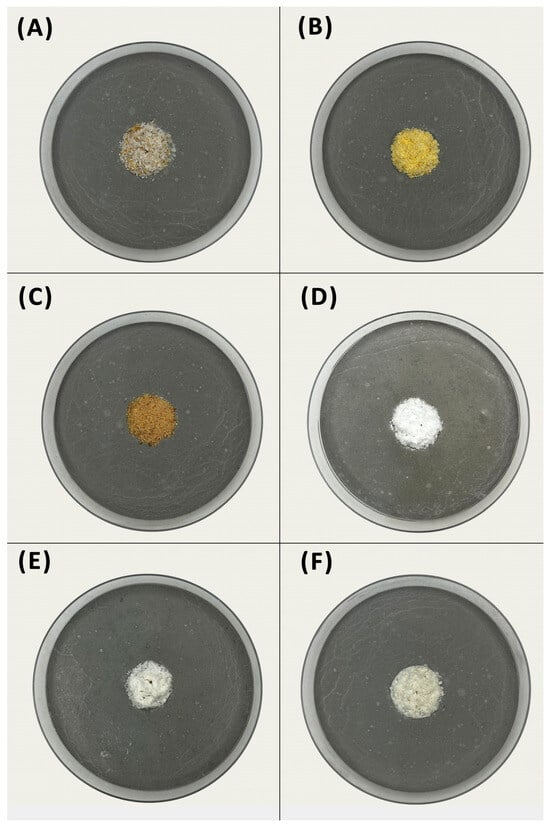
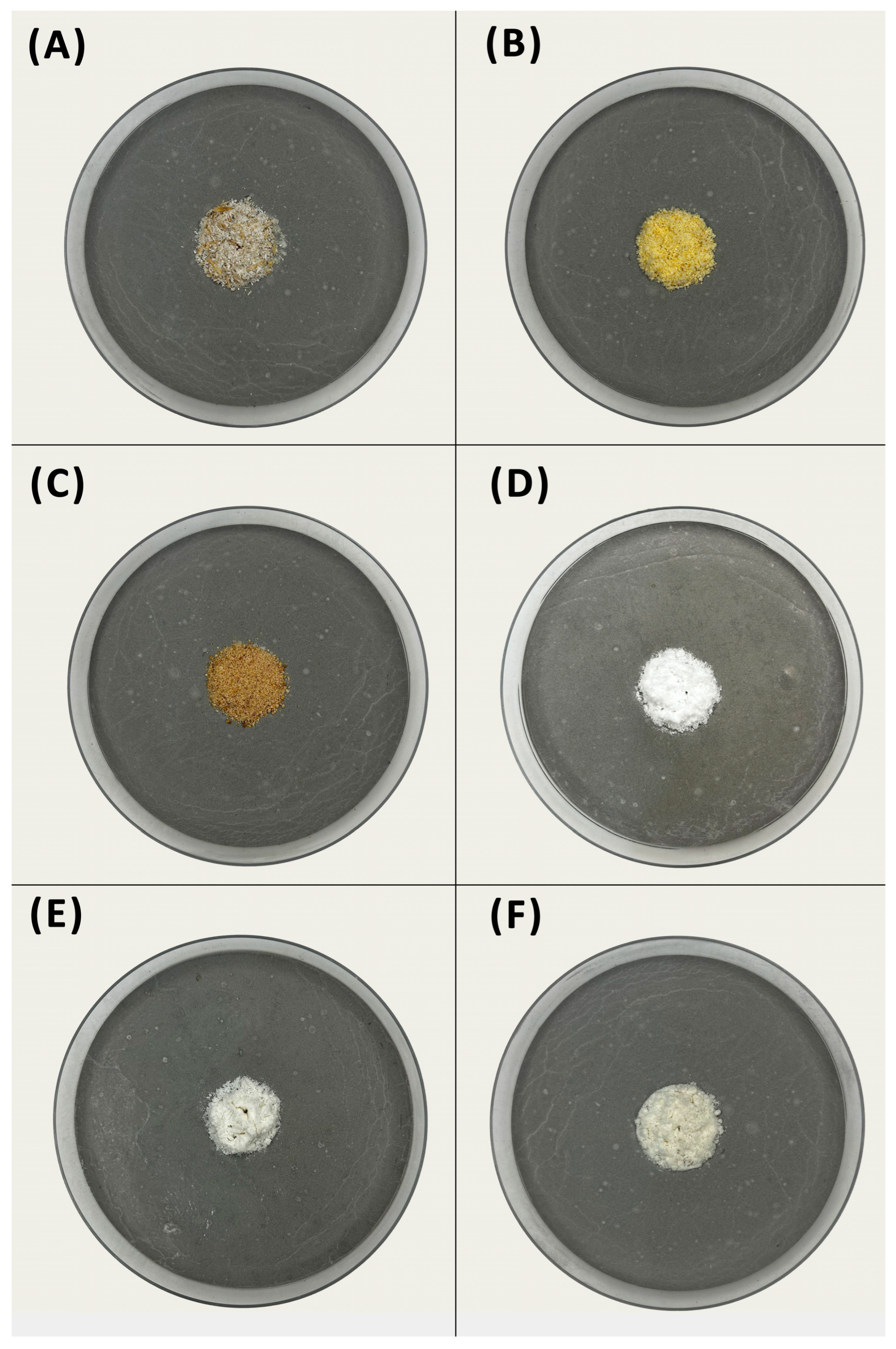
The experimental arenas were constructed using Petri dishes with a surface area of 50.27 cm2 (∅ 8 cm × 1.5 cm height), having their bottoms coated with a 0.5 cm thick layer of cement (GIGAS Low Carbon Portland Composite Cement material, Heidelberg Materials Hellas, Aspropyrgos, Greece). The arenas were allowed to dry for 24 h (h) and were then ready for use [18]. For the tests, 0.3 g of whole barley flour, chickpea flour, date flour, potato flour, white rice flour, or white soft wheat flour were separately placed in the center of the arena [22] (Figure 1).
Figure 1.
Quantity (0.3 g) of (A) whole barley flour, (B) chickpea flour, (C) date flour, (D) potato flour, (E) white rice flour, and (F) white soft wheat flour in the center of the experimental arenas.
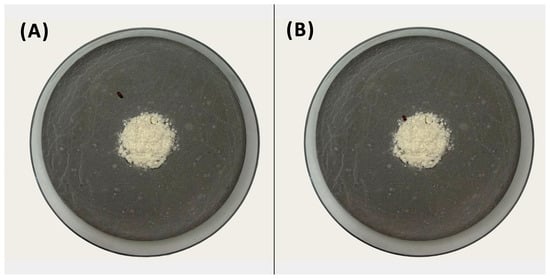
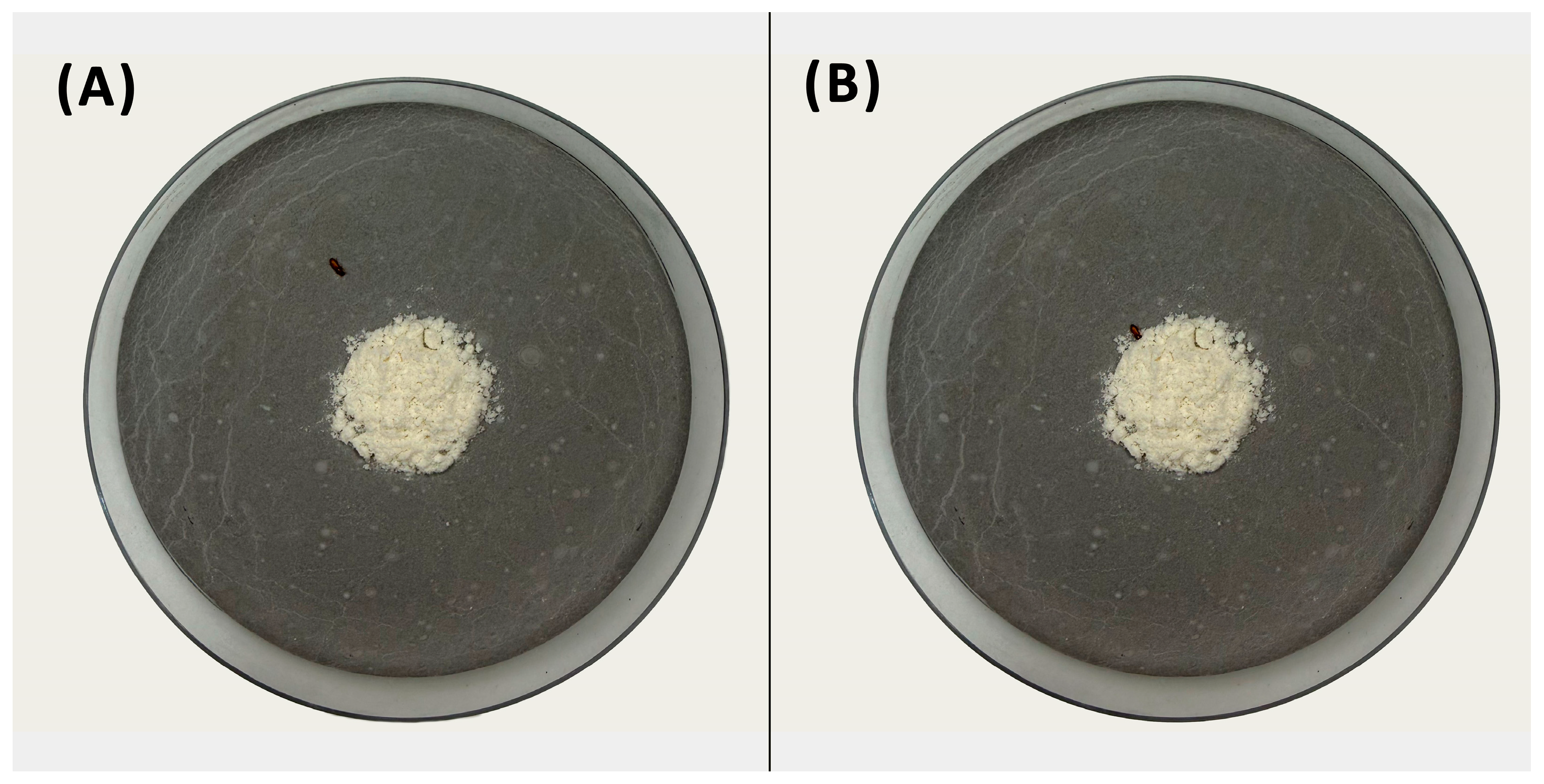
Insects were deprived of food for a whole day prior to the observations [22]. Subsequently, an unsexed adult individual of L. oryzae was released at the periphery of the arena (the internal walls of the dish). Then, the required time to reach the food source, the time spent at the food source, the time spent away from the food source, and the number of visits to the food source were recorded visually for 900 s (15 min) at 30 °C [22] (Figure 2).
Figure 2.
Latheticus oryzae individual (A) walking to the food source and (B) reaching the food source.
In addition, the Preference Index (PI, %) was calculated as the percentage of the total observation time that each insect spent at the food source, according to the following equation:
For insects that did not visit the food during the observation period (i.e., 900 s), the time spent at the food was recorded as zero (PI = 0), and these individuals were retained in the dataset. In the context of the present study, PI was used as a measure of behavioral association or retention at the tested flour substrate and should not be interpreted as a direct measure of feeding preference or food acceptance. There were 30 repetitions for each food source (i.e., 30 L. oryzae adult individuals per flour type) [22,23]. For each repetition, a new arena, L. oryzae adult, and food source were used. In total, 180 individuals were tested (30 repetitions × 6 substrates). The experiments were carried out at 65% R.H., 30 °C and natural light between 8 a.m. and 8 p.m. [22].
2.4. Statistical Analysis
The time required for insects to reach food was analyzed as time-to-event data using the Life Distribution procedure in JMP 16.2 [24]. An event was defined as the insect reaching the food source, while L. oryzae individuals that did not reach the food within the predefined time limit of 15 min were treated as right-censored observations. A lognormal distribution was applied for parametric modeling of the time-to-event data [25,26]. Differences among the six flour types were assessed using the global log-rank, Peto–Peto, and Wilcoxon tests [27]. To evaluate the overall effect of flour type on the probability of success/failure of L. oryzae individuals to reach the food source, a Generalized Linear Model (GLM) with binomial distribution and logit link was applied, using white soft wheat flour as the reference group. The statistical significance level was set at p ≤ 0.05. The Shapiro–Wilk test was used to test the normality of L. oryzae data for the PI, time spent away from the food source, and number of visits to the food source [28]. Since the data did not follow a normal distribution in most groups (except for the trait “time spent away from the food source” in the potato flour; p = 0.1208), nonparametric tests were applied. Specifically, the Kruskal–Wallis test was used for group comparisons [29] and the Steel–Dwass test for multiple pairwise comparisons [30,31]. The graphical presentation of the distribution and variability of the observed values per trait for each type of flour was achieved using box plots, displaying the median, quartiles (Q1 and Q3), and data range. The significance level was set at p ≤ 0.05. The statistical package JMP 16.2 was used for the analysis [24].
3. Results
3.1. Effect of Flour Type on Latheticus oryzae Individuals to Reach the Food
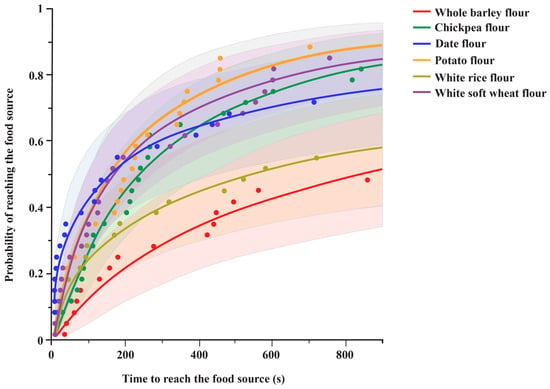
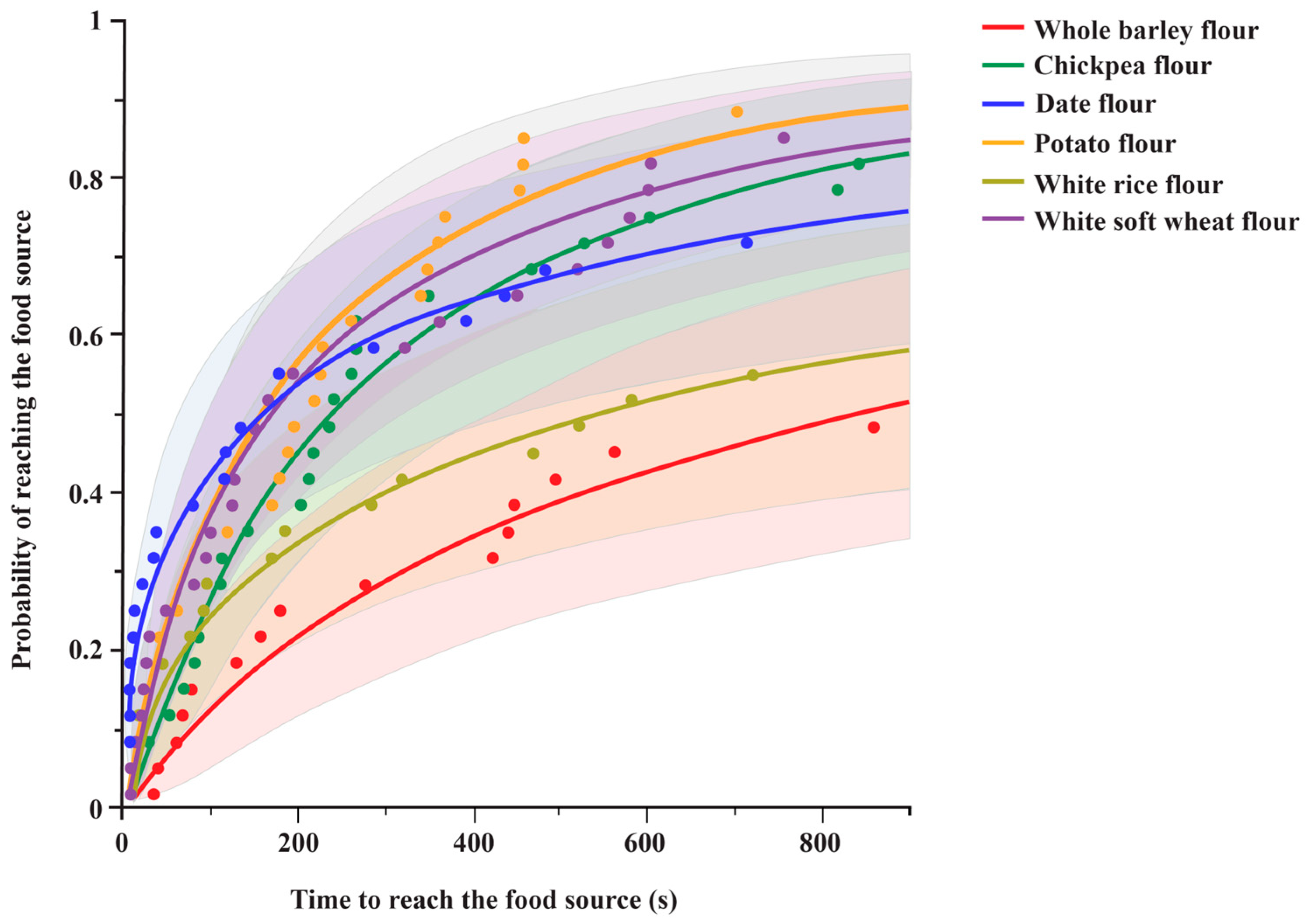
The analysis of time to reach the food showed that the type of flour significantly affected the time insects required to reach the food source (Figure 3). Specifically, the distribution curves differed significantly among the six flours (log-rank test, χ2 = 18.31, df = 5, p = 0.0026). Accordingly, significant differences also emerged from the Peto–Peto (χ2 = 15.15, df = 5, p = 0.0097) and Wilcoxon (χ2 = 15.15, df = 5, p = 0.0097) tests. Insects approached potato flour faster than the other flours, presenting the shortest estimated mean time to reach the food source (258.7 s), followed by date flour (299.5 s), white soft wheat flour (304.8 s), and chickpea flour (351.7 s). Longer estimated mean times were recorded for white rice flour (434.0 s) and especially for whole barley flour (570.8 s), which showed the longest estimated mean times of reaching the food source (Figure 3).
Figure 3.
Probability of reaching the food source as a function of time (s) for Latheticus oryzae populations on six different flour types (whole barley, chickpea, date, potato, white rice, and white soft wheat). The solid lines represent the estimated curves (lognormal distribution) with the corresponding 95% confidence intervals (shaded areas) and the colored dots represent the experimentally observed data.
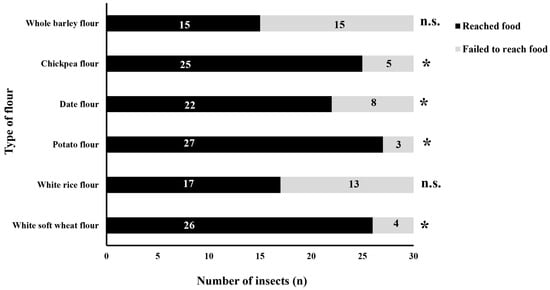
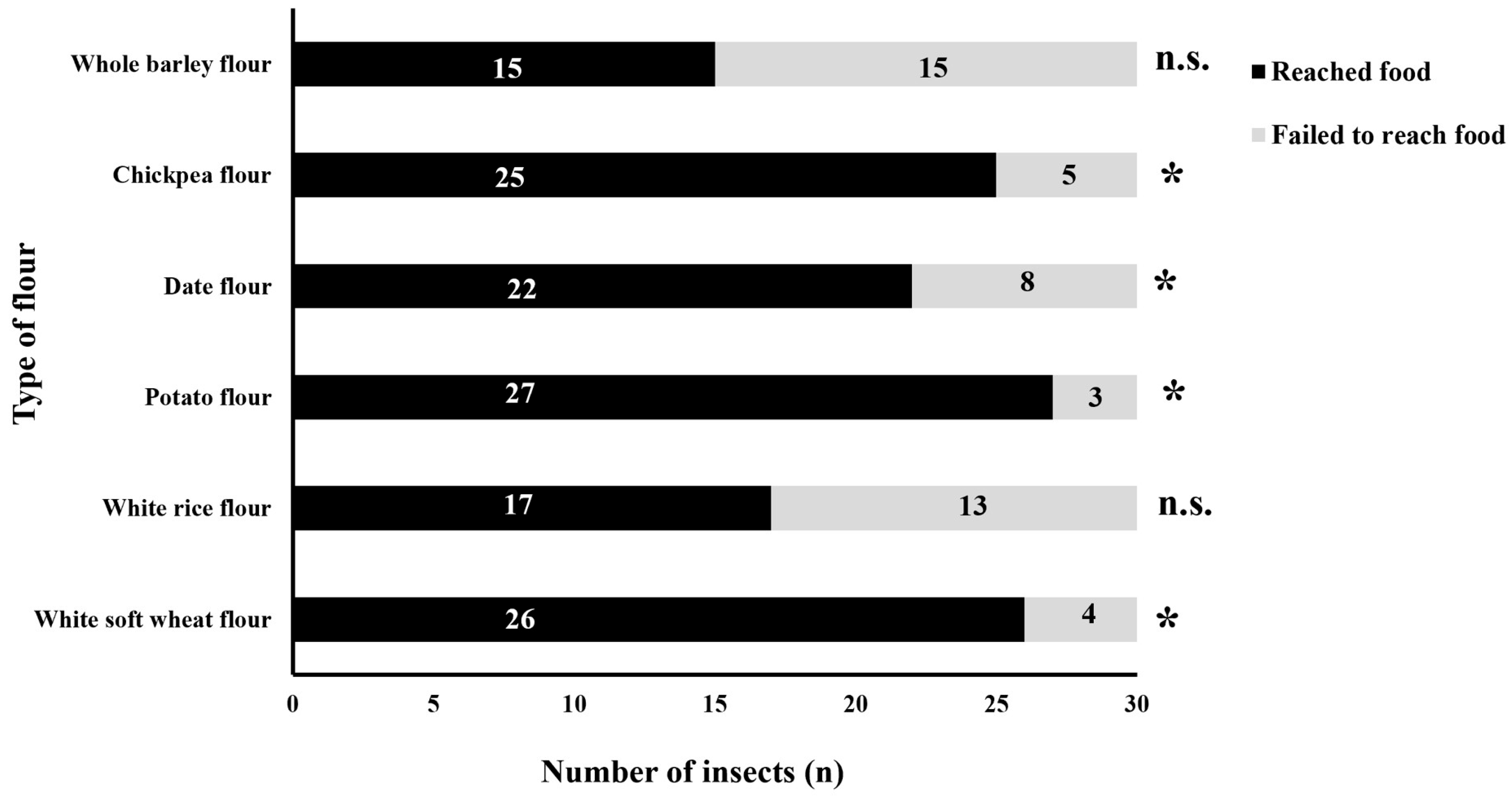
The type of flour had a statistically significant effect on the probability of insects reaching the food source (χ2 = 21.23, df = 5, p = 0.0007). Potato flour exhibited the highest success (27 out of 30 insects reached the food), followed by the white soft wheat flour (26 individuals), chickpea flour (25 individuals), and date flour (22 individuals), with statistically significant differences. In contrast, the lowest success was recorded in white rice flour and whole barley, where 17 out of 30 and 15 out of 30 individuals managed to reach the food source, respectively, without significant differences (Figure 4).
Figure 4.
Number of Latheticus oryzae individuals that reached or did not reach the food source (i.e., whole barley flour, chickpea flour, date flour, potato flour, white rice flour, and white soft wheat flour). Asterisks indicate statistically significant differences (GLM, binomial distribution, p ≤ 0.05), while n.s. indicates no statistically significant difference.
According to the GLM of the probability of L. oryzae individuals reaching the food source, whole barley flour and white rice flour showed negative and statistically significant estimate values (−1.1597 and −0.8915, respectively), indicating lower log-odds of insects reaching the food source compared to white soft wheat flour (Table 1). In contrast, potato flour showed a positive and statistically significant estimate value (1.0375), indicating higher log-odds of insects reaching the food source successfully compared to the reference group (white soft wheat flour) (Table 1). Results for chickpea flour and date flour did not differ statistically from those on white soft wheat flour, indicating that insects behaved similarly to the reference group.
Table 1.
Parameter estimates and results of the GLM for the probability of reaching a food source by flour type (with binomial and logit link distributions). White soft wheat flour serves as the reference category represented by the Intercept. Asterisks indicate statistically significant differences (p ≤ 0.05). White soft wheat flour is the reference category.
3.2. Behavioral Response of L. oryzae to Different Types of Flour
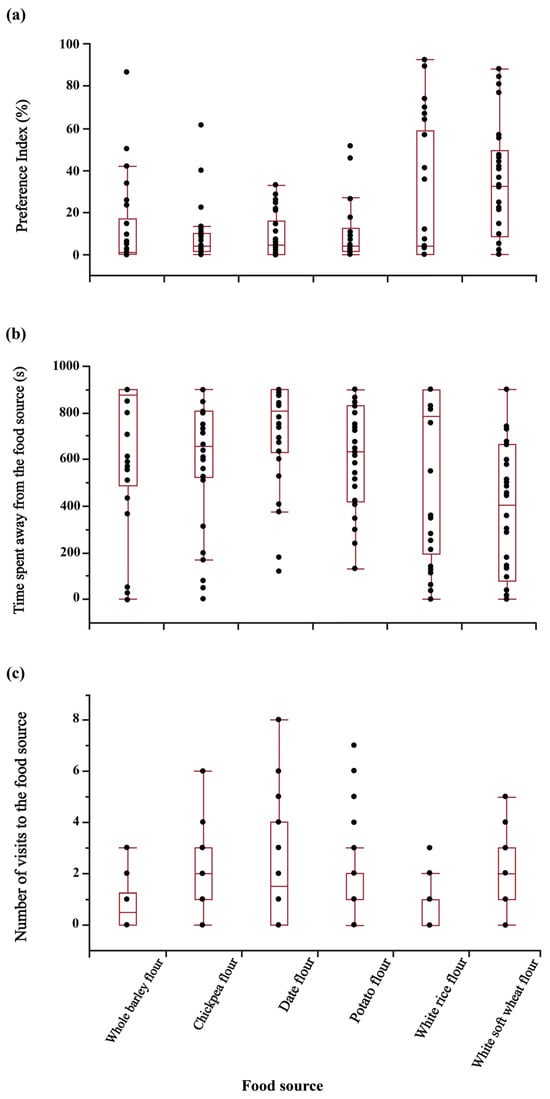
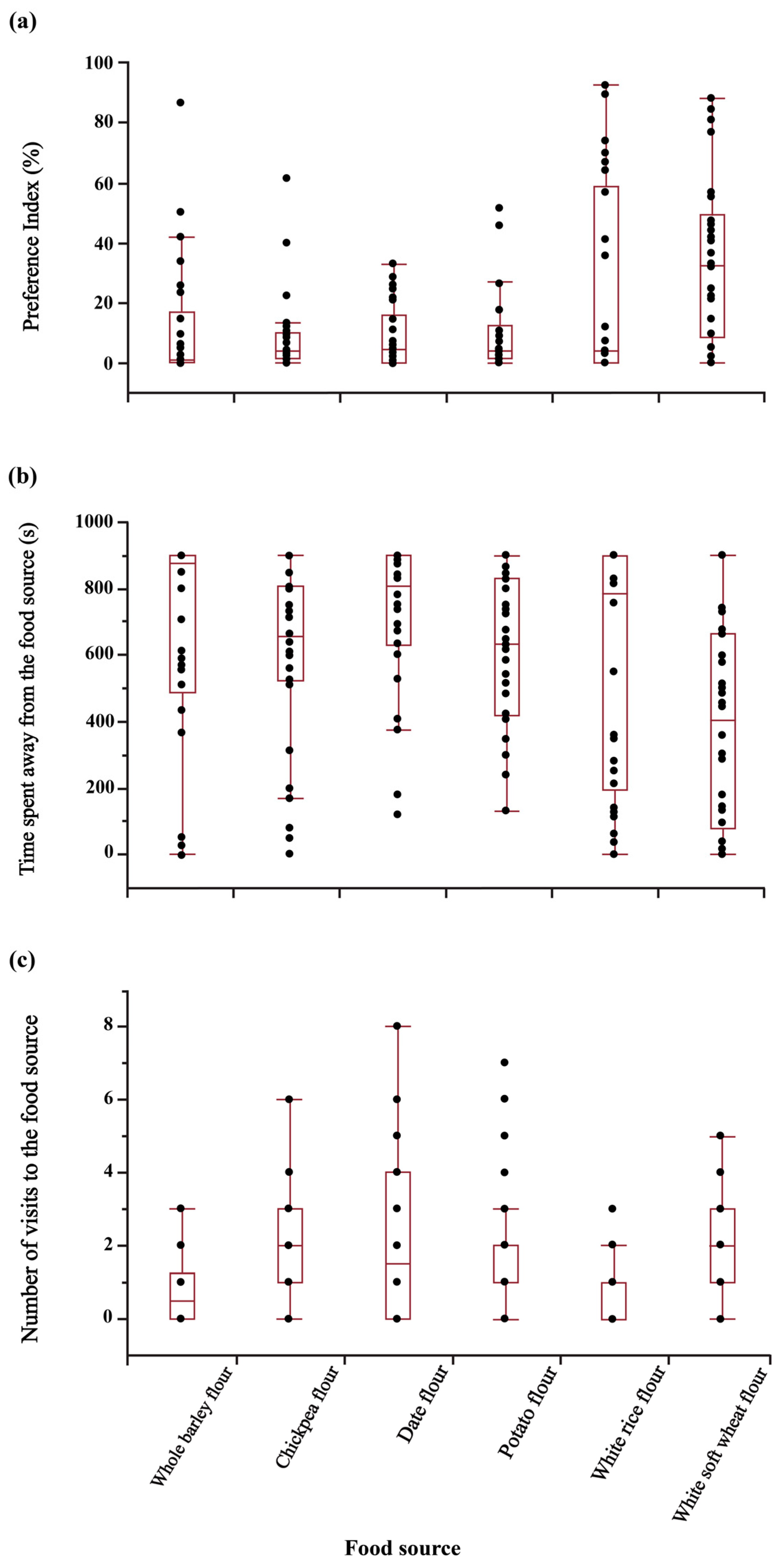
The mean PI of L. oryzae differed significantly among the six flour types (χ2 = 19.3, p = 0.002) (Table 2). The highest mean PI was recorded for white soft wheat flour (33.9%), with significant differences among flours (except white rice flour, 23.4%), while the lowest values were observed for chickpea flour (8.5%) and date flour (8.4%). Results for white soft wheat flour and white rice flour showed a wider data dispersion with several higher outliers, while the remaining flours were tightly concentrated near the lower end of the index (Figure 5a).
Table 2.
Mean values (±Standard Deviation (SD)) of the Preference Index (PI, %), time spent away from the food source (s), and number of visits (n) of Latheticus oryzae on six types of flour (i.e., whole barley flour, chickpea flour, date flour, potato flour, white rice flour, and white soft wheat flour). Different letters in each trait indicate statistically significant differences (Steel–Dwass, p ≤ 0.05).
Figure 5.
Box plots showing the distribution: (a) Preference Index (PI, %), (b) time spent away from the food source (s), and (c) number of visits to the food source of Latheticus oryzae on six different types of flour (i.e., whole barley, chickpea, date, potato, white rice, and white soft wheat). The horizontal line inside each box corresponds to the median, the box limits correspond to the first (Q1) and third quartiles (Q3), the lines (whiskers) extend to the extreme non-outliers, and the dots represent individual observations (i.e., each insect).
The mean time spent away from the food source differed significantly among the six flour types (χ2 = 18.3, p = 0.003) (Table 2). The shortest mean time that L. oryzae remained away from the food source was recorded for white soft wheat flour (391.0 s), which differed significantly from date flour (715.3 s) and whole barley flour (654.5 s). The values for white soft wheat flour shifted noticeably towards the lower durations, while the remaining flours generally exhibited higher durations with a wider dispersion of data (Figure 5b).
The mean number of visits to the food source differed significantly among the six flour types (χ2 = 26.7, p < 0.01) (Table 2). The highest mean number of visits was observed for date flour (2.1) and white soft wheat flour (2.1), followed by potato flour (2.0) and chickpea flour (1.9). The lowest mean number of visits was observed for whole barley flour (0.8) (Table 2). The data distributions for whole barley flour and white rice flour are tightly clustered at the lower end (near 0 and 1 visit), while the box plots for white soft wheat flour, date flour, and potato flour extend upward, exhibiting a higher frequency of L. oryzae visits (Figure 5c).
4. Discussion
The present study provides evidence that food type strongly modulates the foraging behavior of L. oryzae adults. Significant differences among the six flour types were detected across multiple behavioral parameters, including time to reach the food source, probability of reaching the food, PI, time spent away from the food source, and visitation frequency. Collectively, these findings indicate that the response of L. oryzae to a food substrate cannot be adequately characterized by a single behavioral measure. In contrast, these parameters represent distinct components of the foraging process. This distinction is particularly relevant for stored-product pests whose survival and infestation dynamics depend strongly on their ability to locate and exploit spatially heterogeneous food sources [5].
The significant differences in time to reach the food source provide evidence that flour type influenced the initial foraging response of L. oryzae. Potato flour resulted in the fastest approach, whereas whole barley flour resulted in the longest. Additionally, the relatively strong response to potato flour is noteworthy. Most of the tested individuals reached potato flour, representing the highest approach success among the tested substrates, and the probability of successful food detection was significantly higher compared to the one observed for the reference substrate (white soft wheat). A possible interpretation is that potato flour releases cues that facilitate food source detection. In stored-product insects, movement toward food can be influenced by chemical components associated with the food source (attractants), since faster approach indicates stronger chemoattraction or preference [32,33,34,35]. For instance, Trematerra et al. [35] compared the bioactivity of volatiles produced by cereal- and legume-based pasta on Sitophilus granarius (L.) (Coleoptera: Curculionidae) adults in multi-choice behavioral bioassays. Analyzing the response indices in the two-choice behavioral biological tests, the authors suggested that the low attractiveness of legume pasta was mainly due to the lack of attractants rather than the emission of repellent compounds. Thus, potato flour might emit attractive cues. In contrast, the lack-of-attractant interpretation may provide a possible explanation for the comparatively weak responses observed in the present study for whole barley flour and white rice flour. Both substrates resulted in lower approach success and fewer insect visits to the food source, while whole barley flour also showed the longest estimated mean approach time. Chickpea flour showed an intermediate behavioral response, with most individuals successfully locating the food source while spending limited time on it. Such responses may therefore reflect a lack of attractive cues associated with these substrates rather than active avoidance due to repellent compounds. The results obtained for date flour provide further evidence that individual behavioral metrics could capture different aspects of the food source evaluation. Date flour produced the second-shortest estimated mean approach time, indicating relatively rapid detection, while 22 out of 30 insects successfully reached this food source. Yet, the PI of the date flour was the lowest value observed. At the same time, insects made an average number of visits to date flour, equal to the highest visitation frequency recorded (white soft wheat flour). However, since the current study did not identify volatile compounds, the involvement of chemical cues remains hypothetical. The faster response to potato flour should therefore be interpreted primarily as evidence of enhanced behavioral orientation under the tested experimental setup rather than as direct evidence of chemoattraction. Interestingly, the high approach success of potato flour was not combined with the highest PI. Potato flour had a mean PI of 10.9%, significantly lower compared to that recorded for white soft wheat flour. This discrepancy represents one of the most informative findings of the study, since it demonstrates that the food source detection and insect retention are not necessarily equivalent behavioral processes. Further experiments combining chemical characterization, controlled olfactory assays, and direct feeding or consumption measurements will be necessary to determine whether particular volatile or non-volatile constituents explain the responses observed in L. oryzae.
The response to the white soft wheat flour provides a contrasting pattern. White soft wheat flour produced the highest PI, the shortest mean time spent away from the food source, and a high mean number of visits among the tested substrates. In addition, 26 out of 30 individuals successfully reached the white soft wheat flour. These results indicate a strong tendency of L. oryzae to remain associated with this substrate once it detects it. The strong response to white soft wheat flour may also have been influenced by the rearing history of the tested insects. Previous exposure to a particular food influences subsequent behavioral responses through experience. For instance, Yilmaz & Bayram [36] examined species-specific behavioral preferences of Sitophilus oryzae (L.) (Coleoptera: Curculionidae), Callosobruchus maculatus (F.) (Coleoptera: Chrysomelidae), and Tribolium confusum Jacquelin du Val (Coleoptera: Tenebrionidae) on wheat, bulgur, maize, and chickpea. Callosobruchus maculatus and S. oryzae resulted in a preference for chickpea and wheat, respectively, which were their rearing media. From a foraging perspective, the observed behavioral heterogeneity is consistent with the concept that resource selection involves sequential decisions rather than a single response [37]. Such findings provide a possible comparative framework, but they do not establish that the same mechanism occurred in L. oryzae. Experiments using insects reared on different substrates would be required to separate effects of prior experience from intrinsic responses to the tested flours.
5. Conclusions
These findings could have practical implications for stored-product pest management. Substrate-specific differences in movement influence the probability that L. oryzae detects and then exploits certain commodities. In addition, substrates that elicit rapid approach or repeated visitation warrant investigation as potential components in trapping monitoring systems. By quantifying several complementary behavioral traits, the present study expands the available behavioral framework for this species and provides a basis for future investigation into how food source properties influence movement and food exploitation. Future research could combine behavioral assays with chemical characterization of the substrates to determine whether specific volatile or non-volatile components are associated with rapid detection of the food source or prolonged retention in the food source. Additionally, experiments involving L. oryzae individuals reared on different substrates would also be valuable for separating intrinsic substrate-specific behavior from effects associated with previous feeding experience. Future studies could also compare individual and grouped-insect assays, or directly examine responses to conspecific-derived cues, to determine whether social or semiochemical factors modify the responses to different food sources. Furthermore, it would be interesting to analyze food preference and time spent on food depending on sex, age of the tested adults (in days post-eclosion), and whether they have mated.
Author Contributions
Conceptualization, M.C.B., D.L.S.G., C.S.F., A.S., V.P.C.K. and N.G.K.; methodology, M.C.B., D.L.S.G., C.S.F., A.S., V.P.C.K., I.N.K., A.M.K. and N.G.K.; software, M.C.B., D.L.S.G., C.S.F., A.S. and N.G.K.; validation, M.C.B., D.L.S.G., C.S.F., A.S., V.P.C.K., I.N.K., A.M.K. and N.G.K.; formal analysis, M.C.B.; investigation, M.C.B., D.L.S.G., C.S.F., A.S., V.P.C.K., I.N.K., A.M.K. and N.G.K.; resources, N.G.K.; data curation, I.N.K.; writing—original draft preparation, M.C.B., D.L.S.G., C.S.F., A.S., V.P.C.K., I.N.K., A.M.K. and N.G.K.; writing—review and editing, M.C.B., D.L.S.G., C.S.F., A.S., V.P.C.K., I.N.K., A.M.K. and N.G.K.; visualization, M.C.B., D.L.S.G., C.S.F., A.S., V.P.C.K., I.N.K., A.M.K. and N.G.K.; supervision, N.G.K.; project administration, N.G.K.; funding acquisition, N.G.K. All authors have read and agreed to the published version of the manuscript.
Funding
Project 34.0889 (Agricultural University of Athens, Account for Research Funds) partially supported this study.
Institutional Review Board Statement
Not applicable.
Informed Consent Statement
Not applicable.
Data Availability Statement
Data is available within the article.
Conflicts of Interest
The authors declare no conflicts of interest.
References
- Pyke, G.H. Optimal foraging theory: An introduction. In Encyclopedia of Animal Behavior, 2nd ed.; Choe, J.C., Ed.; Academic Press: Oxford, UK, 2019; pp. 111–117. [Google Scholar]
- Anukiruthika, T.; Jian, F.; Jayas, D.S. Movement and behavioral response of stored product insects under stored grain environments—A review. J. Stored Prod. Res. 2021, 90, 101752. [Google Scholar] [CrossRef] [Scilit]
- Gerken, A.R.; Campbell, J.F. Spatial and temporal variation in stored-product insect pest distributions and implications for pest management in processing and storage facilities. Ann. Entomol. Soc. Am. 2022, 115, 239–252. [Google Scholar] [CrossRef] [Scilit]
- Wechsler, S.P.; Bhandawat, V. Behavioral algorithms and neural mechanisms underlying odor-modulated locomotion in insects. J. Exp. Biol. 2023, 226, jeb200261. [Google Scholar] [CrossRef] [Scilit] [PubMed]
- Jian, F. Influences of stored product insect movements on integrated pest management decisions. Insects 2019, 10, 100. [Google Scholar] [CrossRef] [Scilit] [PubMed]
- Kumar, D.; Kalita, P. Reducing postharvest losses during storage of grain crops to strengthen food security in developing countries. Foods 2017, 6, 8. [Google Scholar] [CrossRef] [Scilit] [PubMed]
- Hamdan, F.Q.; Kareem, D.K. Morphological identification of four stored grain pests in Misan province Southern-Iraq. J. Wildl. Biodivers. 2023, 7, 312–329. [Google Scholar] [CrossRef]
- Omkar (Ed.) Pests and their management. In Pests and Their Management; Springer: Singapore, 2018; pp. 1–5. [Google Scholar] [CrossRef] [Scilit]
- Tripathi, A.K. Pests of stored grains. In Pests and Their Management; Omkar, Ed.; Springer: Singapore, 2018; pp. 311–359. [Google Scholar] [CrossRef] [Scilit]
- Ahiduzzaman, M. Postharvest Technology—Recent Advances, New Perspectives and Applications; IntechOpen: London, UK, 2022. [Google Scholar]
- Xu, S.; Cheng, L.; Hu, W.; Gao, Y.; Cheng, Q.; Lv, J. The complete mitochondrial genome of the pest beetle Latheticus oryzae: Assembly, annotation, and phylogenetic analysis. Ecol. Evol. 2025, 15, e72717. [Google Scholar] [CrossRef] [Scilit] [PubMed]
- Howard, R.W. Chemosystematic studies of the Triboliini (Coleoptera: Tenebrionidae): Phylogenetic inferences from the defensive chemicals of eight Tribolium spp., Palorus ratzeburgi (Wissmann), and Latheticus oryzae Waterhouse. Ann. Entomol. Soc. 1987, 80, 398–405. [Google Scholar] [CrossRef] [Scilit]
- Li, J.; Lehmann, S.; Weißbecker, B.; Ojeda Naharros, I.; Schütz, S.; Joop, G.; Wimmer, E.A. Odoriferous defensive stink gland transcriptome to identify novel genes necessary for quinone synthesis in the red flour beetle, Tribolium castaneum. PLoS Genet. 2013, 9, e1003596. [Google Scholar] [CrossRef] [Scilit] [PubMed]
- Srivastava, C.; Subramanian, S. Storage insect pests and their damage symptoms: An overview. Indian J. Entomol. 2016, 78, 53. [Google Scholar] [CrossRef] [Scilit]
- Hafeez, M.A.M.A.; Chapman, G. Effects of temperature and high relative humidity on the rate of development and mortality of Latheticus oryzae Waterhouse (Coleoptera: Tenebrionidae). J. Stored Prod. Res. 1966, 1, 235–242. [Google Scholar] [CrossRef] [Scilit]
- Nowosielski-Slepowron, B.J.A.; Aryeetey, E.A. Developmental biology of field and laboratory populations of Latheticus oryzae Waterhouse (Coleoptera: Tenebrionidae) under various conditions of temperature and humidity. J. Stored Prod. Res. 1980, 16, 55–66. [Google Scholar] [CrossRef] [Scilit]
- Chouhan, J.S.; Yadav, T.D. Toxicity of baythion, etrimfos and malathion against different stages of Lasioderma serricorne (Fab.), Stegobium paniceum (Linn.), and Latheticus oryzae Waterhouse. Indian J. Entomol. 1984, 1984, 277–283. [Google Scholar]
- Kavallieratos, N.G.; Gidari, D.L.S.; Filintas, C.S.; Boukouvala, M.C.; Pantelakis, N.N. Insecticidal response of the understudied Latheticus oryzae to six insecticides. Crop Prot. 2026, 205, 107578. [Google Scholar] [CrossRef] [Scilit]
- Ghaly, W.A.; Saleh, A.; Bosly, H.; Abu El-Ghiet, U. Estimating the lethal absorbed doses of far infrared radiation on both Latheticus oryzae Waterhouse, 1880 (Coleoptera: Tenebrionidae) and germination of Sorghum bicolor L. (Poaceae) grains. J. Radiat. Res. Appl. Sci. 2025, 18, 101851. [Google Scholar] [CrossRef] [Scilit]
- Boukouvala, M.C.; Gidari, D.L.S.; Kavallieratos, N.G.; Romano, D. Where courtship leans left: Insights into the mating behavior of Latheticus oryzae (Coleoptera: Tenebrionidae). Eur. J. Entomol. 2026, 123, 158–164. [Google Scholar] [CrossRef] [Scilit]
- Kavallieratos, N.G.; Athanassiou, C.G.; Boukouvala, M.C.; Tsekos, G.T. Influence of different non-grain commodities on the population growth of Trogoderma granarium Everts (Coleoptera: Dermestidae). J. Stored Prod. Res. 2019, 81, 31–39. [Google Scholar] [CrossRef] [Scilit]
- Kavallieratos, N.G.; Boukouvala, M.C.; Eleftheriadou, N.; Filintas, C.S.; Gidari, D.L.S.; Kyrpislidi, V.P.C. Sublethal effects of chlorantraniliprole on the mobility patterns of Sitophilus spp.: Implications for pest management. Insects 2024, 15, 451. [Google Scholar] [CrossRef] [Scilit] [PubMed]
- Gidari, D.L.S.; Kavallieratos, N.G.; Boukouvala, M.C. Disruptions of mobility and foraging behavior of Alphitobius diaperinus adults exposed to sublethal insecticidal concentrations. Crop Prot. 2025, 197, 107327. [Google Scholar] [CrossRef] [Scilit]
- SAS Institute Inc. Using JMP 16.2; SAS Institute Inc.: Cary, NC, USA, 2021. [Google Scholar]
- Kleinbaum, D.G.; Klein, M. Survival Analysis: A Self-Learning Text, 3rd ed.; Springer: New York, NY, USA, 2012. [Google Scholar]
- Gao, F.; Miller, J.P.; Miglior, S.; Beiser, J.A.; Torri, V.; Kass, M.A.; Gordon, M.O. A joint model for prognostic effect of biomarker variability on outcomes: Long-Term Intraocular Pressure (IOP) fluctuation on the risk of developing Primary Open-Angle Glaucoma (POAG). JP J. Biostat. 2011, 5, 73–96. [Google Scholar] [PubMed]
- Lee, E.T.; Wang, J. Statistical Methods for Survival Data Analysis; John Wiley & Sons: Hoboken, NJ, USA, 2003; Volume 476. [Google Scholar]
- Shapiro, S.S.; Wilk, M.B. An analysis of variance test for normality (complete samples). Biometrika 1965, 52, 591–611. [Google Scholar] [CrossRef] [Scilit]
- Kruskal, W.H.; Wallis, W.A. Use of ranks in one-criterion variance analysis. J. Am. Stat. Assoc. 1952, 47, 583–621. [Google Scholar] [CrossRef]
- Steel, R.G.D. A rank sum test for comparing all pairs of treatments. Technometrics 1960, 2, 197–207. [Google Scholar] [CrossRef]
- Hollander, M.; Wolfe, D.A.; Chicken, E. Nonparametric Statistical Methods; John Wiley & Sons: Hoboken, NJ, USA, 2013; Volume 751. [Google Scholar]
- Chambers, J. Overview on stored-product insect pheromones and food attractants. J. Kans. Entomol. Soc. 1990, 63, 490–499. [Google Scholar]
- Rajendran, S. Insect pest management in stored products. Outlooks Pest Manag. 2020, 31, 24–35. [Google Scholar] [CrossRef] [Scilit]
- Morrison, W.R.; Scully, E.D.; Campbell, J.F. Towards developing areawide semiochemical-mediated, behaviorally-based integrated pest management programs for stored product insects. Pest Manag. Sci. 2021, 77, 2667–2682. [Google Scholar] [CrossRef] [Scilit] [PubMed]
- Trematerra, P.; Pistillo, O.M.; Germinara, G.S.; Colacci, M. Bioactivity of cereal- and legume-based macaroni pasta volatiles to adult Sitophilus granarius (L.). Insects 2021, 12, 765. [Google Scholar] [CrossRef] [Scilit] [PubMed]
- Yilmaz, A.; Bayram, M. Species-specific behavioral and biochemical impacts of stored-product insects on cereals and legumes. J. Stored Prod. Res. 2026, 119, 103149. [Google Scholar] [CrossRef] [Scilit]
- Kumar, A.; Sharma, A.; Gupta, A. Insect behaviour and decision-making. In Advanced Insect Science; Anuradha, P., Sharma, A.K., Basugade, R.P., Singh, S.P., Sharma, R., Eds.; Golden Leaf Publishers: Uttar Pradesh, India, 2026; pp. 151–173. [Google Scholar]

Disclaimer/Publisher’s Note: The statements, opinions and data contained in all publications are solely those of the individual author(s) and contributor(s) and not of MDPI and/or the editor(s). MDPI and/or the editor(s) disclaim responsibility for any injury to people or property resulting from any ideas, methods, instructions or products referred to in the content. |
© 2026 by the authors. Licensee MDPI, Basel, Switzerland. This article is an open access article distributed under the terms and conditions of the Creative Commons Attribution (CC BY) license.