


Abstract
The reconstruction of the Stuttgart Hauptbahnhof railway junction, known as Stuttgart 21, is a very large and long-term infrastructure project. The gradual extension of the project implementation creates a specific time period during which atypical vegetation management in the trackbeds takes place. The vegetation of the trackbeds of the current station includes a total of 68 plant taxa, with Erigeron bonariensis L., Geum urbanum L. and Senecio inaequidens DC being significantly represented, for example. The limited level of disturbance within this “time window” creates favorable conditions in particular for the development of woody plants and lianas, such as Acer campestre L., Acer pseudoplatanus L., Ailanthus altissima (Mill.) Swingle, Clematis vitalba L., Ficus carica L., Hedera helix L. and Sambucus nigra L. The detected spectrum of plant taxa also indicates the formation of a diverse mosaic of microhabitats, which allows the coexistence of species with different ecological requirements. The assessed railway lines also provide space for the occurrence of non-native species, many of which are capable of effective wind dispersal and can subsequently colonize surrounding urban areas. Habitats with a time window of limited vegetation management may represent a poorly described factor influencing the spread of some taxa in the technosphere. The knowledge gained may contribute to a better understanding of the population dynamics of individual taxa and their potential for further spread.
1. Introduction
Transport infrastructure has shaped the European landscape for centuries and was a key driver of landscape transformation between 1920 and 2020, particularly through the expansion of road and rail networks [1,2,3]. Today, transport infrastructure is essential for economic functioning, but it also negatively affects the environment through air pollution, noise and increasing land use demands [4]. Urbanization supports social development [5], yet it contributes to long-term biodiversity loss through changes in land use, microclimate and landscape structure [6]. Railway construction further alters local environmental conditions by influencing humidity, temperature, wind regimes and light availability [7,8].
Railway corridors can provide suitable microhabitats for taxa with different ecological requirements. Rocky and exposed surfaces are inhabited by drought-tolerant or thermophilic taxa, while mesophilic (and sometimes hygrophilic) species find suitable conditions in shady or moist microdepressions with less permeable surfaces [9,10]. These linear habitats are also characterized by extreme environmental conditions and are often burdened by increased levels of pollution, especially heavy metals [11]. These stress factors then significantly limit the survival of original plant taxa [12].
The impacts of railway infrastructure are not limited to the immediate vicinity of the tracks but extend from a few meters to hundreds of meters into the surrounding landscape [13,14,15]. Railway lines run mainly through rural areas and connect metropolitan centers and are often accompanied by vegetation. Given the ecosystem functions and their value to vegetation and contribution to climate protection objectives, in some countries, such as Germany, the aim is not to keep wide corridors along the tracks completely free of vegetation. Vegetation along railways has several positive functions—it contributes to cooling the environment and reducing temperature extremes [16], supports carbon sequestration, helps protect biodiversity and stabilizes slopes around tracks [17,18]. On the other hand, vegetation is also associated with certain risks for railway infrastructure and the operation of rolling stock, such as falling trees, breaking branches under the weight of snow or starting fires on embankments [19,20].
The construction and operation of railways significantly affect the structure and spatial distribution of vegetation. Plant communities around tracks are exposed to disturbances for a long time, not only as a result of intensive passenger and freight transport, but also due to regular management interventions, such as mowing or application of herbicides aimed at suppressing unwanted vegetation [21]. Vegetation regulation is necessary, especially from the point of view of ensuring the safety of railway transport and maintaining the functionality of the infrastructure. Plant residues and organic material can fill cavities in the gravel bed of the track and worsen its drainage capacity. In winter, freezing water contributes to displacements and deformations of the tracks. In addition, the presence of vegetation biomass on the tracks increases the risk of wheel slippage and extends the braking distance, which can negatively affect traffic safety. The main objectives of vegetation regulation therefore include maintaining the quality and stability of the track and ballast bed, protecting wooden sleepers, ensuring worker safety, and preventing fires caused by dry vegetation [22].
Railway companies apply different approaches to vegetation maintenance. In the immediate vicinity of the tracks, vegetation is usually removed at least once a year, while in more remote areas, such as embankments, interventions are only carried out if the vegetation poses a direct risk to traffic [23]. For a long time, glyphosate was the herbicide of choice in Europe, but in recent years some countries have gradually moved away from it and are looking for alternatives. These include, for example, pelargonic acid, often used in combination with sulfonylureas (e.g., flazasulfuron) to achieve a synergistic effect [24,25]. Despite growing public pressure to limit the use of glyphosate, some studies suggest that it may be a relatively suitable substance from a groundwater protection perspective, due to its low mobility in the environment [26,27].
The development of the railway network and the associated transport significantly contribute to the spread of non-native and exotic plant species [28]. The species richness of neophytes increases with the degree of urbanization [29] and the size of settlements, while the number of archaeophytes remains relatively stable and does not differ significantly between settlements of different sizes [30]. Plant propagules originating from various local and regional sources can take root on railway sites. These species subsequently enter mutual ecological interactions, adapt to new conditions and can significantly influence the biodiversity of the wider area [21].
Furthermore, disturbances associated with the construction of railway lines create an environment suitable for the development of ruderal species and the emergence of homogeneous stands of non-native taxa. For this reason, it is necessary to thoroughly assess the affected area before the start of construction work and to propose measures to mitigate the negative impacts on ecosystems and native biota. Preventive and mitigation strategies that limit habitat fragmentation caused by the creation of artificial edges play a key role. To better understand the impact of these linear structures on the species composition of vegetation, it is important to carry out an environmental impact assessment along the route of the planned infrastructure. Another important measure is the use of local soil materials in the construction of embankments, which supports the restoration of native vegetation and the preservation of the seed bank of local species [31].
Urban areas and their green spaces will play an increasingly important role in protecting global biodiversity and human well-being [32,33]. Although urban environments have evolved under similar management regimes as railway habitats and may be similar in many ways, previous research on railway plant communities suggests more pronounced regional differences in their diversity, including species richness [9,34,35]. Railway corridors represent a significant reservoir of insect-pollinated plants, providing food and shelter for a wide range of invertebrates [36,37]. These and other functions are usually associated with institutional green infrastructure, such as parks, gardens or street trees, while spontaneously occurring vegetation is often perceived negatively by the public and urban planners as unwanted weeds [38,39].
However, urban vegetation includes all types of urban vegetation cover within the urban ecosystem, regardless of land use or management [40]. Vegetation of non-institutional green areas is an important part of all forms of urban space use. For example, sidewalks can contribute to supporting biodiversity and provide a multifunctional environment for both humans and plants [41].
Paradoxically, urban environments can often serve as refuges for native plant and animal species, while the surrounding natural or semi-natural habitats have been degraded by human activities, such as agriculture or industry [42,43]. Moreover, a growing body of evidence, particularly from Europe, shows that settlements—especially cities—host higher numbers of vascular plants than their surroundings [44]. This phenomenon can be explained by the high heterogeneity of urban habitats, the warmer microclimate (urban heat island effect) [45] and the increased probability of introduction of non-native species due to long-term and intense propagule pressure associated with human activities [46,47,48].
Railway areas should therefore be included in green infrastructure planning to promote biodiversity in the urban landscape. Future approaches to urban development, for example, in the case of Milan, should make greater use of the principles of nature-based solutions [35]. One specific measure, widespread especially in Central Europe for tram lines, is the so-called “green track”, i.e., a vegetation cover formed by lawn or grasses placed between the rails [49].
Railway station design is influenced by safety, accessibility, historical context, architecture and surrounding land use, requiring site-specific solutions rather than universal approaches. Current reconstruction priorities focus on minimizing walking distances and improving accessibility [50]. Construction and maintenance processes increasingly benefit from shared data environments, improving documentation management and planning efficiency [51]. Despite their unique combination of railway and urban conditions, railway stations remain understudied from a vegetation perspective.
Transport structures, including railway stations, are among the most complex and extensive projects in urban environments. These projects often have extended implementation or delays in completion, creating a time period during which vegetation species composition can change. This “time window” is defined as the period between the decision to redevelop and the start of new operations associated with the termination of the original operation.
A very large and long-term project is the project called Stuttgart 21. In this phase, due to the expected end of operations, regular vegetation management, such as mowing or herbicide application, is reduced or completely stopped, while the service life of the track bed is extended. Although the basic conditions of the railway line remain unchanged, changes in management can significantly affect the species composition of the track vegetation.
Current vegetation studies mainly focus on stable habitats, while temporary habitats emerging and disappearing in connection with various infrastructure projects within the technosphere remain a neglected area of research. The aim of the project is to rebuild the railway infrastructure, including the relocation and modernization of the track, platforms and the Stuttgart Hauptbahnhof station. The long-term nature of this project creates a specific “vegetation window” during which atypical management of the track vegetation takes place. The aim of this case study is: (i) to inventory the species composition of vegetation in the existing Stuttgart Hauptbahnhof railway line during the “time window”, (ii) to divide plant taxa according to their reaction to non-standard disturbances, (iii) to characterize the habitat conditions of the railway line based on the bioindication of the species present and (iv) to evaluate the importance of individual taxa for the biodiversity of the urban ecosystem.
2. Materials and Methods
2.1. Study Area Stuttgart Hauptbahnhof
Stuttgart is located in a temperate oceanic climate zone, which is characterized by warm summers, colder winters and rainfall distributed throughout the year. The average annual temperature is around 10 °C, with the coldest month being January with an average temperature of around 1 °C and the warmest month being July with an average temperature of around 19 °C. The annual precipitation is around 700–800 mm, with more precipitation falling at the turn of spring and summer.
Stuttgart Hauptbahnhof (GPS 48.7856097 N, 9.1833958 E) is the main railway junction in Stuttgart, the capital of the state of Baden-Württemberg. With around 1280 train stops per day [52] and around 255,000 passengers per day, it is one of the busiest long-distance stations of Deutsche Bahn. This terminal station with 16 platforms is also one of 21 stations in the highest price category 1 of DB InfraGO [53].
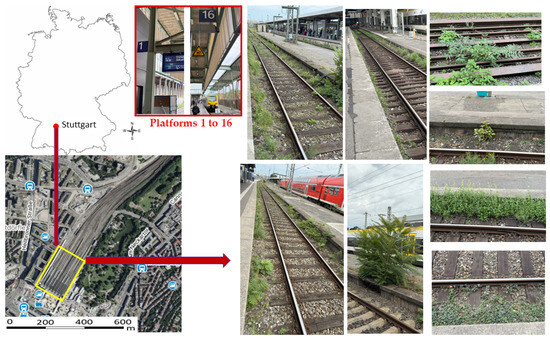
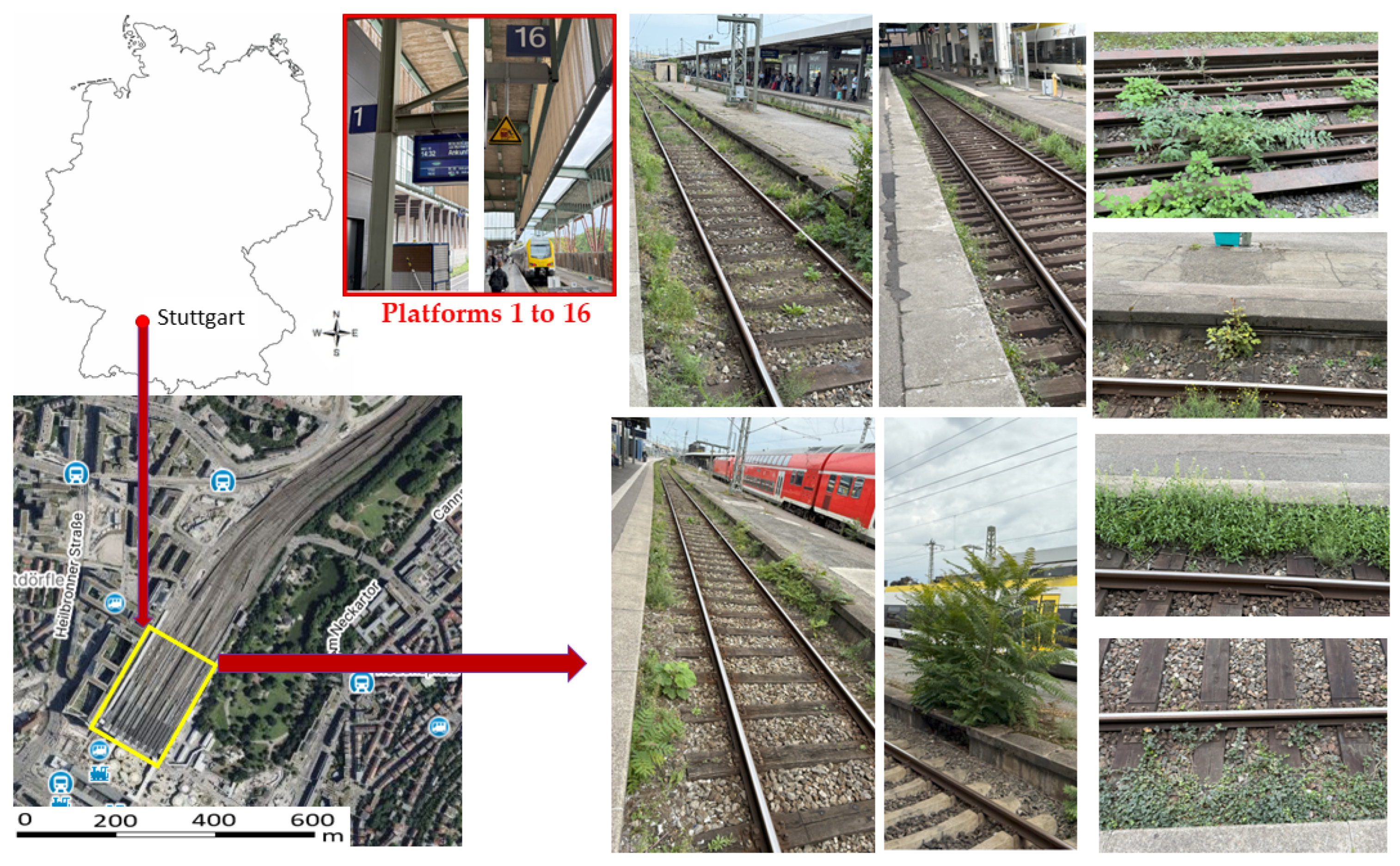
The platform hall of the terminal is directly connected to the transverse hall serving tracks 1 to 16. On the track side, the terminal hall is bordered by a reinforced concrete wall, which serves to mitigate the consequences of a possible brake failure. The eight arches leading to the transverse platform hall are divided into three parts: the upper part is finished with arched windows, the middle part at the level of the platform roofs is solid and the lower part forms a passageway across the entire width towards the transverse hall, where the platform barriers used to be located. A similar architectural solution is found on the opposite side facing the city. The original ceiling structure was destroyed during the Second World War, and the current roof was completed in 1950. Next to the historic station building with a clock tower, known after its architect Paul Bonatz as the “Bonatz Building”, a new station hall is being built. After the end of operation, the existing railway facilities are to be gradually removed [54]. A situational picture of the station and track is shown in Figure 1. The total evaluated area had approximate dimensions of 150 × 250 m. The length of the evaluated part of the track at platforms 2 to 16 was approximately 250 m, while at the track at platform 1 it reached approximately 150 m. The construction of the individual track and platforms was similar. The track was made up of a classic railway structure with a ballasted track bed (ballasted track). The tracks were laid on wooden or concrete sleepers in a layer of crushed aggregate, which transfers the load to the ground and at the same time ensures drainage. The platforms were mainly made up of elevated side and island reinforced concrete structures with prefabricated edges and a surface of anti-slip paving.
Figure 1.
Stuttgart Hauptbahnhof railway station. The total assessed area is marked in yellow, the photos show the vegetation of the trackbeds near platforms 1 to 16.
2.2. Characteristics of the Stuttgart 21 Project
The transport and urban planning project “Stuttgart 21” is currently being implemented and its goal is the fundamental reconstruction of the railway junction in Stuttgart. It is one of the largest infrastructure projects in Germany, whose ambition is to modernize rail transport and transform the central part of the city. At the same time, however, it is also the subject of long-term discussions regarding the financial requirements, environmental impacts and overall usefulness of such large-scale constructions. The first drafts of the project date back to 1994, it was officially approved in 2009, and construction work began in 2010. This year is considered the real beginning of implementation, when the project began to be physically implemented and at the same time provoked extensive public protests in Stuttgart [55]. As part of the Stuttgart 21 project, the existing terminal station is to be replaced by an underground through station with a covered layout and access tracks running in tunnels. The original station is to be rotated by approximately 90° and converted into a through-train system with eight tracks. The accesses to the tracks will be converted into tunnel routes on all sides. The main objective is to increase the capacity of the station, shorten transfer distances and reduce maintenance costs [56]. The “Stuttgart 21” project also aims to address the high traffic concentration at the main station by allowing regional services to pass through, thereby reducing the need for transfers on major routes [57].
The Stuttgart 21 project, introduced in 1995, originally proposed an eight-track through station and has undergone several revisions, including the current design with four island platforms [58]. Despite initial plans for completion by 2021, repeated delays have shifted expected operation to 2027 or later [55]. The long-term implementation of the project has created a “time window” since approximately 2010, during which reduced vegetation management and the planned removal of existing tracks may have influenced vegetation development. The implementation of the “Stuttgart 21” project creates a time window of 31 years from the official start of the project. This period is associated with limited or irregular vegetation management and habitat maintenance.
2.3. Vegetation Assessment Methodology
The vegetation assessment was always carried out in the months of August and September, in the years 2024 and 2025. A botanical list of recorded plant taxa was compiled for each railway yard at platforms 1 to 16. Data on individual taxa were drawn from the floraveg.eu database [59]. Subsequently, the taxa were divided into functional groups based on selected criteria. The first criterion was based on the degree and nature of disturbances. According to Midolo et al. [60], the following characteristics were used: Disturbance frequency, Disturbance severity, Mowing frequency, Grazing pressure and Soil disturbance. The characteristic Disturbance frequency represents an indicator of the frequency of disturbances expressed as a logarithmically defined average inverse value of the return period (in centuries). It indicates the average interval between individual disturbance events and includes all types of disturbances, both anthropogenic and natural. The values relate to disturbances affecting the entire plant community across vegetation layers. Disturbance severity expresses the intensity of disturbance as a continuous value ranging from 0 (no change in biomass) to 1 (complete loss of plant cover). It considers the different types of disturbances that may occur in a habitat. Given that a habitat can be affected by multiple types of disturbances, the values were determined with respect to the most significant ones. Mowing frequency represents an indicator of the frequency of mowing, expressed similarly to the frequency of disturbances, i.e., as the average inverse value of the logarithmically defined return period (in centuries), which expresses the average interval between individual interventions. Grazing pressure expresses the intensity of grazing or grazing-like activities as a continuous value ranging from 0 (no change in biomass) to 1 (complete loss of plant cover) caused by grazing. Soil disturbance is an indicator of soil disturbance, also expressed as a continuous value ranging from 0 (no change in biomass) to 1 (complete loss of plant cover). This indicator includes processes leading to the removal or death of plant biomass due to various forms of soil or substrate disturbance.
The second criterion focused on the relationship of plant taxa to environmental conditions. Ellenberg indicator values for European plant species were used, which represent expert scales ranking species according to their ecological optimum along major environmental gradients. These scales are based on ordinal scales defined by Ellenberg [61]. Values for individual species were determined either as averages from available national and regional databases or were newly derived based on the co-occurrence of species in European vegetation images [62]. The values assigned in this way remain compatible with the original Ellenberg scales and can therefore be used both for large-scale studies of European flora and vegetation and for filling in missing data in regional datasets [59]. Indicator values for individual environmental factors are expressed using ordinal scales [61], with a specific value expressing the relative position of the species on a given ecological gradient—from low to high demands or tolerance to a given factor. A higher value on the scale generally means higher requirements of the species or higher tolerance to the intensity of a given factor: (i) light: scale 1–9 (from strongly shade-loving species to species requiring full light), (ii) temperature: scale 1–12 (from cold habitat species to thermophilic species), (iii) humidity: scale 1–12 (from dry habitats to permanently wet habitats), (iv) soil or water reaction: scale 1–9 (from strongly acidic to alkaline habitats), (v) nutrients: scale 1–9 (from nutrient-poor habitats to nutrient-rich habitats; the value also indirectly reflects the availability of nitrogen or phosphorus and the productivity of the environment), (vi) salinity: scale 0–9 (from environments without increased salt content to highly saline habitats, with the value expressing the concentration of soluble salts such as sulfates, chlorides or carbonates of sodium, potassium, calcium and magnesium).
The third criterion was the importance of taxa in terms of biological relevance. For each plant taxon, the number of other organisms that directly or indirectly depend on it, or use it as a source of food, substrate, shelter or condition for survival and reproduction was determined. Based on data from the database of Tyler et al. [63], taxa were divided according to their importance for biodiversity. This importance is expressed on a logarithmic eight-point scale: BR1 (less than 6 associated species), BR2 (6–12 species), BR3 (13–24 species), BR4 (25–50 species), BR5 (51–100 species), BR6 (101–200 species), BR7 (201–400 species) and BR8 (more than 400 associated species).
The fourth criterion was the attractiveness of plant taxa to pollinators [63]. Taxa were classified according to a seven-level logarithmic scale expressing nectar and pollen production, with the value given in g sugar/m2/year: NP1 (no nectar and pollen production), NP2 (negligible nectar production below 0.2 g, but significant pollen production), NP3 (low nectar production 0.2–5 g, significant pollen), NP4 (medium nectar production 5–20 g, significant pollen), NP5 (higher production 20–50 g, significant pollen), NP6 (high production 50–200 g, significant pollen) and NP7 (very high production above 200 g, significant pollen).
The fifth criterion was based on the geographical origin of plant taxa in Europe. Taxa that are naturally widespread in at least part of the European territory were considered native, although in other regions they may occur as non-native. On the contrary, non-native taxa represent species introduced to Europe by humans, whether intentionally or unintentionally, from other continents. Two groups were distinguished within the assessment: native taxa and neophytes [64]. The classification was based on the floraveg.eu databases [59].
The sixth criterion divided plant taxa according to the method of fruit and seed dispersal [65]. The following categories were distinguished: (i) anemochory—dispersal by wind, when diaspores show specific adaptations for this method of dispersal; (ii) endozoochory—dispersal through the digestive tract of animals; (iii) epizoochory—dispersal of diaspores captured on the surface of the animal body, especially on the fur; (iv) local non-specialized dispersal—including autochory (spontaneous dispersal) and dispersal initiated by wind without significant adaptations diasporic features (e.g., ballochory, blastochory, boleochory, barochory); (v) myrmecochory—dispersal by ants; (vi) anthropochory—dispersal by human activity; and (vii) sporozoites—taxa that reproduce by spores.
3. Results
Based on the assessment of the species composition of the vegetation of the railway tracks of the current Stuttgart Hauptbahnhof station, a total of 68 plant taxa were recorded. The list of detected taxa is given in Table 1, including information on their frequency of occurrence on individual railway tracks.
Table 1.
Overview of the frequency of found plant taxa.
The most frequently represented taxa belonged mainly to ruderal weeds, for example, Erigeron bonariensis L., Geum urbanum L., Senecio inaequidens DC., Ailanthus altissima (Mill.) Swingle, Geranium robertianum L., Hieracium murorum L., Clematis vitalba L. and Taraxacum sect. Taraxacum F.H.Wigg.
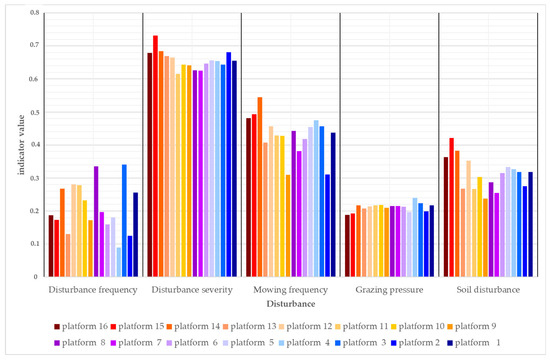
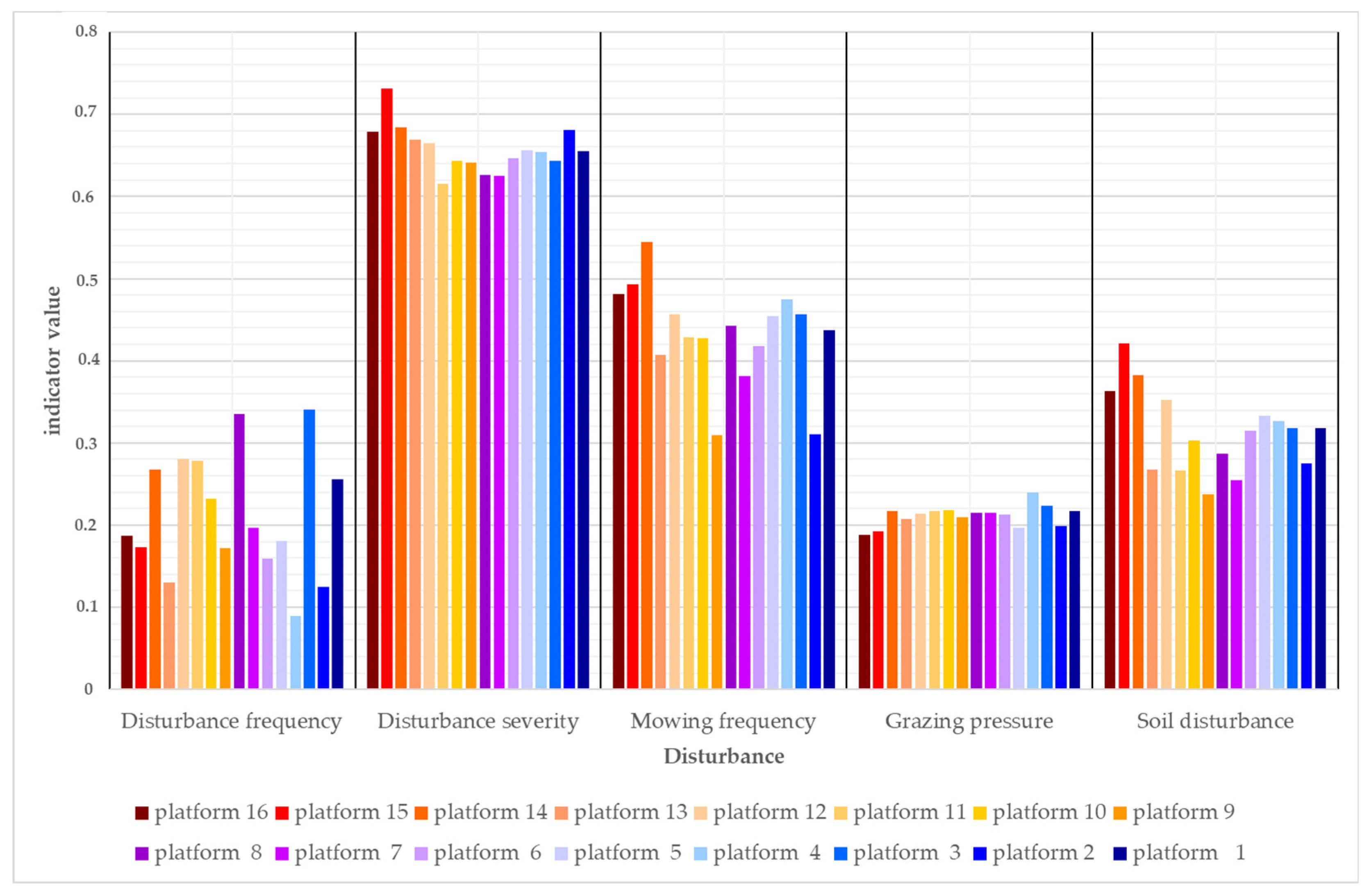
The average values of Disturbance frequency of the monitored track areas are shown in Figure 2. The measured values range from 0.089 to 0.336, which corresponds to an interval of approximately 45–81 years since the last significant disturbance. These results indicate that the current species composition of the track area vegetation indicates at least 45 years since the last significant maintenance or reconstruction of the entire track area. The average values of Disturbance severity of the monitored track areas are shown in Figure 2. The values range from 0.615 to 0.731, which indicates relatively significant losses of plant biomass. The highest rate of loss was recorded on the track area near platform 15, while the lowest was on the track area near platform 11. The results therefore show that the vegetation is exposed to disturbance interventions in the long term.
Figure 2.
Average values of disturbance characteristics on the monitored tracks.
The average values of Mowing frequency of the monitored railway lines are shown in Figure 2. The values range from 0.309 to 0.545, which corresponds to an estimated mowing interval of approximately 28.5–49 years. The results show that vegetation is maintained within very long mowing intervals, or that it is mowed in a mosaic pattern across the entire railway line.
The average values of Grazing pressure of the monitored railway lines are shown in Figure 2. The values range from 0.188 to 0.240, which corresponds to approximately 20% biomass loss. The results show that there is limited but significant removal of vegetation biomass. Grazing-like disturbances in this environment can be caused, for example, by the movement of train sets that mechanically disturb the vegetation.
The average values of Soil disturbance of the monitored railway lines are shown in Figure 2. The values range from 0.238 to 0.421, indicating moderate disturbance of the substrate and associated vegetation biomass. The maximum disturbance rate is less than 45%. The results indicate limited but repeated disturbance of the substrate, which is likely to be associated mainly with infrastructure maintenance, such as the replacement of railway sleepers and related works.
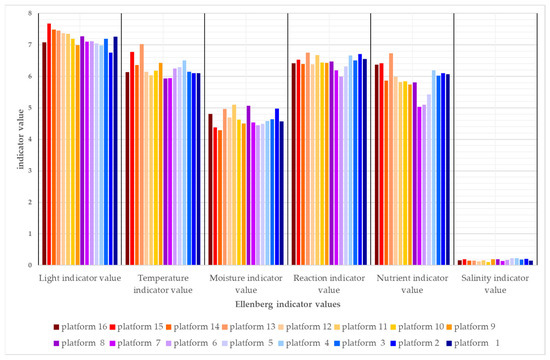
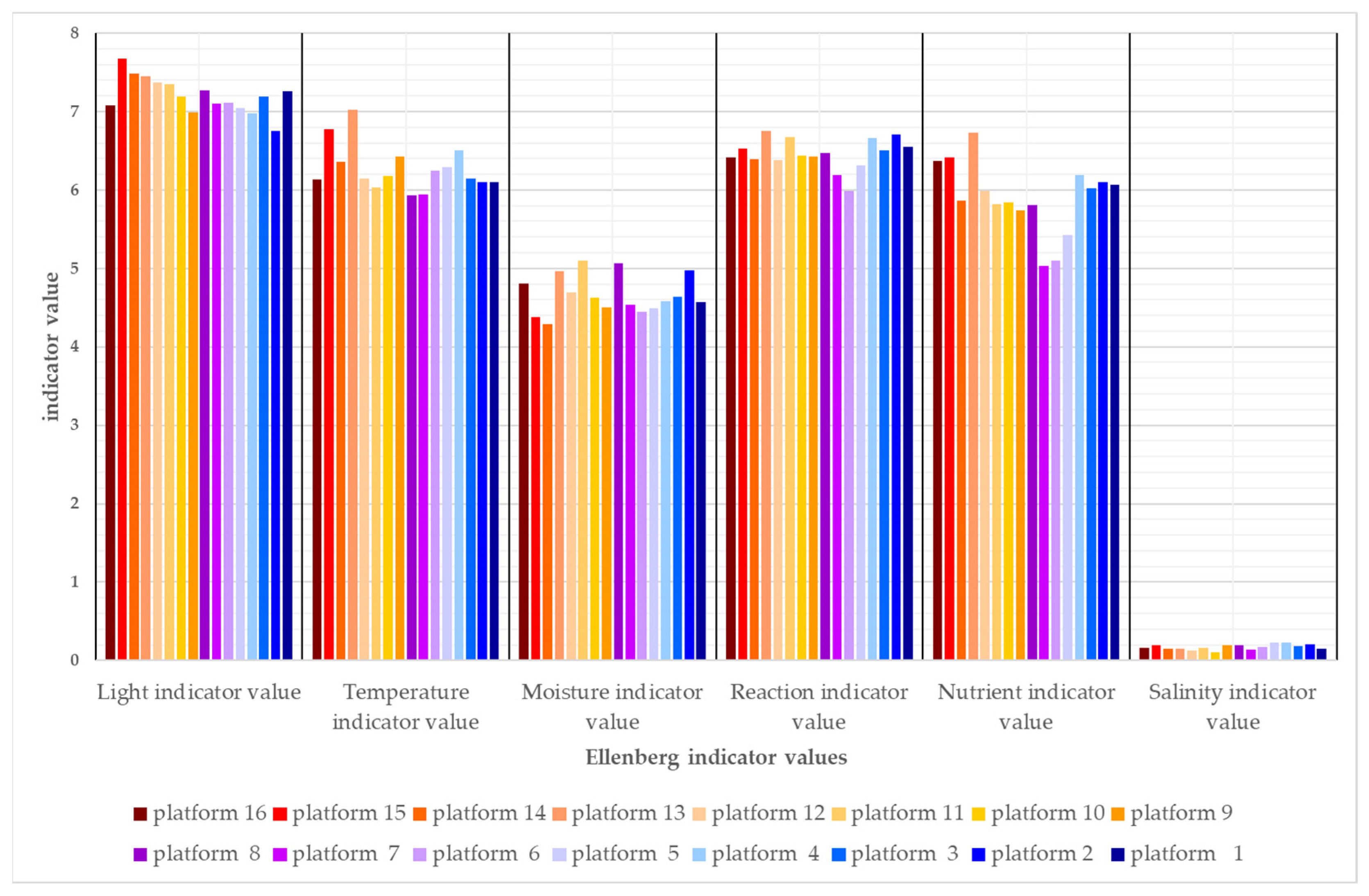
The average Ellenberg indicator values of European plant taxa characterizing the conditions of the evaluated railway tracks are shown in Figure 3. The average indicator values for light are around 7, which corresponds to taxa of partially light habitats. These taxa usually grow in full light or tolerate shading up to approximately 30% of the diffuse radiation falling on the open area. The average indicator values for temperature are around 6. These are transitional taxa between indicators of moderate heat, occurring from the lowlands to the mountain stage, especially in submontane-temperate areas, and more thermophilic taxa, tied to relatively warm lowland areas. The average indicator values for moisture are in the range of 4–5. These taxa do not occur on very moist soils and are tied to fresh, moderately moist habitats. They are absent on permanently wet soils and on habitats that often dry out. The average indicator values for soil reaction are around 6. These are taxa indicating slightly acidic to basic conditions that do not occur in strongly acidic environments. The average indicator values for nutrients are around 6. These taxa prefer habitats moderately rich in nutrients, are less often found in poorer or very rich habitats and are more often tied to environments richer in nutrients than to average or poorer conditions. The average indicator values for salinity are around 0. These are taxa intolerant to higher salt concentrations (glycophytes).
Figure 3.
Average Ellenberg indication values on monitored tracks.
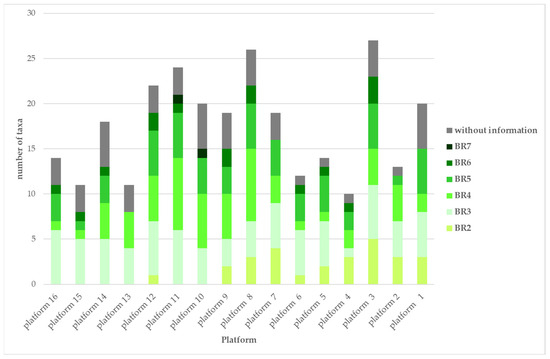
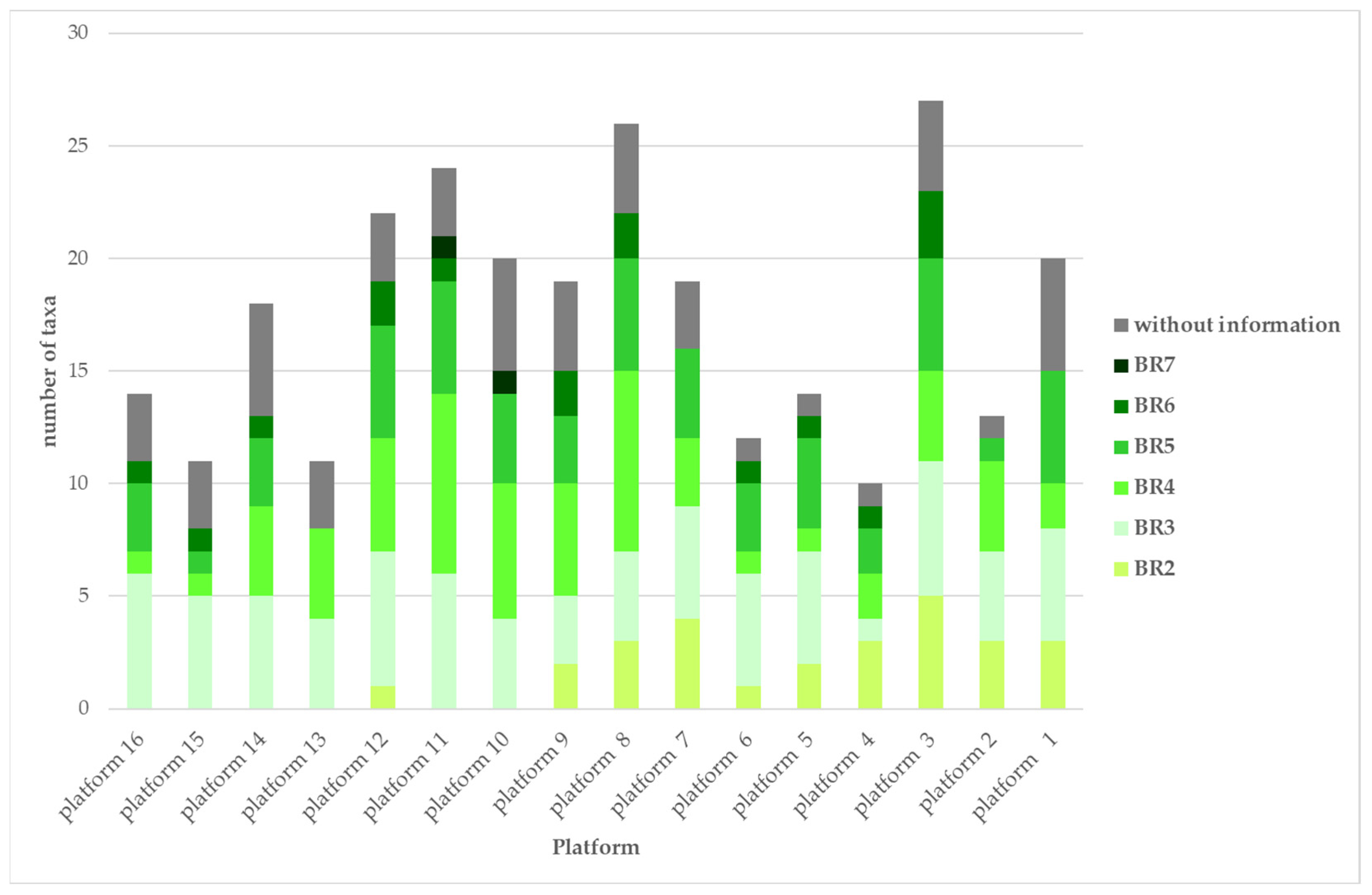
The numbers of taxa divided according to biological relevance are shown in Figure 4. The highest representation was in groups BR3, BR4 and BR5. The vegetation of the monitored railway tracks thus shows biological relevance in the range of approximately 13 to 100 associated taxa.
Figure 4.
Number of plant taxa divided by biological relevance. BR1 (less than 6 associated species), BR2 (6–12 species), BR3 (13–24 species), BR4 (25–50 species), BR5 (51–100 species), BR6 (101–200 species), BR7 (201–400 species) and BR8 (more than 400 associated species).
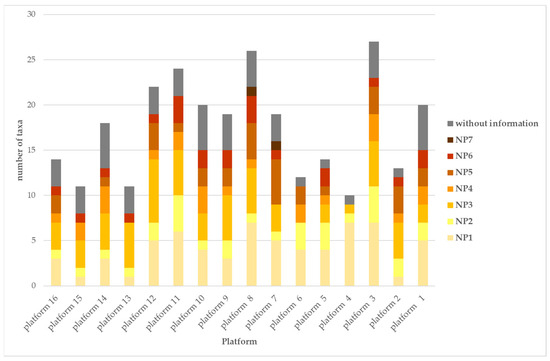
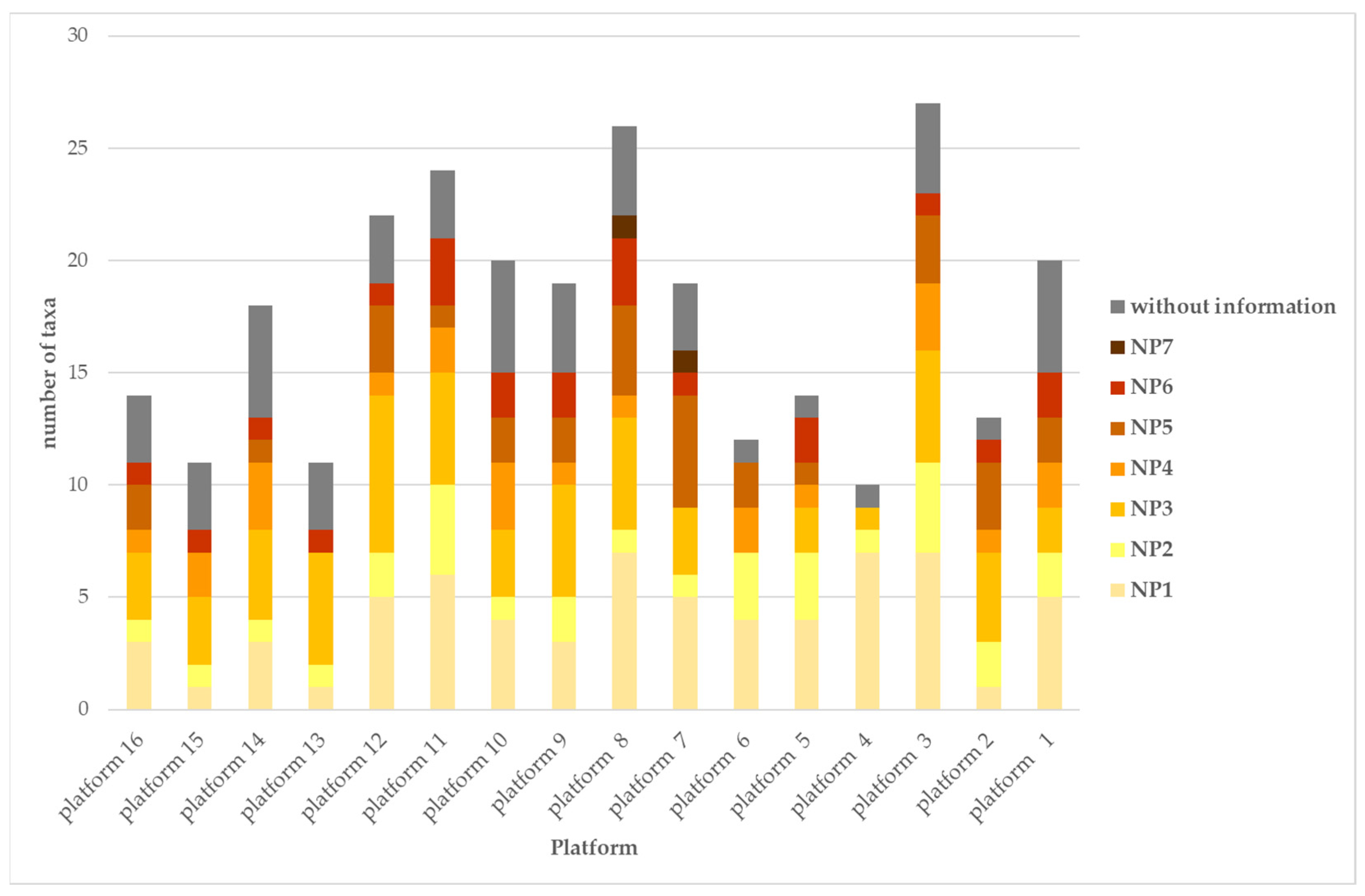
The numbers of taxa divided by nectar and pollen production are shown in Figure 5. Taxa from groups NE1, NE2 and NE3 were the most represented. For most taxa, nectar production ranges from no nectar production and absence of pollen for collection by animals to low nectar production of up to 5 g, with the amount of pollen often significant in these taxa.
Figure 5.
Number of plant taxa divided by nectar and pollen production. NP1 (no nectar and pollen production), NP2 (negligible nectar production below 0.2 g, but significant pollen production), NP3 (low nectar production 0.2–5 g, significant pollen), NP4 (medium nectar production 5–20 g, significant pollen), NP5 (higher production 20–50 g, significant pollen), NP6 (high production 50–200 g, significant pollen) and NP7 (very high production above 200 g, significant pollen).
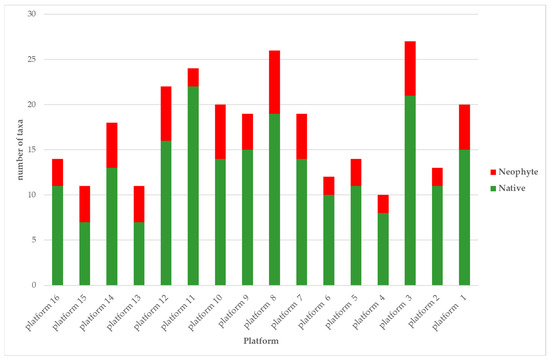
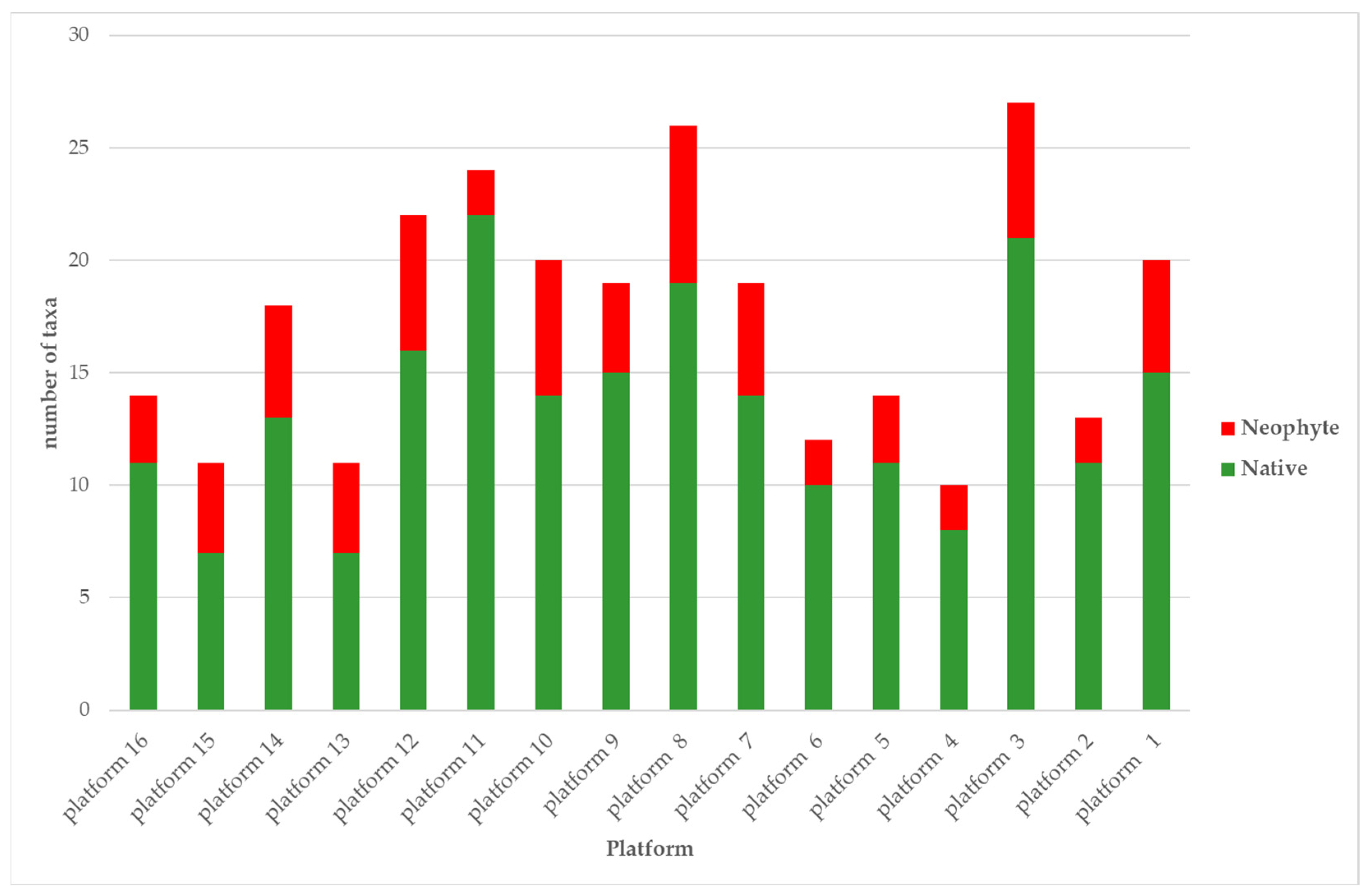
The numbers of taxa distributed by origin in Europe are shown in Figure 6. Native taxa were the most abundant and were present in most of the monitored tracks. On average, approximately 4 neophyte taxa were present per track.
Figure 6.
Number of plant taxa divided by origin in Europe.
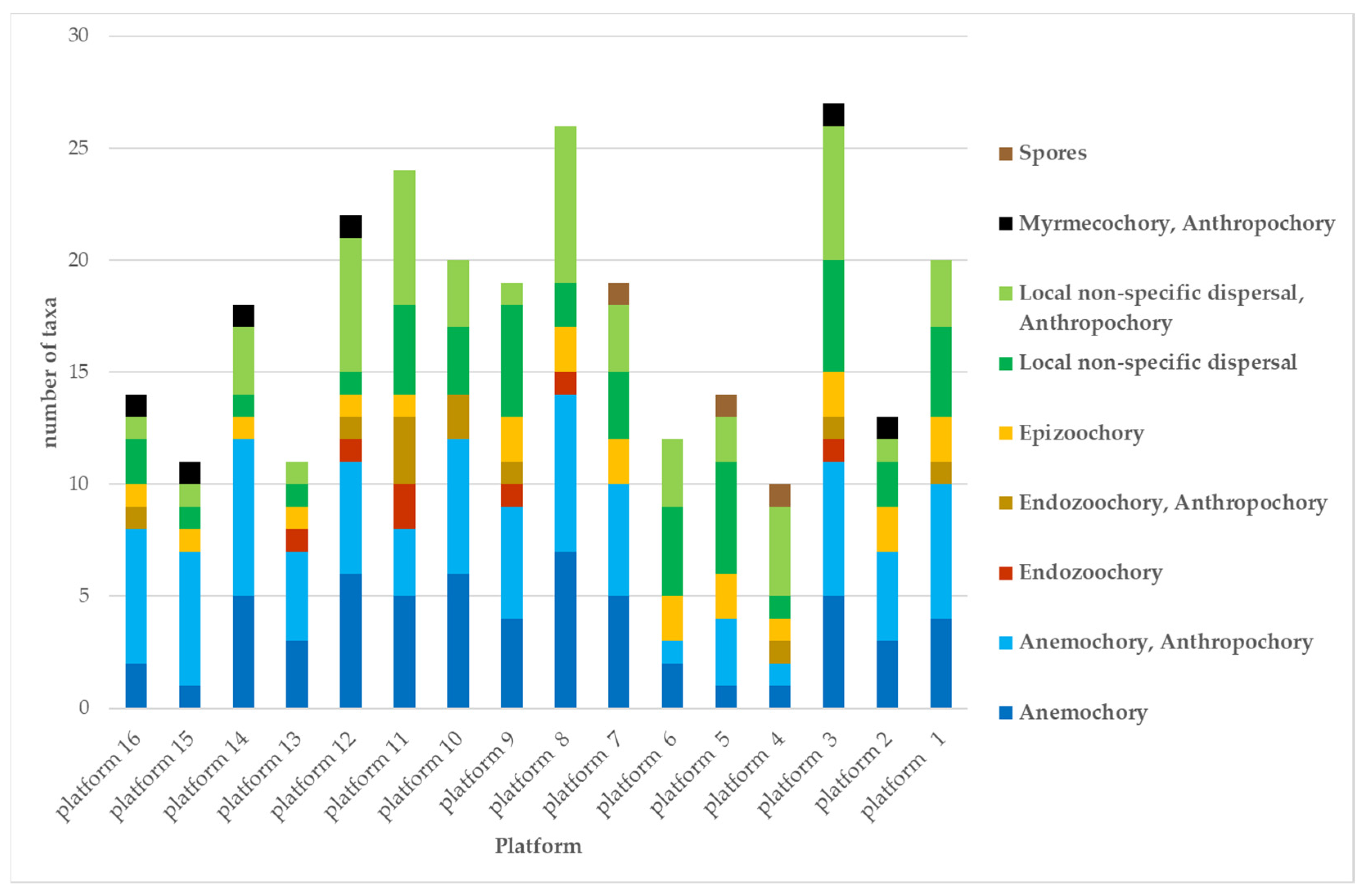
The numbers of taxa divided by the method of dispersal are shown in Figure 7. The most represented taxa were those with anemochoric and anthropochoric dispersal types. In vegetation, the dispersal of plants by humans is significantly represented, which significantly contributes to their expansion in a given environment.
Figure 7.
Number of plant taxa divided by mode of dispersal.
4. Discussion
According to information on the “Stuttgart 21” project and the planned relocation of the tracks, the so-called “time window” lasts approximately 31 years. However, the vegetation composition indicates that the reduced intervention regime on the tracks has been going on for a longer period. Based on the species composition of the vegetation, it is evident that the plant taxa present indicate the minimum length of this time window of approximately 45 years since the last significant maintenance or reconstruction of the entire track (disturbance). However, preparations for the “Stuttgart 21” project were underway earlier, and it can therefore be assumed that the conditions of limited habitat management arose before the official start of the project and persist for a longer period. This is also reflected in the species composition of the railway line vegetation.
At the same time, normal railway traffic causes various disturbances and particularly limits the formation of vegetation biomass. The degree of biomass disturbance varies between individual tracks, because the vegetation composition varies between the monitored sites. The indicated mowing interval is relatively long and ranges from 28.5 to 49 years. Approximately 20% of the biomass is regularly removed, as indicated by the species composition. This removal is similar in nature to grazing and can be caused by passing trains that mechanically disturb plant growth. The species composition of vegetation also indicates various forms of substrate disturbance, which are also associated with biomass reduction. Partial removal of biomass may also be related to local interventions, for example, replacement of railway sleepers due to their poor technical condition. However, the described vegetation indicates limited habitat management, which creates conditions enabling the persistence of populations of a number of plant taxa. According to Rutkovska et al. [21] and Májeková and Limánek [66], the amount of vegetation in the railway environment is fundamentally influenced by the intensity of management interventions, such as mowing, herbicide application or track reconstruction. In the monitored habitat, these interventions were limited or irregular.
Within this “time window”, a specific vegetation management regime is applied, which allows for a gradual change in species composition and supports the occurrence of taxa requiring a lower frequency of interventions. These include, for example, Ailanthus altissima, Clematis vitalba, Acer campestre, A. pseudoplatanus, Ficus carica, Hedera helix, Buddleja davidii and Sambucus nigra. According to Galer et al. [67], tree species usually do not reach fully developed dimensions due to human activity, and further succession towards forest communities is only possible if railway lines are taken out of service. The studied vegetation consists mainly of annual and perennial herbs, supplemented by representatives of lianas. Woody plants (shrubs and trees) are represented mainly by seedlings or individuals with limited growth and deformed habit.
Studies comparing the flora of active and abandoned railway lines show that after their closure, the number of non-native taxa with a short life cycle (therophytes) decreases and persistent native species gradually appear. These changes occur relatively quickly, within a few years [68,69,70]. The results suggest that time-windowed habitats can create conditions for the occurrence and spread of certain plant taxa, including non-native species and species with effective wind-dispersed diaspores. Identification of risk periods and locations can enable targeted vegetation monitoring and regulatory measures to be implemented already during construction works. Such an approach can contribute to limiting the spread of non-native taxa and reducing the invasive potential of some plant taxa in the vicinity of railway infrastructure. The Stuttgart Hauptbahnhof site is situated in the central part of the city and is surrounded by diverse types of environments, including urban parks, built-up areas and brownfields. Vegetation occurring in temporarily disturbed habitats can represent a source of diaspores of some plant taxa for the surrounding environment for a limited period of time.
The results of the study confirm that vegetation succession on railway tracks is currently limited by ongoing railway operations, train movements and limited vegetation management. The conditions of this “time window” also allow for a more significant proliferation of taxa such as Erigeron bonariensis, Geum urbanum and Senecio inaequidens. The vegetation of railway tracks thus represents a sensitive bioindicator of anthropogenic influences and provides valuable knowledge about the dynamics of ecosystem development [71]. Living conditions on railway tracks within this “time window”, as indicated by the plant taxa present, correspond to habitats with full sunlight to partial shade. Shading here reaches approximately 30% of diffuse solar radiation, which indicates that the railway tracks and platform areas are partially covered by structures limiting the direct incidence of light and creating locally shaded microhabitats. The railway infrastructure thus forms significantly fragmented habitats (microhabitats), which enable the long-term survival of plant taxa that are not typical of the original vegetation of the given region. Fragmentation can lead to permanent and difficult to predict consequences, including a local increase in the abundance of some species. For a deeper understanding of the impacts of landscape fragmentation, long-term monitoring is therefore necessary [35,72,73]. In terms of temperature conditions, the environmental indications found correspond to the transitional zone between lowland and foothill areas. The railway station habitats are not significantly overheated and basically reflect the climatic conditions of the wider Stuttgart area. Májeková et al. [74] state that the average annual temperature is a significant factor influencing, in particular, the species richness of native taxa.
Humidity conditions show considerable variability, ranging from wetter habitats to regularly drying out areas. It can therefore be assumed that partial roofing of platforms can locally support the accumulation of rainwater, while well-drained parts of the trackbeds create conditions close to dry habitats. The vegetation is dominated by species with medium moisture preferences, while taxa indicating moist habitats (Solanum lycopersicum, Epilobium hirsutum) and dry habitats (Melica ciliata, Senecio inaequidens) are represented only in small quantities. In this context, Toffolo et al. [35] have drawn attention to the mosaic of microhabitats typical of railway areas, which allows the coexistence of species with very different water regime requirements—from hygrophilous species such as Phragmites australis (Cav.) Trin. ex Steud., Cyperus fuscus L. or Epilobium hirsutum, to xerophilic taxa of embankments, for example, from the genera Papaver spp. and Sedum spp.
In terms of soil reaction, the taxa present indicate predominantly slightly acidic to basic conditions. The trackbed substrate is therefore predominantly neutral to basic in character and its more pronounced acidification can be ruled out. Hutniczak et al. [75] similarly report the dominance of basiphilic taxa on abandoned railway areas in contact with surrounding non-forest communities.
In terms of nutrients, which were probably originally limited in the substrate of the track, the current state appears to be slightly enriched. It can be assumed that railway traffic, together with the accumulation of waste from passengers under conditions of reduced disturbance regime (“time window”), contributes to a gradual increase in the nutrient content. At the same time, however, there is no significant salinization, since most of the recorded taxa belong to glycophytes. Toffolo et al. [35] state that high values of soil reaction and low nutrient content in railway sites may be related to the presence of rubble (gravel, pebbles), which creates specific conditions supporting the occurrence of selected plant taxa. The vegetation of the track within the “time window” of limited disturbance shows the biological relevance of approximately 13 to 100 associated taxa. Among the taxa with higher biological relevance can be included in particular trees (Acer campestre, Acer pseudoplatanus, Crataegus monogyna, Ulmus glabra) and perennial herbs (Calamagrostis epigejos, Cirsium arvense, Dactylis glomerata, Plantago lanceolata, Plantago major). However, from the perspective of the operation and maintenance of railway infrastructure, a higher biological relevance of vegetation in the area of trackbeds is not desirable.
Nectar and pollen production is zero or low for most recorded species, and the vegetation thus does not represent a significant food source for pollinators or a significant attractor for animals that could disrupt railway traffic or be endangered by it. Although transport is generally among the significant causes of animal mortality [76], the nature of the monitored vegetation probably does not support this phenomenon.
In the monitored stands, native plant taxa predominate; however, under conditions of limited disturbance, railway tracks also create space for the occurrence of neophytes, which can spread further into the surrounding urban environment. Büscher et al. [77] and Eliáš [78] state that railway transport in the past significantly contributed to the spread of some species, for example, Geranium purpureum Vill., across Europe, from where they subsequently colonized other urban habitats. Monitoring the spread of invasive taxa is therefore also important from the point of view of the effectiveness of herbicide application on railway infrastructure [79]. Of the species found, Ailanthus altissima, Erigeron bonariensis and Senecio inaequidens in particular may show this potential.
The predominant mechanisms of diaspora spread are anemochory and anthropochory. The vegetation of railway tracks within the “time window” of limited disturbance can thus represent a significant source of diaspores capable of spreading to the surrounding area and influencing the species composition of adjacent urban areas. Individual railway tracks also create different conditions for wind-dispersed taxa. Hutniczak et al. [75] report that railway tracks surrounded by non-forest communities are dominated by species with anemochoric seed dispersal, with habitat fragmentation significantly affecting their dispersion [80]. Synanthropic vegetation can thus represent a potential risk for surrounding ecosystems due to increased propagule pressure and the dynamics of vegetation changes [81].
Human activities create a wide range of specific habitats that plants use to support their populations. Railway tracks represent typical synanthropic habitats hosting a characteristic spectrum of species [82,83]. The extent of ecosystems in which human civilization has become the dominant ecological force is one of the main features of the Anthropocene [84,85]. Railway track conditions may favor taxa with anthropogenic life strategies [86]. Vegetation in urbanized environments is therefore likely to play an increasingly important role in protecting biodiversity and maintaining local taxa [87]. Blackwood et al. [16] point out that railway infrastructure will have to adapt to new challenges associated with global temperature increases and economic fluctuations. At the same time, it is necessary to take into account changes in the species composition of vegetation caused by transport and construction interventions. Shrub biomass can influence ignition thresholds [88] and fires on railway embankments are becoming an emerging risk related to climate change in Germany [89]. Changes in vegetation can bring complications both for rail transport and track management, and for the surrounding urban ecosystems.
A larger and more geographically representative set of study sites would allow for more general conclusions about species richness patterns and a deeper understanding of the flora associated with railway environments [74]. On the other hand, regionally focused studies provide detailed insight into the importance of “time windows” and microhabitats for vegetation development in railway infrastructure conditions.
5. Conclusions
The vegetation of railway tracks changes dynamically and responds, among other things, to changes and differences in the effects of civilization, which are limited in time. Such a specific situation is represented by the “time window” associated with long-term transport and construction projects, which is reflected in the species composition of the vegetation. The vegetation of the railway tracks of the current Stuttgart Hauptbahnhof station includes a total of 68 plant taxa, with Erigeron bonariensis, Geum urbanum and Senecio inaequidens being represented on most railway tracks. Limited disturbance within this “time window” creates conditions particularly suitable for the development of woody plants and lianas, such as Acer campestre, A. pseudoplatanus, Ailanthus altissima, Clematis vitalba, Ficus carica, Hedera helix and Sambucus nigra. These are taxa that have the potential to disrupt the functional properties of the track bed through their root system and negatively affect railway operations.
The plant taxa present also indicate the emergence of a diverse mosaic of microhabitats, which allows the coexistence of taxa with different ecological requirements, especially for light and moisture conditions. The indicative values of the plant taxa also indicate a neutral to alkaline pH of the substrate, relatively higher nutrient availability and low salinity. The evaluated railway tracks also provide space for the occurrence of non-native taxa, such as Ailanthus altissima, Amaranthus retroflexus, Buddleja davidii, Epilobium ciliatum, Erigeron annuus, Erigeron bonariensis, Erigeron canadensis, Paulownia tomentosa and Senecio inaequidens. Most of these species are capable of effective wind dispersal and can colonize surrounding urban areas.
I consider the possibility of extending the assessment of environmental risks of infrastructure projects to include monitoring vegetation changes during long-term construction works to be a major practical benefit of this case study. The results indicate that temporary habitats can create conditions for the occurrence and spread of some plant taxa, including non-native species and species with effective wind-dispersal of diaspores. The practical use lies primarily in identifying risk periods and locations suitable for targeted vegetation monitoring and introducing regulatory measures already during construction works. This can contribute to limiting the spread of non-native taxa and more effective protection of biodiversity in the vicinity of railway infrastructure. Most previous studies focus on habitats without significant changes over time. This work brings a new perspective through the analysis of vegetation in habitats with a time window, i.e., in an environment with temporarily altered conditions.
Large projects such as Stuttgart 21 generate extensive expert and public discussions, which, however, focus primarily on technical, economic or implementation aspects. On the other hand, only minimal attention is paid to vegetation that is adapted to the conditions of railway tracks and at the same time uses the “time window” associated with the reconstruction of transport hubs. As a result of extensive regulation, populations of some taxa can temporarily create new generations and thus influence the species composition of vegetation in the wider area. It is therefore necessary to perceive not only the current conditions of the habitat, but also the temporal dynamics of disturbances. The changing disturbance regime can significantly influence the spread of some plant taxa. Therefore, a systematic analysis of the risks associated with vegetation changes should also be part of infrastructure projects, supplemented by long-term monitoring and possible adjustment of the methods of its regulation.
Funding
This research received no external funding.
Data Availability Statement
The data are not available to the public in order to preserve the originality of the data.
Conflicts of Interest
The author declares no conflicts of interest.
References
- De Block, G.; Polasky, J. Light railways and the rural–urban continuum: Technology, space and society in late nineteenth-century Belgium. J. Hist. Geogr. 2011, 37, 312–328. [Google Scholar] [CrossRef] [Scilit]
- Martí-Henneberg, J. European integration and national models for railway networks (1840–2010). J. Transp. Geogr. 2013, 26, 126–138. [Google Scholar] [CrossRef] [Scilit]
- Auphan, E. La contraction du réseau ferré français dans le temps et dans l’espace. In Colloque International Le Secteur Des Transports Ferroviaires Dans La Mondialisation; Université Versailles-Saint-Quentin-en-Yvelines: Versailles, France, 2013; Available online: https://shs.hal.science/halshs-02880737v1 (accessed on 14 November 2025).
- Pietrzak, K.; Pietrzak, O. Environmental Effects of Electromobility in a Sustainable Urban Public Transport. Sustainability 2020, 12, 1052. [Google Scholar] [CrossRef] [Scilit]
- Guo, P.; Yu, F.; Ren, Y.; Liu, D.; Li, J.; Ouyang, Z.; Wang, X. Response of Ruderal Species Diversity to an Urban Environment: Implications for Conservation and Management. Int. J. Environ. Res. Public Health 2018, 15, 2832. [Google Scholar] [CrossRef] [Scilit]
- Seto, K.C.; Reenberg, A.; Boone, C.G.; Fragkias, M.; Haase, D.; Langanke, T.; Marcotullio, P.; Munroe, D.K.; Olah, B.; Simon, D. Urban land teleconnections and sustainability. Proc. Natl. Acad. Sci. USA 2012, 109, 7687–7692. [Google Scholar] [CrossRef] [Scilit]
- Forman, R.T.; Sperling, D.; Bissonette, J.A.; Clevenger, A.P.; Cutshall, C.D.; Dale, V.H.; Fahrig, L.; France, R.L.; Goldman, C.R.; Heanue, K.; et al. Road Ecology: Science and Solutions; Princeton University Press: Princeton, NJ, USA, 2013; 504p. [Google Scholar]
- Murcia, C. Edge effects in fragmented forests: Implications for conservation. Trends Ecol. Evol. 1995, 10, 58–62. [Google Scholar] [CrossRef] [Scilit] [PubMed]
- Brandes, D. Eisenbahnanlagen als Untersuchungsgegenstand der Geobotanik. Tuexenia 1993, 13, 415–444. [Google Scholar]
- Wittig, R.; Lienenbecker, H. Sandtrockenrasen auf Bahnhöfen in Ostwestfalen. Ber. Naturwiss. Ver. Bielef. Umgeg. 2003, 43, 259–284. [Google Scholar]
- Wiłkomirski, B.; Galera, H.; Sudnik-Wójcikowska, B.; Staszewski, T.; Malawska, M. Railway tracks-habitat conditions, contamination, floristic settlement—A review. Environ. Nat. Resour. Res. 2012, 2, 86. [Google Scholar] [CrossRef] [Scilit]
- Kalusová, V.; Chytrý, M.; van Kleunen, M.; Mucina, L.; Dawson, W.; Essl, F.; Kreft, H.; Pergl, J.; Weigelt, P.; Winter, M.; et al. Naturalization of European plants on other continents: The role of donor habitats. Proc. Natl. Acad. Sci. USA 2017, 114, 13756–13761. [Google Scholar] [CrossRef] [Scilit]
- Bergès, L.; Pellissier, V.; Avon, C.; Verheyen, K.; Dupouey, J.-L. Unexpected long-range edge-to-forest interior environmental gradients. Landsc. Ecol. 2013, 28, 439–453. [Google Scholar] [CrossRef] [Scilit]
- Otto, R.; Arteaga, M.A.; Delgado, J.D.; Arévalo, J.R.; Blandino, C.; Fernández-Palacios, J.M. Road Edge Effect and Elevation Patterns of Native and Alien Plants on an Oceanic Island (Tenerife, Canary Islands). Folia Geobot. 2014, 49, 65–82. [Google Scholar] [CrossRef] [Scilit]
- Winkler, J.; Smékalová, M.; Lumbantobing, Y.R.; Červenková, J.; Sitek, W.; Vaverková, M.D. The Importance of Railway Lines for the Composition of Vegetation in Agricultural Landscapes: A Case Study. Land 2026, 15, 523. [Google Scholar] [CrossRef] [Scilit]
- Blackwood, L.; Renaud, F.G.; Gillespie, S. Nature-based solutions as climate change adaptation measures for rail infrastructure. Nat. Based Solut. 2022, 2, 100013. [Google Scholar] [CrossRef] [Scilit]
- Moomaw, W.R.; Masino, S.A.; Faison, E.K. Intact Forests in the United States: Proforestation Mitigates Climate Change and Serves the Greatest Good. Front. For. Glob. 2019, 2, 27. [Google Scholar] [CrossRef] [Scilit]
- Eisenack, K.; Stecker, R.; Reckien, D.; Hoffmann, E. Adaptation to climate change in the transport sector: A review of actions and actors. Mitig. Adapt. Strateg. Glob. Change 2012, 17, 451–469. [Google Scholar] [CrossRef] [Scilit]
- Szymczak, S.; Bott, F.; Babeck, P.; Frick, A.; Stöckigt, B.; Wagner, K. Estimating the hazard of tree fall along railway lines: A new GIS tool. Nat. Hazards 2022, 112, 2237–2258. [Google Scholar] [CrossRef] [Scilit]
- Szymczak, S.; Bott, F.; von den Driesch, F. Gefahrenhinweiskarten als Tool der Klimafolgenanpassung im Schienenverkehr. gis.Science 2025, 1, 1–7. [Google Scholar] [CrossRef]
- Rutkovska, S.; Pucka, I.; Evarts-Bunders, P.; Paidere, J. The role of railway lines in the distribution of alien plant species in the territory of Daugavpils City (Latvia). Est. J. Ecol. 2013, 62, 212. [Google Scholar] [CrossRef] [Scilit]
- Torstensson, L. Use of herbicides on railway tracks in Sweden. Pestic. Outlook 2001, 12, 16–21. [Google Scholar] [CrossRef] [Scilit]
- Nolte, R.; Behrendt, S.; Magro, M. UIC Guideline for Integrated Vegetation Management—Part A; International Union of Railways (UIC): Paris, France, 2018; Available online: https://uic.org/IMG/pdf/herbie_project_-_part_a.pdf (accessed on 4 November 2025).
- Kilian, M.; Marienhagen, C. Herbicide Combination Containing Pelargonic Acid and Defined ALS Inhibitors. U.S. Patent No. 9609865, 4 April 2017. [Google Scholar]
- Poiger, T.; Müller, J.; Kasteel, R.; Buerge, I.J. Degradation and sorption of the herbicide pelargonic acid in subsoils below railway tracks compared to a range of topsoils. Environ. Sci. Eur. 2024, 36, 4. [Google Scholar] [CrossRef] [Scilit]
- Cederlund, H. Environmental fate of glyphosate used on Swedish railways—Results from environmental monitoring conducted between 2007–2010 and 2015–2019. Sci. Total Environ. 2022, 811, 152361. [Google Scholar] [CrossRef] [Scilit] [PubMed]
- Buerge, I.J.; Pavlova, P.; Hanke, I.; Bächli, A.; Poiger, T. Degradation and sorption of the herbicides 2,4-D and quizalofop-P-ethyl and their metabolites in soils from railway tracks. Environ. Sci. Eur. 2020, 32, 150. [Google Scholar] [CrossRef] [Scilit]
- Galera, H.; Sudnik-Wójcikowska, B.; Wierzbicka, M.; Wiłkomirski, B. Encroachment of forest species into operating and abandoned railway areas in north-eastern Poland. Plant Biosyst. 2011, 145, 23–36. [Google Scholar] [CrossRef] [Scilit]
- Rat, M.M.; Gavrilović, M.T.; Radak, B.Đ.; Bokić, B.S.; Jovanović, S.D.; Božin, B.N.; Boža, P.P.; Anačkov, G.T. Urban flora in the Southeast Europe and its correlation with urbanization. Urban Ecosyst. 2017, 20, 811–822. [Google Scholar] [CrossRef] [Scilit]
- Čeplová, N.; Kalusová, V.; Lososová, Z. Effects of settlement size, urban heat island and habitat type on urban plant biodiversity. Landsc. Urban Plan. 2017, 159, 15–22. [Google Scholar] [CrossRef] [Scilit]
- Haq, S.M.; Calixto, E.S.; Song, L.; Rashid, I.; Khuroo, A.A. Pervasive impacts of railway edge effects on edaphic parameters and vegetation distribution patterns. Environ. Dev. 2024, 52, 101064. [Google Scholar] [CrossRef] [Scilit]
- Aronson, M.F.; Lepczyk, C.A.; Evans, K.L.; Goddard, M.A.; Lerman, S.B.; MacIvor, J.S.; Nilon, C.H.; Vargo, T. Biodiversity in the city: Key challenges for urban green space management. Front. Ecol. Environ. 2017, 15, 189–196. [Google Scholar] [CrossRef] [Scilit]
- Capotorti, G.; Bonacquisti, S.; Abis, L.; Aloisi, I.; Attorre, F.; Bacaro, G.; Balletto, G.; Banfi, E.; Barni, E.; Bartoli, F.; et al. More nature in the city. Plant Biosyst.—Int. J. Deal. All Asp. Plant Biol. 2020, 154, 1003–1006. [Google Scholar] [CrossRef] [Scilit]
- Wrzesien, M.; Denisow, B.; Mamchur, Z.; Chuba, M.; Resler, I. Composition and structure of the flora in intra-urban railway areas. Acta Agrobot. 2016, 69, 1666. [Google Scholar] [CrossRef] [Scilit]
- Toffolo, C.; Gentili, R.; Banfi, E.; Montagnani, C.; Caronni, S.; Citterio, S.; Galasso, G. Urban plant assemblages by land use type in Milan: Floristic, ecological and functional diversities and refugium role of railway areas. Urban For. Urban Green. 2021, 62, 127175. [Google Scholar] [CrossRef] [Scilit]
- Penone, C.; Kerbiriou, C.; Julien, J.-F.; Julliard, R.; Machon, N.; Le Viol, I. Urbanisation effect on Orthoptera: Which scale matters? Insect Conserv. Divers. 2013, 6, 319–327. [Google Scholar] [CrossRef] [Scilit]
- Moroń, D.; Skorka, P.; Lenda, M.; Rożej-Pabijan, E.; Wantuch, M.; Kajzer-Bonk, J.; Celary, W.; Mielczarek, Ł.E.; Tryjanowski, P. Railway embankments as new habitat for pollinators in an agricultural landscape. PLoS ONE 2014, 9, e101297. [Google Scholar] [CrossRef] [Scilit] [PubMed]
- Tzoulas, K.; Korpela, K.; Venn, S.; Yli-Pelkonen, V.; Kaźmierczak, A.; Niemela, J.; James, P. Promoting ecosystem and human health in urban areas using Green Infrastructure: A literature review. Landsc. Urban Plan. 2007, 81, 167–178. [Google Scholar] [CrossRef] [Scilit]
- Bonthoux, S.; Chollet, S.; Balat, I.; Legay, N.; Voisin, L. Improving nature experience in cities: What are people’s preferences for vegetated streets? J. Environ. Manag. 2019, 230, 335–344. [Google Scholar] [CrossRef] [Scilit]
- Wang, B. Urban Vegetation and Urban Vegetation Science. Acta Sci. Nat. Univ. Sunyatseni 1998, 4, 10–13. [Google Scholar]
- Bonthoux, S.; Voisin, L.; Bouché-Pillon, S.; Chollet, S. More than weeds: Spontaneous vegetation in streets as a neglected element of urban biodiversity. Landsc. Urban Plan. 2019, 185, 163–172. [Google Scholar] [CrossRef] [Scilit]
- Yasuda, M.; Koike, F. Do golf courses provide a refuge for flora and fauna in Japanese urban landscapes? Landsc. Urban Plan. 2006, 75, 58–68. [Google Scholar] [CrossRef] [Scilit]
- Huang, L.; Qian, S.; Li, T.; Jim, C.Y.; Jin, C.; Zhao, L.; Lin, D.; Shang, K.; Yang, Y. Masonry walls as sieve of urban plant assemblages and refugia of native species in Chongqing, China. Landsc. Urban Plan. 2019, 191, 103620. [Google Scholar] [CrossRef] [Scilit]
- Gentili, R.; Quaglini, L.A.; Galasso, G.; Montagnani, C.; Caronni, S.; Cardarelli, E.; Citterio, S. Urban refugia sheltering biodiversity across world cities. Urban Ecosyst. 2024, 27, 219–230. [Google Scholar] [CrossRef] [Scilit]
- Oke, T.R. The energetic basis of the urban heat island. Q. J. R. Meteorol. Soc. 1982, 108, 1–24. [Google Scholar] [CrossRef] [Scilit]
- Sukopp, H.; Werner, P. Urban environments and vegetation. In Urban Ecology; Junk: The Hague, The Netherlands, 1983; pp. 247–260. [Google Scholar]
- Pyšek, P. Settlement outskirts—May they be considered as ecotones? Ekológia 1992, 11, 273–286. [Google Scholar]
- Kuhn, I.; Brandl, R.; Klotz, S. The flora of German cities is naturally species rich. Evol. Ecol. Res. 2004, 6, 749–764. [Google Scholar]
- Pfautsch, S.; Howe, V. Green Track for Parramatta Light Rail: A Review; Western Sydney University: Penrith, Australia, 2018. [Google Scholar] [CrossRef]
- Čížek, J.; Jacura, M. Development of barrier-free solutions for selected railway station platforms in Central European countries. Transp. Res. Procedia 2026, 93, 806–812. [Google Scholar] [CrossRef] [Scilit]
- Bartonek, D.; Bures, J.; Vystavel, O.; Havlicek, R. Case Study of Remodelling the As-Built Documentation of a Railway Construction into the BIM and GIS Environment. Appl. Sci. 2023, 13, 5591. [Google Scholar] [CrossRef] [Scilit]
- DB Station&Service AG. Bahnhöfe in Baden-Württemberg; Deutsche Bahn AG: Stuttgart, Germany, 2015; p. 7. Available online: https://www.leo-bw.de/web/guest/detail/-/Detail/details/DOKUMENT/wlbblb_labi/1540650642/Bahnho%CC%88fe%20in%20Baden-Wu%CC%88ttemberg%202015%20Fakten%20Projekte%20Fortschritte (accessed on 15 January 2026).
- Deutscher Bundestag (Ed.) Antwort der Bundesregierung auf die Kleine Anfrage der Abgeordneten Torsten Herbst, Frank Sitta, Dr. Christian Jung, weiterer Abgeordneter und der Fraktion der FDP—Drucksache 19/19475. Verlässlichkeit des Schienenverkehrs an Knotenbahnhöfen. In Bundestagsdrucksache 19/20455; Deutscher Bundestag: Berlin, Germany, 2020; pp. 1–2. Available online: https://dserver.bundestag.de/btd/19/204/1920455.pdf (accessed on 15 January 2026).
- Roser, M. Baubeschreibung Und Städtebauliche Einbindung; Arbeitsgemeinschaft Hauptbahnhof: Stuttgart, Germany; Available online: http://www.hauptbahnhof-stuttgart.eu/stuttgarter_hauptbahnhof_baubeschreibung_staedtebauliche_einbindung.html (accessed on 15 August 2025).
- Novy, J.; Peters, D. Railway Station Mega-Projects as Public Controversies: The Case of Stuttgart 21. Built Environ. 2012, 38, 128–145. [Google Scholar] [CrossRef] [Scilit]
- Bahnprojekt Stuttgart–Ulm e. V. Stuttgart 21: Bautaktung PFA 1.1. Stuttgart, Germany, June 2010. Available online: http://www.das-neue-herz-europas.de/de-DE/download/201007_BaustellenentwicklungPFA1_1.pdf (accessed on 30 June 2010).
- DB Projekt Stuttgart–Ulm GmbH. Infrastruktur. In Bahnprojekt Stuttgart–Ulm; DB Projekt Stuttgart–Ulm GmbH: Stuttgart, Germany, 2018; Available online: https://www.bahnprojekt-stuttgart-ulm.de/projekt/ (accessed on 30 August 2018).
- Deutsche Bahn AG, Geschäftsbereich Netz. Regionalbereich Stuttgart, Projekte. Das Synergiekonzept Stuttgart 21: Die Ergebnisse des Vorprojekts; Deutsche Bahn AG: Stuttgart, Germany, 1995; pp. 14–15, 26–27. [Google Scholar]
- Floraveg. Online Database. 2026. Available online: https://floraveg.eu (accessed on 4 November 2025).
- Midolo, G.; Herben, T.; Axmanová, I.; Marcenò, C.; Pätsch, R.; Bruelheide, H.; Karger, D.N.; Aćić, S.; Bergamini, A.; Bergmeier, E.; et al. Disturbance indicator values for European plants. Glob. Ecol. Biogeogr. 2023, 32, 24–34. [Google Scholar] [CrossRef] [Scilit]
- Ellenberg, H.; Weber, H.E.; Düll, R.; Wirth, V.; Werner, W.; Paulißen, D. Zeigerwerte von Pflanzen v Mitteleuropa. In Scripta Geobotanica; Verlag Erich Goltze: Göttingen, Germany, 1991; Volume 18, pp. 1–248. [Google Scholar]
- Tichý, L.; Axmanová, I.; Dengler, J.; Guarino, R.; Jansen, F.; Midolo, G.; Nobis, M.P.; Van Meerbeek, K.; Aćić, S.; Attorre, F.; et al. Ellenberg-type indicator values for European vascular plant species. J. Veg. Sci. 2023, 34, e13168. [Google Scholar] [CrossRef] [Scilit]
- Tyler, T.; Herbertsson, L.; Olofsson, J.; Olsson, P.A. Ecological indicator and traits values for Swedish vascular plants. Ecol. Indic. 2021, 120, 106923. [Google Scholar] [CrossRef] [Scilit]
- Axmanová, I. Origin in Europe. FloraVeg.EU. 2022. Available online: https://www.floraveg.eu (accessed on 4 November 2025).
- Lososová, Z.; Axmanová, I.; Chytrý, M.; Midolo, G.; Abdulhak, S.; Karger, D.N.; Renaud, J.; Van Es, J.; Vittoz, P.; Thuiller, W. Seed dispersal distance classes and dispersal modes for the European flora. Glob. Ecol. Biogeogr. 2023, 32, 1485–1494. [Google Scholar] [CrossRef] [Scilit]
- Májeková, J.; Limánek, J. Diversity of the flora of the railway stations on the Poprad—Plaveč line (Eastern Slovakia). Bull. Slov. Bot. Spoločnosti 2016, 38, 37–45. [Google Scholar]
- Galera, H.; Sudnik-Wójcikowska, B.; Wierzbicka, M.; Wiłkomirski, B. Directions of changes in the flora structure in the abandoned railway areas. Ecol. Quest. 2012, 16, 29–39. [Google Scholar] [CrossRef] [Scilit]
- Schinninger, I.; Maier, R.; Punz, W. Der stillgelegte Frachtenbahnhof Wien-Nord Standortbedingungen und ökologische Charakteristik der Gefäßpflanzen einer Bahnbrache. Verh. Der Zool. Bot. Ges. Osterr. 2002, 139, 1–10. [Google Scholar]
- Partzsch, M.; Kästner, A. Flora und Vegetetion an Straßenrändern und Bahndämmen im Kreis Kötchen (Sachsen-Anhalt). Hercynia Okol. Umw. Mitteleur. 1995, 29, 193–214. [Google Scholar]
- Brandes, D. Vascular Flora of the Lüchow Railway Station (Lower Saxony, Germany). Available online: http://www.ruderal-vegetation.de/epub/vascular.pdf (accessed on 22 October 2022).
- Winkler, J.; Koda, E.; Červenová, J.; Napieraj, K.; Żółtowski, M.; Jakimiuk, A.; Podlasek, A.; Vaverková, M.D. Fragmentation and biodiversity change in urban vegetation: A case study of tram lines. Land Degrad. Dev. 2024, 35, 1734–1747. [Google Scholar] [CrossRef] [Scilit]
- Ibanez, I.; Katz, D.S.W.; Peltier, D.; Wolf, S.M.; Barrie, B.T.C. Assessing the integrated effects of landscape fragmentation on plants and plant communities: The challenge of multiprocess-multiresponse dynamics. J. Ecol. 2014, 102, 882–895. [Google Scholar] [CrossRef] [Scilit]
- Haddad, N.M.; Brudvig, L.A.; Clobert, J.; Davies, K.F.; Gonzalez, A.; Holt, R.D.; Lovejoy, T.E.; Sexton, J.O.; Austin, M.P.; Collins, C.D.; et al. Habitat fragmentation and its lasting impact on Earth’s ecosystems. Sci. Adv. 2015, 1, e1500052. [Google Scholar] [CrossRef] [Scilit]
- Májeková, J.; Čiliak, M.; Dudáš, M.; Eliáš, P.; Hrivnák, R.; Svitková, I.; Hegedüšová Vantarová, K.; Slezák, M. Climate and traffic volume control plant species richness in railway areas. Flora 2025, 330, 152780. [Google Scholar] [CrossRef] [Scilit]
- Hutniczak, A.; Urbisz, A.; Urbisz, A.; Strzeleczek, Ł. Factors Affecting Plant Composition in Abandoned Railway Areas with Particular Emphasis on Forest Proximity. Diversity 2022, 14, 1141. [Google Scholar] [CrossRef] [Scilit]
- Borkovcová, M.; Mrtka, J.; Winkler, J. Factors affecting mortality of vertebrates on the roads in the Czech Republic. Transp. Res. Part D Transp. Environ. 2012, 17, 66–72. [Google Scholar] [CrossRef] [Scilit]
- Büscher, D.; Keil, P.; Loos, G. Neue Ausbreitungstendenzen von primär als Eisenbahnwanderer aufgetretenen Pflanzenarten im Ruhrgebiet: Die Beispiele Eragrostis minor, Geranium purpureum und Saxifraga tridactylites. In Dynamik der Synanthropen Vegetation: Festschrift Für Prof. Dr. Dietmar Brandes; Technische Uni Braunschweig Universitätsbibl: Braunschweig, Germany, 2008; pp. 97–106. [Google Scholar]
- Eliáš, P. Geranium purpureum Vill.–new alien species to the Slovak flora. Thaiszia J. Bot. 2011, 21, 21–28. [Google Scholar]
- Andersson, F.; Barthelemy, S.; Cederlund, H. An investigation of spray drift deposition of glyphosate from an herbicide spraying train and its potential impact on non-target vegetation and railway ditches. Sci. Total Environ. 2024, 956, 177208. [Google Scholar] [CrossRef] [Scilit]
- Dener, E.; Ovadia, O.; Shemesh, H.; Altman, A.; Chen, S.C.; Giladi, I. Direct and indirect effects of fragmentation on seed dispersal traits in a fragmented agricultural landscape. Agric. Ecosyst. Environ. 2021, 309, 107273. [Google Scholar] [CrossRef] [Scilit]
- Winkler, J.; Vaverková, M.D.; Koda, E. Waste-Derived Ecosystems: Vegetation Responses and Sustainability Challenges. Environ. Conserv. 2026, 53, 51–56. [Google Scholar] [CrossRef] [Scilit]
- Heneidy, S.Z.; Halmy, M.W.; Toto, S.M.; Hamouda, S.K.; Fakhry, A.M.; Bidak, L.M.; Eid, E.M.; Al-Sodany, Y.M. Pattern of urban flora in intra-city railway habitats (Alexandria, Egypt): A conservation perspective. Biology 2021, 10, 698. [Google Scholar] [CrossRef] [Scilit]
- Rendeková, A.; Mičieta, K.; Randáková, Z.; Ballová, D.; Eliašová, M.; Miškovic, J. Flora of the tram tracks of Bratislava. Urban Ecosyst. 2020, 23, 875–891. [Google Scholar] [CrossRef] [Scilit]
- Ellis, E. The planet of no return: Human resilience on an artificial earth. Breakthr. J. 2011, 2, 37–44. [Google Scholar]
- Vega, K.A.; Küffer, C. Promoting wildflower biodiversity in dense and green cities: The important role of small vegetation patches. Urban For. Urban Green. 2021, 62, 127165. [Google Scholar] [CrossRef] [Scilit]
- Winkler, J.; Vaverková, M.D.; Havel, L. Anthropogenic life strategy of plants. Anthr. Rev. 2023, 10, 20530196221149120. [Google Scholar] [CrossRef] [Scilit]
- Sun, Y.; Miao, Y.; Zou, Y.; Jing, X. Urban Green Spaces Under Dual Pressures of Human Activity and Climate Change: A Comprehensive Review. Sustainability 2026, 18, 2365. [Google Scholar] [CrossRef] [Scilit]
- Fernandes, S.; Strauss, A.; Kuschel, E.; Obriejetan, M.; Stangl, R.; Hübl, J.; Ionescu, F.D.; Bigaj-van Vliet, A.; Matos, J. Resilience-Oriented Extension of the RAMSHEEP Framework to Address Natural Hazards through Nature-Based Solutions: Insights from an Alpine Infrastructure Study. Infrastructures 2026, 11, 35. [Google Scholar] [CrossRef] [Scilit]
- Symmank, L.; Mohammadzadeh, S.; Szymczak, S. Embankment Fires on Railways—Where and How to Mitigate? Infrastructures 2025, 10, 337. [Google Scholar] [CrossRef] [Scilit]

Disclaimer/Publisher’s Note: The statements, opinions and data contained in all publications are solely those of the individual author(s) and contributor(s) and not of MDPI and/or the editor(s). MDPI and/or the editor(s) disclaim responsibility for any injury to people or property resulting from any ideas, methods, instructions or products referred to in the content. |
© 2026 by the author. Licensee MDPI, Basel, Switzerland. This article is an open access article distributed under the terms and conditions of the Creative Commons Attribution (CC BY) license.