


Abstract
Organic Rankine Cycles (ORCs) have become one of the most promising technologies for converting low- and medium-grade waste heat into useful power. However, conventional ORC analyses are typically performed using dimensional variables and application-specific operating conditions, limiting transferability across working fluids, heat sources, and system capacities. This study presents a dimensionless similarity framework for ORCs based on Buckingham Π analysis, exergy-based normalization, and reduced thermodynamic coordinates. The methodology transforms conventional ORC performance into a generalized dimensionless representation by normalizing net power output with available heat-source exergy and scaling operating conditions using fluid critical properties. The resulting multidimensional framework incorporates reduced evaporator and condenser pressures, heat-source temperature and utilization parameters, reduced critical temperature, component efficiencies, and the acentric factor. Performance surfaces and sensitivity analyses reveal a well-defined reduced-pressure ridge, with the reference optimum centered near . Parametric assessment demonstrates that the exact location and width of this ridge are conditional on the governing similarity parameters, while the optimal region remains comparatively confined in reduced-pressure space across the investigated domain. Validation using 100 kW–1 MW waste-heat-recovery systems, R245fa and R1233zd(E), and published experimental data supports substantial performance collapse in reduced coordinates. The framework provides a generalized basis for transferable ORC performance mapping, comparison, and preliminary design.
1. Introduction
Although significant improvements have been achieved in engine design and combustion efficiency, a considerable portion of the fuel energy is still lost as waste heat through exhaust gases and cooling systems [1]. In many diesel engines, this lost energy can account for nearly one-third to one-half of the total fuel input [2]. Recovering even a fraction of this energy can improve overall engine efficiency, reduce fuel consumption, and lower greenhouse gas emissions [3,4]. As environmental regulations become more stringent and efforts toward sustainable energy systems intensify, waste heat recovery has become an attractive approach for improving the performance of existing engine technologies.
Among the various waste-heat-recovery technologies, the Organic Rankine Cycle (ORC) has attracted considerable interest due to its ability to utilize low- and medium-temperature heat sources effectively [5,6,7,8,9,10,11,12,13,14]. Unlike conventional steam Rankine cycles, ORCs employ organic working fluids with relatively low boiling points, making them well suited for recovering energy from engine exhaust streams typically found in the range of 250–500 °C. Previous studies have demonstrated that ORC systems can achieve higher energy recovery efficiencies than several alternative technologies and can be adapted to a wide range of operating conditions. Nevertheless, despite the large body of research on ORC applications, most investigations remain focused on specific systems, operating conditions, or working fluids. As a result, a broadly applicable and systematic framework for ORC design and performance prediction is still not well established.
Over the past two decades, extensive research has been conducted on ORC-based waste-heat-recovery systems. Most published studies focus on working fluid selection and comparative thermodynamic performance [15,16,17,18], parametric optimization of evaporator pressure and superheat [19,20,21], exergy and exergo-economic analysis of specific configurations [22,23,24,25,26], dual-loop and cascaded ORC architectures [27,28], or integration with heavy-duty diesel engines and marine systems [12,29,30]. Although these contributions have significantly advanced the field, they share common limitations: results are typically fluid-specific; performance is presented in dimensional variables (e.g., kW, % efficiency); optimal design conclusions depend strongly on the heat source and operating scale; cross-study comparison is difficult due to inconsistent boundary conditions. As a result, ORC design guidelines remain largely case-dependent. Even fundamental parameters such as optimal evaporator pressure vary across studies, with limited understanding of the underlying thermodynamic similarity. Traditional ORC modeling relies on steady-state energy and exergy balances combined with real-fluid property evaluation. Performance metrics such as net power output, exergy-based source-to-work conversion index, exergy efficiency are evaluated under prescribed boundary conditions. While such models are thermodynamically rigorous, their outputs remain dimensional and highly dependent on: heat-source mass flow rate, absolute temperature level, working fluid identity, and system scale. This lack of universality prevents the development of generalized design tools and hinders the transferability of research findings to industrial applications.
Dimensionless analysis offers a powerful approach for identifying the key parameters that govern system behavior. Olmedo et al. [31] developed dimensionless correlations and performance maps for scroll expanders in micro-scale ORCs using conventional specific-speed and specific-diameter parameters. Their approach combined published experimental data with dimensionless representation to generalize expander performance and facilitate preliminary component selection across different operating conditions and sizes. More fundamentally, aus der Wiesche and Reinker [32] extended dimensional analysis to turbomachinery operating with non-perfect organic vapors using the Rayleigh method and Buckingham Π theorem. They demonstrated that conventional perfect-gas similarity parameters are insufficient for non-perfect organic-vapor flows and introduced additional similarity parameters accounting for real-gas behavior, with the theoretical formulation assessed against experimental organic-vapor flow data. These studies establish the importance of dimensionless representation for ORC components and organic-vapor turbomachinery; however, their scope remains primarily at component and flow levels. By normalizing variables using appropriate reference quantities, such as critical thermodynamic properties and heat-source exergy, system performance can be described in a form that is independent of scale. This approach has been widely applied in fields such as fluid mechanics, turbomachinery [33], and heat transfer, where it has facilitated the development of generalized correlations and similarity laws. In the ORC literature, however, the use of dimensionless methods remains relatively limited. Most studies continue to report results in dimensional form and focus on specific working fluids or operating conditions, making direct comparison between different systems difficult. Although some researchers have employed individual non-dimensional parameters, a comprehensive framework based on reduced-pressure scaling, exergy normalization, and Buckingham Π analysis has not yet been fully established for ORC applications. Consequently, the development of a unified dimensionless representation of ORC performance remains an important research need. Such a framework could provide several advantages, including the ability to compare different working fluids on a common basis, evaluate systems of different capacities using the same performance metrics, identify general trends and optimal operating regions, and develop predictive correlations that reduce the need for extensive numerical simulations. These benefits are particularly relevant for waste-heat recovery from heavy-duty diesel engines, where heat-source characteristics and operating conditions can vary considerably across applications.
According to the authors’ knowledge, no generalized similarity framework exists that transforms case-specific ORC analyses into a universal engineering representation applicable across different working fluids, operating conditions, and system scales. Despite the maturity of ORC thermodynamic modeling, the following limitations persist. First, there is no existing universal reduced-pressure map for ORC evaporator optimization. Moreover, exergy-based normalization is rarely used as a primary scaling parameter. In addition, cross-fluid collapse behavior has not been systematically demonstrated. Also, optimal operating regions are typically identified through case-specific parametric sweeps rather than through similarity analysis. Accordingly, a generalized, scale-independent ORC similarity framework remains undeveloped. The present work addresses the above gaps by developing a universal dimensionless performance map for Organic Rankine Cycles. The key contributions are:
- (a)
- An exergy-based dimensionless formulation is developed to represent ORC performance within a unified similarity framework.
- (b)
- A Buckingham Π analysis is employed to derive the governing reduced thermodynamic variables controlling ORC behavior.
- (c)
- A universal reduced-pressure operating region is identified through dimensionless performance mapping.
- (d)
- The proposed framework demonstrates thermodynamic similarity across different engine scales and working fluids.
- (e)
- Universal performance surfaces and contour maps are constructed to provide a generalized representation of ORC operation.
Through these contributions, this study transforms ORC analysis from case-specific parametric evaluation to a generalized thermodynamic similarity framework.
2. System Modeling
2.1. System Description
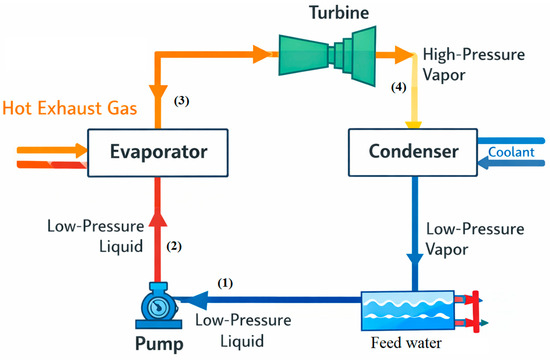
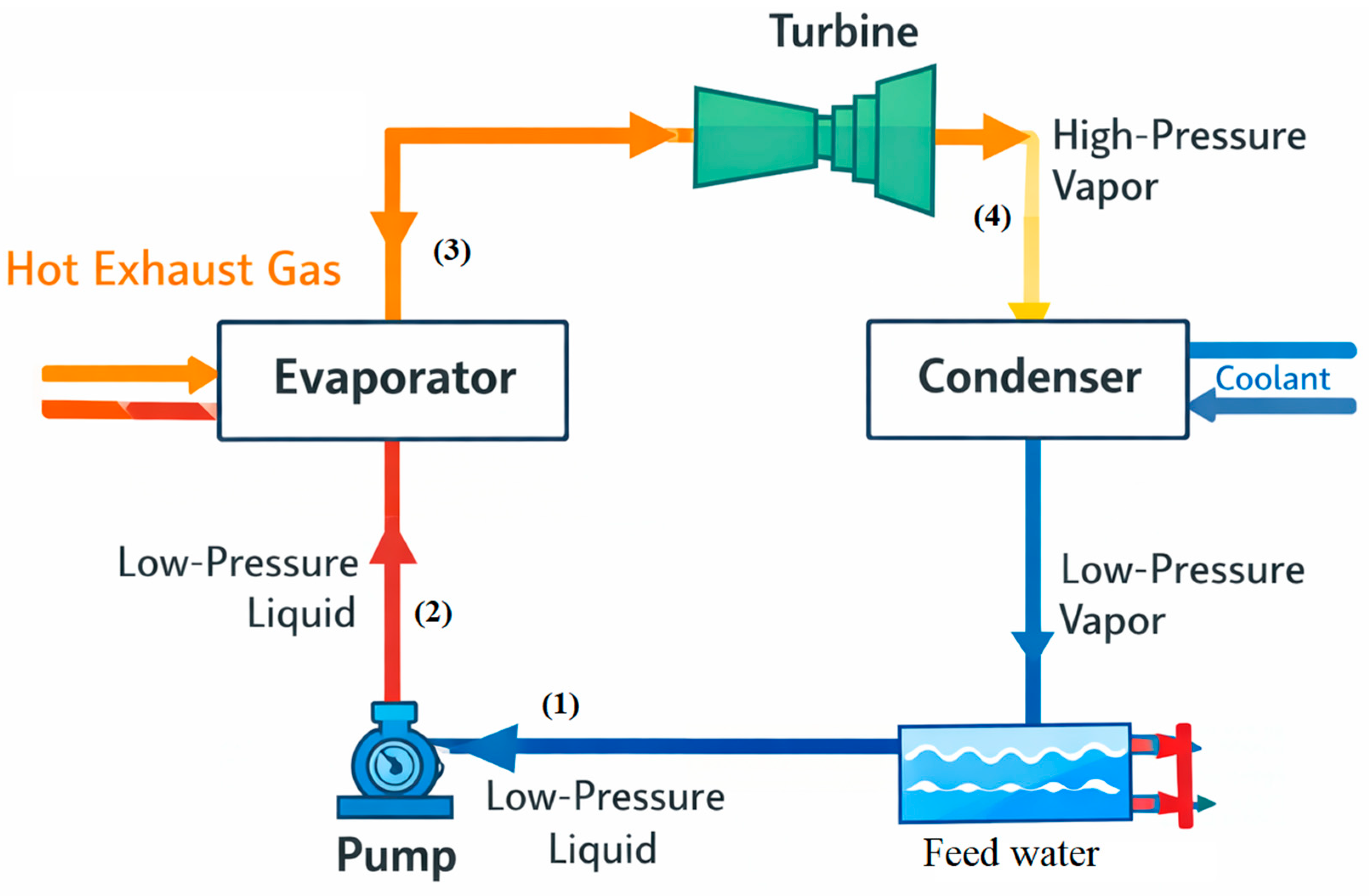
A steady-state subcritical Organic Rankine Cycle (ORC) recovering heat from a single-phase exhaust stream is considered as presented in Figure 1. The system consists of four primary components: pump, evaporator, turbine, and condenser. The working fluid undergoes the following processes:
Figure 1.
Schematic diagram of the Organic Rankine Cycle (ORC) system.
1 → 2: Isentropic pumping (liquid compression)
2 → 3: Heat addition in evaporator (liquid → vapor + superheat)
3 → 4: Expansion in turbine
4 → 1: Heat rejection in condenser
The heat source is assumed to be a single-phase gas stream with approximately constant specific heat. The ambient temperature defines the thermodynamic reference (dead state) for exergy analysis. Table 1 and Table 2 present the main energy and exergy analysis, respectively, used in the current study. These formulations are widely adopted in the ORC literature and constitute the standard thermodynamic framework for evaluating component performance, system efficiency, and irreversibility in waste-heat-recovery applications.
Table 1.
Fundamental thermodynamic relations governing the Organic Rankine Cycle [34].
Table 2.
Exergy analysis formulations for the Organic Rankine Cycle [35].
The thermodynamic model was implemented under steady-state conditions. For each simulation, the heat-source conditions and ORC operating parameters were prescribed first, followed by determination of the working-fluid thermodynamic states. The working-fluid mass flow rate was calculated from the evaporator energy balance rather than independently prescribed. Thermodynamic properties at each state were evaluated using RefProp.
From the above thermodynamic and exergy relations, the net power can be expressed as shown in Equation (1). , and are the heat-source inlet and outlet temperatures, and the ambient temperature. and are the evaporator and condenser pressures. and are the turbine and pump isentropic efficiencies. The fluid properties () are the critical pressure, critical temperature and acentric factor. and denote the heat-source mass flow rate and specific heat capacity, respectively. Variables such as net power output, working-fluid mass flow rate, and turbine-inlet conditions are dependent quantities determined through the thermodynamic balances and therefore are not treated as independent variables in the dimensional analysis.
Complete boundary conditions, numerical settings, and the computational solution procedure are provided in Appendix A. In addition to satisfying the overall energy balance, the modeled operating points were assessed against the local minimum-temperature-approach and turbine-outlet feasibility criteria described therein.
2.2. Dimensional Analysis and Similarity Framework
As shown in Equation (1), the net power output of the cycle can be expressed as a multivariable functional dependence involving heat-source characteristics, operating pressures, component efficiencies, and working-fluid properties. For subcritical ORC systems operating with a single-phase sensible heat source, key fluid characteristics including the critical temperature , critical pressure and acentric factor ω can be included because the ORC operates with real fluids undergoing phase change, and the thermodynamic response of such fluids is governed by their distance from the critical point. Absolute evaporator and condenser pressures do not provide a transferable measure of operating severity across fluids, since the same pressure may represent a near-critical condition for one fluid and a moderate subcritical condition for another. Scaling pressures with the critical pressure therefore converts the cycle operating state into reduced coordinates, allowing meaningful comparison between different working fluids. Similarly, the critical temperature defines the thermal scale of the saturation dome and influences latent heat, vapor density, and expansion behavior. Including critical properties is therefore necessary to capture fluid-dependent phase-change behavior while enabling cross-fluid similarity through reduced thermodynamic variables.
2.2.1. Exergy-Based Power Scale
Instead of normalizing by heat input, this study adopts the heat-source exergy rate as the characteristic power scale as shown in Equation (2). This normalization accounts for heat-source temperature level, removes dependence on exhaust mass flow rate, and provides thermodynamic consistency across different heat sources.
2.2.2. Reduced Thermodynamic Coordinates
To remove fluid dependence in pressure variables, evaporator and condenser pressures are normalized using critical properties, as shown in Equation (3) and Equation (4), respectively.
This choice is motivated by the principle of corresponding states, whereby thermodynamic similarity between fluids improves when expressed in reduced coordinates. Similarly, temperature scaling is performed using the ambient temperature as shown in Equations (5) and (6), respectively.
Alternatively, the heat-source utilization factor represents the fraction of recoverable temperature potential utilized as presented in Equation (7).
2.3. Application of Buckingham Π Theorem
The functional dependence of net power can be written as shown in Equation (8). Selecting as repeating variables provides a dimensionally independent basis spanning the four fundamental dimensions [M], [L], [T], and [Θ]. The complete problem contains n = 13 variables, and the dimensional matrix has rank . Therefore, the Buckingham Π theorem [36] yields independent dimensionless groups. Following systematic dimensional reduction, the resulting independent Π groups are expressed in the following equations.
The complete variable set contains 13 variables and involves four fundamental dimensions: mass, length, time, and temperature. Accordingly, the Buckingham Π theorem yields nine independent dimensionless groups. The dimensional basis of the governing variables is summarized in Table 3. (M), (L), (T), and (Θ) denote the fundamental dimensions of mass, length, time, and temperature, respectively. The present formulation intentionally represents a baseline thermodynamic similarity problem; pinch-point temperature difference and superheat are prescribed through the cycle boundary conditions, while pressure drops and external heat losses are neglected under the steady-state assumptions. These quantities may be introduced as additional dimensionless parameters in a higher-fidelity extension of the framework but are not independently varied in the present analysis. It is worth noting that the dimensional matrix has rank , which is equal to the number of fundamental dimensions. Hence, the null-space dimension is , confirming the existence of nine independent dimensionless groups. In addition, it is worth mentioning that represents the reduced critical-temperature scale of the working fluid and is retained explicitly to account for differences in the thermal position of the saturation envelope relative to the dead-state temperature.
Table 3.
Dimensional matrix of the variables used in the Buckingham Π analysis.
For each non-repeating variable , a dimensionless product was constructed using the selected repeating variables and . Equating the exponents of the fundamental dimensions to zero yields the exponent solutions and the corresponding nine independent Π groups summarized in Table 4.
Table 4.
Exponent solutions and resulting dimensionless groups obtained using the selected repeating variables.
The nine groups above constitute one direct basis obtained from the Buckingham Π theorem. For thermodynamic interpretation, two of these groups are subsequently reparameterized without changing the dimensionality of the problem. First, the raw dimensionless power group is replaced by the exergy-recovery factor, . Second, the outlet-temperature group is combined with the inlet-temperature group to form the heat-source utilization factor, . These are physically motivated transformations of the original Π basis rather than additional independent Buckingham groups.
The relationship between the directly derived Buckingham groups and the reparameterized thermodynamic groups can be established analytically. Using the heat-source exergy definition given in Equation (2), the normalized heat-source exergy can be expressed as shown in Equation (17). Accordingly, the exergy-normalized power parameter is related to the original dimensionless power group through Equation (18). Similarly, the heat-source utilization factor can be written directly in terms of the original temperature groups as shown in Equation (19).
2.4. Similarity Statement
Using the derived Π groups, the ORC performance can be expressed in reduced form as shown in Equation (20). This represents the universal dimensionless ORC performance map. The equation exhibits three fundamental characteristics that strengthen its generality and applicability. First, it is scale-independent, meaning that any proportional change in the heat-source mass flow rate cancels out in the dimensionless power term . As a result, system performance can be evaluated independently of absolute heat-source size, making the framework universally applicable across engine scales and waste-heat levels. Second, it demonstrates partial fluid independence. By scaling pressure with critical pressure and retaining the reduced critical-temperature group , the formulation captures both the mechanical and thermal locations of the working fluid relative to its critical state, thereby reducing fluid-specific dispersion in the similarity representation. This significantly reduces fluid-specific dispersion and enables unified performance mapping across different working fluids. Third, the formulation maintains thermodynamic consistency, since exergy-based normalization ensures that comparisons remain valid across heat sources operating at different temperature levels. By referencing the maximum useful work potential rather than raw thermal input, the framework preserves physical meaning while enabling fair, cross-condition performance evaluation.
The above relation defines a multidimensional similarity space rather than a single invariant two-dimensional performance surface. Accordingly, any two-dimensional map obtained by varying selected Π groups while holding the remaining groups constant represents a conditional projection of this multidimensional space. In this context, the generalized character of the framework refers to the common dimensionless formulation through which different ORC operating conditions, system scales, and working fluids can be represented and compared, rather than implying that the numerical location of the optimum is strictly invariant with respect to every governing Π group.
2.5. Reduced-Pressure Optimality Condition
The optimal evaporator pressure in dimensional space is traditionally determined via parametric sweeps. In dimensionless form, optimality is defined by Equation (21). The existence of a stationary ridge in reduced-pressure space results in Equation (22), for a wide range of and fluids.
According to the principle of corresponding states, the thermodynamic behavior of different working fluids can be compared using reduced properties based on their critical pressure and critical temperature . When pressure and temperature are expressed relative to their critical values, working fluids with similar molecular characteristics tend to display comparable phase-envelope behavior. Accordingly, both reduced pressure and reduced critical temperature are retained explicitly in the complete similarity relation. Under these conditions, the turbine expansion process is influenced more by the reduced-pressure ratio than by the absolute operating pressure. As a result, the overall performance trends of the cycle are largely determined by dimensionless thermodynamic parameters rather than fluid-specific property values.
Residual deviations between fluids arise from second-order effects, including the acentric factor ω, which accounts for molecular complexity and deviation from simple spherical behavior, real-fluid compressibility effects captured by the equation of state, and the degree of proximity to the critical region where property gradients become highly nonlinear. Consequently, while fluid identity does introduce quantitative variations, these primarily affect secondary corrections. The principal topology of the dimensionless performance surface remains universal, reinforcing the robustness of the similarity-based ORC modeling framework.
To summarize, the dimensionless formulation transforms the ORC problem from Equation (23) to Equation (24). This transformation converts the conventional thermodynamic formulation into a similarity-based framework that is independent of system scale. Through exergy normalization and critical-property scaling, the effects of heat-source magnitude, plant size, and fluid-specific properties are substantially reduced. Consequently, diverse operating conditions and working fluids can be represented within a common dimensionless space, revealing underlying performance similarities. This unified representation forms the basis for universal performance maps that can be applied across a wide range of ORC configurations.
Additional details regarding the numerical implementation and thermodynamic feasibility assessment are provided in Appendix A. These include the complete computational boundary conditions, REFPROP implementation, numerical solution procedure, pressure-step resolution and convergence criteria, treatment of turbine-inlet superheat and turbine-outlet state, and the local minimum-temperature-approach criterion applied across the heat-addition process. Representative temperature–heat-duty profiles are also provided to demonstrate thermal feasibility of the modeled operating conditions.
2.6. Experimental Consistency Assessment in Reduced Coordinates
To examine the applicability of the proposed dimensionless representation under realistic ORC operating conditions, an experimental consistency assessment was performed using published measurements from an engine-integrated ORC system reported by Alshammari et al. [29]. The experimental system was coupled to a 200 kW class heavy-duty diesel engine and employed a radial-inflow turbine with NOVEC 649 as the ORC working fluid. The system achieved a maximum thermal efficiency of approximately 4.3%, a maximum electrical output of 6.3 kW at a turbine pressure ratio of 5.9, and a maximum measured turbine efficiency of approximately 35.2%.
For consistency with the theoretical formulation, the experimental measurements were transformed using the same dimensionless definitions adopted in the present framework. The measured high- and low-side ORC pressures were normalized by the critical pressure of NOVEC 649 to obtain the experimental reduced evaporator and condenser pressures, respectively. The experimental reduced evaporator pressure is presented in Equation (25) where is the experimentally measured ORC high-side pressure. Similarly, the experimental reduced condenser pressure is depicted in Equation (26). The experimentally measured low-side pressure is treated independently through and is not used to infer uncertainty in the measured high-side pressure. The experimental temperature ratio is obtained using Equations (27) and (28). These definitions ensure that the thermal level and heat-source utilization of each experimental operating point are represented using the same reduced coordinates as the numerical model. Then, experimental heat-source exergy, presented in Equation (29), is calculated directly from the reported heat-source mass flow rate and inlet and outlet temperatures rather than inferred from the ORC electrical output.
The experimental dimensionless quantities were calculated directly from the reported measurements. Because the high- and low-side pressures were measured independently, their uncertainties were treated separately in and , respectively. The low-side pressure was therefore not propagated into the uncertainty of the reduced high-side pressure. Similarly, uncertainty in was evaluated from the reported uncertainties associated with power output, heat-source mass flow rate, and heat-source inlet and outlet temperatures using standard uncertainty propagation. This treatment avoids the previous use of the turbine-outlet pressure range to estimate uncertainty in the reduced evaporator pressure and provides a physically consistent transformation of the experimental measurements.
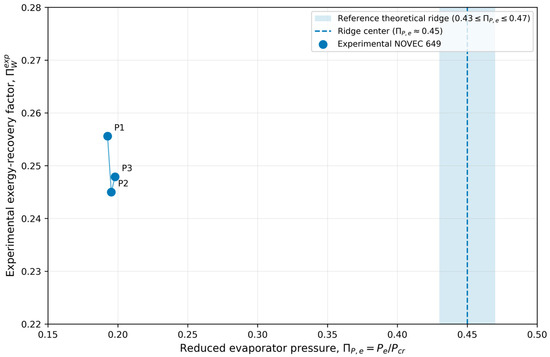
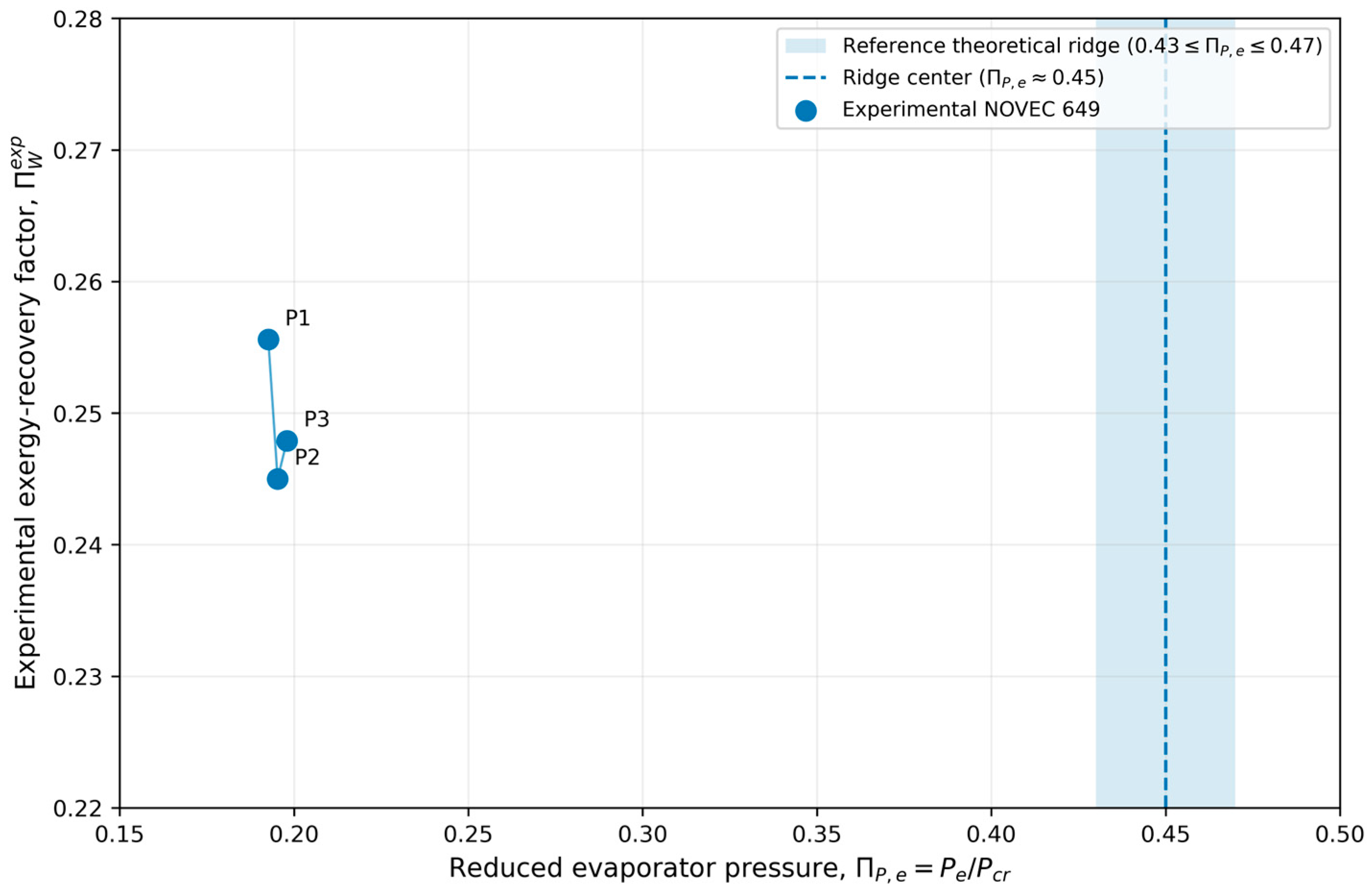
Figure 2 presents the experimentally derived exergy-recovery factor as a function of the measured reduced evaporator pressure and compares the experimental operating region with the reference reduced-pressure ridge identified by the theoretical framework. For NOVEC 649, the evaluated experimental points are located at approximately = 0.19–0.20, with corresponding experimental exergy-recovery factors of approximately = 0.245–0.256. By comparison, the theoretical analysis identifies the reference optimal reduced-pressure region as 0, centered near . In physical terms, the center of this reduced-pressure region corresponds to an evaporator pressure that equals to approximately 45% of the critical pressure of the working fluid.
Figure 2.
Experimental consistency assessment of the reduced-pressure similarity framework using NOVEC 649.
The experimental system therefore operated substantially below the reduced evaporator pressure associated with the theoretical ridge. The experimentally observed exergy-recovery factors should consequently not be interpreted as measurements of performance at the predicted optimum. Rather, the experimental data demonstrate that actual ORC measurements can be consistently transformed into the same reduced-pressure and exergy-normalized coordinates employed by the proposed framework. Accordingly, Figure 2 is interpreted as an experimental consistency assessment of the dimensionless representation, rather than as a pointwise quantitative validation of the theoretical optimum. A direct prediction-error assessment would require numerical model evaluations with exactly the same multidimensional experimental boundary conditions.
3. Case Study
To illustrate the practical applicability of the proposed similarity framework, three representative heavy-duty diesel-engine cases with nominal ratings of 100 kW, 500 kW, and 1 MW were considered. These cases span a broad range of practical applications, from small industrial engines to medium-scale commercial units and larger propulsion or power-generation systems. The corresponding exhaust mass flow rates, temperature levels, component efficiencies, and superheat conditions were prescribed as representative thermodynamic boundary conditions for the comparative analysis and are summarized in Table 5. Accordingly, the three cases should be interpreted as model scenarios selected to examine the behavior of the dimensionless formulation across substantially different heat-source capacities, rather than as direct reproductions of specific commercial engine datasets.
Table 5.
Representative boundary conditions adopted for the 100 kW, 500 kW, and 1 MW diesel-engine case studies.
The cross-scale comparison is intended to assess the internal consistency of the proposed normalization under the assumptions of the present steady-state lumped model. Because both net power output and available heat-source exergy scale approximately with heat-source mass flow rate, their normalization suppresses first-order dependence on system capacity. Therefore, the comparison does not constitute proof of complete physical scale independence. Scale-dependent effects associated with component geometry, Reynolds number, heat-transfer coefficients, pressure losses, heat leakage, and size-dependent turbomachinery performance are not represented explicitly in the present formulation and remain appropriate extensions for future component-level similarity studies.
R245fa was selected as the reference working fluid for the three case studies because of its extensive use in ORC waste-heat-recovery research and its suitability for subcritical operation over the temperature range considered. Its critical temperature and critical pressure are 427.16 K and 3.651 MPa, respectively, providing a convenient thermodynamic basis for reduced-property scaling. Its dry expansion behavior also reduces the likelihood of moisture formation during turbine expansion, while its molecular characteristics lead to moderate volumetric flow requirements and practical turbine dimensions.
By applying the same reduced-coordinate formulation to the three substantially different capacity cases, the analysis evaluates whether the principal ORC performance topology and the location of the reduced-pressure optimum are preserved when the absolute heat-source scale and thermal conditions are varied. The comparison therefore focuses on similarity of the normalized thermodynamic response, rather than exact coincidence of dimensional performance or complete elimination of physical scale effects.
4. Results and Discussions
4.1. Structure of the Universal Performance Surface
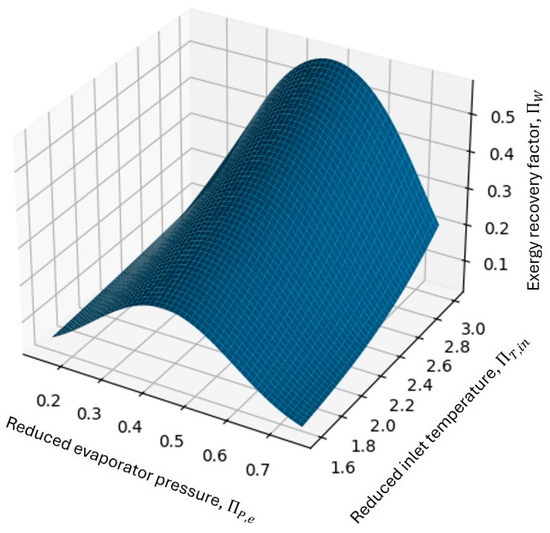
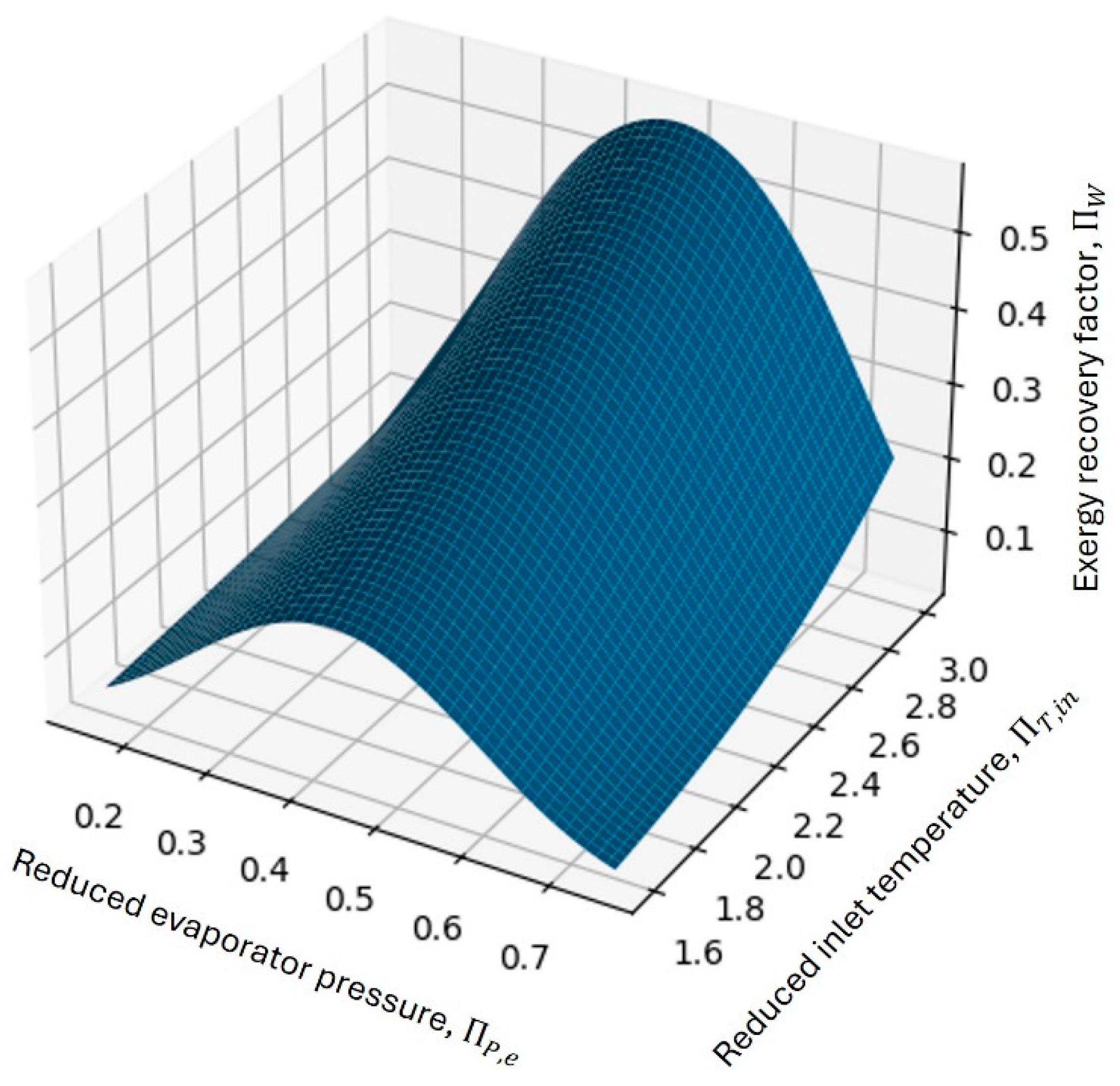
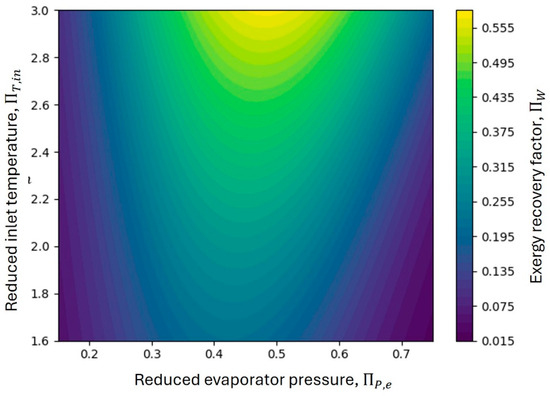
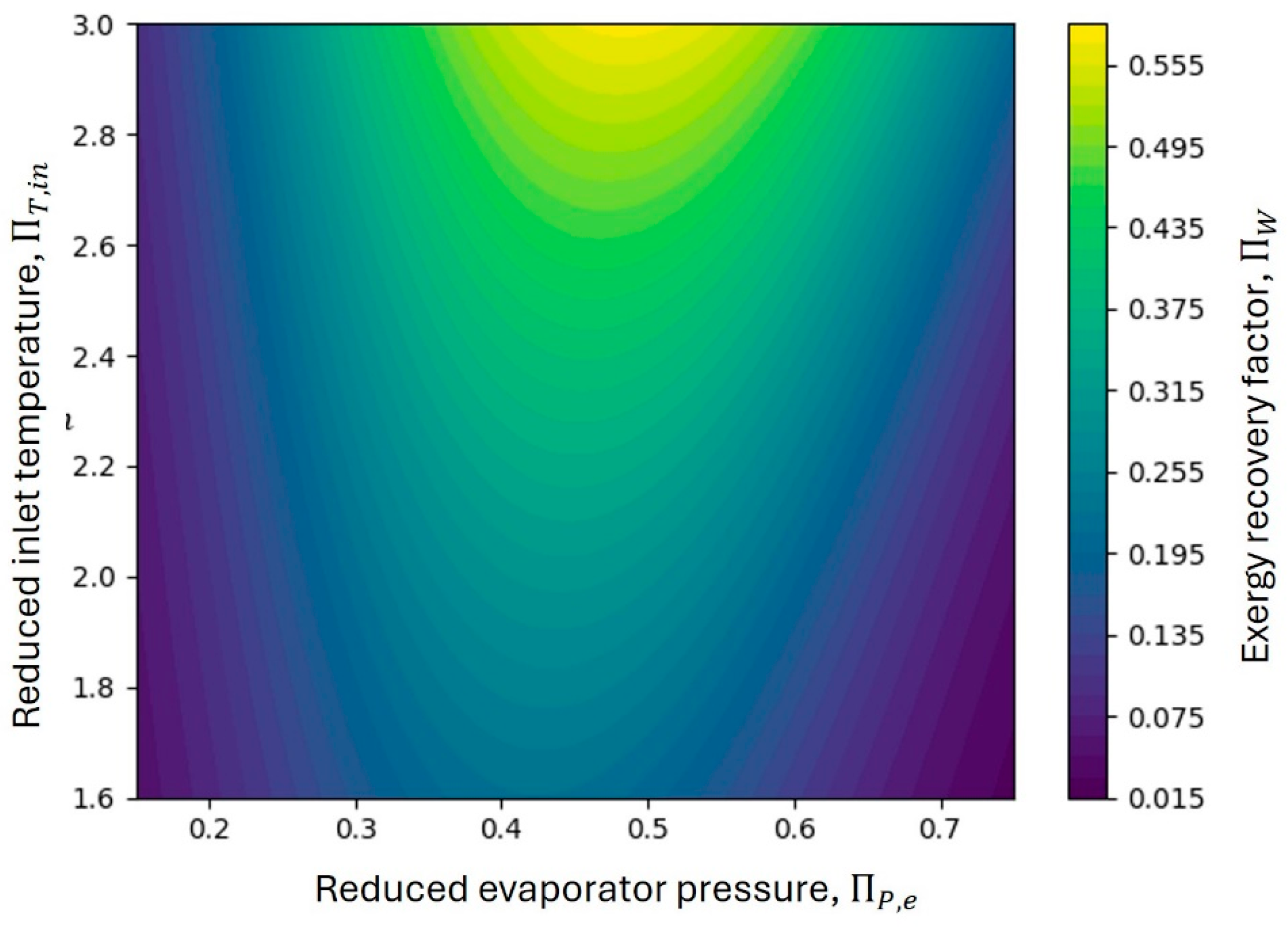
For engineering interpretation, Figure 3 and Figure 4 (which are generated using the computational procedure and thermodynamic feasibility criteria detailed in Appendix A) present a reference two-dimensional projection of the multidimensional similarity framework in three-dimensional surface and contour forms, respectively. The coordinates , , and are derived from the complete Buckingham Π basis established in Section 2.3. For Figure 3 and Figure 4, the reduced evaporator pressure and heat-source inlet-temperature ratio are varied, while the remaining similarity parameters are maintained at their reference values: , , , , , and . These values define the reference slice of the multidimensional similarity space used to generate the two performance maps.
Figure 3.
Reference dimensionless performance surface showing the variation in the exergy-recovery factor with reduced evaporator pressure and heat-source inlet-temperature ratio under the specified baseline conditions.
Figure 4.
Contour representation of the reference dimensionless performance surface, showing the reduced-pressure ridge as a function of reduced evaporator pressure and heat-source inlet-temperature ratio under the specified baseline condition.
Over the investigated heat-source temperature range, the peak exergy-recovery factor increases substantially with increasing , while the location of the optimal reduced evaporator pressure remains confined to a comparatively narrow region around . Despite this significant magnitude increase, the location of the optimal reduced pressure shifts only marginally (less than ±0.02), confirming that evaporator optimality is largely governed by critical-property scaling rather than absolute temperature. The contour density in Figure 4 confirms that performance gradients are steeper along the reduced-pressure direction than along the temperature direction. This structural invariance arises from competing thermodynamic mechanisms. At low reduced pressure, the mean working-fluid saturation temperature remains far below the heat-source temperature, producing large temperature differences and high evaporator irreversibility. As reduced pressure increases, the working-fluid saturation curve approaches the heat-source temperature profile, reducing entropy generation. However, further increases toward the critical region diminish turbine enthalpy drop and lower expansion work. The optimal ridge therefore represents the balance between heat-transfer irreversibility and expansion potential.
4.2. Effect of Heat-Source Utilization Factor
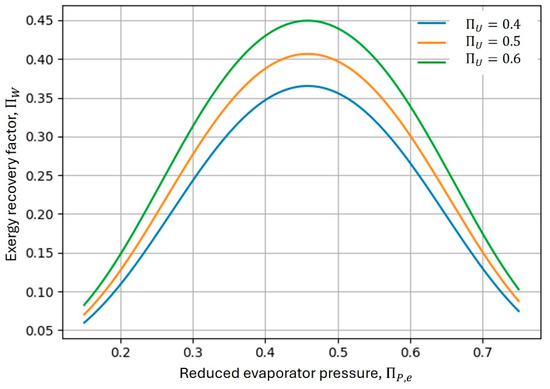
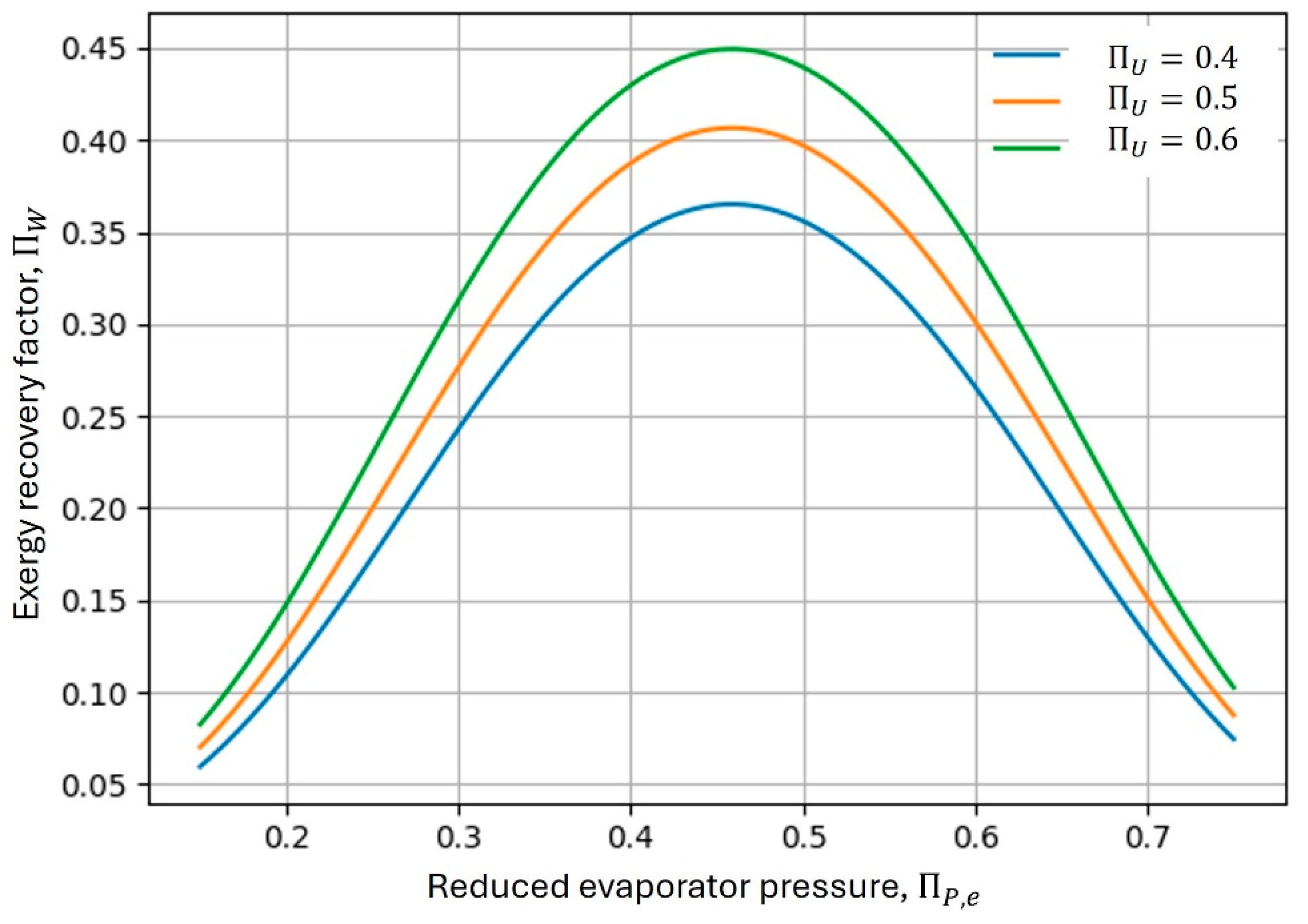
The effect of utilization factor is illustrated in Figure 5. Increasing from 0.40 to 0.60 raises the peak from approximately 0.36 to 0.45 at , corresponding to a 25% increase in second-law performance. However, the optimal reduced pressure remains centered near , indicating that, within the investigated range, utilization primarily affects performance magnitude while producing only limited displacement of the reduced-pressure optimum. This behavior reflects the redistribution of thermodynamic irreversibilities predicted by exergy theory and indicates that the optimum operating condition corresponds to a minimum in total exergy destruction. While increased heat extraction improves available energy recovery, the logarithmic decay of exergy content at lower exhaust temperatures limits marginal gains, producing diminishing returns at high .
Figure 5.
Influence of heat-source utilization factor on the exergy-recovery factor as a function of reduced evaporator pressure.
4.3. Turbine Efficiency Sensitivity
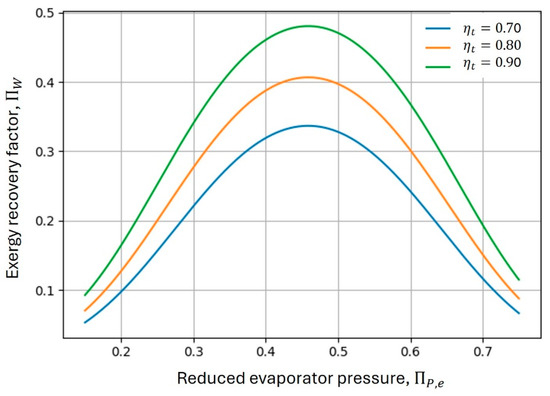
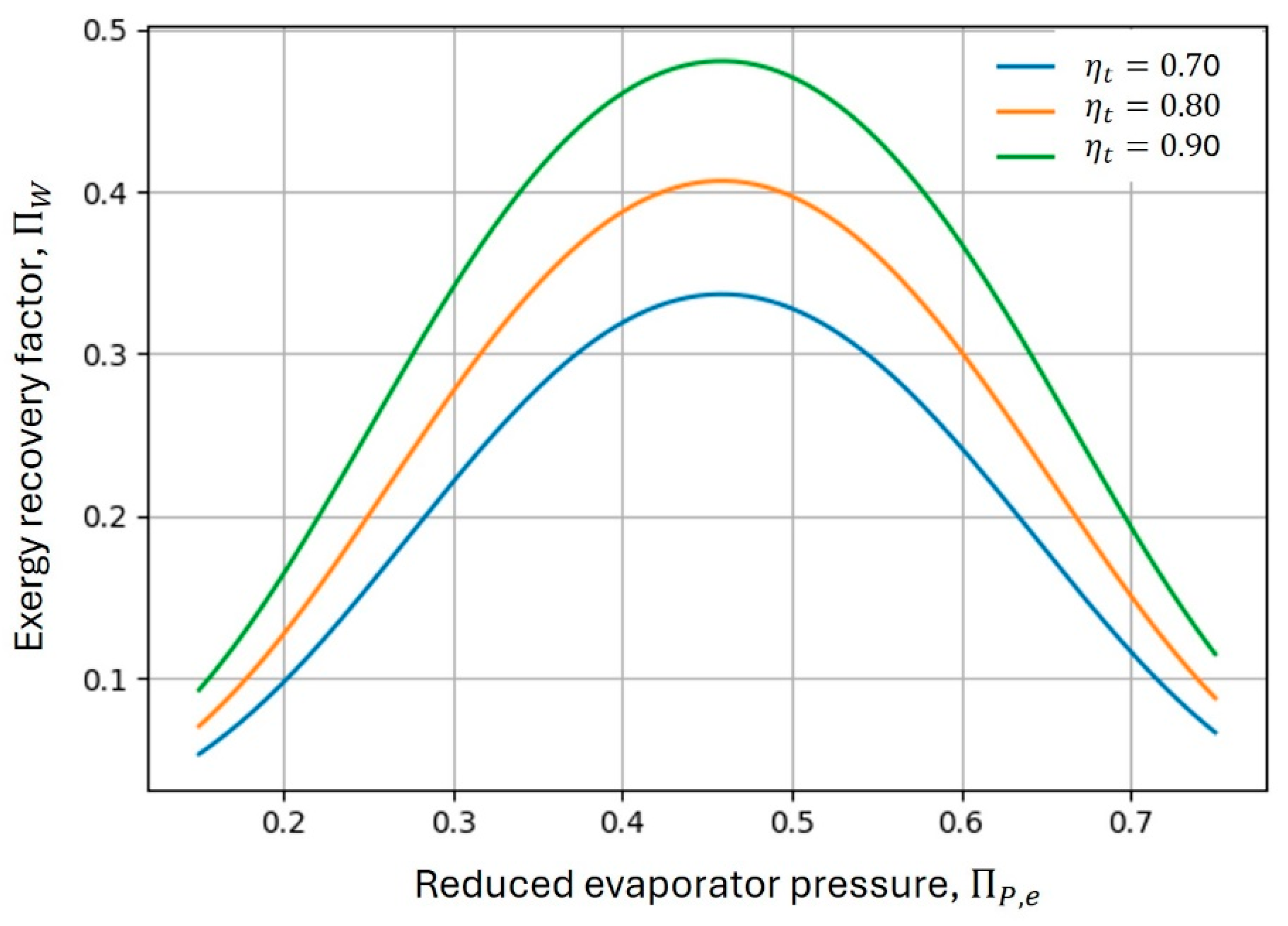
Figure 6 demonstrates the sensitivity of to turbine isentropic efficiency. At the optimal reduced pressure, increasing turbine efficiency from 0.70 to 0.90 increases by approximately 40%. The near-linear trend indicates that turbine irreversibility directly subtracts from recoverable expansion work without fundamentally altering the heat-transfer regime. However, away from the ridge region the sensitivity weakens because heat exchanger irreversibility becomes dominant. Thus, while turbine refinement enhances magnitude, optimal reduced-pressure selection remains structurally more influential. Therefore, the turbine-efficiency analysis provides an additional test of the ridge robustness by relaxing one of the fixed parameters used in the reference maps of Figure 3 and Figure 4.
Figure 6.
Effect of turbine isentropic efficiency on exergy-recovery factor across reduced evaporator pressure.
4.4. Cross-Fluid Similarity
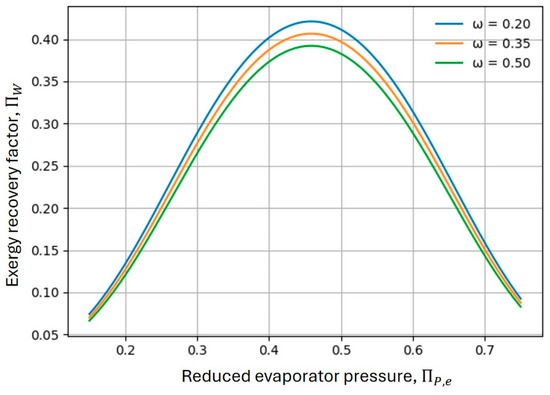
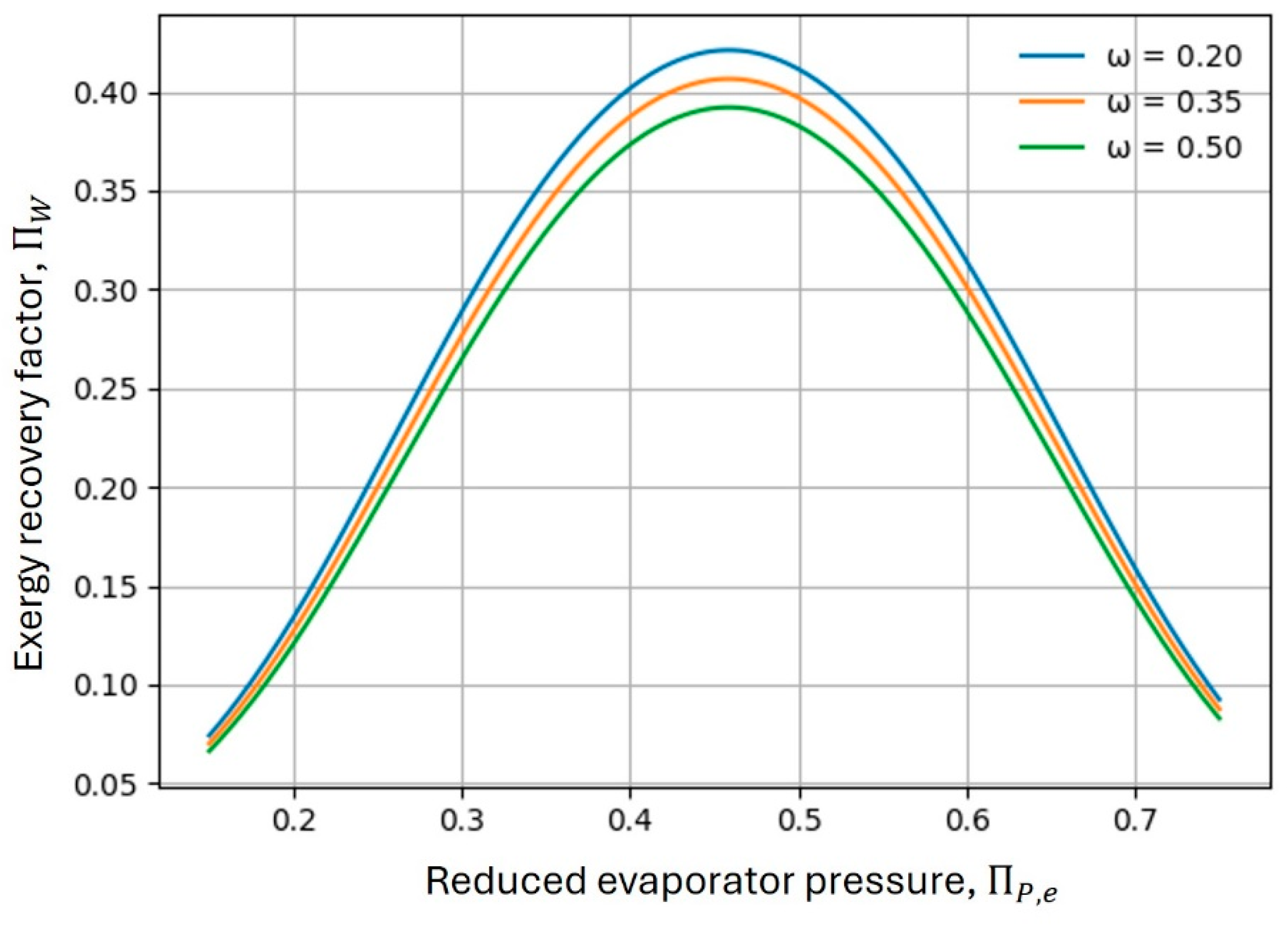
Figure 7 shows the performance curves for varying acentric factors, representing different organic fluids. Varying the acentric factor from produces only moderate changes in peak (from ~0.39 to ~0.42 at ) while the optimal reduced pressure remains within 0.43–0.47. In absolute pressure coordinates, this corresponds to distinct optimal pressures for each fluid due to differing critical pressures. The collapse in reduced space confirms that saturation scaling dominates performance topology, while real-fluid effects influence only second-order magnitude corrections. This behavior aligns with the principle of corresponding states, which predicts similarity in thermodynamic behavior when expressed in reduced variables. It is worth mentioning that the limited displacement observed with variation in ω further indicates that the reduced-pressure ridge is not solely a consequence of the acentric factor adopted in the reference surface.
Figure 7.
Cross-fluid similarity under critical-property scaling, illustrated through variation in acentric factor.
Taken together, Figure 3, Figure 4, Figure 5, Figure 6 and Figure 7 demonstrate that the reduced-pressure ridge is not restricted to a single combination of similarity parameters. Variations in heat-source utilization, turbine efficiency, and fluid acentric factor modify the magnitude of the exergy-recovery factor but produce comparatively limited displacement of the optimal reduced-pressure region. In particular, the cross-fluid analysis places the optimum within 0.43–0.47, while the utilization-factor analysis retains the optimum close to 0.45. These results indicate that ΠP,e ≈ 0.45 should be interpreted as the center of a robust reduced-pressure optimal region within the investigated domain rather than as an exactly invariant mathematical constant.
A fully factorial assessment of ridge width involving simultaneous variation in all governing Π groups would substantially expand the present parameter space; therefore, it is reserved for future work; the present study establishes robustness over the principal thermodynamic, component, and fluid-property variations explicitly investigated.
4.5. Internal Consistency of Dimensionless Scaling Across System Capacities
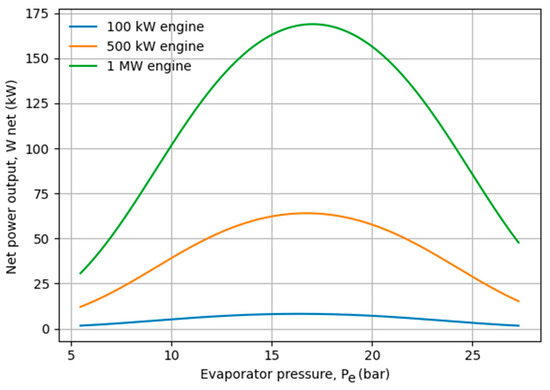
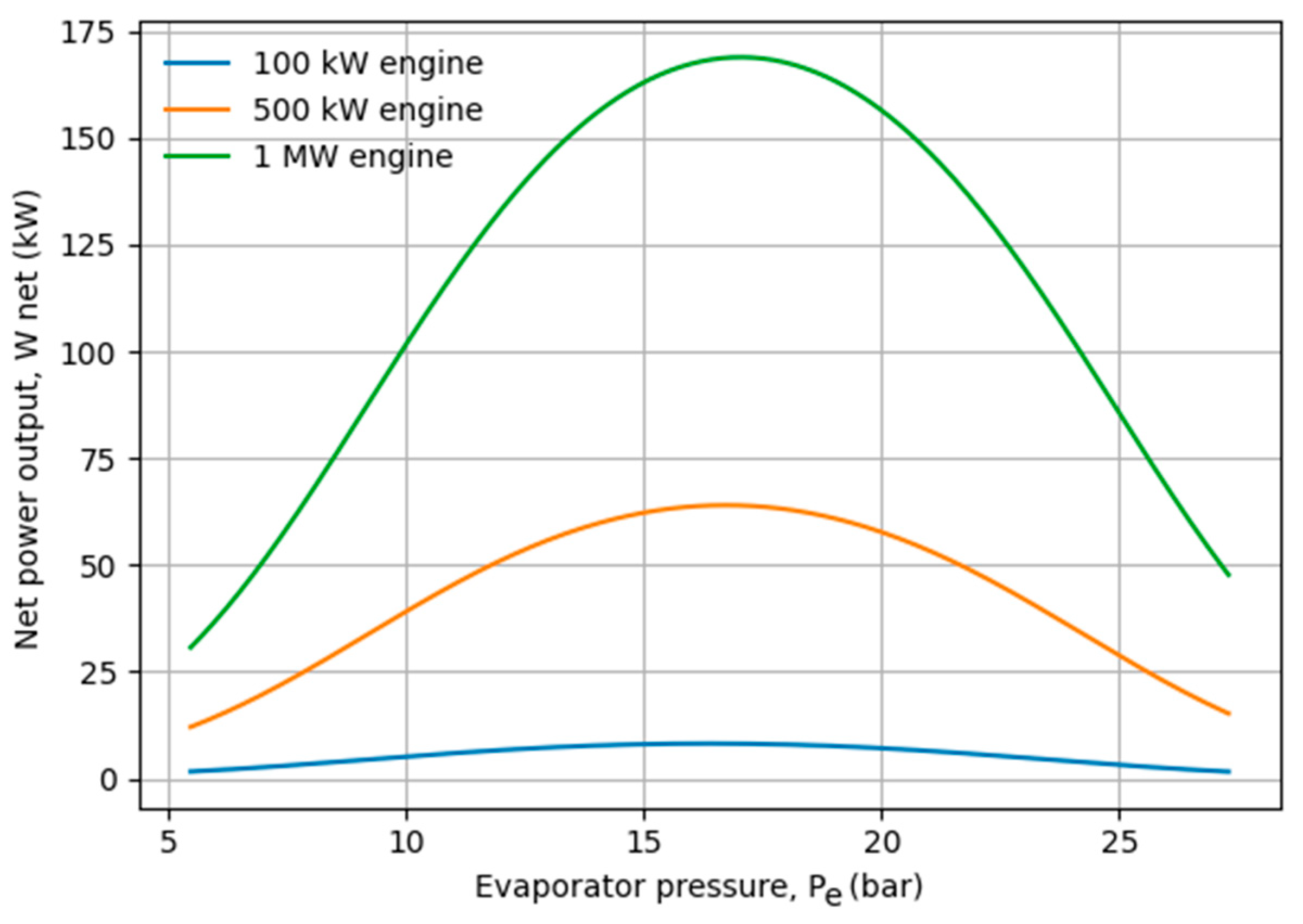
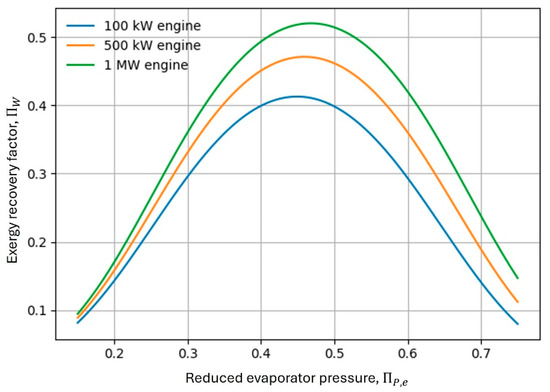
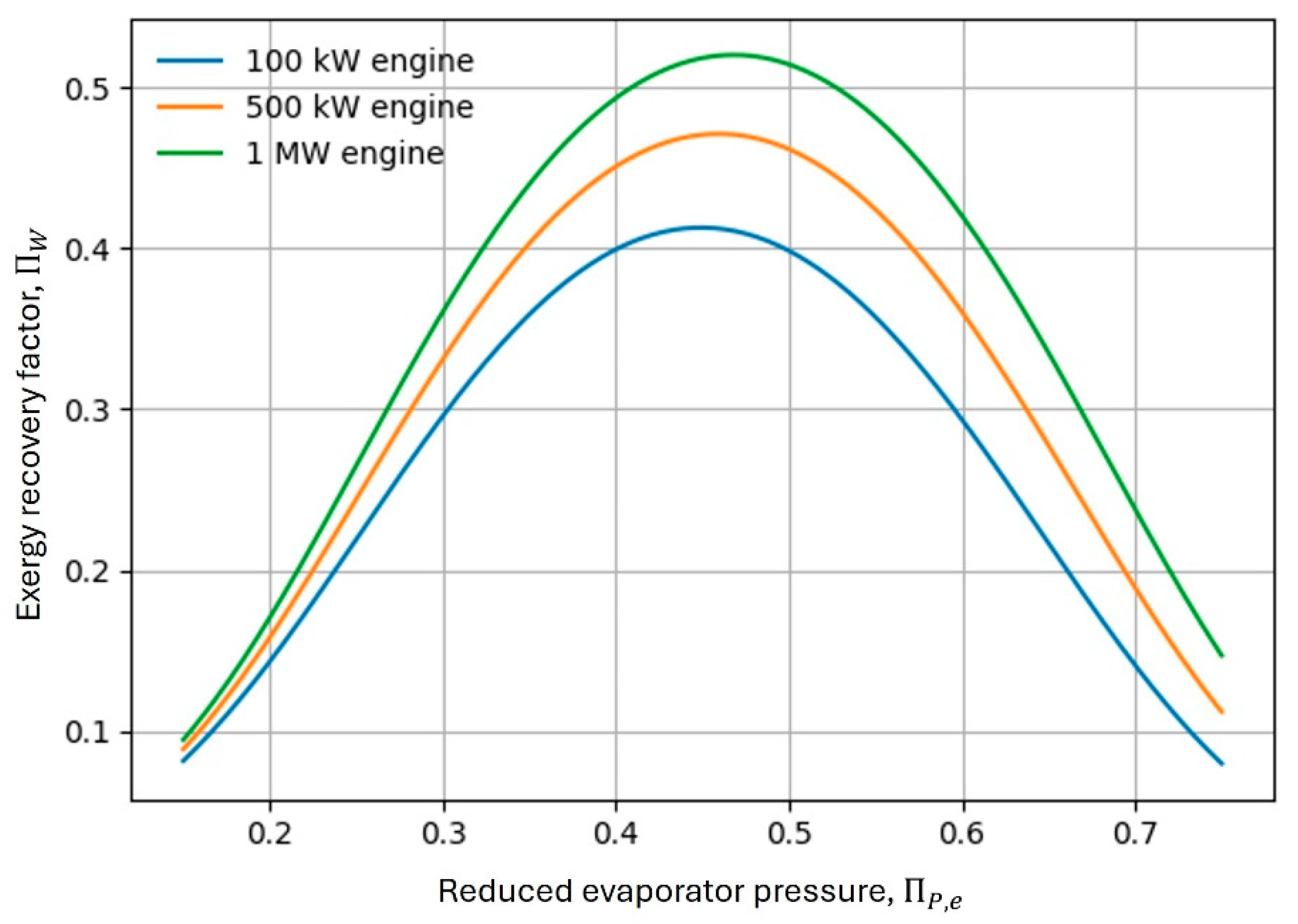
Figure 8 and Figure 9 compare conventional and dimensionless representations for the 100 kW, 500 kW, and 1 MW engine cases. In dimensional coordinates (Figure 8), peak net power increases from approximately 9 kW for the 100 kW engine to approximately 170 kW for the 1 MW engine, and optimal absolute pressure appears engine-specific. Figure 9 shows that the three capacity cases retain a similar reduced-pressure dependence and closely located peak regions despite their substantially different dimensional capacities. However, the normalized curves do not collapse exactly onto a single trajectory, particularly in their magnitudes. The remaining dispersion reflects differences in the prescribed thermal and component boundary conditions among the three cases. The comparison therefore demonstrates internal consistency of the dimensionless normalization and preservation of the reduced-pressure structure across the investigated capacities, rather than proving physical scale independence of ORC systems.
Figure 8.
Conventional dimensional analysis of ORC performance showing net power versus absolute evaporator pressure for three engine scales (100 kW, 500 kW, and 1 MW).
Figure 9.
Comparison of dimensionless ORC performance across the three investigated system capacities, illustrating preservation of the reduced-pressure performance structure and residual dispersion under non-identical operating conditions.
The comparison across the three nominal system capacities is intended as an internal consistency assessment of the proposed normalization rather than as experimental validation of physical scale independence. Under the present steady-state lumped formulation, both net power output and available heat-source exergy scale approximately linearly with heat-source mass flow rate; consequently, their ratio is expected to exhibit limited direct dependence on capacity when component-level scale effects are excluded. The purpose of the comparison is therefore to determine whether systems with substantially different dimensional power levels are represented consistently in the proposed reduced coordinates. Reynolds-number effects, size-dependent turbomachinery efficiency, geometry-dependent heat-transfer coefficients, pressure losses, and external heat leakage are outside the present model and no claim of invariance with respect to these effects is made.
The three cases should also not be interpreted as strictly dynamically similar systems because their heat-source temperatures, component efficiencies, and superheat conditions differ. These differences intentionally preserve representative operating conditions for each application but contribute to the residual separation between the normalized performance curves. Accordingly, similarity is assessed in terms of the reduction, rather than complete elimination, in capacity-dependent dispersion.
To quantify the degree of normalization, the dispersion among the three dimensionless performance curves was evaluated over their common reduced-pressure domain. The resulting mean absolute percentage dispersion (MAPD) was approximately 9.6%, while the maximum pointwise dispersion was approximately 28.9%. The maximum deviation occurs near the boundary of the investigated pressure range, where the exergy-recovery factor becomes comparatively small and percentage-based deviations are consequently amplified. Despite the residual magnitude dispersion, the three cases exhibit closely aligned reduced-pressure peak locations, indicating preservation of the underlying performance topology rather than complete numerical collapse.
4.6. Performance Metrics
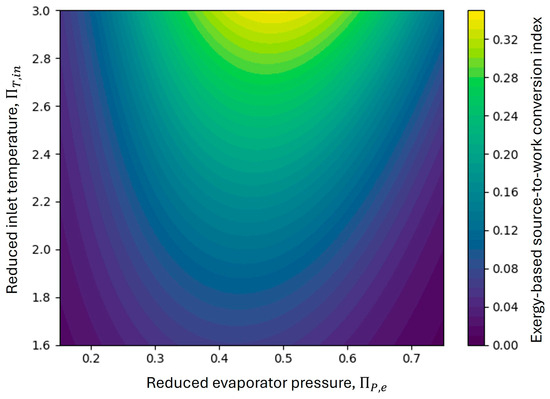
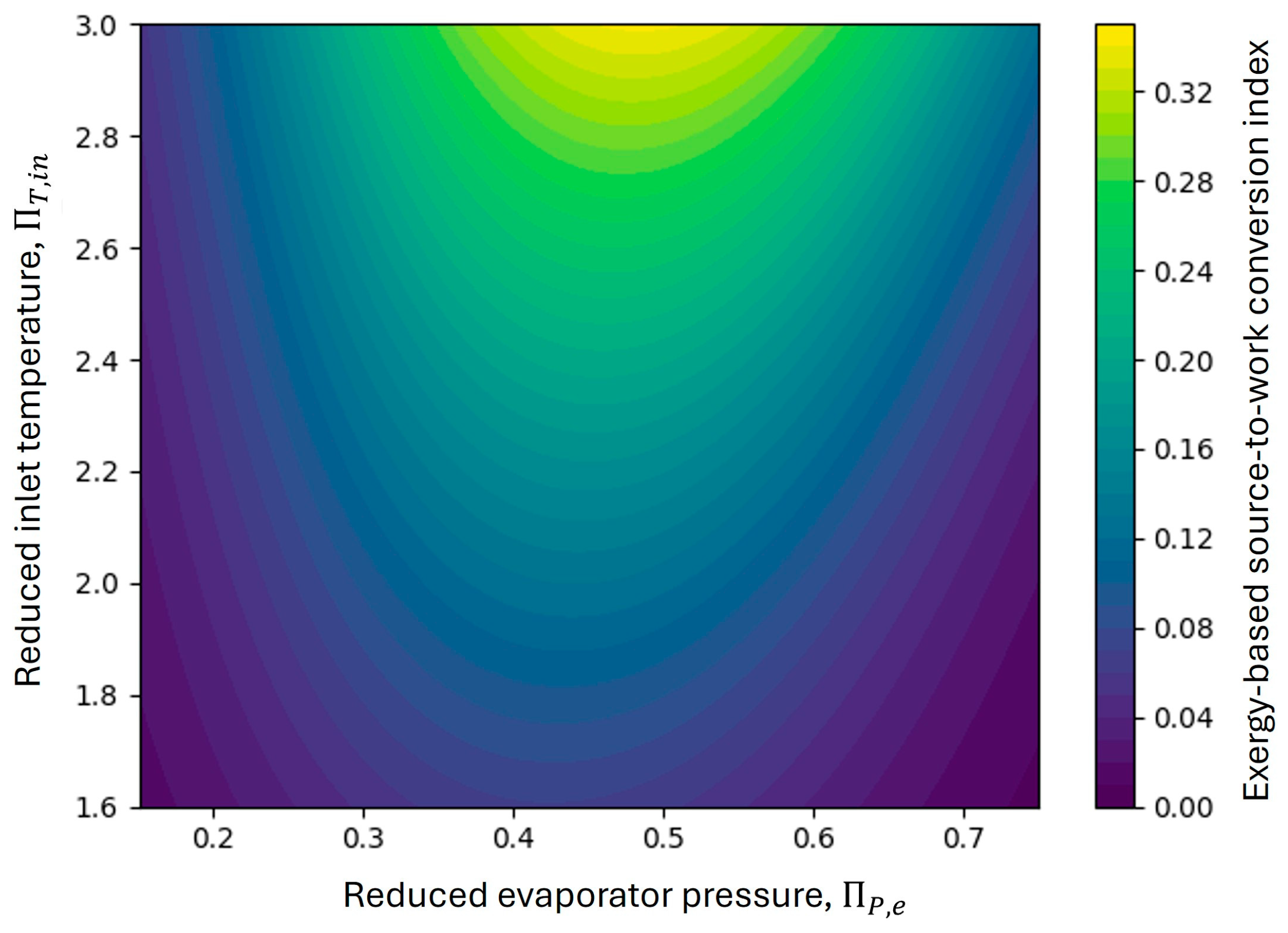
To complement the exergy-recovery analysis, an exergy-based source-to-work conversion index, , was introduced to represent the combined effect of heat-source quality and normalized work recovery. It is defined as . This quantity is a dimensionless similarity indicator and should not be interpreted as the conventional first-law ORC thermal efficiency, which is calculated directly from working-fluid enthalpy differences. As shown in Figure 10, the map reveals a monotonic increase in with increasing heat-source temperature ratio. For example, at the optimal reduced pressure , increases from approximately 0.07 at to nearly 0.33 at , corresponding to more than a four-fold increase. This strong dependence arises because the Carnot factor embedded within the exergy-to-heat ratio increases with temperature ratio, enhancing the theoretical upper bound of conversion efficiency. Along the reduced-pressure axis, the surface exhibits a ridge consistent with the universal exergy recovery ridge. Deviations of ±0.10 in away from the ridge reduce by approximately 10–15%, confirming that optimal evaporator pressure selection is critical for maximizing both first- and second-law performances. The alignment between the efficiency ridge and the exergy ridge further validates the structural consistency of the similarity framework.
Figure 10.
Exergy-based source-to-work conversion index as a function of reduced evaporator pressure and heat-source temperature ratio.
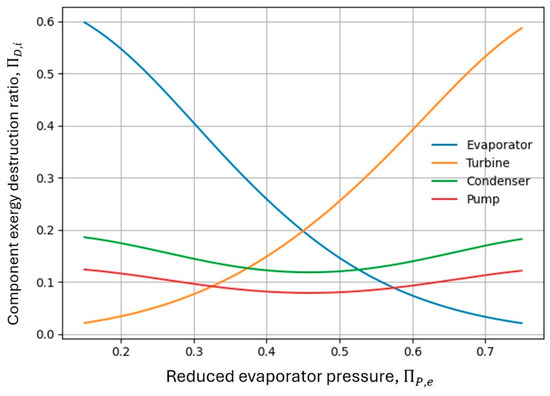
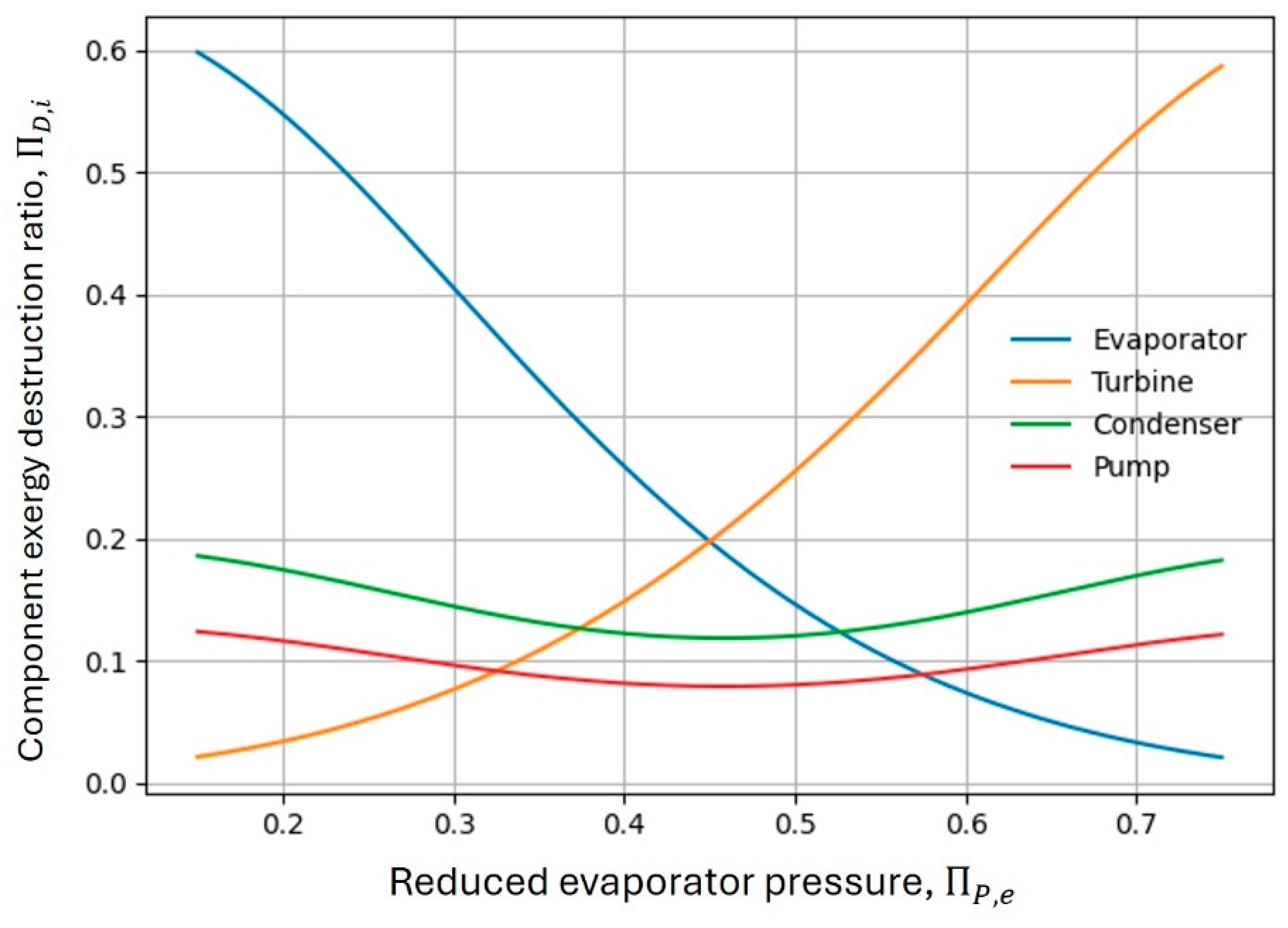
Figure 11 illustrates the distribution of normalized component exergy destruction as a function of reduced evaporator pressure at . At low reduced pressure (), evaporator irreversibility dominates, accounting for nearly 55% of total exergy destruction. This is caused by large temperature differences between exhaust gas and working fluid during phase change. As reduced pressure increases, evaporator irreversibility decreases rapidly, reaching approximately 5% at . Conversely, the normalized contribution of turbine irreversibility increases with reduced evaporator pressure, reaching nearly 60% at high reduced pressures. This trend should not be attributed to a reduction in turbine pressure ratio; under the fixed condenser-pressure condition, the pressure ratio increases with evaporator pressure. Rather, it reflects the changing thermodynamic state and relative redistribution of irreversibility among cycle components as the operating condition approaches the high reduced-pressure region. The condenser and pump contributions remain comparatively small (10–20%) across the entire range. The intersection of the component contributions near the intermediate reduced-pressure region indicates a redistribution of irreversibility but is not, by itself, a criterion for optimality. The total normalized exergy-destruction curve provides the appropriate thermodynamic criterion and exhibits its minimum in the vicinity of the reduced-pressure region where the exergy-recovery factor reaches its maximum. Physically, the optimal condition occurs where heat-transfer entropy generation and expansion losses are minimized simultaneously. Overall, under the reference conditions considered here, the reduced evaporator-pressure optimum near 0.45 arises from the balance between decreasing evaporator irreversibility and increasing relative turbine irreversibility, consistent with the minimum in total exergy destruction.
Figure 11.
Distribution of normalized component exergy destruction ratios as a function of reduced evaporator pressure at .
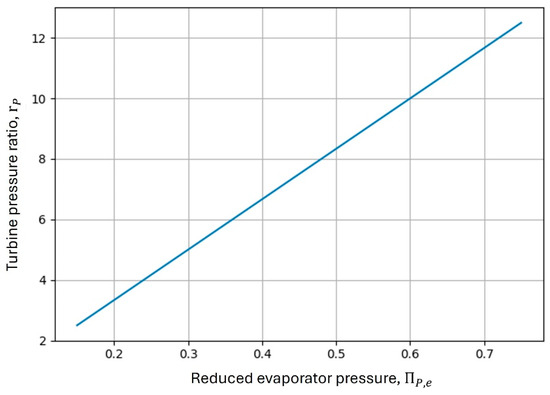
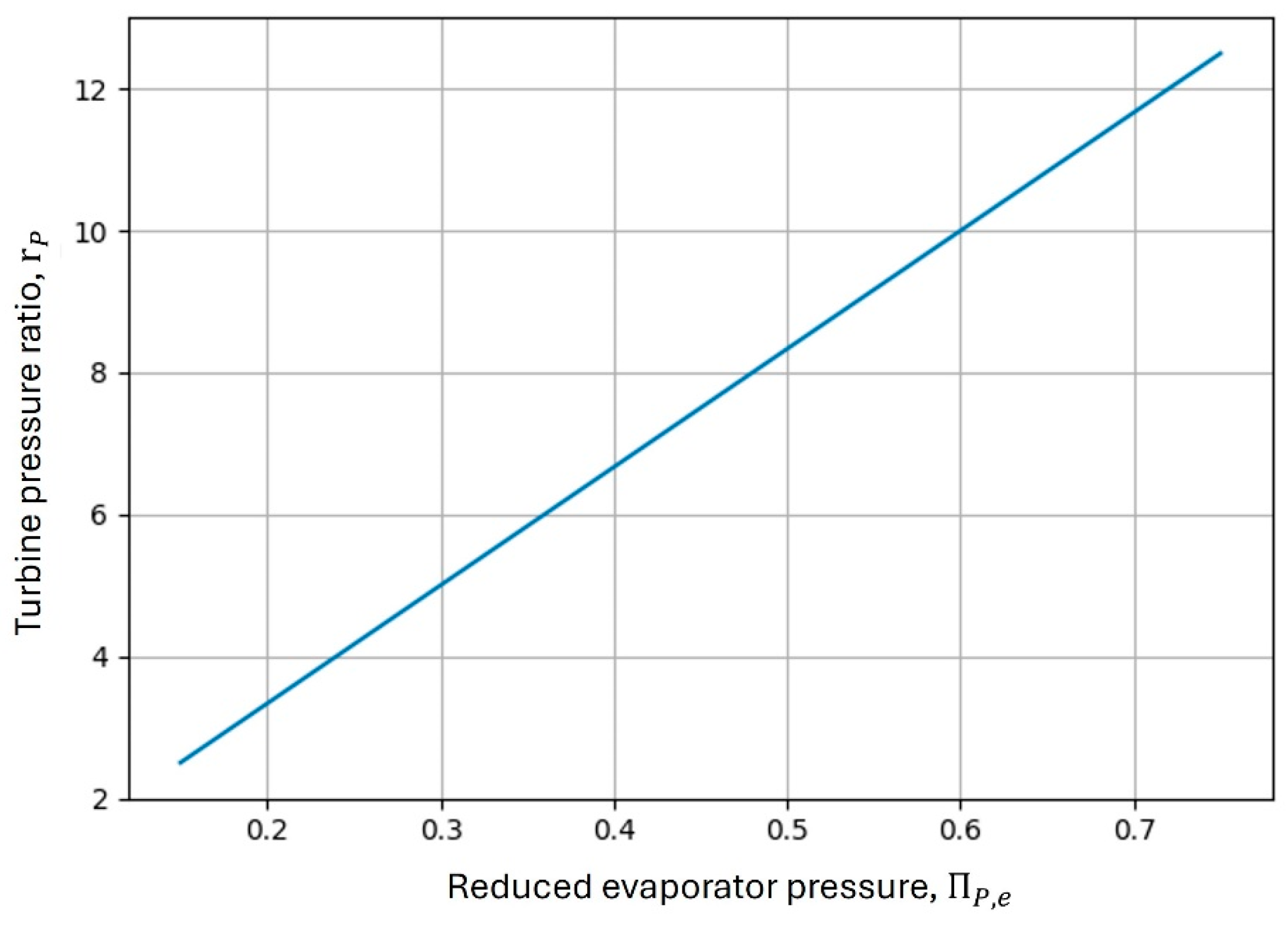
Figure 12 presents the direct relationship between reduced evaporator pressure and turbine pressure ratio , defined as . For the representative case , the turbine pressure ratio increases linearly from approximately 2.5 at to more than 12.5 at . At the reference optimum , the corresponding turbine pressure ratio is approximately 7.5. This linear proportionality confirms that turbine design constraints are directly linked to reduced evaporator pressure. Since the optimal reduced pressure is nearly invariant across engine scales, the corresponding turbine pressure ratio remains structurally constant for different system sizes. For the specified condenser-pressure condition, this provides a useful reference design relation: multi-scale ORC systems targeting diesel exhaust recovery should operate near , largely independent of engine rating.
Figure 12.
Relation between reduced evaporator pressure and turbine pressure ratio.
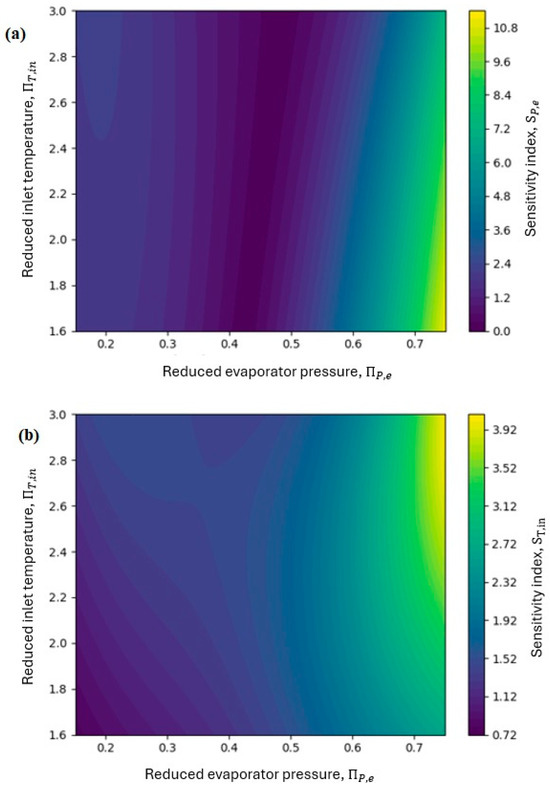
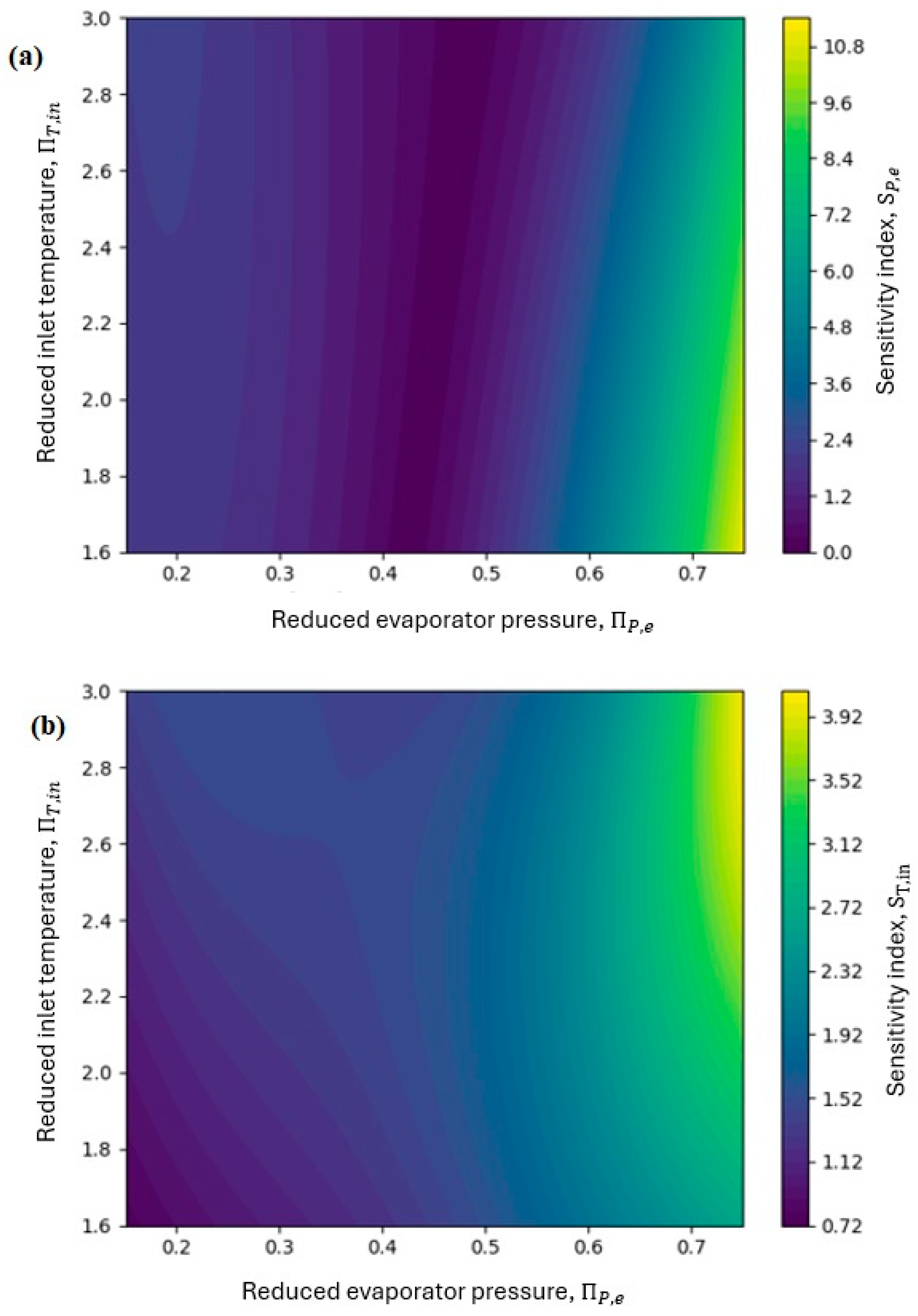
Sensitivity index quantifies how strongly ORC performance responds to changes in a given parameter. In other words, it measures the influence of each variable on the exergy-recovery factor. Figure 13a shows the sensitivity index . Sensitivity is lowest along the performance ridge and increases sharply near ridge boundaries. For example, at , deviations from the optimal increase sensitivity from approximately zero near the ridge to values exceeding 10 at high reduced pressures. This behavior reflects the steep curvature observed in the contour map. Near the ridge, the surface is locally flat in the reduced-pressure direction, indicating robustness to small perturbations. Away from the ridge, the steep gradients indicate that improper pressure selection can significantly degrade performance. Within the investigated parameter domain, reduced evaporator pressure exhibits the strongest local sensitivity and therefore represents a primary design variable. Figure 13b presents the sensitivity index with respect to heat-source temperature ratio, . Sensitivity increases with both temperature ratio and reduced pressure, reaching values near four at the upper-right corner of the map. However, sensitivity remains significantly lower than that associated with reduced evaporator pressure over most of the domain. This confirms that temperature ratio primarily scales performance magnitude rather than governing structural optimization.
Figure 13.
Sensitivity analysis of the dimensionless ORC performance surface: (a) normalized sensitivity of the exergy-recovery factor to reduced evaporator pressure, ; and (b) normalized sensitivity to the heat-source inlet-temperature ratio .
4.7. Cross-Fluid Validation Using R1233zd(E)
To further evaluate the robustness and transferability of the proposed similarity framework, a secondary validation was conducted using R1233zd(E) in addition to the reference fluid R245fa. The two fluids possess comparable but not identical critical properties, with critical pressures of approximately 36.4 bar and 35.7 bar, respectively. When the ORC performance was analyzed using conventional dimensional variables, small differences in the optimal evaporator pressure were observed. Based on the reduced-pressure ridge identified, the optimal evaporator pressure for R245fa was approximately 16.4 bar, whereas the corresponding value for R1233zd(E) was approximately 16.1 bar, representing a difference of about 1.8%. In a conventional ORC study, such differences would typically be interpreted as fluid-specific optimal operating conditions, requiring separate parametric optimization for each fluid. However, when the results were transformed into reduced coordinates, both fluids exhibited nearly identical performance behavior. The maximum exergy-recovery factor occurred within the same reduced-pressure interval, = 0.44–0.46, and the deviation in the ridge location remained below 2% across all investigated engine scales. Furthermore, the overall shape of the performance curves collapsed toward a common topology, indicating that the thermodynamic mechanisms governing optimal operation are controlled primarily by reduced pressure rather than absolute pressure. This behavior is consistent with the principle of corresponding states, whereby fluids operating at similar reduced conditions exhibit analogous thermodynamic characteristics despite differences in molecular structure. The results therefore demonstrate that the proposed dimensionless framework successfully captures the dominant physics of ORC operation while minimizing fluid-specific effects. Although the two fluids produce slightly different dimensional operating pressures and power outputs due to differences in critical properties and real-fluid behavior, the underlying optimal operating regime remains essentially unchanged. Consequently, the reduced-pressure ridge identified in this work can be considered a generalized design rule applicable across multiple working fluids, thereby extending the applicability of the framework beyond a single-fluid analysis and providing additional evidence that the proposed methodology represents a genuine thermodynamic similarity approach rather than a fluid-dependent optimization model.
4.8. Summary of the Results
The results presented in Section 4 demonstrate that Organic Rankine Cycle performance can be represented by a universal similarity surface governed primarily by reduced evaporator pressure and heat-source temperature ratio. The three-dimensional performance map (Figure 3 and Figure 4) revealed a distinct ridge structure centered at , which remained nearly invariant across temperature ratio, working fluid variation, and engine scale. This ridge corresponds to the thermodynamic balance between evaporator heat-transfer irreversibility and turbine expansion losses, as confirmed by the exergy destruction distribution (Figure 11). Parametric analysis showed that increasing heat-source temperature ratio enhances performance magnitude but does not significantly alter the optimal reduced-pressure location. Similarly, improvements in turbine efficiency increase achievable exergy recovery but preserve structural invariance (Figure 6). Cross-fluid comparison (Figure 7 and Section 4.7) demonstrated that when expressed in reduced coordinates, optimal operating conditions collapse into a narrow band despite differences in acentric factor and fluid properties. This confirms that first-order ORC structure is governed by critical-property scaling, while fluid identity introduces only second-order deviations.
The source-to-work conversion index shown in Figure 10 exhibits a ridge consistent with the exergy-recovery surface, indicating that the combined influence of heat-source quality and normalized work recovery preserves the same reduced-pressure topology. The turbine pressure ratio relation (Figure 12) further established that the reference optimum corresponds to a nearly constant pressure ratio (≈7–8 for the representative case), independent of engine rating. Sensitivity analysis (Figure 13a,b) identified reduced evaporator pressure as the dominant structural control variable, with sensitivity magnitudes substantially exceeding those associated with temperature ratio. The multi-scale engine validation (Figure 8) provided quantitative confirmation of scale separation. While dimensional net power varied by more than an order of magnitude across the 100 kW, 500 kW, and 1 MW cases, the dimensionless curves exhibited closely aligned reduced-pressure peak locations while retaining finite differences in magnitude (Figure 9). The calculated MAPD was approximately 9.6%, with a maximum pointwise dispersion of approximately 28.9%, confirming preservation of the reduced-pressure performance topology rather than complete numerical collapse. Percentage deviations in optimal reduced pressure were within ±2%, demonstrating strong invariance across scales.
Collectively, these findings establish that ORC thermodynamic behavior is governed by similarity variables rather than absolute dimensional parameters. The proposed dimensionless framework separates structural thermodynamic optimization from scale-dependent magnitude, enabling universal performance mapping, rapid preliminary design, and cross-scale comparison without repetitive parametric reanalysis.
5. Conclusions
This study developed a dimensionless similarity framework for Organic Rankine Cycle systems using Buckingham Π analysis, exergy normalization, and reduced thermodynamic coordinates. The framework enables ORC performance to be represented within a common reduced space across different operating conditions, system capacities, and working fluids.
Increasing the heat-source temperature ratio substantially improved the exergy-recovery performance, with the source-to-work conversion index rising from approximately 7% to 33%, while the reduced-pressure optimum remained concentrated near . Exergy-destruction analysis showed a transition from evaporator-dominated irreversibility at low reduced pressure to turbine-dominated irreversibility at high reduced pressure, with the reference optimum corresponding to a balance between these competing losses. The associated turbine pressure ratio varied from approximately 2.5 to 12.5, with the optimum occurring near 7–8.
The multi-capacity analysis demonstrated preservation of the reduced-pressure performance topology across the investigated cases, although finite dispersion remained because of differences in thermal and component boundary conditions. Accordingly, the identified optimum should be interpreted as a generalized preliminary-design region rather than an exact universal operating condition.
The present framework is limited by the assumptions of the steady-state lumped model. Future work should incorporate scale-dependent heat-transfer effects, Reynolds-number influences, pressure losses, heat leakage, off-design component behavior, and additional dimensionless groups describing pinch-point, superheat, pressure-loss, and heat-exchanger-conductance effects. Overall, the proposed methodology provides a practical basis for generalized ORC similarity analysis, performance mapping, and preliminary thermodynamic design.
Author Contributions
Conceptualization, S.A., N.A. and F.A.; methodology, S.A., N.A. and F.A.; software, S.A., N.A. and F.A.; validation, S.A., N.A. and F.A.; formal analysis, S.A., N.A. and F.A.; investigation, S.A., N.A. and F.A.; resources, S.A., N.A. and F.A.; data curation, S.A., N.A. and F.A.; writing—original draft preparation, S.A.; writing—review and editing, N.A. and F.A.; visualization, S.A., N.A. and F.A.; supervision, F.A.; project administration, F.A.; funding acquisition, F.A. All authors have read and agreed to the published version of the manuscript.
Funding
This research has been funded by the Scientific Research Deanship at the University of Ha’il, Saudi Arabia, through project number [RG-25 037].
Institutional Review Board Statement
Not applicable.
Informed Consent Statement
Not applicable.
Data Availability Statement
The original contributions presented in this study are included in the article. Further inquiries can be directed to the corresponding author.
Conflicts of Interest
The authors declare no conflicts of interest.
Abbreviations
The following abbreviations are used in this manuscript:
| Nomenclature | Dimensionless Groups | |||
| Symbol | Description | Unit | Symbol | Description |
| cp | Specific heat capacity | kJ/kg·K | ΠW | Exergy-recovery factor |
| Heat-source exergy rate | kW | ΠP,e | Reduced evaporator pressure | |
| h | Specific enthalpy | kJ/kg | ΠP,c | Reduced condenser pressure |
| Heat-source mass flow rate | kg/s | ΠT,in | Reduced heat-source inlet temperature | |
| Working-fluid mass flow rate | kg/s | ΠT,out | Reduced heat-source outlet temperature | |
| Pc | Condenser pressure | bar | ΠU | Heat-source utilization factor |
| Pcr | Critical pressure | bar | ΠT,cr | Reduced critical temperature |
| Pe | Evaporator pressure | bar | ||
| rp | Turbine pressure ratio | – | Subscripts | |
| Heat input rate | kW | Symbol | Description | |
| Heat rejection rate | kW | c | Condenser | |
| s | Specific entropy | kJ/kg·K | cr | Critical |
| T0 | Ambient temperature | K | e | Evaporator |
| Tcr | Critical temperature | K | ex | Exergy |
| Ths,in | Heat-source inlet temperature | K | hs | Heat source |
| Ths,out | Heat-source outlet temperature | K | in | Inlet |
| Net power output | kW | out | Outlet | |
| Pump power | kW | p | Pump | |
| Turbine power | kW | t | Turbine | |
| x | Vapor quality | – | wf | Working fluid |
| Greek Symbols | 0 | Dead state | ||
| Symbol | Description | Unit | ||
| ηex | Exergy efficiency | – | ||
| ηp | Pump isentropic efficiency | – | ||
| ηth | Thermal efficiency | – | ||
| ηt | Turbine efficiency | – | ||
| ω | Acentric factor | – | ||
Appendix A
Appendix A.1. Boundary Conditions and Numerical Settings
The dimensionless similarity framework was implemented using a steady-state thermodynamic model of the basic subcritical ORC comprising a pump, evaporator, turbine, and condenser. Thermophysical properties of the working fluid were evaluated using NIST REFPROP 10.0. For each operating point, the heat-source conditions, condenser condition, component efficiencies, and turbine-inlet superheat were prescribed, whereas the working-fluid mass flow rate was determined from the evaporator energy balance. Pressure losses through the heat exchangers and connecting lines and external heat losses were neglected in accordance with the baseline assumptions of the similarity model. The principal boundary conditions and numerical settings employed in generating the performance maps are summarized in Table A1.
Table A1.
Boundary conditions and numerical settings of the similarity model.
The heat exchangers were represented at the thermodynamic-cycle level rather than through detailed geometric or finite-UA component models. Accordingly, heat-exchanger effectiveness and conductance were not treated as independent design variables. Instead, thermal feasibility was imposed through the prescribed minimum-temperature-approach constraint. This treatment is consistent with the objective of the present work, which is to investigate first-order thermodynamic similarity rather than detailed heat-exchanger sizing. Pressure-drop, finite-conductance, and geometry-dependent transport effects can subsequently be incorporated as additional dimensionless parameters in higher-fidelity extensions of the framework.
Appendix A.2. Computational Procedure
For each operating point, the numerical calculation was performed according to the following sequence. First, the working fluid, heat-source conditions, condenser condition, turbine and pump efficiencies, minimum-temperature approach, and turbine-inlet superheat were specified. The reduced evaporator pressure was then prescribed and converted to dimensional pressure through:
The condenser pressure was similarly determined from:
The condenser outlet was taken as the pump-inlet state, and the pump-outlet state was determined from the prescribed pump isentropic efficiency. The turbine-inlet temperature was defined using the prescribed degree of superheat:
The corresponding enthalpy and entropy were evaluated from REFPROP at and . The working-fluid mass flow rate was subsequently calculated from the overall evaporator energy balance:
The resulting outlet state was then checked against the adopted turbine-outlet feasibility criterion specified in Table A1. Following determination of all thermodynamic states, turbine power, pump consumption, net power, thermal efficiency, exergy destruction, and the corresponding dimensionless performance quantities were calculated using the governing equations presented in the main manuscript. The complete calculation was repeated over the prescribed ranges of reduced evaporator pressure and heat-source temperature ratio. The reduced-pressure grid was discretized using At each grid point, thermophysical properties and energy balances were iteratively evaluated until the numerical convergence criterion of was satisfied.
Appendix A.3. Heat-Exchanger Thermal-Feasibility Assessment
Determination of from Equation (A4) guarantees satisfaction of the overall evaporator energy balance but does not by itself guarantee a physically admissible temperature profile within the heat exchanger. Therefore, thermal feasibility was additionally assessed from the local temperature difference between the heat-source stream and working fluid throughout the heat-addition process.
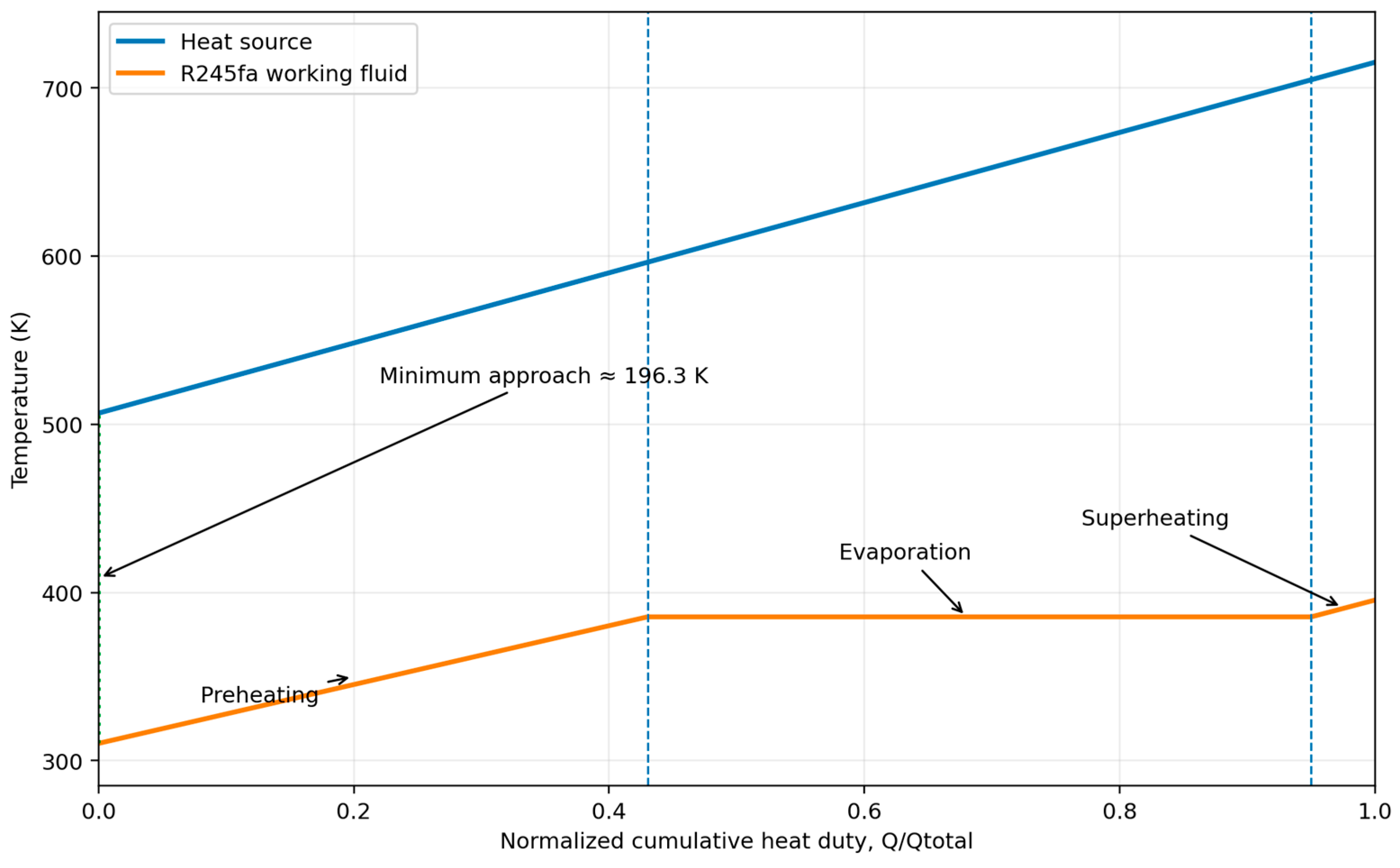
The heat-addition process was divided thermodynamically into preheating, evaporation, and superheating regions. The cumulative heat duty was used as the common coordinate for constructing the temperature profiles of both streams. At each location along the heat exchanger, the local temperature difference was evaluated as shown in Equation (A5). The minimum temperature difference was then determined from Equation (A6). An operating point was considered thermally feasible only when satisfying Equation (A7).
is the prescribed minimum allowable temperature approach. The criterion was applied over the complete heat-addition path rather than solely at the heat-source inlet or outlet. Consequently, satisfaction of the overall energy balance alone was not considered sufficient for accepting an operating point.
For the single-phase heat source with constant specific heat assumed in the present model, the heat-source temperature corresponding to cumulative transferred heat Q was evaluated from Equation (A8). The corresponding working-fluid temperature was obtained directly from its thermodynamic state at the local enthalpy.
Appendix A.4. Turbine-Inlet and -Outlet Feasibility
The turbine inlet was maintained in the superheated-vapor region by prescribing the degree of superheat in Equation (A3). This prevents the turbine inlet from approaching the two-phase region as evaporator pressure changes and provides a consistent definition of the expansion inlet state throughout the parametric analysis. Following expansion, the turbine-outlet state was determined from Equations (A5) and (A6) and checked using REFPROP. The admissibility requirement adopted in the calculations was [insert the actual turbine-outlet criterion], e.g., superheated/dry outlet or . Any operating point failing this requirement was considered unsuitable for the baseline ORC performance map. This additional state check is important because normalization by critical pressure does not itself guarantee an admissible expansion path. Both the reduced operating coordinates and the actual real-fluid state therefore contribute to determining whether a particular point belongs to the physically feasible domain.
Appendix A.5. Representative Temperature-Heat Profiles
Figure A1 presents a representative temperature–heat-duty diagram for an operating point located near the principal reduced-pressure ridge. The selected condition corresponds to approximately and , with the remaining dimensionless parameters maintained at their reference values. The temperature profiles illustrate the three characteristic heat-addition regions of the working fluid: liquid preheating, evaporation, and vapor superheating.
Figure A1.
Representative temperature–heat-duty (T − Q) profiles of the heat source and working fluid through the preheating, evaporation, and superheating regions near the reference reduced-pressure optimum. The minimum local temperature approach, ΔTmin, is indicated on the diagram. The first and second vertical lines are the beginning of evaporation and superheating, respectively.
Appendix A.6. Reproducibility of the Performance Maps
The same computational sequence and feasibility criteria were applied consistently throughout generation of the dimensionless performance maps. For every combination of the investigated dimensionless variables, dimensional pressures and temperatures were first recovered; real-fluid thermodynamic properties were evaluated; the ORC state points and working-fluid mass flow rate were calculated, and the heat-exchanger and turbine-outlet feasibility criteria were subsequently assessed. The accepted operating points were then transformed back into the dimensionless coordinates used in the similarity analysis.
This procedure ensures that the dimensionless maps are constructed from thermodynamically admissible ORC operating states rather than solely from algebraic manipulation of the dimensionless groups. The resulting framework therefore retains the computational simplicity required for similarity analysis while preserving the principal thermodynamic constraints governing subcritical ORC operation.
References
- Tukeev, D.; Afanaseva, O.; Khatrusov, A. Synthesis of Decision Logic for Predictive Maintenance of a Marine Diesel Engine Based on Unconditional Control-Reliability Indicators. Eng 2026, 7, 190. [Google Scholar] [CrossRef] [Scilit]
- Šabanovič, A.; Matijošius, J. Numerical Prediction of Cold Plasma Electrostatic Precipitation in Corrugated Marine Exhaust Ducts. J. Mar. Sci. Eng. 2026, 14, 1091. [Google Scholar] [CrossRef] [Scilit]
- Dobre, C.; Constantin, M. Hydrogen–Natural Gas Blends in Combined Heat and Power Systems: A Comprehensive Review of Energy Performance, Emission Characteristics, and Integration Challenges. Eng 2026, 7, 312. [Google Scholar] [CrossRef] [Scilit]
- Zhang, C.; Yan, L.; Huang, H.; Huang, X.; You, S. Feasibility and operational characteristics study of wastewater flash-evaporation ejection waste heat recovery system. Appl. Therm. Eng. 2024, 253, 123748. [Google Scholar] [CrossRef] [Scilit]
- Park, J.H.; Kim, J.; Hwang, D. Experimental investigation of a 50 kW-class R1336mzz(Z) organic Rankine cycle power generation system for waste heat recovery. Appl. Therm. Eng. 2026, 300, 131523. [Google Scholar] [CrossRef] [Scilit]
- Moradi, R.; Yang, L. Energy, Economic, and Environmental Assessment of Wind Turbine Blade Thermal Recycling Coupled with Organic Rankine Cycle Heat Recovery and Power Generation. Sustainability 2026, 18, 5859. [Google Scholar] [CrossRef] [Scilit]
- Tovar, J.M.; Ochoa, G.V.; Molina, B. 3E Comparative Analysis of Brayton–ORC Cycle Using Two Thermal Sources: Solar Energy and Coconut Shell Biomass. Eng 2024, 5, 3335–3357. [Google Scholar] [CrossRef] [Scilit]
- Li, P.; Qian, T.; Li, J.; Lin, H.; Wang, Y.; Pei, G.; Jie, D.; Liu, D. Thermo-economic analysis of a novel partial cascade organic-steam Rankine cycle. Energy Convers. Manag. 2023, 283, 116941. [Google Scholar] [CrossRef] [Scilit]
- Bhowmick, A.; Kundu, B. Extremum analysis based on exergy and economic principle for ejector-absorption cycles combined with regenerative organic-Rankine and gas-turbine cycles. Energy Convers. Manag. 2022, 253, 115174. [Google Scholar] [CrossRef] [Scilit]
- Yamada, N.; Minami, T.; Anuar Mohamad, M.N. Fundamental experiment of pumpless Rankine-type cycle for low-temperature heat recovery. Energy 2011, 36, 1010–1017. [Google Scholar] [CrossRef] [Scilit]
- Chowdhury, A.S.; Ehsan, M.M. A Critical Overview of Working Fluids in Organic Rankine, Supercritical Rankine, and Supercritical Brayton Cycles Under Various Heat Grade Sources. Int. J. Thermofluids 2023, 20, 100426. [Google Scholar] [CrossRef] [Scilit]
- Zhao, M.; Wei, M.; Tian, G.; Song, P. Simulation of effects of ORC system installation on heavy-duty truck. Appl. Therm. Eng. 2018, 128, 1322–1330. [Google Scholar] [CrossRef] [Scilit]
- Hussain, Q.; Birgham, D. Organic Rankine cycle for light duty passenger vehicles. In Proceedings of the Directions in Engine-Efficiency and Emissions Research (DEER) Conference, Detroit, MI, USA, 3–6 October 2011. [Google Scholar]
- Odaka, M.; Koike, N.; Hijikata, Y.; Miyajima, T. Energy Regeneration of Heavy Duty Diesel Powered Vehicles. In Proceedings of the International Congress & Exposition, Detroit, MI, USA, 23–26 February 1998. SAE paper 980891. [Google Scholar]
- Feng, J.; Tang, Y.; Zhu, S.; Deng, K.; Bai, S.; Li, S. Design of a combined organic Rankine cycle and turbo-compounding system recovering multigrade waste heat from a marine two-stroke engine. Energy 2024, 309, 133151. [Google Scholar] [CrossRef] [Scilit]
- Li, B.; Long, X.; Sun, L.; Gao, T.; Xia, E.; Liu, B.; Wang, Q.; Wang, J.; Xie, H. Thermodynamic performance prediction and optimal working fluid selection for geothermal organic Rankine cycles using convolutional neural network with attention mechanism. Appl. Therm. Eng. 2025, 279, 127778. [Google Scholar] [CrossRef] [Scilit]
- Alharbi, M.; Alshammari, F. Numerical Evaluation of Equation of State Sensitivity in Energy Conversion Systems. Mathematics 2025, 13, 1826. [Google Scholar] [CrossRef] [Scilit]
- Alshammari, F.; Elashmawy, M.; Bechir Ben Hamida, M. Effects of working fluid type on powertrain performance and turbine design using experimental data of a 7.25ℓ heavy-duty diesel engine. Energy Convers. Manag. 2021, 231, 113828. [Google Scholar] [CrossRef] [Scilit]
- Khosravi, S.; Desai, N.B.; Haglind, F.; Arabkoohsar, A. Techno-economic analysis of partial evaporation and sub-critical organic Rankine cycle systems integrated with an absorption heat transformer. Energy 2025, 326, 136366. [Google Scholar] [CrossRef] [Scilit]
- Jang, Y.; Lee, J. Influence of superheat and expansion ratio on performance of organic Rankine cycle-based combined heat and power (CHP) system. Energy Convers. Manag. 2018, 171, 82–97. [Google Scholar] [CrossRef] [Scilit]
- Roy, J.P.; Mishra, M.K.; Misra, A. Performance analysis of an Organic Rankine Cycle with superheating under different heat source temperature conditions. Appl. Energy 2011, 88, 2995–3004. [Google Scholar] [CrossRef] [Scilit]
- Ajuka, L.; Enweremadu, C. Exergy-Informed Machine Learning Framework for Optimizing Waste Heat-to-Power Conversion in Automotive Systems: A Meta-Analytic Study. Mater. Proc. 2026, 31, 8. [Google Scholar] [CrossRef] [Scilit]
- Kılıç, M.; Özcan, F. Thermodynamic Performance Assessment of Standalone Liquid Air Energy Storage Systems with and Without Organic Rankine Cycle Integration for Sustainable Energy Storage Applications. Sustainability 2026, 18, 5369. [Google Scholar] [CrossRef] [Scilit]
- Fergani, Z.; Morosuk, T.; Touil, D. Exergy-based multi-objective optimization of an organic rankine cycle with a zeotropic mixture. Entropy 2021, 23, 954. [Google Scholar] [CrossRef] [Scilit] [PubMed]
- Roșu, R.-A.; Prisăcariu, E.G.; Dumitrescu, O.; Crunteanu, D.E. Next-Generation Manufacturing Technologies for High-Performance Turbomachinery Blades: Trends, Challenges, and Future Directions. Eng 2026, 7, 225. [Google Scholar] [CrossRef] [Scilit]
- Darvish, K.; Ehyaei, A.M.; Atabi, F.; Rosen, A.M. Selection of Optimum Working Fluid for Organic Rankine Cycles by Exergy and Exergy-Economic Analyses. Sustainability 2015, 7, 15362–15383. [Google Scholar] [CrossRef] [Scilit]
- Zhang, N.; Chen, W.; Huang, X.; Liao, D.; Huang, D.; Teng, Y.; Wu, S.; Yue, Y. Enhancing solid oxide fuel cell energy efficiency by coupling a dual-loop trans-critical Rankine cycle and liquefied natural gas cold recovery. Appl. Therm. Eng. 2026, 287, 129411. [Google Scholar] [CrossRef] [Scilit]
- Alshammari, F.; Alharbi, M.; Alharbi, S. Enhanced thermal efficiency in off-highway vehicles using a reheat organic Rankine cycle with a two-stage radial turbine and wet fluids. Case Stud. Therm. Eng. 2025, 71, 106223. [Google Scholar] [CrossRef] [Scilit]
- Alshammari, F.; Pesyridis, A.; Karvountzis-Kontakiotis, A.; Franchetti, B.; Pesmazoglou, Y. Experimental study of a small scale organic Rankine cycle waste heat recovery system for a heavy duty diesel engine with focus on the radial inflow turbine expander performance. Appl. Energy 2018, 215, 543–555. [Google Scholar] [CrossRef] [Scilit]
- Alshammari, F.; Pesyridis, A. Experimental study of organic Rankine cycle system and expander performance for heavy-duty diesel engine. Energy Convers. Manag. 2019, 199, 111998. [Google Scholar] [CrossRef] [Scilit]
- Olmedo, L.E.; Mounier, V.; Mendoza, L.C.; Schiffmann, J. Dimensionless correlations and performance maps of scroll expanders for micro-scale Organic Rankine Cycles. Energy 2018, 156, 520–533. [Google Scholar] [CrossRef] [Scilit]
- aus der Wiesche, S.; Reinker, F. Dimensional analysis and performance laws for organic vapor flow turbomachinery. Energy 2022, 257, 124635. [Google Scholar] [CrossRef] [Scilit]
- Capata, R.; Calabria, A. The Tesla Turbine—Design, Simulations, Testing and Proposed Applications: A Technological Review. Eng 2026, 7, 30. [Google Scholar] [CrossRef] [Scilit]
- Alshammari, F.; Pesyridis, A.; Elashmawy, M. Turbine optimization potential to improve automotive Rankine cycle performance. Appl. Therm. Eng. 2021, 186, 116559. [Google Scholar] [CrossRef] [Scilit]
- Marin, A.; Dobrovicescu, A.; Grosu, L.; Gheorghian, A. Energy and exergy analysis of an Organic Rankine Cycle. UPB Sci. Bull. Ser. D Mech. Eng. 2014, 76, 127–136. [Google Scholar]
- Girard, A. Dimensionless Policies Based on the Buckingham π Theorem: Is This a Good Way to Generalize Numerical Results? Mathematics 2024, 12, 709. [Google Scholar] [CrossRef] [Scilit]

Disclaimer/Publisher’s Note: The statements, opinions and data contained in all publications are solely those of the individual author(s) and contributor(s) and not of MDPI and/or the editor(s). MDPI and/or the editor(s) disclaim responsibility for any injury to people or property resulting from any ideas, methods, instructions or products referred to in the content. |
© 2026 by the authors. Licensee MDPI, Basel, Switzerland. This article is an open access article distributed under the terms and conditions of the Creative Commons Attribution (CC BY) license.