


Abstract
Space-time adaptive processing (STAP) has been widely recognized as an effective technique for suppressing clutter in airborne radar systems. Nevertheless, range ambiguity can seriously affect the clutter rejection capability of conventional STAP methods. Frequency diverse array (FDA) radar provides additional degrees of freedom by exploiting frequency offsets across array elements, thereby offering an effective solution to the range ambiguity problem. Based on this advantage, FDA-STAP has been proposed and developed. However, when the available snapshots are insufficient, the performance of FDA-STAP may deteriorate significantly due to the high-dimensional adaptive processing requirement. To address this issue, this paper investigates reduced-dimension STAP for airborne FDA radar in range-ambiguous environments and proposes an enhanced reduced-dimension FDA-STAP method, referred to as ERD-FDA-STAP. First, the signal model of airborne FDA-STAP radar is established to describe the received data characteristics. Then, a specially designed linear transformation matrix is introduced to decrease the system degrees of freedom. Finally, the proposed ERD-FDA-STAP algorithm is derived based on the minimum variance distortionless response criterion using the reduced-dimension data. Simulation results demonstrate that the proposed method achieves superior clutter suppression performance and maintains good robustness against array gain and phase errors.
1. Introduction
Space-time adaptive processing (STAP) has been widely acknowledged as one of the most powerful signal processing techniques for airborne radar moving target detection [1,2,3]. Since the pioneering investigation conducted by Brennan in 1973 [1], STAP has attracted sustained attention from researchers and engineers due to its remarkable capability in suppressing strong ground clutter and improving radar detection performance. In airborne radar systems, clutter returns usually exhibit strong coupling characteristics in both the spatial and temporal domains. By jointly exploiting the spatial information provided by antenna arrays and the temporal information obtained from coherent pulse trains, STAP can separate moving targets from clutter effectively. Consequently, the output signal-to-interference-plus-noise ratio (SINR) can be significantly enhanced, which is of great importance for reliable target detection in complex electromagnetic environments.
In practical airborne radar applications, high-speed platforms are increasingly employed due to their rapid maneuverability and fast response capability. For such platforms, serious Doppler ambiguity may occur, and a large pulse repetition frequency (PRF) is usually required to satisfy sampling requirements in the Doppler domain. However, increasing the PRF inevitably decreases the unambiguous range, which gives rise to the range ambiguity problem. Conventional STAP methods are generally developed under the assumption that range ambiguity is not considered. When ambiguous range returns are present, traditional STAP cannot effectively separate echoes from different range regions because it lacks range-dependent degrees of freedom. Consequently, the clutter rejection performance may be greatly reduced.
To alleviate the influence of range ambiguity, various technologies have been investigated in existing studies. In general, these technologies aim to introduce additional range-related degrees of freedom, i.e., spatial filtering techniques [4,5,6,7] and waveform diverse array techniques [8,9,10,11,12]. Spatial filtering usually employs array elements distributed along the elevation direction to obtain elevation-domain degrees of freedom. Since echoes from different ranges correspond to different elevation angles, the elevation information can be used to distinguish range-ambiguous clutter. This approach can achieve satisfactory ambiguity resolution when enough array elements are available. Nevertheless, its effectiveness will be limited, as the element number is insufficient. Moreover, additional elevation aperture increases system hardware complexity, which is often undesirable for airborne radar platforms. Unlike spatial filtering, waveform-diverse array techniques acquire range-dependent information by designing waveform parameters, such as frequency, phase, or modulation structure. Since the echoes from different ranges exhibit distinguishable characteristics associated with the waveform parameters, waveform diversity can provide extra range-related degrees of freedom effectively. With appropriate demodulation and signal processing, waveform-diverse arrays can resolve range ambiguity while avoiding a substantial increase in radar hardware.
Frequency diverse array (FDA) radar is an important representative of waveform-diverse array systems. By assigning a small frequency offset among adjacent transmit elements, FDA radar introduces range-angle-dependent characteristics into the received signal, which makes it attractive for overcoming range ambiguity. Recently, FDA has been applied to a variety of radar signal processing tasks, including spectrum estimation [13,14], adaptive beamforming [15,16], target detection [17], and interference suppression [18,19]. However, compared with these applications, the study of FDA-based STAP is still relatively limited and requires further investigation [20,21,22]. It should be emphasized that the optimal FDA-STAP processor relies on the exact clutter covariance matrix (CCM), which is generally unavailable in practice and must be estimated from snapshots. As the number of snapshots is inadequate [23], the estimated covariance matrix becomes inaccurate, leading to a severe loss in STAP performance. Although the Reed–Mallett–Brennan (RMB) rule provides a theoretical guideline for the required number of snapshots, this requirement is difficult to meet in many real scenarios.
To reduce the dependence on snapshots, several FDA-STAP methods have been proposed [24,25,26,27,28,29,30,31,32,33,34]. For example, sparse reconstruction-based FDA-STAP [24,25] can estimate the CCM with limited snapshots and has demonstrated promising performance. However, sparse reconstruction usually involves high computational complexity, which restricts its practical use in real-time airborne radar systems. Shrinkage-based FDA-STAP can also reduce the requirement on snapshots by shrinking the eigenvalues, but it still consumes too much computational time in eigen-decomposition [26]. Reduced-dimension (RD)-FDA-STAP provides another feasible solution [27,28,29,30]. By applying a linear transformation, the dimensionality of the adaptive processing problem can be reduced, thereby decreasing the required snapshots according to the RMB rule [31,32,33,34]. The other range-ambiguous clutter suppression methods also suffer from limited snapshots [35,36]. As a result, RD-FDA-STAP has become an effective approach for suppressing range-ambiguous clutter under limited-snapshot conditions. Nevertheless, existing RD-FDA-STAP methods may still suffer noticeable performance degradation in certain scenarios. The design of the linear transformation matrix is critical to the performance of RD-FDA-STAP. Generally, this matrix is formed by the target channel and several auxiliary channels. A common strategy is to select a small number of auxiliary channels that have strong correlation with the target channel. Based on this idea, the classical three-dimensional localized processing method selects auxiliary channels from a local cube-shaped region centered around the target channel, and its effectiveness has been verified through simulations. However, this channel selection strategy may discard several important spatial degrees of freedom. As a consequence, the achievable performance upper bound is reduced, which may cause degradation in clutter suppression capability.
Motivated by the above limitations, this paper proposes an enhanced RD-FDA-STAP method, referred to as ERD-FDA-STAP, for airborne FDA radar in range-ambiguous clutter environments. Firstly, the received signal model for airborne FDA-STAP radar is established, which provides a basis for subsequent processing. Then, a refined linear transformation matrix is designed to reduce the system dimensionality while preserving useful degrees of freedom as much as possible. Finally, the proposed processor is given. Numerical simulations demonstrate that the developed ERD-FDA-STAP realizes improved clutter rejection performance compared with the existing RD-FDA-STAP approach and exhibits strong robustness against array gain and phase errors.
Notation: In this paper, expresses an identity matrix of size . The symbol refers to the Kronecker product. For a matrix or vector, and are used to represent the transpose and Hermitian transpose, respectively. The complex field is denoted by , while denotes mathematical expectation. Furthermore, the main variables used in the following are given in Table 1 for simplification.
Table 1.
Main variables and their names.
2. Background
2.1. Signal Model
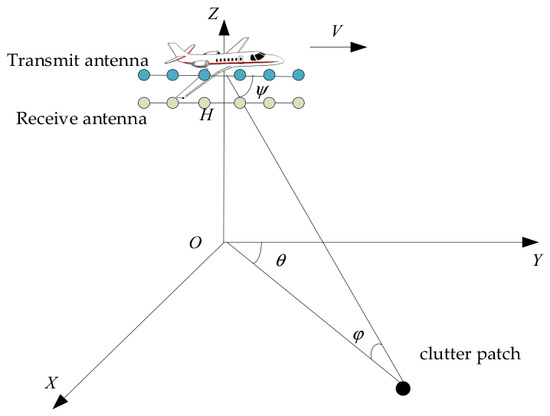
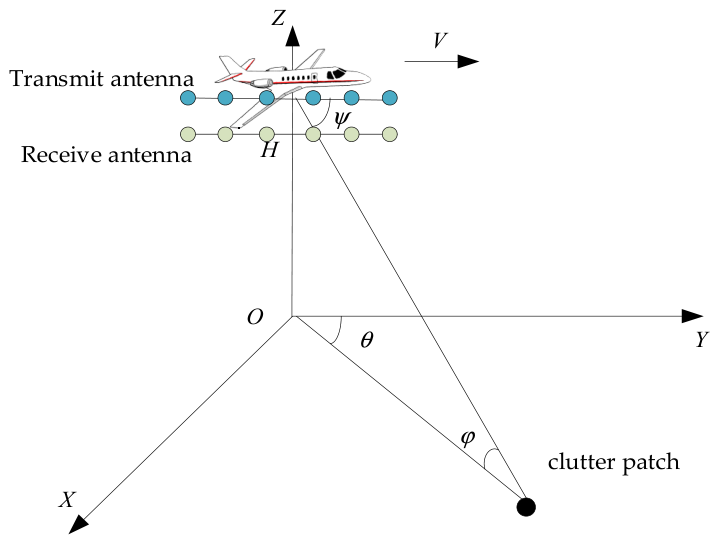
Figure 1 gives the side-looking airborne radar configuration considered. The radar employs a linear transmit-receive array, including transmitting elements and receiving elements. Let the spacings of the transmitting and receiving array elements be and , respectively. The reference carrier frequency is given by . To construct the frequency diverse array, a fixed frequency increment is assigned between adjacent transmit elements. Thus, the carrier frequency corresponding to the-th transmitting element is given as
Figure 1.
Side-looking airborne radar system.
In the considered geometry, and denote altitude and velocity for airborne radar. The variables , , and are used to characterize the elevation angle, azimuth angle, and cone angle, respectively: specifically, for side-looking radar. Assume that the radar transmits pulses with a pulse repetition frequency of and that the transmitted signals are mutually orthogonal. After the preprocessing procedure, the received data corresponding to the -th range cell are written as
where denotes the target, denotes noise, and denotes clutter,
For (3), indicates the range ambiguity order, whereas specifies the number of clutter patches within a single range bin. The parameter characterizes the complex amplitude associated with each clutter patch, and represents the corresponding clutter steering vector. Furthermore, the steering vector is composed of three components, namely the transmit steering vector , the Doppler steering vector , and the receive steering vector , which correspond to the transmit, slow-time, and receive dimensions, respectively.
In (4), , and respectively stand for the transmit, Doppler and receive frequency,
where , denotes the speed of light, and . It is seen that diverse range regions have diverse transmitting frequency from (5), and then the clutter in diverse regions is distinguished from the transmitting dimension.
Therefore, FDA-STAP is mathematically expressed by
where is the radar output power, represents the target steering vector, and denotes the CCM.
With (7), the optimal FDA-STAP can be given as
and the minimal radar output power can be derived as
2.2. Sample-Based FDA-STAP
When utilizing (8), it is necessary to obtain the inverse CCM . Nevertheless, it is hard to obtain the CCM , and it is commonly obtained from limited snapshots,
where is the sample covariance matrix (SCM). Then, the optimal FDA-STAP by (8) will be replaced by
where is the named full-dimension (FD) FDA-STAP weight. Hence, the output power by (11) can be derived by
In terms of (12), we find that FDA-FD-STAP will perform well, as the distance between and is small. Nonetheless, the number of snapshots for estimation is generally not sufficient, i.e., the RMB rule cannot be satisfied, and the distance between and will be large, causing large .
In conventional processing, sparse reconstruction [24,25] and the shrinkage algorithm [26] are the common measures to overcome the issue of limited snapshots. However, they often face performance loss to some extent and huge computational load. Consequently, it is significantly imperative to exploit other techniques to improve FDA-STAP for small-size snapshots.
3. FDA-STAP by Enhanced Reduced-Dimension Algorithm
This section reports an effective RD-FDA-STAP. Firstly, the motivation for RD-FDA-STAP is provided; secondly, we analyze the design of classical RD-FDA-STAP and its disadvantage; finally, we derive the ERD-FDA-STAP.
3.1. Motivation for FDA-STAP by Reduced Dimension
RD-FDA-STAP is commonly considered an effective approach for rejecting clutter under limited snapshots. Additionally, RD-FDA-STAP reduces the computational load significantly. Therefore, this paper mainly considers the range-ambiguous clutter rejection by RD-FDA-STAP.
The fundamental of reduced-dimension FDA-STAP is to reduce the dimension of radar data by a linear transformation. According to the RMB rule, the requirement on snapshots can also be decreased. In addition, the computational load is decreased greatly. Then, according to the MVDR criterion, like (6), RD-FDA-STAP is given as
where is the radar output power under RD-FDA-STAP, is the named linear transformation matrix, and .
Then, the optimal RD-FDA-STAP can be given as
and the corresponding minimal radar output power can be given as
Under limited snapshots, the optimal FDA-STAP obtained with (14) will be replaced by
where . Therefore, the radar output power obtained with (15) can be derived by
In practical situations, the RD DoFs are much smaller than . According to the RMB rule, RD CCM can be well estimated, and the distance between and will be small. Hence, RD-FDA-STAP can perform well under limited snapshots.
3.2. The Classical 3DL RD-FDA-STAP
Noticed that the key issue in (13) or (14) is the design of linear transformation matrix . Therefore, this paper mainly focuses on the design of .
Because clutters associated with distinct range-ambiguous regions are largely uncorrelated, they may be handled independently for each range region. Consequently, the snapshots drawn from other range regions generally contribute little useful information. Therefore, in [29], a classical RD-FDA-STAP is proposed, which is named three-dimensional localization. The design principle of the linear transformation matrix is to select the assisted channels within a properly sized cube area centered on the target channel, with its superior performance being empirically validated. The corresponding mathematical expression of the linear transformation matrix can be described as
where , and represent the selected transmit, time and receive assisted channels, respectively, which can be expressed as
where , and represent the transmit steering vector, time steering vector and receive steering vector. , and denote the number of selected transmit, time and receive assisted channels. , and denote the transmit, time and receive frequency interval.
3.3. The Enhanced RD-FDA-STAP
In practice, the proposed three-dimensional location (3DL) in [29] is similar to the classical joint domain localized method in the conventional two-dimensional STAP [31]. Therefore, 3DL follows the specific advantages and disadvantages of the joint domain localized method. In [29], 3DL commonly selects three transmit spatial-assisted channels, three time-assisted channels and three receive spatial-assisted channels. In multiple STAP applications, spatial channels are highly important for clutter suppression, which can provide reliable spatial information. However, the three spatial channels are not sufficient and commonly result in poor FDA-STAP performance because of the lack of RD system DoFs. Consequently, this requires that the conventional 3DL be enhanced.
To overcome the disadvantages of the classical 3DL, this paper developed an enhanced RD-FDA-STAP. Similar to the conventional extended factored approach [32], the proposed method still selects three time-assisted channels. Aiming at the key spatial-assisted channels, the proposed method selects all the available spatial channels as assisted channels. Combining the selected time-assisted channels and spatial-assisted channels, the linear transformation matrix of ERD-FDA-STAP can be given as
From (18), (19) and (20), the difference between the proposed transformation matrix and existing transformation matrices is intuitively demonstrated. According to the mathematical comparison, it is seen that 3DL selects three transmit, time and receive channels, while the developed ERD-FDA-STAP selects three time channels and all the transmit and receive channels, which sufficiently preserves the spatial degrees-of-freedom for range-ambiguous clutter suppression. With the linear transformation matrix in (20), the developed ERD-FDA-STAP problem can be expressed as
where is the radar output power under ERD-FDA-STAP, and .
Then, the optimal RD-FDA-STAP can be given as
In practice, for limited snapshots, the optimal RD-FDA-STAP defined by (22) will be re-expressed as
Equation (22) is based on the ideal covariance matrix, while Equation (23) uses the sample-estimated covariance matrix under limited snapshots. For limited snapshots, the proposed method is effective since it satisfies the RMB rule by reducing the system degrees of freedom.
With (23), range-ambiguous clutter will be well rejected. It is expected that the requirement on the number of snapshots will be reduced significantly since the system DoFs are reduced. In addition, the performance in will be better than that of the conventional 3DL because the spatial channels are sufficiently exploited.
Remark 1.
For FDA-STAP, if 3 dB output SINR loss is expected, the required snapshots should be larger than two times system degree of freedom. For RD-FDA-STAP, the required snapshots are reduced, but it still should be larger than two times system degree of freedom. If the number of snapshots is extremely limited, the proposed method cannot work effectively.
3.4. Computational Complexity
Within conventional STAP algorithms, heavy computational overhead primarily originates from CCM inversion, eigen-decomposition or sparse reconstruction procedures, whose arithmetic expenses are tightly bound to the CCM’s dimensional scale. This section quantitatively contrasts the computational load for five mainstream schemes: conventional full-dimensional FDA-STAP (FD-FDA-STAP), 3DL, ERD-FDA-STAP, shrinkage-aided FDA-STAP, and sparse-based FDA-STAP.
Specifically, FD-FDA-STAP, shrinkage-based FDA-STAP and subspace-based FDA-STAP are conducted according to the inversion and eigen-decomposition of SCM. The computational cost is . 3DL is conducted based on the inversion of SCM with the dimension , and then the computational cost is . As for the sparse-based FDA-STAP, it will consume too much time for CCM reconstruction, such as with the ANM-based method, and the computational complexity is about . For the proposed ERD-FDA-STAP, its computational complexity is since the dimension of its CCM is .
4. Numerical Experiments
This section gives a series of experiments to illustrate the advantages of the ERD-FDA-STAP approach. The experimental parameter settings are summarized in Table 2. To be specific, 3DL with , and is considered. In addition, , , and and are set as different numbers to show the performance advantages of the developed ERD-FDA-STAP under diverse clutter environments. Meanwhile, array gain and phase errors are considered to further demonstrate the robustness of ERD-FDA-STAP.
Table 2.
Parameters settings.
In the environmental settings, we exploit the classical Ward model for clutter simulation, which was developed by the Lincoln Laboratory at MIT and is popular in multiple research projects on airborne radar signal processing. Moreover, this paper does not consider the situation that a target falls in snapshots.
The performance of different FDA-STAP methods is evaluated using output SINR loss [2]. For instance, output SINR loss corresponding to the optimal FDA-STAP can be expressed as follows:
Output SINR losses of FD-FDA-STAP, 3DL [29], ERD-FD-STAP, and optimal FDA-STAP are obtained in the same manner. The final output SINR loss values are then computed by averaging the results over 100 trials.
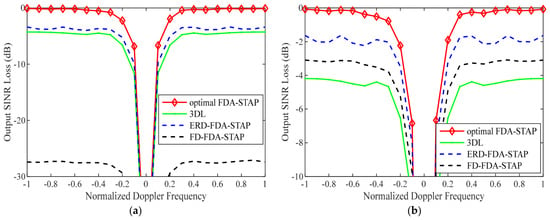
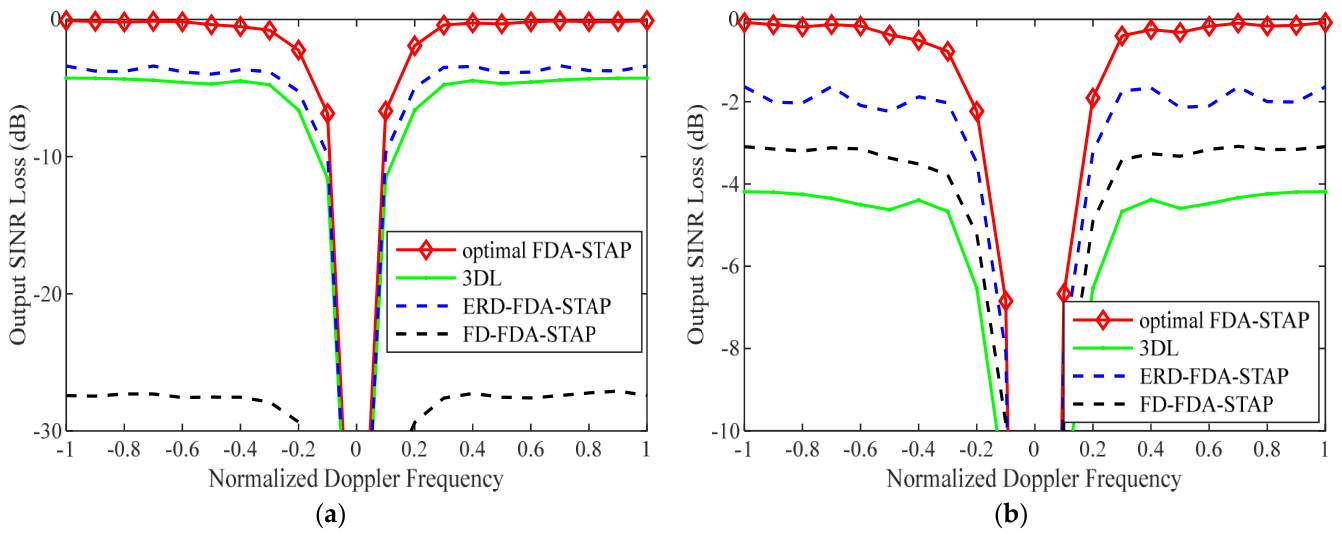
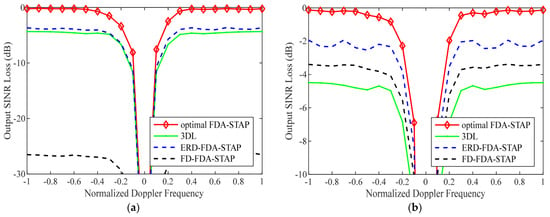
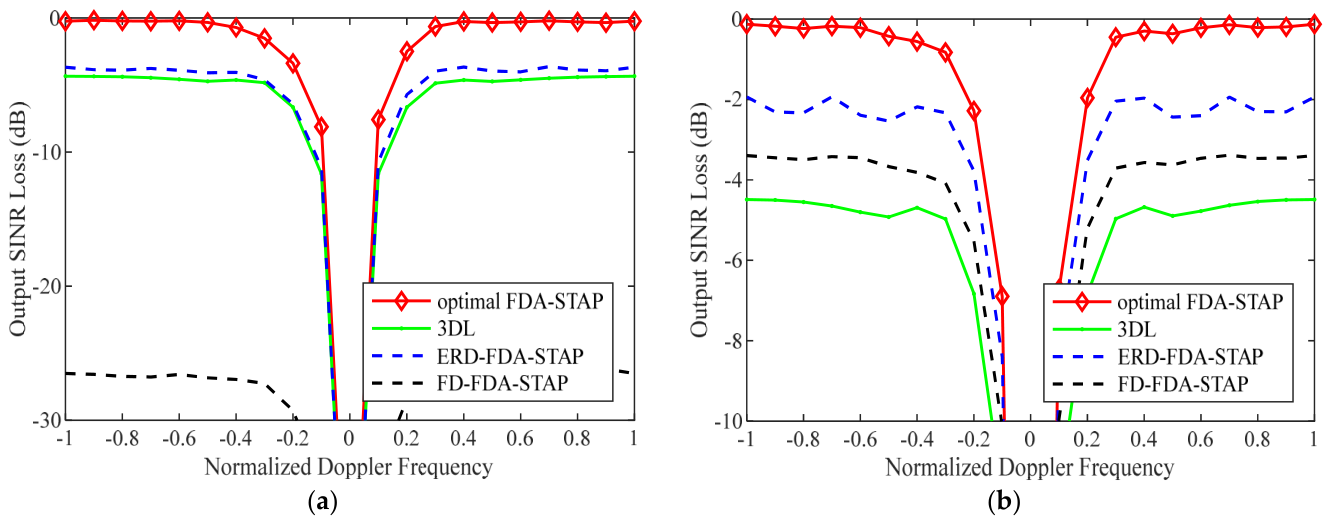
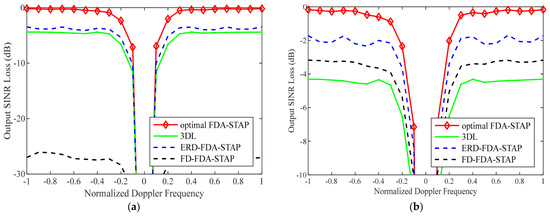
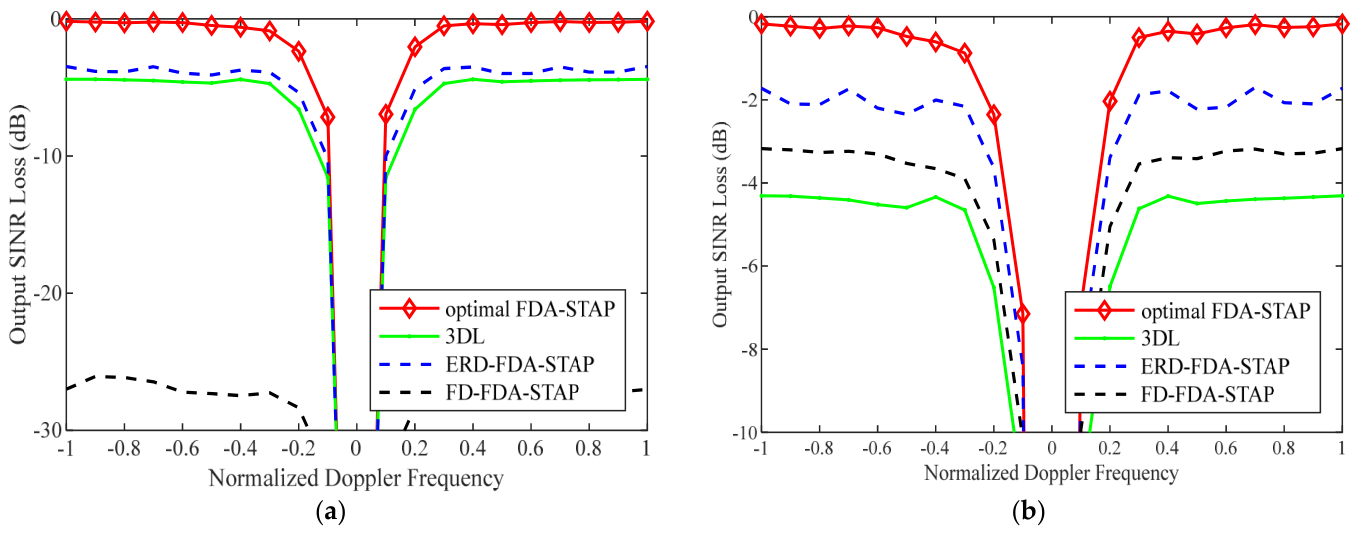
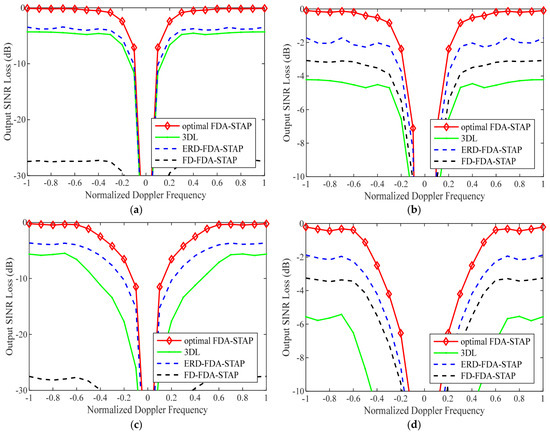
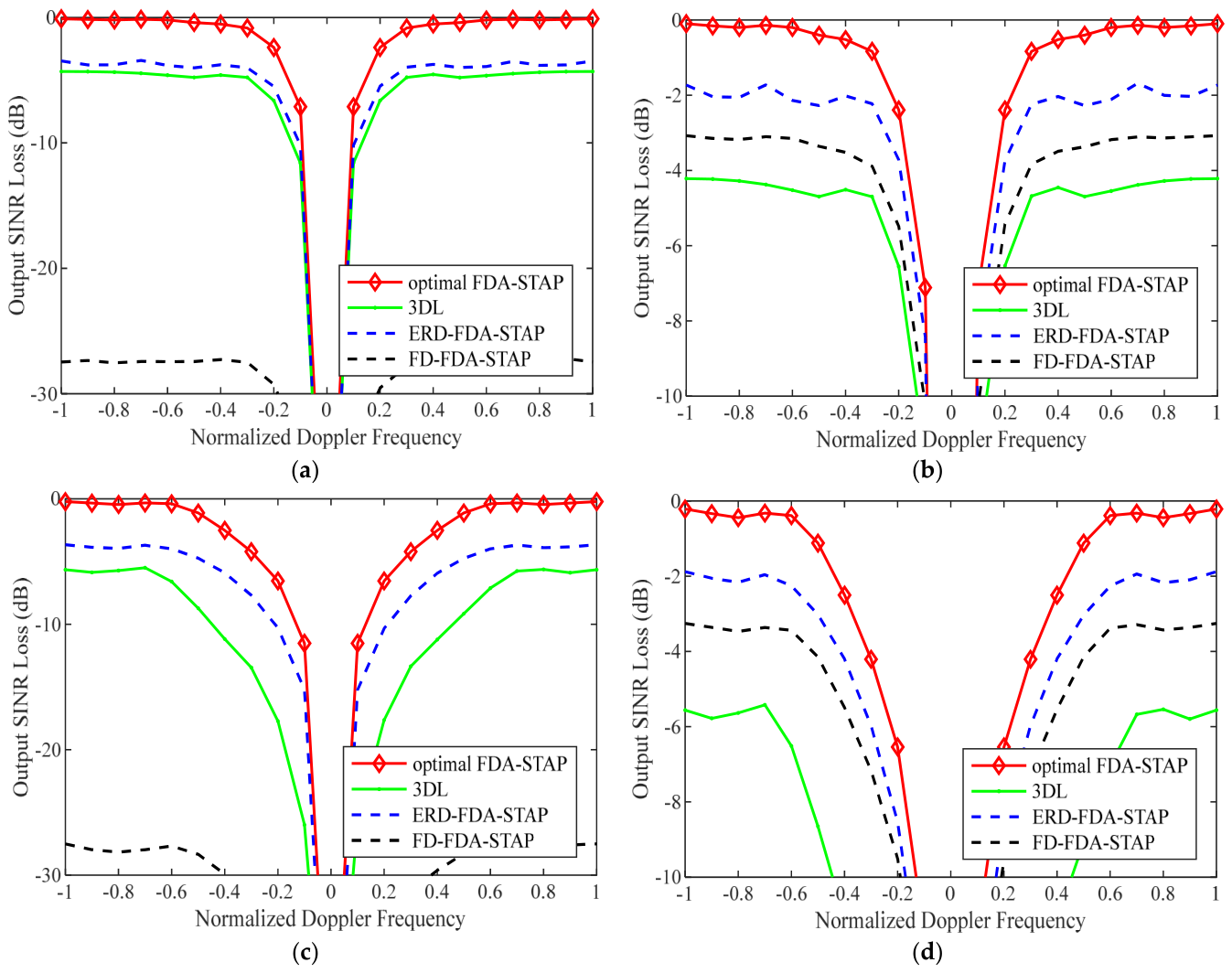
Firstly, Figure 2 shows the output SINR loss as a function of the normalized Doppler frequency under the settings of and . The velocity is specified as and , adopted to examine the performance of ERD-FDA-STAP. The experiments imply that ERD-FDA-STAP achieves better performance than the FD-FDA-STAP and 3DL methods, particularly in the case of limited snapshots. As shown in Figure 2a, when , ERD-FDA-STAP exhibits a clear performance advantage over the conventional FD-FDA-STAP method. Specifically, the output SINR loss obtained by ERD-FDA-STAP is reduced by approximately 24 dB and 1 dB compared with FD-FDA-STAP and 3DL, respectively. In Figure 2b, when , the RMB criterion is met. Under this condition, the output SINR loss of the proposed method decreases relative to that in Figure 2a. Although the performance of traditional FD-FDA-STAP is greatly improved, ERD-FDA-STAP still has better performance than FD-FDA-STAP. More precisely, ERD-FDA-STAP provides the greatest SINR among the methods, with its SINR loss being about 2 dB and 1 dB smaller than those of 3DL and FD-FDA-STAP, respectively.
Figure 2.
Output SINR losses versus normalized Doppler frequencies, , . (a) and (b) .
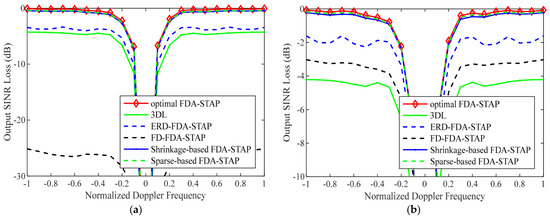
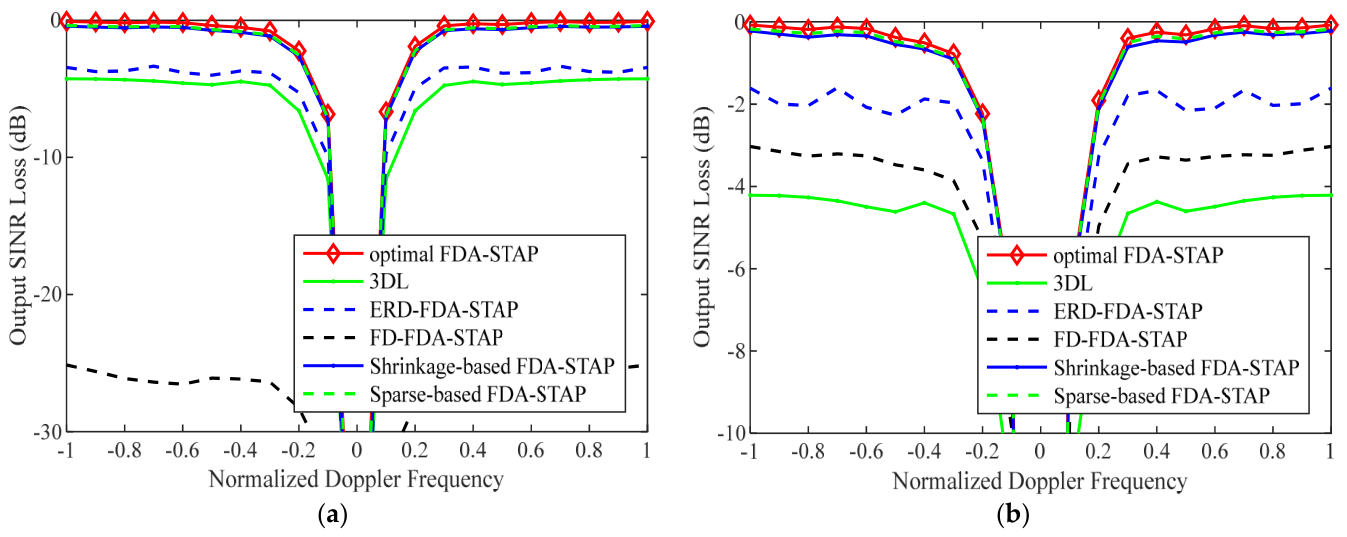
To show the effectiveness of the proposed ERD-FDA-STAP among different FDA-STAP algorithms, the output SINR loss curves with respect to normalized Doppler frequency are shown in Figure 3 under and ; the platform velocity is and . It is seen that the proposed ERD-FDA-STAP has almost identical performance in comparison with the others, which confirms the advantages of the proposed method.
Figure 3.
Output SINR losses versus normalized Doppler frequencies for different FDA-STAP, , . (a) and (b) .
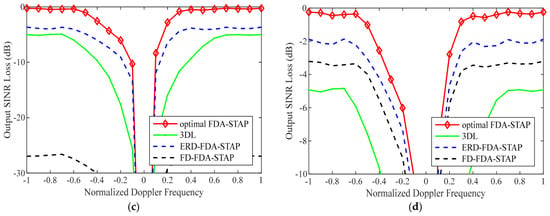
Figure 4 gives the output SINR loss versus normalized Doppler frequency under an increased clutter rank. and are considered in this experiment, the platform velocity is , and . In this scenario, the higher platform speed leads to an increase in clutter rank, as indicated in [37]. Compared with the results in Figure 2, the performance of all tested algorithms degrades to some degree. Even so, the proposed ERD-FDA-STAP method continues to show superior performance. As shown in Figure 4a, when , the SINR loss achieved by ERD-FDA-STAP is reduced by approximately 23 dB and 4 dB relative to FD-FDA-STAP and 3DL. For Figure 3b, when , ERD-FDA-STAP obtains a lower SINR loss than that in Figure 4a, and it still delivers the best overall performance among the compared methods.
Figure 4.
Output SINR losses versus normalized Doppler frequencies, , . (a) and (b) .
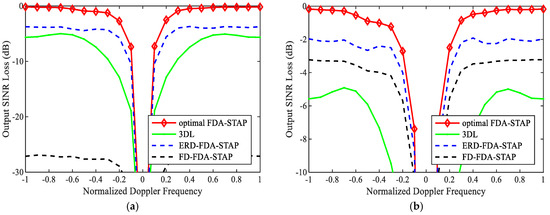
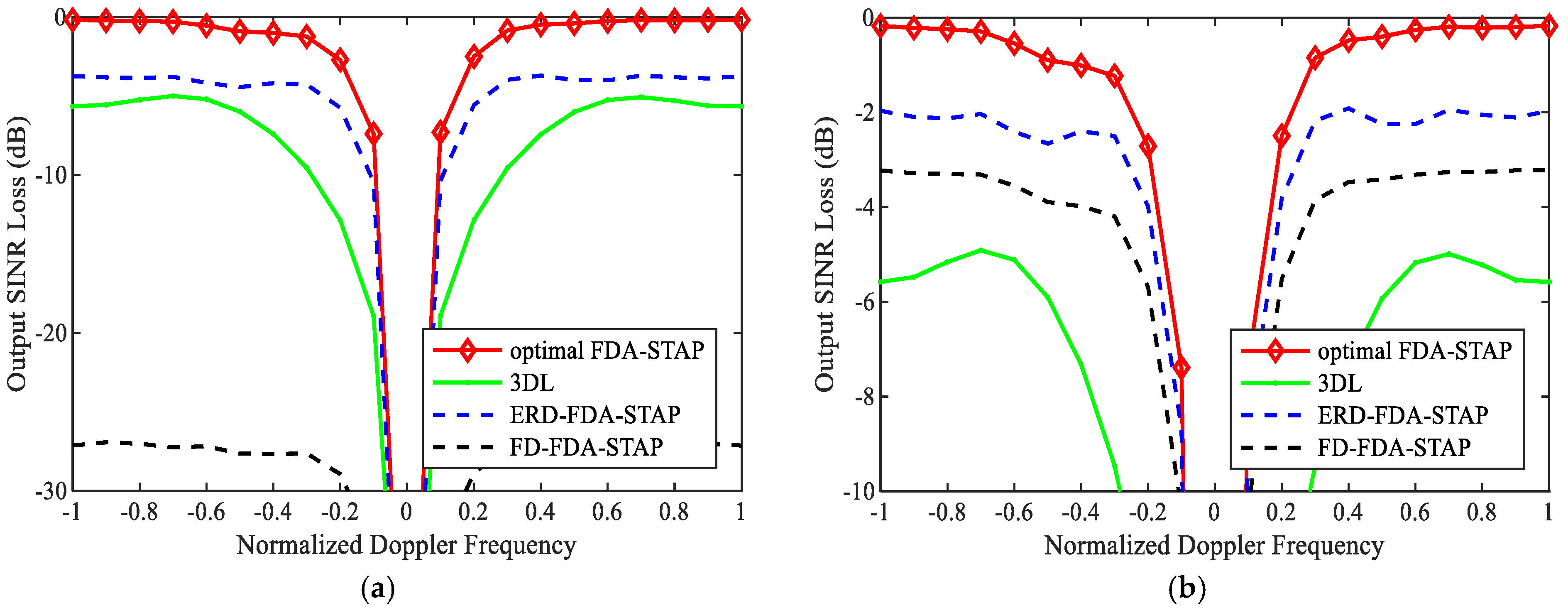
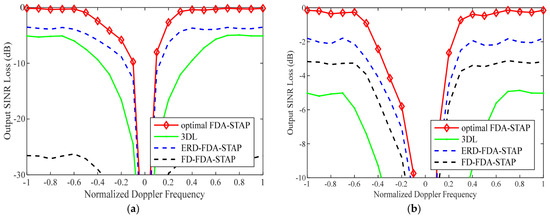
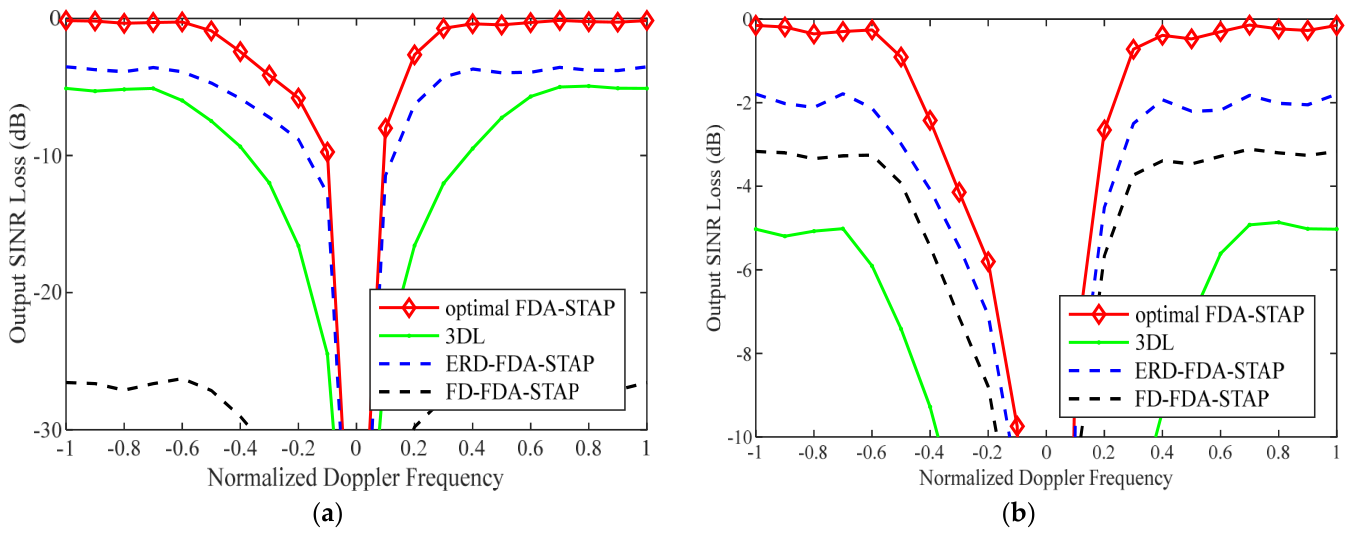
Subsequently, Figure 5 illustrates the output SINR loss as a function of normalized Doppler frequency under the conditions of and , platform velocity and . As reported in [37], the clutter rank increases when the spacing ratio between the transmit and receive arrays becomes larger. Furthermore, the work in [37] has rigorously and theoretically derived the clutter rank under different array element spacing ratios, range ambiguity numbers and velocity ambiguity numbers. Compared with Figure 2, the performance of all algorithms deteriorates to varying degrees. However, ERD-FDA-STAP still outperforms both 3DL and conventional FD-FDA-STAP. In particular, relative to FD-FDA-STAP, the SINR loss obtained by ERD-FDA-STAP is reduced by approximately 24 dB and 1.5 dB when and , respectively. Relative to 3DL, the SINR loss obtained by ERD-FDA-STAP is reduced by approximately 1 dB and 3 dB when and , respectively.
Figure 5.
Output SINR losses versus normalized Doppler frequencies, , . (a) and (b) .
In this experiment, the output SINR loss curves with respect to normalized Doppler frequency are shown in Figure 6 under and , the platform velocity is , and . According to [37], increasing the spacing ratio between the transmit and receive array elements leads to a higher clutter rank. Therefore, compared with the results in Figure 2, the performance of all considered algorithms exhibits a noticeable degradation. Even under this more challenging conditions, the proposed ERD-FDA-STAP method still maintains better performance than both 3DL and conventional FD-FDA-STAP. More specifically, when compared with the conventional FD-FDA-STAP method, ERD-FDA-STAP reduces the output SINR loss by approximately 23 dB and 2 dB for the cases of and , respectively. When compared with the conventional 3DL approach, ERD-FDA-STAP reduces the SINR loss by approximately 2 dB and 3 dB for the cases of and , respectively. This further confirms the robustness and effectiveness of the developed approach when the clutter rank increases.
Figure 6.
Output SINR losses versus normalized Doppler frequencies, , . (a) and (b) .
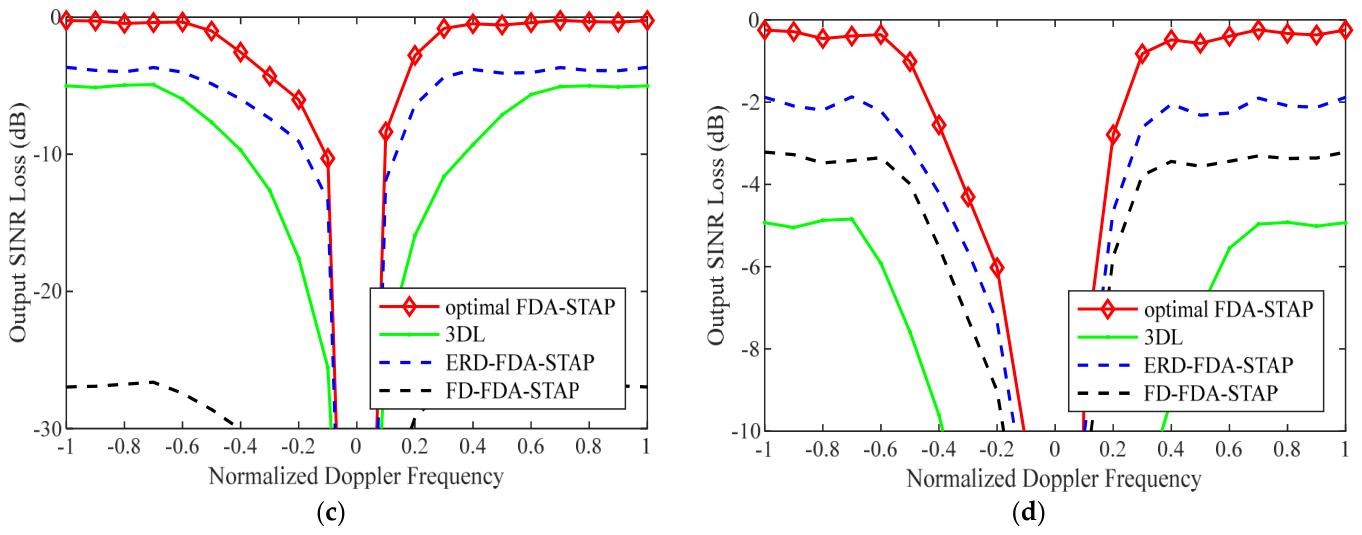
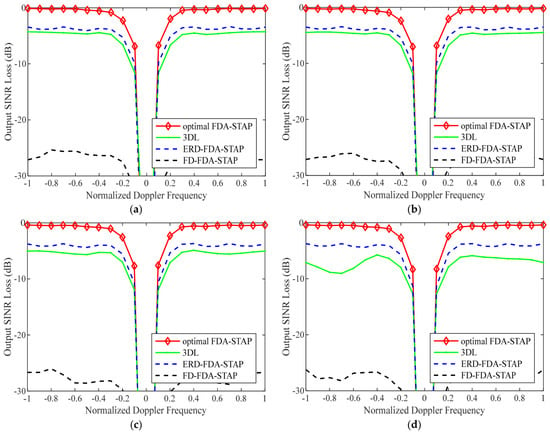
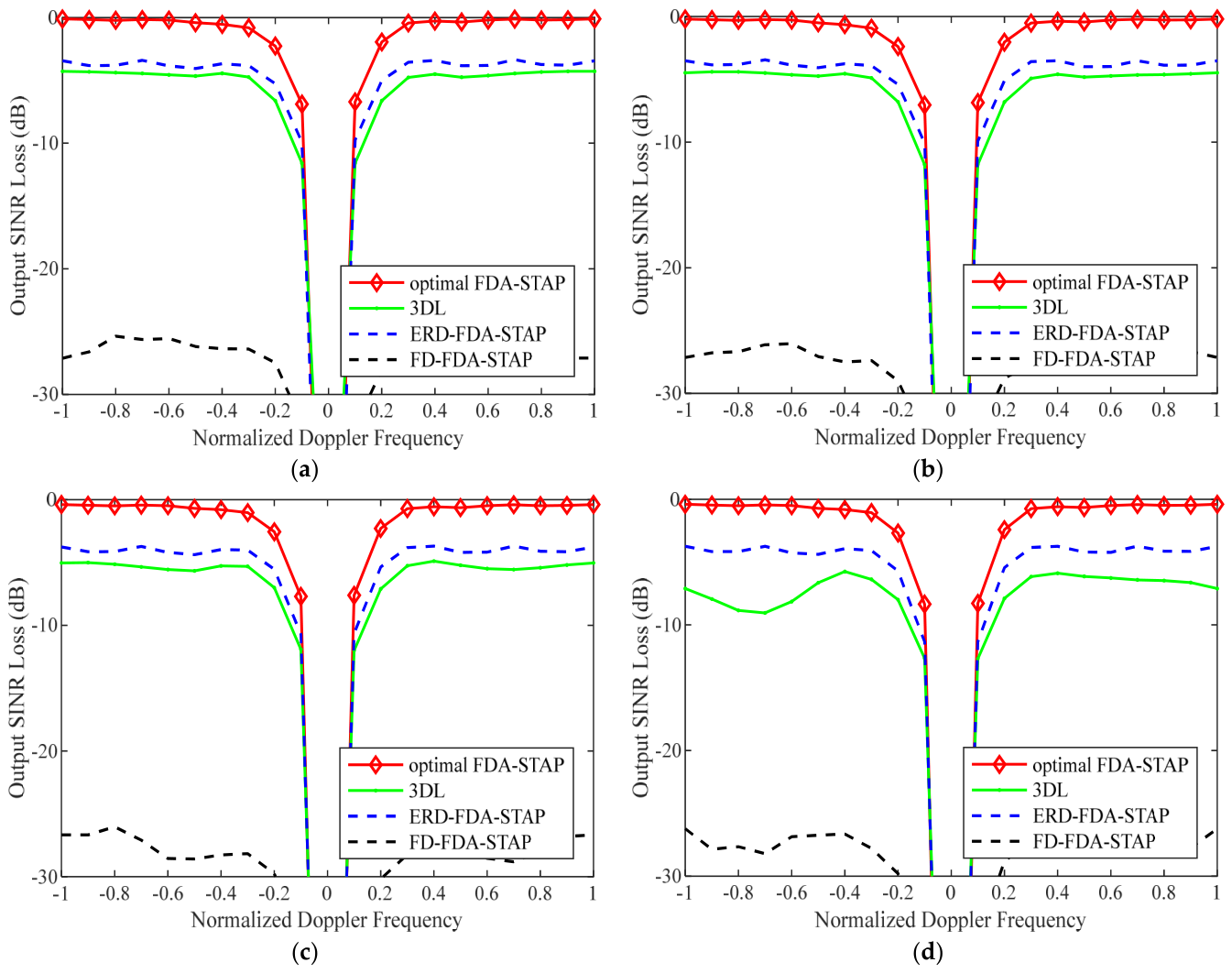
In practical operating environments, variations in external circumstances may result in inconsistencies for amplifier responses and phase characteristics of the receive array channels. These mismatches are usually modeled as array gain and phase errors [37]. The 5% gain and phase errors refer to both amplitude error and phase error. In [37], the error model has been defined, and the gain and phase obey uniform distribution. As described in [2], such errors can cause de-correlation between the transmitting and receiving channels, then making the performance of FDA-STAP worsen. To examine the robustness to the errors for the developed ERD-FDA-STAP method, 5% errors are added to clutter data in this experiment, and the corresponding results are presented in Figure 7. The platform velocities are and , the ratios between transmitting and receiving element spacings are and , and the numbers of snapshots are and , respectively. When , the developed ERD-FDA-STAP can have a clear performance advantage over both 3DL and conventional FD-FDA-STAP. When , the performance differences among FD-FDA-STAP, 3DL, and ERD-FDA-STAP become relatively small. Nevertheless, ERD-FDA-STAP still provides the lowest SINR loss and maintains the best overall performance among the three methods.
Figure 7.
Output SINR losses versus normalized Doppler frequencies under array gain and phase errors. (a) , , ; (b) , , ; (c) , , and (d) , , .
In this experiment, to further show the robustness of the proposed ERD-FDA-STAP, we consider 1%, 3%, 10%, and 15% array gain, and phase errors are considered for comparison. The number of snapshots , the platform velocity is , and . The output SINR loss curves with respect to normalized Doppler frequency are shown in Figure 8. It is seen that the proposed ERD-FDA-STAP still has superior performance when the array gain and phase errors vary, which verifies the robustness of ERD-FDA-STAP.
Figure 8.
Output SINR losses versus normalized Doppler frequencies under different array gain and phase errors , . (a) 1%; (b) 3%; (c) 10% and (d) 15%.
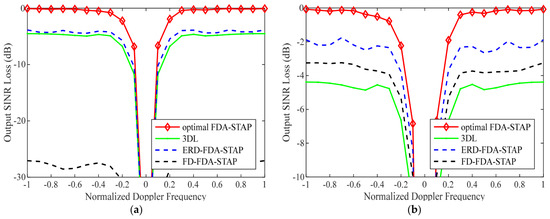
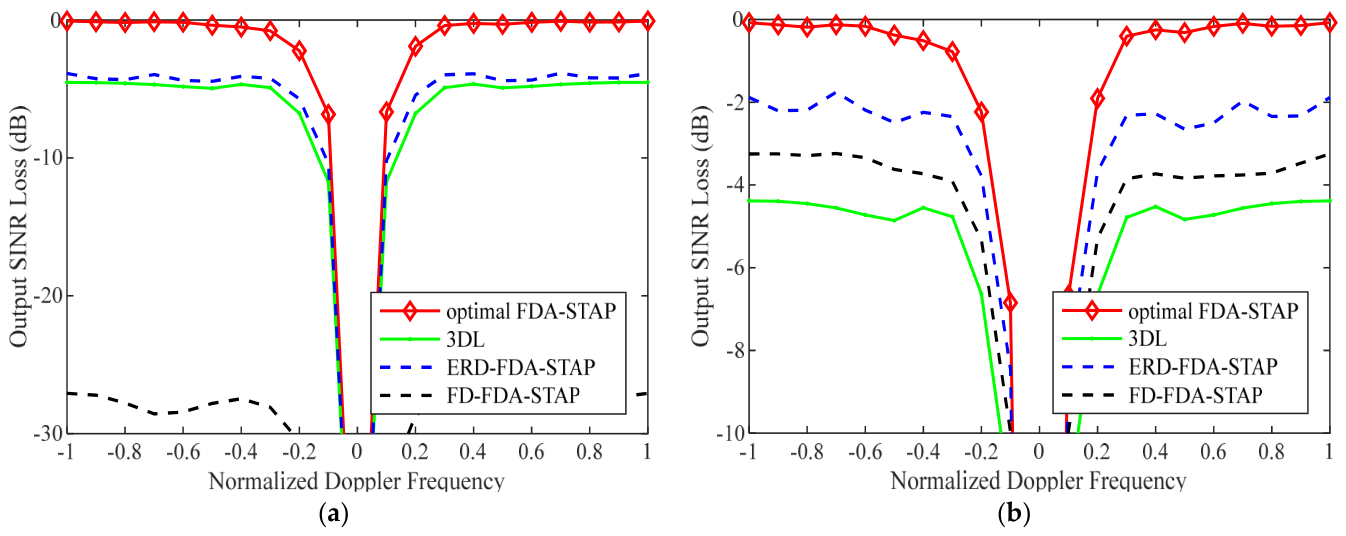
To demonstrate the robustness of the proposed ERD-FDA-STAP method under nonhomogeneous clutter environments, we provide the output SINR loss curves with respect to normalized Doppler frequency for nonhomogeneous snapshots in Figure 9. The number of snapshots and , the platform velocity is , and . It is found that the proposed ERD-FDA-STAP is still superior to the other FDA-STAP methods, which verifies its robustness to nonhomogeneous clutter environments.
Figure 9.
Output SINR losses versus normalized Doppler frequencies for nonhomogeneous clutter environments., , . (a) and (b) .
To further confirm the superiority and adaptability of the developed ERD-FDA-STAP approach in different range-ambiguous clutter scenarios, an additional experiment is carried out by setting the number of range ambiguity regions to three in Figure 10. The platform velocities are given as and , the ratios between the transmitting and receiving element spacings are and , and the numbers of snapshots are chosen as and , respectively. These parameter settings are used to examine the clutter suppression capability of ERD-FDA-STAP under more complex range ambiguity conditions. The simulation results indicate that when , the proposed ERD-FDA-STAP method achieves a noticeable performance improvement over both 3DL and conventional FD-FDA-STAP. This demonstrates that the developed approach can effectively reject ambiguous clutter and maintain superior output SINR performance under limited or challenging snapshot conditions. When , the performance differences among FD-FDA-STAP, 3DL, and ERD-FDA-STAP become relatively smaller, suggesting that the compared methods all benefit from the changed experimental conditions. Nevertheless, ERD-FDA-STAP still yields the lowest SINR loss among the three algorithms. Therefore, even in the case of three range ambiguity regions, the proposed method continues to show the best overall performance, further confirming its robustness and effectiveness in various range-ambiguous clutter environments.
Figure 10.
Output SINR losses versus normalized Doppler frequencies for three range ambiguity regions. (a) , , ; (b) , , ; (c) , , and (d) , , .
To demonstrate the advantage of the proposed ERD-FDA-STAP in computation, we give the runtimes of different FDA-STAP methods in Table 3. It is seen that FD-FDA-STAP has the largest runtime. In contrast, EDR-FDA-STAP has the smallest runtime, which confirms ERD-FDA-STAP is applicable to practical applications.
Table 3.
Runtime Comparison.
5. Conclusions
In this paper, an enhanced reduced-dimension FDA-STAP method, termed ERD-FDA-STAP, was proposed for airborne FDA radar in range-ambiguous environments. The received signal model was first established, and then a refined linear transformation matrix was designed to reduce the data dimension while preserving effective degrees of freedom. Based on the MVDR criterion, the corresponding adaptive processor was further derived. Numerical results show that the proposed ERD-FDA-STAP achieves better clutter suppression performance than existing RD-FDA-STAP methods, especially under limited snapshots and increased clutter rank. Moreover, it exhibits good robustness against array gain and phase errors. These results demonstrate that ERD-FDA-STAP is an effective and robust approach for airborne FDA-STAP processing in range-ambiguous scenarios.
Note that although the proposed ERD-FDA-STAP has distinct advantages, it also faces some challenges, such as higher computational load, performance degradation heterogeneous clutter, etc. In the future, we will further explore more robust technologies to improve ERD-FDA-STAP.
Author Contributions
Conceptualization, D.S. and C.S.; methodology, D.S.; software, C.S.; validation, C.S. and J.S.; writing—original draft preparation, D.S. and C.S.; writing—review and editing, C.S. and Q.L.; visualization, C.S. and Q.L.; supervision, C.S. and J.S.; funding acquisition, D.S. All authors have read and agreed to the published version of the manuscript.
Funding
This research was funded by Natural Science Foundation of Henan, grant number 262300422565; Science and Technology Doctoral Special Project of Nanyang Normal University, grant numbers 2026ZX015 and 2026ZX014; and Cultivation Fund of Nanyang Normal University, grant number 2026PY014.
Institutional Review Board Statement
Not applicable.
Informed Consent Statement
Not applicable.
Data Availability Statement
The original contributions presented in this study are included in the article. Further inquiries can be directed to the corresponding author.
Conflicts of Interest
The authors declare no conflicts of interest.
References
- Brennan, L.E.; Reed, L.S. Theory of adaptive radar. IEEE Trans. Aerosp. Electron. Syst. 1973, AES-9, 237–252. [Google Scholar] [CrossRef] [Scilit]
- Melvin, W.L. A STAP overview. IEEE Aerosp. Electron. Syst. Mag. 2004, 19, 19–35. [Google Scholar] [CrossRef] [Scilit]
- Ward, J. Space-Time Adaptive Processing for Airborne Radar; MIT Lincoln Laboratory Technical Report TR-1015; MIT Lincoln Lab.: Lexington, MA, USA, 1994. [Google Scholar]
- Hale, T.; Temple, M.; Raquet, J.; Oxley, M.; Wicks, M. Localized three-dimensional adaptive spatial-temporal processing for airborne radar. IEE Proc.-Radar Sonar Navig. 2003, 150, 18–22. [Google Scholar]
- Xu, J.; Zhu, S.; Liao, G. Range ambiguous clutter suppression for airborne FDA-STAP radar. IEEE J. Sel. Top. Signal Process. 2015, 9, 1620–1631. [Google Scholar] [CrossRef] [Scilit]
- Duan, K.; Xu, H.; Yuan, H.; Xie, H.; Wang, Y. Reduced-DOF three-dimensional STAP via subarray synthesis for nonsidelooking planar array airborne radar. IEEE Trans. Aerosp. Electron. Syst. 2020, 56, 3311–3325. [Google Scholar]
- Chen, W.; Xie, W.; Wang, Y. Short-range clutter suppression for airborne radar using sparse recovery and orthogonal projection. IEEE Geosci. Remote Sens. Lett. 2022, 19, 3500605. [Google Scholar]
- Antonik, P.; Wicks, M.C.; Griffiths, H.D.; Baker, C.J. Frequency diverse array radars. In Proceedings of the 2006 IEEE Conference on Radar, Verona, NY, USA; IEEE: New York, NY, USA, 2006; pp. 1–3. [Google Scholar]
- Blunt, S.D.; Mokole, E.L. Overview of radar waveform diversity. IEEE Aerosp. Electron. Syst. Mag. 2016, 31, 2–42. [Google Scholar] [CrossRef] [Scilit]
- Xu, J.; Zhang, Y.; Liao, G.; So, H.C. Resolving range ambiguity via multiple-input multiple-output radar with element-pulse coding. IEEE Trans. Signal Process. 2020, 68, 2770–2783. [Google Scholar]
- He, X.; Yu, Y.; Guo, Y.; Liao, G.; Zhu, S.; Xu, J.; Gu, T. Ground moving target detection with nonuniform subpulse coding in SAR system. IEEE Trans. Geosci. Remote Sens. 2023, 61, 1–18. [Google Scholar]
- Xu, J.; Liao, G.; So, H.C. Space-time adaptive processing with vertical frequency diverse array for range-ambiguous clutter suppression. IEEE Trans. Geosci. Remote Sens. 2016, 54, 5352–5364. [Google Scholar]
- Fang, Y.; Zhu, S.; Liao, B.; Li, X.; Liao, G. Target localization with bistatic MIMO and FDA-MIMO dual-mode radar. IEEE Trans. Aerosp. Electron. Syst. 2024, 60, 952–964. [Google Scholar]
- Zhu, J.; Zhu, S.; Xu, J.; Lan, L.; He, X. Cooperative range and angle estimation with PA and FDA radars. IEEE Trans. Aerosp. Electron. Syst. 2022, 58, 907–921. [Google Scholar]
- Gong, P.; Zhang, Z.; Wu, Y.; Wang, W.-Q. Joint design of transmit waveform and receive beamforming for LPI FDA-MIMO radar. IEEE Signal Process. Lett. 2022, 29, 1938–1942. [Google Scholar] [CrossRef] [Scilit]
- Xu, Y.; Wang, A.; Xu, J. Range-angle transceiver beamforming based on semicircular-FDA scheme. IEEE Trans. Aerosp. Electron. Syst. 2022, 58, 834–843. [Google Scholar]
- Lan, L.; Marino, A.; Aubry, A.; Maio, A.; Liao, G.; Xu, J. GLRT-based adaptive target detection in FDA-MIMO radar. IEEE Trans. Aerosp. Electron. Syst. 2021, 57, 597–613. [Google Scholar]
- Bang, H.; Wang, W.-Q.; Zhang, S.; Liao, Y. FDA-based space-time-frequency deceptive jamming against SAR imaging. IEEE Trans. Aerosp. Electron. Syst. 2022, 58, 2127–2140. [Google Scholar]
- Li, J.; Zhang, F.; Xu, Z.; Pan, S. Frequency-Domain Adaptive Processing With Stepped-Frequency Radar for Deceptive Jamming Suppression. IEEE Signal Process. Lett. 2026, 33, 1561–1565. [Google Scholar]
- Xu, J.; Zhu, S.; Liao, G. Space-time-range adaptive processing for airborne radar systems. IEEE Sens. J. 2015, 153, 1602–1610. [Google Scholar]
- Lan, L.; Xu, J.; Liao, G.; Zhang, Y.; Fioranelli, F.; So, H.C. Suppression of mainbeam deceptive jammer with FDA-MIMO radar. IEEE Trans. Veh. Technol. 2020, 69, 11584–11598. [Google Scholar] [CrossRef] [Scilit]
- Lan, L.; Liao, G.; Xu, J.; Xu, Y.; So, H.C. Beampattern synthesis based on novel receive delay array for mainlobe interference mitigation. IEEE Trans. Antennas Propag. 2023, 71, 4470–4485. [Google Scholar] [CrossRef] [Scilit]
- Reed, I.S.; Mallett, J.D.; Brennan, L.E. Rapid convergence rate in adaptive arrays. IEEE Trans. Aerosp. Electron. Syst. 1974, AES-10, 853–863. [Google Scholar] [CrossRef] [Scilit]
- Liu, Z.; Zhu, S.; Xu, J.; Lan, L. An adaptive range-angle-Doppler processing approach for FDA-MIMO radar based on sparse reconstruction. In Proceedings of the 2021 CIE International Conference on Radar, Haikou, Hainan, China; IEEE: New York, NY, USA, 2021; pp. 1704–1708. [Google Scholar]
- Wang, Z.; Li, X.; Xu, C.; Wu, B.; Song, D. Sea Clutter Suppression by Atomic Norm Minimisation in Frequency Diverse Array-Space-Time Adaptive Processing Radar Under Range Ambiguity. IET Radar Sonar Navig. 2025, 19, e70090. [Google Scholar]
- Song, D.; Song, C.; Liu, D.; Wang, Z. FDA-STAP by shrinkage algorithm under range ambiguity for limited snapshots. IEEE Access 2025, 13, 213092–213106. [Google Scholar]
- Wen, C.; Huang, Y.; Peng, J.; Wu, J.; Zheng, G.; Zhang, Y. Slow-time FDA-MIMO technique with application to STAP radar. IEEE Trans. Aerosp. Electron. Syst. 2022, 58, 74–95. [Google Scholar]
- Liu, Z.; Zhu, S.; Xu, J.; He, X.; Liu, Q. Moving target detection in range-ambiguous clutter scenario with PA-FDA dual-mode radar. Digit. Signal Process. 2023, 135, 103942. [Google Scholar]
- Xu, J.; Liao, G.; Zhang, Y.; Ji, H.; Huang, L. An adaptive range-angle-doppler processing approach for FDA-MIMO radar using three-dimensional localization. IEEE J. Sel. Top. Signal Process. 2017, 11, 309–320. [Google Scholar]
- Wen, C.; Ma, C.; Peng, J.; Wu, J. Bistatic FDA-MIMO radar space-time adaptive processing. Signal Process. 2019, 163, 201–212. [Google Scholar]
- Wang, H.; Cai, L. On adaptive spatial-temporal processing for airborne surveillance radar systems. IEEE Trans. Aerosp. Electron. Syst. 1994, 30, 660–670. [Google Scholar] [CrossRef] [Scilit]
- DiPietro, R.C. Extended factored space-time processing for airborne radar systems. In Proceedings of the Conference Record of the Twenty-Sixth Asilomar Conference on Signals, Systems & Computers; IEEE: New York, NY, USA, 1992; pp. 425–430. [Google Scholar]
- Lai, Y.; Duan, K.; Wang, W. Reduced-dimension matrix optimization method for nonstationary clutter suppression in space-time adaptive processing. IEEE Trans. Signal Process. 2025, 73, 4921–4937. [Google Scholar]
- Zhang, Y.; Jiang, L.; Ewe, H.T. A novel data-driven modeling method for the spatial–temporal correlated complex sea clutter. IEEE Trans. Geosci. Remote Sens. 2022, 60, 5104211. [Google Scholar]
- Kan, Q.; Xu, J.; Xu, Y.; Wang, W.; Lan, L.; Liao, G. Range-ambiguous clutter suppression for space–air bistatic radar based on FDA-MIMO. IEEE Trans. Aerosp. Electron. Syst. 2026, 62, 7731–7746. [Google Scholar]
- Qiu, Z.; Duan, K.; Liao, Z. Range ambiguous clutter suppression for forward-looking airborne radar based on frequency coding and phase waveforms modulation in slow-time. IEEE Trans. Aerosp. Electron. Syst. 2024, 60, 8470–8482. [Google Scholar] [CrossRef] [Scilit]
- Song, D.; Chen, S.; Feng, Q.; Xi, F.; Liu, Z. Subspace-based STAP in airborne FDA radar for homogeneous clutter under range ambiguity. IEEE Trans. Aerosp. Electron. Syst. 2024, 60, 2909–2921. [Google Scholar] [CrossRef] [Scilit]

Disclaimer/Publisher’s Note: The statements, opinions and data contained in all publications are solely those of the individual author(s) and contributor(s) and not of MDPI and/or the editor(s). MDPI and/or the editor(s) disclaim responsibility for any injury to people or property resulting from any ideas, methods, instructions or products referred to in the content. |
© 2026 by the authors. Licensee MDPI, Basel, Switzerland. This article is an open access article distributed under the terms and conditions of the Creative Commons Attribution (CC BY) license.