


Abstract
Thin rectangular plates, due to their small thickness relative to length and width and their high strength-to-weight ratio, are widely used in structural elements such as ship hulls, bridge decks, and aircraft wings. They are prone to nonlinear buckling under compressive forces, especially under biaxial in-plane compressive loading with large displacements, where linear theories often fail and membrane stresses complicate analysis. This study aimed to formulate a general mathematical equation for buckling analysis of thin rectangular isotropic plates with large displacements subject to biaxial in-plane forces using the Ritz potential energy functional method, and incorporates both geometric and material nonlinearities. Based on the formulated general equation, a specific equation for an all-round simply supported (SSSS) plate was developed using polynomial displacement shape function to determine the stiffness characteristics. Numerical values for critical buckling and post-buckling loads under biaxial compression for a square plate case were obtained. To validate these results, a comparison with values in the literature was made and the results show high consistency. The uniaxial buckling deviations ranged 0.047–0.10%, while undeformed biaxial buckling coefficients across varying aspect ratios and loading ratios (n = Ny/Nx) showed near-zero differences. From the two studies used for comparison, the maximum deviation is 24.42% and the minimum deviation is 1.12%. This indicates that the new model is adequate. Also, the adequacy of this new equation can be judged based on the simplicity of the formulation, and the closed agreement of the obtained numerical results with established results in the literature. This research enhances theoretical understanding of nonlinear buckling in thin plates and offers practical insights for improving structural reliability and efficiency in civil, mechanical, aerospace, and marine engineering. Therefore, the conclusion is that the model is suitable for buckling and post-buckling analysis of thin rectangular isotropic plates.
1. Introduction
Thin rectangular plates, characterized by their small thickness relative to length and width, are widely used in structural components like bridge decks, ship hulls, and aircraft wings [1,2,3]. Their susceptibility to buckling under compressive loads, especially in biaxial conditions, makes the study of their stability crucial [4,5]. Depending on the span-to-thickness ratio, plates are classified as thin, moderately thick, or thick [6]. Small deflection scenarios are modeled using Kirchhoff theory, while large deflections require nonlinear formulations like von Kármán theory [7,8]. This research focuses on the nonlinear biaxial buckling behavior of thin plates under large deflection, subjected to in-plane forces, which is critical for accurate structural analysis and failure prevention [6,9,10].
Many buckling analysis studies of rectangular plates have primarily focused on small deflection behavior, often considering only uniaxial or biaxial buckling with boundary conditions such as SSSS, CCCC, or CCCS. Onwuka et al. [11] conducted a rigorous buckling analysis of biaxially compressed, thin rectangular isotropic plates with simply supported edges (SSSS) using Galerkin’s method. By analyzing plates with aspect ratios from 1 to 2, they derived a general equation for critical buckling load, which proved highly accurate, showing as little as 0.047% error compared to exact trigonometric solutions. Their findings confirm the reliability of Galerkin’s method for small-deflection buckling predictions in engineering applications involving biaxial loading. This work was based on small displacement analysis only, without consideration of large displacement effects.
However, thin rectangular plates are vulnerable to nonlinear buckling behavior under compressive forces, particularly during biaxial loading with large displacements, where traditional linear theories prove inadequate [12,13]. To address this, advanced models such as the von Kármán plate theory are used, although they involve complex mathematics and Airy’s stress functions [13]. These von Kármán equations are nonlinear partial differential equations which involved Airy’s stress function, and makes the solution more complex and limited in application. Moreso, a closed form solution was not possible for these equations. Besides, his equations where only applicable to uniaxial buckling analysis based on assumed middle surface displacement. Levy [14] attempted a solution to the von Kármán equations using an assumed trigonometric shape function for an SSSS plate. A critical look at that work shows how complex and involved it was, and that it was based on many assumptions in order to simplify the work. This work was still based on von Kármán equations developed in 1910, and his approach was not applicable to other support conditions in uniaxial in-plane loading. Iyengar [15] also carried out post-buckling analysis of an SSSS plate, based on an approximate method used by A. S. Volvir and K. Marguerre. This work was still based on trying to get an approximate solution to the same von Kármán equation with application to only one support type. Due to the complex nature of such an approach, Iyengar [15] adopted an energy approach based on minimum strain energy. He obtained an equation in terms of the modulus of the material at the inelastic range and amplitude of deflection, but neither parameter could be defined, rendering the equation of no practical use. In an effort to improve on Iyengar’s equation, Adah [16] modified Iyengar’s equation and developed a more practical and simplified approach for post-buckling analysis of SSSS rectangular plates. The introduction of a numerical factor (β = 0.025) made the method easier to implement without compromising accuracy. The model’s results aligned closely with the existing literature, particularly under large deflection conditions, enhancing its value for engineers needing efficient nonlinear analysis tools for thin plate structures. However, this modified equation was still based only on the SSSS plate which Iyengar had formulated.
In a very remarkable effort to apply the von Kármán equations beyond SSSS plates, some recent scholars [17,18,19] in their various PhD theses have determined the stress functions they used in their works (post-buckling, free vibration, and pure bending analyses of rectangular plates with large deflection, respectively) instead of relying on assumptions like earlier scholars. They also determined the middle surface displacement used in their works. However, a critical study of their works reveals how involved and lengthy the expression of stress functions is. The nature of the stress functions determined by them may discourage engineering analysts, and their results show minimal improvements. Oguaghamba [20] explored the post-buckling characteristics of clamped rectangular plates (CCCC) under biaxial loading using direct integration of von Kármán equations. A key revelation was that plate failure occurs not at the critical buckling load but at a post-buckling deflection of 0.0478 times the plate thickness, demonstrating the load-resisting capacity beyond initial buckling. This finding shifts the conventional understanding of failure criteria, emphasizing the strength of clamped configurations under large deflection regimes. This work represents a great improvement but is still based on von Kármán equations with Airy’s stress function. Also, it was based on uniaxial in-plane loading only. Wang & El-Sheikh [21] introduced a simplified yet powerful method to solve large-deflection problems in rectangular plates governed by von Kármán equations. Their spreadsheet-friendly solution reduces computational complexity while maintaining high accuracy, verified against FEM and analytical benchmarks. This work significantly bridges the gap between theoretical modeling and practical engineering analysis, especially for professionals without access to advanced numerical tools. Their work was still dependent on von Kármán equations. Zhang et al. [22] applied a wavelet Galerkin method to tackle large-deflection bending in thin rectangular plates, enhancing computational efficiency and accuracy. By embedding boundary conditions directly into the formulation, the method outperformed usual techniques like FEM in both precision and speed. This research pushes the boundaries of numerical plate analysis and offers a powerful alternative for complex plate modeling under nonlinear deformation.
In an attempt to circumvent the von Kármán large deflection equations, Ibearugbulem et al. [23] developed a simplified and exact approach for post-buckling analysis by eliminating Airy’s stress functions and formulating a new strain–displacement relation and applying the Ritz energy approach. Their method pinpointed a deflection-to-thickness ratio threshold of 0.225, beyond which small deflection models become unreliable. With an average deviation of just 12.65% from its benchmark data, the study offers a practical and reliable tool for analyzing biaxially loaded SSSS plates under large deflections. This new approach was based on uniaxial loading and applied to SSSS plate. Extending this approach and improving on the derivation process of nonlinear strain–displacement relations, Adah et al. [24] presented an enhanced nonlinear strain–displacement model based on cube deformation principles and integrated it within total potential energy formulations for stability analysis. Analyzing five different boundary conditions, the study demonstrated that increasing displacement raises frequency while increasing aspect ratio reduces it, aligning with theoretical behavior. The improved model proved versatile and effective for analyzing uniaxial buckling under large deflection, offering broad applicability across varied engineering plate problems. However, again, this approach was applicable only to uniaxial loading.
In all, while some researchers have explored large-deflection behavior, even with the recent excellent work of formulating a new different equation from that of the long standing von Kármán approach, these studies often focus on uniaxial loading, limiting their broader applicability. Most real-world plates’ problems of stability analysis in aerospace, naval and general structural engineering are subjected to axial in-plane forces, which have detrimental effects on structural safety.
To fill this research gap, the aim of this paper is to investigate the buckling behavior of a thin isotropic rectangular plate with large displacement subject to biaxial in-plane forces, by obtaining a comprehensive general equation for thin isotropic rectangular plate stability analysis, and using an all-round supported SSSS thin rectangular plate under large deflection to demonstrate the adequacy of the model. To achieve this, the following objectives will be adopted.
- Formulate a new general mathematical equation for the buckling of a thin isotropic rectangular plate with large displacement subject to biaxial in-plane forces using the Ritz energy approach.
- Use the polynomial displacement shape function for the SSSS plate to determine the stiffnesses and formulate a specific model for an all-round simply supported SSSS thin rectangular plate under large displacement.
- Compare the obtained numerical values of buckling and post-buckling loads with those in the established literature.
- Draw a conclusion on the adequacy of the new mathematical equation.
This will offer a comprehensive buckling and post-buckling equation that incorporates both geometric and material nonlinearities using the Ritz total potential energy functional. Finally, the research proposes practical recommendations to enhance the structural performance and reliability of thin plates in engineering applications.
From a mechanics perspective, the motivation of the present work is to develop a unified and analytically compact formulation for biaxial buckling and post-buckling analysis that preserves the essential nonlinear behavior while reducing the algebraic complexity associated with classical von Kármán-based approaches. Unlike formulations that rely explicitly on Airy stress functions and von Kármán equations, the present Ritz-based framework expresses stability characteristics directly in terms of displacement, amplitudes and stiffness, enabling transparent interpretation of bending and membrane contributions. This structure allows the resulting equations to be readily specialized to different boundary conditions and loading ratios without altering the underlying formulation. This work will be beneficial for the design of plated thin structures and the advancement of research. It will also provide an easy all-inclusive thin isotropic plate mathematical model for obtaining critical loads and nonlinear uniaxial and biaxial buckling load values, thereby saving time and energy of plate designers and analysts. It will also offer a better understanding of both linear and nonlinear stability behavior of thin isotropic rectangular plates.
2. Formulation of the General Biaxial Buckling Equation Under Large Deflection
2.1. Assumptions
This formulation is based on the assumptions that the plate is isotropic, homogeneous, thin and rectangular in shape; the middle surface displacements are reasonable in magnitude and cannot be neglected; and the displacement is large.
The Ritz total potential energy functional equation for a plate loaded uniaxially with in-plane compressive forces under large deflection as given by Adah et al. [14] for uniaxial buckling is
where:
Total energy functional;
Out-of-plane displacement;
Flexural rigidity of the plate;
In-plane force along the axis
Adjusting Equation (1) to include the biaxial in-plane forces along the x and y directions yields the general potential energy functional biaxial equation of thin rectangular plates under large displacements as given in Equation (5).
A non-dimensional parameter is introduced:
where a is the dimension along the x-axis and b is the plate dimension along the y-axis, while R and Q are the non-dimensional parameters along the x- and y-axes, respectively.
Putting Equation (6) into Equation (5) gives
Simplifying further yields
Let the aspect ratio be
and Equation (8) becomes Equation (10)
The general out-of-plane displacement, w, is given as the product of the amplitude of displacement, A, and the shape profile of the plate, h.
The higher the amplitude of displacement, A, the higher the out-of-plane displacement, w. The shape profile is different for every plate type or edge condition. This can be polynomial or trigonometric in nature.
Hence, substituting Equation (11) into Equation (10) yields Equation (12):
Carrying out direct variation by differentiating with respect to A gives
Multiplying Equation (13) by gives
Dividing by D gives
This can be represented as
where,
where:
kbx = Bending stiffness along x-axis;
kbxy = Bending stiffness along xy-axis;
kby = Bending stiffness along y-axis;
Kmx = Membrane stiffness along x-axis;
kmxy = Membrane stiffness along xy-axis;
kmy = Membrane stiffness along y-axis;
kbT = Total bending stiffness;
kmT = Total membrane stiffness;
= External buckling load stiffness along x-axis;
kNxy = External buckling load stiffness along xy-axis;
kNy = External buckling load stiffness along y-axis;
h = Shape function or profile of the plate;
R = Non-dimensional parameter in the x direction;
Q = Non-dimensional parameter in the y direction.
Equation (16) can be written as
where:
Assuming
where n is the ratio of , called the load factor, then Equation (28) becomes
Collecting like terms yields
For a non-shear force case, , Equation (32) reduces to Equation (34):
Substituting Equation (2) into Equation (34) gives
Making the compressive in-plane force, , the subject of the formula yields
where
Equation (36) or Equation (37) is the general biaxial compressive buckling equation under large displacement in terms of the amplitude of displacement, while Equation (38) is the biaxial compressive buckling load coefficient equation under large displacement in terms of the amplitude of displacement.
From Equation (11), the amplitude of displacement, A, is given as
Substituting Equation (39) into Equation (38) gives
At the point of maximum deflection, h = . Hence,
Substituting Equation (41) into Equation (37) gives
where hmax = value of the shape function of the plate at the point of maximum deflection.
Equation (42) is the general biaxial compressive buckling equation under large displacement in terms of displacement, while Equation (41) is the biaxial compressive buckling load coefficient equation under large displacement in terms of displacement.
Furthermore, the stress in a thin plate is given by
Substituting Equation (42) into Equation (43) gives
Simplifying yields
Rewriting Equation (45) yields
The buckling load parameter is obtained by substituting Equation (3) into Equation (46) as follows:
This can be written as
Equation (48) is the buckling load parameter of the rectangular thin isotropic plate subjected to biaxial buckling under larger deflection.
The formula for the deflection-to-thickness ratio is obtained by making (w/t) the subject of the formula from Equation (48) as follows:
Simplifying yields
Making the subject of the equation yields
or, alternatively,
Equation (52) is the general formula for the deflection-to-thickness ratio for the biaxial buckling of a thin isotropic rectangular plate subjected to in-plane loading.
2.2. Determination of the Stiffness of the SSSS Plate
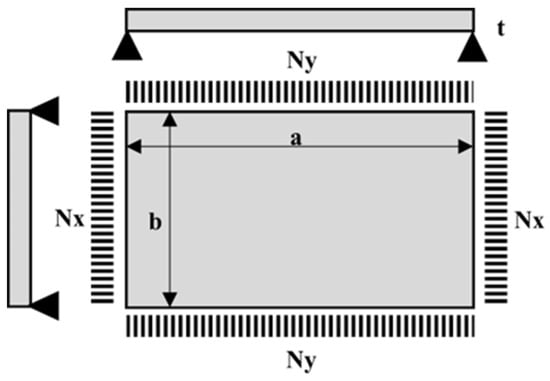
The boundary conditions or plate type for the all-round simply supported (SSSS) plate subject to biaxial compressive forces can be described as shown in Figure 1 below.
Figure 1.
SSSS plate.
The polynomial shape function will be used here because it is much easier to evaluate than the trigonometric shape function while yielding negligible variation in results. The trigonometric shape function for the SSSS plate is given as h = Sin(mπR)Sin(nπQ). The polynomial shape function for the SSSS plate is given as
For this type,
This polynomial shape function was derived based on a truncated polynomial series at the fifth term. The derivations of various shape functions for different plate support conditions can be found in [25].
The first author has used both trigonometric and polynomial shape functions in his earlier works for different plate support types and all have proven adequate.
To obtain the stiffness, partial derivatives and necessary expansion of Equations (17)–(27) are calculated, and the stiffness values obtained are presented in Table 1 followed by other results from the SSSS plate. The initial conditions are of zero displacements in the plate, i.e., it is undeformed at the beginning of the loading.
Table 1.
Bending, external load, and membrane stiffness of the SSSS rectangular plate.
3. Results and Discussion
The results are presented in the Table 2. The stiffnesses for SSSS rectangular plates are recorded in Table 1 above.
Table 2.
Biaxial compressive buckling load coefficient for the SSSS plate with an aspect ratio of 1.0 under large deflection.
Substituting these stiffnesses into the general coefficient equation (41) for biaxial compressive buckling load under large deflection yields the results for the biaxial buckling coefficient equation for the SSSS plate shown in Equation (56):
Equation (42) then becomes
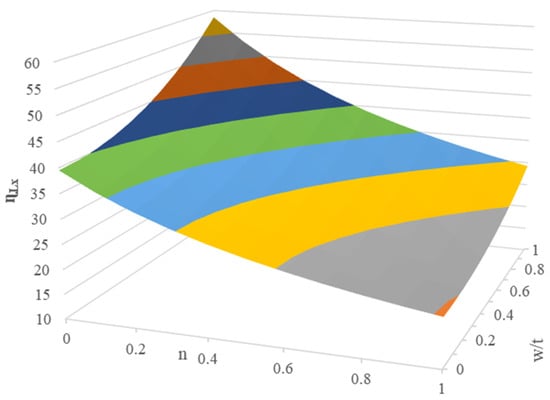
From Equation (56) the numerical values of the coefficient of biaxial buckling load for the thin isotropic rectangular SSSS plate under large displacement subject to in-plane forces are as shown in Table 2 and Figure 2 for an aspect ratio of 1.
Figure 2.
Biaxial buckling load coefficient for the SSSS plate with an aspect ratio of 1.0 under large deflection.
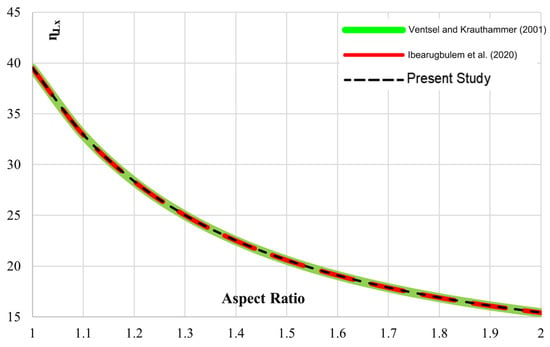
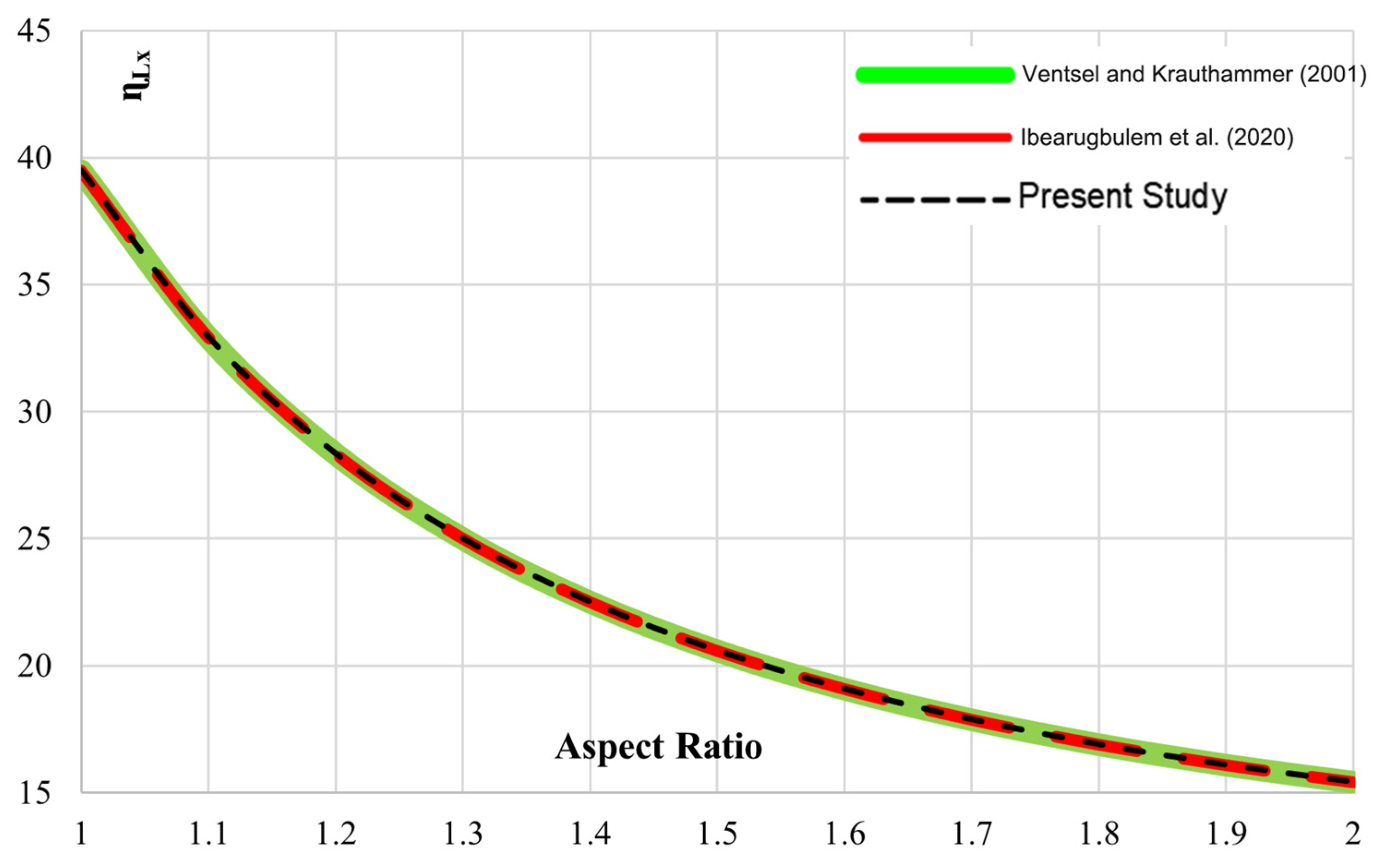
To validate these results, comparison was made with values in pieces of some literature [3,23]), as shown in Table 3 and Figure 3. Table 3 shows comparison of the buckling coefficient results of the undeformed SSSS rectangular plate of the present study and previous studies under uniaxial loading, i.e., the biaxial buckling ratio n = 0, aspect ratio = 1.0, and deflection-to-thickness ratio w/t = 0.
Table 3.
Comparison of Critical uniaxial load coefficient for the SSSS plate.
Figure 3.
Graphical representation of Critical uniaxial load coefficient for the SSSS plate [3,23].
As shown in Table 3, the results obtained in the present study exhibit a marginal deviation when compared with those reported in [3], with percentage differences ranging from 0.047% to 0.068%. Similarly, the comparison with the findings of [23] reveals a deviation ranging from 0.056% to 0.10%. In both cases, the present study consistently records slightly higher values, placing it at the upper bound of the comparisons. These discrepancies, however, are minor and are primarily attributed to approximation errors arising from differences in the computational procedures and rounding methods adopted in each study. Despite these minor discrepancies, the differences are remarkably small, ranging from 0.047% to 0.10%, which demonstrates a high degree of agreement with the established literature, and these percentage difference values are within the acceptable statistical limits. The result also reveals that the higher the aspect ratio, the lower the critical load (see Figure 3). This implies that increasing the span length of a plate reduces its load carrying capacity and increases displacement. Hence, for safety consideration, the aspect ratio of a plate is a critical factor.
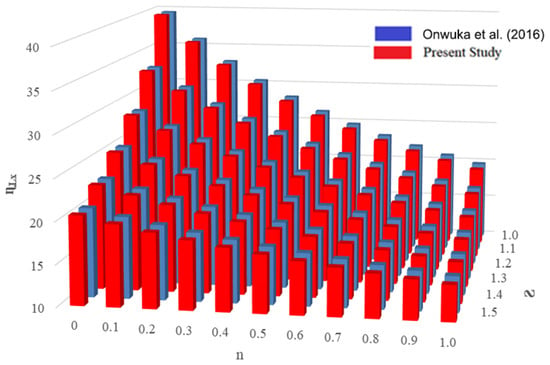
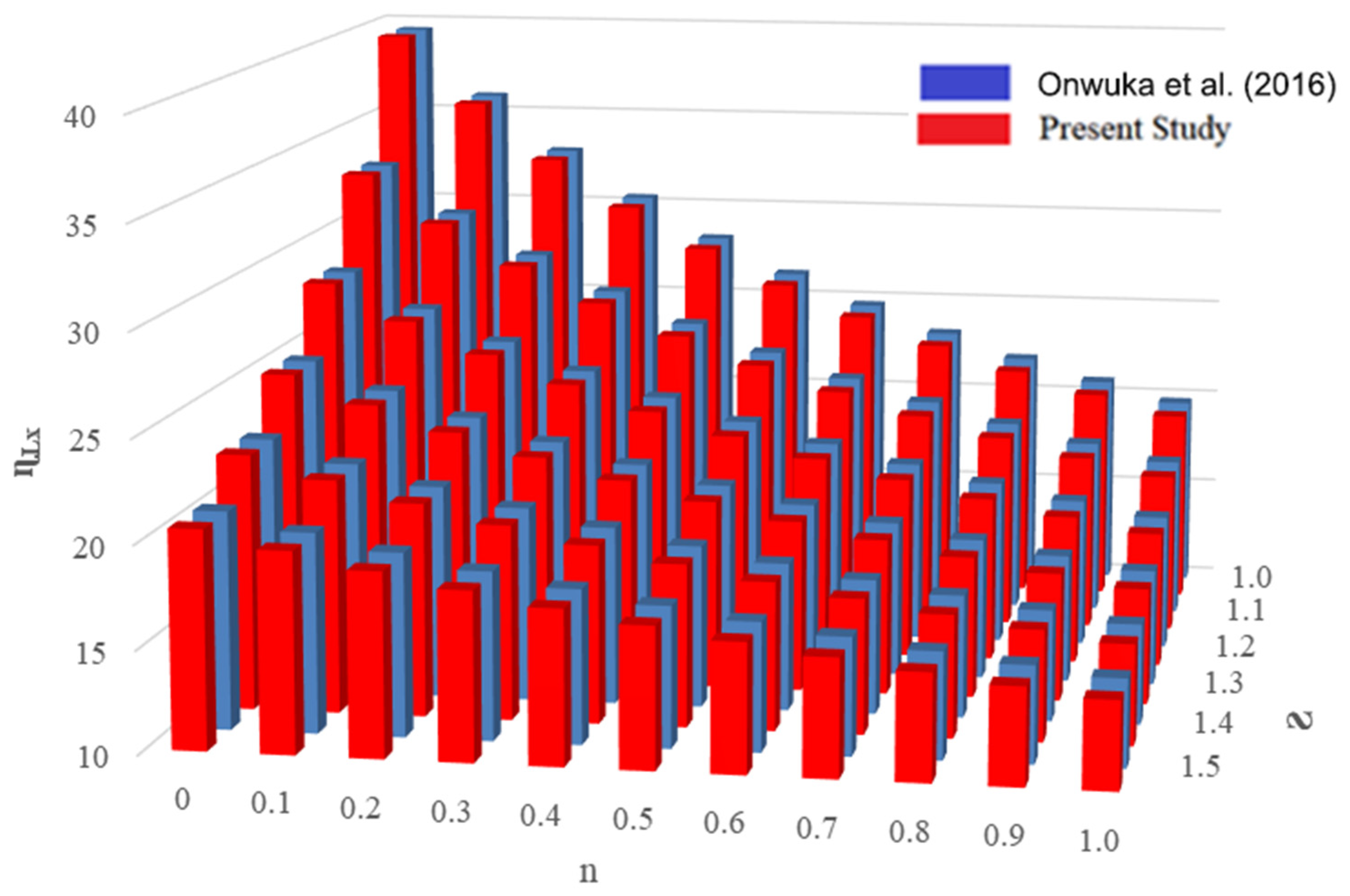
Furthermore, the undeformed biaxial buckling coefficients result for the SSSS plate at various aspect ratios are compared with the results obtained in [11], as shown in Table 4 and Figure 4 below.
Table 4.
Comparison of Undeformed biaxial buckling load coefficient results for the SSSS plate.
Figure 4.
Pictorial view of Critical biaxial load coefficient results for the SSSS plate [11].
For the biaxial in-plane buckling of SSSS plates, the undeformed buckling coefficients obtained in this study were compared with those of [11] over a biaxial loading ratio range of 0 to 1 (in intervals of 0.1) and varying aspect ratios, as shown in Table 4. The differences are minimal, confirming the accuracy and reliability of the derived formula for calculating biaxial buckling loads across a range of aspect ratios. From Table 4 and Figure 4, it is observed that the plate’s ability to resist buckling reduces as the load factor or buckling ratio increases. This highlights the effect of biaxial loading on the plate. This implies that during design, the higher the load factor, the higher the tendency of the plate to fail. Hence, the load factor is a critical factor in design, and designers must ensure that at any point, the plate strength is higher than the load factor. Also, similar to the uniaxial case, the biaxial critical load reduces with increases in the aspect ratio. All these observations are in line with the practical behavior of thin plates.
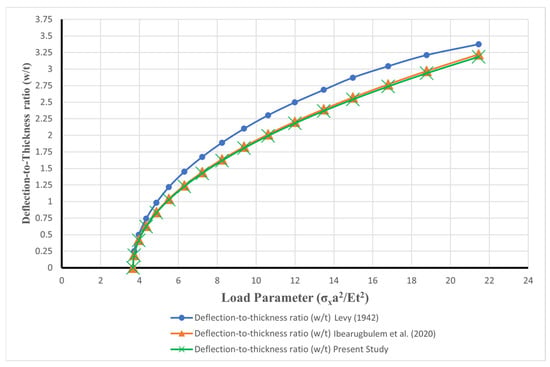
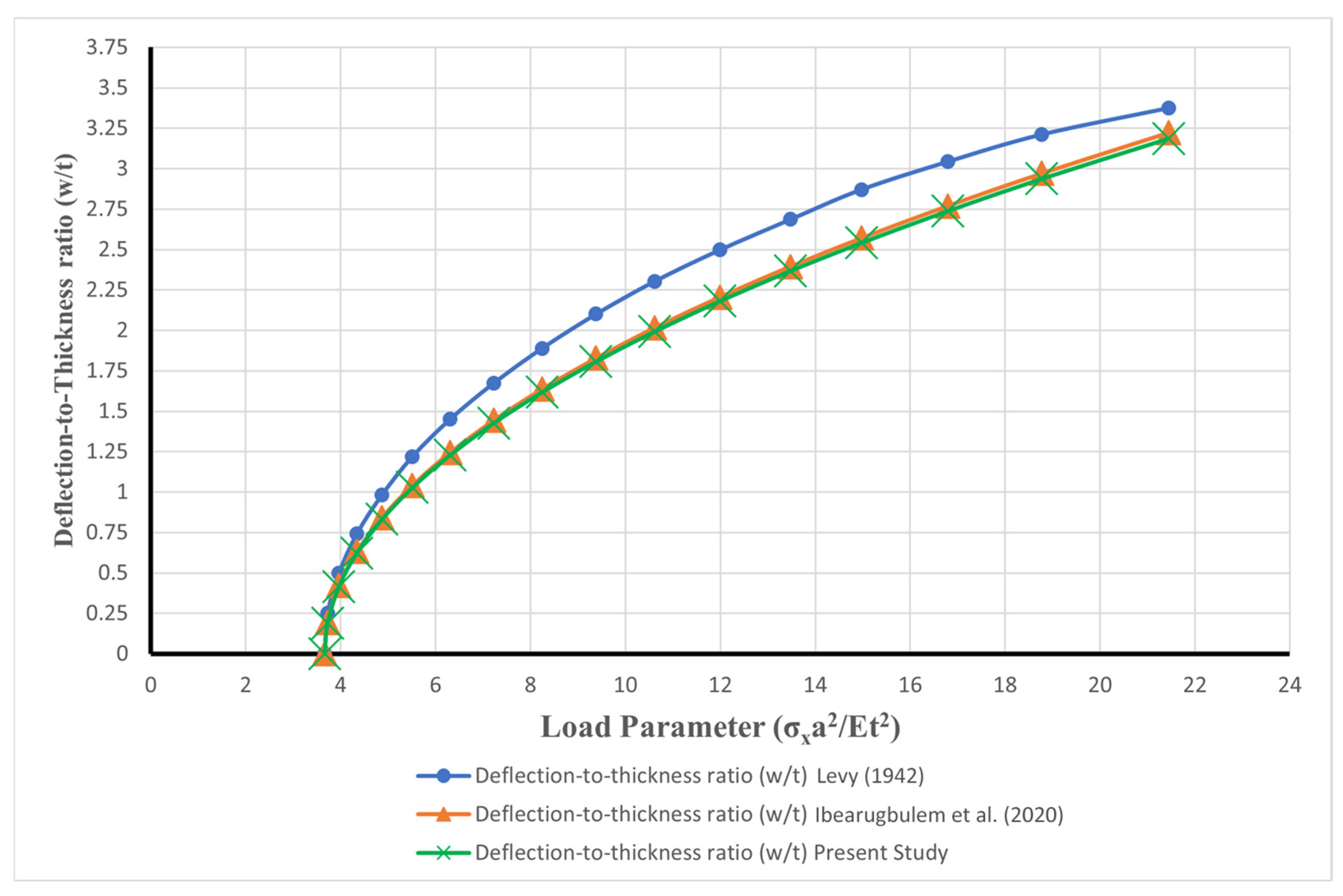
Another comparison of results is made for the deflection of the SSSS square plate for given values of the load parameter where the Poisson ratio (ν) is approximately 0.316 with the results from [14,23]. For this case, Equation (48) is used to calculate the deflection-to-thickness ratio, w/t. The results are shown in Figure 5 and Table 5.
Figure 5.
Graph of deflection-to-thickness ratio (w/t) against load parameter (σxa2/Et2) for the SSSS square plate [14,23].
Table 5.
Comparison of load parameter vs. w/t, indicating the percentage deviation.
As seen in Figure 5 and Table 5, the comparison between the results obtained in this study and those reported in [14] reveals a maximum deviation of 24.42% and a minimum deviation of 5.61%, with the present results consistently lying at the lower bound. This disparity is primarily attributed to differences in analytical approaches and assumptions adopted in the respective studies. In contrast, the comparison with the results of [23] shows a significantly smaller average deviation of 1.23%, again with the present results forming the lower bound. This slight difference is mainly due to minor approximation errors due to differences in decimal places used in the simplified method adopted here. Despite these variances, the close agreement with more established methods, especially considering the relative simplicity of the present formulation, demonstrates the reliability and practical utility of the derived expressions for efficiently determining the deflection and strength of rectangular plates.
In addition, the new mathematical model presented in this work offers an all-in-one mathematical model used to determine or analyze rectangular plates for critical load (small deflection approach), uniaxial analysis, and biaxial analysis for a wide range of boundary conditions or plate types. The proposed formulation offers a compact analytical framework suitable for stability investigations of thin isotropic plates under combined in-plane loading. Besides, the new model is applicable to a wide range of materials. What is needed is just the Poisson ratio and the Young’s modulus of elasticity values of the material. Moreso, its application to various support types have been proven by the first author in another manuscript. This makes the new model more robust for thin plate stability analysis, unlike the two long standing von Kármán partial nonlinear differential equations that Levy only attempted to solve for SSSS plates because of the difficulty of solving the von Kármán equations. This makes the new model a unique equation to save analysts from such tedious and complex analysis. This present equation also gives a clearer sequence of formulation that showcases a better understanding of the behavioral pattern of thin plates. It also offers a simple opportunity to teach the analysis of thin plates with large displacement in a classroom environment, saving time and energy.
Note that this mathematical formula or equation is limited to thin isotropic homogeneous rectangular plates. Further research is ongoing on its application to anisotropic and composite plates.
4. Conclusions
This study provides vital insights into the nonlinear biaxial compressive buckling behavior of thin rectangular plates under large displacement by offering a new refined general mathematical model for buckling and post-buckling analysis of thin isotropic plates for both uniaxial and biaxial in-plane loading. In line with the set objectives, this work has:
- Formulated a new general mathematical equation for the buckling of a thin isotropic rectangular plate with large displacement subject to biaxial in-plane forces using the Ritz energy approach (Equation (42)). By employing the Ritz energy method and an improved strain–displacement formulation, it has developed a reliable predictive model that simplifies traditional von Kármán-based approaches and enhances design efficiency.
- Applied the polynomial displacement shape function for an SSSS plate to determine the stiffnesses and formulate a specific model for an all-round simply supported SSSS thin rectangular plate under large displacement (Equation (57)).
- Compared the obtained numerical values of buckling and post-buckling loads with those in the established literature, and the results are adequate. Based on the results, the research highlights how key structural parameters such as stiffness properties, deflection-to-thickness ratio (w/t), biaxial loading ratio (n = Ny/Nx), and aspect ratio (Ƨ = b/a) influence buckling and post-buckling responses of a rectangular thin plate. The key findings reveal that increasing the biaxial loading ratio (n) reduced the critical load due to added constraints and higher susceptibility to out-of-plane deflection. Conversely, plates subjected to higher w/t ratios exhibited greater post-buckling strength, indicating beneficial nonlinear membrane effects. Additionally, as the aspect ratio (Ƨ) increased, the buckling load decreased, with elongated plates behaving more like slender columns with lower structural stiffness. These insights are crucial for optimizing plate design and improving stability under complex loading and geometric conditions. Based on the comparison analysis, the present results agree very well with those in the literature. Besides the SSSS plate type used here, the first author has demonstrated in another article the applicability of the general model to different support conditions and confirmed the adequacy of the new mathematical equation.
- Enabled the conclusion to be drawn that the present new general mathematical model is adequate for linear and nonlinear analysis of thin rectangular isotropic plates. Hence, it is recommended for the design of thin isotropic rectangular plates of different support types.
Author Contributions
Conceptualization: E.I.A., H.U.E. and A.-A.S.; Methodology: E.I.A., H.U.E., A.-A.S.; Formal analysis and investigation: E.I.A., H.U.E. and A.-A.S.; Writing—original draft preparation: E.I.A., H.U.E. and A.-A.S.; Graphics and Editing: A.M.E. All authors have read and agreed to the published version of the manuscript.
Funding
This research received no external funding.
Institutional Review Board Statement
Not applicable.
Informed Consent Statement
Not applicable.
Data Availability Statement
The original contributions presented in this study are included in the article. Further inquiries can be directed to the corresponding author.
Conflicts of Interest
The authors declare no conflicts of interest.
References
- Chandrashekhara, K. Theory of Plates; University Press: Hyderabad, India, 2001. [Google Scholar]
- Onyeka, F.C.; Osegbowa, D.; Arinze, E.E. Application of a New Refined Shear Deformation Theory for the Analysis of Thick Rectangular Plates. Niger. Res. J. Eng. Environ. Sci. 2020, 5, 901–917. [Google Scholar]
- Ventsel, E.; Krauthammer, T. Thin Plates and Shells: Theory: Analysis, and Applications; CRC Press: Boca Raton, FL, USA, 2001. [Google Scholar]
- Szilard, R. Theories and Applications of Plate Analysis: Classical, Numerical, and Engineering Methods; John Wiley: Hoboken, NJ, USA, 2004. [Google Scholar]
- Timoshenko, S.; Gere, J. Theory of Elastic Stability. In Beulen von Schalen, Vortr und Diskussionsbeitr der Schalenbeultagung; McGraw-Hill: New York, NY, USA, 1961. [Google Scholar]
- Reddy, J.N. Theory and Analysis of Elastic Plates and Shells, 2nd ed.; CRC Press: London, UK, 2006; ISBN 978-0849384158. [Google Scholar]
- Ibearugbulem, O.M.; Onyeka, F.C. Moment and Stress Analysis Solutions of Clamped Rectangular Thick Plate. Eur. J. Eng. Technol. Res. 2020, 5, 531–534. [Google Scholar]
- Onyeka, F.C.; Mama, B.O.; Nwa-David, C.D. Analytical modelling of a three-dimensional (3D) rectangular plate using the exact solution approach. IOSR J. Mech. Civ. Eng. 2022, 19, 76–88. [Google Scholar]
- Wu, B.; Pagani, A.; Filippi, M.; Chen, W.; Carrera, E. Large-deflection and post-buckling analyses of isotropic rectangular plates by Carrera Unified Formulation. Int. J. Non-Linear Mech. 2019, 116, 18–31. [Google Scholar] [CrossRef] [Scilit]
- Xiang, Y.; Wang, C.M.; Kitipornchai, S. Exact Buckling Solutions For Rectangular Plates Under Intermediate and End Uniaxial Loads. J. Eng. Mech. 2003, 129, 835–838. [Google Scholar] [CrossRef] [Scilit]
- Onwuka, D.O.; Ibearugbulem, O.M.; Iwuoha, S.E.; Arimanwa, J.I.; Sule, S. Buckling Analysis of Biaxially Compressed All-Round Simply Supported (SSSS) Thin Rectangular Isotropic Plates Using the Galerkin’s Method. J. Civ. Eng. Urban 2016, 6, 48–53. [Google Scholar]
- Chaje, A. Principles of Structural Stability Theory; Prentice Hall: London, UK, 1974. [Google Scholar]
- Enem, J.I. Nonlinear Analysis of Isotropic Rectangular Thin Plates Using Ritz Method. Saudi J. Eng. Technol. 2022, 7, 502–512. [Google Scholar] [CrossRef] [Scilit]
- Levy, S. Bending of Rectangular Plates with Large Deflections; Technical Notes; National Advisory Committee for Aeronautics (NACA): Kitty Hawk, NC, USA, 1942.
- Iyengar, N.G.R. Structural Stability of Columns and Plate; Ellis Horwood: Chichester, UK, 1988; pp. 281–289. [Google Scholar]
- Adah, E.I. Buckling and Postbuckling Analysis of SSSS Rectangular Plates using Modified Iyengar’s Equation. IOSR J. Mech. Civ. Eng. 2019, 16, 35–40. [Google Scholar]
- Oguaghamba, O.A. Analysis of Buckling and Postbuckling Loads of Isotropic Thin Rectangular Plates. Ph.D. Thesis, Department of Civil Engineering, Federal University of Technology, Owerri, Nigeria, 2015. [Google Scholar]
- Onodagu, P.D. Nonlinear Dynamic Analysis of Thin Rectangular Plates Using Ritz Method. Ph.D. Thesis, Department of Civil Engineering, Federal University of Technology, Owerri, Nigeria, 2018. [Google Scholar]
- Enem, J.I. Geometrically Nonlinear Analysis of Isotropic Rectangular Thin Plates Using Ritz Method. Ph.D. Thesis, Department of Civil Engineering, Federal University of Technology, Owerri, Nigeria, 2018. [Google Scholar]
- Oguaghamba, O.A.; Ezeh, J.C.; Ibearugbulem, M.O.; Ettu, L.O. Buckling and Postbuckling Loads Characteristics of All Edges Clamped Thin Rectangular Plate. Int. J. Eng. Sci. 2015, 4, 55–61. [Google Scholar]
- Wang, D.; El-Sheikh, A.I. Large-Deflection Mathematical Analysis of Rectangular Plates. J. Eng. Mech. 2005, 131, 809–821. [Google Scholar] [CrossRef] [Scilit]
- Zhang, L.; Wang, J.; Zhou, Y.-H. Wavelet solution for large deflection bending problems of thin rectangular plates. Arch. Appl. Mech. 2015, 85, 355–365. [Google Scholar] [CrossRef] [Scilit]
- Ibearugbulem, O.M.; Adah, E.I.; Onwuka, D.O.; Okere, C.E. Simple and Exact Approach to Post Buckling Analysis of Rectangular Plate. Int. J. Civ. Eng. 2020, 7, 54–64. [Google Scholar] [CrossRef] [Scilit]
- Adah, E.I.; Ibearugbulem, O.M.; Ezeanyagu, C.F.; Okon, E.E. An improved formulation of nonlinear strain-displacement relations and specific mathematical models for stability analysis of thin rectangular plates. J. Invent. Eng. Technol. 2023, 3, 85–102. [Google Scholar]
- Ibearugbulem, O.M.; Ezeh, J.C.; Ettu, L.O. Energy Methods in Theory of Rectangular Plates; Liu House of Excellence Ventures: Owerri, Nigeria, 2014. [Google Scholar]

Disclaimer/Publisher’s Note: The statements, opinions and data contained in all publications are solely those of the individual author(s) and contributor(s) and not of MDPI and/or the editor(s). MDPI and/or the editor(s) disclaim responsibility for any injury to people or property resulting from any ideas, methods, instructions or products referred to in the content. |
© 2026 by the authors. Licensee MDPI, Basel, Switzerland. This article is an open access article distributed under the terms and conditions of the Creative Commons Attribution (CC BY) license.