


Abstract
Modern materials science is focused on the development of steels with a range of performance characteristics, including high strength, wear resistance, corrosion resistance, and long-term performance in various conditions. Special attention is paid to the control of the microstructure of steels at the crystallization stage, which allows for the improvement of metal properties without significantly increasing the cost of the manufacturing process. One of the promising methods of microstructural engineering is the modification of steels with dispersed particles of refractory compounds, such as titanium carbide (TiC), zirconium carbide (ZrC), and tungsten carbide (WC). However, the processes of dissolution, dissociation, and interaction of such ceramic particles with the metal melt, as well as their influence on the formation of the microstructure and properties under the conditions of non-equilibrium crystallization, which is typical for centrifugal casting, are not sufficiently studied for austenitic stainless steels. In this work, the influence of dispersed carbide particles of TiC, ZrC, and WC, which are introduced into the melt of austenitic stainless steel (Cr ≈ 18%, Ni ≈ 10%) during centrifugal casting, on the redistribution of alloying elements, the formation of the microstructure, and the mechanical properties of the material is investigated. Special attention is paid to the kinetic nature of the dissolution and interaction of the carbides with the melt, as well as the directional distribution of elements across the cross-section of the billets. The study includes the analysis of the distribution of Ti, W, and Zr across the cross-section of the centrifugally cast billets, the study of the microstructure and phase composition of the inclusions using SEM/EDS, and mechanical testing. It is found that the implementation of dispersion hardening leads to an increase in the tensile strength by up to ~22% compared to the initial alloy (from 496 to 612 MPa), while the impact strength decreases by 5–25% (from 110 to 82 J/cm2) depending on the type and quantity of the introduced particles. The analysis of microhardness shows the presence of a gradient of local properties across the cross-section of the centrifugally cast billets, with microhardness values ranging from ~110 to 195 HV0.5. For the modified samples, the relative difference between the inner and outer zones is ~5–20%, reflecting the combined effect of non-equilibrium solidification, redistribution of alloying elements, formation and spatial distribution of secondary phases, and local structural heterogeneity. These results confirm the possibility of controlling the distribution of properties within a single billet.
1. Introduction
In modern research, microstructural modification of metals by the introduction of dispersed particles of micron and submicron sizes is considered as one of the possible ways to improve mechanical properties, including strength, hardness, and wear resistance [1,2,3,4]. This approach allows for the formation of composite materials with specific characteristics by even or intentionally non-uniform distribution of strengthening phases within the matrix [5,6,7,8,9]. Several studies have shown that the introduction of dispersed particles can influence crystallization processes, inclusion morphology, and local mechanical properties, especially when combined with directional solidification and casting methods [10,11,12].
The main approaches for microstructural modification using dispersed particles involve introducing pre-formed reinforcing phases into the melt and/or controlling the internal precipitation of particles within the metal matrix. In this context, reinforcing particles intentionally introduced into the melt should be distinguished from conventional metallurgical inclusions (oxides, sulfides, etc.), which form unintentionally and are not considered strengthening phases. For stainless steels, including austenitic and martensitic classes, these approaches are considered additional strengthening mechanisms and allow for varying the balance between strength and ductility of the material by manipulating microstructural factors. The effectiveness of these methods is largely determined by the size, quantity, and spatial distribution of particles, as well as the crystallization conditions. Stainless steels encompass several metallurgical classes, including ferritic, austenitic, duplex, martensitic, and precipitation-hardened grades. In the present work, the discussion is intentionally focused on austenitic and precipitation-hardened stainless steels, as these classes are most relevant to particle-assisted strengthening and gradient structure formation due to their high alloying levels, stable austenitic matrix, and sensitivity of mechanical properties to microstructural heterogeneity.
In precipitation-hardened PH-type steels, the hardening efficiency is determined by the composition and number of particles that form during aging. Nanoscale precipitates based on nickel, copper, and titanium provide increased strength while maintaining plasticity if their distribution in the matrix is uniform and they are coherent with the crystal lattice [10,13,14]. Titanium and niobium additives contribute to the formation of TiC and NbC carbides, as well as fine intermetallic precipitates, which improve strength and increase the thermal stability of the structure [14,15]. In martensitic and super-martensitic steels, the introduction of titanium changes the morphology of carbides, refines grains, and promotes the formation of Ti(C,N) particles, which strengthen the material with a moderate decrease in impact toughness [16,17].
Another way to improve properties is the formation of gradient structures in the material volume. With centrifugal casting and directional crystallization, it is possible to obtain billets in which the content of hardening phases varies from the surface to the center. Thus, when tungsten carbides are introduced into stainless steel, a structure with a hard, wear-resistant surface and a more ductile core can be formed. Such a gradient structure improves wear and fatigue resistance while maintaining an acceptable level of overall ductility rather than providing a simultaneous enhancement of all mechanical properties [12,18]. A similar effect is achieved when modifying the melt with rare earth elements, which change the shape and composition of nonmetallic inclusions, improving steel cleanliness and corrosion resistance [19,20]. Titanium-containing modifiers are also used as inoculants in steel casting, contributing to more uniform crystallization and grain refinement [21].
In recent years, approaches aimed at creating property gradients not only through phase composition but also through internal substructure have been actively developed. Thus, mechanical surface hardening or controlled thermal treatments lead to the formation of regions with different grain sizes and defect densities. This creates a transition from a hard and strong surface to a more ductile core, providing high yield strength while maintaining sufficient ductility [22,23,24]. Such gradient structures are advantageous in terms of fatigue and fracture resistance, as they reduce stress concentration between layers with different properties [25].
Combinations of dispersed precipitates and gradient structures are of particular interest for austenitic and duplex steels. Studies have shown that the combined effect of nanoscale precipitates and structural heterogeneity across the thickness of the material can provide very high strength while maintaining reasonable plasticity [11,26]. In this case, the distribution of particles along grain boundaries plays an important role, as they impede dislocation motion and suppress localized deformation.
Studies of steels containing TiC, WC, and ZrC particles have shown that such systems exhibit a combination of several strengthening mechanisms: solid-solution, dispersion, and structural strengthening. At the same time, titanium contributes to a more uniform distribution of reinforcing particles and structural stability, tungsten increases hardness primarily due to dissolution in the matrix, and zirconium promotes the formation of oxide–carbide inclusions that enhance structural stability at elevated temperatures [27,28].
Thus, analysis of the literature shows that the controlled introduction or precipitation of particles in stainless steels is an effective tool for tailoring their properties. The use of directional and centrifugal casting methods makes it possible to form internal gradients of composition and structure without resorting to coating or powder-based technologies. Such materials typically exhibit a trade-off between increased strength and hardness and reduced ductility, making them promising for critical structural and high-temperature applications.
The purpose of this work is to experimentally study the effect of dispersed refractory carbide particles (TiC, WC, and ZrC) introduced into the melt during centrifugal casting on the formation of a gradient microstructure and the mechanical properties of austenitic stainless steel.
To achieve this goal, the following tasks were addressed:
- –
- Analyzing the distribution of titanium, tungsten, and zirconium across the cross-section of centrifugally cast billets;
- –
- Studying microstructural features and determining the types of inclusions formed during single and combined carbide additions;
- –
- Evaluating the impact of the introduced carbides on the material’s strength characteristics.
2. Materials and Methods
Experimental samples were obtained using a high-frequency induction melting unit SELT-001-15/44-T (InterSELT LLC, Saint-Petersburg, Russia). The unit is equipped with an inductor, and the lining made of periclase-sharpened printed matter (75% MgO and up to 7% SiO2) was updated before the experiments.
Smelting was performed using 12X18H10T steel (C ≤ 0.12%, Cr = 17–19%, Ni = 9–11%, Ti ≤ 0.7%, Mn ≤ 2%, Si ≤ 0.8%, S ≤ 0.02%, p ≤ 0.035%, Fe—balance), while deoxidation was performed by primary powder aluminum, and the resulting slag was removed before casting. Before the experiments, the initial powders of TiC, WC, and ZrC carbides were examined using scanning electron microscopy to assess the typical particle size. It was found that the predominant particle size for titanium carbide was ~10–20 μm, for tungsten carbide it was ~4–9 μm, and for zirconium carbide it was ~5–10 μm. While some particles may have been smaller or larger, the majority of particles (approximately 95% based on visual assessment) fell within these ranges.
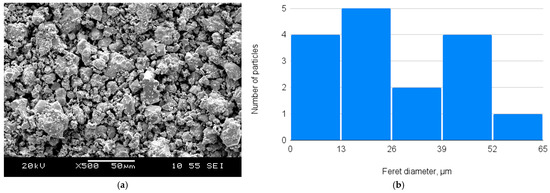
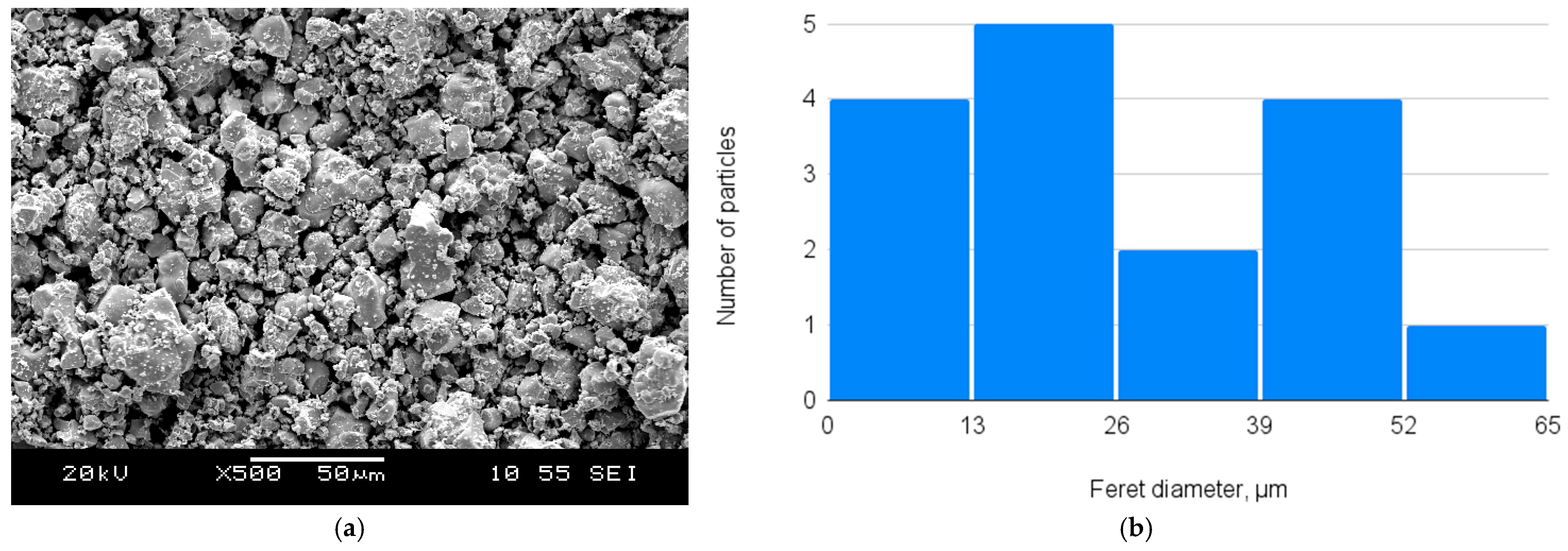
To validate this assessment, a quantitative analysis of particle size distribution was performed using ImageJ software (v. 1.52u) on SEM micrographs (Figure 1). For each carbide type, at least 600 primary particles were measured; agglomerates larger than 50 µm were excluded. The results are as follows: TiC—median = 12.55 µm, mean = 13.52 ± 5.67 µm (CV = 42%, n = 605); WC—median = 5.90 µm, mean = 6.63 ± 3.76 µm (CV = 57%, n = 620); ZrC—median = 7.15 µm, mean = 7.85 ± 3.12 µm (CV = 40%, n = 615). These values confirm the accuracy of the initial visual estimation (Table 1).
Figure 1.
Study of source particles: (a) SEM micrograph of initial WC powder (×500); (b) particle size distribution of WC.
Table 1.
Used samples.
The dimensions of the obtained blanks were as follows: outer diameter, 120 mm; height, 90 mm; wall thickness, 16–19 mm; weight of the obtained blanks, 3.5–4 kg (depending on the diameter). The inner and outer sides had satisfactory surface quality, characteristic of hardened centrifugal cast blanks: a dense crust on the outer surface with metal deposits on samples with the maximum number of introduced particles and a loose inner surface with traces of shrinkage phenomena, slag, and potholes.
The obtained samples were subjected to heat treatment in a laboratory chamber. Heating up to a temperature of 680 °C was carried out for 50 min, after which the exposure was carried out for 1 h. The cooling was carried out in a closed furnace for 24 h. The heat treatment mode was selected to relax the casting stresses without significantly changing the microstructure formed during centrifugal casting. This approach allowed for the preservation of the distribution of dispersed carbide particles and their interaction products with the matrix, which could be eliminated at higher temperatures during dissolution annealing.
For further microstructural studies, the samples were cut into 10 mm thick fragments on an Ergonomic 320.250 DGH band saw (BOMAR LLC, Brno, Czech Republic) without overheating. The cut was made closer to the central part of the cylinders to assess the uniformity of the particle distribution over the section. Rectangular fragments were prepared from each of the samples. Next, these fragments were pressed into plastic capsules on a Simplimet 1000 hot-pressing machine (Bühler Holding AG, Uzwil, Switzerland). The obtained samples were sanded and polished on an EcoMet 250/300 grinding (Bühler Holding AG, Uzwil, Switzerland) and polishing machine with an AutoMet semi-automatic nozzle (Bühler Holding AG, Uzwil, Switzerland), using diamond pastes and gradually reducing the size of the abrasive until a mirror-like surface was achieved. Before the study, the samples were etched in a solution consisting of 30 mL of nitric acid (HNO3), 20 mL of hydrochloric acid (HCl), 50 mL of distilled water, 5 g of ferric chloride (FeCl3), and 3 g of copper chloride (CuCl2).
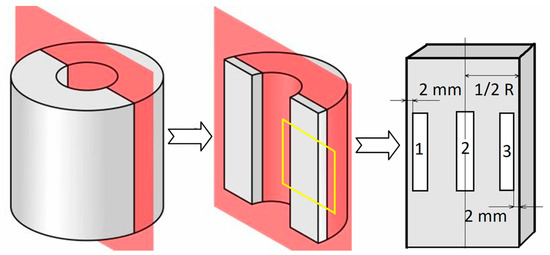
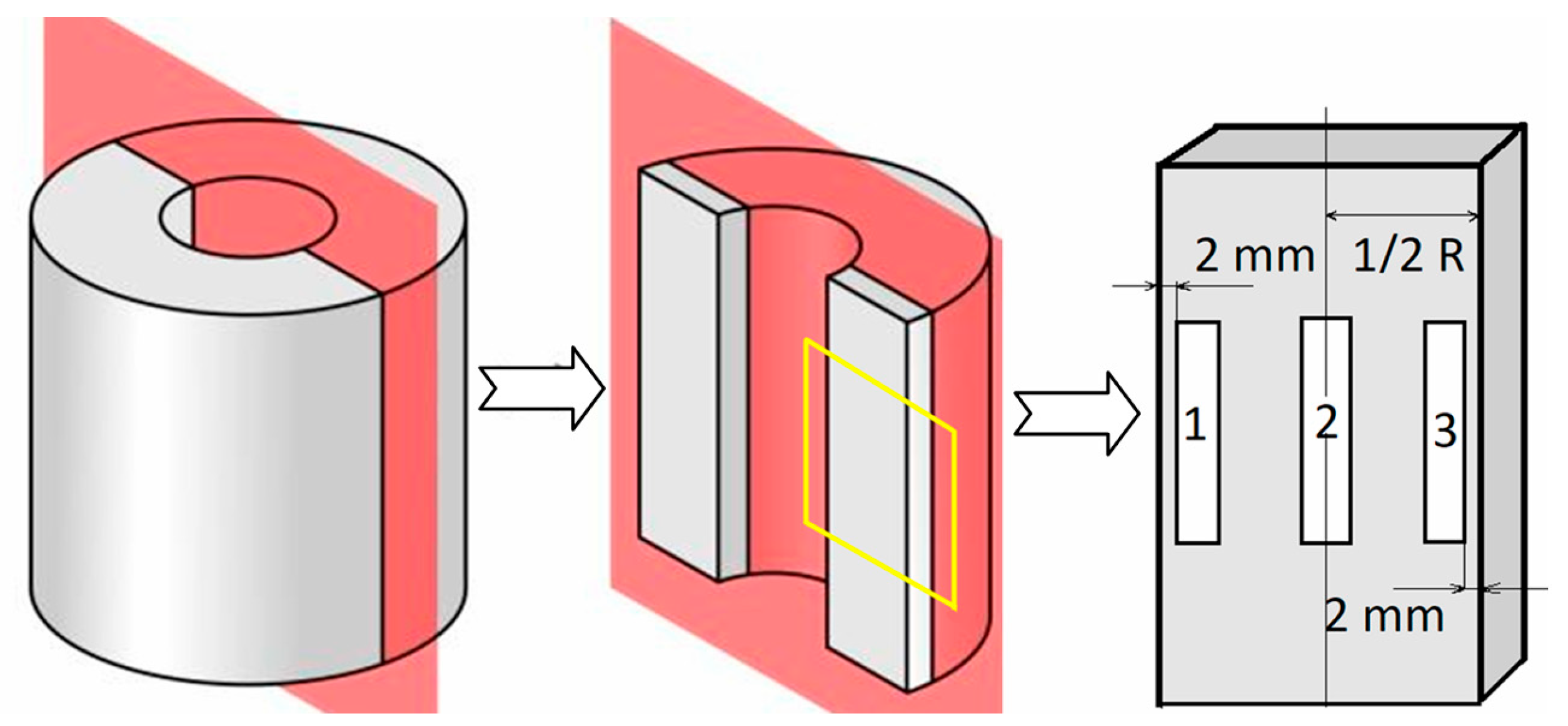
Metallographic studies were conducted using an Axio Observer MAT optical inverted microscope and the Thixomet software package (v.5.3), as well as a JEOL JSM–6460 LV scanning electron microscope (JEOL Ltd., Tokyo, Japan) equipped with an energy-dispersive X-ray analysis system (EDS, Oxford Instruments, Oxfordshire, UK). Electron microscopy studies were performed using secondary and backscattered electron modes. The study methodology involved a sequential examination of the microstructure across the cross-section of the billets, from the inner surface to the outer surface. The exact locations of the analyzed zones (inner, mid-radius, and outer) are indicated in Figure 2. For each selected area, an energy-dispersive analysis of the elemental composition was performed, where spectra were recorded from the surface of the sample within the field of view at a magnification of ×30. At least three independent EDS spectra were acquired per zone (inner, mid-radius, and outer) to ensure statistical reliability. Bulk matrix composition (Table 2) was determined from these averaged EDS spectra acquired at ×30 magnification to ensure representative sampling. In contrast, inclusion chemistry (e.g., Zr-O-C aggregates) was assessed via point analyses at ×2000 magnification on individual particles. Thus, the obtained spectra correspond to the averaged elemental composition of the selected surface areas within the field of view at this magnification and are not intended to determine the bulk chemical composition of the alloy. The obtained data were used to analyze the changes in the elemental composition across the cross-section of the billets, which allowed for the assessment of the redistribution of alloying elements and the possible interaction of the introduced carbide particles with the metal matrix during the crystallization process and subsequent heat treatment.
Figure 2.
Sample cutting scheme for microstructure and microhardness studies: 1—inner surface; 2—mid-radius (1/2 R); 3—outer surface.
Table 2.
Average distribution of Ti, W, and Zr across the cross-section of the workpieces based on EDS analysis.
The energy-dispersive analysis was also used for qualitative and semi-quantitative identification of the types of inclusions. However, it should be noted that the EDS method has limitations in the determination of light elements (C, N, O) and is not intended for precise phase or stoichiometric analysis. Consequently, carbon, nitrogen, and oxygen concentrations presented in Table 3 should be regarded as qualitative indicators only and are not suitable for quantitative assessment. Therefore, the interpretation of the phase composition of the inclusions is qualitative and based on a combination of morphological features, contrast in the BSE mode, and the relative ratio of elements in the spectra. The microstructure images indicate specific areas and points where spectra were collected, and the size of the dispersed particles was visually assessed using SEM micrographs at a magnification of ×2000. The provided size ranges are for estimation and comparison purposes. To complement the visual assessment, a quantitative analysis of in situ particle size distribution was performed for selected samples using ImageJ software on BSE-SEM micrographs. Particle identification was carried out via threshold segmentation followed by manual refinement to exclude non-carbide features (e.g., δ-ferrite networks or oxide films). Feret diameter was used as the primary size metric. Multiple fields of view were analyzed per sample to ensure statistical reliability, with total particle counts exceeding 200 where applicable.
Table 3.
Elemental composition of inclusions based on energy-dispersive analysis (EDS), wt.%.
To study the mechanical properties of the centrifugally cast billets, samples were prepared for tensile, impact, and microhardness tests. The billets were cut using a bandsaw, and the samples were machined to the desired dimensions. Due to the relatively thin thickness of the billets, the method was limited to cutting standard samples for mechanical tests from different radial zones. Therefore, the tensile and impact samples were made from the central part of the billets, ensuring the accuracy and comparability of the results.
Tensile tests were performed on cylindrical samples manufactured in accordance with GOST 1497–84 [29] using a UT 110M–5 tensile testing machine (Testsystems LLC, Ivanovo, Russia). The samples had a working part with a diameter of 4 mm and a length of 40 mm, and the gripping parts had a diameter of 9 mm. At least three samples were tested for each blank, and the results section presents the average values of the tensile strength and elongation.
The impact strength was determined using the Charpy method on an IO 5003–0.3 pendulum impact testing machine (New Technologies LLC, Kazan, Russia) in accordance with GOST 9454–78 [30]. Rectangular samples with dimensions of 10 × 10 × 50 mm and a U-shaped notch were used for testing. At least three repeated tests were performed for each composition, and the Results section presents the average values of the impact strength.
Microhardness was measured using an ITV-1 microhardness tester with a Vickers indenter at a load of 0.5 kgf (4.903 N) and a holding time of 15 s, which corresponds to the HV0.5 scale. Measurements were performed along the cross-section of the workpiece from the inner to the outer surface to assess the hardness gradient. For each radial zone (inner, middle, and outer), a series of at least five indentations was made with an interval greater than the size of the indentation diagonal to exclude mutual influence. The values presented in the Section 3 represent the arithmetic mean ± standard deviation. The observed spread (±3–8 HV0.5) reflects the microstructural heterogeneity inherent in centrifugally cast austenitic steel, including carbide clustering, δ-ferrite networks along grain boundaries, and microsegregation gradients.
3. Results
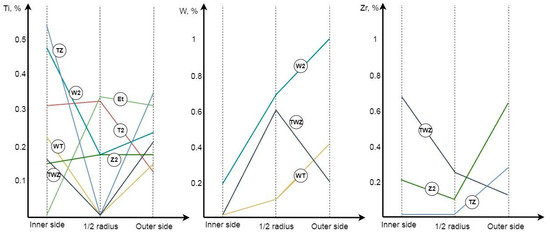
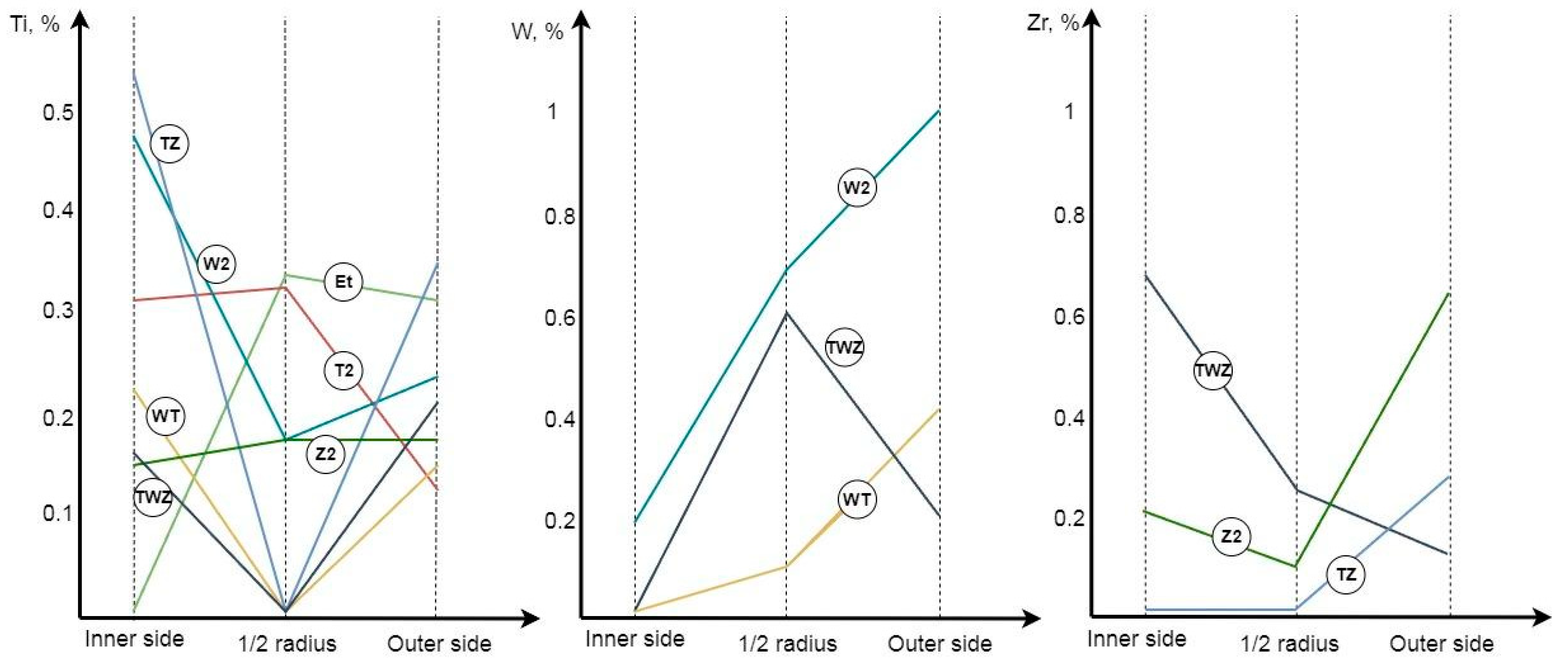
In the study of the chemical composition heterogeneity across the cross-section of the workpieces, at the first stage, the cross-sectional distribution of titanium, tungsten, and zirconium was evaluated using averaged EDS spectra acquired at ×30 magnification, which provides an integrated measure of total elemental content (both dissolved and particulate) in each zone. This approach enables assessment of macrosegregation trends across the billet cross-section. Special attention was paid to the distribution of titanium, tungsten, and zirconium across the cross-section of the workpieces (Table 2). Based on the table results, distribution graphs were constructed (Figure 3). The data in Table 2 and Figure 3 represent mean values obtained from at least three independent EDS measurements per zone (inner, 1/2R, outer). Corresponding standard deviations (±SD) are reported in Table 2 to reflect experimental scatter. Due to the high density of data series in Figure 3, error bars are omitted for clarity; however, the full uncertainty information is provided in Table 2.
Figure 3.
Distribution of Ti, W, and Zr over the cross-section of the samples.
Studies of microstructures using optical and electron microscopes have shown that the etalon sample is characterized by a homogeneous composition of the base alloy without additives, with minimal inclusions, and a morphology typical of austenitic steel (fine dispersed inclusions of oxides, sulfides, and nitrides without carbide particles, angular or rounded, without agglomeration). Point spectra at the intersection of the lines confirm the absence of additional introduced carbides Ti, Zr, and W.
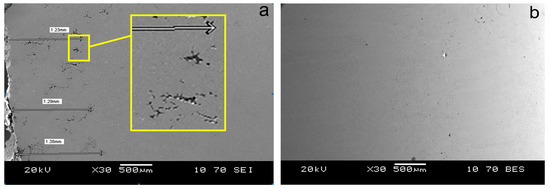
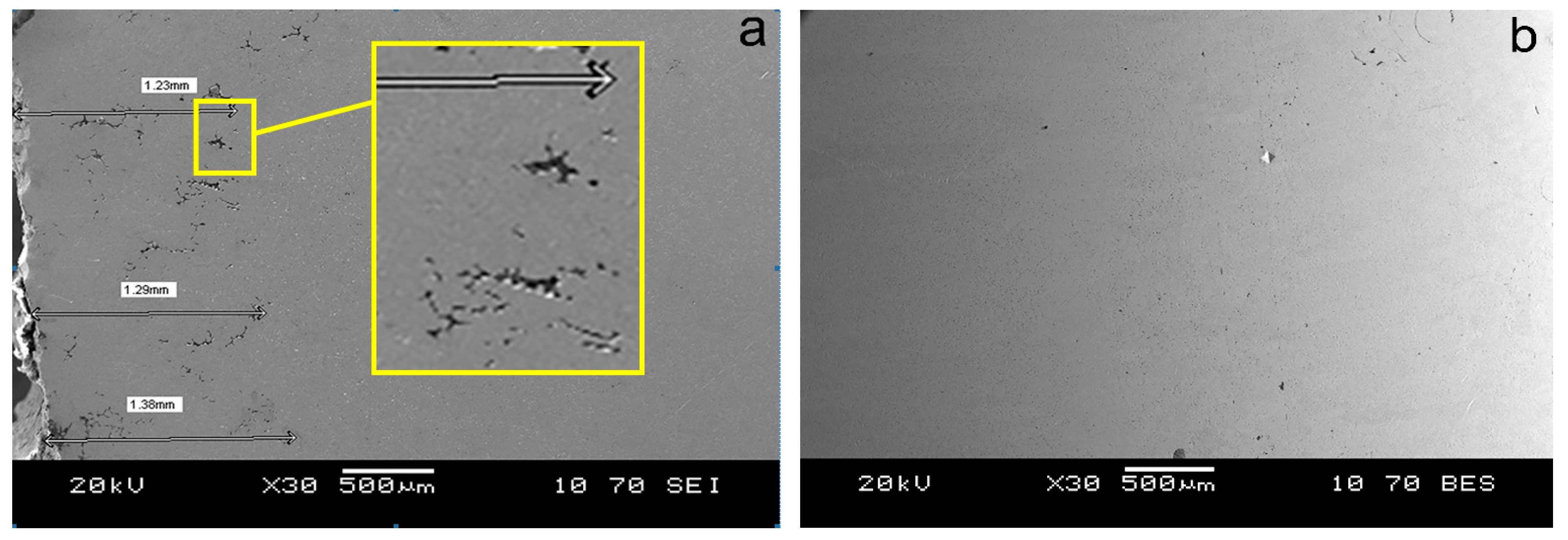
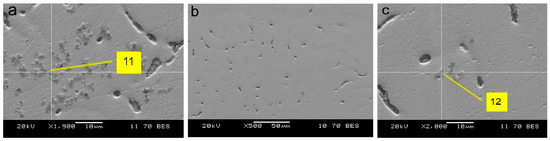
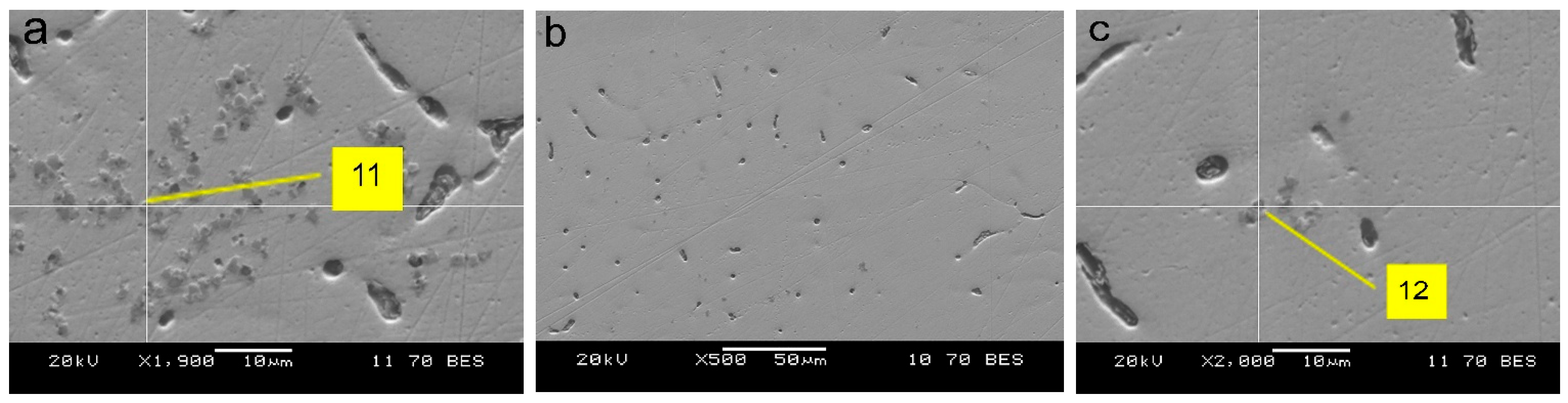
On the inner side of the etalon, there are elongated dark areas and local breaks that visually resemble crack-like defects (Figure 4). However, their morphology, orientation, and localization indicate their shrinkage nature, which is typical for centrifugally cast billets in the absence of modifying additives. These areas are interpreted as foundry shrinkage defects rather than secondary phase precipitation or actual cracks. It should be noted that in samples with the introduction of dispersed TiC, WC, and ZrC carbide particles, such shrinkage phenomena were not observed, indicating a more stable crystallization process and a reduced tendency to form shrinkage defects.
Figure 4.
Etalon sample microstructure: (a) inner surface; (b) outer surface.
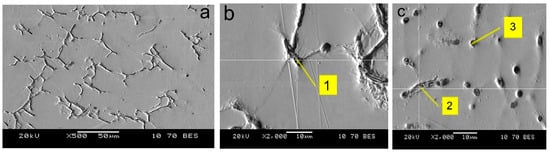
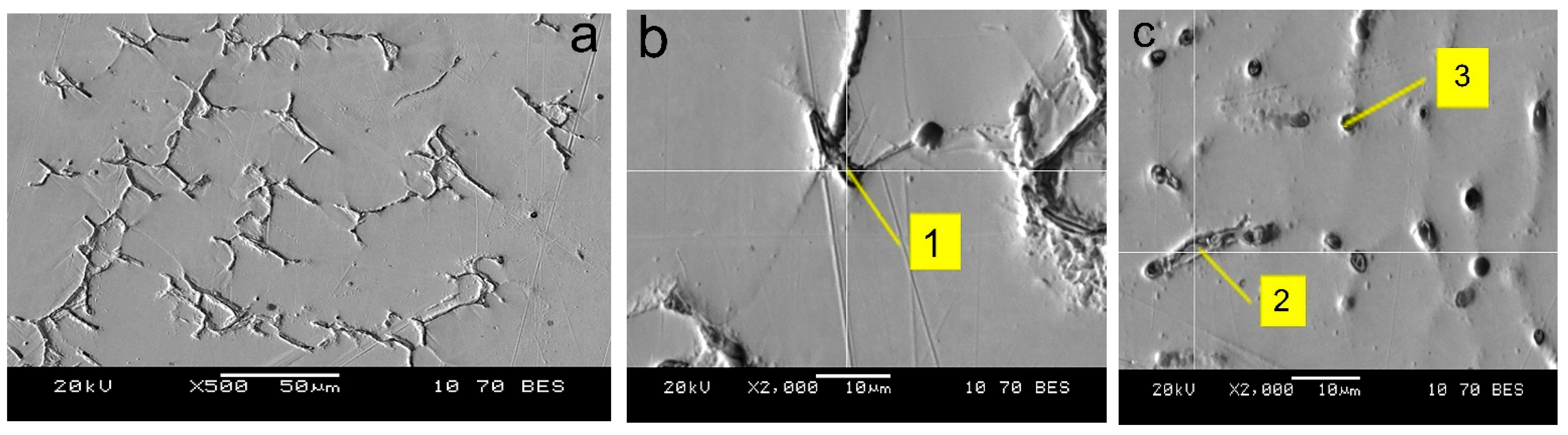
The microstructures of all the studied workpieces, including the reference blank that does not contain dispersed additives, show characteristic dark-etched areas, which are predominantly located along the grain boundaries of the austenitic matrix (Figure 5a–c). These areas have an elongated or branching morphology that visually repeats the direction of the grain boundaries, and they retain this characteristic in all the studied alloys, regardless of the presence of TiC, WC, or ZrC particles. However, the studied blanks do not exhibit a pronounced dendritic morphology with well-developed branching of dendritic axes. This is likely due to the high crystallization rate during centrifugal casting of thin-walled blanks, where dendritic growth occurs within a limited time interval and manifests itself primarily as microsegregation and interdendritic phases along the grain boundaries.
Figure 5.
Etalon sample microstructure: (a) general view of the δ-ferrite; (b) location of sampling spectrum 1; (c) locations of sampling spectrums 2 and 3.
Chemical analysis based on point spectra (Table 3) revealed that the dark contrast regions exhibit an increase in iron and chromium content, while the nickel content decreases, and there is also a local presence of carbon and oxygen. The data presented in Table 3 are based on energy-dispersive analysis (EDS) and reflect the local elemental composition of the inclusions in weight percentages (wt.%). This combination of elemental composition corresponds to δ-ferrite (delta ferrite) formed during non-equilibrium solidification, with possible impurities of carbide and oxide inclusions. It should be noted that the observed chromium enrichment is of a local microstructural nature and does not result in the formation of a stable macroscopic chromium segregation across the cross-section of the blanks, as evidenced by the systematic enrichment of the near-surface zone compared to the core.
The magnetic test confirmed the presence of a magnetic response in all the samples, which indirectly indicates the presence of the δ-ferrite, as the austenitic matrix is non-magnetic. The magnetic response is considered a qualitative indicator rather than a method for quantitative phase assessment. Since the billets were not subjected to plastic deformation, the detected magnetic δ-ferrite is associated with solidification-related ferritic regions rather than deformation-induced α′-martensite. The ferrite fraction was estimated visually at approximately 5–10% based on etching contrast in optical micrographs. Quantitative phase analysis (e.g., ASTM E562 [31] point counting or magnetic susceptibility measurements) was not performed in this study; this represents a limitation of the present work. Nevertheless, the observed ferrite content falls within typical ranges for centrifugally cast austenitic stainless steels (ASTM A351 CF-8/CF-8M grades permit 5–20% δ-ferrite) and, crucially, is present in the unmodified Etalon sample—confirming its origin from non-equilibrium solidification conditions rather than carbide additions. The light-etched areas between dark boundaries represent the austenitic (γ) matrix, which constitutes the primary phase (>90%) in all samples. Its grain structure is not distinctly resolved in optical micrographs due to chemical homogeneity after etching—a typical characteristic of cast austenitic stainless steels. Thus, the observed residual magnetism originates solely from the minor fraction of δ-ferrite formed during solidification, while the dominant austenitic matrix remains fully stable and non-magnetic.
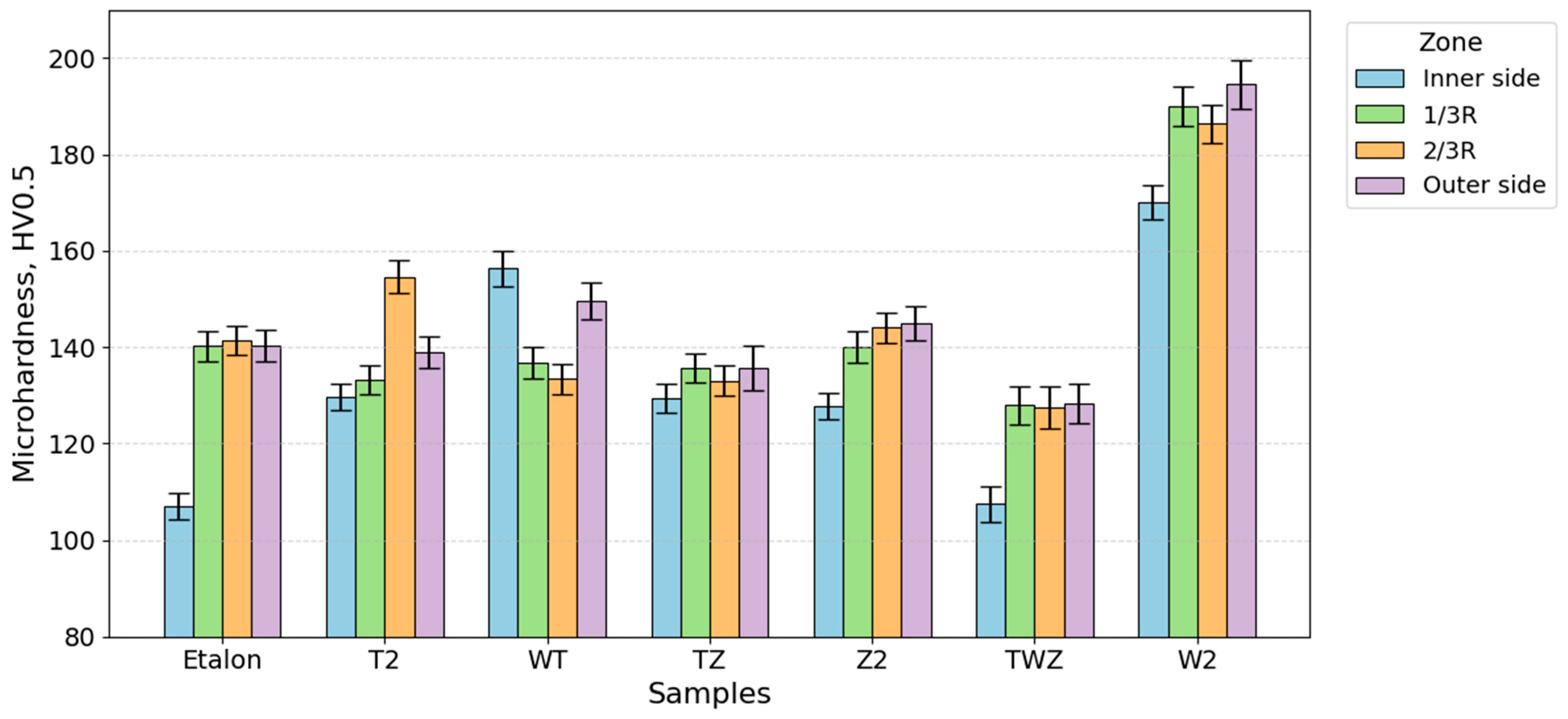
Thus, the subsequent stress-relief annealing at 680 °C did not generate any new ferrite phase; it only relaxed casting stresses and may have slightly enhanced the etching contrast of the pre-existing δ-ferrite network. Therefore, the presence of the δ-ferrite can be considered a natural consequence of the heat treatment of the studied billets and the chemical heterogeneity of the alloy. This observation is of practical significance, as even a small fraction of ferritic content can affect the magnetic properties and mechanical anisotropy of the material. The characteristic absence of dispersed inclusions indicates that the change in the hardness of the reference material is due to microstructural features, internal stresses after cooling, and local structural inhomogeneities formed during the centrifugal casting process. This is evident in the variation of the microhardness across the billet’s cross-section, ranging from 106.9 HV0.5 in the inner part to 140.3 HV0.5 on the outer surface, which is associated with the formation of a denser structure in the near-surface regions.
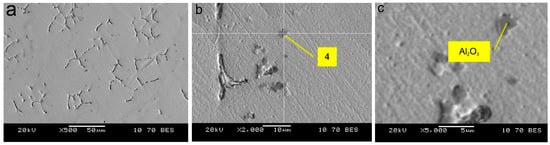
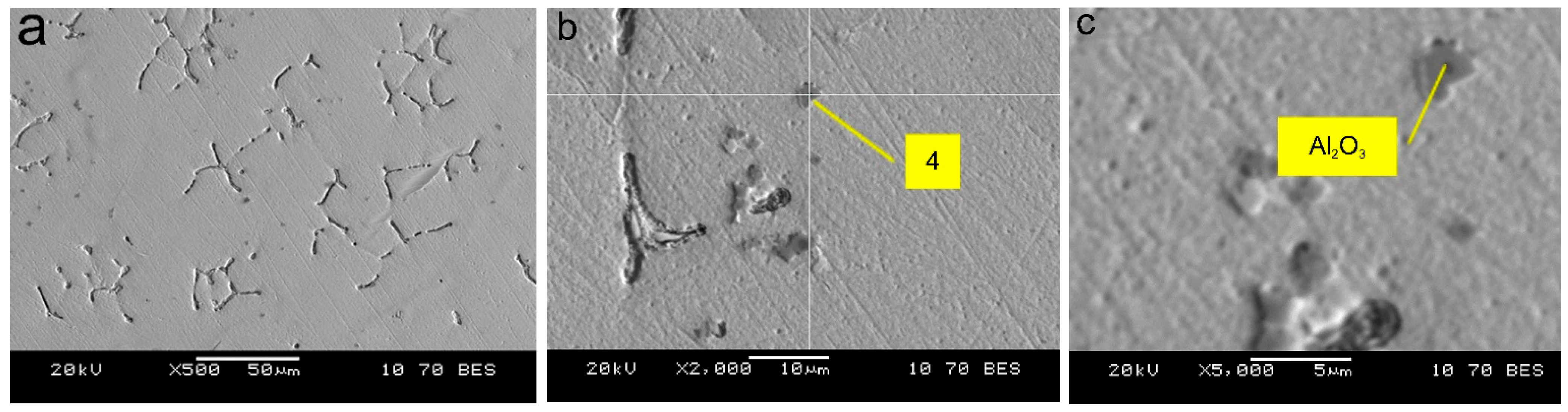
The addition of titanium carbide (sample T2) significantly changes the morphology and phase distribution: the inner part contains single small TiC and Ti(C,N) inclusions, while the central and outer zones exhibit a uniform distribution of small discrete particles (2–3 μm in size) that form a network along the grain boundaries (Figure 6). These particles exhibit high chemical stability and hinder the movement of dislocations. Additionally, the sample contains complex TiC/Ti(C,N) compounds with traces of O/Al, with a local oxidized shell and a nitride/carbonitride center (Figure 5c). Microhardness measurements revealed values ranging from 129.7 to 138.9 HV0.5. Notably, there is a decrease in the difference between the inner and outer zones compared to the reference sample, indicating a more uniform distribution of local properties across the workpiece. Therefore, the addition of TiC does not lead to an increase in the absolute level of hardness but rather to a smoothing of the microhardness gradient formed during the centrifugal casting process.
Figure 6.
T2 sample microstructure: (a) inner surface; (b) location of sampling spectrum 4 on the outer surface; (c) inclusion in the center.
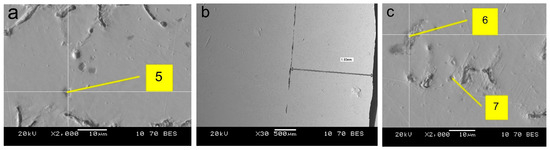
When zirconium carbide is added, the microstructure of the Z2 sample retains its overall uniformity, but the number of particles increases towards the outer side, and in some cases, regions enriched with zirconium and oxygen are observed. These regions are interpreted as complex Zr–O–Si oxide–carbonitride formations, predominantly localized at grain boundaries (Figure 7). However, the microhardness values remain within the range of 127–145 HV0.5, indicating a moderate strengthening effect of zirconium carbide, although the microhardness gradient is less pronounced than in the reference sample.
Figure 7.
Z2 sample microstructure: (a) inner surface; (b) detachment on the outer surface; (c) inclusions on the outer surface.
A distinctive feature of this sample is the presence of a distinct crust zone 1.9 mm from the edge, which is not observed in other samples (Figure 7b). This zone is likely the result of a localized increase in particle flow during casting, resulting in insufficient metal to react with the incoming particles and the formation of a “detachable layer.” This region is not typical and occurs sporadically on a single sample.
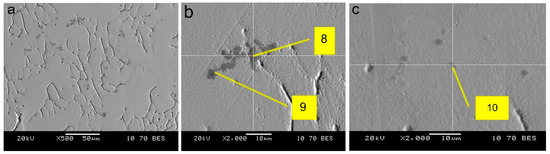
In the TZ sample with a combined feed of TiC and ZrC, there is a more pronounced structural heterogeneity: in the inner surface zone, the number of carbide and oxycarbide particles is significantly higher than in the central part and on the outer surface (Figure 8), while the microhardness gradient across the sections has significantly leveled out. There are also particles with aluminum oxide in the center, surrounded by nitrides and carbonitrides (Figure 8b). The distribution of particles has changed: on the outer surface, there is a clustering of particles, while in the middle and inner regions, there are individual particles (Figure 8c).
Figure 8.
TZ sample microstructure: (a) inner surface; (b) workpiece center with clusters of inclusions; (c) inclusions on the outer surface.
In a multi-component TWZ sample containing titanium, zirconium, and tungsten carbides, a complex spatial organization of phases is observed (Figure 9). The microstructure is characterized by an extremely uneven distribution of a large number of small (2–3 μm) carbonitride and oxocarbide particles throughout the cross-section of the workpieces. The highest concentration of particles is observed on the outer and inner surfaces, where they are arranged in separate clusters. In the middle region, particles are typically arranged individually (Figure 8b). No individual tungsten carbide particles are found in either this sample or the W2 sample (with the highest amount of WC), but tungsten is present in the matrix of the carbide-containing samples. This suggests that the particles dissociated during interaction with the metal and subsequent heat treatment. This is supported by the microhardness values for the W2 sample, which increased by approximately 30% compared to the etalon sample.
Figure 9.
TWZ sample microstructure: (a) inner surface; (b) workpiece center; (c) inclusions on the outer surface.
The combination of microstructure and microhardness data suggests that the change in the mechanical properties of these compositions is due to a combination of dispersion strengthening due to the presence of TiC, WC, and ZrC particles, as well as structural effects related to the redistribution of internal stresses and microstructural ordering during subsequent thermal treatment.
For all blanks, the distribution of nitride and carbonitride particles per field of view was calculated at 2000-fold magnification (field of view area 0.002473 mm2). The assessment was carried out for 10 visual fields. Next, the average value was calculated. The results are presented in Table 4.
Table 4.
Particle distribution over the workpiece cross-section.
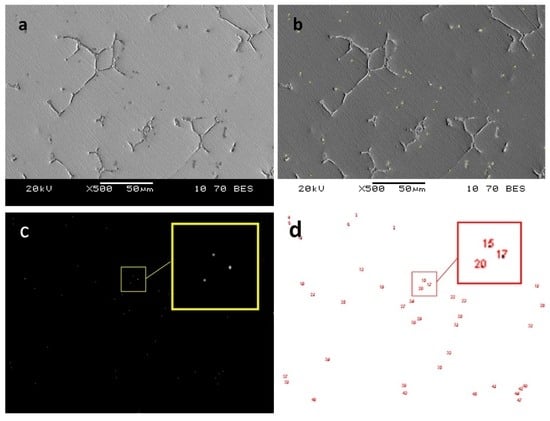
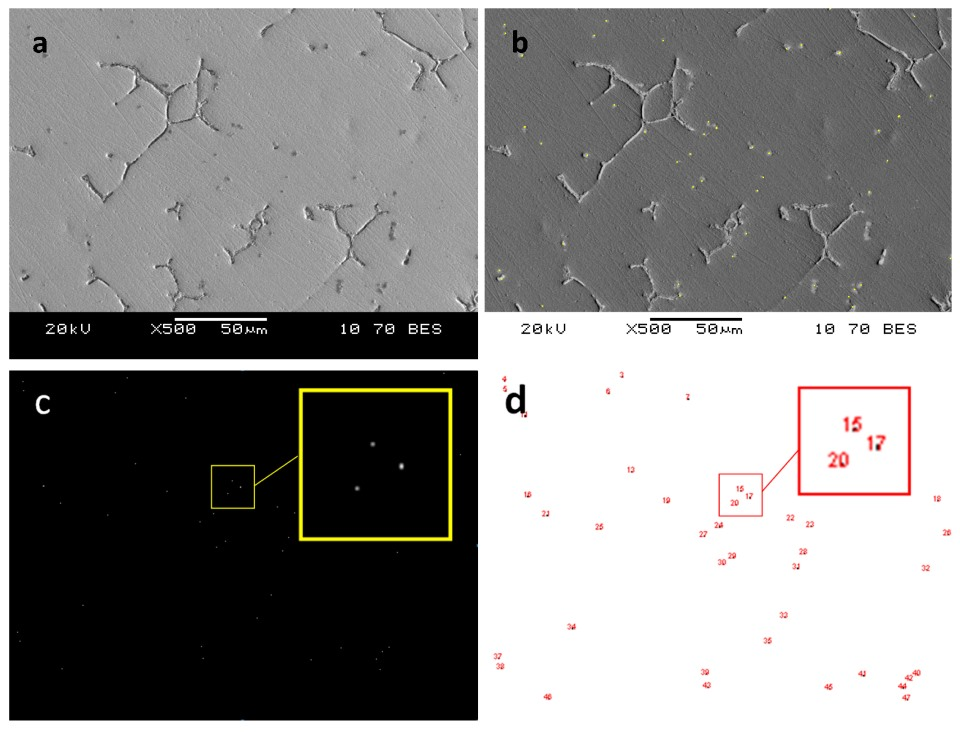
To validate the visual particle assessment presented in Table 4, quantitative image analysis was performed for the T2 sample using ImageJ software on BSE-SEM micrographs acquired at ×500 magnification. Five independent fields of view in the outer zone were analyzed, yielding a total of 247 particles. The average Feret diameter was 2.2 ± 0.7 µm (CV = 32%), corresponding to a particle density of approximately 640 particles/mm2 and an estimated volume fraction of ~0.25 vol.%. These results confirm the visually estimated size range of 1–4 µm reported in Table 4 and demonstrate the feasibility of statistically robust particle characterization in centrifugally cast microstructures. The analysis workflow is illustrated in Figure 10.
Figure 10.
Quantitative particle analysis workflow in the outer zone of the T2 sample (BSE-SEM, ×500, scale bar = 50 µm): (a) original micrograph; (b) binary image after thresholding (same field as «a»); (c) enlarged region (yellow box in (c) showing manually verified particles as white dots on black background—magnified for visibility; (d) particle labeling output from ImageJ (same field), with numbered particles (e.g., 15, 20, 17); the inset shows a magnified view of the numbering for clarity. Total particles counted across 5 fields: n = 247; mean Feret diameter = 2.2 ± 0.7 µm.
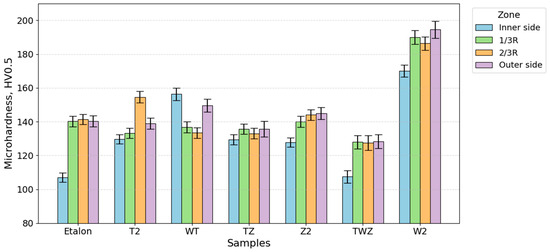
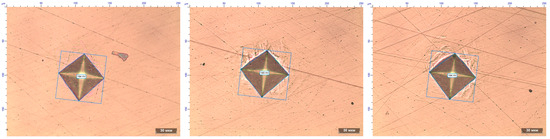
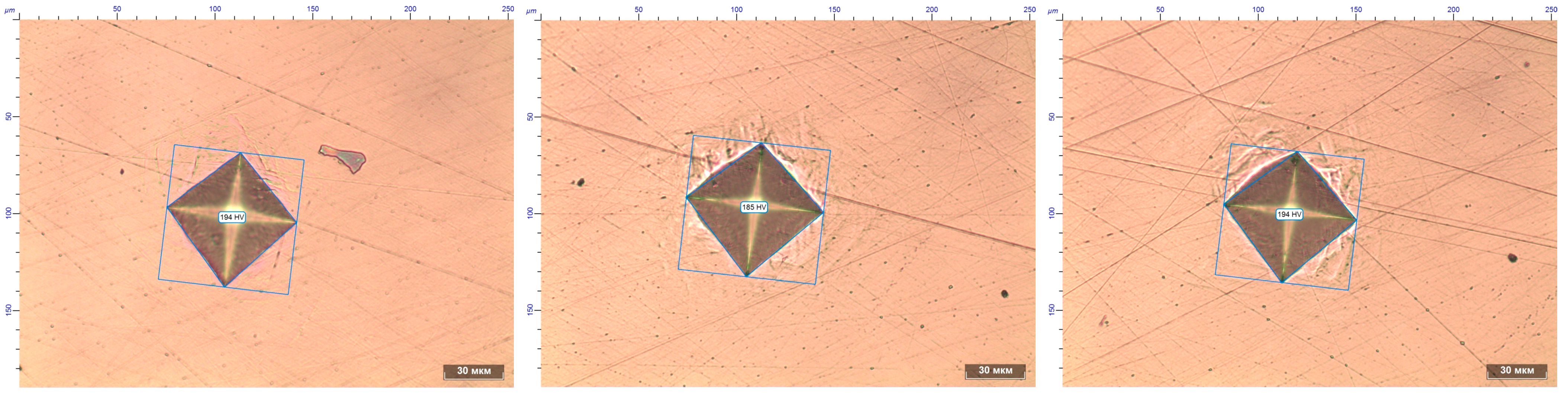
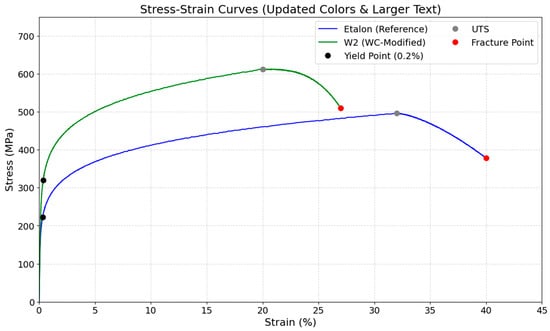
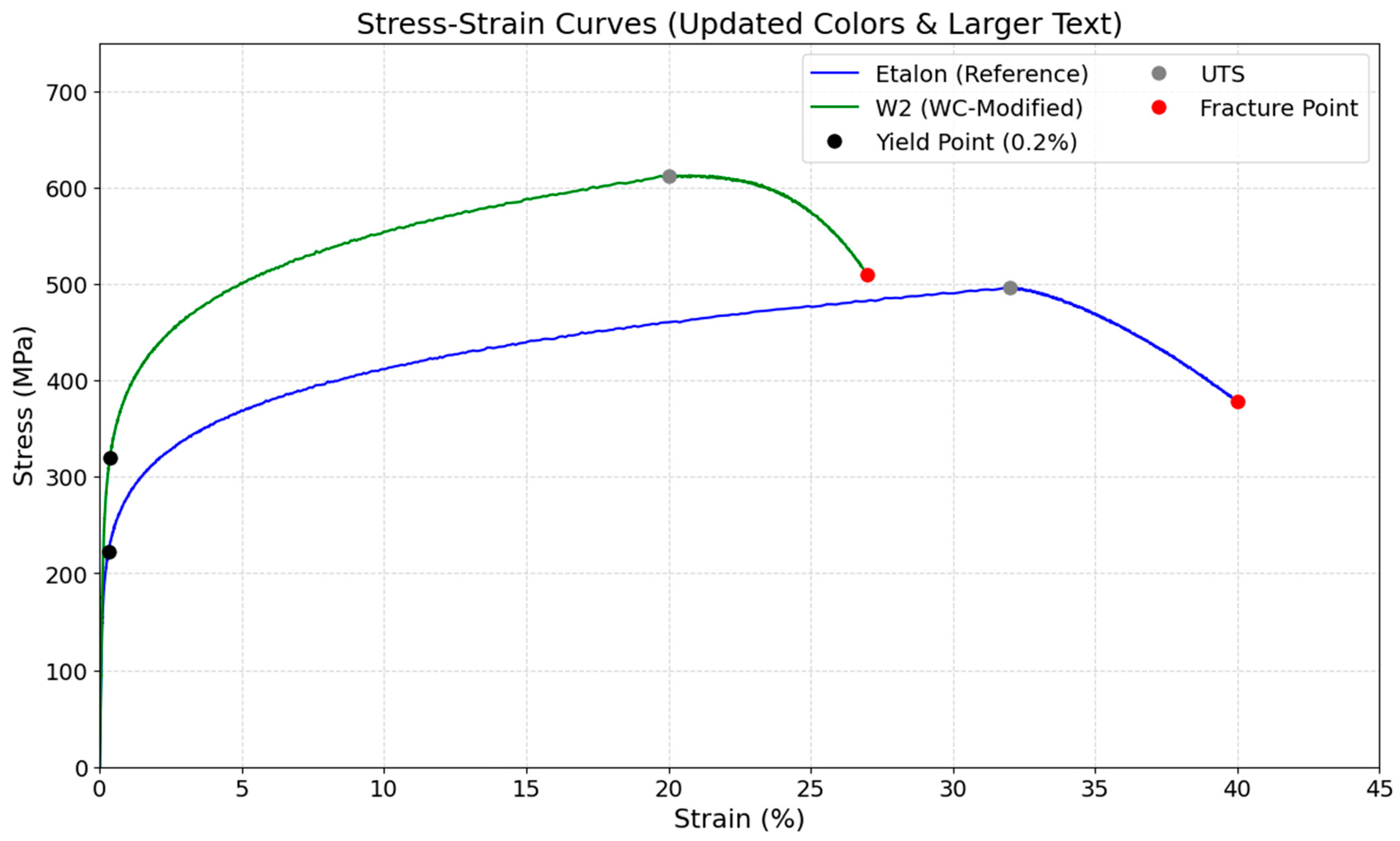
All samples were also examined for mechanical properties (Table 5) and microhardness (Table 6), and based on the microhardness results, a graph was plotted (Figure 11). Representative Vickers indentation marks for sample W2 are shown in Figure 12 to confirm measurement reproducibility. Tensile testing revealed that all investigated compositions exhibited a qualitatively similar stress–strain response, characteristic of cast austenitic stainless steels: elastic deformation followed by distinct yield, continuous strain hardening, and ductile fracture without abrupt failure. Given this uniformity in deformation behavior, a schematic stress–strain curve illustrating the typical tensile response is presented in Figure 13, with representative examples for the unmodified Etalon and the WC-modified W2 sample to highlight the contrast in strength and ductility induced by carbide addition. Due to the small thickness of the blanks, samples were cut from the middle part to assess the mechanical properties, and the axis of the samples approximately corresponded to a half-radius. Yield strength values correspond to the 0.2% offset yield point, as determined in accordance with GOST 1497–84 [29].
Figure 11.
Microhardness distribution across the cross-sections of centrifugally cast billets (HV0.5). Error bars represent ± standard deviation (SD); measurements were performed with n = 5 indentations per zone. Data are from Table 6.
Figure 12.
Representative Vickers indentations on the outer surface of sample W2. Measured HV0.5 values: 194, 185, and 194 HV. Scale bars: 30 µm.
Figure 13.
Schematic illustration of a typical stress–strain curve for centrifugally cast austenitic stainless steel, showing elastic deformation, yield point (0.2% offset), strain hardening, and ductile fracture.
Table 5.
Mechanical properties of the samples (mean ± SD, n = 3).
Table 6.
Microhardness distribution across billet cross-sections, HV0.5 (mean ± SD, n ≥ 5).
For the etalon sample, the properties are lower than those typical for deformed steel, which is due to the casting method and the subsequent annealing. Annealing reduces residual stresses, increasing ductility, but the δ-ferrite reduces the ductility by 10–20% compared to homogenizing annealing, similar to what is observed in cast stainless steels such as CF-8 [32]. The introduction of carbide particles in some samples leads to changes in mechanical properties, which may be due to the dispersive effect of discrete inclusions that hinder the movement of dislocations [33]. This results in a moderate decrease in ductility and impact strength, which is likely caused by the formation of inclusions and their local clustering [33]. For the T2 sample, there was an increase in the tensile strength by 31 MPa, accompanied by a decrease in the KCU to 93 J/cm2, which correlates with the distribution of TiC/Ti(C,N) particles predominantly along the grain boundaries. Similar effects of dispersed carbide particles on the strength characteristics of cast metal matrix composites (MMCs) have been observed in other studies [34].
A similar mechanism was observed in the Z2 sample, where an increase in the tensile strength was accompanied by a decrease in the KCU. In this case, the strengthening is associated with complex Zr–O–Si oxide–carbonitride formations that are predominantly localized along the grain boundaries. The core zone has a local effect on the ductility, but the overall uniformity of the structure and annealing minimize this decrease, and the sample cutout area is approximately in the middle of the billet. There is evidence in the literature that zirconium carbide in austenitic composites increases the strength by 5–10% due to oxide inclusions but reduces the elongation by a similar percentage [35]. The combination of TiC and WC additions increased the tensile strength to 545 MPa, while reducing δ to 33% and KCU to 86 J/cm2, due to the combined effect of titanium-containing particles and dissolved tungsten. The dissociation of tungsten carbide during casting and annealing contributes to solid-solution strengthening, but the clustering of inclusions may reduce ductility [36].
In the TZ sample, the changes in properties compared to the reference are minimal: a slight increase in the tensile strength by 10 MPa and a decrease in the KCU by 12 J/cm2, which is likely due to the aligned gradient that maintains plasticity through Zr oxides at the boundaries.
The multi-component TWZ sample exhibits a decrease in all properties, with a tensile strength of 460 MPa and a KCU of 105 J/cm2. Among all the samples, this is the only one that showed a decrease in all indicators, which can be attributed to the competition between particles, clustering, and the highest gradient of particle count across the cross-section.
The most significant increase in the tensile strength is observed in the W2 sample, where the tensile strength is 612 MPa, accompanied by a decrease in the KCU to 82 J/cm2, which is due to the dissociation of WC and the enrichment of the matrix with tungsten. In cast steels, this modification enhances strength through supersaturation of the solid solution but reduces ductility due to potential stress concentrations [37]. The overall gradient of the structure (harder outer layers and a more ductile center) provides a comprehensive improvement in properties without a sharp phase boundary, which is beneficial for mechanical integrity under load.
It should be noted that all fracture surfaces exhibited a mixed-mode morphology typical of cast austenitic stainless steels, with no qualitative differences observed between the etalon and modified samples. Therefore, the interpretation of impact toughness is based solely on quantitative KCU values, which reliably reflect the embrittlement trend induced by carbide modification.
4. Discussion
The observed distribution of Ti, W, and Zr elements (Figure 3) is well explained by centrifugal casting, crystallization kinetics, and the chemical affinity of the elements. For samples containing titanium carbide additives (T2, WT, TWZ, and TZ), an increased titanium content is observed near the inner surface of the billets, with a decrease in the middle region and a partial recovery of the concentration towards the outer surface. This is consistent with the fact that titanium is actively bound to TiC/Ti(C,N) carbonitrides during the early stages of crystallization, and some discrete particles are retained and “washed out” by the solidification front from the middle zone, resulting in a minimum of dissolved titanium [38]. In the later stages of crystallization, the inner surface of the billets retains a higher proportion of dissolved Ti and smaller particles, while the outer surface contains some titanium in the form of thin oxidized particle shells (Ti–O, Ti–Al–O) that were trapped by the “cold crust” during early cooling. In some microstructures, complex inclusions with an aluminum oxide core (Al2O3) surrounded by carbonitride shells were observed (Figure 5c), indicating local chemical interactions between the introduced titanium-containing particles and oxygen-containing non-metallic inclusions in the melt. Therefore, the observed distribution profile of titanium across the billets is a result of the combined effects of early carbonitride formation, particle displacement by the solidification front, and subsequent oxidation–reaction interactions in the near-surface regions, as confirmed by SEM/EDS analysis. The light-etched regions observed between the dark boundaries correspond to the austenitic (γ) matrix, which constitutes the dominant phase in all samples; its grain morphology is not sharply resolved after etching, which is typical for cast austenitic stainless steels.
Statistical analysis of the mechanical properties was performed to assess the significance of changes induced by carbide modification relative to the etalon sample. Independent two-sample t-tests (assuming unequal variances) were conducted based on mean values and estimated standard deviations (SD) from at least three replicate tests per sample. The results indicate statistically significant increases in ultimate tensile strength (σ_UTS) and yield strength (σ_{0.2}) in WC-modified samples, particularly in W2 (σ_UTS: t = 9.29, p = 0.0014; σ_{0.2}: t = 11.65, p = 0.0007) and WT (σ_UTS: t = 4.42, p = 0.013; σ_{0.2}: t = 8.25, p = 0.0014). This reflects the dominant role of solid-solution strengthening due to the dissolution of WC particles and enrichment of the metallic matrix with tungsten, as confirmed by EDS analysis data (Table 3). The corresponding decreases in elongation and impact strength were also statistically significant in these samples (W2: elongation t = 6.24, p = 0.005; impact strength t = 4.85, p = 0.010; WT: elongation t = 3.36, p = 0.035; impact strength t = 4.51, p = 0.011), consistent with reduced ductility resulting from the presence of tungsten in solid solution.
For samples modified with TiC and ZrC (T2, Z2), moderate but statistically significant increases in σ_UTS and σ_{0.2} were observed (e.g., T2: σ_UTS t = 2.91, p = 0.045; σ_{0.2} t = 5.18, p = 0.007), whereas changes in elongation and impact strength were marginal or statistically non-significant (p > 0.05 for elongation in T2 and Z2). Combined modifications (TWZ, TZ) exhibited minimal or statistically non-significant differences (e.g., TWZ: σ_UTS t = 3.99, p = 0.017—borderline significant; impact strength t = 1.11, p = 0.332—non-significant; TZ: σ_UTS t = 0.98, p = 0.383—non-significant). This suggests interactions between carbides that limit the overall strengthening effect, likely due to altered dissolution kinetics and redistribution of alloying elements across the billet cross-section. The obtained data confirm the gradient nature of properties, with the most pronounced effects observed in WC-modified billets, in agreement with the identified microstructural heterogeneity and spatial distribution of secondary phases.
In all samples with introduced tungsten carbide (W2, WT, and TWZ), a systematic increase in concentration towards the outer side was observed. In microstructures, WC particles in the solid phase are extremely rare, and tungsten is predominantly found in the solid solution of the γ-matrix and/or in the composition of thin shells of mixed precipitates [39]. This behavior of WC in austenitic stainless steels has been previously reported by other authors, who have shown that introduced tungsten carbide particles can partially dissociate and participate in the solid-solution strengthening of the matrix without preserving the original morphology of the WC particles [40]. The apparent dissolution of WC particles during centrifugal casting is consistent with their known thermodynamic instability in iron-based melts at high temperatures. According to published data [40], WC decomposition becomes thermodynamically favorable above approximately 1500 °C, which aligns with the casting temperature used in this study (~1700 °C). In contrast, TiC and ZrC are characterized by highly negative enthalpies of formation (ΔH_f ≈ –184 kJ/mol for TiC and –208 kJ/mol for ZrC, per standard thermochemical data), resulting in exceptional thermal stability up to 1800 °C. This explains why TiC and ZrC persist as discrete inclusions, while WC dissolves into the matrix. Under these conditions, the degree of WC dissolution is determined by the kinetics of the carbide’s interaction with the liquid metal and the time of contact between the particles and the melt before intensive crystallization begins, rather than by the equilibrium solubility limit of tungsten in austenite. The increase in tungsten content towards the outer surface can be explained by the sequence of non-equilibrium crystallization and the early fixation of the chemical composition in the outer zone, while the inner part of the workpiece solidifies later. As a result, the outer surface crystallizes a tungsten-enriched composition of the melt, while the inner region (late crystallization) remains relatively depleted. In the TWZ sample, tungsten exhibits an unusual behavior, with the highest concentration observed in the middle of the sample. In previous studies by the authors, such results were not observed [41,42]. The key difference in tungsten’s behavior is the multi-component feed (more than two types of carbides in the mixture), which suggests that the distribution processes are complicated by the competing formation and dissolution of Ti- and Zr-carbides, which alter the local carbon activity and slow down the diffusion of tungsten. However, the overall trend of enrichment towards the outer surface remains consistent, which aligns with the observed morphology and increased microhardness in the surface regions. These observed features of the TWZ system can be explained from the perspective of general concepts of multi-component melt modification, where excessive complexity of the composition without considering the thermodynamic and kinetic compatibility of the components often leads to inferior properties compared to simpler systems.
The most pronounced gradient in chemical composition is observed in the Z2 and TZ samples: the concentration of Zr increases towards the outer side, with a minimum at 1/2R. This is due to the high oxidative activity of Zr, which quickly forms oxide–carbide clusters (Zr–O–C, ZrO2-containing) in the melt, which nucleate and adhere to the early-forming outer crust (the zone of intense heat dissipation and contact with the oxide film at the mold wall) [16,43]. These clusters have reduced mobility and are effectively captured by the crystallization front near the surface. The middle zone is characterized by the removal of inclusions by both the solidification front and thermocapillary convection (with a minimum at 1/2R), while the inner zone captures only a portion of the smaller inclusions [44]. After annealing, the thin Zr-oxide shells deplete the carbonitrides, maintaining a high Zr concentration near the surface but not significantly increasing the hardness (which is consistent with the average microhardness values that are close to the reference values).
The observed differences in the distribution of Ti-, W-, and Zr-containing phases have a direct impact on the mechanical properties of the resulting workpieces. The tungsten-containing systems exhibit the highest increase in tensile strength, which is attributed to the peripheral enrichment of the solid solution and the contribution of solid-solution and dispersion strengthening. However, local areas of solid solution supersaturation can lead to a decrease in impact strength. In the titanium and zirconium systems, the changes in mechanical properties are primarily driven by the presence of dispersed inclusions and structural stabilization, resulting in a more balanced combination of strength and ductility.
The results of microhardness measurements show that centrifugal casting, as a process, forms a pronounced gradient of local properties across the cross-section of the workpiece, even in the unmodified state. It should be emphasized that the observed microhardness gradients are not related to deformation-induced martensite. The investigated billets were not subjected to plastic deformation, and the chemical composition of 12X18H10T steel ensures high austenite stability. The detected magnetic response is associated with solidification-related ferritic regions formed under non-equilibrium crystallization and subsequent heat treatment, rather than with deformation-induced phase transformations. In this work, the degree of microhardness gradient was evaluated based on the value of ΔHV0.5 between the outer and inner zones of the workpiece, which allows for a correct comparison of the effects of various modifying additives. For austenitic stainless steels in an equilibrium state, a pronounced hardness gradient across the cross-section is not typical. However, in the conditions of centrifugal casting, the formation of a microhardness gradient is possible due to non-equilibrium crystallization, different cooling rates, and redistribution of alloying elements across the cross-section of the workpiece, which has previously been demonstrated for high-alloy steels in studies on non-equilibrium solidification and microsegregation during centrifugal casting [45]. The introduction of dispersed carbide particles, despite their directional redistribution, in most cases leads not to an increase but to a smoothing of the microhardness gradient. This may be due to a more uniform distribution of strengthening phases and redistribution of dissolved elements, which reduces the contrast between the inner and outer zones compared to the reference sample.
To quantitatively assess the influence of dispersed particles on mechanical properties, an additional analysis of inclusion distribution was performed in the outer zone of sample T2. Particle counting was carried out on BSE-SEM micrographs acquired at ×500 magnification, which provides a field area 16 times larger than at ×2000 and enables the formation of a statistically representative dataset. Five independent fields of view were analyzed, yielding a total of 247 particles, with a mean of 49.4 ± 5.2 particles per field. The average Feret diameter of the particles is 2.2 ± 0.7 µm (CV = 32%), which agrees well with the visually estimated size range (1–4 µm) reported in Table 4. Given a field area of 0.077 mm2, the particle density amounts to approximately 640 particles/mm2, corresponding to an estimated volume fraction of φ ≈ 0.25 vol.%.
Based on these parameters, an order-of-magnitude estimation of dispersion strengthening via the Orowan mechanism yields a strength increment Δσ of ~30–60 MPa, consistent with the experimentally observed increase in tensile strength from 496 MPa (Etalon) to 527 MPa (T2). Thus, the quantitative particle analysis confirms that the change in mechanical properties is attributable not only to elemental redistribution but also to dispersion hardening driven by particle size and density.
For the W2 system, quantitative particle analysis in the solidified matrix was not performed, as the introduced WC particles are almost completely dissolved during casting, with discrete particles rarely observed in the solid phase; strengthening is therefore governed primarily by solid-solution hardening.
In sample Z2, the number of Zr-containing inclusions increases toward the outer surface; however, these inclusions exhibit complex oxycarbonitride chemistry and are predominantly localized as isolated clusters or zones, limiting the feasibility of reliable statistical density assessment. The absence of a pronounced microhardness increase in this case indicates a moderate contribution of such inclusions to strengthening compared to the T2 system.
The workpiece with a multi-component TWZ feed deserves special attention, as it exhibits the greatest heterogeneity in the distribution of elements across the cross-section and a less predictable pattern of property changes. It is likely that the simultaneous presence of multiple types of carbides leads to competition between dissolution processes, inclusion formation, changes in local carbon activity, and complex diffusion processes in the melt [46]. This indicates the limitations of using a multi-component carbide feed in the conditions of centrifugal casting of thin-walled workpieces and highlights the need for further research on such systems.
The observed radial redistribution of Ti, W, and Zr—and the resulting mechanical property gradients—are fully consistent with the established principles of solidification under hypergravity conditions. As recently reviewed [47], centrifugal acceleration induces forced convection and density-driven solute migration, leading to non-equilibrium macrosegregation that depends on solidification kinetics rather than equilibrium partitioning. This framework directly explains the tungsten enrichment in the outer zone of W2 and the anomalous mid-radius concentration in the multi-component TWZ system.
5. Conclusions
- It has been shown that the introduction of dispersed carbide particles—TiC, ZrC, and WC—during centrifugal casting leads to the formation of a pronounced gradient of chemical composition and microstructure across the cross-section of the workpieces without the formation of a sharp phase boundary.
- The implementation of dispersed-dispersion strengthening provides an increase in the tensile strength of austenitic stainless steel by up to ~20% compared to the initial alloy (from 496 to 612 MPa), depending on the type and quantity of the introduced particles.
- The increase in strength is accompanied by a decrease in impact strength by 5–25% (from 110 to 82 J/cm2), and the nature of the change in properties is determined by the type of strengthening mechanism and the distribution of inclusions.
- The analysis of microhardness showed that centrifugal casting, as a process, provides the formation of a gradient of chemical composition and properties across the cross-section of the workpieces: in the reference, the relative difference between the inner and outer zones reaches ~30%. The introduction of dispersed carbide particles leads to the smoothing of the microhardness gradient, reducing its magnitude to ~5–20%, depending on the type of particles introduced.
- Tungsten-containing systems provide the highest level of mechanical strengthening: the tensile strength increases to 600–612 MPa (up to ~20% compared to the reference), while the microhardness in the outer zones reaches ~190–195 HV0.5. Titanium- and zirconium-containing systems demonstrate a more moderate increase in tensile strength (up to 525–545 MPa) with a lower decrease in impact strength.
- In general, it has been shown that the introduction of dispersed carbide particles during centrifugal casting allows for targeted influence on the microstructure and mechanical properties of austenitic steel, changing the distribution of strengthening phases and providing a different balance of strength and ductility, depending on the composition and quantity of the introduced additives.
Author Contributions
Conceptualization, A.A.; Methodology, A.A. and S.L.; Software, E.P.; Validation, I.C. and S.L.; Formal analysis, I.C.; Investigation, A.A.; Resources, A.N. and S.L.; Data curation, A.N.; Writing—original draft, A.A.; Writing—review & editing, S.L. and E.P.; Visualization, S.L. and E.P.; Supervision, I.C.; Project administration, A.N.; Funding acquisition, A.N. All authors have read and agreed to the published version of the manuscript.
Funding
This research was funded by the Science Committee of the Ministry of Science and Higher Education of the Republic of Kazakhstan (Grant No. AP23485709).
Institutional Review Board Statement
Not applicable.
Informed Consent Statement
Not applicable.
Data Availability Statement
The original contributions presented in this study are included in the article. Further inquiries can be directed to the corresponding author.
Conflicts of Interest
The authors declare no conflict of interest.
References
- Watanabe, Y.; Inaguma, Y.; Sato, H.; Miura-Fujiwara, E. A Novel Fabrication Method for Functionally Graded Materials under Centrifugal Force: The Centrifugal Mixed-Powder Method. Materials 2009, 2, 2510–2525. [Google Scholar] [CrossRef] [Scilit]
- Minko, D.V.; Belyavin, K.E.; Sheleg, V.K. Theory and Practice of Obtaining Functional Gradient Materials by Pulsed Electrophysical Methods; BNTU: Minsk, Belarus, 2020; pp. 251–258. (In Russian) [Google Scholar]
- Niino, M.; Hirai, T.; Watanabe, R. The functionally gradient materials. J. Jpn. Soc. Compos. Mater. 1987, 13, 257–264. [Google Scholar] [CrossRef] [Scilit]
- Kieback, B.; Neubrand, A.; Riedel, H. Processing techniques for functionally graded materials. Mater. Sci. Eng. A 2003, 362, 81–105. [Google Scholar] [CrossRef] [Scilit]
- Ogawa, T.; Watanabe, Y.; Sato, H.; Kim, I.-S.; Fukui, Y. Theoretical study of fabrication of functionally graded material with density gradient by a centrifugation solid-particle method. Compos. Part A 2006, 37, 2194–2200. [Google Scholar] [CrossRef] [Scilit]
- Suresh, S.; Mortensen, A. Fundamentals of Functionally Graded Materials, Processing and Thermomechanical Behaviour of Graded Metals and Metal-Ceramic Composites; IOM Communications Ltd.: London, UK, 1998; pp. 48–52. [Google Scholar]
- Miyamoto, Y.; Kaysser, W.A.; Rabin, B.H.; Kawasaki, A.; Ford, R.G. Functionally Graded Materials: Design, Processing and Applications; Kluwer Academic Publishers: Boston, MA, USA, 1999; pp. 147–149. [Google Scholar]
- Uemura, S.; Noda, Y.; Shinohara, Y.; Watanabe, Y. Development and Technology of Functionally Graded Materials; CMC Publishing Co., Ltd.: Tokyo, Japan, 2009; pp. 224–229. [Google Scholar]
- Eremin, E.N.; Zherebtsov, S.N. Application of inoculating modification at electroslag casting of tubes from alloy XH38BT. Foundry Prod. Metall. 2003, 2, 68–71. (In Russian) [Google Scholar]
- Cui, P.; Xing, G.; Nong, Z.; Chen, L.; Lai, Z.; Liu, Y.; Zhu, J. Recent Advances on Composition–Microstructure–Property Relationships of Precipitation-Hardening Stainless Steels. Materials 2022, 15, 8443. [Google Scholar] [CrossRef] [Scilit] [PubMed]
- Li, Q.; Zhou, L.; Gao, H.; Pan, Y.; Ma, J.; Zhang, X.; Jiang, J.; Fang, F. 3 GPa Dual Phase Stainless Steel from Synergistic Heterogeneous Structure and Nano-Precipitate. Mater. Res. Lett. 2025, 13, 207–216. [Google Scholar] [CrossRef] [Scilit]
- Moreira, A.B.; Ribeiro, A.R.; Vieira, M.F. Functionally Graded WC-Reinforced Stainless-Steel Composites via Casting: Microstructure and Wear Performance. J. Compos. Sci. 2025, 9, 495. [Google Scholar] [CrossRef] [Scilit]
- Bae, D.; Park, S.; Seol, J.B.; Lee, D.J.; Amanov, A.; Sung, H.; Kim, J.G. Microstructural evolution and mechanical properties of laser-powder bed fusion processed 316L stainless steel with an ultrasonic-nanocrystalline surface modification. Mater. Sci. Eng. A 2023, 862, 144436. [Google Scholar] [CrossRef] [Scilit]
- Wang, Z.; Li, H.; Shen, Q.; Liu, W.; Wang, Z. Nano-precipitates Evolution and Their Effects on Mechanical Properties of 17-4 Precipitation-hardening Stainless Steel. Acta Mater. 2018, 156, 158–171. [Google Scholar] [CrossRef] [Scilit]
- Liu, C.; Xiong, F.; Wang, Y.; Cao, Y.; Liu, X.; Xue, Z.; Peng, Q.; Peng, L. Strengthening Mechanism and Carbide Precipitation Behavior of Nb-Mo Microalloy Medium Mn Steel. Materials 2021, 14, 7461. [Google Scholar] [CrossRef] [Scilit] [PubMed]
- Yu, W.-T.; Li, J.; Shi, C.-B.; Zhu, Q.-T. Effect of Titanium on the Microstructure and Mechanical Properties of High-Carbon Martensitic Stainless Steel 8Cr13MoV. Metals 2016, 6, 193. [Google Scholar] [CrossRef] [Scilit]
- Lian, Y.; Huang, J.; Zhang, J.; Zhang, C.; Gao, W.; Zhao, C. Effect of 0.2 and 0.5% Ti on the microstructure and mechanical properties of 13Cr supermartensitic stainless steel. J. Mater. Eng. Perform. 2015, 24, 4253–4259. [Google Scholar] [CrossRef] [Scilit]
- Oktay, M.; Taşcı, E.; Küçükelyas, B.; Uzunsoy, D. Investigation of Microstructure and Mechanical & Electrochemical Behaviors of Martensitic Stainless Steel (MSS) and Alloyed White Cast Iron (WCI) Rolls Fabricated by a Centrifugal Casting. J. Innov. Sci. Eng. 2020, 4, 109–118. [Google Scholar] [CrossRef] [Scilit]
- Wang, C.; Ma, R.; Zhou, Y.; Liu, Y.; Daniel, E.F.; Li, X.; Wang, P.; Dong, J.; Ke, W. Effects of rare earth modifying inclusions on the pitting corrosion of 13Cr4Ni martensitic stainless steel. J. Mater. Sci. Technol. 2021, 93, 232–243. [Google Scholar] [CrossRef] [Scilit]
- Zhang, X.; Yang, S.; Li, J.; Wu, J. Transformation of oxide inclusions in stainless steel containing yttrium during isothermal heating at 1473 K. Metals 2019, 9, 961. [Google Scholar] [CrossRef] [Scilit]
- Arvola, D.A.; Lekakh, S.N.; O’Malley, R.J.; Bartlett, L.N. Two Inoculation Methods for Refining As-Cast Grain Structure in 316L Stainless Steel. Int. J. Met. 2019, 13, 504–518. [Google Scholar] [CrossRef] [Scilit]
- Ke, L. Gradient nanostructured materials. Acta Metall. Sin. 2015, 51, 1–10. [Google Scholar] [CrossRef]
- He, Q.; Wei, W.; Wang, M.-S.; Guo, F.-J.; Zhai, Y.; Wang, Y.-F.; Huang, C.-X. Gradient microstructure design in stainless steel: A strategy for uniting strength-ductility synergy and corrosion resistance. Nanomaterials 2021, 11, 2356. [Google Scholar] [CrossRef] [Scilit]
- Long, Q.Y.; Lu, J.X.; Fang, T.H. Microstructure and Mechanical Properties of AISI 316L Steel with an Inverse Gradient Nanostructure Fabricated by Electro-Magnetic Induction Heating. Mater. Sci. Eng. A 2019, 751, 42–50. [Google Scholar] [CrossRef] [Scilit]
- Yan, F.K.; Liu, G.Z.; Tao, N.R.; Lu, K. Strength and Ductility of 316L Austenitic Stainless Steel Strengthened by Nano-Scale Twin Bundles. Acta Mater. 2012, 60, 1059–1071. [Google Scholar] [CrossRef] [Scilit]
- Xu, S.; He, J.; Zhang, R.; Zhang, F.; Wang, X. Strain-Induced Precipitation Behaviors of 7Mo Super-Austenitic Stainless Steel. J. Mater. Res. Technol. 2023, 27, 7871–7881. [Google Scholar] [CrossRef] [Scilit]
- Zhang, J.-L.; Hu, C.-H.; Liu, Y.-X.; Yang, Y.; Ji, G.; Song, C.-J.; Zhai, Q.-J. Precipitation Strengthening of Nano-Scale TiC in a Duplex Low Density Steel under Near-Rapid Solidification. J. Iron Steel Res. Int. 2021, 28, 1141–1148. [Google Scholar] [CrossRef] [Scilit]
- Jia, Y.; Deng, X.-T.; Wang, Q.; Li, C.-R.; Wu, H.; Wang, Z.-D. Synergistic Effects of Multiscale TiC and Dual-Phase Structure on Tensile Properties of Particle-Reinforced Steel. J. Iron Steel Res. Int. 2023, 31, 1232–1245. [Google Scholar] [CrossRef] [Scilit]
- GOST 1497-84; Metals. Tensile Testing Methods. Standardinform: Moscow, Russia , 2005.
- GOST 9454-78; Metals. Impact Bending Test Method at Low, Room and Elevated Temperatures. Standardinform: Moscow, Russia, 2005.
- ASTM E562; Standard Test Method for Determining Volume Fraction by Systematic Manual Point Count. ASTM International: West Conshohocken, PA, USA, 2019.
- Cho, S.; Lee, J.; Shin, S.; Lee, D.; Kim, M.; Kim, H.; Choi, M.; Seok Lee, Y.; Jo, I.; Hong, H.U.; et al. Enhancing high-temperature properties of stainless steel composites reinforced with Titanium Carbide Reinforcement: A Study on Coefficient of Thermal Expansion, Thermal Conductivity, and Strength. J. Mater. Res. Technol. 2023, 25, 7241–7253. [Google Scholar] [CrossRef] [Scilit]
- Huang, L.; Li, B.; Xu, B.; Zhou, Y.; Li, M.; Li, C.; Yang, B.; Pan, C.; Zhang, G. Effect of ZrC on the Microstructure and Properties of CrMnFeCoNi High-Entropy Alloy Coatings Prepared by a Plasma Transferred Arc Process. Materials 2023, 16, 7401. [Google Scholar] [CrossRef] [Scilit]
- Huang, X.; Mei, S.; Li, Y.; Li, M.; Shujun, Z.; Shang, H. Effect of TiC Content on Microstructure and Wear Performance of 17-4PH Stainless Steel Composites Manufactured by Indirect Metal 3D Printing. Materials 2023, 16, 6449. [Google Scholar] [CrossRef] [Scilit]
- Xi, L.; Feng, L.; Gu, D.; Wang, R.; Sarac, B.; Prashanth, K.G.; Eckert, J. ZrC + TiC Synergically Reinforced Metal Matrix Composites With Micro/Nanoscale Reinforcements Prepared By Laser Powder Bed Fusion. J. Mater. Res. Technol. 2022, 19, 4645–4657. [Google Scholar] [CrossRef] [Scilit]
- Chen, W.; Xu, L.; Zhang, Y.; Han, Y.; Zhao, L.; Jing, H. Additive Manufacturing Of High-Performance 15-5PH Stainless Steel Matrix Composites. Virtual Phys. Prototyp. 2022, 17, 336–381. [Google Scholar] [CrossRef] [Scilit]
- Yang, W.; Guo, A.; Sheng, X.; Tang, R.; Qu, P.; Wang, S.; Liu, C.; Yin, L.; Sui, S.; Guo, S. Preparation of 316L Stainless Steel/WC Gradient Layered Structure With Excellent Strength-Elongation Synergy Using Laser Powder Bed Fusion. J. Manuf. Process. 2025, 133, 692–704. [Google Scholar] [CrossRef] [Scilit]
- Szewczyk-Nykiel, A. The microstructure and properties of titanium carbide reinforced stainless steel matrix composites prepared by powder metallurgy. Tech. Trans. 2018, 7, 191–206. [Google Scholar] [CrossRef] [Scilit]
- Onuoha, C.C.; Jin, C.; Farhat, Z.; Kipouros, G.J.; Plucknett, K.P. The Effects of TiC Grain Size and Steel Binder Content on the Reciprocating Wear Behaviour of TiC-316L Stainless Steel Cermets. Wear 2016, 350–351, 116–129. [Google Scholar] [CrossRef] [Scilit]
- Moreira, A.B.; Ribeiro, L.M.M.; Lacerda, P.; Pinto, A.M.P.; Vieira, M.F. Production and Characterization of Austenitic Stainless Steel Cast Parts Reinforced with WC Particles Fabricated by Ex Situ Technique. Materials 2021, 14, 7855. [Google Scholar] [CrossRef] [Scilit]
- Chumanov, I.V.; Anikeev, A.N.; Zherebtsov, D.A. Influence of dispersed particles of tungsten carbide on the microstructure of 12Kh18N10T steel obtained by centrifugal casting. Chernye Met. 2020, 12, 68–73. [Google Scholar] [CrossRef] [Scilit]
- Anikeev, A.; Chumanov, I.; Sedukhin, V. Analysis of Various Aspects in Metals Creation with Given Microheterogeneity Degree. In International Russian Automation Conference; Lecture Notes in Electrical Engineering; Springer: Cham, Switzerland, 2023; pp. 147–156. [Google Scholar] [CrossRef] [Scilit]
- Li, Y.; Wang, L.; Chen, C.; Yang, S.; Li, X. New Insights into the Mechanism of Nucleation of ZrO2 Inclusions at High Temperature. Materials 2022, 15, 7960. [Google Scholar] [CrossRef] [Scilit]
- You, D.; Michelic, S.K.; Presoly, P.; Liu, J.; Bernhard, C. Modeling Inclusion Formation during Solidification of Steel: A Review. Metals 2017, 7, 460. [Google Scholar] [CrossRef] [Scilit]
- Klančnik, U.; Košec, B.; Mrvar, P.; Medved, J. Non-equilibrium solidification and microsegregation in centrifugally cast high speed steel for rolls. J. Min. Metall. Sect. B Metall. 2018, 54, 59–66. [Google Scholar] [CrossRef] [Scilit]
- Vesco, S.; Salvi, D.; Almonti, D. High performance particle-reinforced epoxy composites with industrial grade graphite, GNPs and hBN: A comparative study. Int. J. Adv. Manuf. Technol. 2025, 136, 1379–1391. [Google Scholar] [CrossRef] [Scilit]
- You, F.; Zhao, X.; Yue, Q.; Gu, Y.; Wang, J.; Bei, H.; Zhang, Z. A review on solidification of alloys under hypergravity. Prog. Nat. Sci. Mater. Int. 2023, 33, 279–294. [Google Scholar] [CrossRef] [Scilit]

Disclaimer/Publisher’s Note: The statements, opinions and data contained in all publications are solely those of the individual author(s) and contributor(s) and not of MDPI and/or the editor(s). MDPI and/or the editor(s) disclaim responsibility for any injury to people or property resulting from any ideas, methods, instructions or products referred to in the content. |
© 2026 by the authors. Licensee MDPI, Basel, Switzerland. This article is an open access article distributed under the terms and conditions of the Creative Commons Attribution (CC BY) license.