


Abstract
Accurate state-of-charge (SoC) estimation is essential for ensuring the safety, efficiency, and longevity of lithium-ion batteries in electric vehicles and energy storage systems. However, conventional methods such as ampere-hour (AH) integration and the extended Kalman filter (EKF) often suffer from error accumulation, sensitivity to initial conditions, and inadequate handling of strong nonlinearities and time-varying noise. To overcome these limitations, this paper proposes a novel LDL-Decomposition-Based Multi-Innovation Adaptive Unscented Kalman Filter (LDL-MIAUKF) algorithm that integrates three key innovations: (1) multi-innovation theory to exploit historical measurement sequences for enhanced state correction; (2) an adaptive mechanism to dynamically adjust process and observation noise covariances in real time; and (3) LDL decomposition (instead of Cholesky) to guarantee numerical stability and positive definiteness of the covariance matrix during sigma point generation. A second-order RC equivalent circuit model is established for the lithium battery, and its parameters are identified online using the forgetting factor recursive least squares (FFRLS) method under Hybrid Pulse Power Characterization (HPPC) test conditions. The proposed LDL-MIAUKF algorithm is then applied to estimate SoC using real battery data. Experimental results demonstrate that the LDL-MIAUKF achieves a maximum SoC estimation error of less than 1% at 25 °C and effectively tracks the reference SoC with high robustness. Furthermore, the terminal voltage prediction error of the identified model remains within ±0.1 V, confirming model accuracy. These results validate that the proposed LDL-MIAUKF algorithm significantly improves estimation accuracy, stability, and adaptability, making it a promising solution for advanced battery management systems.
1. Introduction
Accurate SoC estimation is a cornerstone of safe, efficient, and reliable operation in lithium-ion battery systems, particularly in electric vehicles and grid-scale energy storage applications. With the global push toward carbon neutrality and China’s strategic emphasis on new energy technologies as outlined in documents such as the New Energy Vehicle Industry Development Plan (2021–2035) and the 14th Five-Year Plan for Advanced Energy Storage, high-precision SoC estimation has become a critical enabler for next-generation battery management systems (BMSs).
Despite significant progress, SoC estimation remains challenging due to the inherent nonlinear dynamics of lithium-ion batteries, strong dependence on operating conditions (e.g., temperature, aging, and load profiles), and time-varying internal parameters. Therefore, it is necessary to optimize the battery model construction and the SoC estimation algorithm to improve the estimation accuracy [1]. Researchers have developed various modeling and estimation approaches, broadly categorized into electrochemical models, data-driven models, and equivalent circuit models (ECMs) [2]. Among these, ECMs have gained widespread adoption in practical BMS implementations due to their balance of accuracy, computational efficiency and physical interpretability [3]. A comprehensive review of lithium-ion battery models and parameter identification techniques was conducted by Barcellona and Piegari, who systematically analyzed the characteristics, applicability and inherent limitations of different modeling approaches, providing a fundamental theoretical basis for the rational selection and optimization of battery models for practical SoC estimation scenarios [4].
However, the accuracy of the equivalent circuit model is highly dependent on its parameters, so the precision of parameter identification is crucially important. The internal resistance and capacitance of the battery will dynamically adjust with factors such as the battery’s SoC, temperature, depth of discharge, cycle number, and capacity degradation [5]. If the parameter identification is inaccurate, it may lead to the accumulation of SOC estimation errors, thereby affecting the accuracy of the battery’s SoC estimation, causing safety hazards, and reducing the battery’s working efficiency. Common parameter identification methods include the Genetic Algorithm (GA), Particle Swarm Optimization (PSO), Recursive Least Squares Method (RLS), and others. Yao et al. [6] employed a GA to optimize a neural network for battery fault diagnosis, but this data-driven approach does not identify physical RC model parameters and lacks interpretability. In contrast, Białoń et al. [7] applied PSO to offline identify the parameters of a first-order RC model by minimizing the voltage prediction error; however, PSO is prone to premature convergence and sensitive to initial settings, limiting its robustness in dynamic environments. To enable real-time adaptation, Li et al. [8] utilized the RLS method for online parameter identification due to its computational efficiency and recursive structure, yet standard RLS struggles with noise and assumes stationary system dynamics. These limitations have motivated the adoption of enhanced identification techniques—such as the FFRLS, which better handles time-varying battery characteristics and improves estimation robustness in practical BMS applications.
RLS is a widely used online parameter identification method due to its recursive structure and low computational cost [9]. However, standard RLS assumes stationary dynamics and is sensitive to noise, limiting its adaptability in real-world battery operation. To address this, the FFRLS is adopted in this work to identify the parameters of the second-order RC model, enabling better tracking of time-varying battery characteristics.
Recent research on SoC estimation for lithium-ion batteries has evolved along three main technical pathways: model parameter identification, data-driven learning, and advanced Kalman filtering. For open-circuit voltage (OCV)-based methods, Farmann and Sauer demonstrated that OCV–SoC mapping is significantly affected by temperature and aging, necessitating dynamic calibration for accuracy [10]. Meanwhile, Deng and Sun enhanced the AH integration method with real-time correction mechanisms, though it remains vulnerable to current drift and environmental variations [11].
To capture complex nonlinearities, machine learning approaches have been explored: Liu et al. combined an improved barnacle mating optimizer with support vector machines for robust SoC prediction under varying conditions [12], while Gong et al. developed a deep neural network that achieves high accuracy through multi-layer nonlinear feature extraction, albeit at the cost of high computational load and limited real-time capability [13].
Among model-based filtering approaches, the EKF has been widely adopted for SoC estimation due to its recursive structure and ability to handle mild nonlinearities. Xiong et al. conducted systematic experimental evaluations on battery SoC estimation based on the adaptive extended Kalman filter, and reported strong estimation performance with high accuracy and robustness under dynamic operating conditions, which fully verified the effectiveness of adaptive Kalman filter variants for battery SoC estimation [14]. Chen et al. applied EKF to electric vehicle batteries, demonstrating effective SoC tracking under model uncertainty and measurement noise through linearized prediction and update steps [15]. To address EKF’s limitations in highly nonlinear systems, several adaptive and hybrid variants have been proposed. Ge developed an AFFRLS-AEKF framework that combines adaptive FFRLS with EKF for joint parameter and SoC estimation, improving adaptability to time-varying dynamics [16]. Similarly, Tang et al. employed a dual EKF to decouple state and parameter estimation, enhancing convergence speed and accuracy in energy storage systems [17]. Despite these improvements, EKF still relies on first-order Taylor linearization, which introduces approximation errors in strongly nonlinear battery systems.
To overcome this fundamental limitation, researchers have turned to the unscented Kalman filter (UKF) and its advanced variants, which avoid linearization by using sigma point transformations. Dong et al. utilized UKF for battery state prediction, achieving higher accuracy and robustness in nonlinear environments without computing Jacobians [18]. Building on this, Du et al. integrated an adaptive mechanism into UKF (AUKF) to dynamically adjust noise covariances in response to real-time disturbances [19]. Ding et al. further enhanced numerical stability by combining SVD-based AUKF with online parameter identification, ensuring reliable long-term operation [20].
Consequently, KF-based methods, particularly advanced variants of UKF, have become a dominant paradigm for high-performance SoC estimation. In this context, this paper proposes a novel LDL-MIAUKF algorithm that synergistically integrates LDL decomposition, multi-innovation theory, and an adaptive noise adjustment mechanism into the UKF framework. Combined with online parameter identification via the FFRLS method, the proposed approach aims to enhance estimation accuracy, numerical stability, and robustness under dynamic operating conditions.
In summary, this paper makes three key contributions aimed at overcoming the limitations of conventional SoC estimation methods such as ampere-hour integration and EKF. First, we integrate multi-innovation theory into the UKF framework to exploit historical measurement sequences, which mitigates error accumulation and enhances state correction in dynamic conditions. Second, we introduce an adaptive mechanism that dynamically adjusts process and observation noise covariances in real time, reducing sensitivity to initial settings and handling time-varying disturbances more effectively than fixed-noise filters. Third, we replace the conventional Cholesky decomposition with LDL decomposition in the sigma point generation step, ensuring numerical stability and guaranteeing positive definiteness of the covariance matrix even under model mismatch or long-term operation. These innovations are combined within a unified LDL-MIAUKF algorithm, which is further supported by online parameter identification using the FFRLS method under HPPC conditions. Together, the proposed approach not only addresses the shortcomings of existing techniques—such as poor nonlinearity handling, error accumulation, and noise sensitivity—but also delivers higher accuracy, improved robustness, and reliable real-time performance, making it a promising candidate for next-generation battery management systems.
2. Second-Order RC Equivalent Circuit Model and Parameter Identification
2.1. Second-Order RC Equivalent Circuit Model
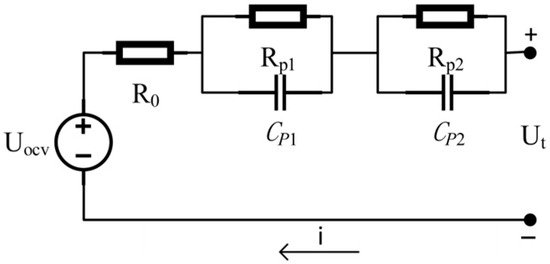
The second-order RC model of the battery has higher accuracy, especially in the process of fast current change or long period battery charging and discharging, the two time constants of the battery response are simulated by two RC networks, which better reflects the slow and fast response characteristics of the battery. On the basis of the second-order RC model, it is still possible to continue to add RC networks to describe the battery model more comprehensively. However, the increase in RC links will bring more unknown parameters, which makes the model-solving process more complicated, and it cannot effectively fit the practical application. The second-order RC equivalent circuit model is shown in Figure 1.
Figure 1.
Second-order RC equivalent circuit model.
In the equivalent circuit model, the internal resistance R0 is used to represent the resistance of the material used in the battery and the electrolyte, representing the battery internal resistance. A number of RC networks are used to reflect the polarization effect of the battery, in which the RC network includes a polarization resistance and a polarization capacitance, respectively Rp and Cp, and reflects the energy loss caused by chemical reactions and electron and ion migration during the battery’s working process through the RC network. Uocv represents the open circuit voltage of the battery and is one of the main output signals of the battery. Through the lithium battery equivalent circuit model, the dynamic response and steady-state characteristics of the battery can be easily analyzed, so as to model and simulate the battery system.
From Kirchhoff’s current law and Kirchhoff’s voltage law, the following can be obtained:
Meanwhile, the battery terminal voltage Ut is
Ut represents the terminal voltage of the battery and I is the current in the loop. In the first RC network, the voltage, polarization resistance and polarization capacitance at both ends are represented by Up1, Rp1 and Cp1. Similarly, in the second RC network, the voltage, polarization resistance and polarization capacitance at both ends are represented by Up2, Rp2 and Cp2, and R0 represents the internal resistance in the circuit. The SoC expression of this model is as follows:
In Formulaes (2)–(6), ΔT is the sampling time, which can be set as 1 s, that is, ΔT = 1s; is the Coulomb efficiency; Qn indicates the actual available battery capacity. Therefore, the equation of the state of the second-order RC equivalent circuit model can be obtained as
2.2. Model Parameter Identification Based on the FFRLS Algorithm
RLS is an online learning method by which the regression parameters can be updated step by step. When new data come in, this algorithm will update the parameters in time, thus eliminating the work of processing all historical data; the expression is as follows:
where Pk is the covariance matrix, which is used to describe the parameter accuracy, yk is the observation value of the k time, and xk is the input of the k time.
However, it is difficult for the RLS to deal with data with higher noise, impacting parameter identification accuracy. Meanwhile, the related covariance matrix update involves the inversion of the matrix, making it difficult to deal with high latitude problems. At this point, the RLS was improved by introducing a forgetting factor between 0.9 and 1, forming the FFRLS. The forgetting factor is used to weight the historical data and give a higher weight to the new data so to avoid the excessive influence of the historical data on the identification results. Through this method, the FFRLS can not only adapt to the change in data, but also correspond to the non-stationary data, especially the parameter change in dynamic environment, and improve the robustness of the system. The basic calculation formula of FFRLS is as follows:
where yk is the system output; φk is the system variable; θkT is expressed as parameter variables; indicates system white noise. The subscript k of each variable represents the sampled value at time k, and the recursion formula for FFRLS is
where KLs,k and k are the algorithm gain matrix; PLs,k is the error covariance matrix of the predicted value of the state variable; λ is the forgetting factor, and its value generally belongs to the range 0–1. When its value is 1, the algorithm deforms to the conventional recursive least square method.
In order to combine the FFRLS with the established equivalent circuit model, the established second-order RC model needs to be expanded into the following least squares form:
The time constant of the first RC network can be made as follows:
The same can be obtained as follows:
Therefore, it can be changed to
Resumption:
In Equation (11), the original equation can be discretized and the system sampling time can be represented by T, which can be obtained as follows:
Each k is calculated as follows:
Therefore, it is known that the parameter θk = [k1 k2 k3 k4 k5]T needs to be identified. After setting the initial values θ0 and P(0), the parameters to be identified are substituted into the following formula:
Further calculation can be obtained as follows:
When the FFRLS is used to identify parameters of the second-order RC model, the forgetting factor determines the dependence of the algorithm on historical data and the updating speed of model parameters. The size of the forgetting factor directly affects the weight of past data and the forgetting rate of the algorithm in the short and long term. If the forgetting factor is set too high, the algorithm will pay too much attention to historical data, which may reduce the model’s response ability to recent data, reduce the model’s adaptability, and make it difficult to reflect the change in battery performance over time. On the contrary, if the forgetting factor is too low, the algorithm will quickly ignore the historical data, resulting in frequent fluctuations of model parameters, resulting in decreased prediction accuracy and affecting the stability of the model.
3. SoC Estimation Algorithm
Considering the pronounced nonlinear characteristics of lithium battery charging and discharging processes, conventional methods such as ampere-hour integration, open-circuit voltage (OCV), and the standard Kalman filter struggle to effectively handle such nonlinear dynamics. In contrast, the extended Kalman filter (EKF) can more effectively address the nonlinear dynamic behavior of batteries, offering higher accuracy and reliability. However, as the system’s nonlinearity intensifies, the estimation error of the EKF gradually increases. This degradation arises because the EKF neglects higher-order terms during linearization, leading to phase-dependent approximation errors. To address this issue, it is necessary to employ the unscented Kalman filter (UKF) for strongly nonlinear systems. The UKF transforms the complex nonlinear state prediction problem into one involving the expansion of a sigma point set and its propagation through the nonlinear system. This approach avoids the computation of Jacobian matrices, reduces computational burden, and handles nonlinear estimation problems more effectively.
3.1. UKF Algorithm
Compared to the EKF’s linearization approach, the UKF retains the system’s nonlinear characteristics and accounts for higher-order statistical moments, thereby yielding more accurate state estimates. The unscented transformation is implemented as follows.
- (1)
- Sigma Point Construction
- (2)
- Calculation of mean and covariance weights
Assuming the nonlinear system is subject to Gaussian white noise, the system can be described by the following equations:
where the state vector is denoted as xk; the measurement vector is denoted as zk; f(xk) represents the nonlinear state function associated with xk; h(xk) represents the nonlinear measurement function related to xk; and wk and vk denote the process noise and measurement noise, respectively.
The UKF algorithm proceeds as follows:
- (1)
- Initialization
- (2)
- Sigma point generation
Sigma points are generated using Equation (18), and are then propagated through the nonlinear state equation to obtain predicted states.
- (3)
- Predicted state and covariance computation
- (4)
- Measurement update
Propagate sigma points through h(.) to obtain predicted measurements.
- (5)
- Innovation covariance and cross-covariance calculation
- (6)
- Kalman gain computation and state/covariance update
This completes the standard UKF procedure.
3.2. SoC Estimation Based on the LDL-MIAUKF Algorithm
However, in practical applications, the noise of the battery system will change with the increase in the running time; if the system noise is still unchanged, then during the long-term operation of the battery, the estimated result will produce a certain error. In addition, the statistical characteristics of noise should be set based on experience, and the process noise error Q and observation noise covariance R should be corrected before starting the calculation. If the unsuitable value is selected, a large error will occur in the estimation results. Therefore, considering the time-varying characteristics of the battery and the variability of the noise, based on the UKF algorithm, the adaptive link is combined to correct the Q value and R value of the estimation algorithm, and the AUKF is obtained.
At the same time, in order to further improve the accuracy of the SoC estimation algorithm and make full use of the data generated by each iteration, a new multiple-innovation theory is introduced on the basis of the above algorithm. The commonly used single new information method updates only based on the current observation value, while the multi-new information method not only realizes the cooperative correction of system parameters, but also effectively inhibits the error caused by the instantaneous data by constructing a new information sequence containing multiple historical observation data points. Compared with the single new information method, the multi-new information method deeply mines the value of historical data so that the charged state estimation algorithm has higher accuracy and robustness.
However, during the simulation experiment, it was found that the use of the UKF algorithm would lead to system errors in some special cases because the covariance matrix of the system at a certain time was not positive, which made the Cholesky decomposition method ineffective. In order to solve the above problems, the LDL decomposition method was further introduced to calculate the sigma points required by the algorithm. Thus, the sustainable operation of the algorithm is guaranteed.
Based on the above analysis, the LDL-MIAUKF estimation algorithm can be obtained. The algorithm integrates three key enhancements into the UKF framework, as detailed below.
- (1)
- LDL Decomposition for Numerical Stability
In standard UKF, the square root of the error covariance matrix Pk−1 is computed via Cholesky decomposition to generate sigma points. However, due to numerical errors or model mismatch, Pk−1 may lose positive definiteness, causing Cholesky failure. To ensure robustness, we replace Cholesky with LDL decomposition:
where Lk−1 is a unit lower triangular matrix and Dk−1 is a diagonal matrix with non-negative entries.
The sigma points are then generated as
where xk−1 and xt,k−1 denote the optimal estimated state variable values at time k−1.
- (2)
- Multi-Innovation Processing for Enhanced Robustness
Instead of using only the current innovation, we construct a multi-innovation , sequence over a sliding window of length p:
The corresponding cross-covariance and innovation covariance are as follows.
The multi-innovation gain is
Then construct the unscented Kalman filter gain matrix as follows:
This mechanism leverages historical measurement residuals to suppress instantaneous noise and improve estimation stability.
- (3)
- Adaptive Noise Covariance Adjustment
To handle the time-varying process and measurement noise, we dynamically update the noise covariances Qk and Rk based on the current innovation residual :
where and ∈ (0, 1) are forgetting factors that balance the historical and current information.
The complete LDL-MIAUKF procedure is summarized as follows:
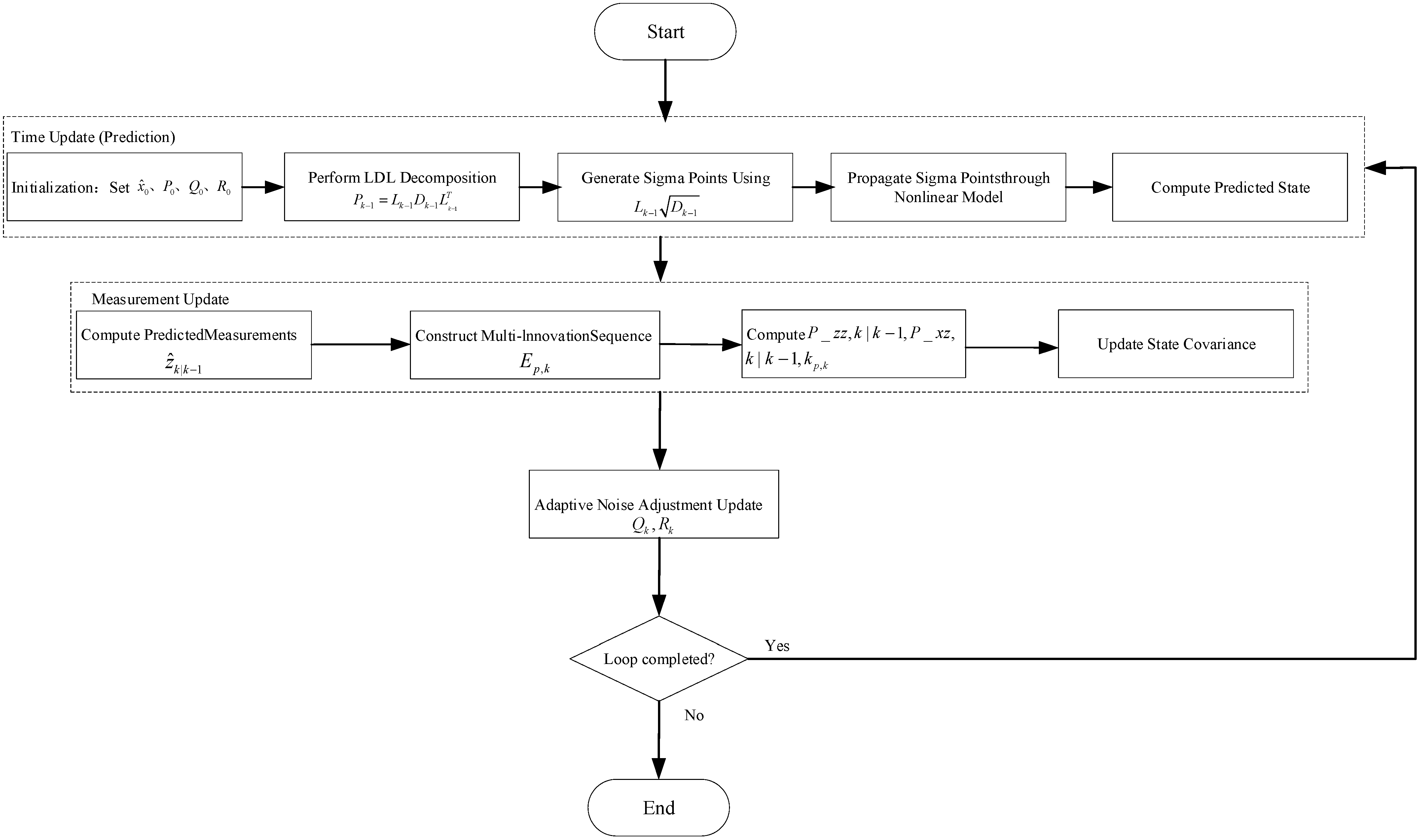
Step 1. Initialization: Set , P0, Q0, R0.
Step 2. Time Update:
- (1)
- Perform LDL decomposition of Pk−1;
- (2)
- Generate sigma points χk−1;
- (3)
- Propagate through nonlinear model:= f(xk−1);
- (4)
- Compute predicted state and covariance .
Step 3. Measurement Update:
- (1)
- Compute predicted measurements ;
- (2)
- Construct multi-innovation sequence Ek;
- (3)
- Compute , ,
- (4)
- Update state and covariance:
Step 4. Adaptive Adjustment: Update Qk, Rk using the innovation residual.
Step 5. Repeat for next time step.
By synergistically integrating LDL decomposition, multi-innovation theory, and adaptive noise tuning, LDL-MIAUKF achieves superior accuracy, stability, and robustness in SoC estimation under dynamic operating conditions. The Block diagram of the LDL-MIAUKF method is shown in Figure 2.
Figure 2.
Block diagram of the LDL-MIAUKF method.
At this point, the LDL-MIAUKF estimation algorithm comes to an end. Compared with the traditional EKF algorithm, although this algorithm has more computational steps, it improves its adaptability to nonlinear systems and ignores the solution of the Jacobian matrix, thereby reducing the computational difficulty to a certain extent. The termination condition is that the data input for this time has been calculated completely, and we are waiting for the next data input.
4. Simulation Verification and Result Analysis
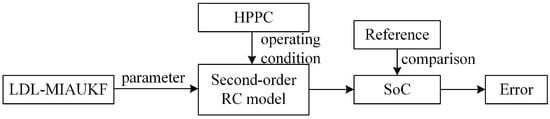
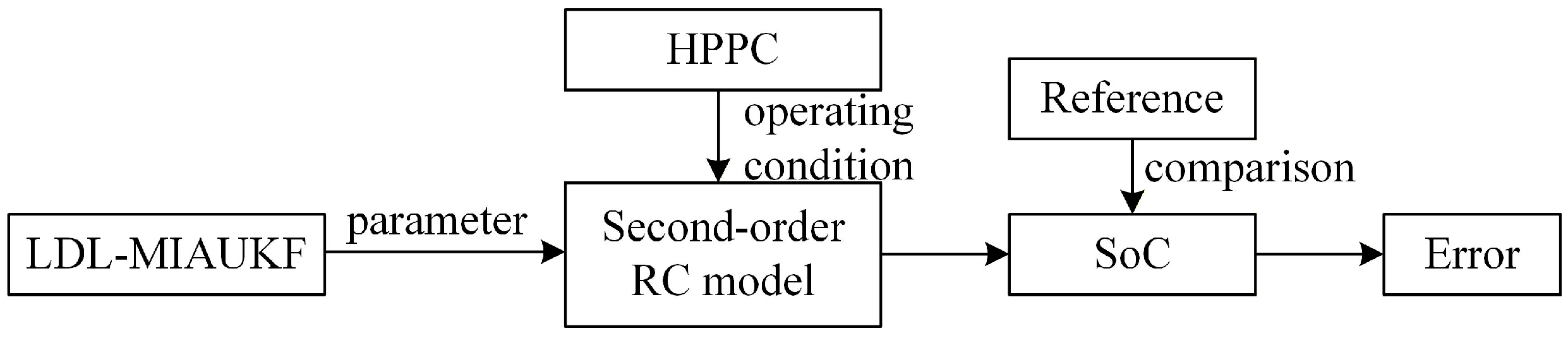
The hyperparameters used in this study, including the forgetting factor λ = 0.97 for FFRLS, α = 0.001, β = 2, and k = 0.05 for UKF, as well as = 0.97 and p = 6 for MIAUKF, were determined through extensive simulation trials. These values were selected as they consistently yielded the best balance between estimation accuracy, robustness, and convergence speed among the tested configurations. The experimental workflow is illustrated in Figure 3.
Figure 3.
Experimental workflow.
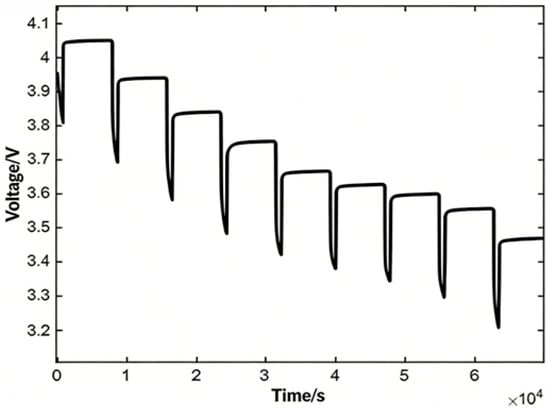
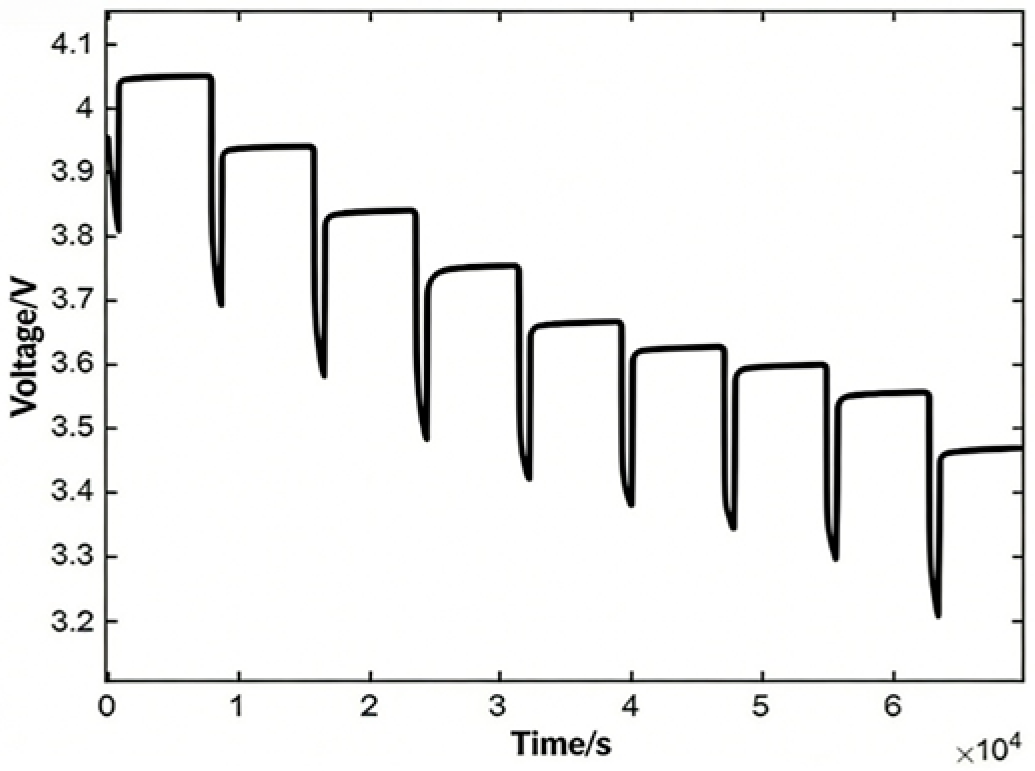
In order to verify the accuracy of the electrical model, better simulate the actual working process of the battery, and provide data support for the state estimation of the battery, the battery discharge data under the HPPC condition was selected as the static condition parameter identification in this paper.
The lithium battery was tested with a 0.5 C rate constant current pulse discharge, and the parameters were identified according to the obtained voltage response curve. The battery voltage change curve and single change curve are shown in Figure 4.
Figure 4.
Voltage variation curve (simulation based on experimental HPPC data).
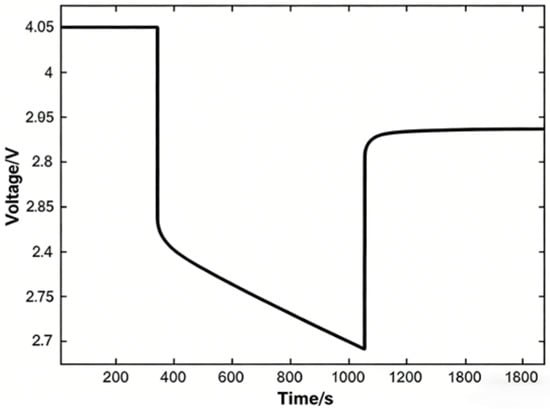
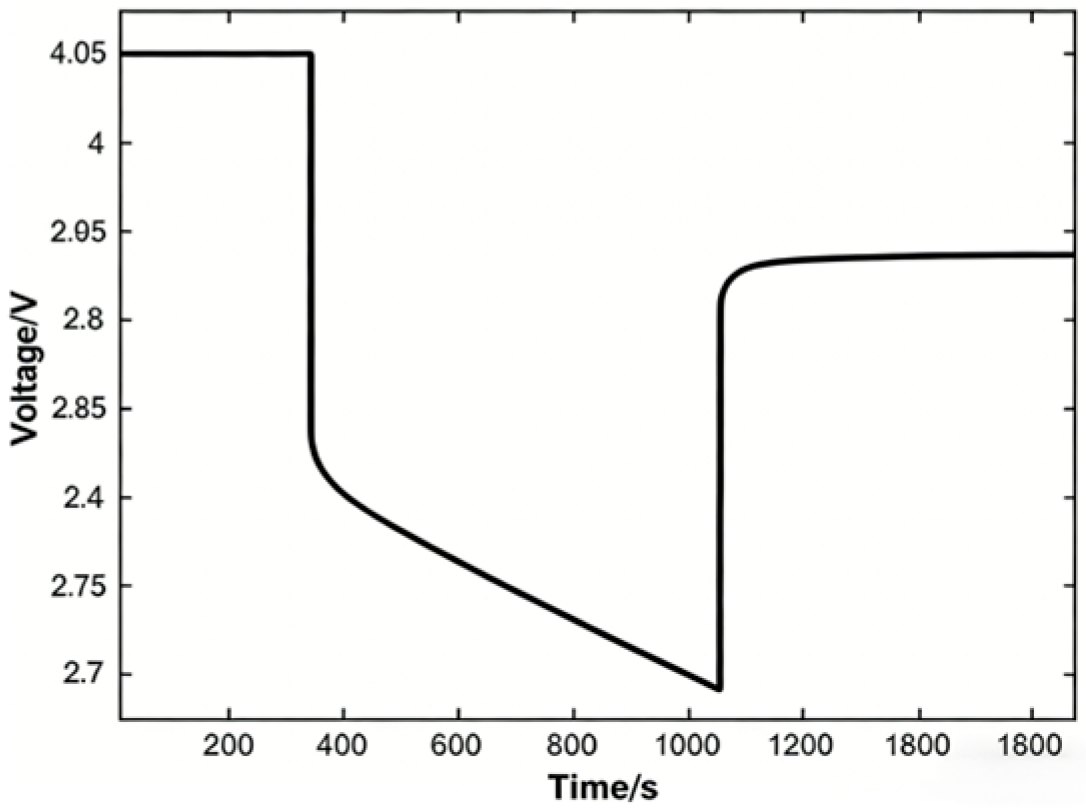
The parameters to be identified in the model include ohm internal resistance R0, polarization resistance and polarization capacitance Rp1 and Cp1, and Rp2 and Cp2, respectively. Under the state of single pulse discharge, the terminal voltage change curve is shown in Figure 5.
Figure 5.
Voltage variation curve of a single discharge (simulation based on experimental HPPC data).
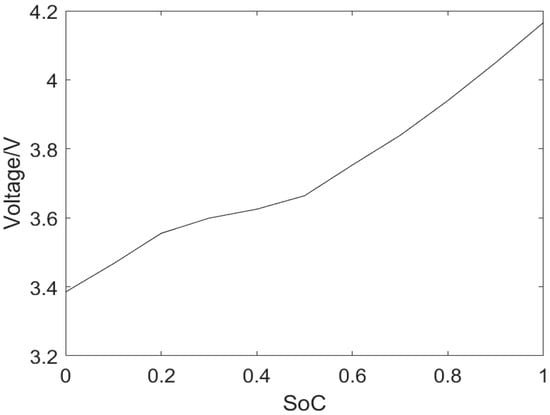
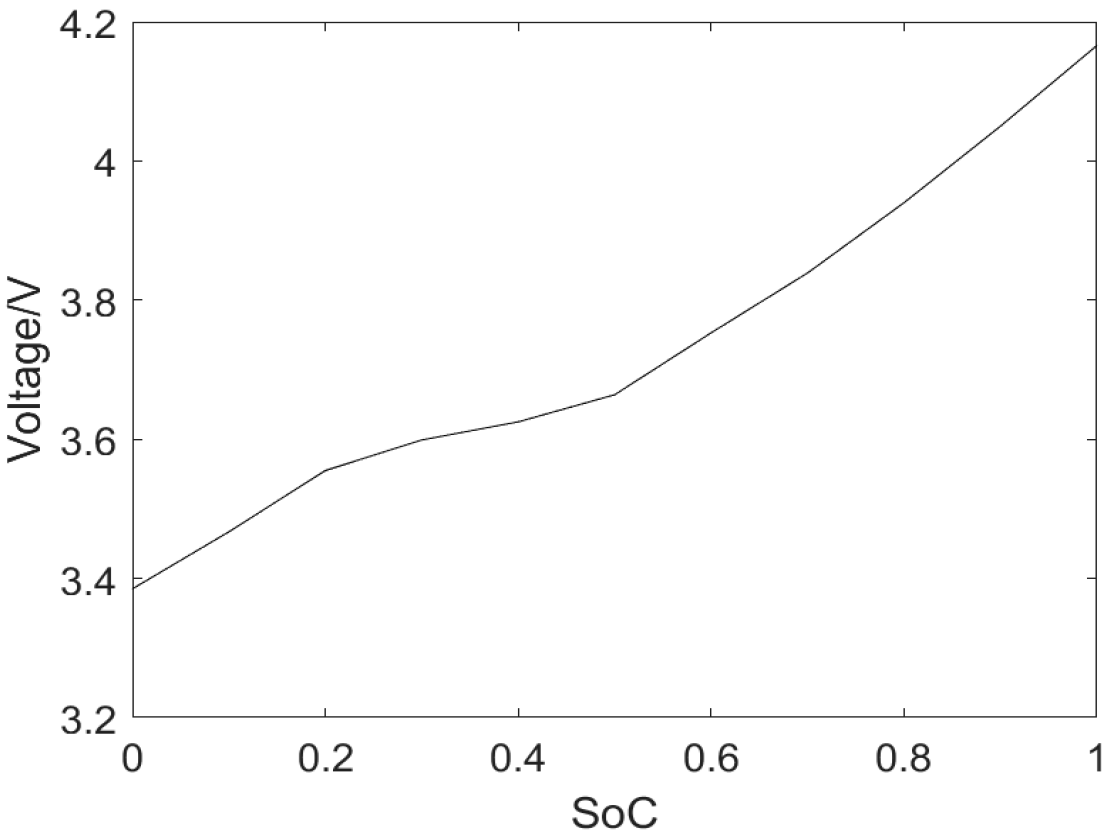
The resulting SoC-OCV curve is shown in Figure 6.
Figure 6.
SoC-OCV curve (simulation based on experimental HPPC data).
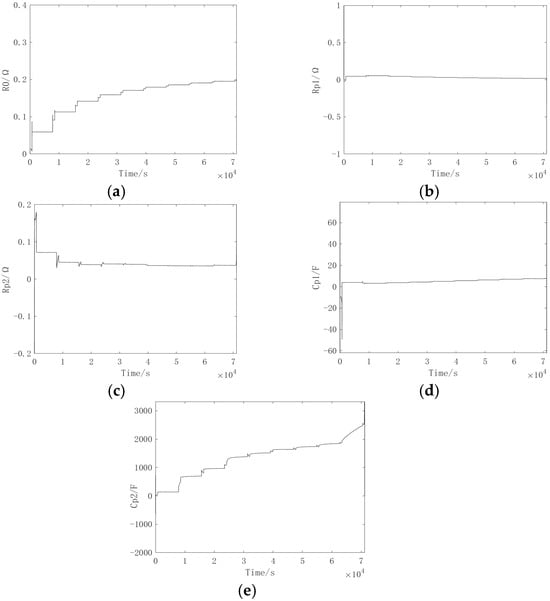
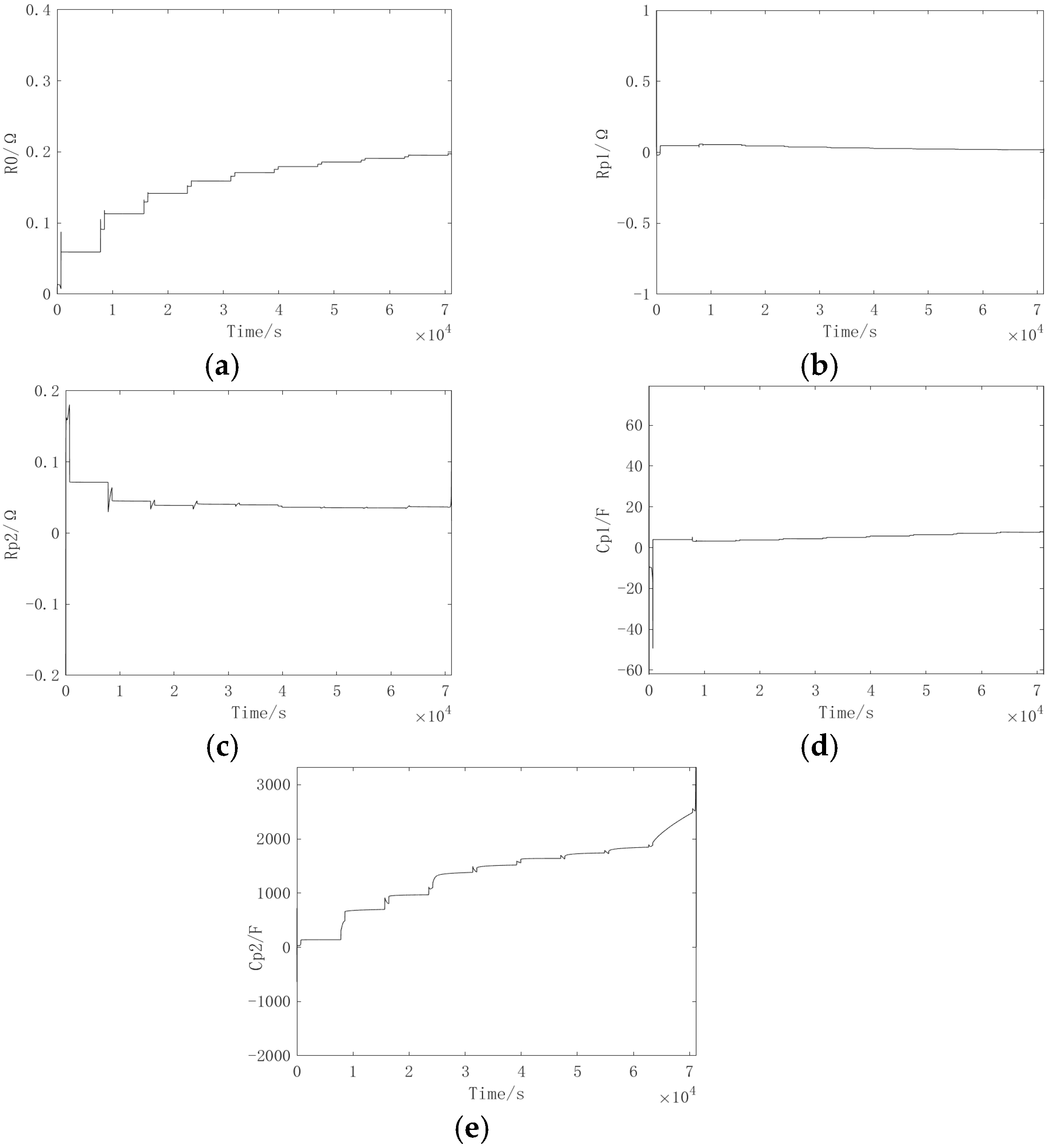
Therefore, the above data are brought into the identification algorithm, and the identification results obtained are shown in Figure 7.
Figure 7.
Parameter identification result (simulation based on experimental HPPC data). (a) R0 identification result. (b) Rp1 identification result. (c) Rp2 identification result. (d) Cp1 identification result. (e) Cp2 identification result.
As can be seen from Figure 7, when the FFRLS identification algorithm is used in this working condition, the identified parameters have relatively stable curves the rest of the time, except that there are spikes and negative numbers in the beginning and end stages of the operation, and good results are achieved.
In order to verify the effectiveness of the LDL-MIAUKF algorithm proposed in this paper, a lithium battery SoC estimation algorithm model was built in Matlab 2022b, the EKF algorithm and LDL-MIAUKF algorithm were used respectively to estimate the battery SoC, and the accuracy of the estimation results was considered. Taking the HPPC working condition as the verification condition, the initial ambient temperature was set as 25 °C, and the initial state variable of the system was set as x0 = [1, 0, 0]T. The HPPC test was conducted as follows: the battery was first stabilized at specific SoC levels (from 100% to 0% in 10% intervals). At each SoC point, a 10 s discharge pulse at 0.5 C rate was applied, followed by a 20 min rest period to allow for voltage relaxation. A charge pulse of the same magnitude (0.5 C, 10 s) was then applied. Throughout the test, voltage and current time-series data were recorded using a precision digital multimeter. The raw data were subsequently preprocessed using a strong-tracking KF to suppress measurement noise and improve signal fidelity.
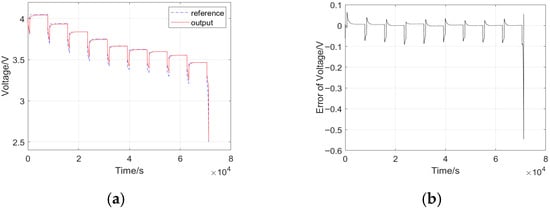
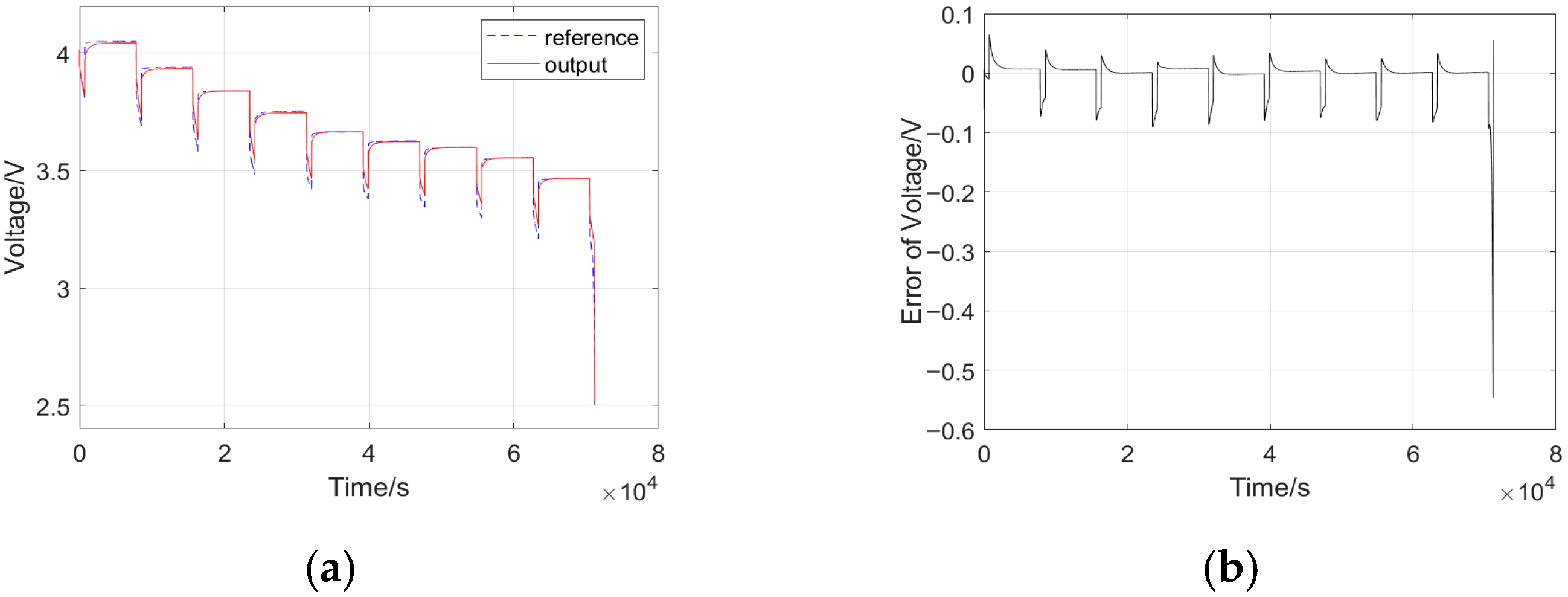
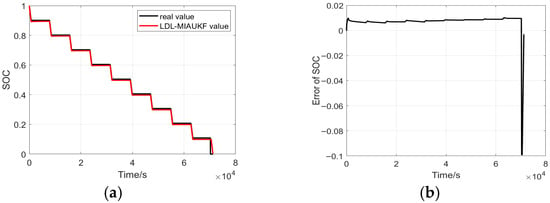
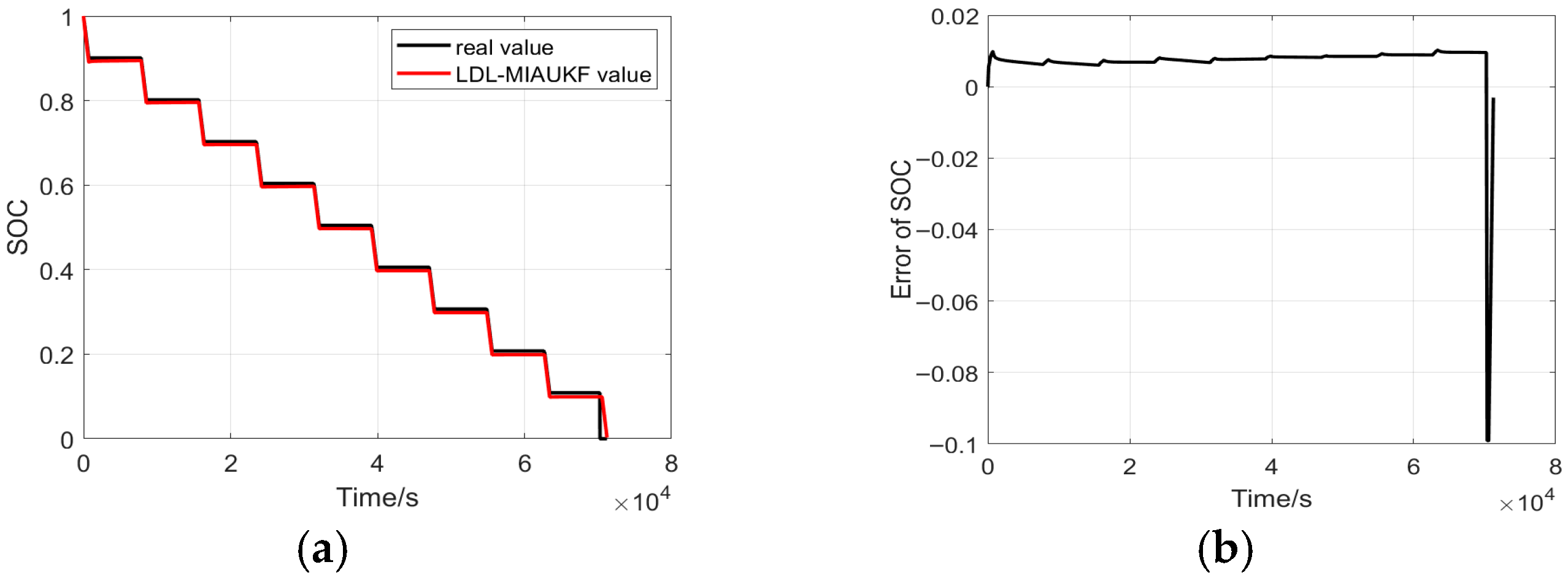
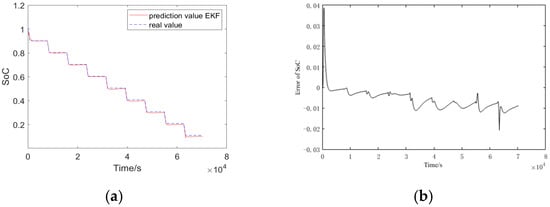
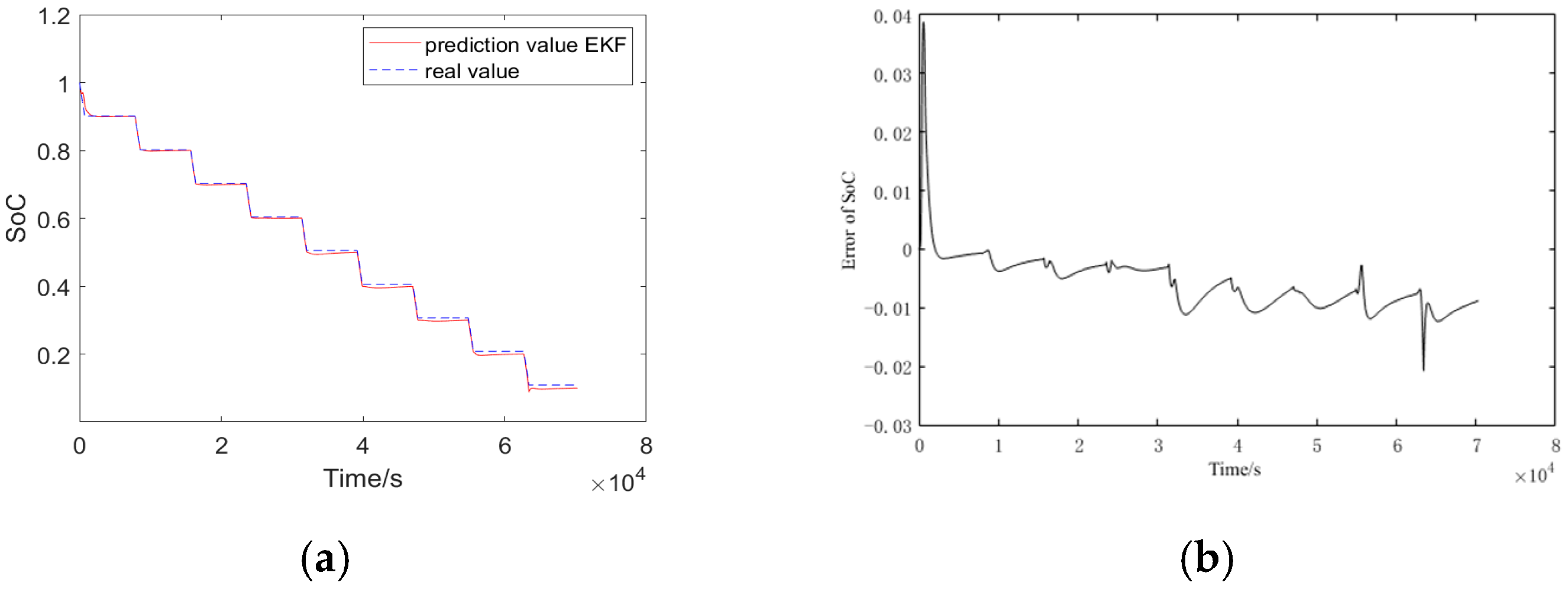
Figure 8 shows the battery terminal voltage and error output by the LDL-MIAUKF algorithm under this condition. Figure 9 shows the SoC estimation results and error curve. Figure 10 shows the battery SoC estimation results and error curve of the EKF algorithm under the same conditions; the calculation result of ampere-hour integral method is used as the current SoC reference value.
Figure 8.
Output terminal voltage under HPPC. (a) Output voltage. (b) Error of output voltage.
Figure 9.
LDL-MIAUKF algorithm estimation result. (a) SoC. (b) Error of SoC.
Figure 10.
EKF algorithm estimation result. (a) SoC. (b) Error of SoC.
Figure 9 proves the validity and accuracy of the parameter identification results in this paper. The voltage tracking of the output terminal of the model is good, and the voltage errors are controlled within 0.1 V.
Figure 9 and Figure 10 verify the effectiveness of the LDL-MIAUKF algorithm and EKF algorithm. Under the same working conditions, the LDL-MIAUKF algorithm can control the SoC estimation error within 0.01, and the EKF algorithm can almost control the SoC estimation error within 0.02, which is close to the reference value. The LDL-MIAUKF achieves an RMSE of 0.006, outperforming the EKF (RMSE = 0.013). Comparing the estimation results of the two algorithms, it is not difficult to find that the estimation results using the LDL-MIAUKF algorithm have smaller errors, higher accuracy and stability, and better tracking effects than the EKF algorithm. It can be proved that LDL-MIAUKF is a more efficient algorithm for estimating the state of battery charge. To evaluate the computational efficiency of the proposed LDL-MIAUKF algorithm, the average execution time per estimation step was recorded on a standard PC (Intel Core i7-1165G7, 2.8 GHz, with MATLAB R2023a). The LDL-MIAUKF required 1.82 ms/step, compared to 1.18 ms/step for the EKF. Although LDL-MIAUKF involves additional operations (multi-innovation processing, adaptive update, and LDL decomposition), its execution time remains well below the typical BMS sampling interval (e.g., 10–100 ms), confirming its suitability for real-time implementation.
Table 1 presents a comparison between the LDL-MIAUKF algorithm and conventional techniques.
Table 1.
Comparison between LDL-MIAUKF algorithm and conventional techniques.
The comparison of the estimation results of the LDL-MIAUKF algorithm with the actual SoC of the battery in the experimental data indicates the accuracy and reliability of this algorithm. Compared with the EKF algorithm, the estimated SoC value of the battery by this method is higher than that of the traditional EKF algorithm in all other times, except for one error at the end of battery discharge.
5. Conclusions
This work presents a robust SoC estimation framework for lithium-ion batteries by combining online parameter identification with an enhanced filtering algorithm. The second-order RC model parameters are accurately identified using the FFRLS method under HPPC conditions, yielding a terminal voltage prediction error within ±0.1 V. Building on this, the LDL-MIAUKF algorithm integrating multi-innovation processing, adaptive noise adjustment, and LDL decomposition is implemented for SoC estimation. Experimental results demonstrate that, at 25 °C, the proposed algorithm achieves a maximum SoC estimation error below 1%. It maintains stable convergence throughout the entire discharge process. Moreover, it exhibits high estimation accuracy and strong tracking performance. The method proposed in this paper has certain real-time advantages at the algorithm level, but its real-time characteristics in practical applications still need further research. These results demonstrate that the proposed approach effectively addresses nonlinear dynamics and time-varying noise, offering a reliable and accurate solution for practical battery management systems.
Author Contributions
Conceptualization, Z.X.; methodology, Z.X.; software, Z.X.; validation, Z.X.; writing—original draft preparation, Z.X. and T.P. All authors have read and agreed to the published version of the manuscript.
Funding
This research received no external funding.
Institutional Review Board Statement
Not applicable.
Informed Consent Statement
Not applicable.
Data Availability Statement
The raw data supporting the conclusions of this article will be made available by the authors on request.
Conflicts of Interest
The authors declare no conflict of interest.
References
- Cui, X.; Wu, J.; Deng, K.; Wang, Y.; Feng, J.; Li, Y. Online State of Charge Estimation of Lithium-ion Battery Based on Improved Extended Kalman Filter Algorithm. Low Volt. Appar. 2024, 6, 49–58. [Google Scholar]
- Dong, L.; Lai, J.; Su, J. Online Parameter Identification and SOC Estimation Method for Lithium Batteries Based on IMAFFRLS-EKF. Acta Energiae Solaris Sin. 2024, 45, 66–74. [Google Scholar]
- He, H.; Qin, H.; Sun, X.; Shui, Y. Comparison study on the battery SoC estimation with EKF and UKF algorithms. Energies 2013, 6, 5088–5100. [Google Scholar] [CrossRef] [Scilit]
- Barcellona, S.; Piegari, L. Lithium ion battery models and parameter identification techniques. Energies 2017, 10, 2007. [Google Scholar] [CrossRef] [Scilit]
- How, D.N.T.; Hannan, M.A.; Lipu, M.S.H.; Lipu, M.S.H.; Ker, P.J. State of charge estimation for lithium-ion batteries using model-based and data-driven methods: A review. IEEE Access 2019, 7, 136116–136136. [Google Scholar] [CrossRef] [Scilit]
- Liu, R.; Yuan, C. A Novel Dual-Layer Genetic Algorithm with Parameter Interaction Framework for Battery Parameter Identification. Energy Storage 2025, 7, e70265. [Google Scholar] [CrossRef] [Scilit]
- Białoń, T.; Niestrój, R.; Korski, W. PSO-based identification of the Li-Ion battery cell parameters. Energies 2023, 16, 3995. [Google Scholar] [CrossRef] [Scilit]
- Li, R.; Wang, Z.; Yu, J.; Lei, Y.; Zhang, Y.; He, J. Dynamic parameter identification of mathematical model of lithium-ion battery based on least square method. In Proceedings of the 2018 IEEE International Power Electronics and Application Conference and Exposition (PEAC); IEEE: New York, NY, USA, 2018; pp. 1–5. [Google Scholar]
- Fan, X.; Feng, H.; Zhang, X. Optimization of Least Squares Method and Its Application in Parameter Identification of Lithium-Ion Battery Model. Trans. China Electrotech. Soc. 2024, 39, 1577–1588. [Google Scholar]
- Farmann, A.; Sauer, D.U. A study on the dependency of the open-circuit voltage on temperature and actual aging state of lithium-ion batteries. J. Power Sources 2017, 347, 1–13. [Google Scholar] [CrossRef] [Scilit]
- Deng, T.; Sun, H. A novel real-time SOC estimation method for lithium-ion batteries based on ampere-hour integration. J. Chongqing Univ. Sci. Technol. (Nat. Sci. Ed.) 2015, 29, 101–106. [Google Scholar]
- Liu, B.; Wang, H.; Tseng, M.L.; Li, Z. State of charge estimation for lithium-ion batteries based on improved barnacle mating optimizer and support vector machine. J. Energy Storage 2022, 55, 105830. [Google Scholar] [CrossRef] [Scilit]
- Gong, Q.; Wang, P.; Cheng, Z. A novel deep neural network model for estimating the state of charge of lithium-ion battery. J. Energy Storage 2022, 54, 105308. [Google Scholar] [CrossRef] [Scilit]
- Chen, Z.; Fu, Y.; Mi, C.C. State of charge estimation of lithium-ion batteries in electric drive vehicles using extended Kalman filtering. IEEE Trans. Veh. Technol. 2012, 62, 1020–1030. [Google Scholar] [CrossRef] [Scilit]
- Xiong, R.; He, H.; Sun, F.; Zhao, K. Evaluation on state of charge estimation of batteries with adaptive extended Kalman filter by experiment approach. IEEE Trans. Veh. Technol. 2012, 62, 108–117. [Google Scholar] [CrossRef] [Scilit]
- Ge, K. Battery SOC estimation method based on AFFRLS-AEKF. Inf. Technol. Informatiz. 2024, 12, 179–185. [Google Scholar]
- Yu, G.; Wang, F.; Wang, L.; Li, W.; Jin, H.; Lu, J.; Yang, C. Estimation of state of charge for lead–carbon batteries utilizing the fusion of DEKF algorithm and PNGV model. Ionics 2025, 31, 8097–8109. [Google Scholar] [CrossRef] [Scilit]
- Dong, G.; Wei, J.; Chen, Z.; Sun, H.; Yu, X. Remaining dischargeable time prediction for lithium-ion batteries using unscented Kalman filter. J. Power Sources 2017, 364, 316–327. [Google Scholar] [CrossRef] [Scilit]
- Fan, X.; Feng, H.; Yun, X.; Wang, C.; Zhang, X. SOC estimation for lithium-ion battery based on AGA-optimized AUKF. J. Energy Storage 2024, 75, 109689. [Google Scholar] [CrossRef] [Scilit]
- Ding, C.; Wang, T.; Zhang, L.; Guo, Q. State of Charge Estimation of Lithium-Ion Batteries Based on Online Parameter Identification and SVD-AUKF. South. Power Syst. Technol. 2025, 19, 170–181. [Google Scholar]

Disclaimer/Publisher’s Note: The statements, opinions and data contained in all publications are solely those of the individual author(s) and contributor(s) and not of MDPI and/or the editor(s). MDPI and/or the editor(s) disclaim responsibility for any injury to people or property resulting from any ideas, methods, instructions or products referred to in the content. |
© 2026 by the authors. Licensee MDPI, Basel, Switzerland. This article is an open access article distributed under the terms and conditions of the Creative Commons Attribution (CC BY) license.