


Abstract
World models represent environments and predict how their states evolve under interventions. Their use in generative simulation and interactive environments, autonomous driving, and robotics and embodied control is growing, yet application validation remains fragmented across model families. Using the relation , this review organizes the field around state representation, action representation, and transition modeling. We compare visual and geometric states with object-centric or belief/latent organization; semantic, hierarchical, latent, and executable actions; and autoregressive, diffusion-based, predictive latent, explicit-simulation, and learned–physics hybrid transitions. Across the three applications, we connect these choices to identity drift, non-executable plans, unsafe multimodal forecasts, long-horizon instability, and sim-to-real degradation. We then link each failure to six diagnostic dimensions: perceptual fidelity, physical validity, action consistency, rollout stability, calibration, and decision utility. The synthesis provides a cross-application engineering matrix and motivates Active Intervention Loops, Physical Laws Internalization, and Progressive Structural Integration. It identifies the State–Action–Transition commitments that shape application suitability and separates visual plausibility from evidence of interactive or deployment readiness.
1. Introduction
The primary focus of this review is learned world models, whose predictive state-evolution mechanisms are learned from data. We distinguish these from hybrid learned–physics systems, which explicitly couple learned components with specified physical dynamics, and from conventional simulators used as physical transition references. MuJoCo and Brax belong to the third category: their inclusion supports comparison of state variables, assumptions, and control interfaces, but does not classify them as learned world models [1,2]. Contemporary learned models span latent dynamics for control, interactive video prediction, driving, and robotic manipulation. Learning compact dynamics for imagination [3] and prediction in representation space [4] provide common motivations, yet these systems maintain different information and offer different evidence of action grounding and predictive validity.
This diversity creates a practical problem. A model can produce realistic video while failing to preserve object identity, physical events, or control effects [5,6]. A compact latent model can support efficient policy learning while omitting a rare but decision-relevant variable. An explicit simulator can enforce selected constraints yet remain difficult to calibrate or transfer. Consequently, plausible prediction alone is an insufficient criterion. The more useful question is which information and interventions a design preserves, which failures it introduces, and whether those failures preclude a specific application [7].
We organize this question around the minimal transition relation
where is the model’s state at time , is used broadly as an intervention or conditioning variable, and defines how the model evolves. In particular, semantic conditioning does not necessarily specify a causal or executable intervention. The state may be pixels, tokens, occupancy, objects, or a stochastic latent variable; the action may be text, a goal, a latent code, a planned trajectory, or actuator control. The transition may be autoregressive, diffusion-based, predictive in representation space, or constrained by an explicit simulator. Equation (1) is therefore a common analytical language, not an assertion that these systems have equivalent causal or control capabilities.
The central thesis of this survey is that many limitations attributed generically to world models can be localized to one of three design commitments or to a mismatch between them. Figure 1 summarizes the SAT commitments. A state bottleneck occurs when fails to retain entities, geometry, uncertainty, or temporal persistence required later. An action bottleneck occurs when is expressive but not executable, executable but embodiment-specific, or too coarse to identify causal effects. A transition bottleneck occurs when accumulates rollout error, ignores multimodality, violates constraints, or becomes too expensive for planning. Cross-stage failures arise when, for example, a transition is asked to preserve contact dynamics that the state has already compressed away, or when a generated future cannot be tested because the action representation does not map to the agent’s controls.
Figure 1.
State–Action–Transition (SAT) taxonomy. State carriers and cross-cutting state organization are distinguished; and denote configuration and velocity in physical state. Actions span semantic conditions, goals and skills, latent codes, and executable controls. Learned transitions include generative and predictive latent models; hybrid transitions couple learned dynamics with explicit physics. Composite learned models combine learned mechanisms without necessarily using a physics simulator. Illustrations denote design routes, not capability rankings.
Latent geometry is a particularly consequential but easily obscured commitment. Continuous, discrete, and hybrid designs—including continuous relaxations used to optimize discrete variables—differ in information loss, optimization, multimodality, rollout behavior, planning, and physical verifiability. Treating latent type as a minor implementation choice therefore hides how uncertainty, regime changes, and decision boundaries propagate through long-horizon prediction. We make this comparison explicit while keeping generator architecture and latent geometry as separate analytical variables.
Applications are used throughout as tests of the framework rather than as the top-level taxonomy. Generative simulation and interactive environments, autonomous driving, and robotics and embodied control are analyzed through the same engineering questions: what state must be retained, which actions must be executable, what the transition must guarantee, which failure creates an operational consequence, and how that failure can be diagnosed. Adjacent applications also test parts of this lens: remote sensing-oriented world modeling uses directional instructions to extrapolate neighboring image tiles [8]. This is spatial continuation, not evidence of temporal physical dynamics; the three primary application domains remain our focus. Evidence is then separated into offline demonstration, simulator closed loop, and real-system closed loop. This protocol makes abstract trade-offs observable: state drift becomes identity or occupancy failure, action ambiguity becomes an unreachable trajectory, and transition mismatch becomes unsafe or unstable closed-loop behavior.
The survey makes three contributions:
- We organize established State–Action–Transition concepts into a diagnostic review procedure connecting modeling commitments to failure hypotheses and suitable tests. The contribution is analytical organization, not a new mathematical decomposition or learning algorithm.
- We compare state, action, and transition alternatives under common engineering criteria, with dedicated treatment of continuous, discrete, and hybrid latent transitions.
- We connect the three application domains to diagnostic evaluation and evidence boundaries through a compact engineering matrix, then derive Active Intervention Loops, Physical Laws Internalization, and Progressive Structural Integration as explicitly labeled author synthesis.
The remainder of the paper is organized as follows. Section 2 describes the review methodology and relationship to existing surveys. Section 3 formalizes the SAT lens and comparison criteria. Section 4, Section 5 and Section 6 analyze the three design dimensions. Section 7 studies cross-stage bottlenecks and evaluation. Section 8 develops research directions and limitations, and Section 9 concludes.
2. Review Methodology and Related Surveys
2.1. Scope and Evidence Collection
This is a structured, evidence-driven review of state representation, action grounding, and environment evolution, not an exhaustive systematic review. The original collection began with an inherited survey bibliography and was extended through gap-driven searches, reference tracing, and expert-recommended additions. A complete historical search-engine list, execution period, and database-query log were not retained. The submission date, 11 September 2026, identifies the original bibliography; it is not a verified date of a comprehensive field-wide search.
The targeted revision-stage update was conducted on 7 October 2026. It used web search with domain-restricted queries to locate arXiv papers, OpenReview or official conference proceedings, primary project pages, and publisher records. Reviewer-named works were searched by exact title or model name, followed by examination of the relevant method or evaluation descriptions. Representative topic queries used the domain restriction site:arxiv.org with the quoted term combinations “world model” + “object-centric” + “occupancy”; “world model” + “latent action” + “action-conditioned”; “world model” + “continuous latent” + “discrete latent”; and “world simulator” + “physical” + “evaluation”. Here, plus signs separate jointly queried terms, not literal query operators. These are examples from the documented update, not a recovered log of the original collection. The update was targeted to the review questions and reviewer-identified gaps; its cut-off does not imply exhaustive coverage through that date. Publication identities and versions were checked against primary papers, official proceedings or publisher pages, OpenReview, arXiv, and bibliographic records. Metadata verification alone is not evidence that a resource was systematically searched.
Eligibility assessment first used titles and abstracts to identify a source’s contribution to a SAT comparison, an application requirement, a documented failure mechanism, a relevant foundation, or an evaluation question. Method descriptions or full-text passages were checked for claims requiring finer technical detail. Primary methods, foundational studies, surveys, benchmarks, and technical reports were retained when that role was identifiable. Incidental terminology overlap was insufficient. Sources without temporal prediction could support foundations, planning, evaluation, or adjacent applications, but were not relabeled as temporal world-model methods. Duplicate preprint and published versions were consolidated under one publication identity, with verified formal publications preferred. Preprints and institutional reports remain identified as such.
The bibliography contains 137 uniquely cited sources. The descriptive analyses use this inventory and the eligibility rules below. The reproducibility target is the retained corpus and its documented analysis. Missing historical records prevent reconstruction of the original discovery process, so we do not report unverifiable numbers of retrieved, screened, or rejected records or claim PRISMA compliance. The inventory is not a representative sample of the field.
2.2. SAT Coding and the Technical-Method Subset
The retained-corpus accounting is 137 sources = 82 technical and simulator-reference publications + 55 supporting sources. Figure 2 uses the 82-publication subset. Inclusion requires temporal environment, video, or state prediction, direct use of such prediction, or an explicit physical simulator included as a transition reference. The supporting sources concern foundations, surveys, evaluation, policy or planning, replay, adjacent applications, or safety standards. These are retained-source counts, not historical search or rejection counts, and the subset is not 82 learned world-model methods. Temporal V-JEPA prediction is included, whereas image-only I-JEPA is foundational; WorldGym supplies a generative evaluation environment, whereas VideoPhy evaluates existing generators. The counting unit is a publication: separate papers in a model family count separately, but multiple tasks in one paper do not.
Figure 2.
Composition of the 82-publication technical and simulator-reference subset of the revised 137-source inventory (Supplementary Table S1). Panel (a) groups categories; panel (b) expands them. Inner, middle, and outer rings encode state, action, and transition. Each ring independently sums to 100%; legends show counts and percentages. Mixed and unresolved assignments remain included; gray denotes unresolved cases. Angular alignment does not encode joint relationships. These interpretive primary-label summaries describe this selected collection, not field-wide adoption, maturity, comparative capability, or growth.
All references were manually verified by the authors. SAT labels are source-level judgments, not automatic keyword classifications. Supplementary Table S1 documents the 82 assignments; companion records identify the 55 supporting sources and counting rules. Traceability permits inspection but does not establish independent coding reliability. Small percentage differences should not support substantive claims about the prevalence of technical choices.
One primary label per dimension is an aggregation convention for Figure 2, not an exhaustive implementation description. State coding follows the principal representation maintained or predicted for the reviewed modeling claim. Action coding follows the interface supplied directly to the predictor, not a downstream policy’s output. Transition coding follows the principal successor-generation mechanism. A mixed label is used when coequal components cannot be summarized adequately by one category; an unresolved label records insufficient evidence. Both remain in the denominator. Object organization, recurrence, and latent-variable geometry are retained in qualitative explanations rather than treated as additional disjoint bins.
For example, DreamerV2 combines deterministic recurrent information with sampled categorical variables: its discrete stochastic component does not make the entire maintained state discrete [9]. Repeated temporal rollout of GameNGen’s diffusion predictor does not turn its within-step generation into token autoregression [10]. The original Cosmos report covers both autoregressive and diffusion models and is therefore coded as mixed learned transition, not learned–physics coupling; Cosmos-Predict2.5 supplies a separate flow-based entry [11,12]. Physics-informed supervision alone likewise does not establish explicit simulator coupling. A multi-label analysis would preserve component presence but yield overlapping percentages that need not sum to 100%. Establishing how it changes Figure 2 would require separate source-level re-annotation; invariance to alternative coding rules is not claimed.
2.3. Descriptive Keyword Analysis
The auxiliary profiles in Appendix A document the collection’s vocabulary rather than the whole world-model field. Of the 137 sources, 134 enter the title–abstract analysis; three safety standards are excluded because they are normative documents rather than research abstracts. A fixed, manuscript-informed vocabulary is matched to source titles and retained abstracts; the Sora report’s opening summary substitutes for a formal abstract. Spelling variants are normalized, and each source contributes at most once per term. A match denotes discussion, not implementation, and is neither an author keyword nor a topic inferred by topic modeling. Because source selection and vocabulary were informed by the review questions, these profiles are not independent validation of SAT.
The heatmap divides matching-source counts by all text-eligible sources in each displayed bibliography-year group. It includes 115 sources through 2025, pooling 2007–2022 and showing 2023, 2024, and 2025 separately. The 19 text-eligible 2026 sources are omitted only from this temporal display because coverage of that year is incomplete. The network uses all 134 text-eligible sources and links terms appearing in the same source. Both analyses use versioned text and the cited publication record’s year, which can differ from the initial preprint or conference-event year. Their denominators and visual encodings are given in the appendix captions; unequal time bins and purposive selection preclude interpretation as field-wide growth or technology adoption.
2.4. Relationship to Existing Surveys
Recent surveys provide broad introductions to world models, video-based simulators, embodied intelligence, robotics, and physical AI. General reviews often organize methods by architectures, training objectives, or application domains [13,14,15]. Specialized surveys examine physical consistency in generated video [16,17], native 3D/4D representations [18], robotic learning [19,20], embodied AI [21], or multimodal generative simulation [22]. Physical-AI surveys further connect perception, reasoning, modeling, and interaction [23]. These perspectives are valuable because they document fast-moving model families and domain-specific terminology.
The present survey asks a complementary question: what does a model commit to at each term of Equation (1)? Alongside architectural and application-oriented views, this perspective enables comparison of, for example, a tokenized game simulator and a structured driving model on state persistence, action grounding, and transition error even when their outputs and benchmarks differ. It also makes internal differences within an application explicit: two “driving world models” may differ more in their treatment of geometry and intervention than a driving model and a robotic model that share object-centric state and executable control.
Table 1 summarizes these complementary perspectives, not a ranking or a claim that neighboring surveys omit the listed issues. Our contribution is a cross-domain diagnostic chain: design choice failure mechanism observable consequence evaluation potential remedy.
Table 1.
Comparison of representative survey lenses and complementary SAT perspectives.
State, action, and transition are established concepts in dynamical systems and model-based reinforcement learning [24]. SAT introduces no new decomposition or algorithm. Its analytical procedure is to identify maintained information, identify the direct conditioning interface, characterize successor generation, and connect possible incompatibilities to observable failures and suitable tests. V-JEPA 2 and V-JEPA 2-AC share a representation-learning lineage but differ in whether executable actions directly condition the predictor [25]. GameNGen and LaDi-WM both use diffusion, yet visual game simulation and action-conditioned feature prediction for manipulation require different tests of state retention and executed outcomes [10,26]. These distinctions complement architecture- and application-based surveys; they are not claimed to be inaccessible to other organizations.
2.5. Analysis Protocol and Limits
Each technical section connects a design choice to the information or control it preserves, its failure mechanisms, and suitable diagnostics. We distinguish a method instance from a benchmark result and from cross-paper synthesis. Comparative claims remain conditional unless the source directly controls the alternatives; differences in data, architecture, compute, and task otherwise prevent attributing a gain to one SAT choice.
Application evidence is distinguished as offline demonstration, simulator closed loop, or real-system closed loop, using the level directly reported by each source. The literature profiles measure the composition of this selected evidence base, not consensus or capability. Manual coding remains interpretive, and unresolved assignments limit finer prevalence comparisons. Stable citation keys connect the manuscript, Supplementary Table S1, and analysis records, keeping uncited library entries outside every denominator.
3. A Unified State–Action–Transition Framework
Equation (1) separates three questions that are often entangled in model descriptions. What constitutes the state that is carried forward? What condition or intervention distinguishes one possible future from another? What mechanism evolves the state and represents uncertainty? A system need not expose all three variables explicitly, but it must instantiate them operationally. An unconditional video generator, for example, treats action as absent or absorbed into context. A language-conditioned generator treats the prompt as a semantic action. A robotic latent dynamics model may encode observations into , use motor commands as , and predict a distribution over latent successors.
SAT isolates these predictive modeling commitments; it is not a complete MDP or POMDP formulation or a specification of an entire agent. Observation encoders and history-dependent belief updates determine how state is formed and corrected. Under partial observability, state may represent a belief distribution or an approximate summary of observation and action history. A learned latent is not assumed to be Markov-sufficient merely because it is called a state [24,27].
Prediction and observation update serve different roles. A transition anticipates a successor before new evidence arrives; an observation-conditioned update can revise that prediction. An observation model or decoder may connect latent states to sensor measurements, but reconstruction is optional. Rewards, costs, goals, value functions, and policies determine which distinctions matter and how candidate futures are evaluated. These quantities may shape representation and transition learning although they are abstracted from the minimal SAT equation. Goals and task context can condition prediction without constituting executable interventions. MuZero and TD-MPC2 provide decision-oriented examples without required observation reconstruction, discussed in Section 6.3 [28,29].
The comparisons below identify candidate mechanisms and application requirements, not controlled rankings of model families. Empirical results are bounded by the cited study’s tasks and configurations; other trade-offs are engineering hypotheses requiring matched data, objectives, horizons, and computation budgets.
3.1. State: Sufficient for Which Decision?
A state is not useful merely because it reconstructs its observation. It is useful when it preserves distinctions needed for future prediction or action selection. Pixel states retain appearance but mix decision-relevant structure with nuisance variation. Geometric states expose spatial relations while omitting unobserved material or causal properties. Object-centric states introduce entity persistence and composition but depend on segmentation and correspondence. Stochastic latents represent uncertainty but may entangle modes. The relevant criterion is therefore conditional sufficiency: whether preserves the information needed by the intended , transition horizon, and evaluation target.
3.2. Action: From Condition to Intervention
Actions range from descriptive conditions to executable controls. Text and goals offer semantic breadth, latent actions can recover recurring changes from observation, and low-level commands permit physical execution. These are not interchangeable. A condition can correlate with a future without identifying a realizable cause, while an actuator command can be causally precise yet tied to one embodiment. Action quality therefore depends on grounding, temporal resolution, reachability, and transfer.
3.3. Transition: Fidelity, Control, and Cost
The transition model allocates capacity among visual fidelity, uncertainty, controllability, cost, and rollout stability. Token-autoregressive models such as IRIS support sequence prediction, but feeding predictions back as context can accumulate error [30]. Diffusion can model multimodal futures, while repeated denoising may increase the cost of evaluating candidate actions [31]. Latent models can avoid observation decoding during planning, but their objectives determine which information survives [29]. Explicit simulators enforce selected modeled constraints, subject to calibration and numerical assumptions [1]. Coupled systems introduce interfaces where learned and specified dynamics may disagree. None of these mechanisms establishes a universal capability or latency ordering.
3.4. Bottlenecks and Cross-Stage Compatibility
We define a bottleneck as a design-induced restriction that prevents an otherwise capable model from satisfying an application requirement. State bottlenecks produce aliasing, lost identity, or missing hidden factors. Action bottlenecks produce ambiguity, unreachable intent, or temporal mismatch. Transition bottlenecks produce compounding error, excessive sampling cost, or simulator bias. The key criterion is compatibility: improving one stage may not help if another cannot use the added information. More geometric state is wasted when actions cannot target geometry; richer action is wasted when transitions ignore it; a constrained transition cannot recover an object that disappeared from state.
As shown in Figure 1, state carriers include 2D visual and structured 3D/4D representations, BEV maps or vectors, and physical simulator state. Object persistence and belief/latent organization are cross-cutting properties, not competing dimensional categories. Action interfaces include semantic, hierarchical/goal, latent, and executable forms; some predictors have no action conditioning. Learned transitions include generative and predictive latent mechanisms, while explicit physics and coupled learned–physics systems provide distinct routes. The subsequent sections trace their engineering bottlenecks.
The same diagnostic question can recur across domains: identity loss after an object leaves view, omission of an occluded road user, and loss of contact-relevant information in manipulation motivate tests of state sufficiency. Different probes are required, and a missing explicit variable does not prove that its information is absent from a latent representation. SAT supplies a comparison question, not a unique causal diagnosis from the appearance of an output.
3.5. Composition of the Reviewed Technical Subset
Figure 2 documents the composition of 82 selected technical and simulator-reference publications within the revised 137-source inventory. It is a reading guide to the included evidence, not an estimate of field-wide adoption, methodological maturity, comparative effectiveness, or technological development. Selection was informed by the review questions, so category frequencies do not independently validate SAT. The auxiliary vocabulary profiles are placed in Appendix A rather than used to motivate engineering conclusions.
Each publication contributes once per SAT dimension. Visual state includes image/video-derived tokens, slots, and latents, not the numerical dimensionality of a latent vector. The 3D/4D aggregate groups occupancy, LiDAR, Gaussians, and physical simulator state; BEV maps, generic vectors, and mixed representations are counted separately. Executable interfaces group controls with trajectory or pose inputs, without establishing that every conditioned trajectory is reachable. Panel (a) aggregates categories; panel (b) preserves finer distinctions, including flow-based transition. Mixed learned mechanisms are distinct from explicit learned–physics coupling. Mixed and unresolved labels record aggregation or evidence limitations, not additional capabilities. Source-level scopes and rationales are provided in Supplementary Table S1.
3.6. Selected Technical Milestones
Figure 3 provides a complementary, author-organized view of how design options broaden across state, action, transition, and engineering use. The 2012–2019 window pairs compact recurrent world models and continuous-latent planning with simulated control [1,3,27]. The 2020–2023 window highlights categorical latent imagination, token-based prediction, planning in latent action spaces, and robot learning from imagined trajectories [9,30,32,33].
Figure 3.
Selected milestones in world-model design routes. Rows track state representations, action interfaces, transition mechanisms, and engineering applications; columns group representative examples discussed in the text. The periods are organizational windows, not invention dates or universally agreed historical stages. Arrows indicate expansion of design options, not replacement or a performance ranking. Explicit physics and differentiable simulation continue in parallel. RSSM: recurrent state-space model; AR: autoregressive; JEPA: joint-embedding predictive architecture.
The 2024–2026 window groups examples that broaden visual and spatial representations through video, occupancy, LiDAR, and Gaussians [34,35,36,37]. Language-based robot interfaces and learned latent actions expand conditioning choices [38,39], while diffusion, predictive representations, and physics-informed learning offer different transition mechanisms [31,40,41]. These windows organize representative emphasis, not the first appearance of every technique or application. Explicit physics and differentiable simulation remain continuing parallel routes [1,2,42]; the figure does not imply that later methods replace or universally outperform earlier ones.
The following sections use this framework to compare design routes without asserting a single optimal representation. Appropriate choices depend on which distinctions must survive, which interventions must be executable, and which errors are tolerable in the target application.
4. State Representation
Evidence scope: the following comparisons describe representational affordances and possible failure mechanisms, conditional on the cited implementations and target task. Table 2 summarises the synthesis of state commitments, retained information, failure boundaries, and key diagnostics from the preceding discussion.They are not controlled experiments establishing that one state family retains more useful information than another. Explicit geometry or entities make selected variables accessible; they do not prove that an alternative latent lacks that information.
The state determines what the transition can preserve and what the action can address. A state representation must compress observations enough to support learning and rollout while retaining the variables that distinguish consequential futures. This requirement is application-dependent. Appearance is central to video generation, metric geometry is central to driving, contact and object configuration are central to manipulation, and uncertainty is central whenever unobserved causes permit multiple futures. The state bottleneck appears when compression or representation choice removes one of these distinctions before the transition has an opportunity to model it.
Table 2.
Synthesis of state commitments, retained information, failure boundaries, and key diagnostics from the preceding discussion.
4.1. Projected Visual States: Images, Video, and Tokens
Images and videos are the dominant scalable interface because they are abundant and compatible with mature generative models. Large video models can learn objects, motion patterns, and scene regularities from broad observational data, and systems such as Sora and GAIA-1 illustrate the scale and richness of this route [34,43]. Driving models including Drive-WM and DriveDreamer condition visual futures on vehicle context or control [44,45]. Tokenization further makes high-dimensional observations compatible with sequence models and interactive generation.
The advantage of visual state is coverage: a single representation can encode texture, lighting, deformable objects, weather, and semantic context without a hand-designed ontology. Its weakness is that perspective projection does not explicitly preserve metric structure or causal state. Occlusion can make two distinct worlds look identical, while visually small differences—a contact gap, tire slip, or traffic-light phase—may determine the next action. Pixel reconstruction also allocates capacity to nuisance detail. A model may therefore improve perceptual likelihood without improving decision sufficiency.
Long-horizon video compounds this problem. Identity, count, geometry, and hidden object state must be carried across many locally plausible frames. Once an entity is merged, duplicated, or forgotten, later transitions can remain visually smooth while describing a different world. Benchmarks focused on physical commonsense and embodied quality expose this separation between appearance and state validity [5,6,46]. The application consequence is direct: visually realistic driving video cannot guarantee persistent occupancy, and a plausible manipulation video cannot guarantee that contact forces or gripper state are correct.
4.2. Structured 3D and 4D States
Structured spatial representations expose relations that projection leaves implicit. Occupancy grids make free and occupied 3D space explicit, while temporal occupancy represents its 4D evolution. OccWorld and UniWorld adopt occupancy-centered state [35,47], Copilot4D predicts future LiDAR configurations [36], and HERMES, OccSora, and I2-World combine structured state with learned dynamics [48,49,50].
Neural rendering provides a complementary route by binding appearance to spatial support. InfiniCube combines voxels, video guidance, and dynamic 3D Gaussians, while Gaussian world models target manipulation-centric state [37,51]. DriveArena instead couples controllable multi-view generation with traffic simulation for closed-loop agent evaluation [52]. These routes improve geometric access, but they expose different variables and should not be treated as interchangeable 3D states.
Metric structure can support viewpoint consistency, collision reasoning, and spatial persistence when geometry and correspondence are sufficiently accurate; it does not automatically produce a complete physical state. Occupancy indicates where matter may be, not its mass, friction, articulation, intent, or response to intervention. LiDAR provides spatial samples whose accuracy and density depend on the sensor and scene. Gaussian or radiance representations can bind appearance to location while leaving object identity and dynamics implicit. Synchronized sensing, calibration, temporal correspondence, and 3D annotation can add collection costs; their impact depends on whether these signals are measured, simulated, or inferred.
Physical simulators instead expose variables such as configuration and velocity, as in MuJoCo and Brax [1,2]. Figure 1 shows this state separately from geometric observations. Figure 2a aggregates these physical and spatial representations, while panel (b) distinguishes them; BEV maps and generic vectors remain a separate coding group. The number of coordinates in any encoded vector is not the criterion for calling it a 3D/4D state.
The resulting bottleneck is a trade between broad observational coverage and explicit structure. Structured state can prevent certain geometric contradictions by construction, yet may still fail under occlusion, rare agents, nonrigid interaction, or distribution shift. Driving applications benefit when the state preserves lanes, agents, and free space, but safe planning also requires uncertainty and hidden intent. Manipulation benefits from 3D object state, but success may depend on local contact properties absent from a scene representation. Thus “more dimensions” are useful only when they encode variables that the downstream transition and action can exploit.
4.3. Object-Centric, Compositional, and Persistent States
Object-centric states represent a scene as entities and relations rather than a monolithic feature map. Dynamics learned for an object or relation may then be reused in new arrangements. Compositional language conditioning, as in RoboDreamer [53], is distinct and does not itself establish persistent object state. PlaySlot and Dyn-O connect entity representations to imagination and control [54,55]. CarFormer demonstrates their relevance to driving [56], while other object-centric studies examine causal or systematic generalization [57,58].
Object structure addresses several failures of pixel state. Identity can be represented explicitly, interactions can be localized, and state updates can focus on changing entities. It also supports relational questions such as which object affords an action or which agent caused an event. However, object-centric models inherit difficult front-end assumptions. Segmentation may be ambiguous; an “object” may not be the correct unit for fluids, cloth, crowds, or articulated mechanisms; and correspondence errors can cause identity switches. A slot that is stable in reconstruction may still omit contact, internal state, or uncertainty.
Persistence is therefore more demanding than object discovery. A useful persistent state must maintain identity through occlusion, update it after interaction, and represent uncertainty when evidence is missing. It should also distinguish epistemic uncertainty about the scene from genuinely stochastic evolution. Without these properties, an object-centric representation can turn a visual failure into a symbolic one: the model confidently tracks the wrong entity or assigns an interaction to the wrong slot.
4.4. Continuous, Discrete, and Uncertainty-Aware State
Latent geometry constrains encoding but does not alone determine uncertainty quality. Continuous variables support pathwise gradient estimation when a differentiable reparameterization is available [59]; this does not establish smooth physical dynamics or inherent averaging of modes. A single point predictor trained with squared error targets a conditional mean and may average incompatible futures, irrespective of whether its internal representation is continuous or discrete [60]. Codebooks provide reusable alternatives, but useful separation depends on vocabulary capacity and retention of decision-relevant variation [61,62]. Representation capacity is also relevant to continuous world-model learning [63]. Section 6.5 examines these conditional mechanisms rather than ranking geometries.
When observations admit multiple plausible states, uncertainty must be represented in either geometry. A deterministic representation can hide ambiguity behind an average, while an uncalibrated stochastic representation can produce diverse but poorly ranked futures. Evaluation should therefore test whether state uncertainty predicts failure and whether downstream policy rankings remain stable under missing evidence.
4.5. Memory, Belief State, and Causal Sufficiency
Many environments are partially observed. The current image may not reveal an occluded object, another driver’s intention, or a material property inferred through earlier contact. In such settings, may approximate a belief distribution or summarize history rather than simply encode the latest frame. Neither recurrence nor the label “latent state” establishes Markov sufficiency. Recurrent memory, temporal attention, and persistent entities are possible mechanisms for retaining history; their usefulness requires task-specific tests. As discussed in Section 3, observation-conditioned belief revision must remain distinct from model-generated prediction.
This distinction matters because rollout and observation update serve different roles. During imagination, the state evolves according to the model’s uncertainty. After a new observation, inconsistent hypotheses should be corrected or rejected. A model that treats its own prediction as equivalent to evidence can become self-confirming: an object omitted during rollout remains absent even when later context should reveal it. Conversely, a model that overwrites memory with each frame cannot preserve hidden state through occlusion. Mastering memory tasks and persistent object diagnostics therefore test more than sequence length; they test whether belief update is calibrated [64,65].
Causal sufficiency is a stronger requirement. A state is causally sufficient for an action family when it retains the variables needed to predict how those actions change the environment. This does not require discovering every physical cause, but it does require avoiding systematic hidden confounding within the modeled interface. For example, a driving state that records trajectory but not traffic-light phase may learn an action-outcome association that fails at an intersection. A manipulation state that records pose but not grasp contact may predict motion that is visually plausible but mechanically unreachable.
Belief-state quality can be assessed through controlled memory tests: remove observations, reintroduce hidden objects, intervene after long occlusion, and compare uncertainty before and after evidence. Probes should ask whether the state retains event history and whether posterior updates improve downstream prediction. Such tests localize failures that ordinary reconstruction averages hide.
4.6. State Bottleneck Synthesis
The state bottleneck is not solved by choosing the richest possible representation. It is reduced when the state preserves distinctions required by the intended actions and horizon at an acceptable data and computation cost. Visual states offer broad observational coverage, geometric states expose spatial constraints, object-centric states can support composition, and stochastic latents can encode uncertainty. These are potential affordances rather than guarantees. An application may combine these routes, but combination alone is insufficient: their interfaces must preserve identity, calibration, and task-relevant detail. State design should therefore report what information is deliberately discarded and which downstream failures that choice can produce.
5. Action Representation
Evidence scope: action categories describe interfaces, not an experimentally established hierarchy of control quality. The trade-offs below are conditional on embodiment, timing, data, and the cited grounding procedure. A nominally executable input is not sufficient evidence of correct or safe execution; semantic and latent interfaces require their own validation.
The variable specifies the conditioning interface; whether it represents an intervention depends on its grounding. Without such grounding, a model may learn how observations co-vary but cannot reliably answer what will happen if an agent does something different. Contemporary systems use text, goals, latent action codes, trajectories, or low-level control, each providing a different balance among expressiveness, executability, supervision, and transfer. The action bottleneck occurs when a condition is too ambiguous to identify a causal change, too embodiment-specific to transfer, or too temporally mismatched for the transition model.
5.1. Semantic and Language-Conditioned Actions
Natural language is attractive because it can describe open-ended goals, scene changes, and long-horizon intent. Interactive video generators and vision-language-action systems use semantic conditioning to access broad concepts and compositional instructions. Language can specify “turn left after the pedestrian crosses” or “place the red block behind the cup” without defining every intermediate control. It therefore expands the space of requested futures and supports human-facing interaction.
Semantic breadth does not establish executability. A sentence usually underdetermines trajectory, force, timing, and embodiment. Multiple control sequences may satisfy the same instruction, and some visually plausible outcomes may be unreachable by the actual agent. Language-conditioned generation can therefore learn correlations between descriptions and outcomes without learning a grounded intervention. Work on 3D vision-language-action modeling and large robotic policies illustrates attempts to connect semantics to action [38,66,67], while language-conditioned world-model approaches explore planning or imitation under such goals [68].
The bottleneck becomes visible when semantic consistency is mistaken for causal control. A generated robot video can match the instruction while violating kinematics; a driving future can depict a turn without respecting steering and road geometry. Evaluation must therefore test whether the action can be recovered from the predicted transition, whether the outcome is reachable, and whether equivalent paraphrases preserve control effects.
5.2. Executable and Embodiment-Specific Actions
Executable actions include steering, acceleration, joint position, velocity, torque, or other signals accepted by a controller. They provide a precise interface between model prediction and physical intervention. Driving models can condition futures on ego trajectories or controls, and robotic models can imagine outcomes of motor commands. DayDreamer demonstrates world-model learning on physical robots [33]; driving and manipulation systems similarly connect model rollout to executable decisions.
Precision comes at the cost of generality. Action dimensions, ranges, control frequency, and dynamics depend on the embodiment. A policy trained for one arm or vehicle may not transfer even when the semantic task is unchanged. Low-level actions also lengthen the planning horizon: a simple instruction becomes hundreds of correlated control steps, amplifying transition error and search cost. Sensor and actuator latency further create misalignment between the nominal and the state change it causes.
This route therefore faces an embodiment ceiling. It can provide precise local control within a known system while struggling to reuse knowledge across agents. The relevant question is not whether executable action is better than language, but where semantic intent should be translated into embodiment-specific commands and how uncertainty in that translation should be represented.
5.3. Latent and Inferred Actions
Large video collections rarely include action labels. Latent-action models infer compact variables that explain recurring changes between observations. PreLAR studies learnable action representations for world-model pretraining [69]; latent-action pretraining and adaptable world models seek to recover controllable structure from videos [39,70]. Inverse dynamics can supply pseudo-actions, and compact latent action spaces can simplify planning [32].
Latent actions address label scarcity and may discover reusable motion primitives. Yet identifiability is a central limitation. A latent variable may encode camera motion, agent action, environmental dynamics, or appearance change without separating them. Two distinct interventions can have similar visual effects, while the same intervention can have different effects across states. A latent code is useful only if it is stable, controllable, and mappable to execution or meaningful semantic change.
The risk is circular evaluation: a transition is considered controllable because it responds to a latent code, while the code is considered an action because it changes the transition. Stronger evaluation asks whether the code predicts known controls, transfers across scenes, supports inverse recovery, or improves reachable planning. Latent action should therefore be treated as a hypothesis about intervention structure, not as evidence that causality has been identified.
5.4. Hierarchical Actions, Affordances, and Temporal Abstraction
Hierarchical actions bridge semantic intent and low-level control. A high-level decision selects a subgoal, skill, or affordance; a lower-level controller realizes it. Hieros uses hierarchical imagination over structured state [71], and hierarchical world models have been explored for whole-body control [72]. Temporal abstraction reduces effective planning depth and makes long tasks more interpretable.
Affordances add a state-dependent constraint: an action is meaningful only where the environment permits it. “Grasp” depends on object geometry and reachability; “merge” depends on road context and other agents. This links action quality back to state. A semantic action without affordance state is underspecified, while an affordance without an executable controller may remain descriptive.
A related interface appears in Earth observation agents. The Lightweight Multimodal Meta-Planner separates multimodal task planning from tool execution and uses a domain-specific task library to structure intermediate goals [73]. It illustrates hierarchical grounding at the workflow level, rather than a learned environment transition or a guarantee of physical control.
Hierarchy introduces its own boundaries. Skill libraries may not cover novel tasks, discrete options can hide continuous corrections, and errors at a high level persist over many low-level steps. Interfaces between levels also need calibration: the high-level model should know when a skill is unavailable or likely to fail. Because tasks and skill vocabularies differ across studies, hierarchical grounding remains difficult to compare directly.
5.5. Action–State Co-Design and Reachability
Action representation cannot be selected independently of state. A goal expressed in image coordinates requires a state that preserves camera geometry; an object-level command requires persistent entities; a force or torque requires contact and dynamic parameters. If the state does not expose the variables used to define an action, the transition must infer them implicitly, often from correlations that fail under distribution shift.
Reachability provides a practical compatibility test. Given and a proposed semantic, latent, or trajectory-level action, the model should estimate whether an executable realization exists for the current embodiment. This can be treated as a constraint, a learned feasibility score, or a distribution over control sequences. Importantly, failure to reach a goal is not always transition error: it may reveal that the action abstraction omitted a precondition or that the state failed to represent an affordance.
Modular action grounding and latent-action work suggest interfaces between semantic concepts and predicted change [39,69,74]. As an author synthesis, we propose three diagnostic consistency relations for such interfaces. Forward consistency asks whether decoding an action and applying it produces the predicted change. Inverse consistency asks whether the action can be recovered from the observed change. Compositional consistency asks whether reusable actions retain meaning across compatible states and embodiments.
Closed-loop feedback is essential because open-loop action labels can be correct while execution differs due to delay, disturbance, or unmodeled dynamics. The world model should update its action belief after observing the result and separate command uncertainty from transition uncertainty. This makes action grounding a continuing inference problem rather than a one-time mapping from text or token to control.
5.6. Action Bottleneck Synthesis
Semantic, latent, hierarchical, and executable actions are complementary abstraction levels and interface routes rather than a mandatory linear stack. As shown in Table 3, semantic actions define intent, affordances constrain what is possible, skills provide temporal abstraction, latent variables can capture reusable change, and executable controls realize an intervention; a particular system need not use every route. Failures arise when a required translation or grounding step is absent. A text-conditioned future is not necessarily reachable; a latent code is not necessarily causal; an actuator command is not necessarily transferable. Reporting action representation should therefore include its grounding source, temporal scale, embodiment, reachability assumptions, and the feedback used to verify that the intended intervention occurred.
Table 3.
Synthesis of action levels, grounding bottlenecks, and key diagnostics from the preceding discussion.
6. Transition Modeling
Evidence scope: comparisons in this section separate study-specific results from mechanism-based hypotheses. Model size, training data, conditioning, sampling procedure, horizon, hardware, and planning budget can confound comparisons across papers. Unless a cited study controls these factors, no family-wide superiority in latency, multimodality, or rollout stability is inferred.
The transition determines how represented state changes under the supplied condition or intervention. Its design is often described by the generator—autoregressive, diffusion, recurrent, predictive latent, or simulation-based—but generator choice alone is insufficient. A transition also commits to an output space, stochastic structure, rollout schedule, and constraint model. These commitments determine whether the model prioritizes perceptual detail, uncertainty, action response, computational speed, or physical consistency.
Three tensions recur across transition families. First, prediction targets allocate resources differently: generating pixels requires observation decoding, whereas a latent predictor can omit that operation but may discard decision-relevant information. The actual efficiency difference depends on model size, resolution, and rollout protocol. Second, diversity is useful for intervention only when it represents relevant alternative outcomes and responds appropriately to the supplied action. Third, one-step accuracy and long-horizon usefulness are not equivalent: small local errors can alter future inputs, producing compounding drift and incorrect policy ranking.
6.1. Autoregressive and Tokenized Transitions
Autoregressive (AR) transitions factorize a trajectory into conditional next-step predictions. After observations are encoded as tokens or latent states, a Transformer or recurrent model estimates the next token given previous tokens and actions. IRIS and related token-based world models demonstrate the compatibility of sequence modeling with interactive environments [30]. GAIA-1 applies generative sequence modeling to driving [43], while Genie and iVideoGPT explore interactive environment generation at larger visual scale [75,76]. VideoPoet and WorldGPT illustrate the use of broad sequence-model priors for multimodal or high-level world evolution [77,78].
In token-based implementations such as IRIS, factorization supplies a next-token training objective and permits conditioning on realized history [30]. The practical cost of variable-length rollout depends on tokenization, context management, and generation schedule. Temporal autoregression should be distinguished from token autoregression: GameNGen recursively applies a next-frame diffusion predictor conditioned on previous frames and game actions [10]. Its noise augmentation addresses accumulated context error in that setting, illustrating that diffusion denoising and temporal autoregression are compatible choices.
Its main bottleneck is exposure to its own errors. During training, the model often receives correct context; during rollout, a wrong token becomes part of the next input. The error may be visually small but semantically decisive, after which locally plausible continuations describe the wrong state. Token order also imposes a factorization that may not match simultaneous physical interaction. Long sequences increase latency and make global constraints difficult to enforce. Improvements in memory and sample efficiency help [64,79], but do not remove the need to evaluate compounding error under intervention.
For applications, the relevant distinction is between plausible continuation and stable closed-loop simulation. A game model can tolerate occasional visual variation if action response remains consistent; a driving model cannot tolerate a token error that removes an agent or changes right of way. Evaluation should therefore measure action consistency and event preservation over rollout, not only next-token likelihood.
6.2. Diffusion and Flow Transitions
Diffusion models represent prediction as iterative denoising and are effective for multimodal, high-dimensional outputs. Imagen Video and Stable Video Diffusion demonstrate scalable visual synthesis and temporal modeling [80,81]. World-model variants use diffusion for action-conditioned generation, long-horizon imagination, or reinforcement learning. Diffusion for World Modeling shows that visual detail can matter for control in Atari [31]; EDELINE studies memory in diffusion-based world models [82]; and Epona combines autoregressive structure with diffusion for driving [83]. Diffusion world models have also been used to support offline or continual reinforcement learning [84,85].
Diffusion provides a distributional prediction mechanism rather than requiring a single mean output, but multimodal coverage and calibration depend on training and sampling. DIAMOND demonstrates its control relevance in the evaluated Atari setting; Epona combines denoising with autoregressive driving prediction [31,83]. These results do not establish that diffusion is more accurate or stable across applications than alternative transition models.
Specific variants matter. The original Cosmos report includes diffusion and autoregressive models associated with continuous and discrete visual tokenizers, respectively [11]. Cosmos-Predict2.5 instead supplies a flow-based generation example [12]. The family name therefore cannot determine a unique transition mechanism, action interface, or latent geometry. GameNGen predicts subsequent visual observations from frames and game actions, whereas LaDi-WM diffuses future visual-foundation-model features conditioned on historical features and robot actions [10,26]. The latter uses imagined features to refine a manipulation policy. Their shared diffusion label does not make visual fidelity and executed task outcome interchangeable validation targets.
Repeated denoising can increase planning cost when many actions, horizons, and uncertainty samples must be evaluated, but it does not make every diffusion model slower than every alternative. GameNGen’s few-step configuration illustrates the importance of reporting the actual sampling and hardware budget [10]. Fewer-step sampling or distillation must be assessed jointly with prediction quality. Conditioning also does not establish correct intervention effects, and visual smoothness does not establish persistent identity or geometry.
The application consequence is a three-way pressure among detail, controllability, and planning throughput. A generative simulator useful for dataset augmentation may accept slow sampling, whereas online control requires bounded latency and consistent action effects. Diffusion world models should therefore report not only perceptual metrics but sampling budget, action sensitivity, uncertainty quality, and downstream decision utility.
6.3. Predictive Latent Transitions
Predictive latent models evolve a representation rather than reconstructing every observation. Joint-embedding predictive architectures learn to predict target representations from context. I-JEPA and V-JEPA demonstrate spatial and temporal representation prediction [40,86]. By suppressing unpredictable pixel detail, representation-space prediction can focus capacity on stable semantic structure and support efficient learning from unlabeled data.
Recurrent state-space models (RSSMs) combine deterministic memory with stochastic latent state. PlaNet uses learned latent dynamics for planning [27]; Dreamer learns behavior from imagined latent trajectories [87]; DreamerV2 introduces discrete latent variables [9]; and DreamerV3 improves robustness across diverse tasks [88]. Predictive latent modeling is not limited to JEPA and RSSM: other work studies robust latent representation, uncertainty, contrastive prediction, and memory [89,90,91].
V-JEPA 2 separates action-free visual representation pretraining from V-JEPA 2-AC, an action-conditioned predictor trained on robot interaction data for planning [25]. Predictive features alone do not identify the effects of executable interventions. The action-conditioned model adds a specific interface and robot-planning evaluation; its reported sensitivity to camera position further shows that grounding depends on how visual state and control coordinates are related.
MuZero learns hidden dynamics together with reward, policy, and value predictions without requiring reconstruction of environmental observations [28]. TD-MPC2 combines latent dynamics, reward prediction, and value learning for continuous-control planning without an observation decoder [29]. These examples make the SAT abstraction boundary concrete: reward and value objectives shape which latent distinctions matter. A useful state need not preserve every visible detail, but must retain information relevant to evaluating actions under the declared task objective.
Latent prediction can omit observation decoding during rollout, as in the decision-oriented examples above; this does not establish lower total cost for every implementation. Gradient-based learning or planning additionally requires suitable differentiability and objectives. Relevance is determined by training objectives and data: a latent state can be predictive on average while discarding a rare visual cue, contact event, or small obstacle. Representation collapse, posterior mismatch, and oversmoothing are possible failure mechanisms requiring source- and task-specific diagnosis. Without visible reconstruction, appropriate probes are needed to detect such failures.
Predictive latent models should therefore be evaluated through probes and interventions, not only latent loss. Can the state recover object identity, geometry, action effect, uncertainty, and event boundaries? Does a policy selected in latent rollout perform similarly in the environment? These questions connect representation learning to the discrete/continuous design considered below.
6.4. Explicit and Hybrid Physical Transitions
SAT supplies a common analytical language for transition mechanisms relevant to world-model engineering, while preserving the distinction between learned prediction, explicit learned–physics coupling, and specified simulation. Physics-informed supervision alone does not establish simulator coupling, and differentiability alone does not make a simulator a learned world model. MuJoCo and Brax are physical transition references, not learned predictors [1,2].
Explicit simulators specify transition structure through equations, constraints, and numerical integration. MuJoCo provides rigid-body dynamics for control [1]; Brax and Isaac Gym support massively parallel simulation [2,92]; differentiable systems such as DiffTaichi expose gradients through simulation [42]. These tools offer interpretability and enforce selected conservation, contact, or kinematic assumptions more directly than unconstrained generation.
The strength of explicit transition is verifiability within its modeled regime. Variables have physical meaning, interventions are executable, and failures can often be traced to parameters or equations. Its limitation is specification. Real environments include deformable objects, complex contacts, unobserved parameters, human behavior, sensor artifacts, and open-world semantics. Building and calibrating a simulator can be expensive, and an incorrect law is consistently wrong.
Hybrid learned–physics models seek to combine structure and flexibility. A learned component may estimate residual dynamics, latent parameters, perception, or unmodeled interaction while an explicit component preserves known constraints. DriveArena illustrates system-level coupling of learned visual generation and traffic simulation [52], corresponding to the coupled-system category in Figure 2. RoboScape provides a related but distinct route: physics-informed supervision of learned prediction, rather than an explicit simulator coupled into the transition [41]. Physical-commonsense benchmarks motivate checking the resulting behavior rather than inferring validity from a physics-related design label [6]. Hybridization, however, introduces an interface problem: learned and explicit states must agree on units, identity, uncertainty, and update timing. A residual model can also learn to cancel an incorrect simulator rather than identify a transferable correction.
The proper comparison is thus not “learned versus physical” in the abstract. It is which constraints are known, which variables are observable, how mismatch is detected, and whether the model can update its physical assumptions under intervention.
6.5. Discrete, Continuous, and Hybrid Latent Transition Spaces
Latent type changes how uncertainty, modes, and errors propagate through every transition family. The distinction should be separated from generator architecture: an AR model can predict continuous latent vectors or discrete tokens; an RSSM can use Gaussian or categorical stochastic state; and a hybrid latent state can combine a discrete regime with continuous evolution. Here, hybrid refers to latent geometry, not the coupling of learned dynamics and explicit physics in Figure 1.
6.5.1. Continuous Latent Variables
Continuous latents represent state in Euclidean or manifold-like spaces. In variational formulations, differentiable reparameterization permits pathwise gradient estimation [59]. This is an optimization property, not evidence that physical dynamics are smooth or that a straight latent interpolation is reachable. Gradient-based planning additionally requires suitable differentiability and an objective aligned with the intended control task.
Continuity alone does not imply mode averaging. Under squared-error training, a single point forecast may approach the conditional mean of incompatible outcomes, such as opposite maneuvers [60]. The issue is the objective and distributional assumptions, not continuous representation itself. A restricted uncertainty family can also fail to describe branching futures; a richer continuous distribution may preserve them. Nuisance retention and off-manifold drift are possible encoding or rollout failures that require source- and task-specific diagnosis.
Continuous representations should therefore be evaluated for mode coverage, calibration, decision utility, and the reachability of interpolated predictions. No general advantage over discrete representations follows from local smoothness alone.
6.5.2. Discrete Latent Variables
Discrete latents map observations to categories or codebook entries. VQ-VAE establishes a learned discrete representation through vector quantization [61], with later work scaling codebooks and generation [62]. Discrete Codebook World Models examine this design for continuous control [93], while quantized causal dynamics study robustness and fine-grained transitions [94]. DreamerV2 demonstrates categorical latent state within an RSSM [9].
Discrete state supplies a vocabulary of alternatives, but those alternatives need not align with physical regimes or interpretable modes [61]. Scannell et al. compare discrete codebook designs for the investigated continuous-control tasks [93]; their findings are not a universal ordering of latent geometries. Quantization can lose distinctions when relevant states share a code, and unused codes can reduce effective capacity. Whether compactness benefits search depends on vocabulary size, transition structure, and the planning algorithm. Token errors can create abrupt changes, but their downstream cost must be measured rather than inferred from discreteness.
Discrete latents are not inherently interpretable. A token is meaningful only if its usage is stable and aligned with factors relevant to action. Large codebooks can reproduce complexity without exposing semantics, while small codebooks may erase safety-critical distinctions. Reporting codebook size without utilization, transition entropy, and downstream sensitivity is therefore insufficient.
6.5.3. Relaxations and Hybrid Latents
Categorical variables are difficult to optimize with ordinary backpropagation. Concrete and Gumbel-Softmax distributions provide continuous relaxations of discrete sampling [95,96]. They enable gradient-based training while approximating categorical choices. The relaxation temperature controls a trade-off: soft samples provide gradients but differ from hard inference; low temperatures more closely approximate categories but can increase variance or instability.
Hybrid latents use discrete variables for regimes and continuous variables for within-regime variation. A driving model might represent maneuver class discretely and trajectory details continuously; a manipulation model might represent contact mode discretely and pose continuously. This decomposition matches many physical processes, but it requires the model to learn the boundary between regime selection and continuous evolution. Wrong regime choice and wrong within-regime state become separate failure channels.
Hybrid design is therefore a family of hypotheses, not a guaranteed solution. It should state which uncertainty is categorical, which dynamics are continuous, how mode switches are learned, and whether the decomposition improves intervention or calibration. Table 4 condenses the comparison using evidence from continuous [59,63], discrete [61,93], and relaxed or hybrid designs [94,95,96].
Table 4.
Conditional engineering considerations for latent transition spaces. Entries summarize the cited mechanisms and possible failure modes in Section 6.5, not controlled comparisons or inherent properties of every implementation. Objective, distribution family, vocabulary capacity, and planner affect the outcome.
6.6. Deterministic and Stochastic Transition Assumptions
Latent geometry is only one part of transition uncertainty. A deterministic transition maps a state-action pair to one successor, while a stochastic transition represents a distribution over possible successors. A single-successor model can avoid sampling variance, but neither computational efficiency nor gradient stability follows from determinism alone. Its adequacy depends on the uncertainty relevant to the task and the information retained in state. Under partial observation, a point forecast can hide plausible alternatives: squared-error training can favor their conditional mean, whereas a mode-seeking objective may select one outcome [60]. These are objective-dependent consequences, not a universal ranking of deterministic and stochastic models.
Stochastic transitions can represent uncertainty in outcomes, hidden state, or model parameters. RSSMs combine deterministic memory with stochastic state so that history and uncertainty play different roles [27,88]. Diffusion transitions represent complex conditional distributions, while ensemble or probabilistic state-space methods can express model disagreement. Uncertainty in deep state-space models is itself a subject of analysis [90].
Not all diversity is useful uncertainty. A model can generate varied texture while remaining insensitive to action, or produce multiple futures without assigning calibrated probability. It is therefore necessary to separate aleatoric uncertainty—multiple outcomes compatible with the represented world—from epistemic uncertainty caused by missing data or model mismatch. The former may require diverse planning; the latter may require information gathering or conservative fallback.
Transition uncertainty also interacts with latent type. A continuous Gaussian latent may underrepresent separated modes; a categorical latent may represent modes but hide within-mode variation; and a diffusion decoder may restore visual diversity that is not present in the control state. Hybrid models can allocate these roles explicitly, but only if training and evaluation identify them. Calibration should be measured at event and decision level, not solely per-pixel likelihood.
For planning, the relevant question is how uncertainty changes action choice. A model may be visually uncertain but decision-certain when all futures support the same action, or visually confident but decision-uncertain near a safety boundary. Risk-sensitive evaluation should therefore compare predicted outcome distributions, failure probabilities, and policy rankings with environment results. This shifts stochastic modeling from a generation feature to a requirement for responsible intervention.
6.7. Long-Horizon Error and Transition Evaluation
Long-horizon failure is produced by interaction among state compression, action mismatch, and transition approximation. AR models feed token errors back into context; diffusion models may preserve detail while drifting in control or identity; latent models can remain numerically stable after losing decision-relevant information; simulators can preserve an incorrect specified law. No single one-step metric identifies these failures.
Evaluation should decompose error into event preservation, action response, uncertainty calibration, state consistency, and decision utility. Counterfactual tests should hold state fixed while changing action, and intervention tests should check whether predicted differences match reachable outcomes. Rollout evaluation should include rare events and points at which discrete regimes change, since average smooth motion underrepresents the difficult cases.
The transition routes are not mutually exclusive. An autoregressive factorization can decode a predictive latent state, and diffusion can be coupled to explicit constraints. Output representation, latent geometry, action conditioning, constraints, and sampling budget must therefore be reported separately rather than collapsed into a single architecture label.
6.8. Transition Bottleneck Synthesis
Transition choice should be stated as a bundle: output state, latent type, stochastic assumptions, conditioning, rollout schedule, constraints, and computational budget. AR, diffusion, predictive latent, and explicit routes each solve a different portion of the problem. The discrete/continuous comparison further shows why the same architecture can fail differently under different latent geometries. A transition suitable for downstream use is not simply the model with the highest isolated fidelity; its uncertainty and errors must remain visible enough to prevent incorrect intervention.
7. Cross-Stage Bottlenecks, Applications, and Evaluation
The SAT decomposition is most useful when it reveals failures that cannot be assigned to one module in isolation. A model may have a detailed state but an action that cannot address it, or an expressive transition that evolves information absent from the state. Application readiness therefore depends on the compatibility of all three stages and on evaluation that can identify where a failure originates.
7.1. Cross-Stage Failure Chains
State loss followed by transition confidence. Suppose a state encoder compresses away a small obstacle, contact gap, or hidden agent. The transition may then evolve its latent state consistently and with low uncertainty because the missing variable is no longer represented. This is more dangerous than visibly noisy prediction: the model is confidently coherent inside the wrong state. Increasing transition capacity cannot recover information that was removed upstream. The remedy must involve state retention, uncertainty about unobserved variables, or an observation-update mechanism.
Action ambiguity followed by plausible generation. A semantic instruction permits many realizations. If training data contain a dominant visual pattern, the transition may generate that pattern regardless of the agent’s actual capabilities. The result is semantically plausible but not executable. This chain connects language grounding, affordance state, and control-conditioned transition. It should be tested through reachability and counterfactual action changes rather than text-video similarity alone.
Executable control with incompatible abstraction. Low-level commands can be precise, yet the state may not expose variables on which their effects depend. A torque-conditioned model without contact or articulation state must infer those factors implicitly at every step. Conversely, a detailed physical state can be wasted if the transition receives only a coarse goal and cannot determine the control path. Compatibility requires the temporal and physical resolution of and to match the transition horizon.
Transition fidelity with wrong evaluation. A video transition can score well on perceptual metrics while violating action response or physical events. A latent model can achieve low predictive loss while selecting the wrong policy. A simulator can conserve its specified quantities while omitting real-world effects. In each case, the evaluation target validates the model’s internal objective rather than its downstream use. Diagnostic evaluation is therefore part of model design, not a final presentation step.
7.2. Engineering Application Analysis
The following domains are not treated as independent catalogs. Each is analyzed through the same six questions: required state, acceptable action interface, transition requirement, SAT failure and consequence, diagnostic evaluation, and boundary of the supporting evidence.
7.2.1. Generative Simulation and Interactive Environments
GameNGen provides an action-conditioned game example: it predicts the next visual observation using diffusion conditioned on previous frames and actions, then feeds generated observations into subsequent predictions [10]. Its context-noise augmentation targets accumulated error in recursive rollout. This is evidence for a particular interactive setting, not general physical simulation. Cosmos likewise requires variant-specific description: the original diffusion and autoregressive models and the later flow-based Cosmos-Predict2.5 use different generation mechanisms [11,12]. Generation quality alone does not establish an executable control interface.
State and action requirements. A generative simulator must retain more than the pixels visible in the current frame. Persistent entity identity, scene layout, camera geometry, occluded or off-screen state, and event history determine whether a user can leave an object, change viewpoint, and later encounter a consistent world. Text prompts are useful for scene specification, but an interactive environment also needs interventions with identifiable effects, such as camera motion, agent commands, or game controls. Genie, iVideoGPT, and related action-conditioned systems illustrate the move from passive clips toward controllable environments [75,76,97].
Transition requirements and failure consequences. The transition must support branching futures, respond strongly and locally to interventions, preserve unobserved state, and remain coherent over repeated rollouts. A state bottleneck appears as identity replacement or forgotten off-screen content. An action bottleneck appears when different commands produce nearly the same attractive continuation. A transition bottleneck appears as temporal drift, physically impossible events, or cost that prevents interaction at the required rate. These failures make a generator unsuitable as a training or evaluation environment even when individual clips are convincing.
Diagnostics and evidence boundary. Perceptual metrics should be paired with physical-event tests, action counterfactuals, persistence probes, and inverse-action recovery. VideoPhy, WorldSimBench, WorldScore, and EWMBench assess different aspects of generated behavior; MMWorld instead evaluates multimodal video understanding [5,46,98,99,100]. Their tasks are not interchangeable, as detailed in Section 7.5.2. Offline clip quality, simulator interaction, and decision-equivalent prediction require separate evidence.
7.2.2. Autonomous Driving
State and action requirements. Driving state must preserve metric road geometry, free space, agent identity and intent, traffic rules, occlusion, sensor history, and uncertainty. Structured occupancy and 4D representations expose collision-relevant geometry that may be inconspicuous in RGB space [48,49,50,101], while object-centric state can make agent interactions explicit [56]. The action interface should match the downstream planner: a route or semantic intent is too coarse for short-horizon safety checks, whereas steering and acceleration may be too local for evaluating strategic alternatives. Ego trajectories offer a useful middle layer when they remain dynamically feasible and traceable to vehicle control.
Transition requirements and failure consequences. The transition must represent multimodal responses of other road users, preserve rare participants, respect ego dynamics, and return calibrated uncertainty within a bounded planning latency. If the state drops a partly occluded cyclist, a coherent transition can remain confidently wrong; if multimodal futures collapse to an average, the planner may rank an unsafe maneuver as benign. TrafficBots and probabilistic driving models demonstrate the importance of multi-agent and multimodal prediction [102,103], while World4Drive, DrivingGPT, and WorldRFT illustrate tighter coupling between world prediction and planning [104,105,106].
Diagnostics and evidence boundary. Evaluation should combine occupancy persistence and rare-agent recall with collision, route completion, comfort, planner ranking, calibration, and intervention-conditioned divergence. Online trajectory evaluation and planning-and-causality benchmarks directly test whether a predicted world supports the right decision rather than only the right-looking scene [107,108]. The reviewed evidence spans open-loop visual or occupancy forecasting and closed-loop evaluation in driving simulators, including CARLA-oriented studies [109,110]; broad public-road deployment evidence remains limited and should not be inferred from simulator success.
7.2.3. Robotics and Embodied Control
V-JEPA 2-AC tests action-conditioned feature prediction in robot planning, while LaDi-WM conditions diffusion over visual features on candidate robot actions and uses imagined states to refine its policy [25,26]. These are distinct routes from visual representation learning to executed intervention. MuZero and TD-MPC2 make the complementary point that reward- and value-relevant latent dynamics need not reconstruct observations [28,29]. These examples motivate assessing the state against the decision objective rather than treating visual detail as a universal requirement.
State and action requirements. Manipulation state must expose object identity and geometry, articulation, contact mode, affordances, embodiment, and—when the task depends on them—force, tactile, or proprioceptive variables that RGB alone may not identify. Structured Gaussian and object-centric models can preserve geometry for manipulation [51,111,112]. At the action stage, an open-ended instruction must be grounded through feasible skills, constraints, or value maps before it becomes an executable trajectory. SayCan constrains language-level choices with affordance values, and VoxPoser grounds open-set instructions into composable 3D value maps [113,114].
Transition requirements and failure consequences. The transition must be contact-sensitive, embodiment-aware, and recoverable after mismatch. Long tasks also require temporal abstraction: Director selects latent goals for a low-level worker, while goal-conditioned hierarchical predictors plan coarse-to-fine visual trajectories [115,116]. A state error can switch the inferred contact regime; a semantic action can specify an unreachable outcome; and a transition learned on one embodiment can predict motion that another robot cannot execute. In each case, an attractive imagined trajectory can cause failed grasping, unsafe contact, or compounding sim-to-real error.
Diagnostics and evidence boundary. Robotic evaluation should report reachability, contact-event accuracy, inverse-action recovery, task success, replanning after perturbation, and transfer of policy ranking to the real platform. Action-conditioned video benchmarking exposes whether a generated future retains control-relevant information [117]; DayDreamer and DexSim2Real2 provide real-robot or sim-to-real evidence beyond visual demonstration [33,112]. Nevertheless, much evidence remains task- and embodiment-specific. Video-generated data such as DreamGen can improve breadth [118], but deployment claims still require closed-loop robot results and explicit failure recovery.
7.2.4. Reading Concrete Failure Examples
Figure 4 schematically connects the SAT requirements to three literature-motivated failure mechanisms in autonomous driving, video generation, and robotic manipulation.
Figure 4.
Schematic illustration of failure modes across applications. (a) In autonomous driving, a detected obstacle (green box) is not respected by the planned path (red dashed arrow), leading to a collision. (b) The requested action is running while facing the treadmill console, but the illustrated output faces away. Green and red arrows indicate the requested and inconsistent facing directions, respectively. (c) A predicted stable grasp contrasts with unsuccessful execution, illustrated by a falling object.
In autonomous driving, Fail2Drive documents a blocked-road case in which TransFuser++ detects the obstructing vehicle but still predicts full-speed driving, resulting in a collision [119]. Figure 4a abstracts this perception–planning mismatch: detecting an obstacle does not ensure that the planned response respects it. This driving-system example motivates a diagnostic requirement, rather than attributing the collision to a particular world-model component.
For video generation, VideoPhy evaluates adherence to the conditioning text separately from physical commonsense [5]. Figure 4b uses a conceptual treadmill example: the requested action is running while facing the console, whereas the illustrated output faces away from it. The failure is inconsistency with the specified action, not backward-facing running itself. This schematic is not a VideoPhy test result; it illustrates why semantic-action consistency must be checked alongside visual realism and physical validity.
For embodied manipulation, RoboWM-Bench converts predicted videos into actions and executes them in simulation; its qualitative comparison shows an apparently secure banana grasp that does not translate into successful execution [120]. Figure 4c represents this gap with a generic gripper and block, rather than reproducing the recorded task. Perceptual plausibility and embodied executability must therefore be evaluated separately, with contact and action grounding checked together.
7.3. Cross-Application Engineering Matrix
Table 5 condenses the application analysis into a requirement and diagnostic matrix. The preceding subsections retain the failure mechanisms, consequences, and qualitative evidence boundaries that would make the table unnecessarily dense.
Table 5.
Application-specific SAT requirements and key diagnostics.
7.4. Cross-Domain Engineering Constraints
The matrix also supports direct cross-domain comparisons. In interactive generation, an object may need to retain identity while outside view; in driving, an occluded road user may remain relevant to a maneuver; in manipulation, hidden contact or slip may determine the next command’s effect. Identity after reappearance, occlusion-conditioned agent recall, and contact-state or slip prediction are different diagnostics of a common question: does state retain information that changes future outcomes? The absence of an explicitly named variable does not establish absence of its information from a latent state; probes and controlled tests are needed.
Action mismatch supplies a second comparison. A video instruction, driving maneuver, or manipulation goal can describe an outcome without specifying a reachable control sequence. Evaluation must connect the requested intervention, the predictor’s direct input, and the executed result. Accumulated error supplies a third comparison: identity drift, occupancy drift, and pose or contact error should be assessed over declared horizons, separating uncorrected prediction from operation with observation updates. Similar outputs need not have identical causes; these comparisons generate diagnostic hypotheses, not unique causal attributions.
Latency and compute budget. Transition quality is useful only if it fits the application’s decision period. Pixel-space autoregression or iterative diffusion may offer detailed futures but consume a sampling budget that a control loop cannot hide; compact predictive states and temporal abstraction can reduce repeated fine-grained rollout [30,115,116,121]. Reports should therefore include end-to-end latency, hardware, rollout horizon, number of samples, replanning frequency, and the cost of uncertainty estimation. Model-based reinforcement learning literature similarly treats planning depth and compute allocation as part of the method rather than an external implementation detail [24].
Uncertainty, calibration, and safe fallback. Sampling diversity does not establish calibrated risk. A deployable system should distinguish irreducible multimodality from lack of knowledge, report event-level calibration, and test confidence under distribution shift [90,103]. As an engineering synthesis, we recommend a runtime gate triggered by uncertainty, constraint violation, or model–observation disagreement. A domain-specific response may shorten the horizon, request a new observation, invoke a verified controller, defer to human supervision, or enter a conservative stop state. Both the trigger and fallback behavior should be evaluated as part of the world-model pipeline.
Long tails and distribution shift. Average-case scores can hide rare states that dominate failure cost. Controlled subsets should distinguish occlusion, novel composition, unfamiliar actions, sensor corruption, and changed dynamics [58,122]. Ding et al. [123] learn and remove domain-specific features for image-classification generalization. This motivates testing whether world-model states separate nuisance variation from predictive factors, but does not establish robustness of temporal rollout. Driving and robotics claims must identify the tested shift and whether success was visual, simulator-closed-loop, or hardware-based.
Sim-to-real and system interfaces. Transfer failure is often an interface failure rather than a single-model error. Sensor timing, coordinate frames, physical units, control rate, actuator limits, and reset or recovery semantics must remain consistent across state estimation, transition rollout, planner, and controller. Real-robot world-model learning and explicit sim-to-real models show that closing this loop requires embodiment-specific evidence [33,112]. Hybrid systems can combine learned residuals with explicit constraints, but they should expose uncertainty and timing at the interface; otherwise a modular design can conceal a new cross-stage bottleneck.
7.5. A Multidimensional Evaluation Protocol
No single metric in the reviewed literature establishes application suitability by itself. We recommend reporting a profile across at least six dimensions.
- Perceptual fidelity measures whether outputs are visually or sensor-wise coherent. It is necessary for explicit generation but insufficient for state validity.
- Physical validity tests kinematics, contact, conservation-like constraints, object permanence, and commonsense event order [5,6].
- Action consistency tests whether changing changes the predicted future in the intended way, whether action can be recovered, and whether the outcome is reachable. Comparative robotic video prediction provides an early example of action-conditioned evaluation [117].
- Long-horizon stability tracks identity, geometry, uncertainty, and event history under repeated rollout rather than independent clips.
- Calibration and uncertainty asks whether prediction confidence reflects ambiguity, distribution shift, and model failure instead of merely producing diverse samples.
- Decision utility measures whether simulated returns or policy rankings agree with environment outcomes. WorldGym and decision-focused benchmarks emphasize this requirement [7,108].
These dimensions generate hypotheses for failure localization. Poor physical validity can motivate hidden-state or transition tests; weak action consistency can motivate interface or conditioning tests. Good reconstruction with poor decision utility can motivate examination of the representation objective and planner. None uniquely establishes a cause without interventions or component-level checks.
7.5.1. Measurements and Protocols
Perceptual fidelity. For generated video, Fréchet Video Distance summarizes distributional similarity under a declared feature extractor, clip length, and sampling protocol [124]. Paired image metrics may be used when suitable references exist, while recognizing that one observed future does not enumerate every valid stochastic outcome. Image-quality metrics are not mandatory for latent predictors without observation generation.
Physical validity. Assess observable constraints and identifiable events, such as interpenetration, contact consistency, object permanence, and kinematic feasibility. Report event-failure rates or constraint residuals against an appropriate reference. VideoPhy judgments and reference-based Physics-IQ comparisons provide complementary proxies [5,125]; human or model judgments should be distinguished from instrumented measurements of positions, forces, or other physical quantities.
Action consistency. Hold observed history or the initial-state estimate fixed, vary the direct action input, and compare predicted effects with observed effects of the corresponding intervention. Examples are vehicle trajectories under different controls, object displacement under robot commands, and event responses to game inputs [10,25,117]. Action sensitivity and inverse-action recovery are auxiliary tests: neither alone establishes that an effect is correct, uniquely identifiable, or executable.
Long-horizon stability. Report identity switches, geometric or state error, event-failure rates, and time to first violation against rollout horizon. Specify both prediction steps and elapsed simulated time. Distinguish rollout on model-generated context from operation with fresh observations; GameNGen’s context-error analysis illustrates why that distinction matters [10]. Stable appearance over a fixed clip is not evidence of bounded accumulated error at arbitrary horizons.
Calibration and uncertainty. For defined events such as collision, slip, or task success, compare predicted probabilities with outcomes using Brier scores or negative log-likelihood and reliability analysis [60]. For continuous forecasts, report interval coverage together with width or an appropriate proper scoring rule. Stratify by horizon and relevant distribution shift. These recommendations concern a declared prediction target; diversity alone does not establish calibrated uncertainty.
Decision utility. Compare model-based rankings of candidate policies or action sequences with measured outcomes in a reference environment [7,108]. Report ranking agreement, realized return or success, safety-related costs, and selection regret relative to the evaluated candidate set. Fix or disclose the planner, initial-state distribution, interaction budget, and computation budget. These are recommended protocols, not experiments newly performed for this review.
7.5.2. Benchmark Coverage and Remaining Evaluation Gaps
The following coverage comparison is our synthesis of benchmark protocols, distinguishing direct measurements from task-specific proxies rather than combining scores.
VideoPhy. VideoPhy evaluates physical commonsense and adherence to textual descriptions in generated videos [5]. It informs physical validity and semantic conditioning consistency. Caption adherence does not establish correct executable interventions, and clip-level judgments do not directly assess probability calibration or downstream decision quality.
Physics-IQ. Physics-IQ compares generated continuations of physical interactions with reference observations, using spatial and spatiotemporal overlap and related comparison metrics [125]. These are physical-prediction proxies, not direct measurements of complete physical state or acquired laws. The protocol does not itself validate actuator grounding, calibrated event probabilities, or closed-loop control. The subsequent Physics-IQ Verified audit further motivates scrutiny of prompts, references, and aggregation [126].
WorldSimBench. WorldSimBench combines explicit perceptual evaluation with implicit manipulative evaluation [98]. The first assesses visual quality, condition consistency, and embodied plausibility. The second translates generated videos into controls and measures outcomes in simulated tasks, informing actionability and decision utility. Outcomes characterize the combined generation, video-to-action, and simulation pipeline, not exclusively the transition model.
WorldScore. WorldScore measures controllability, quality, and dynamics in world generation, including camera-motion agreement and spatial or temporal consistency [99]. It informs perceptual fidelity, conditioning consistency, and aspects of rollout coherence. Camera and textual control are specific interfaces: their success does not establish correct motor-command effects or downstream physical-control decisions.
EWMBench. EWMBench evaluates scene consistency, end-effector motion, and semantic alignment in embodied video generation [46]. Its extracted two-dimensional trajectories provide motion and temporal-consistency diagnostics. Their agreement does not establish three-dimensional contact forces, physical reachability, or successful real-robot execution.
MMWorld. MMWorld evaluates multimodal video understanding through questions including counterfactual and predictive reasoning [100]. It supplies supporting evidence about interpretation of world events, not direct measurements of generated-state fidelity, action-conditioned transition error, accumulated rollout error, or closed-loop decision utility.
Across this benchmark set, perceptual and physical evaluation have complementary implementations, whereas actionable prediction and decision utility remain interface- and environment-specific. Temporal-consistency measures do not automatically supply standardized error curves over increasing uncorrected rollout horizons. Event-probability calibration under distribution shift also lacks a common protocol across this set. Section 7.5.1 therefore recommends horizon-dependent state and event errors, proper probability scoring and reliability analysis, and independently measured outcomes or policy rankings. This coverage assessment is not a new aggregate benchmark score.
7.6. Evaluation Design Principles
Three principles operationalize the six dimensions. First, hold fixed and vary , controlling random seeds or uncertainty samples. This tests action sensitivity and invariance where the intervention should have no effect, without by itself establishing causality. When controls are executable, compare predicted changes with observed trajectories. Second, evaluate event-centered subsets: contacts, occlusions, mode switches, and near failures expose boundaries hidden by average frames. Third, connect predictions to downstream decisions; planning models require policy-selection or return tests, not only image similarity.
Cross-embodiment, cross-sensor, and cross-domain tests probe reuse beyond one simulator or action vocabulary. Their results should remain separate because applications legitimately weight the six dimensions differently.
7.7. Reporting and Diagnostic Checklist
A reproducible report should specify state and observation formats, the direct action interface and its time scale, transition output and latent type, rollout horizon, uncertainty mechanism, sampling budget, and downstream task. Together with the latency and hardware information in Section 7.4, these fields define what is being compared.
Separate one-step prediction under valid context from rollout under model-generated context, and report event and shift subsets. The benchmark comparison in Section 7.5.2 distinguishes generation, video understanding, physical prediction proxies, and video-to-control pipelines. Report which of the six dimensions is directly measured, which is represented only by a proxy, and which remains untested; different outputs and tasks should not be collapsed into one interchangeable score.
Uncertainty reports should identify what is randomized, how samples are scored, and whether event probabilities or risk-sensitive policy rankings are calibrated. Diversity alone does not show coverage. Report failure-triggering states and actions alongside aggregate results, and distinguish state loss, action-grounding error, transition error, and evaluation mismatch. This localization supports a concrete remedy and prevents best-case video selection from standing in for robustness evidence.
7.8. Requirement-Driven Model Selection
Model selection starts from an application’s requirement profile, not an architecture ranking. Table 5 supplies domain-specific priorities; the profile additionally fixes horizon, latency, uncertainty tolerance, and unacceptable failures. Candidates can then be tested against the same operational constraints even when their outputs differ.
A visually strong driving generator may fail a profile requiring reliable occupancy and action response. Conversely, a compact manipulation model may be preferable if it preserves contact state and supports stable recovery. Interactive media can weight visual diversity more heavily while still requiring persistent off-screen state and consistent user control. The six diagnostic dimensions make these trade-offs explicit rather than converting them into a universal score.
Composition is justified when components provide complementary capabilities: appearance generation, structured control state, or explicit physical constraints. Their interfaces must preserve identity, coordinates, units, uncertainty, and action timing. Otherwise, individually capable components introduce a new SAT bottleneck. Publishing the requirement profile and its tests makes both the selection and later comparisons interpretable.
The requirement profile should also distinguish a hard constraint from a preference. A missed decision deadline or an infeasible control can disqualify a candidate even when average visual quality improves. Preferences can instead be compared within the feasible set. This distinction keeps model selection tied to operational costs and makes explicit which compromises remain acceptable to the application.
7.9. Cross-Stage Synthesis
Across domains, state retention, action grounding, and rollout error supply shared diagnostic questions with different operational tests. Identity after reappearance, occluded-agent recall, and contact-state prediction test relevant information retention; matched action interventions test conditioning; horizon-dependent event and state errors test accumulated mismatch. SAT organizes these questions without establishing a unique cause or a universal ordering of designs. Any proposed remedy requires evidence at the relevant interface and deployment level.
8. Research Directions and Limitations
Active Intervention Loops (AIL), Physical Laws Internalization (PLI), and Progressive Structural Integration (PSI) are organizational labels for research agendas synthesized from the reviewed evidence. They do not denote new algorithms or establish priority for their constituent ideas. Their purpose is to connect existing research strands to specific SAT failure hypotheses and identify comparisons that could assess a proposed remedy.
8.1. Active Intervention Loops
Large-scale video learning can provide broad observational regularities without controlled interventions [75,76]. A model may then remain uncertain about which changes are caused by an action. An Active Intervention Loop closes this gap by coupling prediction, action selection, observation, and belief revision. The model should select interventions that distinguish competing hypotheses, observe their effects, and update both state and transition uncertainty.
Positioning. AIL draws on active learning, information-seeking exploration, and model-based reinforcement learning. Actions selected to improve a dynamics model or reduce uncertainty are established ideas, as illustrated by Plan2Explore [127]. The SAT emphasis is to ask whether uncertainty concerns missing state information, an ambiguous action interface, or inaccurate transition prediction, and to select interventions that distinguish these explanations. This organizes existing ideas around a diagnostic question rather than introducing a new exploration algorithm.
Evidence from active world-model planning, physical robot learning, latent action, and policy-evaluation environments motivates the components of this loop [7,33,70]. The key technical challenge is avoiding self-confirmation. If the model chooses interventions and interprets outcomes using the same biased state, it may reinforce its own mistakes. External sensing, disagreement measures, causal tests, or simulator-to-world comparison are needed.
Testable question. Do interventions targeted at a diagnosed SAT ambiguity improve held-out action-effect prediction and calibration more efficiently than random, reward-driven, or established information-seeking exploration? Comparisons should match interaction and computation budgets and report downstream decision benefit and recovery from model error. Feedback alone is insufficient; the evaluation must identify the uncertainty reduced or hypothesis rejected.
8.2. Physical Laws Internalization
Positioning. PLI draws on physics-informed machine learning, structured dynamics, and differentiable simulation [42,128]. We claim no novelty for physical losses, conservation constraints, or learned–physics coupling. The organizing question is whether an imposed constraint remains meaningful across maintained state, action interface, and transition rollout, including when the constraint is uncertain or valid only in a restricted regime. The agenda emphasizes transfer and falsification of physical assumptions across SAT interfaces.
Learned transitions scale with data but can violate persistent constraints; explicit simulators enforce selected laws but struggle with open-world complexity. Physical Laws Internalization seeks representations and objectives in which stable constraints become part of learned state evolution rather than post hoc visual correction.
Internalization can occur at several levels. State may expose objects, geometry, material parameters, or conserved quantities. Transition may use equivariance, differentiable constraints, residual simulation, or structured latent variables. Physics-informed embodied learning provides one way to introduce structured supervision, whereas physical-video benchmarks expose failures that such supervision should address [5,6,17,41]. Evaluation should isolate contacts, gravity, permanence, and regime change rather than infer physical validity from visual quality.
The direction does not imply that one universal equation set should be imposed on all environments. Human behavior, deformable matter, and unobserved context limit fully specified simulation. The aim is to identify which regularities are persistent enough to constrain learning and which must remain uncertain. Hybrid latents are relevant here: discrete variables may represent contact or behavior regimes, while continuous variables represent evolution within a regime.
Testable question. Which form of physical integration—supervision, architectural constraints, or explicit simulator coupling—reduces targeted violations under held-out physical parameters and contact regimes? Comparisons should measure predictive and decision utility under matched resources, since satisfying one constraint does not establish physical completeness. A residual that masks simulator error is not necessarily a transferable correction; assumptions should remain falsifiable.
8.3. Progressive Structural Integration
Positioning. PSI overlaps with curriculum learning, transfer learning, and multistage representation learning [25,129]. It organizes questions about the order in which persistent entities, geometry, executable action grounding, and physical structure are introduced. It does not establish a universal training order or a new learning paradigm.
Video-scale learning offers broad semantic and visual coverage, while structured 3D, object-centric, action-aware, and physical models offer stronger inductive organization. Progressive Structural Integration seeks to combine these advantages over stages of training and interaction rather than requiring full structure from the start.
A model may begin with large-scale visual pretraining, discover objects or latent actions from observational data, align them with geometry and executable control on smaller paired datasets, and refine physical assumptions through intervention. This progression matches the uneven availability of data: internet video is abundant, calibrated 4D scenes are scarce, and real robot interactions are expensive. Work on learned action representation, structured object state, and Gaussian world models illustrates pieces of such a pipeline [51,55,69].
Two adjacent Earth observation examples illustrate narrower components of this idea. RemoteBAGEL adapts multimodal generation to direction-conditioned spatial continuation [8], while the Lightweight Multimodal Meta-Planner combines domain task structure with execution-feedback training [73]. These support domain-specific representation and interface design, respectively; neither validates the full temporal world-model curriculum proposed here.
Progression introduces alignment problems. Tokens learned for reconstruction may not correspond to objects needed for control; 3D lifting can inherit video identity errors; later supervision may overwrite broad semantic knowledge. Structural integration therefore needs explicit interfaces and diagnostics. A useful approach should show that added structure improves a targeted capability—persistence, action grounding, physical validity, or transfer—without silently reducing coverage elsewhere.
Testable question. Does staged integration improve a specified capability relative to joint training or alternative stage orders under the same total data, supervision, and computation? Evaluate persistence, action grounding, physical validity, or transfer together with retention of earlier capabilities. Stage-order ablations and forgetting tests are needed to distinguish a useful curriculum from extra supervision or a larger training budget; no sequence is assumed universally beneficial.
8.4. Data, Compute, Safety, and Governance
World-model development concentrates data and compute requirements. Video-scale systems inherit dataset bias, privacy concerns, and uneven representation of rare events. Structured driving and robotic data are expensive and may expose sensitive locations, behavior, or operational systems. Simulation can generate volume but reproduces its assumptions. Documentation should distinguish observed, generated, and intervention data and report how each shapes state and transition coverage.
Compute affects scientific comparison. A model with stronger visual quality may be unusable for planning because sampling is too slow, while a compact latent model may offer better decision utility at lower cost. Evaluation should report training resources, rollout latency, memory, and the number of samples required for uncertainty. Efficiency is part of application validity, not merely an engineering footnote.
SAT failures and hazard pathways. A state bottleneck may omit an occluded road user, misrepresent free space, or lose contact-relevant information during manipulation, potentially contributing to collision, unsafe contact, or object release. An action bottleneck may involve incorrect coordinate frames, units, timing, actuator limits, or skill grounding, causing execution to differ from the imagined maneuver. A transition bottleneck may underestimate braking distance, slip, contact changes, or another agent’s response, leading a planner to select an action with inadequate margins. These are illustrative hazard pathways, not unique causal assignments; several components may interact in one event. Rigorous evaluation and security analysis remain necessary beyond model quality [130,131].
Relationship to safety frameworks. The six-dimensional diagnostic profile organizes evidence for hazard-driven assessment; it is not a certification procedure. ISO 26262 addresses functional safety concerning malfunctioning safety-related electrical/electronic systems in road vehicles [132]. ISO 21448 addresses safety of intended functionality, including hazards associated with functional or performance insufficiencies and reasonably foreseeable misuse [133]. Learned-model omissions can therefore matter even without a component malfunction. This is a scope-level comparison, not a claim of clause-by-clause compliance.
For industrial robots and their applications, ISO 10218 and ANSI/A3 R15.06-2025 provide relevant safety frameworks within their respective scopes [134]. Their applicability must be established for the specific robot and deployment; they should not be applied indiscriminately to every embodied system. A benchmark score neither establishes compliance nor determines a safety integrity level or replaces a system-level safety argument.
Physical validity, action consistency, and rollout stability can support tests of specified constraints; calibration relates predicted risk to observed events; decision utility should include safety-related outcomes alongside task performance. Perceptual fidelity is supporting evidence where relevant, not a substitute for hazard-specific validation. Scenario selection, foreseeable misuse, sensing and actuation limits, and recovery behavior must enter the system-level assessment.
Complementary verification. Reachability analysis examines unsafe reachable states [135]; control barrier functions can restrict controls to maintain a specified safe set [136]; temporal-logic shielding can block actions that violate a formal specification [137]. Their guarantees depend on assumptions about state abstraction, dynamics and error bounds, feasible controls, and timely execution. Verification of a learned model alone does not transfer a guarantee to the physical system. Deployment also requires monitored model–observation disagreement, validated fallback behavior, and traceable interventions, with generated scenarios kept distinct from measured physical evidence.
Governance also affects benchmark design. Public leaderboards can reward visual averages while hiding rare-event failure, and proprietary data can make results difficult to reproduce. Benchmarks should disclose scenario composition, leakage controls, and failure subsets. Long-tail evaluation work reinforces the need to avoid letting frequent easy cases dominate conclusions [122].
8.5. Limitations of This Survey
This review has four principal limitations. First, the original purposive collection and the targeted revision update do not establish exhaustive coverage; a complete historical query and screening record is unavailable. The 137-source inventory is partitioned by analysis eligibility, not treated as a representative field sample. Figure 2 describes 82 technical and simulator-reference publications; the auxiliary text profiles in Appendix A include supporting literature. Second, no inter-rater agreement statistic is reported. Primary labels simplify mixed implementations, and lexical coverage is not implementation, consensus, or adoption. Third, SAT emphasizes predictive modeling commitments and abstracts from a complete agent, institutional setting, human factors, and hardware constraints. Fourth, the comparative synthesis and AIL, PLI, and PSI agendas are conditional interpretations, not controlled experiments, universal rankings, or a validated unique research program. Preprint metadata and claims may also change.
The review does not require every system to expose symbolic state, an explicit action variable, or observation reconstruction. SAT asks which operational roles the components play and where information or control may be lost. Later publications and status changes beyond the documented targeted update are not automatically incorporated, and no field-wide bibliometric inference is drawn from the selected source collection.
8.6. Open Questions
Several questions remain. What is the smallest state that preserves all distinctions needed by a family of tasks rather than one benchmark? How can latent actions be identified from observation without conflating camera, agent, and environment motion? When should a model represent a regime discretely and variation continuously? How can physical constraints be learned without converting uncertain assumptions into false certainty? Which evaluation profile predicts real closed-loop usefulness across embodiments? Answers will likely require joint progress in representation, intervention, transition, and evaluation rather than scale in one component alone.
9. Conclusions
World models are often grouped by application or generator, yet their practical limitations arise from more basic commitments about state, action, and transition. This survey used to compare those commitments across generative simulation and interactive environments, autonomous driving, and robotics and embodied control. The synthesis indicates that visual scale does not guarantee persistent or decision-sufficient state, semantic conditioning does not guarantee executable intervention, and high one-step or perceptual accuracy does not guarantee useful long-horizon prediction.
The latent-space comparison identifies conditional mechanisms rather than a preferred geometry. Reparameterizable continuous variables permit pathwise gradients; point-forecast averaging depends on the objective and outcome distribution, not continuity alone. Discrete vocabularies can preserve alternatives or alias important variation, depending on their capacity and training. Hybrid designs separate regime and within-regime modeling but require justified inference boundaries. Their engineering value must be tested against the distinctions and decisions required by the application.
Across applications, suitability depends on cross-stage compatibility, whereas confidence in that assessment depends on evaluation capable of exposing weak links. The cross-application matrix explains why the same architecture can be acceptable for visual simulation yet unsuitable for driving or contact-rich control: the required state, action granularity, failure cost, and evidence gate differ. We therefore recommend six diagnostic dimensions—perceptual fidelity, physical validity, action consistency, rollout stability, calibration, and decision utility—while treating latency and compute as deployment constraints. Evidence should also be separated into offline demonstration, simulator closed loop, and real-system closed loop.
The proposed Active Intervention Loops, Physical Laws Internalization, and Progressive Structural Integration synthesize routes toward models that learn from feedback, preserve stable constraints, and combine data scale with explicit structure. Their value remains conditional on controlled intervention, calibrated closed-loop evaluation, and real-system evidence. Progress toward application-ready interactive world models therefore requires internal abstractions whose omissions, uncertainty, intervention boundaries, and fallback conditions remain visible and testable.
Supplementary Materials
The following supporting information can be downloaded at: https://www.mdpi.com/article/10.3390/eng7100561/s1.
Author Contributions
Conceptualization, methodology, investigation, data curation, formal analysis, software, and writing—original draft preparation, Y.L.; visualization, Y.L. and C.H.; writing—review and editing, Y.L., B.L., K.L., and Z.L. B.L. reviewed the entire manuscript, K.L. focused on language and writing refinement, and Z.L. contributed to manuscript review. All authors have read and agreed to the published version of the manuscript.
Funding
This research received no external funding.
Institutional Review Board Statement
Not applicable.
Informed Consent Statement
Not applicable.
Data Availability Statement
No new experimental data were created. Supplementary Table S1 and companion records document the revised 137-source inventory, including the 82-publication SAT subset and 55 supporting sources. Reproducible analysis records cover Figure 2, Figure A1 and Figure A2: 134 sources are text-eligible after exclusion of three standards, and the temporal display uses the 115 text-eligible sources dated through 2025. These records support reconstruction of the descriptive analyses, not of the undocumented original search history.
Acknowledgments
The authors used GPT-6 Astra (OpenAI) to improve grammar, language quality, readability, and academic style and to assist with translation, manuscript revision, literature organization, source-level annotation, and preparation of analysis and visualization code. OpenAI’s image-generation tool was also used to create the conceptual illustrations in Figure 4; these illustrations do not represent experimental results. The authors retain full responsibility for the scientific content, review methodology, classification decisions, interpretation of the reviewed evidence, and conclusions.
Conflicts of Interest
The authors declare no conflicts of interest.
Abbreviations
| AI | Artificial Intelligence |
| AR | Autoregressive |
| JEPA | Joint-Embedding Predictive Architecture |
| RSSM | Recurrent State-Space Model |
| SAT | State–Action–Transition |
| VLA | Vision–Language–Action |
Appendix A. Supplementary Literature Profiles
These auxiliary profiles describe vocabulary in the selected source collection under the protocol in Section 2.3. They are not used to infer field structure, adoption, growth, maturity, or comparative effectiveness. Low lexical coverage can reflect wording or source selection rather than absence or unimportance of a design. Source eligibility, retained text, term matches, and plotting rules are recorded in the companion data.
Figure A1.
Keyword coverage among 115 text-eligible sources dated through 2025 in the revised 137-source inventory. Darker cells denote a higher within-group percentage of titles or abstracts containing a term. Denominators are 29 (2007–2022), 14 (2023), 26 (2024), and 46 (2025). Terms overlap; columns do not sum to 100%. Three safety standards are excluded from all lexical analysis, and 19 text-eligible 2026 sources are excluded from this temporal display only. Unequal year groups and purposive selection preclude interpretation as field-wide growth or adoption rates.
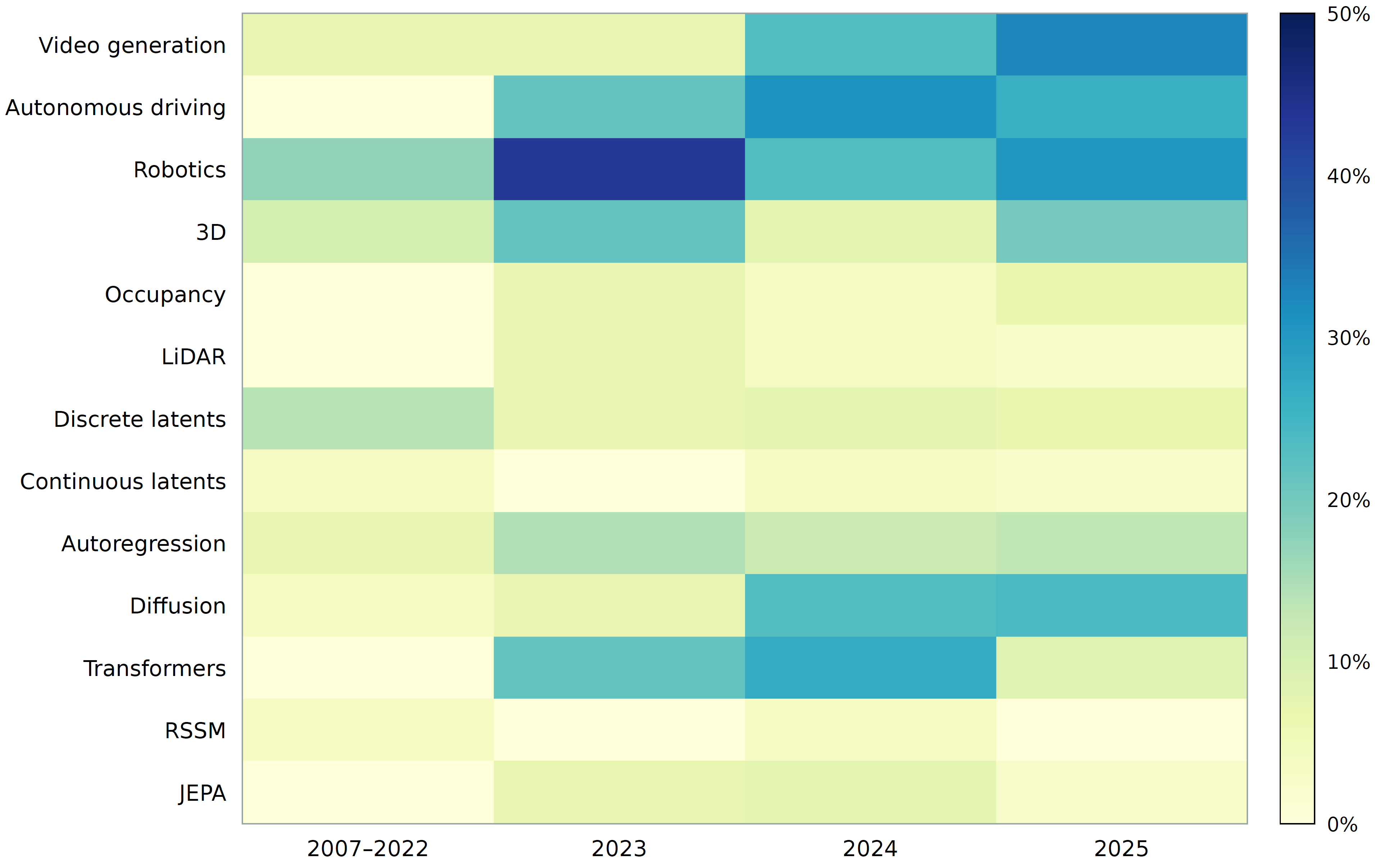
The network records shared source text, not joint implementation or causal dependence. Its manuscript-informed vocabulary and layout are reading aids, not independent evidence supporting the SAT taxonomy. The node threshold and removal of isolated nodes limit which terms are displayed; a missing node does not demonstrate that a concept is absent from the field.
Figure A2.
Keyword co-occurrence across 134 text-eligible sources in the revised inventory, including supporting literature and excluding three safety standards. Node area encodes containing-source count, edge thickness shared-source count, and color mean bibliography year. Terms require at least three containing sources and links at least two shared sources; isolated nodes are omitted. The resulting display has 69 terms and 604 links. Positions prioritize readability, and distances are not calibrated semantic similarities. This collection-specific vocabulary map does not estimate field structure, adoption, or independent support for SAT.
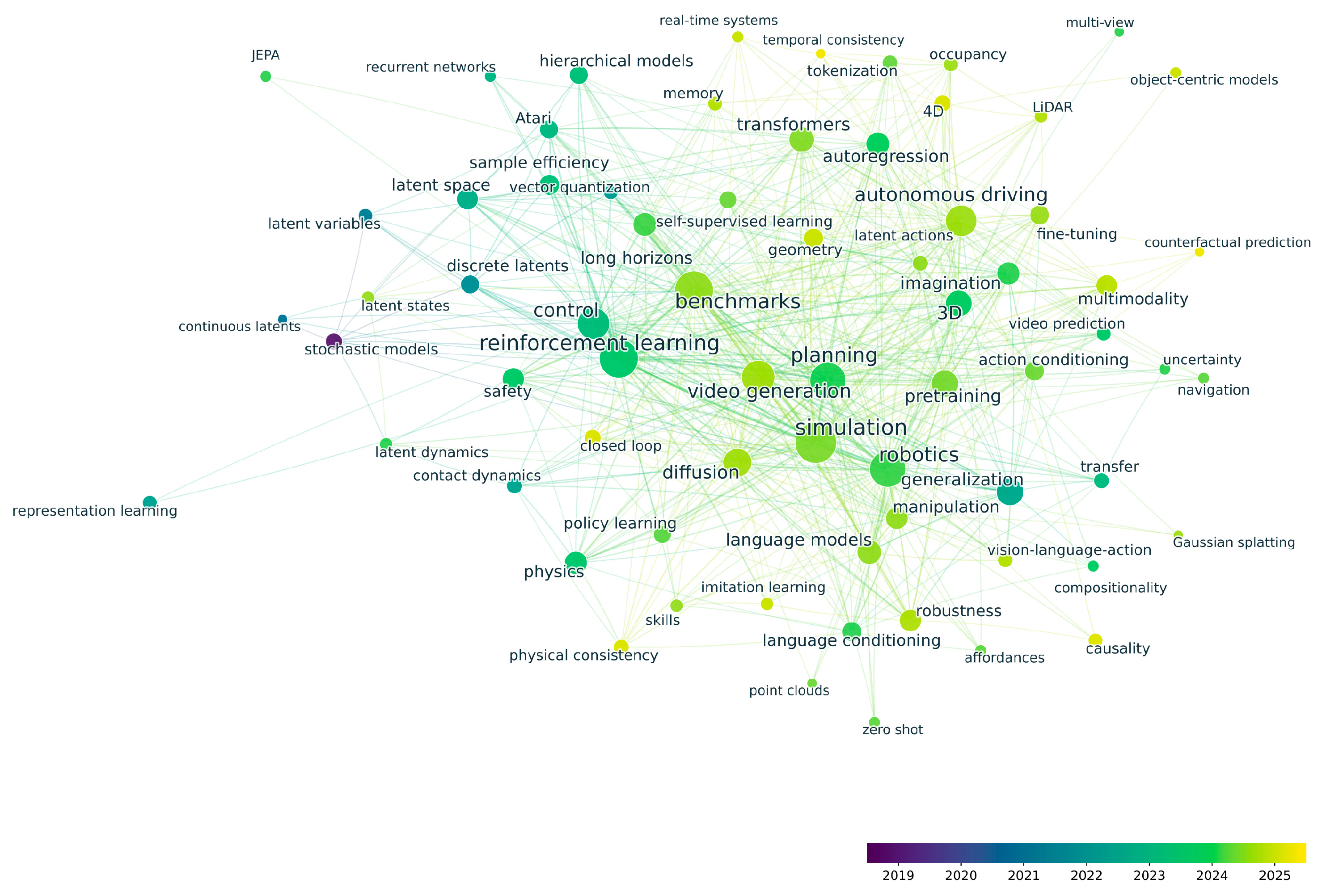
References
- Todorov, E.; Erez, T.; Tassa, Y. MuJoCo: A physics engine for model-based control. In Proceedings of the IEEE/RSJ International Conference on Intelligent Robots and Systems; IEEE: Piscataway, NJ, USA, 2012; pp. 5026–5033. [Google Scholar] [CrossRef] [Scilit]
- Freeman, C.D.; Frey, E.; Raichuk, A.; Girgin, S.; Mordatch, I.; Bachem, O. Brax–a differentiable physics engine for large scale rigid body simulation. In Proceedings of the Neural Information Processing Systems Track on Datasets and Benchmarks; Curran Associates, Inc.: Red Hook, NY, USA, 2021. [Google Scholar]
- Ha, D.; Schmidhuber, J. Recurrent world models facilitate policy evolution. In Proceedings of the Advances in Neural Information Processing Systems; Neural Information Processing Systems Foundation: La Jolla, CA, USA, 2018; Volume 31. [Google Scholar]
- Dawid, A.; LeCun, Y. Introduction to latent variable energy-based models: A path toward autonomous machine intelligence. J. Stat. Mech. Theory Exp. 2024, 2024, 104011. [Google Scholar] [CrossRef] [Scilit]
- Bansal, H.; Lin, Z.; Xie, T.; Zong, Z.; Yarom, M.; Bitton, Y.; Jiang, C.; Sun, Y.; Chang, K.W.; Grover, A. VideoPhy: Evaluating Physical Commonsense for Video Generation. In Proceedings of the International Conference on Learning Representations, Singapore, 24–28 April 2025. [Google Scholar]
- Meng, F.; Liao, J.; Tan, X.; Shao, W.; Lu, Q.; Zhang, K.; Cheng, Y.; Li, D.; Qiao, Y.; Luo, P. Towards World Simulator: Crafting Physical Commonsense-Based Benchmark for Video Generation. In Proceedings of the International Conference on Machine Learning, Vancouver, BC, Canada, 13–19 July 2025; Volume 267, pp. 43781–43806. [Google Scholar]
- Quevedo, J.; Sharma, A.K.; Sun, Y.; Suryavanshi, V.; Liang, P.; Yang, S. WorldGym: World Model as An Environment for Policy Evaluation. In Proceedings of the International Conference on Learning Representations, Rio de Janeiro, Brazil, 23–27 April 2026. [Google Scholar]
- Lu, Y.; Wu, B.; Li, Z.; Li, K.; Huang, C.; Wang, H.; Lan, Q.; Chen, R.; Chen, L.; Liang, B. Remote Sensing-Oriented World Model. arXiv 2025, arXiv:2509.17808. [Google Scholar] [CrossRef] [Scilit]
- Hafner, D.; Lillicrap, T.; Norouzi, M.; Ba, J. Mastering Atari with discrete world models. In Proceedings of the International Conference on Learning Representations, Virtual, 3–7 May 2021. [Google Scholar]
- Valevski, D.; Leviathan, Y.; Arar, M.; Fruchter, S. Diffusion Models Are Real-Time Game Engines. In Proceedings of the International Conference on Learning Representations, Singapore, 24–28 April 2025. [Google Scholar]
- Agarwal, N.; Ali, A.; Bala, M.; Balaji, Y.; Barker, E.; Cai, T.; Chattopadhyay, P.; Chen, Y.; Cui, Y.; Ding, Y.; et al. Cosmos World Foundation Model Platform for Physical AI. arXiv 2025, arXiv:2501.03575. [Google Scholar] [CrossRef] [Scilit]
- Ali, A.; Bai, J.; Bala, M.; Balaji, Y.; Blakeman, A.; Cai, T.; Cao, J.; Cao, T.; Cha, E.; Chao, Y.-W.; et al. World Simulation with Video Foundation Models for Physical AI. arXiv 2025, arXiv:2511.00062. [Google Scholar] [CrossRef] [Scilit]
- Zhu, Z.; Wang, X.; Zhao, W.; Min, C.; Li, B.; Deng, N.; Dou, M.; Wang, Y.; Shi, B.; Wang, K.; et al. Is Sora a world simulator? a comprehensive survey on general world models and beyond. arXiv 2024, arXiv:2405.03520. [Google Scholar]
- Ding, J.; Zhang, Y.; Shang, Y.; Zhang, Y.; Zong, Z.; Feng, J.; Yuan, Y.; Su, H.; Li, N.; Sukiennik, N.; et al. Understanding world or predicting future? A comprehensive survey of world models. ACM Comput. Surv. 2025, 58, 1–38. [Google Scholar] [CrossRef] [Scilit]
- Zidan, A.H.; Pan, Y.; Jiang, H.; Yan, R.; Ruan, W.; Wu, Z.; Chen, L.; You, W.; Li, X.; Chen, B.; et al. World Models: A Comprehensive Survey of Architectures, Methodologies, Reasoning Paradigms, and Applications. arXiv 2026, arXiv:2606.00133. [Google Scholar] [CrossRef] [Scilit]
- Lin, M.; Wang, X.; Wang, Y.; Wang, S.; Dai, F.; Ding, P.; Wang, C.; Zuo, Z.; Sang, N.; Huang, S.; et al. Exploring the evolution of physics cognition in video generation: A survey. arXiv 2025, arXiv:2503.21765. [Google Scholar] [CrossRef] [Scilit]
- Kang, B.; Yue, Y.; Lu, R.; Lin, Z.; Zhao, Y.; Wang, K.; Huang, G.; Feng, J. How Far is Video Generation from World Model: A Physical Law Perspective. In Proceedings of the International Conference on Machine Learning, Vancouver, BC, Canada, 13–19 July 2025; Volume 267, pp. 28991–29017. [Google Scholar]
- Kong, L.; Yang, W.; Mei, J.; Liu, Y.; Liang, A.; Zhu, D.; Lu, D.; Yin, W.; Hu, X.; Jia, M.; et al. 3D and 4D world modeling: A survey. arXiv 2025, arXiv:2509.07996. [Google Scholar] [CrossRef] [Scilit]
- Hou, B.; Li, G.; Jia, J.; An, T.; Guo, X.; Leng, S.; Geng, H.; Ze, Y.; Harada, T.; Torr, P.; et al. World Model for Robot Learning: A Comprehensive Survey. arXiv 2026, arXiv:2605.00080. [Google Scholar] [CrossRef] [Scilit]
- Wang, F.; Wang, Z.; Pei, G.; Zhang, M.; Liang, C.; Hu, J.; Li, Z.; Wu, J.; Han, N.; Zhang, Z.; et al. World Models for Robotic Manipulation: A Survey. arXiv 2026, arXiv:2606.00113. [Google Scholar] [CrossRef]
- Li, X.; He, X.; Zhang, L.; Wu, M.; Li, X.; Liu, Y. A Comprehensive Survey on World Models for Embodied AI. arXiv 2025, arXiv:2510.16732. [Google Scholar] [CrossRef] [Scilit]
- Hu, Y.; Wang, L.; Liu, X.; Chen, L.H.; Guo, Y.; Shi, Y.; Liu, C.; Rao, A.; Wang, Z.; Xiong, H. Simulating the Real World: A Unified Survey of Multimodal Generative Models. IEEE Trans. Pattern Anal. Mach. Intell. 2026, 48, 11007–11026. [Google Scholar] [CrossRef] [Scilit] [PubMed]
- Xiang, K.; Zhang, T.J.; Huang, Y.; He, J.; Liu, Z.; Tang, Y.; Zhou, R.; Luo, L.; Wen, Y.; Chen, X.; et al. Aligning Perception, Reasoning, Modeling and Interaction: A Survey on Physical AI. IEEE Trans. Pattern Anal. Mach. Intell. 2026, 48, 12938–12957. [Google Scholar] [CrossRef] [Scilit] [PubMed]
- Moerland, T.M.; Broekens, J.; Plaat, A.; Jonker, C.M. Model-Based Reinforcement Learning: A Survey. Found. Trends Mach. Learn. 2023, 16, 1–118. [Google Scholar] [CrossRef] [Scilit]
- Assran, M.; Bardes, A.; Fan, D.; Garrido, Q.; Howes, R.; Komeili, M.; Muckley, M.; Rizvi, A.; Roberts, C.; Sinha, K.; et al. V-JEPA 2: Self-Supervised Video Models Enable Understanding, Prediction and Planning. arXiv 2025, arXiv:2506.09985. [Google Scholar] [CrossRef] [Scilit]
- Huang, Y.; Zhang, J.; Zou, S.; Liu, X.; Hu, R.; Xu, K. LaDi-WM: A Latent Diffusion-Based World Model for Predictive Manipulation. In Proceedings of the Conference on Robot Learning, Seoul, Republic of Korea, 27–30 September 2025; Volume 305, pp. 1726–1743. [Google Scholar]
- Hafner, D.; Lillicrap, T.; Fischer, I.; Villegas, R.; Ha, D.; Lee, H.; Davidson, J. Learning latent dynamics for planning from pixels. In Proceedings of the International Conference on Machine Learning, Long Beach, CA, USA, 9–15 June 2019; Volume 97, pp. 2555–2565. [Google Scholar]
- Schrittwieser, J.; Antonoglou, I.; Hubert, T.; Simonyan, K.; Sifre, L.; Schmitt, S.; Guez, A.; Lockhart, E.; Hassabis, D.; Graepel, T.; et al. Mastering Atari, Go, Chess and Shogi by Planning with a Learned Model. Nature 2020, 588, 604–609. [Google Scholar] [CrossRef] [Scilit] [PubMed]
- Hansen, N.; Su, H.; Wang, X. TD-MPC2: Scalable, Robust World Models for Continuous Control. In Proceedings of the International Conference on Learning Representations, Vienna, Austria, 7–11 May 2024. [Google Scholar]
- Micheli, V.; Alonso, E.; Fleuret, F. Transformers are sample-efficient world models. In Proceedings of the International Conference on Learning Representations, Kigali, Rwanda, 1–5 May 2023. [Google Scholar]
- Alonso, E.; Jelley, A.; Micheli, V.; Kanervisto, A.; Storkey, A.; Pearce, T.; Fleuret, F. Diffusion for World Modeling: Visual Details Matter in Atari. In Proceedings of the Advances in Neural Information Processing Systems; Neural Information Processing Systems Foundation: La Jolla, CA, USA, 2024. [Google Scholar]
- Jiang, Z.; Zhang, T.; Janner, M.; Li, Y.; Rocktäschel, T.; Grefenstette, E.; Tian, Y. Efficient Planning in a Compact Latent Action Space. In Proceedings of the International Conference on Learning Representations, Kigali, Rwanda, 1–5 May 2023. [Google Scholar]
- Wu, P.; Escontrela, A.; Hafner, D.; Abbeel, P.; Goldberg, K. DayDreamer: World Models for Physical Robot Learning. In Proceedings of the Conference on Robot Learning, Atlanta, GA, USA, 6–9 November 2023; Volume 205, pp. 2226–2240. [Google Scholar]
- Brooks, T.; Peebles, B.; Holmes, C.; DePue, W.; Guo, Y.; Jing, L.; Schnurr, D.; Taylor, J.; Luhman, T.; Luhman, E.; et al. Video Generation Models as World Simulators. OpenAI Technical Report. 2024. Available online: https://openai.com/index/video-generation-models-as-world-simulators/ (accessed on 11 October 2026).
- Zheng, W.; Chen, W.; Huang, Y.; Zhang, B.; Duan, Y.; Lu, J. OccWorld: Learning a 3D occupancy world model for autonomous driving. In Proceedings of the European Conference on Computer Vision; Springer: Berlin/Heidelberg, Germany, 2024; pp. 55–72. [Google Scholar]
- Zhang, L.; Xiong, Y.; Yang, Z.; Casas, S.; Hu, R.; Urtasun, R. Copilot4D: Learning Unsupervised World Models for Autonomous Driving via Discrete Diffusion. In Proceedings of the International Conference on Learning Representations, Vienna, Austria, 7–11 May 2024. [Google Scholar]
- Lu, Y.; Ren, X.; Yang, J.; Shen, T.; Wu, Z.; Gao, J.; Wang, Y.; Chen, S.; Chen, M.; Fidler, S.; et al. InfiniCube: Unbounded and Controllable Dynamic 3D Driving Scene Generation with World-Guided Video Models. In Proceedings of the IEEE/CVF International Conference on Computer Vision, Honolulu, HI, USA, 19–25 October 2025; pp. 27272–27283. [Google Scholar]
- Kim, M.J.; Pertsch, K.; Karamcheti, S.; Xiao, T.; Balakrishna, A.; Nair, S.; Rafailov, R.; Foster, E.P.; Sanketi, P.R.; Vuong, Q.; et al. OpenVLA: An Open-Source Vision-Language-Action Model. In Proceedings of the Conference on Robot Learning, Seoul, Republic of Korea, 27–30 September 2025; Volume 270, pp. 2679–2713. [Google Scholar]
- Gao, S.; Zhou, S.; Du, Y.; Zhang, J.; Gan, C. AdaWorld: Learning Adaptable World Models with Latent Actions. In Proceedings of the International Conference on Machine Learning, Vancouver, BC, Canada, 13–19 July 2025. [Google Scholar]
- Bardes, A.; Garrido, Q.; Ponce, J.; Chen, X.; Rabbat, M.; LeCun, Y.; Assran, M.; Ballas, N. Revisiting feature prediction for learning visual representations from video. arXiv 2024, arXiv:2404.08471. [Google Scholar] [CrossRef] [Scilit]
- Shang, Y.; Zhang, X.; Tang, Y.; Jin, L.; Gao, C.; Wu, W.; Li, Y. RoboScape: Physics-informed Embodied World Model. In Proceedings of the Advances in Neural Information Processing Systems; Neural Information Processing Systems Foundation: La Jolla, CA, USA, 2025; Volume 38. [Google Scholar]
- Hu, Y.; Anderson, L.; Li, T.M.; Sun, Q.; Carr, N.; Ragan-Kelley, J.; Durand, F. DiffTaichi: Differentiable programming for physical simulation. In Proceedings of the International Conference on Learning Representations, Addis Ababa, Ethiopia, 26–30 April 2020. [Google Scholar]
- Hu, A.; Russell, L.; Yeo, H.; Murez, Z.; Fedoseev, G.; Kendall, A.; Shotton, J.; Corrado, G. GAIA-1: A generative world model for autonomous driving. arXiv 2023, arXiv:2309.17080. [Google Scholar] [CrossRef] [Scilit]
- Wang, Y.; He, J.; Fan, L.; Li, H.; Chen, Y.; Zhang, Z. Driving into the future: Multiview visual forecasting and planning with world model for autonomous driving. In Proceedings of the IEEE/CVF Conference on Computer Vision and Pattern Recognition, Seattle, WA, USA, 17 June 2024; pp. 14749–14759. [Google Scholar]
- Wang, X.; Zhu, Z.; Huang, G.; Chen, X.; Zhu, J.; Lu, J. DriveDreamer: Towards real-world-drive world models for autonomous driving. In Proceedings of the European Conference on Computer Vision; Springer: Berlin/Heidelberg, Germany, 2024; pp. 55–72. [Google Scholar] [CrossRef] [Scilit]
- Yue, H.; Huang, S.; Liao, Y.; Chen, S.; Zhou, P.; Chen, L.; Yao, M.; Ren, G. EWMBench: Evaluating Scene, Motion, and Semantic Quality in Embodied World Models. In Proceedings of the British Machine Vision Conference, Sheffield, UK, 24–27 November 2025. [Google Scholar]
- Min, C.; Zhao, D.; Xiao, L.; Nie, Y.; Dai, B. UniWorld: Autonomous driving pre-training via world models. arXiv 2023, arXiv:2308.07234. [Google Scholar] [CrossRef] [Scilit]
- Zhou, X.; Liang, D.; Tu, S.; Chen, X.; Ding, Y.; Zhang, D.; Tan, F.; Zhao, H.; Bai, X. HERMES: A Unified Self-Driving World Model for Simultaneous 3D Scene Understanding and Generation. In Proceedings of the IEEE/CVF International Conference on Computer Vision, Honolulu, HI, USA, 19–25 October 2025; pp. 27817–27827. [Google Scholar] [CrossRef] [Scilit]
- Wang, L.; Zheng, W.; Ren, Y.; Jiang, H.; Cui, Z.; Yu, H.; Lu, J. OccSora: 4D Occupancy Generation Models as World Simulators for Autonomous Driving. IEEE Trans. Image Process. 2026, 35, 4947–4960. [Google Scholar] [CrossRef] [Scilit] [PubMed]
- Liao, Z.; Wei, P.; Zhang, R.; Chen, S.; Wang, H.; Ren, Z. I2-World: Intra-Inter Tokenization for Efficient Dynamic 4D Scene Forecasting. In Proceedings of the IEEE/CVF International Conference on Computer Vision, Honolulu, HI, USA, 19–25 October 2025; pp. 25810–25819. [Google Scholar] [CrossRef] [Scilit]
- Lu, G.; Jia, B.; Li, P.; Chen, Y.; Wang, Z.; Tang, Y.; Huang, S. GWM: Towards Scalable Gaussian World Models for Robotic Manipulation. In Proceedings of the IEEE/CVF International Conference on Computer Vision, Honolulu, HI, USA, 19–25 October 2025; pp. 9263–9274. [Google Scholar] [CrossRef] [Scilit]
- Yang, X.; Wen, L.; Wei, T.; Ma, Y.; Mei, J.; Li, X.; Lei, W.; Fu, D.; Cai, P.; Dou, M.; et al. DriveArena: A Closed-loop Generative Simulation Platform for Autonomous Driving. In Proceedings of the IEEE/CVF International Conference on Computer Vision, Honolulu, HI, USA, 19–25 October 2025; pp. 26933–26943. [Google Scholar]
- Zhou, S.; Du, Y.; Chen, J.; Li, Y.; Yeung, D.Y.; Gan, C. RoboDreamer: Learning Compositional World Models for Robot Imagination. In Proceedings of the International Conference on Machine Learning, Vienna, Austria, 21–27 July 2024. [Google Scholar]
- Villar-Corrales, A.; Behnke, S. PlaySlot: Learning Inverse Latent Dynamics for Controllable Object-Centric Video Prediction and Planning. In Proceedings of the International Conference on Machine Learning, Vancouver, BC, Canada, 13–19 July 2025. [Google Scholar]
- Wang, Z.; Wang, K.; Zhao, L.; Stone, P.; Bian, J. Dyn-O: Building Structured World Models with Object-Centric Representations. In Proceedings of the Advances in Neural Information Processing Systems; Neural Information Processing Systems Foundation: La Jolla, CA, USA, 2025. [Google Scholar]
- Hamdan, S.; Güney, F. CarFormer: Self-Driving with Learned Object-Centric Representations. In Proceedings of the European Conference on Computer Vision; Springer: Berlin/Heidelberg, Germany, 2024. [Google Scholar]
- Nishimoto, Y.; Matsubara, T. Object-Centric World Models for Causality-Aware Reinforcement Learning. In Proceedings of the AAAI Conference on Artificial Intelligence; AAAI Press: Washington, DC, USA, 2026; Volume 40, pp. 24585–24593. [Google Scholar] [CrossRef] [Scilit]
- Kim, Y.; Singh, G.; Park, J.; Gulcehre, C.; Ahn, S. Imagine the Unseen World: A Benchmark for Systematic Generalization in Visual World Models. In Proceedings of the Advances in Neural Information Processing Systems; Neural Information Processing Systems Foundation: La Jolla, CA, USA, 2023. [Google Scholar]
- Kingma, D.P.; Welling, M. Auto-Encoding Variational Bayes. In Proceedings of the International Conference on Learning Representations, Banff, AB, Canada, 14–16 April 2014. [Google Scholar]
- Gneiting, T.; Raftery, A.E. Strictly Proper Scoring Rules, Prediction, and Estimation. J. Am. Stat. Assoc. 2007, 102, 359–378. [Google Scholar] [CrossRef] [Scilit]
- Van den Oord, A.; Vinyals, O.; Kavukcuoglu, K. Neural Discrete Representation Learning. In Proceedings of the Advances in Neural Information Processing Systems; Neural Information Processing Systems Foundation: La Jolla, CA, USA, 2017. [Google Scholar]
- Razavi, A.; van den Oord, A.; Vinyals, O. Generating Diverse High-Fidelity Images with VQ-VAE-2. In Proceedings of the Advances in Neural Information Processing Systems; Neural Information Processing Systems Foundation: La Jolla, CA, USA, 2019. [Google Scholar]
- Song, Y.; Wu, L.; Foster, D.J.; Krishnamurthy, A. Rich-Observation Reinforcement Learning with Continuous Latent Dynamics. In Proceedings of the International Conference on Machine Learning, Vienna, Austria, 21–27 July 2024. [Google Scholar]
- Samsami, M.R.; Zholus, A.; Rajendran, J.; Chandar, S. Mastering Memory Tasks with World Models. In Proceedings of the International Conference on Learning Representations, Vienna, Austria, 7–11 May 2024. [Google Scholar]
- Liu, Y.; Chen, Y. Event-Conditioned Diagnostics of Kinematic, Contact, and Object-Permanence Fields in Passive Object-State World Models. arXiv 2026, arXiv:2606.28455. [Google Scholar] [CrossRef] [Scilit]
- Zhen, H.; Qiu, X.; Chen, P.; Yang, J.; Yan, X.; Du, Y.; Hong, Y.; Gan, C. 3D-VLA: A 3D Vision-Language-Action Generative World Model. In Proceedings of the International Conference on Machine Learning, Vienna, Austria, 21–27 July 2024. [Google Scholar]
- Zitkovich, B.; Yu, T.; Xu, S.; Xu, P.; Xiao, T.; Xia, F.; Wu, J.; Wohlhart, P.; Welker, S.; Wahid, A.; et al. RT-2: Vision-Language-Action Models Transfer Web Knowledge to Robotic Control. In Proceedings of the Conference on Robot Learning, Atlanta, GA, USA, 6–9 November 2023; Volume 229, pp. 2165–2183. [Google Scholar]
- Nematollahi, I.; DeMoss, B.; Chandra, A.L.; Hawes, N.; Burgard, W.; Posner, I. LUMOS: Language-Conditioned Imitation Learning with World Models. In Proceedings of the IEEE International Conference on Robotics and Automation, Atlanta, GA, USA, 19–23 May 2025; pp. 8219–8225. [Google Scholar] [CrossRef] [Scilit]
- Zhang, L.; Kan, M.; Shan, S.; Chen, X. PreLAR: World Model Pre-training with Learnable Action Representation. In Proceedings of the European Conference on Computer Vision; Springer: Berlin/Heidelberg, Germany, 2024; pp. 185–201. [Google Scholar] [CrossRef] [Scilit] [PubMed]
- Ye, S.; Jang, J.; Jeon, B.; Joo, S.; Yang, J.; Peng, B.; Mandlekar, A.; Tan, R.; Chao, Y.W.; Lin, B.Y.; et al. Latent Action Pretraining from Videos. In Proceedings of the International Conference on Learning Representations, Singapore, 24–28 April 2025. [Google Scholar]
- Mattes, P.; Schlosser, R.; Herbrich, R. Hieros: Hierarchical Imagination on Structured State Space Sequence World Models. In Proceedings of the International Conference on Machine Learning, Vienna, Austria, 21–27 July 2024; Volume 235, pp. 35079–35103. [Google Scholar]
- Hansen, N.; S V, J.; Sobal, V.; LeCun, Y.; Wang, X.; Su, H. Hierarchical World Models as Visual Whole-Body Humanoid Controllers. In Proceedings of the International Conference on Learning Representations, Singapore, 24–28 April 2025; pp. 62175–62195. [Google Scholar]
- Xu, J.; Shangguan, B.; Zhu, M.; Liu, H.; Jiang, J.; He, G.; Feng, P.; Jin, S.; Liang, B.; Chang, Y.; et al. Bridging Perception and Action: A Lightweight Multimodal Meta-Planner Framework for Robust Earth Observation Agents. arXiv 2026, arXiv:2605.04777. [Google Scholar] [CrossRef] [Scilit]
- Yu, W.; Chen, W.; Yin, S.; Easterbrook, S.; Garg, A. Modular Action Concept Grounding in Semantic Video Prediction. In Proceedings of the IEEE/CVF Conference on Computer Vision and Pattern Recognition, New Orleans, LA, USA, 18–24 June 2022; pp. 3595–3604. [Google Scholar] [CrossRef] [Scilit]
- Bruce, J.; Dennis, M.; Edwards, A.; Parker-Holder, J.; Shi, Y.; Hughes, E.; Lai, M.; Mavalankar, A.; Steigerwald, R.; Apps, C.; et al. Genie: Generative Interactive Environments. In Proceedings of the International Conference on Machine Learning, Vienna, Austria, 21–27 July 2024. [Google Scholar]
- Wu, J.; Yin, S.; Feng, N.; He, X.; Li, D.; Hao, J.; Long, M. iVideoGPT: Interactive VideoGPTs are Scalable World Models. In Proceedings of the Advances in Neural Information Processing Systems; Neural Information Processing Systems Foundation: La Jolla, CA, USA, 2024. [Google Scholar]
- Kondratyuk, D.; Yu, L.; Gu, X.; Lezama, J.; Huang, J.; Schindler, G.; Hornung, R.; Birodkar, V.; Yan, J.; Chiu, M.C.; et al. VideoPoet: A large language model for zero-shot video generation. In Proceedings of the International Conference on Machine Learning, Vienna, Austria, 21–27 July 2024; Volume 235, pp. 25105–25124. [Google Scholar]
- Ge, Z.; Huang, H.; Zhou, M.; Li, J.; Wang, G.; Tang, S.; Zhuang, Y. WorldGPT: Empowering LLM as multimodal world model. In Proceedings of the ACM International Conference on Multimedia; ACM: New York, NY, USA, 2024; pp. 7346–7355. [Google Scholar] [CrossRef] [Scilit]
- Robine, J.; Höftmann, M.; Uelwer, T.; Harmeling, S. Transformer-based World Models Are Happy with 100k Interactions. In Proceedings of the International Conference on Learning Representations, Kigali, Rwanda, 1–5 May 2023. [Google Scholar]
- Ho, J.; Chan, W.; Saharia, C.; Whang, J.; Gao, R.; Gritsenko, A.; Kingma, D.P.; Poole, B.; Norouzi, M.; Fleet, D.J.; et al. Imagen Video: High definition video generation with diffusion models. arXiv 2022, arXiv:2210.02303. [Google Scholar] [CrossRef] [Scilit]
- Blattmann, A.; Dockhorn, T.; Kulal, S.; Mendelevitch, D.; Kilian, M.; Lorenz, D.; Levi, Y.; English, Z.; Voleti, V.; Letts, A.; et al. Stable Video Diffusion: Scaling latent video diffusion models to large datasets. arXiv 2023, arXiv:2311.15127. [Google Scholar] [CrossRef] [Scilit]
- Lee, J.H.; Lin, B.J.; Sun, W.F.; Lee, C.Y. EDELINE: Enhancing Memory in Diffusion-based World Models via Linear-Time Sequence Modeling. In Proceedings of the Advances in Neural Information Processing Systems; Neural Information Processing Systems Foundation: La Jolla, CA, USA, 2025. [Google Scholar]
- Zhang, K.; Tang, Z.; Hu, X.; Pan, X.; Guo, X.; Liu, Y.; Huang, J.; Yuan, L.; Zhang, Q.; Long, X.X.; et al. Epona: Autoregressive Diffusion World Model for Autonomous Driving. In Proceedings of the IEEE/CVF International Conference on Computer Vision, Honolulu, HI, USA, 19–25 October 2025; pp. 27220–27230. [Google Scholar] [CrossRef] [Scilit]
- Ding, Z.; Zhang, A.; Tian, Y.; Zheng, Q. Diffusion world model: Future modeling beyond step-by-step rollout for offline reinforcement learning. In Proceedings of the International Conference on Learning Representations, Singapore, 24–28 April 2025. [Google Scholar]
- Chen, F.; Han, F.; Guan, C.; Yuan, L.; Zhang, Z.; Yu, Y.; Zhang, Z. Stable continual reinforcement learning via diffusion-based trajectory replay. arXiv 2024, arXiv:2411.10809. [Google Scholar] [CrossRef] [Scilit]
- Assran, M.; Duval, Q.; Misra, I.; Bojanowski, P.; Vincent, P.; Rabbat, M.; LeCun, Y.; Ballas, N. Self-supervised learning from images with a joint-embedding predictive architecture. In Proceedings of the IEEE/CVF Conference on Computer Vision and Pattern Recognition, Vancouver, BC, Canada, 17–24 June 2023; pp. 15619–15629. [Google Scholar]
- Hafner, D.; Lillicrap, T.; Ba, J.; Norouzi, M. Dream to control: Learning behaviors by latent imagination. In Proceedings of the International Conference on Learning Representations, Addis Ababa, Ethiopia, 26–30 April 2020. [Google Scholar]
- Hafner, D.; Pasukonis, J.; Ba, J.; Lillicrap, T. Mastering Diverse Control Tasks through World Models. Nature 2025, 640, 647–653. [Google Scholar] [CrossRef] [Scilit] [PubMed]
- Sun, R.; Zang, H.; Li, X.; Islam, R. Learning Latent Dynamic Robust Representations for World Models. In Proceedings of the International Conference on Machine Learning, Vienna, Austria, 21–27 July 2024. [Google Scholar]
- Becker, P.; Neumann, G. On Uncertainty in Deep State Space Models for Model-Based Reinforcement Learning. arXiv 2022, arXiv:2210.09256. [Google Scholar] [CrossRef] [Scilit]
- Burchi, M.; Timofte, R. Learning Transformer-based World Models with Contrastive Predictive Coding. In Proceedings of the International Conference on Learning Representations, Singapore, 24–28 April 2025. [Google Scholar]
- Makoviychuk, V.; Wawrzyniak, L.; Guo, Y.; Lu, M.; Storey, K.; Macklin, M.; Hoeller, D.; Rudin, N.; Allshire, A.; Handa, A.; et al. Isaac Gym: High performance GPU-based physics simulation for robot learning. In Proceedings of the Neural Information Processing Systems Track on Datasets and Benchmarks; Curran Associates, Inc.: Red Hook, NY, USA, 2021. [Google Scholar]
- Scannell, A.; Nakhaei, M.; Kujanpää, K.; Zhao, Y.; Luck, K.S.; Solin, A.; Pajarinen, J. Discrete Codebook World Models for Continuous Control. In Proceedings of the International Conference on Learning Representations, Singapore, 24–28 April 2025. [Google Scholar]
- Hwang, I.; Kwak, Y.; Choi, S.; Zhang, B.T.; Lee, S. Fine-Grained Causal Dynamics Learning with Quantization for Improving Robustness in Reinforcement Learning. In Proceedings of the International Conference on Machine Learning, Vienna, Austria, 21–27 July 2024. [Google Scholar]
- Maddison, C.J.; Mnih, A.; Teh, Y.W. The Concrete Distribution: A Continuous Relaxation of Discrete Random Variables. In Proceedings of the International Conference on Learning Representations, Toulon, France, 24–26 April 2017. [Google Scholar]
- Jang, E.; Gu, S.; Poole, B. Categorical Reparameterization with Gumbel-Softmax. In Proceedings of the International Conference on Learning Representations, Toulon, France, 24–26 April 2017. [Google Scholar]
- He, H.; Zhang, Y.; Lin, L.; Xu, Z.; Pan, L. Pre-Trained Video Generative Models as World Simulators. In Proceedings of the AAAI Conference on Artificial Intelligence; AAAI Press: Washington, DC, USA, 2026; Volume 40, pp. 4645–4653. [Google Scholar] [CrossRef] [Scilit]
- Qin, Y.; Shi, Z.; Yu, J.; Wang, X.; Zhou, E.; Li, L.; Yin, Z.; Liu, X.; Sheng, L.; Shao, J.; et al. WorldSimBench: Towards Video Generation Models as World Simulators. In Proceedings of the International Conference on Machine Learning, Vancouver, BC, Canada, 13–19 July 2025; Volume 267, pp. 50338–50362. [Google Scholar]
- Duan, H.; Yu, H.X.; Chen, S.; Fei-Fei, L.; Wu, J. WorldScore: A Unified Evaluation Benchmark for World Generation. In Proceedings of the IEEE/CVF International Conference on Computer Vision, Honolulu, HI, USA, 19–25 October 2025; pp. 1–12. [Google Scholar] [CrossRef] [Scilit]
- He, X.; Feng, W.; Zheng, K.; Lu, Y.; Zhu, W.; Li, J.; Fan, Y.; Wang, J.; Li, L.; Yang, Z.; et al. MMWorld: Towards Multi-discipline Multi-faceted World Model Evaluation in Videos. In Proceedings of the International Conference on Learning Representations, Singapore, 24–28 April 2025. [Google Scholar]
- Yang, Y.; Mei, J.; Ma, Y.; Du, S.; Chen, W.; Qian, Y.; Feng, Y.; Liu, Y. Driving in the Occupancy World: Vision-Centric 4D Occupancy Forecasting and Planning via World Models for Autonomous Driving. In Proceedings of the AAAI Conference on Artificial Intelligence; AAAI Press: Washington, DC, USA, 2025; Volume 39, pp. 9327–9335. [Google Scholar] [CrossRef] [Scilit]
- Zhang, Z.; Liniger, A.; Dai, D.; Yu, F.; Gool, L.V. TrafficBots: Towards World Models for Autonomous Driving Simulation and Motion Prediction. In Proceedings of the IEEE International Conference on Robotics and Automation, London, UK, 29 May–2 June 2023; pp. 1522–1529. [Google Scholar] [CrossRef] [Scilit]
- Xiao, L.; Liu, J.J.; Yang, S.; Li, X.; Ye, X.; Yang, W.; Wang, J. Learning Multiple Probabilistic Decisions from Latent World Model in Autonomous Driving. In Proceedings of the IEEE International Conference on Robotics and Automation, Atlanta, GA, USA, 19–23 May 2025; pp. 1279–1285. [Google Scholar] [CrossRef] [Scilit]
- Zheng, Y.; Yang, P.; Xing, Z.; Zhang, Q.; Zheng, Y.; Gao, Y.; Li, P.; Zhang, T.; Xia, Z.; Jia, P.; et al. World4Drive: End-to-End Autonomous Driving via Intention-aware Physical Latent World Model. In Proceedings of the IEEE/CVF International Conference on Computer Vision, Honolulu, HI, USA, 19–25 October 2025; pp. 28632–28642. [Google Scholar] [CrossRef] [Scilit]
- Chen, Y.; Wang, Y.; Zhang, Z. DrivingGPT: Unifying Driving World Modeling and Planning with Multi-modal Autoregressive Transformers. In Proceedings of the IEEE/CVF International Conference on Computer Vision, Honolulu, HI, USA, 19–25 October 2025; pp. 26890–26900. [Google Scholar] [CrossRef] [Scilit]
- Yang, P.; Lu, B.; Xia, Z.; Han, C.; Gao, Y.; Zhang, T.; Zhan, K.; Lang, X.; Zheng, Y.; Zhang, Q. WorldRFT: Latent World Model Planning with Reinforcement Fine-Tuning for Autonomous Driving. In Proceedings of the AAAI Conference on Artificial Intelligence; AAAI Press: Washington, DC, USA, 2026; Volume 40, pp. 11649–11657. [Google Scholar] [CrossRef] [Scilit]
- Li, Y.; Wang, Y.; Liu, Y.; He, J.; Fan, L.; Zhang, Z. End-to-End Driving with Online Trajectory Evaluation via BEV World Model. In Proceedings of the IEEE/CVF International Conference on Computer Vision, Honolulu, HI, USA, 19–25 October 2025; pp. 27137–27146. [Google Scholar] [CrossRef] [Scilit]
- Schofield, H.; Elmahgiubi, M.; Rezaee, K.; Shan, J. Beyond Simulation: Benchmarking World Models for Planning and Causality in Autonomous Driving. In Proceedings of the IEEE International Conference on Robotics and Automation, Atlanta, GA, USA, 19–23 May 2025; pp. 1308–1314. [Google Scholar] [CrossRef] [Scilit]
- Li, Q.; Jia, X.; Wang, S.; Yan, J. Think2Drive: Efficient Reinforcement Learning by Thinking in Latent World Model for Quasi-Realistic Autonomous Driving (in CARLA-v2). In Proceedings of the European Conference on Computer Vision; Springer: Berlin/Heidelberg, Germany, 2024; Volume 15103, pp. 142–158. [Google Scholar] [CrossRef] [Scilit]
- Yang, Z.; Jia, X.; Li, Q.; Yang, X.; Yao, M.; Yan, J. Raw2Drive: Reinforcement Learning with Aligned World Models for End-to-End Autonomous Driving (in CARLA v2). In Proceedings of the Advances in Neural Information Processing Systems; Neural Information Processing Systems Foundation: La Jolla, CA, USA, 2025; Volume 38. [Google Scholar] [CrossRef] [Scilit]
- Lu, G.; Zhang, S.; Wang, Z.; Liu, C.; Lu, J.; Tang, Y. ManiGaussian: Dynamic Gaussian Splatting for Multi-task Robotic Manipulation. In Proceedings of the European Conference on Computer Vision; Springer: Berlin/Heidelberg, Germany, 2024; Volume 15093, pp. 349–366. [Google Scholar] [CrossRef] [Scilit]
- Jiang, T.; Guan, Y.; Ma, L.; Xu, J.; Meng, J.; Chen, W.; Zeng, Z.; Li, L.; Wu, D.; Chen, R. DexSim2Real2: Building Explicit World Model for Precise Articulated Object Dexterous Manipulation. IEEE Trans. Robot. 2025, 41, 4360–4379. [Google Scholar] [CrossRef] [Scilit]
- Ichter, B.; Brohan, A.; Chebotar, Y.; Finn, C.; Hausman, K.; Herzog, A.; Ho, D.; Ibarz, J.; Irpan, A.; Jang, E.; et al. Do As I Can, Not As I Say: Grounding Language in Robotic Affordances. In Proceedings of the Conference on Robot Learning, Atlanta, GA, USA, 6–9 November 2023; Volume 205, pp. 287–318. [Google Scholar]
- Huang, W.; Wang, C.; Zhang, R.; Li, Y.; Wu, J.; Fei-Fei, L. VoxPoser: Composable 3D Value Maps for Robotic Manipulation with Language Models. In Proceedings of the Conference on Robot Learning, Atlanta, GA, USA, 6–9 November 2023; Volume 229, pp. 540–562. [Google Scholar]
- Hafner, D.; Lee, K.H.; Fischer, I.; Abbeel, P. Deep Hierarchical Planning from Pixels. In Proceedings of the Advances in Neural Information Processing Systems; Neural Information Processing Systems Foundation: La Jolla, CA, USA, 2022; Volume 35. [Google Scholar]
- Pertsch, K.; Rybkin, O.; Ebert, F.; Zhou, S.; Jayaraman, D.; Finn, C.; Levine, S. Long-Horizon Visual Planning with Goal-Conditioned Hierarchical Predictors. In Proceedings of the Advances in Neural Information Processing Systems; Neural Information Processing Systems Foundation: La Jolla, CA, USA, 2020; Volume 33. [Google Scholar]
- Nunes, M.S.; Dehban, A.; Moreno, P.; Santos-Victor, J. Action-conditioned Benchmarking of Robotic Video Prediction Models: A Comparative Study. In Proceedings of the IEEE International Conference on Robotics and Automation, Paris, France, 31 May–31 August 2020; pp. 8316–8322. [Google Scholar] [CrossRef] [Scilit]
- Jang, J.; Ye, S.; Lin, Z.; Xiang, J.; Bjorck, J.; Fang, Y.; Hu, F.; Huang, S.; Kundalia, K.; Lin, Y.C.; et al. DreamGen: Unlocking Generalization in Robot Learning through Video World Models. In Proceedings of the Conference on Robot Learning, Seoul, Republic of Korea, 27–30 September 2025; Volume 305, pp. 5170–5194. [Google Scholar]
- Gerstenecker, S.; Geiger, A.; Renz, K. Fail2Drive: Benchmarking Closed-Loop Driving Generalization. arXiv 2026, arXiv:2604.08535. [Google Scholar] [CrossRef] [Scilit]
- Jiang, F.; Chen, Y.; Xu, K.; Liu, Y.; Wang, H.; Shen, Z.; Lu, J.; Huang, S.; Wang, Y.; Xie, C.; et al. RoboWM-Bench: A Benchmark for Evaluating World Models in Robotic Manipulation. arXiv 2026, arXiv:2604.19092. [Google Scholar] [CrossRef] [Scilit]
- Burchi, M.; Timofte, R. Accurate and Efficient World Modeling with Masked Latent Transformers. In Proceedings of the International Conference on Machine Learning, Vancouver, BC, Canada, 13–19 July 2025. [Google Scholar]
- Li, B.; Hong, Y.; Qian, C.; Ha, H.; Liu, J.; Wang, Z.; Guo, Y.; Li, Y.; Ji, H. Trimming the Long-Tail of Visual World Modeling Evaluation. arXiv 2026, arXiv:2606.24256. [Google Scholar] [CrossRef] [Scilit]
- Ding, Y.; Wang, L.; Liang, B.; Liang, S.; Wang, Y.; Chen, F. Domain Generalization by Learning and Removing Domain-specific Features. In Proceedings of the Advances in Neural Information Processing Systems; Neural Information Processing Systems Foundation: La Jolla, CA, USA, 2022; Volume 35, pp. 24226–24239. [Google Scholar] [CrossRef] [Scilit]
- Unterthiner, T.; van Steenkiste, S.; Kurach, K.; Marinier, R.; Michalski, M.; Gelly, S. Towards Accurate Generative Models of Video: A New Metric and Challenges. arXiv 2018, arXiv:1812.01717. [Google Scholar] [CrossRef] [Scilit]
- Motamed, S.; Culp, L.; Swersky, K.; Jaini, P.; Geirhos, R. Do Generative Video Models Understand Physical Principles? In Proceedings of the IEEE/CVF Winter Conference on Applications of Computer Vision, Tucson, AZ, USA, 6–10 March 2026; pp. 948–958. [Google Scholar]
- Rädsch, T.; Asano, Y.M.; Kuehne, H.; Bauer, S.; Jaini, P.; Geirhos, R.; Lüth, C.T. Physics-IQ Verified. arXiv 2026, arXiv:2606.18943. [Google Scholar] [CrossRef] [Scilit]
- Sekar, R.; Rybkin, O.; Daniilidis, K.; Abbeel, P.; Hafner, D.; Pathak, D. Planning to Explore via Self-Supervised World Models. In Proceedings of the International Conference on Machine Learning, Vienna, Austria, 13–18 July 2020; Volume 119, pp. 8583–8592. [Google Scholar]
- Karniadakis, G.E.; Kevrekidis, I.G.; Lu, L.; Perdikaris, P.; Wang, S.; Yang, L. Physics-Informed Machine Learning. Nat. Rev. Phys. 2021, 3, 422–440. [Google Scholar] [CrossRef] [Scilit]
- Bengio, Y.; Louradour, J.; Collobert, R.; Weston, J. Curriculum Learning. In Proceedings of the International Conference on Machine Learning, Montreal, QC, Canada, 14–18 June 2009; pp. 41–48. [Google Scholar] [CrossRef] [Scilit]
- Yang, C.; Wang, X.; Jiang, J.; Zhang, Q.; Huang, X. LLM-Based World Models Can Make Decisions Solely, But Rigorous Evaluations are Needed. arXiv 2026, arXiv:2411.08794. [Google Scholar] [CrossRef] [Scilit]
- Su, H.; Luo, J.; Liu, C.; Yang, X.; Zhang, Y.; Dong, Y.; Zhu, J. A Survey on Autonomy-Induced Security Risks in Large Model-Based Agents. IEEE Trans. Pattern Anal. Mach. Intell. 2026, 48, 11382–11401. [Google Scholar] [CrossRef] [Scilit] [PubMed]
- ISO 26262-1:2018; Road Vehicles—Functional Safety—Part 1: Vocabulary. International Organization for Standardization: Geneva, Switzerland, 2018.
- ISO 21448:2022; Road Vehicles—Safety of the Intended Functionality. International Organization for Standardization: Geneva, Switzerland, 2022.
- ANSI/A3 R15.06-2025; Industrial Robots and Robot Systems—Safety Requirements. Association for Advancing Automation: Ann Arbor, MI, USA, 2025.
- Bansal, S.; Chen, M.; Herbert, S.; Tomlin, C.J. Hamilton-Jacobi Reachability: A Brief Overview and Recent Advances. In Proceedings of the IEEE Conference on Decision and Control, Melbourne, Australia, 12–15 December 2017. [Google Scholar]
- Ames, A.D.; Coogan, S.; Egerstedt, M.; Notomista, G.; Sreenath, K.; Tabuada, P. Control Barrier Functions: Theory and Applications. In Proceedings of the European Control Conference, Naples, Italy, 15–28 June 2019. [Google Scholar]
- Alshiekh, M.; Bloem, R.; Ehlers, R.; Könighofer, B.; Niekum, S.; Topcu, U. Safe Reinforcement Learning via Shielding. In Proceedings of the AAAI Conference on Artificial Intelligence; AAAI Press: Washington, DC, USA, 2018. [Google Scholar]
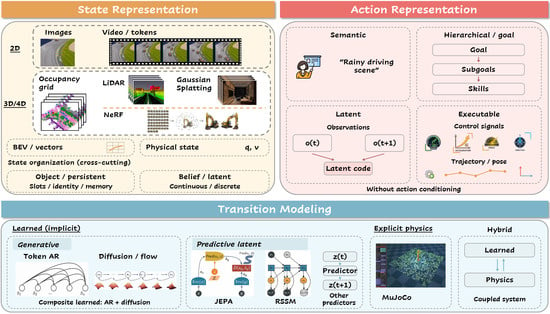
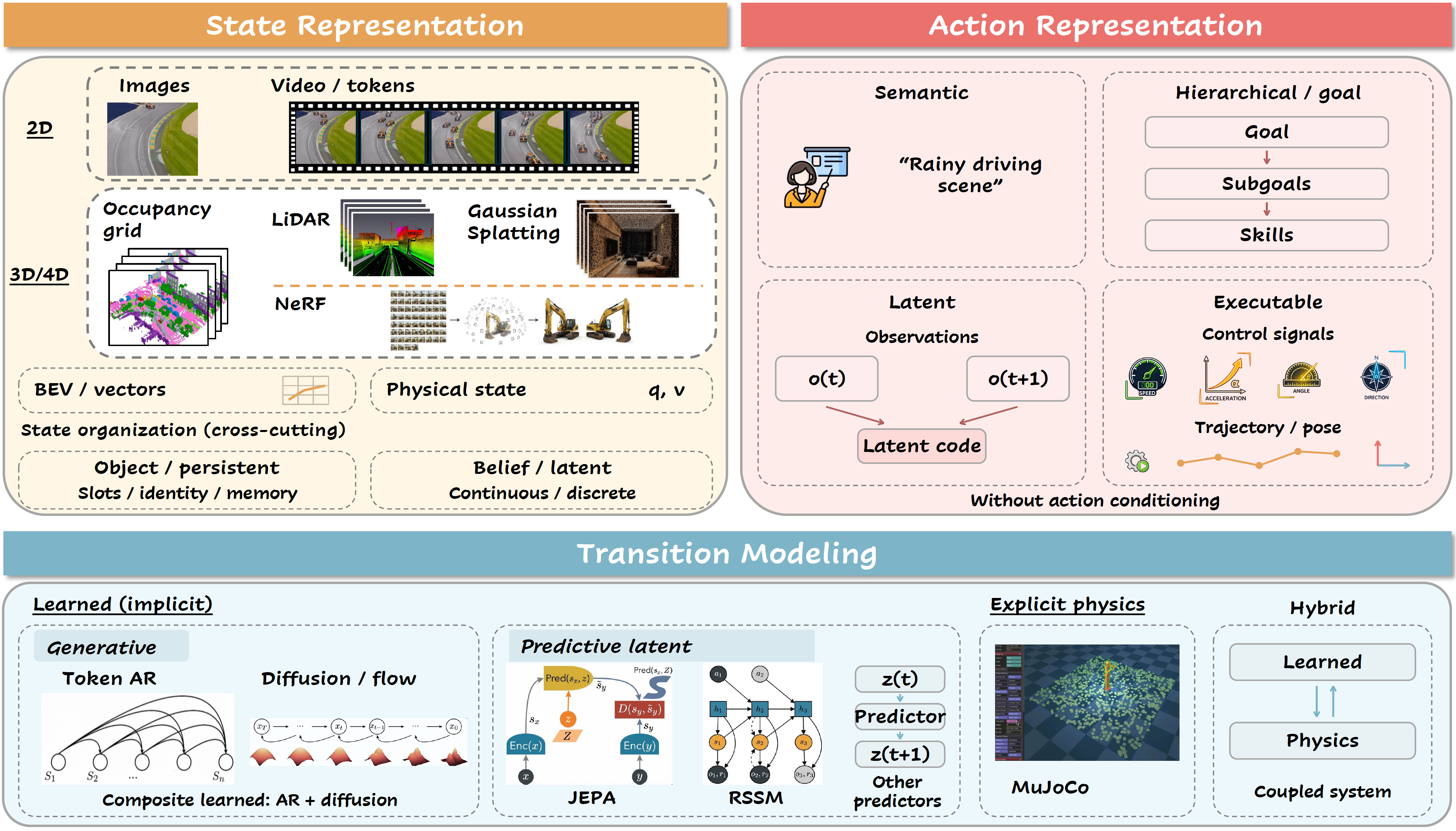
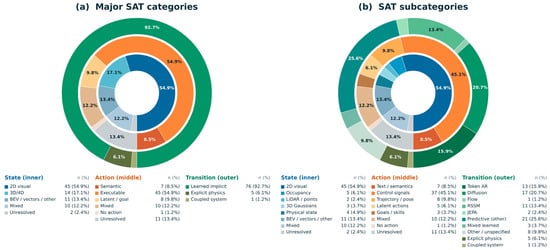
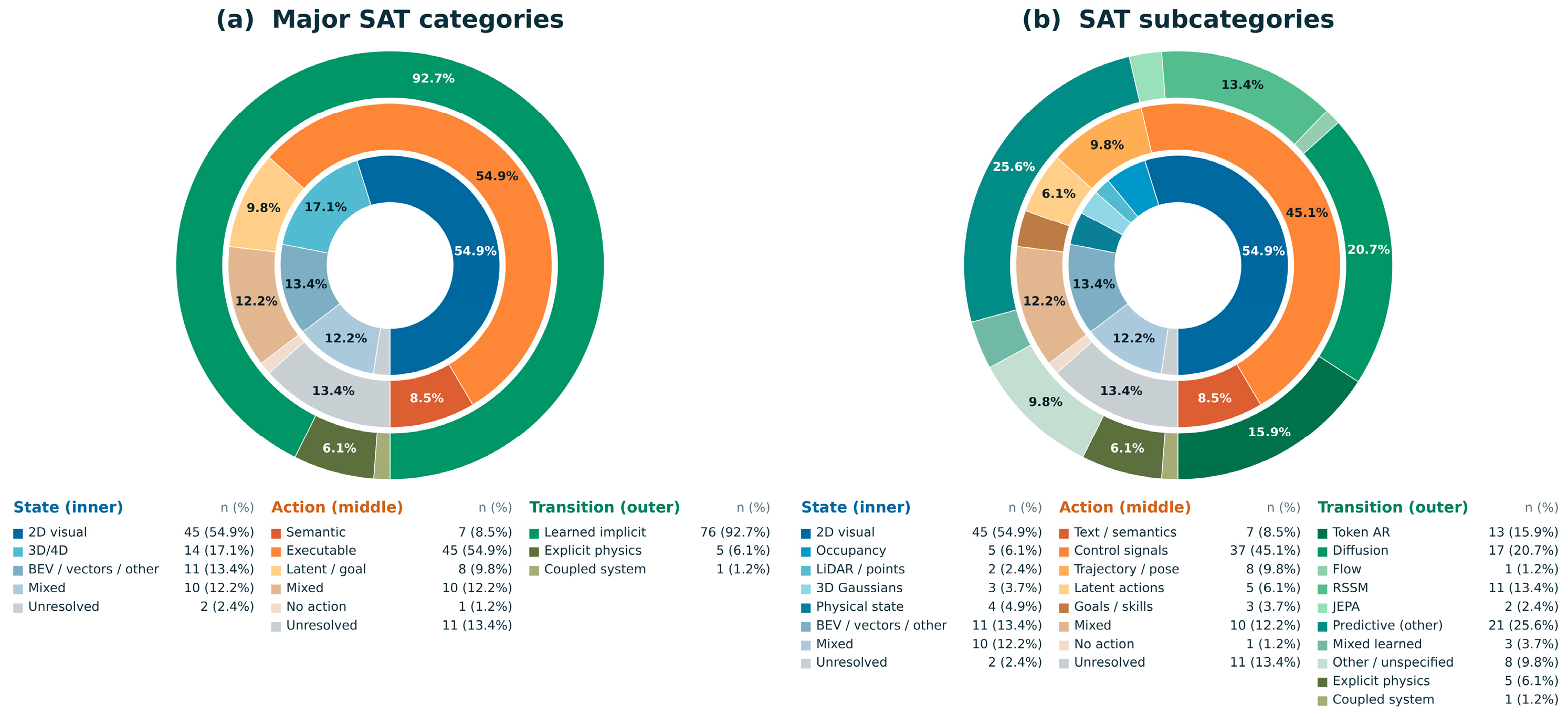
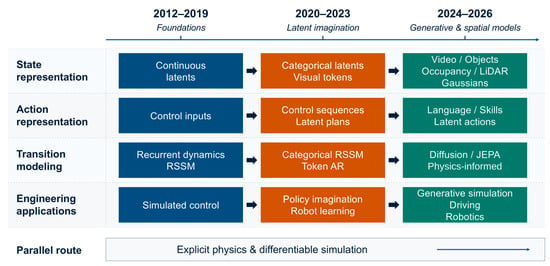
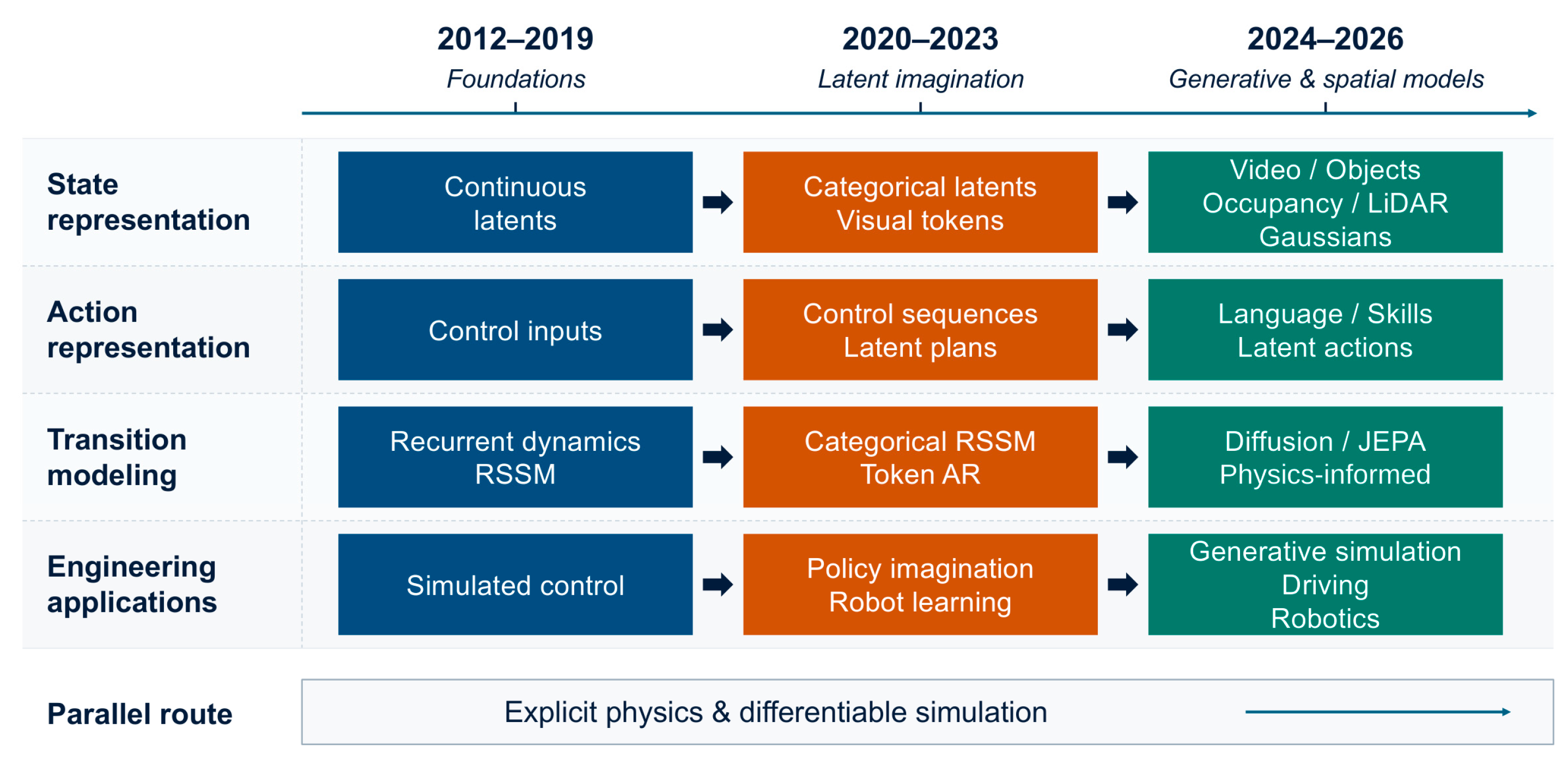
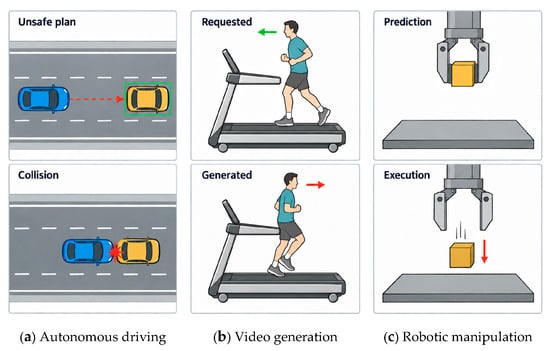
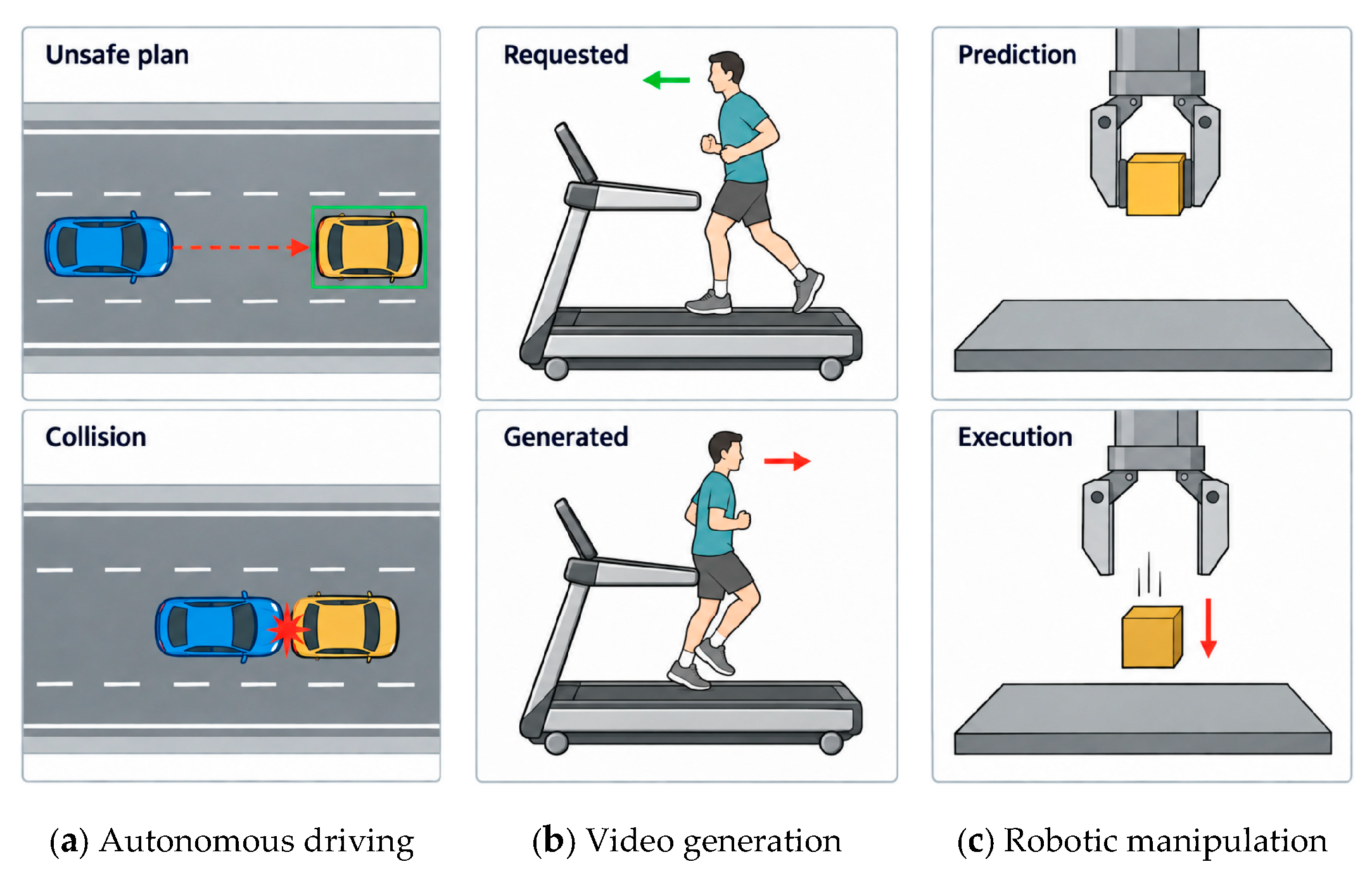

Disclaimer/Publisher’s Note: The statements, opinions and data contained in all publications are solely those of the individual author(s) and contributor(s) and not of MDPI and/or the editor(s). MDPI and/or the editor(s) disclaim responsibility for any injury to people or property resulting from any ideas, methods, instructions or products referred to in the content. |
© 2026 by the authors. Licensee MDPI, Basel, Switzerland. This article is an open access article distributed under the terms and conditions of the Creative Commons Attribution (CC BY) license.