You are currently viewing a new version of our website. To view the old version click .

CivilEng, Volume 3, Issue 2

June 2022 - 22 articles

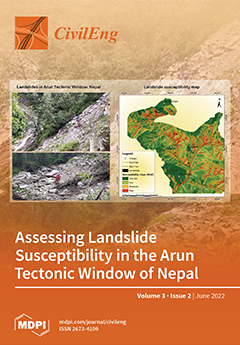
Cover Story: The northern stretch of the Arun watershed in East Nepal is dominated by steep slopes and rugged topography and experiences extensive landslides each year. Reliable landslide susceptibility assessment can potentially be an important tool for risk evaluation and mitigation in the Himalayas. The present study explores two GIS-based bivariate statistical methods, the weight of evidence method (WoE) and the frequency ratio (FR) method to assess landslide susceptibility in this area. Seven relevant topographical, hydrological, geological, and anthropogenic factors are considered in the assessment; both methods produced fairly reliable results, but the weight of evidence method is more sensitive to the spatial variation of relevant factors. View this paper
  • Issues are regarded as officially published after their release is announced to the table of contents alert mailing list .
  • You may sign up for email alerts to receive table of contents of newly released issues.
  • PDF is the official format for papers published in both, html and pdf forms. To view the papers in pdf format, click on the "PDF Full-text" link, and use the free Adobe Reader to open them.

Articles (22)

  • Article
  • Open Access
1 Citations
3,863 Views
20 Pages

Modeling of Progressive Scouring of a Pier-on-Bank

  • Vidya Subhash Chavan,
  • Shen-En Chen,
  • Navanit Sri Shanmugam,
  • Wenwu Tang,
  • John Diemer,
  • Craig Allan,
  • Nicole Braxtan,
  • Tarini Shukla,
  • Tianyang Chen and
  • Zachery Slocum

22 April 2022

Scour, caused by swiftly moving water, can remove alluvial sediment and soil, creating holes surrounding a bridge component and compromising the integrity of the bridge structure. Such problems can be equally critical for bridges with piers-on-bank b...

  • Article
  • Open Access
12 Citations
4,086 Views
18 Pages

New Models for the Properties of Warm Mix Asphalt with Sasobit

  • Morteza Rezaeizadeh Herozi,
  • Wilfredo Valenzuela,
  • Alireza Rezagholilou,
  • Ali Rigabadi and
  • Hamid Nikraz

12 April 2022

Warm Mix Asphalt (WMA) is a set of technologies that uses additives to reduce binder viscosity and increase mixture workability, which provides a complete coating of aggregates at lower temperatures around 100 °C to 130 °C. Organic wax or Sas...

  • Article
  • Open Access
3 Citations
3,050 Views
15 Pages

Freeze-Thaw Behaviour of Post-Installed Bonded Anchors under Changing Climate Conditions

  • Elisabeth Stierschneider,
  • Oliver Zeman and
  • Konrad Bergmeister

10 April 2022

The freeze-thaw behaviour of bonded fasteners in concrete is assessed according to the European Assessment Document 330499-01-0601 with freeze-thaw condition tests, which include 50 temperature cycles with a duration of 24 h between −20 °C...

  • Article
  • Open Access
21 Citations
7,606 Views
16 Pages

8 April 2022

Growing demand for road infrastructures and accompanying environmental footprint calls for the replacement of pavement materials with recycled options. The complexities in real-world usability are dependent upon project-specific characteristics and a...

  • Article
  • Open Access
6,218 Views
20 Pages

8 April 2022

In curtain wall applications, anchor channels are frequently installed near the edge of composite slabs with profiled steel decking. The complex concrete geometry of these floor slabs affects the capacity of all concrete failure modes, but there are...

  • Article
  • Open Access
17 Citations
5,188 Views
19 Pages

2 April 2022

Climate change is causing more frequent extreme weather events. The consequences of increasing global temperature on the operating cost of existing buildings, and the associated health, safety, and economic risks were investigated. Eight cities in On...

  • Article
  • Open Access
14 Citations
5,498 Views
14 Pages

Eggshell and Walnut Shell in Unburnt Clay Blocks

  • Nusrat Jannat,
  • Rafal Latif Al-Mufti and
  • Aseel Hussien

1 April 2022

Agricultural residues/by-products have become a popular choice for the manufacturing of building materials due to their cost-effectiveness and environmental friendliness, making them a viable option for achieving sustainability in the construction se...

  • Article
  • Open Access
19 Citations
7,829 Views
21 Pages

25 March 2022

Roads account for a major part of energy/resource consumption and emission of GHGs, such as CO2, PM, NOx, O3, etc., due to high demand for virgin materials, specifically in developing regions. The applicability of recycled materials, such as recycled...

  • Article
  • Open Access
1 Citations
3,831 Views
18 Pages

Recycling of Excavated Soils from Mini-Trenches Made on Road or Sidewalks to Install Public Utilities

  • Ali Hussan,
  • Daniel Levacher,
  • Salim Mezazigh,
  • Ilona Nzabika and
  • Philippe Dhervilly

25 March 2022

Digging trenches on roads, sidewalks, or banks to accommodate public demands is required for the installation of water pipelines, natural gas lines, electric cables, and optical fibers. The soils extracted from these trenches always have substantial...

  • Review
  • Open Access
15 Citations
5,180 Views
13 Pages

Carbonation Potential of Cementitious Structures in Service and Post-Demolition: A Review

  • Cinthia Maia Pederneiras,
  • Catarina Brazão Farinha and
  • Rosário Veiga

23 March 2022

The construction sector is responsible for a great environmental impact. The cement industry, which is included in this sector, emits about 650 to 800 kg of CO2 per each tonne of cement produced, being one of the most polluting industries in terms of...

of 3

Get Alerted

Add your email address to receive forthcoming issues of this journal.

XFacebookLinkedIn
CivilEng - ISSN 2673-4109