


Abstract
Background: Telemedicine encompasses heterogeneous remote-care models, whereas telemonitoring specifically refers to the asynchronous collection and subsequent professional review of patient-generated data. This pilot study assessed the feasibility of questionnaire-based asynchronous telemonitoring in patients receiving conservative treatment for hemorrhoidal disease. Materials and Methods: Adults aged 18–65 years with grade I-III hemorrhoidal disease not requiring surgery were enrolled after an in-person consultation. All participants followed the same asynchronous telemonitoring pathway and were randomized only to one of four conservative therapeutic regimens. Questionnaires were administered at baseline and after 7, 15, and 30 days. Feasibility indicators included questionnaire completion, comprehension, and the need for additional telephone or in-person contact; symptom changes and between-regimen comparisons were exploratory outcomes. Results: Of 277 eligible patients, 139 enrolled and 99 completed all four questionnaires (attrition, 28.7%). Questionnaire comprehension remained greater than 5/10. Patient-reported bowel-function-associated symptoms and well-being improved during follow-up, with no evidence of superiority of any therapeutic regimen. Conclusions: Serial asynchronous collection of patient-reported information was operationally feasible in this selected, digitally capable population. Because no conventional follow-up control group was included, the study cannot establish equivalence, noninferiority, superiority, or replacement of in-person follow-up. Controlled studies using validated hemorrhoid-specific outcomes are required.
1. Introduction
Telemedicine is an umbrella term encompassing healthcare delivered at a distance through digital communication technologies. Synchronous telemedicine involves real-time bidirectional interaction, such as telephone or video consultation, whereas asynchronous telemonitoring involves the collection, transmission, storage, and later professional review of patient-generated data, including questionnaire responses. Hybrid interventions combine asynchronous monitoring with synchronous communication, wearable devices, education, or messaging. These distinctions are important because evidence obtained from one modality cannot automatically be extrapolated to another. Prior work has examined teleconsultation in clinical decision-making [1], mobile health and social-media engagement in cancer screening [2], and mobile technologies supporting communication between healthcare professionals [3].
Digital care has been used in several surgical settings. Examples include synchronous postoperative virtual visits after low-risk surgery and colorectal surgery [4,5], predominantly asynchronous app-based education and collection of patient-reported outcomes after total knee replacement [6], hybrid remote-monitoring programs combining activity tracking with bidirectional text messaging after hip or knee arthroplasty [7], synchronous telehealth prehabilitation education before major cancer surgery [8], and telephone- or video-based postoperative wound assessment [9]. These approaches differ materially in intensity, communication mode, and clinical purpose.
Potential advantages of remote care include reduced travel and more frequent assessment, particularly for geographically dispersed populations. However, digital access, data quality, privacy, regulatory requirements, and the possibility that patient-reported information may not adequately substitute for physical examination remain important concerns. During the COVID-19 pandemic, adoption accelerated markedly, but careful terminology and modality-specific evaluation are still required [5,10]. Additional literature has addressed telemedicine during the COVID-19 pandemic [11], specific implications for colorectal surgeons [12], and remote care for patients with an ostomy [13].
The primary focus of the present study was therefore to assess the feasibility and sustainability of an asynchronous questionnaire-based telemonitoring pathway for patients receiving conservative treatment for grade I-III hemorrhoidal disease in a rural hospital network in northern Italy. All participants underwent the same telemonitoring pathway; randomization concerned only four conservative therapeutic regimens. A narrative review was also undertaken to place this specific model in the context of synchronous, asynchronous, and hybrid digital-care interventions.
2. Materials and Methods
This prospective, exploratory pilot study enrolled adults who underwent an initial in-person consultation and received a diagnosis of grade I-III hemorrhoidal disease according to Goligher [14], provided that surgery was not indicated. All participants entered the same asynchronous questionnaire-based telemonitoring pathway. Randomization concerned only the four conservative therapeutic regimens described below and did not allocate participants to telemonitoring versus conventional follow-up. Questionnaires were delivered by email through Google Forms at the end of the initial visit (t0) and after 7 (t1), 15 (t2), and 30 days (t3). The telemonitoring pathway was evaluated through serial questionnaire completion, comprehension, and the need for additional telephone or in-person clinical contact; longitudinal symptom changes and comparisons among therapeutic regimens were prespecified exploratory analyses. This report was prepared in accordance with CONSORT 2010 and the CONSORT extension for randomized pilot and feasibility trials. The randomized component concerned allocation to the four therapeutic regimens; the asynchronous telemonitoring pathway was common to all participants. The completed checklist is provided as supplementary submission material.
2.1. Randomized Therapeutic Regimens
The following were chosen as therapeutic regimens for our ambulatory patients and were randomly assigned to each participant of the study:
- Protocol A: Proctonorm® (α-lipoic acid, leucoselect phytosome, ginkgoselect phytosome, bromelain) 2 tablets before meals at 8 AM and 8 PM (for 5 days), then 1 tablet at 8 AM and 8 PM for 15 days.
- Protocol B: Flogovis® (fraxinus excelsior dry extract, escin, bromelain, serratiopeptidase) 2 tablets before meals at 8 AM and 8 PM (for 5 days), then 1 tablet at 8 AM and 8 PM for 15 days
- Protocol C: Crioven® (micronized diosmin, Vitis vinifera L., semen, centella, ascorbic acid) 2 tablets before meals at 8 AM-8 PM (for 5 days), then 1 tablet at 8 AM-8 PM for 15 days
- Protocol D: Prisma® (mesoglycan) 2 tablets before meals at 8 AM-8 PM (for 5 days), then 1 tablet at 8 AM-8 PM for 15 days
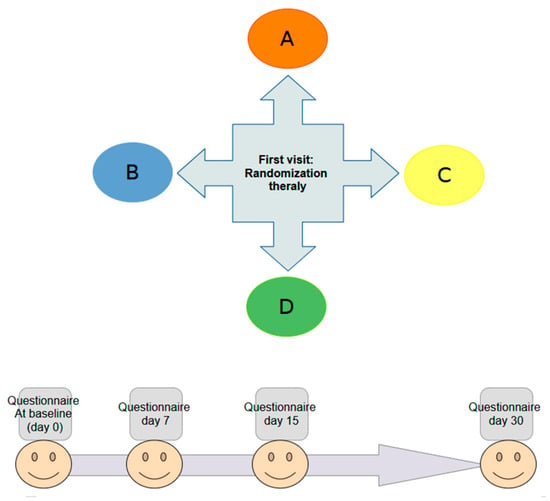
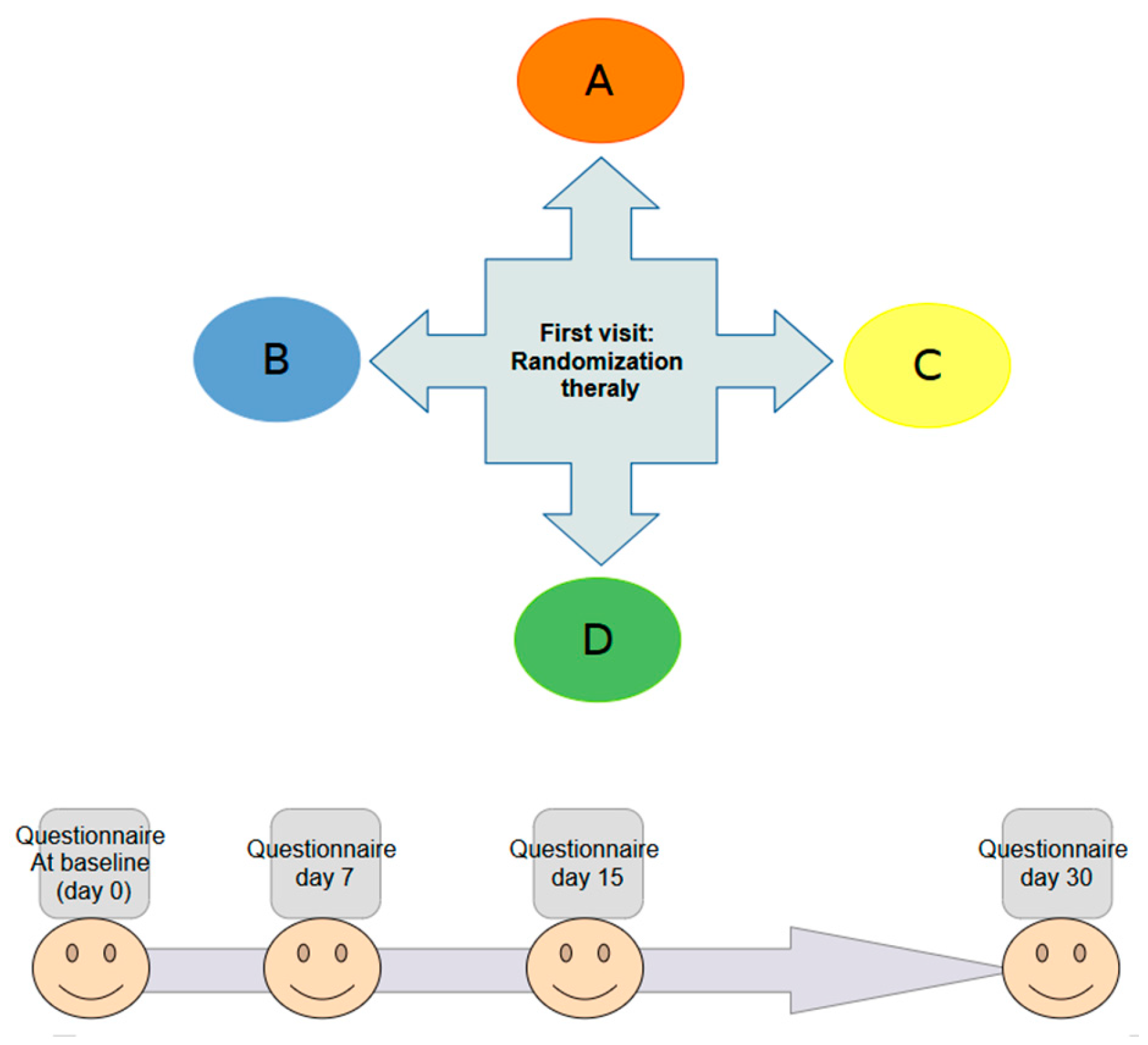
All patients also received topical treatment with Fitostimoline Proctogel cream® (wheat extract, glycerin, hydroxyethylcellulose, phenoxyethanol, polyethylene glycol 400), twice daily for 30 days, regardless of the randomized therapeutic regimen. Figure 1 depicts the four randomized therapeutic protocols (A–D) and the common questionnaire schedule.
Figure 1.
Study design and questionnaire schedule. A, Proctonorm®; B, Flogovis®; C, Crioven®; D, Prisma®. Letters A–D identify randomized treatment protocols, not figure subpanels. All groups completed questionnaires at baseline and on days 7, 15, and 30.
Questionnaire comprehension was rated on a scale from 1 (minimum) to 10 (maximum). To reduce attrition related to digital access in this initial pilot, eligibility was limited to adults aged 18–65 years who could independently use a computer or comparable device and a personal email account. This selection criterion restricts generalizability, particularly to older or digitally vulnerable populations.
No formal hypothesis-based power calculation was performed because the study was designed as an exploratory feasibility pilot and not to demonstrate clinical equivalence, noninferiority, superiority, or differences in treatment efficacy. Approximately 100 complete cases constituted a pragmatic prespecified target intended to provide pilot estimates of questionnaire retention and feasibility and to inform the design and sample-size calculation of a future controlled study. Recruitment continued beyond 100 enrolled participants because attrition was anticipated.
2.2. Statistical Analysis
The statistical analysis was formally conducted using two different systems. Firstly, thanks to the automatic data generation feature of Google Forms, it was possible to obtain graphs and percentages related to the main parameters under study in our population. Secondly, the SPSS® software version 26.0 was used to statistically evaluate differences between the identified subgroups. Specifically, Student’s t-test was used to compare the mean values of independent groups, while the chi-square test was employed to compare groups of values expressed as percentages.
2.3. Literature Review’s Methodology
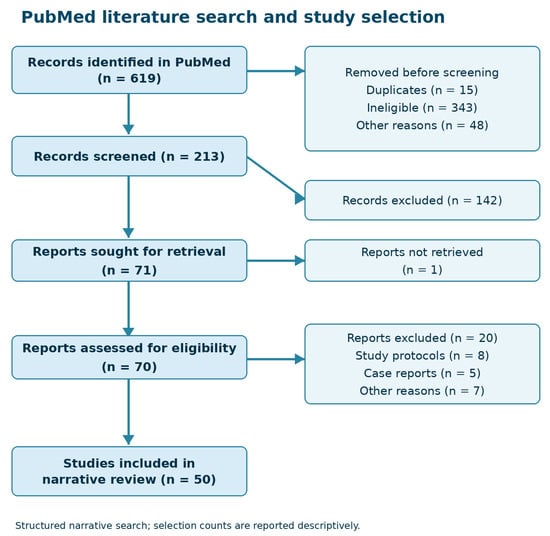
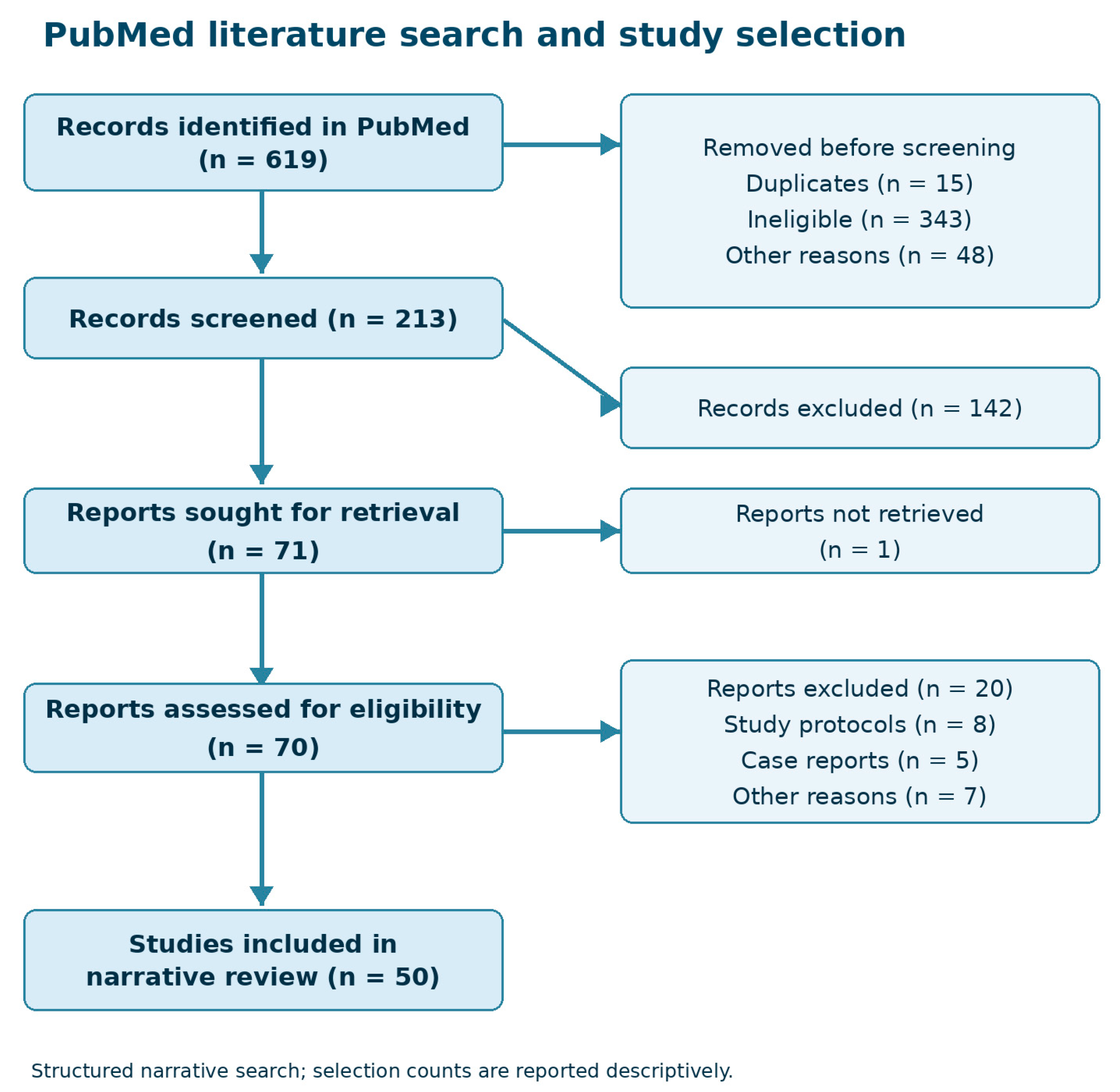
A structured narrative literature search was conducted in PubMed using the terms Surgery AND Telemedicine, limited to the previous 5 years, humans, adults, and free full text. The search identified 619 records. Two investigators (N.F. and F.V.) independently screened titles and abstracts; disagreements were resolved by a third investigator (S.G.). Fifty articles were retained for narrative consideration. Because the identified interventions were methodologically heterogeneous, selected representative studies are compared by digital modality, study design and relevance to the present questionnaire-based asynchronous pathway in the Discussion (Figure 2).
Figure 2.
Flow diagram of the structured narrative literature search. PubMed was searched using Surgery AND Telemedicine and filters for the previous 5 years, humans, adults, and free full text. Of 619 identified records, titles and abstracts were independently screened by two investigators; 50 articles were retained for narrative consideration. The diagram is presented using the PRISMA 2020 framework for transparent reporting of record selection.
This study was conducted in accordance with the Declaration of Helsinki, the European Union Medical Devices Directive (93/42/EEC art.15), and the local transpositions of the Member States.
The study followed the guidelines for clinical studies as outlined in EN ISO 14155:2020 [15] and in compliance with good clinical practice norms, and it was authorized by the local Ethics Committee in 2022, with protocol code CE: 477/2022/Oss/AUSLFe. Written informed consent was obtained from all participants before study enrollment.
2.4. Study Objectives
The primary objective was to assess the operational feasibility and sustainability of asynchronous questionnaire-based telemonitoring through retention across scheduled questionnaires, patient-reported comprehension, repeated acquisition of patient-generated data, and the frequency of additional telephone or in-person clinical contacts.
Secondary exploratory objectives were to describe longitudinal changes in the patient-reported variables collected during the first 30 days and to compare outcomes among the four randomized conservative therapeutic regimens. The study was not designed to determine whether telemonitoring was equivalent, noninferior, or superior to conventional outpatient follow-up, or whether it could replace in-person reassessment.
Exclusion criteria were a primary proctological diagnosis other than grade I-III hemorrhoidal disease, a concomitant anorectal disorder likely to confound symptom assessment, an indication for surgical treatment, age below 18 or above 65 years, or inability to participate independently in the digital pathway using a computer or comparable device and a personal email address. General medical comorbidities, such as treated hypertension, were not exclusion criteria unless they precluded conservative outpatient management or independent participation.
3. Results
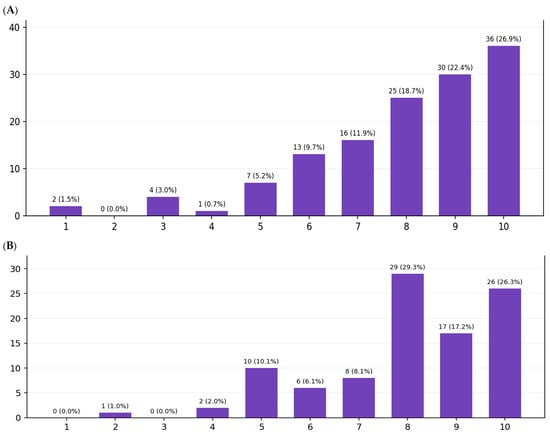
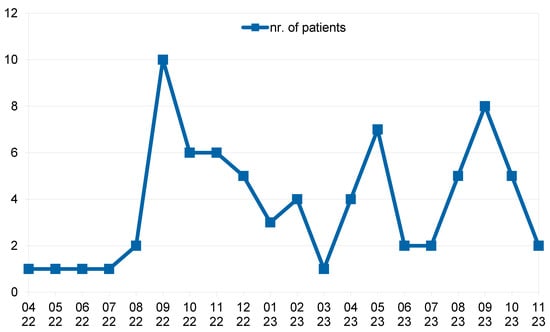
A total of 277 eligible patients were identified; 139 agreed to participate and received the baseline questionnaire. Ninety-nine participants completed all four questionnaires, corresponding to an attrition rate of 28.7%. Questionnaire comprehension remained greater than 5/10 at baseline and at 30 days (Figure 3). The timing of initial consultations over the 20-month study period is shown in Figure 4. Most participants were aged 40–59 years. During the three months preceding consultation, 46% reported constipation and 47.5% reported pain associated with defecation.
Figure 3.
Score assigned to questionnaire comprehension at time 0 (A) and after 30 days (B) (baseline, n = 134; day 30, n = 99; Google Forms data).
Figure 4.
Timeline of the first visit from April 2022 to November 2023 (Google Forms data).
The questionnaire compared selected bowel-function-associated patient-reported variables at baseline and after 30 days: sensation of incomplete evacuation, difficult evacuation, time required for evacuation, and abdominal pain (Table 1). These variables were not intended as a validated or comprehensive hemorrhoid-specific severity score. Bleeding, prolapse, pruritus, and anal pain or discomfort were not systematically quantified and therefore cannot be evaluated retrospectively. Subjective well-being was assessed at days 7 and 15 using both a 1–10 score and the categories complete, partial, or no benefit (Table 2). No statistically significant difference in well-being was observed among regimens A-D; across all regimens, the mean well-being score increased between days 7 and 15 (p = 0.006). Additional telephone or in-person contacts are reported as process indicators of the telemonitoring pathway in Table 3.
Table 1.
Selected bowel-function-associated patient-reported variables at baseline and 30 days; these variables do not constitute a validated hemorrhoid-specific severity score.
Table 2.
Exploratory comparison of patient-reported well-being at 7 and 15 days.
Table 3.
Exploratory clinical-course variables and additional contacts recorded through the telemonitoring pathway at 7 and 15 days.
4. Discussion
The present study evaluated the operational feasibility of repeated asynchronous questionnaire-based data collection after an initial in-person proctological consultation. It did not compare telemonitoring with conventional follow-up. The principal feasibility observations were that 99 participants completed all four questionnaires, comprehension remained above 5/10, and relatively few additional telephone or in-person contacts were recorded. Nevertheless, the 28.7% attrition rate is clinically relevant and limits any claim of broad acceptability.
The literature identified by the narrative search encompassed distinct digital-care modalities. Synchronous postoperative video visits may provide real-time clinical interaction [4,5], whereas app-based education and electronic patient-reported outcomes may be predominantly asynchronous [6]. Hybrid programs may combine wearables, symptom monitoring, goal-directed messaging, and bidirectional communication [7]. Telehealth prehabilitation education [8], postoperative wound assessment by telephone or video [9], mHealth screening interventions [2], and provider-to-provider communication tools [3] address still different objectives. These studies offer useful context for remote care but should not be interpreted as direct evidence of efficacy for the email-based asynchronous questionnaire pathway evaluated here. The representative studies are classified by modality and relevance in Table 4.
Table 4.
Representative digital-care studies classified by modality, key finding, and relevance to the present asynchronous questionnaire-based telemonitoring pathway.
In particular, the randomized trial by Mehta et al. used an activity monitor, pain and symptom tracking, goal-directed messaging, and, when necessary, a smartphone enabling bidirectional text communication [7]. It is therefore more appropriately classified as a hybrid remote-monitoring intervention rather than as an intervention equivalent to our questionnaire-only pathway. Likewise, Waterland et al. evaluated a synchronous telehealth prehabilitation education session before major cancer surgery [8]. These methodological differences are now made explicit in Table 4.
Within the present cohort, several bowel-function-associated variables and subjective well-being improved during conservative therapy. However, these observations cannot establish that telemonitoring caused clinical improvement, because every participant received both medical therapy and the same telemonitoring pathway, and no non-telemonitoring comparator was included. Comparisons among regimens A–D were exploratory and the study was not powered to demonstrate treatment efficacy.
The collected symptom variables also have important limitations. Sensation of incomplete evacuation, difficult evacuation, evacuation time, and abdominal pain describe selected bowel-function-associated complaints but do not constitute a validated hemorrhoid-specific outcome set. Bleeding, prolapse, pruritus, and anal pain or discomfort were not systematically quantified. Future studies should incorporate validated hemorrhoid-specific measures and objective clinical assessment.
Questionnaire comprehension and the limited requirement for unplanned telephone or in-person contact support the technical operability of the pathway among participants who completed follow-up. At the same time, restricting enrollment to adults aged 18–65 years with independent digital access selected a relatively digitally capable population and may have overestimated feasibility in routine practice.
The principal limitation is the absence of a conventional follow-up control group. Consequently, the study cannot determine equivalence, noninferiority, superiority, safety, cost-effectiveness, or the capacity of asynchronous telemonitoring to replace outpatient reassessment. Other limitations include the pragmatic sample size without a formal power calculation, single-network design, 28.7% attrition, reliance on subjective patient-reported data, absence of validated hemorrhoid-specific outcomes, and selection according to age and digital capability.
A future adequately powered controlled study should compare asynchronous telemonitoring with conventional in-person follow-up using prespecified feasibility, safety, satisfaction, resource-use, and validated disease-specific clinical outcomes. Such a design would be required before recommending substitution of routine outpatient follow-up.
Despite these limitations, the study provides preliminary operational information on serial asynchronous data collection in conservative proctological care and clarifies the distinction between this model and synchronous or hybrid telemedicine interventions.
5. Conclusions
In a selected population of adults with independent digital access, questionnaire-based asynchronous telemonitoring allowed serial collection of patient-reported information during conservative treatment for hemorrhoidal disease. These findings support operational feasibility but do not demonstrate equivalence, noninferiority, superiority, or replacement of conventional outpatient follow-up. The substantial attrition and absence of validated hemorrhoid-specific outcomes further limit clinical interpretation. Controlled, adequately powered studies comparing telemonitoring with conventional follow-up are needed before this pathway can be recommended as a substitute for in-person reassessment.
Author Contributions
Conceptualization, N.F.; methodology and study design, N.F., S.G. and C.V.F.; development, configuration and validation of the digital questionnaire and data-collection workflow, N.F., S.G., M.F., F.V. and M.M.; patient recruitment, investigation and longitudinal data acquisition, N.F., S.G., S.S., M.F., L.C. and A.P.; data curation and source-data verification, N.F., S.G., S.S., L.C., A.P. and F.V.; formal analysis, N.F., S.G. and F.V.; literature search, independent screening and evidence interpretation, N.F., F.V. and S.G.; writing—original draft preparation, N.F., S.G. and A.P.; writing—review and editing, all authors; supervision and clinical interpretation, S.G., A.P. and C.V.F.; project administration, N.F. and S.G. Specifically, S.S. verified questionnaire and source data; M.F. contributed to digital form configuration and participant-level data collection; L.C. contributed to follow-up data acquisition and clinical-data validation; F.V. contributed to database management, formal analysis and independent literature screening; M.M. contributed to technical validation of the digital data-collection workflow and review of data integrity; and C.V.F. contributed to study methodology, clinical interpretation and critical revision of the manuscript. All authors have read and agreed to the published version of the manuscript.
Funding
This research received no external funding.
Institutional Review Board Statement
The study was conducted in accordance with the Declaration of Helsinki and was approved by the Ethics Committee of Ferrara in 2022 (protocol code CE: 477/2022/Oss/AUSLFe, Approval Date: 16 June 2022).
Informed Consent Statement
Written informed consent was obtained from all participants involved in the study.
Data Availability Statement
The participant-level data supporting this study are not publicly available because of patient privacy and applicable ethical/data-protection restrictions. De-identified data may be considered for sharing by the corresponding author upon reasonable request, subject to institutional authorization and applicable legal requirements.
Conflicts of Interest
The authors declare no conflicts of interest.
References
- Deldar, K.; Bahaadinbeigy, K.; Tara, S.M. Teleconsultation and Clinical Decision Making: A Systematic Review. Acta Inform. Med. 2016, 24, 286–292. [Google Scholar] [CrossRef] [Scilit]
- Ruco, A.; Dossa, F.; Tinmouth, J.; Llovet, D.; Jacobson, J.; Kishibe, T.; Baxter, N. Social Media and mHealth Technology for Cancer Screening: Systematic Review and Meta-analysis. J. Med. Internet Res. 2021, 23, e26759. [Google Scholar] [CrossRef] [Scilit] [PubMed] [PubMed Central]
- Gonçalves-Bradley, D.C.; Maria, A.R.J.; Ricci-Cabello, I.; Villanueva, G.; Fønhus, M.S.; Glenton, C.; Lewin, S.; Henschke, N.; Buckley, B.S.; Mehl, G.L.; et al. Mobile Technologies to Support Healthcare Provider-to-Provider Communication and Management of Care. Cochrane Database Syst. Rev. 2020, 8, CD012927. [Google Scholar] [CrossRef] [Scilit] [PubMed] [PubMed Central]
- Harkey, K.; Kaiser, N.; Zhao, J.; Hetherington, T.; Gutnik, B.; Matthews, B.D.; Kelz, R.R.; Reinke, C.E. Postdischarge Virtual Visits for Low-risk Surgeries: A Randomized Noninferiority Clinical Trial. JAMA Surg. 2021, 156, 221–228. [Google Scholar] [CrossRef] [Scilit] [PubMed] [PubMed Central]
- Yao, L.Y.; Fleshner, P.R.; Zaghiyan, K.N. Impact of postoperative telemedicine visit versus in-person visit on patient satisfaction: A randomized clinical trial. Surgery 2023, 173, 322–327. [Google Scholar] [CrossRef] [Scilit] [PubMed] [PubMed Central]
- Timmers, T.; Janssen, L.; van der Weegen, W.; Das, D.; Marijnissen, W.-J.; Hannink, G.; van der Zwaard, B.C.; Plat, A.; Thomassen, B.; Swen, J.-W.; et al. The Effect of an App for Day-to-Day Postoperative Care Education on Patients with Total Knee Replacement: Randomized Controlled Trial. JMIR mHealth uHealth 2019, 7, e15323. [Google Scholar] [CrossRef] [Scilit] [PubMed] [PubMed Central]
- Mehta, S.J.; Hume, E.; Troxel, A.B.; Reitz, C.; Norton, L.; Lacko, H.; McDonald, C.; Freeman, J.; Marcus, N.; Volpp, K.G.; et al. Effect of Remote Monitoring on Discharge to Home, Return to Activity, and Rehospitalization After Hip and Knee Arthroplasty: A Randomized Clinical Trial. JAMA Netw. Open 2020, 3, e2028328. [Google Scholar] [CrossRef] [Scilit] [PubMed] [PubMed Central]
- Waterland, J.L.; Chahal, R.; Ismail, H.; Sinton, C.; Riedel, B.; Francis, J.J.; Denehy, L. Implementing a Telehealth Prehabilitation Education Session for Patients Preparing for Major Cancer Surgery. BMC Health Serv. Res. 2021, 21, 443. [Google Scholar] [CrossRef] [Scilit] [PubMed] [PubMed Central]
- NIHR Global Health Research Unit on Global Surgery; GlobalSurg Collaborative. Use of Telemedicine for Postdischarge Assessment of the Surgical Wound: International Cohort Study, and Systematic Review with Meta-analysis. Ann. Surg. 2023, 277, e1331–e1347. [Google Scholar] [CrossRef] [Scilit] [PubMed] [PubMed Central]
- Fabbri, N.; Pesce, A.; Greco, S.; Feo, C.V. Letter to the editor: A point of view on telemedicine in colorectal surgery. Surgery 2023, 174, 1097–1098. [Google Scholar] [CrossRef] [Scilit] [PubMed]
- Mills, E.C.; Savage, E.; Lieder, J.; Chiu, E.S. Telemedicine and the COVID-19 Pandemic: Are We Ready to Go Live? Adv. Ski Wound Care 2020, 33, 410–417. [Google Scholar] [CrossRef] [Scilit] [PubMed] [PubMed Central]
- Tyler, K.M.; Baucom, R. What Every Colorectal Surgeon Should Know About Telemedicine. Dis. Colon Rectum 2020, 63, 418–419. [Google Scholar] [CrossRef] [Scilit]
- Dinuzzi, V.; Palomba, G.; Minischetti, M.; Amendola, A.; Aprea, P.; Luglio, G.; De Palma, G.; Aprea, G. Telemedicine in Patients with an Ostomy During the COVID-19 Pandemic: A Retrospective Observational Study. Wound Manag. Prev. 2021, 67, 12–17. [Google Scholar] [CrossRef] [Scilit] [PubMed]
- Goligher, J.C. Haemorrhoids or piles. In Surgery of the Anus, Rectum and Colon, 4th ed.; Goligher, J.C., Ed.; Baillière Tindall: London, UK, 1980; p. 96. [Google Scholar]
- ISO 14155:2020; Clinical Investigation of Medical Devices for Human Subjects—Good Clinical Practice. International Organization for Standardization (ISO): Geneva, Switzerland, 2020.

Disclaimer/Publisher’s Note: The statements, opinions and data contained in all publications are solely those of the individual author(s) and contributor(s) and not of MDPI and/or the editor(s). MDPI and/or the editor(s) disclaim responsibility for any injury to people or property resulting from any ideas, methods, instructions or products referred to in the content. |
© 2026 by the authors. Licensee MDPI, Basel, Switzerland. This article is an open access article distributed under the terms and conditions of the Creative Commons Attribution (CC BY) license.