


Abstract
Background: Anesthesiologist-estimated blood loss is a frequent outcome in retrospective blood-conservation studies, but whether it captures the effect of tranexamic acid (TXA) in total knee arthroplasty (TKA) is unknown. Methods: This retrospective cohort study included primary unilateral TKAs in patients aged 40–75 years (2024–2025) at a public hospital in Mexico. The primary outcome, intraoperative blood loss recorded on the anesthesia record, was analyzed with linear regression including a TXA × tourniquet interaction and prespecified confounders. Predictors of TXA use and recording patterns were examined. Results: Of 343 patients, 125 (36.4%) received 1 g intravenous TXA and 233 (67.9%) had a tourniquet. TXA was not associated with recorded blood loss without a tourniquet (adjusted difference +15 mL; 95% CI −73 to 103) or with one (+24 mL; −18 to 65), whereas the tourniquet was associated with −349 mL (−405 to −293). Clinical and organizational variables did not predict TXA use (optimism-corrected AUC 0.54). Without a tourniquet, 95.5% of values were multiples of 50 mL; with a tourniquet, 0 mL was recorded less often after TXA (adjusted OR 0.43; 0.23–0.80). Conclusions: Recorded intraoperative blood loss reflected tourniquet use and recording habits, not preoperative TXA, and should not be used to evaluate antifibrinolytics.
1. Introduction
Total knee arthroplasty (TKA) is the standard treatment for end-stage degenerative knee disease, and its volume keeps growing as the population ages [1]. Perioperative blood loss leads to postoperative anemia and transfusion, which are associated with infection, poorer functional recovery, longer hospital stays, and higher mortality [2]. About half of the blood lost after TKA is hidden and cannot be seen in the surgical field or in the drains [3].
Tranexamic acid (TXA) is a synthetic lysine analog that competitively blocks the conversion of plasminogen to plasmin, which prevents fibrin breakdown and stabilizes the clot [4]. In TKA it reduces blood loss and the need for transfusion [5], clinical practice guidelines recommend it for primary arthroplasty [6], and in national databases it has been associated with fewer transfusions without more adverse events [7]. Its use is still not universal. In the United States, TXA was given in 62.5% of TKAs in 2021 and less often to patients at thromboembolic risk [8]. In Brazil, it was associated with fewer transfusions in routine practice [9], but little is known about how often, and on what grounds, it is used in Latin American public hospitals.
The tourniquet has long been used to limit intraoperative bleeding and improve the surgical field. It has also been associated with more postoperative pain, a smaller early range of motion, and more thrombotic and other postoperative complications [10,11]. In randomized trials it led to more serious adverse events and more pain, with no difference in overall blood loss [11]. When TXA is given, the tourniquet reduces intraoperative bleeding at the cost of greater hidden loss [12], and there is still no agreement on the best way to use it [13]. Because fibrinolysis peaks several hours after surgery [14], what a study observes depends on when blood loss is measured.
Many retrospective studies compare these strategies using the blood loss estimated by the anesthesiologist [15]. This estimate is inaccurate in simulations [16] and agrees poorly with hemoglobin-based methods [17]. Less is known about how it behaves in routine records, including how much values are rounded, whether a tourniquet creates a floor effect, and whether the estimate depends on the same clinician who decides to give TXA.
The primary objective was to evaluate the association between preoperative intravenous TXA and recorded intraoperative blood loss in primary TKA and whether this association differs with tourniquet use. The protocol hypothesis was that TXA would reduce estimated blood loss regardless of tourniquet use. The secondary objectives were to identify factors associated with TXA administration and to describe how blood loss was recorded, as a basis for an institutional protocol on TXA use and blood loss assessment.
2. Materials and Methods
2.1. Study Design and Participants
We conducted a retrospective cohort study at the Hospital General “Gral. José María Morelos y Pavón” of the Instituto de Seguridad y Servicios Sociales de los Trabajadores del Estado (ISSSTE), a public hospital in Mexico City, and reported it according to the STROBE statement [18]. We reviewed the records of patients who underwent TKA between January 2024 and December 2025. We included patients aged 40 to 75 years with a primary unilateral TKA and an anesthesia record documenting blood loss, tourniquet use, and whether TXA was given. We excluded revision and bilateral arthroplasties; patients with documented coagulopathy, anticoagulation that had not been discontinued, active thromboembolic disease, or TXA allergy; records with incomplete data; and procedures that could not be verified in the source documents. All eligible patients in this period were included, so the sample size was set by the available records and was not calculated in advance. The study followed the Declaration of Helsinki, and data were analyzed without personal identifiers. The Research Ethics Committee and the Research Committee of the hospital approved the protocol (registration number RPI.HGGJMMYP.0038.2025; 31 December 2025).
2.2. Variables
The main exposure was intravenous TXA given before incision, as documented on the anesthesia record or in the medical orders. The institutional practice was a single 1 g intravenous dose before surgery. There was no written protocol, and the decision rested with the attending orthopedic surgeon and anesthesiologist. Tourniquet use was defined as a recorded ischemia time greater than 0 min.
The primary outcome was recorded intraoperative blood loss, defined as the volume in milliliters recorded by the anesthesiologist on the anesthesia record (hereafter, recorded blood loss). It was estimated by counting blood-soaked surgical material, assigning 10 mL to each soaked gauze sponge and 100 mL to each soaked laparotomy pad, and adding the volume in the suction canister when bleeding was greater. We also report the proportion of patients with recorded blood loss of 500 mL or more, which is about 10% of the blood volume of a 70 kg adult.
Clinical covariates were age, sex, body mass index (BMI), American Society of Anesthesiologists (ASA) physical status class, type of anesthesia (regional, or general or other), type 2 diabetes mellitus, systemic arterial hypertension, history of deep vein thrombosis (DVT), chronic antiplatelet or anticoagulant use, and chronic use of nonsteroidal anti-inflammatory drugs (NSAIDs). Sex was taken from the medical record (female or male); gender was not recorded. Organizational variables were the shift (morning or afternoon), the operating room, and the semester of surgery. Anesthesia time was calculated from the recorded start and end of anesthesia; values below 45 min or above 420 min were considered implausible, most likely transcription errors, and were treated as missing. Clinical variables and procedure type were checked against the data extraction sheet.
2.3. Statistical Analysis
Variables were summarized as mean and standard deviation (SD), median and interquartile range (IQR), or counts and percentages. Within each tourniquet stratum, patients who did and did not receive TXA were compared with the standardized mean difference (SMD). SMDs of 0.20, 0.50, and 0.80 were interpreted as small, medium, and large differences, respectively [19], and SMDs below 0.10 as negligible imbalance [20].
For the primary objective, we fitted a linear regression of recorded blood loss on TXA, tourniquet use, and their interaction, with heteroscedasticity-robust (HC3) standard errors. Confounders were chosen a priori on clinical grounds and included age, sex, BMI, ASA class, type of anesthesia, antithrombotic use, and NSAID use. We did not adjust for anesthesia time, because a longer operation can result from bleeding rather than cause it, and adjusting for it could hide part of the association. The TXA effect in each stratum was estimated from linear combinations of the coefficients. To describe the contribution of each factor, we report the proportion of the variance of recorded blood loss (R2) explained by tourniquet use alone, by TXA alone, by the clinical covariates, and by the full model. The precision of the comparison between patients with and without TXA was described by the smallest difference detectable with 80% power at a two-sided α of 0.05, given the group sizes and the observed standard deviations.
Four sensitivity analyses were performed. The first was median regression, which is less affected by skewed data and repeated values, fitted with the QuantReg class of statsmodels; its 95% confidence intervals (CIs) were percentile intervals from 2000 nonparametric bootstrap resamples of patients (NumPy random generator, seed 2026). The second was inverse probability of treatment weighting (IPTW) within each tourniquet stratum, in which each patient was weighted by the inverse of the estimated probability of the treatment received (stabilized weights), so that the weighted groups had similar covariate distributions; balance was checked with weighted SMDs, and the weighted difference was estimated by weighted least squares with HC3 standard errors. The third was propensity score matching (PSM), in which patients were matched 1:1 on the logit of the propensity score by nearest-neighbor matching without replacement within a caliper of 0.2 SD [21], and the mean difference between matched pairs was estimated with a paired t test. PSM compared patients with and without TXA within each tourniquet stratum, and operations with and without a tourniquet; in the latter comparison, each patient operated on without a tourniquet was matched to one with a tourniquet. Propensity scores for IPTW and PSM were estimated by logistic regression with the confounders of the primary model, plus TXA in the tourniquet comparison. The fourth added anesthesia time to the primary model, as a marker of surgical complexity, to examine whether the selection of patients for TXA influenced the results; it was not the primary analysis because anesthesia time may also be a consequence of bleeding. For the proportion of patients with recorded blood loss of 500 mL or more, the risk difference between patients with and without TXA was calculated with the Newcombe 95% CI, which remains accurate with small groups and proportions close to 0.
Factors associated with TXA administration were analyzed with logistic regression including the clinical covariates, tourniquet use, and the organizational variables. We calculated the area under the ROC curve (AUC) corrected for optimism with 500 bootstrap resamples (seed 2027) and compared the blocks of clinical and organizational variables with likelihood ratio tests. Logistic models used model-based standard errors, and robust (HC0) standard errors were calculated as a check.
To describe recording, each value was classified as 0 mL, a multiple of 100 mL, a multiple of 50 mL not divisible by 100, or another value, and proportions were compared between patients with and without TXA. In operations with a tourniquet, because of a possible floor effect, we used a two-part model, with logistic regression for recording 0 mL and gamma regression with a log link and robust (HC0) standard errors for the amount when it was greater than 0 mL, both adjusted for the confounders and tourniquet time.
As exploratory analyses, we examined factors associated with recorded blood loss in operations without a tourniquet and recorded blood loss by tourniquet time (1 to 59, 60 to 119, and 120 min or more). Complete cases were analyzed. Proportions were compared with Fisher’s exact test, which does not rely on large-sample approximations, and p values were adjusted for multiple comparisons with the Holm–Bonferroni method [22] within each family of tests defined by the study objectives, namely the two stratum-specific TXA contrasts of the primary objective, the proportion with recorded blood loss of 500 mL or more, the predictors of TXA administration, and the recording analyses (Table S6). Coefficients of adjustment covariates were not interpreted as hypothesis tests. Analyses were performed in Python 3.12.10 with statsmodels 0.14.6, SciPy 1.17.1, NumPy 1.26.4, pandas 3.0.1, and scikit-learn 1.8.0, and figures were drawn in R 4.4.3 with ggplot2 3.5.2.
2.4. Changes from the Protocol
The protocol included an objective on transfusion that could not be assessed because transfusion was not recorded in the source data. Tourniquet use was defined by its recorded time, and bilateral arthroplasties were excluded. The interaction term corresponds to the protocol hypothesis; the secondary objectives and the sensitivity analyses were defined after the initial review of the data. During peer review, we added PSM, the analysis adjusted for anesthesia time, the description of explained variance, the calculation of detectable differences, and the adjustment for multiple comparisons; all were post hoc.
3. Results
3.1. Participants
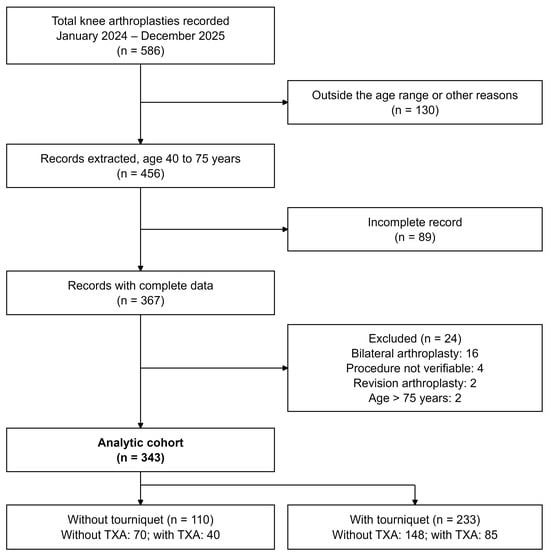
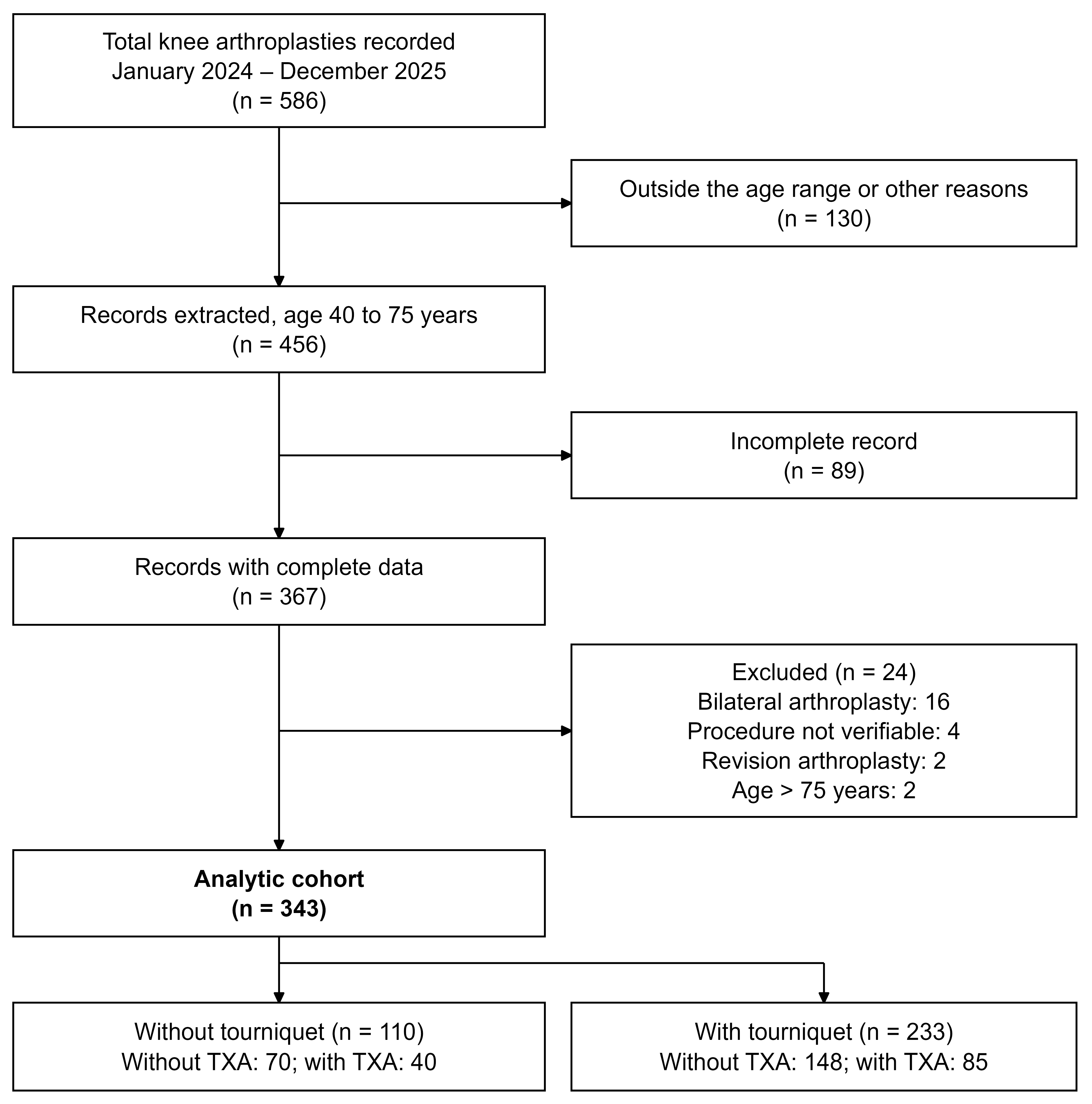
Of 456 records extracted, 367 had complete data and 343 met the selection criteria (Figure 1). Mean age was 65.6 years (SD 5.9); 65.6% of patients were women and 50.7% had obesity. A tourniquet was used in 233 patients (67.9%) and TXA in 125 (36.4%), with similar proportions of TXA use without (36.4%) and with (36.5%) a tourniquet. The largest baseline differences between patients with and without TXA were in the stratum without a tourniquet, for general or other anesthesia (SMD 0.49) and anesthesia time (SMD 0.48); both were small differences, and no SMD reached the medium threshold of 0.50 (Table 1).
Figure 1.
Flow diagram of participants. TXA: tranexamic acid.
Table 1.
Patient characteristics by tourniquet and tranexamic acid use.
3.2. Recorded Intraoperative Blood Loss
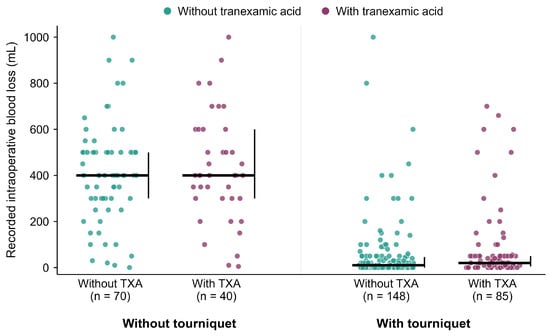
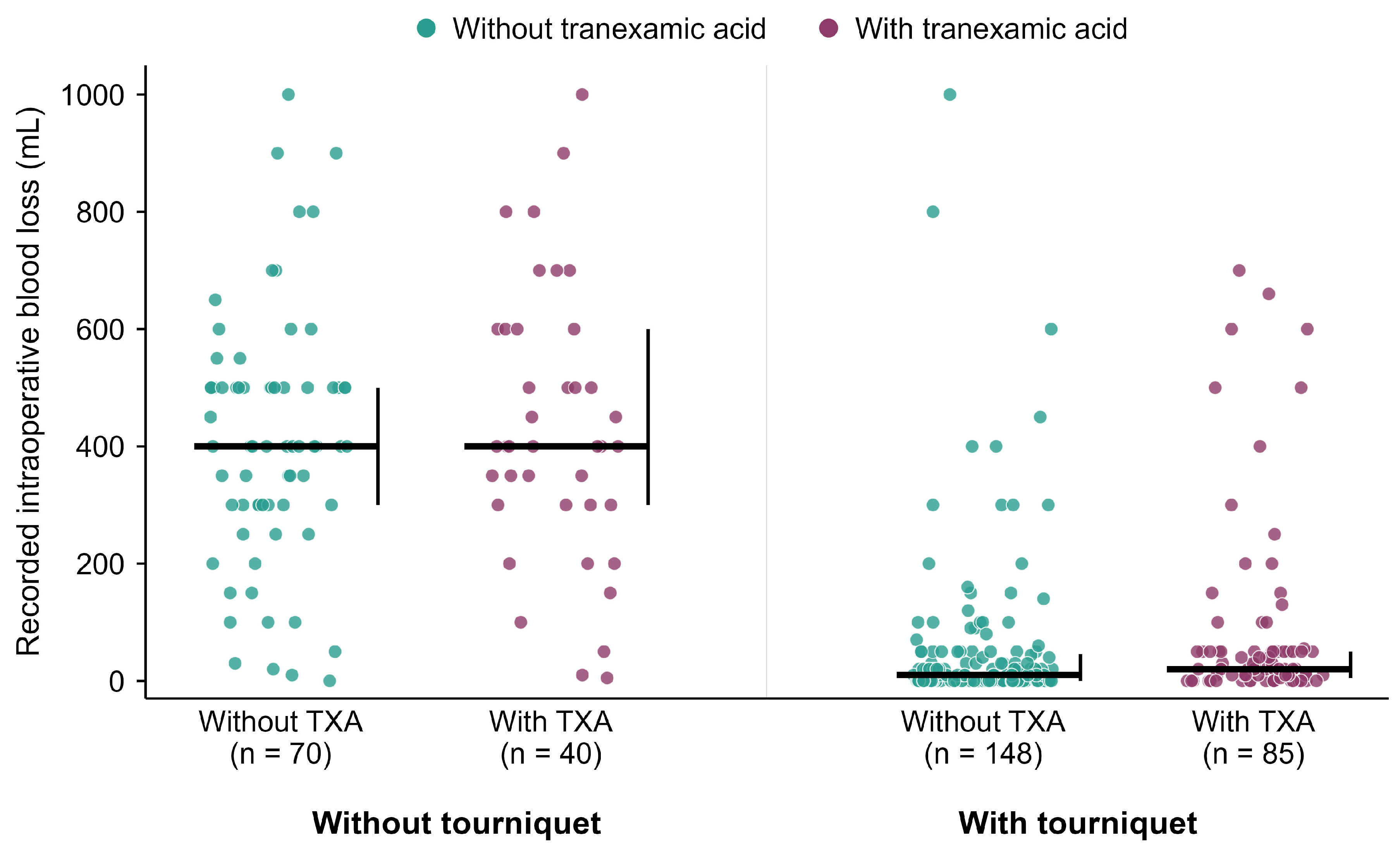
Without a tourniquet, 44 of 110 patients (40.0%) had recorded blood loss of 500 mL or more (Table 2, Figure 2). In the adjusted model, the difference in recorded blood loss associated with TXA was +15 mL (95% CI −73 to 103) without a tourniquet and +24 mL (95% CI −18 to 65) with a tourniquet (p for interaction = 0.86). With the available group sizes and pooled SDs of 220 and 145 mL, the study had 80% power to detect differences of 123 mL (SMD 0.56) without a tourniquet and 55 mL (SMD 0.38) with one.
Table 2.
Recorded intraoperative blood loss and differences associated with tranexamic acid by tourniquet use.
Figure 2.
Recorded intraoperative blood loss by tourniquet and tranexamic acid use. Each dot is one patient; the horizontal line shows the median and the vertical line the interquartile range. TXA: tranexamic acid.
In median regression, the difference associated with TXA in the tourniquet stratum was +10 mL (95% CI 2 to 29). After IPTW, the largest weighted SMD was 0.05, and the weighted differences were +12 mL without and +24 mL with a tourniquet (Table S2). PSM matched 34 of 40 patients with TXA without a tourniquet and 85 of 85 with a tourniquet, with residual imbalance (largest SMD 0.20 and 0.13); the differences were −35 mL (95% CI −156 to 87) and +22 mL (95% CI −28 to 71), respectively (Table S1). Without a tourniquet, anesthesia time was also longer with TXA among patients under regional anesthesia (SMD 0.42); with anesthesia time added to the model, the differences were +8 mL (95% CI −76 to 92) and +23 mL (95% CI −19 to 65). With Bonferroni correction for the two strata, the 97.5% CIs were −85 to 116 mL and −24 to 71 mL (Table S6).
Tourniquet use was associated with −349 mL (95% CI −405 to −293) in patients without TXA and −340 mL (95% CI −419 to −262) in those with TXA (Table 3). In 105 propensity score-matched pairs (largest SMD after matching 0.08), recorded blood loss was 340 mL lower with a tourniquet (95% CI 290 to 391; Table S1). Tourniquet use alone explained 47.5% of the variance in recorded blood loss, compared with 0.3% for TXA and 3.6% for the seven clinical covariates together; the full model explained 49.0% (Table 3).
Table 3.
Multivariable linear regression of recorded intraoperative blood loss.
Linear regression with robust (HC3) standard errors (n = 343; R2 = 0.49). The tranexamic acid coefficient refers to patients without a tourniquet and the tourniquet coefficient to patients without tranexamic acid. The proportion of the variance explained (R2) was 0.475 for tourniquet use alone, 0.003 for tranexamic acid alone, 0.036 for the seven covariates alone, and 0.038 for the full model without the tourniquet terms. Maximum variance inflation factor, 1.06; Breusch–Pagan test, p = 0.29. ASA: American Society of Anesthesiologists; BMI: body mass index; CI: confidence interval; NSAID: nonsteroidal anti-inflammatory drug.
3.3. Tranexamic Acid Administration
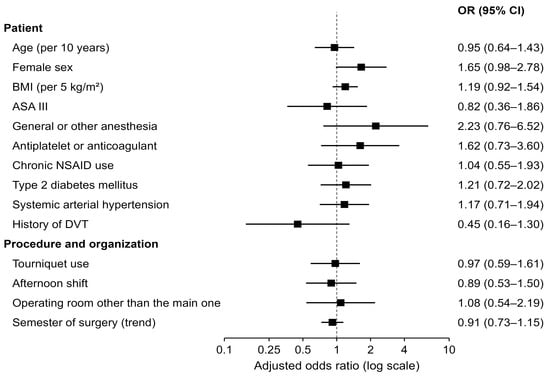
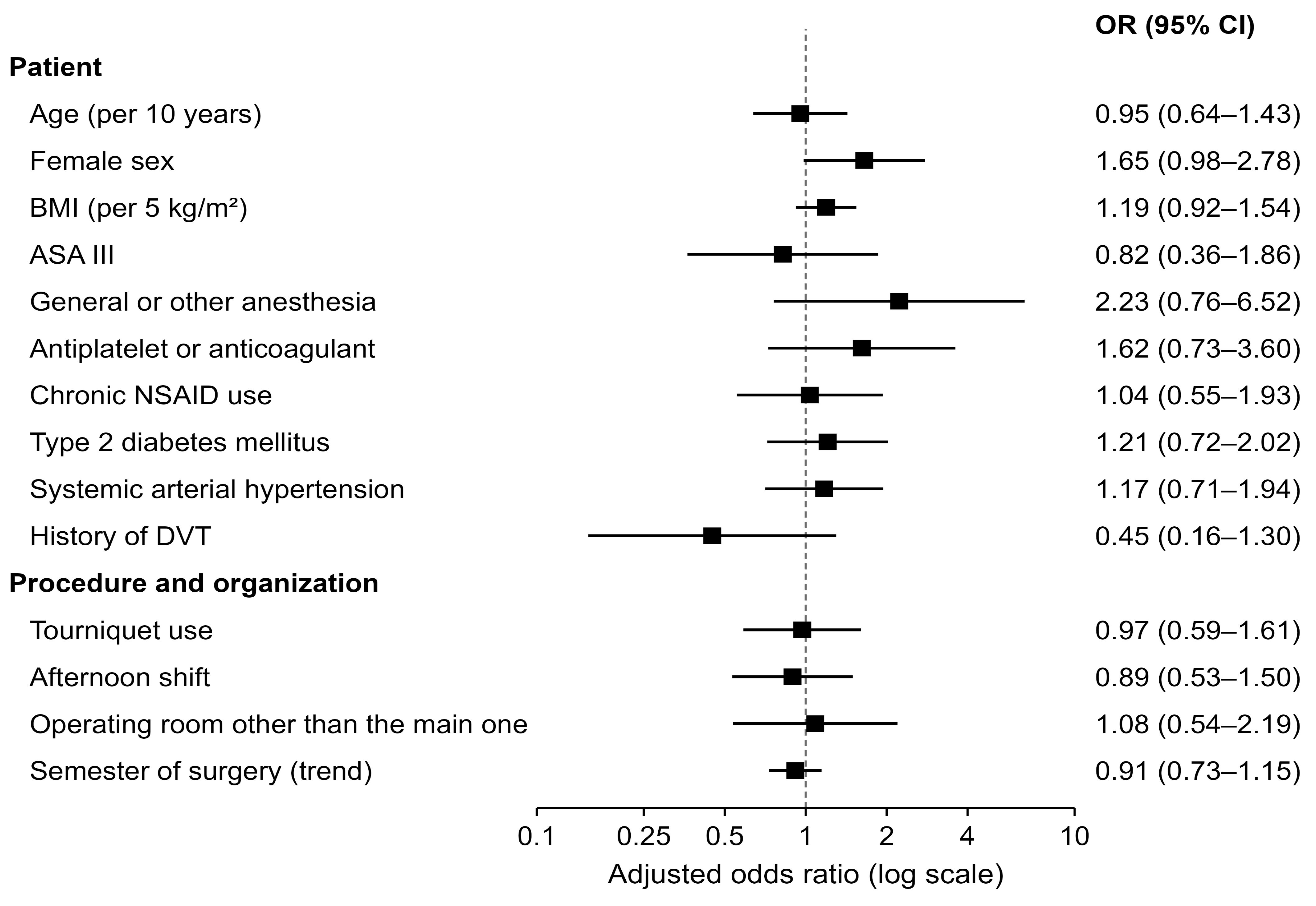
The proportion of patients who received TXA in each semester was 34.0%, 40.9%, 39.1%, and 31.8%. No clinical or organizational variable was associated with TXA administration (Figure 3). The AUC was 0.62, and it was 0.54 after optimism correction; the clinical and organizational blocks had p = 0.21 and p = 0.91, respectively (Holm-adjusted p = 0.41 and 0.91); robust standard errors led to the same conclusions.
Figure 3.
Factors associated with tranexamic acid administration. Adjusted odds ratios from a logistic regression model (n = 337; 121 patients with tranexamic acid). ASA: American Society of Anesthesiologists; BMI: body mass index; CI: confidence interval; DVT: deep vein thrombosis; NSAID: nonsteroidal anti-inflammatory drug; OR: odds ratio.
3.4. Blood Loss Recording
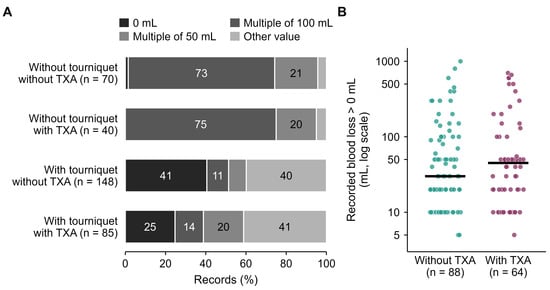
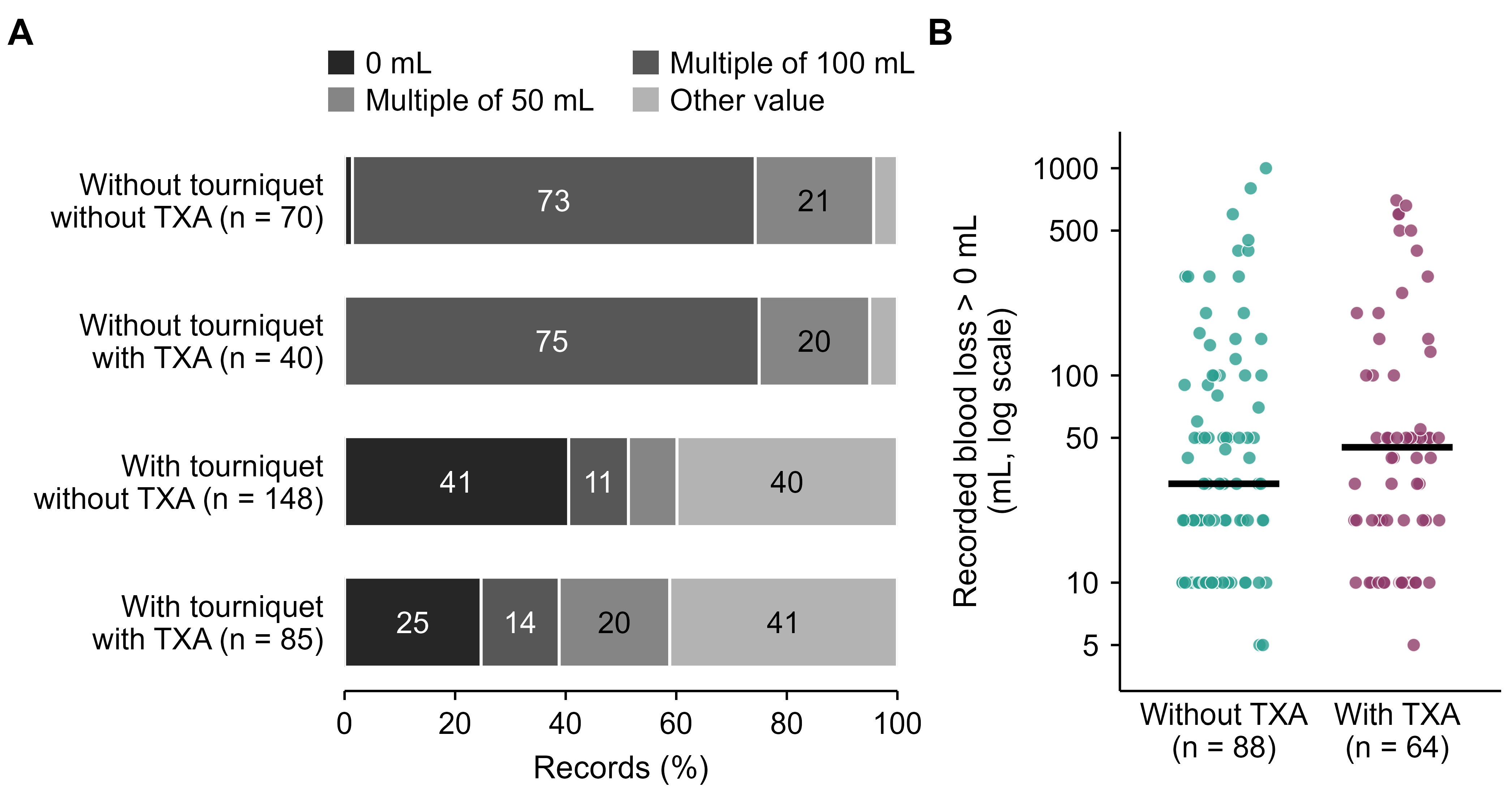
Without a tourniquet, 95.5% of values were multiples of 50 mL and 74.5% were multiples of 100 mL. Multiples of 50 mL accounted for 95.0% of records with TXA and 95.7% without TXA (difference −0.7 percentage points; 95% CI −12.6 to 7.7) (Figure 4A). With a tourniquet, 0 mL was recorded in 21 of 85 patients with TXA (24.7%) and in 60 of 148 without TXA (40.5%), with an adjusted odds ratio (OR) of 0.43 (95% CI 0.23 to 0.80; Holm-adjusted p = 0.024 within the recording analyses and 0.055 when all seven secondary tests were treated as one family; Table S6). When the value was greater than 0 mL, the median was 45 mL (IQR 20–100) with TXA and 30 mL (IQR 10–92) without TXA (Figure 4B), with an adjusted ratio of means of 1.41 (95% CI 0.92 to 2.18) (Table S5).
Figure 4.
Blood loss recording. (A) Distribution of recorded values by tourniquet and tranexamic acid use; numbers are percentages. (B) Values greater than 0 mL in operations with a tourniquet, on a logarithmic scale; the horizontal line shows the median. TXA: tranexamic acid.
3.5. Exploratory Analyses
In operations without a tourniquet, no variable was associated with recorded blood loss (Table S3). Among patients with a tourniquet, 15.4% of those with tourniquet times of 1 to 59 min had recorded blood loss of 500 mL or more, compared with 1.8% of those with 60 to 119 min and 4.5% of those with 120 min or more (Table S4).
4. Discussion
In this cohort, recorded intraoperative blood loss was associated with tourniquet use and not with preoperative TXA, with or without a tourniquet. TXA administration did not depend on the clinical or organizational characteristics we measured. Recorded values clustered on round numbers, and the recording of 0 mL differed by TXA use. Tourniquet use alone explained almost half of the variance in recorded blood loss, and TXA explained almost none.
The lack of association with TXA is consistent with the physiology of bleeding in TKA. With a tourniquet, most blood is lost after its release and during the postoperative period, as drain output and hidden loss [3,12], and fibrinolysis peaks hours after surgery [14]. Visible intraoperative bleeding is the fraction on which a preoperative dose can act least. In the network meta-analysis behind current guidelines, administration before incision gave inconsistent results, with less transfusion but no smaller blood loss volume [5]. In a trial with and without a tourniquet, intraoperative bleeding was similar between groups, and the differences appeared in hidden loss [23]. One retrospective cohort did find less intraoperative bleeding with a tourniquet plus TXA, although with combined intravenous and intra-articular dosing [24], and in Mexico a single 1 g preoperative dose reduced the postoperative drop in hemoglobin [25]. Without a tourniquet, the confidence interval excludes mean reductions larger than 73 mL. Our data cannot establish whether TXA was effective; they show that blood loss recorded during surgery does not capture its effect.
The regimen may also have contributed. Our patients received a single 1 g intravenous dose, whereas recent evidence favors more intensive schemes. In a multicenter trial, an initial dose of 60 mg/kg followed by three postoperative doses reduced total blood loss by about 340 mL compared with 15 mg/kg plus one postoperative dose, mainly through less hidden loss, at the cost of more postoperative nausea and with no increase in venous occlusive events [26]. A meta-analysis of 34 trials found slightly lower total blood loss and drain output with intra-articular than with intravenous administration [27]. In both cases the benefit appeared in postoperative and hidden loss, which the anesthesia record does not capture.
The recording method explains part of this insensitivity. Blood loss was estimated by counting soaked sponges and pads at fixed values of 10 and 100 mL, so recorded amounts are counts converted to volume, and partially soaked material, blood on drapes, and irrigation fluid in the suction canister are left to judgment. In line with this, nearly all values without a tourniquet were multiples of 50 mL. This coarseness adds error, and because it was the same with and without TXA, it biases estimates toward the null. With a tourniquet, where a bloodless field leaves few soaked sponges, 0 mL was recorded less often in patients who received TXA, without a clear difference in the amount when some blood loss was recorded. The small median difference in this stratum is better explained by this recording pattern than by greater actual bleeding, since TXA does not increase hemorrhage. This finding was secondary and did not remain significant when all secondary tests were analyzed as one family, so it requires confirmation. One possible explanation is differential measurement, because the clinician who decides to give TXA is usually the one who estimates blood loss on the anesthesia record and may pay closer attention to it. Retrospective studies that compare hemostatic strategies using this record may therefore reflect differences between clinicians more than between treatments [15].
The difference associated with the tourniquet, which persisted after propensity score matching, was far larger than the 88 mL reduction in intraoperative blood loss estimated in randomized trials, in which the hemoglobin decline and transfusion did not change [28], and larger than the 198 mL reported in an earlier meta-analysis that found no difference in calculated blood loss [10]. Visual estimation departs from hemoglobin-based methods [17], whereas calculating loss with Nadler’s blood volume and Gross’s equation needs only routine laboratory data [29,30]. Without a tourniquet, four in ten patients had recorded loss of 500 mL or more, a figure useful for planning hemodynamic monitoring and blood product availability. The greater recorded blood loss with short tourniquet times suggests partial use, for example, only during cementation. In one trial this strategy increased intraoperative bleeding without changing total loss, and in a large cohort it had a profile similar to use from incision to cementation [13,31]. Because the tourniquet strategy was not recorded, this observation only generates hypotheses.
TXA use was lower than that reported in the United States [8], and the model barely outperformed chance in explaining it, which suggests that the decision depended on individual preference rather than on a protocol. Guidelines recommend TXA in primary arthroplasty [6]. Its thromboembolic safety is supported, although trials excluded most patients with previous thrombosis [32], and in Latin America it has also been associated with less blood loss and fewer transfusions [9,33]. Because use did not follow measured patient risk, confounding by indication through these factors is limited. The same finding suggests that an institutional protocol with a defined dose and timing would make TXA use more uniform and allow it to be evaluated with appropriate outcomes.
The subjective decision to give TXA could still have biased the comparison in two ways. First, the surgeon or the anesthesiologist may have favored TXA in patients expected to bleed more, for reasons not captured in the records, such as low preoperative hemoglobin, severe deformity, or an anticipated difficult operation, a form of confounding by indication [34]. Anesthesia time was longer with TXA in operations without a tourniquet, even under regional anesthesia, which is compatible with this kind of selection. Such confounding would make TXA appear less effective, but adding anesthesia time to the model, weighting, and matching did not change the conclusions. Second, as noted above, the anesthesiologist who decides to give TXA usually also records blood loss, so recording may differ between groups regardless of actual bleeding. Both mechanisms would bias the comparison against TXA. Our results therefore cannot exclude an effect of TXA on actual blood loss; they show that blood loss recorded in this way depends too much on clinical judgment to evaluate it.
This study has limitations. TXA and the tourniquet were not randomly assigned, and unmeasured confounders may remain, such as the surgeon, surgical technique, blood pressure, or preoperative hemoglobin. Hemoglobin, transfusions, and thromboembolic events were not available, so neither total blood loss nor safety could be assessed. TXA was given as a single 1 g dose, without intra-articular or postoperative doses, and the interval between administration and incision was not recorded. This was a single-center study with small subgroups and no sex-specific analysis, and excluding incomplete records may have introduced selection bias. The sample size was fixed by the available records, which limited the precision of the comparison without a tourniquet, and the study was not powered to test the interaction. The secondary objectives and the analyses added during peer review were defined after the data were reviewed and require confirmation. Future studies should measure blood loss with hemoglobin-based methods and evaluate a TXA protocol with a before-and-after design.
5. Conclusions
In primary TKA, recorded intraoperative blood loss was associated with tourniquet use and with recording patterns, but not with preoperative TXA. TXA use was infrequent and did not follow patient risk. Blood loss recorded on the anesthesia record should not be used as an outcome to evaluate antifibrinolytics; hemoglobin-based estimates and a standardized TXA protocol are needed.
Supplementary Materials
The following supporting information can be downloaded at https://www.mdpi.com/article/10.3390/surgeries7040127/s1: Table S1: Propensity score-matched analyses; Table S2: Covariate balance before-and-after inverse probability of treatment weighting; Table S3: Factors associated with recorded blood loss in operations without a tourniquet; Table S4: Recorded blood loss by tourniquet time; Table S5: Two-part model of recorded blood loss in operations with a tourniquet; Table S6: Adjustment for multiple comparisons; STROBE checklist.
Author Contributions
Conceptualization, S.E.C.-S. and J.J.P.-M.; methodology, S.E.C.-S. and J.J.P.-M.; formal analysis, S.E.C.-S.; investigation, S.E.C.-S., A.L.S., J.A.F.V.V., J.N.C. and L.S.M.M.; data curation, S.E.C.-S.; resources, N.d.R.L.R. and M.A.O.L.; writing—original draft preparation, S.E.C.-S.; writing—review and editing, J.J.P.-M., M.A.S.R., M.G.F., A.P.X., N.d.R.L.R. and M.A.O.L.; supervision, J.J.P.-M.; project administration, S.E.C.-S. All authors have read and agreed to the published version of the manuscript.
Funding
This research received no external funding.
Institutional Review Board Statement
The study was conducted in accordance with the Declaration of Helsinki and approved by the Research Ethics Committee and the Research Committee of Hospital General “Gral. José María Morelos y Pavón”, ISSSTE (registration number RPI.HGGJMMYP.0038.2025; 31 December 2025).
Informed Consent Statement
Individual informed consent was not obtained because this retrospective study used existing medical records without intervention or contact with patients.
Data Availability Statement
The data presented in this study are available on request from the corresponding author due to privacy and ethical restrictions, as they come from the medical records of a public institution.
Acknowledgments
S.E.C.-S. dedicates this work to Luis, who has grown up at every stage of this project and whose presence has been a constant source of strength and motivation. During the preparation of this manuscript, the authors used Grammarly and Claude (Anthropic; Opus 5 models) for grammar, spelling checks, and translation. The authors have reviewed and edited the output and take full responsibility for the content of this publication.
Conflicts of Interest
The authors declare no conflicts of interest.
Abbreviations
The following abbreviations are used in this manuscript:
| ASA | American Society of Anesthesiologists |
| AUC | Area under the receiver operating characteristic curve |
| BMI | Body Mass Index |
| CI | Confidence Interval |
| DVT | Deep Vein Thrombosis |
| IPTW | Inverse Probability of Treatment Weighting |
| IQR | Interquartile Range |
| NSAID | Nonsteroidal Anti-Inflammatory Drug |
| OR | Odds Ratio |
| PSM | Propensity Score Matching |
| SD | Standard Deviation |
| SMD | Standardized Mean Difference |
| TKA | Total Knee Arthroplasty |
| TXA | Tranexamic Acid |
References
- Shichman, I.; Roof, M.; Askew, N.; Nherera, L.; Rozell, J.C.; Seyler, T.M.; Schwarzkopf, R. Projections and epidemiology of primary hip and knee arthroplasty in Medicare patients to 2040–2060. JBJS Open Access 2023, 8, e22.00112. [Google Scholar] [CrossRef] [Scilit] [PubMed]
- Spahn, D.R. Anemia and patient blood management in hip and knee surgery: A systematic review of the literature. Anesthesiology 2010, 113, 482–495. [Google Scholar] [CrossRef] [Scilit] [PubMed]
- Sehat, K.R.; Evans, R.L.; Newman, J.H. Hidden blood loss following hip and knee arthroplasty. Correct management of blood loss should take hidden loss into account. J. Bone Jt. Surg. Br. Vol. 2004, 86, 561–565. [Google Scholar] [CrossRef] [Scilit]
- Ng, W.; Jerath, A.; Wąsowicz, M. Tranexamic acid: A clinical review. Anaesthesiol. Intensive Ther. 2015, 47, 339–350. [Google Scholar] [CrossRef] [Scilit] [PubMed]
- Fillingham, Y.A.; Ramkumar, D.B.; Jevsevar, D.S.; Yates, A.J.; Shores, P.; Mullen, K.; Bini, S.A.; Clarke, H.D.; Schemitsch, E.; Johnson, R.L.; et al. The efficacy of tranexamic acid in total knee arthroplasty: A network meta-analysis. J. Arthroplast. 2018, 33, 3090–3098.e1. [Google Scholar] [CrossRef] [Scilit] [PubMed]
- Fillingham, Y.A.; Ramkumar, D.B.; Jevsevar, D.S.; Yates, A.J.; Bini, S.A.; Clarke, H.D.; Schemitsch, E.; Johnson, R.L.; Memtsoudis, S.G.; Sayeed, S.A.; et al. Tranexamic acid use in total joint arthroplasty: The clinical practice guidelines endorsed by the American Association of Hip and Knee Surgeons, American Society of Regional Anesthesia and Pain Medicine, American Academy of Orthopaedic Surgeons, Hip Society, and Knee Society. J. Arthroplast. 2018, 33, 3065–3069. [Google Scholar] [CrossRef] [Scilit] [PubMed]
- Hsu, L.I.; Chen, J.W.; Hsu, H.W.; Hou, S.M. Evaluating three routes of tranexamic acid administration in total hip and knee arthroplasty: A nationwide database analysis in Taiwan. Anesthesiology 2026, 145, 359–372. [Google Scholar] [CrossRef] [Scilit] [PubMed]
- Lawand, J.; Kubsad, S.; Liu, I.; Agarwal, A.R.; Gu, A.; Harris, A.B.; Thakkar, S.C. Risk-stratified perioperative tranexamic acid utilization for total hip and knee arthroplasty: Analysis of trends of the past decade. Bull. Hosp. Jt. Dis. 2026, 84, 10–14. [Google Scholar] [CrossRef] [Scilit] [PubMed]
- Pavão, D.M.; Heringer, E.M.; Almeida, G.J.; de Faria, J.L.R.; Albuquerque, R.S.P.E.; de Sousa, E.B.; Labronici, P.J. Predictive and protective factors for allogenic blood transfusion in total knee arthroplasty. A retrospective cohort study. J. Orthop. 2023, 40, 29–33. [Google Scholar] [CrossRef] [Scilit] [PubMed]
- Zhang, W.; Li, N.; Chen, S.; Tan, Y.; Al-Aidaros, M.; Chen, L. The effects of a tourniquet used in total knee arthroplasty: A meta-analysis. J. Orthop. Surg. Res. 2014, 9, 13. [Google Scholar] [CrossRef] [Scilit] [PubMed]
- Ahmed, I.; Chawla, A.; Underwood, M.; Price, A.J.; Metcalfe, A.; Hutchinson, C.E.; Warwick, J.; Seers, K.; Parsons, H.; Wall, P.D.H. Time to reconsider the routine use of tourniquets in total knee arthroplasty surgery. Bone Jt. J. 2021, 103, 830–839. [Google Scholar] [CrossRef] [Scilit] [PubMed]
- Sun, C.; Zhang, X.; Ma, Q.; Tu, Y.; Cai, X.; Zhou, Y. Impact of tourniquet during total knee arthroplasty when tranexamic acid was used: A meta-analysis of randomized controlled trials. J. Orthop. Surg. Res. 2022, 17, 18. [Google Scholar] [CrossRef] [Scilit] [PubMed]
- Mallett, K.E.; Weinblatt, A.I.; Ondek, N.T.; Öettl, F.C.; Lan, R.; Lyman, S.; Chalmers, B.P.; Gonzalez Della Valle, A. Finding the sweet spot: A mixed-effects analysis of four tourniquet strategies and blood conservation in 15,394 primary total knee arthroplasties. J. Arthroplast. 2026, 41, S204–S209. [Google Scholar] [CrossRef] [Scilit] [PubMed]
- Blanié, A.; Bellamy, L.; Rhayem, Y.; Flaujac, C.; Samama, C.M.; Fontenay, M.; Rosencher, N. Duration of postoperative fibrinolysis after total hip or knee replacement: A laboratory follow-up study. Thromb. Res. 2013, 131, e6–e11. [Google Scholar] [CrossRef] [Scilit] [PubMed]
- Kukreja, P.; Johnson, B.M.; Traylor, C.; O’Keefe, K.J.; Naranje, S.; McKeown, J.; Paul, C.A.; Bell, B. Comparison of the utilization of tranexamic acid and tourniquet use in total knee arthroplasty: A retrospective case series. Cureus 2022, 14, e24842. [Google Scholar] [CrossRef] [Scilit] [PubMed]
- Rothermel, L.D.; Lipman, J.M. Estimation of blood loss is inaccurate and unreliable. Surgery 2016, 160, 946–953. [Google Scholar] [CrossRef] [Scilit] [PubMed]
- Ma, Q.; Duan, X.; Wang, X.; Liu, J.; Niu, N. Accuracy and agreement of three blood-loss estimation methods versus the HbMass method for assessing blood loss during PLIF. J. Orthop. Surg. Res. 2026, 21, 254. [Google Scholar] [CrossRef] [Scilit] [PubMed]
- von Elm, E.; Altman, D.G.; Egger, M.; Pocock, S.J.; Gøtzsche, P.C.; Vandenbroucke, J.P.; STROBE Initiative. The Strengthening the Reporting of Observational Studies in Epidemiology (STROBE) statement: Guidelines for reporting observational studies. Lancet 2007, 370, 1453–1457. [Google Scholar] [CrossRef] [Scilit] [PubMed]
- Cohen, J. Statistical Power Analysis for the Behavioral Sciences, 2nd ed.; Lawrence Erlbaum Associates: Hillsdale, NJ, USA, 1988. [Google Scholar]
- Austin, P.C. Balance diagnostics for comparing the distribution of baseline covariates between treatment groups in propensity-score matched samples. Stat. Med. 2009, 28, 3083–3107. [Google Scholar] [CrossRef] [Scilit] [PubMed]
- Austin, P.C. Optimal caliper widths for propensity-score matching when estimating differences in means and differences in proportions in observational studies. Pharm. Stat. 2011, 10, 150–161. [Google Scholar] [CrossRef] [Scilit] [PubMed]
- Holm, S. A simple sequentially rejective multiple test procedure. Scand. J. Stat. 1979, 6, 65–70. [Google Scholar]
- Huang, Z.; Xie, X.; Li, L.; Huang, Q.; Ma, J.; Shen, B.; Kraus, V.B.; Pei, F. Intravenous and topical tranexamic acid alone are superior to tourniquet use for primary total knee arthroplasty: A prospective, randomized controlled trial. J. Bone Jt. Surg. Am. Vol. 2017, 99, 2053–2061. [Google Scholar] [CrossRef] [Scilit] [PubMed]
- Gokkus, K.; Aybar, A. Tourniquet, tranexamic acid, and computer-assisted cryotherapy in primary total knee arthroplasty: A retrospective cohort study. Medicine 2026, 105, e48909. [Google Scholar] [CrossRef] [Scilit] [PubMed]
- Campos-Flores, D.; Lameiro-Sánchez, F.P.; Galicia-Zamalloa, A.L. Efficacy of single-dose preoperative tranexamic acid to prevent blood loss in total hip and knee joint replacement. Acta Ortop. Mex. 2025, 39, 8–12. (In Spanish) [Google Scholar] [PubMed]
- Xie, J.; Huang, Q.; Huang, Z.; Wang, F.; Liu, J.; Tian, H.; Huang, W.; Pei, F. High dose of tranexamic acid infusion in primary total knee arthroplasty: A randomized multicenter clinical trial. Chin. Med. J. 2024, 137, 359–361. [Google Scholar] [CrossRef] [Scilit] [PubMed]
- Li, J.; Liu, R.; Rai, S.; Ze, R.; Tang, X.; Hong, P. Intra-articular vs. intravenous administration: A meta-analysis of tranexamic acid in primary total knee arthroplasty. J. Orthop. Surg. Res. 2020, 15, 581. [Google Scholar] [CrossRef] [Scilit] [PubMed]
- Boutros, M.; Awad, G.; Abboud, E.; Zhao, A.; Thakkar, S.C. Total knee arthroplasty with or without a tourniquet: A meta-analysis of randomized controlled trials. Eur. J. Orthop. Surg. Traumatol. 2025, 35, 397. [Google Scholar] [CrossRef] [Scilit] [PubMed]
- Nadler, S.B.; Hidalgo, J.H.; Bloch, T. Prediction of blood volume in normal human adults. Surgery 1962, 51, 224–232. [Google Scholar] [PubMed]
- Gross, J.B. Estimating allowable blood loss: Corrected for dilution. Anesthesiology 1983, 58, 277–280. [Google Scholar] [CrossRef] [Scilit] [PubMed]
- Diri, D.; Alasaad, H.; Abou Ali Mhana, S.; Muhammed, H.; Ibrahim, J. Blood loss in primary unilateral total knee arthroplasty with limited tourniquet application: A randomized controlled trial. JBJS Open Access 2023, 8, e23.00020. [Google Scholar] [CrossRef] [Scilit] [PubMed]
- Fillingham, Y.A.; Ramkumar, D.B.; Jevsevar, D.S.; Yates, A.J.; Shores, P.; Mullen, K.; Bini, S.A.; Clarke, H.D.; Schemitsch, E.; Johnson, R.L.; et al. The safety of tranexamic acid in total joint arthroplasty: A direct meta-analysis. J. Arthroplast. 2018, 33, 3070–3082.e1. [Google Scholar] [CrossRef] [Scilit] [PubMed]
- Bidolegui, F.; Arce, G.; Lugones, A.; Pereira, S.; Vindver, G. Tranexamic acid reduces blood loss and transfusion in patients undergoing total knee arthroplasty without tourniquet: A prospective randomized controlled trial. Open Orthop. J. 2014, 8, 250–254. [Google Scholar] [CrossRef] [Scilit] [PubMed]
- Kyriacou, D.N.; Lewis, R.J. Confounding by indication in clinical research. JAMA 2016, 316, 1818–1819. [Google Scholar] [CrossRef] [Scilit] [PubMed]

Disclaimer/Publisher’s Note: The statements, opinions and data contained in all publications are solely those of the individual author(s) and contributor(s) and not of MDPI and/or the editor(s). MDPI and/or the editor(s) disclaim responsibility for any injury to people or property resulting from any ideas, methods, instructions or products referred to in the content. |
© 2026 by the authors. Licensee MDPI, Basel, Switzerland. This article is an open access article distributed under the terms and conditions of the Creative Commons Attribution (CC BY) license.