


Abstract
Background/Objectives: Open fasciectomy is the standard treatment for Dupuytren’s disease, but recent Australian outcome data are scarce. This study assessed outcomes and predictors of recurrence after open fasciectomy at a tertiary centre. Methods: We retrospectively reviewed all open fasciectomy procedures for Dupuytren’s disease at Peninsula Health, Victoria (January 2023–October 2024). Data included contracture correction, functional scores (URAM, Southampton), recurrence at 6 and 12 months, complications, and demographic predictors. Appropriate statistical tests were used (significance: p < 0.05). Results: Among 152 procedures (mean age 63.8; 70.2% male), contracture correction was significant for all joints. URAM and Southampton scores improved by 15.3 and 7.6 points (p < 0.001). Complications (22.4%) were mainly transient neuropraxia. Recurrence was 10.5% at six months and 13.8% at twelve months. Smoking and female sex increased recurrence risk. Conclusions: Open fasciectomy provides effective correction, functional gain, and low early recurrence rates. Smoking and female sex predict recurrence, supporting tailored counselling and reaffirming open fasciectomy as the standard for advanced Dupuytren’s disease.
1. Introduction
Dupuytren’s disease is a chronic fibroproliferative disorder of the palmar fascia, causing progressive digital contractures that impair hand function [1]. It often affects older Caucasian men, especially the ring and little fingers, and is linked to genetic and environmental factors such as smoking, diabetes, and manual labour [2,3].
Surgical intervention is indicated when contracture causes functional limitation or joint contracture exceeding 30° at the metacarpophalangeal (MCP) joint or any degree of contracture at the proximal interphalangeal (PIP) joint. The aim is to restore extension while minimising recurrence and morbidity. Treatment options include percutaneous needle fasciotomy (PNF), collagenase clostridium histolyticum (CCH) injection, and limited or open fasciectomy (LF/OF), each differing in invasiveness, cost, and durability [4,5]. Minimally invasive techniques allow faster recovery but are associated with higher recurrence rates, particularly in PIP-dominant disease, whereas open fasciectomy remains the reference standard for durable correction [6,7].
Open fasciectomy involves meticulous dissection and excision of diseased fascia, protecting displaced neurovascular bundles. Evidence shows it provides superior and longer-lasting correction compared with PNF or CCH [5]. Recurrence rates range from 12 to 39% after limited fasciectomy, 50 to 85% after PNF, and 30 to 40% after CCH [6]. A recent individual-patient data analysis reported recurrence rates of 10% after open fasciectomy, 33% after PNF, and 41% after CCH at 36 months [7]. Despite these benefits, fasciectomy carries a higher risk of complications, including wound infection, digital nerve injury, and complex regional pain syndrome [8].
Despite the widespread use of open fasciectomy, in Australia, data evaluating early recurrence, complications and patient-reported functional outcomes, such as the Unité Rhumatologique des Affections de la Main (URAM) and Southampton Scoring Scheme Score, remains limited [9]. Most available evidence originates from European and North American cohorts where patient demographics, healthcare systems, and treatment pathways may differ from Australian tertiary practice. This study, therefore, aims to evaluate the clinical, functional and early recurrence outcomes following open fasciectomy at a tertiary Australian centre. By providing contemporary local outcome data, we aim to benchmark Australian practice against international standards and inform patient counselling and surgical decision-making.
2. Materials and Methods
2.1. Study Design
This retrospective cohort study included all open fasciectomy cases for Dupuytren’s disease at Peninsula Health, Victoria (January 2023–October 2024). Ethics approval was obtained, and STROBE guidelines were followed.
2.2. Inclusion and Exclusion Criteria
Inclusion: Adults (≥18) undergoing open fasciectomy for primary or recurrent Dupuytren’s. Exclusion: Non-open procedures, incomplete data, or loss to follow-up within 12 months.
2.3. Data Collection and Variables
Data included demographics, comorbidities, disease characteristics, operative details, contracture correction, patient-reported outcomes (URAM, Southampton), complications, and recurrence at 6 and 12 months. Recurrence was defined as ≥20° recurrent contracture in any treated joint or a new cord, consistent with previously published consensus definitions of Dupuytren’s recurrence [10]. Recurrence was assessed clinically during routine post-operative follow-up by the treating surgical team and documented within the medical record. The unit of analysis was each treated digit. Where multiple digits underwent open fasciectomy during the same operative procedure, each digit was analysed independently for the above objective and subjective surgical outcomes.
2.4. Statistical Analysis
Statistical analysis was conducted using GraphPad Prism v10.5.0 and SPSS v29. Data were summarised as mean +SD or median (IQR) following Shapiro–Wilk normality testing, and as frequencies/percentages for categorical variables. Paired t-tests or Wilcoxon signed-rank tests were used to compare pre- and postoperative measures. Categorical associations used χ2 or Fisher’s exact tests (effect size: Cramér’s V), and Spearman’s ρ assessed age correlations. Complication/recurrence rates were stratified by sex/comorbidity. Significance was set at p < 0.05.
3. Results
3.1. Cohort Demographics
There were 152 cases (mean age 63.8). Males made up 70.2%. Most were right-handed and worked manual jobs (Table 1). Comorbidities included smoking (32.5%), cardiovascular disease (19.9%), alcohol use (21.9%), and diabetes (11.3%) (Table 2).
Table 1.
Demographics of included patients.
Table 2.
Comorbidities of included patients.
3.2. Objective Joint Outcomes
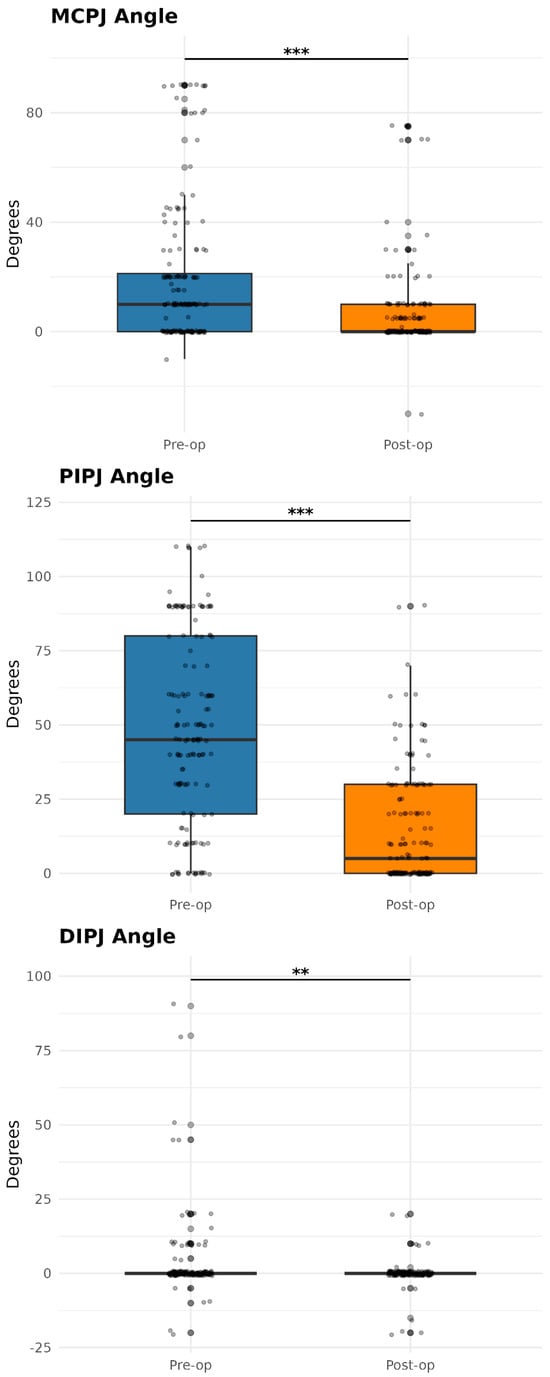
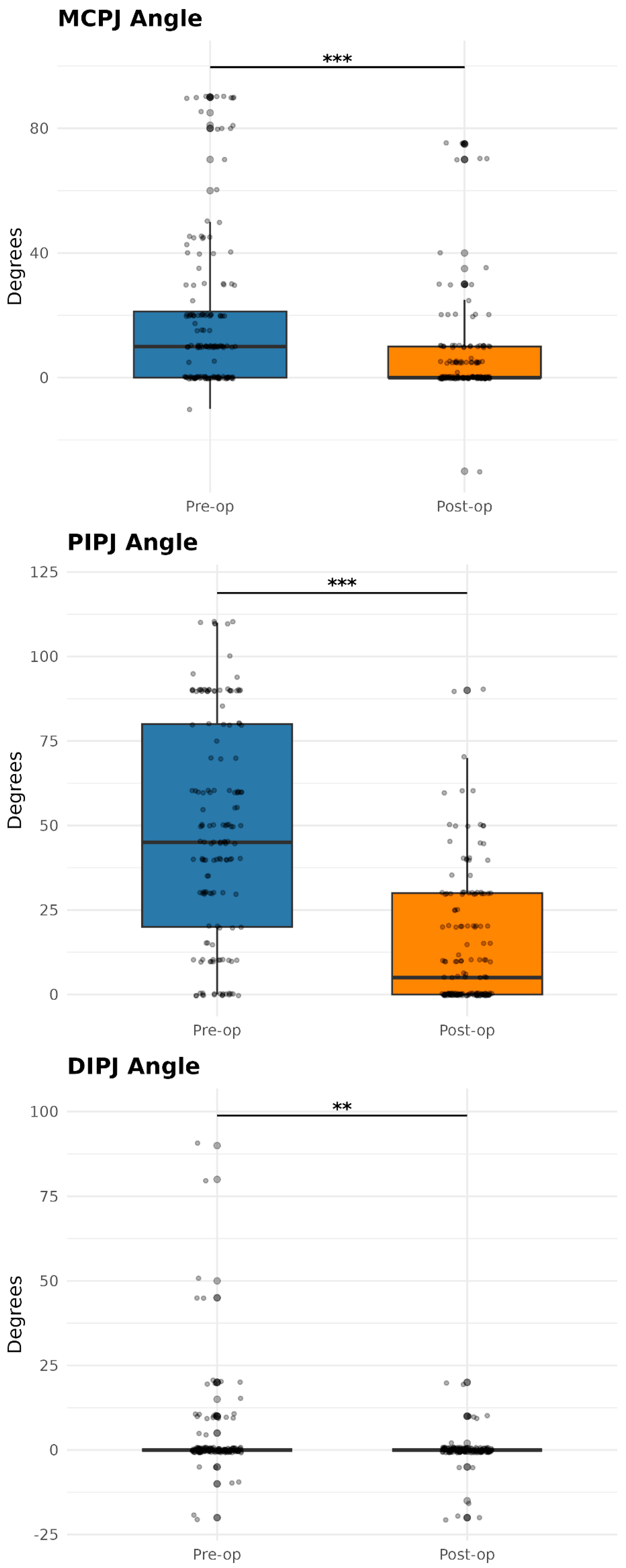
All three joint levels demonstrated statistically significant improvements postoperatively. The metacarpophalangeal joint (MCPJ) angle decreased from 19.6 ± 26.0° preoperatively to 7.4 ± 16.6° postoperatively (p < 0.001) (Figure 1). The proximal interphalangeal joint (PIPJ) angle decreased from 49.1 ± 32.5° to 14.5 ± 19.4° (p < 0.001) (Figure 1), while the distal interphalangeal joint (DIPJ) angle decreased from 3.1 ± 12.6° to 0.0 ± 4.2° (p = 0.001) (Figure 1). Among these, the PIPJ demonstrated the largest absolute improvement of 34.6°, representing a 70% reduction, whereas the DIPJ exhibited the highest proportional correction of 82%.
Figure 1.
Preoperative and postoperative contracture angles at the MCPJ, PIPJ, and DIPJ following open fasciectomy. Significant improvement was observed across all joints (*** p < 0.001 for MCPJ and PIPJ; (** p = 0.001 for DIPJ).
3.3. Functional Outcomes
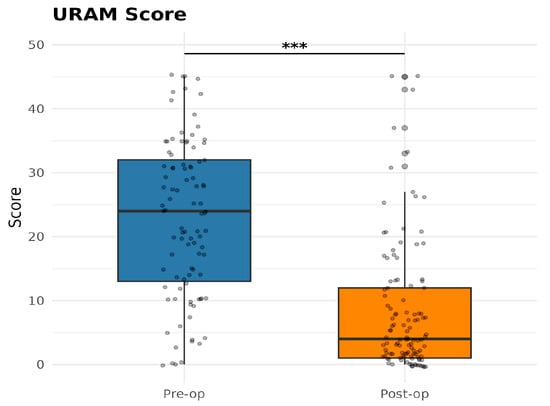
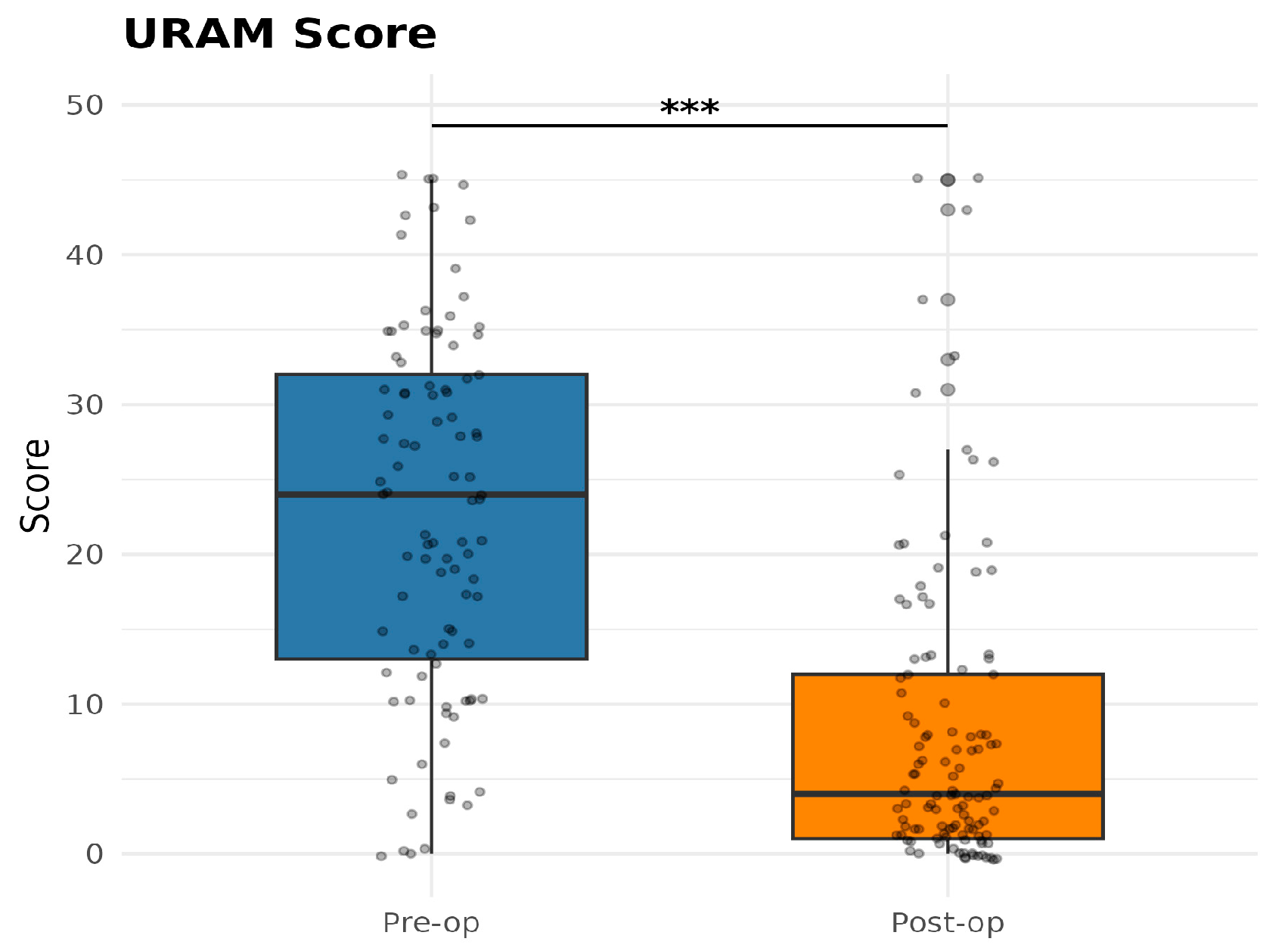
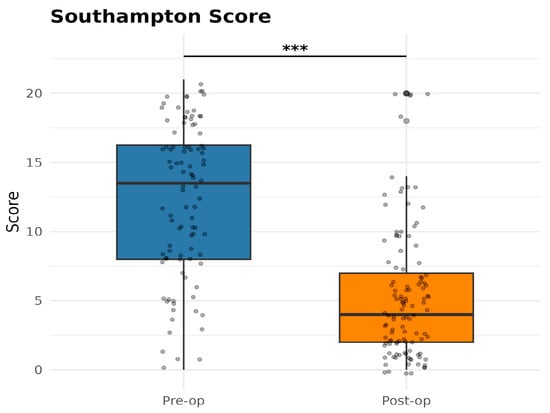
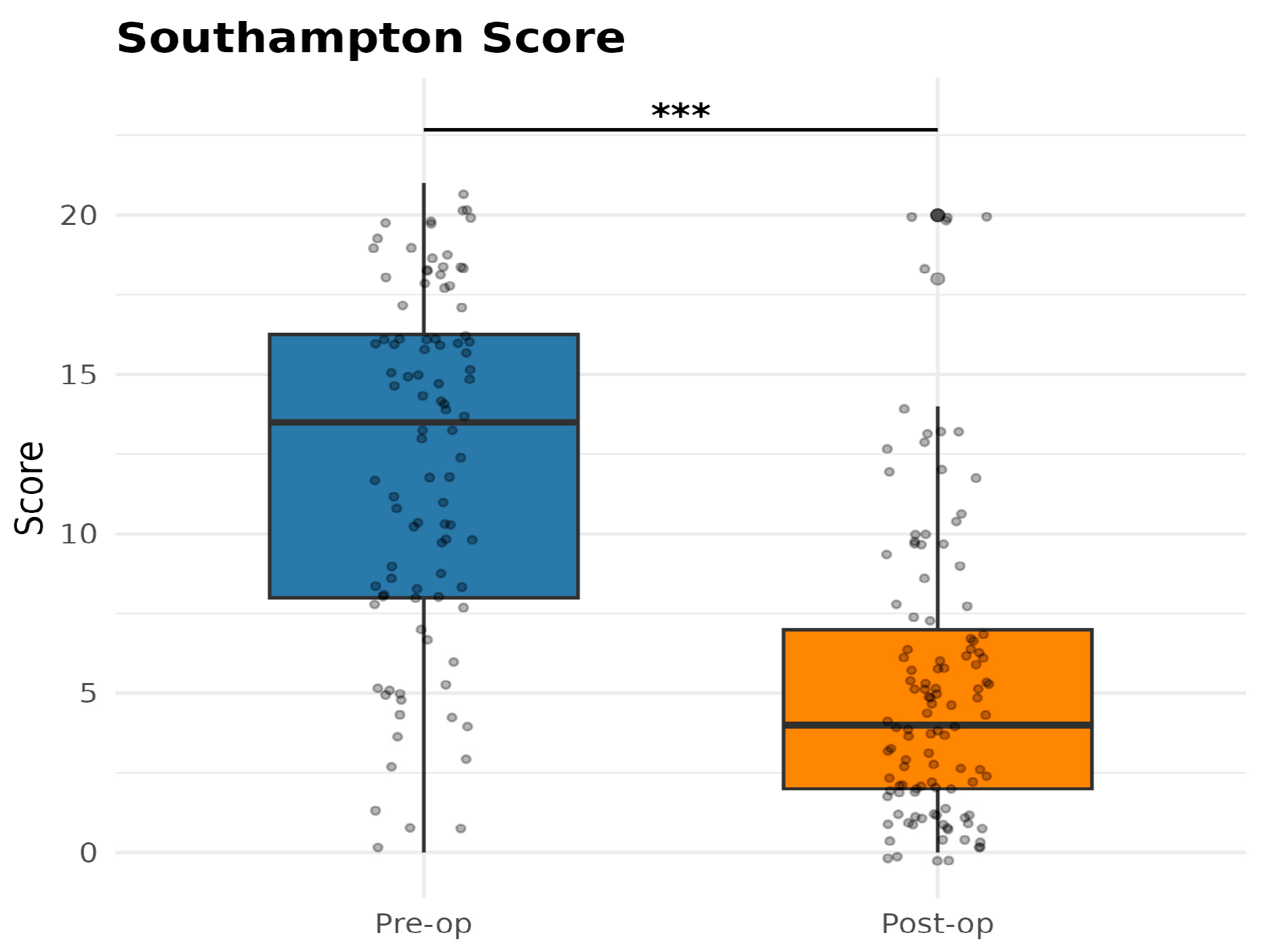
Patient-reported functional outcomes also improved significantly. The URAM score improved from 22.8 ± 12.2 to 8.2 ± 10.0, reflecting a mean improvement of 15.3 points (p < 0.001) (Figure 2). Similarly, the Southampton wound score improved from 12.3 ± 5.5 to 5.4 ± 4.8, corresponding to a mean improvement of 7.6 points (p < 0.001) (Figure 3). These results indicate substantial functional and wound-healing improvement, consistent with international reports of robust recovery following open fasciectomy.
Figure 2.
Southampton score before and after open fasciectomy. Median Southampton score decreased from 13.5 to 4 (*** p < 0.001).
Figure 3.
URAM score before and after open fasciectomy. Mean URAM decreased from 22.8 to 8.2 (*** p < 0.001).
3.4. Complications
Postoperative complications occurred in 34 cases (22.4%). The most frequent were digital nerve neuropraxia (50%), wound dehiscence (17.6%), surgical site infection (14.7%), iatrogenic nerve laceration (11.8%), iatrogenic arterial laceration (2.9%), and hypersensitivity (2.9%). Of the 32 cases with documented follow-up management, 16 (50%) resolved within six months, one by twelve months, and the remainder required medical or minor surgical management: topical antiseptics dressings ± oral antibiotics (25%), secondary surgery debridement (6.2%), or microsurgical repair of iatrogenic neurovascular bundle injury (15.6%). Complication rates did not differ significantly by gender (24.5% in males vs. 17.8% in females; p = 0.403) or age (ρ = 0.085, p = 0.301).
3.5. Recurrence
Recurrence occurred in 16 cases (10.7%) at six months and 21 cases (14%) at twelve months (Table 3). Smoking was the strongest predictor of recurrence, showing a moderate association at six months (Cramér’s V = 0.278, p = 0.001) and a weak–moderate association at twelve months [V = 0.182, p = 0.041] Diabetes and alcohol use were not significantly associated with recurrence. Age did not correlate with recurrence (ρ = −0.077 at six months; ρ = −0.009 at twelve months; p > 0.3). However, despite not finding any significant differences in recurrence between genders at 6 months (p = 0.39), gender demonstrated a significant difference at 12 months, with female cases exhibiting higher recurrence rates (25.6% vs. 9.4%; p = 0.01).
Table 3.
Recurrence rate of Dupuytren’s disease in included patients.
4. Discussion
This study examined the outcomes of open fasciectomy for Dupuytren’s disease at a tertiary Australian centre. The results show that open fasciectomy provides substantial correction of contractures, meaningful functional improvement, and acceptable rates of complications and recurrence. The procedure remains a durable and practical option, consistent with international experience. Smoking was the strongest predictor of recurrence, while female sex was associated with higher recurrence at twelve months, suggesting both biological and behavioural influences.
Deformity correction closely matched international benchmarks, with mean postoperative improvements of 12.2° at the MCPJ, 34.6° at the PIPJ, and 3.2° at the DIPJ. The PIPJ showed the greatest absolute gain, aligning with international data reporting comparable improvements and low recurrence rates after limited fasciectomy [6,7,8]. The PIPJ result is particularly significant, as this joint contributes most to hand function and grip release.
Functional outcomes further confirm the efficacy of open fasciectomy. Both URAM and Southampton scores improved significantly, indicating better dexterity, hand strength, and wound recovery. The 15.3-point mean URAM gain mirrors European multicentre data and exceeds the minimal clinically important difference, confirming that anatomical correction translates into meaningful functional benefit [5,9]. Including PROMs strengthens evaluation by reflecting patient-centred outcomes beyond joint motion.
The overall complication rate of 22.4% falls within the upper international range [8]. Digital nerve neuropraxia accounted for half of all complications, followed by minor wound issues and superficial infections. Most neuropraxias resolved within six months, consistent with traction-related neurapraxia rather than iatrogenic transection [8]. No vascular injuries, tendon ruptures, or complex regional pain syndrome occurred, reflecting careful technique and structured rehabilitation. Complications were unrelated to age, sex, or comorbidities, supporting the safety of open fasciectomy in older or medically complex patients.
Recurrence remains a major challenge across all techniques. Rates of 10.5% at six months and 13.8% at twelve months compare favourably with international data (12–39% for open fasciectomy, 50–85% for PNF, 30–40% for CCH) [4,7]. Low recurrence likely reflects complete fascial excision under consultant supervision and structured rehabilitation. However, given the progressive nature of Dupuytren’s Disease, the recurrence rates reported at six and twelve months likely underestimate the true long-term recurrence burden. Recent long-term comparative data demonstrate this progressive recurrence over a 10-year period, emphasising the importance of extended follow-up when evaluating the durability of correction [11].
Smoking was the most significant modifiable predictor of recurrence, evident at both six and twelve months. This finding aligns with literature linking smoking to increased fibroblast proliferation, collagen turnover, and microvascular dysfunction [12]. Nicotine-induced vasoconstriction and chronic hypoxia may prolong myofibroblast activity through TGF-β upregulation, promoting recurrent fibrosis [13]. These results reinforce the importance of smoking cessation counselling to reduce recurrence risk.
Female sex was also associated with higher recurrence (25.6% vs. 9.4% in males). Although Dupuytren’s disease predominantly affects men, women may represent a distinct biological subgroup. Previous studies suggest that women may present later than men and with more diffuse disease that is less amenable to mechanical correction [14]. Biological mechanisms related to fibrosis modulation, such as hormonal influences on collagen synthesis and TGF-β signalling, have been described in such studies [15,16]. However, given the relatively small female sample size and limited number of recurrence events, these findings should be interpreted with caution. Larger female cohorts are needed to clarify these associations.
No association was found between age and recurrence or complications, consistent with prior studies suggesting that disease biology, rather than age, determines outcome [5,6]. Earlier recurrence in younger patients is likely a reflection of genetic predisposition. The narrow age range and predominance of severe disease in this cohort may explain the absence of an age effect. Age alone should not deter surgery, as older patients achieved comparable results.
The complication and recurrence profiles observed reaffirm open fasciectomy as the standard of care for advanced Dupuytren’s disease. Compared with less invasive approaches, it offers greater correction, lower recurrence, and superior long-term satisfaction, albeit with slightly higher short-term wound risk. Outcomes in this Australian cohort mirror major European studies, demonstrating similar efficacy in contemporary tertiary care.
Limitations of this study include its retrospective design, short follow-up period, and lack of stratification by digit or disease stage. The small proportion of female patients limits the power for sex-specific analysis. Nonetheless, this represents one of the larger recent Australian series and provides valuable insight into early outcomes and predictors of recurrence.
In summary, open fasciectomy remains the most effective treatment for moderate-to-severe Dupuytren’s disease, providing durable correction, functional recovery, and a low rate of early recurrence. Smoking and female sex predicted recurrence, emphasising the importance of tailored counselling and follow-up. These findings reaffirm open fasciectomy as a safe and reliable standard in Australian tertiary care, supporting further multicentre research into biological mechanisms and long-term cost-effectiveness.
5. Conclusions
Open fasciectomy remains an effective and safe treatment for Dupuytren’s disease in contemporary Australian practice. In this cohort, the procedure achieved significant correction across MCPJ, PIPJ, and DIPJ contractures, with corresponding improvements in hand function and low complication rates. Early recurrence was uncommon, and most complications were minor and self-limiting. Smoking and female sex were associated with recurrence, highlighting the need for tailored preoperative counselling and follow-up. These findings reaffirm open fasciectomy as the benchmark intervention for advanced Dupuytren’s disease, providing durable correction and functional restoration in tertiary care settings.
Author Contributions
Conceptualization, I.S., W.M.R. and R.J.R.; methodology, I.S. and W.M.R.; software, A.S. (Akshay Soni) and O.S.; validation, I.S., W.M.R. and R.J.R.; formal analysis, O.S.; investigation, A.S. (Akshay Soni), J.V., A.S. (Angus Skeen) and S.-V.A.; resources, A.S. (Akshay Soni) and I.S.; data curation, I.S. and O.S.; writing—original draft preparation, A.S. (Akshay Soni) and I.S.; writing—review and editing, J.V., A.S. (Akshay Soni), S.-V.A., A.S. (Angus Skeen) and O.S.; visualization, I.S., A.S. (Akshay Soni), O.S., J.V., A.S. (Angus Skeen) and S.-V.A.; supervision, W.M.R. and R.J.R.; project administration, W.M.R., I.S. and R.J.R. All authors have read and agreed to the published version of the manuscript.
Funding
This research received no external funding.
Institutional Review Board Statement
Approval for the study was granted by the Peninsula Health Human Research Ethics Committee (QA/122494/PH-2025-499756).
Informed Consent Statement
Informed consent was waived due to the retrospective nature of the study.
Data Availability Statement
Data available on request.
Conflicts of Interest
The authors declare no conflicts of interest.
References
- Layton, T.B.; Williams, L.; Nanchahal, J. Dupuytren’s disease: A localised and accessible human fibrotic disorder. Trends Mol. Med. 2023, 29, 218–227. [Google Scholar] [CrossRef] [Scilit] [PubMed]
- Hindocha, S.; McGrouther, D.A.; Bayat, A. Epidemiological evaluation of Dupuytren’s disease incidence and prevalence rates in relation to etiology. Hand 2009, 4, 256–269. [Google Scholar] [CrossRef] [Scilit] [PubMed]
- Salari, N.; Heydari, M.; Hassanabadi, M.; Kazeminia, M.; Farshchian, N.; Niaparast, M.; Solaymaninasab, Y.; Mohammadi, M.; Shohaimi, S.; Daneshkhah, A. The worldwide prevalence of the Dupuytren disease: A comprehensive systematic review and meta-analysis. J. Orthop. Surg. Res. 2020, 15, 495. [Google Scholar] [CrossRef] [Scilit] [PubMed]
- Chen, N.C.; Srinivasan, R.C.; Shauver, M.J.; Chung, K.C. A systematic review of outcomes of fasciotomy, aponeurotomy, and collagenase treatments for Dupuytren’s contracture. Hand 2011, 6, 250–255. [Google Scholar] [CrossRef] [Scilit] [PubMed]
- Nann, S.; Kovoor, J.; Fowler, J.; Kieu, J.; Gupta, A.; Hewitt, J.; Ovenden, C.; Edwards, S.; Bacchi, S.; Jacobsen, J.H.W.; et al. Surgical Management of Dupuytren Disease: A Systematic Review and Network Meta-analyses. Hand 2024, 19, 1283–1292. [Google Scholar] [CrossRef] [Scilit] [PubMed]
- van Rijssen, A.L.; ter Linden, H.; Werker, P.M. Three-Year Results of First-Ever Randomized Clinical Trial on Treatment in Dupuytren’s Disease: Percutaneous Needle Fasciotomy Versus Limited Fasciectomy. In Dupuytren’s Disease and Related Hyperproliferative Disorders; Springer: Berlin/Heidelberg, Germany, 2012; pp. 281–288. [Google Scholar] [CrossRef] [Scilit]
- van den Berge, B.A.; Habibi, H.; Dijkstra, P.U.; Atroshi, I.; Davis, T.R.; Jenmalm, P.; van Rijssen, A.; Selles, R.W.; Scherman, P.; Strömberg, J.; et al. Outcomes of limited fasciectomy, needle fasciotomy and collagenase injection for Dupuytren’s disease: A systematic review and meta-analysis of individual patient data. J. Hand Surg. Eur. Vol. 2025, 50, 878–890. [Google Scholar] [CrossRef] [Scilit] [PubMed]
- Krefter, C.; Marks, M.; Hensler, S.; Herren, D.B.; Calcagni, M. Complications after treating Dupuytren’s disease. A systematic literature review. Hand Surg. Rehabil. 2017, 36, 322–329. [Google Scholar] [CrossRef] [Scilit] [PubMed]
- Beaudreuil, J.; Allard, A.; Zerkak, D.; Gerber, R.A.; Cappelleri, J.C.; Quintero, N.; Lasbleiz, S.; Bernabé, B.; Orcel, P.; Bardin, T.; et al. Unite Rhumatologique des Affections de la Main (URAM) scale: Development and validation of a tool to assess Dupuytlren’s disease-specific disability. Arthritis Care Res. 2011, 63, 1448–1455. [Google Scholar] [CrossRef] [Scilit] [PubMed]
- Kan, H.J.; Verrijp, F.W.; Hovius, S.E.; van Nieuwenhoven, C.A.; Dupuytren Delphi Group; Selles, R.W. Recurrence of Dupuytren’s contracture: A consensus-based definition. PLoS ONE 2017, 12, e0164849. [Google Scholar] [CrossRef] [Scilit] [PubMed]
- Fulchignoni, C.; Pietramala, S.; Barbaliscia, M.; Passiatore, M.; Caruso, L.; Cannella, A.; Merendi, G.; Rocchi, L.; Taccardo, G.; de Vitis, R. Ten-year follow-up: Collagenase injection versus open surgery for Dupuytren’s disease. Surgeries 2026, 7, 34. [Google Scholar] [CrossRef] [Scilit]
- An, H.S.; Southworth, S.R.; Jackson, W.T.; Russ, B. Cigarette smoking and Dupuytren’s contracture of the hand. J. Hand Surg. 1988, 13, 872–874. [Google Scholar] [CrossRef] [Scilit] [PubMed]
- Balık, M.S.; Bedir, R. Palmar Fibromatosis: An Analysis of 25 Cases. Eur. Arch. Med. Res. 2019, 35, 43. [Google Scholar] [CrossRef] [Scilit]
- Hindocha, S.; Stanley, J.K.; Watson, S.; Bayat, A. Dupuytren’s diathesis revisited: Evaluation of prognostic indicators for risk of disease recurrence. J. Hand Surg. 2006, 31, 1626–1634. [Google Scholar] [CrossRef] [Scilit] [PubMed]
- Affinito, P.; Palomba, S.; Sorrentino, C.; Di Carlo, C.; Bifulco, G.; Arienzo, M.P.; Nappi, C. Effects of postmenopausal hypoestrogenism on skin collagen. Maturitas 1999, 33, 239–247. [Google Scholar] [CrossRef] [Scilit] [PubMed]
- Avouac, J.; Pezet, S.; Gonzalez, V.; Baudoin, L.; Cauvet, A.; Ruiz, B.; Boleto, G.; Brandely, M.L.; Elmerich, M.; Allanore, Y. Estrogens counteract the profibrotic effects of TGF-β and their inhibition exacerbates experimental dermal fibrosis. J. Investig. Dermatol. 2020, 140, 593–601. [Google Scholar] [CrossRef] [Scilit] [PubMed]

Disclaimer/Publisher’s Note: The statements, opinions and data contained in all publications are solely those of the individual author(s) and contributor(s) and not of MDPI and/or the editor(s). MDPI and/or the editor(s) disclaim responsibility for any injury to people or property resulting from any ideas, methods, instructions or products referred to in the content. |
© 2026 by the authors. Licensee MDPI, Basel, Switzerland. This article is an open access article distributed under the terms and conditions of the Creative Commons Attribution (CC BY) license.