


Abstract
The European Union now routinely leverages economic governance to tackle strategic vulnerabilities caused by geopolitical rivalry, foreign dependencies, and supply chain shocks. This article analyses this shift, exploring how the EU adapts its economic toolkit and what restricts its capacity to act as a geoeconomic power. It builds an analytical framework connecting external pressures, strategic vulnerabilities, policy choices, and institutional barriers. Methodologically, the study combines qualitative document analysis of EU policy frameworks with trade metrics and evidence from the Geoeconomic Interconnectivity Index. The findings show a clear expansion in investment screening, anti-coercion tools, targeted industrial policy, and supply-chain diversification—all aimed at safeguarding core sectors and curbing asymmetric exposure. These steps mark a departure from purely regulatory-market logic towards a hybrid model blending market openness, defensive controls, and capacity-building. Persistent institutional splits, conflicting national priorities, technological gaps, and reliance on foreign markets limit the effectiveness of this transition. Ultimately, the EU’s evolving geoeconomic stance aims not for total self-sufficiency, but for the deliberate, strategic management of interdependence.
1. Introduction
The intensification of geopolitical rivalry, alongside global economic fragmentation and the securitisation of trade, is fundamentally reshaping the international order. Long linked to liberal assumptions of mutual gain and political stability (Keohane & Nye, 2017) [1], economic interdependence now appears primarily as a source of strategic exposure and geopolitical leverage. Today, trade flows, foreign investment, technology, supply networks, and critical infrastructure undergo scrutiny far beyond pure economic efficiency; they function directly as tools of state power, resilience, and coercion (Blackwill & Harris, 2016) [2]. The deepening US–China rivalry, the weaponisation of commercial ties, and the wider deployment of sanctions, export restrictions, and state subsidies point to a friction-ridden geoeconomic landscape where economics and hard geopolitics overlap (Ivančík & Dušek, 2026a) [3].
These shifting dynamics hit the European Union hard, given its historical commitment to open markets, multilateral rules, and global integration. Severe structural vulnerabilities surfaced when the COVID-19 shock and Russia’s invasion of Ukraine laid bare the risks of extreme external reliance in core domains like energy, critical minerals, semiconductors, and high-tech inputs. Meanwhile, friction between Washington and Beijing forces Brussels to carefully balance commercial openness against strategic resilience (Christiansen, 2020) [4]. In response, European policymakers have started weaving security logic into domains historically governed by liberal market principles—spanning trade policy, industrial strategy, tech regulation, and foreign investment screening (Ivančík & Dušek, 2026c) [5].
European policy debates increasingly centre on strategic autonomy, economic security, resilience, and de-risking. Brussels seeks to curb dangerous single-source dependencies while retaining the benefits of international economic integration. To this end, EU institutions turn to specialized geoeconomic instruments, deploying anti-coercion mechanisms, industrial funding, critical raw material strategies, export controls, and targeted supply-chain diversification (Matthijs & Meunier, 2023) [6].
The EU’s geoeconomic pivot remains analytically complex and politically debated. Despite heightened ambitions, the Union still lacks the structural features of a classical geopolitical superpower. Decision-making remains fragmented across national capitals, member states harbour conflicting economic interests, and reliance on foreign technology, export markets, and defence alliances persists (Kerschbaumer, 2025) [7]. Friction lingers between Brussels’ normative loyalty to open multilateralism and its new focus on strategic protection. The Union functions as a hybrid geoeconomic actor, positioned somewhere between market-driven governance and strategic state intervention (Anghel et al., 2020) [8].
Existing research captures important elements of this shift, including the EU’s market power, the geopoliticisation of trade and investment, open strategic autonomy, and the securitisation of economic governance. These distinct literature strands rarely merge to show how external pressures, structural dependencies, policy tools, and internal institutional barriers interact. The core analytical gap concerns how the adoption and operational limits of individual geoeconomic instruments connect within the EU’s specific institutional setting.
Addressing this gap, the article explains how geopolitical pressures drive changes in EU economic governance, how these tools manage strategic vulnerabilities, and which political constraints limit their impact. We contend that the EU is evolving from a regulatory-market actor into a defensive geoeconomic player, though its trajectory remains constrained by internal divisions, asymmetric dependencies, and friction between commercial openness and strategic protection. To guide the analysis, the paper addresses a primary research question: How is the EU’s geoeconomic transformation reshaping its economic governance, and what constrains the effectiveness of this transformation?
Three interconnected subquestions follow: (1) Which external pressures and strategic dependencies drive changes in EU economic governance? (2) How do these pressures shape the design and function of specific EU geoeconomic instruments? (3) How do institutional fragmentation, conflicting national interests, and ongoing external dependencies limit these responses?
Methodologically, the study uses a qualitative analytical design centred on structured document analysis of key EU frameworks—specifically REPowerEU as an energy-security framework, the EU investment screening mechanism, the Anti-Coercion Instrument, and the Critical Raw Materials Act—supported by official economic metrics and dataset evidence from the Geoeconomic Interconnectivity Index. We compare these policy materials to trace recurring patterns in risk management and strategic adaptation across different institutional contexts. Academic scholarship provides the conceptual groundwork, while empirical findings draw directly from EU policy documents, trade statistics, and GEOII indicators.
The analysis makes four contributions to research on geoeconomics and European integration. First, it builds an integrated framework connecting external pressures, vulnerabilities, policy choices, and institutional constraints. Second, it frames EU initiatives not as isolated measures, but as part of a wider structural turn towards strategic resilience. Third, it clarifies how this turn alters the link between economic governance and the EU’s global footprint without projecting a shift to classical power politics. Fourth, it conceptualises the EU’s model as an ongoing adaptation where regulatory rules, defensive measures, and targeted intervention coexist alongside permanent structural constraints.
2. Theoretical Framework
2.1. Geoeconomics, Interdependence, and Strategic Power
The prominence of geoeconomics reflects the deepening fusion of economic governance and geopolitical rivalry in contemporary international relations (Herranz-Surrallés et al., 2024; Bauerle Danzman & Meunier, 2024) [9,10]. While post-Cold War globalisation rested on the liberal assumption that cross-border integration would yield mutual gains and tame geopolitical friction, developments challenge this framework. Far from serving strictly as a driver of shared prosperity, economic interdependence now acts as a vector for strategic vulnerability, external coercion, and systemic dependence.
The concept of geoeconomics gained traction precisely to capture this structural shift (Shahzad, 2022) [11]. Edward Luttwak originally defined geoeconomics as the logic of geopolitical rivalry carried out through economic methods rather than military force (Luttwak, 1990) [12]. Subsequent literature broadened this foundation to cover the strategic use of economic tools to achieve geopolitical aims and mitigate external exposure. Blackwill and Harris (2016) conceptualise geoeconomics as the deployment of economic instruments to advance national interests and exert influence [2], whereas Roberts et al. (2019) focus on strategic competition centred on relative gains, institutional resilience, and asymmetric exposure [13]. Taken together, these perspectives demonstrate how economic governance functions as a core component of state power (Luttwak, 1990) [12].
A primary focus of current geoeconomic scholarship involves the changing structure of interdependence itself. Liberal theories traditionally framed cross-border integration as a stabilising force generating absolute gains for all participants. Recent literature stresses that asymmetric dependencies grant structural power to actors holding sway over key networks and infrastructures. Farrell and Newman (2019) identify this mechanism as “weaponised interdependence”, where states controlling financial hubs, tech standards, or supply networks leverage these chokepoints coercively [14]. Globalisation thus operates not merely as an engine of market integration, but as an arena for geopolitical contestation.
Export controls, technology restrictions, state subsidies, sanctions regimes, and supply-chain rivalry illustrate how states deploy economic policy within geoeconomic competition (Gertz & Evers, 2020) [15]. The COVID-19 shock and Russia’s invasion of Ukraine further exposed the fragility of global supply networks, laying bare the strategic risks of concentrated reliance on foreign inputs in semiconductors, energy, digital systems, and critical minerals. Economic security and resilience now occupy a core position in strategic policymaking.
Contemporary geoeconomics differs from traditional commercial rivalry in several key respects (Blackwill & Harris, 2016) [2]. Strategic sectors are selected based on geopolitical relevance rather than pure market value, governments demonstrate greater willingness to absorb short-term economic costs to secure resilience, and economic governance responds to strategic imperatives. These dynamics drive the securitisation of economic policy, blurring the boundary between market economics and hard geopolitics (Babić et al., 2022) [16].
Within this theoretical landscape, scholars draw a distinction between offensive and defensive geoeconomics. Offensive geoeconomics involves deploying economic leverage to project geopolitical power or alter the behaviour of foreign actors. Defensive geoeconomics focuses instead on mitigating exposure, enhancing resilience, and shielding key sectors from external coercion (Wigell et al., 2019) [17]. This conceptual boundary clarifies the EU’s changing posture. Historically anchored in internal market integration, regulatory rules, and multilateral frameworks, the EU avoided coercive economic leverage. Global economic fragmentation and the securitisation of trade now push Brussels towards defensive geoeconomic adaptation centred on economic security and strategic autonomy.
Geoeconomics captures the interpenetration of market mechanics and strategic logic in a fragmented global order rather than a substitution of geopolitics with economics (Shahzad, 2022) [11]. Economic governance, technological competition, and the active management of exposure now form primary arenas of international power—a framework essential for understanding the EU’s transformation into a hybrid geoeconomic actor (Babić et al., 2022) [16].
2.2. Strategic Autonomy, Economic Security, and the Management of Dependence
The securitisation of economic ties has fundamentally reshaped debates on strategic autonomy and economic security within the European Union (Bauerle Danzman & Meunier, 2024; Juncos & Vanhoonacker, 2024) [10,18]. First introduced within defence and security circles—most notably in the 2016 EU Global Strategy—strategic autonomy gradually expanded into economic and technological domains in response to mounting geopolitical friction, supply-chain shocks, and foreign dependencies.
This trajectory illustrates a deeper shift in how the EU interprets the nexus between globalisation and security. Throughout the post-Cold War era, European economic governance rested on the premise that commercial openness, market integration, and interdependence would automatically yield prosperity and geopolitical stability. The COVID-19 shock and Russia’s invasion of Ukraine dismantled this assumption, exposing severe exposure across critical domains such as energy, semiconductors, pharmaceuticals, raw materials, and digital networks (Jacobs et al., 2023; Helwig, 2023) [19,20]. These developments accelerated the integration of security logic into economic policy, fuelling demands for greater operational resilience and EU-level capacity (Ivančík & Dušek, 2026c) [5].
Within this analytical landscape, strategic autonomy represents the EU’s effort to reconcile market openness with strategic protection. The concept prioritises the Union’s ability to act independently across core sectors while remaining integrated into the global economy. Strategic autonomy has thus evolved into an umbrella framework encompassing economic security, technological sovereignty, industrial resilience, supply-chain diversification, and the protection of critical infrastructure (Ivančík & Dušek, 2026b) [21].
The concept of “open strategic autonomy”, championed by the European Commission, captures this dual imperative (Schmitz & Seidl, 2023) [22]. On one side, Brussels maintains its commitment to open markets, multilateral trade, and international integration. On the other, it acknowledges the necessity of curbing single-source reliance and building defences against external coercion. Open strategic autonomy aims not to dismantle interdependence, but to manage it deliberately and strategically.
Economic security has gained a more prominent position in EU policymaking (Bauerle Danzman & Meunier, 2024; Freudlsperger & Meunier, 2024) [10,23]. Economic security covers the protection of supply chains, technological capabilities, industrial competitiveness, energy systems, and digital infrastructure against geopolitical exposure. Resilience no longer serves merely as an economic efficiency target, but as a mandatory strategic requirement. Recent EU frameworks targeting critical raw materials, industrial capacity, foreign investment screening, and technological governance demonstrate this broad-based securitisation of economic policy (Siddi & Kustova, 2021) [24].
The pivot from liberal market logic towards strategic economic governance stands out clearly in Brussels’ approach to China. Rejecting outright economic decoupling, the EU pursues a policy of “de-risking”, aiming to curb excessive strategic dependencies in vital domains without severing commercial ties. This posture stems from the realization that deep integration with geopolitical rivals creates severe vulnerabilities in sensitive sectors such as semiconductors, batteries, telecommunications, artificial intelligence, and clean energy tech (Fasulo et al., 2025) [25].
At the same time, structural contradictions continue to restrict the EU’s pursuit of strategic autonomy. The Union remains deeply tied to global commercial flows and reliant on foreign inputs for advanced technologies, energy, and critical minerals. Member states regularly pursue divergent national economic priorities and foreign policy goals, hindering the creation of unified strategies (Youngs, 2021) [26]. Measures intended to build resilience and reduce exposure can clash with the EU’s normative commitments to market liberalisation, state aid enforcement, and multilateral rules.
These internal frictions underscore the hybrid character of the EU’s strategic adaptation in an era dominated by power politics (Veselinovič, 2022) [27]. Lacking centralized geopolitical command, the EU relies on regulatory authority, internal market size, and policy coordination rather than traditional coercive force. Strategic autonomy reflects not a conversion into a classical superpower, but an evolving effort to adjust the European economic framework to geoeconomic friction and global fragmentation.
2.3. From Regulatory Influence to Hybrid Geoeconomic Action
The rise of geoeconomic competition has changed how scholars conceptualise the European Union’s international role. Historically, literature framed the EU primarily as a normative, civilian, or market power whose leverage stemmed from regulatory standards, market scale, and the externalisation of rules rather than hard power (Damro, 2012) [28]. Frameworks such as “normative power Europe” and “market power Europe” highlighted Brussels’ capacity to align foreign behaviour through institutional norms and trade access rather than strategic projection (Manners, 2002) [29].
Accelerating geopolitical rivalries, technological friction, and the securitisation of economic networks now test the bounds of these classical paradigms (Herranz-Surrallés et al., 2024; Haroche, 2024) [9,30]. In a global arena defined by systemic rivalry and weaponised interdependence, regulatory reach and market openness no longer suffice to safeguard Europe’s economic security. Recent scholarship reflects this shift, treating the EU as an emerging geoeconomic power that weaves strategic logic into trade frameworks, industrial policy, technology standards, and security controls (Meunier & Nicolaidis, 2019) [31].
Existing research establishes the EU’s geoeconomic turn but gives less attention to how its underlying drivers connect. The analysis focuses on the structural links between external vulnerabilities, defensive policy tools, and the institutional constraints governing their execution.
The geoeconomic pivot does not, however, represent a complete break from the EU’s regulatory origins. Instead, it marks the gradual fusion of strategic security logic into domains long ruled by liberal market principles—representing a geoeconomic transformation of the single market itself (Herranz-Surrallés et al., 2024) [9]. As Weinhardt et al. (2022) point out, Brussels now deploys economic governance to build systemic resilience and curb dangerous dependencies alongside its traditional pursuit of market efficiency [32]. This dual logic appears across investment screening mechanisms, supply-chain strategies, industrial subsidies, export regimes, and critical raw materials policy.
The EU’s geoeconomic adaptation differs from the strategies pursued by traditional powers such as the United States and China. While major powers regularly deploy economic tools offensively to project influence or alter foreign behaviour, the EU’s approach remains largely defensive. European geoeconomic policies prioritise risk mitigation, resilience, and strategic protection over coercive projection. Tools such as anti-coercion mechanisms, foreign investment screening, and supply-chain diversification aim not to dominate global rivals, but to cushion the Union against external shocks and political pressure (Aggarwal & Reddie, 2021) [33].
The defensive orientation is closely linked to the Union’s pursuit of strategic autonomy. Amid global fragmentation, Brussels attempts to reconcile market openness with strategic security. This transformation remains hybrid and contested. While the Union strives to bolster economic security, technological sovereignty, and industrial capacity, it simultaneously defends multilateralism, open markets, and rules-based governance. EU geoeconomic policy thus operates under constant friction between liberal integration and state intervention, competitiveness and protection, openness and resilience.
Structural constraints further limit the EU’s capacity to act as a unified geoeconomic power. Divergent national interests, institutional fragmentation, and reliance on foreign markets, technology, energy, and minerals weaken strategic alignment. Unlike centralised states, the EU operates through a multi-level governance architecture that frequently slows or complicates coordinated strategic responses (Leonard et al., 2019) [34].
At the same time, the EU retains substantial structural strengths in the geoeconomic arena. Its single market, regulatory footprint, technological assets, and central position in global trade supply significant leverage. The Union remains deeply integrated with its immediate neighbourhood. Data from the Geoeconomic Interconnectivity Index (GEOII) shows that the EU maintains the highest levels of trade, financial, and regulatory interconnectivity across neighbouring regions, even as rivalry with China, Russia, and the United States intensifies (Bertelsmann Stiftung, 2025) [35].
This study conceptualises the EU as a hybrid geoeconomic actor because its capabilities blend three distinct forms of economic power: regulatory market influence, defensive management of vulnerabilities, and selective strategic intervention. This hybridity goes beyond using diverse policy tools; it reflects the coexistence of liberal economic principles and security-driven controls within a single institutional setup. The dynamic interaction between external pressures, vulnerabilities, policy choices, and institutional barriers ultimately dictates both the scope and the boundaries of EU geoeconomic action.
3. Methodology and Research Design
3.1. Analytical Design and Research Procedure
This study adopts a qualitative analytical research design to examine the interplay between external pressures, strategic vulnerabilities, EU policy responses, and internal institutional limits within Europe’s geoeconomic adaptation. Rather than treating these dynamics as isolated phenomena, the analysis maps their structural relationships across four analytical dimensions. This design clarifies how shifts in the global environment trigger specific economic policy measures and how institutional and political friction shapes their implementation.
The primary empirical method consists of structured qualitative document analysis applied to core EU strategic, legislative, and policy texts (Bowen, 2009) [36]. This document analysis traces how official European frameworks define strategic vulnerabilities, justify defensive policy tools, and conceptualise the trade-offs between commercial openness, system resilience, and economic security. To anchor the qualitative findings in empirical reality, the analysis integrates official trade metrics and dataset evidence from the Geoeconomic Interconnectivity Index (GEOII) [35]. Combining qualitative policy analysis with quantitative interconnectivity metrics links actual policy choices directly to the structural vulnerabilities identified within our conceptual framework.
The analytical design follows a clear sequence connecting external pressures, structural vulnerabilities, policy tools, and institutional constraints. This structure provides a coherent basis for evaluating empirical evidence, examining whether changes in EU economic governance respond to identified risks, and assessing how institutional conditions limit policy execution. The framework functions as an interpretive scaffold to structure the empirical narrative, rather than a deterministic causal model requiring quantitative hypothesis testing.
Operationalising this design follows a four-stage research procedure. First, the analysis identifies the primary external shocks reshaping the EU’s geoeconomic operating environment. Second, it examines the concrete dependencies and vulnerabilities linked to these external disruptions. Third, it evaluates the strategic policy tools introduced to mitigate these exposures, explicitly distinguishing between defensive and offensive geoeconomic functions. A policy instrument is classified as defensive when its main objective is to reduce vulnerability, shield strategic assets, or boost system resilience; it is categorized as offensive when designed primarily to project power or coerce external actors. Fourth, the analysis evaluates the institutional and political bottlenecks that limit instrument execution and overall effectiveness. Within this framework, the EU’s geoeconomic pivot is operationalised as a demonstrable shift in economic governance, marked by the systematic integration of security imperatives into policy domains historically governed by market efficiency and liberalisation. This sequential approach ensures a clear distinction between rhetorical shifts in policy discourse and tangible changes embedded in economic governance instruments.
3.2. Empirical Material, Sources, and Analytical Procedures
The empirical material comprises core EU strategic documents, legislative and policy instruments on economic security and industrial policy, trade and interdependence metrics, and data from the Geoeconomic Interconnectivity Index (GEOII). These sources directly address the four dimensions of our analytical framework: external pressures, strategic dependencies, policy responses, and internal constraints. While academic scholarship establishes theoretical concepts and contextualises findings, EU policy documents and official indicators form the primary empirical foundation for assessing Europe’s geoeconomic adaptation.
The empirical observations draw directly from official policy texts, economic datasets, and GEOII indicators. Scholarly literature serves as a conceptual lens rather than self-contained empirical evidence, guiding the interpretation of data through the theoretical categories defined in Section 2 and Section 3. Maintaining this distinction ensures a rigorous assessment of whether observed EU policy shifts reflect genuine institutional adaptation, active vulnerability management, or changes in geoeconomic orientation.
Document selection covers key EU strategic and legislative frameworks adopted between 2020 and 2026—a period marked by the rise of economic security, de-risking, industrial resilience, and foreign investment screening in European policymaking. Core texts include the REPowerEU Plan, the Critical Raw Materials Act, the EU investment screening framework alongside its subsequent revision, and the Anti-Coercion Instrument. These materials were chosen purposively as direct, tangible responses to external shocks and strategic exposures. This selection is analytical rather than exhaustive, aiming to capture variations across policy functions and governance tools.
Analysing the selected documents followed a four-stage process. First, the analysis mapped references to external pressures and strategic risks threatening the EU’s economic environment. Second, it examined how official texts linked these pressures to specific structural dependencies and vulnerabilities. Third, the study identified policy measures introduced to mitigate these exposures, classifying their primary functions as defensive or offensive according to the criteria set out in Section 3.1. Fourth, the analysis evaluated implementation rules, governance arrangements, and political constraints limiting policy execution. Comparing these findings across policy texts and validating them against economic indicators revealed recurring patterns and key functional differences across instruments.
The empirical footprint focuses on three main categories of sources. First, the study maps EU policy initiatives targeting economic security, industrial strategy, investment screening, technological sovereignty, and supply-chain resilience. Second, it integrates trade and interdependence metrics to capture Europe’s structural exposures—particularly towards the United States, China, and critical industrial sectors. Third, the analysis draws on findings from the Geoeconomic Interconnectivity Index (GEOII) to evaluate the EU’s regional economic integration and relative footprint across its neighbouring regions.
The GEOII measures bilateral interconnectivity between the EU and 21 neighbouring states, comparing European linkages against those of the United States, China, and Russia. Its indicators fall into three sub-indices: trade, finance, and policy. The trade dimension tracks the intensity and structure of commercial flows; the finance dimension captures foreign direct investment and capital linkages; and the policy dimension assesses regulatory and institutional alignment. The composite index uses a geometric mean of normalised sub-index scores, penalising imbalanced scores across the three pillars. Within this study, GEOII values serve a descriptive purpose to compare the standing of major powers at specific moments; they are not used to model causal effects or run continuous time-series regressions.
Analytical validity relies on method triangulation across distinct data types. Legislative texts provide evidence of formal institutional adaptation; economic indicators reveal structural vulnerabilities and trade exposure; and academic literature helps interpret the strategic context. Applying a uniform analytical matrix across all policy materials ensures interpretive consistency. Assertions regarding policy adaptation rest not on isolated texts, but on converging evidence drawn from multiple sources across all four dimensions.
Combining these empirical strands bridges theoretical insights with dataset evidence, offering a comprehensive view of the EU’s adaptation within a fragmented global order.
3.3. The Dimensions of EU Geoeconomic Adaptation
The empirical analysis rests on four interconnected analytical dimensions that form a single conceptual matrix. The first dimension identifies the external shocks reshaping the EU’s operating environment, including US–China rivalry, global economic fragmentation, Russia’s invasion of Ukraine, and the securitisation of trade, technology, and supply chains. The second dimension maps the structural dependencies exposed by these shocks across critical sectors such as energy, semiconductors, critical raw materials, digital infrastructure, and emerging technologies. The third dimension evaluates European policy responses, focusing on geoeconomic instruments such as foreign investment screening, anti-coercion tools, targeted industrial strategies, export controls, and supply-chain diversification. The fourth dimension examines the institutional and political barriers shaping implementation, notably internal governance splits, conflicting national interests, and friction between market openness and strategic protection. Connecting external pressures, structural vulnerabilities, policy choices, and operational limits reveals both the character and the boundaries of EU geoeconomic adaptation.
Figure 1 outlines this sequential logic.
Figure 1.
Analytical Framework of EU Geoeconomic Adaptation. Source: Authors’ own analytical framework.
This framework provides the structural blueprint for the empirical evaluation in Section 4, where the four dimensions are systematically applied to the selected policy instruments and economic indicators.
3.4. Scope and Limitations of the Analysis
Several analytical boundaries require explicit framing. First, this study does not model statistical causal relationships or measure the exact quantitative impact of individual policy tools. Instead, it provides an interpretive explanation of how external shocks, structural exposures, policy responses, and governance constraints interact. The findings capture documented institutional developments and structural patterns, rather than statistical estimates of policy efficacy.
Second, many of the governance processes examined remain fluid. Strategic autonomy, economic security, and de-risking continue to evolve across EU institutions and member states, meaning the analysis records an ongoing structural transition rather than a fully settled policy regime.
Third, while the paper incorporates trade metrics and dataset evidence, it does not attempt a comprehensive quantitative audit of EU geoeconomic performance. Empirical indicators serve to substantiate specific analytical claims regarding strategic adaptation, risk mitigation, and institutional change.
4. Results
4.1. External Pressures and the Sources of Strategic Vulnerability
Our findings identify the erosion of post-Cold War liberal globalisation and the convergence of commercial and geopolitical rivalry as primary external drivers of the EU’s geoeconomic adaptation. Escalating US–China competition, the weaponisation of commercial ties, supply-chain shocks, and Russia’s invasion of Ukraine drive the securitisation of European economic governance. Within European policy circles, economic interdependence is no longer evaluated strictly as a mechanism for prosperity, but as a source of strategic exposure and external leverage.
The empirical results below reflect our structured document analysis, executing the four-stage procedure outlined in Section 3.1. The evaluation explicitly separates documented policy initiatives, indicators of structural vulnerability, and the analytical interpretation of their geoeconomic function.
Strategic rivalry between Washington and Beijing exerts severe structural pressure on the EU, given Europe’s deep economic linkages with both states. The United States remains the EU’s primary export market, absorbing 20.6% of extra-EU exports in 2024, whereas China stands as the largest origin of imports, supplying 21.3% of total extra-EU imports in the same year (Eurostat, 2025a) [37]. Beijing’s role is critical across manufacturing and technology value chains, where dependencies remain concentrated in key industrial sectors (European Commission, 2024a). These trade ties generate clear economic benefits, but simultaneously expose the Union to geopolitical friction, technological rivalry, and economic coercion. This vulnerability stands out in high-technology trade: in 2024, China accounted for 30% of EU high-tech imports, serving as the leading external supplier, followed by the United States at 23% (Eurostat, 2025b) [38]. These figures demonstrate the concentration of external exposure across technologically sensitive sectors, including electronics, telecommunications equipment, computing hardware, and advanced machinery.
The COVID-19 pandemic further laid bare the structural fragility of highly concentrated production networks and just-in-time logistics (Jacobs et al., 2023; Donnelly, 2023) [19,39]. Shipping bottlenecks, severe semiconductor and medical equipment shortages, and reliance on foreign manufacturing capacity highlighted the dangers of unmitigated external dependencies (Jacobs et al., 2023; Donnelly, 2023; Hilpert & Lohmann, 2026) [19,39,40]. These disruptions accelerated the integration of supply-chain security, diversification, and structural resilience into EU economic governance.
Russia’s invasion of Ukraine marked a decisive turning point in European economic security thinking (Helwig, 2023; Jerzyniak & Herranz-Surrallés, 2024) [20,41]. Prior to the conflict, approximately 40% of EU natural gas imports originated from Russia, demonstrating how asymmetric exposure could be weaponised for geopolitical coercion and laying bare the structural vulnerabilities embedded in the European economic model (European Commission, 2022) [42]. The resulting energy crisis forced the integration of security imperatives into trade, industrial, and energy policy, reinforcing the strategic urgency of resilience and diversification.
These pressures intensify amid global economic fragmentation. As Ivančík and Dušek (2026a) argue, rising tariff barriers, sanctions regimes, export controls, state subsidies, and competing technical standards weaken multilateral governance, driving the emergence of a regionalised and contested global economy [3]. Economic governance itself transforms into a primary arena of geopolitical rivalry (Gertz & Evers, 2020) [15].
The EU faces distinct operational challenges in this environment owing to its structural openness. Extra-EU exports represented 22.8% of EU GDP in 2024, while extra-EU imports stood at 20.5% (OECD, 2025) [43]. This high exposure leaves European markets susceptible to external shocks in critical domains, including energy, raw materials, semiconductors, and advanced technologies. The central strategic problem for Brussels lies not in abandoning globalisation, but in actively managing the structural exposures of interdependence (Keohane & Nye, 2017) [1] by balancing commercial openness against resilience and security.
This core dilemma shapes European strategies surrounding strategic autonomy and de-risking. Steering clear of complete economic decoupling, the Union seeks to curb single-source strategic dependencies while retaining the gains of international trade integration (Brinza et al., 2024) [44]. This posture reflects both the structural realities of the European single market and the prohibitive economic costs associated with broad-based market exit.
These structural shifts alter the EU’s international footprint. Dataset evidence from the Geoeconomic Interconnectivity Index (GEOII) confirms that the EU retains the highest level of overall interconnectivity across its neighbouring regions in trade, finance, and regulatory alignment, even as its dominance faces growing pressure from China and other systemic actors. Beijing’s expanding economic presence across strategic infrastructure and connectivity projects in neighbouring regions further intensifies competition over regional trade, investment, and market standards.
In sum, Europe’s geoeconomic adaptation stems from the convergence of power politics, structural vulnerability, technological competition, and global economic fragmentation. These drivers translate into tangible changes across EU economic governance, most visibly in policy tools targeting resilience, supply-chain diversification, and economic security.
4.2. Policy Instruments and the Practice of Geoeconomic Adaptation
Systemic rivalry and heightened strategic exposure drive a more deliberate deployment of economic policy tools across the European Union. Historically dependent on market integration, regulatory standards, and multilateral frameworks, European governance now incorporates security logic directly into trade, investment, industrial policy, and technology regulation (Roberts et al., 2019) [13]. Commercial governance no longer focuses solely on market efficiency and liberalisation, but serves as an engine for system resilience, strategic protection, and geopolitical adaptation.
The institutionalisation of investment screening mechanisms marks a clear milestone in this transition. The EU Investment Screening Regulation represents a distinct shift away from Brussels’ traditional open-market stance on foreign direct investment, establishing that corporate acquisitions in critical infrastructure, advanced technologies, energy networks, and digital systems carry strategic security risks (Weinhardt et al., 2022) [32]. Investment policy has become more closely tied to exposure management and economic security imperatives (Aggarwal & Reddie, 2021) [33].
The rollout of the investment screening framework illustrates how structural vulnerabilities translate into concrete governance mechanisms (European Parliament and Council of the European Union, 2026) [45]. Mounting concern that foreign takeovers in sensitive domains could compromise public order and strategic autonomy—particularly regarding critical infrastructure, core tech, energy assets, or digital architecture—provided the main impulse. The EU instead introduced a Union-level coordination mechanism that allows member states and the Commission to screen transactions collaboratively, without imposing broad restrictions on foreign capital. The Regulation defines this mandate explicitly, noting that “This Regulation establishes a cooperation mechanism to enable Member States and the Commission to exchange relevant information on foreign investments” (European Parliament and of the Council of the European Union, 2026) [45].
Operational since October 2020, the screening mechanism facilitated information exchanges on over 1700 transactions by January 2025 (European Commission, 2025) [46]. Its geoeconomic function is fundamentally defensive: mitigating exposure to hostile strategic takeovers while maintaining the overall openness of the European investment environment. Nevertheless, implementation reveals clear structural limitations, as final screening decisions and enforcement remain anchored in national authorities. The instrument thus enhances collective risk management without establishing a fully centralized EU investment-security regime.
A parallel evolution unfolds across trade policy (Meunier & Nicolaidis, 2019) [31]. The instruments evaluated below showcase distinct modes of adaptation within our analytical framework. Investment screening operates as a defensive guardrail against sensitive corporate acquisitions. The Anti-Coercion Instrument introduces a complementary defensive layer, creating a unified mechanism to deter and counter foreign economic coercion. Industrial policy and supply-chain initiatives combine defensive protection with developmental capacity-building, aiming to curb external reliance while expanding domestic production. Categorising instruments as defensive or offensive serves not to label EU strategy in binary terms, but to isolate the primary operational focus of individual policy tools.
Instruments including the Anti-Coercion Instrument, the Foreign Subsidies Regulation, export regimes, and anti-subsidy mechanisms demonstrate how geopolitical logic penetrates trade governance. The Anti-Coercion Instrument holds special strategic relevance by directly confronting economic pressure deployed by third-country governments (Gehrke & Schmelzer, 2026) [47]. Steering clear of offensive statecraft, Brussels applies these mechanisms defensively to neutralize exposure to foreign leverage and fortify strategic resilience (Wigell et al., 2019) [17].
The Anti-Coercion Instrument illustrates a second instance where vulnerability recognition triggers an institutionalised geoeconomic response. The core threat stems from third countries using economic measures to force political concessions from the Union or individual member states. Regulation (EU) 2023/2675 explicitly addresses this collective-action vulnerability, observing that “Member States, acting on their own, cannot counteract economic coercion by third countries through measures falling within the area of common commercial policy” (European Parliament & Council of the European Union, 2023) [48].
Asymmetric pressure leaves individual member states exposed to foreign retaliation, as isolated national actions lack the scale to mount an effective defence. Regulation (EU) 2023/2675 resolves this imbalance by establishing a unified procedure: the European Commission investigates third-country measures, consults member states, and evaluates whether the practice constitutes economic coercion. The framework allows up to four months for formal assessment, prioritizing diplomatic resolution before countermeasures are considered. Should coercive measures persist, the EU can deploy targeted response measures designed to induce cessation while minimizing collateral harm to European economic operators (European Parliament & Council of the European Union, 2023) [48]. The instrument serves a defensive geoeconomic function, leveraging single-market scale and collective regulatory authority as countervailing power. Its primary operational constraint rests on political cohesion: effectiveness hinges on member states’ willingness to back a joint response and the credibility of available countermeasures once coercion is established.
Industrial and technological policy forms a third pillar of Europe’s geoeconomic adjustment. For decades, European governance favoured liberalisation, state-aid enforcement, and fiscal discipline over targeted state intervention. Intensifying global competition in semiconductors, battery technology, digital infrastructure, and green tech has accelerated the return of industrial strategy as a core policy tool (Heldt & Meunier, 2026) [49]. Initiatives such as the Critical Raw Materials Act and the Net-Zero Industry Act exemplify this integration of industrial competitiveness, supply-chain resilience, and economic security (European Commission, 2023) [50].
The Critical Raw Materials Act demonstrates how structural dependencies translate into concrete, measurable policy targets. Europe’s core vulnerability lies in its limited domestic extraction and processing capacity, alongside heavy reliance on single external suppliers—most notably China—for critical raw materials. Brussels paired domestic capacity-building with diversification of external supplies rather than seeking self-sufficiency. Regulation (EU) 2024/1252 explicitly identifies the internal market risks of uncoordinated national responses, noting that “uncoordinated actions by Member States risk distorting competition and fragmenting the internal market” (European Parliament & Council of the European Union, 2024a) [51]. Adopted in 2024, the Act sets clear 2030 benchmarks: domestic extraction must cover at least 10% of the Union’s annual needs, processing 40%, and recycling 25%, while single-country dependence for any strategic raw material should not exceed 65% of annual consumption (European Commission, 2024b) [52]. Implementation rapidly advanced from broad targets to project-level intervention. In 2025, the Commission approved the first wave of Strategic Projects within and outside the EU, offering direct support to streamline permitting and mobilize investment (European Commission, 2025) [46]. The Act thus combines defensive and developmental geoeconomic logic: it cushions European industry against external supply shocks while expanding internal extraction, processing, recycling, and diversification capacity. Its operational impact faces clear limits: scaling alternative supply networks requires substantial capital and time, meaning single-source dependencies cannot be unwound overnight without straining production costs and industrial competitiveness.
The strategic rationale driving these initiatives links directly to Europe’s structural dependencies across critical domains (see Table 1). The three policy tools evaluated here map to distinct stages within the same adaptation process. Foreign investment screening mitigates the risk of hostile capital creating strategic vulnerabilities; the Anti-Coercion Instrument counters asymmetric economic pressure; and the Critical Raw Materials Act targets single-source supply dependencies. Their governance structures reflect these differing objectives: investment screening relies on information exchange between Brussels and national capitals; the Anti-Coercion Instrument sets up a unified procedure for investigating coercion and launching countermeasures; and the Critical Raw Materials Act pairs Union-wide benchmarks with targeted project financing. EU geoeconomic governance does not deploy a one-size-fits-all model. Instead, it combines defensive risk management, collective security against external coercion, and targeted capacity-building.
Table 1.
Selected Strategic Dependencies and Supply-Chain Vulnerabilities of the European Union (2022–2024).
These policy mechanisms respond to deep structural dependencies spanning strategically vital sectors. The Union remains heavily reliant on third-country suppliers—primarily China and the United States—for essential technological and industrial inputs (Ragonnaud, 2023) [53]. These structural asymmetries create severe exposure, as supply failures in key sectors directly threaten European industrial output, technological competitiveness, and the green transition. The indicators summarized in Table 1 highlight the scale and concentration of these exposures, framing the strategic context behind legislative action. Industrial policy now fuses geopolitical risk reduction directly with traditional competitiveness and efficiency targets.
The concept of de-risking captures this underlying strategic posture. Steering clear of full economic decoupling, de-risking aims to curb critical dependencies in strategically sensitive sectors while preserving broad-based commercial ties. This stance reflects the structural realities of the European economy, which remains deeply integrated into global production networks. Brussels attempts to strike a workable balance between market openness, systemic resilience, and geopolitical security (Schmitz & Seidl, 2023) [22].
Supply-chain diversification forms a core pillar of this framework. European initiatives prioritize securing alternative streams of critical minerals, expanding domestic manufacturing, and forging stronger economic partnerships across neighbouring regions and the Global South. Strategic investments under the Global Gateway umbrella demonstrate how infrastructure funding, connectivity projects, and trade agreements now advance geopolitical imperatives alongside traditional commercial goals.
European geoeconomic policy operates under significant internal friction. Measures designed to build industrial resilience and shield strategic sectors frequently clash with foundational EU principles of market liberalisation, state-aid control, and open trade. Furthermore, relaxing industrial subsidy rules risks widening splits within the single market, as larger member states leverage far greater fiscal resources than smaller economies.
Institutional fragmentation continues to hamper strategic alignment. While Brussels expands its geoeconomic toolkit, member states maintain divergent foreign policy postures regarding China, industrial intervention, trade relations, and strategic priorities (Quaglia & Christiansen, 2026) [54]. European geoeconomic adaptation progresses through pragmatic, incremental institutional shifts rather than a unified grand strategy.
The expansion of regulatory and industrial tools marks a shift in European economic governance. Trade rules, foreign investment screening, industrial policy, and technology standards no longer operate solely as technocratic tools for market regulation, but as instruments for strategic resilience and geopolitical adaptation in a fragmented global economy.
Across the policy cases evaluated, our four analytical dimensions form a connected sequence: external geopolitical shocks expose structural vulnerabilities; these exposures dictate policy design; implementation dictates whether tools perform defensive or developmental functions; and institutional, political, and economic bottlenecks govern overall effectiveness. The empirical findings support our core thesis: the EU’s geoeconomic adaptation is defined not by the sheer volume of legislation passed, but by the structural alignment between external pressures, targeted vulnerabilities, policy functions, and institutional limits.
4.3. Structural Dependencies and the Limits of Strategic Capacity
Despite Brussels’ escalating rhetoric surrounding strategic autonomy and economic security, the European Union remains bound by deep structural dependencies that constrain its geoeconomic leverage. These vulnerabilities are embedded within the European economic model itself, built historically on extreme commercial openness, hyper-globalized supply chains, and external technology and energy inputs. European geoeconomic transformation is thus driven not merely by strategic ambition, but by structural asymmetries that complicate resilience-building and strategic adaptation.
A primary vulnerability stems from reliance on external consumer markets and global production networks. The European economy remains heavily export-driven and integrated into transnational supply chains, particularly those linked to the United States and China. While these interdependencies sustain industrial competitiveness and economic output, they expose European manufacturing to geopolitical shocks, trade restrictions, and technological coercion. This exposure is acutely felt across core industrial sectors, including automotive manufacturing, chemicals, machinery, semiconductors, pharmaceuticals, and advanced engineering.
Technological dependencies impose another severe structural bottleneck. Notwithstanding its regulatory clout and single-market scale, the EU faces widening capability gaps compared to the US and China across foundational technologies, including semiconductors, artificial intelligence, cloud infrastructure, quantum computing, and digital platforms (Pacheco & Velez, 2025) [55]. High reliance on American tech stacks and Asian microchip supply chains undermines European technological sovereignty and limits strategic flexibility. The semiconductor sector exemplifies this imbalance: over 75% of global microchip manufacturing capacity remains concentrated in East Asia—predominantly Taiwan and South Korea—leaving European industry exposed to potential shocks in the Indo-Pacific (Ragonnaud, 2023) [53]. Instability in East Asia thus constitutes a direct threat to European industrial output and technological resilience.
Parallel exposures persist in critical raw materials and energy security. The twin green and digital transitions drastically expand European demand for rare earths, lithium, cobalt, and strategic minerals required for battery storage, semiconductor fabrication, renewable energy infrastructure, and defence technology. Domestic extraction and refining capacities remain negligible, leaving the Union heavily dependent on external suppliers—most notably China, which supplies roughly 98% of the EU’s rare earth elements (European Commission, 2023) [50]. Concentrated supply chains grant external actors potent economic leverage, as any supply restriction threatens key manufacturing sectors across Europe.
Russia’s invasion of Ukraine laid bare identical vulnerabilities in energy governance. Decades of reliance on Russian fossil fuel imports demonstrated how asymmetric trade interdependence can be weaponised for geopolitical coercion (European Commission, 2022) [42]. The subsequent energy crisis exposed the systemic flaws of a model that prioritized immediate economic efficiency over long-term security, accelerating the integration of geopolitical risk management into energy and industrial policy (Jerzyniak & Herranz-Surrallés, 2024) [41].
European vulnerabilities compound through stark internal asymmetries across member states. Divergent industrial models, fiscal headroom, energy mixes, and foreign policy priorities impede the formulation of unified geoeconomic strategies. Conflicting national approaches toward China highlight these internal frictions: while several capitals advocate for stricter de-risking and defensive market instruments, others prioritize commercial ties and industrial joint ventures. Similar policy divisions split member states over national state-aid rules, technology subsidies, and defence-industrial integration.
Institutional fragmentation further limits European strategic cohesion. Competencies essential to geoeconomic governance remain divided between supranational institutions and national authorities, slowing rapid and coordinated responses to geopolitical shocks. While the European Commission has consolidated its authority over trade defence and strategic industrial frameworks, sensitive domains—such as national security, taxation, and primary energy choices—remain firmly under national sovereignty.
Pursuing strategic autonomy triggers unavoidable economic trade-offs. Measures designed to reshore production, diversify supply networks, or subsidise critical industrial sectors may boost system resilience, but they risk raising input costs and dampening economic efficiency (Leonard et al., 2019) [34]. This dynamic creates friction between commercial competitiveness and national security, openness and protectionism, market liberalisation and state intervention. Europe’s doctrine of open strategic autonomy thus remains inherently hybrid and contested.
Global economic fragmentation exacerbates these pressures. Rising regionalism, economic nationalism, and the decay of multilateral institutions intensify competitive pressure on European industry. Simultaneously, Beijing’s expanding footprint in strategic infrastructure, energy grid investments, and regional connectivity projects across neighbouring areas poses a direct challenge to Europe’s economic standing and regional influence (the comparative trajectories of key actors are summarized in Table 2).
Table 2.
Selected GEOII Patterns and Their Implications for the EU, 2010–2023.
In sum, Europe’s geoeconomic pivot unfolds under persistent structural limits. Although Brussels confronts the strategic hazards of asymmetric exposure, its capacity to neutralize these vulnerabilities remains constrained by deep technology gaps, internal institutional divisions, national economic asymmetries, and the inherent openness of the European single market. The pursuit of geoeconomic resilience reflects not a shift toward complete self-reliance, but a selective, incremental process of adaptation within a contested global economy.
The GEOII data indicate that the EU remained the most interconnected actor within its immediate geographical periphery across the selected observations, while the relative position of other major powers changed. The EU’s score declined from 75.2 in 2021 to 71.8 in 2023, whereas China’s score increased from 12.0 in 2010 to 29.5 in 2023 (Bertelsmann Stiftung, 2025) [35]. These observations indicate a narrowing relative gap between the EU and China, but the selected time points do not establish a continuous or linear trajectory. Russia retains significant regional interconnectivity in parts of the Eastern neighbourhood, while the United States remains less economically interconnected with the EU neighbourhood than the other actors. The GEOII evidence supports the conclusion that the EU retains a strong position while facing a changing competitive environment, rather than demonstrating a uniform decline in its geoeconomic position.
4.4. Institutional Fragmentation and the Constraints on Collective Action
While the EU expands its geoeconomic toolkit and resilience strategies, its capacity to act as a unified geoeconomic power remains constrained by deep internal fragmentation and structural asymmetries (Herranz-Surrallés et al., 2024; Bauerle Danzman & Meunier, 2024) [9,10]. These bottlenecks reflect the EU’s complex multi-level architecture, conflicting national interests, uneven industrial capabilities, and divergent strategic priorities. European geoeconomic adaptation remains selective, fragmented, and politically contested (Kerschbaumer, 2025) [7].
A central limitation rests in the fragmented nature of European strategic governance. Competencies vital to geoeconomic policy remain split between supranational institutions and national capitals (Quaglia & Christiansen, 2026) [54]. While the European Commission holds extensive authority over trade, market competition, and core industrial frameworks, member states retain sovereign control over defence, taxation, energy mixes, and foreign policy. This institutional divide slows rapid responses to external shocks and undermines overall strategic cohesion.
Consensus requirements across key decision-making domains further restrict the Union’s geopolitical agility. Divergent national interests frequently delay or dilute joint measures on foreign sanctions, state aid, technology standards, and diplomatic relations with Beijing. The EU struggles to translate broad strategic rhetoric into coordinated execution, reinforcing its status as a powerful regulatory actor rather than a cohesive geopolitical player.
The EU’s investment screening framework exemplifies this governance friction. Although Brussels established a joint cooperation mechanism, the actual review and enforcement of foreign transactions remain firmly anchored in national screening regimes and state authorities. The Commission’s 2025 report noted that while the cooperation mechanism facilitated information exchanges on over 1700 transactions, divergent national screening setups underscore the need for structural updates. The framework demonstrates that the EU can build collective procedures to identify economic security risks without centralising the ultimate authority to block specific investments (European Commission, 2025) [46].
Internal economic asymmetries impose further structural constraints. Member states differ sharply in fiscal space, industrial competitiveness, technological maturity, and external trade exposure. Major economies such as Germany and France command far greater financial resources to subsidise strategic industries and technological innovation than smaller or fiscal-constrained states. The return of state-led industrial policy thus risks widening internal economic divides and triggering disputes over burden-sharing, single-market coherence, and fair competition.
These internal splits are most visible in European policy toward China. While several member states push for stricter de-risking and tighter investment screening, others prioritize commercial ties and industrial partnerships with Beijing. Germany’s export-led industrial model, for instance, remains deeply intertwined with Chinese manufacturing and consumer demand, complicating consensus on restrictive EU-wide policies (Sullivan & Bateman, 2025) [56]. Similar national divergences hamper European integration across energy policy, defence-industrial production, and digital governance.
The fragmentation of the international economy further intensifies these challenges. The rise of economic nationalism, regionalisation, and transactional power politics undermines the stability of the multilateral system upon which the EU historically depended. In this environment, the Union must simultaneously preserve internal cohesion, maintain economic openness, and strengthen strategic resilience under conditions of intensifying geopolitical competition.
These findings identify institutional fragmentation, divergent member-state interests, technological dependencies, and tensions between liberal openness and strategic protection as the principal constraints affecting the implementation of EU geoeconomic policies. The implications of these findings for the EU’s evolving role as a geoeconomic actor are examined in the Discussion.
National variations in risk assessment directly shape EU strategy, as member states weigh the economic and strategic trade-offs of external exposure differently. Regarding China, states heavily reliant on Chinese consumer or industrial markets tend to advocate for gradual risk mitigation, whereas capitals with lower commercial exposure push for firmer protective boundaries.
These divergent priorities dictate not only foreign policy postures, but the internal distribution of costs and benefits generated by EU geoeconomic initiatives. Member states with expansive industrial footprints profit directly from state aid relaxations and EU-level capacity-building funds. Smaller or fiscally constrained states face competitive disadvantages when national subsidies are deployed unevenly across the single market. Internal fragmentation thus operates both through conflicting foreign policy choices and unequal financial capacity to execute geoeconomic policy.
Continued reliance on external powers further limits European strategic autonomy. Despite structural resilience goals, the Union remains dependent on the United States across critical domains, including advanced digital technology, cloud infrastructure, defence systems, and transatlantic security architecture via NATO. Dependencies on Beijing remain deeply entrenched across vital supply chains. China supplied 30% of EU high-tech imports in 2024, with European Commission assessments confirming heavy reliance on Chinese critical raw materials, clean-energy technology, and core industrial inputs (Eurostat, 2025b; European Commission, 2024b; European Parliament and of the Council of the European Union, 2024a; European Commission, 2024a) [38,51,52,57]. Unwinding these dependencies requires more than diplomatic diversification; it imposes substantial adjustment costs on European manufacturers and consumers. These asymmetries highlight a structural paradox: the Union pursues strategic autonomy while remaining thoroughly embedded in external economic and security networks.
Building resilience triggers difficult economic trade-offs. Reshoring manufacturing, diversifying supply networks, and subsidising strategic sectors enhance national security, but inevitably raise production costs and strain international competitiveness. Brussels operates within a framework of managed interdependence, seeking to balance commercial openness with strategic safeguards. This equilibrium remains inherently fragile, as security-driven interventions frequently undermine liberal market norms and multilateral trade commitments.
Further friction arises from the EU’s normative self-conception (Manners, 2002) [29]. While the Union frames itself as a defender of rules-based multilateralism and open markets, its expanding use of industrial state aid, export restrictions, and defensive trade tools aligns directly with strategic security imperatives. Reconciling normative commitments with realpolitik-driven economic governance poses an ongoing diplomatic challenge.
Global economic fragmentation compounds these internal pressures. Rising economic nationalism, regional supply-chain blocs, and transactional power politics systematically erode the multilateral architecture upon which European prosperity was built. Navigating this environment obliges the Union to preserve internal single-market cohesion, safeguard commercial openness, and build strategic resilience amidst escalating geopolitical rivalry.
Overall, European geoeconomic execution remains constrained by institutional fragmentation, divergent national interests, technological gaps, and tensions between liberal openness and strategic protection. The analytical implications of these constraints for Europe’s evolving global role are evaluated in Section 5.
5. Discussion
5.1. The EU’s Hybrid Geoeconomic Role and Its Analytical Foundations
The findings are consistent with scholarship that identifies market scale, regulatory scope, and economic interdependence as primary sources of European influence (Damro, 2012) [28], while contextualising how this leverage operates amidst escalating geoeconomic rivalry. The EU is not abandoning its regulatory market foundations in favour of a conventional power framework. Instead, empirical evidence demonstrates that established market mechanisms are now coupled with defensive tools designed to shield critical capabilities and reduce strategic exposure. This dynamic refines the traditional dichotomy between the EU as a regulatory market power and as a geoeconomic actor, demonstrating that both modes coexist within a single economic governance framework. The hybrid posture documented here stems not from an accumulation of legislation, but from the simultaneous operation of market-based rules and security-driven market intervention.
The empirical record supports literature on weaponised interdependence, which highlights how asymmetric economic networks generate structural vulnerabilities alongside political leverage (Farrell & Newman, 2019) [14]. However, the European experience introduces a critical nuance: Brussels responds to these structural exposures primarily through defensive policy mechanisms rather than by weaponizing its own market power for external coercion. Tools such as foreign investment screening, the Anti-Coercion Instrument, and the Critical Raw Materials Act reflect distinct avenues of vulnerability management—ranging from blocking hostile acquisitions to protecting policy autonomy and securing critical mineral supply lines. The evidence supports the distinction between offensive and defensive geoeconomics (Wigell et al., 2019) [17] and shows that defensive interventions reinforce rather than replace the EU’s market-based model.
The analysis connects policy developments that are frequently examined in isolation. External geopolitical shocks do not dictate policy outcomes automatically; their impact is mediated by which structural vulnerabilities become politically salient, which instruments are selected to address them, and the institutional constraints governing implementation. This explanatory logic clarifies why similar external pressures generate uneven policy responses across sectors, and why creating new geoeconomic instruments does not automatically yield strategic coherence. European geoeconomic adaptation is thus best understood as a process of mediated adaptation rather than a linear trajectory toward conventional power projection.
The designation of the EU as a hybrid actor is an empirical observation rather than an analytical assumption. It reflects the co-existence of market-driven regulation alongside security-oriented policy tools, while our four-dimensional framework demonstrates why these mechanisms overlap and why their strategic impact remains inherently constrained.
5.2. Open Strategic Autonomy Under Conditions of Strategic Tension
The evidence supports scholarship that conceptualises open strategic autonomy as an effort to reconcile commercial openness with resilience and strategic security (Gehrke, 2022; Schmitz & Seidl, 2023) [22,58], while demonstrating that this balancing logic generates operational friction. Empirical evidence confirms that trade-offs between openness and resilience permeate policy execution. Foreign investment screening preserves the general openness of the European investment environment while imposing security-based conditions; the Critical Raw Materials Act pursues supply diversification while absorbing the economic costs of domestic capacity-building; and expanding industrial subsidies fortify strategic sectors while risking competitive distortions inside the single market (Heldt & Meunier, 2026) [49]. Open strategic autonomy operates not as a settled policy equilibrium, but as an ongoing negotiation between competing commercial and security objectives.
This tension similarly infuses the EU’s industrial decarbonisation strategy. The Net-Zero Industry Act exemplifies how climate imperatives merge with industrial resilience and strategic competitiveness (European Parliament and of the Council of the European Union, 2024b) [59]. Expanding domestic clean-tech production reduces external reliance, but introduces dilemmas surrounding higher input costs, state-aid competition, and uneven adjustment burdens across member states. This shift marks not a retreat from decarbonisation targets, but a fundamental change in how those targets are pursued, as environmental policy fuses with domestic manufacturing capacity, supply-chain security, and industrial competitiveness.
Decarbonisation is thus absorbed into the geoeconomic framework identified in this study: environmental goals remain intact but are pursued through tools engineered to deliver strategic security. In this respect, green policy mirrors the adaptation pattern observed across other sectors: external reliance creates strategic vulnerability, policy interventions aim to expand domestic or diversified capacity, and the resulting transition exposes new economic and distributional constraints.
The analysis shifts attention from achieving absolute self-reliance to managing the terms of interdependence without incurring severe strategic exposure. European policy tools do not aim to eliminate external dependencies entirely—an objective that empirical evidence confirms as incompatible with the structure of the single market. Instead, European strategy distinguishes between commercial ties that yield economic gains and those that generate critical vulnerabilities. This selective logic clarifies why resilience-building and commercial openness operate as concurrent, rather than sequential, pillars of EU economic governance.
The adjustment burdens associated with this shift are distributed unevenly. Stark variations in fiscal headroom and industrial capacity across member states dictate their ability to capitalize on or execute strategic economic initiatives, adding an internal barrier to geoeconomic alignment. This dynamic aligns with warnings that a revival of state-led industrial policy risks compounding existing structural imbalances and complicating single-market governance (Heldt & Meunier, 2026) [49]. Scholarship on open strategic autonomy must account more fully for the domestic distribution of costs and operational capacities required to build resilience. Within the EU, strategic autonomy is as much about managing the internal fallout of risk mitigation as it is about curbing external dependence.
Further friction stems from Europe’s ongoing reliance on the United States across defence, digital infrastructure, and frontier technologies. Brussels seeks greater strategic autonomy while remaining structurally anchored within transatlantic economic and security architecture (Youngs, 2021) [26]. Parallel contradictions mark the relationship between Europe’s normative self-conception and its more strategic economic behaviour (Veselinovič, 2022) [27]. Expanding the use of export controls, foreign investment screening, and industrial subsidies risks tarnishing the EU’s standing as a champion of open multilateralism, inviting accusations of selective protectionism.
Open strategic autonomy should not be framed as a settled synthesis of openness and security. Its internal logic remains conditional: resilience measures deliver strategic value only to the extent that they can be implemented without eroding the market integration and institutional cohesion from which European power derives. Strategic autonomy thus carries an inherent tension between mitigating structural vulnerability and preserving the economic foundations of European influence.
5.3. Geoeconomic Capacity and the Future of the EU’s Global Role
These findings carry implications for conceptualising Europe’s international posture. Empirical evidence does not point to a complete transition from regulatory authority toward hard geopolitical power. Instead, it reveals an emerging mode of geoeconomic influence that fuses regulatory scale, market size, economic interconnectivity, and targeted state intervention. Structural shifts in the international system and the rising centrality of economic governance within geopolitical rivalry provide the setting for this shift (Herranz-Surrallés et al., 2024; Haroche, 2024; Ikenberry, 2024) [9,30,60]. Dataset evidence from the GEOII illustrates that the EU maintains a strong baseline in regional economic interconnectivity, even as margins relative to competing powers compress (Bertelsmann Stiftung, 2025) [35]. The Union thus retains substantial structural assets for geoeconomic leverage, though translating these assets into tangible influence depends on converting raw interconnectivity into systemic resilience and strategic capacity.
Executing such a strategy hinges directly on the political and institutional cohesion of the Union. European integration has advanced unevenly, consolidating supranational control across key commercial domains while leaving fiscal, social, and migration governance largely distributed across national capitals (Christiansen, 2020; Quaglia & Christiansen, 2026) [4,54]. This structural incompleteness—where a monetary union and single market operate without fully integrated fiscal, social, or migration architectures—complicates the distribution of economic adjustment costs and weakens the political foundation for joint strategic action. Aligning geoeconomic governance requires political consensus over strategic priorities, equitable burden-sharing, and shared domestic legitimacy. Rather than treating fiscal, social, or migration frameworks as isolated domains, our analysis recognizes them as structural components of the institutional environment shaping European geoeconomic adaptation.
The findings suggest a different way of assessing strategic autonomy. Autonomy should be measured not by the degree to which the EU eliminates external exposure, but by its capacity to navigate asymmetric interdependence and retain policy autonomy under external pressure. Analytical focus shifts from autonomy as an absolute end-state toward autonomy as an operational capability for selective risk management. This conceptualization aligns with empirical reality: the EU continues to rely heavily on external trade, foreign technology, critical resources, and transatlantic security structures, while simultaneously deploying instruments to mitigate the strategic hazards embedded in these linkages. It underscores that coherent strategic policymaking and internal cohesion are prerequisites for effective economic governance (Matthijs & Meunier, 2023) [6].
Future European geoeconomic performance will depend on the friction between external leverage and internal alignment. While single-market scale and regulatory reach provide a foundation for global influence, institutional fragmentation, conflicting national interests, unequal fiscal space, and deep external dependencies constrain the coherent deployment of these resources. This supports research emphasizing the uneven and contested nature of European geoeconomic adaptation alongside the persistent friction between liberal openness and strategic protectionism (Herranz-Surrallés et al., 2024) [9]. Europe’s future geoeconomic footprint will depend not only on the intensity of systemic geopolitical rivalries, but also on its capacity to reconcile economic openness, strategic resilience, and institutional cohesion.
Political legitimacy is another important constraint. Geoeconomic interventions demand collective choices that distribute costs unevenly across member states, industrial sectors, and socio-economic groups, rendering strategic adaptation politically sensitive even when high-level objectives are shared. The viability of European geoeconomic governance thus depends as much on sustaining political legitimacy as it does on technical institutional design (Christiansen, 2020) [4].
The hybrid character identified here should not be understood as a permanent institutional equilibrium. It represents a contingent, dynamic mode of adaptation whose trajectory will evolve alongside shifts in international rivalry, supply-chain exposures, national political agendas, and member-state capacities. European geoeconomic transformation remains inherently open-ended: the balance between market openness and state-led protection may deepen, narrow, or recalibrate as global conditions and internal political dynamics evolve.
6. Conclusions
The EU’s geoeconomic transformation does not amount to a departure from its established economic model. It changes how that model is deployed under conditions of geopolitical pressure. Economic governance now reflects concerns over strategic dependence, supply security, technological sovereignty, and the protection of policy autonomy. The policy instruments examined in this study converge on these objectives while serving distinct functions. Foreign investment screening and the Anti-Coercion Instrument operate primarily as defensive shields—limiting external exposures and safeguarding the Union’s freedom of manoeuvre—whereas the Critical Raw Materials Act and associated industrial initiatives focus on expanding domestic productive capacity.
Together, these instruments form the basis of Europe’s emerging geoeconomic posture. The Union has not abandoned market-based rules in favour of conventional power projection. Instead, regulatory authority, market scale, and defensive economic tools now operate concurrently within a unified institutional setting. Describing the EU as a hybrid geoeconomic actor captures this coexistence, though it should not be viewed as a static institutional endpoint. Its evolution remains contingent upon external shocks, the specific vulnerabilities that gain political salience, the policy tools deployed in response, and the collective capacity of member states and EU institutions to execute them coherently.
The findings qualify established understandings of open strategic autonomy. In practice, the EU cannot cultivate autonomy by simply severing global ties. Its economic foundation relies on deep linkages with external markets, frontier technologies, raw materials, and security networks. A more realistic objective involves distinguishing between commercial interdependencies that remain economically beneficial and those that generate critical strategic hazards. This selective approach inevitably entails difficult trade-offs: measures designed to build resilience can elevate production costs, erode price competitiveness, and create asymmetric adjustment burdens across member states. This friction is particularly pronounced in the EU’s industrial decarbonisation agenda, where net-zero targets are now closely tied to industrial capacity, supply-chain security, and global competitiveness.
Introducing geoeconomic instruments does not automatically yield coherent geoeconomic power. While the EU commands vast economic and regulatory resources, their strategic value depends on the political conditions under which they are mobilised. Institutional fragmentation, divergent national commercial interests, unequal fiscal capacities, and deeply entrenched external dependencies remain substantial bottlenecks. European geoeconomic influence will ultimately depend not merely on crafting new policy tools, but on the Union’s capacity to coordinate their deployment without fracturing the single-market integration from which its global standing originates.
In response to the primary research question, Europe’s geoeconomic adaptation is reshaping economic governance through an expanding matrix of defensive, resilience-oriented, and capacity-building instruments. However, its ultimate effectiveness remains constrained by internal institutional fragmentation and persistent external dependencies. Enhancing alignment across these instruments—and between EU institutions and member states—is vital if the Union is to translate structural geoeconomic capacity into decisive strategic action.
Finally, this study is bounded by its qualitative design and its selection of policy documents and economic indicators. It does not establish explicit causal relationships, provide an exhaustive evaluation of individual instrument performance, or offer a systematic comparative analysis against other global economic powers. These limitations highlight valuable avenues for future research, including comparative assessments of how the EU, the United States, and China balance economic openness, strategic protection, and state intervention, as well as longitudinal studies on whether Europe’s current geoeconomic trajectory will consolidate into strategic coherence or remain structurally contested.
Author Contributions
Conceptualization, T.P.; methodology, M.K.; software, M.K.; validation, T.P. and M.K.; formal analysis, T.P. and M.K.; investigation, T.P. and M.K.; resources, T.P.; data curation, T.P.; writing—original draft preparation, T.P.; writing—review and editing, T.P.; visualization, T.P.; supervision, D.G.; project administration, D.G.; funding acquisition, D.G. All authors have read and agreed to the published version of the manuscript.
Funding
This research was supported by the EU NextGenerationEU through the Recovery and Resilience Plan for Slovakia under the project within the Smart Transformational and Innovation Consortium Slovakia (STICS) No. 09I02-03-V01-00011.
Institutional Review Board Statement
Not applicable.
Informed Consent Statement
Not applicable.
Data Availability Statement
The research material used in this study consists of publicly available policy documents, institutional materials, and scholarly literature.
Acknowledgments
AI-assisted language support was used solely as an editorial and linguistic aid to improve the quality and clarity of English expression and the accuracy of specialized terminology. It was not used to generate scientific ideas, research results, analytical conclusions, or scientific contributions presented in the manuscript.
Conflicts of Interest
The authors declare no conflict of interest.
References
- Keohane, R.O.; Nye, J.S. Power and interdependence revisited. In International Organization, 2nd ed.; Kirton, J.J., Ed.; Routledge: London, UK, 2017; pp. 81–110. [Google Scholar]
- Blackwill, R.D.; Harris, J.M. War by Other Means: Geoeconomics and Statecraft; Harvard University Press: Cambridge, MA, USA, 2016. [Google Scholar]
- Ivančík, R.; Dušek, J. The geoeconomic turn: European Union economic security in an era of global fragmentation. Entrep. Sustain. Issues 2026, 13, 79–90. [Google Scholar] [CrossRef] [Scilit]
- Christiansen, T. The EU’s new normal: Consolidating European integration in an era of populism and geo-economics. J. Common Mark. Stud. 2020, 58, 13–27. [Google Scholar] [CrossRef] [Scilit]
- Ivančík, R.; Dušek, J. Transforming European security: Industrial resilience, institutional adaptation, and strategic autonomy for sustainable development. World 2026, 7, 70. [Google Scholar] [CrossRef] [Scilit]
- Matthijs, M.; Meunier, S. Europe’s geoeconomic revolution: How the EU learned to wield its real power. Foreign Aff. 2023, 102, 168–179. Available online: https://www.foreignaffairs.com/europe/european-union-geoeconomic-revolution (accessed on 29 May 2026).
- Kerschbaumer, S. The EU’s Geoeconomic Strategy in a Fragmented Global Order; European Institute: Nice, France, 2025; Available online: https://www.cife.eu/Ressources/FCK/image/Theses/2025/GLOBAL_Kerschbaumer_Thesis_2025.pdf (accessed on 29 May 2026).
- Anghel, S.; Immenkamp, B.; Lazarou, E.; Saulnier, J.L.; Wilson, A.B. On the Path to Strategic Autonomy: The EU in an Evolving Geopolitical Environment; European Parliamentary Research Service (EPRS): Brussels, Belgium, 2020; Available online: https://www.europarl.europa.eu/RegData/etudes/STUD/2020/652096/EPRS_STU(2020)652096_EN.pdf (accessed on 29 May 2026).
- Herranz-Surrallés, A.; Damro, C.; Eckert, S. The geoeconomic turn of the Single European Market? Conceptual challenges and empirical trends. J. Common Mark. Stud. 2024, 62, 919–937. [Google Scholar] [CrossRef] [Scilit]
- Bauerle Danzman, S.; Meunier, S. The EU’s Geoeconomic Turn: From Policy Laggard to Institutional Innovator. J. Common Mark. Stud. 2024, 62, 1097–1115. [Google Scholar] [CrossRef] [Scilit]
- Shahzad, A. Geoeconomics. Policy Perspect. 2022, 19, 21–40. [Google Scholar] [CrossRef] [Scilit]
- Luttwak, E.N. From geopolitics to geo-economics: Logic of conflict, grammar of commerce. Natl. Interest 1990, 20, 17–23. [Google Scholar]
- Roberts, A.; Moraes, H.C.; Ferguson, V. Toward a geoeconomic order in international law and jurisprudence. J. Int. Econ. Law 2019, 22, 655–676. [Google Scholar] [CrossRef] [Scilit]
- Farrell, H.; Newman, A.L. Weaponized interdependence: How global economic networks shape state coercion. Int. Secur. 2019, 44, 42–79. [Google Scholar] [CrossRef] [Scilit]
- Gertz, G.; Evers, M.M. Geoeconomic competition: Will state capitalism win? Wash. Q. 2020, 43, 117–136. [Google Scholar] [CrossRef] [Scilit]
- Babić, M.; Dixon, A.D.; Liu, I.T. (Eds.) The Political Economy of Geoeconomics: Europe in a Changing World; Palgrave Macmillan: Cham, Switzerland, 2022. [Google Scholar]
- Wigell, M.; Scholvin, S.; Aaltola, M. (Eds.) Geo-Economics and Power Politics in the 21st Century: The Revival of Economic Statecraft; Routledge: London, UK, 2019. [Google Scholar]
- Juncos, A.E.; Vanhoonacker, S. The Ideational Power of Strategic Autonomy in EU Security and External Economic Policies. J. Common Mark. Stud. 2024, 62, 955–972. [Google Scholar] [CrossRef] [Scilit]
- Jacobs, T.; Gheyle, N.; De Ville, F.; Orbie, J. The Hegemonic Politics of “Strategic Autonomy” and “Resilience”: COVID-19 and the Dislocation of EU Trade Policy. J. Common Mark. Stud. 2023, 61, 3–19. [Google Scholar] [CrossRef] [Scilit] [PubMed]
- Helwig, N. EU Strategic Autonomy after the Russian Invasion of Ukraine: Europe’s Capacity to Act in Times of War. J. Common Mark. Stud. 2023, 61, 724–743. [Google Scholar] [CrossRef] [Scilit]
- Ivančík, R.; Dušek, J. Sustainable development and democratic resilience in the European Union: Linking sustainability governance with geopolitical, geoeconomic, and security challenges. Sustainability 2026, 18, 3631. [Google Scholar] [CrossRef] [Scilit]
- Schmitz, L.; Seidl, T. As open as possible, as autonomous as necessary: Understanding the rise of open strategic autonomy in EU trade policy. J. Common Mark. Stud. 2023, 61, 834–852. [Google Scholar] [CrossRef] [Scilit]
- Freudlsperger, C.; Meunier, S. When Foreign Policy Becomes Trade Policy: The EU’s Anti-Coercion Instrument. J. Common Mark. Stud. 2024, 62, 1063–1079. [Google Scholar] [CrossRef] [Scilit]
- Siddi, M.; Kustova, I. From a liberal to a strategic actor: The evolution of the EU’s approach to international energy governance. J. Eur. Public Policy 2021, 28, 1076–1094. [Google Scholar] [CrossRef] [Scilit]
- Fasulo, F.; Italia, R.; Prina Cerai, A.; Favarotto, L. The EU’s Road to Economic Security; Istituto per gli Studi di Politica Internazionale (ISPI): Milan, Italy, 2025; Available online: https://www.esteri.it/wp-content/uploads/2025/11/ISPI-Policy-Paper_Le-sfide-economiche-delleta-dellinsicurezza.pdf (accessed on 29 May 2026).
- Youngs, R. The EU’s Strategic Autonomy Trap; Carnegie Europe: Brussels, Belgium, 2021; Available online: https://carnegieendowment.org/research/2021/03/the-eus-strategic-autonomy-trap (accessed on 29 May 2026).
- Veselinovič, J. European foreign policy think tanks and ‘strategic autonomy’: Making sense of the EU’s role in the world of geoeconomics. In The Political Economy of Geoeconomics: Europe in a Changing World; Babić, M., Dixon, A.D., Liu, I.T., Eds.; Palgrave Macmillan: Cham, Switzerland, 2022; pp. 81–106. [Google Scholar]
- Damro, C. Market power Europe. J. Eur. Public Policy 2012, 19, 682–699. [Google Scholar] [CrossRef] [Scilit]
- Manners, I. Normative power Europe: A contradiction in terms? J. Common Mark. Stud. 2002, 40, 235–258. [Google Scholar] [CrossRef] [Scilit]
- Haroche, P. Geoeconomic Power Europe: When Global Power Competition Drives EU Integration. J. Common Mark. Stud. 2024, 62, 938–954. [Google Scholar] [CrossRef] [Scilit]
- Meunier, S.; Nicolaïdis, K. The geopoliticization of European trade and investment policy. J. Common Mark. Stud. 2019, 57, 103–113. [Google Scholar] [CrossRef] [Scilit]
- Weinhardt, C.; Hillebrand Pohl, J.; Mau, K. The EU as a geoeconomic actor? A review of recent European trade and investment policies. In The Political Economy of Geoeconomics: Europe in a Changing World; Babić, M., Dixon, A.D., Liu, I.T., Eds.; Palgrave Macmillan: Cham, Switzerland, 2022; pp. 107–136. [Google Scholar]
- Aggarwal, V.; Reddie, A. Economic statecraft in the 21st century: Implications for the future of the global trade regime. World Trade Rev. 2021, 20, 137–151. [Google Scholar] [CrossRef] [Scilit]
- Leonard, M.; Pisani-Ferry, J.; Ribakova, E.; Shapiro, J.; Wolff, G. Redefining Europe’s Economic Sovereignty; Policy Contribution; Bruegel: Brussels, Belgium, 2019; Available online: https://www.bruegel.org/sites/default/files/wp_attachments/PC-09_2019_final-1.pdf (accessed on 29 May 2026).
- Bertelsmann Stiftung. The Geoeconomic Interconnectivity Index (GEOII); Bertelsmann Stiftung: Gütersloh, Germany, 2025; Available online: https://www.bertelsmann-stiftung.de/de/publikationen/publikation/did/the-geoeconomic-interconnectivity-index (accessed on 29 May 2026).
- Bowen, G.A. Document Analysis as a Qualitative Research Method. Qual. Res. J. 2009, 9, 27–40. [Google Scholar] [CrossRef] [Scilit]
- Eurostat. Slight Decline in Imports and Exports from China in 2024. Eurostat News, 4 March 2025. Available online: https://ec.europa.eu/eurostat/web/products-eurostat-news/w/ddn-20250304-1 (accessed on 20 August 2026).
- Eurostat. EU High-Tech Trade Back to a Surplus in 2024. Eurostat News, 24 September 2025. Available online: https://ec.europa.eu/eurostat/web/products-eurostat-news/w/ddn-20250924-2 (accessed on 20 August 2026).
- Donnelly, S. Semiconductor and ICT Industrial Policy in the US and EU: Geopolitical Threat Responses. Politics Gov. 2023, 11, 129–139. [Google Scholar] [CrossRef] [Scilit]
- Hilpert, H.G.; Lohmann, S. The Return of Power Politics to the Market: Theory and Practice of the Geoeconomic Zeitenwende; Stiftung Wissenschaft und Politik (SWP): Berlin, Germany, 2026; Available online: https://www.swp-berlin.org/publikation/the-return-of-power-politics-to-the-market-theory-and-practice-of-the-geoeconomic-zeitenwende (accessed on 29 May 2026).
- Jerzyniak, T.; Herranz-Surrallés, A. EU Geoeconomic Power in the Clean Energy Transition. J. Common Mark. Stud. 2024, 62, 993–1013. [Google Scholar] [CrossRef] [Scilit]
- European Commission. REPowerEU Plan; COM(2022) 230 Final; European Commission: Brussels, Belgium, 2022; Available online: https://eur-lex.europa.eu/resource.html?uri=cellar:fc930f14-d7ae-11ec-a95f-01aa75ed71a1.0001.02/DOC_1&format=PDF (accessed on 29 May 2026).
- OECD. OECD Economic Surveys: European Union and Euro Area 2025; Organisation for Economic Co-Operation and Development Publishing: Paris, France, 2025; Available online: https://www.oecd.org/en/publications/oecd-economic-surveys-european-union-and-euro-area-2025_5ec8dcc2-en/full-report/basic-statistics-of-the-european-union-2024_3e3c0872.html (accessed on 21 August 2026).
- Brinza, A.; Bērziņa-Čerenkova, U.A.; Le Corre, P.; Seaman, J.; Turcsányi, R.; Vladisavljev, S. EU–China Relations: De-Risking or De-Coupling—The Future of the EU Strategy Towards China; Directorate-General for External Policies of the Union, European Parliament: Brussels, Belgium, 2024; Available online: https://www.europarl.europa.eu/RegData/etudes/STUD/2024/754446/EXPO_STU(2024)754446_EN.pdf (accessed on 29 May 2026).
- European Parliament and the Council of the European Union. Regulation (EU) 2026/1386 of the European Parliament and of the Council of 17 June 2026 on the Screening of Foreign Investments in the Union and Repealing REGULATION (EU) 2019/452; Official Journal of the European Union: Luxembourg, 2026; Available online: https://eur-lex.europa.eu/eli/reg/2026/1386/oj/eng (accessed on 18 August 2026).
- European Commission. Fifth Annual Report on the Screening of Foreign Direct Investments into the Union; COM(2025) 632 Final; European Commission: Brussels, Belgium, 2025; Available online: https://eur-lex.europa.eu/legal-content/EN/TXT/?uri=celex:52025DC0632 (accessed on 18 August 2026).
- Gehrke, T.; Schmelzer, N. Beijing Hold’em: European Cards Against Chinese Coercion; European Council on Foreign Relations (ECFR): Berlin, Germany, 2026; Available online: https://ecfr.eu/publication/beijing-holdem-european-cards-against-chinese-coercion/ (accessed on 29 May 2026).
- European Parliament and the Council of the European Union. Regulation (EU) 2023/2675 of the European Parliament and of the Council of 22 November 2023 on the Protection of the UNION and its Member States from Economic Coercion by Third Countries; Official Journal of the European Union: Luxembourg, 2023; Available online: https://eur-lex.europa.eu/eli/reg/2023/2675/oj/eng (accessed on 18 August 2026).
- Heldt, E.C.; Meunier, S. How EU industrial policy got its groove back: Securitisation and governance shifts in the geoeconomic era. J. Eur. Public Policy 2026, 1–29. [Google Scholar] [CrossRef] [Scilit]
- European Commission. Proposal for a Regulation Establishing a Framework for Ensuring a Secure and Sustainable Supply of Critical Raw Materials (Critical Raw Materials Act); COM(2023) 160 Final; European Commission: Brussels, Belgium, 2023; Available online: https://eur-lex.europa.eu/legal-content/EN/TXT/?uri=CELEX%3A52023PC0160 (accessed on 29 May 2026).
- European Parliament and the Council of the European Union. Regulation (EU) 2024/1252 of the European Parliament and of the Council of 11 April 2024 Establishing a Framework for Ensuring a Secure and Sustainable Supply of Critical Raw Materials and Amending Regulations (EU) No 168/2013, (EU) 2018/858, (EU) 2018/1724 and (EU) 2019/1020; Official Journal of the European Union: Luxembourg, 2024; Available online: https://eur-lex.europa.eu/eli/reg/2024/1252/oj/eng (accessed on 19 August 2026).
- European Commission. In Focus: Clean Energy Technologies; European Commission—Directorate-General for Energy: Brussel, Belgium, 2024; Available online: https://energy.ec.europa.eu/news/focus-clean-energy-technologies-2024-05-15_en (accessed on 20 August 2026).
- Ragonnaud, G. The EU Chips Act: Securing Europe’s Semiconductor Supply; European Parliamentary Research Service (EPRS): Brussels, Belgium, 2023; Available online: https://www.europarl.europa.eu/RegData/etudes/BRIE/2022/733596/EPRS_BRI(2022)733596_EN.pdf (accessed on 29 May 2026).
- Quaglia, L.; Christiansen, T. ‘Show me the money!’ The changing dynamics of economic governance in the European Union. J. Eur. Public Policy 2026, 1–20. [Google Scholar] [CrossRef] [Scilit]
- Pacheco, F.; Velez, M.J. Between regulation and global influence: Can the EU compete in the digital economy? Reg. Sci. Environ. Econ. 2025, 2, 30. [Google Scholar] [CrossRef] [Scilit]
- Sullivan, J.; Bateman, J. China Decoupling Beyond the United States: Comparing Germany, Japan, and India; Carnegie Endowment for International Peace: Washington, DC, USA, 2025; Available online: https://assets.carnegieendowment.org/static/files/Sullivan%20Bateman_Decoupling%20Approaches.pdf (accessed on 29 May 2026).
- European Commission. Economic Outlook for EA and EU; European Commission: Brussels, Belgium, 2024; Available online: https://ec.europa.eu/economy_finance/forecasts/2024/spring/spring_forecast-2024_special%20issue_china_en.pdf (accessed on 20 August 2026).
- Gehrke, T. EU Open Strategic Autonomy and the Trappings of Geoeconomics. Eur. Foreign Aff. Rev. 2022, 27, 61–78. [Google Scholar] [CrossRef] [Scilit]
- European Parliament and the Council of the European Union. Regulation (EU) 2024/1735 of the European Parliament and of the Council of 13 June 2024 on Establishing a Framework of Measures for Strengthening Europe’s Net-Zero Technology Manufacturing Ecosystem and Amending Regulation (EU) 2018/1724; Official Journal of the European Union: Luxembourg, 2024; Available online: https://eur-lex.europa.eu/eli/reg/2024/1735/2025-08-17/eng (accessed on 19 August 2026).
- Ikenberry, G.J. Three worlds: The West, East and South and the competition to shape global order. Int. Aff. 2024, 100, 121–138. [Google Scholar] [CrossRef] [Scilit]
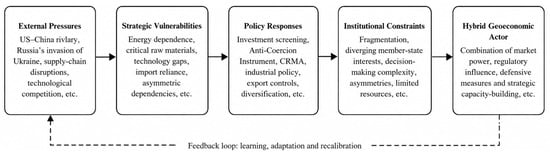
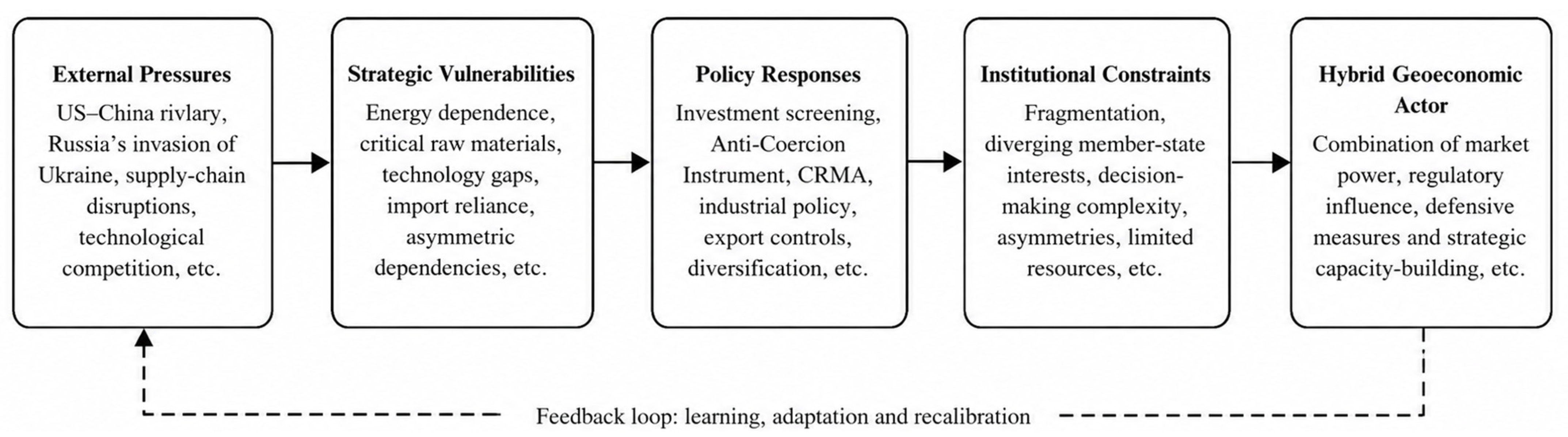

Disclaimer/Publisher’s Note: The statements, opinions and data contained in all publications are solely those of the individual author(s) and contributor(s) and not of MDPI and/or the editor(s). MDPI and/or the editor(s) disclaim responsibility for any injury to people or property resulting from any ideas, methods, instructions or products referred to in the content. |
© 2026 by the authors. Licensee MDPI, Basel, Switzerland. This article is an open access article distributed under the terms and conditions of the Creative Commons Attribution (CC BY) license.