


Abstract
Climate-related crises increasingly call for coordinated responses across multiple organisations. Drawing on crisis communication and network governance perspectives, this study considers how inter-organisational relationships enable collective crisis readiness during extreme weather events. Using a qualitative design, 16 semi-structured interviews were conducted with crisis communication scholars and practitioners and analysed through inductive thematic analysis. Data suggest that crisis readiness cannot be understood solely as an organisational attribute but is enacted through networks of collaborating actors. Four interrelated mechanisms emerged as critical for translating organisational preparedness into collective crisis response: inter-organisational efficacy, relational resilience, relational agility and collective learning. The study conceptualises relational readiness as a network-level condition that enables organisations to enact preparedness collectively and draws attention to the importance of inter-organisational relationships in climate-related emergencies.
1. Introduction
Climate change is increasing the frequency and severity of extreme weather events worldwide, specifically in vulnerable regions such as the Mediterranean Basin [1,2,3]. One devastating example in recent years is the isolated high-level depression (DANA) that struck Spain, particularly the Valencia region, in October 2024, causing 237 deaths and major social and economic disorder [4].
The Spanish DANA illustrates a broader pattern of climate-intensified extremes observed globally. For example, in southern Brazil, the April–May 2024 floods affected approximately 90% of municipalities in Rio Grande do Sul, displaced around 600,000 individuals, and resulted in more than 180 fatalities [5]. In the Sahel, the March–April 2024 heatwave pushed temperatures above 45 °C, reaching 48.5 °C in Kayes, Mali [6].
In its 2023 assessment, the Intergovernmental Panel on Climate Change (IPCC), the international body established by the World Meteorological Organisation (WMO) and the United Nations Environment Programme (UNEP) to assess climate science, highlighted the paramount need for regional and local adaptation measures capable of addressing the growing risks associated with climate change [7]. At the international policy level, Article 7 of the Paris Agreement frames adaptation as enhancing adaptive capacity and strengthening resilience. More recently, the Belém Adaptation Indicators adopted at CMA 7 during COP30 have reinforced the importance of the institutional and relational capacities required to translate adaptation commitments into coordinated action [8]. In this context, communication constitutes a central component of climate adaptation and disaster risk management [9].
Climate-related crises do not unfold solely as physical emergencies, but also as communicative events determined by hybrid media systems, digital channels, competing interpretations and rapidly circulating information. Public administrations are therefore required not only to coordinate operational responses but also to steer complex information environments characterised by uncertainty, misinformation and intense public scrutiny.
Crisis communication research has traditionally focused on how organisations communicate during emergencies. More recently, the concept of “READINESS” has been introduced to explain how organisations develop the cognitive, emotional and procedural capacities required to anticipate, adapt to and respond successfully to crises [10]. However, climate-related crises frequently transcend organisational and jurisdictional boundaries, demanding coordinated action among public agencies, emergency services, scientific institutions and other stakeholders. In these contexts, effective crisis communication depends not only on the preparedness and readiness of individual organisations but also on their capacity to coordinate and exchange information across networks of interdependent actors [11,12]. Communication networks are therefore not peripheral to emergency response but constitute a central condition for coordinated collective action.
To address this gap, this study draws on network governance theory to explore the role of inter-organisational relationships in enabling collective crisis readiness. Focusing on public administrations operating in the context of extreme weather events, the study examines how crisis communication scholars and practitioners understand the relational conditions and mechanisms that support coordinated crisis response across organisational boundaries.
2. Theoretical Background
2.1. Crisis Communication Readiness: Conceptual Foundations and Current Limitations
The concept of “READINESS” has emerged through close collaboration between practitioners and scholars, in response to an increasingly sophisticated landscape of issues and crisis management [13]. Research suggests that effective communication during a crisis is no longer sufficient on its own; rather, it depends on a range of pre-existing conditions being in place. The READINESS model is built upon three interrelated pillars [10,14]. The first is multilevel efficacy, which refers to the shared belief, throughout different levels of the organisation, that the necessary capabilities are in place to carry out required tasks and achieve positive outcomes. The second element is mindset, understood as an active disposition to adapt cognitively and affectively to the developing conditions of a crisis. The third pillar refers to the dynamic processes which shape organisational responses to crises. This dimension brings attention to the importance of agility and dynamic capabilities, which enable organisations to adapt resources, navigate uncertainty, and make timely decisions as crisis conditions change.
Within this system, researchers also identify preparedness and resilience as fundamental yet distinct components of READINESS. Preparedness refers to prior planning, training, and the development of knowledge, skills, physical resources, and structured plans designed to manage crises effectively. On the other hand, resilience is understood as the capacity to recover from, overcome, or adapt to negative effects and setbacks experienced during or after a crisis [10]. While both elements are essential, they represent different dimensions within the wider readiness process.
Recent extensions of the READINESS framework have primarily focused on organisational factors and processes [15,16]. While this model presents a persuasive explanation of how organisations develop crisis response capabilities, it provides less explicit insight into how such capabilities are enacted collectively under conditions of interdependence. This limitation is notably relevant in the context of wicked crises, which cannot be addressed by a single organisation alone [17,18]. For public administrations in particular, effective crisis management depends not only on internal readiness but also on the ability to coordinate across organisations and governance levels [19,20].
2.2. Network Governance as a Missing Lens
In public administration research, collaboration has long been recognised as key for addressing complex societal challenges such as the effects of climate change [21,22,23]. Collaborative governance is generally understood as processes in which public and non-public actors engage collectively in decision-making and implementation [24,25]. In crisis contexts, these non-public actors may include community organisations, volunteer groups and informal response networks, whose situated knowledge, social ties and response capacities can complement institutional action [26,27].
Within this broader structure, network governance can be understood as a specific form of collaborative governance that emphasises both institutional and informal relationships among organisations, highlighting decentralised coordination, interdependence and the management of interorganisational ties [20,28,29]. From this perspective, governance is understood as a set of formally designed structures and procedures, but also as an emergent process guided by ongoing, adaptive, and self-organising interactions [30]. A central assumption of network governance is that complicated societal challenges fail to be addressed by individual organisations acting independently [28,31,32]. Consequently, network governance shifts analytical attention from the capabilities of individual organisations to the quality of the relationships that enable collective action.
Research has identified several relational conditions that facilitate collaboration within governance networks. Among them is goal alignment, whereby actors share compatible objectives, expectations, and interpretations of policy problems. Such coordination provides a common basis for cooperative problem-solving and enhances network participants’ capacity to coordinate their efforts proficiently [28,32,33]. Closely related to this is the concept of multiplexity, which refers to the concurrence of multiple regulated and informal ties between actors [29,34,35]. These overlapping relationships create familiarity, reinforce mutual expectations, and strengthen coordination capacities over time.
Trust is another fundamental mechanism underpinning network performance, as it is consistently identified as a key condition for information sharing, resource exchange, and joint decision-making across strands of network governance research [29,36]. By reducing uncertainty about other actors’ intentions and capabilities, trust can also serve as a substitute for costly monitoring and control mechanisms [28,29]. Trust in crisis governance also extends beyond relationships among participating organisations to their relationships with affected communities [37,38]. Risk perceptions and memories of previous events influence how warnings are interpreted and whether official information is translated into protective action [39,40]. Governance networks therefore require channels for incorporating grassroots feedback and sustaining public trust, as internal coordination may be insufficient when institutions are disconnected from affected populations [40,41].
Literature further illustrates the value of collective learning and sensemaking processes [42,43]. Governance networks perform within environments characterised by uncertainty, incomplete information, and evolving risks. Under such conditions, collaboration involves not only the exchange of information but also the collective interpretation of events and the development of shared understandings of risks, responsibilities, and appropriate courses of action. Through repeated interaction, joint exercises, benchmarking, and cross-learning activities, actors develop shared cognitive frames that facilitate coordination and reduce the likelihood of fragmented responses [43].
At the same time, governance networks must remain capable of adjusting to changing circumstances. Crisis situations frequently require actors to modify existing patterns of interaction, reconfigure responsibilities, and mobilise new resources in reaction to evolving conditions. Effective collaboration therefore depends both on stable relationships and adaptive forms of coordination that allow networks to balance organisational autonomy alongside collective objectives [31,32].
2.3. From Organisational Readiness to Relational Readiness: A Network Governance Perspective
In the original version of the readiness framework [10,14,44], preparedness refers to the pre-crisis development of plans, training, resources and knowledge, while readiness captures the mindset and evolving processes that enable organisations to anticipate, adapt and respond adequately. Resilience is conceived as the principal outcome, reflected in the ability to absorb disruption, recover and learn from adversity. Together, these concepts give a comprehensive account of how individual organisations prepare for and respond to crises.
However, contemporary climate-related crises increasingly transcend organisational and jurisdictional boundaries, demanding coordinated action among multiple public agencies, emergency services, scientific institutions and other stakeholders. While the READINESS framework explains how organisations develop crisis response abilities, it offers less insight into how such capabilities are enacted collectively under conditions of interdependence. Network governance tackles this limitation by focusing on the relational structures and interaction methods through which collective action is coordinated across organisational boundaries.
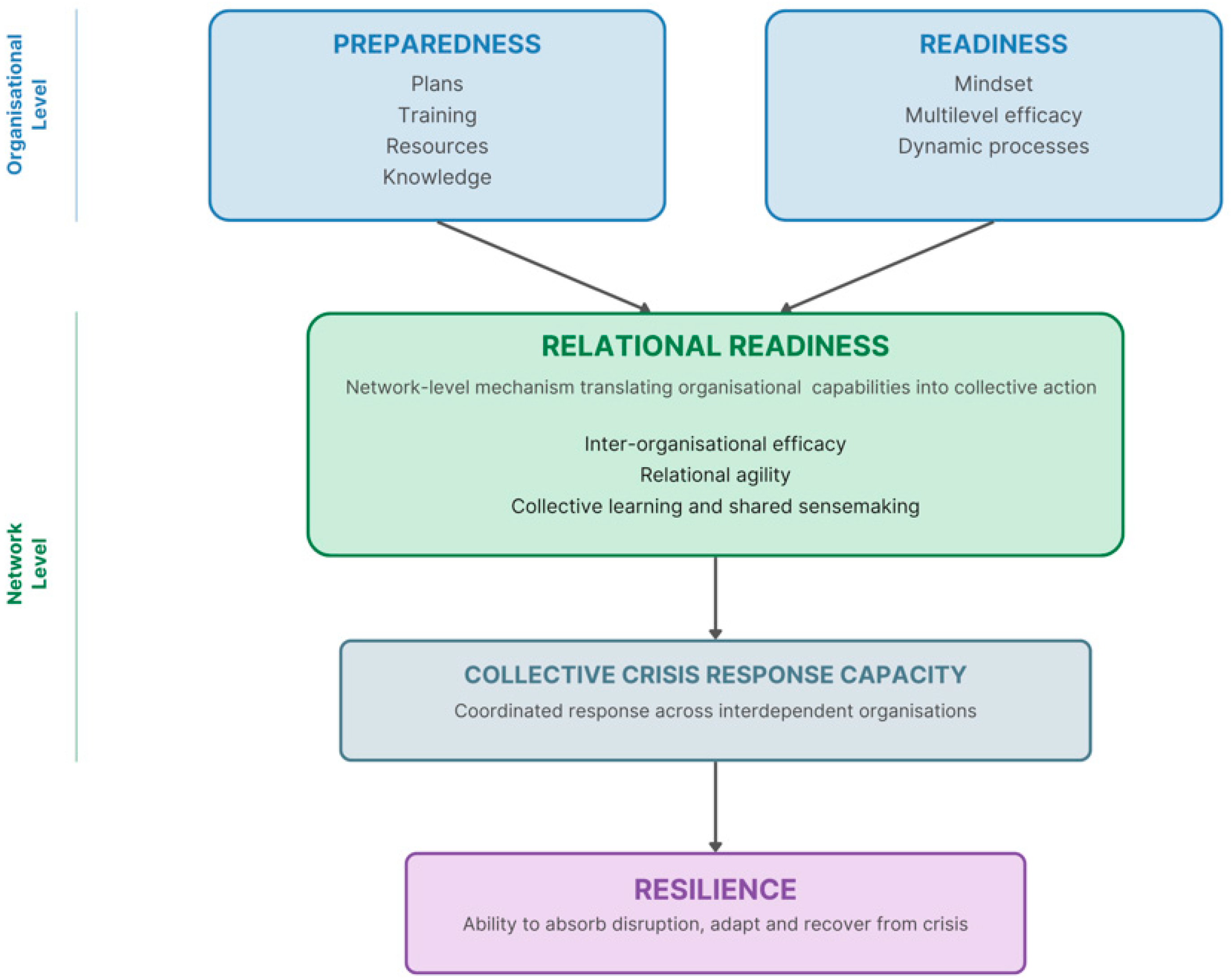
Building on both perspectives, this study conceptualises relational readiness as the network-level condition through which organisational preparedness as well as readiness are translated into collective crisis response. Accordingly, relational readiness is understood as an emergent property of governance networks rather than a capability possessed by any single organisation. It reflects the extent to which interdependent actors have developed the relationships, expectations and coordination mechanisms necessary to anticipate, comprehend and respond collectively to crises. The associations presented in Table 1 should therefore be understood as heuristic rather than deterministic. Their purpose is to illustrate how concepts from both literatures can be combined to explain the collective enactment of crisis readiness.
Table 1.
Extending crisis readiness from the organisational to the network level.
Several mechanisms identified in the network governance literature help explain how organisations enact readiness collectively. One such mechanism is goal alignment. In the readiness literature, the LEAP framework emphasises the significance of cultivating crisis-ready relationships with primary stakeholders characterised by aligned goals, compatible expectations, and agreed norms of interaction [14]. From a network governance perspective, this emphasis is consistent with the Advocacy Coalition Framework, which argues that cooperation is more effective when actors share objectives and collective priorities [33]. These relationships are often embedded in multiplex ties, where official and informal interactions overlap and reinforce one another over time, thereby strengthening trust and facilitating cooperation [29,35]. Together, these insights support the importance of strong, reciprocal relationships as a foundation for collective crisis response and relational resilience [44,45].
A second mechanism concerns inter-organisational efficacy. Within the READINESS framework, multilevel efficacy refers to the shared belief that individuals, teams, and the organisation itself possess the capabilities required to achieve desired outcomes [10,14]. In networked crisis environments, this logic can be extended to the inter-organisational level. Drawing on Collaborative Advantage Theory, crisis management effectiveness depends on the availability of resources and on the belief that collaboration will generate outcomes that cannot be achieved independently [32,46]. Network governance research further suggests that such efficacy is strongly dependent on trust, which reduces uncertainty and facilitates the exchange of information, knowledge, and resources across organisational boundaries [32,47]. In this sense, trust functions as a key relational condition enabling collective action.
A third mechanism relates to the dynamic process dimension of readiness. In networked settings, agility depends on the ability to rapidly assemble multi-agency crisis teams or ‘war rooms’ composed of actors who already possess mutual trust, procedural familiarity and a common understanding of each other’s roles. These pre-existing relational conditions enable organisations to integrate expertise and make timely decisions under pressure [14]. This relational agility reflects the capacity of networks to navigate structural tensions, adapt coordination patterns, and reconfigure collective action through established channels of interaction. Its effective activation during acute emergencies is fundamentally constrained by human and psychosocial factors [48]. Under severe time pressure, decision-makers and communicators experience acute psychological stress, emotional arousal, and cognitive overload, which can trigger heuristic biases such as myopic loss aversion and defensive threat-rigidity [39].
Finally, the literature on crisis learning points out the importance of cross-learning processes through which actors from different organisations exchange knowledge, test assumptions, and develop shared understandings of risks and reaction strategies during the prevention and preparedness phases [14,16]. Viewed through a network governance lens, these processes can be understood as forms of shared sensemaking that enable actors to collectively interpret complex and ambiguous situations and develop common cognitive frames before crises occur [30,43]. Such shared understandings facilitate coordinated decision-making and lower the likelihood of divergent responses during crises.
These mechanisms suggest that effective crisis response could not only depend on the readiness of individual organisations but also on the quality of the relationships connecting them. The concept of “Relational readiness” emerges through trust, alignment, inter-organisational efficacy, shared sensemaking and adaptive coordination, enabling organisations to translate individual preparedness into collective crisis response capacity. This perspective shifts analytical attention from individual organisations to the governance networks in which they are embedded.
Although relational readiness can be theoretically grounded at the intersection of the readiness and network governance literatures, its practical meaning remains insufficiently understood. In particular, little empirical attention has been devoted to how crisis communication experts perceive inter-organisational relationships as enabling coordinated, collective responses to crises within the READINESS framework. To address this gap, the study poses the following research questions:
RQ1. How do crisis communication scholars and practitioners understand the role of inter-organisational relationships in enabling crisis readiness across networks of collaborating organisations?
RQ2. What relational mechanisms do experts identify as critical for translating organisational preparedness and readiness into collective crisis response capacity?
3. Methodology
Due to the exploratory nature of the research and in alignment with previous studies on readiness [16], a qualitative research design based on in-depth interviews was adopted. Qualitative interviews are well-suited for examining emerging organisational processes and for capturing expert perspectives on complex phenomena such as crisis communication and collaborative governance.
A purposive sampling strategy was employed to recruit participants with recognised expertise in crisis communication. The final sample included sixteen participants based in Spain: ten academics specialising in crisis communication and related fields, and six senior communication professionals with experience advising public institutions during crisis situations. Incorporating both academic and practitioner perspectives allowed for the capture of theoretical and practice-based understandings of the relationship between crisis communication readiness and inter-organisational collaboration. The target sample size aligned with recommendations for qualitative research aimed at identifying recurring themes within a relatively homogeneous group of knowledgeable informants [49]. Sample adequacy was assessed using the concept of information power [50], considering the focused aim, the participants’ specialised expertise, the study’s theoretical grounding, the richness of the interviews, and the cross-case analytical strategy. Interim analyses showed substantial recurrence in the core patterns by interviews 14 and 15, while the final interview further refined them. The 16-participant sample was therefore considered adequate for the study’s exploratory purpose, without claiming exhaustive coverage of the phenomenon. The demographic characteristics of the crisis communication expert sample are summarised in Table 2.
Table 2.
Demographic characteristics of crisis communication expert sample.
Data were collected between February and April 2026. Fifteen interviews were conducted online via Google Meet and lasted between 29 and 65 min. Participants received the study information and interview guide in advance and provided informed consent. At the beginning of each session, the study’s purpose, confidentiality arrangements and voluntary nature of participation were reiterated. The interviews were conducted by research team members with training and experience in qualitative interviewing. Owing to scheduling constraints, one participant submitted written responses based on the same interview guide. These were incorporated into the dataset as received; however, because the written format did not allow real-time follow-up probing, this contribution is acknowledged as a less interactive form of data generation.
The semi-structured interview guide comprised six core questions addressing four broad areas: (1) participants’ understanding of readiness; (2) the role of inter-organisational relationships in crisis communication; (3) the relational conditions enabling or constraining collective response; and (4) learning and adaptation across organisational boundaries. The interview guide was applied flexibly, with follow-up questions used to clarify responses, elicit concrete examples and explore differences between formal procedures and actual experiences of inter-organisational coordination. The interviews were audio-recorded, transcribed verbatim and anonymised before analysis.
Instrument and Data Analysis
A thematic analysis of interview transcripts was conducted using the reflexive thematic analysis approach developed by Braun and Clarke [51,52]. This method aligned with the study’s aim to explore how crisis communication scholars and practitioners interpret readiness in networked crisis environments, rather than to quantify specific perceptions. The analysis focused on participants’ understandings of the relational mechanisms through which crisis readiness is enacted collectively across organisational boundaries.
All transcripts were imported into ATLAS.ti to facilitate data management, coding, and thematic analysis. Following the six-phase approach proposed by Braun and Clarke [51], transcripts were reviewed multiple times, coded, and organised into candidate themes, which were then refined and interpreted in relation to relational readiness. All transcripts were coded by the lead researcher, who was present during all the interviews conducted. While the analysis was informed by existing literature on crisis communication readiness and network governance, themes were generated inductively through repeated engagement with the data and subsequently interpreted through the theoretical lens of relational readiness. The final themes were organised into an analytical narrative that examined how participants conceptualised crisis communication readiness in networked governance contexts and identified relational mechanisms critical for translating organisational preparedness into collective crisis response capacity. Table 3 presents the final themes developed through the thematic analysis, along with illustrative codes that informed their construction.
Table 3.
Development of the themes from the coding process.
4. Results
4.1. From Organisational Readiness to Collective Response
A recurring theme across interviews was the perception that crisis response should no longer be viewed as the responsibility of a single organisation. Both scholars and practitioners consistently described readiness as a collective capability, contingent upon the coordination of multiple actors operating under conditions of uncertainty.
Participants further emphasised that this interdependence generates both operational and reputational consequences. Twelve interviewees explicitly described crisis management as a system in which the actions of one organisation directly influence the capacity of others to respond. Participant 10 characterised this dynamic as a “domino effect”, illustrating how a single operational or communicative decision can disrupt the broader response effort. Additionally, participants indicated that citizens tend to assess crisis management collectively, rather than evaluating individual organisations.
All participants agreed that collaboration is ultimately unavoidable during major crises. For instance, participant 10 observed that “there comes a point when collaboration is not only necessary, but fundamental, for a very simple reason: in a given territory there may be two, three, four, or five different administrations in charge, but ultimately the resolution of the crisis is meant to benefit the citizens of that territory.” Nevertheless, interviewees distinguished between collaboration that arises out of necessity and collaboration that is proactively cultivated. Six interviewees acknowledged that extreme events often compel organisations to cooperate because independent action becomes materially impossible. As Participant 2 stated, “no administration can reach everywhere during a large-scale emergency”, making resource sharing inevitable. Participant 11 echoed this sentiment, noting that such situations prompt organisations to recognise that “we need one another”. However, participants generally characterised these forms of cooperation as reactive rather than strategic. Participant 4 observed that, in the absence of prior coordination, what typically emerges is an urgent exchange of information once the emergency is already underway, lacking the alignment and shared responsibility necessary for genuine coordination. Some interviewees further cautioned that relying on collaboration to emerge spontaneously during crises effectively places the response at the mercy of circumstance rather than preparedness.
Consequently, twelve participants emphasised that effective collaboration relies on relationships established well before a crisis occurs. According to their perspectives, communication channels, trust, and mutual understanding cannot be improvised under conditions of uncertainty and time constraints. Participant 4 asserted that “communication has to be fluid beforehand”, highlighting that relationships of trust require prior interaction, “even if only a minimal one”. Participant 6 similarly argued that organisations must “work on what comes before the crisis”. Two interviewees described relationships as a resource for preparedness. Specifically, participant 12 referred to a “relational reservoir” or stock of social capital built through consistency, mutual experiences, and joint work over time. Participant 11 provided a practical example from more than a decade of collaboration with port-sector associations, explaining that when personal and inter-organisational relationships are already in place, collaboration during unforeseen events becomes significantly smoother and faster.
4.2. Trust and Shared Responsibility
Analysis of the interviews indicates that participants consistently highlight that effective crisis response depends not only on the resources available to individual organisations but also on the degree to which actors trust one another, share responsibility, and believe in their collective capacity to act. Notably, twelve participants repeatedly associated successful collaboration with the presence of strong, enduring relationships that support coordination under conditions of uncertainty.
Trust was identified as the foundation of collective confidence. Participants emphasised that organisations are more likely to exchange information, rely on one another, and coordinate decisions when they have confidence in the competence, intentions, and reliability of their counterparts. Participant 13 defined efficacy in these terms, stating that effective crisis response requires “trust in people, teams and the organisation as a whole… both your own and the other institutions involved”. Participant 10 similarly underscored the importance of confidence in decision-making processes, observing that rapid and coordinated action depends on trust within crisis teams as well as between collaborating organisations. Collectively, these accounts indicate that inter-organisational efficacy is grounded in the belief that others possess both the willingness and the capability to contribute effectively to a collective response.
Participants further emphasised that collective action relies on more than mutual trust. Several interviewees asserted that effective crisis management requires a shared understanding that responsibility for managing emergencies cannot rest with a single organisation. Participant 2 stated that organisations must communicate a sense of “shared responsibility for the emergency” to citizens. On this line, participant 4 distinguished between cooperation and coordination, suggesting that while organisations may cooperate by exchanging information or resources, genuine coordination requires “a commitment to shared responsibility and alignment”. Participant 11 reinforced this perspective by stating that effective crisis response begins with recognising that “no organisation can operate successfully in isolation within a complex governance system”. These perspectives indicate that efficacy arises not only from confidence in capabilities but also from confidence in a shared commitment to collective goals.
On the other hand, participants stated that if trust and a sense of shared responsibility are lacking, coordination can be replaced by defensive communication and competition for institutional visibility. One participant noted that some organizations try to “stand alone in the spotlight”. In contrast, another participant stated that crisis communication should focus on the “protection of citizens rather than that of the institutions or of organizations.” This suggests that organizations might place a greater emphasis on protecting their reputation or avoiding responsibility than on open information sharing and collective action.
4.3. Mobilising Expertise and Coordination Under Pressure
A central theme identified in the interviews is the need to establish prompt operational environments, often referred to as “situation rooms.” Participant 1 highlights the creation of these spaces as a clear indicator of readiness. Within these temporary structures, communication chains are significantly simplified, traditional bureaucratic hierarchies are suspended, and interactions become purely operational, typically coordinated by one or a few individuals in command. Participant 5 supports this perspective, stating that, “in order to mobilise the bureaucratic elephant of public administration, institutions must provide dedicated spaces,” resources, and teams specifically designed to respond with immediate agility.
Participants also emphasized the significance of formal coordination structures specifically designed for crisis situations. Participant 10 described the activation of a preventive crisis committee, supported by messaging groups, where decisions are discussed and adopted collaboratively several days before meteorological events reach their peak impact. Similarly, Participant 3 identified the CECOPI (Integrated Operational Coordination Centre) as a paradigmatic example of a temporary coordination mechanism that structures information management and synchronises communication across institutions. According to this participant, failure to activate such structures promptly, or their prolonged inactivity during critical periods, constitutes the “complete antithesis of readiness.” Participant 7 further highlighted the importance of physical crisis cabinets that bring together mayors, regional authorities, technical experts, and communication professionals within the same operational environment to prevent contradictory decisions and messages.
A second aspect of relational agility involves the rapid mobilisation of expertise across organisational boundaries. Participants consistently asserted that uncertainty heightens the importance of specialised technical knowledge, and that effective crisis response depends on governance arrangements capable of integrating such expertise into decision-making processes. Participant 3 contended that preparedness begins with “the assumption of technical leadership,” suggesting that political actors should recognise when specialised institutions are better positioned to guide crisis response. Participant 1 similarly argued that crises require the intervention of “strategic and technical considerations instead than purely political considerations.” Participant 13 illustrated this dynamic through the University of Valencia’s response to the DANA event. According to this participant, the university was able to make timely decisions because its emergency advisory council included highly specialised meteorological experts whose assessments informed the response despite initial public scepticism.
The interviews further indicated that agility relies on organisational arrangements that accelerate decision-making. Several participants argued that crises often reveal the limitations of conventional bureaucratic procedures, especially when decisions require multiple layers of approval. Participant 4 emphasised that crisis actors must be able to “make decisions quickly” and should not be required to wait for validation from multiple organisational levels. Participant 13 similarly argued that crisis managers need sufficient autonomy to “take decisions and communicate rapidly,” or at minimum, direct access to senior decision-makers capable of responding within minutes. Participant 5 summarised this requirement as “agility, which is fundamentally the opposite of bureaucracy,” while Participant 7 identified excessive validation procedures as a principal obstacle to effective crisis management.
4.4. Learning Beyond Organisational Boundaries
Scholars and practitioners conceptualized learning as a process that extends beyond organisational boundaries. Rather than relying solely on internal experiences, organisations should actively observe, exchange, and reflect on the successes and failures of others. Eleven participants explicitly stated that cross-learning enables institutions to identify vulnerabilities, challenge existing assumptions, and enhance preparedness without directly experiencing crises. Participant 8 emphasized the importance of “learning from the good and the bad things other administrations have done,” contending that analyzing the failures of others helps organisations avoid repeating similar mistakes. Participant 12 similarly described how the Basque Government used the DANA catastrophe in Valencia “as a mirror through which to evaluate its own preparedness gaps and identify potential vulnerabilities before facing a comparable event.” These accounts indicate that readiness is shaped not only by direct experience but also by the capacity of organisations to absorb and internalize lessons generated elsewhere within the governance network.
Participants further argued that the value of cross-learning lies not only in the transfer of information but also in the development of shared interpretations of complex and uncertain situations. Through continuous exchange of experiences, organisations develop common understandings of risks, appropriate response strategies, and emerging threats. In this context, learning serves as a form of collective sensemaking that enables actors to construct shared cognitive frames prior to crises. Rather than responding to events from isolated organisational perspectives, participants described readiness as requiring a common understanding of how crises unfold and how different actors should respond collectively.
This process was also closely linked to the development of adaptive capacity. Participant 11 described readiness as the ability to “adapt to a completely new situation spontaneously” and for teams to transition into “emergency mode” when circumstances change. Participant 13 similarly argued that effective crisis management requires actors to “think flexibly, adjust strategies, and manage emotions when situations change.” Notably, participants did not characterize these capabilities as solely individual competencies. Instead, they suggested that exposure to diverse experiences, perspectives, and practices across organisations enhances the collective ability of networks to adapt when confronted with unfamiliar situations.
At the same time, several interviewees argued that these learning processes remain weakly institutionalized within many public administrations. Participant 4 criticized the absence of an “institutionalized learning cycle,” contending that organisations often remain reactive rather than systematically incorporating lessons from previous crises into preparedness activities. Participant 9 similarly criticized public-sector knowledge management, suggesting that organisations are frequently “reinventing the wheel” instead of learning from previous failures, including those exposed during the COVID-19 pandemic. These observations suggest that the primary challenge is not merely generating knowledge but establishing mechanisms capable of sustaining learning and reflection across organisations over time.
5. Discussion and Conclusions
5.1. Reinterpreting Readiness Through a Network Governance Lens
Existing conceptualisations provide a robust explanation of how organisations prepare for crises effectively [14,44]. However, these frameworks do not offer clear insights into how readiness functions when effective crisis response depends on the coordination of multiple organisations [17,18]. This study advances the emerging literature on crisis communication readiness by proposing a framework that goes beyond its original organisational focus.
Participants consistently described crisis response as a collective endeavour, noting that no single organisation possesses sufficient resources, expertise, or legitimacy to manage extreme weather events independently. In this context, readiness should not be understood solely as an organisational attribute. Instead, it depends on the ability of organisations to coordinate their actions through networks of interdependent actors. This observation does not challenge the core assumptions of the readiness framework. Rather, participants strongly affirmed the importance of proactive orientation, situational awareness, adaptive capacity, and crisis-ready relationships. The findings indicate that these capabilities become increasingly difficult to enact in isolation within governance systems characterised by fragmented responsibilities, overlapping jurisdictions, and multiple centres of authority.
This finding extends existing readiness research in two significant ways. First, it indicates that preparedness should not be viewed solely as an organisational attribute. Although crisis communication scholarship has primarily conceptualised preparedness in terms of plans, resources, training, and internal capabilities, participants repeatedly emphasised the importance of inter-organisational relationships. Governance systems may be procedurally or technically prepared yet remain vulnerable if these relationships are weak, fragmented, or underdeveloped. Second, the findings demonstrate that readiness is enacted relationally. Organisational capabilities are necessary, but their effectiveness depends on the condition of the governance networks through which organisations operate. From this perspective, readiness is not confined to individual organisations but is expressed through the interactions that connect actors before, during, and after crises.
Network governance offers a valuable perspective for understanding this dynamic. Previous research has highlighted the importance of trust, reciprocity, collaboration, and coordination for collective action [29,33,47]. The present findings indicate that these mechanisms are especially significant in crisis contexts, as they determine whether organisational capabilities can be mobilized collectively under conditions of uncertainty and time pressure.
5.2. Relational Foundations of Collective Crisis Readiness
Although the previous section emphasizes the value of a network governance perspective for understanding crisis readiness, the findings further illuminate the relational conditions that facilitate collective crisis response. The interviews indicate that relational readiness comprises a configuration of mutually reinforcing mechanisms, rather than a singular capability, through which organisations convert preparedness into coordinated action. Whereas network governance primarily investigates how actors coordinate and collaborate, relational readiness examines the degree to which these relationships are prepared to support collective action prior to a crisis.
Inter-organisational efficacy refers to the shared belief that the organisations involved possess both the capacity and the willingness to contribute effectively to a collective response. Existing readiness research emphasizes confidence in the abilities of individuals and teams to achieve desired outcomes [10,14]. However, participants conceptualized efficacy in collective terms. Effective crisis response was described as relying not only on trust in one’s own organisation’s competence, but also on confidence that other organisations would act responsibly, share information, and contribute to a coordinated response.
Relational resilience denotes the capacity of established inter-organisational relationships to sustain coordination under pressure. While previous studies have primarily explored how relationships assist organisations or individuals in coping with adversity [44,45], participants in this study emphasized the role of relationships in maintaining coordination across organisational boundaries. A recurring theme was that such relationships cannot be improvised. Several participants noted that trust develops gradually through repeated interactions and collaborative efforts, resulting in what one interviewee termed a “relational reservoir” that can be accessed during emergencies. This perspective suggests that resilience is embedded not only within organisations, but also within the relationships that connect them.
However, relational resilience is not necessarily preserved once a crisis begins. Findings suggest that political competition and accountability pressures may encourage blame-shifting and defensive communication, particularly when organisations prioritise institutional reputation over shared responsibility and citizen protection. Divergent organisational cultures may reinforce this fragmentation by producing incompatible understandings of authority, responsibility and legitimate crisis action [12,53]. Under these conditions, reduced information sharing and competing public messages can rapidly erode previously established trust, weakening inter-organisational efficacy when it is most needed [19]. Relational readiness therefore depends not only on building relationships before a crisis, but also on preserving shared responsibility when political and reputational pressures intensify.
Relational agility refers to the capacity of a governance network to activate and reconfigure established relationships, roles and communication channels rapidly as crisis conditions evolve. The readiness literature underscores the significance of adaptability and the capacity to respond dynamically to evolving circumstances [14]. The interviews indicate that, within interdependent crisis environments, agility is frequently facilitated by relationships rather than by formal structures alone. Participants consistently referenced informal communication channels, trusted contacts, crisis committees, and temporary coordination spaces that enabled rapid information exchange, expertise mobilisation, and decision-making under significant time constraints. However, relational agility should not be understood solely as a structural capacity. Because coordination is enacted by individuals operating under acute stress and uncertainty, it also depends on their ability to regulate emotional arousal, maintain shared situational awareness and avoid defensive decision-making under cognitive overload [44]. These findings suggest that agility is contingent not only on organisational flexibility, but also on relational arrangements that support swift coordination when standard bureaucratic procedures are insufficient.
Collective learning refers to the exchange and interpretation of knowledge and experience across organisational boundaries. Participants consistently characterized learning as a process that occurs across organisational boundaries, rather than solely within individual organisations. Observing responses in other territories, exchanging experiences with peers, and reflecting on the successes and failures of other administrations were identified as key sources of preparedness. This process was valued not only for generating knowledge, but also for fostering shared interpretations of risks and appropriate responses. Consequently, learning contributed to a common understanding of crises and reinforced collective sensemaking processes that underpin coordinated action.
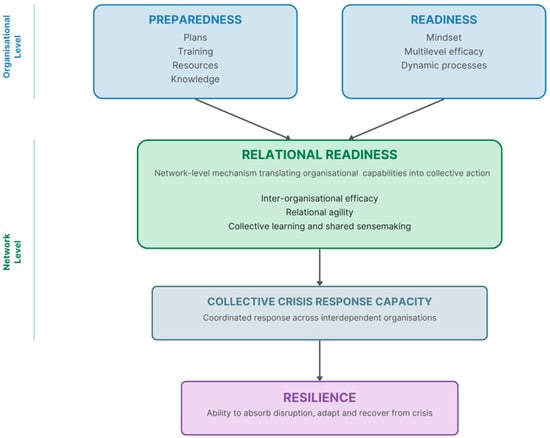
The findings offer empirical support for the relational processes depicted in Figure 1. The empirical basis of these components, including participant coverage and the illustrative codes underpinning their interpretation, is summarised in Table 3. Rather than operating as isolated mechanisms, inter-organisational efficacy, relational resilience, relational agility, and collective learning interact to enable the translation of organisational preparedness and readiness into collective crisis response. These mechanisms should not be regarded as independent variables. Trust facilitates information exchange, which in turn supports learning, while repeated interaction enhances both efficacy and coordination. Thus, relational readiness refers to the overall state of collective preparedness that emerges from the interplay of these mechanisms. Although network governance research has typically examined these mechanisms separately, the present findings indicate that their combined configuration is essential for governance networks to convert organisational preparedness into collective crisis response capacity. Overall, the findings are consistent with previous readiness and network governance research in identifying efficacy, adaptability, trust and learning as central to crisis response.
Figure 1.
Relational Readiness as a Network-level Mechanism for Inter-institutional Crisis Response. Source: Author’s own elaboration based on references [10,14] and the network governance literature.
Beyond their operational implications, this study also suggests that relational readiness has important communicative dimensions. In climate-related crises, organisations operate within complex information environments characterised by uncertainty, rapidly evolving events, and intense public scrutiny. Under such conditions, inter-organisational relationships may contribute not only to coordination and resource mobilisation, but also to communicative coherence, trust-building, and the development of shared interpretations that support collective sensemaking. Relational readiness therefore represents a relevant capability for strengthening coordinated crisis communication in increasingly interconnected and climate-vulnerable contexts.
5.3. Practical Implications for Public Administrators
The findings indicate that relational readiness must be developed before a crisis rather than improvised once an emergency has begun. For public administrators, the proposed framework translates into the following practical priorities:
- Map the governance network in advance by identifying relevant organisations, responsibilities, expertise, resources, decision-making authority and points of contact.
- Strengthen relationships through regular inter-institutional meetings, joint exercises and collaborative planning during non-crisis periods.
- Establish clear activation procedures for crisis committees, situation rooms and direct communication channels that enable information and expertise to circulate rapidly.
- Agree on shared communication principles, information-sharing procedures and coordination between spokespersons to reduce contradictory messages, defensive communication and blame-shifting.
- Incorporate community organisations, local volunteers and representatives of affected populations into preparedness activities and the co-design of risk communication protocols and feedback mechanisms.
- Include psychosocial conditions in joint training by preparing teams to manage stress, fatigue and cognitive overload while maintaining shared situational awareness.
- Institutionalise joint post-crisis reviews and cross-organisational learning so that experience leads to changes in protocols, relationships and future preparedness.
These measures should be adapted to the legal, political and organisational characteristics of each governance context. Their purpose is not to replace existing organisational preparedness but to ensure that individual capabilities can be mobilised collectively when a crisis crosses institutional and jurisdictional boundaries.
6. Limitations
This exploratory study draws on a purposive sample of 16 scholars and senior practitioners based in Spain. Although this sample was considered adequate for the study’s focused and exploratory purpose, its limited size and geographical concentration constrain the breadth and transferability of the findings. Fifteen participants were interviewed synchronously, while one provided written responses to the same interview guide. Although this contribution addressed the same core topics, the absence of real-time probing may have reduced its depth and richness. The data also capture expert accounts rather than direct observations of crisis coordination, and the sample did not include frontline personnel, affected citizens, community organisations or informal volunteer networks. Consequently, the study does not empirically examine how relational readiness intersects with grassroots feedback, community resilience, risk perception, social memory or the formation and erosion of public trust. Future research should incorporate these actors and combine interviews with comparative case studies, direct observation, documentary evidence and network analysis across different crises and governance contexts.
Author Contributions
Conceptualization, C.S.A. and F.J.P.R.; methodology, C.S.A. and P.F.; software, C.S.A.; validation, C.S.A.; formal analysis, C.S.A. and F.J.P.R.; investigation, C.S.A., P.F. and F.J.P.R.; resources, C.S.A. and F.J.P.R.; data curation, C.S.A. and F.J.P.R.; writing—original draft preparation, C.S.A.; writing—review and editing, P.F. and F.J.P.R.; visualization, C.S.A.; supervision, P.F. and F.J.P.R.; project administration, C.S.A. All authors have read and agreed to the published version of the manuscript.
Funding
This research received no external funding.
Institutional Review Board Statement
Ethical review and approval were waived. Given the qualitative and non-interventional nature of the study, data were collected through in-depth interviews with adult participants. Participation was voluntary, and all participants received information about the aims and procedures of the study and provided informed consent before taking part. No biological samples were collected, and the interview data were anonymised and processed in accordance with the General Data Protection Regulation (Regulation (EU) 2016/679) and the Spanish Organic Law 3/2018 on the Protection of Personal Data and Guarantee of Digital Rights.
Informed Consent Statement
Informed consent was obtained from all subjects involved in the study.
Data Availability Statement
The original contributions presented in the study are included in the article, further inquiries can be directed to the corresponding authors.
Conflicts of Interest
The authors declare no conflicts of interest.
References
- Greenpeace España. Un Informe de Greenpeace Elaborado con Datos del CSIC Demuestra que el Cambio Climático Afectó a Diez de los Eventos Meteorológicos Extremos más Graves de la Última Década en España. 16 November 2025. Available online: https://es.greenpeace.org/es/sala-de-prensa/comunicados/un-informe-de-greenpeace-elaborado-con-datos-del-csic-demuestra-que-el-cambio-climatico-afecto-a-diez-de-los-eventos-meteorologicos-extremos-mas-graves-de-la-ultima-decada-en-espana/ (accessed on 12 March 2026).
- Otto, F.; Keeping, T.; Vrkic, D.; Clarke, B.; Barnes, C.; Philip, S.; Kew, S.; Pinto, I.; Bacher, A.; Vahlberg, M.; et al. Unequal Evidence and Impacts, Limits to Adaptation: Extreme Weather in 2025; Grantham Institute for Climate Change: London, UK, 2025. [Google Scholar] [CrossRef]
- Paura, C.V. Las 7 Catástrofes Naturales más Mortíferas del Último Siglo en España; National Geographic España: Madrid, Spain, 2026; Available online: https://cutt.ly/Tt3QUmKC (accessed on 12 March 2026).
- Kataryniuk, I.; Fernández Cerezo, A. Un Año de la DANA: El Impacto Económico de Una Catástrofe Natural; El Blog del Banco de España; Banco de España: Madrid, Spain, 2025. [Google Scholar]
- Clarke, B.; Barnes, C.; Rodrigues, R.; Zachariah, M.; Alves, L.M.; Haarsma, R.; Pinto, I.; Yang, W.; Vahlberg, M.; Vecchi, G.; et al. Climate change and El Niño behind extreme precipitation leading to major floods in southern Brazil in 2024. npj Nat. Hazards 2026, 3, 4. [Google Scholar] [CrossRef] [Scilit]
- World Weather Attribution. Extreme Sahel Heatwave That Hit Highly Vulnerable Population at the End of Ramadan Would not Have Occurred Without Climate Change. 18 April 2024. Available online: https://cutt.ly/Lyo3ph99 (accessed on 3 March 2026).
- Calvin, K.; Dasgupta, D.; Krinner, G.; Mukherji, A.; Thorne, P.W.; Trisos, C.; Romero, J.; Aldunce, P.; Barret, K.; Blanco, G.; et al. Climate Change 2023: Synthesis Report, Summary for Policymakers. Contribution of Working Groups I, II and III to the Sixth Assessment Report of the Intergovernmental Panel on Climate Change; Arias, P., Bustamante, M., Elgizouli, I., Flato, G., Howden, M., Méndez-Vallejo, C., Pereira, J.J., Pichs-Madruga, R., Rose, S.K., Saheb, Y., et al., Eds.; IPCC: Geneva, Switzerland, 2023. [Google Scholar] [CrossRef] [Scilit]
- United Nations Framework Convention on Climate Change. Report of the Conference of the Parties Serving as the Meeting of the Parties to the Paris Agreement on Its Seventh Session, Held in Belém from 10 to 22 November 2025: Addendum. Part Two: Action Taken at Its Seventh Session (FCCC/PA/CMA/2025/19/Add.2). 2026. Available online: https://unfccc.int/sites/default/files/resource/cma2025_19_a02.pdf (accessed on 12 March 2026).
- Cheng, Y.; Funkhouser, C.; Raabe, T.; Cross, R. Examining organization-public relationships in crises: A thematic meta-analysis of updated literature from 1997 to 2019. J. Contingencies Crisis Manag. 2022, 30, 148–160. [Google Scholar] [CrossRef] [Scilit]
- Jin, Y.; Shivers, B.N.; Wang, Y.; Coombs, W.T.; Van Der Meer, T.G.L.A. Readiness as a new framework for crisis management: Academic-industry integrated expert insights from practitioners and scholars. J. Commun. Manag. 2025, 29, 1–16. [Google Scholar] [CrossRef] [Scilit]
- Coombs, W.T.; Holladay, S.J. The Handbook of Crisis Communication; Wiley-Blackwell: Oxford, UK, 2012. [Google Scholar]
- Wang, F.; Hou, X.; Feng, X. What factors contribute to the formation of interorganizational collaboration networks: A longitudinal study in response to COVID-19 emergency. J. Contingencies Crisis Manag. 2024, 32, e12556. [Google Scholar] [CrossRef] [Scilit]
- Björck, A.; Bläse, R.; Bastida, P. Becoming crisis-ready: A systematic literature review on corporate crisis readiness and the process to achieving it. J. Contingencies Crisis Manag. 2024, 32, e12614. [Google Scholar] [CrossRef] [Scilit]
- Jin, Y.; Coombs, T.; Wang, Y.; Van der Meer, T.G.L.A.; Shivers, B. Readiness: The keystone of crisis management architecture. Corp. Commun. Rev. 2025, 1, 17–23. [Google Scholar] [CrossRef] [Scilit]
- Gigliotti, R.A.; Alvarez-Robinson, S. The Role of Leadership Communication in Building Crisis Readiness and Resilient Leadership in Times of Disruption: An Exploratory Study. Behav. Sci. 2025, 15, 1260. [Google Scholar] [CrossRef] [Scilit]
- Shivers, B.N.; Jin, Y.; Mains, G.; Wang, Y.; Gracey, R.; Coombs, W.T.; van der Meer, T.G.L.A. Cultural insights for the readiness framework: A qualitative study of practitioner and scholar perspectives. Public Relat. Rev. 2025, 51, 102632. [Google Scholar] [CrossRef] [Scilit]
- Coombs, W.T.; Tachkova, E.R. How Emotions Can Enhance Crisis Communication: Theorizing Around Moral Outrage. J. Public Relat. Res. 2024, 36, 6–22. [Google Scholar] [CrossRef] [Scilit]
- Dai, J.; Azhar, A. Collaborative governance in disaster management and sustainable development. Public Adm. Dev. 2024, 44, 358–380. [Google Scholar] [CrossRef] [Scilit]
- Tao, Z.; Shi, Y. The dynamic collaboration in crisis communication: A complex adaptive systems perspective. Humanit. Soc. Sci. Commun. 2025, 12, 1883. [Google Scholar] [CrossRef] [Scilit]
- Wang, H.; Ran, B. Network governance and collaborative governance: A thematic analysis on their similarities, differences, and entanglements. Public Manag. Rev. 2023, 25, 1187–1211. [Google Scholar] [CrossRef] [Scilit]
- Larsson, O.L.; Sjöqvist, S. Managing National Food Security in the Global North: Is collaborative governance a possible route forward? Risk Hazards Crisis Public Policy 2022, 13, 118–143. [Google Scholar] [CrossRef] [Scilit]
- Rauhaus, B.M.; Sibila, D.A.; Mahan, M. Collaboration in crisis: Utilizing the SOS program, an at-home COVID-19 vaccine administration initiative, to demonstrate best practices in emergency management collaboration. Public Adm. Rev. 2023, 83, 1404–1408. [Google Scholar] [CrossRef] [Scilit]
- Van der Wal, Z. Being a Public Manager in Times of Crisis: The Art of Managing Stakeholders, Political Masters, and Collaborative Networks. In Public Administration Review; Blackwell Publishing Ltd.: Oxford, UK, 2020; Volume 80, pp. 759–764. [Google Scholar] [CrossRef] [Scilit]
- Ansell, C.; Sørensen, E.; Torfing, J. Theorizing the political dimension of collaborative governance. Perspect. Public Manag. Gov. 2025, 8, 158–171. [Google Scholar] [CrossRef] [Scilit]
- Emerson, K.; Nabatchi, T.; Balogh, S. An integrative framework for collaborative governance. J. Public Adm. Res. Theory 2012, 22, 1–29. [Google Scholar] [CrossRef] [Scilit]
- Norris, F.H.; Stevens, S.P.; Pfefferbaum, B.; Wyche, K.F.; Pfefferbaum, R.L. Community resilience as a metaphor, theory, set of capacities, and strategy for disaster readiness. Am. J. Community Psychol. 2008, 41, 127–150. [Google Scholar] [CrossRef] [Scilit]
- Aldrich, D.P.; Meyer, M.A. Social capital and community resilience. Am. Behav. Sci. 2015, 59, 254–269. [Google Scholar] [CrossRef] [Scilit]
- Pu, C.; Zou, Y. Understanding New Advances in Network Governance: A Systematic Literature Review. Public Perform. Manag. Rev. 2025, 48, 129–164. [Google Scholar] [CrossRef] [Scilit]
- Whetsell, T.A.; Kroll, A.; Dehart-Davis, L. Formal Hierarchies and Informal Networks: How Organizational Structure Shapes Information Search in Local Government. J. Public Adm. Res. Theory 2021, 31, 653–669. [Google Scholar] [CrossRef] [Scilit]
- Yi, H.; Liu, W.; Ma, L. Designed networks and the emergence of self-organizing interlocal learning network: Evidence from Chinese cities. Public Adm. 2024, 102, 21–39. [Google Scholar] [CrossRef] [Scilit]
- Hermansson, H.M.L. Disaster management collaboration in Turkey: Assessing progress and challenges of hybrid network governance. Public Adm. 2016, 94, 333–349. [Google Scholar] [CrossRef] [Scilit]
- Vangen, S. Developing Practice-Oriented Theory on Collaboration: A Paradox Lens. Public Adm. Rev. 2017, 77, 263–272. [Google Scholar] [CrossRef] [Scilit]
- Huhe, N.; Thomson, R.; Arregui, J.; Naurin, D. Intergovernmental cooperation networks, national policy positions and partisan ideologies: Longitudinal evidence from the Council of the European Union. J. Eur. Public Policy 2022, 29, 78–96. [Google Scholar] [CrossRef] [Scilit]
- Villalba Ferreira, M.E.; Dijkstra, A.G.; Aniche, L.Q.; Scholten, P. Towards a typology of inter-municipal cooperation in emerging metropolitan regions. A case study in the solid waste management sector in Ecuador. Cogent Soc. Sci. 2020, 6. [Google Scholar] [CrossRef] [Scilit]
- Wang, H.; Qi, H.; Ran, B. Public–Private Collaboration Led by Private Organizations in Combating Crises: Evidence from China’s Fighting Against COVID-19. Adm. Soc. 2022, 54, 3–28. [Google Scholar] [CrossRef] [Scilit]
- Shazi, R.; Gillespie, N.; Steen, J. Trust as a predictor of innovation network ties in project teams. Int. J. Proj. Manag. 2015, 33, 81–91. [Google Scholar] [CrossRef] [Scilit]
- Sataøen, H.L.; Skotnes, R.Ø.; Hansen, K.; Eriksson, M. Municipal risk communication challenges in the Nordic context: Organizing risk ownership. Risk Hazards Crisis Public Policy 2024, 16, e12289. [Google Scholar] [CrossRef] [Scilit]
- Wiese, M.; Van der Westhuizen, L.-M. Public coping discourse in response to government health crisis communication. Corp. Commun. Int. J. 2023, 28, 44–67. [Google Scholar] [CrossRef] [Scilit]
- Coombs, W.T. Public sector crises: Realizations from COVID-19 for crisis communication. Partecip. Conflitto 2020, 13, 990–1001. [Google Scholar] [CrossRef]
- Kim, S. It is time that matters in crisis communication: The role of temporal distance and crisis threat appraisal. Public Relat. Rev. 2022, 48, 102155. [Google Scholar] [CrossRef] [Scilit]
- Crespo Martínez, I.; Garrido Rubia, A. La pandemia del coronavirus: Estrategias de comunicación de crisis. Más Poder Local 2020, 41, 12–19. [Google Scholar]
- Björck, A.; Vogel, B.; Pugnetti, C.; Lopez, M. Advancing cyber crisis readiness: Context, microfoundations and the role of leadership. J. Commun. Manag. 2025, 30, 322–341. [Google Scholar] [CrossRef] [Scilit]
- Liu, B.F.; Iles, I.A.; Herovic, E. Leadership under Fire: How Governments Manage Crisis Communication. Commun. Stud. 2020, 71, 128–147. [Google Scholar] [CrossRef] [Scilit]
- Tachkova, E.R.; Brannon, G.E. Psychological resilience and crisis readiness: Connecting employee well-being and internal crisis communication. J. Commun. Manag. 2025, 30, 425–439. [Google Scholar] [CrossRef] [Scilit]
- Agarwal, V.; Buzzanell, P.M. Communicative Reconstruction of Resilience Labor: Identity/Identification in Disaster-Relief Workers. J. Appl. Commun. Res. 2015, 43, 408–428. [Google Scholar] [CrossRef] [Scilit]
- Xiao, Q.; Zhuang, W.X. Exploring Collaborative Advantage: A Comprehensive Review and Synthesis of Research on Collaboration. Am. J. Manag. 2025, 25, 1–12. [Google Scholar] [CrossRef] [Scilit]
- Douglas, S.; Ansell, C.; Parker, C.F.; Sørensen, E.; ’T Hart, P.; Torfing, J. Understanding Collaboration: Introducing the Collaborative Governance Case Databank. Policy Soc. 2020, 39, 495–509. [Google Scholar] [CrossRef] [Scilit]
- Chaudhri, V.; Armbrust, N.; Nguyen, S. Permanently on standby: Practitioner perspectives on the complexities of crisis planning. J. Contingencies Crisis Manag. 2024, 32, e12600. [Google Scholar] [CrossRef] [Scilit]
- Hagaman, A.K.; Wutich, A. How Many Interviews Are Enough to Identify Metathemes in Multisited and Cross-cultural Research? Another Perspective on Guest, Bunce, and Johnson’s (2006) Landmark Study. Field Methods 2017, 29, 23–41. [Google Scholar] [CrossRef] [Scilit]
- Malterud, K.; Siersma, V.D.; Guassora, A.D. Sample size in qualitative interview studies: Guided by information power. Qual. Health Res. 2016, 26, 1753–1760. [Google Scholar] [CrossRef] [Scilit]
- Braun, V.; Clarke, V. Using thematic analysis in psychology. Qual. Res. Psychol. 2006, 3, 77–101. [Google Scholar] [CrossRef] [Scilit]
- Braun, V.; Clarke, V. Thematic Analysis: A Practical Guide; SAGE: Thousand Oaks, CA, USA, 2022. [Google Scholar]
- Crespo, I.; Garrido, A.; Medina, R.M. La comunicación de crisis en la administración pública española: Análisis de evidencia empírica. GAPP Nueva Época 2017, 18, 110–134. [Google Scholar] [CrossRef] [Scilit][Green Version]

Disclaimer/Publisher’s Note: The statements, opinions and data contained in all publications are solely those of the individual author(s) and contributor(s) and not of MDPI and/or the editor(s). MDPI and/or the editor(s) disclaim responsibility for any injury to people or property resulting from any ideas, methods, instructions or products referred to in the content. |
© 2026 by the authors. Licensee MDPI, Basel, Switzerland. This article is an open access article distributed under the terms and conditions of the Creative Commons Attribution (CC BY) license.