


Abstract
Adaptive cruise control (ACC) tracks a time-gap reference that trades efficiency against spacing safety; in practice this gap is fixed offline, although the safest choice depends on the closing speed and on the reliability of the perception that supplies the lead-vehicle state. We present GL-TGS-v2, a guarded, interpretable supervisor that selects the time-gap reference of an adaptive model predictive controller (MPC) online from tracked lead-vehicle kinematics. The supervisor is a decision-tree distillation of a calibrated adaptive expert, wrapped by a perception-aware safety shield; its only authority is the time-gap reference, so it retrofits onto an existing controller without re-opening the inner loop. We evaluate it in closed loop on a frozen stack that couples a YOLO11 detector, a joint probabilistic data association (JPDA) tracker, and the adaptive MPC, with documented runtime and per-run provenance gates. In a hard lead-braking scenario (ten runs per method), GL-TGS-v2 matches the expert at a matched mean time gap and improves minimum relative distance over fuzzy and fixed-gap baselines by 3.3–5.2 m, with 95% confidence intervals excluding zero, lower target loss, and no collisions. Benign testing shows no regression, while shield ablation characterizes the guard as an auditable protective override.
1. Introduction
Adaptive cruise control (ACC) regulates the longitudinal motion of an ego vehicle to maintain a desired spacing to a lead vehicle, usually through a constant time-gap (constant-time-headway) policy [1]. The desired time gap is a powerful design lever: a small gap improves throughput and efficiency but shrinks the spacing margin when the lead vehicle brakes hard, while a large gap is conservative and smooth yet wastes road capacity and can still lose the target when perception degrades. In practice the gap is fixed offline, even though the safest gap at any instant depends on the closed-loop conditions, the closing speed, and the reliability of the detection and tracking pipeline that supplies the controller with the lead-vehicle state. The supervisor proposed here conditions on the closing speed and on the reliability of the perception pipeline: it observes the tracked longitudinal state and the health of the track, and does not take curvature as an input. Both evaluation scenarios run on the same curved geometry, so curvature is held fixed rather than varied, and conditioning the gap on road geometry is left to future work.
Existing remedies for the fixed gap fall into three families, and each leaves part of the problem open. Analytic variable-time-gap laws adapt the headway from the driving state [2,3], but the laws are hand-derived and consume range and range rate as trusted inputs. Fuzzy supervisors [4,5] are readable rule bases, yet they rely on hand-tuned memberships, carry no learning mechanism, and are likewise silent on what to command when the sensing chain degrades. Learned policies, most prominently reinforcement learning (RL) [6,7], promise adaptivity but resist audit, and without an external constraint they can converge to unsafe or degenerate behavior, a risk that safe RL mitigates by restricting the policy to a verified set [8,9]. Interpretable policy extraction [10,11] closes part of the audit gap, but it has not been applied to time-gap supervision with a perception stack in the loop. What is missing is a supervisor that combines three properties: learning from a defensible reference, rule-by-rule auditability, and protection in the perception-failure regime that the other families assume away. Supplying and evaluating that combination is the contribution of this paper.
This work targets the supervisory layer that selects the time-gap reference online. We consider a complete perception-in-the-loop stack in which a YOLO11 object detector [12] feeds a joint probabilistic data association (JPDA) multi-object tracker [13], whose estimates drive an adaptive model predictive controller (MPC) for longitudinal control [14]. The supervisor’s only authority is to choose the time-gap reference that the MPC tracks; it does not modify the controller, the tracker, or the detector. This is a deliberately narrow and deployable interface: a supervisor that improves spacing safety purely by better time-gap selection can be retrofitted onto an existing, already-validated controller without re-opening the inner loop.
Two properties make this problem difficult. First, the decision is made on estimated rather than ground-truth states, so the supervisor must be robust to the same detection and tracking noise it indirectly influences: an overly aggressive gap can cause the tracker to lose the target during a hard-braking transient. Second, any learned policy allowed to shrink the gap must be prevented from ever selecting an unsafe spacing. These requirements motivate a supervisor that is learned for adaptivity, shielded for safety, and interpretable for engineering trust.
We propose GL-TGS-v2 (Guarded Learning-Based Time-Gap Supervision), an interpretable decision-tree distillation of an adaptive expert, trained by imitation and wrapped by an explicit, perception-aware safety shield. The main contributions are:
- 1.
- a shielded, interpretable time-gap supervisor that selects the MPC reference online from tracked lead-vehicle kinematics, with a human-readable decision tree and an explicit run-time safety shield;
- 2.
- a single-session, round-robin closed-loop evaluation over a shared, frozen YOLO11–JPDA–MPC stack with a captured runtime configuration and per-run provenance gates, comparing the supervisor against a calibrated expert reference, a Wu-style fuzzy supervisor, and three fixed-gap policies under identical conditions (ten repetitions per method), with target continuity treated as a first-class metric; and
- 3.
- evidence, on a curved-road hard lead-braking scenario, that the supervisor reaches expert-level spacing behavior at a matched mean time gap while improving the minimum relative distance over every practical baseline (95% confidence intervals exclude zero). This evidence is accompanied by a benign no-regression check on the same documented stack, a shield ablation that characterizes the guard as an auditable protective override rather than an aggregate-performance lever, an openly reported comfort trade-off, and the negative reinforcement-learning results that motivated the design.
We frame the claims conservatively throughout: the expert is a calibrated reference for imitation, not a baseline to be beaten; the fuzzy supervisor is a re-implementation under identical conditions, not a reproduction of a published system; the shield is an auditable protective floor rather than a performance contributor; and the comfort trade-off is reported openly.
2. Related Work
Constant-time-headway spacing is the standard ACC reference and underlies string-stability analysis [1]; field measurements of seven production ACC systems document string-unstable behavior at every tested headway setting [15], and experimentally calibrated ACC response models quantify the trade-off a fixed headway imposes [16]. Meanwhile, microscopic car-following models such as the Intelligent Driver Model [17] capture the same gap-regulation behavior. Vahidi and Eskandarian survey collision-avoidance and ACC spacing strategies [18], and recent work adopts variable time headway: Mao et al. [2] adapt the headway to the lead vehicle’s deceleration with an MPC upper controller, and a 2025 review catalogs open ACC challenges [19]. Most recently, a variable time-gap feedback policy was proposed to balance string stability and efficiency [3]. All of these adapt the gap analytically; we instead learn the selection and shield it.
In the recent literature the controller beneath that reference is most often model predictive. Li et al. [14] pose multi-objective vehicular ACC as an MPC trading off tracking, fuel, and comfort, and for broader driving tasks MPC addresses cornering and handling [20], integrated trajectory tracking and stability [21], and collision avoidance via adaptive potential fields [22]. We treat the adaptive MPC as a fixed inner loop and contribute only the supervisory reference it receives.
What this literature largely assumes away is perception. Most ACC studies presume an idealized lead-vehicle state, yet control quality depends on detection and tracking. Yoon et al. [23] use Gaussian-process prediction of cut-in vehicles for proactive control, and the MATLAB/Simulink (R2024b) highway lane-following test bench [24] couples detection, tracking, and control in closed loop. We evaluate the supervisor on estimated states, which elevates target continuity to a reported metric in its own right.
The perception front-end itself is well established. One-stage detectors of the YOLO family have been standard automotive front-ends since Redmon et al. [25], and recent variants improve accuracy and speed for driving, such as an improved YOLOv5 detector for vehicles and pedestrians [26]; YOLO11 [12] is the generation used in this work. Downstream, joint probabilistic data association [13] remains the canonical soft-association tracker and is the tracker in our stack. Recent driving trackers fuse camera and LiDAR, with DeepFusionMOT [27] and MSA-MOT [28] reporting robust 3D association under clutter and missed detections, which are precisely the failure modes the shield must tolerate.
Against that background, two families of gap supervisor are relevant, and the first is rule-based. Fuzzy logic has a long history in headway management, and Mo et al. [4] design an interval type-2 fuzzy hierarchical ACC. We include a Wu-style Sugeno fuzzy time-gap supervisor as a strong rule-based baseline under identical conditions: it adapts the fuzzy ACC safe-distance formulation of Wu et al. [5] to time-gap selection, and is not a full reproduction of their variable-weight MPC system.
The second family is learned. RL has been applied to ACC and longitudinal decision-making, and Zhao et al. [6] learn an ACC policy with a safety layer, with surveys covering deep RL for driving [7], but unconstrained RL can be unsafe or degenerate. Safe RL therefore restricts the policy to a verified safe set: García and Fernández survey the field [8], Alshiekh et al. [9] introduce shielding, and Gu et al. [29] review methods and theory, while recent work continues this direction with neuro-symbolic safe highway-driving policies [30] and human-in-the-loop adversarial reinforcement learning using a diffusion policy for multi-task autonomous navigation [31]. Our shield follows this line but wraps an imitation policy rather than an RL one.
That choice connects to a third thread. Imitation learning reproduces expert behavior from demonstrations [32] and is widely used for driving, including hybrids with RL [33]. When a policy must be audited, decision trees are attractive: Bastani et al. [10] extract verifiable tree policies from an oracle, and Vos and Verwer [11] optimize interpretable tree policies directly. GL-TGS-v2 combines these threads: an interpretable tree is distilled from an expert and wrapped by an explicit run-time shield.
3. Materials and Methods
3.1. Proposed Method
3.1.1. Problem Formulation
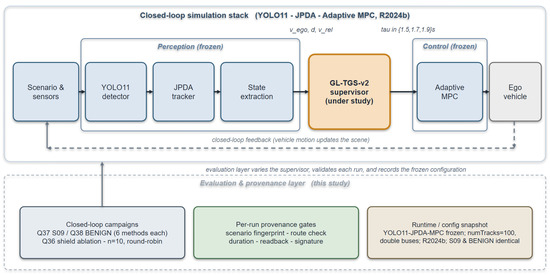
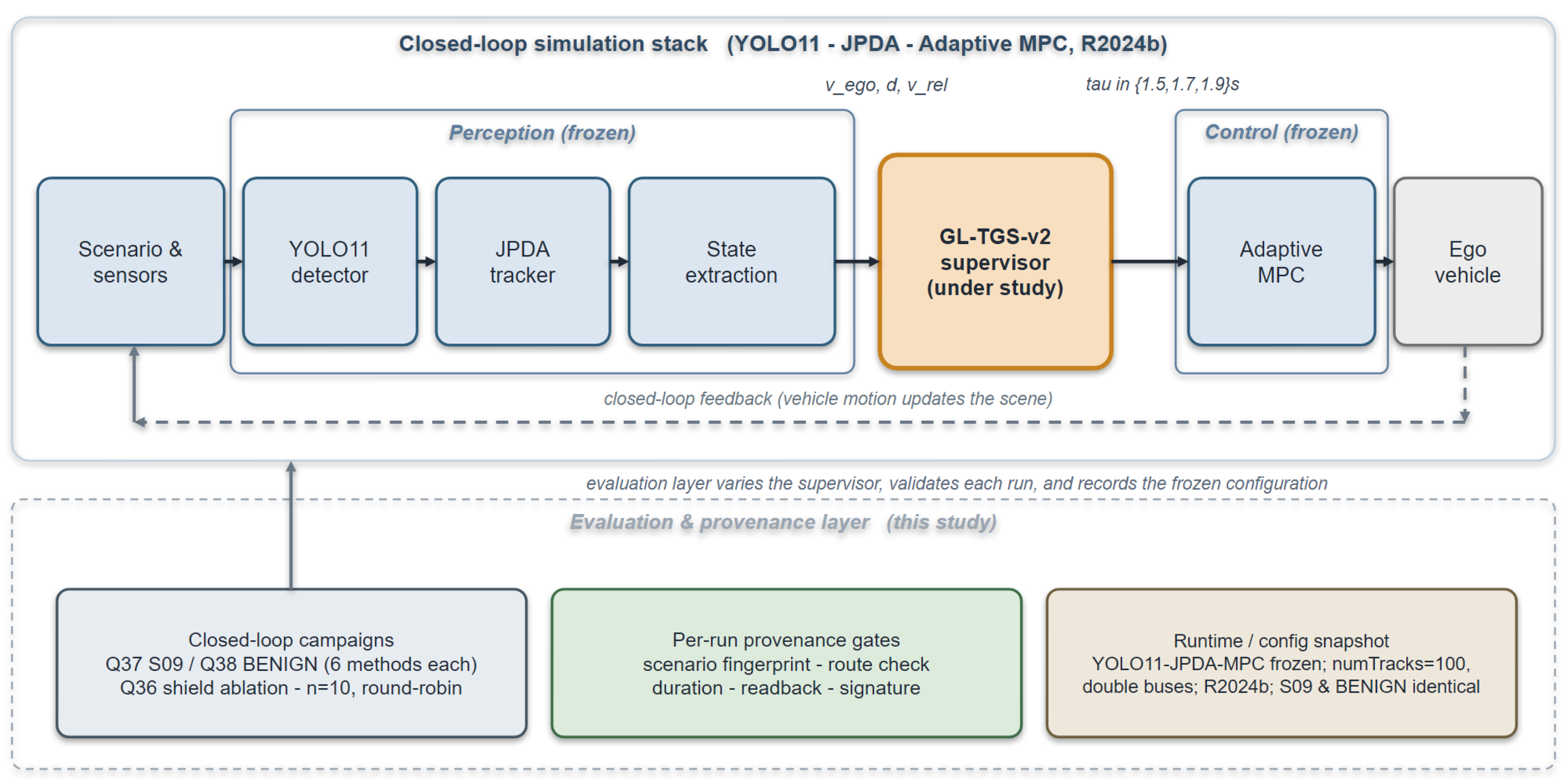
We consider closed-loop adaptive cruise control on a shared perception–tracking–control stack (Figure 1). At each supervisory step k (period s), the YOLO11 detector and JPDA tracker provide an estimate of the lead-vehicle relative state , where is ego speed, relative distance, and relative velocity (closing negative). A supervisory policy selects a time-gap reference from the finite set s, the production preset values exposed by the underlying test bench; the adaptive MPC then tracks the selected reference. The supervisor is the only component that differs across methods; the detector, tracker, MPC, and routing are fixed. Writing for the feature map, for the learned policy, and for the shield, the deployed supervisor is
Here is the commanded time gap at step k, the tracked lead state, the feature map of Table 1, the distilled tree policy of Table 2, and the safety shield of (2).
Figure 1.
Solution architecture: the closed-loop YOLO11–JPDA–adaptive-MPC stack (top) together with the evaluation and provenance layer used in this study (bottom). A frozen YOLO11 detector and JPDA tracker estimate the lead-vehicle state ; state extraction feeds the GL-TGS-v2 supervisor, which maps this state to a time-gap reference s that a frozen adaptive MPC then tracks; the dashed path denotes the closed loop. The stack is built on the MathWorks highway lane-following test bench [24]. The supervisor is the only component that varies across methods, and its sole output is the time-gap reference. The provenance layer records, per run, the six-method closed-loop campaigns, the scenario-fingerprint/route/duration/read-back gates, and the captured runtime-configuration snapshot.
Table 1.
Feature vector of GL-TGS-v2 (deployable tracker inputs only).
Table 2.
Deployed GL-TGS-v2 decision rules . Rows are evaluated top to bottom; the first matching condition sets the gap. Split constants are shown rounded for display; to three decimals they are , , and , and their full-precision values are released with the supplementary selector.
The objective is to keep the realized mean time gap small (efficiency) while preserving the worst-case spacing margin and target continuity under perception noise (safety).
3.1.2. Feature Vector
The raw inputs are range-limited, and , and expanded into with closing speed , headway , and lost-track flag (Table 1). The limits keep the policy well-defined when the tracker reports a sentinel for a missing target ( m, which clips to 200 m, so on sentinel-reporting samples), the regime in which target continuity is most at risk.
3.1.3. Expert Teacher and Its Limitation
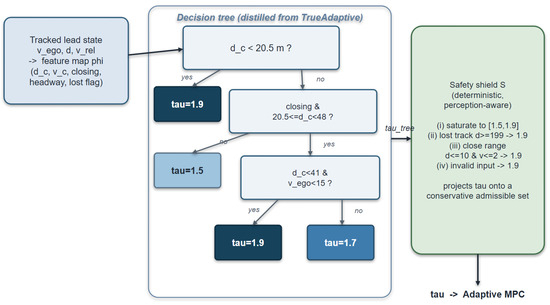
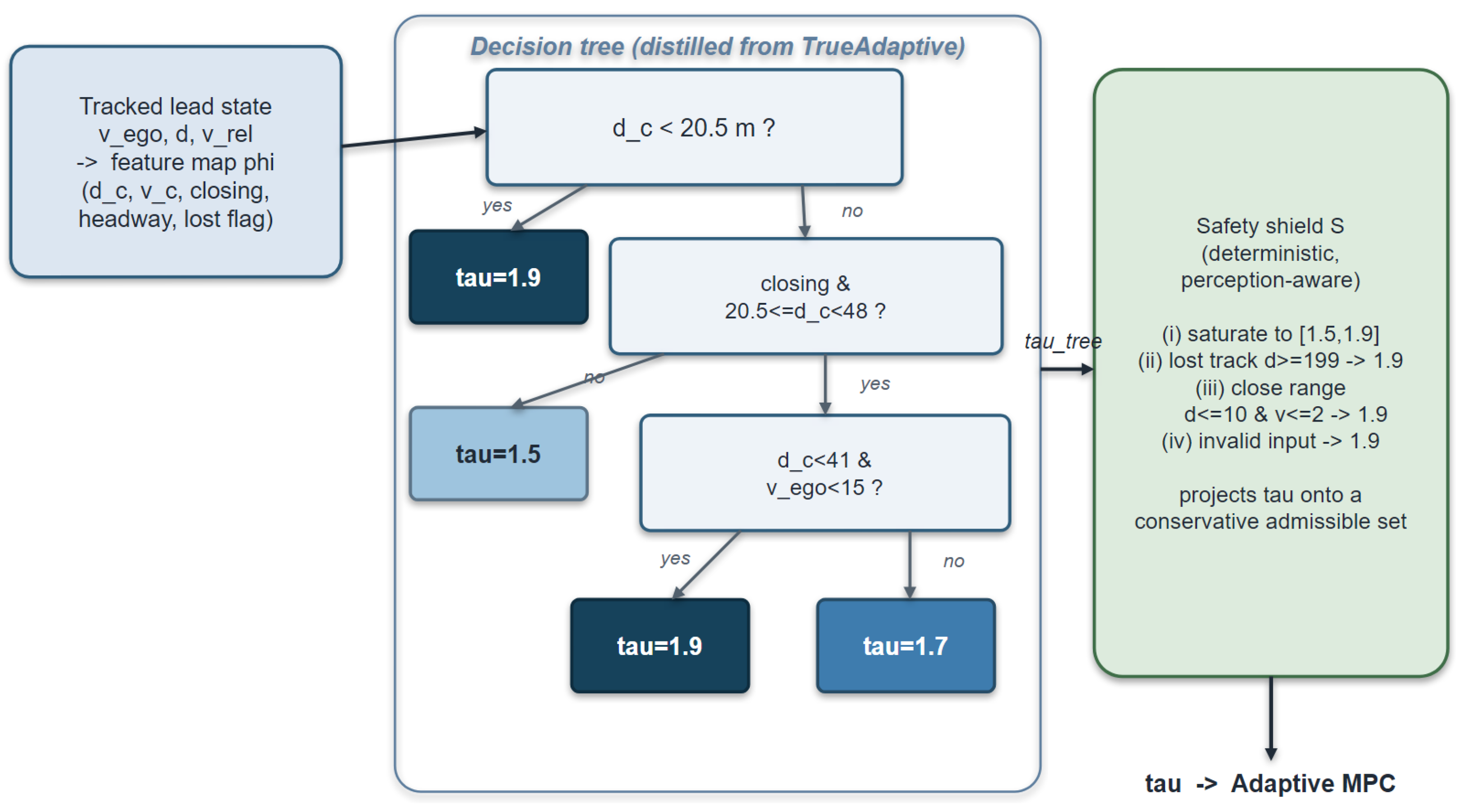
The imitation target is TrueAdaptive, a calibrated adaptive rule of the same form. Its complete deployed logic is reported here for reproducibility: the rule selects s if m, or if jointly m/s, m, and m/s; otherwise s if m/s and m; otherwise s. It thus escalates the gap when the range is short or the vehicle is closing at moderate range and speed, and relaxes to s otherwise. The rule contains no explicit handling of lost-track sentinel or non-finite inputs: the tracker’s lost-track sentinel range, on the order of m, and any comparison involving NaN fall through to the s branch. Its thresholds were tuned offline using full-trajectory (oracle) knowledge of the braking event, so it is treated as a calibrated expert reference, used for imitation and fidelity assessment, never as a baseline to beat. TrueAdaptive remains an embedded calibrated reference implementation rather than the deployable artifact proposed in this work. Supplying a deployable, interpretable, perception-hardened version of that behavior is the role of GL-TGS-v2 (Figure 2).
Figure 2.
Internal structure of the GL-TGS-v2 supervisor. The tracked lead state is mapped to the feature vector and classified by an interpretable decision tree distilled from the TrueAdaptive expert (leaf shading denotes the selected gap). A deterministic, perception-aware safety shield then projects the action onto a conservative admissible set before it reaches the adaptive MPC; the shield is a protective override under perception dropouts, not a source of aggregate-performance gain.
3.1.4. GL-TGS-v2 Policy
GL-TGS-v2 is a decision-tree distillation of TrueAdaptive obtained by imitation learning [10,11,32,33]. A training set combines logged closed-loop trace samples with a dense boundary grid spanning m/s, m, m/s; every sample is labeled by the TrueAdaptive rule applied to its underlying tracked state, . A CART classification tree (at most 40 splits, minimum leaf size 1) is fitted to . The grid augmentation forces correct behavior in regions the trace never visits, and the fitted tree reproduces TrueAdaptive with label fidelity on 50,000 held-out random draws and on the grid and trace samples. The deployed policy is the compact rule set in Table 2; because each branch is an explicit threshold on an interpretable feature, every decision maps to a physical condition.
3.1.5. Safety Shield
The learned action is not applied directly. A deterministic shield [9] projects it onto a conservative admissible set before it reaches the MPC, applying in order
Rules (i)–(iv) in (2) are design choices of this work: the shielding principle follows [9], while the specific guards and thresholds (the 199 m lost-track threshold, the 10 m and 2 m/s close-range bounds, and the 1.9 s conservative gap) are set in this work from the tracker’s sentinel behavior and the admissible gap set. The shield is independent of how the policy was learned, so the closed-loop action is always at least as conservative as the protective floor regardless of the tree output. Guards (ii) and (iv) are explicitly perception-aware: when the JPDA track drops or an input is invalid, the supervisor commands the most conservative gap. Guard (iii) is a kinematic floor: at very short range it escalates unless the lead is clearly pulling away. As quantified by the ablation in the Section 4, the shield is a rarely activated protective override that keeps the closed loop conservative under detector and tracker dropouts.
3.1.6. Difference Between TrueAdaptive and GL-TGS-v2
Table 3 summarizes the distinction. The two share the same input interface and the same nominal escalation logic (hence the matched mean time gap in the Section 4), but GL-TGS-v2 adds three things TrueAdaptive lacks: an explicit, auditable tree representation; perception-aware safety guards; and a deployment-oriented MATLAB Function-block implementation. These additions, not a change in nominal logic, are what GL-TGS-v2 contributes.
Table 3.
TrueAdaptive (expert reference) vs. GL-TGS-v2 (proposed).
A natural question is why learning is involved at all, given that the expert is itself a deterministic rule: could TrueAdaptive not simply be implemented directly as an auditable function and wrapped with the same shield? The deployed artifact has the same auditable deployment form: a compact, 30-line, loop-free MATLAB function. Its nominal rule, however, was obtained and validated by distillation rather than by manual transcription. First, a hand transcription would be assumed correct rather than verified: the expert is embedded in the simulation model, so a manual copy carries no independent check that the deployed artifact matches the embedded rule, whereas distillation queries the expert as a black box and measures the agreement over the gridded operating envelope of Section 3.1.4. Second, a manual implementation subjected to the same grid evaluation would be equivalent; fitting a tree on 99,105 oracle-labeled states, including a dense 97,600-point grid over that envelope, performs that verification automatically and at scale. Its measured fidelity is 99.3% on 50,000 held-out random draws and 100% on the grid and trace samples, and an out-of-distribution audit flagged zero unsafe disagreements (zero monotonicity violations of the commanded gap). The residual disagreements on 50,000 uniform random draws are confined to thin slabs between each learned split and its expert threshold, at most 1.93 m in range, 0.026 m/s in closing speed, and 0.94 m/s in ego speed; within these slabs the two policies command different presets. Third, the expert has no designed dropout semantics. On a lost track the tracker reports a sentinel range on the order of m; the expert’s nominal rule reads this as a distant lead and relaxes to the shortest gap just when the lead is unobserved. A deployable artifact must instead specify safe outputs on sentinel and non-finite inputs, which the guards supply. A transcribed expert carrying the same shield was not run as a separate arm. The measured arms that exist are TrueAdaptive itself, evaluated unguarded in both scenario campaigns; GL-TGS-v2, which matches it on the primary endpoint at a matched mean gap (minimum-relative-distance difference m, CI m); and the shield ablation, which detected no material change in GL-TGS-v2’s nominal aggregate metrics. Together these show close teacher reproduction and characterize the shield’s effect on the deployed selector; they do not constitute a direct experiment on that combined arm. The learning machinery is thus the validation instrument, not an end in itself; the contribution is the pipeline as a whole, from an embedded expert to a compact rule artifact with quantified fidelity over a stated envelope, an audited failure-mode specification, and closed-loop validation through a narrow reference interface.
3.1.7. Baselines and Deployment
The Wu-style fuzzy supervisor, a Sugeno-type weighted rule controller that adapts the fuzzy ACC safe-distance formulation of Wu et al. [5] (in the broader spirit of fuzzy headway designs [4]) to online time-gap selection, rather than reproducing their full variable-weight MPC system, is deployed exactly as specified here: it forms a safety distance (Wu’s safe-distance model: a one-second headway coefficient multiplies each speed term, so both contribute meters, plus a 10 m standoff; the deployed code carries the unit coefficients implicitly and is in meters), errors , , piecewise-linear memberships on each error, a triangular center term flanked by saturating shoulder terms, with half-width and ramp 15 m for and 3 m/s for , and a defuzzified continuous gap . The rule base is a Sugeno table with singleton consequents, rows over the distance-error memberships (negative, zero, positive) and columns over the relative-speed memberships (closing, steady, opening): , , and s, combined with product rule weighting; the deployed 25-line selector, including its input sanitation, is provided verbatim as Supplementary Material S2. The fixed baselines hold or s. All implemented supervisor variants use the same MATLAB Function-block interface, so every method drives the MPC reference through an identical route while the MPC, tracker, and detector are unchanged, isolating the supervisory policy as the sole independent variable.
3.2. Experimental Setup
3.2.1. Test Bench and Scenarios
All policies were evaluated in closed loop on a MATLAB/Simulink highway lane-following test bench [24] with a frozen YOLO11 detector, a JPDA tracker, and an adaptive MPC longitudinal controller. Two scenarios were used, both on one documented runtime: S09, a curved road with a hard lead-vehicle braking (stop-and-go) event that compresses the spacing margin rapidly while the curve and the braking transient challenge tracking continuity; and a benign curved car-following scenario, used as a does-no-harm check.
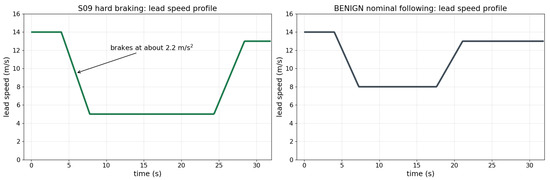
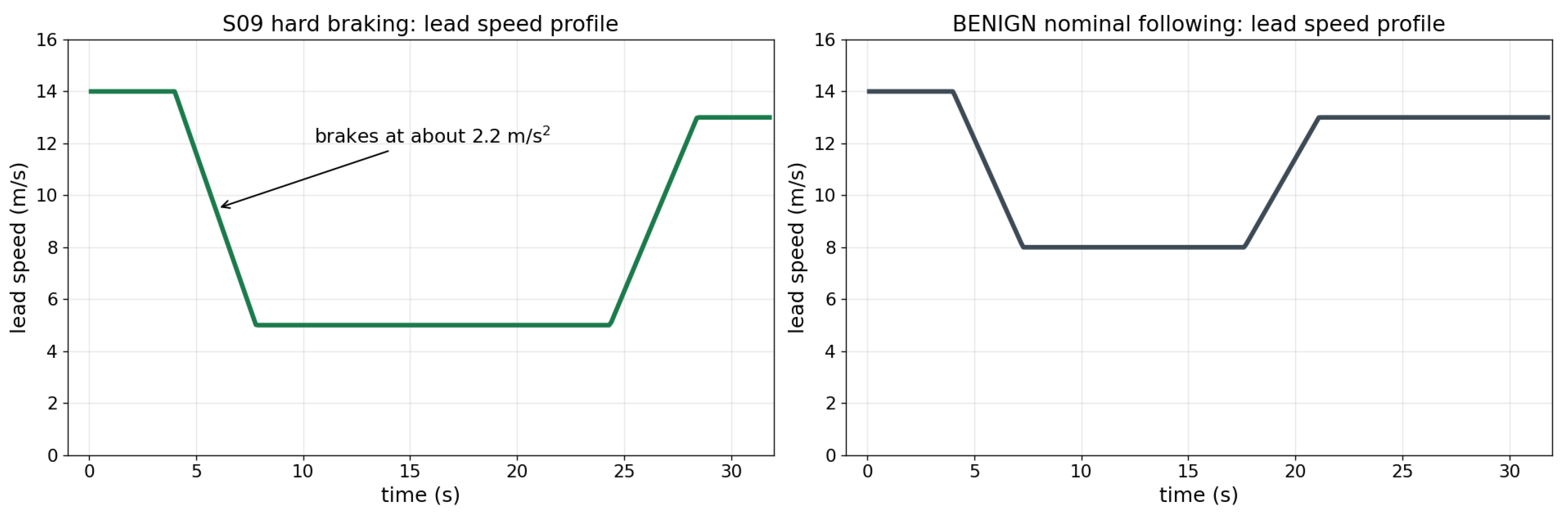
The two scenarios were selected from the shipped scenario family of the test bench by two criteria. The stress case had to be a rear-end conflict, because critical braking is the dominant near-crash surrogate in naturalistic driving data [34] and front-to-rear conflicts are the crash mode most directly addressed by longitudinal assistance [35]; S09 modifies the shipped curved stop-and-go scenario into a hard lead-braking event. The check case had to contain no author-chosen parameters, so the benign scenario is the shipped variant as distributed. Both simulate 30 s on the same curved geometry and are regenerated from source and fingerprint-verified before every accepted run. In S09 the ego set speed is 14 m/s and the lead starts 35 m ahead at 14 m/s; at s the lead brakes to 5 m/s at approximately 2.2 m/s2 before recovering to 13 m/s. In the benign scenario the lead starts 50 m ahead and decelerates from 14 to 8 m/s at 1.7 m/s2 before recovering to 13 m/s. Figure 3 shows both lead-speed profiles.
Figure 3.
Lead-vehicle speed profiles of the two evaluation scenarios: S09 hard braking (left) and the benign nominal-following check (right), drawn from the fingerprint-verified scenario definitions.
All experiments ran on a single ASUS ROG Strix SCAR 18 laptop workstation (ASUSTeK Computer Inc., Taipei, Taiwan) with an Intel Core i9-14900HX CPU at 2.20 GHz (Intel Corporation, Santa Clara, CA, USA), 64 GB RAM, and an NVIDIA GeForce RTX 4090 Laptop GPU (NVIDIA Corporation, Santa Clara, CA, USA) under Windows 11 (Microsoft Corporation, Redmond, WA, USA), using MATLAB/Simulink R2024b (The MathWorks, Inc., Natick, MA, USA) with the Automated Driving Toolbox highway lane-following test bench [24]; the YOLO11 detector executes on the GPU. The multi-object tracker was configured with a capacity of 100 tracks and double-precision JPDA bus definitions, and the identical captured runtime configuration was verified across all campaigns (Section 3.2.2).
3.2.2. Single Documented Stack and Provenance
A central methodological choice is that every method, in both scenarios, runs on one identical, documented perception–tracking–control stack. For each campaign the runtime configuration, comprising the tracker capacity and data types, the multi-object-tracking bus definitions, the detector and controller blocks, and the software version (MATLAB R2024b), was captured to a snapshot at run time, and the S09 and benign snapshots are identical, so the “frozen stack” claim can be checked against the archives rather than merely asserted. Each accepted run additionally passed automatic provenance gates: the scenario was regenerated from its source function and verified against a fingerprint of the active scenario object (which defeats a stale-workspace activation failure mode, in which the simulator silently re-runs a previously loaded scenario), the supervisor-to-MPC route was verified at the signal level (the selector output equals the gap reference the MPC receives, to numerical tolerance), full simulation duration was confirmed, and the deployed selector text was read back and verified before the run was counted. Only the simulation command was used; in-memory routing was reversible; no model was saved; and no evaluation criterion was relaxed.
3.2.3. Methods and Protocol
Six time-gap policies were evaluated under identical perception, tracking, and control conditions: GL-TGS-v2 (proposed), TrueAdaptive (calibrated expert reference), the Wu-style fuzzy supervisor, and Fixed-1.5/1.7/1.9. In each scenario all six were executed in a single round-robin campaign within one session, ten repetitions each, for sixty closed-loop runs, so every method shares one runtime and no result depends on cross-session data. At the observed run-to-run standard deviations (0.13–0.30 m on S09), ten repetitions give 95% half-widths of roughly 0.1–0.2 m, an order of magnitude below the 3.3–5.2 m effects at stake. The expert was repeated each round as a same-session consistency anchor (S09 run-to-run minimum-distance standard deviation m).
3.2.4. Metrics and Criteria
Each run was summarized by validated metrics (the lateral RMS metric is intentionally excluded: GL-TGS-v2 has no direct authority over the lateral controller or the path reference, so lateral tracking is not treated as a supervisory endpoint; any lateral effect could arise only indirectly, through the longitudinal speed profile): minimum relative distance (MinRelDist, m; larger is safer), the primary safety endpoint; target-lost percentage (TargetLost, %; lower is better), defined as the percentage of supervisory time steps for which the tracker reports no valid lead track and used as a secondary endpoint for tracking continuity; realized mean time gap (MeanTG, s); RMS relative velocity (RMSRelVel, m/s), a comfort proxy; and collisions. Two policies operate at a matched mean time gap if their mean gaps differ by at most s, a quarter of the s spacing between adjacent presets. Statistical comparisons use estimation with confidence intervals; a difference is treated as established only when its interval excludes zero. Where the supervisor and the expert are compared, we describe the outcome as matched: an observed difference whose interval includes zero. No non-inferiority margin was prespecified, so no formal non-inferiority or equivalence is claimed.
3.2.5. Reproducibility and Analysis Provenance
Every parameter introduced by this work is stated in this manuscript. The supervisor is specified by the feature clips and sentinel handling in Table 1, the decision rules in Table 2 with the exact split constants released alongside the supplementary selector, and the shield guards and thresholds in (2). The evaluation is specified by the imitation-training configuration (grid ranges and tree size limits, Section 3.1.4), the matched-gap criterion (Section 3.2.4), and the scenario parameters (Section 3.2.1). The baselines and stack are specified by the fuzzy baseline’s safe-distance model, membership half-widths, and defuzzification in Section 3.1.7 and by the tracker capacity, bus data types, software version, and hardware in Section 3.2.1. No quantity outside this inventory was tuned in this work: the MPC runs with the shipped test-bench parameterization, and the detector runs with the project’s pre-established YOLO11 configuration, both fixed before this comparison. All result figures and tables in Section 4 derive from the archived per-run logs through deterministic analysis scripts: each accepted run stores its full signal traces, scenario fingerprint, and runtime-configuration snapshot, and every reported statistic is recomputable from those archives. Generative-AI tools were used for language editing of the manuscript and for assistance in developing and checking portions of the deterministic analysis and figure-preparation scripts. All scripts were executed and verified by the authors against the archived MATLAB/Simulink campaign data. No generative model generated, altered, selected, or optimized any experimental outcome or reported numerical result. All numerical data and statistical analyses derive from the archived MATLAB/Simulink campaigns and distillation records and remain recomputable from those archives. The per-run archives (140 runs) and the figure- and table-generation scripts are available as described in the Data Availability Statement.
4. Results
Table 4 reports the S09 benchmark as mean ± standard deviation over ten runs; Table 5 reports the improvement of GL-TGS-v2 over each practical baseline; Table 6 reports the benign does-no-harm campaign; Table 7 reports the shield ablation. Figure 4, Figure 5, Figure 6, Figure 7, Figure 8, Figure 9, Figure 10, Figure 11 and Figure 12 visualize the data.
Table 4.
S09 benchmark (mean ± std, ; current documented stack).
Table 5.
Improvement of GL-TGS-v2 over each practical baseline (S09); minimum-distance differences with 95% confidence intervals.
Table 6.
Benign does-no-harm campaign (mean ± std, ; same documented stack). GL-TGS-v2 matches the expert at a matched gap; on benign, adaptive methods naturally use smaller gaps than the conservative Fixed-1.9.
Table 7.
Shield ablation on S09 (mean ± std, per variant). The ablation is a separate same-day campaign, a distinct session from the benchmark of Table 4, so its shielded-arm means differ slightly and its comparisons are within-campaign; denotes run-to-run variation below the reporting resolution (the same method’s Table 4 arm showed a 0.13 m run-to-run standard deviation).
Figure 4.
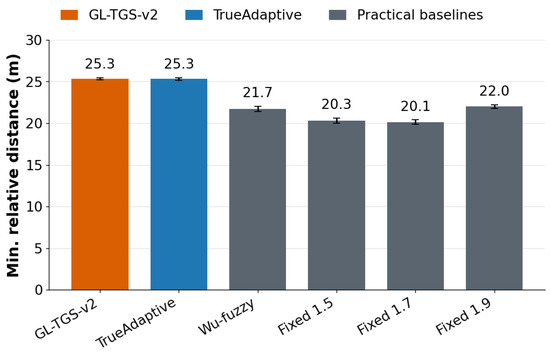
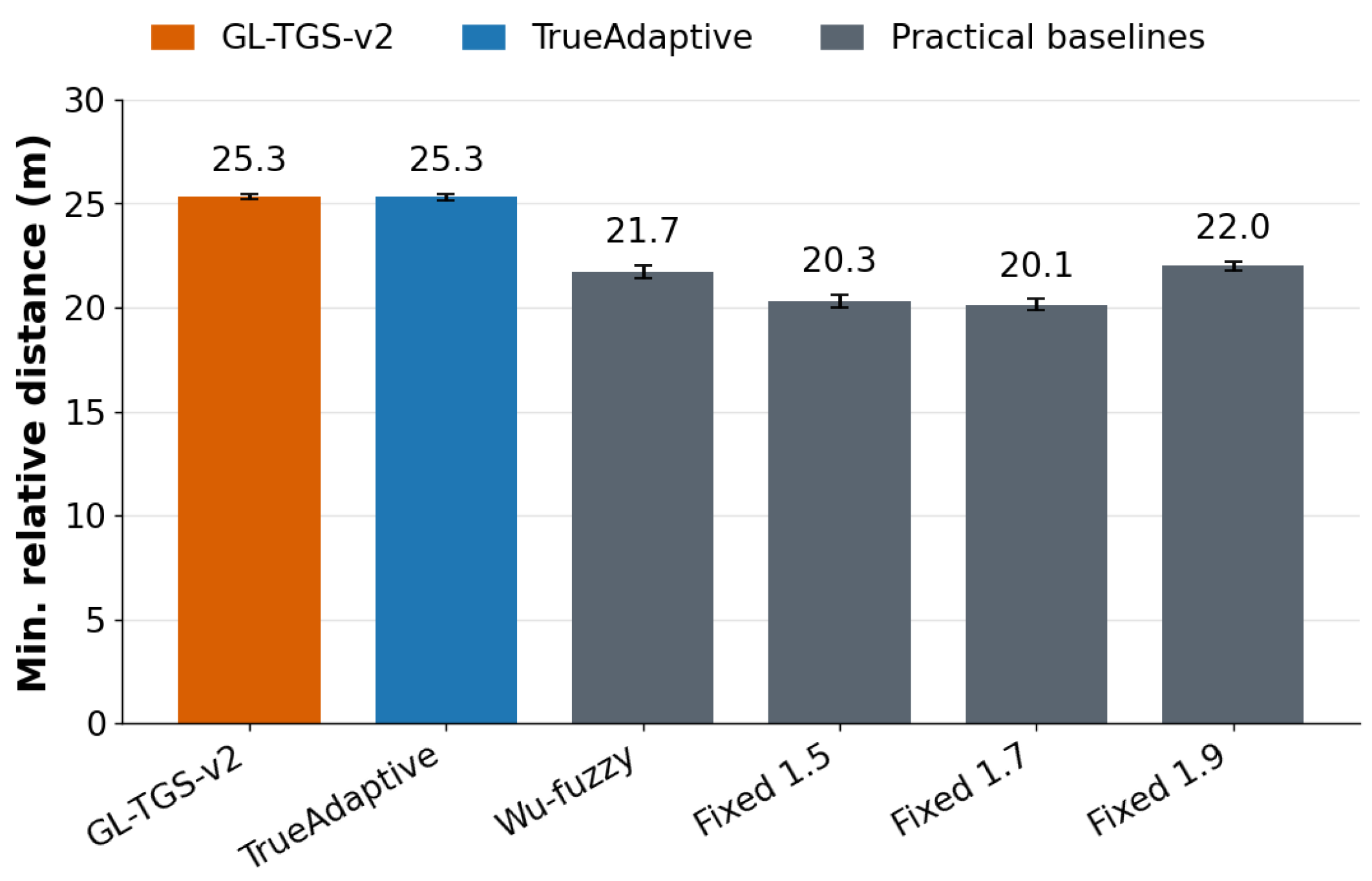
Minimum relative distance (S09; mean ± std, ). GL-TGS-v2 matches the expert and exceeds every practical baseline (95% CIs of the differences exclude zero).
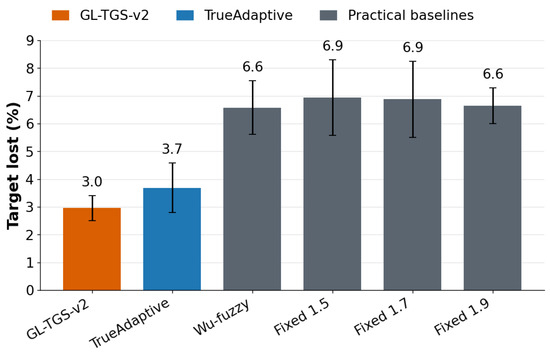
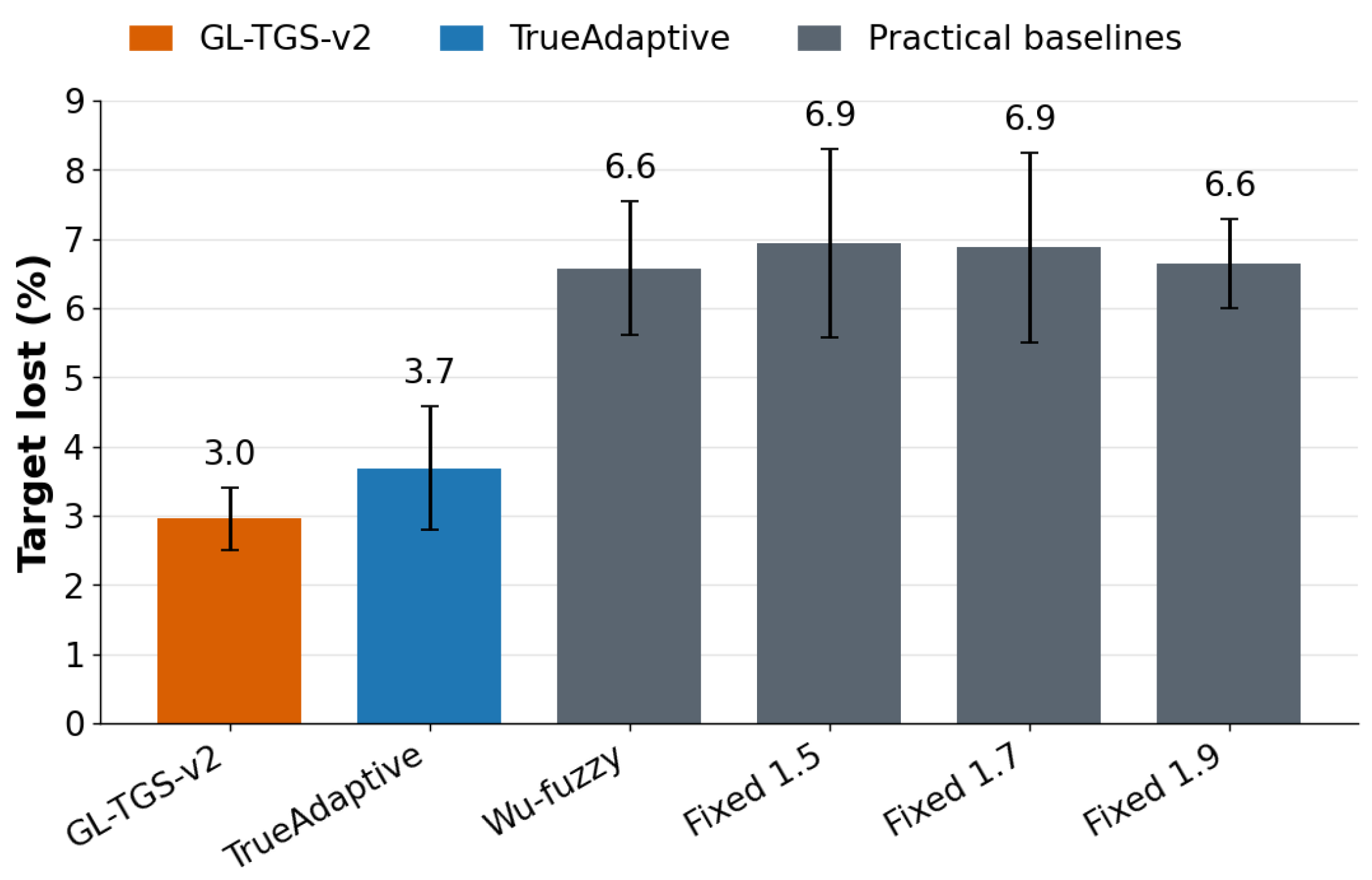
Figure 5.
Target-lost percentage (S09; mean ± std, ). GL-TGS-v2 is below all practical baselines and comparable to the expert.
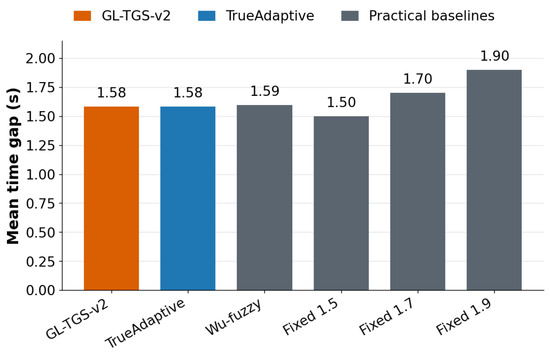
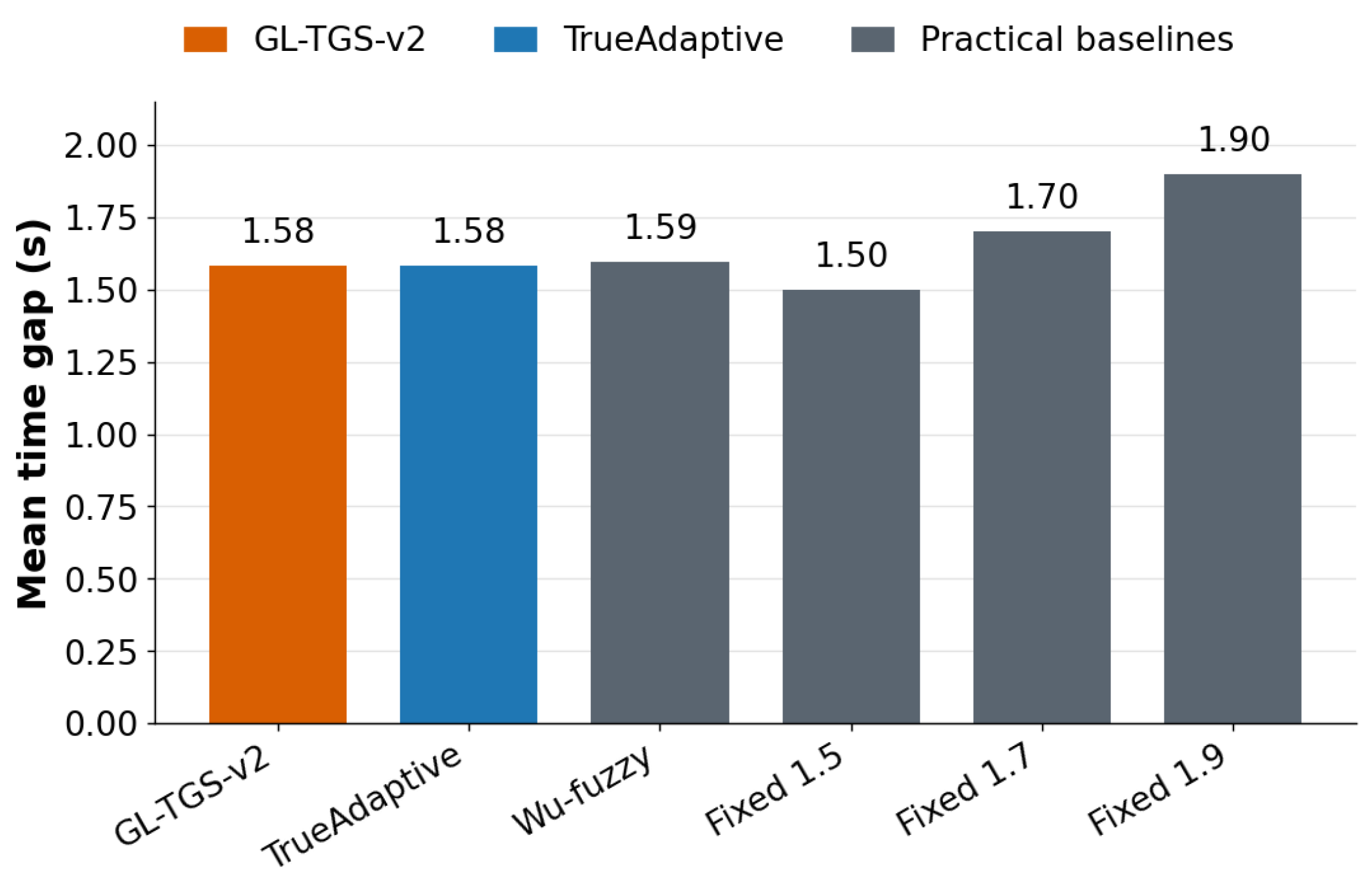
Figure 6.
Mean time gap (S09). GL-TGS-v2 matches the expert and sits well below Fixed-1.9, i.e., it achieves the larger margin without inflating the gap.
Figure 7.
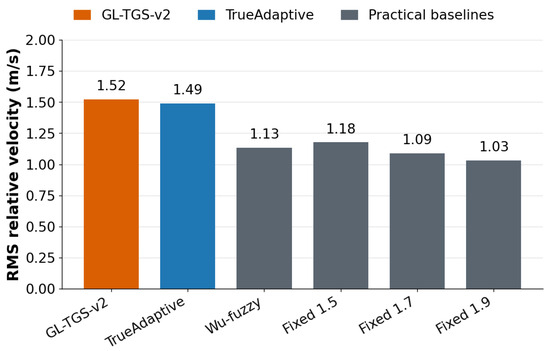
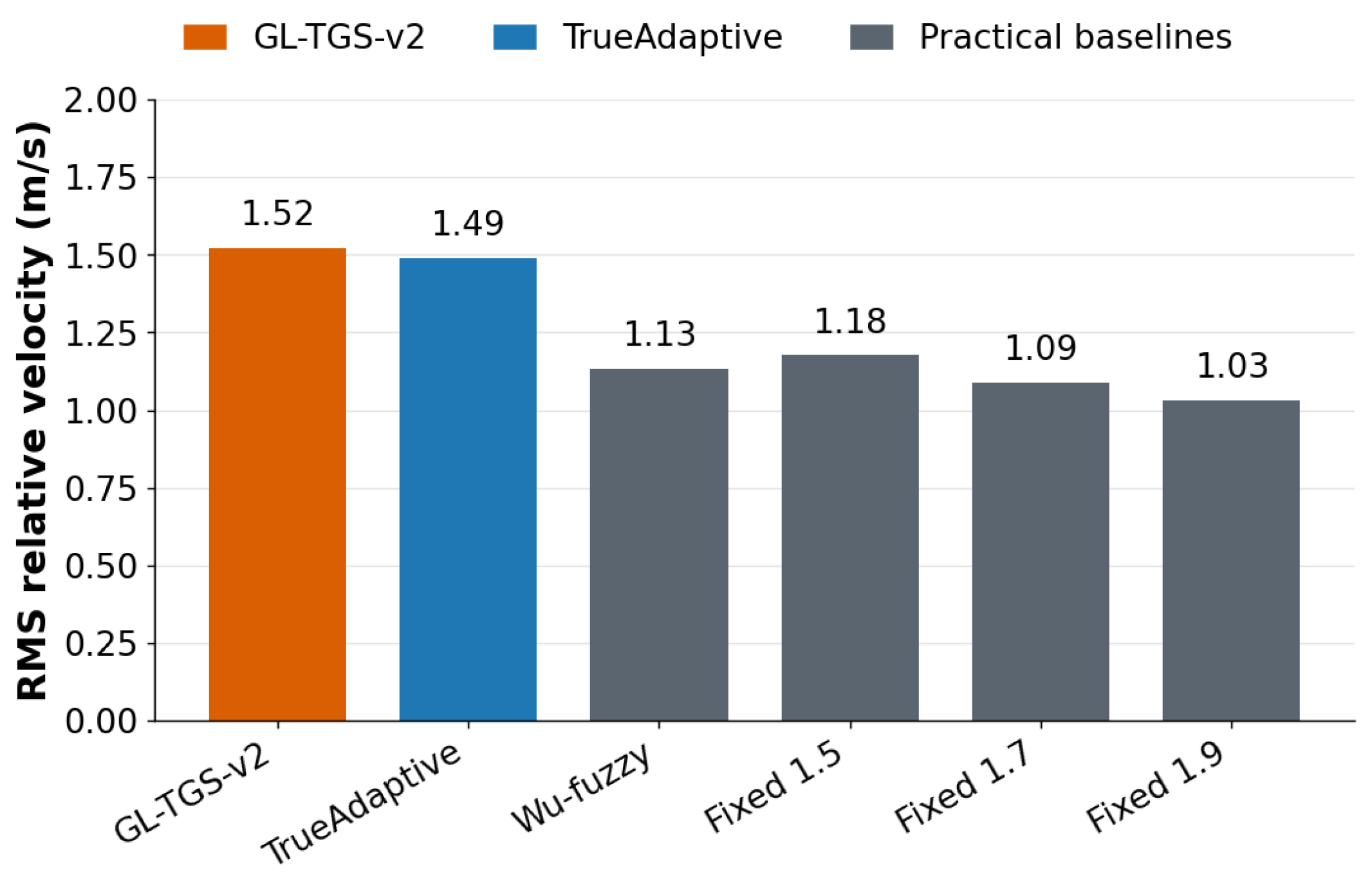
RMS relative velocity (S09; comfort proxy; lower is smoother). The fuzzy and conservative fixed gaps are smoother, the comfort trade-off reported in the text.
Figure 8.
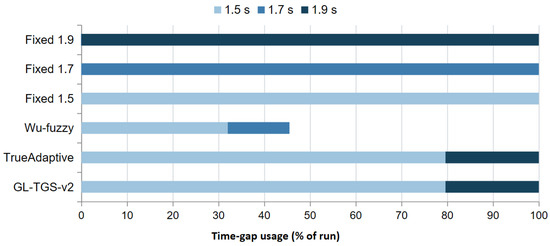
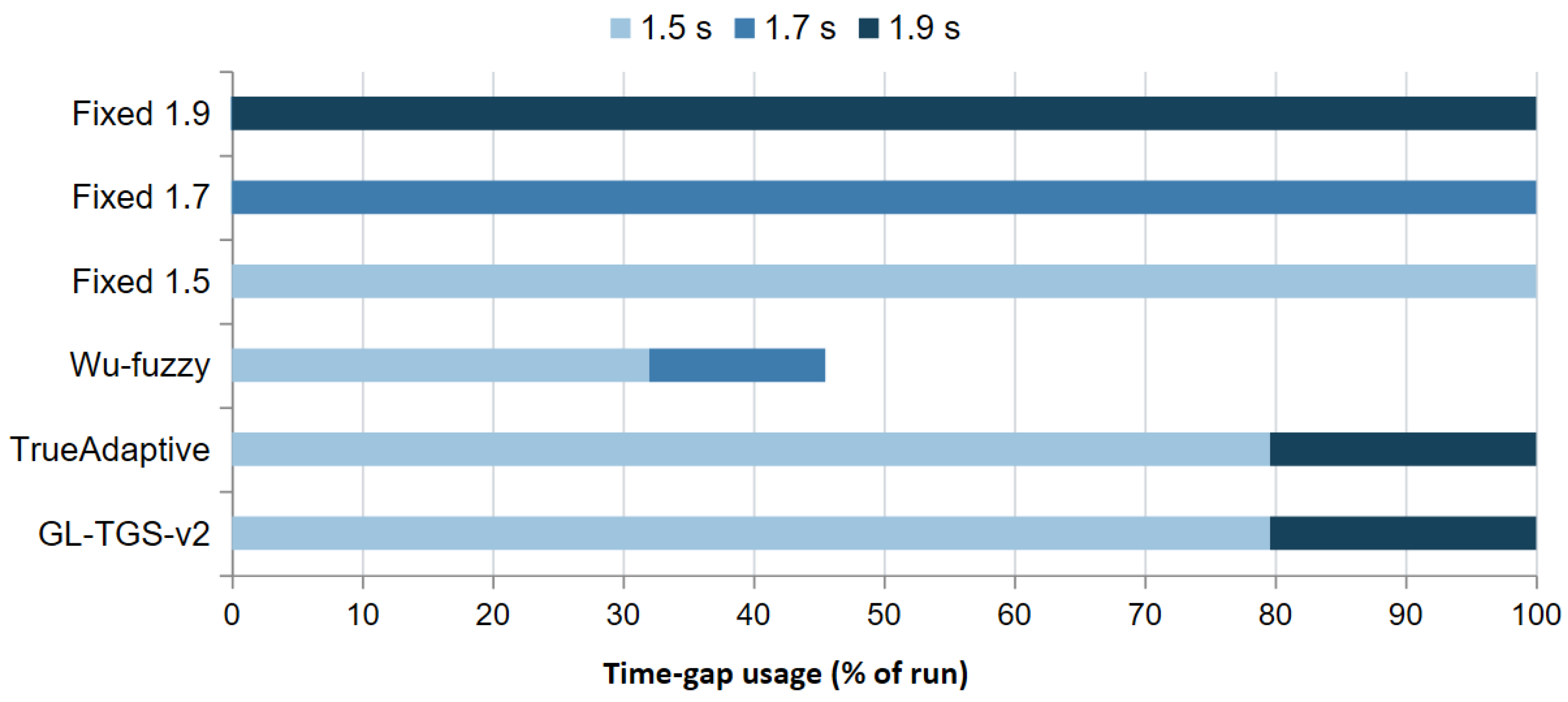
Time-gap usage by method (S09). Bars show the fraction of the run spent at the exact discrete gaps (1.5/1.7/1.9 s). GL-TGS-v2 mirrors the expert’s discrete escalation. The Wu-style fuzzy supervisor is continuous, so its bar is intentionally shorter than 100%: the remaining time is spent at intermediate gaps that do not coincide with a discrete level, not missing data.
Figure 9.
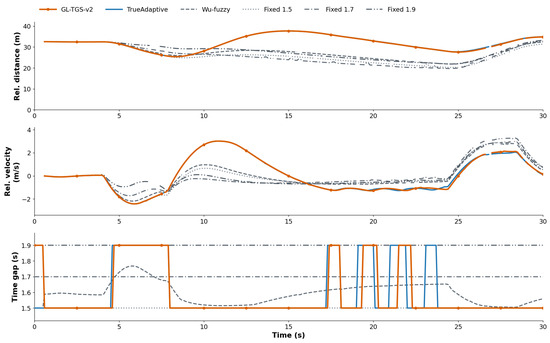
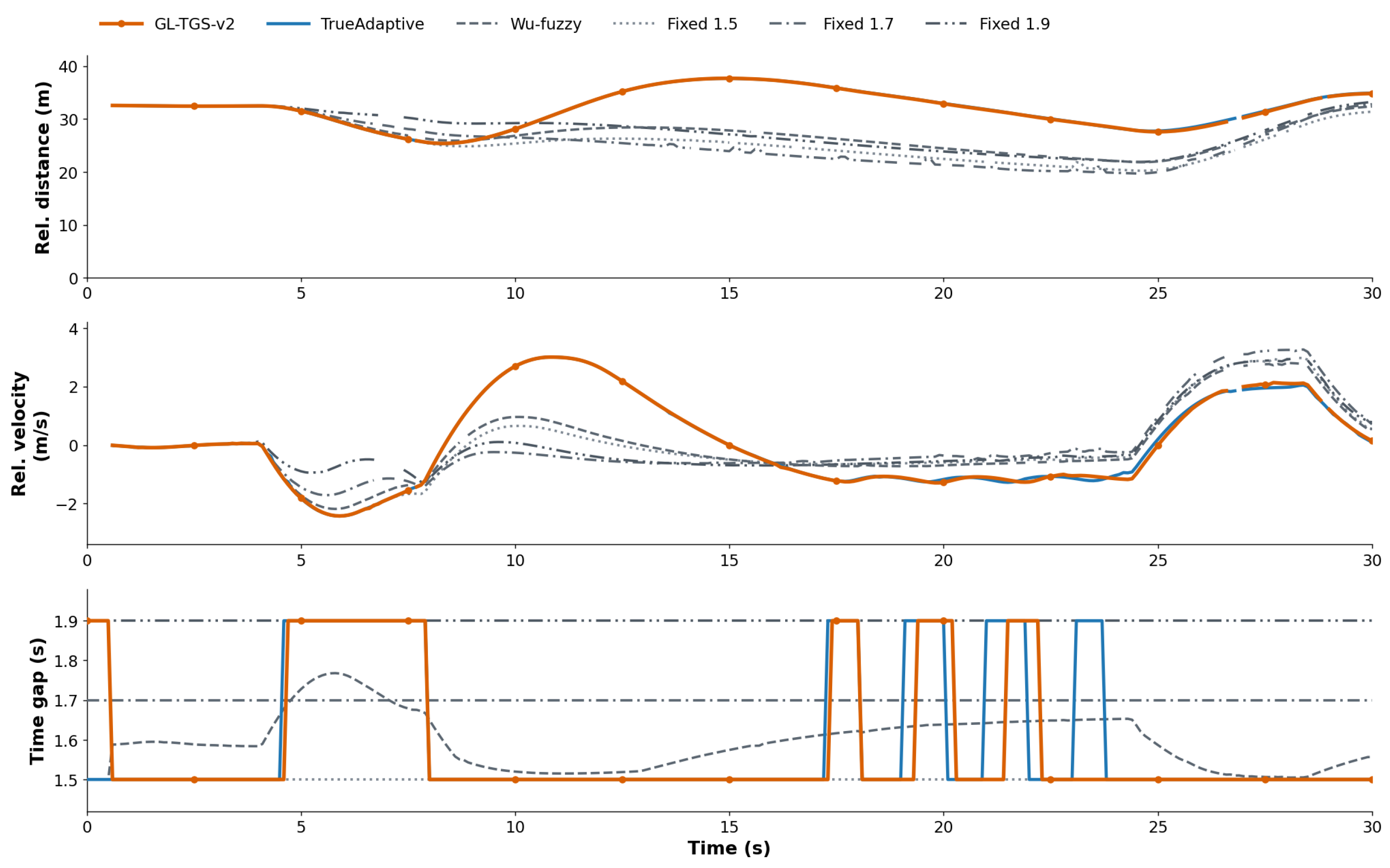
S09 closed-loop response (run 1 of each method) for all six methods: relative distance, relative velocity, and the selected time gap, drawn from the archived campaign signals; lost-track sentinel samples are masked, so dropouts appear as gaps. GL-TGS-v2 (orange) nearly overlaps TrueAdaptive (blue); the Wu-style fuzzy and fixed-gap baselines (gray, dashed/dotted) provide closed-loop context. Markers on GL-TGS-v2 aid visibility where it coincides with the expert.
Figure 10.
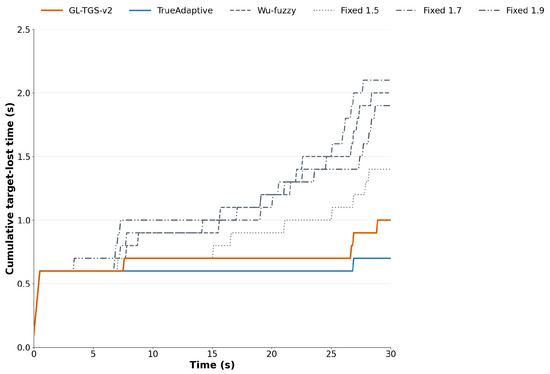
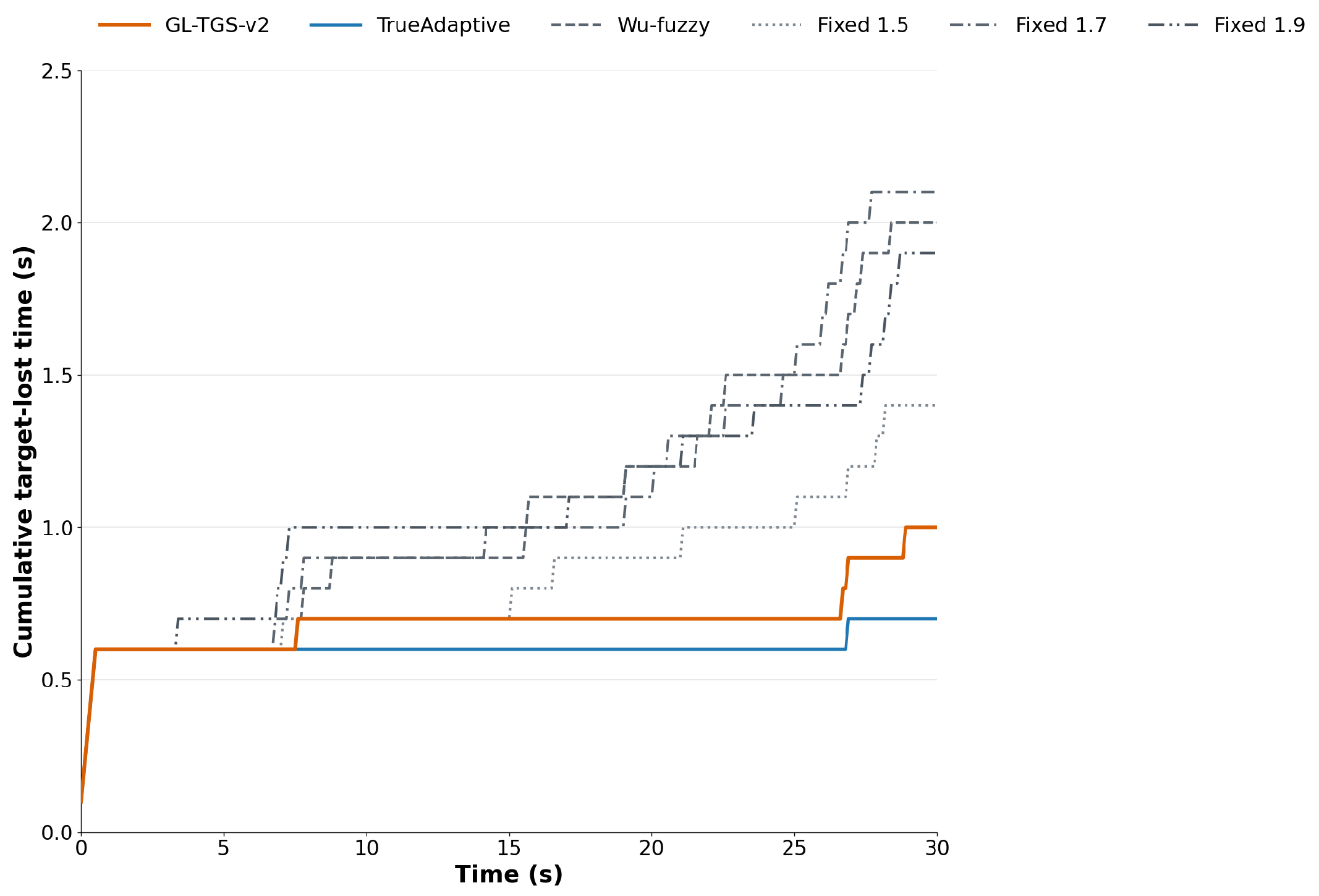
Cumulative target-lost time over the S09 run (representative run per method; lower is better). GL-TGS-v2 and the expert remain lowest, while the Wu-style fuzzy and fixed-gap baselines accumulate more lost-target time.
Figure 11.
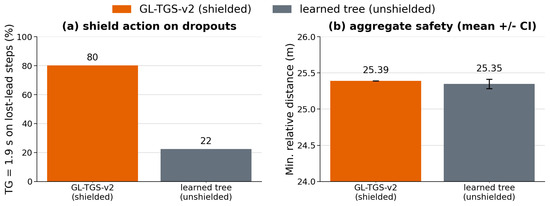
Shield ablation (S09). (a) share of s commands on lost-lead time steps (shielded vs. unshielded); (b) aggregate minimum relative distance with CIs. The shield changes lost-lead behavior but leaves aggregate safety unchanged.
Figure 12.
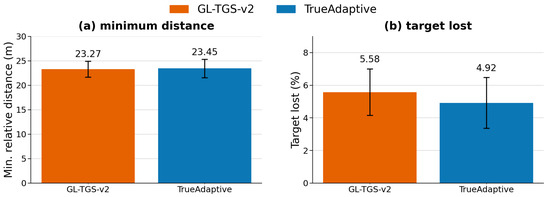
Benign scenario (same documented stack): GL-TGS-v2 versus the expert shows no regression in (a) minimum relative distance or (b) target-lost percentage (mean ± std, ).
At a matched mean time gap ( s for GL-TGS-v2 versus s for the expert, a difference of s, far inside the s criterion), GL-TGS-v2 reached a minimum relative distance of m, coinciding at the reported precision with the expert’s m: the difference is m with a confidence interval of m that includes zero (Figure 4). We therefore report GL-TGS-v2 as matched to the expert on the primary endpoint at a matched gap: no difference was detectable under this experiment, and we do not claim to surpass the expert. Both were well above the Wu-style fuzzy supervisor ( m) and every fixed-gap policy (– m). Target loss was for GL-TGS-v2, comparable to the expert () and below every practical baseline (–; Figure 5); the small supervisor-versus-expert target-loss difference ( pp) is smaller than the expert’s run-to-run standard deviation ( pp) and reverses sign on the benign scenario, so it is not interpreted as superiority over the expert. All six policies were collision-free.
The advantage over every practical baseline is larger still and its interval excludes zero: m versus the fuzzy supervisor (CI ), m versus Fixed-1.5 (), m versus Fixed-1.7 (), and m versus Fixed-1.9 (), the last while operating at a substantially smaller mean gap ( versus s; Figure 6 and Figure 8). Target loss was reduced by roughly 55– relative to every practical baseline.
Because minimum relative distance is computed over valid-track steps and the target-loss rates differ across methods (about 3% for GL-TGS-v2 versus 6.6–6.9% for the practical baselines), we checked whether the validity mask itself inflates the comparison in two ways. The first bounds the artifact per method: the minimum over valid steps can only overstate, never understate, the minimum the same signal attains over all steps, and since the baselines lose the target roughly twice as often as GL-TGS-v2, any masking bias favors the baselines. The second is recomputation on an unmasked signal: we repeated every comparison on the ground-truth bumper-to-bumper distance recorded by the test bench (its “headway” log signal, in meters), which never passes through the detector or tracker and is defined at every time step. The unmasked margins reproduce the masked ones to within 0.04 m: m versus the fuzzy supervisor, m versus Fixed-1.5, m versus Fixed-1.7, m versus Fixed-1.9, and m versus the expert, the last coinciding with the masked value at the reported precision. The reported advantages are therefore properties of the trajectories; validity masking does not create them.
The time traces corroborate these aggregates (Figure 9): all methods start near m; during the brake (–8 s) the spacing compresses, and GL-TGS-v2 and the expert recover to the largest distances while the fuzzy and Fixed-1.5 policies settle lower. The action panel shows GL-TGS-v2 reproducing the expert’s discrete escalations toward s, around the brake and during the brief late-run closing episodes, and otherwise holding s, whereas the fuzzy supervisor varies continuously and the fixed policy is constant. Cumulative target-lost time (Figure 10) confirms that GL-TGS-v2 tracks the expert and stays well below Fixed-1.5.
Turning to uncertainty, with ten repetitions we report confidence intervals (per-method means: Student’s t, nine degrees of freedom; between-method differences: Welch’s unequal-variance t with Welch–Satterthwaite degrees of freedom). The GL-TGS-v2 and expert minimum-distance intervals overlap and the interval of their difference includes zero ( m), supporting the matched (no detectable difference) reading at a matched gap; against every practical baseline the difference interval excludes zero by a wide margin. We report intervals rather than standardized effect sizes, whose magnitudes here would be inflated by the small baseline variances.
Re-running all six methods, same session, on the benign scenario on the identical captured configuration shows no regression versus the expert (Figure 12): GL-TGS-v2 minimum distance m versus the expert m (difference m, CI ) and target loss versus (difference pp, CI ) at a matched gap (difference s), both collision-free. The benign distributions are wider than S09’s, so these intervals are correspondingly loose; the result is a does-no-harm check, not a second efficacy claim. On this scenario the conservative preset attains the largest margin (25.79 m) and the lowest target loss (2.56%): a permanently long gap secures benign margin at every instant at a standing cost in spacing efficiency (1.900 s against 1.584 s), the cost the supervisor avoids by escalating on demand.
To isolate the contribution of the safety shield, GL-TGS-v2 was run with and without the perception-aware guards on S09 under the identical stack (ten runs each, Table 7, Figure 11). The shield changes behavior precisely where it is designed to: on lost-lead time steps (about of the run) it raises the commanded gap to s on roughly of those steps, versus about without the shield. The shortfall from 100% consists of isolated single-sample dropouts on which the selector input had not yet taken the sentinel value, consistent with a one-step offset between the validity flag used by the metric and the selector input. It does not change aggregate safety: minimum distance differs by m (unshielded minus shielded; CI , includes zero) and target loss is within noise between the two variants. We therefore characterize the shield as a rarely activated protective override, a verifiable protective floor under perception dropouts, rather than a source of aggregate-performance gain.
5. Discussion
The results indicate that an interpretable, imitation-distilled, safety-shielded time-gap supervisor can reach expert-level spacing behavior while improving on the practical baselines in the hard lead-braking scenario, under identical perception-in-the-loop conditions on a single, documented stack. We interpret the expert comparison carefully: GL-TGS-v2 matches the expert at a matched mean time gap, with a minimum-distance difference of m whose interval includes zero. We therefore describe the outcome as matched to (expert-level), not better than, the expert; the supervisor’s value is that it makes that behavior explicit, perception-hardened, and deployable, not that it surpasses the oracle-calibrated rule.
Against the practical baselines the advantage on S09 is consistent and robust: GL-TGS-v2 attains a larger minimum distance than the Wu-style fuzzy supervisor and all fixed gaps, each difference’s interval excluding zero, without inflating the mean gap to the conservative Fixed-1.9 level. In a hard-braking scenario, where spacing margin is the dominant safety concern, this is the trade-off that matters.
A point that warrants explanation is that GL-TGS-v2 attains a larger minimum distance than the constant Fixed-1.9 policy ( vs. m) while operating at a smaller mean time gap ( vs. s). This is not a contradiction. The supervisor’s adaptive, closing-triggered escalation coincides with markedly better target continuity, target loss of versus for Fixed-1.9, whereas the constant large gap yields no comparable continuity gain: its target loss sits within the – band of the practical baselines. The closed-loop traces and the cumulative target-lost curve (Figure 9 and Figure 10) are consistent with a mechanism in which more continuous tracking supplies the MPC with a more stable lead-state estimate through the curve and the braking transient; this coupled experiment does not isolate that pathway causally. What the experiment does establish is that the margin is obtained at a smaller mean gap: the gain comes from escalating at the right moment rather than from holding a uniformly large gap.
The supervisor does not dominate on every axis. The fuzzy supervisor and the conservative fixed gaps achieved lower RMS relative velocity (– m/s versus m/s for GL-TGS-v2; Figure 7), they are smoother, and GL-TGS-v2 does not claim better comfort. The contribution is a stronger safety–efficiency trade-off, with a smoothness cost acknowledged explicitly.
In practical terms, the S09 margins read as follows. Expressed at the scenario’s 14 m/s approach speed, the additional 3.3–5.2 m of minimum spacing is equivalent to a 0.24–0.37 s headway increment, a buffer against a further or harder lead deceleration. The increment is obtained without a conservative average headway: GL-TGS-v2 operates at a mean commanded gap of 1.581 s, about 0.08 s above the most aggressive preset and far below the 1.900 s of Fixed-1.9, so the margin is obtained through the timing of escalation rather than through a permanently long mean headway, the quantity that matters for throughput. Because the supervisor’s only authority is the reference of an already-validated MPC, the mechanism deploys as a software-level supervisory update to an existing ACC stack; no controller redesign is involved. The halved target-loss share suggests the same escalation also keeps the lead inside the tracker’s operating envelope, a benefit to every downstream consumer of the track; as noted above, this coupled experiment cannot isolate that mechanism. These readings are bounded by the simulation-only setting; hardware-in-the-loop and vehicle validation remain future work.
Because GL-TGS-v2 and the expert share the same nominal logic, one might attribute their small closed-loop differences to the shield. The ablation (Table 7) shows this is not an aggregate-safety effect: removing the shield leaves minimum distance and target continuity unchanged within noise. What the shield does, measurably and by design, is enforce the most conservative gap on the rare lost-lead time steps (raising the share of s commands there from about to about ). The shield is thus an interpretable, separately verifiable protective floor that activates under perception dropouts, valuable for engineering trust and safety assurance, rather than a mechanism that improves the aggregate metrics. We report it as such and make no aggregate-safety claim for it.
A related design caveat concerns the role of S09. The expert’s thresholds were calibrated with oracle knowledge of the S09 braking event, and S09 is also the scenario with the largest margins over the practical baselines. The comparisons are scoped so that the role of this coincidence is explicit and bounded. The supervisor-versus-expert result on S09 is a deployment-fidelity check: it verifies that the distilled, guarded artifact reproduces its teacher in closed loop, and it is never presented as independent efficacy. The efficacy comparisons are against baselines that received no calibration on either scenario: the fuzzy supervisor’s safe-distance model follows the literature formulation and its membership half-widths were fixed a priori, before any closed-loop evaluation, and the fixed gaps are the production presets themselves. The benign campaign then supplies the scenario that informed no calibration; there the supervisor shows no regression against the expert. Efficacy beyond the calibration envelope of the expert family is future work, and the Limitations state it as such.
The imitation-plus-shield design was adopted after reinforcement-learning supervisors failed to justify deployment during development on the same test bench: a value-based supervisor converged to fixed-gap-like behavior and an actor-critic supervisor collapsed to the most conservative gap, while an anticipatory variant degraded minimum distance and target continuity. These negative results motivate distillation with an explicit, separately verifiable shield over reward-driven RL for this task.
The findings agree in direction with the external literature; their magnitudes remain specific to this test bench. Field measurements of seven commercially deployed ACC systems found string-unstable behavior at every tested headway setting [15], and experimentally calibrated ACC response models document the tension a fixed headway imposes between margin and efficiency [16]; both observations argue for supervising the gap rather than holding it. Adaptive time-gap studies report the same qualitative ordering observed here, with adaptive selection outperforming fixed settings under braking disturbances [2,3], and fuzzy safe-distance supervision improving safety margins over fixed spacing [5]. The present study differs in evaluating the supervisor with the perception stack in the loop and in reporting target continuity as a first-class metric. Because scenarios, stacks, and protocols differ across these works, the agreements are consistency checks rather than head-to-head comparisons.
No claim is made of surpassing the expert or any externally published system; the fuzzy baseline is a re-implementation under identical conditions, not a reproduction of a specific published controller. The contribution is a closed-loop demonstration, on a shared and documented YOLO11–JPDA–MPC stack, that a shielded interpretable distilled supervisor reaches expert-level spacing while improving on practical baselines on the hard lead-braking scenario at a matched gap, with a benign does-no-harm check and an auditable safety shield.
6. Limitations
First, the study covers two scenarios on one stack, one hard-braking scenario in depth and a benign no-regression check; generalization across road geometries, traffic densities, braking profiles, cut-in maneuvers, and broader sensor-degradation modes remains to be demonstrated. In particular, because S09 informed the expert’s calibration, S09 remains a calibration-linked efficacy benchmark; the benign scenario informed no calibration and provides a no-regression check only, so generalization of efficacy beyond the calibration envelope has not been established here. Second, the action space is a discrete three-level time gap, chosen for interpretability and shield verifiability; a finer or continuous shielded action space may yield smoother behavior. Third, the fuzzy baseline is a representative re-implementation under identical conditions, so comparisons are made within the test bench rather than against external published results. Fourth, although each method was run ten times with a same-session expert anchor and a captured runtime configuration, the evidence is from one simulation environment; on-vehicle or hardware-in-the-loop validation is future work. Fifth, the comfort trade-off reported in the Results is documented, not resolved. Finally, the captured configuration snapshot documents the tracker, bus, detector, and controller blocks and the software version; the inner MPC weights and detector thresholds are held fixed by the no-retune protocol but are not independently re-derived in the snapshot.
7. Conclusions
We presented GL-TGS-v2, an interpretable decision-tree distillation of an adaptive expert, wrapped by a perception-aware safety shield, that selects the time-gap reference for an adaptive MPC in a full YOLO11–JPDA–MPC perception-in-the-loop ACC stack. In single-session, ten-repetition closed-loop campaigns on a curved-road hard lead-braking scenario, with a documented, shared runtime and per-run provenance gates, GL-TGS-v2 matched the expert at a matched mean time gap while outperforming fixed-gap and Wu-style fuzzy supervisors in minimum relative distance under identical conditions (every interval excluding zero), remaining collision-free, with the comfort trade-off reported. A benign scenario on the identical stack showed no regression versus the expert, and an ablation characterized the safety shield as an auditable protective override rather than an aggregate-performance lever. The interface is deliberately deployable: spacing safety is improved purely by better time-gap selection, without modifying the inner-loop controller, the tracker, or the detector. Future work will extend the evaluation to more scenarios, including cut-in maneuvers and degraded-sensing conditions, explore finer shielded action spaces, benchmark against tuned safe-RL supervisors under the same frozen stack, analyze the sensitivity of the shield thresholds, extend the comfort assessment to acceleration and jerk profiles, and pursue hardware-in-the-loop validation.
Supplementary Materials
The following supporting information can be downloaded at https://www.mdpi.com/article/10.3390/automation7050142/s1, Supplementary Material S1, the deployed GL-TGS-v2 selector (MATLAB function, full-precision split constants and shield guards); Supplementary Material S2, the deployed fuzzy-baseline selector (MATLAB function).
Author Contributions
Conceptualization, H.E. and K.A.E.S.; methodology, H.E., K.A.E.S., R.F.A.-K. and M.G.; software, H.E.; validation, H.E.; formal analysis, H.E.; investigation, H.E.; writing—original draft preparation, H.E.; writing—review and editing, K.A.E.S., R.F.A.-K. and M.G.; supervision, K.A.E.S., R.F.A.-K. and M.G. All authors have read and agreed to the published version of the manuscript.
Funding
This research received no external funding.
Institutional Review Board Statement
Not applicable.
Informed Consent Statement
Not applicable.
Data Availability Statement
The closed-loop results derive from three current-stack campaigns on a single documented runtime: an S09 six-method benchmark (sixty runs), a benign six-method does-no-harm campaign (sixty runs), and a shield ablation (twenty runs), each saving full per-run traces, a scenario fingerprint, and a runtime-configuration snapshot. The deployed 30-line selector function, containing, at full precision, the split constants shown rounded in Table 2, is provided as Supplementary Material S1; the deployed fuzzy-baseline selector is provided verbatim as Supplementary Material S2. The per-run data, the distillation training and audit records, and the figure- and table-generation scripts are available from the corresponding author on reasonable request; the simulation environment is the MATLAB/Simulink highway lane-following test bench [24].
Acknowledgments
During the preparation of this work the authors used generative-AI tools for language editing of the manuscript and for assistance in developing and checking portions of the deterministic analysis and figure-preparation scripts. All scripts were executed and verified by the authors against the archived MATLAB/Simulink campaign data. No generative model generated, altered, selected, or optimized any experimental outcome or reported numerical result. All numerical data, statistical analyses, and reported figures derive from the authors’ archived MATLAB/Simulink campaigns and distillation records, described in the Data Availability Statement, and remain recomputable from those archives. The authors reviewed and edited all content and take full responsibility for the content of this publication.
Conflicts of Interest
The authors declare no conflict of interest.
References
- Swaroop, D.; Hedrick, J.K.; Chien, C.C.; Ioannou, P. A comparison of spacing and headway control laws for automatically controlled vehicles. Veh. Syst. Dyn. 1994, 23, 597–625. [Google Scholar] [CrossRef] [Scilit]
- Mao, J.; Yang, L.; Liu, K.; Du, J.; Cui, Y. Adaptive cruise control system based on improved variable time headway spacing strategy. J. Intell. Fuzzy Syst. 2021, 40, 1471–1479. [Google Scholar] [CrossRef] [Scilit]
- El-Baklish, S.K.; Kouvelas, A.; Makridis, M.A. Driving towards stability and efficiency: A variable time gap strategy for adaptive cruise control. Transp. Res. Part C Emerg. Technol. 2025, 174, 105074. [Google Scholar] [CrossRef] [Scilit]
- Mo, H.; Meng, Y.; Wang, F.-Y.; Wu, D. Interval type-2 fuzzy hierarchical adaptive cruise following-control for intelligent vehicles. IEEE/CAA J. Autom. Sin. 2022, 9, 1658–1672. [Google Scholar] [CrossRef] [Scilit]
- Wu, D.; Qiao, B.; Du, C.; Zhu, Y.; Yan, F.; Liu, C.; Li, Y.; Li, J. Multi-objective dynamic coordinated adaptive cruise control for intelligent electric vehicle with sensors fusion. Mech. Syst. Signal Process. 2024, 209, 111125. [Google Scholar] [CrossRef] [Scilit]
- Zhao, R.; Wang, K.; Che, W.; Li, Y.; Fan, Y.; Gao, F. Adaptive cruise control based on safe deep reinforcement learning. Sensors 2024, 24, 2657. [Google Scholar] [CrossRef] [Scilit] [PubMed]
- Zhao, R.; Li, Y.; Fan, Y.; Gao, F.; Tsukada, M.; Gao, Z. A survey on recent advancements in autonomous driving using deep reinforcement learning. IEEE Trans. Intell. Transp. Syst. 2024, 25, 19365–19398. [Google Scholar] [CrossRef] [Scilit]
- García, J.; Fernández, F. A comprehensive survey on safe reinforcement learning. J. Mach. Learn. Res. 2015, 16, 1437–1480. [Google Scholar]
- Alshiekh, M.; Bloem, R.; Ehlers, R.; Könighofer, B.; Niekum, S.; Topcu, U. Safe reinforcement learning via shielding. In Proceedings of the AAAI Conference on Artificial Intelligence, New Orleans, LA, USA, 2–7 February 2018; Volume 32, pp. 2669–2678. [Google Scholar]
- Bastani, O.; Pu, Y.; Solar-Lezama, A. Verifiable reinforcement learning via policy extraction. In Proceedings of the 32nd Conference on Neural Information Processing Systems (NeurIPS 2018), Montréal, QC, Canada, 3–8 December 2018; pp. 2499–2509. [Google Scholar]
- Vos, D.; Verwer, S. Optimizing interpretable decision tree policies for reinforcement learning. arXiv 2024, arXiv:2408.11632. [Google Scholar]
- Khanam, R.; Hussain, M. YOLOv11: An overview of the key architectural enhancements. arXiv 2024, arXiv:2410.17725. [Google Scholar]
- Fortmann, T.E.; Bar-Shalom, Y.; Scheffe, M. Sonar tracking of multiple targets using joint probabilistic data association. IEEE J. Ocean. Eng. 1983, 8, 173–184. [Google Scholar] [CrossRef] [Scilit]
- Li, S.; Li, K.; Rajamani, R.; Wang, J. Model predictive multi-objective vehicular adaptive cruise control. IEEE Trans. Control Syst. Technol. 2011, 19, 556–566. [Google Scholar] [CrossRef] [Scilit]
- Gunter, G.; Gloudemans, D.; Stern, R.E.; McQuade, S.; Bhadani, R.; Bunting, M.; Delle Monache, M.L.; Lysecky, R.; Seibold, B.; Sprinkle, J.; et al. Are commercially implemented adaptive cruise control systems string stable? IEEE Trans. Intell. Transp. Syst. 2021, 22, 6992–7003. [Google Scholar] [CrossRef] [Scilit]
- Milanés, V.; Shladover, S.E. Modeling cooperative and autonomous adaptive cruise control dynamic responses using experimental data. Transp. Res. Part C Emerg. Technol. 2014, 48, 285–300. [Google Scholar] [CrossRef] [Scilit]
- Treiber, M.; Hennecke, A.; Helbing, D. Congested traffic states in empirical observations and microscopic simulations. Phys. Rev. E 2000, 62, 1805–1824. [Google Scholar] [CrossRef] [Scilit] [PubMed]
- Vahidi, A.; Eskandarian, A. Research advances in intelligent collision avoidance and adaptive cruise control. IEEE Trans. Intell. Transp. Syst. 2003, 4, 143–153. [Google Scholar] [CrossRef] [Scilit]
- Bavalatti, S.; Kangralkar, Y.; Pattar, S.; Badiger, V.P. Adaptive cruise control in autonomous vehicles: Challenges, gaps, comprehensive review, and future directions. arXiv 2025, arXiv:2510.03300. [Google Scholar]
- Han, K.; Park, G.; Sankar, G.S.; Nam, K.; Choi, S.B. Model predictive control framework for improving vehicle cornering performance using handling characteristics. IEEE Trans. Intell. Transp. Syst. 2021, 22, 3014–3024. [Google Scholar] [CrossRef] [Scilit]
- Zhai, L.; Wang, C.; Hou, Y.; Liu, C. MPC-based integrated control of trajectory tracking and handling stability for intelligent driving vehicle driven by four hub motor. IEEE Trans. Veh. Technol. 2022, 71, 2668–2680. [Google Scholar] [CrossRef] [Scilit]
- Yang, H.; He, Y.; Xu, Y.; Zhao, H. Collision avoidance for autonomous vehicles based on MPC with adaptive APF. IEEE Trans. Intell. Veh. 2024, 9, 1559–1570. [Google Scholar] [CrossRef] [Scilit]
- Yoon, Y.; Kim, C.; Lee, J.; Yi, K. Interaction-aware probabilistic trajectory prediction of cut-in vehicles using Gaussian process for proactive control of autonomous vehicles. IEEE Access 2021, 9, 63440–63455. [Google Scholar] [CrossRef] [Scilit]
- The MathWorks, Inc. Highway Lane Following (Automated Driving Toolbox), MATLAB/Simulink R2024b Documentation; The MathWorks, Inc.: Natick, MA, USA, 2024; Available online: https://www.mathworks.com/help/releases/R2024b/driving/ug/highway-lane-following.html (accessed on 13 June 2026).
- Redmon, J.; Divvala, S.; Girshick, R.; Farhadi, A. You only look once: Unified, real-time object detection. In Proceedings of the IEEE Conference on Computer Vision and Pattern Recognition (CVPR), Las Vegas, NV, USA, 27–30 June 2016; pp. 779–788. [Google Scholar]
- Jia, X.; Tong, Y.; Qiao, H.; Li, M.; Tong, J.; Liang, B. Fast and accurate object detector for autonomous driving based on improved YOLOv5. Sci. Rep. 2023, 13, 9711. [Google Scholar] [CrossRef] [Scilit] [PubMed]
- Wang, X.; Fu, C.; Li, Z.; Lai, Y.; He, J. DeepFusionMOT: A 3D multi-object tracking framework based on camera-LiDAR fusion with deep association. IEEE Robot. Autom. Lett. 2022, 7, 8260–8267. [Google Scholar] [CrossRef] [Scilit]
- Zhu, Z.; Nie, J.; Wu, H.; He, Z.; Gao, M. MSA-MOT: Multi-stage association for 3D multimodality multi-object tracking. Sensors 2022, 22, 8650. [Google Scholar] [CrossRef] [Scilit] [PubMed]
- Gu, S.; Yang, L.; Du, Y.; Chen, G.; Walter, F.; Wang, J.; Knoll, A. A review of safe reinforcement learning: Methods, theories, and applications. IEEE Trans. Pattern Anal. Mach. Intell. 2024, 46, 11216–11235. [Google Scholar] [CrossRef] [Scilit] [PubMed]
- Sharifi, I.; Yildirim, M.; Fallah, S. Toward safe autonomous highway driving policies using a neuro-symbolic deep reinforcement learning approach. Transp. Res. Rec. 2026, 2680, 416–431. [Google Scholar] [CrossRef] [Scilit]
- Hu, D.; Huang, C.; Wu, J.; Yuan, X. Toward multi-task generalization in autonomous navigation: A human-in-the-loop adversarial reinforcement learning with diffusion policy. IEEE Trans. Intell. Transp. Syst. 2025, 26, 19493–19507. [Google Scholar] [CrossRef] [Scilit]
- Ross, S.; Gordon, G.J.; Bagnell, J.A. A reduction of imitation learning and structured prediction to no-regret online learning. In Proceedings of the Fourteenth International Conference on Artificial Intelligence and Statistics (AISTATS), Fort Lauderdale, FL, USA, 11–13 April 2011; Volume 15, pp. 627–635. [Google Scholar]
- Booher, J.; Rohanimanesh, K.; Xu, J.; Isenbaev, V.; Balakrishna, A.; Gupta, I.; Liu, W.; Petiushko, A. CIMRL: Combining imitation and reinforcement learning for safe autonomous driving. arXiv 2024, arXiv:2406.08878. [Google Scholar]
- Bagdadi, O. Assessing safety critical braking events in naturalistic driving studies. Transp. Res. Part F Traffic Psychol. Behav. 2013, 16, 117–126. [Google Scholar] [CrossRef] [Scilit]
- Cicchino, J.B. Effectiveness of forward collision warning and autonomous emergency braking systems in reducing front-to-rear crash rates. Accid. Anal. Prev. 2017, 99, 142–152. [Google Scholar] [CrossRef] [Scilit] [PubMed]

Disclaimer/Publisher’s Note: The statements, opinions and data contained in all publications are solely those of the individual author(s) and contributor(s) and not of MDPI and/or the editor(s). MDPI and/or the editor(s) disclaim responsibility for any injury to people or property resulting from any ideas, methods, instructions or products referred to in the content. |
© 2026 by the authors. Licensee MDPI, Basel, Switzerland. This article is an open access article distributed under the terms and conditions of the Creative Commons Attribution (CC BY) license.