


Abstract
This study presents an adaptive sliding mode control approach for trajectory tracking of a quadrotor unmanned aerial vehicle functioning under external interference and kinematic unpredictability. Linear and rotational motion equations formulated in inactive local coordinate system frames are developed with the aid of a nonlinear six-degrees-of-freedom quadrotor dynamic model. Through mitigating excessive switching activity, reliability is improved. Here, the proposed controller integrates sliding mode control with bounded adaptive switching gain factors and boundary-layer smoothing. The operational design is applied within a sequential outer-loop/inner-loop structure for linear and orientation control. The conventional sliding mode control, alongside the proportional derivative control, which employs MATLAB/Simulink R2024a simulations while being interference-affected with an unknown performance set-up, is deployed in this work to relatively appraise the proposed ASM controller. The assessment involves three-dimensional trajectory, control input characteristics, tracking error analysis, adaptive gain growth, and chattering analysis with quantitative performance metrics. The computational output revealed that the proposed ASMC attained superior tracking performance with limited oscillation and level control action. The controller achieves a total RMSE of approximately 0.38 m and a lower aggregate tracking error when using the conventional SMC and PD controllers under equivalent conditions. Furthermore, the adaptive gain mechanism successfully lowers chattering while maintaining robustness against interferences, a large amount of ambiguity, and inertial imbalance with signal noise. The results validate that the proposed ASMC delivers a functional balance between robustness, control smoothness, and tracking accuracy alongside execution homogeneity for autonomous quadrotor UAV trajectory tracking in unsettled and unstable environments.
1. Introduction
Over the past few years, unmanned aerial vehicles, specifically quadrotor platforms, have drawn notable attention from researchers due to their wide range of applications for surveillance purposes, agriculture, inspections, mapping, and autonomous navigation [1,2,3]. Their vertical takeoff and landing capability, mechanical simplicity, and maneuverability all make them fitting for operations in compound and confined environments [4,5]. Even so, due to their intrinsically nonlinear dynamics, close linkage between linear and rotational movements, sensitivity to external interference, and model unpredictability, among other factors, the control of quadrotors poses a significant challenge [1,2,3,4,6].
The under-controlled framework of a quadrotor system, which has only six degrees of freedom and independent control inputs, largely defines its features [6,7,8]. This under-controlled framework, in addition to nonlinear aerodynamic outcomes and parameter uncertainties, notably mass variations and unstructured dynamics, further impedes the design of high-performance controllers [3,8,9]. What is more, environmental interference, together with wind gusts and sensor noise, reduces the tracking performance, leading to uncertainty if not adequately managed [2,6]. Hence, the evolution of robust and adaptive control strategies is key to attaining reliable operation under realistic conditions for UAVs.
Proportional derivatives, together with proportional–integral–derivative controllers, are among the most frequently used conventional control approaches due to their simplicity and ease of technical deployment [4,10]. Even so, these techniques are generally inadequate for handling nonlinear dynamics and powerful interference, frequently causing steady-state errors and reduced transient performance [3,4,10]. State-of-the-art nonlinear control approaches, including backstepping control [11,12], response linearization [13], and model predictive control [14], have been proposed to address these challenges. These techniques, even with their effectiveness, frequently depend on accurate system models and may decline in the presence of unpredictability [3,6].
In the realm of nonlinear systems, sliding mode control has evolved as a resilient control technique as a result of its built-in robustness opposed to parallel uncertainties and interferences [15]. SMC guarantees steady and robust tracking performance by imposing system trajectories onto a pre-specified sliding surface [1,15]. Nonetheless, the long-established SMC approach deploys secured switching gain, a large amount of which must be adopted to compensate for worst-case scenarios [16]. These, by extension, often result in an unrestrained control effort and undesirable high-frequency oscillations, referred to as “chattering,” which may provoke unstructured uncertainties and devalue actuator performance [16,17]. Adopting adaptive sliding mode control is a reliable strategy for managing these constraints. Here, the switching gain is fine-tuned online according to the system behavior [18]. In doing so, the adaptive mechanism permits only the requisite control effort to preserve the robustness of the controller, thereby mitigating chattering while retaining stability [19]. However, designing a productive ASMC law that balances robustness, convergence speed, and even control action remains an active research problem [20].
In this study, an ASMC structure for the trajectory tracking of a quadrotor UAV operating within interference-affected and unknown states is used. Additionally, a formulation of the quadrotor using linear and rotational movement equations for the nonlinear dynamic model is first developed. A sliding surface is first defined in relation to the position of the tracking errors for the nonlinear dynamic model; based on this model, a sliding surface is defined in terms of position errors, and to moderate the switching gain dynamically, an adaptive law is introduced based on the given mode. Through minimizing redundant switching activity, in contrast to conventional SMC, the proposed controller is designed to achieve seamless tracking. Through a thorough MATLAB/Simulink simulation, the achievement of the proposed controller is assessed using an aggressive circular trajectory. A just and significant comparison can be achieved using a conventional sliding mode controller alongside a PD controller, which was also implemented under the same disruptive and unknown operating conditions. Via trajectory tracking, tracking error evaluation, response analysis, and control input characteristics, in addition to quantitative performance metrics involving root-mean-square error, the resultant settling time and integral absolute error clearly demonstrated the effectiveness of the proposed method.
Summarily, the major contributions of this work are presented as follows:
- A bounded adaptive sliding mode trajectory tracking controller combines leakage-based adaptive gain tuning and boundary-layer smoothing within a hierarchical UAV control architecture, improving robustness and reducing chattering under simultaneous disturbances and parameter uncertainties.
- The evolution of a scale position–altitude–attitude flow control fit for practical MATLAB/Simulink application along with future embedded UAV realization.
- Estimation of the performance of an ASNC in comparison to traditional SMC and PD controls under similar interference-affected and unknown operating set-up scenarios.
- Quantitative validation using trajectory tracking performance, control input characteristics, tracking error analysis, IAE, and RMSE alongside settling- time metrics, exhibiting enhanced robustness and a smoother control action of the proposed ASMC strategy.
2. Related Works
In contrast to numerous adaptive sliding mode techniques that rely on neural networks [21], disturbance estimators [22], optimization algorithms [23], or higher-order sliding mode systems [24], the proposed technique sustains a comparatively seamless control architecture whilst achieving strong robustness under interference and unreliability. The proposed bounded adaptive switching gain structure minimizes inessential control switching as well as upgrading transient smoothness, needing outstandingly increased algorithm complexity. This stability between robustness, simplicity, and practical feasibility comprises the principal novelty of the current study.
Principally, they have abilities, including vertical takeoff, as well as landing capability, and extensive relevance in surveillance, precision agriculture, inspection, transportation, and mapping as well as in rescue operations [4,6,8,15,25]. However, due to their nonlinear, strong coupled, under-actuated and susceptibility to external interference and parametric instabilities, quadrotor UAVs remain complex to manage [1,6,7,15]. Recent review studies by Abbas et al. [8], Cetinsaya, Reiners, and Cruz-Neira [4], Hassani, Mansouri, and Ahaitouf [3], Gedefaw, Abera, and Abdissa [6], Karahan [5], and Yesmin and Sinha [1] proposed that highly nonlinear and robust control techniques are important, particularly in enhancing UAV autonomy, interference rejection, and stability under operational conditions.
Because of their ease of operational implementation and simplicity, researchers extensively use traditional proportional–integral–derivative controllers [26], even though traditional PID methods experience a decline in performance under strong nonlinearities, disturbances, and parameter modifications [27]. In a bid to manage these limitations, Noordin, Basri, Mahamed, and Lazim [10] deployed an adaptive PID controller integrated with sliding mode concepts and fuzzy compensation for quadrotor attitude and position control. Even though the strategy significantly upgraded robustness while reducing chattering, the controller still requires an auxiliary correction mechanism and multiplier effect in adaptation.
Numerous researchers, in a bid to advance robustness against unreliability and external interference, chose to investigate nonlinear control techniques, such as backstepping [11,12,28,29,30], adaptive control [29,31,32,33,34], feedback linearization [13,35], model predictive control [2,14], as well as sliding mode control [10,19,34,36,37]. For instance, Eliker, Grouni, Tadjine, and Zhang [31] presented a nonsingular finite-time adaptive robust saturated dynamically shaped controller that integrates backstepping and terminal sliding mode control whilst managing dynamically shaped intricacy, unreliability, and control constraints.
In the same way, Tilki and Erust [29] proposed a robust adaptive backstepping global swift dynamic final sliding mode controller for trajectory tracking, while Li, Wan, Li, and Hou [28] presented an adaptive neural network-based backstepping approach with a barrier Lyapunov function to manage the constraints as well as the saturation at the output and input level. Even though this strategy shows a considerably high amount of tracking accuracy, it comes at the cost of high computational complexity due to its iterative model, supplementary adaptive system, and multiple compensators alongside auxiliary adaptive systems.
Due to the exceptional robustness against field interference and modeling unreliability, SMC has become among the most popular strategies for quadrotor UAVs amidst nonlinear robust control practices [1,25]. Gambhire, Kishore, Londhe, and Pawar [15] analyzed the potency of SMC-based control practice among nonlinear systems, while Yesmin and Sinha [1] proposed a thorough survey of the SMC strategy for quadrotor UAVs, which comprises traditional SMC, terminal SMC, adaptive SMC, super-twisting SMC, and neural network-based SMC. Traditional SMC forces system trajectories onto a planned sliding surface and, despite the interference, sustains them. But chattering, which is prone to exciting unpatterned dynamics, elevates actuator wear as well as downgrading practical implementation performance [38] for Shao, Zheng, as well as Fu [20].
The chattering effects frequently produced due to the discontinuous switching action of traditional SMC are capable of exciting dynamics, increasing actuator wear, and reducing practical implementation performance [38]. Shao, Zheng, and Fu [20] additionally emphasized that the main research directions for mitigating chattering whilst maintaining robustness are adaptive gain tuning as well as the improved sliding-surface design.
More so, notice that numerous studies have ventured into the possibilities of improving the traditional SMC using adaptive, finite time as well as higher-order methods. Labbadi and Cherkaoui [39] presented a robust adaptive global time- varying sliding mode controller suited for handling Gaussian random unpredictability as well as interference whilst omitting the reaching phase via a global time-varying sliding surface. Mehmood et al. [40], in their study, proposed an adaptive super-twisting sliding mode controller capable of handling quadrotor UAVs under interference with parametric unreliability, illustrating improved robustness in comparison with the fixed-gain controllers. The authors Wang, Parwana, Umemoto, Endo, and Matsuno [36] recommended a non-cascade adaptive sliding mode controller for quadrotor UAVs with unidentified mass, interference, and inertia and, via indoor flight test, conducted an experiment to validate the system. El-Sousy et al. [41], in their study, introduced an interference-based nonsingular terminal sliding mode controller under wind disturbances, while for Zhu, Wang, Ren, and Li [42], the authors merged an improved tracking differentiator, a variable-gain finite time extended state observer, as well as a super-twisting SMC to enhance interference rejection and convergence speed. This strategy typically requires disturbance observers, higher-order differentiators, or complicated adaptive structures; more so, they generally exhibit improved robustness and tracking performance.
Current research works have progressively incorporated intelligent and learning-based strategies with adaptive SMC. Assefa, Gedefaw, Abdissa, and Lemma [37] proposed an adaptive neuro-fuzzy inference system-based SMC for quadrotor UAVs that operates under interference and parameter variations, which reduces chattering effects and improves tracking performance compared to traditional SMC. Fatemi and Akbarimajd [34] deployed a multilayer perceptron neural network to fine-tune SMC gain and enhance adaptability under an unknown operating state online. Geronel, Garpelli, da Silva, and Bueno [43] formulated an adaptive neural network-based SMC for payload-carrying quadrotors, while Zhang, Meng, Hao, and Xia [44] presented a radial basis function neural network with an assisted adaptive SMS fault tolerance controller. Additionally, Imran, Alyazidi, Eltayeb, and Ahmed [33], as well as Ranjan and Majhi [45], thoroughly examined adaptive fault tolerance control approaches for quadrotors.
UAVs work under the influence of interference and actuator faults. These intelligent and fault-tolerant strategies substantially enhanced adaptability and robustness, but they also introduced added computational complexity and operational overhead due to the effects of neural approximators, optimization protocols, and observer-based estimation techniques.
In recent research, application-based UAV control has drawn significant attention (Ijaz, Shi, Khan, Khodaverdian, and Javaid). In [46], the authors examined robust adaptive control for agricultural spraying systems under diverse payloads and wind disturbances, even though Lin et al., in the same vein, [2] recommended a design for a topology-based model predictive control planner for quadrotor navigation environments. These works illustrate that a modern UAV control system must resolve not only the nonlinear dynamics as well as the unpredictability associated with the system but, in addition, comprises mission-dependent limitations, environmental consequences, as well as real-time application needs.
It is worth noting that, in spite of the recorded progress in this area of research, as accounted for in the literature, it is not without limitations. Numerous adaptive and intelligent SMC strategies rely on complex adaptation laws, interference observers, neural networks, or algorithmically complex optimization techniques that may set constraints on real-time applications. Additionally, some extant procedures focused principally on balancing performance, excluding detailed analyses of adaptive gain progression and chattering reduction and comparative tracking under simultaneous interference and parametric unpredictability.
This research work presents a hierarchical adaptive sliding mode control structure for quadrotor trajectory tracking under interference and unpredictability, driven by the huddles observed in previous works. Bounded adaptive switching gains and boundary-based layer smoothing are deployed by the proposed controller to improve robustness whilst mitigating chattering and needless switching activity.
The overall efficacy of the proposed strategy is validated via MATLAB/Simulink simulations and relative analyses with traditional SMC and PD controllers under disturbed and uncertain operating conditions.
3. Quadrotor UAV System Modeling
The quadrotor dynamics adopted in this work follow the well-established 6-DOF rigid-body model widely used in the UAV control literature. For completeness, only the essential equations required for the subsequent controller design are presented, while the emphasis of this work is placed on the proposed adaptive sliding mode control strategy.
3.1. Coordinate Frames and Notation
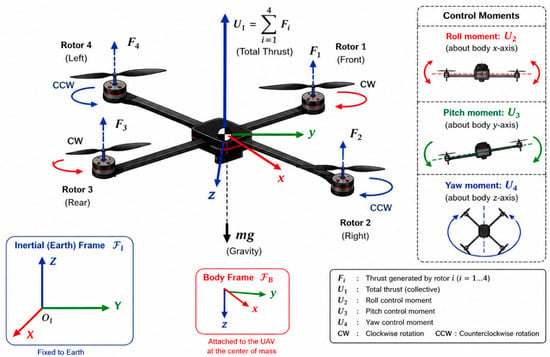
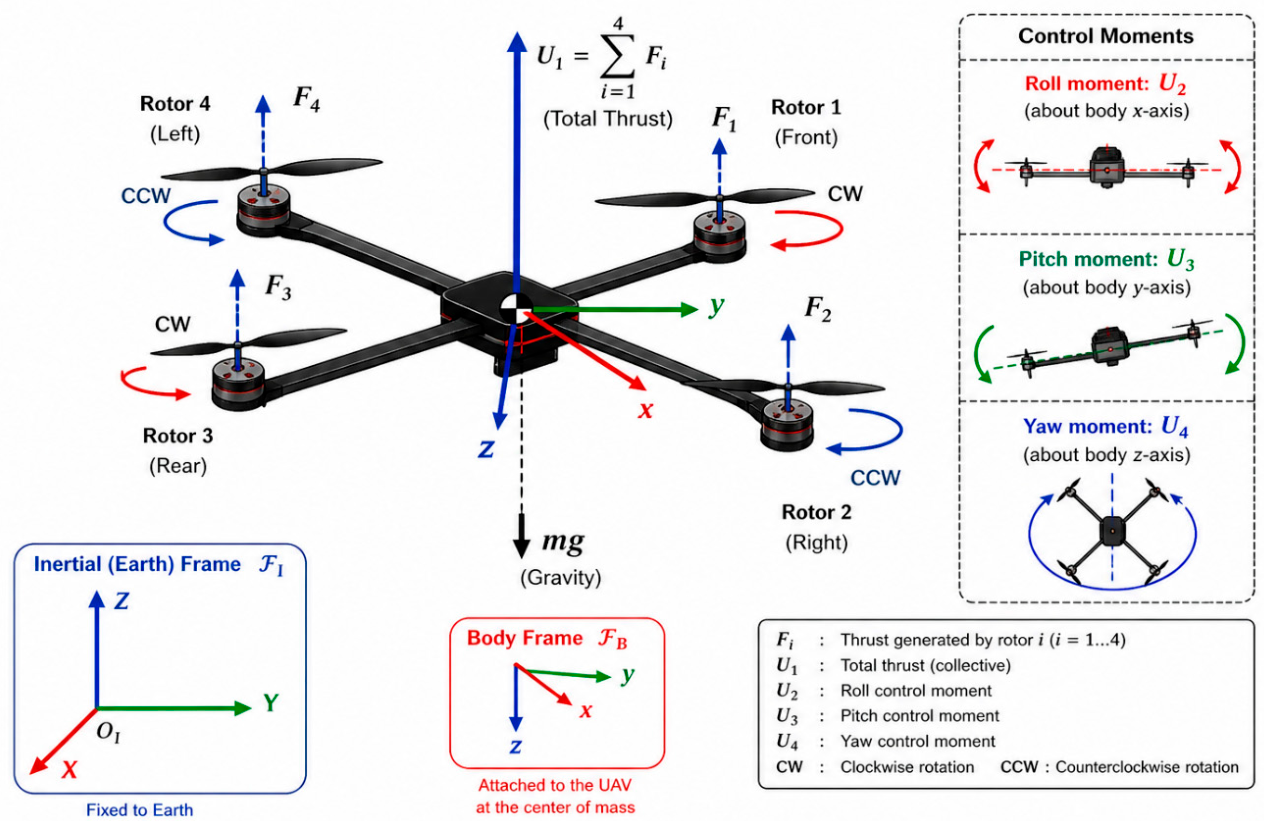
A rigid body with six DOF is a clear replica of how the quadrotor UAV is modeled, consisting of three translational as well as three rotational motions. Figure 1 presents a clear demonstration of the coordinate frames as well as a force/moment illustration of the quadrotor UAV. The UAV center of mass is seen firmly attached to the body while the inertial frame is fixed to the earth. The overall translational and rotational motion of the system is governed by the total thrust and the control torques generated by the rotors.
Figure 1.
Quadrotor UAV coordinate frames and force/moment illustration, exhibiting the inertial structure , body-fixed frame , total propulsive force , gravitational pull, and control torques .
Here, two frames of reference are defined: the inertial frame is fixed to the earth, and the body-fixed frame is affixed to the UAV center of mass.
The initial frame position of the quadrotor is described as:
The Euler angle equation is used to describe the attitude of the UAV:
where defines the roll angle, is pitch angle, is the yaw angle.
3.2. Kinematic Model
The rotation matrix relation is used to represent the transformation from the body structure to the inertial structure given by:
Broadening we have:
where and signify cosine and sine functions. The relationship between angular velocity and Euler angle rates is given by:
with:
3.3. Translational Dynamics
The translational motion is given by Newton’s second law [47]:
where depict the mass, is gravity, is the propulsive force, and represents interference and uncertainties. The propulsive force articulated in the inertial frame is given by:
Substituting (8) into (7) yields:
Expanding component-wise becomes:
where , , and exemplify lumped translational acceleration interference arising from external forces, aerodynamic effects, and model unpredictability.
3.4. Rotational Dynamics
Euler’s rotational equations give [47]:
where is inertia matrix, is control torque and represents interference. Expanding gives
3.5. Control Inputs
The control inputs are defined as:
where is the total thrust, and are roll, pitch and yaw torques, respectively.
3.6. State-Space Representation
Define the state vector:
The system can be written as:
in which is the captured nonlinear dynamics, symbolizes input coupling, and is the lumps interference as well as unpredictability.
4. Disturbance and Uncertainty Modeling
In real-world quadrotor UAV implementations, the system is susceptible to numerous unpredictability as well as interference arising from prevailing conditions from the surrounding environment, parameter alteration, as well as modeling imprecision [31,40]. To guarantee the practical assessment of the proposed control technique, the two interferences as well as parametric unreliability were integrated into the system dynamics.
Section 3 presents effects modeled as additive terms in both the translational and rotational dynamics.
4.1. External Disturbance Modeling
The translational dynamics in (9) are enhanced by means of forces derived from interference
where:
The relation presents grouped external interference such as wind gusts, sensor-induced perturbations, and aerodynamic drag variation. Similarly, in (13), the rotational dynamics are modified as follows:
where:
showing torque interference arising from aerodynamic effects, external perturbations, or rotor imbalance.
4.2. Disturbance Characteristics
The disturbances are presumed to be constrained, however unknown, satisfying the following:
where and are hidden positive constants. For the purpose of simulation, the interferences were modeled as time-dependent signals made up of sinusoidal elements as well as step-like deviations:
where , represent the disturbance amplitudes, , : are disturbance frequencies, and . This formulation ensures continuous excitation of the system, realistic disturbance variation, and evaluation of controller robustness under dynamic conditions.
Although Dryden and von Kármán turbulence models are widely employed in flight dynamics and aerospace applications to represent stochastic atmospheric turbulence, the objective of this work is to evaluate the robustness of the proposed adaptive sliding mode controller under bounded external disturbances and model uncertainties rather than to reproduce a specific atmospheric turbulence spectrum. Therefore, the disturbance model in (25), which combines sinusoidal and step-like components, was adopted because it provides continuous bounded excitation with abrupt variations that effectively challenge the controller and is commonly used for robustness evaluation in nonlinear control studies. Future work will consider more realistic turbulence models, such as the Dryden model, during experimental and hardware-in-the-loop validation.
4.3. Parametric Uncertainty Modeling
Besides outside interference, parametric uncertainties are presented in the system framework. The variables comprise the mass and inertia matrix . The variables are modeled as:
where , are nominal values, and , are bounded uncertainties with:
These uncertainties stand for payload variation, modeling errors, and structural parameter mismatch.
4.4. Lumped Uncertainty Representation
In the case of developing a control algorithm, the interference and uncertainties were grouped into a combined uncertainty term:
After explicitly modeling the external disturbances and parametric uncertainties in Section 4.1, Section 4.2 and Section 4.3, these effects are combined into the lumped disturbance vector d(t). Consequently, the general nonlinear state–space model in (19) can now be rewritten in compact form as:
Equation (29) is, therefore, not a new system model but a compact reformulation of (19), in which the disturbance term is explicitly defined according to Equations (20)–(28). This representation is adopted in the subsequent controller design and stability analysis.
This representation is particularly suitable for robust control design, as it allows the controller to offset for all unknown effects altogether.
The disturbance and uncertainty model offers a unified representation for external disturbances and parametric variations in robustness analysis of the proposed controller. This formulation is implemented in the MATLAB/Simulink model to evaluate the tracking performance under realistic operating conditions.
5. Proposed Adaptive Sliding Mode Control
This section presents the proposed adaptive sliding mode control framework for the translation motion control of the quadrotor UAV. A hierarchical data structure comprising an outer-loop translational controller as well as an inner-loop attitude stabilization controller is integrated in the larger framework of the design. In the presence of interference as well as parametric uncertainties, the proposed ASMC is employed in the outer-loop position control subsystem in order to achieve robust trajectory tracking. The outer-loop controller generates the required total thrust and desired attitude commands, while the inner loop settles the rotational dynamics of the UAV.
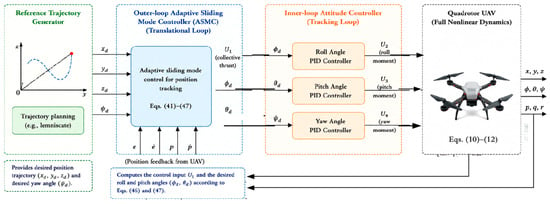
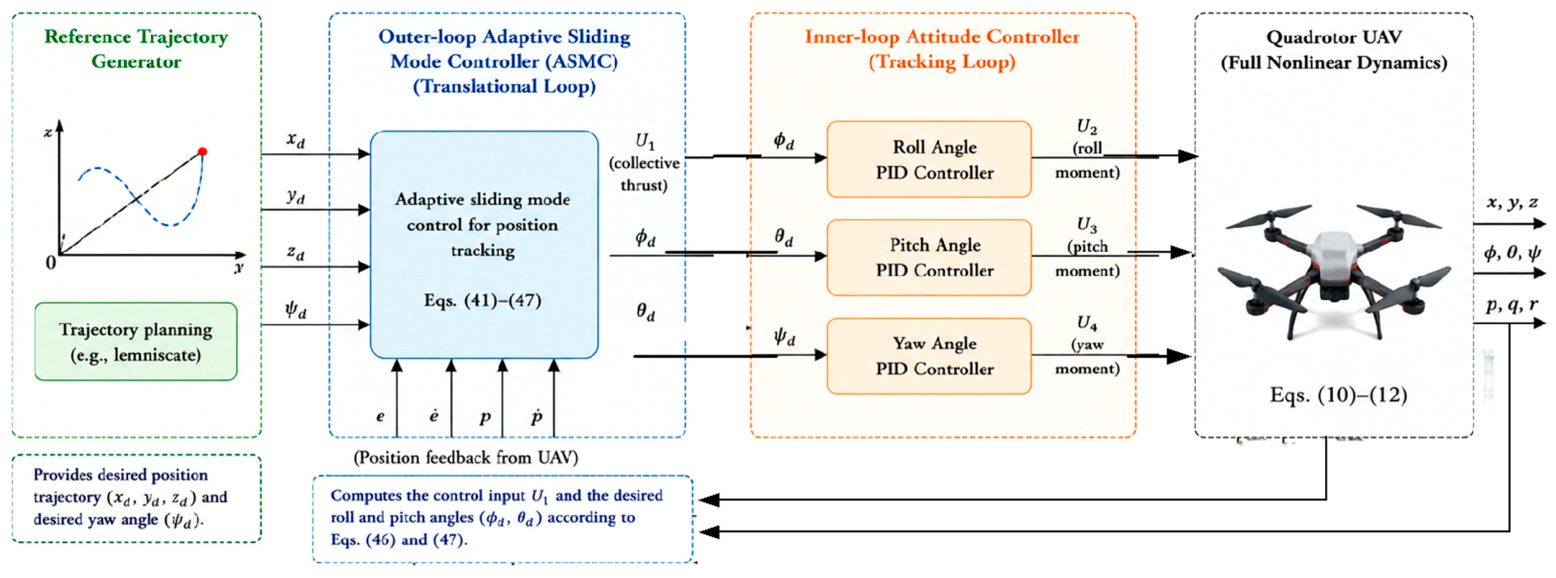
The hierarchical control frame of the proposed UAV control system is demonstrated in Figure 2. The outer-loop controller is in charge of controlling the translational position tracking in the x-, y-, and z-directions utilizing the proposed adaptive sliding mode control approach. The outer loop produces the overall thrust input U1 alongside the preferred roll, pitch, and yaw attitude stabilization controller built on the position tracking errors as well as the required trajectory-acquired data. To ensure seamless operation, the required attitude commands are then delivered to the inner-loop attitude stabilization controller to maintain equilibrium, which subsequently produces the rotational control torques that are expected to keep the UAV orientation stable. While sustaining balanced attitude dynamics under external interference as well as model uncertainties, the hierarchical framework permits trajectory tracking.
Figure 2.
This figure illustrates the hierarchical control architecture of the quadrotor UAV, demonstrating the outer-loop position controller as well as the inner-loop altitude controllers integrated with feedback.
It should be emphasized that the Reference Trajectory Generator supplies only the desired position trajectory and the desired yaw angle . The desired roll and pitch angles are computed online by the proposed adaptive sliding mode controller according to Equations (46) and (47) to achieve the required translational motion. The inner-loop attitude controller then tracks these generated attitude commands to stabilize the quadrotor.
As illustrated in Figure 2, the controller system is structured into two distinct hierarchical-level planes, while the outer loop accounts for position tracking in the and directions by creating the required roll and pitch angles . These desired angles represent the UAV’s required orientation to achieve lateral motion.
5.1. Control Objective
Designing a robust ASMC that can guarantee precise trajectory tracking of the quadrotor UAV in the presence of interference and uncertainties is the main goal. The given relation represents the trajectory:
with its derivatives and , ensuring bounded trajectory tracking alongside convergence to an adequately limited zone around the target trajectory.
where is a little bounded tracking residual.
5.2. Tracking Error Definition
Describe the position tracking error:
as well as its derivative:
5.3. Sliding Surface Design
A linear sliding surface is described as:
where:
is a positive definite gain matrix. When , the error dynamics become:
which guarantees exponential convergence of tracking errors.
5.4. Equivalent Control Design
From the linear dynamics in (10) to (12), the position subsystem can be described in compact nonlinear form, where the linear accelerations rely on both the total forward force input as well as the quadrotor attitude angles:
Differentiating the sliding surface:
Substituting:
The equivalent control is chosen to negate known dynamics:
5.5. Adaptive Sliding Mode Control Law
To guarantee robustness, a switching term is added:
where is the adaptive gain, represents element-wise multiplication, and is the boundary-layer thickness. The feedback gain matrix is selected as a symmetric positive definite matrix () to guarantee that the quadratic term is positive definite, thereby contributing to the Lyapunov stability of the closed-loop system.
The saturation function is designated as:
where denotes the -th component of the sliding surface vector , corresponding to the translational motion along the -, -, and -axes, respectively.
5.6. Adaptive Gain Law
In order to enhance robustness whilst decreasing inordinate switching movement, adaptive switching gains are injected into the sliding mode controller. According to the sliding surface magnitude, the adaptive gains are streamlined online and are managed by the following adaptation law:
where represents the adaptive switching gain correlating to the ith linear channel, depicts the adaptation rate, and is a leakage coefficient introduced to avoid unbounded parameter growth. During considerable tracking errors, the adaptive mechanism augments the switching gain and progressively decreases it as the tracking errors converge; consequently, chattering is lowered whilst preserving robustness against external interference as well as uncertainties.
The first term increases the adaptive gain as the tracking error grows, while the leakage term prevents unbounded gain accumulation and reduces excessive switching near equilibrium. In order to guarantee boundedness
When the error is large, the adaptive law guarantees large gains and decreased gains near convergence, reducing the effects of chattering.
The proposed ASMC is significantly different from the conventional sliding mode controllers with constant switching gain. It introduces a bounded adaptive switching gain mechanism with a leakage term that constantly adjusts the control action based on the instantaneous sliding variable. The projection bounds guarantee that the adaptive gain is bounded in some sense, so that the gain does not grow too fast while still being robust to disturbances and model uncertainties. Thus, the controller improves the chattering suppression while retaining the disturbance rejection ability and is easy to implement for the real-time embedded UAV applications.
5.7. Thrust and Attitude Generation
The commanded acceleration is used to compute thrust:
The desired roll and pitch angles are subsequently derived from the translational dynamics in Equations (10)–(12) by solving for the attitude variables required to generate the commanded accelerations.
The yaw angle is directly assigned:
The proposed adaptive sliding mode controller is developed for the outer-loop translational dynamics, where it computes the collective thrust together with the desired attitude commands . The corresponding control torques , , and are generated by a conventional inner-loop attitude controller that tracks these desired attitude commands; therefore, the inner-loop controller is adopted as a standard low-level stabilization module and is not further derived, since it is not the focus of this work.
The novelty of the proposed approach lies in the integration of a bounded adaptive switching gain update law with leakage compensation and boundary-layer smoothing within the outer-loop trajectory controller. This enables automatic online adjustment of the switching gain according to the tracking error, thereby reducing unnecessary control activity and chattering while preserving robustness against bounded disturbances and parametric uncertainties. Compared with conventional fixed-gain sliding mode control, the proposed method provides improved adaptability with low computational complexity, making it suitable for practical UAV implementation.
6. Stability Analysis
Theorem 1.
Consider the quadrotor UAV nonlinear system described by (19), subject to bounded external disturbances and parametric uncertainties satisfying (24) to (29). Assume that the desired trajectory and its first two derivatives are bounded. Furthermore, let the controller gains satisfyand let the adaptive switching gains be updated according to (43) while remaining within the bounds specified in (44). Then, under the proposed adaptive sliding mode controller (41), all closed-loop signals remain bounded. Moreover, the sliding variable converges to a compact neighborhood of the origin, and the trajectory tracking error is uniformly ultimately bounded despite bounded disturbances and parametric uncertainties.
Proof.
Consider the quadrotor linear dynamics with mass disturbance:
Presume that the disturbance is bounded as:
where . It is also presumed that the preferred trajectories , , and are bounded.
- Sliding Surface Dynamics
Recall the sliding surface defined in Equation (34) , and its derivative presented in Equation (38) . Substituting the system dynamics into (38), we obtain:
Employing the proposed ASMC control law, the sliding dynamics become:
- Lyapunov Function Candidate
Consider the following Lyapunov function candidate:
where is an ideal positive switching gain selected to exceed the upper bound of the corresponding disturbance, i.e., , thereby ensuring that the switching action is sufficient to compensate for the bounded disturbance during the Lyapunov stability analysis.
- Time Derivative of the Lyapunov Function
Differentiating (53) gives:
Substituting (52) into (54):
Expanding (55):
- Substitution of the Adaptive Law
The adaptive switching gain is updated according to the following:
where is a leakage coefficient. Substituting (57) into (56), the Lyapunov derivative becomes:
The saturation function performs similarly to the sign function apart from the boundary layer. Hence:
Consequently, outside the boundary layer, (58) becomes
The intermittent switching action is substituted by an even confined approximation. Consequently, the closed-loop system is anticipated to converge to a concise vicinity of the origin instead of precisely to zero.
- Boundedness and Convergence Analysis
Using the bounded disturbance assumption, the disturbance term meets:
Choose the ideal switching gain so that:
Then, there exists a positive constant , satisfying:
Therefore, the Lyapunov derivative can be bounded as:
It should be noted that the leakage term is introduced to prevent unbounded growth of the adaptive switching gain rather than to provide additional negative definiteness. Since the adaptive gain is constrained within the prescribed bounds given in Equation (65), the quantity remains bounded. Consequently, the leakage contribution is itself bounded and does not compromise the negative definiteness established by the dominant quadratic term together with the disturbance compensation term. Therefore, the overall Lyapunov derivative remains negative outside a compact neighborhood of the origin, establishing uniform ultimate boundedness of the closed-loop system.
The leakage term ensures bounded adaptive gains and helps to ensure the boundedness of the adaptive law. While this term is not necessarily negative for all values of the adaptive gain, its boundedness does not affect the overall uniform ultimate boundedness shown by the Lyapunov analysis.
Owing to the controller using a saturation boundary layer and bounded adaptive gains, precise asymptotic convergence to zero is not declared. Alternatively, the closed-loop system is consistently ultimately bounded. Thus, the sliding variable converges to a concise vicinity around the origin:
where is a bounded residual determined by the boundary-layer thickness, interference level, and controller gains. Seeing that the sliding surface is described as , boundedness of implies the boundedness of the tracking error. Hence:
is a small bounded residual tracking error.
Therefore, all closed-loop signals remain bounded, and the sliding variable together with the trajectory tracking error are uniformly ultimately bounded under the proposed adaptive sliding mode controller. This completes the proof of Theorem 1. □
7. Simulation Setup
Through the numerical simulations carried out in the MATLAB/Simulink environment, the proposed ASMC strategy is validated. In Section 3, the quadrotor UAV model is detailed and implemented using a nonlinear dynamic framework, incorporating both translational and rotational dynamics. The entire simulation process was conducted under external interference and uncertain conditions, guaranteeing a pragmatic assessment of controller performance. The total simulation duration is set to: . Table 1 gives a summary of the physical parameters of the quadrotor UAV used in the simulation.
Table 1.
Quadrotor UAV parameters.
Table 1 summarizes the physical parameters of the quadrotor UAV used in the simulation. These parameters conform to a usual small-scale quadrotor platform that are used as nominal values in the controller design.
Table 2 illustrates the parameters of the ASMC, SMC, and PD controllers utilized in the simulation. In order to guarantee a fair comparison under similar operating conditions, the parameters are tuned.
Table 2.
Illustration of controller parameters used for ASMC, SMC, and PD implementations.
An aggressive circular trajectory is used to evaluate the tracking operation under dynamic conditions
Using . The equivalent velocity and acceleration signals are acquired analytically and supplied to the controller. The desired yaw angle is chosen based on the trajectory direction using the four-quadrant inverse tangent function:
7.1. Disturbance and Uncertainty Injection
By intentionally injecting disturbance and parameter uncertainties into the simulation, the controllers’ robustness is tested. By applying external disturbance to the translational motions as well as the rotational dynamics , these disturbances track the form
that creates a mix of smooth and sudden perturbations. By modifying the quadrotor’s mass and inertia value parameters, uncertainties are added while retaining the controller designed for the stated model. This premeditated disparity is essential for true robustness. Additionally, to further demonstrate feasible implementation conditions, measurement noise is incorporated. Table 3 provides a summary of the entire disturbance and uncertainty settings employed in the simulations.
Table 3.
Disturbance and uncertainty settings applied to the quadrotor UAV during simulation.
The disturbances employed consist of both continuous sinusoidal components and discontinuous switching terms; this disturbance represents a practical environmental effect, such as wind gusts and modeling inaccuracies. Furthermore, parametric uncertainties and stochastic interference are integrated to simulate non-ideal operational statuses. A thorough and rigorous evaluation of controller performance under disturbed as well as uncertain scenarios was provided in this set-up.
7.2. Simulink Implementation
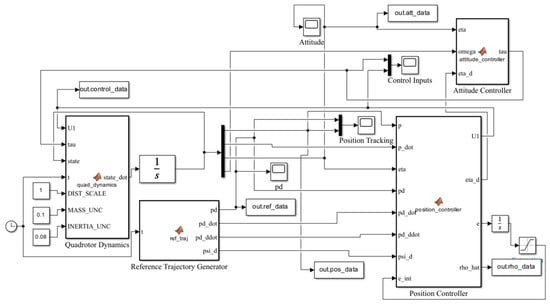
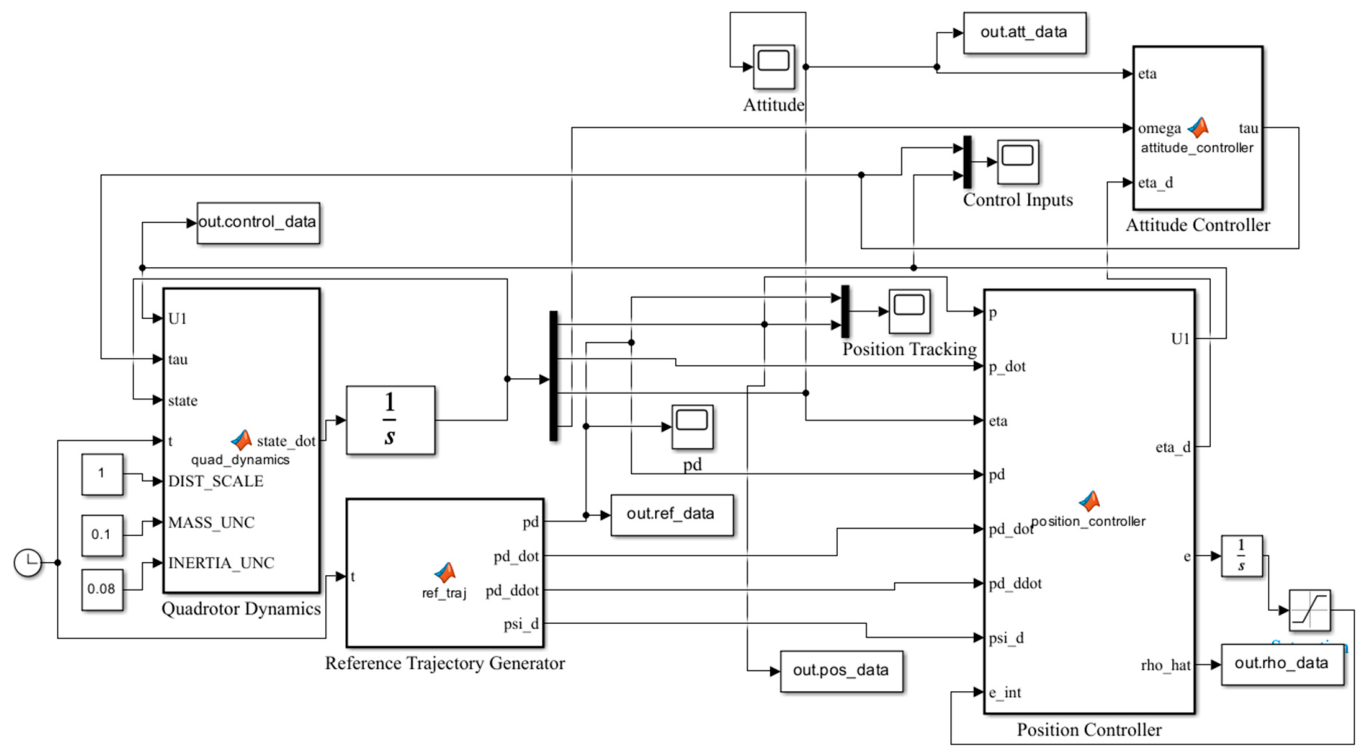
Figure 3 presents the MATLAB/Simulink deployment of the proposed control system. The proposed model incorporates the quadrotor nonlinear dynamics, a reference trajectory generator, perturbation injection, and a hierarchical control framework.
Figure 3.
MATLAB/Simulink implementation of the quadrotor UAV control system, comprising the nonlinear dynamics, reference trajectory generator, perturbation injection, and hierarchical control loops.
The simulation model comprises several interconnected subsystems, as illustrated in Figure 3. The reference trajectory generator generates the required position, velocity, acceleration, and yaw signals essential for trajectory monitoring.
The nonlinear 6-DOF system, integrating both translational and rotational motion, is well illustrated by the quadrotor dynamics block. Through suitable measurement blocks, the system states, along with position, velocity as well as attitude, are fed back to the controllers.
The control design is deployed in a hierarchical pattern. Building on the tracking error, the outer-loop position controller computes the desired thrust and required attitude, while the inner-loop altitude and attitude controllers control vertical motion as well as orientation by creating the control input applied to the quadrotor dynamics.
By injecting disturbance and uncertainties within the simulation model, the controller’s robustness under practical conditions is tested. These incorporate external forces and model parameter variations.
Using “To workspace” blocks, the simulation outputs are neatly collected, enabling withdrawal of position, attitude, control input, and reference signals for post- processing and performance estimation.
This modular performance promotes comprehensive separation between system dynamics, control design, and data analysis, guaranteeing reproducibility and ease of extension for future research.
8. Results and Discussion
In this section, the proposed ASMC simulation results are displayed, and a performance comparative analysis between the proposed controller, a conventional SMC, and a PD controller is carried out. Under similar disturbance and parameter uncertainties, the controller performance was evaluated while tracking the aggressive circular trajectory introduced in Section 7. Performance is evaluated through numerous important measures, including trajectory tracking accuracy, position responses, tracking error characteristics, and control input behavior.
RMSE, IAE, and settling time are among the quantitative metrics estimated and are used to yield an objective comparison of how each controller managed the challenging test conditions.
8.1. 3D Trajectory Tracking Performance
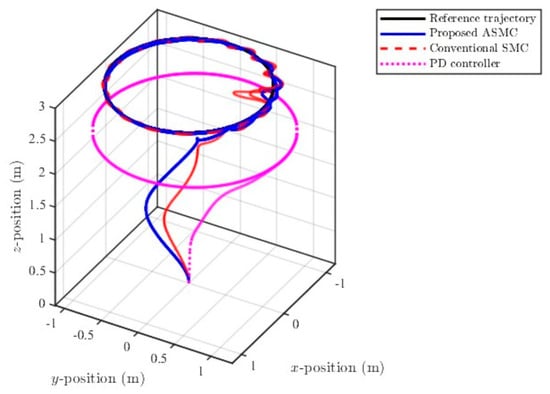
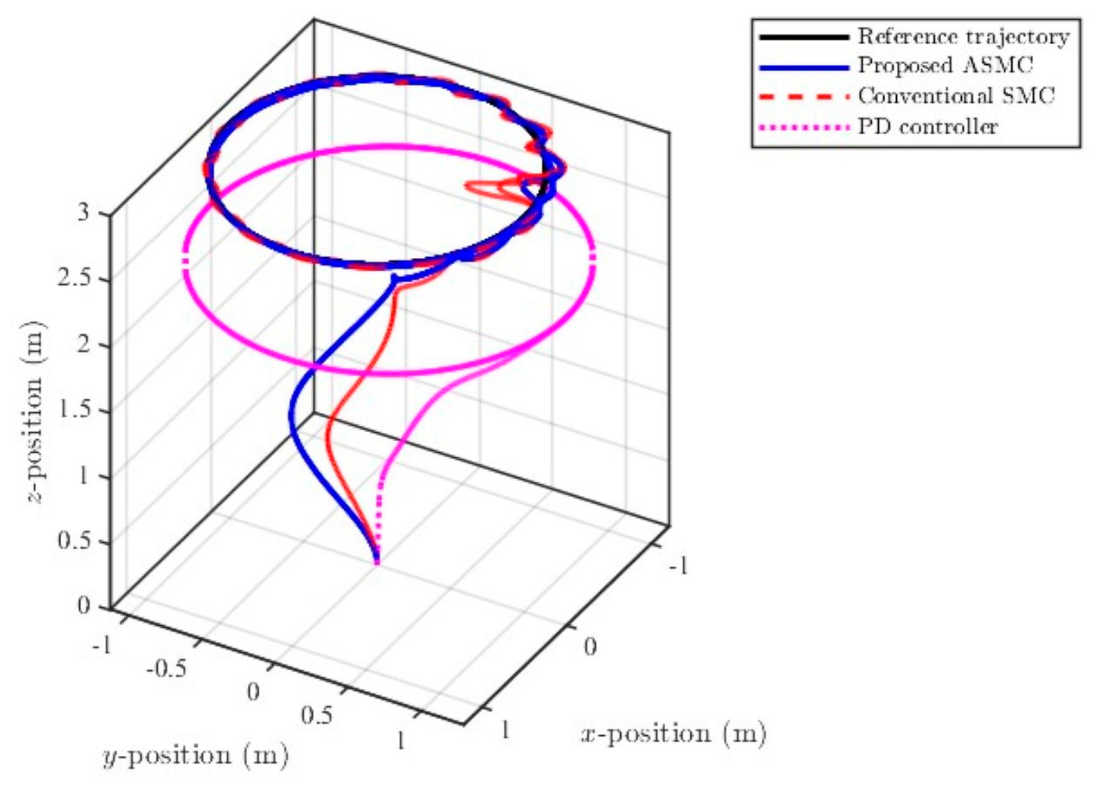
The three-dimensional trajectory tracking performance of the quadrotor UAV is demonstrated in Figure 4.
Figure 4.
Illustration of three-dimensional trajectory tracking performance of the UAV under externally injected disturbance and uncertain conditions for ASMC, SMC, and PD controllers.
All three controllers attempt to track the circular reference path, as illustrated in Figure 4. But the variation in their accuracy is clearly noticeable. By doing so, the ASMC achieves the smoothest and most consistent tracking by maintaining very close adherence to the required trajectory throughout the entire motion. This is due to the effects of the switching behavior, which is limited by the persistent trailing oscillations. On the contrary, the PD controller manages to keep on track, especially along curved sections, at the points where its errors become obviously pronounced.
These results highlight the benefit of the adaptive switching mechanism in the ASMC. By doing so, the gain based on the tracking error is modified, effectively handling disturbance and model uncertainties while avoiding excessive switching; oscillations cannot be fully suppressed with the fixed-gain SMC, while the PD lacks the robustness required for nonlinear, disturbed flight conditions.
8.2. Position Tracking Responses
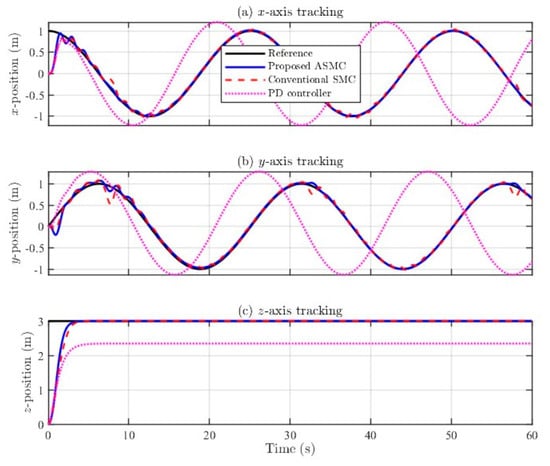
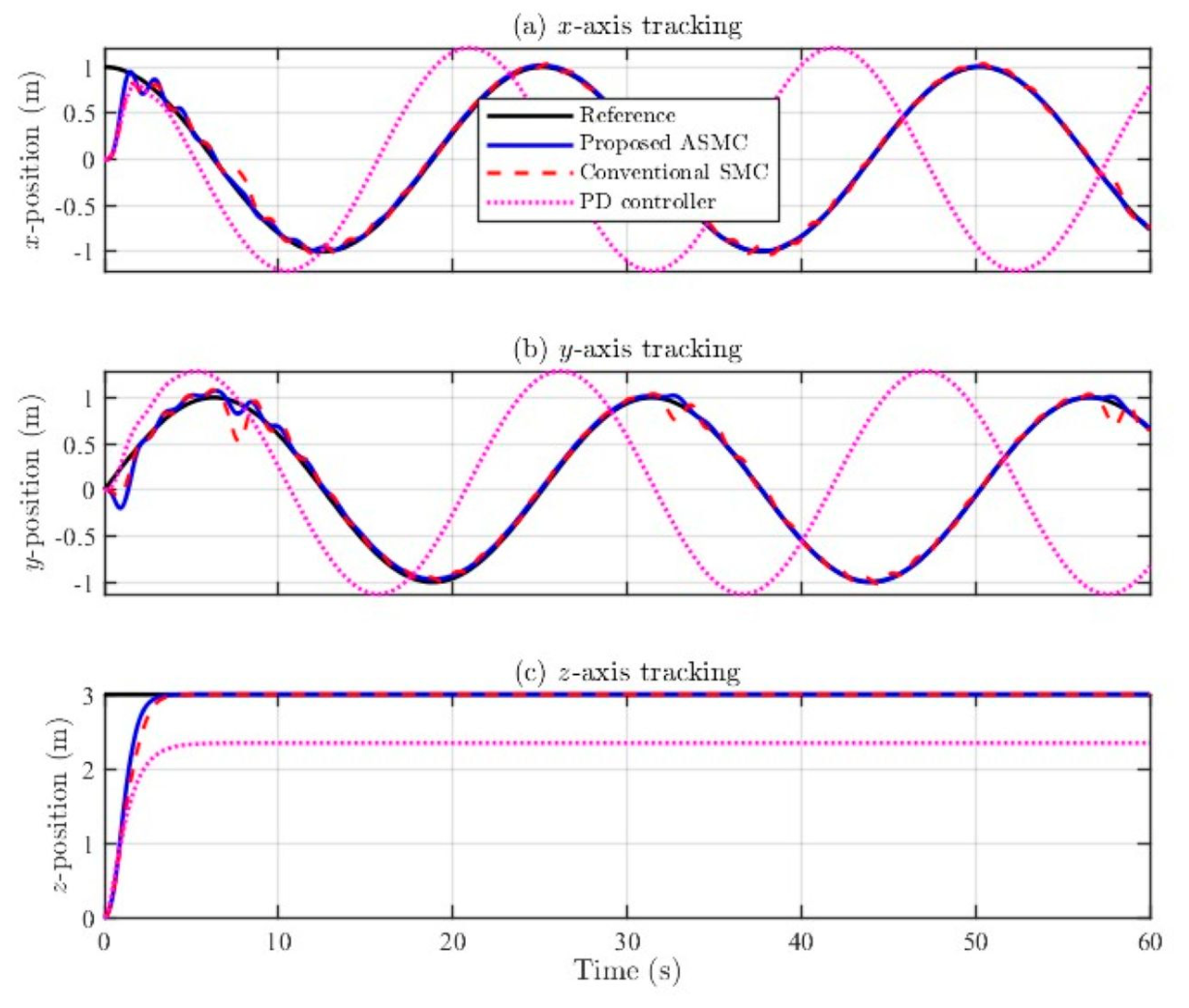
The time-domain position tracking responses along the , , and axes are shown in Figure 5.
Figure 5.
Illustration of position tracking responses of the UAV in the , , and directions.
Several clear differences in the manner of the controller responses are highlighted. ASMC and SMC closely and accurately track the reference signal across all axes. The ASMC shows noticeable and smoother transients, spatially in the x and y directions. A minimal oscillation is injected by the SMC during these transient phases because of its adaptation, while the PD controller presents large tracking errors and protracted settling time.
A constructive altitude regulation along the z-axis is observed, since thrust directly impacts vertical motion. However, the ASMC provides a constructive response with hardly any oscillations owing to its adaptive gain adjustment, which alleviates the control effort when the system approaches the required trajectory.
8.3. Tracking Error Analysis
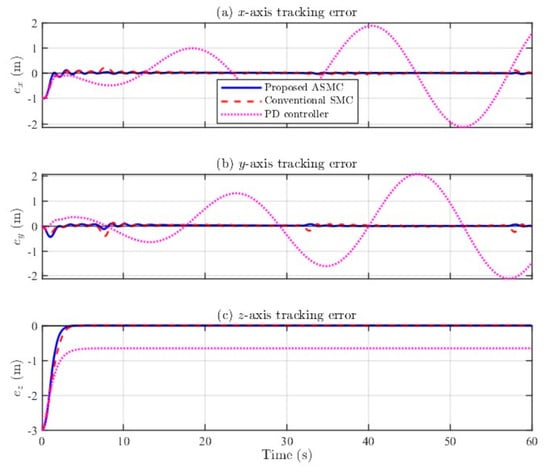
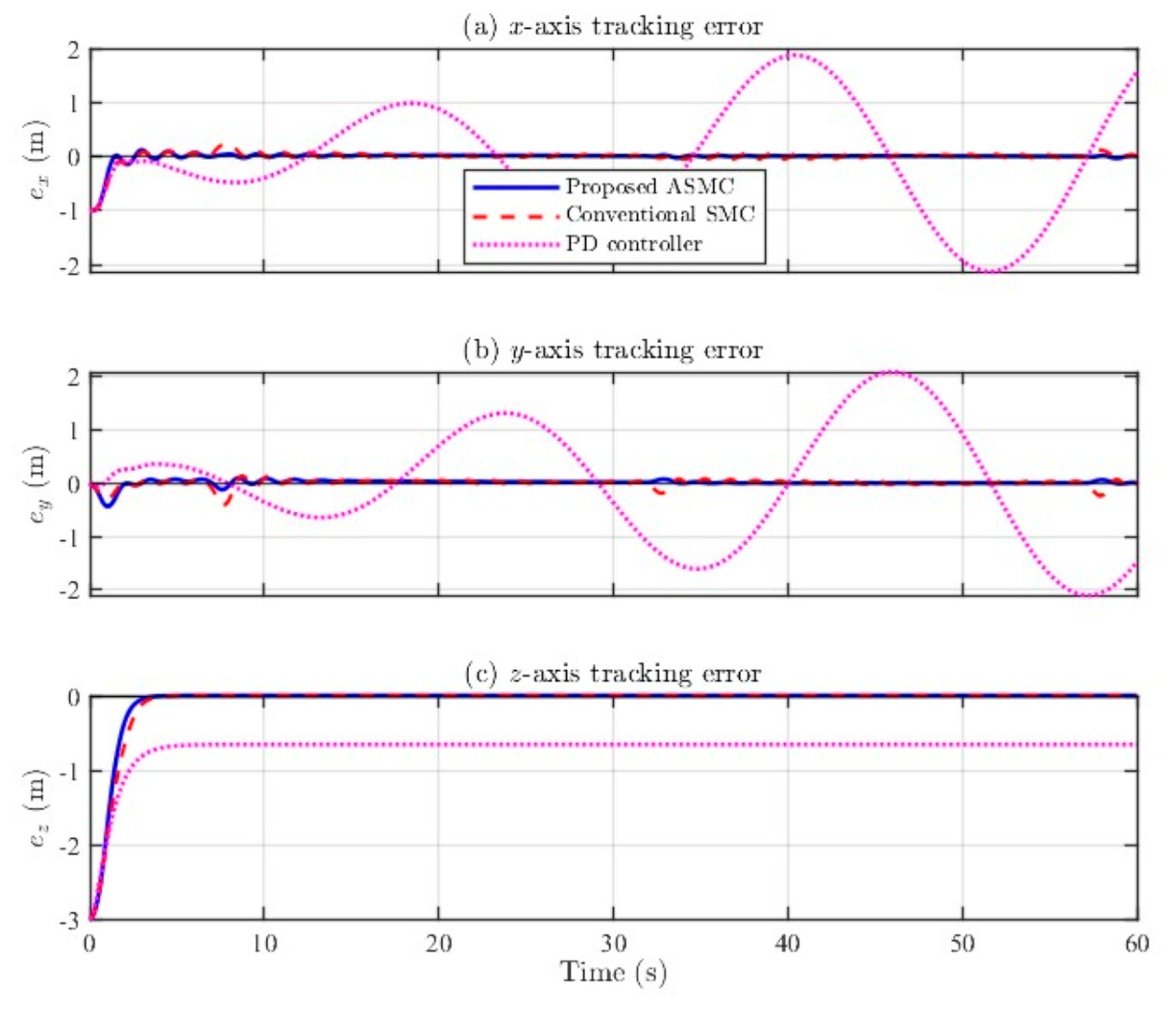
Figure 6 demonstrates the position tracking errors along the x, y and z axes. These help to impart a constructive comparison of the disturbance rejection and tracking capabilities of the controllers.
Figure 6.
Position tracking errors of the UAV along the , , and axes.
Figure 6 clearly highlights the differences in tracking error performance. The smallest error across all axes is accomplished, sustaining tight and stable tracking through the entire motion. The typical SMC shows the anticipated oscillatory error pattern caused by its switching characteristics, while the PD controller puts up with large, persistent errors, revealing its weak disturbance rejection capability. The ASMC’s decreased oscillations and tune-down error magnitudes revealed how successful the adaptive gain mechanism is at recouping for disturbances as well as uncertainties whilst keeping the control action even and stable.
8.4. Control Input Analysis
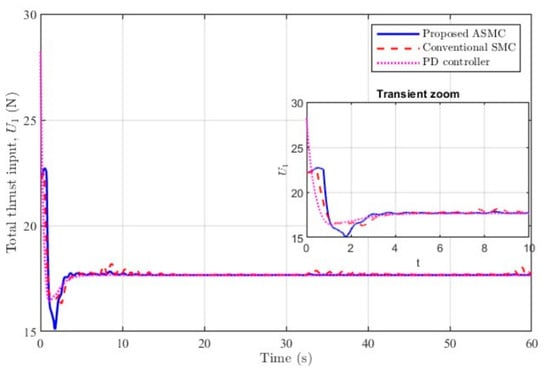
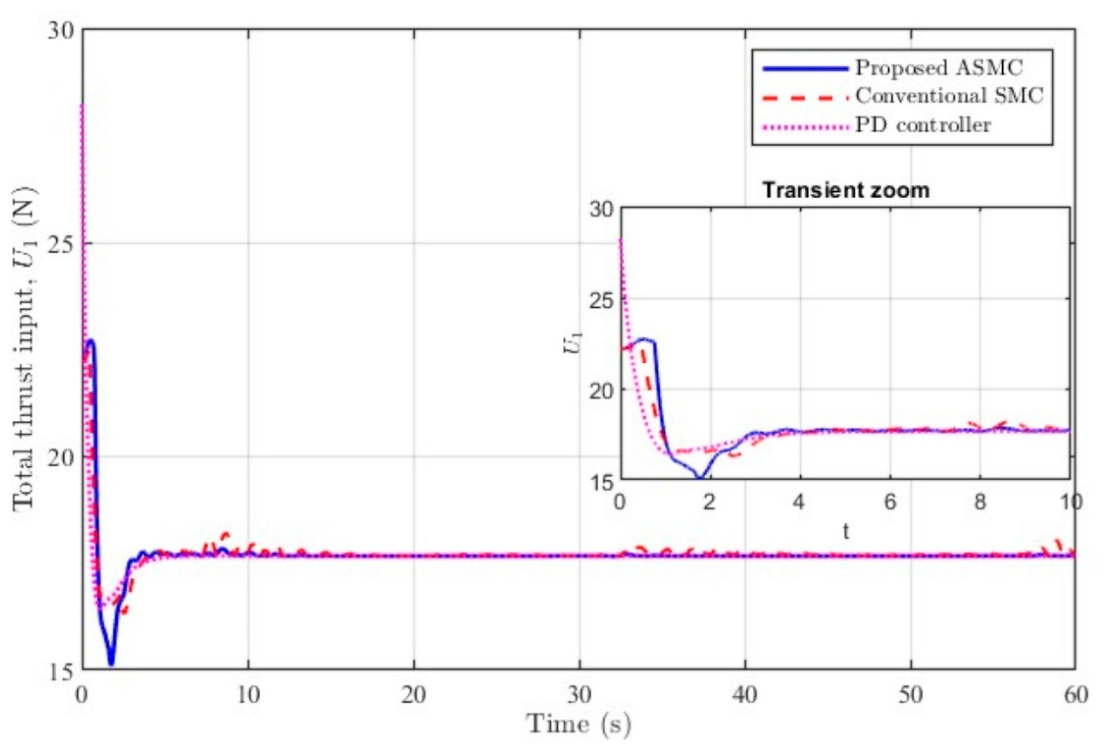
Figure 7 illustrates the entire thrust input created by each controller to estimate the smoothness and robustness of the control effort under disturbed as well as uncertain operating conditions.
Figure 7.
Total thrust input of the UAV under disturbed and uncertain conditions.
Figure 7 clearly highlights the control input created by each strategy. After the initial transient, the ASMC produces smooth inputs, displaying noticeably diminished chattering as well as making it most suitable for real-world end effectors. Because of its erratic switching term, the traditional SMC still injects small oscillations, while the PD controller displays substantial transient deviations, demonstrating its less efficient control effort. Even though SMC remains robust, its fickleness automatically generates oscillatory inputs. Conversely, the ASMC achieves a better balance between robustness, fast response, and even control due to its adaptive gain regulation.
8.5. Adaptive Gain Evolution
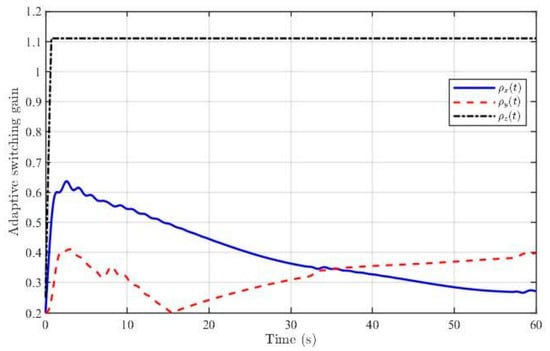
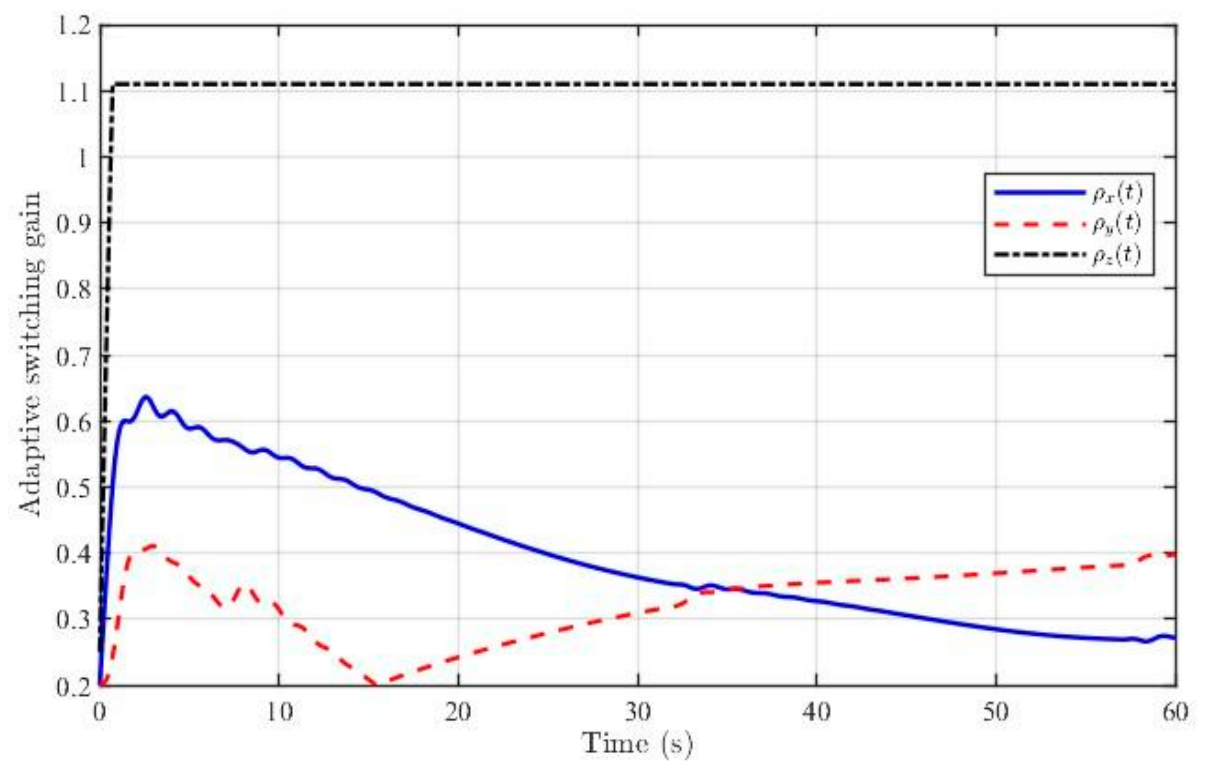
The evolution of the adaptive switching gains , , and is illustrated in Figure 8.
Figure 8.
Illustration of the development of adaptive switching gains , , and during trajectory tracking under disturbances and uncertainties.
Figure 8 illustrates the adaptive switching gains during trajectory tracking under disturbed and uncertain conditions. The adaptive gain changes dynamically according to the tracking error magnitude and disturbance intensity. Throughout the transient phase, larger switching gains are created to recoup from the initial tracking error disturbance from the surroundings. As the system nears the required trajectory, the gains moderately reduce and converge to bounded steady-state values.
The proposed adaptive mechanism spontaneously modifies the switching gains online, hence improving robustness while avoiding excessively substantial fixed gains. Principally, the adaptive approach decreases inessential control effort and reduces chattering effects regularly associated with traditional sliding mode control.
8.6. Chattering Comparison
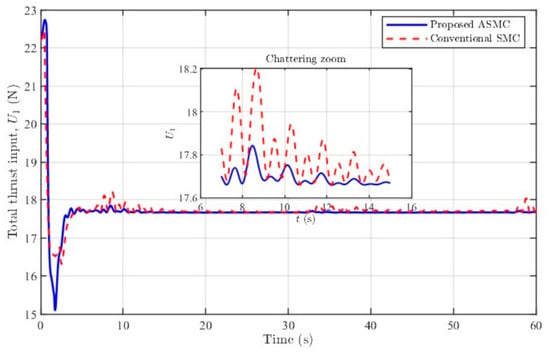
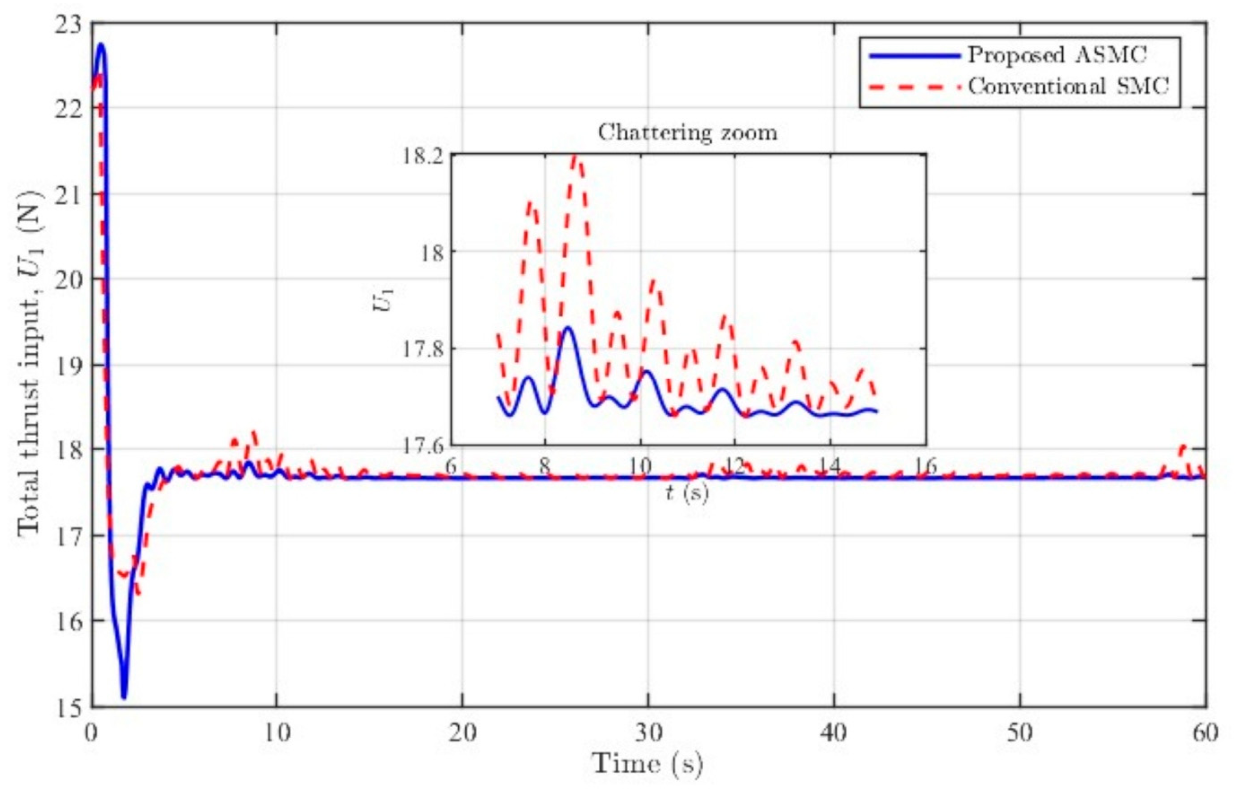
Additionally, estimating the switching behavior and control smoothness of the proposed controller, an enlarged comparison of the control input responses is demonstrated in Figure 9, highlighting the chattering behavior of the ASMC and traditional SMC during a transient duty cycle.
Figure 9.
A chattering comparison of the total thrust input U1 for the proposed ASMC and conventional SMC controllers under disturbed and uncertain conditions.
A zoomed comparison of the entire thrust input during a transient interval to demonstrate the chattering characteristic of the controllers is provided in Figure 9. Here, a noticeable high-frequency oscillation brought about by the fixed discontinuous switching term is exhibited by the traditional SMC.
In the center, the proposed ASMC generates a higher-level and balanced control signal accompanied by minimal oscillation amplitude, thanks to the adaptive switching gain mechanism, which achieved improvement and dynamically tuned the control actions in accordance with the tracking condition, rather than maintaining unwanted large switching gains.
In real-time applications of UAVs, a reduced rate of chattering effect is of utmost significance because excessive switching may thrill unmodeled dynamics, increase actuator wear, and consequently reduce energy efficiency. From the results, a clear demonstration of how the proposed ASMC achieved a more desirable balance between robustness and control smoothness is shown.
8.7. Quantitative Performance Evaluation
Table 4 provides a computed and summarized objective comparison and performance metrics, including RMSE, IAE, and settling time.
Table 4.
Quantitative performance comparison of ASMC, SMC, and PD controllers under disturbance-affected and unpredictable working conditions.
From the quantitative performance metrics, the superiority of the proposed ASMC strategy is further validated. The lowest total RMSE and IAE values among all controllers are achieved via the ASMC, distinctly indicating enhanced tracking precision and cumulative error decrease under interference-based conditions.
Even though the traditional SMC sustains acceptable robustness, its fixed switching gain leads to substantially more oscillatory behavior along with higher cumulative error. Put down to its inadequacy to compensate for nonlinear coupling, parameter uncertainty, and time-varying disturbances, the PD controller revealed considerably reduced performances. Additionally, the PD controller fell short of satisfying the settling criterion within the simulation duration, specifying inadequate robustness under disturbance-affected nonlinear operating conditions.
The enhanced settling characteristics of the ASMC also exhibited the adaptive gain regulation enhancement of the transient response without sacrificing robustness. These results jointly show that the proposed controller attained a more favorable balance between tracking accuracy, robustness, and control smoothness.
Additionally, assessing the robustness behavior of the proposed controller, supplementary simulations were presided over under diverse disturbance intensities and parameter uncertainties. Three operating conditions were regarded by steadily increasing the disturbance magnitude, mass uncertainty, and inertia uncertainty. The robustness performance of the proposed ASMC was collated with that of the traditional SMC using the total root-mean-square tracking error (RMSE total), integral absolute error (IAE total), maximum tracking error, and settling time. Table 5 gives a corresponding result in summary.
Table 5.
Robustness evaluation of the proposed ASMC and conventional SMC under diverse disturbance and uncertainty levels.
Table 5 presents a demonstration of how both controllers encounter performance deterioration as the disturbance and uncertainty levels increase. Nevertheless, the proposed ASMC continuously maintains lower RMSE_total, lower IAE_total, smaller maximum tracking error, and shorter settling time in contrast to the traditional SMC under all operating conditions. In particular, the performance deterioration of the proposed ASMC arises more moderately as the disturbance gravity increases, revealing stronger robustness and enhanced adaptability to uncertain operating environments. On the other hand, the traditional SMC exhibits larger tracking errors and longer settling times, particularly under grave disturbance conditions, attributable to its fixed switching gain framework and increased chattering activity.
From an engineering viewpoint, the robustness enhancement realized by the proposed ASMC is specifically significant for the functional execution of UAVs in unstable environments, such as wind gusts, payload variations, aerodynamic disturbances, and parameter mismatch conditions. The adaptive switching gain instrument allows the controller to increase robustness only when necessary, hence reducing excessive switching activity and improving control smoothness during nominal operation. This characteristic can lower actuator stress, reduce energy consumption related to unnecessary control oscillations, and enhance flight reliability in real-world autonomous UAV implementation.
Comprehensively, the robustness analysis further validates the effectiveness of the proposed ASMC for efficient trajectory tracking under disturbed and uncertain operating conditions.
8.8. Overall Discussion
Figure 4, Figure 5, Figure 6, Figure 7, Figure 8 and Figure 9 and Table 4 reveal results that plainly demonstrate the performance of the proposed ASMC and its reliability under disturbances as well as parameter uncertainties. It continuously delivers robust trajectory tracking, profiting from reduced chattering owing to its adaptive gain mechanism, and sustains a strong balance between robustness and control smoothness. In contrast to the traditional SMC, the ASMC attained better tracking accuracy, lower cumulative error, and smoother control inputs while maintaining similar robustness characteristics.
The simulations similarly validate the stability of the controller, even when disturbances, parameter variations, and measurement noise occur concurrently. This revealed that the adaptive switching gain mechanism successfully compensates for model inconsistency and external perturbations without relying on observers or neural network-based evaluators.
More so, the current study is narrowed to MATLAB/Simulink simulations. Applied conditions, such as actuator saturation, communication delays, sensor latency, and aerodynamic effects, were not incorporated and will be addressed in future experimental studies.
9. Conclusions
This work introduced a robust adaptive sliding mode control structure for trajectory tracking of a quadrotor UAV operating under disturbances and parametric uncertainties. A nonlinear six-degrees-of-freedom quadrotor model was developed using linear and rotational dynamics formulated in inertial and body-fixed coordinate frames. To enhance robustness while reducing unrestrained switching activity, a bounded adaptive switching gain mechanism and saturation boundary layer were included in the sliding mode controller. The proposed control strategy was executed within a hierarchical outer-loop/inner-loop framework for linear motion control and attitude stabilization.
The efficiency of the proposed ASMC was evaluated through MATLAB/Simulink simulations under disturbed and uncertain operating conditions, including external disturbances, mass variation, inertia uncertainty, and statistical noise. Contrastive analyses were conducted against a traditional sliding mode controller and a PD controller using intrusive circular trajectory tracking scenarios. The results revealed that the proposed ASMC attained greater accurate trajectory tracking, smaller tracking errors, smoother control inputs, and remarkably reduced chattering compared with standard controllers. Quantitative performance assessment revealed that the proposed controller attained a total RMSE of approximately 0.38 m with lower increasing tracking error and enhanced transient response under all investigated operating conditions.
The adaptive switching gain mechanism allowed the controller to vigorously modify the control effort in accordance with the tracking condition, thereby sustaining robustness needless of overly large fixed switching gains. In addition, the chattering analysis validates the proposed ASMC, creating smoother control-input characteristics in comparison with the traditional SMC whilst maintaining disturbance rejection capability. The robustness evaluation under varying disturbance intensities and uncertainty levels also showed that the proposed controller sustained stable and bounded tracking performance even in the face of severe operating conditions.
From an engineering point of view, the proposed ASMC proffers a practical balance between robustness, performance simplicity, and control smoothness, making it appropriate for autonomous UAV applications operating in unsettled and disturbance-affected environments. Contrary to numerous observer-based or intelligent adaptive sliding mode approaches, the proposed method evades unrestrained computational complexity whilst still attaining strong disturbance rejection and dependable trajectory tracking performance.
Although the proposed controller has been validated through comprehensive MATLAB/Simulink simulations under disturbances and parametric uncertainties, experimental implementation on a real quadrotor UAV platform will be considered in future work to further verify its practical applicability and real-time performance.
Funding
The authors extend their appreciation to Prince Sattam bin Abdulaziz University for funding this research work through the project number (PSAU/2025/01/35232).
Institutional Review Board Statement
Not applicable.
Informed Consent Statement
Not applicable.
Data Availability Statement
The original contributions presented in this study are included in the article. Further inquiries can be directed to the corresponding author.
Conflicts of Interest
The author declares no conflicts of interest.
References
- Yesmin, A.; Sinha, A. Sliding Mode Controller for Quadcopter UAVs: A Comprehensive Survey. Drones 2025, 9, 625. [Google Scholar] [CrossRef] [Scilit]
- Lin, Y.; Yan, H.; Rao, K.; Lv, Y.; Lv, L.; Song, G. Topology based model predictive control planner for quadrotor flight in complex environments. Int. J. Syst. Sci. 2025, 57, 2531–2544. [Google Scholar] [CrossRef] [Scilit]
- Hassani, H.; Mansouri, A.; Ahaitouf, A. Performance Evaluation of Control Strategies for Autonomous Quadrotors: A Review. Complexity 2024, 2024, 8820378. [Google Scholar] [CrossRef] [Scilit]
- Cetinsaya, B.; Reiners, D.; Cruz-Neira, C. From PID to swarms: A decade of advancements in drone control and path planning—A systematic review (2013–2023). Swarm Evol. Comput. 2024, 89, 101626. [Google Scholar] [CrossRef] [Scilit]
- Karahan, M. Development Stages of Quadrotors from Past to Present: A Review. Drones 2025, 9, 840. [Google Scholar] [CrossRef] [Scilit]
- Gedefaw, E.; Abera, N.; Abdissa, C. A Review of Modeling and Control Techniques for Unmanned Aerial Vehicles. Eng. Rep. 2025, 7, e70215. [Google Scholar] [CrossRef] [Scilit]
- Ryll, M.; Bülthoff, H.; Giordano, P. A Novel Overactuated Quadrotor Unmanned Aerial Vehicle: Modeling, Control, and Experimental Validation. IEEE Trans. Control Syst. Technol. 2015, 23, 540–556. [Google Scholar] [CrossRef] [Scilit]
- Abbas, N.; Abbas, Z.; Zafar, S.; Ahmad, N.; Liu, X.; Khan, S.S.; Foster, E.D.; Larkin, S. Survey of Advanced Nonlinear Control Strategies for UAVs: Integration of Sensors and Hybrid Techniques. Sensors 2024, 24, 3286. [Google Scholar] [CrossRef] [Scilit] [PubMed]
- Khalid, A.; Mushtaq, Z.; Arif, S.; Zeb, K.; Khan, M.; Bakshi, S. Control Schemes for Quadrotor UAV: Taxonomy and Survey. ACM Comput. Surv. 2024, 56, 124. [Google Scholar] [CrossRef] [Scilit]
- Noordin, A.; Basri, M.; Mohamed, Z.; Lazim, I. Adaptive PID Controller Using Sliding Mode Control Approaches for Quadrotor UAV Attitude and Position Stabilization. Arab. J. Sci. Eng. 2021, 46, 963–981. [Google Scholar] [CrossRef] [Scilit]
- Maaruf, M.; Hamanah, W.; Abido, M. Hybrid Backstepping Control of a Quadrotor Using a Radial Basis Function Neural Network. Mathematics 2023, 11, 991. [Google Scholar] [CrossRef] [Scilit]
- Kapnopoulos, A.; Kazakidis, C.; Alexandridis, A. Quadrotor trajectory tracking based on backstepping control and radial basis function neural networks. Results Control Optim. 2024, 14, 100335. [Google Scholar] [CrossRef] [Scilit]
- Eltayeb, A.; Rahmat, M.; Basri, M. Adaptive Feedback Linearization Controller for Stabilization of Quadrotor UAV. Int. J. Integr. Eng. 2020, 12, 1–17. [Google Scholar] [CrossRef] [Scilit]
- Mubdir, B.; Prempain, E. Distributed nonlinear model predictive control for a quadrotor UAV. Int. J. Micro Air Veh. 2025, 17, 17568293251349733. [Google Scholar] [CrossRef] [Scilit]
- Gambhire, S.; Kishore, D.; Londhe, P.; Pawar, S. Review of sliding mode based control techniques for control system applications. Int. J. Dyn. Control 2021, 9, 363–378. [Google Scholar] [CrossRef] [Scilit]
- Lee, H.; Utkin, V. Chattering suppression methods in sliding mode control systems. Annu. Rev. Control 2007, 31, 179–188. [Google Scholar] [CrossRef] [Scilit]
- Liu, H.; Fu, J. Low-chattering consensus of second-order multi-agent system based on implicit discrete-sliding mode control. Asian J. Control 2026, 28, 672–684. [Google Scholar] [CrossRef] [Scilit]
- Plestan, F.; Shtessel, Y.; Brégeault, V.; Poznyak, A. New methodologies for adaptive sliding mode control. Int. J. Control 2010, 83, 1907–1919. [Google Scholar] [CrossRef] [Scilit]
- Rodriguez, J.; Lechappe, V.; Chesne, S. New methodology for adaptive sliding mode control with self-tuning threshold based on chattering detection. Mech. Syst. Signal Process. 2025, 235, 112854. [Google Scholar] [CrossRef] [Scilit]
- Shao, K.; Zheng, J.; Fu, M. Review on the developments of sliding function and adaptive gain in sliding mode control. J. Autom. Intell. 2025, 4, 266–272. [Google Scholar] [CrossRef] [Scilit]
- Feng, H.; Song, Q.; Ma, S.; Ma, W.; Yin, C.; Cao, D.; Yu, H. A new adaptive sliding mode controller based on the RBF neural network for an electro-hydraulic servo system. ISA Trans. 2022, 129, 472–484. [Google Scholar] [CrossRef] [Scilit] [PubMed]
- Rabiee, H.; Ataei, M.; Ekramian, M. Continuous nonsingular terminal sliding mode control based on adaptive sliding mode disturbance observer for uncertain nonlinear systems. Automatica 2019, 109, 108515. [Google Scholar] [CrossRef] [Scilit]
- Ferrara, A.; Incremona, G.P.; Regolin, E. Optimization-based adaptive sliding mode control with application to vehicle dynamics control. Int. J. Robust Nonlinear Control 2019, 29, 550–564. [Google Scholar] [CrossRef] [Scilit]
- Shtessel, Y.; Plestan, F.; Edwards, C.; Levant, A. Adaptive sliding mode and higher order sliding-mode control techniques with applications: A survey. In Sliding-Mode Control and Variable-Structure Systems: The State of the Art; Springer: Berlin/Heidelberg, Germany, 2023; pp. 267–305. [Google Scholar]
- Yaskiran, B.; Öztürk, M.; Gökçe, B. Review of SMC and FOSMC Strategies for Rotary Wing UAVs. Fractal Fract. 2026, 10, 200. [Google Scholar] [CrossRef] [Scilit]
- Zhou, L.; Pljonkin, A.; Singh, P.K. Modeling and PID control of quadrotor UAV based on machine learning. J. Intell. Syst. 2022, 31, 1112–1122. [Google Scholar] [CrossRef] [Scilit]
- Konstantopoulos, G.C.; Baldivieso-Monasterios, P.R. State-limiting PID controller for a class of nonlinear systems with constant uncertainties. Int. J. Robust Nonlinear Control 2020, 30, 1770–1787. [Google Scholar]
- Li, J.; Wan, L.; Li, J.; Hou, K. Adaptive Backstepping Control of Quadrotor UAVs with Output Constraints and Input Saturation. Appl. Sci. 2023, 13, 8710. [Google Scholar] [CrossRef] [Scilit]
- Tilki, U.; Erüst, A. Robust Adaptive Backstepping Global Fast Dynamic Terminal Sliding Mode Controller Design for Quadrotors. J. Intell. Robot. Syst. 2021, 103, 21. [Google Scholar] [CrossRef] [Scilit]
- Mofid, O.; Mobayen, S. Robust fractional-order sliding mode tracker for quad-rotor UAVs: Event-triggered adaptive backstepping approach under disturbance and uncertainty. Aerosp. Sci. Technol. 2024, 146, 108916. [Google Scholar] [CrossRef] [Scilit]
- Eliker, K.; Grouni, S.; Tadjine, M.; Zhang, W. Quadcopter nonsingular finite-time adaptive robust saturated command-filtered control system under the presence of uncertainties and input saturation. Nonlinear Dyn. 2021, 104, 1363–1387. [Google Scholar] [CrossRef] [Scilit]
- Ni, J.; Zhang, Z.; Wang, X.; Huang, X. Robust Adaptive Attitude Trajectory Tracking Control for Quadrotor UAVs based on Relaxed Controllability Condition. In Proceedings of the 17th International Conference on Control, Automation, Robotics and Vision (ICARCV), Singapore, 11–13 December 2022; pp. 653–658. [Google Scholar] [CrossRef] [Scilit]
- Imran, I.; Alyazidi, N.; Eltayeb, A.; Ahmed, G. Robust Adaptive Fault-Tolerant Control of Quadrotor Unmanned Aerial Vehicles. Mathematics 2024, 12, 1767. [Google Scholar] [CrossRef] [Scilit]
- Fatemi, M.; Akbarimajd, A. Adaptive Sliding Mode Control for Quadrotor UAVs Under Disturbances Using Multi-Layer Perceptron. IEEE Access 2025, 13, 45518–45526. [Google Scholar] [CrossRef] [Scilit]
- Rodrigues, P.; Nuñez-Alvarez, J.R.; Alkhayyat, A.; M, C.; Singh, A.; Vani, Y.S.; Priya, A.; Kdv, P.; Kumar, A.; Jalalnezhad, M. Quadrotor Position Control Using Fuzzy Adaptive Feedback Linearization Controller and Sliding Mode Controller. J. Vib. Eng. Technol. 2025, 13, 346. [Google Scholar] [CrossRef] [Scilit]
- Wang, T.; Parwana, H.; Umemoto, K.; Endo, T.; Matsuno, F. Non-cascade Adaptive Sliding Mode Control for Quadrotor UAVs under Parametric Uncertainties and External Disturbance with Indoor Experiments. J. Intell. Robot. Syst. 2021, 102, 8. [Google Scholar] [CrossRef] [Scilit]
- Assefa, D.; Gedefaw, E.; Abdissa, C.; Lemma, L. Adaptive Neuro-Fuzzy Inference System-Based Sliding Mode Control in the Presence of External Disturbances and Parameter Variation for Quadcopter UAV. Eng. Rep. 2025, 7, e70417. [Google Scholar] [CrossRef] [Scilit]
- Rehan, A.; Boiko, I.; Zweiri, Y. Chaotic chattering in sliding mode control systems. IEEE Trans. Autom. Control 2024, 69, 7925–7931. [Google Scholar] [CrossRef] [Scilit]
- Labbadi, M.; Cherkaoui, M. Robust Adaptive Global Time-varying Sliding-mode Control for Finite-time Tracker Design of Quadrotor Drone Subjected to Gaussian Random Parametric Uncertainties and Disturbances. Int. J. Control Autom. Syst. 2021, 19, 2213–2223. [Google Scholar] [CrossRef] [Scilit]
- Mehmood, Y.; Aslam, J.; Ullah, N.; Chowdhury, M.; Techato, K.; Alzaed, A. Adaptive Robust Trajectory Tracking Control of Multiple Quad-Rotor UAVs with Parametric Uncertainties and Disturbances. Sensors 2021, 21, 2401. [Google Scholar] [CrossRef] [Scilit] [PubMed]
- El-Sousy, F.; Alattas, K.A.; Mofid, O.; Mobayen, S.; Asad, J.H.; Skruch, P.; Assawinchaichote, W. Non-Singular Finite Time Tracking Control Approach Based on Disturbance Observers for Perturbed Quadrotor Unmanned Aerial Vehicles. Sensors 2022, 22, 2785. [Google Scholar] [CrossRef] [Scilit] [PubMed]
- Zhu, W.; Wang, L.; Ren, Y.; Li, Y. Trajectory Tracking of UAVs Using Sigmoid Tracking Differentiator and Variable Gain Finite-Time Extended State Observer. Drones 2022, 6, 350. [Google Scholar] [CrossRef] [Scilit]
- Geronel, R.; Garpelli, L.; da Silva, M.; Bueno, D. Adaptive Neural Network-Based Sliding Mode Tracking Control for Quadrotor Flights with a Payload. J. Vib. Eng. Technol. 2025, 13, 601. [Google Scholar] [CrossRef] [Scilit]
- Zhang, D.; Meng, L.; Hao, Y.; Xia, R. Adaptive sliding mode fault-tolerant control of UAV systems based on radial basis function neural networks. Sci. Rep. 2025, 15, 27504. [Google Scholar] [CrossRef] [Scilit] [PubMed]
- Ranjan, S.; Majhi, S. Fixed-Time State Observer-Based Robust Adaptive Neural Fault-Tolerant Control for a Quadrotor Unmanned Aerial Vehicle. Int. J. Adapt. Control Signal Process. 2025, 39, 132–151. [Google Scholar] [CrossRef] [Scilit]
- Ijaz, S.; Shi, Y.; Khan, Y.; Khodaverdian, M.; Javaid, U. Robust adaptive control law design for enhanced stability of agriculture UAV used for pesticide spraying. Aerosp. Sci. Technol. 2024, 155, 109676. [Google Scholar] [CrossRef] [Scilit]
- Amin, R.; Aijun, L.; Shamshirband, S. A review of quadrotor UAV: Control methodologies and performance evaluation. Int. J. Autom. Control 2016, 10, 87–103. [Google Scholar] [CrossRef] [Scilit]

Disclaimer/Publisher’s Note: The statements, opinions and data contained in all publications are solely those of the individual author(s) and contributor(s) and not of MDPI and/or the editor(s). MDPI and/or the editor(s) disclaim responsibility for any injury to people or property resulting from any ideas, methods, instructions or products referred to in the content. |
© 2026 by the author. Licensee MDPI, Basel, Switzerland. This article is an open access article distributed under the terms and conditions of the Creative Commons Attribution (CC BY) license.