


Abstract
This paper investigates uncertainty-resilient stabilization of an inverted pendulum on a cart (IPOC) using an interval type-2 Takagi–Sugeno (IT2 T–S) fuzzy model and an LQR-based control framework. The IPOC dynamics are represented as a weighted combination of local linear subsystems, where interval firing strengths derived from upper and lower membership functions capture modeling uncertainties. An LQR state-feedback controller is designed for each subsystem, and the final control input is obtained by blending the local controllers according to the normalized firing strengths. To analyze stability, an LMI-based verification condition is established as a sufficient condition for the subsystem LQR controllers. Simulation results show that this condition is satisfied only in a limited operating region, while the closed-loop system can still remain stable even when the condition is violated, demonstrating the reduced conservatism and flexibility of the proposed approach. Furthermore, comparisons with the conventional PDC structure confirm that the proposed method provides greater design flexibility and enables a trade-off between robustness and transient-state performance.
1. Introduction
The inverted pendulum family, including the cart–pendulum system and the rotary inverted pendulum (also known as the Furuta pendulum), is widely recognized as a representative class of underactuated and highly nonlinear mechanical systems in control research [1,2,3,4,5]. These platforms have long served as standard benchmarks for validating stabilization, swing-up, and robustness strategies because they share key difficulties such as nonminimum-phase behavior, strong coupling between translational/rotational motions, and an open-loop unstable upright equilibrium [6]. In particular, the inverted pendulum on a cart is a canonical benchmark in nonlinear control and has long been used to evaluate stabilization methods for underactuated mechanical systems. The plant exhibits strong nonlinear coupling between the cart translation and the pendulum rotation, and the upright equilibrium is open-loop unstable. As a result, even small perturbations in the pendulum angle may grow rapidly if the control action is not sufficiently fast and well coordinated with the cart motion. In addition, the system is inherently underactuated because a single control input applied to the cart must simultaneously regulate both the cart position and the pendulum angle, which makes the stabilization problem nontrivial. In practice, further challenges arise from parameter uncertainties, friction and unmodeled dynamics, and measurement noise. These characteristics make the pendulum–cart system a suitable platform for testing uncertainty-resilient control strategies that can provide stable and well-damped responses over a range of operating conditions.
The same demand also arises in intelligent robotic control, human–robot interaction, and human-like robots, where concrete control strategies and rigorous stability proofs are required to address nonlinearities, uncertainties, and time-dependent effects. Uncertainty in mobile manipulation is addressed through variable admittance control, which provides Lyapunov-based stability analysis and experimental validation, enabling door-opening tasks while avoiding ground obstacles and adaptively adjusting parameters based on real-time motion states and estimated interaction forces and torques [7]. Pneumatic Artificial Muscles (PAMs), which are challenging due to their inherent nonlinearity, hysteresis, and time-dependent dynamics, are modeled using a dynamic Takagi–Sugeno (T-S) fuzzy model leveraging the Nonlinear Auto-Regressive Moving Average with exogenous inputs (NARMAX) framework to achieve improved system identification with low prediction errors [8]. A tracking control method for overhead cranes with variable cable lengths is developed using a Takagi–Sugeno (T-S) descriptor fuzzy model combined with Input Shaping (IS), where a PDC integral controller and Lyapunov-based LMIs with H∞ and L∞ criteria ensure reduced payload oscillations and robust tracking performance [9]. Therefore, the T-S framework, combined with Lyapunov-based analysis and LMI-based control design, constitutes a powerful approach for handling uncertainty modeling, disturbances, and time-dependent problems.
Fuzzy systems provide an appealing alternative for controlling nonlinear plants when deriving an accurate global model is difficult or when the system exhibits operating regimes with different local behaviors [10,11]. In a fuzzy modeling framework, a nonlinear mapping can be approximated by a set of fuzzy IF–THEN rules, enabling intuitive representation and flexible approximation capability. Among fuzzy modeling paradigms, the Takagi–Sugeno (T-S) approach is particularly useful because each fuzzy rule is associated with a local linear model, and the global system behavior is obtained by blending these local models with rule-dependent weighting functions [12,13,14,15,16]. This structure has two practical advantages. First, it transforms a nonlinear control problem into the coordinated control of multiple linear subsystems, allowing one to exploit mature tools from linear systems theory. Second, it often yields a compact and interpretable representation of nonlinear dynamics, especially when the premise variables are chosen to capture the dominant nonlinearities. Nevertheless, (T-S) fuzzy modeling can still be challenging in implementation due to the selection of membership functions, the potential growth of the rule base when multiple premise variables are involved, and sensitivity to uncertainties or noise in the premise variables that define the rule activations [17,18]. To mitigate these challenges, a reduced-complexity Takagi–Sugeno fuzzy descriptor (RC-TSFD) model is developed, enabling an accurate representation of the system’s nonlinear dynamics through a small set of linear submodels [19].
Conventional (T-S) fuzzy models are typically constructed using type-1 fuzzy sets, where each membership grade is represented by a crisp value in [20,21]. Generally, type-1 (T-S) fuzzy models have been extensively developed and applied in many fields, particularly for handling nonlinear systems [22,23]. In addition, type-1 fuzzy systems have also been widely employed to enhance robustness and approximate unknown nonlinear terms [24,25]. Although type-1 (T-S) models are widely adopted, their performance and reliability may degrade when uncertainties exist in the membership functions, premise variables, or plant parameters that affect the accuracy of local linearization [26,27]. To explicitly address this issue, interval type-2 fuzzy logic systems have been introduced, in which the membership grade is no longer represented by a single value but by an interval bounded by lower and upper membership functions [28,29,30,31]. Indeed, type-2 fuzzy systems have been extensively developed in many fields because they significantly enhance the capability to handle uncertainties [32,33]. When integrated into the (T-S) structure, interval type-2 (T-S) fuzzy models generate interval firing strengths for each rule, thereby providing additional degrees of freedom to capture uncertainty and represent ambiguity in the fuzzy partition [34,35,36,37]. Importantly, interval type-2 fuzzy modeling remains computationally tractable compared with general type-2 fuzzy systems while offering enhanced robustness in the presence of modeling errors and uncertain or noisy premise variables [38,39]. However, despite these advantages in handling uncertainties, methods based on interval type-2 fuzzy systems often face computational challenges and may significantly increase conservatism compared with type-1 (T-S) fuzzy models. For this reason, many studies in the literature have focused on deriving methods to reduce both computational complexity and conservatism, such as employing imperfect matching conditions or exploiting additional information embedded in interval type-2 fuzzy sets during the design process [40,41,42]. Moreover, although interval type-2 fuzzy sets can significantly improve uncertainty handling, excessively enlarging the footprint of uncertainty may lead to infeasible LMI conditions [40].
On the other hand, owing to the linear consequent structure, control design can be performed more efficiently by applying methods such as pole placement or LQR to each subsystem to achieve the desired performance. However, applying subsystem-based design methods requires guaranteeing the stability of the overall original system, which is often difficult to establish, particularly for interval type-2 (T-S) fuzzy systems. This difficulty arises because stability analysis and robustness guarantees generally require preserving the convex-sum properties of the membership functions. In summary, extending control design methods from type-1 to interval type-2 (T-S) fuzzy modeling has significant practical importance, especially for nonlinear systems subject to uncertainties. Motivated by this, this work develops a synthesis framework for LQR controller design based on interval type-2 (T-S) fuzzy modeling and demonstrates its implementation on a cart–pendulum system with uncertainties.
For controller design within the (T-S) framework, the parallel distributed compensation (PDC) scheme is one of the most common strategies. In PDC, the controller is constructed by assigning a local feedback gain to each rule and then blending these gains using the same weighting functions as the plant. Generally, PDC can yield effective performance, where the stability of the overall system is ensured based on sufficient conditions in the LMI framework. However, it may lead to increased design and implementation complexity and often suffers from conservatism, particularly for interval type-2 systems where the firing strengths are interval-valued and additional conditions may be required to guarantee stability, thereby further increasing conservatism. Moreover, tuning multiple rule-wise gains may become cumbersome as the number of subsystems increases, and the resulting controller may be more difficult to implement and maintain. The established PDC-structure-based LMI approach normally derives a set of control parameters to ensure stability. However, when nonlinear systems are remodeled into a TS fuzzy model based on the sector nonlinearity approach, the membership functions and subsystems are constructed to accurately represent the original system. Motivated by the drawbacks of the PDC structure and the characteristics of the IT2-TS fuzzy model, this paper adopts a simpler yet systematic alternative: a linear quadratic regulator (LQR) is designed for each local subsystem [43,44]. The LQR framework provides an optimal state-feedback gain by minimizing a quadratic cost function, offering a transparent trade-off between state regulation and control effort. By computing an LQR gain for each subsystem and blending the corresponding local control actions according to the normalized firing strengths, the proposed strategy avoids the explicit construction of a PDC fuzzy controller while retaining the key advantage of fuzzy blending for representing global nonlinear behavior. In practice, designing an LQR controller for each subsystem is intuitive; however, it does not provide a definitive guarantee regarding the stability of the overall system. To check the stability of the whole system under a set of LQR-based subsystem controllers, a verification step based on a sufficient condition is provided. Nevertheless, to emphasize the flexibility of the proposed approach, simulation results demonstrate that even when the verification condition is not satisfied, the proposed method can still achieve stable behavior for the inverted pendulum-on-cart system.
The main contributions of this paper can be summarized as follows. First, an interval type-2 Takagi–Sugeno fuzzy model is developed for the inverted pendulum on a cart by selecting premise variables derived from the nonlinear dynamics and constructing a rule base that yields a weighted combination of local linear subsystems. Second, an LQR-based subsystem control strategy is proposed in which an optimal state-feedback gain is computed for each local subsystem and the final control input is synthesized through fuzzy blending, thereby reducing controller complexity compared with conventional PDC designs. Third, the effectiveness of the proposed uncertainty-resilient framework is verified through simulation studies in Simulink under different initial conditions, demonstrating stable and well-damped regulation of both the cart and pendulum states. Furthermore, comparisons under uncertainty and disturbance conditions are conducted with the PDC controller [45] to demonstrate the efficiency of the proposed method.
The remainder of this paper is organized as follows. Section 2 presents the fuzzy modeling and controller design, including the type-1 (T-S) formulation, its extension to the interval type-2 case, and the subsystem LQR design procedure. Section 3 applies the proposed approach to the inverted pendulum on a cart and provides the resulting IT2 (T-S) model parameters. Section 4 reports simulation results for stabilization and robustness evaluation. Finally, Section 5 concludes the paper and outlines possible directions for future work.
2. Fuzzy Modeling and Controller Design
This section presents the modeling and control framework adopted in this study. We first recall the Takagi–Sugeno (T-S) fuzzy modeling concept, in which a nonlinear plant is represented by a weighted combination of locally linear subsystems constructed from fuzzy IF–THEN rules. This representation provides a convenient bridge between nonlinear dynamics and linear control tools, because each rule captures local behavior through a state-space model, while the overall response is obtained by blending the rule consequents via normalized firing strengths.
To enhance robustness against uncertainties and unmodeled dynamics, the classical type-1 T-S structure is extended to an interval type-2 T-S fuzzy model. In this framework, the membership grades are represented by lower and upper membership functions, generating interval firing strengths for each rule. This allows the model to explicitly capture parameter variations and noisy premise variables while remaining computationally tractable compared with general type-2 systems.
Based on the obtained T-S/IT2 T-S model, the controller is designed using a linear quadratic regulator (LQR) approach. Instead of employing the conventional parallel distributed compensation (PDC) scheme, an LQR state-feedback gain is independently designed for each local subsystem, and the final control input is synthesized through fuzzy blending of the local control actions.
Most existing fuzzy LQR approaches optimize local subsystem performance and combine the resulting controllers heuristically through fuzzy inference [46,47], often without explicitly guaranteeing global stability. Although the method in [2] ensures stability through a common Lyapunov function, it relies on LMI-based formulations that may introduce conservatism. Designing independent local LQR controllers offers greater flexibility and a wider feasible design region, but stability verification becomes challenging due to the use of different local Lyapunov functions.
To address this issue, a verification mechanism based on sufficient conditions derived from a multiple Lyapunov approach is proposed. Unlike most existing fuzzy LQR methods, which mainly rely on simulations and experiments, the proposed framework provides a systematic stability verification for the overall fuzzy closed-loop system.
2.1. T-S Fuzzy Type 1
The Takagi–Sugeno fuzzy model is constructed based on fuzzy IF-THEN rules that describe the local linear relationship between the input and output of a nonlinear system. The i-th rule of the T-S fuzzy model is given as follows:
Rule i: If is and … and is , then:
where is a fuzzy set and r is the number of rules in the model; is the state vector, is the input vector, is the output vector, , and ; , …, are known premise variables, which may be functions of the state variables and disturbances. The variable is used to denote the vector containing all individual elements , …, . It is assumed that the premise variables are not functions of the input variables . This assumption is necessary to avoid a complicated defuzzification process of the fuzzy controller. Note that stability conditions can still be applied even when the premise variables are functions of the input variables . Each linear consequent equation represented by is called a “subsystem”.
For a given pair , the final output of the fuzzy system is inferred as follows:
where
The term is the membership grade of in and
2.2. T-S Fuzzy Type 2
The Interval Type-2 Fuzzy Logic System (IT2FLS) is a special case of a type-2 fuzzy logic system, in which the secondary membership functions are bounded within an interval rather than being a full type-1 fuzzy set. This fuzzy system significantly simplifies the computations compared with the general type-2 fuzzy logic system, while still retaining the benefits of uncertainty handling. An interval type-2 fuzzy set is defined as follows:
where
- x is the input variable belonging to the universe of discourse X.
- is the interval of membership grades at point x, where
- -
- is the upper membership function (Upper Membership Function—UMF).
- -
- is the lower membership function (Lower Membership Function—LMF).
Therefore, the footprint of uncertainty (Footprint of Uncertainty—FoU) of the fuzzy set is defined as follows:
The processing procedure in an IT2FLS consists of three main stages, namely fuzzification, fuzzy inference, and type reduction, which together convert crisp inputs into a robust output under uncertainty.
Step 1: Fuzzification
The input x is mapped to an interval of values rather than a single number as in a type-1 fuzzy system. The membership function of each input variable is defined by the UMF and LMF.
Step 2: Fuzzy inference
The fuzzy rules take the form:
Step 3: Type reduction
This step transforms the interval type-2 fuzzy set into a crisper output value. Some common methods include:
- Centroid Type Reduction: Determines the two bounds and of the output interval, based on the Karnik–Mendel (KM Algorithm) or simplified approaches such as the Nie–Tan method.
- Height and Center-of-Sets Methods: Compute the weights based on the extreme values of the fuzzy sets.
The general expression of the output is:
where and are the lower and upper bounds of the output after inference.
Step 4: Defuzzification
After type reduction, a crisp value y is obtained and used as the final output.
Step 5: Output generation
The output value is used to control the system or serves as the output of the model.
The interval type-2 fuzzy system (IT2 fuzzy system) is described as follows:
Fuzzy rule i: If is and … and is , then:
where is the state vector, is the control input, is the IT2 fuzzy set of rule i, and is a measurable premise variable, with , .
The matrices and are known system matrices.
The firing interval of rule i is:
where
The lower and upper membership functions (Lower and Upper Membership Functions—LUMFs) are denoted as:
with the property:
thus:
The interval type-2 fuzzy system is defuzzified into the following form:
where
with the weighting functions:
satisfying:
Moreover, it is assumed that the system matrices satisfy the following condition:
for stability analysis.
The above formulation yields a tractable interval type-2 T-S representation in which the overall dynamics are obtained by blending the local linear subsystems through the rule-dependent weighting functions. The interval nature of the membership grades introduces additional degrees of freedom that can effectively capture uncertainty in the premise variables and modeling errors, which is beneficial for stability and robustness analysis.
2.3. LQR Controller
The state signals of the controlled plant contain the most complete information about the system dynamics. When external disturbances act on the system, the state signals reflect their effects most rapidly. Therefore, to achieve the desired control performance and maintain stability under disturbances, it is necessary to design a controller that can track the state variations of the plant and generate an appropriate control input.
Consider a linear time-invariant system described by the state-space model:
The Linear Quadratic Regulator (LQR) is considered one of the most important and influential results in optimal control theory. The objective of the LQR controller is to determine an optimal control input that drives the system from the initial state to the final state with the minimum cost.
Consider a time-invariant linear system in the state-space form:
The cost function to transfer the system from state to is given by:
where M and Q are positive semidefinite matrices, and R is a positive definite matrix. We define:
To ensure the optimal control objective in the controller design for each subsystem, the control signal is formulated to satisfy the following equation:
Hence, the control input is:
Assume that the value function V has the form:
where is a positive definite matrix with . Then:
By substituting these partial derivatives to the control input in (22), the optimal control signal can be derived as:
Note that the controller in (25) for each linear subsystem can be obtained by appropriately selecting the corresponding performance weighting matrices and . In fact, this selection can be arbitrary even when the matrices and are known. However, to ensure that such selections guarantee the stability of the overall system, sufficient stability conditions are required. These conditions are established based on the controller gains obtained by solving the LQR problem for each linear subsystem.
2.4. Stability Analysis
Following the conventional PDC control structure, the stability of the controller can be easily ensured by solving LMIs using a common Lyapunov function. However, in the design of local LQR controllers for the submodels, each LQR controller derives its own Lyapunov function for the corresponding submodel. In practice, these Lyapunov functions of the submodels can still be adjusted by changing the weighting matrices Q and R. The stability of the combined LQR subcontrollers can then be established by deriving a condition based on multiple Lyapunov functions.
Considering the candidate multiple Lyapunov function as follows:
The derivative of this function is given as follows:
Assuming that , we have:
Following the LQR controller design for each subsystem, we have . Substituting this into the above equation, to guarantee the stability of the overall system, we obtain:
Following the properties of , the above inequality holds if:
Different from using an LMI solver to derive a set of parameters ensuring the stability of the whole system, in the LQR-based TS fuzzy model design, the set of parameters is predefined by the LQR solver. Thus, the parameters such as and are predefined, and to ensure the stability of the whole system, it is necessary to check (30) and (31) for each subsystem with respect to all other subsystems. Note that the value of can be ensured to be relatively small when the system operates in the predefined region where the differential is bounded. Therefore, these parameters can be predefined to simplify the analysis. Normally, a set of LQR subcontrollers can be selected by adjusting such that the set of parameters obtained from the LQR design can ensure the stability of the overall system.
However, the condition (31) is only a sufficient condition, and it is conservative; directly checking the parameters obtained from LQR tools for each subsystem does not guarantee satisfaction of condition (31). To overcome this challenge, following the properties of the membership functions, we have:
Using this property, combined with Equation (29), the stability of the whole system can be ensured as follows:
The conditions (31) can be rewritten as follows:
where W is an arbitrary matrix such that is a semi-positive definite matrix. With the predefined selection of parameters in the LQR design, there exists a W such that condition (34) is satisfied, and then the whole system is stable. The W can be solved by using the LMI framework to check the stability of the whole system.
Note that the conditions (30) and (34) are used to ensure that the LQR controllers can stabilize the whole system. However, these conditions are only sufficient conditions, and even if the parameters do not satisfy them, the whole system may still be stable. To derive a set of parameters from the LQR tools that ensures the stability conditions are satisfied, the matrices and in the LQR design can be adjusted. These conditions only indicate that when a set of and is selected for each subsystem based on the LQR design, the stability of the whole system can be ensured by the LQR-based subsystems. To find a set of , metaheuristic methods are normally required. However, in this study, it is assumed that there exists at least one set of such that there exists a W, and thus the LQR design based on subsystem design can achieve stability for the overall system. In practice, even if such a W does not exist to ensure the stability of the overall system, the simulation results will demonstrate this.
However, as discussed, condition (34) may not be effective when considering a wide operating range, since it requires simultaneously constraining both the bounds of the derivatives of the membership functions and the range of the system states in order to satisfy the sufficient conditions. Therefore, to provide a clearer stability analysis for the designed controller, the stability of the control system can instead be verified by replacing condition (34) with the following conditions:
In condition (36), the controller gains , obtained from the LQR design procedure, are substituted into the LMI formulation to solve for the Lyapunov matrices . This means that these conditions provide more degrees of freedom, since it is possible to determine r different matrices instead of seeking a common matrix, as required in condition (34).
Remark 1.
It should be noted that the matrices directly affect the existence of . This implies that the selection of the weighting matrices and is essential to guarantee the existence of . For this reason, applying direct methods for stability analysis may become infeasible when a strict objective function is imposed. In theory, global optimality can only be achieved if all subsystems are designed using a common pair of weighting matrices . However, in practice, greater flexibility can be achieved by allowing different choices of and for each subsystem in order to ensure the existence of . In this situation, the performance of the original system is determined by the blended performance of all subsystems through the fuzzy membership functions. Generally, since each subsystem satisfies its own objective function, the performance objective of the original system can be bounded by the objective functions of the subsystems due to the convex-sum property of the membership functions.
3. Application to the Control of the POC System
The dynamic equations of the inverted pendulum on a cart system are:
When represented in the state-space form, we have:
with
By fuzzifying the system with the premise variables , , , and , we obtain: Rule i: If is and is and is and is , then:
The IT2 fuzzy model of the POC system is:
where and are computed as
with a pendulum length of , the pendulum angle is constrained within the interval , and the corresponding angular velocity lies within . The masses of the pendulum rod and the cart vary within the ranges and , respectively. Under these parameter variations, the resulting system matrices A and B are given as follows:
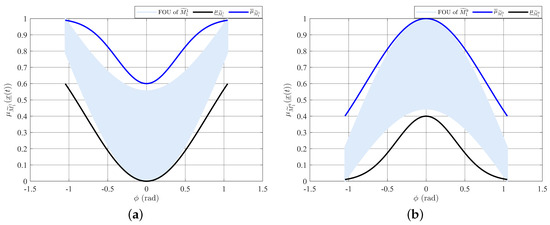
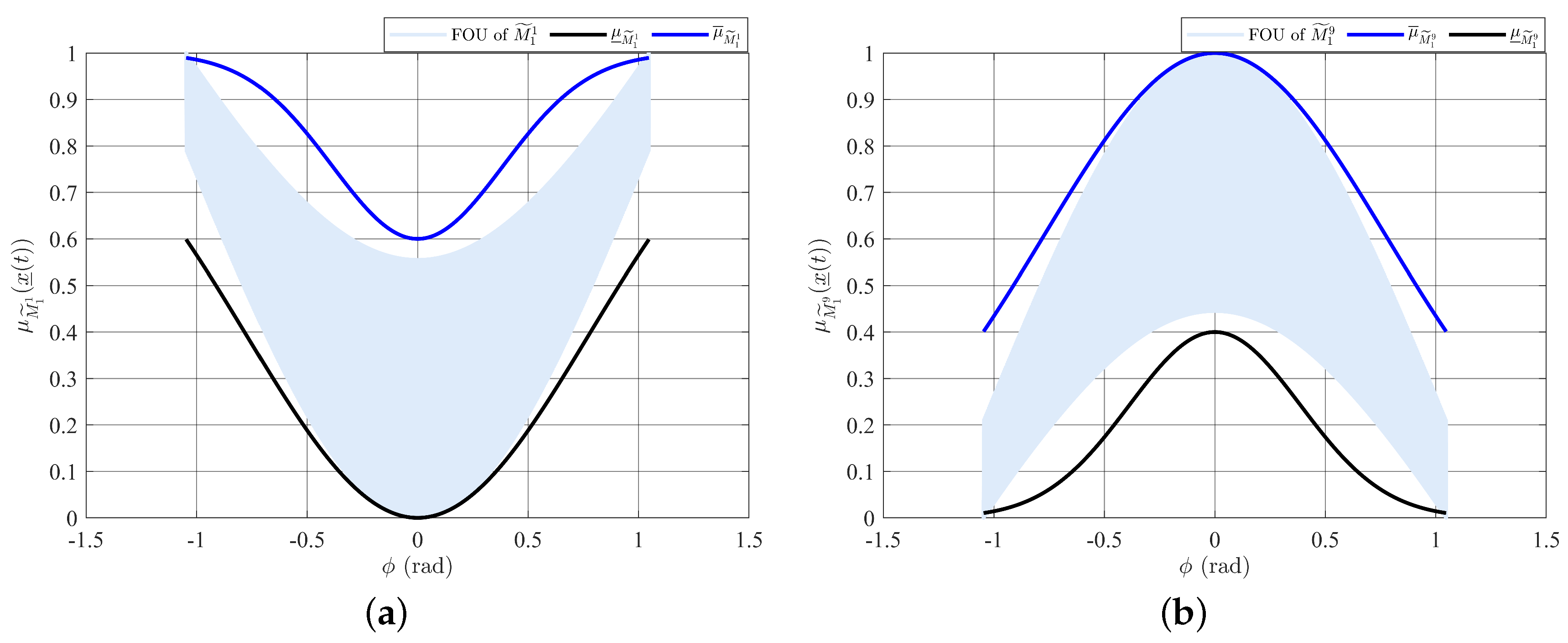
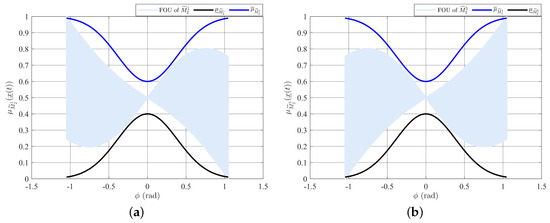
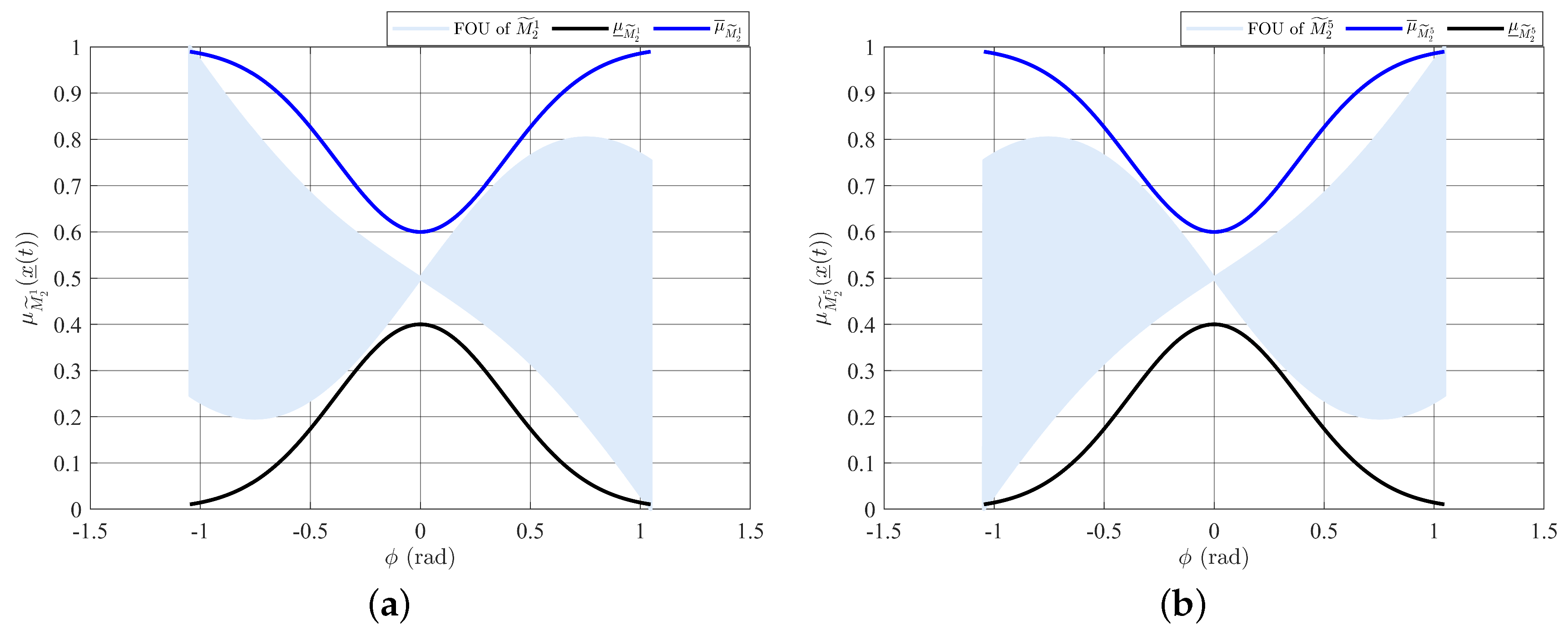
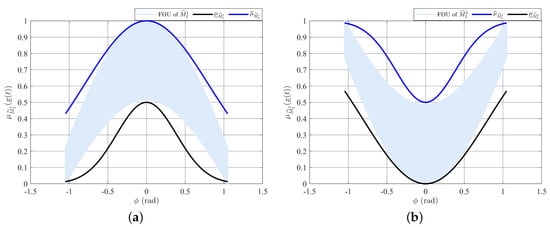
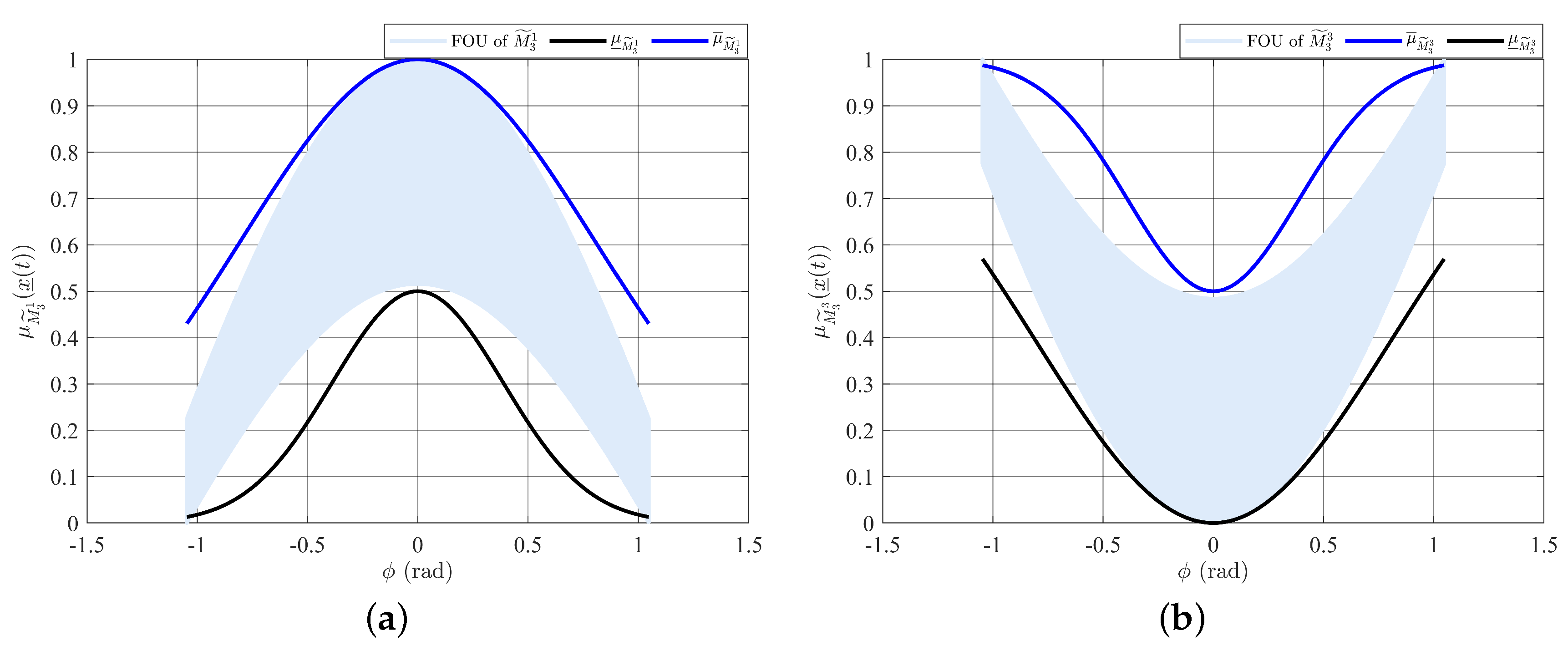
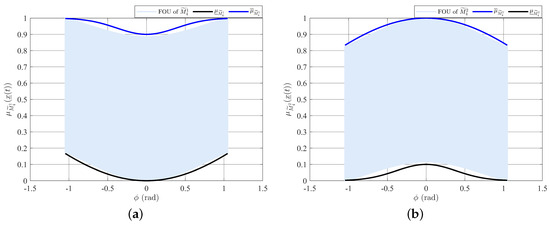
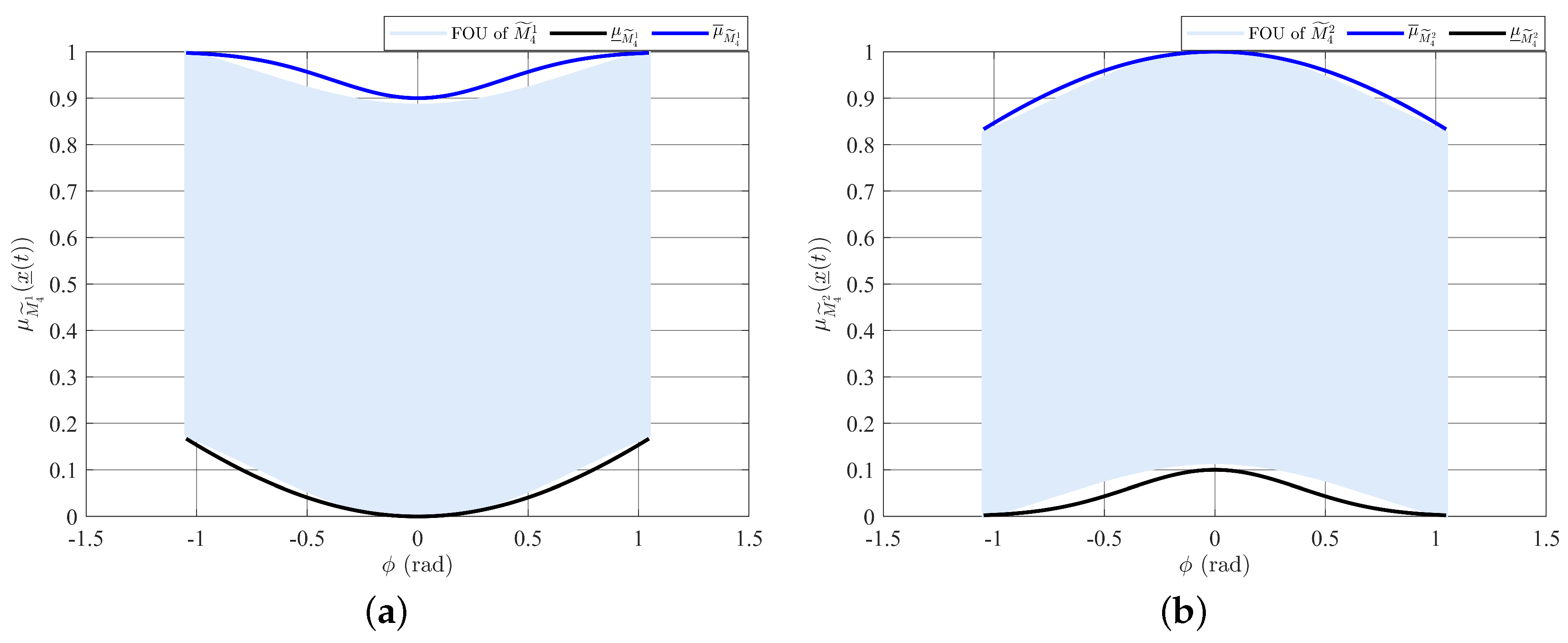
The footprints of uncertainty of the fuzzy sets are illustrated in the figures below.
For establishing the proposed controller, the selected parameters for the LQR design for each subsystem are as follows: and . The LQR controller for each subsystem is computed using the following MATLAB R2024a command: .
By solving the LMI conditions in Section 2.4, (35) and (36), the overall system is stable when there exist matrices . These matrices are obtained by solving the LMIs as follows:
Following the Figure 1, Figure 2, Figure 3 and Figure 4, the membership functions are establied for the IT2-TS fuzzy model for inverted pendulum on cart as follows:
where and are the lower and upper membership functions corresponding to the k-th vertex of the i-th premise variable, where and , respectively. The membership function corresponding to the other vertex of each premise variable i can be defined as and .
Figure 1.
Footprint of uncertainty, LUMF of (a) and (b) .
Figure 2.
Footprint of uncertainty, LUMF of (a) and (b) .
Figure 3.
Footprint of uncertainty, LUMF of (a) and (b) .
Figure 4.
Footprint of uncertainty, LUMF of (a) and (b) .
4. Simulation and Results
To validate the effectiveness of the proposed fuzzy modeling and control approach, simulations were conducted in Simulink using the aforementioned system parameters under several different scenarios, including simulations with different initial conditions and comparisons with the PDC method. Furthermore, several assessments based on performance indices are provided to demonstrate the effectiveness of the proposed method.
Firstly, to prove the stability of the proposed method, three different conditions are derived to ensure the stability of the system when the initial states are chosen within the region where the IT2-TS fuzzy model is established.
- 1.
- ,
- 2.
- ,
- 3.
- (with input signal noise).
4.1. Simulation Results for Stabilization Control
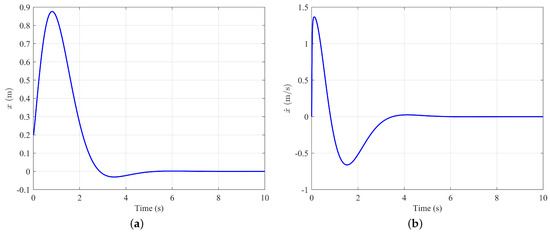
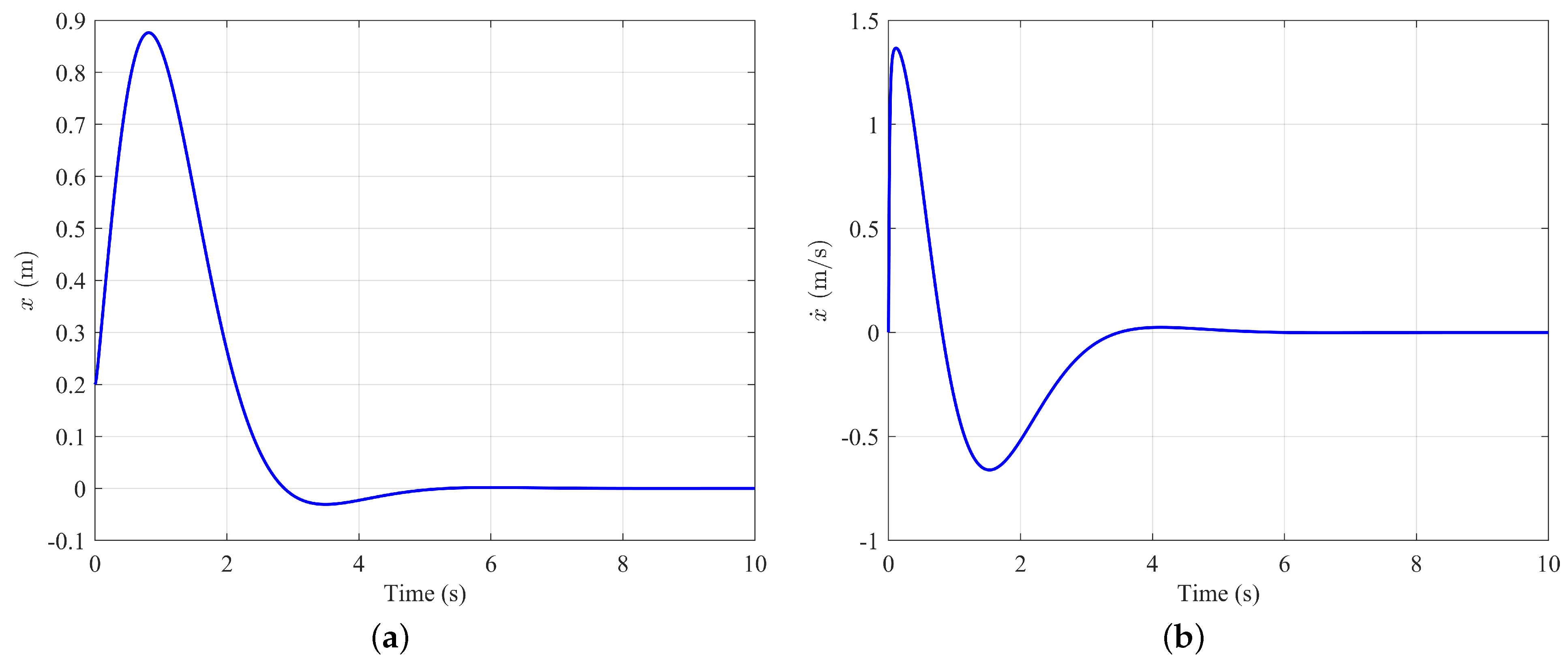
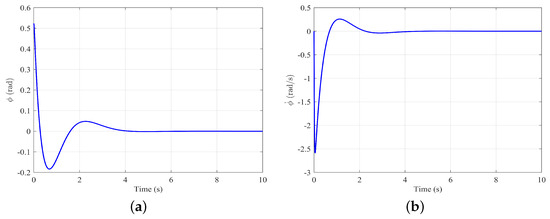
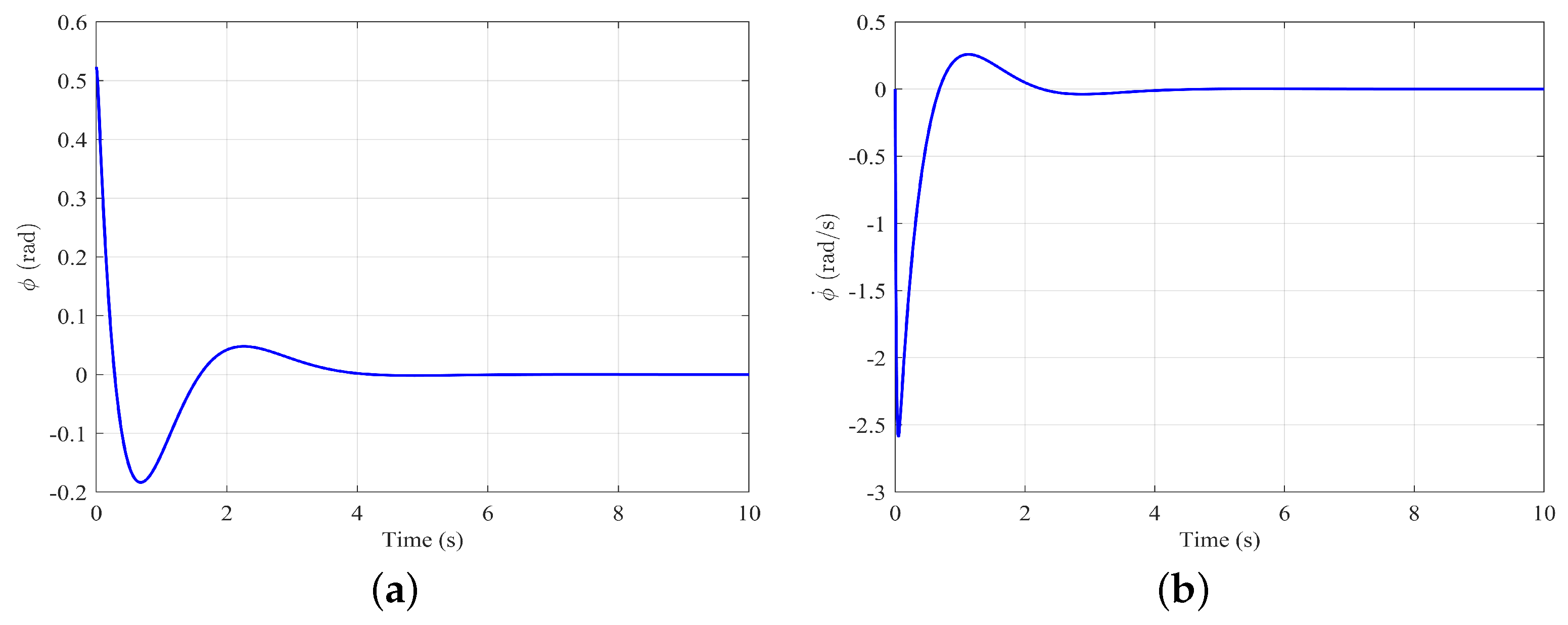
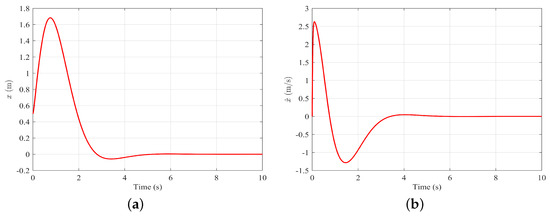
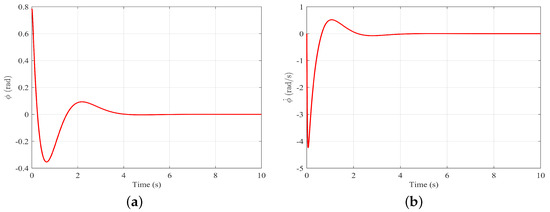
Figure 5 and Figure 6 illustrate the stabilization performance under the initial condition m and . In Figure 5, the cart position exhibits a short transient with a moderate overshoot and then converges to the equilibrium, while the cart velocity decays to zero after a brief oscillatory response. In Figure 6, the pendulum angle is regulated back to the upright position, and its angular velocity rapidly diminishes, confirming that the closed-loop system remains stable and achieves satisfactory damping for this initial deflection.
Figure 5.
Cart position (a) and cart velocity (b) with the initial angle (rad).
Figure 6.
Pendulum angle (a) and its angular velocity (b) with the initial angle (rad).
Figure 7 and Figure 8 present the responses for a larger initial angle m and . As expected, the transient amplitudes are larger than those in the case. Nevertheless, Figure 7 shows that the cart motion remains bounded and settles to the equilibrium without divergence, and the velocity converges to zero after the transient phase. Figure 8 demonstrates that the pendulum angle is successfully driven to the upright equilibrium and the angular velocity is damped out, indicating that the proposed approach can stabilize the system even under a more challenging initial condition.
Figure 7.
Cart position (a) and its velocity (b) with the initial angle (rad).
Figure 8.
Pendulum angle (a) and its angular velocity (b) with the initial angle (rad).
4.2. Simulation Results Under Input Disturbance
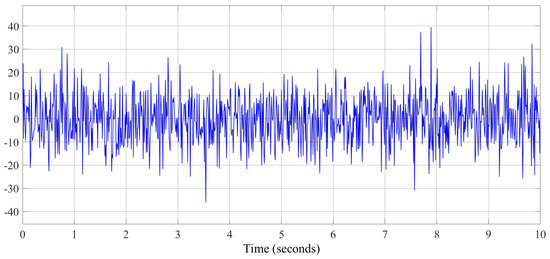
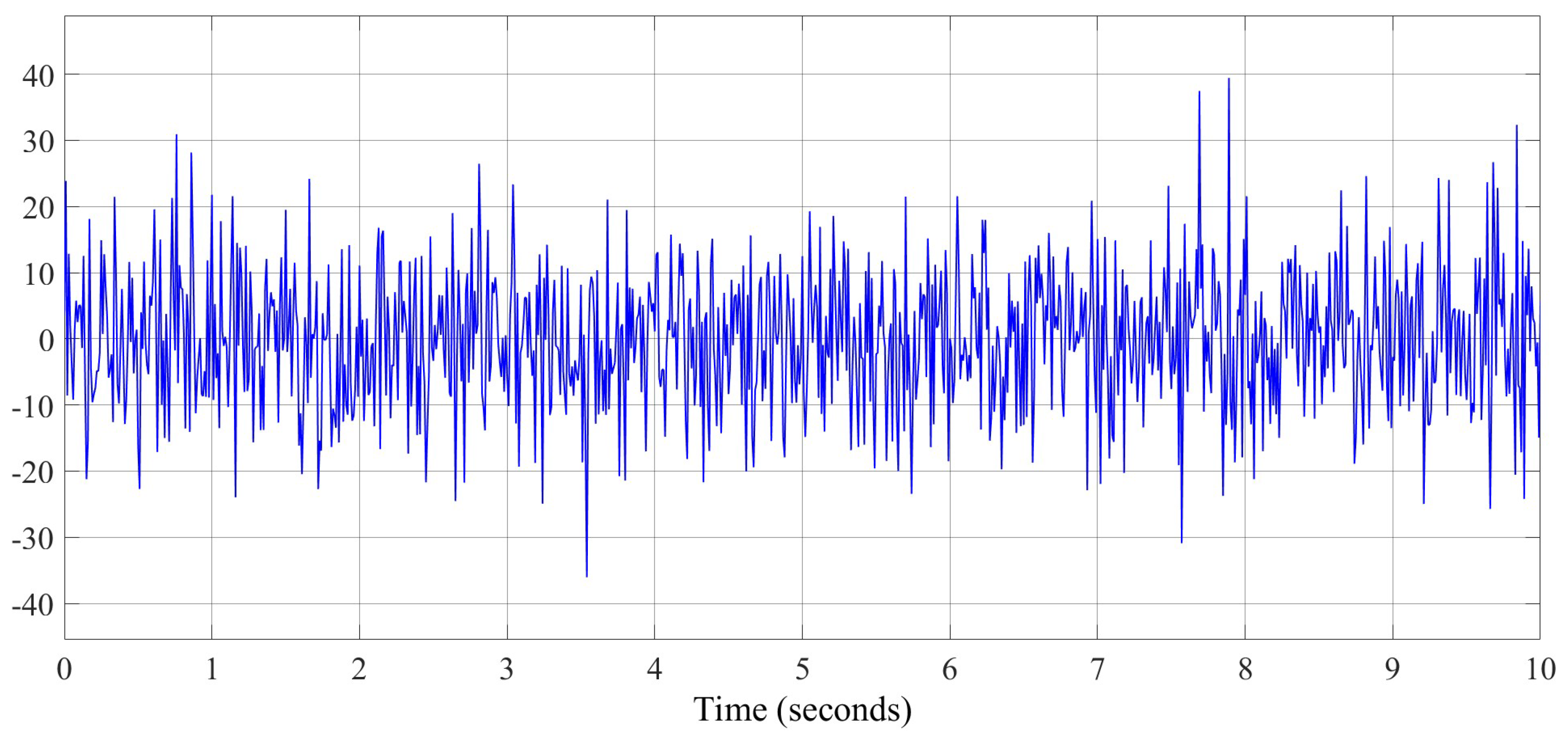
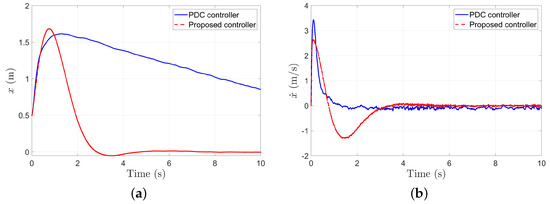
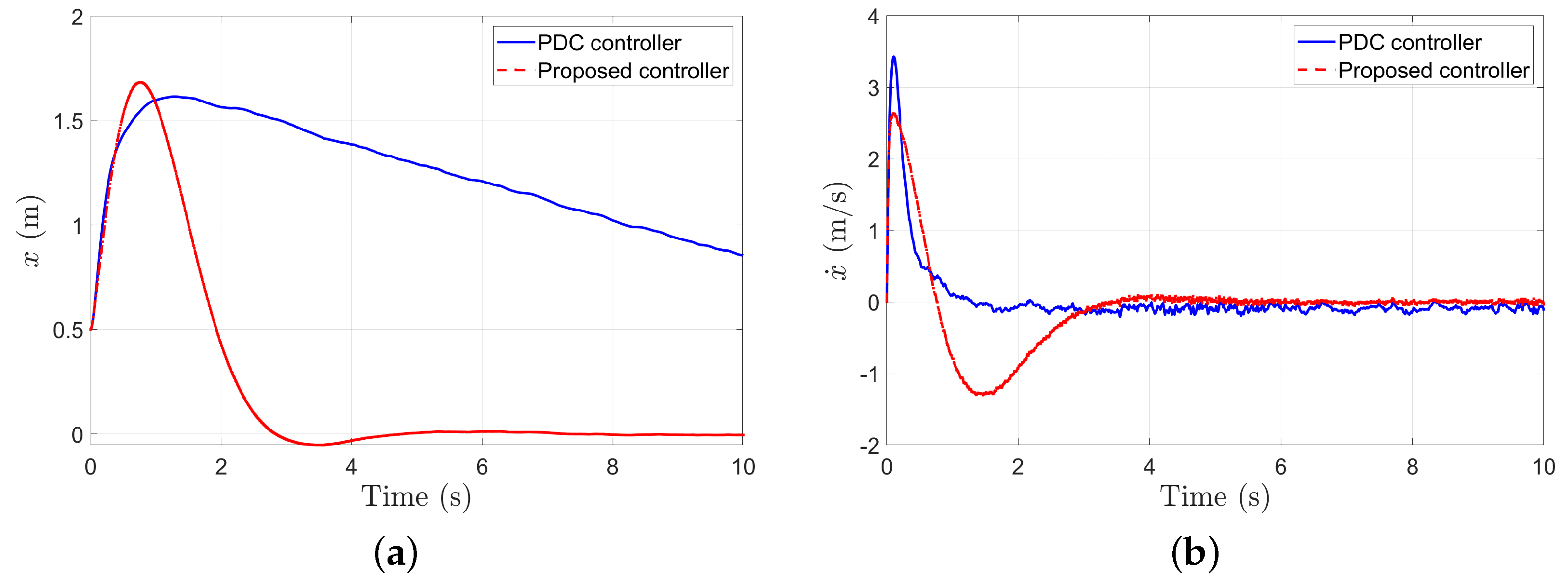
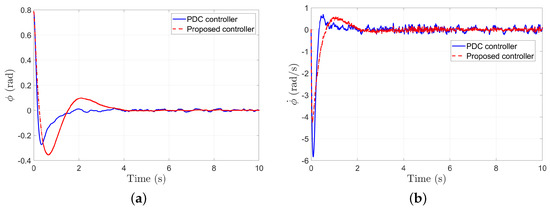
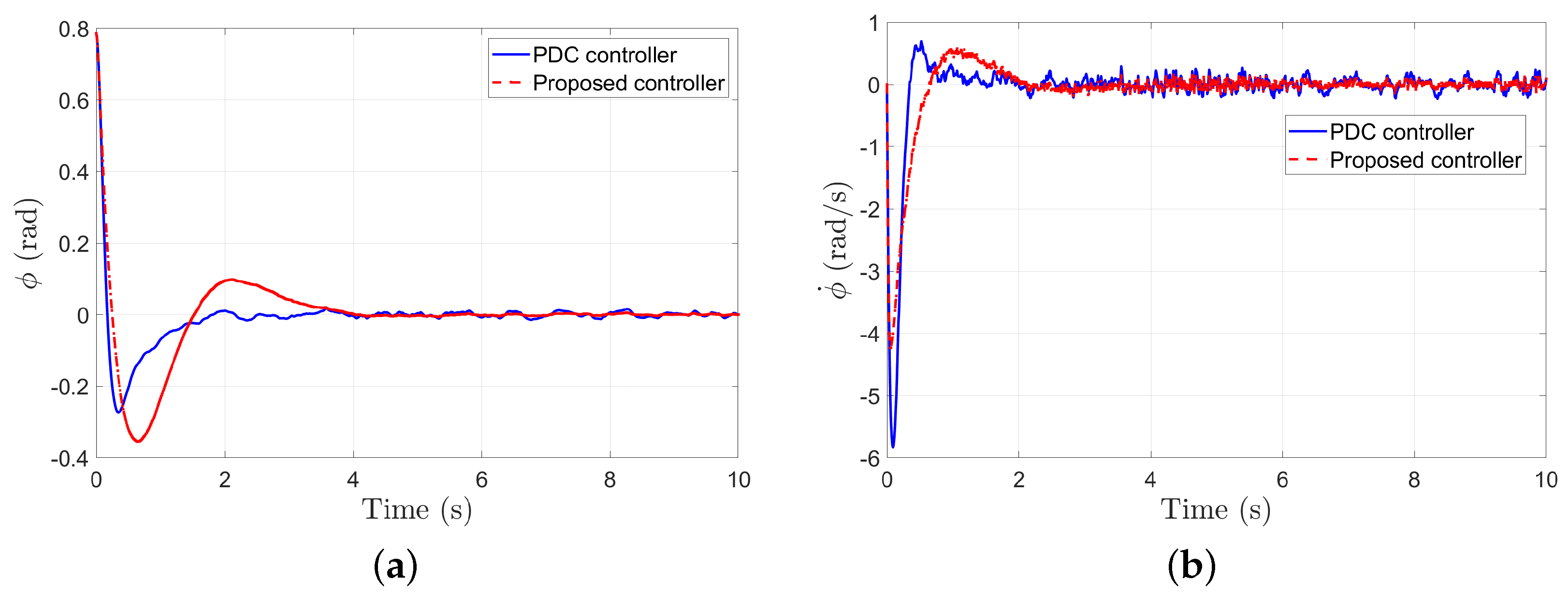
In this part, comparisons are conducted with a conventional PDC controller based on a type-1 TS fuzzy system [45], which is designed at the nominal point and , , and , with the same premise variables as those used in the proposed method. In this scenario, the disturbance is exerted on the system by an external input acting on the state and , and this signal is depicted in Figure 9. In Figure 10 and Figure 11, the blue line represents the response obtained using the PDC controller, while the red line represents the response using the proposed controller.
Figure 9.
Disturbance signal.
Figure 10.
Cart position (a) and its velocity (b) with the initial angle (rad) under disturbance.
Figure 11.
Pendulum angle (a) and its angular velocity (b) with the initial angle (rad) under disturbance.
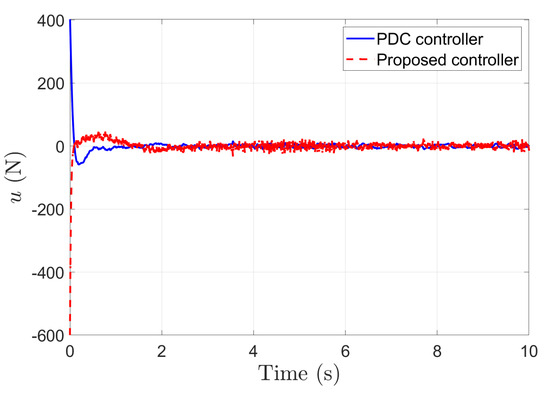
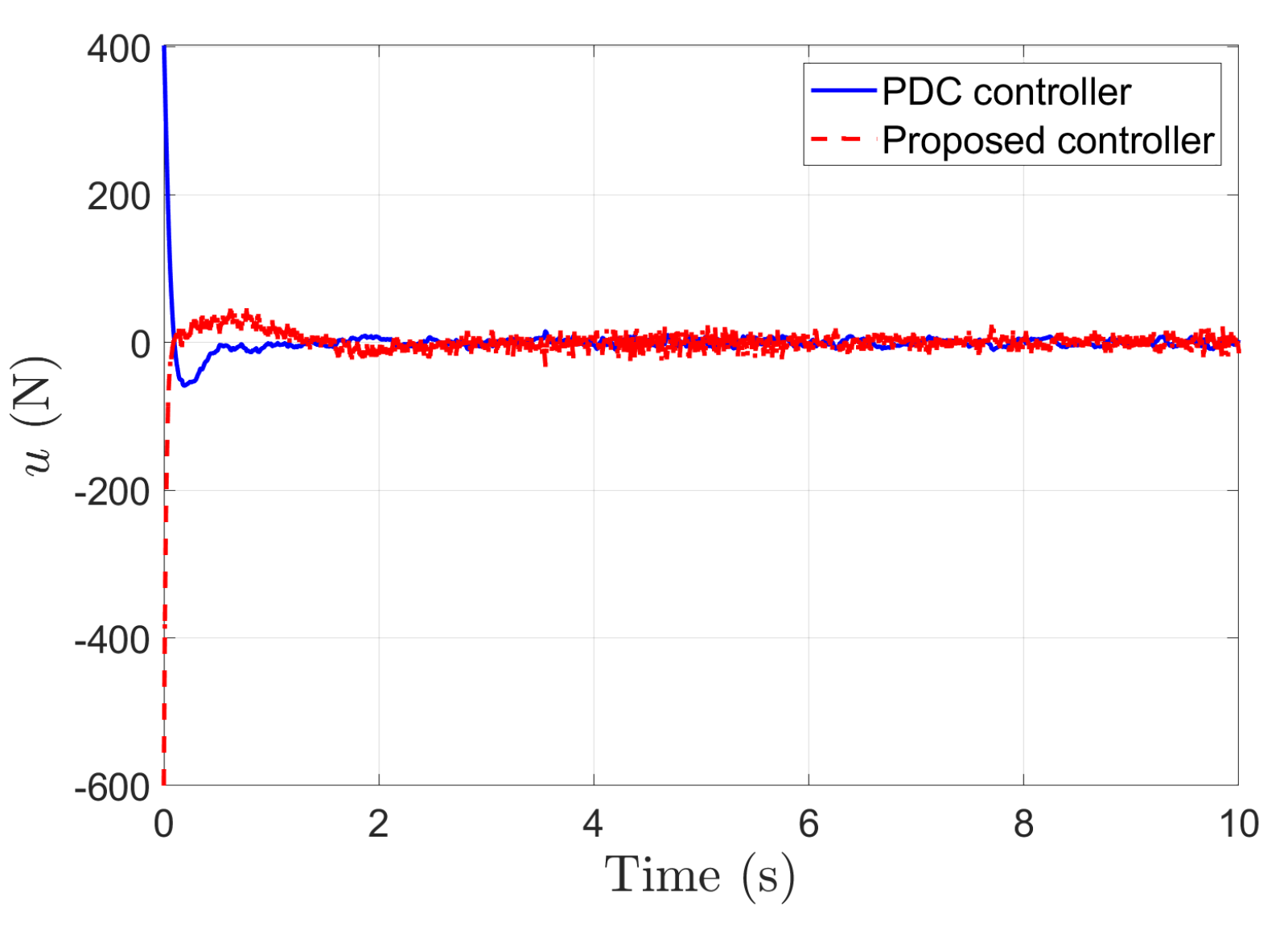
Figure 10 and Figure 11 show the closed-loop responses under input disturbance for the initial condition m and . In Figure 10, the cart position remains bounded and converges to the equilibrium after a transient, while the cart velocity settles close to zero with small residual fluctuations caused by the disturbance. In Figure 11, the pendulum angle is still regulated back to the upright equilibrium and remains within a small neighborhood around zero, whereas the angular velocity exhibits slight steady-state oscillations due to the noisy input. These results demonstrate that the proposed control strategy preserves stability and provides disturbance attenuation, maintaining acceptable tracking and damping performance in the presence of input noise. Figure 12 presents the control input response under external disturbance for the case where the initial angle is (rad).
Figure 12.
Control signal.
The , , and , , denote the overshoot, settling time, and RMSE values of the corresponding signals, respectively.
Following Table 1, the proposed method generally exhibits a better balance between settling time for the states while ensuring robustness under disturbances compared with the PDC controller. The PDC controller leads the system to settle quickly in three states, including , , and , while the proposed method outperforms it in terms of the settling time of state x, with only compared with of the PDC controller. Regarding overshoot, the proposed method improves the overshoot in the derivative states, including and , with values of only and compared with and of the PDC controller, respectively.
Table 1.
Overshoot, settling time, and RMSE values of the states.
In summary, during the transient process, the proposed method achieves a better balance between settling time and overshoot for all system states, while the PDC controller, although ensuring the overall system stability and convergence, results in some states converging slowly and exhibiting larger overshoot. Furthermore, as shown in Figure 10 and Figure 11, the robustness of the proposed method is explicitly demonstrated in the post-settling period, where the fluctuations are smaller than those obtained using the PDC controller. By contrast, the control effort represents a trade-off to ensure robustness, as the of the proposed method is larger than that of the PDC method.
In conclusion, the simulation results prove the effectiveness of the proposed method for control applications of IP systems with uncertainties and disturbances. The comparison emphasizes that the proposed method achieves a better balance between optimality and robustness in controlling the IP system compared with the PDC controller.
5. Conclusions
This paper presented an uncertainty-resilient stabilization framework for the inverted pendulum on a cart based on interval type-2 Takagi–Sugeno (IT2 T-S) fuzzy modeling and subsystem LQR control. The nonlinear pendulum–cart dynamics were represented as a weighted combination of local linear subsystems, where interval firing strengths were generated by lower and upper membership functions to capture modeling uncertainty. Instead of employing a conventional PDC controller, an LQR gain was computed for each subsystem and the final control signal was synthesized by blending the local LQR actions according to the normalized firing strengths. Simulation results under multiple initial conditions demonstrated that the cart position/velocity and pendulum angle/angular velocity were effectively regulated to the equilibrium with stable and well-damped responses, and the closed-loop system maintained bounded behavior even in the presence of input disturbance.
Although the proposed method is effective, it still faces several challenges. In particular, proving the stability of the original nonlinear system over a wide operating range remains difficult because the stability verification conditions are still conservative. In addition, the computational complexity increases significantly when dealing with highly complex systems. Future work will focus on extending the proposed method to more realistic settings and providing stronger validation. First, a rigorous stability and performance analysis will be developed, including less conservative conditions for interval type-2 fuzzy blending and a systematic selection procedure for the LQR weighting matrices. Second, the proposed approach will be evaluated under additional uncertainties, such as friction, actuator saturation, and sensor noise, and will be compared with PDC-based and other robust control strategies. Finally, experimental implementation on a laboratory pendulum-cart platform will be conducted to verify real-time feasibility and assess robustness under practical nonidealities. Furthermore, future studies will also investigate reduced-complexity design frameworks using imperfect premise matching techniques to extend the applicability of the proposed method to a broader class of real-world systems.
Funding
This research received no external funding.
Institutional Review Board Statement
Not applicable.
Informed Consent Statement
Not applicable.
Data Availability Statement
The original contributions presented in this study are included in the article. Further inquiries can be directed to the corresponding author.
Conflicts of Interest
The authors declare no conflicts of interest.
References
- Basaran, S. Modified inverted pendulum on a cart system with four-bar mechanism. ISA Trans. 2025, 159, 364–374. [Google Scholar] [CrossRef] [Scilit]
- Pham, D.B.; Dao, Q.T.; Nguyen, T.V.A. Optimized hierarchical sliding mode control for the swing-up and stabilization of a rotary inverted pendulum. Automation 2024, 5, 282–296. [Google Scholar] [CrossRef] [Scilit]
- Jeong, J.; Ban, J. Reinforcement learning-based friction compensation of an inverted pendulum on a cart. Int. J. Mach. Learn. Cybern. 2025, 16, 10939–10957. [Google Scholar] [CrossRef] [Scilit]
- Han, K.C.; Kim, J.Y. Posture stabilizing control of quadruped robot based on cart-inverted pendulum model. Intell. Serv. Robot. 2023, 16, 521–536. [Google Scholar] [CrossRef] [Scilit]
- Dong, B.T.; Nguyen, T.V.A. Reconstructing membership functions for observer-based controller design of takagi–sugeno fuzzy model with unmeasured premise variables. Int. J. Fuzzy Syst. 2026, 28, 478–491. [Google Scholar] [CrossRef] [Scilit]
- Pamplona Beron, L.E.; Gentiluomo, D.; De Simone, M.C.; Guida, D. Swing-Up and Stabilization Control of a Cart-Pendulum System Using NMPC, LQR, and Reinforcement Learning. In Proceedings of the International Conference “New Technologies, Development and Applications”; Springer: Berlin/Heidelberg, Germany, 2025; pp. 573–580. [Google Scholar] [CrossRef] [Scilit]
- Xing, H.; Liu, Y.; Chen, J.; Li, W.; Ding, L.; Tavakoli, M. Variable admittance control for door opening with a wheeled mobile manipulator considering ground obstacles. Intell. Serv. Robot. 2026, 19, 41. [Google Scholar] [CrossRef] [Scilit]
- Tran, Q.T.; Mai, T.G.; Duong, M.D.; Dao, Q.T. Modeling of Antagonistic Pneumatic Artificial Muscles Using Takagi-Sugeno Fuzzy Model. In Proceedings of the Advances in Information and Communication Technology; Springer: Berlin/Heidelberg, Germany, 2026; pp. 11–19. [Google Scholar] [CrossRef] [Scilit]
- Nguyen, H.P.; Bui, N.T.; Nguyen, T.-V.-A. Tracking control based on takagi-sugeno fuzzy descriptor model for overhead crane combined with input shaping. IEEE Access 2024, 12, 127507–127521. [Google Scholar] [CrossRef] [Scilit]
- Yue, S.; Xu, N.; Zhang, L.; Zhao, N. Observer-based event-triggered adaptive fuzzy hierarchical sliding mode fault-tolerant control for uncertain under-actuated nonlinear systems. Int. J. Fuzzy Syst. 2025, 27, 1303–1320. [Google Scholar] [CrossRef] [Scilit]
- Chen, X.; Fang, J.; Li, J. Robust control design and optimization for under-actuated mechanical systems considering fuzzy uncertainties. Processes 2025, 13, 609. [Google Scholar] [CrossRef] [Scilit]
- Dong, B.T.; Dao, Q.T.; Nguyen, M.L.; Nguyen, T.V.A. Fuzzy observer-based adaptive fault tolerant control for uncertain underactuated nonlinear systems under TS fuzzy model with unmeasured premise variables. J. Frankl. Inst. 2025, 363, 108270. [Google Scholar] [CrossRef] [Scilit]
- Aslam, M.S.; Bilal, H.; Vasilakos, A.V. Self–triggered Scheme Design for Takagi–Sugeno Fuzzy Model based on Mismatch Premise Variable with Time–varying Delay. IEEE Trans. Autom. Sci. Eng. 2025, 22, 15536–15548. [Google Scholar] [CrossRef] [Scilit]
- Coradini, M.F.; Felão, L.H.V.; Lyra, S.d.S.; Teixeira, M.C.M.; Kitano, C. Takagi–Sugeno Fuzzy Nonlinear Control System for Optical Interferometry. Sensors 2025, 25, 1853. [Google Scholar] [CrossRef] [Scilit]
- Nguyen, A.T.; Dequidt, A.; Nguyen, V.A.; Vermeiren, L.; Dambrine, M. Fuzzy descriptor tracking control with guaranteed L∞ error-bound for robot manipulators. Trans. Inst. Meas. Control 2021, 43, 1404–1415. [Google Scholar] [CrossRef] [Scilit]
- Zaman, M.Q.; Wu, H.M. Genetic algorithm based takagi-sugeno fuzzy modelling of a mecanum wheeled mobile robot. Int. J. Control Autom. Syst. 2025, 23, 907–919. [Google Scholar] [CrossRef] [Scilit]
- Xie, W.B.; Liang, J.S.; Wang, Z.H.; Yang, J. Non-monotonic Lyapunov function based membership function dependent robust control of Takagi–Sugeno fuzzy systems. Eng. Appl. Artif. Intell. 2025, 152, 110785. [Google Scholar] [CrossRef] [Scilit]
- Mátyás, A.; Lendek, Z. Observer design for time-delay TS fuzzy systems with nonlinear consequents. IFAC-PapersOnLine 2021, 54, 62–67. [Google Scholar] [CrossRef] [Scilit]
- Nguyen, H.P.; Nguyen, T.V.A. A reduced-complexity Takagi–Sugeno fuzzy descriptor control approach for double-pendulum overhead crane. J. Vib. Control 2026, 10775463261425077. [Google Scholar] [CrossRef] [Scilit]
- Michalíková, A. Explanation of Air Quality Data Using Takagi–Sugeno Fuzzy Inference System. Appl. Sci. 2025, 15, 3461. [Google Scholar] [CrossRef] [Scilit]
- Xue, G.; Hu, L.; Wang, J.; Ablameyko, S. ADMTSK: A high-dimensional Takagi–Sugeno–Kang fuzzy system based on adaptive Dombi T-norm. IEEE Trans. Fuzzy Syst. 2025, 33, 1767–1780. [Google Scholar] [CrossRef] [Scilit]
- Hwang, G.C.; Lin, S.C. A stability approach to fuzzy control design for nonlinear systems. Fuzzy Sets Syst. 1992, 48, 279–287. [Google Scholar] [CrossRef] [Scilit]
- Tang, H.H.; Ahmad, N.S. Fuzzy logic approach for controlling uncertain and nonlinear systems: A comprehensive review of applications and advances. Syst. Sci. Control Eng. 2024, 12, 2394429. [Google Scholar] [CrossRef] [Scilit]
- Chen, B.; Liu, X.P.; Ge, S.S.; Lin, C. Adaptive fuzzy control of a class of nonlinear systems by fuzzy approximation approach. IEEE Trans. Fuzzy Syst. 2012, 20, 1012–1021. [Google Scholar] [CrossRef] [Scilit]
- Zhao, X.; Wang, X.; Ma, L.; Zong, G. Fuzzy approximation based asymptotic tracking control for a class of uncertain switched nonlinear systems. IEEE Trans. Fuzzy Syst. 2019, 28, 632–644. [Google Scholar] [CrossRef] [Scilit]
- Dong, B.T.; Nguyen, T.V.A. Robust Fault-Tolerant Tracking Control for Nonlinear Systems Using a Takagi-Sugeno Fuzzy Model Based on a State and Fault Fuzzy Observer. Int. J. Robust Nonlinear Control 2025, 35, 6207–6229. [Google Scholar] [CrossRef] [Scilit]
- Li, J.; Lu, A.Y.; Deng, C.; Zhang, J.N. Efficient Fuzzy Model Predictive Tracking Control of Nonlinear Systems: A Membership Function Approximation Approach. IEEE Trans. Fuzzy Syst. 2026, 34, 924–936. [Google Scholar] [CrossRef] [Scilit]
- Pham, D.H.; Nguyen, D.H.; Pham, M.K.; Nguyen, T.V.A. Trajectory Tracking of Two-Wheeled Self-Balancing Mobile Robots Using MPPF-Constrained HSMC and Interval Type-2 Fuzzy Logic. J. Frankl. Inst. 2026, 363, 108551. [Google Scholar] [CrossRef] [Scilit]
- Wei, C.; Zhao, T.; Cao, J.; Li, P. Water quality prediction model based on interval type-2 fuzzy neural network with adaptive membership function. Int. J. Fuzzy Syst. 2025, 28, 940–954. [Google Scholar] [CrossRef] [Scilit]
- Nguyen, D.H.; Nguyen, T.v.A.; Bui, N.T. Trajectory Tracking of Cable-Driven Parallel Robot via a Hybrid Structure of Type-2 Fuzzy Controllers and Sliding Mode Control Under Disturbances and Pulley Friction with Vibration Analysis. IEEE Access 2025, 13, 188534–188551. [Google Scholar] [CrossRef] [Scilit]
- Dirik, M.; Castillo, O.; Kocamaz, A.F. Gaze-Guided Control of an Autonomous Mobile Robot Using Type-2 Fuzzy Logic. Appl. Syst. Innov. 2019, 2, 14. [Google Scholar] [CrossRef] [Scilit]
- Castillo, O.; Melin, P. A review on interval type-2 fuzzy logic applications in intelligent control. Inf. Sci. 2014, 279, 615–631. [Google Scholar] [CrossRef] [Scilit]
- Lam, H.K.; Xiao, B.; Chen, M. A Review on Interval Type-2 Fuzzy-Model-Based Control Systems: Membership-Function-Dependent Perspectives. IEEE Trans. Fuzzy Syst. 2025, 33, 3856–3870. [Google Scholar] [CrossRef] [Scilit]
- Pérez-Briceño, C.; Ponce, P.; Mei, Q.; Fayek, A.R. A Type-2 Fuzzy Logic Expert System for AI Selection in Solar Photovoltaic Applications Based on Data and Literature-Driven Decision Framework. Processes 2025, 13, 1524. [Google Scholar] [CrossRef] [Scilit]
- Zeng, Y.; Hussein, Z.A.; Chyad, M.H.; Farhadi, A.; Yu, J.; Rahbarimagham, H. Integrating type-2 fuzzy logic controllers with digital twin and neural networks for advanced hydropower system management. Sci. Rep. 2025, 15, 5140. [Google Scholar] [CrossRef] [Scilit] [PubMed]
- Nguyen, D.H.; Nguyen, T.V.A. Optimized Interval Type-2 Fuzzy Control Using Modified Shark Smell Algorithm for Precision Trajectory Tracking of 8-Cable-Driven Parallel Robots. Int. J. Fuzzy Syst. 2026, 1–15. [Google Scholar] [CrossRef] [Scilit]
- Zhao, N.; Zhao, T.; Cao, J.; Shi, H. Fault diagnosis of dual-network recursive interval type-2 fuzzy neural network based on SVD-TLS optimization. Comput. Ind. Eng. 2025, 207, 111280. [Google Scholar] [CrossRef] [Scilit]
- Sain, D.; Praharaj, M.; Mohan, B.; Yang, J.M. Interval type-2 fuzzy PID controllers with interval of confidence and various types of footprints of uncertainty. Inf. Sci. 2025, 699, 121795. [Google Scholar] [CrossRef] [Scilit]
- Li, Y.; Mei, K.; Ma, L.; Ding, S. Adaptive interval type-2 fuzzy SOSM control for nonlinear systems with uncertainties. Int. J. Fuzzy Syst. 2025, 1–12. [Google Scholar] [CrossRef] [Scilit]
- Lam, H.K.; Li, H.; Deters, C.; Secco, E.L.; Wurdemann, H.A.; Althoefer, K. Control design for interval type-2 fuzzy systems under imperfect premise matching. IEEE Trans. Ind. Electron. 2013, 61, 956–968. [Google Scholar] [CrossRef] [Scilit]
- Xiao, B.; Lam, H.K.; Rathinasamy, S. Interval type-2 fuzzy-model-based control design and membership-functions-dependent analysis. Int. J. Syst. Sci. 2023, 54, 2837–2839. [Google Scholar] [CrossRef] [Scilit]
- Wang, Z.; Lam, H.K.; Meng, A.; Li, Z. Relaxed stabilization of event-triggered interval type-2 T–S fuzzy positive systems with stochastic actuator failure. IEEE Trans. Fuzzy Syst. 2023, 31, 4435–4446. [Google Scholar] [CrossRef] [Scilit]
- Yang, Z.X.; Jhong, B.G.; Su, S.F.; Chen, M.Y. An Approach to Generate the LQR Based Takagi–Sugeno Fuzzy Model Controller for Nonlinear System. Int. J. Fuzzy Syst. 2025, 1–12. [Google Scholar] [CrossRef] [Scilit]
- Mon, Y.J. Fuzzy PDC-Based LQR Sliding Neural Network Control for Two-Wheeled Self-Balancing Cart. Electronics 2025, 14, 1842. [Google Scholar] [CrossRef] [Scilit]
- Pham, D.B.; Pham, D.T.; Dao, Q.T.; Nguyen, V.A. Takagi-sugeno fuzzy control for stabilizing nonlinear inverted pendulum. In Intelligent Systems and Networks: Selected Articles from ICISN 2022; Springer: Singapore, 2022; pp. 333–341. [Google Scholar] [CrossRef] [Scilit]
- Hazem, Z.B.; Fotuhi, M.J.; Bingül, Z. Development of a Fuzzy-LQR and Fuzzy-LQG stability control for a double link rotary inverted pendulum. J. Frankl. Inst. 2020, 357, 10529–10556. [Google Scholar] [CrossRef] [Scilit]
- Jeon, T.; Paek, I. Design and Verification of the LQR Controller Based on Fuzzy Logic for Large Wind Turbine. Energies 2021, 14, 230. [Google Scholar] [CrossRef] [Scilit]

Disclaimer/Publisher’s Note: The statements, opinions and data contained in all publications are solely those of the individual author(s) and contributor(s) and not of MDPI and/or the editor(s). MDPI and/or the editor(s) disclaim responsibility for any injury to people or property resulting from any ideas, methods, instructions or products referred to in the content. |
© 2026 by the author. Licensee MDPI, Basel, Switzerland. This article is an open access article distributed under the terms and conditions of the Creative Commons Attribution (CC BY) license.