


Abstract
Glucagon-like peptide-1 receptor agonists (GLP-1 RAs) are widely prescribed for type 2 diabetes mellitus (T2DM) and obesity, with well-documented benefits for weight reduction, glycemic control, and cardiovascular health. Preclinical evidence and emerging clinical data suggest that GLP-1 RAs may exert anti-inflammatory and chondroprotective effects relevant to osteoarthritis (OA). While most research focuses on weight-bearing joints, the potential impact on non-weight-bearing joints remains unclear. The available evidence utilized in this review was in the form of clinical studies, database analyses, and animal models. The databases of PubMed, Embase, Cochrane Library, and Google Scholar were utilized to extract data. Search criteria included “GLP-1 receptor agonist”, “Ozempic”, “osteoarthritis”, “inflammation”, “non-weight-bearing joints”, “shoulder osteoarthritis”, and “hand osteoarthritis”. When non-weight-bearing joint-specific literature was unavailable, evidence from weight-bearing joints was examined to infer possible implications. Preclinical studies demonstrate that GLP-1 RAs can reduce pro-inflammatory cytokines, inhibit chondrocyte apoptosis, and modulate NF-κB signaling in joint tissues. In human OA cohorts, GLP-1 RA use has been associated with slower cartilage loss, lower pain scores, and reduced rates of arthroplasty in patients with established OA, including effects not fully explained by weight loss. However, large database studies have also reported increased OA diagnoses in individuals using GLP-1 RAs with no pre-existing disease. Although direct evidence in non-weight-bearing OA is sparse, findings from weight-bearing joint studies suggest a potential disease-modifying role for GLP-1 RAs, alongside possible risks. The heterogeneity of reported effects underscores the need for targeted clinical trials in hand, wrist, and shoulder OA.
1. Introduction
Osteoarthritis (OA) is the most prevalent joint disorder worldwide and a leading cause of disability in adults. OA can be categorized as occurring in weight-bearing and non-weight-bearing joints. In this review, “non-weight-bearing joint” is used operationally to describe upper-limb joints that are not routinely exposed to axial body-weight transmission as are the hips, knees and spine. The term does not imply absence of mechanical joint loading. While the knees, hips, and spine are more commonly studied in conjunction with OA, non-weight-bearing joints found mostly in the hands, wrists, elbows, and shoulders also impose substantial functional limitations and healthcare burden as assessed by Bijlsma et al. [1]. Hunter and Bierma-Zeinstra, meanwhile, highlight that these non-weight-bearing joints in the upper limbs remain vulnerable to degenerative changes through cartilage breakdown, synovial inflammation, and subchondral bone remodeling [2]. Hand osteoarthritis is notably common, with an age-standardized prevalence of radiographic hand OA of 44.2% among women in the Framingham Osteoarthritis Study; upper-limb OA is also relevant in occupations involving repetitive hand use [3].
Upper- and lower-limb OA share core aspects of cartilaginous and synovial mechanisms such as degenerative and inflammatory processes. Their biomechanical environments, however, differ in several ways (e.g., function, weight carried, amount of repetitive use, stability). These differences encourage investigation into metabolic and inflammatory pathways, including GLP-1 signaling, that may influence OA in aspects not solely dependent on weight-bearing mechanics.
Drucker describes glucagon-like peptide-1 receptor agonists (GLP-1 RAs) as incretin-based therapies first developed for type 2 diabetes mellitus (T2DM), now also approved for obesity management. Their benefits in weight reduction, glycemic control, and cardiovascular health are well established [4]. More recently, experimental and clinical evidence by Meurot et al. in France has suggested potential disease-modifying effects in OA. Mechanistic studies show GLP-1 RAs exert anti-inflammatory actions, modulate catabolic pathways, and protect chondrocytes from apoptosis [5]. The presence of GLP-1 receptors in human cartilage and synovium, as Chen et al. demonstrate, identifies an potential mechanistic pathway for these hypotheses [6].
Most human data come from studies of weight-bearing joints, which cannot be directly extrapolated to non-weight-bearing sites. In non-weight-bearing joints, metabolic and inflammatory mechanisms may play a significant role in overall joint health rather than mechanical loading, raising the possibility of their potential usage as a model to assess weight-loss-independent effects of GLP-1 Ras. For orthopedic surgeons, understanding these effects is clinically relevant, as these GLP-1 Ras are increasingly encountered in patients presenting with upper-limb OA. Investigation into largely untested theories of their influence of symptom progression, timing of surgery, and rehabilitation potential would be prudent. However, possible adverse effects such as arthralgia or lean mass loss also warrant consideration.
Existing treatment options for upper-limb OA consist primarily of activity modification, physical therapy, analgesics, splinting, and surgery. These therapies are effective at reducing pain and improving function, but in the context of metabolic and inflammatory changes in upper-limb joints there is insufficient evidence that they address these aspects of OA progression. GLP-1 RAs should not be considered an OA treatment currently; rather, their proposed biological mechanisms make them an intriguing subject for investigation as a potential supportive therapy.
This review synthesizes current knowledge of GLP-1 RAs in non-weight-bearing OA, drawing on mechanistic and weight-bearing joint data where direct evidence is limited.
2. Methods
This study was conducted as a narrative review on 25 April 2025 to synthesize current evidence on glucagon-like peptide-1 receptor agonists (GLP-1 RAs) and their potential effects on osteoarthritis (OA), with a focus on non-weight-bearing joints. A narrative approach was chosen due to the limited number of directly relevant studies and the heterogeneity in study design, populations, and outcomes across the available literature. The first attempt to obtain texts was a search of Pub Med and Embase with the following search strategy:
((((((((("Acromioclavicular Joint"[Mesh]) OR "Atlanto-Axial Joint"[Mesh]) OR "Atlanto-Occipital Joint"[Mesh]) OR "Elbow Joint"[Mesh]) OR "Hand Joints"[Mesh]) OR "Pubic Symphysis"[Mesh]) OR "Shoulder Joint"[Mesh]) OR "Sternocostal Joints"[Mesh]) OR "Temporomandibular Joint"[Mesh]) AND ((("Anti-Obesity Agents"[Mesh]) OR "Glucagon-Like Peptide 1"[Mesh]) OR "semaglutide" [Supplementary Concept]).
This strategy yielded 0 results in both databases. Comparable searches were also placed in Google Scholar and Cochrane with their site-specific search terminology, which likewise yielded 0 results.
Consequently, the team adopted a more exploratory approach, using broader and less complex keyword searches and manual screening of articles to identify relevant literature. The following methodology was subsequently completed with each of the four student investigators assembling and assessing the texts found. Texts were shared amongst the student investigators, and any duplicates were appropriately removed from consideration.
The search was redone on 2 September 2026, at which time 1 result was found using the aforementioned strategy. Additional exploratory searches were subsequently performed to discover any works published in the year following the initial search that met inclusion criteria.
2.1. Search Strategy
A literature search was conducted using PubMed, Embase, Cochrane Library, and Google Scholar. Articles published between 1 January 2000 and 2 September 2026 were included to ensure reproducibility and coincide with the first GLP-1 launch. Open Evidence was also used as an auxiliary search tool to verify that no other sources existed that were worth pursuing in this review.
Search terms included combinations of controlled vocabulary and keywords related to:
- Intervention: “GLP-1 receptor agonist,” “glucagon-like peptide-1,” “semaglutide,” “liraglutide,” “dulaglutide,” “Ozempic”;
- Condition: “osteoarthritis,” “cartilage,” “chondrocyte,” “synovium”;
- Mechanisms: “inflammation,” “NF-kB,” “cytokines,” “apoptosis,” “metabolic inflammation”;
- Anatomy: “non-weight-bearing joints,” “hand,” “wrist,” “elbow,” “shoulder osteoarthritis”.
Boolean operators (AND/OR) were applied to combine terms. Reference lists of included articles were also manually screened to identify additional relevant studies.
Because the search process evolved to encompass a broader scope and was not designed as a systematic review, exact search strategies and record counts for each query were not recorded.
2.2. Eligibility Criteria
Inclusion criteria:
- Studies published in English;
- Publication year ≥2000;
- Human clinical studies, observational studies, database analyses, animal models, or in vitro/mechanistic studies;
- Studies evaluating GLP-1 RAs in relation to:
- ○
- OA outcomes (pain, function, imaging, arthroplasty risk);
- ○
- Cartilage biology or chondrocyte activity;
- ○
- Synovial or systemic inflammation.
Exclusion criteria:
- Non-English publications;
- Studies prior to 2000;
- Non-OA musculoskeletal conditions;
- Non-incretin pharmacologic intervention;
- Editorials, commentaries, and conference abstracts without primary data.
Duplicate records identified across databases were removed before screening.
2.3. Study Selection
All retrieved records underwent a two-stage screening process:
- Title and abstract screening to assess relevance to GLP-1 RAs, OA, or related mechanisms;
- Full-text review to confirm eligibility based on inclusion and exclusion criteria.
Discrepancies in inclusion were resolved through discussion among the authors. Studies meeting all criteria were included in the final synthesis. A total of 23 studies were included.
2.4. Data Synthesis
Due to heterogeneity in study design and outcome measures, a quantitative meta-analysis was not feasible. Instead, findings were synthesized narratively and grouped into:
- Mechanistic and molecular evidence;
- Preclinical (animal/in vitro) studies;
- Clinical and observational data;
- Orthopedic and clinical implications.
Because direct evidence in non-weight-bearing joints was severely limited, findings from weight-bearing joint studies were included when mechanistically applicable, with explicit acknowledgement of this extrapolation.
3. Mechanistic Rationale for GLP-1 RA Effects in OA
GLP-1 RAs may influence OA through both systemic metabolic improvements and direct local joint preservation. These mechanisms may be especially relevant in upper-limb joints, where mechanical unloading from reduced body mass is expected to have different levels of effect compared to knee or hip OA.
3.1. Indirect Metabolic and Anti-Inflammatory Effects
Obesity and metabolic dysfunction may contribute to OA through adipokine dysregulation, chronic low-grade inflammation, and increased production of pro-inflammatory cytokines [7]. GLP-1 RAs improve glycemic control, reduce insulin resistance, and lower systemic inflammation—changes that may influence cartilage biology across different mechanical loading environments [8,9]. He et al. discuss that improved glycemic control may also reduce advanced glycation end products (AGEs) in cartilage, which stiffen the matrix and impair repair capacity [10]. AGEs pose a structural threat beyond the mechanical stiffening of the extracellular matrix; they act as potent and sustained inflammatory drivers. AGEs serve as primary ligands for the Receptor for Advanced Glycation End Products (RAGE), which is widely expressed on the surface of both chondrocytes and synovial fibroblasts. The interaction between these ligands and their receptor triggers a feed-forward intracellular signaling loop that perpetuates oxidative stress and amplifies catabolic cytokine release, independent of mechanical joint loading. The improvements in glycemic regulation brought on by GLP-1 RAs deplete the substrate necessary for continuous AGE formation. Furthermore, experimental models utilizing primary chondrocytes have demonstrated that direct GLP-1 receptor activation significantly downregulates RAGE protein expression, directly hindering AGE-induced inflammatory cytokine production and subsequent catabolic matrix degradation [11]. Consequently, this dual mechanism—depleting the AGE substrate and downregulating its receptor—mitigates RAGE-mediated catabolic pathways within the joint space to preserve cellular resilience and matrix elasticity.
3.2. Direct Effects on Cartilage and Synovium
GLP-1 receptors are expressed in articular cartilage and synovial membranes [7]. Preclinical studies, mainly in knee OA models, show that GLP-1 RAs:
- Modulate inflammatory and catabolic signaling pathways in experimental OA models [6,7,12].
- Reduce chondrocyte apoptosis and preserve extracellular matrix integrity [7].
- Potentially promote anabolic repair pathways in cartilage [7].
Though direct evidence in non-weight-bearing OA is lacking, experimental studies provide biological plausibility for GLP-1 receptor-mediated modulation of inflammatory pathways relevant to OA. Liraglutide has demonstrated anti-inflammatory and anti-degradative effects in experimental OA models [6], while studies in AGE-exposed chondrocytes have shown reductions in inflammatory signaling and apoptosis [12]. Additional mechanistic evidence from non-OA cellular models suggests that liraglutide can inhibit NF-kB activation [11]. Collectively, these findings support a potential anti-inflammatory role for GLP-1 receptor signaling; however, the evidence remains predominantly preclinical, and findings from non-OA experimental systems should not be interpreted as evidence of therapeutic efficacy in OA or extrapolated directly to non-weight-bearing joints.
Recent work has supported a metabolic rationale for direct joint effects. In an obesity-associated murine OA model, semaglutide was associated with OA attenuation and chondrocyte metabolic homeostasis. The investigators proposed involvement of GLP-1 receptor–AMPK–PFKFB3 signaling and used diet-controlled experimental conditions intended to demonstrate a weight-loss-independent mechanism. Although these data provides biological rationale for potential metabolic effects beyond mechanical unloading, they remain translational and do not establish clinical efficacy in non-weight-bearing joint OA. Metabolic stress can promote an obesogenic or diabetic joint microenvironment, leading to mitochondrial dysfunction, reactive oxygen species (ROS) production, chondrocyte apoptosis, and expression of cartilage-degrading enzymes such as matrix metalloproteinase-3 (MMP-3). AMP-activated protein kinase (AMPK) activation has been associated with cellular energy regulation and autophagy, and may contribute to the chondroprotective effects attributed to GLP-1 receptor signaling [13,14,15,16]. Table 1 summarizes the current evidence regarding the GLP-1 RAs in OA while Table 2 summarizes their proposed mechanisms. Preclinical studies provide biological rationales for investigating a chondroprotective role of GLP-1 receptor agonists in OA, although nearly all work to date has been conducted in weight-bearing joint models.
Table 1.
Summary and hierarchy of GLP-1 RA evidence relevant to osteoarthritis.
Table 2.
Proposed mechanisms of GLP-1 RA effects in osteoarthritis and supporting evidence.
- Liraglutide in murine OA models: Reduced synovial inflammation, lowered TNF-α and IL-6 concentrations, and inhibited chondrocyte apoptosis [6].
- Cartilage explant studies: GLP-1 receptor stimulation led to reduced expression of matrix metalloproteinases (MMP-3), key mediators of cartilage matrix breakdown [6].
While these models primarily involve the knee, the identified pathways, including NF-κB and AMPK signaling, may not be joint-specific and therefore warrant investigation in other synovial joints expressing GLP-1 receptors. However, whether these mechanisms translate into clinically meaningful effects in non-weight-bearing OA remains unknown. A 2025 systematic review of preclinical and human studies similarly found promising chondroprotective and immunomodulatory signals for GLP-1 RAs in experimental OA models but concluded that the available human evidence remains largely limited to knee OA and therefore does not provide direct evidence for OA in non-weight-bearing joints [22].
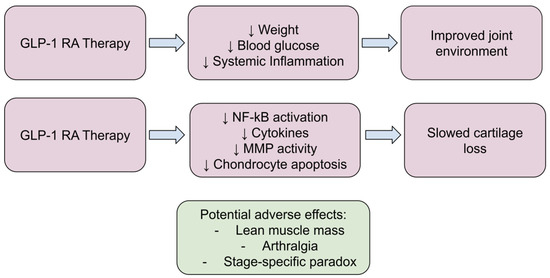
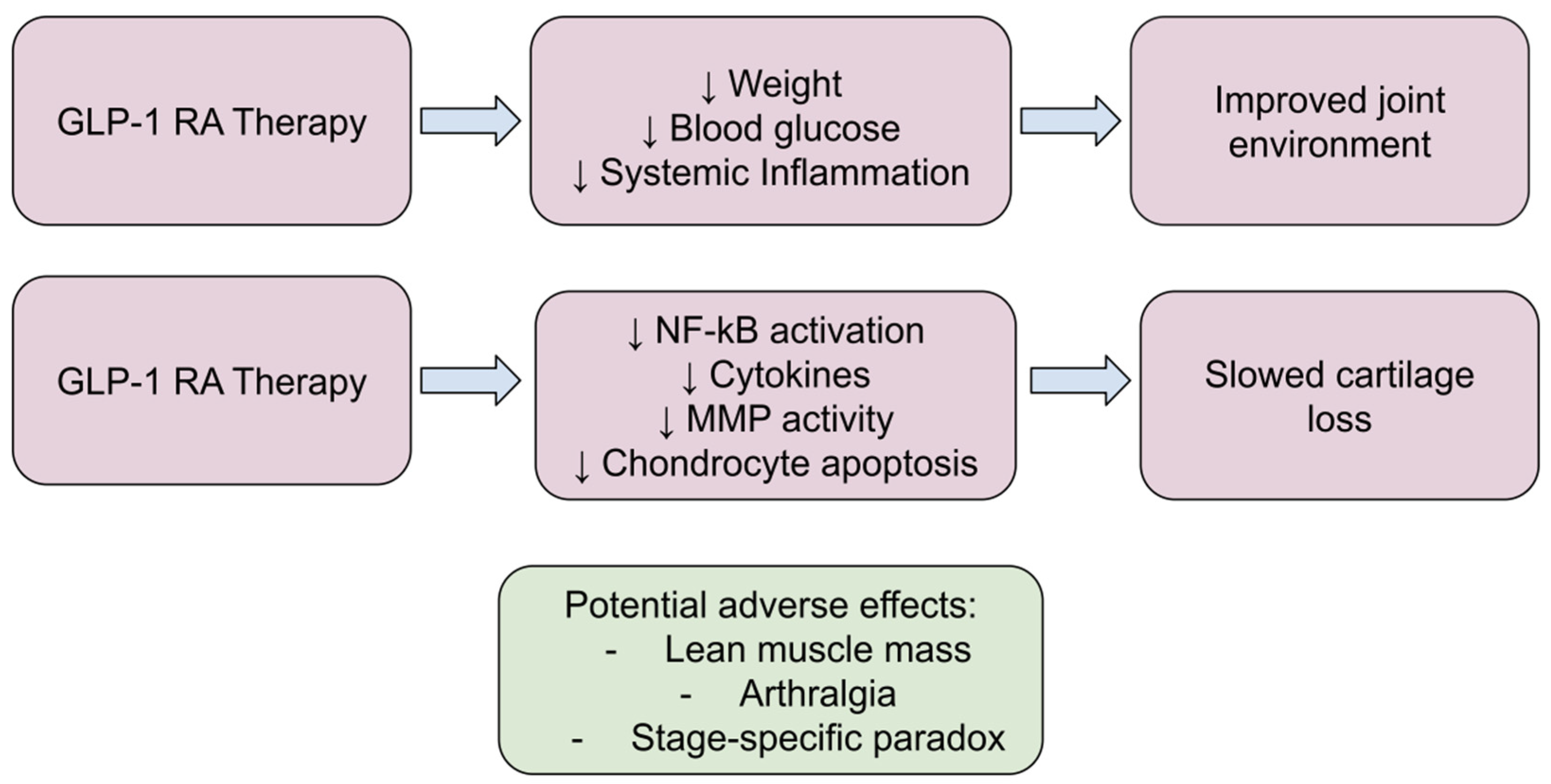
Figure 1 summarizes the proposed systemic and local mechanisms through which GLP-1 RAs may influence OA.
Figure 1.
Proposed mechanistic diagram. A schematic drawn from incomplete and unconfirmed data illustrating systemic (metabolic/anti-inflammatory) and local (cartilage/synovium) pathways by which GLP-1 RAs may influence OA progression. Includes potential beneficial effects and adverse mechanisms, with emphasis on relevance to non-weight-bearing joints.
Direct upper-limb evidence remains extremely limited. A retrospective matched cohort study found that GLP-1 receptor agonist use was associated with higher observed five-year incidence of glenohumeral OA and selected shoulder diagnoses, including atraumatic rotator cuff tears and adhesive capsulitis [19]. Given the observational design and potential for residual confounding, selection bias, and detection bias, these findings do not establish causality but caution against direct extrapolation of potentially beneficial knee and hip OA findings to the shoulder.
Shanghai Osteoarthritis Cohort: Zhu et al. disclose that in patients with knee OA and T2DM, ≥2 years of GLP-1 RA use was associated with modest improvements in WOMAC scores, reduced analgesic use, and slower medial femorotibial cartilage loss on MRI. Weight reduction mediated approximately 32% of the observed association with reduced surgical rates, suggesting that weight loss may not fully account for the observed association [18]. Likewise, in a randomized, blinded, and placebo-controlled trial of adults with obesity and moderate knee osteoarthritis, once-weekly semaglutide was associated with greater reductions in body weight and knee OA-related pain, as well as improved physical function, over 68 weeks. These results from a randomized trial show substantial benefits in obesity-associated knee OA. However, they do not demonstrate efficacy in improving OA in non-weight-bearing joints, nor do they show modification of structural disease [17].
US National Health Network Study: Among patients with pre-existing hip or knee OA, GLP-1 RA use was associated with reduced odds of progressing to total joint arthroplasty within one year—however, these associations were not fully accounted for by BMI change. In contrast, in patients without prior OA, GLP-1 RA users had higher incidence of OA diagnoses and greater use of intra-articular injections, as reported by Lavu et al. [19].
Some large-scale studies have reported increased OA diagnoses among GLP-1 RA users without prior disease [20].The discordant findings of increased OA incidence is doubtless important to appreciate. The context in which these results were found warrants caution in interpretation as well. These associations may reflect several confounders given that medication exposure is not randomized, and disease staging is sometimes imperfect. Several factors may be involved, including reverse causality, detection bias, and different healthcare utilization. Metabolic changes or shifts in activity levels could bring latent symptoms to attention, thereby unmasking subclinical OA. Furthermore, as warned by Wilding et al., a significant amount of weight loss during GLP-1 RAs may be from lean mass, potentially altering joint biomechanics and stability [21].
In non-weight-bearing joints, muscle atrophy around the shoulder or wrist could impair dynamic stabilization, potentially exacerbating symptoms in the presence of existing degenerative change. These apparently discordant findings may potentially reflect differences in disease stage, patient characteristics, healthcare utilization, or other unmeasured confounders. It is also possible that changes in body composition or activity following GLP-1 RA initiation could alter symptom recognition. These explanations remain speculative and require prospective investigation.
Although GLP-1 receptor agonists share a common incretin-based mechanism, the class is pharmacologically heterogeneous. Individual GLP-1 RAs differ to a degree in their own mechanisms (e.g., pharmacokinetics and receptor interactions) and in their effects on bodily systems (e.g., metabolic, musculoskeletal, cardiovascular). Tolerability profiles also vary between individual members of this class. At present, however, the literature is insufficient to determine whether any of these agent-level differences translate into clinically meaningful differences in joint outcomes.
3.3. Clinical Implications for Orthopedic Surgery
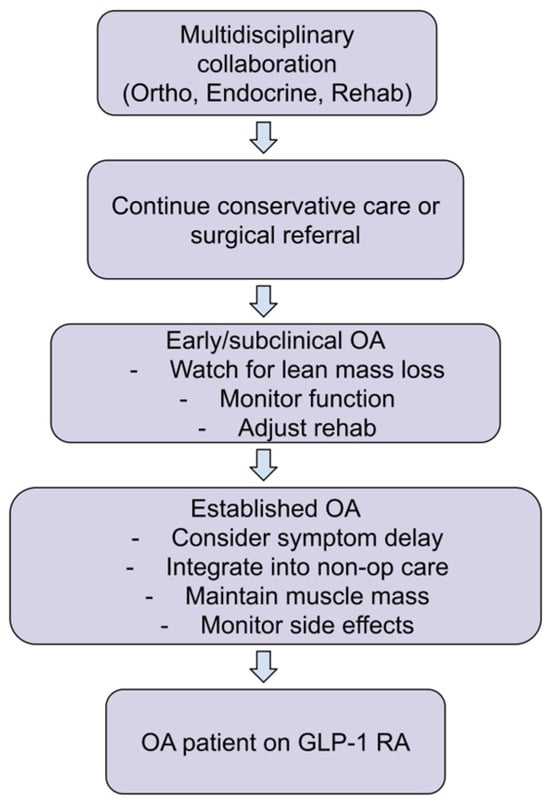
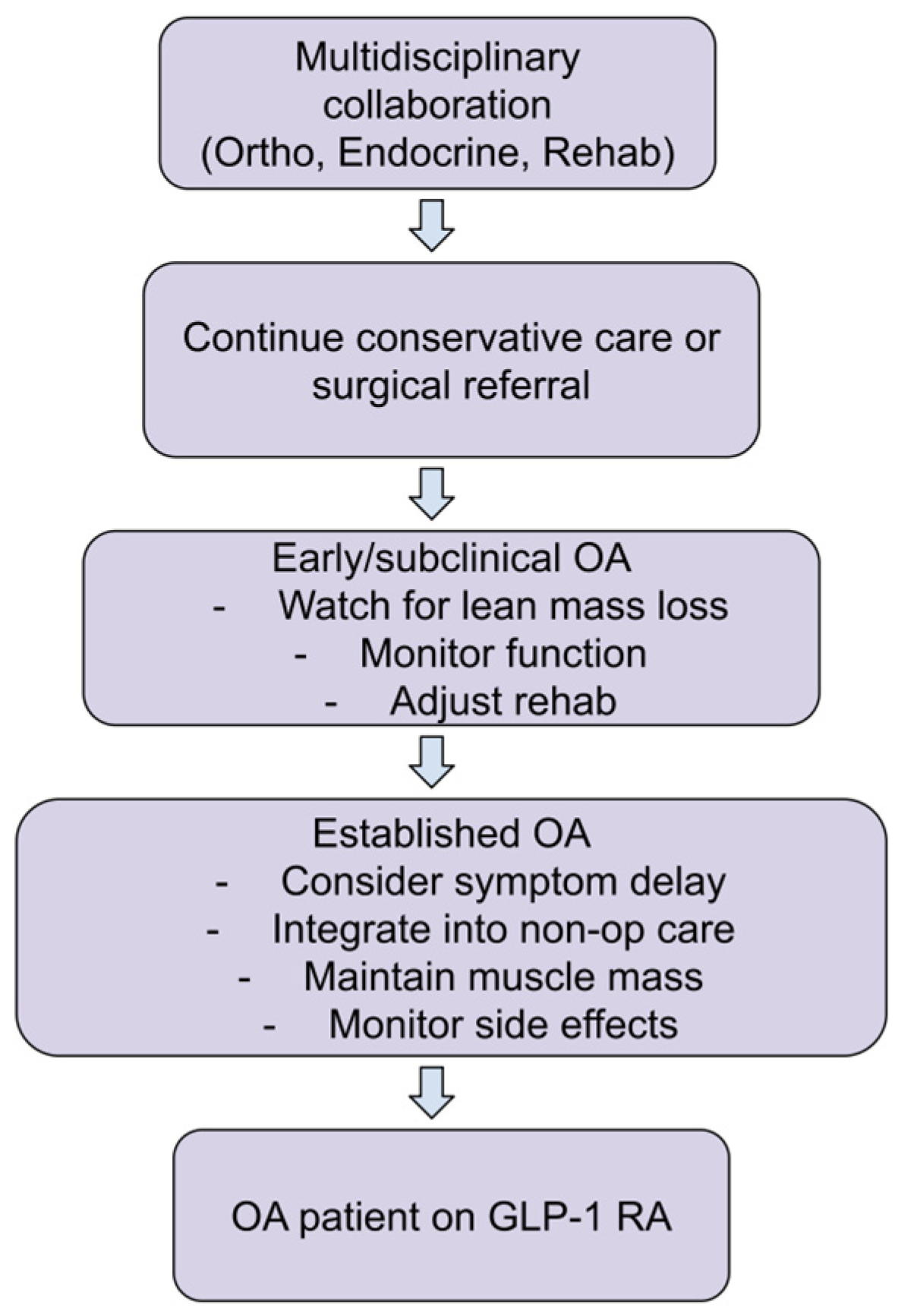
The rapid expansion of GLP-1 RA use in patients with type 2 diabetes mellitus and obesity suggests that orthopedic surgeons will increasingly encounter patients on these medications during OA evaluation and treatment. Although direct data for upper-limb OA are lacking, extrapolation from existing studies suggests several considerations, some of which are visualized in Figure 2.
Figure 2.
Conceptual orthopedic decision framework. Flow diagram showing hypothesis of how awareness of GLP-1 RA use may influence evaluation and management of OA in non-weight-bearing joints—from diagnosis through nonoperative care, timing of surgical referral, and postoperative rehabilitation.
3.4. Diagnosis and Early Recognition
- Potential for symptom modulation: The anti-inflammatory effects observed in experimental studies raise the possibility that GLP-1 RAs could influence OA symptoms beyond the bounds of measured weight loss. However, this hypothesis has not been established in non-weight-bearing OA, and prospective clinical studies are required to determine whether GLP-1 RA exposure has any substantial clinical benefit beyond the context of weight loss.
- Increased detection in early disease: Observational data have shown higher rates of OA diagnosis among GLP-1 RA users without prior OA [19,21]. These findings may reflect unmasking of previously subclinical symptoms, increased healthcare utilization or surveillance, residual confounding, or other sources of bias rather than a causal medication effect. New-onset upper-limb symptoms in GLP-1 RA users should therefore be interpreted within the broader clinical context.
- Biomechanical consequences: Substantial weight reduction with GLP-1 RAs can include a significant loss of lean body mass. In upper-limb OA, particularly at the shoulder and wrist, loss of periarticular muscle mass can impair dynamic stability, increase joint loading during functional activities, and exacerbate pain.
- Rehabilitation impact: Muscle weakness may slow postoperative recovery and reduce the effectiveness of conservative interventions such as strengthening-based physiotherapy. If preservation of muscle mass is deemed clinically valuable for patients on GLP-1 Ras, then resistance training and adequate protein intake may be advised.Non-operative Management
- Synergy with conservative measures: If GLP-1 RAs did indeed possess anti-inflammatory effects, it could potentially allow for a complement to existing OA treatment modalities such as physical therapy, splinting and intra-articular injections.
- Monitoring progression: Given the heterogeneity of reported effects, orthopedic surgeons may desire serial functional assessments and imaging, when indicated, in order to help determine whether disease is stable, improving, or progressing. As more research is done on the topic of GLP-1 RAs in orthopedics, the precise advice for which serial assessments are most advantageous will become more evident.
3.5. Surgical Decision-Making
- Timing of intervention: Whether GLP-1 RA therapy influences the timing of surgical intervention in non-weight-bearing OA is unknown. Future studies should evaluate whether GLP-1 RA exposure is associated with changes in symptom progression, functional decline, or eventual surgical treatment.
- Perioperative considerations: GLP-1 RAs may affect gastrointestinal motility, which has anesthesia implications, and their metabolic benefits can improve perioperative glycemic control—potentially reducing surgical complication risk. While there is still much variability in management, some patients may be put on full stomach precautions prior to surgery as gastric contents may empty differently under the influence of incretin therapy.
3.6. Multidisciplinary Coordination
- Collaboration with endocrinology and primary care: Given the theorized dual metabolic and musculoskeletal implications, a shared-care model can help optimize both systemic and joint outcomes. More knowledge in this field will allow for better communication with endocrinologists and physicians that manage obesity-related care of patients.
- Research partnerships: Prospective collaboration between orthopedic, metabolic, and rehabilitation specialists could help define the effects of GLP-1 RAs on non-weight-bearing OA, including symptoms, body composition, surgical outcomes, and postoperative rehabilitation.
4. Conclusions
Preclinical studies provide biological plausibility that GLP-1 receptor signaling may influence OA-related inflammatory, metabolic, and chondrocyte pathways. Observational data in knee and hip OA have reported associations with slower cartilage loss, reduced analgesic requirements, and lower progression to arthroplasty, while randomized clinical evidence demonstrates symptomatic improvement with semaglutide in obesity-associated knee OA. However, these findings should not be interpreted as establishing disease-modifying efficacy, particularly in non-weight-bearing OA.
However, these potential benefits are counterbalanced by contradictory findings—most notably, increased OA incidence in patients without pre-existing disease—and by concerns regarding lean body mass loss and potentially stage-specific or population-dependent associations. In non-weight-bearing joints, where dynamic muscle stabilization plays a critical role in preserving function, periarticular muscle loss could have a proportionally greater impact on symptom progression and treatment outcomes.
For orthopedic surgeons, the clinical implications are twofold. First, GLP-1 RAs may eventually have a role in OA management, but evidence specific to upper-limb disease is currently insufficient to define that role. Particularly for patients with comorbid obesity or T2DM, these clinically untested theories of offering possible symptom relief and delayed surgical need may inspire curiosity into this topic. Second, vigilance is warranted for medication-associated musculoskeletal changes that could influence surgical planning, rehabilitation potential, and patient-reported outcomes.
Given the rapid increase in GLP-1 RA use, there is an urgent need for targeted research on their effects in non-weight-bearing joint OA. Priorities include:
- Randomized controlled trials, specifically in upper-limb OA phenotypes, using standardized imaging and patient-reported outcomes.
- Longitudinal studies to assess stage-dependent effects and identify predictors of benefit versus harm.
- Body composition-focused research to quantify lean mass changes and evaluate mitigation strategies.
- Mechanistic studies to clarify receptor-mediated pathways in cartilage and synovium of non-weight-bearing joints.
In conclusion, GLP-1 receptor agonists are an interesting pharmacologic candidate in OA research. They show promising anti-inflammatory and chondroprotective signals in preclinical studies and observational analyses of weight-bearing OA. However, current evidence does not establish benefit in upper-limb OA, and any extrapolation to these joints is largely speculative. Until higher-quality evidence specific to these joints is available, orthopedic surgeons can use the weight-bearing OA literature as a limited contextual framework, while recognizing that direct applicability to non-weight-bearing joints remains unproven and should be interpreted alongside each patient’s metabolic and musculoskeletal context.
Limitations
This narrative review is constrained by the absence of randomized controlled trials (RCTs), clinical trials, or large cohort studies specific to non-weight-bearing joint OA, precluding direct clinical evidence. Reliance on knee and hip OA data to infer potential effects in upper-limb joints represents a key limitation, given pathophysiological differences between weight-bearing and non-weight-bearing sites. Additionally, heterogeneous data across GLP-1 receptor agonists, limited human mechanistic studies, and inconsistent body composition data restricted our ability to perform more standardized comparative analyses. Furthermore, the observational nature of the available clinical data introduces significant confounding variables and risks of bias. Unmeasured confounders, such as concurrent lifestyle modifications, physical therapy, or changes in diet routinely prescribed alongside GLP-1 RAs for metabolic management, may independently influence joint health and obscure direct pharmacological effects. There is also a notable risk of selection and detection bias; patients prescribed incretin therapies often undergo closer clinical surveillance as compared to the population at large.
Author Contributions
Conceptualization, A.S.; methodology, Z.A.C., B.S.L. and J.-P.C.O.; formal analysis, Z.A.C., A.K.I. and J.-P.C.O.; investigation, Z.A.C., A.K.I., J.-P.C.O. and B.S.L.; data curation, A.K.I., Z.A.C. and J.-P.C.O.; writing—original draft preparation, Z.A.C., J.-P.C.O., A.K.I. and B.S.L.; writing—Z.A.C. and A.K.I.; visualization, B.S.L.; supervision, A.S. and Z.A.C.; project administration, A.S. All authors have read and agreed to the published version of the manuscript.
Funding
This research received no external funding.
Institutional Review Board Statement
Not Applicable.
Informed Consent Statement
Not Applicable.
Data Availability Statement
No new data were created or analyzed in this study. Data sharing is not applicable to this article.
Acknowledgments
Thanks is given to the CHSU library team for their help in conducting a thorough search of the literature on the topics contained in this review.
Conflicts of Interest
The authors declare no conflicts of interest.
References
- Bijlsma, J.W.J.; Berenbaum, F.; Lafeber, F.P.J.G. Osteoarthritis: An update with relevance for clinical practice. Lancet 2011, 377, 2115–2126. [Google Scholar] [CrossRef] [Scilit] [PubMed]
- Hunter, D.J.; Bierma-Zeinstra, S. Osteoarthritis. Lancet 2019, 393, 1745–1759. [Google Scholar] [PubMed]
- Haugen, I.K.; Englund, M.; Aliabadi, P.; Niu, J.; Clancy, M.; Kvien, T.K.; Felson, D.T. Correction: Prevalence, incidence and progression of hand osteoarthritis in the general population: The Framingham Osteoarthritis Study. Ann. Rheum. Dis. 2018, 77, 1546. [Google Scholar] [CrossRef] [Scilit] [PubMed]
- Drucker, D.J. Mechanisms of Action and Therapeutic Application of Glucagon-like Peptide-1. Cell Metab. 2018, 27, 740–756. [Google Scholar] [CrossRef] [Scilit] [PubMed]
- Meurout, C.; Martin, C.; Sudre, L.; Breton, J.; Bougault, C.; Rattenbach, R.; Bismuth, K.; Jacques, C.; Berenbaum, F. Liraglutide, a Glucagon-Like Peptide 1 Receptor Agonist, Exerts analgesic, Anti-Inflammatory and Anti-Degradative Actions in Osteoarthritis. Sci. Rep. 2022, 12, 1567. [Google Scholar] [CrossRef] [Scilit] [PubMed]
- Chen, J.; Xie, J.J.; Shi, K.S.; Gu, Y.-T.; Wu, C.-C.; Xuan, J.; Ren, Y.; Chen, L.; Wu, Y.-S.; Zhang, X.-L.; et al. Glucagon-Like Peptide-1 Receptor Regulates Endoplasmic Reticulum Stress-Induced Apoptosis and the Associated Inflammatory Response in Chondrocytes and the Progression of Osteoarthritis in Rat. Cell Death Dis. 2018, 9, 212. [Google Scholar] [CrossRef] [Scilit] [PubMed]
- Nedunchezhiyan, U.; Varughese, I.; Sun, A.R.; Wu, X.; Crawford, R.; Prasadam, I. Obesity, inflammation, and immune system in osteoarthritis. Front. Immunol. 2022, 13, 907750. [Google Scholar] [CrossRef] [Scilit] [PubMed]
- Nauck, M.A.; Meier, J.J. Incretin hormones: Their role in health and disease. Diabetes Obes. Metab. 2018, 20, 5–21. [Google Scholar] [CrossRef] [Scilit] [PubMed]
- Doyle, M.E.; Egan, J.M. Mechanisms of action of glucagon-like peptide 1 in the pancreas. Pharmacol. Ther. 2007, 113, 546–593. [Google Scholar] [CrossRef] [Scilit] [PubMed]
- He, C.P.; Chen, C.; Jiang, X.C.; Li, H.; Zhu, L.-X.; Wang, P.-X.; Xiao, T. The role of AGEs in pathogenesis of cartilage destruction in osteoarthritis. Bone Jt. Res. 2022, 11, 292–300. [Google Scholar] [CrossRef] [Scilit] [PubMed]
- Dai, Y.; Mehta, J.L.; Chen, M. Glucagon-Like Peptide-1 Receptor Agonist Liraglutide Inhibits Endothelin-1 in Endothelial Cell by Repressing Nuclear Factor-Kappa B Activation. Cardiovasc. Drugs Ther. 2013, 27, 371–380. [Google Scholar] [CrossRef] [Scilit] [PubMed]
- Zhang, X.; Jiang, J.; Xu, J.; Chen, J.; Gu, Y.; Wu, G. Liraglutide; a glucagon-like peptide-1 receptor agonist, ameliorates inflammation and apoptosis via inhibition of receptor for advanced glycation end products signaling in AGEs induced chondrocytes. J. Orthop. Surg. Res. 2024, 19, 466. [Google Scholar]
- Qin, H.; Yu, J.; Yu, H.; Zhou, C.; Yuan, D.; Wang, Z.; Zhu, Z.; Wei, G.; Ou, P.; Li, Z.; et al. Semaglutide ameliorates osteoarthritis progression through a weight loss-independent metabolic restoration mechanism. Cell Metab. 2026, 38, 582–597.e6. [Google Scholar] [CrossRef] [Scilit] [PubMed]
- Garcia, D.; Shaw, R.J. AMPK: Mechanisms of Cellular Energy Sensing and Restoration of Metabolic Balance. Mol. Cell 2017, 66, 789–800. [Google Scholar] [CrossRef] [Scilit] [PubMed]
- Mihaylova, M.M.; Shaw, R.J. The AMPK signalling pathway coordinates cell growth, autophagy and metabolism. Nat. Cell Biol. 2011, 13, 1016–1023. [Google Scholar] [CrossRef] [Scilit] [PubMed]
- Tamargo-Gómez, I.; Mariño, G. AMPK: Regulation of Metabolic Dynamics in the Context of Autophagy. Int. J. Mol. Sci. 2018, 19, 3812. [Google Scholar] [CrossRef] [Scilit] [PubMed]
- Bliddal, H.; Bays, H.; Czernichow, S.; Hemmingsson, J.U.; Hjelmesæth, J.; Morville, T.H.; Koroleva, A.; Neergaard, J.S.; Sánchez, P.V.; Wharton, S.; et al. STEP 9 Study Group. Once-weekly semaglutide in persons with obesity and knee osteoarthritis. N. Engl. J. Med. 2024, 391, 1573–1583. [Google Scholar] [CrossRef] [Scilit] [PubMed]
- Zhu, H.; Zhou, L.; Wang, Q.; Cai, Q.; Yang, F.; Jin, H.; Chen, Y.; Song, Y.; Zhang, C. Glucagon-like peptide-1 receptor agonists as a disease-modifying therapy for knee osteoarthritis mediated by weight loss: Findings from the Shanghai Osteoarthritis Cohort. Ann. Rheum. Dis. 2023, 82, 1218–1226. [Google Scholar] [CrossRef] [Scilit] [PubMed]
- Lavu, M.S.; Porto, J.R.; Hecht, C.J., II; Kaelber, D.C.; Sculco, P.K.; Heckmann, N.D.; Kamath, A.F. The Five Year Incidence of Progression to Osteoarthritis and Total Joint Arthroplasty in Patients Prescribed Glucagon-Like Peptide 1 Receptor Agonists. J. Arthroplast. 2024, 39, 2433–2439. [Google Scholar] [CrossRef] [Scilit] [PubMed]
- Davis, W.R.; Bank, N.C.; Lauck, B.J.; Creighton, R.A.; Mistovich, R.J. How do glucagon-like peptide-1 receptor agonists influence the progression of shoulder pathology? A matched cohort analysis. JSES Rev. Rep. Tech. 2026, 6, 100613. [Google Scholar] [CrossRef] [Scilit] [PubMed]
- Wilding, J.P.H.; Batterham, R.L.; Calanna, S.; Davies, M.; Van Gaal, L.F.; Lingvay, I.; McGowan, B.M.; Rosenstock, J.; Tran, M.T.; Wadden, T.A.; et al. Once-Weekly Semaglutide in Adults with Overweight or Obesity. N. Engl. J. Med. 2021, 384, 989–1002. [Google Scholar] [CrossRef] [Scilit] [PubMed]
- Cheng, J.; Solomon, T.; Estee, M.; Cicuttin, F.M.; Lim, Y.Z. Effect of glucagon-like peptide-1 receptor agonists in osteoarthritis: A systematic review of pre-clinical and human studies. Osteoarthr. Cart. Open 2025, 7, 100567. [Google Scholar] [CrossRef] [Scilit] [PubMed]

Disclaimer/Publisher’s Note: The statements, opinions and data contained in all publications are solely those of the individual author(s) and contributor(s) and not of MDPI and/or the editor(s). MDPI and/or the editor(s) disclaim responsibility for any injury to people or property resulting from any ideas, methods, instructions or products referred to in the content. |
© 2026 by the authors. Licensee MDPI, Basel, Switzerland. This article is an open access article distributed under the terms and conditions of the Creative Commons Attribution (CC BY) license.