


Abstract
This correspondence extends a previously introduced waveform-domain monostatic passive radar from single-target localization to simultaneous multi-target detection and localization. The radar employs a Sparse Uniform Circular Array (SUCA) with Deterministic Multifrequency Dither (DMD), for which target location is represented by a precomputed physical waveform dictionary. The previously developed QR formulation transforms the dictionary and the received composite waveform into an orthogonal Q-space, where correlations provide direct detection and physical-index localization without conventional range–Doppler processing. Two complementary performance measures are considered. First, target-presence detection is evaluated at a prescribed false-alarm probability of . Monte Carlo results show high detection probability with only weak dependence on the number of simultaneously present targets for . Second, exact complete-index recovery is used to quantify multi-target localization. For both range-separated and azimuth-separated targets, the exact-recovery probability approaches unity for all investigated target populations , with substantially lower SNR required in the azimuth-separated case. These results are obtained from a single T = 1 s dwell without Doppler separation, temporal averaging, tracking, sequential target cancellation, or explicit estimation of the unknown scattering coefficients. The results demonstrate the feasibility of extending waveform-domain passive sensing to simultaneous multi-target detection and direct physical-index localization using narrowband signals of opportunity.
1. Introduction
In our previous work [1], a monostatic waveform-domain passive sensing architecture was introduced in which a Sparse Uniform Circular Array (SUCA) with Deterministic Multifrequency Dither (DMD) maps target range and angular coordinates directly into a composite received waveform. The target location can then be estimated by correlating the received waveform with a precomputed physical waveform dictionary. The same physical-dictionary concept was subsequently investigated for passive sensing using Starlink downlinks as spaceborne Illuminators of Opportunity [2], demonstrating its applicability to a substantially different signal source and operating-frequency range. Consequently, direct Line Of Sight (LOS) to the Illuminator of Opportunity (IoO), typically required in conventional passive radar to obtain a reference signal, is not required. The importance of eliminating this LOS requirement was noted by Prof. M. Cherniekov in a private discussion with the author.
The present paper addresses the next problem: simultaneous detection and localization of multiple targets present within the field of view of such a monostatic passive radar. As demonstrated in [1], the QR-based detector transforms the waveform dictionary into an orthogonal Q-space, thereby reducing the effects of the original dictionary non-orthogonality and providing a well-conditioned representation for target detection and location estimation. The received composite waveform is projected into the same orthogonal basis, so that target hypotheses can be evaluated directly through Q-space correlation.
A broader review of the passive-radar and waveform-domain sensing literature is provided in [1]; the present correspondence therefore focuses on prior work directly relevant to multi-target recovery in radar, array processing, and sparse signal representation. Compressed-sensing radar represents a sparse target scene on a discretized parameter grid [3]. Orthogonal Matching Pursuit (OMP) and related methods recover multiple occupied dictionary indices through iterative support selection [4]. Orthogonal Least Squares (OLS) and Multiple Orthogonal Least Squares (MOLS) similarly use support-selection procedures based on residual reduction, with MOLS allowing several candidate indices to be selected in a single iteration [5,6].
Related sparse-support methods have also been applied to simultaneous source localization. Yardibi et al. [7] investigated sparse support recovery and sphere decoding for array signal processing. Barik and Vikalo [8] developed sparsity-aware sphere-decoding methods for sparse support recovery, while branch-and-bound techniques have been applied to exact best-subset selection [9]. These methods provide useful context for multi-target support recovery; however, the present approach does not employ iterative coefficient estimation, residual minimization, or conventional sparse-reconstruction optimization. Instead, it retains the physical dictionary as the direct localization representation and uses correlation in the orthogonal Q-space.
A recent related passive-radar approach was reported by Bazzi and Chafii [10], who considered RIS-enabled passive target localization with joint target-number detection and angle-of-arrival estimation. That framework differs from the present method in both architecture and processing. The proposed radar uses a compact monostatic SUCA receiver without an external direct-path reference channel, while target location is represented through a physical waveform dictionary generated from the SUCA geometry and Deterministic Multifrequency Dither and evaluated in Q-space.
Frequency-diverse array (FDA) radar provides additional relevant context because element-dependent frequency offsets can generate range–angle-dependent responses. Random frequency-diverse arrays have been developed for direction–range indication [11], while receiver processing architectures for active FDA radar have also been investigated [12]. Wang et al. [13] considered an active FDA-MIMO radar in which frequency diversity is generated by the transmit array. At each receiver element, the returned composite signal is separated into the transmitted FDA frequency components by digital mixing and matched filtering, after which joint range–angle parameter estimation is performed.
In contrast, in the present passive configuration the SUCA receiver observes an Illuminator-of-Opportunity signal that is not generated by a frequency-diverse transmit array and therefore does not contain the corresponding element-indexed FDA frequency components. Consequently, the received signal cannot be separated into a set of transmitter-generated FDA components at the receiver. To overcome this limitation, the complex-logarithm transformation was proposed, and its efficacy was demonstrated in [1] for single-target localization.
The contribution of this paper is the extension of that waveform-domain formulation to simultaneous multi-target operation in Q-space. Two complementary performance measures are considered. First, target presence is evaluated by comparing Q-space correlations with a threshold corresponding to a prescribed false-alarm probability. Second, localization performance is evaluated by the probability of exact recovery of the complete set of physical dictionary indices associated with the simultaneously present targets. The numerical study examines both range-separated and azimuth-separated target populations for up to simultaneous targets and evaluates performance as a function of signal-to-noise ratio. The spatial grids used in these simulations are selected to illustrate multi-target performance and are not intended to establish the ultimate range or azimuth resolution limits of the radar.
The results show that first-stage target detection remains strong at with only weak dependence on the number of simultaneously present targets. Exact complete-index recovery approaches unity for all investigated target populations in both the range-separated and azimuth-separated cases, with substantially lower SNR required for azimuth localization. These results are obtained from a single s dwell without conventional range–Doppler processing, explicit estimation of the unknown scattering coefficients, temporal averaging, tracking, or sequential target cancellation.
The remainder of this paper is organized as follows. Section 2 describes the physical principle of the passive monostatic radar. Section 3 presents the multi-target signal model together with its Q-space representation. Section 4 presents the numerical verification, including threshold-detection and exact complete-index recovery performance for range-separated and azimuth-separated target populations. Section 5 summarizes the main conclusions.
2. Physical Principle of the Passive Monostatic Radar
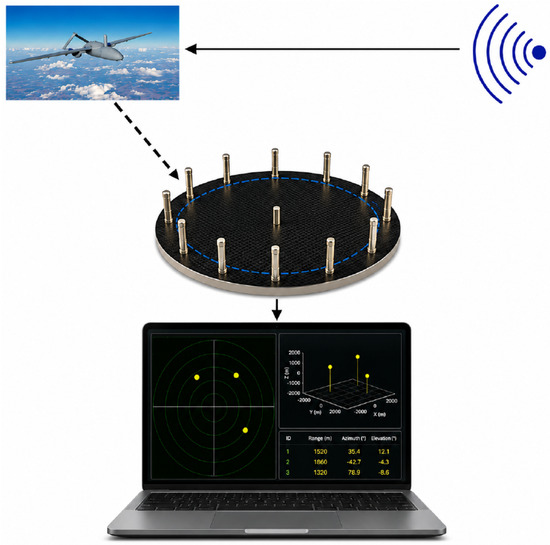
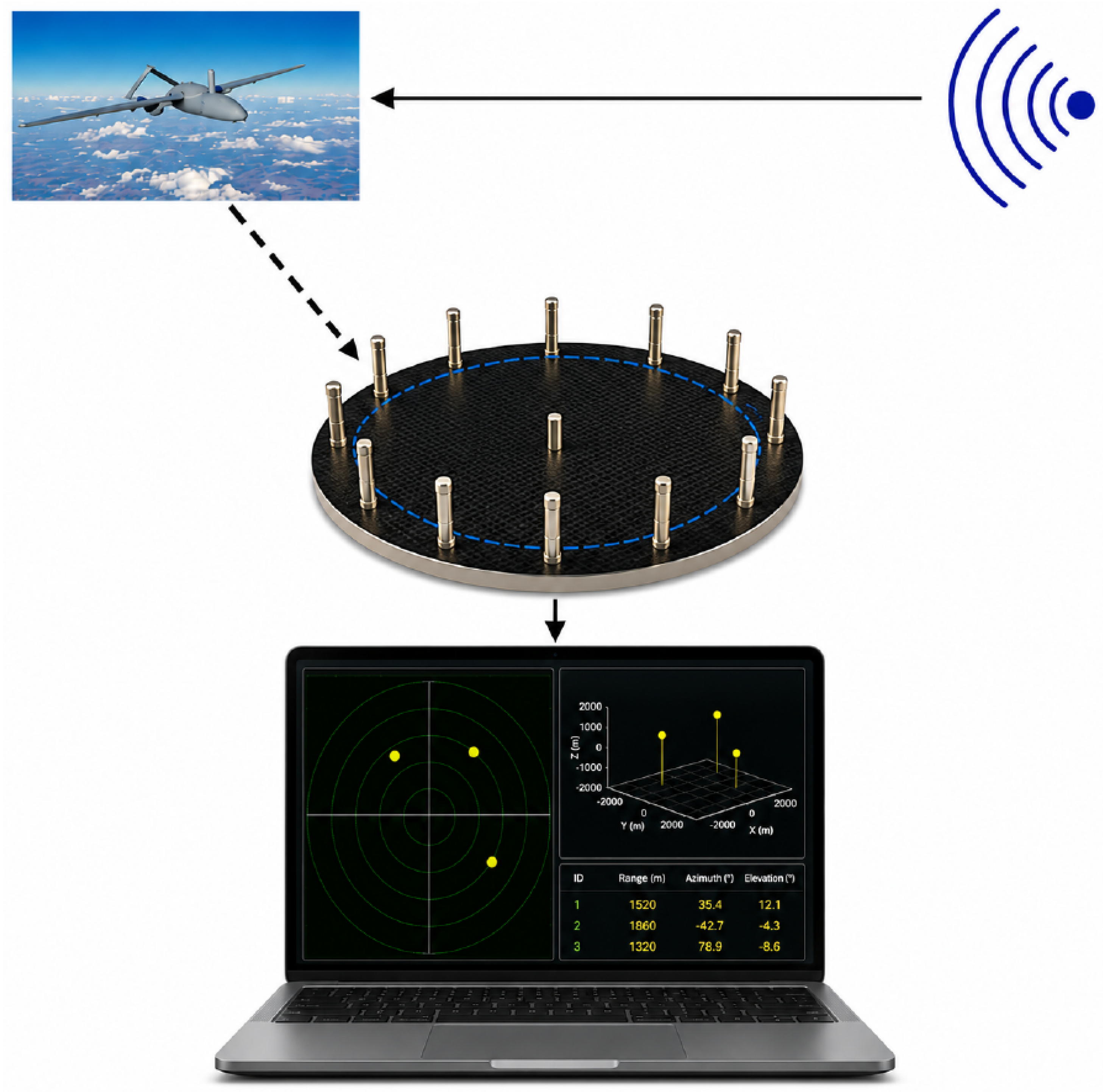
The simplified passive monostatic radar architecture is illustrated in Figure 1. An Illuminator of Opportunity (IoO) continuously illuminates the surveillance area. The electromagnetic field scattered by one or more targets is received by a Sparse Uniform Circular Array (SUCA) consisting typically of 5–11 antenna elements. Depending on the operating frequency and application, the receiving elements may be monopoles, patches, helices, or other antenna types. The array is sparse, with adjacent element spacing of approximately one wavelength of the IoO signal, while the circular geometry provides a full field of view in azimuth.
Figure 1.
Simplified passive monostatic radar architecture.
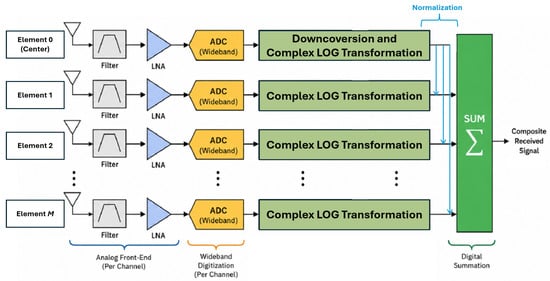
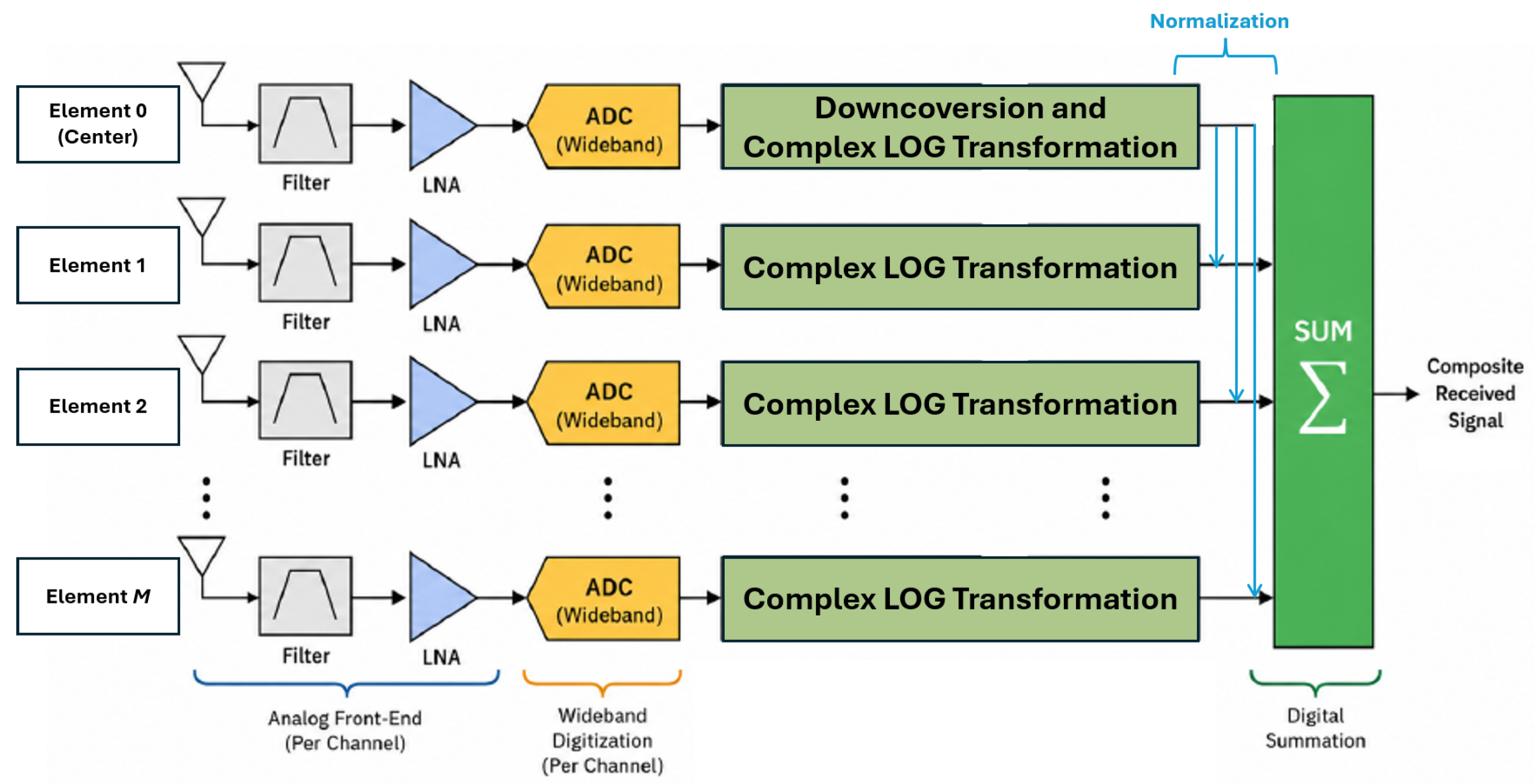
Assume first that the SUCA receives the signal scattered from a single target. According to the receiver block diagram in Figure 2, the complex signal in each of the M SUCA receiver channels is processed independently through filtering, low-noise amplification, and analog-to-digital conversion, resulting in the discrete-time signal , where is the receiver-channel index, while corresponds to the SUCA element at the center of the ring in Figure 1. Because the SUCA aperture is small compared with the target range, the unknown IoO waveform can be considered approximately identical in all receiver channels and therefore independent of the channel index, i.e., . The signal entering the mth channel from the SUCA is therefore
where is the propagation distance from the target to the mth SUCA element and .
Figure 2.
Simplified receiver block diagram of the proposed passive monostatic radar.
To obtain information about the target range, azimuth, and elevation, the receiver beam must be forced to steer within a prescribed spatial sector. In addition, the unknown common waveform must be eliminated. Both objectives can be achieved through the complex logarithmic transformation. Denoting the downconverted signal in channel 0 as
the normalized logarithmic signal becomes
The common unknown waveform is therefore canceled by the normalization. Multiplying the phase term in (3) by , where
gives
After transformation back into exponential form, the normalized output of the mth receiver channel becomes
The receiver output after digital summation can therefore be expressed as
According to (7), the deterministic frequency dither (DFD) term produces continuous receiver beam steering in the azimuth–elevation domain and makes the receiver-channel signals mutually orthogonal and therefore independently separable in the time domain over the dwell interval T, while the term is responsible for focusing the receiving beam at a prescribed three-dimensional location [1,14].
3. Multi-Target Signal Model
The multi-target case follows the same receiver-processing path, except that the signal delivered by each SUCA element is now a superposition of the signals scattered by all simultaneously present targets:
where P is the number of simultaneously present targets, is the complex scattering coefficient of the pth target, is its Doppler frequency, and is the distance between that target and the mth SUCA element. The corresponding downconverted center-channel reference is
Normalization to the downconverted center-channel reference gives
Normalization removes the common unknown IoO waveform, but it does not remove the target-dependent Doppler components in a multi-target scene. This effect can be mitigated by shortening the dither dwell, . For example, with , the dwell time is only . During such a short interval, even a very fast target moving at changes its position by only
Therefore, the corresponding Doppler-induced phase variation during a single dwell is sufficiently small to be neglected for the localization processing considered here, and
For compactness, define the geometry-dependent normalized response of the mth SUCA channel as
Applying the same complex-logarithm transformation used in the single-target case and transforming back into exponential form gives the physical multi-target receiver output
As before, the dither forces the SUCA beam to steer in the azimuth–elevation domain, while the geometry-dependent term preserves the target-range information in the received waveform.
Equation (13) describes the physical composite waveform produced by the simultaneously present targets. The single-target response used to construct the physical waveform dictionary follows directly as the special case .
Following [1], a spatial grid containing L candidate target locations is defined. For a target at the ith grid location, the normalized response of the mth channel is
The corresponding transformed single-target dictionary waveform is therefore
where is the propagation distance from the ith candidate target location to the mth SUCA ring element and is the corresponding distance to the center element.
The corresponding dictionary atom is
and the waveform dictionary is
Q-Space Representation of the Multi-Target Signal
For the multi-target recovery formulation, the sampled received waveform is represented in the physical single-target dictionary as
where is the physical dictionary atom associated with the location of the pth target, is the same complex scattering coefficient introduced in (8), and denotes additive receiver noise.
Although the physical waveform dictionary defined in (17) contains the responses associated with all candidate target locations, its columns are generally non-orthogonal. Following [1], an orthonormal basis spanning the dictionary space is obtained using the QR decomposition
where the columns of form an orthonormal basis satisfying
Let
denote the resulting orthonormal basis. The ith physical dictionary atom is represented in Q-space as
and the complete dictionary becomes
The received multi-target waveform, including additive noise, is projected onto the same orthonormal basis as
Substitution of (18) gives
where
Since every dictionary atom belongs to the space spanned by , its correlation with the received waveform is preserved:
The Q-space representation therefore provides an orthonormal coordinate system for the physical dictionary while preserving the waveform information required for subsequent target detection and localization. Noise components orthogonal to the dictionary space are rejected by the projection.
4. Numerical Verification
The preceding formulation establishes the physical and mathematical basis for simultaneous multi-target localization. The remaining question is whether the complete target-index set can be recovered reliably from a single noisy dwell as the number of simultaneously present targets increases. This is evaluated statistically using the following Monte Carlo study.
4.1. Spatial Search Grid and Noiseless Correlation Response
For continuity with the single-target configuration reported in [1], the numerical simulations use the same basic SUCA and DMD parameters. The SUCA consists of 11 ring elements and one center element, for a total of 12 receiving elements, and operates at an FM-band carrier frequency of . The progressive DMD increment is , the receiver dwell time is , and 256 samples are acquired during each dwell. The SUCA radius is
The physical search region is discretized as
First, the correlation between the noiseless received waveform (24) and the dictionary waveforms (23) is examined to illustrate how the presence of a target at a candidate location is identified. Table 1 and Table 2 illustrate the noiseless correlation behavior for simultaneously present targets. For both the range- and azimuth-separated cases, the true target locations correspond to the largest correlation responses on the respective search grids in the noiseless case.
Table 1.
Noiseless normalized correlation values for the true range-separated case on the grid at .
Table 2.
Noiseless normalized correlation values for the true azimuth-separated case on the grid at .
In the range-separated case, all correlation values are extremely close to unity, and the separation between neighboring true and false candidate locations is very small. Consequently, we can expect that even relatively small noise perturbations can change their ordering and degrade exact target recovery. This expected sensitivity to noise is examined quantitatively below through Monte Carlo simulations over a range of SNR values.
The azimuth-separated case exhibits substantially greater correlation separation. The ten true target locations remain above the three non-target locations, with the weakest true-target correlation equal to and the strongest non-target correlation equal to . Thus, the noiseless results indicate considerably greater robustness of azimuth discrimination to additive noise than range discrimination for the selected spatial grids.
The markedly different correlation behavior in range and azimuth can be understood from the SUCA geometry. At the kilometer-scale ranges considered here, a change in target range produces an almost common propagation-distance change across all array elements. Following center-element normalization, the remaining differences between neighboring range-dependent waveforms are therefore small, resulting in very high correlation values. In contrast, a change in azimuth modifies the relative propagation distances among the ring elements and produces a stronger element-dependent phase variation across the SUCA. Consequently, neighboring azimuth-dependent dictionary waveforms are more distinct and exhibit substantially greater correlation separation. This difference is specific to the array geometry and spatial grids used in the present numerical study.
4.2. Monte Carlo Multi-Target Recovery in Additive Noise
Two complementary Monte Carlo studies were performed. In the first, the targets were separated in range while their azimuth was fixed at . The range grid was
For each value of P, the targets occupied adjacent range-grid locations, giving a separation of between neighboring targets. In the second study, the targets were separated in azimuth while their range was fixed at . The azimuth grid was
giving an angular separation of between adjacent target locations.
In practical radar operation, target detection and target localization represent two distinct performance requirements. The first is to establish the presence of a target within the observed range or azimuth sector at a prescribed false-alarm probability. The second is to determine the correct target location once target presence has been established.
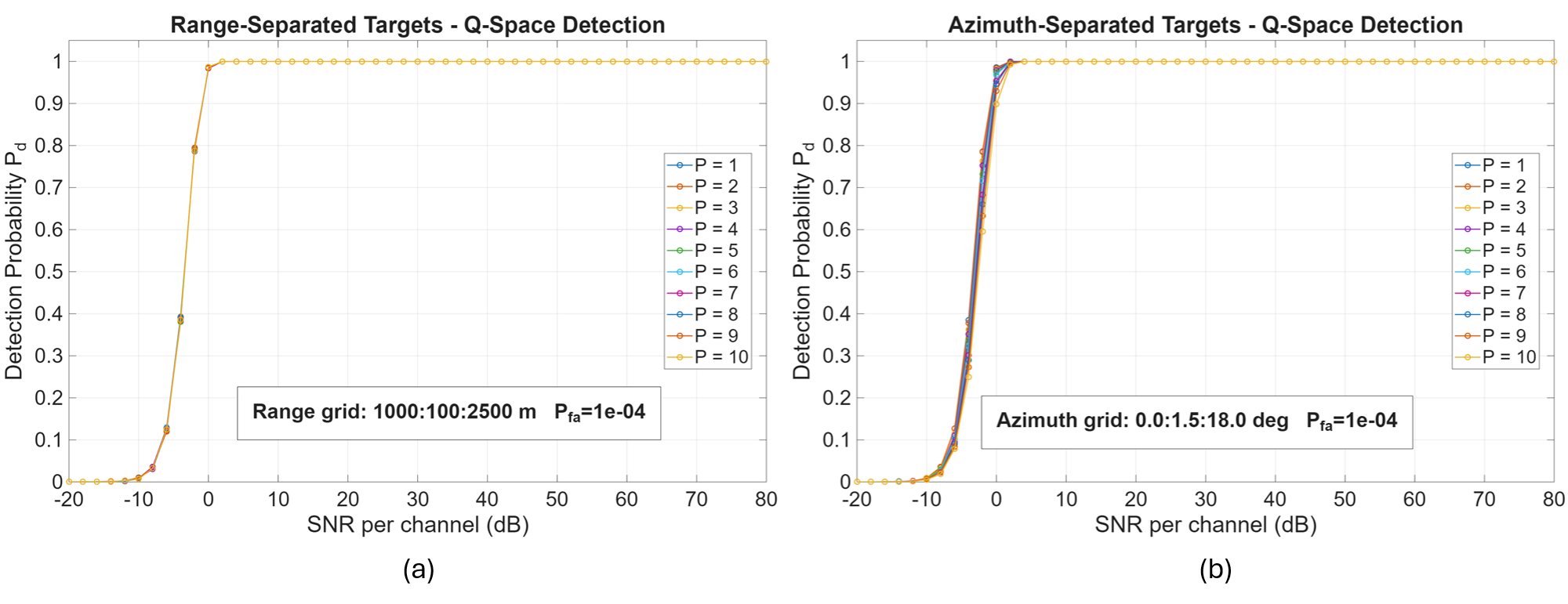
Figure 3 characterizes the first of these requirements. The Q-space correlation is compared with the threshold corresponding to , and the resulting curves give the probability that a true target hypothesis exceeds this detection threshold. For both the range-separated and azimuth-separated cases, the detection probability is only weakly dependent on the number of simultaneously present targets. This result shows that the presence of multiple targets has little effect on the first-stage detection probability over the investigated target population.
Figure 3.
Q-space threshold-detection probability for simultaneously present targets at . (a) Range-separated targets at . (b) Azimuth-separated targets at .
The more demanding localization problem is evaluated separately because it requires discrimination among competing dictionary atoms rather than only establishing target presence. For every target number and SNR value, independent noise realizations were generated. The waveform dictionary remained noise-free, while additive noise was introduced only into the received composite waveform. Localization was considered successful only when the complete set of P target indices was recovered correctly. The exact-recovery probability is therefore defined as
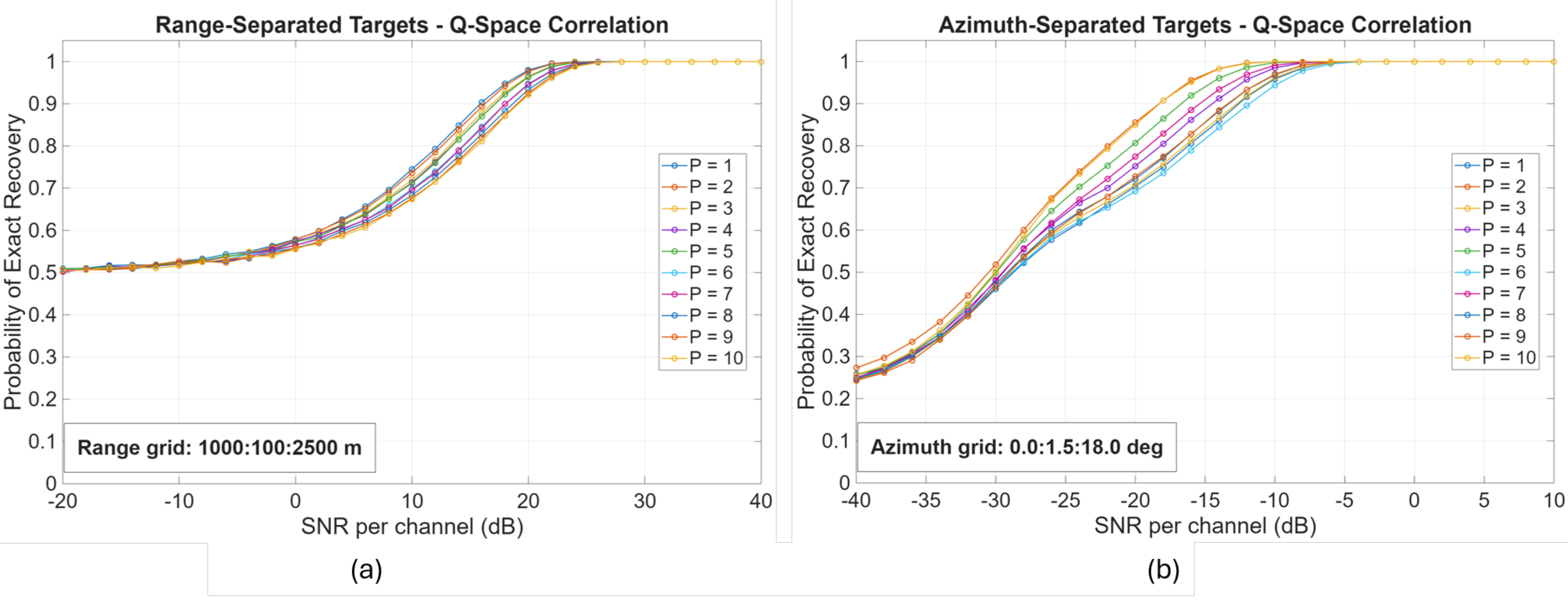
For both range-separated and azimuth-separated target populations, the probability of exact complete-index recovery increases smoothly with SNR and approaches unity for all investigated target numbers . The dependence on the number of simultaneously present targets is relatively weak. The azimuth-separated case requires substantially lower SNR than the range-separated case, reflecting the greater separation among the corresponding azimuth-dictionary responses, as illustrated by the correlation values in Table 1 and Table 2.
It is important to note that several consecutive s dwells may be coherently combined to increase the effective SNR. For example, combining dwells provides an ideal processing gain of
while increasing the total observation interval to only . Thus, a single-dwell recovery requirement of approximately corresponds ideally to a per-dwell SNR of only about while retaining a probability of correct complete-index recovery approaching unity.
At , the wavelength is approximately . Even a target moving at travels only
during this interval.
The azimuth-separated case in Figure 4b exhibits particularly strong performance. The recovery transition shifts only gradually toward higher SNR as P increases, and essentially complete recovery is achieved for all investigated target populations . Remarkably, the probability of exact complete-index recovery approaches unity at an SNR of approximately , demonstrating reliable multi-target localization even when the received signal power is below the noise level.
Figure 4.
Monte Carlo verification of simultaneous multi-target index recovery for independent noise realizations. (a) Exact recovery probability versus SNR for range-separated targets at . (b) Exact recovery probability versus SNR for azimuth-separated targets on the grid at .
These results demonstrate the strong practical potential of the proposed radar. Up to ten simultaneously present targets can be localized with essentially complete physical-index recovery using the waveform dictionary, without conventional range–Doppler processing, Doppler separation, sequential target cancellation, tracking, or explicit estimation of the unknown scattering coefficients.
It is useful to note that the proposed receiver uses only 12 SUCA elements and an Illuminator-of-Opportunity receiver bandwidth of approximately for an FM broadcast signal. In contrast, a conventional passive radar would require approximately of signal bandwidth to obtain a range resolution. Similarly, an approximately broadside azimuth resolution would require about 68 half-wavelength-spaced elements in a conventional uniform linear array.
5. Conclusions
The numerical results demonstrate consistently strong performance of the proposed physical dictionary receiver over the investigated multi-target cases. For both range-separated and azimuth-separated target populations, the first-stage Q-space detector maintains a high probability of target presence detection at the prescribed false-alarm probability , with only weak dependence on the number of simultaneously present targets up to . This result is particularly important because it shows that increasing the simultaneous target population does not significantly degrade the basic detectability of the true target hypotheses.
The localization results are particularly strong. For both range-separated and azimuth-separated target populations, the probability of exact complete-index recovery approaches unity for all investigated target numbers . Increasing the number of simultaneously present targets produces only a relatively small shift in the recovery transition. The azimuth-separated case requires substantially lower SNR, with essentially complete recovery obtained at approximately .
It is important to note that several consecutive dwells may be coherently combined to increase the effective SNR. Combining dwells provides an ideal processing gain of while increasing the total observation interval to only . Thus, a single-dwell recovery requirement of approximately corresponds ideally to a per-dwell SNR of only about while retaining an exact-recovery probability approaching unity. At , . Even a target moving at travels only during this interval.
The significance of the results can also be illustrated by comparison with a representative conventional bistatic passive radar. For the numerical dictionary used in the present study, the range spacing is and the azimuth spacing is . A conventional radar providing approximately range resolution would require about of illuminating-signal bandwidth. Similarly, an approximately broadside angular resolution would require about 68 half-wavelength-spaced elements, corresponding to an aperture of approximately , or about at . By contrast, the proposed SUCA receiver employs only 11 ring elements plus the center element, with a radius of approximately . Since its physical dimensions scale with wavelength, operation at higher frequencies opens a practical path toward compact and potentially handheld implementations of the proposed passive radar.
The proposed receiver instead employs 11 SUCA ring elements on a radius of approximately , together with the center normalization element, for a total of 12 receive elements. The Illuminator-of-Opportunity receiver bandwidth can be approximately for an FM broadcast signal. For an equal receiver noise figure, the reduction from to corresponds to approximately lower integrated thermal-noise power.
The range spacing and azimuth spacing used in these simulations are representative dictionary-grid values selected to investigate simultaneous multi-target performance. They are not presented as resolution limits of the proposed radar.
The comparison in Table 3 emphasizes that the difference is not merely a reduction in bandwidth, aperture, or observation time, but a fundamentally different localization mechanism. Conventional bistatic passive radar constructs target coordinates from separate measurements of delay, Doppler, and angle. In the proposed radar, the target geometry modifies the multichannel SUCA response, and the resulting received waveform is compared directly with a physical dictionary.
Table 3.
Comparison with representative conventional bistatic passive radar.
Thus, the Monte Carlo results demonstrate more than the operation of a multi-target search algorithm. They show that narrowband passive sensing, microsecond-scale observation, compact-aperture reception, low-false-alarm target detection, and simultaneous multi-target localization can be incorporated within a single physical-dictionary framework. Favorable performance is maintained across the investigated target populations, from a single target to simultaneous targets. The received waveform itself carries the spatial information imposed by the propagation geometry, while Q-space processing provides a direct means of detecting the corresponding target hypotheses and identifying their physical dictionary locations.
Funding
This research received no external funding.
Data Availability Statement
No new datasets were created or analyzed in this study. The numerical results reported in this work were generated using the models and procedures described in the manuscript.
Acknowledgments
The author acknowledges the use of ChatGPT (GPT-6, OpenAI) for language editing, technical discussion, manuscript organization, and assistance in refining the presentation of the mathematical and numerical results. The scientific concepts, radar formulation, simulation methodology, interpretation of the results, and final content of the manuscript are the responsibility of the author.
Conflicts of Interest
The author declares no conflicts of interest.
References
- Volman, V.; Nessel, J.A. Monostatic Waveform-Domain Passive Radar for Detection and Localization Using a Sparse Circular Array with Deterministic Frequency Dither. Sensors 2026, 26, 3816. [Google Scholar] [CrossRef] [Scilit] [PubMed]
- Volman, V. Reference-Free Passive Radar Using Starlink Signals of Opportunity. Telecom 2026, 7, 119. [Google Scholar] [CrossRef] [Scilit]
- Herman, M.A.; Strohmer, T. High-Resolution Radar via Compressed Sensing. IEEE Trans. Signal Process. 2009, 57, 2275–2284. [Google Scholar] [CrossRef] [Scilit]
- Cattenoz, M.; Savy, L.; Marcos, S. Extended Orthogonal Matching Pursuit for Robust and Fast Target Localisation in Multiple-Input Multiple-Output Radar. IET Radar Sonar Navig. 2017, 11, 1709–1717. [Google Scholar] [CrossRef] [Scilit]
- Wang, J.; Li, P. Recovery of Sparse Signals Using Multiple Orthogonal Least Squares. IEEE Trans. Signal Process. 2017, 65, 2049–2062. [Google Scholar] [CrossRef] [Scilit]
- Hashemi, A.; Vikalo, H. Sparse Recovery via Orthogonal Least-Squares under Presence of Noise. arXiv 2016, arXiv:1608.02554. [Google Scholar]
- Yardibi, T.; Li, J.; Stoica, P.; Cattafesta, L.N. Sparse Representations and Sphere Decoding for Array Signal Processing. Digit. Signal Process. 2012, 22, 253–262. [Google Scholar] [CrossRef] [Scilit]
- Barik, S.; Vikalo, H. Sparsity-Aware Sphere Decoding: Algorithms and Complexity Analysis. IEEE Trans. Signal Process. 2014, 62, 2212–2225. [Google Scholar] [CrossRef] [Scilit][Green Version]
- Gatu, C.; Kontoghiorghes, E.J. Branch-and-Bound Algorithms for Computing the Best-Subset Regression Models. J. Comput. Graph. Stat. 2006, 15, 139–156. [Google Scholar] [CrossRef] [Scilit]
- Bazzi, A.; Chafii, M. Towards ISAC RIS-Enabled Passive Radar Target Localization. In Proceedings of the ICC 2025—IEEE International Conference on Communications, Montreal, QC, Canada, 8–12 June 2025; pp. 2290–2295. [Google Scholar] [CrossRef] [Scilit]
- Liu, Y.; Ruan, H.; Wang, L.; Nehorai, A. The Random Frequency Diverse Array: A New Antenna Structure for Uncoupled Direction–Range Indication in Active Sensing. IEEE J. Sel. Top. Signal Process. 2017, 11, 295–308. [Google Scholar] [CrossRef] [Scilit]
- Jones, A.M.; Rigling, B.D. Frequency Diverse Array Radar Receiver Architectures. In Proceedings of the 2012 International Waveform Diversity & Design Conference (WDD), Kauai, HI, USA, 22–27 January 2012. [Google Scholar] [CrossRef] [Scilit]
- Wang, Z.; Li, X.; Zhu, S.; Wei, F.; Liu, C. Angle and Range Unambiguous Estimation with Nested Frequency Diverse Array MIMO Radars. Remote Sens. 2025, 17, 446. [Google Scholar] [CrossRef] [Scilit]
- Del Prete, S.; Barbiroli, M.; Fuschini, F. Frequency Diverse Array for Signal Geofencing in Wireless Communications: Does it Work? IEEE Open J. Antennas Propag. 2025, 6, 51–63. [Google Scholar] [CrossRef] [Scilit]

Disclaimer/Publisher’s Note: The statements, opinions and data contained in all publications are solely those of the individual author(s) and contributor(s) and not of MDPI and/or the editor(s). MDPI and/or the editor(s) disclaim responsibility for any injury to people or property resulting from any ideas, methods, instructions or products referred to in the content. |
© 2026 by the author. Licensee MDPI, Basel, Switzerland. This article is an open access article distributed under the terms and conditions of the Creative Commons Attribution (CC BY) license.