


Abstract
Background/Objective: Non-communicable diseases and mental health conditions impose a growing burden on working-age adults, yet prevention strategies remain fragmented and rarely personalized. This study describes the development of an evidence-informed framework integrating multi-domain health assessment and psychological risk stratification to support personalized prevention in adults aged 18–65 years. Methods: National behavioral surveillance data (PASSI 2023–2024) and occupational disease data (INAIL 2024) were examined to inform the framework. Validated assessment instruments were selected across relevant health domains according to their applicability to the target population. A user-centered and participatory design approach was also incorporated into the DELPHI (Digital Engagement for Lifelong Prevention and Health Improvement) project. Results: The epidemiological evidence highlighted persistent behavioral risk factors and social inequalities among working-age adults. The resulting framework comprises seven assessment domains, integrating validated instruments to characterize participants’ health status and modifiable risk factors. Psychological risk indicators were used to define two personalized prevention pathways, “Maintenance” and “Rebalancing”, with periodic reassessment. Conclusions: The DELPHI framework integrates multi-domain health assessment with psychological risk-based personalization to support preventive interventions in working-age adults. The clinical trial is ongoing; its outcomes, usability and effectiveness will be evaluated upon completion of the project.
1. Introduction
The rising prevalence of non-communicable diseases (NCDs)—cardiovascular disease, type 2 diabetes, musculoskeletal disorders, and mental health conditions—poses a major challenge to healthcare systems [1]. These conditions share modifiable risk factors (sedentary behavior, poor diet, tobacco use, harmful alcohol consumption, chronic psychosocial stress) that are amenable to early intervention during the working years [2]. Among NCDs, mental health conditions represent a major public health concern. According to recent WHO estimates, approximately 1.2 billion people worldwide were living with a mental disorder in 2023, corresponding to nearly one in seven individuals [3]. In Europe, the economic burden of mental health problems, including subclinical conditions, exceeded €600 billion in 2015, corresponding to 4.1% of EU GDP [4].
Despite the diffusion of wearable devices and digital health tools, few existing solutions provide an integrated framework that exploits multimodal data for a personalized view of health [5,6,7]. Common indicators are often assessed with fragmented models, while personalized prevention strategies remain relatively limited, potentially reducing their effectiveness [8].
The working-age population (18–65 years) represents a strategic target for prevention. University students face academic pressure, financial uncertainty, and social transitions [9,10]. Their health-related risk factors span individual, academic, biological, lifestyle, social, and financial domains [9]. Previous evidence indicates that only 3.4% of them meet the five-a-day recommendation for fruit and vegetable consumption [11], while regular physical activity is associated with healthier dietary habits and lower psychological distress [12]. Workers are exposed to organizational and psychosocial stressors, including imbalanced job design, employment insecurity, and negative workplace climate [13,14]. Employment precariousness during early working life has been associated with an approximately 50% increased risk of mental health problems [14]. Furthermore, healthcare workers involved in manual patient handling face additional musculoskeletal risks, addressed by Italian Legislative Decree 81/2008 [15]. In Southern Italy, these challenges may be compounded by socioeconomic disparities and inequalities in access to services [16,17].
Risk stratification—the systematic classification of individuals into differentiated need profiles—is increasingly recognized as a valuable approach for tailoring interventions [18]. Evidence from clinical treatment settings suggests that stratified-care models may improve treatment outcomes compared with conventional approaches [19]. Although these findings cannot be directly extrapolated to primary prevention, they illustrate the potential value of tailoring interventions to individual needs. However, the application of multi-domain risk stratification to primary prevention in working-age populations remains underdeveloped.
This paper presents the methodological framework developed within the DELPHI (Digital Engagement for Lifelong Prevention and Health Improvement) project, funded under the Italian National Recovery and Resilience Plan (PNRR), for personalized prevention in working-age adults (18–65 years). Specifically, the manuscript aims to (a) examine epidemiological evidence on health determinants relevant to the target population; (b) describe the selection of validated assessment instruments; and (c) present the resulting risk stratification criteria and personalized prevention pathways. The framework informed the development of a clinical trial protocol that has been approved by the National Ethics Committee of the Istituto Superiore di Sanità on 4 May 2026 and registered on ClinicalTrials.gov on 25 May 2026 (NCT07612852). The present manuscript focuses on the scientific rationale and methodological development of the framework. Its clinical implementation is currently ongoing, while the study outcomes, usability, and effectiveness of the proposed system remain to be evaluated upon completion of the project.
2. Materials and Methods
2.1. Data Sources and Study Design
The framework was developed by integrating the predefined objectives of the DELPHI project with a multi-phase approach comprising: (i) examination of epidemiological evidence on modifiable risk factors, including publicly available aggregate indicators from the Italian PASSI behavioral surveillance system; (ii) user-centered and participatory design; and (iii) selection of validated assessment instruments.
The epidemiological indicators were obtained from the PASSI 2023–2024 surveillance system, coordinated by the Italian National Institute of Health (ISS). PASSI targets adults aged 18–69 years through continuous telephone interviews; over 90% of Local Health Units participate, covering more than 90% of the Italian population, with approximately 35,000–37,000 interviews annually [20]. PASSI indicators were selected based on their relevance to the behavioral risk factors and chronic health conditions addressed within the multidomain DELPHI framework. Occupational disease data were obtained from the INAIL 2024 Annual Report [21].
National PASSI estimates were used to provide epidemiological context for framework development and were not intended to represent the DELPHI target population aged 18–65 years in Sicily, Campania, and Basilicata. No individual-level surveillance data were accessed, and no original statistical analyses were performed.
2.2. Target Population and Study Setting
The DELPHI framework is being implemented in a multicenter pilot randomized controlled trial involving two cohorts from Southern Italy: university students from the Department of Psychology, Educational Science and Human Movement (SPPEFF), University of Palermo (Sicily), and multidisciplinary workers (clinicians, researchers, and administrative staff) from four centers of the Don Carlo Gnocchi Foundation located in Salerno (SA), Sant’Angelo dei Lombardi (AV), Acerenza (PZ), and Tricarico (MT), across Campania and Basilicata.
The planned study population comprises 200 participants, including 100 university students and 100 workers, recruited through the participating institutions according to the eligibility criteria established in the registered clinical trial (ClinicalTrials.gov, NCT07612852).
Three age categories were established for stratified randomization: young adults (18–30 years), middle-aged adults (31–50 years), and pre-seniors (51–65 years). Randomization also accounts for sex and employment-related characteristics, including sedentary work, shift work, and manual occupational activities. Individual age will be recorded as a continuous variable to allow subsequent age-related analyses independently of the predefined randomization strata.
Participants are randomized 1:1 through the REDCap randomization module to an intervention arm, using the full DELPHI platform with personalized recommendations and pathway-specific content, or to a control arm, using a basic version limited to passive monitoring. The primary outcomes are feasibility, usability and acceptability of the platform at 6 ± 1 months. Eligibility screening, including the psychological safety criteria (Section 2.5), precedes randomization. Allocation to the Maintenance or Rebalancing pathway is rule-based, is performed at baseline independently of randomization, and determines the psychological content delivered in the intervention arm.
2.3. User-Centered and Participatory Design
A combined User-Centered Design (UCD) and Participatory Design (PD) approach translated epidemiological evidence into actionable requirements. Representative segments from each cohort were engaged through contextual observations and semi-structured interviews, co-creation workshops (user journeys, paper prototypes, key messages), usability testing of low-fidelity screens, and iterative validation. Findings were consolidated with an impact-effort matrix, yielding functional and non-functional requirements under GDPR-compliant procedures (plain-language consent, pseudonymization, data minimization). These activities informed the development of the platform and of the preventive content; they were not designed to evaluate effectiveness, and the usability and acceptability of the platform are being assessed in the ongoing clinical trial.
2.4. Selection of Assessment Instruments
Assessment instruments were identified by a clinician based on the 2021 European Society of Cardiology (ESC) Guidelines on cardiovascular disease prevention [22], the 2013 ESC/EASD Guidelines on diabetes, pre-diabetes, and cardiovascular diseases [23], and the NICE guideline NG59 on low back pain and sciatica [24], together with the Italian Progetto CUORE resources [25] and relevant scientific literature on instrument validation. The 2013 ESC/EASD guidelines were used because they discuss FINDRISC as a non-invasive tool for identifying individuals at increased risk of type 2 diabetes. For the psychological, physical activity, and nutritional domains, instrument selection was additionally informed by domain-specific development and the validation literature, feasibility of administration, and suitability for the target population and preventive setting. Instruments were evaluated according to the following pre-defined criteria: relevance to the 18–65 age range (excluding geriatric tools); scientific validation with an available Italian version; brevity and suitability for immediate application; and ability to discriminate clinical risk in the domains of interest. No formal systematic database search or consensus procedure was undertaken, as the selection was performed by a single clinician.
2.4.1. Clinical Profiling
To assess comorbidities and the risk of mortality, the Cumulative Illness Rating Scale (CIRS) [26,27] and the Charlson Comorbidity Index (CCI) [28] were examined. The CCI was selected for its greater ease of administration, established prognostic value, and greater suitability for the target population of working-age adults. An inclusion threshold of CCI 0–2 was defined, corresponding to a relatively limited comorbidity burden, consistent with the target population of the proposed standardized primary prevention pathway.
For the assessment of cardiovascular risk, the Framingham Risk Score [29], QRISK3 [30], and the cardiovascular risk tables developed as part of the Italian CUORE project (Istituto Superiore di Sanità, ISS) [31] were taken into consideration. Framingham and QRISK3 were not selected because their applicability might be limited when applied to populations other than those for which they were originally developed; in particular, QRISK3 was developed and validated primarily on the UK population, while estimates based on Framingham may overestimate coronary risk in populations with a lower incidence of coronary events, including Italy [32]. The CUORE Project tables were therefore adopted because they were specifically developed and validated in the Italian population, ensuring greater consistency with the target population and easy applicability in the contexts of occupational medicine and primary prevention.
Specifically, the CUORE cardiovascular risk charts, rather than the individual risk score, were selected. These charts estimate the 10-year probability of a first major cardiovascular event based on six variables: sex, age, diabetes status, smoking status, systolic blood pressure, and total serum cholesterol. As the charts are validated for individuals aged 40–69 years without previous major cardiovascular events, their application within DELPHI was restricted to participants aged 40–65 years meeting the instrument’s applicability criteria. For younger participants (18–39 years), cardiovascular risk factors are assessed individually through clinical evaluation and the study’s Case Report Form (CRF), without calculating a CUORE risk category.
For participants eligible for CUORE assessment, risk categories I–III, corresponding to an estimated 10-year cardiovascular risk below 15%, were established as the inclusion criterion. This threshold was defined within the DELPHI protocol to identify individuals suitable for the proposed standardized preventive intervention, rather than as a universally recommended clinical cut-off. Accordingly, the CUORE-based eligibility criterion is not applied to participants outside the instrument’s validated age range. Individuals exceeding the predefined CCI threshold (CCI > 2) or, where applicable, the CUORE threshold (categories IV–VI) are excluded from the standardized DELPHI pathway and referred for specialist assessment, allowing for more individualized clinical evaluation and management.
With regard to the risk of type 2 diabetes, several predictive models were examined, including the Finnish Diabetes Risk Score (FINDRISC) [33], the ADA Diabetes Risk Test [34,35], the Cambridge Risk Score [36], the Atherosclerosis Risk in Communities (ARIC) model [37], and the San Antonio Heart Study model [38].
Although the Cambridge Risk Score uses routinely collected clinical information, it was primarily developed to identify undiagnosed diabetes, while the San Antonio model includes laboratory-based variables, making it less suitable for the proposed screening approach. Similarly, the ARIC and ADA models were considered less directly transferable to the European reference population. FINDRISC was therefore selected because it is a non-invasive and easy-to-administer tool, widely validated in European populations, and demonstrates good predictive performance in identifying individuals at increased risk of developing type 2 diabetes in primary prevention settings. Furthermore, although total serum cholesterol is collected for cardiovascular risk assessment, FINDRISC allows diabetes risk to be estimated without requiring additional laboratory investigations specifically for this purpose. FINDRISC scores are classified according to the standard cut-off values: low risk (0–6 points), slightly elevated risk (7–11 points), moderate risk (12–14 points), high risk (15–20 points), and very high risk (21–26 points).
With regard to musculoskeletal risk, with a particular focus on low back pain, the Keele STarT Back Screening Tool (SBST) and the Örebro Musculoskeletal Pain Questionnaire were evaluated [39,40,41]. Although the Örebro Questionnaire provides a comprehensive assessment of psychosocial factors associated with persistent musculoskeletal pain, it takes longer to administer and is less specifically focused on low back pain. The SBST was therefore chosen because it is brief, specifically designed for low back pain, and validated for stratifying patients based on their risk of persistent disability and chronicity, making it particularly suitable for prognostic stratification in working-age individuals with low back pain. The Italian version of the SBST, translated and cross-culturally adapted [42] and validated in Italian patients with low back pain [43], is used. Given the high prevalence and preventive relevance of low back pain, the SBST is administered to all participants, regardless of the presence of current low back pain, to ensure a uniform assessment procedure. However, prognostic risk stratification will be restricted to participants reporting current low back pain, in accordance with the intended use and validation of the instrument. For participants without low back pain, questionnaire responses will be considered for descriptive purposes only, without assigning a prognostic risk category.
Eligibility screening and multidimensional clinical profiling are conducted as part of the initial clinical assessment. This involves administering the CUORE cardiovascular risk charts, where applicable, the FINDRISC for type 2 diabetes risk, and the SBST for low back pain, along with collecting a comprehensive medical history via the study’s Case Report Form (CRF), in order to characterize comorbidities, relevant risk factors, and other clinically relevant information.
2.4.2. Psychological Profiling
Psychological profiling was designed to identify different manifestations and levels of emotional distress that may be relevant to preventive intervention, even in the absence of a diagnosed mental disorder. The assessment strategy combined the 21-item Depression Anxiety Stress Scales (DASS-21) [44,45] and the Beck Depression Inventory-II (BDI-II) [46,47], both available in validated Italian versions and suitable for administration in adult community samples. The DASS-21 was selected because it provides a brief multidimensional assessment of three related but distinguishable components of psychological distress, namely depressive symptoms, anxiety symptoms, and stress, the latter assessing irritability, impatience, tension and persistent arousal [44,45]. Its inclusion was considered particularly appropriate for the DELPHI target population, which comprises university students and workers potentially exposed to academic, occupational, socioeconomic, and lifestyle-related stressors. Recent evidence also supports the cross-cultural robustness of its three-factor structure [48].
The BDI-II was included as a complementary measure providing a more detailed assessment of depressive symptom severity, including cognitive, affective, motivational, and somatic manifestations. The combined administration of the two instruments was intended to improve the sensitivity of psychological screening.
While the DASS-21 captures a broader pattern of emotional distress across depression, anxiety, and stress, the BDI-II allows a more focused evaluation of depressive symptomatology and includes a specific item addressing thoughts of death or self-harm. The instruments are therefore not conceived as interchangeable or as tools for establishing a clinical diagnosis, but as complementary screening measures supporting risk identification, preventive pathway allocation, and the activation of safety procedures where necessary.
DASS-21 subscale scores are used in their original form (sum of the seven items, range 0–21), without multiplication by two, as in the Italian validation [45]. The thresholds adopted (Depression ≥ 7, Anxiety ≥ 5, Stress ≥ 10; Section 2.5) are the lowest raw scores within the “moderate” severity range of the original DASS, which starts at doubled scores of 14, 10 and 19, respectively [44].
2.4.3. Physical Activity and Nutritional Profiling
Physical activity and nutritional habits represent two major and closely interconnected determinants of health and were therefore jointly considered to obtain a comprehensive lifestyle profile of each participant. The assessment strategy is based on standardized, validated, and easily applicable tools, selected to provide reliable information while limiting the burden on participants and facilitating their use in large study populations. Physical activity is assessed using the short form of the International Physical Activity Questionnaire (IPAQ-SF), a validated seven-item instrument assessing walking, moderate-intensity, and vigorous-intensity physical activity performed during the previous seven days, together with sedentary time [49]. The Italian version, tested for reliability and validity in an Italian sample [50], is administered. This multidimensional approach was considered particularly suitable because it provides a broader representation of habitual physical behavior than instruments focusing exclusively on structured exercise. Moreover, the standardized IPAQ-SF scoring system allows physical activity to be expressed in MET-minutes/week and participants to be classified into different activity levels, thus providing a quantitative and comparable measure that can be integrated with other lifestyle and health-related variables. Specifically, participants are classified as having low (<700 MET-minutes/week), moderate (700–2519 MET-minutes/week), or high (≥2520 MET-minutes/week) physical activity. These project-specific cut-offs have also been used in previous study [51]; MET-minutes/week are also recorded as a continuous variable. Nutritional habits are assessed with the 14-item PREDIMED Mediterranean Diet Adherence Screener [52,53,54,55], which provides a rapid and validated measure of adherence to the Mediterranean dietary pattern. The questionnaire explores key dietary behaviors, including the consumption of olive oil, fruit and vegetables, legumes, fish, meat, and sugar-sweetened products, generating an overall score that reflects the quality of the habitual dietary pattern. The Mediterranean diet was chosen as the nutritional reference model because of its established relevance to cardiovascular and metabolic health and because it represents an appropriate dietary framework for the Italian population. Beyond the assessment of dietary habits, individual energy and nutritional requirements are estimated according to the 2024 Italian Dietary Reference Intakes (LARN 2024 guidelines [56]). Basal metabolic rate (BMR) is estimated using the age- and sex-specific Schofield equations adopted by the LARN [56], while Total Energy Expenditure (TEE) is calculated by multiplying BMR by an individual Physical Activity Level (PAL) coefficient [57]. In the DELPHI project, the PAL coefficient is assigned at baseline in the electronic case report form (eCRF) according to a project-specific mapping of the total IPAQ-SF score: PAL = 1.4 for an IPAQ-SF score < 700 MET-minutes/week; PAL = 1.6 for scores from 700 to 1600 MET-minutes/week; PAL = 1.8 for scores >1600 and <2520 MET-minutes/week; and PAL = 2.0 for scores ≥2520 MET-minutes/week. The PAL is used only to estimate energy requirements; reference values for water, macronutrients, and micronutrients are subsequently used to define individual nutritional requirements. The combined use of IPAQ, MEDAS/PREDIMED, and LARN therefore provides complementary information: IPAQ characterizes habitual physical activity, MEDAS describes the quality of the habitual dietary pattern, and LARN provides the reference framework for estimating energy and nutrient requirements. Together, these instruments allow an integrated profiling of physical activity, dietary behavior, and nutritional needs, supporting the identification of potentially modifiable lifestyle factors and providing a standardized basis for subsequent personalized lifestyle interventions.
2.5. Psychological Risk Stratification Methodology
Psychological risk stratification was organized into two preventive pathways: Maintenance and Rebalancing. The choice of a two-profile model reflects the preventive, rather than diagnostic or therapeutic, purpose of the DELPHI framework. The model distinguishes participants showing no relevant psychological indicators at baseline from those presenting elevated but non-acute levels of depression, anxiety, or stress that may benefit from more structured preventive support. A larger number of symptom-based categories was not considered necessary at this stage, since stratification was not intended to reproduce clinical severity classifications but to translate screening results into two clearly differentiated and actionable modes of digital intervention.
The Maintenance profile includes participants who do not meet any of the predefined DASS-21 or BDI-II thresholds. For these individuals, the intervention focuses on consolidating adaptive routines, strengthening awareness of psychological well-being, and preventing the development or accumulation of risk factors. The Rebalancing profile is assigned when at least one predefined psychological threshold is reached: DASS-21 Depression ≥ 7, Anxiety ≥ 5, or Stress ≥ 10, or BDI-II ≥ 20, provided that the BDI-II total score is <29 and Item 9 is scored 0. This profile provides more structured content aimed at supporting emotional regulation, stress management, attentional grounding, and the recovery of balance in everyday routines.
Allocation is performed by a predefined rule applied in the electronic case report form, without case-by-case clinical judgment. BDI-II scores of 20–28 correspond to the moderate symptom range [46,47]; Rebalancing is nevertheless a preventive, non-clinical pathway made of low-intensity, non-activating content (e.g., slow breathing, a daily micro-pause, a brief self-kindness practice, a weekend body scan), and its assignment does not imply a diagnosis or a clinical assessment.
The criteria are applied according to a precautionary logic, whereby reaching the threshold in any one of the assessed psychological dimensions is sufficient for assignment to Rebalancing. This approach acknowledges that psychological vulnerability may emerge through different symptom patterns and reduces the likelihood that participants with relevant distress in a single domain are overlooked. Maintenance and Rebalancing should not be interpreted as fixed clinical categories or diagnostic labels, but as modifiable prevention states used to determine the type and intensity of support delivered through the DELPHI digital platform. The rule therefore favors sensitivity over specificity and may assign a large proportion of participants to Rebalancing, particularly among university students (see the Strengths and Limitations section).
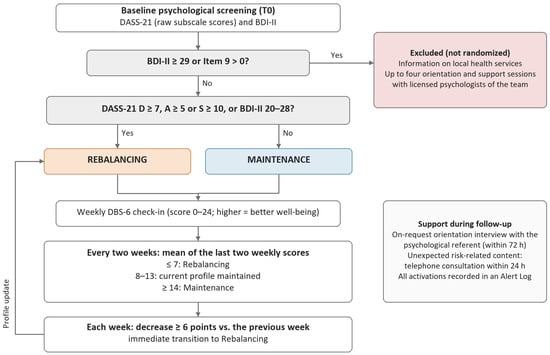
A BDI-II total score ≥ 29 or any score > 0 on Item 9 (thoughts of death or self-harm) constitutes a safety criterion and overrides the standard pathway-allocation procedure. The criterion is applied automatically in the electronic case report form at baseline (T0): participants meeting either condition will be not randomized and are excluded from the study. They are provided with information and contact details for appropriate local health services (general practitioner, territorial mental health services). The research team also offers these participants, as a support activity outside the study procedures, up to four free orientation and support sessions, in person or online, with licensed psychologists of the team. These sessions are not a clinical treatment, and no study data are collected during them.
Participants assigned to Rebalancing, including those with BDI-II scores of 20–28 and Item 9 = 0 or with severe DASS-21 scores, receive information on psychological consultation and local health services, can request an orientation interview with the psychological referent within 72 h, and are monitored weekly with the DBS-6 (see below). No proactive contact is planned, consistent with the non-clinical, preventive scope of the study. The DASS-21 does not trigger the safety procedure on its own, because it contains no item on suicidal ideation.
Stratification is subsequently updated through weekly monitoring using the DELPHI Brief Scale (DBS-6; Table S1), a project-specific six-item check-in referring to the previous seven days (mood, interest, energy, calm, agitation, tension; each rated 0–4, negative items reverse-scored; total 0–24, higher = better well-being). Its items are adapted from validated measures of well-being, depression, anxiety and stress (WHO-5 [58]; PHQ-2 and PHQ-9 [59,60]; GAD-7 [61]; DASS-21 [44,45]); as a composite measure it has not been psychometrically validated, and it is not used for diagnosis or as a safety instrument. Every two weeks, the mean of the two latest scores determines the profile: ≤7 Rebalancing, 8–13 current profile maintained (a buffer zone limiting frequent switching), ≥14 Maintenance. In addition, a decrease of at least six points compared with the previous week results in immediate transition to Rebalancing. Missing weekly scores are not imputed: the two-week mean and the ≥6-point rule are computed only from consecutive completed weeks; otherwise, the current profile is maintained and a reminder is sent. These cut-offs are a priori operational values, not empirically derived, and are an initial proposal to be refined with pilot data. The procedure is a rule-based algorithm, not a predictive model.
Dynamic re-stratification permits movement in both directions between profiles as psychological conditions evolve. Participants showing emerging or increasing vulnerability can receive more focused preventive support, whereas those showing stable improvement can transition to lighter maintenance content. This approach is intended to limit unnecessary intervention burden and support sustained engagement, and it provides a transparent rule-based foundation for future integration with longitudinal platform-use indicators and wearable-sensor data.
Follow-up safety monitoring is separate from the DBS-6, which is used only to update the profile. The BDI-II and DASS-21 are re-administered at T1 (6 ± 1 months) and after a DBS-6 alert (two-week mean ≤7 or a decrease of ≥6 points). Participants assigned to Rebalancing can also request an orientation interview with the psychological referent of the project, a licensed psychologist, by telephone or remotely, within 72 h. If risk-related content emerges (BDI-II ≥ 29 or Item 9 > 0 at re-administration, or during contacts with the participant), or if more than one interview is needed, the psychological referent provides a telephone consultation within 24 h, decides on referral to the general practitioner or local mental health services, and informs the study coordinator. Each activation is recorded in the REDCap Alert Log (date, reason, actions taken and outcome), allowing response times to be verified.
2.6. AI-Assisted Technologies in the Writing Process
During the preparation of this manuscript, the authors used ChatGPT (OpenAI, GPT-6) solely for language translation. All translated text was carefully reviewed and verified by the authors, who take full responsibility for the final content of the manuscript.
3. Results
3.1. Epidemiological Profile of Behavioral Risk Factors
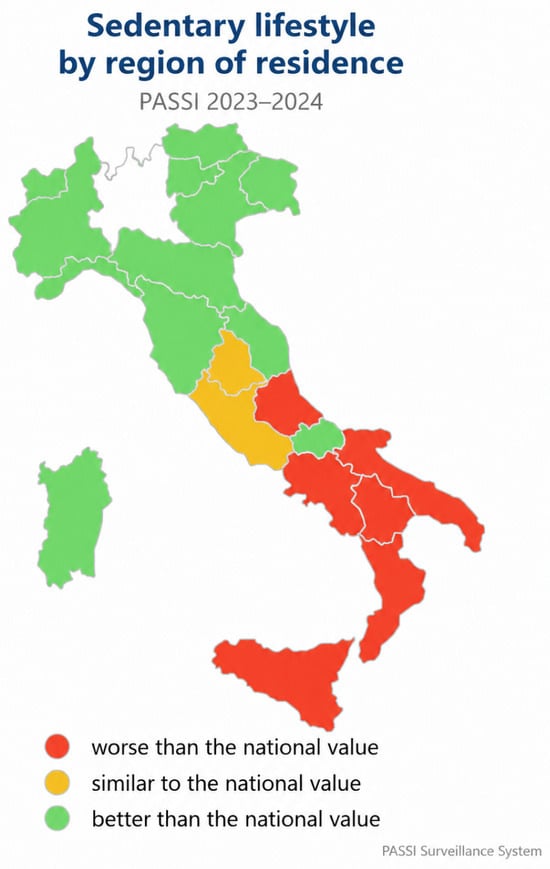
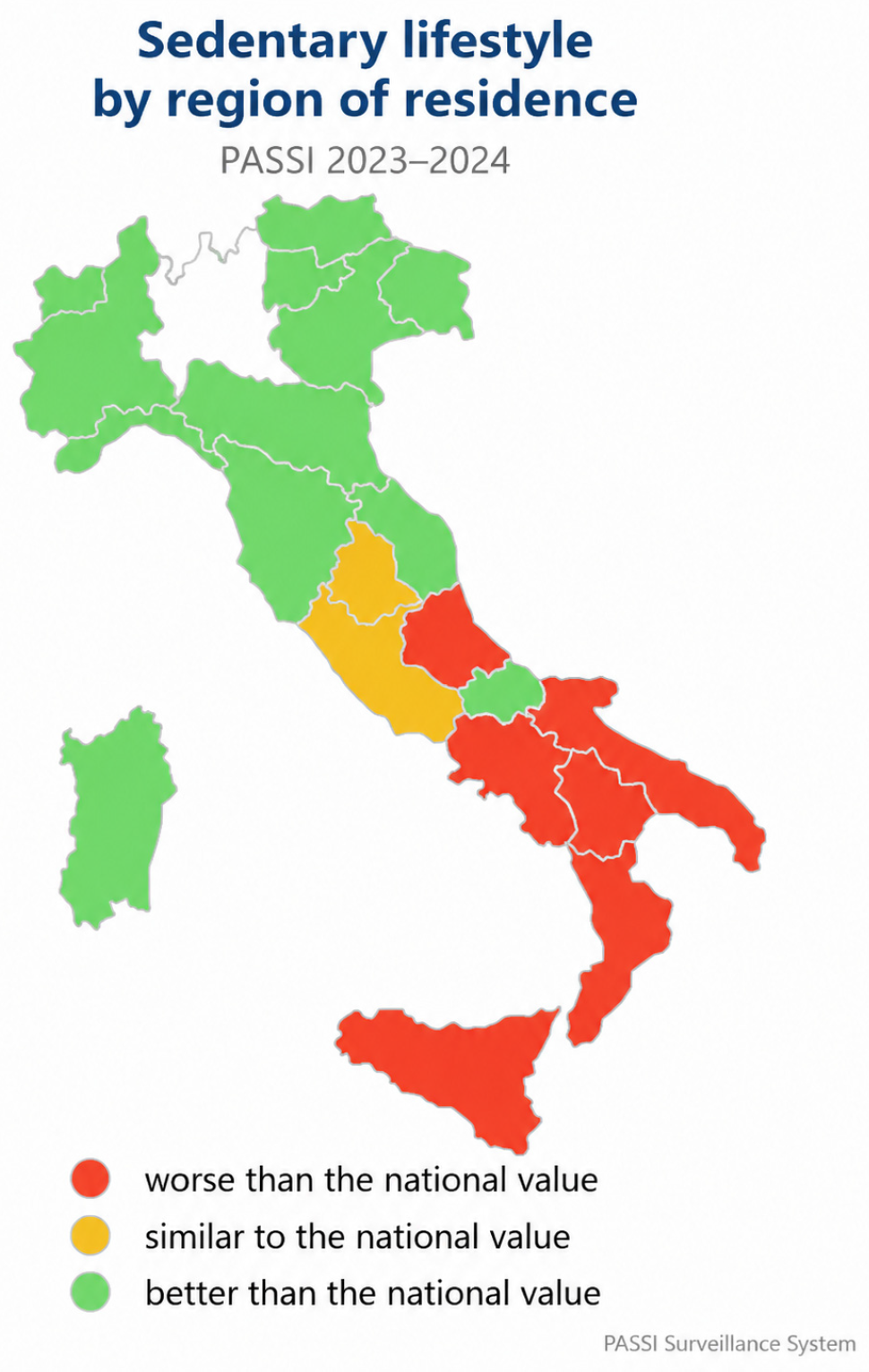
PASSI 2023–2024 data show persistent behavioral risk factors with marked social gradients. One in four adults (24%) smoke, reaching 36% among those with economic hardship versus 21% without; fewer than 50% of smokers report cessation advice. High-risk drinking affects 18% of adults, peaking at 36% among 18–24-year-olds, yet only 7% of high-risk drinkers receive advice to reduce consumption. Only 7.4% consume the recommended five daily fruit/vegetable portions, with lower adherence in the South (41% eating ≥3 portions vs. 50% in Central Italy). Physical inactivity affects 27% of adults, exceeding 50% in Calabria (Figure 1).
Figure 1.
Sedentary adults by region of residence (PASSI 2023–2024). Bars show standardized prevalence with 95% confidence intervals; the dashed line indicates the national value (27.2%). Colors indicate whether the regional value is worse than, similar to or better than the national value, as classified by PASSI. Values range from 7.2% in the Autonomous Province of Bolzano to 51.4% in Calabria; data for Lombardy are not available. Figure created by the authors from PASSI data (Istituto Superiore di Sanità) [20]. Source: https://www.epicentro.iss.it/passi/dati/attivita-oms (accessed on 12 September 2026).
3.2. Epidemiological Evidence on Health Conditions and Psychological Well-Being
According to the Italian PASSI surveillance system (2023–2024), cardiovascular risk factors were highly prevalent among adults aged 18–69 years (Table 1). Excess body weight affected 43% of respondents, while approximately 18% reported hypertension, 18% hypercholesterolemia, and 5% diabetes. In addition, 27% were physically inactive, 24% were current smokers, and 7.4% met the recommended daily intake of five portions of fruit and vegetables.
Table 1.
Prevalence of selected cardiovascular and behavioral risk factors among Italian adults (18–69 years). Table from PASSI surveillance 2023–2024 (https://www.epicentro.iss.it/passi/dati/cardiovascolare (accessed on 12 September 2026)).
Marked age-related and socioeconomic differences were observed. Self-reported hypertension increased from slightly over 2% among adults aged 18–34 years to 33% among those aged 50–69 years. Hypertension was more prevalent among men, individuals with excess body weight, and those experiencing socioeconomic disadvantage. Similarly, self-reported hypercholesterolemia increased from less than 4% to approximately 30% across the same age groups and was more frequently reported among individuals with excess body weight and lower socioeconomic status.
Preventive management also differed between conditions. Approximately 80% of respondents with hypertension reported receiving pharmacological treatment, compared with slightly more than 40% of those with hypercholesterolemia. Lifestyle recommendations were frequently reported for both conditions, particularly regarding physical activity, weight management, and dietary habits. Overall, these findings highlight the frequent coexistence of multiple modifiable cardiovascular risk factors in the Italian adult population.
According to the INAIL 2024 Annual Report, musculoskeletal and connective-tissue disorders accounted for approximately three-quarters of occupational disease claims with a coded diagnosis (approximately 63,000 claims in 2024) [21]. In addition, 48.98% of Italian high-school students aged 14–19 years reported at least one episode of low back pain [62], indicating that this condition often begins before working age. In PASSI 2023–2024, slightly over 6% of adults aged 18–69 years reported depressive symptoms; these adults reported on average approximately 16 days of poor mental health in the preceding month, compared with fewer than 2 days among those without depressive symptoms. In the same survey, at least one chronic disease was reported by 18.1% of adults, increasing from 6.9% at 18–34 years to 28.6% at 50–69 years (Table 2). Among Italian university students, the prevalence of stress (72.6%), anxiety (61.8%) and depression (41.6%) is far higher than in the general population [10]. Taken together, these findings indicate that health vulnerabilities span metabolic, cardiovascular, musculoskeletal, psychological and lifestyle-related domains and may coexist before a chronic disease is diagnosed, supporting preventive approaches that identify early vulnerability and address modifiable determinants of health.
Table 2.
Prevalence of at least one self-reported chronic disease among Italian adults aged 18–69 years, by sociodemographic characteristics (PASSI 2023–2024) (https://www.epicentro.iss.it/passi/dati/croniche, accessed on 12 September 2026).
3.3. Multi-Domain Risk Assessment Framework
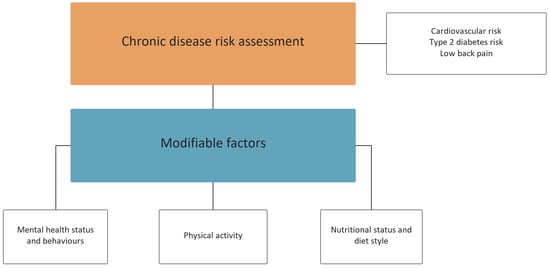
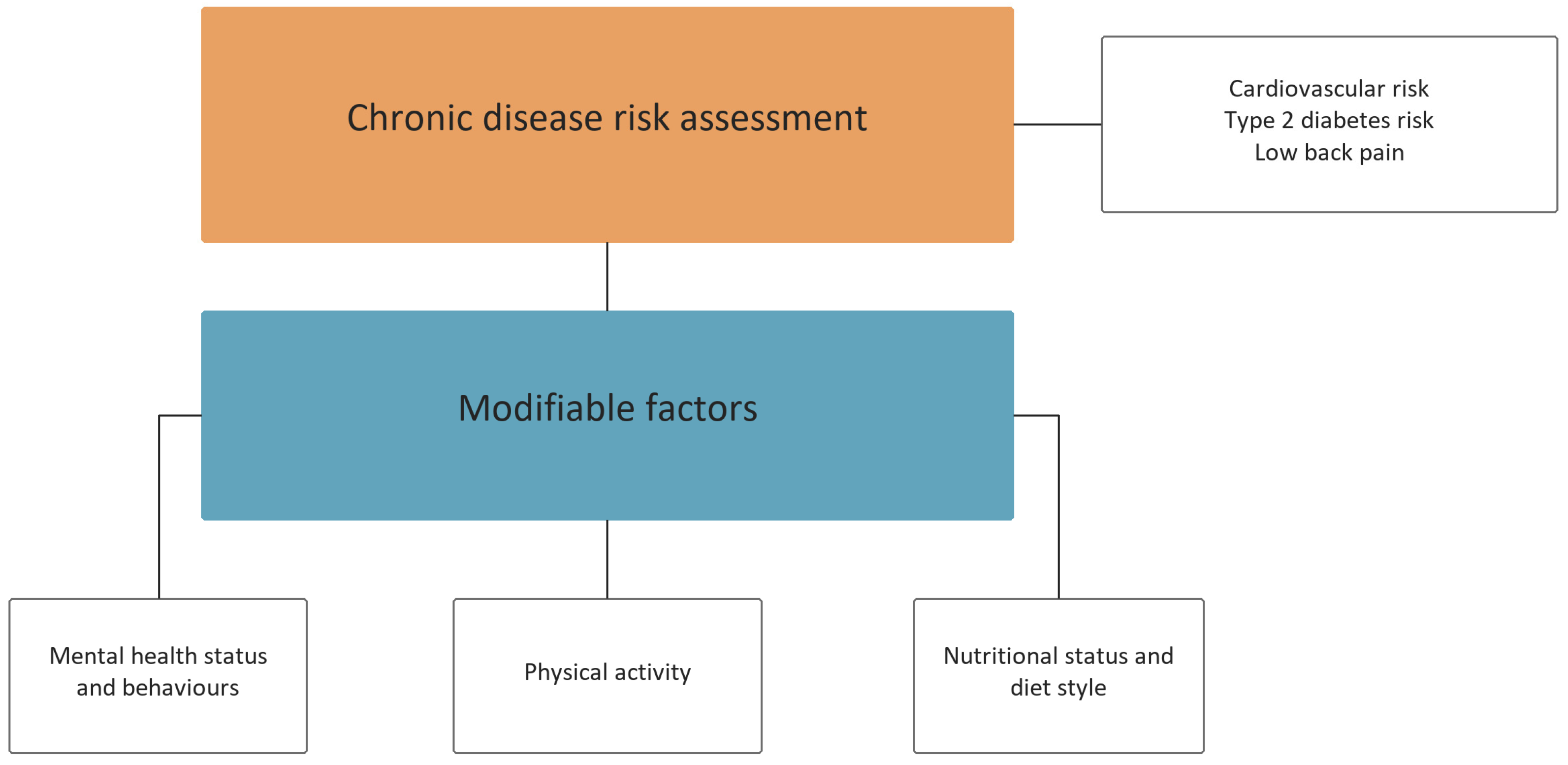
The integration of epidemiological evidence, population-specific risk factors, and validated assessment instruments resulted in a multi-domain risk assessment framework comprising seven interrelated domains: comorbidity, cardiovascular, metabolic, musculoskeletal, psychological, physical activity, and nutritional risk. Each domain was associated with specific assessment instruments, key indicators, and thresholds, as summarized in Table 3. Published evidence also suggests interactions between domains: academic stress has been associated with unhealthy eating through emotional eating [63], and excess weight and low back pain have been described as mutually reinforcing [64]. The multidomain approach was designed to assess the heterogeneous and interacting determinants of health in the target population side-by-side rather than in isolation. This approach is consistent with the prevention rationale of DELPHI, in which the coexistence of multiple moderate risks may be clinically and preventively relevant even when no single domain reaches a threshold for a specific diagnosis. The domains contribute in different ways (Table 3): comorbidity and cardiovascular risk define eligibility; metabolic, musculoskeletal, physical activity and nutritional indicators support participant characterization; and psychological indicators determine allocation to the prevention pathways. No composite multidomain score has been defined at this stage (Figure 2).
Table 3.
Multi-domain risk assessment framework: domains, instruments, thresholds, and use within the framework.
Figure 2.
Diagram illustrating the chronic disease risk assessment defined within the DELPHI project, along with the modifiable risk factors that will be collected and monitored over the course of the study.
3.4. Psychological Risk Stratification Model and Prevention Pathways
The allocation rules, the safety criteria and the re-stratification rules are described in Section 2.5 and summarized in Figure 3. In brief, participants meeting the BDI-II or Item 9 safety criteria are excluded, directed to local health services and offered orientation and support by licensed psychologists of the research team; the remaining participants are assigned to Maintenance when no psychological threshold is reached and to Rebalancing when at least one is reached, and are subsequently re-stratified using the weekly DBS-6 (Table S1). Maintenance and Rebalancing should not be interpreted as fixed clinical categories, but as modifiable prevention states that change as the participant’s psychological condition evolves. In future developments, repeated questionnaire-based assessments could be combined with longitudinal information generated through interaction with the digital platform to refine risk profiles; these developments are not part of the present framework, and no predictive model has been developed or validated.
Figure 3.
Flow diagram of psychological screening, pathway allocation, safety procedure and rule-based re-stratification in the DELPHI framework. D, A, S: DASS-21 Depression, Anxiety and Stress raw subscale scores; BDI-II, Beck Depression Inventory-II; DBS-6, DELPHI Brief Scale. DASS-21 scores alone do not trigger the safety procedure; the DBS-6 has not been psychometrically validated, and its cut-offs are a priori operational values.
4. Discussion
The DELPHI framework was developed to support personalized prevention by integrating validated assessment instruments across complementary health domains with psychological risk-based allocation to differentiated preventive pathways. The epidemiological evidence considered during its development highlighted persistent modifiable risk factors and socioeconomic inequalities among working-age adults. In addition, the limited provision of preventive counseling reported by national surveillance data underscores the importance of exploring complementary approaches to health promotion beyond conventional healthcare encounters. Universities and workplaces may represent suitable settings for engaging individuals in preventive activities [65,66].
Existing risk-based prevention approaches, such as the WHO HEARTS framework for cardiovascular disease prevention and management [67], use established risk indicators to guide clinical and preventive decisions. Stratified and stepped-care models similarly adjust the intensity of care to individual risk or response, as in the STarT Back approach for low back pain [39] and in psychological care for depression [19]. DELPHI differs in its broader assessment of health determinants and its proposed use of psychological indicators to guide personalized behavioral prevention. Importantly, the framework does not currently generate a composite multidomain risk score: information collected across the assessment domains supports participant characterization, whereas psychological risk indicators determine allocation to the Maintenance and Rebalancing pathways. This distinction is essential when interpreting the framework in relation to established clinical risk-stratification models.
The emphasis on psychological indicators reflects the relationship between psychological distress, health behaviors, and physical health. Chronic psychosocial stress has been associated with dysregulation of the hypothalamic–pituitary–adrenal axis and sympathetic nervous system, which have been proposed as pathways linking stress to cardiovascular disease and type 2 diabetes [68,69]; these mechanisms were not examined in DELPHI. These relationships provide a rationale for considering psychological well-being within preventive interventions, although the extent to which the proposed pathways improve psychological or physical health outcomes remains to be established.
The framework also incorporates periodic psychological reassessment, allowing pathway allocation to be reconsidered as participants’ needs change over time. This approach is intended to provide greater responsiveness than a single baseline assessment. However, the validity of the stratification criteria, the feasibility of repeated assessments, and the clinical utility of adaptive pathway allocation require prospective evaluation. This rule-based re-stratification is not a predictive model; predictive approaches may be explored in future work if supported by data.
Strengths and Limitations
The main strengths of the DELPHI framework include the integration of validated assessment instruments across complementary health domains, their selection based on the characteristics of the target population, and the combination of multidomain health assessment with psychological risk-based personalization. An additional strength is the incorporation of periodic reassessment, designed to accommodate changes in participants’ psychological profiles and preventive needs over time. User input gathered through participatory design activities informed the development of the platform, although this component was not formally evaluated.
Several limitations should be acknowledged. First, the DBS-6 is a project-specific scale that has not been psychometrically validated, its cut-offs are a priori operational values, and the psychological risk-stratification criteria have not yet been prospectively validated in the target population. Second, the extensive assessment battery may impose a substantial burden on participants, potentially affecting adherence, response quality, and data completeness. Third, recruitment from selected university and occupational settings in Southern Italy may introduce selection bias and limit the generalizability of the findings. Furthermore, differences in access to digital technologies and levels of digital literacy may influence engagement with the platform and its accessibility across population subgroups.
Additional limitations include reliance on self-reported information for several assessments, the selection of instruments by a single clinician without a systematic review or consensus procedure, and the use of project-specific IPAQ-SF cut-offs, which limits comparability with studies applying the official IPAQ scoring. Participants with severe DASS-21 scores receive information and on-request support rather than proactive contact. Moreover, the precautionary “any threshold” rule may assign a large proportion of participants to Rebalancing, particularly among university students; this is nevertheless consistent with the preventive, non-clinical nature of the platform, in which Rebalancing consists of low-intensity content. The feasibility, usability, and effectiveness of the differentiated preventive pathways remain to be established through the ongoing clinical trial. Future work should examine the psychometric properties of the DBS-6, refine its cut-offs, explore rules for integrating information across domains and, only if supported by data, develop and validate predictive models for finer stratification.
5. Conclusions
The DELPHI framework proposes an approach that links epidemiological evidence from national surveillance to validated multi-domain assessment, covering clinical, psychological and lifestyle domains, and to rule-based, personalized prevention pathways for adults aged 18–65. Informed by PASSI data and developed with input from user-centered and participatory design activities, it aims to bridge population-level evidence and individual-level preventive action. Its empirical performance, the integration of information across domains, the effectiveness of the pathways and the acceptability and usability of the platform are being assessed or remain to be evaluated in the ongoing DELPHI study.
Supplementary Materials
The following supporting information can be downloaded at https://www.mdpi.com/article/10.3390/epidemiologia7060159/s1. Table S1: DELPHI Brief Scale (DBS-6): items, scoring and closest items in validated instruments.
Author Contributions
Conceptualization, S.I.I., M.S., G.T. and I.G.A.; methodology, S.I.I., M.S., R.B. and G.T.; software, G.T., R.B. and F.P.; validation, M.G., A.G. and S.C.; formal analysis, S.I.I., M.V.M. and B.C.; investigation, S.I.I., M.S., M.A.P., V.H., S.C. and M.V.M.; resources, I.G.A., G.T. and M.S.; data curation, M.A.P., V.H., F.P. and C.P.; writing—original draft preparation, S.I.I. and M.S.; writing—review and editing, M.G., A.G., M.A.P., V.H., R.B., B.C., C.P., G.T. and I.G.A.; visualization, A.G., S.C., M.V.M. and F.P.; supervision, G.T. and I.G.A.; project administration, I.G.A. and G.T.; funding acquisition, I.G.A. and G.T. All authors have read and agreed to the published version of the manuscript.
Funding
This work was supported by the Italian Complementary National Plan PNC-I.1 “Research initiatives for innovative technologies and pathways in the health and welfare sector” D.D. 931 of 6 June 2022, “DARE-DigitAl lifelong pRevEntion” initiative, code PNC0000002, CUP: B53C22006460001.
Institutional Review Board Statement
The study was conducted in accordance with the Declaration of Helsinki and approved by the Comitato Etico Nazionale (CEN) of the Istituto Superiore di Sanità on 04/05/2026 (protocol AOO-ISS—04/05/2026—0019012, Class: PRE BIO CEN 01.00).
Informed Consent Statement
Written informed consent is obtained from all participants enrolled in the clinical trial. Consent for publication is not applicable, as this manuscript does not contain any individual person’s data.
Data Availability Statement
This article describes a methodological framework informed by publicly available aggregate surveillance data (PASSI, ISS; INAIL open data); no new individual-level datasets were generated.
Acknowledgments
The authors wish to thank Flavia Altavilla, Giorgia Bruschetta, Giulia Giordano, Chiara Urone and Alessia Valdesi for their support in bibliographic research and study preparation. During the preparation of this manuscript, the authors used ChatGPT (OpenAI, GPT-6) solely for language translation. All translated text was carefully reviewed and verified by the authors, who take full responsibility for the final content of the manuscript.
Conflicts of Interest
The authors declare no conflicts of interest.
References
- World Health Organization. Noncommunicable Diseases. Fact Sheet. Available online: https://www.who.int/news-room/fact-sheets/detail/noncommunicable-diseases (accessed on 15 October 2026).
- Laffond, A.; Rivera-Picón, C.; Rodríguez-Muñoz, P.M.; Juárez-Vela, R.; Ruiz de Viñaspre-Hernández, R.; Navas-Echazarreta, N.; Sánchez-González, J.L. Mediterranean diet for primary and secondary prevention of cardiovascular disease and mortality: An updated systematic review. Nutrients 2023, 15, 3356. [Google Scholar] [CrossRef] [Scilit]
- World Health Organization. Mental Disorders. Fact Sheet. Available online: https://www.who.int/news-room/fact-sheets/detail/mental-disorders (accessed on 15 October 2026).
- OECD; European Union. Health at a Glance: Europe 2018; OECD Publishing: Paris, France, 2018. [Google Scholar] [CrossRef] [Scilit]
- Aksüt, G.; Eren, T.; Alakaş, H.M. Using wearable technological devices to improve workplace health and safety: An assessment on a sector base with multi-criteria decision-making methods. Ain Shams Eng. J. 2024, 15, 102423. [Google Scholar] [CrossRef] [Scilit]
- Ates, H.C.; Ates, C.; Dincer, C. Stress monitoring with wearable technology and AI. Nat. Electron. 2024, 7, 98–99. [Google Scholar] [CrossRef] [Scilit]
- Bruschetta, R.; Latella, D.; Formica, C.; Campisi, S.; Failla, C.; Marino, F.; Iacono Isidoro, S.; Giambò, F.M.; Bonanno, L.; Cerasa, A.; et al. “BrainHeart”: Pilot study on a novel application for elderly well-being based on Mindfulness Acceptance and Commitment Therapy. Bioengineering 2024, 11, 787. [Google Scholar] [CrossRef] [Scilit]
- Debon, R.; Coleone, J.D.; Bellei, E.A.; De Marchi, A.C.B. Mobile health applications for chronic diseases: A systematic review of features for lifestyle improvement. Diabetes Metab. Syndr. 2019, 13, 2507–2512. [Google Scholar] [CrossRef] [Scilit]
- Mofatteh, M. Risk factors associated with stress, anxiety, and depression among university undergraduate students. AIMS Public Health 2021, 8, 36–65. [Google Scholar] [CrossRef] [Scilit]
- Gambolò, L.; Pireddu, R.; D’Angelo, M.; Ticozzi, E.M.; Bellini, L.; Solla, D.; Fagoni, N.; Stirparo, G. Exploring mental health of Italian college students: A systematic review and meta-analysis. Discov. Ment. Health 2025, 5, 91. [Google Scholar] [CrossRef] [Scilit]
- Sansone, V.; Angelillo, S.; Paduano, G.; D’Antonio, G.; Pelullo, C.P.; Di Giuseppe, G. Physical activity and Mediterranean diet: A focus on university students’ habits. Nutrients 2025, 17, 2951. [Google Scholar] [CrossRef] [Scilit]
- Levante, A.; Quarta, S.; Massaro, M.; Calabriso, N.; Carluccio, M.A.; Damiano, F.; Pollice, F.; Siculella, L.; Lecciso, F. Physical activity habits prevent psychological distress in female academic students: The multiple mediating role of physical and psychosocial parameters. Heliyon 2024, 10, e26626. [Google Scholar] [CrossRef] [Scilit]
- Harvey, S.B.; Modini, M.; Joyce, S.; Milligan-Saville, J.S.; Tan, L.; Mykletun, A.; Bryant, R.A.; Christensen, H.; Mitchell, P.B. Can work make you mentally ill? A systematic meta-review of work-related risk factors for common mental health problems. Occup. Environ. Med. 2017, 74, 301–310. [Google Scholar] [CrossRef] [Scilit]
- Thern, E.; Matilla-Santander, N.; Hernando-Rodriguez, J.C.; Almroth, M.; Bodin, T. Precarious employment in early adulthood and later mental health problems: A register-linked cohort study. J. Epidemiol. Community Health 2023, 77, 755–761. [Google Scholar] [CrossRef] [Scilit]
- Governo della Repubblica Italiana. Decreto Legislativo 9 aprile 2008, n. 81. Testo Unico sulla Salute e Sicurezza sul Lavoro. Gazzetta Ufficiale della Repubblica Italiana, 30 April 2008; n. 101.
- Sesti, F.; Minardi, V.; Baglio, G.; Bell, R.; Goldblatt, P.; Marceca, M.; Masocco, M.; Campostrini, S.; Marmot, M. Social determinants of mental health in Italy: The role of education in the comparison of migrant and Italian residents. Int. J. Equity Health 2022, 21, 116. [Google Scholar] [CrossRef] [Scilit]
- Quintano, C.; Mazzocchi, P.; Rocca, A. The determinants of Italian NEETs and the effects of the economic crisis. Genus 2018, 74, 5. [Google Scholar] [CrossRef] [Scilit]
- Haas, L.R.; Takahashi, P.Y.; Shah, N.D.; Stroebel, R.J.; Bernard, M.E.; Finnie, D.M.; Naessens, J.M. Risk-stratification methods for identifying patients for care coordination. Am. J. Manag. Care 2013, 19, 725–732. [Google Scholar]
- Delgadillo, J.; Ali, S.; Fleck, K.; Agnew, C.; Southgate, A.; Parkhouse, L.; Cohen, Z.D.; DeRubeis, R.J.; Barkham, M. Stratified care vs stepped care for depression: A cluster randomized clinical trial. JAMA Psychiatry 2022, 79, 101–108. [Google Scholar] [CrossRef] [Scilit]
- Istituto Superiore di Sanità. Sorveglianza PASSI—Progressi delle Aziende Sanitarie per la Salute in Italia. Available online: https://www.epicentro.iss.it/passi/ (accessed on 15 June 2026).
- INAIL. Infortuni e Malattie Professionali in Italia—Relazione Annuale 2024; INAIL: Rome, Italy, 2024. [Google Scholar]
- Visseren, F.L.J.; Mach, F.; Smulders, Y.M.; Carballo, D.; Koskinas, K.C.; Bäck, M.; Benetos, A.; Biffi, A.; Boavida, J.M.; Capodanno, D.; et al. 2021 ESC Guidelines on cardiovascular disease prevention in clinical practice. Eur. Heart J. 2021, 42, 3227–3337. [Google Scholar] [CrossRef] [Scilit]
- Rydén, L.; Grant, P.J.; Anker, S.D.; Berne, C.; Cosentino, F.; Danchin, N.; Deaton, C.; Escaned, J.; Hammes, H.P.; Huikuri, H.; et al. ESC Guidelines on diabetes, pre-diabetes, and cardiovascular diseases developed in collaboration with the EASD. Eur. Heart J. 2013, 34, 3035–3087. [Google Scholar] [CrossRef] [Scilit]
- National Institute for Health and Care Excellence (NICE). Low Back Pain and Sciatica in Over 16s: Assessment and Management (NG59); (updated 2026); NICE: London, UK, 2016; Available online: https://www.nice.org.uk/guidance/ng59 (accessed on 15 October 2026).
- Istituto Superiore di Sanità. Progetto CUORE—Carta del Rischio Cardiovascolare [Cardiovascular Risk Charts]. Available online: https://www.cuore.iss.it/valutazione/carte (accessed on 15 October 2026).
- Linn, B.S.; Linn, M.W.; Gurel, L. Cumulative illness rating scale. J. Am. Geriatr. Soc. 1968, 16, 622–626. [Google Scholar] [CrossRef] [Scilit]
- Hudon, C.; Fortin, M.; Vanasse, A. Cumulative Illness Rating Scale was a reliable and valid index in a family practice context. J. Clin. Epidemiol. 2005, 58, 603–608. [Google Scholar] [CrossRef] [Scilit]
- Charlson, M.E.; Pompei, P.; Ales, K.L.; MacKenzie, C.R. A new method of classifying prognostic comorbidity in longitudinal studies: Development and validation. J. Chronic Dis. 1987, 40, 373–383. [Google Scholar] [CrossRef] [Scilit]
- Wilson, P.W.F.; D’Agostino, R.B.; Levy, D.; Belanger, A.M.; Silbershatz, H.; Kannel, W.B. Prediction of coronary heart disease using risk factor categories. Circulation 1998, 97, 1837–1847. [Google Scholar] [CrossRef] [Scilit]
- Hippisley-Cox, J.; Coupland, C.; Brindle, P. Development and validation of QRISK3 risk prediction algorithms to estimate future risk of cardiovascular disease: Prospective cohort study. BMJ 2017, 357, j2099. [Google Scholar] [CrossRef] [Scilit]
- Giampaoli, S.; Palmieri, L.; Chiodini, P.; Cesana, G.; Ferrario, M.; Panico, S.; Pilotto, L.; Sega, R.; Vanuzzo, D.; Gruppo di Ricerca del Progetto CUORE. The global cardiovascular risk chart. Ital. Heart J. Suppl. 2004, 5, 177–185. (In Italian) [Google Scholar]
- Menotti, A.; Puddu, P.E.; Lanti, M. Comparison of the Framingham risk function-based coronary chart with risk function from an Italian population study. Eur. Heart J. 2000, 21, 365–370. [Google Scholar] [CrossRef] [Scilit]
- Lindström, J.; Tuomilehto, J. The diabetes risk score: A practical tool to predict type 2 diabetes risk. Diabetes Care 2003, 26, 725–731. [Google Scholar] [CrossRef] [Scilit]
- Ward, E.D.; Hopkins, W.A.; Shealy, K. Evaluation of the use of a diabetes risk test to identify prediabetes in an employee wellness screening. J. Pharm. Pract. 2022, 35, 524–527. [Google Scholar] [CrossRef] [Scilit]
- Bang, H.; Edwards, A.M.; Bomback, A.S.; Ballantyne, C.M.; Brillon, D.; Callahan, M.A.; Teutsch, S.M.; Mushlin, A.I.; Kern, L.M. Development and validation of a patient self-assessment score for diabetes risk. Ann. Intern. Med. 2009, 151, 775–783. [Google Scholar] [CrossRef] [Scilit]
- Griffin, S.J.; Little, P.S.; Hales, C.N.; Kinmonth, A.L.; Wareham, N.J. Diabetes risk score: Towards earlier detection of type 2 diabetes in general practice. Diabetes Metab. Res. Rev. 2000, 16, 164–171. [Google Scholar] [CrossRef]
- Schmidt, M.I.; Duncan, B.B.; Bang, H.; Pankow, J.S.; Ballantyne, C.M.; Golden, S.H.; Folsom, A.R.; Chambless, L.E. Identifying individuals at high risk for diabetes: The Atherosclerosis Risk in Communities study. Diabetes Care 2005, 28, 2013–2018. [Google Scholar] [CrossRef] [Scilit]
- Stern, M.P.; Williams, K.; Haffner, S.M. Identification of persons at high risk for type 2 diabetes mellitus: Do we need the oral glucose tolerance test? Ann. Intern. Med. 2002, 136, 575–581. [Google Scholar] [CrossRef] [Scilit]
- Hill, J.C.; Dunn, K.M.; Lewis, M.; Mullis, R.; Main, C.J.; Foster, N.E.; Hay, E.M. A primary care back pain screening tool: Identifying patient subgroups for initial treatment. Arthritis Rheum. 2008, 59, 632–641. [Google Scholar] [CrossRef] [Scilit]
- Linton, S.J.; Halldén, K. Can we screen for problematic back pain? A screening questionnaire for predicting outcome in acute and subacute back pain. Clin. J. Pain 1998, 14, 209–215. [Google Scholar] [CrossRef] [Scilit]
- Gabel, C.P.; Melloh, M.; Burkett, B.; Osborne, J.; Yelland, M. The Örebro Musculoskeletal Screening Questionnaire: Validation of a modified primary care musculoskeletal screening tool in an acute work-injured population. Man. Ther. 2012, 17, 554–565. [Google Scholar] [CrossRef] [Scilit]
- Maggiani, A.; Abenavoli, A. Italian translation and cross-cultural adaptation of a back pain screening questionnaire (STarT Back Screening Tool). Ann. Ig. 2019, 31, 69–75. [Google Scholar] [CrossRef] [Scilit]
- Giusti, E.M.; Varallo, G.; Abenavoli, A.; Manzoni, G.M.; Aletti, L.; Capodaglio, P.; Castelnuovo, G.; Maggiani, A. Factor structure, validity, and reliability of the STarT Back Screening Tool in Italian obese and non-obese patients with low back pain. Front. Psychol. 2021, 12, 740851. [Google Scholar] [CrossRef] [Scilit]
- Lovibond, S.H.; Lovibond, P.F. Manual for the Depression Anxiety Stress Scales; Psychology Foundation of Australia: Sydney, Australia, 1995. [Google Scholar]
- Bottesi, G.; Ghisi, M.; Altoè, G.; Conforti, E.; Melli, G.; Sica, C. The Italian version of the Depression Anxiety Stress Scales-21: Factor structure and psychometric properties on community and clinical samples. Compr. Psychiatry 2015, 60, 170–181. [Google Scholar] [CrossRef] [Scilit]
- Beck, A.T.; Steer, R.A.; Brown, G. Beck Depression Inventory–II (BDI-II); APA PsycTests: Washington, DC, USA, 1996. [Google Scholar] [CrossRef] [Scilit]
- Sica, C.; Ghisi, M. The Italian versions of the Beck Anxiety Inventory and the Beck Depression Inventory-II: Psychometric properties and discriminant power. In Leading-Edge Psychological Tests and Testing Research; Lange, M.A., Ed.; Nova Science Publishers: New York, NY, USA, 2007; pp. 27–50. [Google Scholar]
- Zanon, C.; Zhao, N.; Topkaya, N.; Şahin, E.; Vogel, D.L.; Ertl, M.M.; Sanatkar, S.; Liao, H.-Y.; Rubin, M.; Baptista, M.N.; et al. Psychometric properties of the Depression, Anxiety, and Stress Scale–21 (DASS-21) across nine countries/regions. Int. J. Test. 2025, 25, 178–193. [Google Scholar] [CrossRef] [Scilit]
- Craig, C.L.; Marshall, A.L.; Sjöström, M.; Bauman, A.E.; Booth, M.L.; Ainsworth, B.E.; Pratt, M.; Ekelund, U.L.; Yngve, A.; Sallis, J.F.; et al. International Physical Activity Questionnaire: 12-country reliability and validity. Med. Sci. Sports Exerc. 2003, 35, 1381–1395. [Google Scholar] [CrossRef] [Scilit]
- Mannocci, A.; Di Thiene, D.; Del Cimmuto, A.; Masala, D.; Boccia, A.; De Vito, E.; La Torre, G. International Physical Activity Questionnaire: Validation and assessment in an Italian sample. Ital. J. Public Health 2010, 7, 369–376. [Google Scholar] [CrossRef] [Scilit]
- Aiello, P.; Peluso, I.; Di Giacomo, S.; Di Sotto, A.; Villaño Valencia, D. Body Composition and Metabolic Status of Italian and Spanish University Students: Relationship with Fruit and Vegetable Consumption. Nutrients 2022, 14, 3296. [Google Scholar] [CrossRef] [Scilit]
- Martínez-González, M.A.; García-Arellano, A.; Toledo, E.; Salas-Salvadó, J.; Buil-Cosiales, P.; Corella, D.; Covas, M.I.; Schröder, H.; Arós, F.; Gómez-Gracia, E.; et al. A 14-item Mediterranean diet assessment tool and obesity indexes among high-risk subjects: The PREDIMED trial. PLoS ONE 2012, 7, e43134. [Google Scholar] [CrossRef] [Scilit]
- Schröder, H.; Fitó, M.; Estruch, R.; Martínez-González, M.A.; Corella, D.; Salas-Salvadó, J.; Lamuela-Raventós, R.; Ros, E.; Salaverría, I.; Fiol, M.; et al. A short screener is valid for assessing Mediterranean diet adherence among olderSpanish men and women. J. Nutr. 2011, 141, 1140–1145. [Google Scholar] [CrossRef] [Scilit]
- García-Conesa, M.T.; Philippou, E.; Pafilas, C.; Massaro, M.; Quarta, S.; Andrade, V.; Jorge, R.; Chervenkov, M.; Ivanova, T.; Dimitrova, D.; et al. Exploring the validity of the 14-item Mediterranean Diet Adherence Screener (MEDAS): A cross-national study in seven European countries around the Mediterranean region. Nutrients 2020, 12, 2960. [Google Scholar] [CrossRef] [Scilit]
- Recio-Rodriguez, J.I.; Garcia-Ortiz, L.; Garcia-Yu, I.A.; Lugones-Sanchez, C.; Olmo, E.Z.-D.; Bolibar, B.; Casajuana-Closas, M.; Lopez-Jimenez, T.; Llobera, J.; Ramos, R.; et al. Effectiveness of a multiple health-behaviour-change intervention in increasing adherence to the Mediterranean Diet in adults (EIRA study): A randomized controlled hybrid trial. BMC Public Health 2022, 22, 2127. [Google Scholar] [CrossRef] [Scilit]
- Società Italiana di Nutrizione Umana (SINU). LARN—Livelli di Assunzione di Riferimento di Nutrienti ed Energia per la Popolazione Italiana, 5th ed.; Biomedia: Milan, Italy, 2024. [Google Scholar]
- Westerterp, K.R. Physical activity and physical activity induced energy expenditure in humans: Measurement, determinants, and effects. Front. Physiol. 2013, 4, 90. [Google Scholar] [CrossRef] [Scilit]
- Topp, C.W.; Østergaard, S.D.; Søndergaard, S.; Bech, P. The WHO-5 Well-Being Index: A systematic review of the literature. Psychother. Psychosom. 2015, 84, 167–176. [Google Scholar] [CrossRef] [Scilit]
- Kroenke, K.; Spitzer, R.L.; Williams, J.B.W. The Patient Health Questionnaire-2: Validity of a two-item depression screener. Med. Care 2003, 41, 1284–1292. [Google Scholar] [CrossRef] [Scilit]
- Kroenke, K.; Spitzer, R.L.; Williams, J.B.W. The PHQ-9: Validity of a brief depression severity measure. J. Gen. Intern. Med. 2001, 16, 606–613. [Google Scholar] [CrossRef] [Scilit]
- Spitzer, R.L.; Kroenke, K.; Williams, J.B.W.; Löwe, B. A brief measure for assessing generalized anxiety disorder: The GAD-7. Arch. Intern. Med. 2006, 166, 1092–1097. [Google Scholar] [CrossRef] [Scilit]
- Masiero, S.; Sarto, F.; Cattelan, M.; Sarto, D.; Del Felice, A.; Agostini, F.; Scanu, A. Lifetime prevalence of nonspecific low back pain in adolescents: A cross-sectional epidemiologic survey. Am. J. Phys. Med. Rehabil. 2021, 100, 1170–1175. [Google Scholar] [CrossRef] [Scilit]
- Caso, D.; Cestone, M.; Fabbricatore, R.; Conner, M. Unhealthy eating and academic stress: The moderating effect of eating style and BMI. Health Psychol. Open 2020, 7, 2055102920975274. [Google Scholar] [CrossRef] [Scilit]
- Ruiz-Fernández, C.; Schol, J.; Ambrosio, L.; Sakai, D. The vicious cycle of obesity and low back pain: A comprehensive review. Appl. Sci. 2025, 15, 6660. [Google Scholar] [CrossRef] [Scilit]
- Javanmardi, S.; Rappelt, L.; Zangenberg, S.; Heinke, L.; Baumgart, C.; Niederer, D.; Freiwald, J. Effectiveness of workplace health promotion programs for industrial workers: A systematic review. BMC Public Health 2025, 25, 168. [Google Scholar] [CrossRef] [Scilit]
- Moroni, A.; Micheletti Cremasco, M.; Gilli, G.; Degan, R. Workplace health promotion in Italian university employees: Effects on body composition and Mediterranean diet adherence. Int. J. Environ. Res. Public Health 2024, 21, 1003. [Google Scholar] [CrossRef] [Scilit]
- World Health Organization. HEARTS: Technical Package for Cardiovascular Disease Management in Primary Health Care: Risk-Based CVD Management; World Health Organization: Geneva, Switzerland, 2020. [Google Scholar]
- Kivimäki, M.; Steptoe, A. Effects of stress on the development and progression of cardiovascular disease. Nat. Rev. Cardiol. 2018, 15, 215–229. [Google Scholar] [CrossRef] [Scilit]
- Hackett, R.A.; Steptoe, A. Type 2 diabetes mellitus and psychological stress—A modifiable risk factor. Nat. Rev. Endocrinol. 2017, 13, 547–560. [Google Scholar] [CrossRef] [Scilit]

Disclaimer/Publisher’s Note: The statements, opinions and data contained in all publications are solely those of the individual author(s) and contributor(s) and not of MDPI and/or the editor(s). MDPI and/or the editor(s) disclaim responsibility for any injury to people or property resulting from any ideas, methods, instructions or products referred to in the content. |
© 2026 by the authors. Licensee MDPI, Basel, Switzerland. This article is an open access article distributed under the terms and conditions of the Creative Commons Attribution (CC BY) license.