


Abstract
Background: Bushfire smoke exposure (BFSE) is associated with adverse pregnancy and neonatal outcomes; however, the specific impact of BFSE on pregnancies complicated by asthma is not well characterised. Methods: A retrospective cohort study analysed data from 22,166 pregnant women who gave birth in the Illawarra Shoalhaven region between January 2017 and December 2022. Women with asthma were identified by the ICD-10-AM code for asthma during hospital admission for birth. Exposure was defined using a fixed time-window assumption. Women were considered exposed to bushfire smoke if they experienced at least 4 weeks of their pregnancy between 25 October 2019 and 4 February 2020. Results: Prevalence of asthma in the total population was 8.31%. In the control cohort, outcomes for pregnant women with asthma were poorer than those without. Pregnant women with BFSE had increased odds of postpartum haemorrhage (OR 1.603; 95% CI 1.42–1.81), and decreased odds of gestational hypertension (OR 0.615; 95% CI 0.49–0.77), gestational diabetes mellitus (OR 0.703; 95% CI 0.63–0.79) and preterm birth (OR 0.813; 95% CI 0.67–0.98). Maternal asthma did not confound the relationship between BFSE and any of the primary study outcomes. Conclusions: This study emphasises the independent effects of asthma on pregnancy outcomes. The impact of BFSE on pregnant women with asthma remains unclear. Further research is needed to characterise the true effect of BFSE on pregnancies, uncomplicated and complicated by asthma.
1. Introduction
The 2019–2020 New South Wales (NSW) Black Summer bushfires were unprecedented in their intensity, duration, and scale, resulting in widespread bushfire smoke exposure (BFSE) and severely diminished air quality across eastern Australia [1]. Over 11,400 bushfires burnt across NSW for more than four months, resulting in high concentrations of bushfire smoke that led to particulate matter (PM) levels exceeding historical averages and Air Quality Index levels soaring to 25 times higher than hazardous levels [2]. Course PM (PM10) and fine PM (PM2.5) pose serious risks to human health. Inhalable particles with a diameter less than 10 µm are defined as PM10 and are small enough to enter the lungs; particles with a diameter less than 2.5 µm are defined as PM2.5 and are small enough to enter the bloodstream [3]. During the Black Summer bushfires, PM2.5 levels frequently exceeded the national standard of 25 µg/m3, reaching 98.5 µg/m3 in January 2020, with the subsequent BFSE leading to increased emergency department presentations for asthma exacerbations and hospital admissions for respiratory problems [4].
According to NSW air quality data, the Illawarra Shoalhaven region experienced poor air quality during the Black Summer bushfire period from 25 October 2019 to 4 February 2020 [5]. Even though this region was not directly impacted by local bushfires, air quality was still notably diminished. Air quality is considered good when daily PM10 levels are <33.5 µg/m3 and PM2.5 levels are <16.75 µg/m3, and poor when daily PM10 levels are >50 µg/m3 and PM2.5 levels are >25 µg/m3. During the bushfire period, PM10 and PM2.5 exceeded poor levels for 69% and 57% of the bushfire period, respectively. The maximum daily PM10 and PM2.5 levels recorded were 540.8 µg/m3 and 250.9 µg/m3, respectively [5]. Research has consistently shown that bushfire smoke and associated air pollution have adverse effects on pregnancy, impacting neonatal outcomes significantly [6]. Studies from previous bushfire events, such as the 2009 Black Saturday bushfires in Victoria and the 2003 Californian fires, have linked BFSE during pregnancy to low birth weight (LBW) and pre-term birth (PTB) [7,8]. While the exact mechanisms remain unclear, it is hypothesised that PM and air pollution from bushfires can cross the placenta, leading to fetal pulmonary inflammation and disruptions in fetomaternal circulation [9]. Additionally, maternal stress during bushfires has also been associated with increased risks of LWB and PTB [10].
Maternal asthma is a prevalent comorbidity, complicating around 12% of pregnancies in Australia annually [11]. Studies have highlighted the increased risks associated with pregnancies complicated by maternal asthma: adverse maternal outcomes include gestational diabetes (GDM), gestational hypertension and preeclampsia [12,13,14]. Adverse neonatal outcomes include LBW, intrauterine growth restriction (IUGR), PTB, neonatal hypoxia and increased rates of caesarean delivery [15,16]. Despite this knowledge, the maternal and neonatal outcomes of pregnancies complicated by asthma and exposed to bushfire smoke are not well characterised. To the authors’ knowledge, this is the first study to explore the effects of BFSE on pregnancy outcomes in women with asthma. Given the significant health risks associated with both BFSE and asthma, this study aimed to provide valuable insights into the effect of BFSE and asthma on maternal, neonatal and birthing outcomes.
2. Materials and Methods
2.1. Study Setting and Population
This retrospective, observational cohort study utilised routinely collected health data from the Illawarra Health Information Platform, a secured non-identifiable databank containing health data from the Illawarra Shoalhaven Local Health District (ISLHD). This study was approved by the joint ISLHD and University of Wollongong (UOW) Human Research Ethics Committee (2022/ETH01783) and was conducted in accordance with the National Statement on Ethical Conduct in Human Research (2007) and the Strengthening the Reporting of Observational Studies in Epidemiology guidelines.
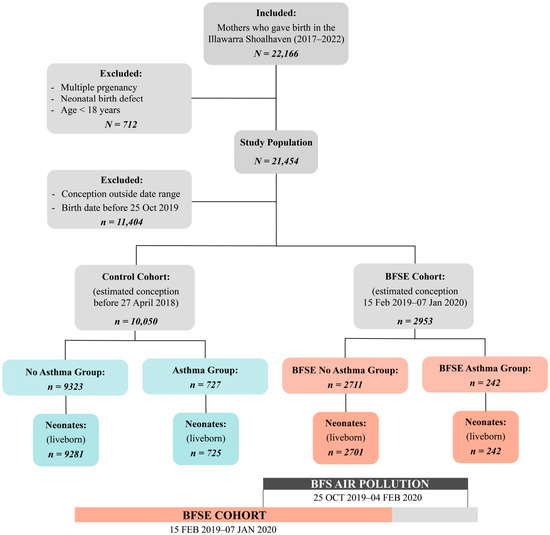
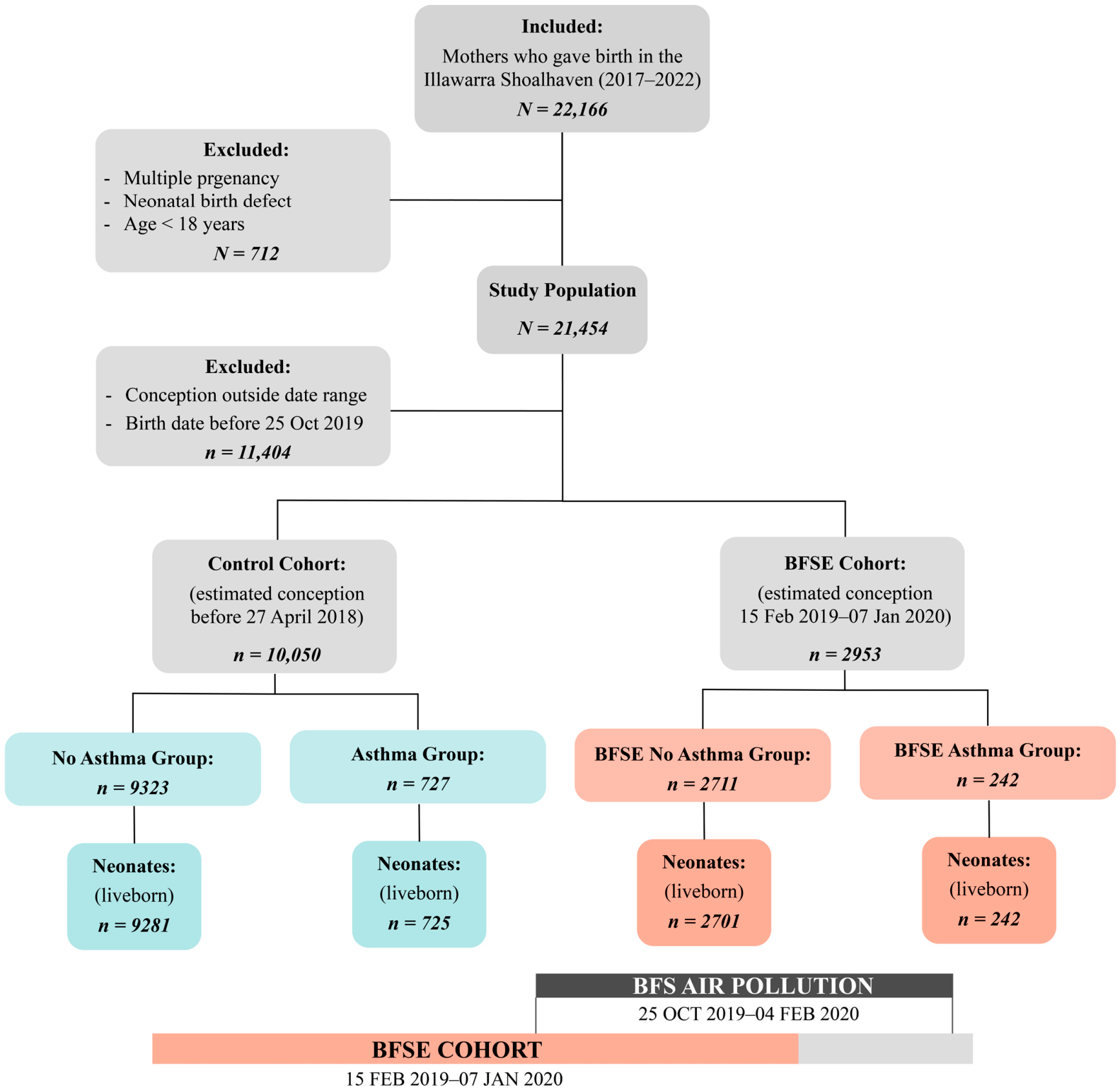
Data from all pregnant women aged 18 or older who were pregnant and gave birth in the ISLHD between 1 January 2017 and 1 December 2022 were included. Women with asthma were identified by the presence of an International Classification of Diseases-Tenth Revision-Australian Modification (ICD-10-AM) code for asthma during their hospital admission for birth. Mothers with a multiple pregnancy and neonates with a birth defect, defined by the presence of an ICD-10-AM code, were excluded. The study included two cohorts, the control cohort and the BFSE cohort (Figure 1). According to data from the NSW Air Quality Monitoring Network, air quality was affected within the ISLHD region from 25 October 2019 to 4 February 2020 [5]. Previous studies have highlighted negative effects of short-term exposure to air pollution, defined as exposure lasting for <30 days, on pregnancy outcomes [17], as such, mothers were considered exposed to bushfire smoke if at least 4 weeks of their pregnancy occurred between 25 October 2019 and 4 February 2020. Subsequently, mothers in the BFSE cohort were defined by an estimated conception date between 15 February 2019 and 7 January 2020, inclusive of a 36-week and 4-week washout period.
Figure 1.
Flowchart of participants included in a study of pregnant women with asthma exposed to bushfire smoke. BFSE: Bushfire Smoke Exposure.
Each cohort was then split into two groups based on maternal asthma status to form four groups: No Asthma (control cohort); Asthma (control cohort); BFSE No Asthma (BFSE cohort); and BFSE Asthma (BFSE cohort). For descriptive statistics, all four groups were used. For logistic regression modelling, the control cohort (pooled No Asthma and Asthma groups) and the BFSE cohort (pooled BFSE No Asthma and BFSE Asthma groups) were used. The control cohort included all mothers with an estimated conception date before 27 April 2018, inclusive of a 42-week washout period to the start of the BFSE cohort. Neonates born prematurely before 25 October 2019 were excluded from the BFSE cohort, the BFSE No Asthma group and the BFSE Asthma group. Preparation of the study dataset was conducted using RStudio (version RStudio 2023.06.0+421).
2.2. Outcome Measures
Demographic and comorbidity phenotypes were established for each mother based on ICD-10-AM codes from the mother’s hospital admission for birth. Baseline demographics included gender, maternal age at admission for birth, Aboriginal or Torres Strait Islander status, gestational age, body mass index at the first antenatal visit (BMI kg/m2), parity, and birth type. Caesarean section classification was defined using the Australian Classification of Health Intervention (5th edition) code set representing procedures. Elective caesarean section refers to a caesarean section performed before the onset of labour; emergency caesarean section refers to a caesarean section performed after the onset of labour. All study outcomes were defined using the ICD-10-AM code set. The primary maternal outcomes were gestational hypertension and GDM; the primary birthing outcomes were non-reassuring fetal status and postpartum haemorrhage (PPH); the primary neonatal outcomes were PTB and LBW. Non-reassuring fetal status includes ICD-10-AM codes that refer to labour and delivery complicated by fetal stress, fetal heart rate anomaly, cord complications, cord prolapse, short cord, cord around neck, and meconium in amniotic fluid. Neonates weighing less than 2500 g were defined as LBW. Only live births were included for neonatal analysis.
2.3. Statistical Analyses
Relationships between categorical variables were compared using log-linear regression; continuous variables were compared using the Mann–Whitney U test or Kruskal–Wallis one-way analysis of variance (ANOVA), unless stated otherwise. Comparisons were made within cohorts (No Asthma and Asthma; BFSE No Asthma and BFSE Asthma) and between cohorts. Logistic regression was used to ascertain the independent effect of BFSE on the primary study outcomes and to assess the confounding effect of asthma. Univariate and multivariable logistic regression was used to calculate the odds ratio (OR) and 95% confidence interval (CI) for the primary maternal, birthing and neonatal outcomes. Univariate models were first adjusted for asthma to ascertain any specific confounding effect of asthma on BFSE. Multivariable models were adjusted for maternal age, BMI, parity, oligohydramnios, smoking, neonatal gender, GDM, pre-eclampsia and gestational hypertension, except where any of the confounders were the dependent variable in the model. Additionally, the PPH model was also adjusted for birth type. All analyses were conducted using Jamovi (version 2.3.16.0).
3. Results
In total, 21,454 women were included in this study. A total of 10,050 women were included in the control cohort, and 2953 were included in the BFSE cohort. In the control cohort, 9323 women without asthma (No Asthma group) and 727 women with asthma (Asthma group) had a singleton pregnancy. In the BFSE cohort, 2711 women without asthma (BFSE No Asthma group) and 242 women with asthma (BFSE Asthma group) had a singleton pregnancy (Figure 1).
Maternal, neonatal and birthing characteristics and outcomes for the No Asthma, Asthma, BFSE No Asthma and BFSE Asthma groups are detailed in Table 1. Several maternal and birthing characteristics and outcomes were significantly altered in the control cohort. Average LOS was significantly increased by 13.12%, BMI by 7%, depression by 336.93%, anxiety by 95.28%, and smoking by 183.39% in the Asthma group. Additionally, rates of GDM (33.85%), oligohydramnios (59.09%), elective (63.89%) and emergency caesareans (28.89%) were significantly increased in the Asthma group. Neonates born to women in the Asthma group were 1.19% smaller, weighed 2.95% less and had significantly increased rates of PTB (44.76%), LBW (70.63%) and admission to the neonatal intensive care unit (NICU) (40.54%).
Table 1.
Maternal, birthing and neonatal characteristics and outcomes in women with maternal asthma, bushfire smoke exposure or both.
Changes to maternal and birthing characteristics in the BFSE cohort were similar to those seen in the control cohort. The BFSE Asthma group had no significant change in LOS, increased BMI (5.77%), increased rates of depression (244.35%) and increased rates of smoking (120.64%) when compared to the BFSE No Asthma group. Rates of elective and emergency caesareans, and non-reassuring fetal status were also increased in the BFSE Asthma group (51.03%, 36.99% and 33.22%, respectively). In contrast to the control cohort, there were no differences in maternal outcomes, neonatal characteristics and neonatal outcomes in the BFSE cohort. When compared to their respective control groups, the BFSE No Asthma and BFSE Asthma groups had decreased LOS (4.61% and 9.09%), decreased rates of GDM (17.87% and 42.87%) and gestational hypertension (26.62% and 64.97%), and increased rates of PPH (57.75% and 65.85%). The BFSE Asthma group also had increased rates of non-reassuring fetal status (37.43%).
Table 2 details sex differences in the control cohort and the BFSE cohort. Allometry was reduced in female neonates born to mothers with asthma in the control cohort, but not the BFSE cohort. Similarly, there was no change in PTB, LBW or admission to NICU rates in female BFSE neonates born to mothers with asthma, despite a change in control female neonates.
Table 2.
Sex differences of neonates born to women with maternal asthma, bushfire smoke exposure or both.
Table 3 outlines the independent effect of BFSE on the odds of the primary maternal, birthing and neonatal outcomes. In total, 2953 mothers were exposed to bushfire smoke for at least four weeks of their pregnancy. The non-exposed cohort included 10,050 women. Unadjusted, asthma-adjusted and multivariable adjusted models are shown. When adjusted for potential confounders, BFSE significantly decreased the odds of gestational hypertension (OR 0.615; 95% CI 0.49–0.77), GDM (OR 0.703; 95% CI 0.63–0.79) and PTB (OR 0.813; 95% CI 0.67–0.98). Conversely, BFSE significantly increased the odds of PPH (OR 1.603; 95% CI 1.42–1.81). Asthma did not confound the effect of BFSE in any of the models.
Table 3.
Association between bushfire smoke exposure during pregnancy and primary maternal, birth and neonatal outcomes, controlled for maternal asthma.
4. Discussion
The study aimed to explore the effect of BFSE from the 2019-20 Black Summer bushfires on pregnant women with asthma. Asthma in pregnancy, particularly poorly controlled or exacerbated asthma, is known to promote adverse pregnancy outcomes [18]. BFSE is known to exacerbate asthma and is also associated with adverse pregnancy outcomes [10]. Even so, the literature on the outcomes of pregnant women with asthma exposed to bushfire smoke is extremely limited [19]. To the authors’ knowledge, this is the first study to explore the maternal, birthing, and neonatal outcomes in women with asthma exposed to bushfire smoke. This was a retrospective cohort study that utilised a fixed time-window assumption to define exposure. All findings presented are observational in nature, do not imply causation and should be interpreted in the context of the discussed limitations.
In the present study, outcomes of pregnant women with asthma in the control cohort were consistent with the literature [20], with the Asthma group experiencing increased rates of adverse maternal, birthing and neonatal outcomes compared to the No Asthma group. Uncontrolled asthma during pregnancy is persistently associated with increased risks of prematurity, LBW, and an increased likelihood of congenital malformations [21]. Previous research has also linked BFSE to poor pregnancy outcomes, such as LBW and PTB [22]. In the present study, the BFSE Asthma group did not experience increased rates of adverse maternal and neonatal outcomes compared to the BFSE No Asthma group but did experience increased rates of non-reassuring fetal status. While the expected findings in the control cohort provide some reassurance regarding the identification of asthma within the dataset, the unexpected findings in the BFSE cohort should be interpreted cautiously, given several methodological constraints.
This study was conducted in the ISLHD, a region exposed to secondary air pollution rather than direct fire activity, meaning that true exposure levels likely varied substantially across individuals. Future studies would benefit from investigating areas more severely impacted during the Black Summer bushfires, such as Bega and Batemans Bay, although statistical power will likely be a challenge. Exposure variability is further compounded by the use of a fixed time-window assumption, which may not accurately capture the timing or intensity of smoke exposure for all women. Linkage of the study dataset with regional air-quality measures was beyond the scope of the present analysis. Incorporating such data may offer additional contextual insight into participants’ exposure to poor air quality. Additionally, the analysis relied on routinely collected health records, the accuracy and completeness of which cannot be fully ensured, introducing the potential for misclassification within the cohorts. High rates of smoking during pregnancy across all groups, combined with the absence of information on clinical decision-making, asthma severity, respiratory events, and medication use, further limit the contextual interpretation of these findings.
Adjusted binomial logistic regression showed no significant change in the odds of non-reassuring fetal status; however, the shift in direction from the univariate to the multivariable model was primarily driven by two significantly associated covariates: multiparity and female newborn gender. Adjusted binomial logistic regression also showed that the odds of PPH were significantly increased in pregnant women exposed to bushfire smoke. The reason for this increase is not clear. We previously reported an unexplained increase in PPH in women exposed to COVID-19 lockdowns [23]. Further characterisation of PPH is needed as there may be undefined risk factors for the condition. Uterine atony and labour induction are unlikely to account for the increased rates of PPH observed in this study, given the absence of higher rates of recognised risk factors for these conditions in the BFSE cohort [24]. Placenta-related disorders are an important consideration; however, the study lacked sufficient statistical power to examine these outcomes reliably. The transition from ObstetriX to eMaternity during the study period may also have influenced documentation practices and subsequent coding of PPH, as the accuracy of PPH recording in ObstetriX has been shown to underestimate actual PPH incidence [25]. Despite these factors, the rise in PPH among BFSE-exposed pregnancies remains concerning and warrants further investigation in datasets with more obstetric and clinical detail.
The decreased odds of some adverse pregnancy outcomes observed in the BFSE cohort were unexpected. Notably, the odds of GDM, gestational hypertension, and PTB were significantly lower in the BFSE cohort, despite previous studies reporting that each 1 μg/m3 increase in BFSE is associated with a 13.2% increase in PTB risk [26]. Sex-specific differences among female neonates also appeared contrary to the literature. Inhalation of bushfire smoke has been shown to alter placental development and function, leading to inadequate nutrient transfer and subsequently inhibiting skeletal and muscular development in neonates [8]. In the control cohort, female neonates born to mothers in the Asthma group had higher rates of LBW and NICU admission; however, these differences were not observed in the BFSE Asthma cohort (Table 2). Importantly, these findings should not be interpreted as evidence of a protective effect of bushfire smoke exposure. Rather, they highlight several important methodological and contextual considerations that limit the interpretability of the observed associations.
Current advice for pregnant women during bushfires includes reducing potential exposure to smoke by staying indoors, closing windows and wearing masks [27]. The present findings may suggest that this guidance is already widely understood and followed. Ambient air pollution alone has been linked to increased rates of GDM, gestational hypertension and PTB [28,29,30], likely through mechanisms involving oxidative stress and inflammation that impair glucose metabolism and disrupt endothelial function [31,32]. The Illawarra region has previously experienced poor air quality due to industrial emissions from Port Kembla [33], and although speculative, the reduced odds of these outcomes in the BFSE cohort may support the link between adverse pregnancy outcomes and general air pollutants. Research into the effect of general air pollution on pregnancy is considerably limited, and specific thresholds for safe exposure during pregnancy are not well-defined.
Several additional considerations for the decreased odds of GDM, gestational hypertension and PTB must also be acknowledged. Healthy survivor bias may have contributed if pregnancies at higher risk of these complications were delivered outside the BFSE period. Temporal confounding must also be considered, as the non-concurrent control cohort predates the BFSE cohort by more than a year, during which secular changes in clinical practice, population characteristics, or environmental conditions may have occurred. In addition, although hospital access in the Illawarra region was not disrupted during the BFSE period, subtle changes in healthcare-seeking behaviour or antenatal care utilisation may have influenced the diagnosis or management of pregnancy complications.
Residual confounding remains an important limitation. Unmeasured factors such as socioeconomic characteristics, indoor air quality, occupational exposures, unrecorded comorbidities, or missing clinical information may have contributed to the observed associations. The lack of clinical detail is particularly important, as the present study cannot truly differentiate the effect of asthma in the context of disease heterogeneity, severity and control. Future studies should aim to incorporate such data to allow for more robust interpretation. Furthermore, the BFSE Asthma group had a small sample size for several of the maternal and neonatal outcomes, limiting statistical power, reducing the precision of estimates, and constraining the ability to examine trimester-specific effects or adjust adequately for confounding. Future studies may consider grouping data from multiple areas impacted by bushfire smoke to increase power.
Overall, this study supports the current literature that women with asthma experience adverse pregnancy outcomes; however, the effect of asthma on pregnancy outcomes in women exposed to bushfire smoke is not. Research in this area is challenging and often relies on natural experiments arising from natural disasters. Subsequently, studies are frequently limited by the need to define exposure using a fixed time-window assumption, as was required in this study. Nonetheless, there is an inherent need for further research into the effect of asthma on pregnancy outcomes in women exposed to bushfire smoke, and improved characterisation of air pollutant exposure during pregnancy.
Author Contributions
Conceptualisation, P.H.; methodology, B.M. and P.H.; validation, B.M. and P.H.; formal analysis, B.M. and P.H.; writing—original draft, B.M., I.C., A.H., L.P., S.S. and P.H.; writing—review and editing, B.M., I.C., A.H., L.P., S.S. and P.H.; project administration, B.M. and P.H. All authors have read and agreed to the published version of the manuscript.
Funding
The authors acknowledge the Illawarra Health Information Platform (IHIP) research partnership established between the ISLHD and the University of Wollongong, with ISLHD providing funding and support for the platform and the data used in this study.
Institutional Review Board Statement
This study was approved by the joint ISLHD and University of Wollongong (UOW) Human Research Ethics Committee (2022/ETH01783) (14 September 2022) and was conducted in accordance with the National Statement on Ethical Conduct in Human Research (2007) and the Strengthening the Reporting of Observational Studies in Epidemiology guidelines.
Informed Consent Statement
Patient consent was waived due to the use of de-identified routinely collected administrative data, as approved by the HREC.
Data Availability Statement
The original contributions presented in this study are included in the article. Further inquiries can be directed to the corresponding author.
Acknowledgments
The authors acknowledge IHIP as the source of data used in this study and the New South Wales Ministry of Health, which authorised the release of the data.
Conflicts of Interest
The authors declare no conflicts of interest.
References
- Australian Institute for Disaster Resilience; Australian Government National Emergency Management Agency. AIDR Bushfire—Black Summer New South Wales, July 2019–March 2020. 2020. Available online: https://knowledge.aidr.org.au/resources/black-summer-bushfires-nsw-2019-20/ (accessed on 22 April 2024).
- Bui, D.; Davis, S.; Flynn, A.; Bell, R.; Dharmage, S. Impact of Recent Catastrophic Bushfires on People with Asthma in Australia: Health, Social and Financial Burdens. Respirology 2021, 26, 296–297. [Google Scholar] [CrossRef] [Scilit] [PubMed]
- Thangavel, P.; Park, D.; Lee, Y.-C. Recent Insights into Particulate Matter (PM2.5)-Mediated Toxicity in Humans: An Overview. Int. J. Environ. Res. Public Health 2022, 19, 7511. [Google Scholar] [CrossRef] [Scilit] [PubMed]
- Borchers Arriagada, N.; Palmer, A.J.; Bowman, D.M.; Morgan, G.G.; Jalaludin, B.B.; Johnston, F.H. Unprecedented Smoke-Related Health Burden Associated with the 2019–2020 Bushfires in Eastern Australia. Med. J. Aust. 2020, 213, 282–283. [Google Scholar] [CrossRef] [Scilit]
- Riley, M.; Kirkwood, J.; Jiang, N.; Ross, G.; Scorgie, Y. Air Quality Monitoring in NSW: From Long Term Trend Monitoring to Integrated Urban Services. Air Qual. Clim. Change 2020, 54, 44–51. [Google Scholar]
- Murphy, V.E.; Karmaus, W.; Mattes, J.; Brew, B.K.; Collison, A.; Holliday, E.; Jensen, M.E.; Morgan, G.G.; Zosky, G.R.; McDonald, V.M.; et al. Exposure to Stress and Air Pollution from Bushfires During Pregnancy: Could Epigenetic Changes Explain Effects on the Offspring? Int. J. Environ. Res. Public Health 2021, 18, 7465. [Google Scholar] [CrossRef] [Scilit]
- O’Donnell, M.; Behie, A. Effects of Bushfire Stress on Birth Outcomes: A Cohort Study of the 2009 Victorian Black Saturday Bushfires. Int. J. Disaster Risk Reduct. 2013, 5, 98–106. [Google Scholar] [CrossRef] [Scilit]
- Holstius, D.M.; Reid, C.E.; Jesdale, B.M.; Morello-Frosch, R. Birth Weight Following Pregnancy During the 2003 Southern California Wildfires. Environ. Health Perspect. 2012, 120, 1340–1345. [Google Scholar] [CrossRef] [Scilit] [PubMed]
- Basilio, E.; Chen, R.; Fernandez, A.C.; Padula, A.M.; Robinson, J.F.; Gaw, S.L. Wildfire Smoke Exposure During Pregnancy: A Review of Potential Mechanisms of Placental Toxicity, Impact on Obstetric Outcomes, and Strategies to Reduce Exposure. Int. J. Environ. Res. Public Health 2022, 19, 13727. [Google Scholar] [CrossRef] [Scilit]
- Amjad, S.; Chojecki, D.; Osornio-Vargas, A.; Ospina, M.B. Wildfire Exposure During Pregnancy and the Risk of Adverse Birth Outcomes: A Systematic Review. Environ. Int. 2021, 156, 106644. [Google Scholar] [CrossRef] [Scilit] [PubMed]
- ABS Health Conditions Prevalence. Key Findings on Long-Term Health Conditions and Chronic Conditions, and Prevalence in Australia Australian Bureau of Statistics Website: Australian Government 2023. Available online: https://www.abs.gov.au/statistics/health/health-conditions-and-risks/health-conditions-prevalence/latest-release#cite-window1 (accessed on 27 April 2025).
- Jensen, M.E.; Barrett, H.L.; Peek, M.; Gibson, P.G.; Murphy, V. Maternal Asthma and Gestational Diabetes Mellitus: Exploration of Potential Associations. Obstet. Med. 2021, 14, 12–18. [Google Scholar] [CrossRef] [Scilit]
- Wang, M.; He, W.; Li, M.; Li, F.; Jiang, L.; Wang, J.; Wang, H.; Liu, X.; Yang, K.; Qiu, J. Maternal Asthma and the Risk of Hypertensive Disorders of Pregnancy: A Systematic Review and Meta-Analysis of Cohort Studies. Hypertens. Pregnancy 2020, 39, 12–24. [Google Scholar] [CrossRef] [Scilit]
- Sly, P.D. Maternal Asthma, Pregnancy Complications, and Offspring Wheeze. Untangling the Web. Am. J. Respir. Crit. Care Med. 2019, 199, 1–2. [Google Scholar] [CrossRef] [Scilit] [PubMed]
- Enriquez, R.; Griffin, M.R.; Carroll, K.N.; Wu, P.; Cooper, W.O.; Gebretsadik, T.; Dupont, W.D.; Mitchel, E.F.; Hartert, T.V. Effect of Maternal Asthma and Asthma Control on Pregnancy and Perinatal Outcomes. J. Allergy Clin. Immunol. 2007, 120, 625–630. [Google Scholar] [CrossRef] [Scilit] [PubMed]
- Wang, G.; Murphy, V.E.; Namazy, J.; Powell, H.; Schatz, M.; Chambers, C.; Attia, J.; Gibson, P.G. The Risk of Maternal and Placental Complications in Pregnant Women with Asthma: A Systematic Review and Meta-Analysis. J. Matern.-Fetal Neonatal Med. 2014, 27, 934–942. [Google Scholar] [CrossRef] [Scilit]
- Yu, Z.; Zhang, X.; Zhang, J.; Feng, Y.; Zhang, H.; Wan, Z.; Xiao, C.; Zhang, H.; Wang, Q.; Huang, C. Gestational Exposure to Ambient Particulate Matter and Preterm Birth: An Updated Systematic Review and Meta-Analysis. Environ. Res. 2022, 212, 113381. [Google Scholar] [CrossRef] [Scilit]
- Murphy, V.E.; Clifton, V.L.; Gibson, P.G. Asthma Exacerbations During Pregnancy: Incidence and Association with Adverse Pregnancy Outcomes. Thorax 2006, 61, 169–176. [Google Scholar] [CrossRef] [Scilit]
- Beyene, T.; Murphy, V.E.; Gibson, P.G.; McDonald, V.M.; Van Buskirk, J.; Holliday, E.G.; Vertigan, A.E.; Horvat, J.C.; Zosky, G.R.; Morgan, G.G.; et al. The Impact of Prolonged Landscape Fire Smoke Exposure on Women with Asthma in Australia. BMC Pregnancy Childbirth 2022, 22, 919. [Google Scholar] [CrossRef] [Scilit]
- Giles, W.; Murphy, V. Asthma in Pregnancy: A Review. Obstet. Med. 2013, 6, 58–63. [Google Scholar] [CrossRef] [Scilit]
- Virchow, J.C. Asthma and Pregnancy. Semin Respir. Crit. Care Med. 2012, 33, 630–644. [Google Scholar] [CrossRef] [Scilit]
- Walter, C.M.; Schneider-Futschik, E.K.; Knibbs, L.D.; Irving, L.B. Health Impacts of Bushfire Smoke Exposure in Australia. Respirology 2020, 25, 495–501. [Google Scholar] [CrossRef] [Scilit] [PubMed]
- Hofstee, P.; Mulholland, B.; Kelly, M.; Davis, W.; Curtis, K. COVID-19 Lockdowns Affected Birthing Outcomes in a Regional New South Wales Health District. Aust. N. Z. J. Obstet. Gynaecol. 2024, 64, 459–466. [Google Scholar] [CrossRef] [Scilit]
- Breathnach, F.; Geary, M. Uterine atony: Definition, prevention, nonsurgical management, and uterine tamponade. Semin. Perinatol. 2009, 33, 82–87. [Google Scholar] [CrossRef] [Scilit] [PubMed]
- Chua, S.C.; Treadwell, E.L.; Gidaszewski, B.; Gibbs, E.; Kirby, A.; Khajehei, M. Validation of the accuracy of postpartum haemorrhage data in the ObstetriX database: A retrospective cohort study. Int. J. Med. Inform. 2018, 120, 42–49. [Google Scholar] [CrossRef] [Scilit] [PubMed]
- Abdo, M.; Ward, I.; O’Dell, K.; Ford, B.; Pierce, J.R.; Fischer, E.V.; Crooks, J.L. Impact of Wildfire Smoke on Adverse Pregnancy Outcomes in Colorado, 2007–2015. Int. J. Environ. Res. Public Health 2019, 16, 3720. [Google Scholar] [CrossRef] [Scilit]
- Vardoulakis, S.; Jalaludin, B.B.; Morgan, G.G.; Hanigan, I.C.; Johnston, F.H. Bushfire Smoke: Urgent Need for a National Health Protection Strategy. Med. J. Aust. 2020, 212, 349. [Google Scholar] [CrossRef] [Scilit] [PubMed]
- Melody, S.M.; Ford, J.B.; Wills, K.; Venn, A.; Johnston, F.H. Maternal Exposure to Fine Particulate Matter from a Large Coal Mine Fire Is Associated with Gestational Diabetes Mellitus: A Prospective Cohort Study. Environ. Res. 2020, 183, 108956. [Google Scholar] [CrossRef] [Scilit]
- Klepac, P.; Locatelli, I.; Korošec, S.; Künzli, N.; Kukec, A. Ambient Air Pollution and Pregnancy Outcomes: A Comprehensive Review and Identification of Environmental Public Health Challenges. Environ. Res. 2018, 167, 144–159. [Google Scholar] [CrossRef] [Scilit] [PubMed]
- Niu, Z.; Habre, R.; Yang, T.; Grubbs, B.H.; Eckel, S.P.; Toledo-Corral, C.M.; Johnston, J.; Dunton, G.F.; Lurvey, N.; Al-Marayati, L.; et al. Preconceptional and Prenatal Exposure to Air Pollutants and Risk of Gestational Diabetes in the Madres Prospective Pregnancy Cohort Study. Lancet Reg. Health—Am. 2023, 25, 100575. [Google Scholar] [CrossRef] [Scilit]
- Tang, X.; Zhou, J.-B.; Luo, F.; Han, Y.; Heianza, Y.; Cardoso, M.A.; Qi, L. Air Pollution and Gestational Diabetes Mellitus: Evidence from Cohort Studies. BMJ Open Diabetes Res. Care 2020, 8, e000937. [Google Scholar] [CrossRef] [Scilit]
- Buxton, M.A.; Heydarzadeh, S.; Gronlund, C.J.; Castillo-Castrejon, M.; Godines-Enriquez, M.S.; O’Neill, M.S.; Vadillo-Ortega, F. Associations between Air Pollution Exposure and Blood Pressure During Pregnancy among Princesa Cohort Participants. Toxics 2023, 11, 424. [Google Scholar] [CrossRef] [Scilit]
- Simmons, J.B.; Paton-Walsh, C.; Mouat, A.P.; Kaiser, J.; Humphries, R.S.; Keywood, M.; Griffith, D.W.T.; Sutresna, A.; Naylor, T.; Ramirez-Gamboa, J. Bushfire Smoke Plume Composition and Toxicological Assessment from the 2019–2020 Australian Black Summer. Air Qual. Atmos. Health 2022, 15, 2067–2089. [Google Scholar] [CrossRef] [Scilit]

Disclaimer/Publisher’s Note: The statements, opinions and data contained in all publications are solely those of the individual author(s) and contributor(s) and not of MDPI and/or the editor(s). MDPI and/or the editor(s) disclaim responsibility for any injury to people or property resulting from any ideas, methods, instructions or products referred to in the content. |
© 2026 by the authors. Licensee MDPI, Basel, Switzerland. This article is an open access article distributed under the terms and conditions of the Creative Commons Attribution (CC BY) license.