


Abstract
Background: Effective hypertension management depends partly on medication adherence. Mental health disorders, such as anxiety and depression, may influence adherence, but evidence in older populations is limited. This secondary analysis of a cohort study identifies adherence trajectories to antihypertensive medications among older adults and assesses whether anxiety and depression are associated with trajectory membership. Patients and Methods: A cohort of 986 older adults (aged 65 and above) using antihypertensive treatments was analyzed. Adherence was measured using prescription claims over a 12-month period. Adherence patterns over time were characterized using Group-Based Trajectory Modeling (GBTM). Self-reported symptoms and diagnostic codes for anxiety and depression were used to assess for mental health disorders. Associations between depression or anxiety and adherence trajectories were investigated using logistic regression models adjusting for potential confounders. Results: We identified two stable adherence trajectories: a high-adherence group (83.6%) and a low-adherence group (16.4%). No evidence of an association was observed between the presence of anxiety (adjusted odds ratio (OR) of 1.2, 95% confidence interval (CI): 0.8–1.9) or depression (adjusted OR of 1.0, 95% CI: 0.6–1.6) and adherence trajectories. Conclusions: While most older adults in the study maintained high adherence to antihypertensive medications, a notable minority consistently demonstrated low adherence. These findings suggest that additional determinants of adherence trajectory, beyond mental health, should be investigated.
1. Introduction
Hypertension poses a considerable challenge to public health, particularly among older adults [1]. Although management primarily relies on antihypertensive medications [2], adherence to prescribed regimens remains suboptimal [3]. Mental health conditions like anxiety and depression can influence treatment adherence for chronic conditions, including hypertension [4,5], a relationship that has been shown to be complex in the literature [6,7,8]. Patients facing chronic conditions often experience intense emotions, heightening their likelihood of developing mental health disorders, especially anxiety and depression [9,10]. These disorders not only undermine self-management behaviors (such as regular medication-taking, diet, and exercise) but may also worsen blood pressure via stress-mediated pathways, thereby weakening both pharmacological and lifestyle interventions [5,11,12,13]. Depression, in particular, poses a significant health burden and remains largely undiagnosed in hypertensive patients [14,15]. While some studies report links between depression and non-adherence, findings remain inconsistent regarding depressive symptoms and adherence [16].
Medication adherence is “the process by which patients take their medications as prescribed” and encompasses three concepts: initiation, implementation, and discontinuation [17]. Research on medication adherence in chronic conditions such as hypertension typically relies on aggregated static metrics, such as the proportion of days covered (PDC) or medication possession ratio (MPR), to measure adherence over long periods [18]. These measures often use an 80% threshold to assess adherence [19]. Group-based trajectory models, on the other hand, identify population subgroups with similar adherence patterns over time, offering a more nuanced perspective [20].
Given the burden of non-adherence on health management [21,22], a better understanding of how mental health interplays with medication adherence is crucial for devising effective public health strategies. Thus, this study aims to (1) describe the adherence trajectories to antihypertensive medications among a primary care older adult population with hypertension and (2) explore the association between these adherence trajectories and the presence of anxiety and depression.
2. Material and Methods
2.1. Study Design and Sample
This research used secondary data drawn from the Enquête sur la Santé des Aînés et l’utilisation des Services de santé (ESA-S) cohort. Between 2011 and 2013, 1765 participants aged 65 years and older without cognitive impairment were recruited in primary care settings and completed in-home interviews. Survey data were subsequently linked to provincial administrative health databases (Régie de l’assurance maladie du Québec: RAMQ), including physician claims, hospitalization records, and prescription drug claims. Administrative data were available for the three years before and after the interview for those who consented. Additional details regarding cohort design and data collection have been reported elsewhere [23].
Participants were included in this study if they met all the following criteria:
- Having a documented history of hypertension ascertained with at least one hospitalization or physician claim with a hypertension diagnosis code (i.e., an International Classification of Diseases, ninth revision (ICD-9) code 401–405 or tenth revision (ICD-10) code I10–I11), within the 3 years before and after the ESA-S interview.
- Being users of an antihypertensive (at least one dispensed antihypertensive medication before the interview date). The presence of antihypertensive medications was ascertained from the RAMQ database using the medication common identification number of the American Hospital Formulary Service (AHFS) classification (AHFS 24:08:16 24:16:xx, 24:20:xx, 24:24:xx, 24:28:xx, 24:32:xx, 24:36:xx, and 40:28:xx) (Supplementary Table S1) [24].
- Having continuous coverage from the public health insurance plan from the day before the ESA-S interview until 12 months afterward.
2.2. Medication Adherence Measurement
Participants’ adherence (i.e., implementation) to antihypertensive medications was measured using the Continuous Multiple-Interval Measures of Medication Availability, 9th version (CMA9) [25,26] and data from the RAMQ database over a 360-day observation window following the ESA-S interview. More specifically, CMA9 was calculated using a refill-based supply ratio excluding hospitalization periods from refill intervals. Supply ratios were capped at 1, and any surplus medication from overlapping supply or early refills was carried forward to subsequent intervals. Medication switching was allowed within the same medication class. For patients using combination therapy, CMA9 was calculated separately for each antihypertensive class and averaged. We obtained monthly CMA9 values by averaging daily adherence values within each of the twelve possible consecutive 30-day observation periods.
2.3. Medication Adherence Trajectories
Adherence trajectories were analyzed using Group-Based Trajectory Modeling (GBTM), a statistical method used in longitudinal studies to identify distinct developmental trajectories within a population. GBTM is particularly useful for time-based measurements of behaviors or conditions [27], using a censored normal finite mixture model [20]. To uniquely account for implementation, adherence trajectories were modeled between the interview date and the last medication refill date or end of the observation window (i.e., 360 days after the interview date), whichever came first. The identified adherence trajectory groups were named according to their shape.
2.4. Common Mental Disorders (CMDs)
The presence of a CMD was first based on self-reported specific symptoms collected during the ESA-S in-person interviews. It was then translated into DSM-IV criteria-based specific mental health conditions such as generalized anxiety disorder (GAD), specific phobia, social phobia, panic disorder, agoraphobia, obsessive–compulsive disorder (OCD), post-traumatic stress disorder (PTSD), major depressive disorder, and minor depression. Second, CMDs were also identified with at least one inpatient or outpatient ICD-9 or ICD-10 diagnostic code for depression or anxiety in the RAMQ database within the six months preceding the interview. The ICD codes used are presented in Supplementary Table S2. Participants were classified as having depression or anxiety if either symptom-based assessments or administrative diagnostic codes indicated the presence of the condition in this period. Incident CMDs arising after the interview were not considered.
2.5. Covariables
Potential confounders in the relationship between CMDs and medication adherence were identified with the World Health Organization (WHO) model, which outlines five key dimensions affecting medication adherence [28]. These dimensions are socioeconomic (e.g., income level, education, social support), health system (e.g., accessibility, quality of care), condition-related (e.g., comorbidities, disease severity), therapy-related (e.g., treatment complexity, side effects, perceived benefits), and patient-related (e.g., beliefs, attitudes, motivation, self-efficacy).
Based on this model, variables available in the ESA-S study included: sex, age, marital status, education level, annual income, social support, and treatment complexity (i.e., the number of concomitant medications). Social support was evaluated using three questions from the ESA-S interview that assessed instrumental and emotional support, with scores ranging from 0 (weak support) to 3 (excellent support). Additionally, overall disease burden was measured using the Charlson comorbidity index [29].
2.6. Statistical Analysis
Socio-demographic and clinical characteristics were described using means and standard deviations (SD) or medians with interquartile ranges (IQR) for continuous variables and frequencies for categorical variables. Adherence trajectories were estimated using the SAS (version 9.4) macro proc traj v9m5 for GBTM [30]. Model adequacy was determined by considering multiple criteria, with no single criterion prioritized over the others: (1) relative entropy of >0.70, indicating acceptable classification; (2) an average posterior probability (AvePP) of membership > 0.70 within each trajectory group; (3) odds of correct classification (OCC) > 5 for each group; and (4) a minimum group size representing at least 5% of the study population (Supplementary Table S3). Models satisfying these criteria were considered statistically adequate candidates. When more than one model met all predefined criteria, the final selection was additionally informed by subject matter knowledge regarding medication adherence, model parsimony, and the clinical interpretability of the resulting trajectories.
Associations between CMDs and adherence trajectories were investigated using logistic regression models adjusting for age, sex, socioeconomic factors (income, education, marital status, social support), and the Charlson index, as well as the number of concomitant medications. Crude and adjusted odds ratios (OR) with 95% confidence intervals (95% CI) were estimated for each CMD across the identified adherence trajectory groups, using the trajectory group with the highest level of adherence as the reference category. The improved 3-step method was applied [31]. Missing data on sociodemographic and confounding factors were addressed with multiple imputations. Twenty-five imputed datasets were generated using the Markov chain Monte Carlo method implemented in PROC MI (SAS 9.4) under a missing-at-random assumption. The imputation model included age, sex, marital status, education, annual income, social support, Charlson comorbidity index, and anxiety and depression variables. Convergence of the imputation algorithm was assessed by inspection of trace and autocorrelation plots. Estimates obtained from the imputed datasets were combined using PROC MIANALYZE according to Rubin’s rules. Sensitivity analyses included computation of daily CMA for each medication individually without assuming carry-over when changing medications, and exclusion of patients using a weekly pill dispenser (i.e., seven-day supplies).
2.7. Ethical Approval
This research relies exclusively on secondary analyses of anonymized data. The primary ESA-S longitudinal study received ethical approval from the CIUSSS Estrie Ethics Committee (#2019-2856). Additionally, the specific analysis conducted in this paper received approval from the Ethics Review Board (CER) of the Centre de recherche du CHU de Québec–Université Laval (project number: 2021-5076). All data were anonymized and stored securely according to ethical and regulatory guidelines.
3. Results
3.1. Baseline Characteristics
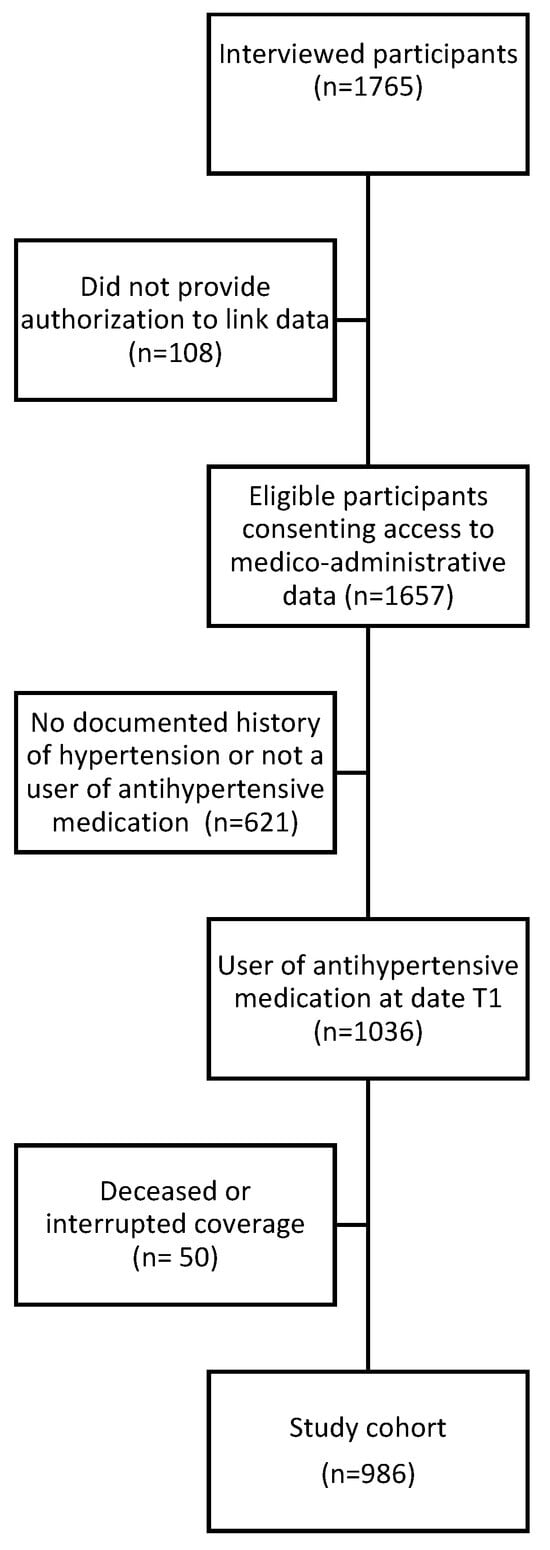
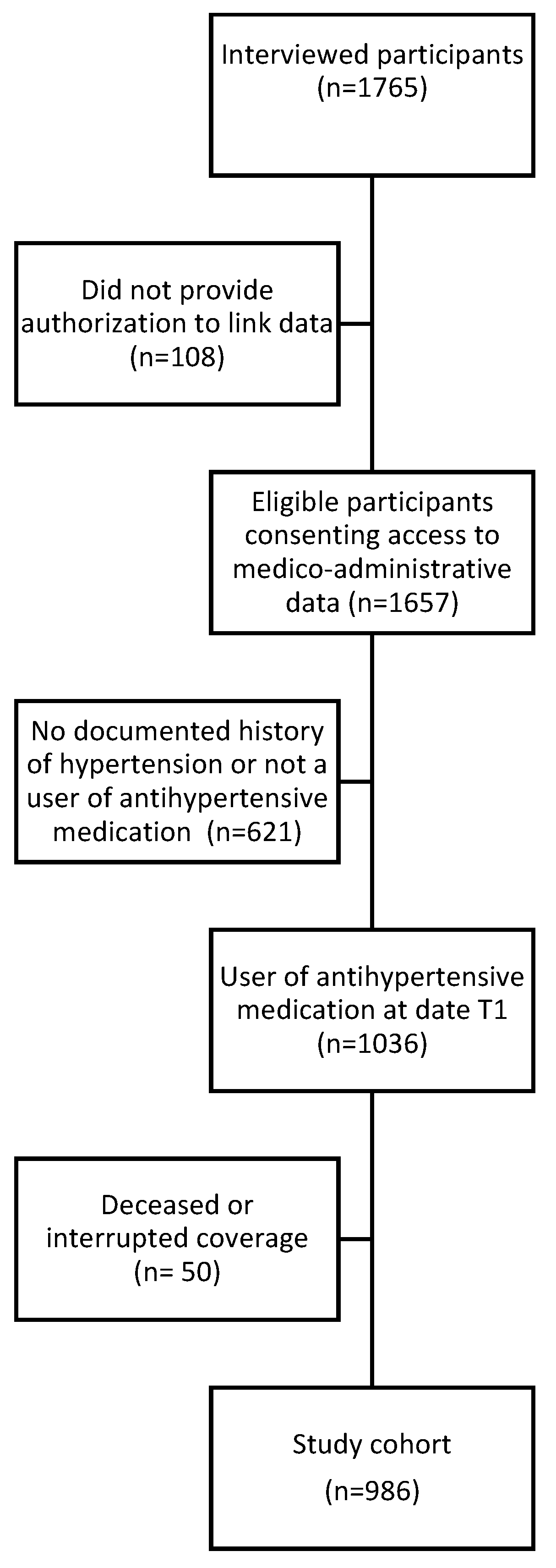
Among the ESA-S participants, 986 were using antihypertensive medications and were thus included in the present study (Figure 1). The mean age of the participants was 74.7 years (SD = 6.1). A total of 140 (14.2%) older adults reported symptoms of depression or had inpatient or outpatient diagnostic codes for depression. Regarding anxiety disorders, 228 (23.1%) older adults reported symptoms of anxiety during the interview or had inpatient or outpatient diagnostic codes related to anxiety within the 6-month period. Most participants at baseline were treated with more than one antihypertensive medication (542, 55.0%).
Figure 1.
Flowchart of the participants included in the study cohort.
3.2. Adherence Trajectories
Identification and Characteristics of Trajectories
Up to six GBTM group numbers were tested, and both the 2-group and 3-group solutions met all predefined adequacy criteria (Supplementary Table S3). The 3-group option had the highest BIC and AIC values, while the 2-group option had better entropy. This was also true for sub-cohorts where patients on a weekly pill dispenser were removed (n = 333, 33.8%) or when each medication was used instead of medication classes for carry-over.
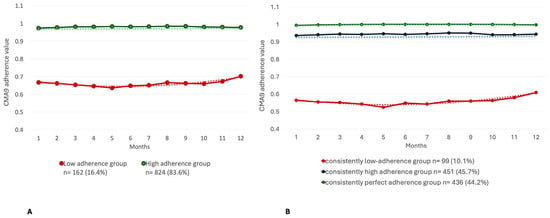
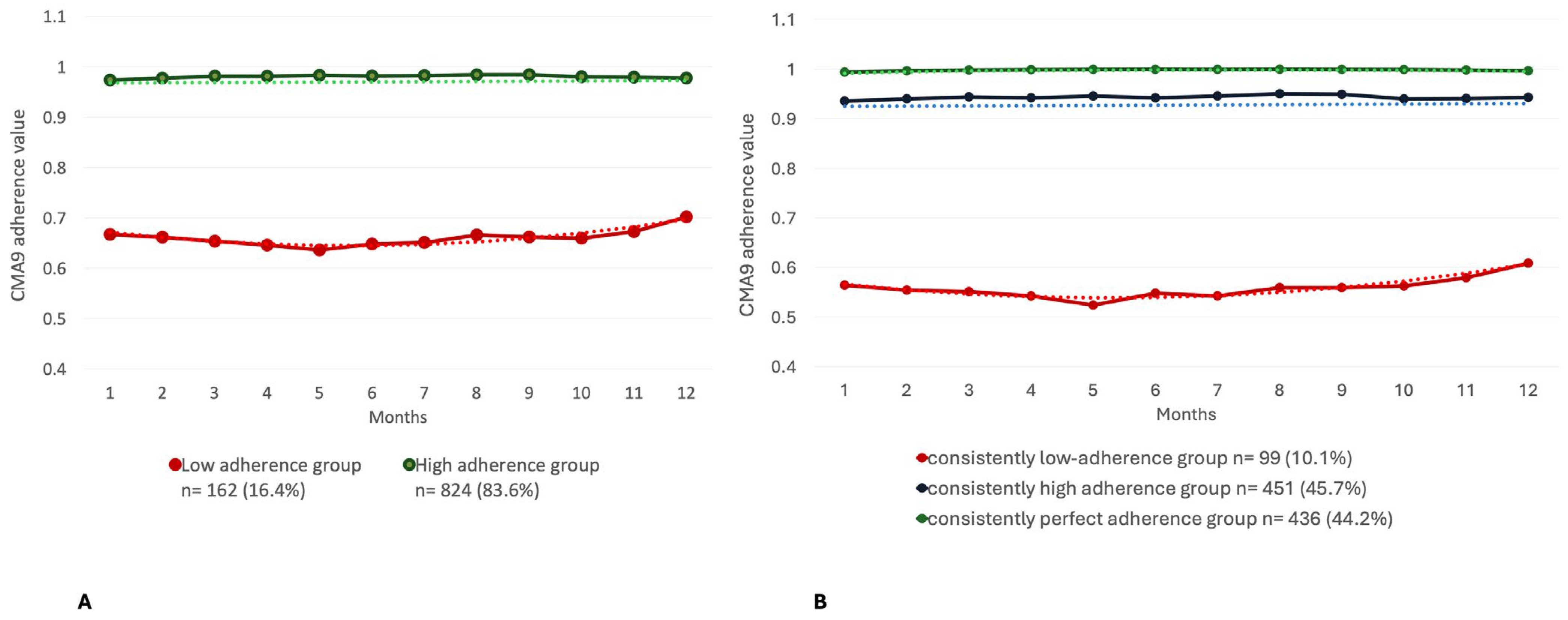
Figure 2A presents the 2-group and Figure 2B the 3-group models. In the 3-group model, two groups had very similar shapes and high adherence levels, so distinguishing them would not necessarily be clinically relevant. Therefore, we retained the 2-group trajectories model based on clinical interpretability and parsimony: the consistently low-adherence (16.4% of the study population) and the consistently high-adherence (83.6% of the study population) groups. Different order combinations were sequentially tested for the two models that satisfied all the minimum fit criteria. For the retained 2-group model, the first trajectory was modeled using a quadratic polynomial (order 2) and the second trajectory using a linear polynomial (order 1). Table 1 shows the clinical and socio-demographic characteristics of the 2-group adherence trajectories.
Figure 2.
Adherence trajectories. (A). 2-group model, (B). 3-group model. Notes: The dotted lines represent the predicted trajectory per group, while the solid lines represent the average trajectory per group.
Table 1.
Baseline characteristics of the participants (N = 986) across the 2-group adherence trajectories.
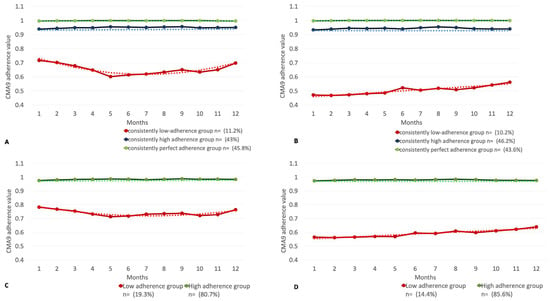
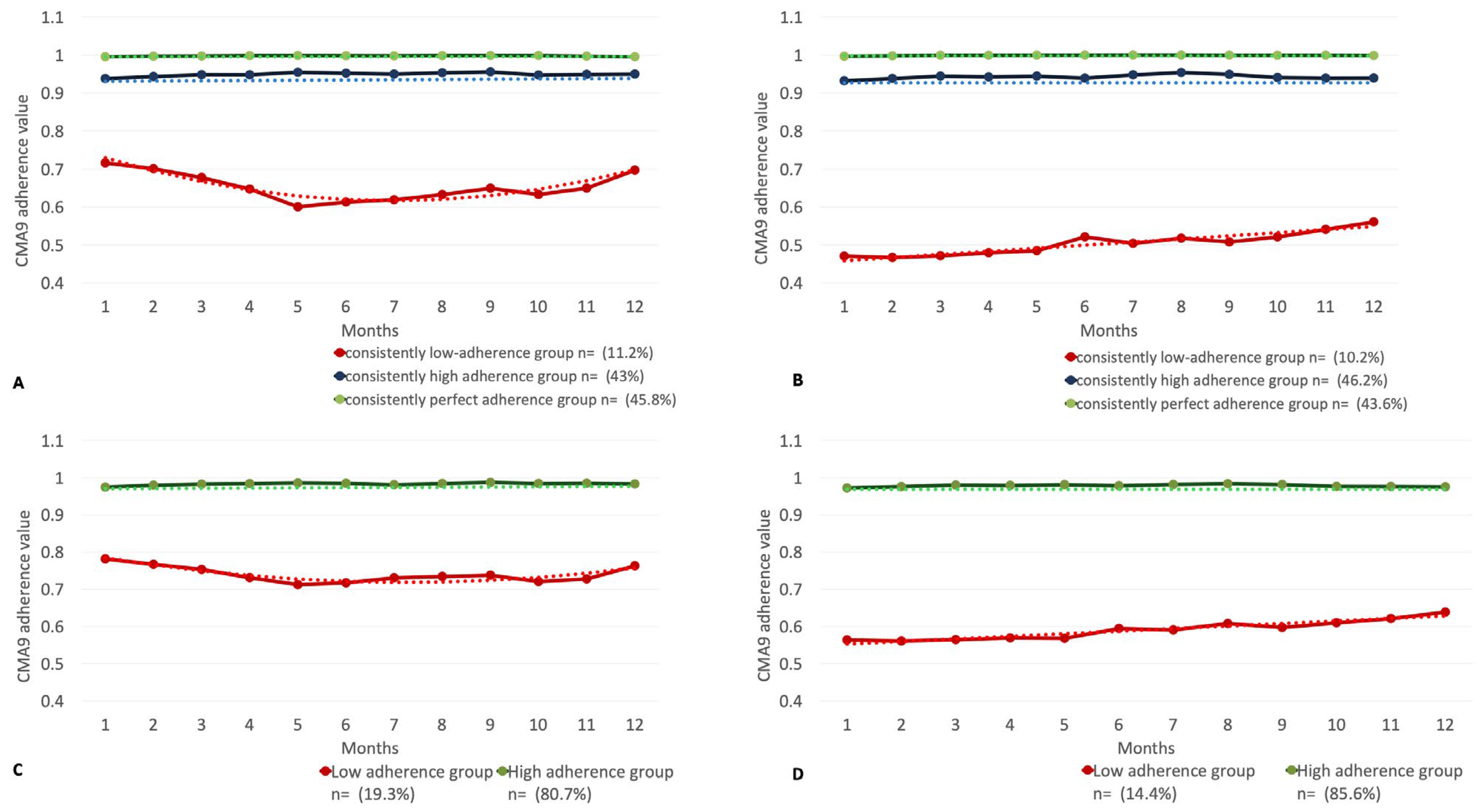
Figure 3A–D illustrate the adherence trajectories for the 3-group and 2-group models, fitted separately for male and female participants. The low-adherence group was smaller in females (14.4% in the female versus 19.3% in the male population), but adherence measures were also lower in this group.
Figure 3.
Adherence trajectories by sex. (A). 3-group model in males, (B). 3-group model in females, (C). 2-group model in males, (D). 2-group model in females. Notes: The dotted lines represent the predicted trajectory per group, while the solid lines represent the average trajectory per group.
In the logistic regression models, neither depression nor anxiety was associated with adherence trajectory groups. Adjusted odds ratio values and 95% confidence intervals were 1.0 (95% CI: 0.6–1.6) and 1.2 (95% CI: 0.8–1.9), respectively, for depression and anxiety. Restricting the definition of depression to participants meeting ESA-S criteria for major depressive disorder only or to confirmed cases identified by ICD-9/10 diagnostic codes in medico-administrative databases did not alter the results; no evidence of association with adherence trajectory groups was observed (adjusted OR: 1.1; 95% CI: 0.6–2.0). Detailed results are presented in Table 2.
Table 2.
Crude and adjusted odds ratios (OR) evaluating the association between anxiety and depression and medication adherence trajectories.
4. Discussion
This study identified two distinct adherence trajectories to antihypertensive medications among older adults in Quebec: a consistently low-adherence group and a consistently high-adherence group, comprising 16.4% and 83.6% of the study population, respectively. Interestingly, neither anxiety nor depression was associated with adherence trajectory membership after adjustment for potential confounders.
We observed several similarities when comparing our findings to those of Dillon et al. [32], who used GBTM to assess adherence to antihypertensive medications in older adults in a community pharmacy setting in Ireland. They retained three adherence trajectories: very high adherence (52.8%), high adherence (40.7%), and low adherence (6.5%) [32]. The shape and distribution of Dillon et al.’s three trajectory groups are similar to those we initially identified. On the other hand, Hargrove et al. [33] identified six trajectories, ranging from perfect adherence (40% of participants) to immediate stopping (18% of participants) [33]. It is worth mentioning that this latter study focused on new antihypertensive users, and both implementation and persistence were measured, explaining the higher number of trajectories and the perfect adherence at initiation in all groups. In contrast, we studied prevalent users, i.e., individuals already diagnosed and treated for hypertension, and measured adherence between the first and last refill to capture only the implementation phase of adherence. This means that non-persistent individuals may already have been lost to follow-up and were also excluded from the analysis, resulting in a sample with more stable adherence behaviors.
Previous studies have shown that adherence to medication regimens in older adult patients is a multifaceted issue influenced by various factors, including cognitive decline, polypharmacy, and socioeconomic status [34]. Interestingly, despite these numerous barriers to optimal adherence, evidence suggests that individuals aged 65 to 80 might have better adherence rates than younger adults [34]. This aligns with our finding that a substantial proportion of the older population maintains high adherence levels.
We modeled adherence trajectories separately by sex. While the trajectory shapes are similar for the higher adherence groups, some differences are observed between females and males in the lower adherence groups. Specifically, the low-adherence group among females exhibited lower adherence levels compared to the corresponding group in males, yet this group constituted a smaller proportion of the female population. Any further interpretation should consider that groups identified by GBTM are probabilistic [20], and group assignment may be considered a 100% imputation rather than an observed group. Overall, the literature suggests a trend toward females experiencing more adherence issues than males [35,36]. However, this trend is not consistent across studies [36].
Mental disorders such as depression and anxiety are known to impact medication adherence adversely [2]. However, our study found no clear evidence of an association between these conditions and adherence trajectories. This finding contradicts some studies that have demonstrated a strong link between mental health issues and poor adherence to antihypertensive medications. For example, some authors found that depression [37,38] and anxiety [38] significantly predicted sub-optimal medication adherence among older adults with hypertension. Additionally, Bautista et al. [39] identified a significant association between mild anxiety and non-adherence, but not for more severe levels of anxiety. However, in a systematic review by Eze-Nliam et al. [16], six of the eight included studies reported non-significant associations between depression and poor medication adherence.
The discrepancies between our findings and those of other studies might be due to differences in study populations (demographics and/or prevalence of anxiety and depression), methods of measuring adherence, and variations in healthcare systems. Our study focused on older adult patients in Quebec and showed a high overall adherence rate. This finding may partly reflect contextual factors specific to the Quebec healthcare setting, including public prescription drug coverage for older adults, although this hypothesis could not be assessed in the present study. This result contrasts with studies conducted in different cultural and healthcare settings, such as Son et al. in Korea [37], where healthcare system differences and cultural attitudes towards mental health might affect adherence behaviors differently. Moreover, while our study used GBTM to identify adherence trajectories over time, the other studies [16,37,38,39] employed a static measure. Additionally, the definition and measurement of adherence and mental health conditions varied across studies. While some relied on self-reported measures [37], others used objective measures such as prescription refills, leading to potential discrepancies in the reported associations [39].
One of the main strengths of our study is the use of GBTM and the focus on the implementation phase of antihypertensive adherence. To our knowledge, few studies have used these techniques to provide a nuanced understanding of medication adherence over time, revealing patterns that static measures might overlook. GBTM allowed us to identify and characterize subgroups with distinct adherence behaviors, offering insights into potential areas for intervention. In addition, to analyze the association of depression and anxiety with trajectories, we employed the improved three-step approach described by Davies et al. [31], which minimizes bias when estimating the effects of covariates on group membership. Although the data were collected between 2011 and 2013, medication nonadherence remains a persistent challenge in hypertension management. The unique linkage of self-reported and medico-administrative data available in the ESA-S cohort provided a valuable opportunity to examine adherence trajectories in a way that is rarely possible using a single data source. It also minimized the potential for misclassification bias and improved the comprehensiveness of the case definitions of depression and anxiety. As neither source alone fully captures these conditions, combining the two approaches helps identify both symptomatic individuals without a documented diagnosis and clinically diagnosed cases that may be underreported in self-assessments.
Despite the strengths of our study, there are some limitations. First, it is well known that depression and anxiety are underdiagnosed in the older population [40,41], which means that our study might not have captured all cases of depression and anxiety. Nevertheless, the fact that both administrative claims data and clinical diagnoses, as well as symptom-based self-report data, were used increased the sensitivity of our measures. On the other hand, using self-reported data for identifying depression and anxiety cases may have introduced an information bias, as we might have considered together more severe cases (formally diagnosed by a physician), with less severe ones (self-reported only) that might not have been classified as having a CMD by a physician. Second, using medico-administrative databases, where prescription renewals are used as a proxy for medication adherence, has inherent limitations. This approach assumes that filling a prescription equates to medication consumption, which might not always be accurate, leading to potential misclassification of adherence behaviors. Third, the absence of detectable associations should be interpreted with caution, as the limited sample size in some adherence trajectory groups and the number of variables included in the adjusted models may have hindered the study’s ability to detect existing relationships between mental health disorders and medication adherence. The absence of an observed association may also reflect a depletion-of-susceptibles phenomenon, in which patients most vulnerable to having adherence issues, including those experiencing depression-related early treatment cessation, were no longer represented later in the study period. Finally, the data are relatively old. Changes in healthcare delivery, prescribing practices, and population characteristics over time, as well as differences in healthcare setting populations, may limit the generalizability of our findings.
5. Conclusions
Our study contributes to the understanding of medication adherence trajectories among older adults with hypertension, revealing that while a significant portion shows high adherence, a notable minority has sub-optimal adherence. Although anxiety and depression did not appear to be associated with these adherence trajectories, other factors may contribute and should be explored to identify modifiable determinants of non-adherence. These findings underscore the need for larger studies with longer follow-up periods from therapy initiation to investigate predictors of membership in the lower adherence trajectories and identify the inflection point at which adherence trajectories become stable. This could inform the timing and nature of interventions to improve long-term medication adherence to antihypertensives.
Supplementary Materials
The following supporting information can be downloaded at: https://www.mdpi.com/article/10.3390/hearts7030026/s1, Table S1: International Classification of Diseases (ICD) diagnostic codes considered for anxiety and depressive disorders; Table S2: Group selection and fit criteria order fixed at two; Table S3: AHFS Codes and Corresponding Pharmacological Classes of Antihypertensive Medications Included in the Study.
Author Contributions
Conceptualization, G.E., L.G., C.L. and H.-M.V.; methodology, G.E., L.G., C.L. and H.-M.V.; software, G.E.; validation, L.G. and C.L.; formal analysis, G.E.; investigation, all authors; resources, L.G., C.L. and H.-M.V.; data curation, G.E. and H.-M.V.; writing—original draft preparation, G.E., L.G. and C.L.; writing—review and editing, L.G., C.L. and H.-M.V.; visualization, G.E.; supervision, L.G. and C.L.; project administration, C.L. and H.-M.V.; funding acquisition, C.L., L.G. and H.-M.V. All authors have read and agreed to the published version of the manuscript.
Funding
The ESA-S study was supported through a Personalized Health Catalyst Grant from the Canadian Institutes of Health Research (CIHR #201706). GE received a scholarship from both the Réseau Québécois sur le Suicide, les troubles de l’Humeur et les troubles Associés (RQSHA) and the Fonds d’enseignement et de la recherche (FER) of the Faculty of Pharmacy, Université Laval. CL, LG and HMV were awarded Leverage Funding Program support (2020–2021 competition) from the Quebec Network for Research on Aging (Réseau Québécois de recherche sur le vieillissement—RQRV). The funding agencies were not involved in the study’s design, data collection, analysis, or interpretation, nor in writing the manuscript or submitting it for publication.
Institutional Review Board Statement
The study was conducted in accordance with the Declaration of Helsinki and approved by the Ethics Committees of CIUSSS Estrie (#2019-2856 approved on 4 July 2018) and of the Centre de recherche du CHU de Québec–Université Laval (#2021-5076, approved on 3 September 2020).
Informed Consent Statement
Informed consent was obtained from all subjects involved in the ESA-S study. The present study relied exclusively on secondary analyses of anonymized data from the ESA-S study.
Data Availability Statement
The authors are not legally authorized to share or publish the linked survey and medico-administrative data due to privacy and ethical restrictions tied to the use of provincial health data. Requests to access the anonymized dataset should be submitted to the ethics committee of CIUSSS Estrie-Centre Hospitalier Universitaire de Sherbrooke. Furthermore, informed consent for data sharing was not sought from the participants.
Acknowledgments
We want to thank Djamal Berbiche, senior statistician, for his contribution in providing and formatting the ESA-S data used in this study.
Conflicts of Interest
The authors declare no conflicts of interest.
References
- Blais, C.; Rochette, L.; Hamel, D.; Poirier, P. Prevalence, incidence, awareness and control of hypertension in the province of Quebec: Perspective from administrative and survey data. Can. J. Public Health 2014, 105, e79–e85. [Google Scholar] [CrossRef] [Scilit] [PubMed]
- Oliveros, E.; Patel, H.; Kyung, S.; Fugar, S.; Goldberg, A.; Madan, N.; Williams, K.A. Hypertension in older adults: Assessment, management, and challenges. Clin. Cardiol. 2020, 43, 99–107. [Google Scholar] [CrossRef] [Scilit] [PubMed]
- Lee, E.K.P.; Poon, P.; Yip, B.H.K.; Bo, Y.; Zhu, M.-T.; Yu, C.-P.; Ngai, A.C.H.; Wong, M.C.S.; Wong, S.Y.S. Global Burden, Regional Differences, Trends, and Health Consequences of Medication Nonadherence for Hypertension During 2010 to 2020: A Meta-Analysis Involving 27 Million Patients. J. Am. Heart Assoc. 2022, 11, e026582. [Google Scholar] [CrossRef] [Scilit] [PubMed]
- DiMatteo, M.R.; Lepper, H.S.; Croghan, T.W. Depression is a risk factor for noncompliance with medical treatment: Meta-analysis of the effects of anxiety and depression on patient adherence. Arch. Intern. Med. 2000, 160, 2101–2107. [Google Scholar] [CrossRef] [Scilit] [PubMed]
- Grenard, J.L.; Munjas, B.A.; Adams, J.L.; Suttorp, M.; Maglione, M.; McGlynn, E.A.; Gellad, W.F. Depression and Medication Adherence in the Treatment of Chronic Diseases in the United States: A Meta-Analysis. J. Gen. Intern. Med. 2011, 26, 1175–1182. [Google Scholar] [CrossRef] [Scilit] [PubMed]
- Stephenson, J. Noncompliance may cause half of antihypertensive drug “failures”. JAMA 1999, 282, 313–314. [Google Scholar] [CrossRef] [Scilit] [PubMed]
- Wang, P.S.; Bohn, R.L.; Knight, E.; Glynn, R.J.; Mogun, H.; Avorn, J. Noncompliance with antihypertensive medications: The impact of depressive symptoms and psychosocial factors. J. Gen. Intern. Med. 2002, 17, 504–511. [Google Scholar] [CrossRef] [Scilit] [PubMed]
- Krousel-Wood, M.A.; Frohlich, E.D. Hypertension and Depression: Coexisting Barriers to Medication Adherence. J. Clin. Hypertens. 2010, 12, 481–486. [Google Scholar] [CrossRef] [Scilit] [PubMed]
- DeJean, D.; Giacomini, M.; Vanstone, M.; Brundisini, F. Patient Experiences of Depression and Anxiety with Chronic Disease. Ont. Health Technol. Assess. Ser. 2013, 13, 1–33. [Google Scholar] [CrossRef] [Scilit] [PubMed]
- Vetere, G.; Ripaldi, L.; Ais, E.; Korob, G.; Kes, M.; Villamil, A. Prevalence of anxiety disorders in patients with essential hypertension. Vertex 2007, 18, 20–25. [Google Scholar] [PubMed]
- Hamilton, J.E.; Blanco, E.; Selek, S.; Wirfel, K.L.; Bernstam, E.V.; Velligan, D.; Gudala, M.; Roberts, K. Patient and Provider Perspectives on Medication Non-adherence Among Patients with Depression and/or Diabetes in Diverse Community Settings—A Qualitative Analysis. Patient Prefer. Adherence 2022, 16, 1581–1594. [Google Scholar] [CrossRef] [Scilit] [PubMed]
- DeLalio, L.J.; Sved, A.F.; Stocker, S.D. Sympathetic Nervous System Contributions to Hypertension: Updates and Therapeutic Relevance. Can. J. Cardiol. 2020, 36, 712–720. [Google Scholar] [CrossRef] [Scilit] [PubMed]
- Keller, J.; Gomez, R.; Williams, G.; Lembke, A.; Lazzeroni, L.; Murphy, G.M.; Schatzberg, A.F. HPA Axis in Major Depression: Cortisol, Clinical Symptomatology, and Genetic Variation Predict Cognition. Mol. Psychiatry 2017, 22, 527–536. [Google Scholar] [CrossRef] [Scilit] [PubMed]
- Vettath, R.E.; Reddy, Y.N.V.; Reddy, Y.N.V.; Dutta, S.; Singh, Z.; Mathew, M.; Abraham, G. A multicenter cross-sectional study of mental and physical health depression in MHD patients. Indian J. Nephrol. 2012, 22, 251–256. [Google Scholar] [CrossRef] [Scilit] [PubMed]
- Scalco, A.Z.; Scalco, M.Z.; Azul, J.B.S.; Lotufo Neto, F. Hypertension and depression. Clinics 2005, 60, 241–250. [Google Scholar] [CrossRef] [Scilit] [PubMed]
- Eze-Nliam, C.M.; Thombs, B.D.; Lima, B.B.; Smith, C.G.; Ziegelstein, R.C. The association of depression with adherence to antihypertensive medications: A systematic review. J. Hypertens. 2010, 28, 1785–1795. [Google Scholar] [CrossRef] [Scilit] [PubMed]
- Vrijens, B.; De Geest, S.; Hughes, D.A.; Przemyslaw, K.; Demonceau, J.; Ruppar, T.; Dobbels, F.; Fargher, E.; Morrison, V.; Lewek, P.; et al. A new taxonomy for describing and defining adherence to medications. Br. J. Clin. Pharmacol. 2012, 73, 691–705. [Google Scholar] [CrossRef] [PubMed]
- Shah, K.K.; Touchette, D.R.; Marrs, J.C. Research and scholarly methods: Measuring medication adherence. J. Am. Coll. Clin. Pharm. 2023, 6, 416–426. [Google Scholar] [CrossRef] [Scilit]
- Burnier, M. Is There a Threshold for Medication Adherence? Lessons Learnt from Electronic Monitoring of Drug Adherence. Front. Pharmacol. 2019, 9, 1540. [Google Scholar] [CrossRef] [Scilit] [PubMed]
- Nagin, D.S. Group-Based Modeling of Development; Harvard University Press: Cambridge, MA, USA, 2005. [Google Scholar]
- Cutler, R.L.; Fernandez-Llimos, F.; Frommer, M.; Benrimoj, C.; Garcia-Cardenas, V. Economic impact of medication non-adherence by disease groups: A systematic review. BMJ Open 2018, 8, e016982. [Google Scholar] [CrossRef] [Scilit] [PubMed]
- Gentil, L.; Vasiliadis, H.M.; Préville, M.; Berbiche, D. Impact of Mental Disorders on the Association Between Adherence to Antihypertensive Agents and All-Cause Healthcare Costs. J. Clin. Hypertens. 2017, 19, 75–81. [Google Scholar] [CrossRef] [Scilit] [PubMed]
- Préville, M.; Lamoureux-Lamarche, C.; Vasiliadis, H.-M.; Grenier, S.; Potvin, O.; Quesnel, L.; Gontijo-Guerra, S.; Mechakra-Tahiri, S.D.; Berbiche, D. The 6-Month Prevalence of Posttraumatic Stress Syndrome (PTSS) Among Older Adults: Validity and Reliability of the PTSS Scale. Can. J. Psychiatry 2014, 59, 548–555. [Google Scholar] [CrossRef] [Scilit] [PubMed]
- Liste des Médicaments Fournis en Établissement, 13 Décembre 2023 | Régie de L’assurance Maladie du Québec (RAMQ). Available online: https://www.ramq.gouv.qc.ca/fr/media/15816 (accessed on 5 March 2024).
- Dima, A.; Allemann, S.; Dediu, D. AdhereR: An Open Science Approach to Estimating Adherence to Medications Using Electronic Healthcare Databases. Stud. Health Technol. Inform. 2019, 264, 1451–1452. [Google Scholar] [CrossRef] [Scilit] [PubMed]
- Dima, A.; Dediu, D. Computation of adherence to medication and visualization of medication histories in R with AdhereR: Towards transparent and reproducible use of electronic healthcare data. PLoS ONE 2017, 12, e0174426. [Google Scholar] [CrossRef] [Scilit] [PubMed]
- Nagin, D.S.; Odgers, C.L. Group-based trajectory modeling in clinical research. Annu. Rev. Clin. Psychol. 2010, 6, 109–138. [Google Scholar] [CrossRef] [Scilit] [PubMed]
- World Health Organization. Adherence to Long-Term Therapies: Evidence for Action; World Health Organization: Geneva, Switzerland, 2003. [Google Scholar]
- Charlson, M.E.; Carrozzino, D.; Guidi, J.; Patierno, C. Charlson Comorbidity Index: A Critical Review of Clinimetric Properties. Psychother. Psychosom. 2022, 91, 8–35. [Google Scholar] [CrossRef] [Scilit] [PubMed]
- traj: Group-Based Modeling of Longitudinal Data. Available online: https://www.andrew.cmu.edu/user/bjones/documentation.htm (accessed on 15 March 2024).
- Davies, C.; Giles, L.; Glonek, G. Performance of methods for estimating the effect of covariates on group membership probabilities in group-based trajectory models. Stat. Methods Med. Res. 2017, 27, 2918–2932. [Google Scholar] [CrossRef] [Scilit] [PubMed]
- Dillon, P.; Stewart, D.; Smith, S.M.; Gallagher, P.; Cousins, G. Group-Based Trajectory Models: Assessing Adherence to Antihypertensive Medication in Older Adults in a Community Pharmacy Setting. Clin. Pharmacol. Ther. 2018, 103, 1052–1060. [Google Scholar] [CrossRef] [Scilit] [PubMed]
- Hargrove, J.L.; Pate, V.; Casteel, C.H.; Golightly, Y.M.; Loehr, L.R.; Marshall, S.W.; Stürmer, T. Antihypertensive Adherence Trajectories Among Older Adults in the First Year After Initiation of Therapy. Am. J. Hypertens. 2017, 30, 1015–1023. [Google Scholar] [CrossRef] [Scilit] [PubMed]
- Ruksakulpiwat, S.; Schiltz, N.K.; Irani, E.; Josephson, R.A.; Adams, J.; Still, C.H. Medication Adherence of Older Adults with Hypertension: A Systematic Review. Patient Prefer. Adherence 2024, 18, 957–975. [Google Scholar] [CrossRef] [Scilit] [PubMed]
- Goldstein, K.M.; Zullig, L.L.; Bastian, L.A.; Bosworth, H.B. Statin Adherence: Does Gender Matter? Curr. Atheroscler. Rep. 2016, 18, 63. [Google Scholar] [CrossRef] [Scilit] [PubMed]
- Rebić, N.; Law, M.R.; Cragg, J.; Brotto, L.A.; Ellis, U.; Garg, R.; Park, J.Y.; Vera, M.A.D. “What’s Sex and Gender Got to Do with It?” A Scoping Review of Sex- and Gender-Based Analysis in Pharmacoepidemiologic Studies of Medication Adherence. Value Health 2023, 26, 1413–1424. [Google Scholar] [CrossRef] [Scilit] [PubMed]
- Son, Y.-J.; Won, M.H. Depression and medication adherence among older Korean patients with hypertension: Mediating role of self-efficacy. Int. J. Nurs. Pract. 2017, 23, e12525. [Google Scholar] [CrossRef] [Scilit] [PubMed]
- Gentil, L.; Vasiliadis, H.M.; Préville, M.; Bossé, C.; Berbiche, D. Association between depressive and anxiety disorders and adherence to antihypertensive medication in community-living elderly adults. J. Am. Geriatr. Soc. 2012, 60, 2297–2301. [Google Scholar] [CrossRef] [Scilit] [PubMed]
- Bautista, L.E.; Vera-Cala, L.M.; Colombo, C.; Smith, P. Symptoms of depression and anxiety and adherence to antihypertensive medication. Am. J. Hypertens. 2012, 25, 505–511. [Google Scholar] [CrossRef] [Scilit] [PubMed]
- Beekman, A.T.; Copeland, J.R.; Prince, M.J. Review of community prevalence of depression in later life. Br. J. Psychiatry 1999, 174, 307–311. [Google Scholar] [CrossRef] [Scilit] [PubMed]
- Wolitzky-Taylor, K.B.; Castriotta, N.; Lenze, E.J.; Stanley, M.A.; Craske, M.G. Anxiety disorders in older adults: A comprehensive review. Depress. Anxiety 2010, 27, 190–211. [Google Scholar] [CrossRef] [Scilit] [PubMed]

Disclaimer/Publisher’s Note: The statements, opinions and data contained in all publications are solely those of the individual author(s) and contributor(s) and not of MDPI and/or the editor(s). MDPI and/or the editor(s) disclaim responsibility for any injury to people or property resulting from any ideas, methods, instructions or products referred to in the content. |
© 2026 by the authors. Licensee MDPI, Basel, Switzerland. This article is an open access article distributed under the terms and conditions of the Creative Commons Attribution (CC BY) license.