


Abstract
Temporally shaped femtosecond pulses provide a versatile approach for controlling energy deposition in transparent materials. In this work, bulk modification of N-BK7 glass is investigated using double femtosecond pulses with variable delay and energy contrast. Each sub-pulse is set below the single-pulse modification threshold, so any resulting modification arises from their combined interaction within the focal volume. The results reveal an additive effect in which two individually sub-threshold sub-pulses jointly produce permanent bulk modification. The observed effect is most pronounced for comparable sub-pulse energies, whereas the range of energy contrasts supporting modification narrows with increasing delay. The accompanying reduction in the effective transmittance of the second sub-pulse indicates that the first pulse creates a transient material state that promotes subsequent energy deposition. These findings identify pulse delay and energy contrast as effective parameters for controlling bulk modification and suggest a potential route toward more localized energy deposition and smaller feature sizes in three-dimensional glass microfabrication.
1. Introduction
Ultrashort-pulse laser processing provides a powerful route to high-precision structuring of transparent materials. The high peak intensities associated with ultrashort pulses enable nonlinear absorption to be initiated in well-defined regions at selected depths, allowing three-dimensional modification within the material bulk [1,2,3]. This capability has supported applications including the direct writing of optical waveguides [4,5,6], photonic structures [7,8,9], volume gratings [10,11,12], and three-dimensional optical data storage [2,13,14,15]. In these applications, efficient coupling and spatial confinement of laser energy are essential for producing reproducible structures with controlled dimensions.
However, precise control of the modification process remains challenging because energy deposition is governed by a complex interplay of nonlinear excitation, free-carrier dynamics, and pulse propagation [1,16,17,18]. In a transparent dielectric, an intense ultrashort pulse initiates nonlinear photoionization, generating free carriers that transiently alter the optical properties of the material [17,19,20]. The subsequent evolution and relaxation of the excited carrier population govern energy transfer to the material and may ultimately lead to permanent structural modification [1,21]. Because these early excitation and relaxation dynamics unfold over femtosecond-to-picosecond timescales, the material response depends not only on the total incident energy but also on its temporal distribution. Temporal pulse shaping therefore provides an additional means of controlling electron dynamics, optical coupling, and energy deposition.
Among the available temporal-shaping approaches, splitting a pulse into two time-separated sub-pulses provides a direct means of controlling the sequence of excitation and energy delivery [22,23,24]. This strategy has been explored in surface ablation [25,26], drilling and microchannel formation [27,28], wafer slicing [29], refractive-index modification, and fabrication of embedded photonic structures [30,31]. Previous studies have shown that pulse separation, energy distribution, wavelength, and polarization can influence ablation efficiency, material removal, and the spatial extent of laser-induced modification [23,26,32].
In bulk modification, the response to pulse-pair irradiation is governed by the transient state established within the focal region after the first sub-pulse. Free carriers and laser-induced defects can alter the local absorption and refractive index, thereby modifying the propagation and optical coupling of the second sub-pulse. As demonstrated in fused silica, the resulting energy deposition depends on the evolving optical state of the material rather than solely on the total incident energy. Depending on the pulse separation and excitation conditions, this transient response may enhance localized absorption or, conversely, suppress energy deposition through plasma shielding and propagation-induced delocalization [23,33]. However, the combined influence of picosecond pulse separation and sub-pulse energy contrast on bulk modification in BK7 glass remains insufficiently understood.
Clarifying this dependence is relevant not only to the underlying interaction dynamics but also to the spatial control of volumetric modification. If the first sub-pulse creates an inhomogeneous excitation distribution within the focal volume, the second may deposit energy preferentially in the most strongly pre-excited region. The volume driven above the permanent-modification threshold could therefore be more confined than that produced by increasing the energy of a single pulse. Control of pulse separation and energy contrast may thus provide a route toward more localized bulk modification and potentially smaller feature sizes in laser-written waveguides, photonic structures, and other three-dimensional optical devices.
In the present work, we investigate bulk modification of N-BK7 glass produced by pairs of femtosecond sub-pulses with variable time separation and energy ratio. The energy of each sub-pulse is kept below the single-pulse modification threshold, so that any observed permanent modification indicates a combined, rather than independent, action of the two sub-pulses. Post-irradiation phase-contrast microscopy is used to identify permanent bulk modification, while the effective transmittance of the second sub-pulse is examined to probe changes in optical coupling induced by the first pulse. By varying the pulse delay on the picosecond scale and systematically changing the energy contrast between the two sub-pulses, we identify the conditions under which the pulse pair produces an additive response, leading to modification below the single-pulse threshold.
2. Experimental Setup and Methodology
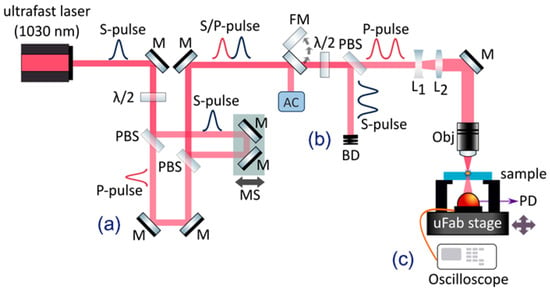
The experimental setup used in this study is shown schematically in Figure 1. It consists of a femtosecond laser source, an optical delay line for generating double-pulse irradiation, MKS Newport (Irvine, CA, USA) three-axis translation stages for precise sample positioning and controlled scanning, focusing optics, and a transmission-monitoring unit based on a photodiode and oscilloscope. The irradiation source was a commercial high-power femtosecond laser system from Amplitude Systèmes (Pessac, France). The laser system is based on a chirped-pulse regenerative amplifier with a directly diode-pumped Yb:KGW gain medium, operating at a central wavelength of 1030 nm. The pulse duration was adjusted using the laser compressor and measured with a custom-built autocorrelator, whose response was additionally verified using an independent laser source operating under near-transform-limited conditions. For the irradiation conditions used in this work, the pulses had an approximately Gaussian temporal profile with a full width at half maximum (FWHM) of about 500 fs. The system provides a maximum average power of 8 W and a repetition-rate tuning range from 1 Hz to 100 kHz, with 100 Hz used throughout the present experiments.
Figure 1.
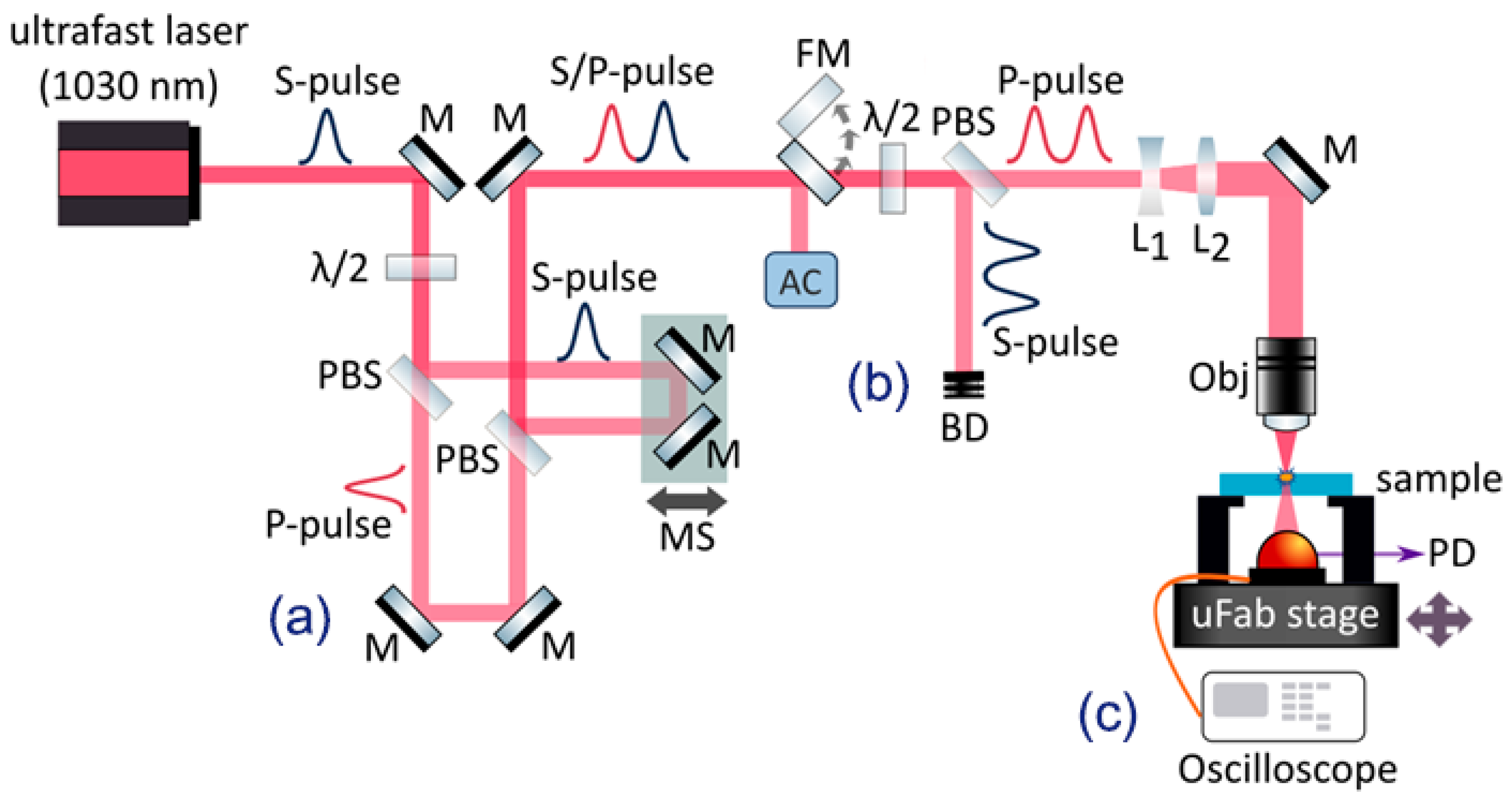
Optical setup used for double-pulse irradiation experiments: (a) Delay-line configuration consisting of mirrors (M), thin-film polarizers (PBS), and a half-wave plate (λ/2). The motorized translation stage (MS) controls the optical path length and therefore the temporal delay between the two sub-pulses. A flip mirror (FM) directs the beam toward the autocorrelator (AC), which is used to measure both the single-pulse duration and the delay between the sub-pulses. (b) Attenuator configuration for energy control of the recombined pulse pair, consisting of a half-wave plate and a thin-film polarizer. The rejected s-polarized component is directed to a beam dump (BD). (c) Sample irradiation and transmission-monitoring configuration. The femtosecond laser beam was focused into the bulk of an N-BK7 glass sample using an objective lens (Obj, NA = 0.25). A telescope formed by lenses L1 and L2 was used to adjust the beam diameter before focusing, ensuring full filling of the objective entrance pupil during the experiments. Three-axis translation stages enabled precise sample positioning and controlled scanning, while the transmitted signal was detected by a photodiode (PD) connected to an oscilloscope.
Bulk modification experiments were performed in a 2 mm thick N-BK7 borosilicate optical glass sample. The sample was mounted on software-controlled MKS Newport three-axis translation stages, which provide three-dimensional motion with 50 nm positioning accuracy, a maximum translation speed of 300 mm/s, and a travel range of 100 × 100 × 5 mm. An XPS-100 controller (Newport Corporation, Irvine, CA, USA) was used to synchronize the electromechanical shutter with the programmed stage trajectory, enabling spatially selective irradiation inside the sample.
Double-pulse irradiation was achieved by splitting the incoming femtosecond pulse into two arms, one of which included an optical delay line for controlling the temporal separation between the two sub-pulses (Figure 1a). The optical scheme used reflective optics (M), thin-film polarizers (P), and a rotatable half-wave plate (λ/2) for beam splitting and energy-ratio tuning between the arms. After recombination, the two sub-pulses formed a collinear pulse pair and passed through an attenuator consisting of a thin-film polarizer and a rotatable half-wave plate to control the pulse energy (measured using an Ophir PE10-C pyroelectric energy sensor (Ophir Optronics Solutions Ltd., Jerusalem, Israel) and define the final linear polarization state (Figure 1b). The beam was then collimated using a lens doublet before being directed to the focusing objective (Figure 1c). The spatial overlap and collinearity of the beams were verified with a beam profiler (Spiricon SP620U, Ophir-Spiricon, LLC, North Logan, UT, USA). Further details of the delay-line configuration are provided elsewhere [34].
The recombined pulse pair was focused approximately 200 µm below the sample surface using a 10× achromatic microscope objective, Olympus RMS10X (Olympus Corporation, Tokyo, Japan), with NA = 0.25, a working distance of 10.6 mm, and an effective focal length of f = 18 mm. The same objective was also used to monitor the processing area during irradiation. The incident beam was adjusted to fully fill the objective entrance pupil. Under ideal Gaussian-beam focusing conditions, the nominal 1/e2 focal-spot radius was estimated as , where M2 = 1.24 is the measured beam-quality factor, λ is the laser wavelength, D = 9 mm is the beam diameter at the objective entrance pupil, and f is the effective focal length of the objective. The corresponding nominal 1/e2 focal-spot diameter was approximately 3.25 µm. Although the moderate numerical aperture used here reduces the influence of strong focusing aberrations compared with high-NA focusing, this value was used only as a nominal estimate of the focal spot size. Since the beam was focused inside the glass volume, the actual intensity distribution may still be affected by residual optical aberrations and propagation through the sample surface [35,36]. In addition, near-threshold irradiation in transparent dielectrics can involve nonlinear propagation effects, including self-focusing and plasma-related beam modification [16]. Therefore, the irradiation conditions are discussed mainly in terms of pulse energy and pulse-energy ratio rather than absolute fluence.
For the delay-dependent irradiation series, the temporal separation between the two sub-pulses was varied from 1 to 21 ps, with five delay values used: 1.4, 2.6, 4.1, 16, and 21 ps. The energy of the leading pulse, E1, was fixed at E1 = 245 nJ, approximately 80% of the single-pulse modification threshold Eth = 310 nJ under the same focusing conditions, while the energy ratio E1/E2 was varied from about 1 to 4.5. In all cases, the energy of each individual sub-pulse was kept below the single-pulse-induced modification threshold. As an additional control, single-pulse irradiation was performed before each double-pulse series under the same focusing and scanning conditions to confirm that an individual sub-threshold pulse did not produce any detectable modification.
For each set of parameters, a series of modification sites was produced inside the N-BK7 sample, with 20 repetitions per condition to improve statistical reliability. The sample was translated at a scanning speed of 1 mm/s while the repetition rate was kept at 100 Hz, resulting in a 10 µm spacing between consecutive pulse pairs. Since the estimated focal-spot diameter was approximately 3.25 µm, consecutive irradiation events did not spatially overlap; therefore, each modification site was produced by one individual double-pulse pair.
The transmitted signal during irradiation was monitored using a fast InGaAs photodiode detector (Thorlabs DET01CFC, Thorlabs, Inc., Newton, NJ, USA) connected to a Tektronix DPO7054C oscilloscope (Tektronix, Inc., Beaverton, OR, USA) with a 500 MHz analog bandwidth (Figure 1c). The oscilloscope was operated in single-shot real-time acquisition mode, and the photodiode position was kept fixed relative to the transmitted laser beam. For each set of parameters, the reference signal was recorded by directing the laser beam outside the specimen. The transmitted signal was then measured during irradiation inside the N-BK7 sample and compared with the corresponding reference signal.
Post-mortem inspection of the irradiated regions was performed in the focal plane using a ZEISS Axio Observer 3 optical microscope (Carl Zeiss Microscopy GmbH, Jena, Germany) equipped with a 40× objective and operated in phase-contrast mode. The images were used to verify the presence or absence of laser-induced bulk modifications.
3. Results and Discussion
To evaluate the effect of temporal pulse splitting on bulk modification in N-BK7 glass, the material response produced by single-pulse and pulse-pair irradiation was compared under the same moderate focusing conditions. The irradiation regime was established by combining transmittance measurements with post-irradiation phase-contrast microscopy. Transmittance measurements were used to monitor changes in the optical response during laser irradiation, while phase-contrast microscopy was used to determine whether the corresponding irradiation conditions resulted in a detectable permanent modification in the bulk. This approach allowed us to identify conditions under which single-pulse irradiation did not produce a visible modification and to examine whether the delayed second sub-pulse could promote the formation of a permanent bulk modification.
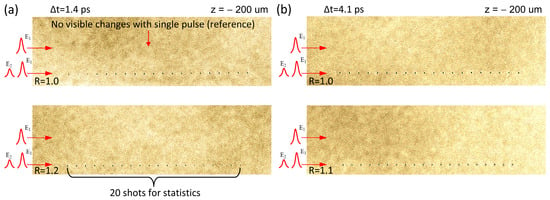
Figure 2 shows representative phase-contrast microscopy images of laser-affected regions produced in the bulk of N-BK7 glass. The images correspond to representative delays from the investigated picosecond range and selected sub-pulse energy ratios, R. They illustrate the main qualitative difference between the single-pulse reference condition and pulse-pair irradiation. The single-pulse exposure was used as a control and, as expected from the selected irradiation regime, did not produce a visible permanent modification in the focal region.
Figure 2.
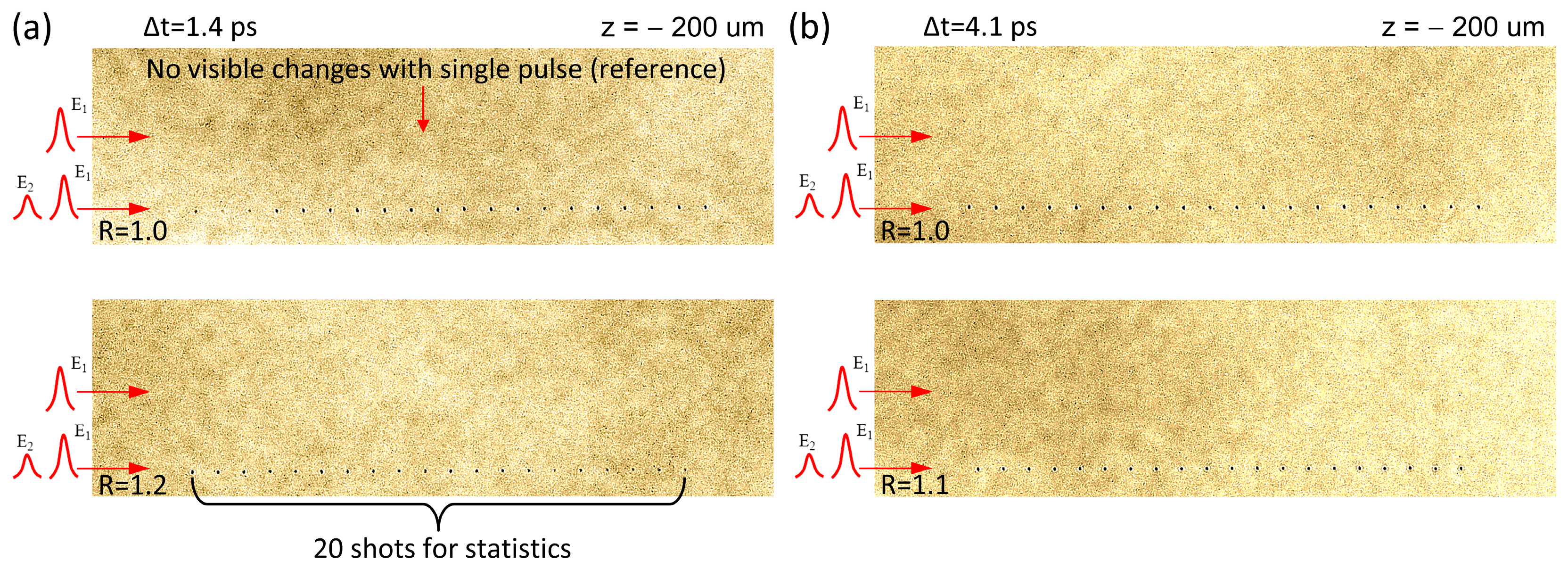
Effect of pulse separation and energy ratio on N-BK7 volumetric modification. Phase-contrast optical microscopy images acquired using a 40× objective in the plane of the laser-modified region for different delays between the two sub-pulses. The laser-induced modifications were produced in the bulk of the glass at z = −200 µm. Images are shown for pulse separations of (a) 1.4 ps with sub-pulse energy ratios R = 1 and R = 1.2, and (b) 4.1 ps with sub-pulse energy ratios R = 1 and R = 1.1. The red arrow marks the region exposed to single-pulse irradiation inside the glass, where no visible modification was observed. The images identify the presence or absence of optically detectable permanent bulk modification and do not establish its microscopic structural origin. Each site received one pulse pair, or one pulse for the control. The 20 repetitions correspond to spatially separated sites.
For pulse-pair irradiation, no detectable phase-contrast feature was observed at higher pulse contrasts. However, when the sub-pulse energies became more comparable, visible bulk modifications appeared. This behavior is illustrated in Figure 2 for both representative delays, showing that the modification is not produced by either sub-pulse acting independently but by their sequential action within the same focal volume.
These observations provide direct evidence of an additive effect of the two sub-pulses. Here, the additive effect refers to the formation of a detectable permanent modification by a delayed pulse pair under conditions where the corresponding single-pulse exposure does not produce a visible change. Additional experiments performed at other pulse separations confirmed that this pulse-pair-induced modification persists over the investigated delay range, up to 21 ps.
To describe the range over which this additive effect remains observable, we define Rmax as the maximum sub-pulse energy ratio, or pulse contrast, for which a detectable bulk modification is still produced by the pulse pair. Within the investigated pulse-energy range, Rmax tends to flatten near 1.1 for delays longer than approximately 4 ps, whereas for shorter delays, below approximately 2.5 ps, the effect remains observable up to Rmax ≈ 1.2. This indicates that, at longer delays, pulse-pair-induced modification occurs mainly when the two sub-pulses have nearly comparable energies, while at shorter delays, the interaction can still persist at a higher pulse contrast.
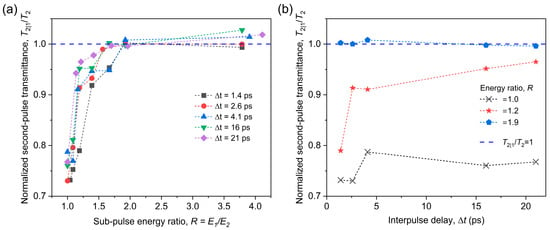
To further probe the additive response, we analyzed the transmittance of the pulse pair with emphasis on the effective transmittance of the second sub-pulse. Since this pulse arrives after the focal volume has been excited by the first sub-pulse, its transmission is sensitive to the transient material state established during the pulse-pair interaction. As shown in Figure 3, the normalized effective transmittance of the second sub-pulse, T2|1/T2, shows a clear reduction when the two sub-pulses have comparable energies, corresponding to the same energy-ratio range in which phase-contrast microscopy reveals pulse-pair-induced bulk modification. The reduced second-pulse transmittance therefore provides a real-time indication that the first sub-pulse alters the optical response encountered by the second sub-pulse during the pulse-pair sequence. This supports the interpretation of a sequential, additive process: each sub-pulse remains below the single-pulse modification threshold, but the first pulse transiently alters the focal volume so that the following pulse can drive the material response toward permanent modification. The reduced collected transmittance is consistent with enhanced absorption, but contributions from scattering and changes in beam propagation cannot be separated by the present measurements.
Figure 3.
Effective second-pulse transmittance in the double-pulse sequence. Normalized effective transmittance of the second sub-pulse, T2|1/T2, shown as a function of (a) the sub-pulse energy ratio R = E1/E2, for different pulse delays, Δt, and (b) Δt for selected energy ratios. The quantity T2|1 was obtained from the energy-weighted double-pulse transmittance after subtracting the contribution of the first pulse. The dashed horizontal line at T2|1/T2 = 1 represents the isolated second-pulse reference. Values below unity indicate reduced second-pulse transmittance in the double-pulse sequence due to the preceding pulse.
The evolution with energy ratio can therefore be viewed as a gradual transition from a weak pulse-pair response to a modification-producing regime. At larger pulse contrast, T2|1/T2 remains close to unity, indicating that the second sub-pulse is transmitted nearly as in the isolated single-pulse case. As the energy ratio approaches unity, the two sub-pulses carry more comparable energies, and T2|1/T2 decreases. This reduction shows that the second sub-pulse experiences a modified optical response of the focal volume created by the preceding sub-pulse. When this decrease becomes sufficiently pronounced, it coincides with the energy-ratio range where permanent bulk modification is resolved by phase-contrast microscopy. Smaller reductions observed before the appearance of a microscopy-detectable feature can be associated with a sub-threshold transient optical response during the pulse-pair interaction. Thus, the transmittance response follows the buildup of the pulse-pair interaction, with permanent modification confirmed by the microscopy-observed bulk features. The delay dependence observed in the Rmax analysis is further reflected in the transmittance response. For shorter delays, the decrease in T2|1/T2 persists to higher pulse contrast, consistent with the larger range of energy ratios over which pulse-pair-induced modification is observed. For longer delays, the reduction becomes restricted to ratios close to unity, corresponding to the flattening of Rmax near 1.1. Together, these trends suggest that the first sub-pulse establishes transient conditions that enhance the contribution of the following sub-pulse, particularly when their energies are comparable. This interpretation is consistent with previous double-pulse studies in other dielectrics, where the first pulse was shown to act as an initiator for subsequent energy deposition.
Figure 3b shows the delay dependence of the normalized effective second-pulse transmittance for selected sub-pulse energy ratios. For nearly equal energies, R = 1.0, the transmittance remains substantially below the isolated-pulse reference throughout the investigated interval, without a clear monotonic recovery. At R = 1.2, it approaches the reference with increasing delay, whereas at R = 1.9 it remains close to unity. This behavior is consistent with the microscopy observations that modification at longer delays requires more comparable sub-pulse energies. The results demonstrate that the influence induced by the leading pulse remains observable at the longest investigated delay of 21 ps. This delay therefore establishes neither a characteristic relaxation time nor the maximum separation over which the effect persists. Likewise, the minimum investigated delay of 1.4 ps does not establish the onset of the response.
In fused silica, Peng et al. demonstrated that a weak initiator pulse can seed energy deposition by a subsequent driving pulse through free carriers at short delays or through self-trapped excitons at picosecond delays, thereby lowering the effective absorption threshold of the second [23]. In the present experiment, however, the pulse sequence is different: the first sub-pulse is equal to or more energetic than the second one, E1 ≥ E2. Therefore, the observed sub-threshold double-pulse modification cannot be described simply as a weak seed enabling a stronger driving pulse. Instead, it shows that, in BK7, an equal or weaker second sub-pulse can still contribute to permanent modification when it arrives within the investigated picosecond delay range and the pulse contrast remains sufficiently low.
Time-resolved measurements in fused silica provide context for the initial carrier dynamics [37,38], with Temnov et al. reporting approximately 200 fs free-carrier relaxation associated with self-trapped-exciton formation. This early relaxation is distinct from the subsequent persistence of the trapped-state response relevant to second-pulse energy deposition [23,39]. Our approximately 500 fs pulses and minimum separation of 1.4 ps do not resolve this initial evolution, and the fused-silica timescale cannot be assigned directly to N-BK7.
For BK7, time-resolved studies have shown picosecond-scale excited-carrier dynamics and transient structural responses persisting beyond the initial electronic excitation [40]. The persistence of the additive effect up to 21 ps is therefore consistent with a longer-lived transient material response in BK7 that modifies the optical coupling of the following sub-pulse. We do not assign this response specifically to self-trapped excitons, since the STE-mediated mechanism is well established for fused silica [23,39] but was not directly resolved in the present BK7 measurements. A more cautious interpretation is that the additive effect is associated with transient electronic, trapped-carrier, or defect-related states in BK7, which can modify absorption, propagation, or energy localization during the second sub-pulse interaction.
At the same time, shielding effects should also be considered. Zukerstein et al. showed for fused silica that free-electron plasma generated by the first pulse can shield or defocus the following pulse at sub-picosecond delays, reducing localized modification, while at longer delays the response may also be affected by the spatial distribution of longer-lived excitonic states [33]. Since the present configuration also corresponds to E1 ≥ E2, partial shielding or delocalization may in principle occur in BK7 as well. However, the present measurements do not allow this contribution to be isolated separately. Experimentally, the net response in the investigated 1.4–21 ps range is additive: pulse-pair-induced modification is observed even when each sub-pulse alone remains below the single-pulse modification threshold. Thus, if shielding is present under these conditions, it does not dominate the interaction for near-comparable sub-pulse energies. Overall, these considerations indicate that the observed sub-threshold double-pulse modification is governed by the net transient response produced by the first sub-pulse. Within the investigated delay range, this response enables the following sub-pulse to drive the material toward permanent bulk modification, while possible shielding or delocalization contributions remain unresolved. These opposing contributions may become more pronounced at sub-picosecond delays, which are outside the present measurement range. Future sub-picosecond delay measurements and propagation modeling will therefore be required to distinguish the relative roles of enhanced absorption, shielding, and spatial redistribution of deposited energy.
Finally, the observed response is distinct from conventional heat accumulation, which is typically associated with high-repetition-rate glass processing, where successive pulses arrive before the deposited heat has fully dissipated [41]. In the present work, the relevant interaction occurs within an individual pulse pair separated by picoseconds. On this timescale, energy transfer from excited electrons to the lattice through electron–phonon interactions may increase the local lattice temperature [1], while thermal diffusion remains slow [33]. The observed sub-threshold double-pulse modification is therefore more consistently associated with transient electronic and/or defect-related changes in the focal volume, together with a possible contribution from transient lattice heating, rather than with cumulative thermal loading.
4. Conclusions
In conclusion, it has been shown that temporal pulse splitting produces an additive effect in the bulk modification of N-BK7, whereby two sub-pulses that are individually below the single-pulse modification threshold can jointly induce permanent modification. This additive response persists throughout the investigated picosecond delay range, although the range of pulse contrasts supporting modification narrows with increasing delay and becomes restricted to near-comparable sub-pulse energies. The accompanying transmittance response provides additional evidence for a sequential interaction in which the first sub-pulse creates a transient material state that promotes energy deposition by the following sub-pulse.
From a practical perspective, this additive effect introduces an additional degree of freedom for controlling the spatial localization of energy deposition. The inhomogeneous excitation created by the first sub-pulse may confine the region in which the following sub-pulse drives the material above the modification threshold, opening a potential route toward reduced feature size and higher-resolution three-dimensional microfabrication in transparent materials. Control of pulse delay and energy ratio may therefore enable more precise tailoring of the modification volume than is possible through pulse energy alone. Accordingly, the possibility of achieving improved spatial resolution will be assessed in future work through quantitative comparison of the modification dimensions produced by single- and double-pulse irradiation.
Further work should also extend the investigated ranges of pulse delay and sub-pulse energy to determine how the additive response evolves and where it becomes limited by shielding or spatial delocalization. Sub-picosecond delays are of particular interest for resolving the contribution of plasma shielding. The wavelength dependence of the effect should also be explored, including excitation with pulse sequences combining the fundamental wavelength and its second harmonic. Such mixed-wavelength pulse pairs may provide additional control over excitation pathways, energy localization, and the resulting modification geometry, further expanding the possibilities for precision laser processing in transparent materials.
Author Contributions
Conceptualization, A.S.Y., M.L.S., T.K.S., N.W.M. and A.S.V.; methodology, A.S.Y., M.M.S., M.L.S., T.K.S., N.W.M. and A.S.V.; validation, M.M.S., M.L.S., T.K.S. and A.S.Y.; formal analysis, M.M.S., M.L.S. and A.S.Y.; investigation, M.M.S. and M.L.S.; data curation, M.M.S. and M.L.S.; writing—original draft preparation, M.M.S. and M.L.S.; writing—review and editing, A.S.Y., M.L.S., T.K.S., N.W.M. and A.S.V.; visualization, M.M.S. and M.L.S.; supervision, A.S.Y. and A.S.V.; project administration, A.S.Y. and A.S.V.; funding acquisition, A.S.Y. All authors have read and agreed to the published version of the manuscript.
Funding
The work was supported by the Higher Education and Science Committee of RA, in the framework of the research project No. 23-2DP-2J002.
Data Availability Statement
The raw data supporting the conclusions of this article will be made available by the authors upon request.
Conflicts of Interest
The authors declare no conflicts of interest.
References
- Gattass, R.R.; Mazur, E. Femtosecond Laser Micromachining in Transparent Materials. Nat. Photonics 2008, 2, 219–225. [Google Scholar] [CrossRef] [Scilit]
- Glezer, E.N.; Milosavljevic, M.; Huang, L.; Finlay, R.J.; Her, T.H.; Callan, J.P.; Mazur, E. Three-Dimensional Optical Storage inside Transparent Materials. Opt. Lett. 1996, 21, 2023–2025. [Google Scholar] [CrossRef] [Scilit] [PubMed]
- Marcinkevičius, A.; Juodkazis, S.; Watanabe, M.; Miwa, M.; Matsuo, S.; Misawa, H.; Nishii, J. Femtosecond Laser-Assisted Three-Dimensional Microfabrication in Silica. Opt. Lett. 2001, 26, 277–279. [Google Scholar] [CrossRef] [Scilit] [PubMed]
- Davis, K.M.; Miura, K.; Sugimoto, N.; Hirao, K. Writing Waveguides in Glass with a Femtosecond Laser. Opt. Lett. 1996, 21, 1729–1731. [Google Scholar] [CrossRef] [Scilit] [PubMed]
- Chen, G.Y.; Piantedosi, F.; Otten, D.; Kang, Y.Q.; Zhang, W.Q.; Zhou, X.; Monro, T.M.; Lancaster, D.G. Femtosecond-Laser-Written Microstructured Waveguides in BK7 Glass. Sci. Rep. 2018, 8, 10377. [Google Scholar] [CrossRef] [Scilit] [PubMed]
- Tong, L.; Gattass, R.R.; Maxwell, I.; Ashcom, J.B.; Mazur, E. Optical Loss Measurements in Femtosecond Laser Written Waveguides in Glass. Opt. Commun. 2006, 259, 626–630. [Google Scholar] [CrossRef] [Scilit]
- Minoshima, K.; Kowalevicz, A.M.; Hartl, I.; Ippen, E.P.; Fujimoto, J.G. Photonic Device Fabrication in Glass by Use of Nonlinear Materials Processing with a Femtosecond Laser Oscillator. Opt. Lett. 2001, 26, 1516–1518. [Google Scholar] [CrossRef] [Scilit] [PubMed]
- Kowalevicz, A.M.; Sharma, V.; Ippen, E.P.; Fujimoto, J.G.; Minoshima, K. Three-Dimensional Photonic Devices Fabricated in Glass by Use of a Femtosecond Laser Oscillator. Opt. Lett. 2005, 30, 1060–1062. [Google Scholar] [CrossRef] [Scilit] [PubMed]
- Minoshima, K.; Kowalevicz, A.; Ippen, E.; Fujimoto, J. Fabrication of Coupled Mode Photonic Devices in Glass by Nonlinear Femtosecond Laser Materials Processing. Opt. Express 2002, 10, 645–652. [Google Scholar] [CrossRef] [Scilit] [PubMed]
- Voigtländer, C.; Richter, D.; Thomas, J.; Tünnermann, A.; Nolte, S. Inscription of High Contrast Volume Bragg Gratings in Fused Silica with Femtosecond Laser Pulses. Appl. Phys. A Mater. Sci. Process. 2011, 102, 35–38. [Google Scholar] [CrossRef] [Scilit]
- Mikutis, M.; Kudrius, T.; Šlekys, G.; Paipulas, D.; Juodkazis, S. High 90% Efficiency Bragg Gratings Formed in Fused Silica by Femtosecond Gauss-Bessel Laser Beams. Opt. Mater. Express 2013, 3, 1862. [Google Scholar] [CrossRef] [Scilit]
- Talbot, L.; Bernier, M. Femtosecond Writing of Intra-Phase-Mask Volume Bragg Gratings. Opt. Lett. 2023, 48, 1954–1957. [Google Scholar] [CrossRef] [Scilit] [PubMed]
- Canioni, L.; Bellec, M.; Royon, A.; Bousquet, B.; Cardinal, T. Three-Dimensional Optical Data Storage Using Third-Harmonic Generation in Silver Zinc Phosphate Glass. Opt. Lett. 2008, 33, 360–362. [Google Scholar] [CrossRef] [Scilit] [PubMed]
- Microsoft Research Project Silica Team Laser Writing in Glass for Dense, Fast and Efficient Archival Data Storage. Nature 2026, 650, 606–612. [PubMed]
- Juodkazis, S.; Matsuo, S.; Misawa, H.; Mizeikis, V.; Marcinkevicius, A.; Sun, H.-B.; Tokuda, Y.; Takahashi, M.; Yoko, T.; Nishii, J. Application of Femtosecond Laser Pulses for Microfabrication of Transparent Media. Appl. Surf. Sci. 2002, 197–198, 705–709. [Google Scholar] [CrossRef] [Scilit]
- Couairon, A.; Sudrie, L.; Franco, M.; Prade, B.; Mysyrowicz, A. Filamentation and Damage in Fused Silica Induced by Tightly Focused Femtosecond Laser Pulses. Phys. Rev. B Condens. Matter Mater. Phys. 2005, 71, 125435. [Google Scholar] [CrossRef] [Scilit]
- Wu, A.Q.; Chowdhury, I.H.; Xu, X. Femtosecond Laser Absorption in Fused Silica: Numerical and Experimental Investigation. Phys. Rev. B Condens. Matter Mater. Phys. 2005, 72, 085128. [Google Scholar] [CrossRef] [Scilit]
- Sukiasyan, M.M.; Sargsyan, M.L.; Sargsyan, T.K.; Martirosyan, N.W.; Vardanyan, A.S.; Yeremyan, A.S. Third-harmonic generation as an intrinsic probe for electronic modification threshold in transparent dielectrics. Opt. Laser Technol. 2026, 203, 116329. [Google Scholar] [CrossRef] [Scilit]
- Rethfeld, B. Unified Model for the Free-Electron Avalanche in Laser-Irradiated Dielectrics. Phys. Rev. Lett. 2004, 92, 187401. [Google Scholar] [CrossRef] [Scilit] [PubMed]
- Gamaly, E.G.; Rode, A.V. Transient Optical Properties of Dielectrics and Semiconductors Excited by an Ultrashort Laser Pulse. J. Opt. Soc. Am. B JOSAB 2014, 31, C36–C43. [Google Scholar] [CrossRef] [Scilit]
- Bulgakova, N.M.; Zhukov, V.P.; Sonina, S.V.; Meshcheryakov, Y.P. Modification of Transparent Materials with Ultrashort Laser Pulses: What Is Energetically and Mechanically Meaningful? J. Appl. Phys. 2015, 118, 233108. [Google Scholar] [CrossRef] [Scilit]
- Stoian, R.; Boyle, M.; Thoss, A.; Rosenfeld, A.; Korn, G.; Hertel, I.V.; Campbell, E.E.B. Laser Ablation of Dielectrics with Temporally Shaped Femtosecond Pulses. Appl. Phys. Lett. 2002, 80, 353–355. [Google Scholar] [CrossRef] [Scilit]
- Peng, J.; Grojo, D.; Rayner, D.M.; Corkum, P.B. Control of Energy Deposition in Femtosecond Laser Dielectric Interactions. Appl. Phys. Lett. 2013, 102, 161105. [Google Scholar] [CrossRef] [Scilit]
- Jiang, L.; Wang, A.-D.; Li, B.; Cui, T.-H.; Lu, Y.-F. Electrons Dynamics Control by Shaping Femtosecond Laser Pulses in Micro/nanofabrication: Modeling, Method, Measurement and Application. Light Sci. Appl. 2018, 7, 17134. [Google Scholar] [CrossRef] [Scilit] [PubMed]
- Chowdhury, I.H.; Xu, X.; Weiner, A.M. Ultrafast Double-Pulse Ablation of Fused Silica. Appl. Phys. Lett. 2005, 86, 151110. [Google Scholar] [CrossRef] [Scilit]
- Gaudfrin, K.; Lopez, J.; Mishchik, K.; Gemini, L.; Kling, R.; Duchateau, G. Fused Silica Ablation by Double Femtosecond Laser Pulses: Influence of Polarization State. Opt. Express 2020, 28, 15189–15206. [Google Scholar] [CrossRef] [Scilit] [PubMed]
- Wang, Z.; Jiang, L.; Li, X.; Wang, A.; Yao, Z.; Zhang, K.; Lu, Y. High-Throughput Microchannel Fabrication in Fused Silica by Temporally Shaped Femtosecond Laser Bessel-Beam-Assisted Chemical Etching. Opt. Lett. 2018, 43, 98–101. [Google Scholar] [CrossRef] [Scilit] [PubMed]
- Chu, D.; Yao, P.; Sun, X.; Yin, K.; Huang, C. Ablation Enhancement of Fused Silica Glass by Femtosecond Laser Double-Pulse Bessel Beam. J. Opt. Soc. Am. B JOSAB 2020, 37, 3535–3541. [Google Scholar] [CrossRef] [Scilit]
- Kim, E.; Shimotsuma, Y.; Sakakura, M.; Miura, K. 4H-SiC Wafer Slicing by Using Femtosecond Laser Double-Pulses. Opt. Mater. Express 2017, 7, 2450. [Google Scholar] [CrossRef] [Scilit]
- Wortmann, D.; Ramme, M.; Gottmann, J. Refractive Index Modification Using Fs-Laser Double Pulses. Opt. Express 2007, 15, 10149–10153. [Google Scholar] [CrossRef] [Scilit] [PubMed]
- Nagata, T.; Kamata, M.; Obara, M. Optical Waveguide Fabrication with Double Pulse Femtosecond Lasers. Appl. Phys. Lett. 2005, 86, 251103. [Google Scholar] [CrossRef] [Scilit]
- Gaudfrin, K.; Lopez, J.; Gemini, L.; Delaigue, M.; Hönninger, C.; Kling, R.; Duchateau, G. Fused Silica Ablation by Double Ultrashort Laser Pulses with Dual Wavelength and Variable Delays. Opt. Express 2022, 30, 40120–40135. [Google Scholar] [CrossRef] [Scilit] [PubMed]
- Zukerstein, M.; Zhukov, V.P.; Derrien, T.J.-Y.; Fedotova, O.; Bulgakova, N.M. Double-Pulse-Laser Volumetric Modification of Fused Silica: The Effect of Pulse Delay on Light Propagation and Energy Deposition. Opt. Express 2024, 32, 12882–12891. [Google Scholar] [CrossRef] [Scilit] [PubMed]
- Yeremyan, A.; Davtyan, H.; Grigoryan, A.; Grigoryan, B.; Ivanyan, M.; Khachatryan, V.; Martirosyan, N.; Sargsyan, M.; Sukiasyan, M.; Vardanyan, A. Application of Low-Energy, Tunable-Delay Ultrashort Electron Bunch Pairs for Irradiation Experiments; JACoW Publishing: Geneva, Switzerland, 2023. [Google Scholar]
- Marcinkevičius, A.; Mizeikis, V.; Juodkazis, S.; Matsuo, S.; Misawa, H. Effect of Refractive Index-Mismatch on Laser Microfabrication in Silica Glass. Appl. Phys. A Mater. Sci. Process. 2003, 76, 257–260. [Google Scholar] [CrossRef] [Scilit]
- Hnatovsky, C.; Taylor, R.S.; Simova, E.; Bhardwaj, V.R.; Rayner, D.M.; Corkum, P.B. High-Resolution Study of Photoinduced Modification in Fused Silica Produced by a Tightly Focused Femtosecond Laser Beam in the Presence of Aberrations. J. Appl. Phys. 2005, 98, 013517. [Google Scholar] [CrossRef] [Scilit]
- Quéré, F.; Guizard, S.; Martin, P. Time-Resolved Study of Laser-Induced Breakdown in Dielectrics. Europhys. Lett. 2001, 56, 138–144. [Google Scholar] [CrossRef] [Scilit]
- Temnov, V.V.; Sokolowski-Tinten, K.; Zhou, P.; El-Khamhawy, A.; von der Linde, D. Multiphoton Ionization in Dielectrics: Comparison of Circular and Linear Polarization. Phys. Rev. Lett. 2006, 97, 237403. [Google Scholar] [CrossRef] [Scilit] [PubMed]
- Grojo, D.; Gertsvolf, M.; Lei, S.; Barillot, T.; Rayner, D.M.; Corkum, P.B. Exciton-Seeded Multiphoton Ionization in bulk SiO2. Phys. Rev. B Condens. Matter Mater. Phys. 2010, 81, 212301. [Google Scholar] [CrossRef] [Scilit]
- Mauclair, C.; Mermillod-Blondin, A.; Mishchik, K.; Bonse, J.; Rosenfeld, A.; Colombier, J.P.; Stoian, R. Excitation and Relaxation Dynamics in Ultrafast Laser Irradiated Optical Glasses. High Power Laser Sci. Eng. 2016, 4, e46. [Google Scholar] [CrossRef] [Scilit]
- Eaton, S.M.; Zhang, H.; Ng, M.L.; Li, J.; Chen, W.-J.; Ho, S.; Herman, P.R. Transition from thermal diffusion to heat accumulation in high repetition rate femtosecond laser writing of buried optical waveguides. Opt. Express 2008, 16, 9443–9458. [Google Scholar] [CrossRef] [Scilit] [PubMed]
Disclaimer/Publisher’s Note: The statements, opinions and data contained in all publications are solely those of the individual author(s) and contributor(s) and not of MDPI and/or the editor(s). MDPI and/or the editor(s) disclaim responsibility for any injury to people or property resulting from any ideas, methods, instructions or products referred to in the content. |
© 2026 by the authors. Licensee MDPI, Basel, Switzerland. This article is an open access article distributed under the terms and conditions of the Creative Commons Attribution (CC BY) license.