


Abstract
This paper presents an approach to solving the coupled thermoelasticity problem that reduces into an uncoupled problem through the heat conduction equation. This approach is based on extending the well-known method of separation-of-variables (Fourier method), in which a function of several variables is represented as a product of single-variable functions. The idea is analogous to constructing the Airy stress function so that the Saint-Venant compatibility condition is satisfied automatically. The modification of the Fourier method consists of imposing additional constraints on the functions describing the components of the displacement vector. A theorem characterizing the form of these functions is proved. The results obtained can be used in modeling perturbed dynamic behavior of spacecraft solar panel arrays caused by the natural variability of the heat flux in orbit. They can also be applied when additional degrees of the mobility of structural elements arise from changes in the initial and boundary conditions of their motion.
1. Introduction
The development of engineering and technology leads to the necessity of solving new problems. At the same time, classical solutions may not satisfy the conditions under which emerging contemporary problems arise. Thus, the thermal shock problem was initially solved for semi-infinite bodies [1,2,3] and simple boundary conditions [4,5,6]. Subsequently, extensive theoretical work has been carried out in the field of thermal shock of solids [7,8,9,10,11,12,13,14,15,16,17,18,19,20,21,22,23,24,25,26,27,28,29,30,31,32,33,34,35,36,37,38,39,40,41,42,43,44,45,46,47,48,49,50,51,52,53,54,55,56,57,58,59,60,61,62,63,64,65,66,67,68,69,70].
A study by [7] examines the problem of thermal shock in a solid body under conditions of thermal impact, thermal heating, and heating by a surrounding medium. Integral relations are used that make it possible to reduce the problem to finding the corresponding Green’s function. A modification of the method of thermal potentials for domains with a uniformly moving boundary is presented.
Study [8] investigates the response of viscoelastic solids to thermal shock within the framework of dynamic models. It is shown that a real solid under such conditions begins to exhibit both elastic and viscous properties. In the author’s opinion, solving thermal shock problems for viscoelastic solids is associated with generalizing the corresponding stress–strain relations.
Studies [9,10] solved a one-dimensional problem for a sphere subjected to thermal shock. The solution employed a generalized fractional-order theory of thermoelasticity. Using the Laplace transform and asymptotic properties of Bessel functions, approximate solutions were obtained for the temperature and stress dynamics during the active phase of the thermal shock. The results of the work demonstrate a significant influence of the fractional parameter on the distributions of the temperature and stress fields in the sphere.
The results obtained in study [11] show that the inertia term is important when describing thermal shock. This term has a significant effect on heat transfer and the temperature field. A comparison is made with similar results from the Landau–Springer generalized theory of thermoelasticity.
Study [12] examines an edge crack in a semi-infinite medium subjected to thermal shock on its surface. A heat conduction model with dual-phase-lag is used for modeling. Values of the thermal stress intensity factor are obtained as functions of crack length and thermal shock time. The limiting values of the thermal shock resistance of the material—i.e., the level it can withstand without catastrophic failure—is determined using both the maximum local stress criterion and the stress intensity factor criterion.
Studies [13,14] solved two crack problems under thermal shock: an edge crack under cold shock and a center crack under hot shock. It was established that the non-local effect has a significant influence on the susceptibility of the material to cracking under thermal shock.
Study [15] examined the problem of thermal shock induced by a laser pulse to obtain expressions for the components of the strain and stress tensors, as well as the temperature field. A comparison was made with results obtained using the generalized theory, the Lord–Shulman theory with a single relaxation time, and the Green–Lindsay theory with two relaxation times.
Study [16] is devoted to the thermal analysis of the thermophysical properties of real materials (metals and ceramics) under thermal shock. Several empirical relationships were obtained that enable modeling of the thermophysical properties of a material during the active phase of thermal shock.
In [17], the author provided a detailed analysis of the factors affecting the thermal stress resistance of ceramic materials. A critical stress theory based on the analysis of thermoelastic stresses was proposed to describe material failure.
Study [18] investigated dynamic changes in the heat transfer rate when analyzing thermal shock fracture. Quantitative evidence was obtained showing that using a constant heat transfer coefficient when analyzing thermal shock fracture in water is incorrect. It was concluded that a constant heat transfer coefficient cannot fully reflect the actual dynamics of stress variation associated with changes in the heat transfer coefficient during liquid phase transitions. The use of a variable heat transfer coefficient, which is a function of surface temperature, is proposed.
Study [19] presented a model of internal thermal shock using a fractional-order derivative. The influence of the fractional-order parameter on the thermoelastic properties of an infinite elastic medium with a cylindrical cavity was investigated using the Laplace transform.
Study [20] solved the thermal shock problem for a thin plate made of titanium alloy. The thermophysical properties of the plate were considered temperature-dependent. The model was derived using the Clausius inequality and the generalized theory of thermoelasticity with a single thermal relaxation time. A series expansion in terms of the temperature increment of the Helmholtz free energy was used to describe the relationship between each thermophysical property of the material and temperature.
Studies [21,22] considered thermal-shock-induced cracking of a long cylinder subjected to a temperature shock on its outer surface, based on a generalized heat conduction model that accounts for the inertia term. The thermal stress intensity factor was obtained using the Fredholm integral equation. The thermal shock resistance of the cylinder was evaluated using both stress-based and fracture-mechanics-based criteria.
The authors of study [23] investigated the thermal shock resistance of transparent Yb:Y3Al5O12 (Yb:YAG) ceramics. This material is considered a potential candidate for solid-state lasers. The analysis confirmed that the thermal stress caused by thermal shock in the transverse direction is much higher than that in the longitudinal direction. This leads to unstable propagation of longitudinal cracks.
Study [24] investigates the influence of microstructure on the macroscopic behavior of complex materials under thermal shock. The response of an elastic half-space to thermal shock is considered. The thermal shock is generated by convective heat transfer on the free surface of the half-space from a fluid whose temperature changes abruptly. The model is constructed within the framework of the generalized theory of gradient thermoelasticity. This theory allows for effective modeling of the material’s microstructure. The modeling was performed using the finite element method under various microstructure parameter values. The simulation results showed that in a gradient material, thermoelastic pulses are more diffused and smoother than in a classical elastic solid.
Study [25] is devoted to an experimental investigation of the consequences of simulated lightning strikes on carbon-epoxy and glass-epoxy laminates. These consequences included thermal shock and mechanical shock waves. It was established that damage occurs mainly in the form of resin sublimation, delamination, and fiber bundle formation. For example, in glass fiber and epoxy resin laminates, damage appeared as extensive delamination caused exclusively by shock waves, with minor signs of thermal shock.
Study [26] proposed a numerical manifold method combined with an exact time integration method for analyzing the fracture of a material with surface cracks due to thermal shock. Discrete equations were solved when analyzing transient thermal processes, followed by a thermoelastic analysis. Stress intensity factors were computed using the interaction integral.
Study [27] presents a one-dimensional thermoelastic analysis of a three-layer functionally graded ceramic-metal strip. A coupled thermoelasticity problem was formulated. This problem was solved within the framework of both classical and generalized theories. The finite element method was used for numerical investigation of transient deformation, temperature field, and stress distributions. Numerical calculations show that the classical theory of coupled thermoelasticity inadequately describes the thermomechanical response of a solid under rapid transient thermal loading. The authors of [27] recommend using generalized thermoelasticity theories, such as the Lord–Shulman theory or the Green–Lindsay theory.
Study [28] investigates dynamic and static problems of thermoelastic fracture. Modeling is performed using a four-node quadrilateral element with sequential interpolation (XCQ4). The inertial effect is considered when analyzing dynamic crack growth.
Study [29] presents a test bench for simulating thermal shock. Thermal strain magnitudes were evaluated using stress analysis methods in conjunction with modern models for predicting crack initiation time.
Study [30] contains an investigation of the behavior of a semi-infinite medium with cracks under thermal shock, where the material properties are temperature-dependent. The medium is subjected to thermal shock on its surface. The temperature field and thermal stresses in the medium without cracks were obtained using the Laplace transform method and a numerical Laplace transform inversion technique. It is shown that accounting for the temperature dependence of material properties affects the thermal shock fracture pattern and the nature of crack growth in solids at high temperatures.
In study [31], a thick plate with a shallow semi-elliptical surface crack was considered based on a heat conduction analysis that does not conform to Fourier’s law. The plate was subjected to thermal shock. The thermoelasticity problem was solved. Expressions for the temperature field of the plate were obtained using the Laplace transform, together with the corresponding formulas for thermal stresses in an uncracked solid. Using the weight function method and analogy methods, a formula was derived for evaluating the thermal stress intensity factor at the crack tip. The influence of thermal shock time, crack depth, and initial crack shape on the thermal stress intensity factor and crack growth behavior was studied. Numerical simulation results show that the non-Fourier model is much more suitable for studying thermal shock cracking and predicting crack growth behavior in solids at high temperatures.
Study [32] presents a procedure for assessing fatigue damage occurrence in nuclear reactor components. It is noted that known fatigue strength assessment procedures have not accounted for the influence of thermal shock regimes. Laboratory test data are presented showing a possible significant reduction in component service life due to material fatigue, depending on strain rate and thermal shock characteristics.
Study [33] is devoted to modeling the shock compression of isotropic polycrystalline elastoplastic solids deformed by dislocation slip. A semi-analytical method is proposed for evaluating the inelastic characteristics of polycrystalline specimens under planar shock loading, based on particle velocity data. This method can be used to assess the significance of strain rates for the feedback term in the heat conduction equation.
Study [34] investigated the effects of thermal shocks at a temperature of 1000 °C on the microstructure of Rene 41 alloy and its hardness. This nickel-based alloy, which exhibits dispersion hardening, possesses high strength at temperatures above 850 °C. Thermal shocks were applied to the specimen surface using solar energy over three and six cycles of 30 s each. Specimen surfaces and cross-sections were examined by measuring hardness using scanning electron microscopy and energy-dispersive X-ray spectroscopy methods. Changes in hardness values correlated with structural transformations induced by thermal shocks.
Study [35] presents an investigation of the thermomechanical behavior of solids accounting for dissipative processes, such as plastic deformation and fracture. Thermomechanical equations for finite deformation are obtained. These equations combine crystal plasticity, its equation of state, and an anisotropic damage model.
Study [36] investigated the thermal properties of Yb:YAlO3 (Yb:YAP) perovskite crystals under cryogenic cooling thermal shock conditions. Specific heat capacity, thermal expansion coefficient, thermal conductivity, and thermal shock resistance parameters were evaluated. A significant increase in thermal shock resistance was recorded upon abrupt temperature change from 298 K to 77 K.
Study [37] presents a numerical simulation of the thermal shock process using a one-way thermohydrodynamic coupling method, as well as an analysis of instantaneous temperature and stress changes in two types of blades during the engine startup phase.
Study [38] investigates the thermoelastic response of a thick solid circular plate under thermal shock. The integral transform method is used to find the solution to the heat conduction equation. The Hankel transform method is employed to analyze numerical results for temperature field, deformation, and thermal stresses.
Study [39] presents a numerical simulation of the temperature field of granite and the fluid flow field under thermal shock using COMSOL Multiphysics. The pattern of temperature field redistribution within the granite is presented. It is shown that the heat exchange model between fluid and solid in granite rocks under thermal shock correctly simulates the thermal conductivity and temperature distribution in granite.
Study [40] considers a one-dimensional half-space problem based on a modified Quintanilla model. In the presented model, Fourier’s and Fick’s laws were supplemented a relaxation time within the Green–Naghdi theory and the framework of the Moore–Gibson–Thompson heat conduction equation.
Study [41] is devoted to a study of the thermomechanical properties of the CoCrFeNiMn high-entropy alloy. According to the authors, this alloy has great potential for application in mechanical engineering due to its good ductility and high fracture toughness at low temperatures. After short-term thermal shock tests, the alloy coatings remained stable; however, small cracks appeared on the surface. The microhardness of the coating after testing also remained stable.
Study [42] considers a thermoelastic boundary value problem for a three-dimensional orthotropic medium based on Eringen’s nonlocal elasticity theory. A thermal shock, whose parameters depend on time, occurs on the free surface of a homogeneous orthotropic solid. The problem is considered within the framework the Type III model according to the Green-Naghdi classification. The equations of the three-dimensional generalized thermoelasticity problem are obtained using normal mode analysis of the governing equations. These equations are solved using the eigenvalue method. The influence of the non-local parameter on thermal deformation and the temperature field is presented graphically.
Studies [43,44] describe mathematical models of thermal shock theory in terms of dynamic thermoelasticity. Constitutive relations for boundary value problems are obtained based on hyperbolic equations grounded in the idea of local nonequilibrium heat transfer processes. Boundary conditions of the first, second, and third kinds are presented in a generalized form when describing thermal shock at the boundary of a solid. A new approach to studying the thermal response of a solid under intense heating or cooling of its surface is presented. Practical relations for the upper-bound estimate of thermal stress are proposed, which allow for a quick and effective assessment of the severity of short-term dynamic stresses.
Study [45] proposes an improved heat transfer model. Fourier’s and Fick’s laws are replaced by more general expressions. The heat conduction and diffusion equations are supplemented with higher-order time derivatives and four phase lags. The proposed model is applied to investigate thermoelastic diffusion processes in a solid cylinder caused by possible thermal and chemical influence on its surface.
Study [46] investigates the dynamic stress characteristics of a nozzle under thermal shock. These characteristics are of great importance for assessing the structural integrity of a high-pressure reactor vessel. A numerical calculation model for the coolant and solid body of a jet engine vessel was constructed and verified. Based on this model, the thermohydraulic characteristics of the cylinder and engine nozzle were studied. In addition, the temperature fields, equivalent stress, and equivalent plastic deformation in the high-stress zone of the cylinder and nozzle under thermal shock were investigated.
In study [47], porous yttrium–zirconium–niobium dioxide sheets were subjected to thermal shock from 200 °C to 500 °C. Afterward, flexural strength characteristics were obtained experimentally, and a comparative analysis was conducted with the original specimens.
Study [48] presents modeling of deformation processes of a zinc single crystal taking anisotropy into account. Anisotropy is represented as different values of linear compression moduli and Grüneisen coefficients depending on direction. Numerical modeling was performed using the dynamic finite element method in a three-dimensional formulation at the Debye temperature.
Study [49] describes an experimental setup for assessing the initiation and propagation of cracks on the surface of nuclear reactors components. This setup consists of a fuel pellet in a sealed section of a copper tube. The device is first heated to a high temperature (580–680 °C) by immersion in a molten salt bath and then quenched in a cold bath (−10 to 4 °C).
Study [50] addresses the problem of high-temperature thermal conductivity of solids exposed to powerful high-frequency electron and laser beams. The high-energy thermal shocks were found to be recurrent and pulsed in nature, leading to the propagation of thermal waves in solids.
Study [51] performed solid modeling of high-temperature components of the leading edge of a high-speed aircraft wing using ABAQUS software. The high-temperature thermal field of a loaded aircraft at high-speed flight was modeled, the stress and strain fields were obtained, and the thermomechanical couplings were analyzed.
Study [52] is devoted to the analysis of thermoelastic wave propagation in continua at microsecond and nanosecond time scales. The authors emphasize that this is particularly important for ultrafast heating, such as thermal shock. A generalized thermoelasticity model was formulated by introducing an additional term into the Lord–Shulman thermoelasticity model. This term accounts for the strain rate and is associated with the relaxation time parameter. The model was applied to solve a one-dimensional problem for a half-space, one end of which is stress-free, while a time-dependent thermal shock is imposed on the other end. Incorporating the strain rate into the Lord–Shulman model eliminates possible jump discontinuities in strain and stress fields at the wave front.
Study [53] investigated the behavior of a novel thermal barrier coating material, (Yb0.1Gd0.9)2Zr2O7 (YbGdZrO)—a zirconate ceramic with rare-earth modifiers. Experimental results showed that after 3000 thermal shock cycles, the interface surface of the coated specimen became light green. In addition, numerous small black spots with a chaotic distribution were observed on the surface. On the surface of the YbGdZrO ceramic topcoat, many microcracks were visible, with an average width of approximately 8.523 μm, uneven distribution, and complex cross-linking.
Study [54] performed numerical modeling of impact and shock-wave interaction of deformable solids. The authors believe that the adequacy and accuracy of modeling are significantly enhanced by using a model that relates yield stress to accumulated plastic deformation, strain rate, and temperature. It is noted that the empirical Johnson–Cook model, at increased impact velocities, complicates the selection of model constants to achieve agreement between computational and experimental data. The paper presents a method for determining the constants of the Johnson–Cook model using an optimization algorithm based on the Nesterov gradient descent method. The authors point out that this method is applicable to a wide range of problems involving impact interactions within a thin surface layer. Thermal shock can be regarded as an example of such an interaction. A methodological similarity can be identified between approaches used to study impacts of different physical nature (mechanical and thermal shocks). This similarity is based on the comparable characteristics of the localized interaction region during the active phase of the impact process.
Study [55] is devoted to applying the Moore–Gibson–Thompson heat conduction concept to a two-dimensional elastic solid half-space. The free surface of the half-space was immersed in a constant-intensity electromagnetic field, rotated at a constant angular velocity, and subjected to thermal shock. The results obtained were compared with those from other thermoelastic models in which relaxation time is not considered.
Study [56] investigated the stress–strain state and fracture of an electrolyzer anode block under cyclic thermal shock, taking into account differences in heating and cooling rates. The modeling was performed within the framework of a phenomenological approach in the mechanics of deformable solids. The anode block was considered as a coke plate with randomly distributed porosity. The three-dimensional finite element method and the author’s proprietary software package EFES 2.0 were used for numerical modeling.
Study [57] presents the results of experimental tests on reinforced concrete monolithic slabs subjected to thermal shock. The slabs were subjected to thermal shock at a temperature of 600 °C and rapidly cooled by immersion in water for 15 min. The experimental results showed that after thermal shock exposure, the compressive strength of the concrete decreased by more than 45%, and the ultimate load-bearing capacity and stiffness decreased by more than 15% and 38%, respectively, compared to the control slab.
Study [58] investigates crack propagation in anisotropic materials subjected to generalized thermal shock under mixed-mode conditions. The finite element method was used to construct the model. An analysis of the Green–Naghdi generalized thermoelasticity theory was conducted to demonstrate its applicability in modeling thermal wave propagation in anisotropic media. The stress intensity factor for growing cracks in anisotropic bodies under thermal shock was determined. The influence of material anisotropy, thermal shock magnitude, and energy dissipation coefficient on the crack propagation trajectory was considered. It was established that under strong anisotropy, the magnitude of the thermal shock does not significantly affect the crack growth trajectory. However, the crack may propagate along an unpredictable trajectory under weak anisotropy.
Study [59] investigated the dynamic response of a two-dimensional half-space to thermal shock, taking into account magnetothermoelastic coupling as well as heat conduction with fractional time derivatives. The half-space material was considered homogeneous, isotropic, thermally conductive, and electrically conductive. Its free surface was subjected to thermal shock. The Lamé–Smith generalized thermoelasticity model was used to describe the thermoelasticity problem.
Study [60] presents a coupled thermomechanical model based on ordinary state-based peridynamic theory for simulating the dynamic response to temperature change and predicting crack propagation under thermal shock in brittle and ductile solids. The Lemaitre model was used to describe ductile fracture. The ultimate tensile strength was used in the Lemaitre model instead of the yield stress for brittle fracture. A sequential solution strategy and an implicit return mapping algorithm were selected to account for the dynamic plastic response to thermal shock.
Study [61] constructed a three-dimensional analytical model based on the Biot variational principle for boundary conditions of the third kind. The variational equations were solved using the finite element method. Computational experiments were conducted on benchmark problems for high-temperature gradients. The results obtained confirm the effectiveness of the proposed approach.
Study [62] is devoted to investigating the thermal response of an isotropic thermoelastic medium heated by a moving heat source. A new heat conduction model based on the Moore–Gibson–Thompson equation was used to describe the temperature field. The model was used to study the thermomechanical behavior of a semi-infinite thermoelastic solid. Laplace transforms together with the eigenvalue method were used to solve the equations. Inverse Laplace transforms were performed using the Honig and Hirdes approximation method.
Study [63] investigated the effect of thermal shock on an isotropic generalized thermoelastic medium within the framework of the Lord–Shulman heat transfer model. In addition to thermal shock, a distributed normal load was applied to the boundary of the medium. The medium consisted of two layers: a finite elastic layer located above a semi-infinite homogeneous isotropic thermally conductive elastic half-space.
Study [64] is devoted to investigating the temperature, deformation, and thermal stress fields in a homogeneous and isotropic three-dimensional thermoelastic half-space. The thermophysical properties of the material were considered temperature-dependent. The thermoelasticity equations were obtained using the Green–Lindsay generalized thermoelasticity theory for the case where the stress-free boundary of the medium is subjected to thermal shock.
Study [65] developed a thermomechanical model for elastic solids within the framework of Green–Naghdi Type II fractional derivative theory supplemented with memory-dependent derivatives. The model allows accounting for delay effects and fractional order thermoelastic responses. Simulation results are obtained for half-space subjected to a time-dependent thermal shock.
Study [66] solved the following problem: a two-dimensional thermoelastic plate with voids contains a moving heat source that can freely travel across the entire plate. The upper surface of the plate is free from external forces and is undeformed at the initial moment. The lower surface is thermally insulated and contacts a rigid structure. The surface is subjected to thermal shock. The finite element method was applied to solve the dynamic equations and the heat conduction equation, since an analytical solution is impossible.
Study [67] is devoted to the development of a coupled thermoelastic discrete model for describing the behavior of brittle materials under thermal shock. It is based on a combination of thermal analysis with the constitutively informed particle dynamics method. The model can describe the initiation and propagation of cracks arising from thermal shock in quenched ceramic specimens.
Study [68] presents a generalized thermoelastic diffusion model that combines dual-phase-lag with Soret and Dufour cross-effects. This eliminates the limitations of the classical Fourier and Fick laws by enabling the propagation of thermal and diffusion waves at finite speed.
Study [69] is devoted to investigating crack propagation in auxetic and non-auxetic honeycomb structures under thermal shock using the Lord–Shulman generalized thermoelasticity theory and the extended finite element method (XFEM). The thermoelastic response of the honeycomb structure is analyzed by solving the coupled thermoelasticity equations using XFEM. Numerical results are compared with analytical solutions. Subsequently, coupled thermomechanical finite element modeling is performed in a mixed-mode formulation for cracked honeycomb materials. The Lord–Shulman theory accounts for the finite speed of thermal wave propagation. This allows for a more accurate analysis of transient thermomechanical interactions compared to classical approaches. The research results show that auxetic honeycombs exhibit stable linear crack growth, a lower crack propagation rate and a faster temperature response to thermal shock. In non-auxetic honeycombs, cracks propagate chaotically, more quickly, and are more sensitive to relaxation time and thermal shock.
In the review [70], the authors examine thermal shock in rocks and substantiate the effects of both external and internal conditions on the response of rock materials to thermal shock. Several analytical equations describing thermal shock are analyzed. The authors conclude that an accurate and reliable mechanical model is essential.
The emergence and development of space technology have added a new practical problem within the framework to the thermal shock issue. When moving in low Earth orbit, a spacecraft periodically finds itself in the Earth’s shadow [71,72]. At the boundary between the sunlit and shadowed portions of the orbit, a thermal shock occurs in the solar panels of the spacecraft [73,74]. However, thermal shock does not generally cause significant perturbation for high-mass spacecraft [75]. The exception is space telescopes, for which the influence of thermal shock on the quality of mission objectives is significant due to the size of the telescope’s sensitive element [76]. Nonetheless, the development and application of small spacecraft have demonstrated the need to study and account for thermal shock for several mission objectives [77,78]. This also applies to additional aspects of structural element mobility arising from, among other things, spontaneous or controlled motion of these elements. These include, for example, remote sensing of Earth from space [79,80] and the implementation of gravity-sensitive processes [81,82]. It is precisely the problem of thermal shock of a small spacecraft solar panel that motivates the problem statement in this paper. As a first approximation, a small spacecraft solar panel can be represented as a thin plate with one rigidly fixed edge and three free edges [83,84]. This is due to the fact that thermal shock occurs within a thin surface layer. Consequently, a thin-plate model can be employed to describe the active phase of thermal shock (a few seconds after the panel emerges from the Earth’s shadow). Studies [85,86] considered the uncoupled thermoelasticity problem to describe thermal shock. Nevertheless, such a formulation may be insufficient under conditions of a large temperature difference across the solar panel between the sunlit and shadowed portions of a small spacecraft’s orbit. This is clearly demonstrated by experiments conducted with the ROSA solar panel [87]. In 2017, these experiments were carried out on the International Space Station. The oscillations caused by the thermal shock not only significantly affected the panel’s temperature field, but also prevented it from being folded up at the end of the experiments. It was jettisoned from the International Space Station while still unfolded. This clearly demonstrates the significance of the feedback term in the heat conduction equation, which determines the coupled formulation.
2. Problem Statement
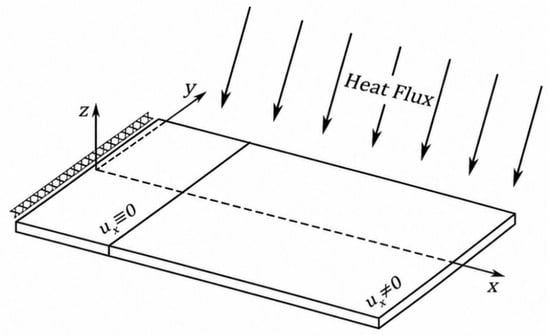
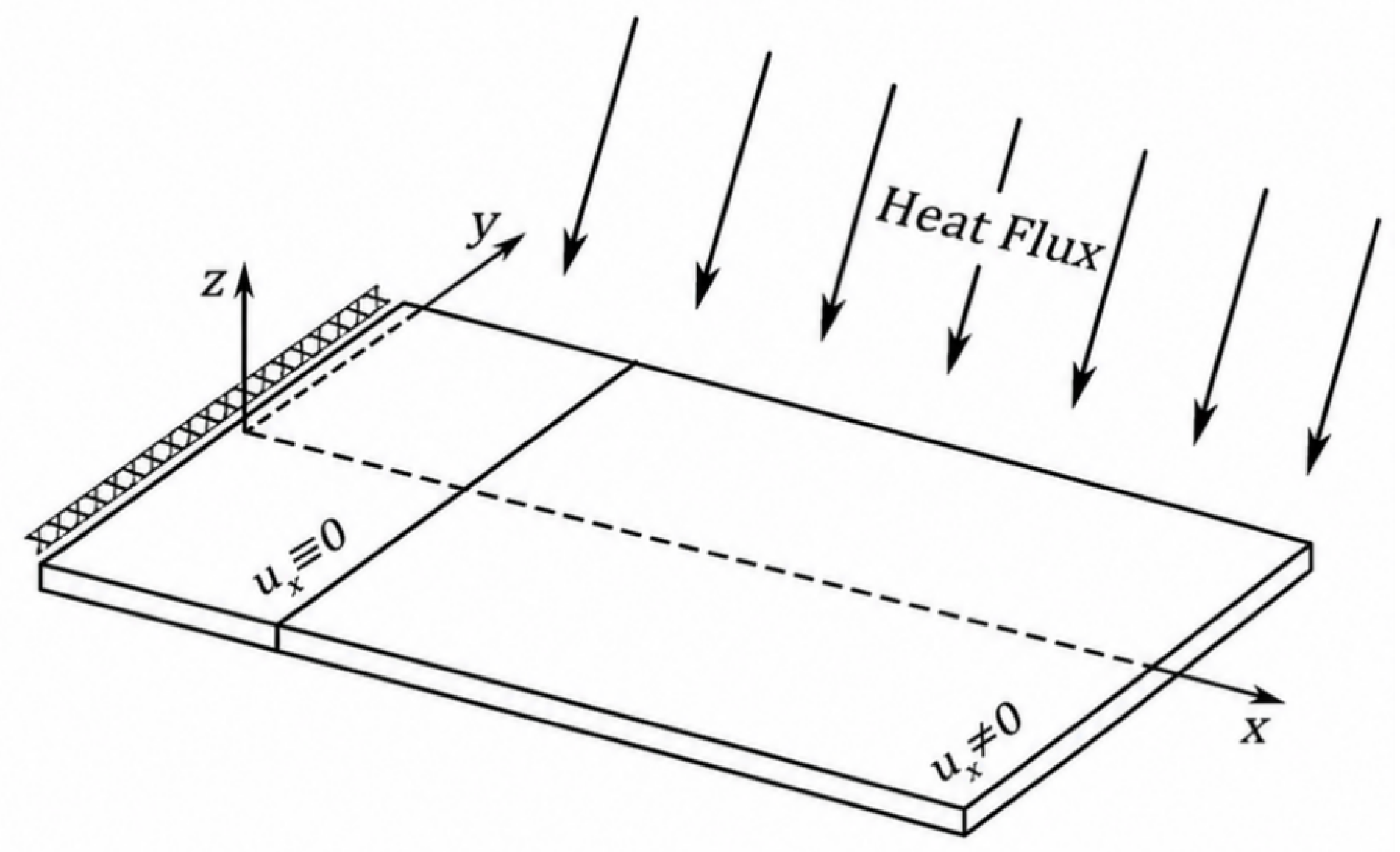
In study [88], the equations of the coupled thermoelasticity problem were obtained for a thin homogeneous plate accounting for material compressibility. A one-dimensional heat conduction model was considered. The entire plate was divided into two regions. In one region, the displacement vector component . In the other region, this component is nonzero (Figure 1).
Figure 1.
The layout of regions under thermal shock of the plate is presented.
The aim of the present work is to develop an approach to solving the thermoelasticity problem in the region where . It was shown in study [88] that the coupled thermoelasticity problem can degenerate into an uncoupled problem for small values of time t, or remain a coupled problem (system of Equations (18) from study [88]):
where is the temperature of points of the plate; a is the thermal diffusivity coefficient; and are the components of the displacement vector along the coordinate axes shown in Figure 1; , c, and are the density, specific heat capacity, and the coefficient of linear thermal expansion of the plate material, respectively; and are the Lamé coefficients.
In [88], the following structure of the functions of the displacement vector components was revealed (system of Equation (17) in study [88]):
It was noted that the system of Equation (1) is redundant. It contains four equations and three unknown functions. The method for solving such a system was not discussed in [88]; developing such a method is the aim of the present work. The classical separation-of-variables method (Fourier method) requires modification to solve a system with an excessive number of equations. Therefore, an approach to its solution will be developed in this work.
3. Materials and Methods
The classical method of separation of variables (Fourier method) [89] assumes the representation of a function of several variables as a product of functions of a single variable. For example, the functions from the system of Equation (2) can be represented using this method as:
Despite occasional criticism (e.g., Ref. [90] discusses the incorrect use of variable separation in accordance with the Fourier method in the theory of mechanical oscillations), the method of separation of variables is often used in solving thermoelasticity problems [91]. It allows one to make the transition from partial differential equations to ordinary differential equations [92]. Its modifications are even used in solving equations with fractional derivatives [93,94].
In the case of the system of Equation (1), the classical Fourier method requires further development. Since none of the four equations in System (1) degenerate after setting , one of the equations in System (2) is redundant. In the present work, one of the equations is proposed to be considered as an additional constraint on the form of one of the functions. Equation (3) of System (2), which contains only the component of the displacement vector, is used as such an equation.
In classical problems of deformable solid mechanics, there are known examples of subjecting the sought functions to several constraints simultaneously. Thus, when determining stresses in a two-dimensional solid, the Airy stress function is often used [95]. Through this function, the components of normal and shear stresses are expressed as follows [96]:
This form of the Airy stress function allows the equilibrium conditions in the deformed state of the body to be automatically satisfied for any functions of normal stress ( and ) and shear stress () that obey (4). Subsequently, the expression for the Airy stress function is determined from the equilibrium equations of the deformed body, and then the stresses themselves are obtained using (4).
4. Results and Discussion
We consider the third equation of System (1) and seek the function taking into account the classical expansion (3):
We impose constraints on the function based on the physical formulation of the problem. First, since at the moment of thermal shock onset () the plate was undeformed, the following holds:
Then, taking into account the first equation of (2), we obtain the initial condition .
Second, the function must be bounded. Otherwise, the right-hand side of Equation (5) diverges, which does not correspond to reality. Thus:
where M is a finite number.
Third, the properties of the function are related to the dynamics of the temperature field of the plate. For instance, if the temperature at all points of the plate increases monotonically, then will also increase monotonically, i.e.:
We obtain:
After transformations, we have:
We impose additional constraints on the function . Let the time derivative of the left-hand side of Equation (9) be equal to zero:
This means forming a partial form for the function . This is similar to the introduction of the Airy function by the system of Equation (4). Possibly, there exist such functions satisfying Equation (9) without the additional condition (10). Similarly, there are expressions for normal and tangential stresses that do not satisfy (4). At the same time, they ensure the equilibrium of the body in a deformed state. In this, the authors see an analogy with (10) when using the Airy function.
The additional condition (10) is not artificial. It is not introduced merely to simplify the solution of Equation (9). Let us return to the connection of the function with the dynamics of the plate temperature field. This was discussed above in connection with the monotonic behavior of the function in the form of inequality (8). In fast-dynamic effects (such as thermal shock), linear terms often play a significant role. This is supported by relevant studies (e.g., Figure 13 in [85]). The temperature changes almost linearly over a limited period of time. This behavior is recorded during experiments (for example, Figure 7 in [87] or Figure 5 in [97]). We apply this property over a limited period of time to the function . This cannot be done over an unlimited period of time. In this case, condition (7) will be violated. However, over this limited period of time, there is every reason to argue that . This statement turns out to be quite enough to come to (10). Really,
The first two terms of the right-hand side of (11) explicitly provides . The third term provide . Therefore, the requirement is sufficient that the right-hand side of (11) to be zero.
Thus, condition (10) is satisfied. Therefore, it can be argued that (10) is not artificially introduced conditions to simplify the solution of Equation (9). They can be justified by the physical formulation of the problem in the case of fast-dynamic effects. The size of the time interval is the subject of a separate study and is not discussed in this paper. However, the fact of its existence is not in doubt among the authors of the article.
Condition (10) is sufficient for the formation of the function . However, it is not necessary, since the solution to Equation (9) can, in the general case, be obtained even without satisfying condition (10).
Then the right-hand side of Equation (9) is a constant. In this case, Equation (9) can be rewritten as:
where .
Equation (12) is a linear homogeneous second-order equation. Its solution is as follows:
It should be noted that a negative left-hand side of Equation (9) under condition (10) transforms solution (13) into a trigonometric form. This does not correspond to the physical formulation of the problem. The values of the function must increase monotonically from the clamped edge to the free edge of the plate. Therefore, this constant is denoted as to emphasize its positive value.
Let us prove that condition (10) can incorporate conditions (6)–(8). Consider a special case where to simplicity the proof. In this case, (10) takes the form:
Theorem 1.
Proof of Theorem 1.
From (14), it follows that:
For condition (6) to be satisfied, it is necessary that:
From (14), it is evident that:
However, taking into account (16):
To eliminate the singularity, it is necessary to require that:
Then condition (17) will be satisfied for a finite negative value of . Let us analyze (14). If condition (8) holds, then then is a monotonically decreasing function. Therefore, to satisfy (14), one can require the derivative to decrease. This automatically follows from (15). To satisfy condition (7), it is necessary to require that the improper integral be finite:
From (14), it is evident that:
Therefore, taking into account that , it is sufficient to let the following limit tend to –1:
Condition (22) admits that:
This is fully consistent with condition (20).
Thus, the function must:
- -
- satisfy condition (14);
- -
- have a first derivative that is infinite at and monotonically decreases to 0 as ;
- -
- have a bounded negative second derivative whose limit is 0 as .
When , (14) takes the form:
where .
Let us consider the limit of the left-hand and right-hand sides of (24) as .
Let us consider the limit of the left-hand and right-hand sides of (24) as .
Satisfying condition (7) means that:
Equations (29) and (30) satisfy the conditions of Landau’s theorem [98]. According to this theorem, all three functions will be bounded without requiring condition (20). For the limit of the first derivative, the following equality holds by Landau’s theorem:
where .
Then, using (30), we have:
Thus, conditions (6) and (7) are satisfied. To satisfy condition (8), we choose a positive value for the limit from the second Equation (26):
The combination of conditions (32) and (33) ensures that condition (8) is satisfied. Thus, the function must:
- -
- satisfy condition (24);
- -
- have a bounded positive first derivative, equal to at and as ;
- -
- have a bounded second derivative, equal to 0 at and as .
The theorem is proved. □
For the case , the proof is substantially more complex and cumbersome. Such an extension of the Fourier method allows not only for automatically satisfying conditions (6)–(8) of the physical formulation of the problem, but also for obtaining an analytical solution to the coupled thermoelasticity problem. This will be shown below. The clamped boundary conditions for have the form:
Or, taking into account the form of the function :
Finally, from (2), (5), and (37), we obtain the function for in the form:
where A and C are some positive constants.
Moreover, as has been shown, it is sufficient that the function satisfies condition (10).
Integrating (39) with respect to x and taking into account the dependence of the functions and on x and t, we obtain:
The clamped boundary conditions for have the form:
Or, taking into account the form of the function :
Hence, it follows that:
Consider now the fourth equation of System (1). Let us determine the terms included in this equation taking into account the results obtained. From expression (40), we have:
Taking into account the notation , we transform (44) to the form:
Next, from expression (40), we obtain:
After simplifications, we have:
Taking into account the initial condition of uniformity of the temperature field , we have:
However, for a thin plate, satisfaction of the first condition in System (49) is not mandatory. The first term in (48) can be neglected compared to the second due to its smallness resulting from the small magnitude of . The values of the second derivative , of course, should not be large.
Consider now the first equation of System (1). It contains all the functions sought in this problem. Let us determine the terms included in this equation taking into account the results obtained. From expression (50), we have:
After grouping the terms, we have:
From Equation (53), we obtain the following system for determining the functions and :
For brevity, we introduce the notation: . The first equation of System (54) contains only the function and can be integrated analytically:
where , , and are integration constants.
Taking into account (43), we can write:
This equation is satisfied by the pair of constant values: , . Then the form of function (55) is substantially simplified:
At from (58), we have:
However, as already noted, for a thin plate this is not a significant drawback. As a proof, let us estimate the magnitude of the discrepancy with respect to the initial uniform temperature field in Equation (48). In study [99], numerical modeling of thermal shock was performed for MA2 magnesium alloy. Based on the data from [99], for (48), taking into account (58), we have:
For a plate of thickness 1 mm with the plane located at the midplane of the plate, we obtain m. Then the maximum value of function (59) is:
It is evident that for small values of the constant , the first term in (61) is negligibly small compared to . For example, in [99] K.
After determining the form of the function , we substitute expression (57) into the second equation of System (54):
Let us introduce the following notation: ; ; . We transform (62) to the following form:
Carrying out further transformations of (63) and grouping the terms, we obtain:
Let us introduce the following notation: . Then (64) takes the form:
Equation (65) does not have an analytical solution in the general case. However, it can be simplified. To do this, we set or:
Expression (66) does not violate the previously stated constraints on the value of the constant . For example, referring again to the example in [99], we have: and (Table A1, Appendix A). Then the maximum temperature deviation from , according to expression (61), is K.
To obtain the correct solution, time should also be scaled. Suppose that after a finite period of time from the moment of the temperature shock, the thermal field of the plate becomes stationary. Denote this point in time by . If the temperature field does not become stationary, then the following can be considered a condition for approximate stationarity:
where is the temperature change in one second.
The fulfillment of condition (67) over a significant time interval can be interpreted as the stationarity of the plate temperature field. This means going from interval to interval . Let us introduce a dimensionless time parameter:
Then the dimensionless time parameter will change within the interval . Rewrite Equation (65) taking into account (66) and (68):
where .
Equation (69) is solved analytically. Its solution is:
When using dimensional time t, a singularity occurs:
In this case, solution (70) will be incorrect. Using dimensionless time solves the singularity problem. The value is not in the range of the dimensionless time parameter.
Thus, taking into account simplification (66), the solution to the thermoelasticity problem for has been obtained in analytical form:
Let us examine and simplify the integral in the first Equation (72). It can easily be written as:
The second integral on the right-hand side of Equation (73) can be evaluated using the following substitution:
Then, we obtain:
The first integral in Equation (73) can also be transformed using substitution (74):
Let us perform another change of variables in integral (76):
Thus, we obtain:
where and .
Finally, the integral of the form (78) can be expressed in terms of the incomplete beta function:
Then (72) will take the form:
Due to the extension of the Fourier method, which consists of imposing additional constraints on the function (10), it has become possible to obtain a solution to the thermoelasticity problem for when (66) holds and to shorten the time interval from to .
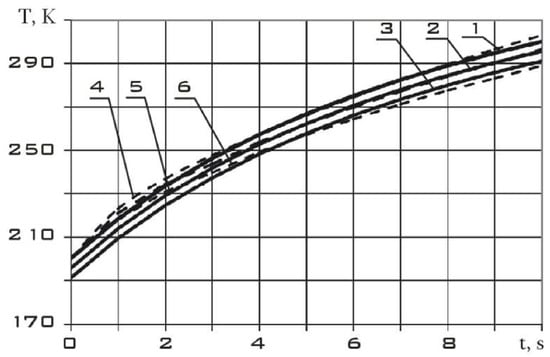
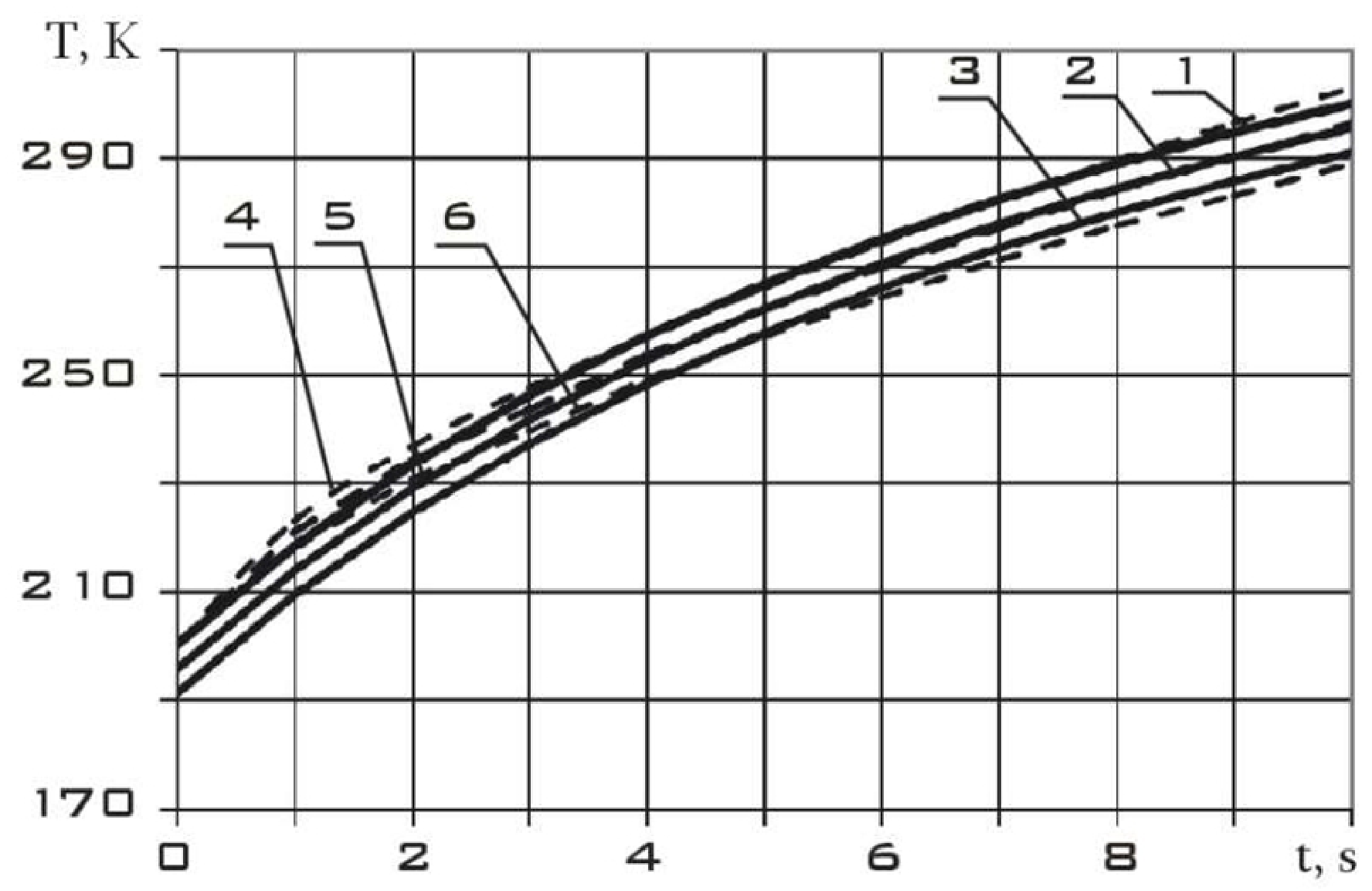
As seen from Equation (80), the initial conditions corresponding to a uniform temperature field are not strictly satisfied. However, compared with previous solutions obtained within the uncoupled formulation of the thermoelasticity problem, this issue has become less significant. In Ref. [84], the temperature evolution in a plate is presented at different locations (, , and ). These results are shown in Figure 2 (reproduced from Ref. [84]. Let us examine the temperature evolution corresponding to the obtained relationship (the first equation of (80)).The data used for the simulations are taken from Table A1 in Appendix A.
Figure 2.
Temperature dynamics of the plate surface layer for an initial temperature distribution of K, obtained from numerical simulations (dotted lines): 1—near the clamped edge (); 2—at the midpoint of the plate (); 3—at the free edge of the plate (); and calculated using Equation (3.18) from Ref. [84] for K/m, s, and K/m (solid lines): 4—near the clamped edge (); 5—at the midpoint of the plate (); 6—at the free edge of the plate ().
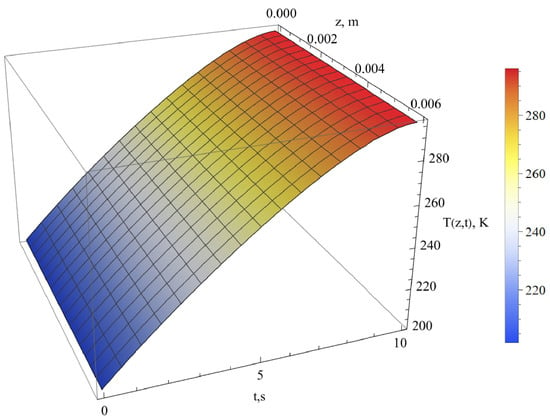
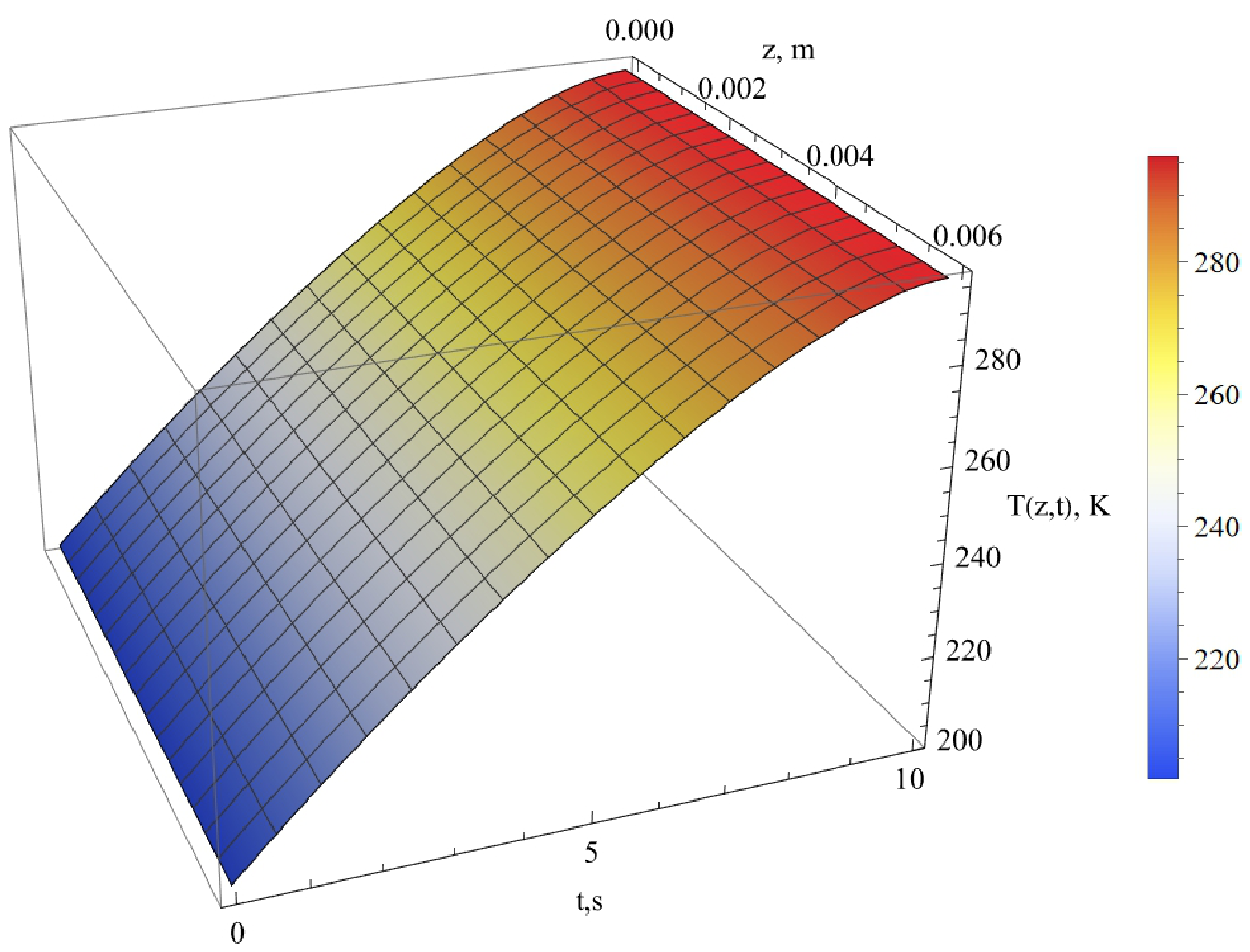
A clear violation of the uniform initial temperature field can be observed in Figure 2. In some cases, this may lead to inaccuracies in numerical simulations when such an initial condition is used. Let us now consider Figure 3. For a direct comparison, the same numerical simulation data as those used in Ref. [84] were employed to construct Figure 3. No such deviation from the uniform initial temperature field is observed in Figure 3. These deviations may become noticeable in the case of thick plates (i.e., for a large range of variation in the coordinate z). However, the thin-plate theory was employed in deriving the thermoelasticity equations in the present model. Therefore, the proposed solution (80) cannot be considered valid for thick plates.
Figure 3.
Temperature dynamics of the plate surface layer for an initial temperature distribution of K, calculated using Equation (80).
Thus, it can be concluded that the coupled formulation of the thermoelasticity problem provides better satisfaction of the initial conditions corresponding to a uniform temperature field than the uncoupled formulation. In the authors’ opinion, this is an important result. It improves the consistency of the analytical approach used to describe thermal shock and further demonstrates the validity of adopting the coupled formulation of the thermoelasticity problem.
5. Conclusions
This work formulates a coupled thermoelasticity problem for a homogeneous thin plate under thermal shock conditions. The plate was rigidly clamped on one edge and had three free edges. The problem was solved within the validity of Fourier’s law in the region where longitudinal deformations are negligibly small (). The Fourier method was used to solve the problem. This method consists of representing a function of several variables as a product of functions, each of which depends on only one variable.
By extending the Fourier method through imposing additional constraints on one of the functions, a solution to the coupled thermoelasticity problem was obtained in the region of negligibly small longitudinal deformations () subject to the additional condition (66). The determination of the size of this region appears to depend on the properties of the specific plate materials. The application of this approach requires combining the boundary conditions for other regions of the plate, where the assumption is not valid. These results are applicable in modeling the stress–strain state of solids under thermal shock.
Author Contributions
Conceptualization, A.V.S.; methodology, A.V.S. and A.S.M.; software, A.V.S. and A.S.M.; validation, A.V.S. and A.S.M.; formal analysis, A.V.S.; investigation, A.V.S. and A.S.M.; resources, A.V.S.; data curation, A.V.S. and A.S.M.; writing—original draft preparation, A.V.S., and A.S.M.; writing—review and editing, A.V.S., and A.S.M.; visualization, A.V.S. and A.S.M.; supervision, A.V.S.; project administration, A.V.S.; funding acquisition, A.V.S. All authors have read and agreed to the published version of the manuscript.
Funding
This work was supported by the Russian Science Foundation (# 25-19-00312).
Institutional Review Board Statement
Not applicable.
Informed Consent Statement
Not applicable.
Data Availability Statement
The original contributions presented in this study are included in the article. Further inquiries can be directed to the corresponding author.
Conflicts of Interest
The authors declare no conflicts of interest.
Appendix A
Table A1.
Thermophysical and geometrical parameters of the plate [84].
References
- Danilovskaya, V.I. On a dynamical problem of thermoelasticity. Prikl. Mat. Mekh. 1952, 16, 341–344. [Google Scholar]
- Biot, M.A. Thermoelasticity and Irreversible Thermodynamics. J. Appl. Phys. 1956, 27, 240–253. [Google Scholar] [CrossRef] [Scilit]
- Melan, E.; Parkus, H. Wärmespannungen Infolge Stationärer Temperaturfelder; Springer: Wien, Austria, 1953. [Google Scholar] [CrossRef] [Scilit]
- Mindlin, R.D.; Cooper, H.L. Thermoelastic stress around a cylindrical inclusion of elliptic cross section. J. Appl. Mech. 1950, 17, 265–270. [Google Scholar] [CrossRef] [Scilit]
- Hetnarski, R.B. Coupled one-dimensional thermal shock problem for small times. Arch. Mech. Stosow. 1961, 13, 295–306. [Google Scholar]
- Lyubov, B.Y.; Kartashov, E.M. Method for solving boundary value problems of thermal conductivity in a region with a boundary moving according to an arbitrary law. Rep. USSR Acad. Sci. 1971, 198, 323–326. [Google Scholar]
- Kartashov, E.M.; Ozherelkova, L.M. New model ideas in the problem of thermal shock. Math. Model. Comput. Simul. 2002, 14, 95–108. [Google Scholar]
- Kartashov, E.M. New model representations of dynamic thermal viscoelasticity in the problem of thermal shock. Bull. Mosc. State Tech. Univ. Named After N.E. Bauman 2012, 2, 123–130. [Google Scholar]
- Wang, Y.; Wang, Q.; Liu, D.; Song, X. Asymptotic analysis of solid sphere subjected to thermal shock under fractional order generalized thermoelasticity. Lixue Xuebao/Chin. J. Theor. Appl. Mech. 2014, 46, 248–254. [Google Scholar] [CrossRef]
- Wang, Y.; Zhang, X.; Song, X. Research on generalized thermoelastic problems of a solid sphere subjected to thermal shock. Yingyong Jichu Yu Gongcheng Kexue Xuebao/J. Basic Sci. Eng. 2013, 21, 767–776. [Google Scholar] [CrossRef]
- Wang, Y.-Z.; Song, X.-N.; Liu, D. Asymptotic analysis for effect of thermal inertia on thermal behaviors. Wuli Xuebao/Acta Physica Sin. 2013, 62, 214601. [Google Scholar] [CrossRef] [Scilit]
- Wang, B.; Li, J.E.; Yang, C. Thermal shock fracture mechanics analysis of a semi-infinite medium based on the dual-phase-lag heat conduction model. Proc. R. Soc. A Math. Phys. Eng. Sci. 2015, 471, 20140595. [Google Scholar] [CrossRef] [Scilit] [PubMed]
- Li, J.E.; Wang, B. Analysis of thermal shock resistance of solids based on the nonlocal elastic theory, part I: Thermal shock stress. WIT Trans. Eng. Sci. 2014, 87, 221–228. [Google Scholar] [CrossRef] [Scilit]
- Li, J.E.; Wang, B. Analysis of thermal shock resistance of solids based on the nonlocal elastic theory, part II: Thermal shock cracking and thermal shock resistance. WIT Trans. Eng. Sci. 2014, 87, 229–238. [Google Scholar] [CrossRef] [Scilit]
- Othman, M.I.A.; Hasona, W.M.; Abd-Elaziz, E.M. The influence of thermal loading due to laser pulse on generalized micropolar thermoelastic solid with comparison of different theories. Multidiscip. Model. Mater. Struct. 2014, 10, 328–345. [Google Scholar] [CrossRef] [Scilit]
- Hirata, Y. Theoretical analyses of thermal shock and thermal expansion coefficients of metals and ceramics. Ceram. Int. 2015, 41, 1145–1153. [Google Scholar] [CrossRef] [Scilit]
- Kingery, W.D. Factors Affecting Thermal Stress Resistance of Ceramic Materials. J. Amer. Ceram. Soc. 1955, 38, 3–15. [Google Scholar] [CrossRef] [Scilit]
- Lee, Y.; No, H.C. Heat transfer origin of thermal shock fracture and its application for LWR fuel during reflood. Int. Top. Meet. Nucl. React. Therm. Hydraul. 2015, 9, 7196–7207. [Google Scholar]
- Wang, Y.; Liu, D.; Wang, Q.; Zhou, J. Effect of fractional order parameter on thermoelastic behaviors of elastic medium with variable properties. Acta Mech. Solida Sin. 2015, 28, 682–692. [Google Scholar] [CrossRef] [Scilit]
- Wang, Y.; Liu, D.; Wang, Q.; Shu, C. Thermoelastic response of thin plate with variable material properties under transient thermal shock. Int. J. Mech. Sci. 2015, 104, 200–206. [Google Scholar] [CrossRef] [Scilit]
- Guo, S.L.; Wang, B.L. Thermal shock cracking behavior of a cylinder specimen with an internal penny-shaped crack based on non-Fourier heat conduction. Int. J. Thermophys. 2016, 37, 17. [Google Scholar] [CrossRef] [Scilit]
- Guo, S.L.; Wang, B.L. Thermal shock fracture of a cylinder with a penny-shaped crack based on hyperbolic heat conduction. Int. J. Heat Mass Transf. 2015, 91, 235–245. [Google Scholar] [CrossRef] [Scilit]
- Wang, H.M.; Jiang, S.J.; Guo, W.; Lu, Z.W.; Qi, J.Q.; Lu, T.C.; Cedelle, J.; Wang, Q.Y.; Huang, Z.Y. The thermal shock behaviors of Yb:YAG transparent ceramics. Ceram. Int. 2016, 42, 8804–8808. [Google Scholar] [CrossRef] [Scilit]
- Papathanasiou, T.K.; Gourgiotis, P.A.; Dal Corso, F. Finite element simulation of a gradient elastic half-space subjected to thermal shock on the boundary. Appl. Math. Model. 2016, 40, 10181–10198. [Google Scholar] [CrossRef] [Scilit]
- Zhou, G.; Golding, J.; Bao, X.; Sun, W. Study of damage characteristics in composite structures from simulated lightning strikes. In Proceedings of the ICCM International Conferences on Composite Materials, Singapore, 2–6 August 2017. [Google Scholar]
- Zhang, H.H.; Ma, G.W.; Fan, L.F. Thermal shock analysis of 2D cracked solids using the numerical manifold method and precise time integration. Appl. Math. Model. 2017, 48, 607–620. [Google Scholar] [CrossRef] [Scilit]
- Nikolarakis, A.M.; Theotokoglou, E.E. Thermal shock problem of a three-layered functionally graded zirconia/titanium alloy strip based on a unified generalized thermoelasticity theory. J. Therm. Stress. 2017, 40, 583–602. [Google Scholar] [CrossRef] [Scilit]
- Nguyen, M.N.; Bui, T.Q.; Nguyen, N.T.; Truong, T.T.; Lich, L.V. Simulation of dynamic and static thermoelastic fracture problems by extended nodal gradient finite elements. Int. J. Mech. Sci. 2017, 134, 370–386. [Google Scholar] [CrossRef] [Scilit]
- Gill, P.; Platts, N.; Currie, C.; Grieveson, E. A thermomechanical PWR test facility to investigate thermal shock loading on a small scale tubular specimen. In Proceedings of the American Society of Mechanical Engineers, Pressure Vessels and Piping Division (Publication) PVP, Prague, Czech Republic, 15–20 July 2018; Volume 1A. [Google Scholar] [CrossRef] [Scilit]
- Liu, X.-F.; Chang, D.-M.; Wang, B.-L.; Cai, L.-R. Effect of temperature-dependency of material properties on thermal shock fracture of solids associated with non-Fourier heat conduction. Theor. Appl. Fract. Mech. 2018, 93, 195–201. [Google Scholar] [CrossRef] [Scilit]
- Chang, D.M.; Liu, X.F.; Wang, B.L.; An, Y.M.; Wang, Q.; Wang, T.G. Non-Fourier thermal shock fracture of solids with shallow semi-elliptical surface crack. Theor. Appl. Fract. Mech. 2018, 96, 160–167. [Google Scholar] [CrossRef] [Scilit]
- Gill, P.; Brown, P.; Tice, D.; Platts, N.; Currie, C. Fatigue initiation of 304L stainless steel subject to thermal shock loading in a PWR environment. In Proceedings of the American Society of Mechanical Engineers, Pressure Vessels and Piping Division (Publication) PVP, San Antonio, TX, USA, 14–19 July 2019; Volume 1. [Google Scholar] [CrossRef] [Scilit]
- Clayton, J.D. Nonlinear thermomechanics for analysis of weak shock profile data in ductile polycrystals. J. Mech. Phys. Solids 2019, 124, 714–757. [Google Scholar] [CrossRef] [Scilit]
- Ungureanu, E.; Anghel, D.-C.; Negrea, D.; Plaiau, A.G.; Rizea, V.; Dicu, M.M.; Ducu, C.M.; Abrudeanu, M. Influence of thermal shocks at high temperatures on microstructure and hardness of RENE 41 alloy. IOP Conf. Ser. Mater. Sci. Eng. 2019, 564, 012046. [Google Scholar] [CrossRef] [Scilit]
- Grilli, N.; Koslowski, M. The effect of crystal anisotropy and plastic response on the dynamic fracture of energetic materials. J. Appl. Phys. 2019, 126, 155101. [Google Scholar] [CrossRef] [Scilit]
- Song, Y.; Zong, N.; Liu, K.; Wang, Z.; Wang, X.; Bo, Y.; Peng, Q.; Xu, Z. Temperature-dependent thermal and spectroscopic properties of Yb:YAlO3 perovskite crystal for a cryogenically cooled near IR laser. Opt. Mater. Express 2020, 10, 1522–1530. [Google Scholar] [CrossRef] [Scilit]
- Guan, P.; Ai, Y. Study on nozzle guide vane subject to thermal shock using the multi-field coupling method. In Proceedings of the 7th International Conference on Power Engineering (ICOPE 2019), Kunming, China, 21–25 October 2020; pp. 1333–1338. [Google Scholar]
- Mungle, N.P.; Mandavgade, N.K.; Mandavgade, S.K.; Verma, M. One dimensional thermal shock problem in a thick plate. Mater. Today Proc. 2021, 47, 5892–5894. [Google Scholar] [CrossRef] [Scilit]
- Wu, X.; Wang, P.; Guo, Q.; Zhang, J.; Cai, M. Numerical simulation of the influence of flow velocity on granite temperature field under thermal shock. Geotech. Geol. Eng. 2021, 39, 37–48. [Google Scholar] [CrossRef] [Scilit]
- Abouelregal, A.E.; Sedighi, H.M. A new insight into the interaction of thermoelasticity with mass diffusion for a half-space in the context of Moore–Gibson–Thompson thermodiffusion theory. Appl. Phys. A Mater. Sci. Process. 2021, 127, 582. [Google Scholar] [CrossRef] [Scilit]
- Liu, J.-T.; Liu, S.-W.; Zheng, H.-L.; Huang, W.-J.; Zhao, W.; Liao, W.-B. Effects of transient thermal shock on the microstructure and mechanical properties of CoCrFeNiMn high-entropy alloy coatings. Front. Mater. 2021, 8, 805296. [Google Scholar] [CrossRef] [Scilit]
- Biswas, S. Three-dimensional nonlocal thermoelasticity in orthotropic medium based on Eringen’s nonlocal elasticity. Waves Random Complex Media 2022, 32, 1128–1149. [Google Scholar] [CrossRef] [Scilit]
- Nenakhov, E.V.; Kartashov, E.M. Estimates of temperature stresses in models of dynamic thermoelasticity. Her. Bauman Mosc. State Tech. Univ. Ser. Nat. Sci. 2022, 1, 88–106. [Google Scholar] [CrossRef] [Scilit]
- Kartashov, E.M.; Krylov, S.S. Generalized model of thermal shock in dynamic thermoelasticity. J. Eng. Phys. Thermophys. 2023, 96, 573–584. [Google Scholar] [CrossRef] [Scilit]
- Abouelregal, A.E.; Ahmad, H.; Yahya, A.M.H.; Saidi, A.; Alfadil, H. Generalized thermoelastic responses in an infinite solid cylinder under the thermoelastic-diffusion model with four lags. Chin. J. Phys. 2022, 76, 121–134. [Google Scholar] [CrossRef] [Scilit]
- Zhao, Y.; Wang, Z.; Li, J. Study on dynamical stress characteristics of DVI nozzle subjected to pressurized thermal shocks. Hedongli Gongcheng/Nuclear Power Eng. 2022, 43, 78–85. [Google Scholar] [CrossRef]
- Riyad, M.F.; Mahmoudi, M.; Minary-Jolandan, M. Manufacturing and thermal shock characterization of porous yttria stabilized zirconia for hydrogen energy systems. Ceramics 2022, 5, 472–483. [Google Scholar] [CrossRef] [Scilit]
- Krivosheina, M.N.; Tuch, E.V. Anisotropy of the Grüneisen coefficient determining the “thermal” part of the pressure in the equations of state of a deformable solid body. Russ. Phys. J. 2022, 65, 1304–1310. [Google Scholar] [CrossRef] [Scilit]
- Ortega, L.H.; Yee, K.L.; Perez-Nunez, D.; McDeavitt, S.M.; Steinman, C.; Schultz, R.R.; Dunzik-Gougar, M.L.; Spencer, B.W. Thermal-shock experiments for separate-effects validation of UO2 fuel fracture models. J. Nucl. Mater. 2022, 572, 154035. [Google Scholar] [CrossRef] [Scilit]
- Zudin, Y.B. Hyperbolic heat conduction equation. In Mathematical Engineering; Springer: Berlin/Heidelberg, Germany, 2023; pp. 201–227. [Google Scholar] [CrossRef] [Scilit]
- Liu, B.; Wang, Y.; Li, C.; Tian, Z.; Cheng, L. Research on the thermal shock simulation of the super high speed aircraft. Mech. Adv. Mater. Struct. 2023, 30, 1889–1896. [Google Scholar] [CrossRef] [Scilit]
- Sarkar, I.; Singh, G. Thermodynamically consistent modified Lord–Shulman generalized thermoelasticity with strain-rate. J. Appl. Mech. Trans. ASME 2023, 90, 031005. [Google Scholar] [CrossRef] [Scilit]
- Liu, Y.; Zhen, Z.; Wang, X.; Mu, R.; He, L.; Xu, Z. Thermo-physical properties, morphology and thermal shock behavior of EB-PVD thermal barrier coating with DLC YbGdZrO/YSZ system. Mater. Today Commun. 2023, 35, 106265. [Google Scholar] [CrossRef] [Scilit]
- Zelepugin, S.A.; Cherepanov, R.O.; Pakhnutova, N.V. Optimization of Johnson–Cook constitutive model parameters using the Nesterov gradient-descent method. Materials 2023, 16, 5452. [Google Scholar] [CrossRef] [Scilit] [PubMed]
- Megahid, S.F.; Abouelregal, A.E.; Askar, S.S.; Marin, M. Study of thermoelectric responses of a conductive semi-solid surface to variable thermal shock in the context of the Moore–Gibson–Thompson thermoelasticity. Axioms 2023, 12, 659. [Google Scholar] [CrossRef] [Scilit]
- Radchenko, P.A.; Radchenko, A.V.; Batuev, S.P.; Radchenko, I.P. Influence of heating rate on destruction of coke plate of electrolyzer under cyclic temperature shock. Russ. Phys. J. 2023, 66, 860–867. [Google Scholar] [CrossRef] [Scilit]
- Shhabat, M.; Ashteyat, A.; Abdel-Jaber, M. Repairing of one-way solid slab exposed to thermal shock using CFRP: Experimental and analytical study. Fibers 2024, 12, 18. [Google Scholar] [CrossRef] [Scilit]
- Bayat, S.H.; Nazari, M.B. Dynamic crack propagation in anisotropic solids under non-classical thermal shock. Eng. Comput. 2024, 40, 1177–1216. [Google Scholar] [CrossRef] [Scilit]
- Bachher, M. Time-fractional heat conduction effects on the dynamic response of a magneto-thermoelastic half-space subjected to a thermal shock. Mech. Solids 2024, 59, 1459–1474. [Google Scholar] [CrossRef] [Scilit]
- Li, H.; Zhang, H.; Zhang, Y.; Bai, X.; Shao, X.; Wu, B. Coupled non-ordinary state-based peridynamics model for ductile and brittle solids subjected to thermal shocks. Appl. Sci. 2024, 14, 6927. [Google Scholar] [CrossRef] [Scilit]
- Haydar, A.; Galuppi, L.; Royer-Carfagni, G. A neat flux-based weak formulation for thermal problems which develops Biot’s variational principle. Int. J. Eng. Sci. 2024, 202, 104103. [Google Scholar] [CrossRef] [Scilit]
- Abouelregal, A.E.; Marin, M.; Askar, S.S.; Foul, A. Transient thermoelastic response in a semi-infinite medium subjected to a moving heat source: An implementation of the Moore–Gibson–Thompson model with higher-order memory-dependent derivatives. Mech. Time-Depend. Mater. 2024, 28, 1555–1581. [Google Scholar] [CrossRef] [Scilit]
- Hafed, Z.S.; Zenkour, A.M. Thermal shock of a two-layer solid based on the refined Lord–Shulman model. Mech. Adv. Mater. Struct. 2025, 33, 2586744. [Google Scholar] [CrossRef] [Scilit]
- Sarkar, N. Transient responses of a 3D temperature rate-dependent semi-infinite thermoelastic medium with variable material properties. Mech. Solids 2025, 60, 278–294. [Google Scholar] [CrossRef] [Scilit]
- Hendy, M.H.; Ezzat, M.A. On Green–Naghdi (II) thermoelasticity theory with time-fraction and memory-dependent derivatives. Acta Mech. 2025, 236, 4771–4793. [Google Scholar] [CrossRef] [Scilit]
- Shekhar, S. Study of non-local thermoelastic impact due to thermal shock on a porous solid in presence of a moving heat source. Int. J. Appl. Comput. Math. 2025, 11, 191. [Google Scholar] [CrossRef] [Scilit]
- Ananchaperumal, V.; Vedantam, S.; Uchimali, M. Development of coupled thermoelastic discrete model for thermal shock cracking in brittle materials: Parametric analysis of crack patterns and material properties. Mater. Sci. Eng. A 2025, 942, 148600. [Google Scholar] [CrossRef] [Scilit]
- Salem, M.G.; Abouelregal, A.E.; Sedighi, H.M. Generalized dual-phase-lag thermoelastic diffusion with Soret and Dufour effects in an infinite hollow cylinder. Int. Commun. Heat Mass Transf. 2025, 172, 110265. [Google Scholar] [CrossRef] [Scilit]
- Zarmehri, N.R.; Rokhi, M.M.; Nazari, M.B.; Bayat, S.H. Crack propagation in honeycomb structures under thermal shock using Lord–Shulman theory. Eng. Struct. 2026, 359, 122553. [Google Scholar] [CrossRef] [Scilit]
- Wong, L.N.Y.; Liu, Z. Thermal shock in rocks: A review of mechanisms, impacts, and applications in underground engineering. J. Rock Mech. Geotech. Eng. 2025, 17, 8172–8197. [Google Scholar] [CrossRef] [Scilit]
- Nikolaeva, A.S.; Evtushenko, M.A.; Manukyan, L.A. Investigation of the accuracy of an approximate solution of the initial boundary value problem of thermal conductivity with boundary conditions of the third kind. Int. J. Math. Model. Numer. Optim. 2025, 15, 52–63. [Google Scholar] [CrossRef] [Scilit]
- Sedelnikov, A.V.; Serpukhova, A.A. Simulation of a flexible spacecraft motion to evaluate microaccelerations. Russ. Aeronaut. 2009, 52, 484–487. [Google Scholar] [CrossRef] [Scilit]
- Bormotov, A.N.; Orlov, D.I. Investigation of perturbations arising from temperature shock with a symmetrical arrangement of flexible elements of a small spacecraft. Symmetry 2023, 15, 1331. [Google Scholar] [CrossRef] [Scilit]
- Belousova, D.A.; Serdakova, V.V. Modeling the temperature shock of elastic elements using a one-dimensional model of thermal conductivity. Int. J. Model. Simul. Sci. Comput. 2020, 11, 2050060. [Google Scholar] [CrossRef] [Scilit]
- Orlov, D.I.; Serdakova, V.V.; Evtushenko, M.A.; Khnyryova, E.S.; Nikolaeva, A.S. Investigating the features of various plate models under the thermal shock in the ANSYS package. Lect. Notes Netw. Syst. 2023, 574, 3085–3093. [Google Scholar] [CrossRef] [Scilit]
- Gao, Y.; Qiao, J.; Niu, J.; Xu, Y.; Yang, Y. Research on the performance of thermal shock and stress with infrared optical domes. Proc. SPIE – Int. Soc. Opt. Eng. 2014, 9280, 92800S. [Google Scholar] [CrossRef] [Scilit]
- Sedelnikov, A.V. Simulation of the microacceleration dynamics within a spacecraft’s interior environment induced by the thermal shock effects of its solar panel array. Microgravity Sci. Technol. 2025, 37, 36. [Google Scholar] [CrossRef] [Scilit]
- Sedelnikov, A.V.; Filippov, A.S.; Gorozhakina, A.S. Evaluation of calibration accuracy of magnetometer sensors of Aist small spacecraft. J. Phys. Conf. Ser. 2018, 1015, 032045. [Google Scholar] [CrossRef] [Scilit]
- Bormotov, A.N.; Orlov, D.I.; Khnyryova, E.S.; Bratkova, M.E. Experience in applying the algorithm for unloading the flywheel engine using magnetic actuators to ensure the stabilization of the Aist-2D remote sensing satellite. Sovrem. Probl. Distantsionnogo Zondirovaniya Zemli Iz Kosmosa 2023, 20, 157–164. [Google Scholar] [CrossRef] [Scilit]
- Khnyryova, E.S. Estimation of the angular velocity of rotation of the Aist-2D small spacecraft for remote sensing of the Earth. Sovrem. Probl. Distantsionnogo Zondirovaniya Zemli Iz Kosmosa 2023, 20, 81–88. [Google Scholar] [CrossRef] [Scilit]
- Sedelnikov, A.V. Fractal assessment of microaccelerations at weak damping of natural oscillation in spacecraft elastic elements. II. Russ. Aeronaut. 2007, 50, 322–325. [Google Scholar] [CrossRef] [Scilit]
- Wang, A.; Wang, S.; Xia, H.; Ma, G. Dynamic modeling and control for a double-state microgravity vibration isolation system. Microgravity Sci. Technol. 2023, 35, 9. [Google Scholar] [CrossRef] [Scilit]
- Serdakova, V.V. Comparative analysis of problem of thermal shock of elastic elements of small satellite in one-dimensional and two-dimensional formulations. E3S Web Conf. 2023, 402, 11014. [Google Scholar] [CrossRef] [Scilit]
- Sedelnikov, A.V.; Serdakova, V.V.; Orlov, D.I.; Nikolaeva, A.S. Investigating the Temperature Shock of a Plate in the Framework of a Static Two-Dimensional Formulation of the Thermoelasticity Problem. Aerospace 2023, 10, 445. [Google Scholar] [CrossRef] [Scilit]
- Sedelnikov, A.V.; Evtushenko, M.A.; Marshalkina, A.S. Analytical solution for thermoelastic response of a thin plate subjected to temperature shock. Int. Commun. Heat Mass Transf. 2025, 169, 109737. [Google Scholar] [CrossRef] [Scilit]
- Orlov, D.I. Modeling the temperature shock impact on the movement of a small technological spacecraft. AIP Conf. Proc. 2021, 2340, 050001. [Google Scholar] [CrossRef] [Scilit]
- Chamberlain, M.K.; Kiefer, S.H.; LaPointe, M.; LaCorte, P. On-orbit flight testing of the Roll-Out Solar Array. Acta Astronaut. 2021, 179, 407–414. [Google Scholar] [CrossRef] [Scilit]
- Sedelnikov, A.V.; Marshalkina, A.S. Investigation into thermoelastic issues arising from temperature shock in spacecraft solar panels. Mathematics 2026, 14, 217. [Google Scholar] [CrossRef] [Scilit]
- Samarsky, A.A.; Vabishchevich, V.P. Computational Heat Transfer; Editorial USSR: Moscow, Russia, 2003; 784p. [Google Scholar]
- Arinchev, S.V. Empirical evidence for incorrectness of using separation of variables according to the Fourier method in oscillation theory. Proc. High. Educ. Inst. Mach. Build. 2022, 5, 59–68. [Google Scholar] [CrossRef] [Scilit]
- Barmagambetov, S.; Koilyshov, U. Solution of multilayer problems for the heat equation by the Fourier method. J. Math. Mech. Comput. Sci. 2025, 127, 3. [Google Scholar] [CrossRef] [Scilit]
- Gasymov, E.A.; Guseinova, A.O.; Gasanova, U.N. Application of generalized separation of variables to solving mixed problems with irregular boundary conditions. Comput. Math. Math. Phys. 2016, 56, 1305–1309. [Google Scholar] [CrossRef] [Scilit]
- He, Y.; Rui, W. Extended separation method of semi-fixed variables together with analytical method for solving time fractional equation. Math. Methods Appl. Sci. 2025, 48, 9934–9945. [Google Scholar] [CrossRef] [Scilit]
- Aleroev, T. Solving the boundary value problems for differential equations with fractional derivatives by the method of separation of variables. Mathematics 2020, 8, 1877. [Google Scholar] [CrossRef] [Scilit]
- Olivieri, C.; Cocking, S.; Fabbrocino, F.; Iannuzzo, A.; Placidi, L.; Adriaenssens, S. Seismic capacity of purely compressed shells based on Airy stress function. Contin. Mech. Thermodyn. 2025, 37, 21. [Google Scholar] [CrossRef] [Scilit]
- Pour, A.K.; Farsangi, E.N. Airy stress function for proposed thermoelastic triangular elements. J. Eng. Math. 2023, 13, 11. [Google Scholar] [CrossRef] [Scilit]
- Su, X.M.; Zhang, J.H.; Wang, J.; Bi, Y.; Qie, D.; Xiang, Z.; Xue, M. Experimental investigation of the thermally induced vibration of a space boom section. Sci. China Phys. Mech. Astron. 2015, 58, 044601. [Google Scholar] [CrossRef] [Scilit]
- Landau, E. Der Picard-Schottkysche Satz und die Blochsche Konstanten. Sitzungsber. Preuss. Akad. Wiss. Berl. Phys.-Math. Kl. 1926, 32, 467–474. [Google Scholar]
- Sedelnikov, A.V.; Glushkov, S.V.; Evtushenko, M.A.; Skvortsov, Y.V.; Nikolaeva, A.S. Computer simulation of the natural vibrations of a rigidly fixed plate considering temperature shock. Computation 2025, 13, 49. [Google Scholar] [CrossRef] [Scilit]
Disclaimer/Publisher’s Note: The statements, opinions and data contained in all publications are solely those of the individual author(s) and contributor(s) and not of MDPI and/or the editor(s). MDPI and/or the editor(s) disclaim responsibility for any injury to people or property resulting from any ideas, methods, instructions or products referred to in the content. |
© 2026 by the authors. Licensee MDPI, Basel, Switzerland. This article is an open access article distributed under the terms and conditions of the Creative Commons Attribution (CC BY) license.