


Abstract
Self-supervised graph collaborative filtering suffers from two geometric pathologies. In Dimensional Collapse, embeddings quietly collapse into a low-rank subspace, a well-documented but poorly solved problem. Semantic Collapse is more complex: stiff -squared orthogonalization penalties that are supposed to push the embeddings apart end up ripping through the heavy-tailed community overlaps that contain the collaborative signal. Earlier studies attempted to mitigate sparsity by injecting static noise or structural perturbations, but such interventions did not pinpoint the root cause, i.e., the distortions in the global covariance geometry itself. In this paper, we propose a Huber-Contrastive Graph Convolutional Network (HCGCN) that combines a spatial message-passing backbone with an contrastive augmentation overhead and a Relation-Aware Dual-View Gated Contrastive Network. The main novelty is a Huber Covariance Whitening module that imposes a geometry-aware threshold on the cross-correlation matrix of augmented views—below the threshold, the gradients follow an penalty (enforcing uniformity); above it, the penalty flattens to (protecting genuine semantic clusters from gradient explosion). This theoretically motivated dual-regime penalty actively preserves the macro-semantic topology of the graph while aggressively stamping out spurious noise correlations. The HCGCN is evaluated on the Yelp2018, Amazon-Book, and MovieLens datasets and performs significantly better than state-of-the-art baselines like LightGCN, SGL, SimGCL, and NESCL, especially under severe cold-start settings where covariance regulation proves most critical.
1. Introduction
The transition from classical matrix factorization [1] to deep geometric learning has always been motivated by one key ambition: compressing sparse, high-dimensional user–item interactions into dense latent spaces that generalize well [2]. GCN [3], GraphSAGE [4], and GAT [5] were the first Graph Neural Networks that demonstrated learning of a non-Euclidean structure, finding successful applications in fields like traffic flow prediction in smart cities [6] and human mobility trajectory modeling [7]. What they failed to show, however, was that ordinary spatial convolutions can survive the extreme sparsity of bipartite recommendation graphs [8]. In practice, gradients disappeared. A creeping over-smoothing began, where representations of distinct nodes became indistinguishable [9]. In response, the field converged on linear message-passing architectures like LightGCN [10] and SGC [11], which systematically removed all activations and non-linear transformations to stabilize training.
Graph Contrastive Learning (GCL) approached the sparsity problem from a different perspective: by maximizing mutual information between augmented views of the graph [12,13]. The approach seemed promising, until alignment uniformity analyses [14] and Dimensional Collapse work [15] revealed a persistent structural flaw. Naive contrastive objectives force representations into degenerate configurations [16]. Contrastive learning typically suffers from two primary failure modes. Dimensional Collapse folds the embedding cloud into a low-rank subspace, wasting most of the capacity of the vector space. Semantic Collapse—the more problematic of the two—is what happens when rigid -squared orthogonality penalties (often borrowed from computer vision frameworks like Barlow Twins [17] or VICReg [18]) destroy the heavy-tailed community overlaps that collaborative filtering manifolds naturally have [19].
In this paper, we propose a Huber-Contrastive Graph Convolutional Network (HCGCN) to solve both failures simultaneously. This architecture combines spatial message passing with a latent-space decorrelation mechanism designed for the geometry of scale-free bipartite graphs [16]. The HCGCN depends on a robust feature-decorrelation objective whose gradient behavior is dynamically modulated by the magnitude of the covariance entries.
Our contributions are as follows:
- Dual-View Gated Architecture. A spatial message-passing
- Huber’s Covariance Whitening. Threshold on the cross-correlation matrix with geometric awareness: gradients below the threshold kill noise; the ceiling above the threshold protects large, real semantic covariances;
- Gradient Starvation Solution. We include degree-attenuated contrastive logits, as well as a sigmoidal warmup schedule that prevents the ranking loss from being swallowed by the decorrelation objective on scale-free graphs;
- Empirical Gains. We achieve state-of-the-art results on Yelp2018, Amazon-Book, and MovieLens, with especially large margins under cold-start conditions.
The rest of this paper is organized as follows. Section 2 reviews spatial aggregation and self-supervised methods, and Section 3 formalizes the pathology of representation collapse. In Section 4, we derive the architecture of the HCGCN. In Section 5, we document the exploratory failures that shaped our design choices. Section 6 shows the experimental results, and Section 7 gives the conclusions.
2. Theoretical Background and the Evolution of Graph Collaborative Filtering
We trace the development of graph collaborative filtering to identify the mathematical bottlenecks that limit current baselines.
2.1. The Limits of Spatial Neighborhood Aggregation
GNNs were designed to learn the higher-order connectivity. Early models (NGCF [20], GCCF [8]) propagated interactions via dense multi-layer perceptrons, but those non-linearities backfired badly on identity-only collaborative filtering tasks: gradient vanishing set in and over-smoothing was close behind. LightGCN [10] provided a simple answer: remove all feature transformations and activations, and simplify the graph convolution to plain neighborhood aggregation on the normalized adjacency:
Training stability was improved, but the challenges of extreme sparsity remained. In sparse interaction graphs, local neighborhood aggregation collects insufficient collaborative signals. Consequently, spatial propagation layers require auxiliary supervision to prevent representation degradation. For instance, UltraGCN [21] attempts to address this by completely bypassing explicit message passing, instead enforcing constraint-based losses directly on initial embeddings to speed up convergence, though it lacks direct covariance regulation to prevent Dimensional Collapse. Both approaches optimize representations using the Bayesian Personalized Ranking (BPR) loss [22]:
with as the predicted preference score and the model parameters.
2.2. The Self-Supervised Paradigm and Graph Contrastive Learning
Graph Contrastive Learning (GCL) addresses sparsity by maximizing mutual information between augmented views, an idea taken from visual representation learning [23,24,25,26]. SGL [12] generates views through structural perturbations (DropEdge [27]) by recomputing the sparse Laplacian for each view epoch-wise. This incurs an overhead per view. Furthermore, random edge dropout breaks path dependencies vital for long-tail users.
SimGCL [13] and XSimGCL [28] completely bypass the structural perturbation overhead by injecting isotropic uniform noise directly into embeddings. There is no graph fracturing, but the noise is relation-agnostic: a hub node with thousands of edges achieves the same magnitude of perturbation as a cold-start node with three. NESCL [29] and NCL [30] adopt a different strategy by treating collaborative neighbors as explicit positives in the contrastive objective.
While these self-supervised models primarily rely on deterministic data perturbation, robust regularization in sparse environments can also be framed as an uncertainty modeling problem. In related engineering disciplines, data scarcity and sensor noise are successfully mitigated by modeling probabilistic fault distributions using Bayesian ensemble learning frameworks [31]. Drawing inspiration from these principles, the HCGCN enforces structured geometric constraints directly on the latent representation to suppress spurious noise and regulate uncertainty without requiring expensive probabilistic sampling.
All of these methods have a blind spot: they optimize pairwise alignment under local heuristics without explicitly regulating the global covariance structure of the latent representation. Consequently, they remain vulnerable to either Dimensional Collapse or Semantic Collapse. To contextualize these models, Table 1 provides a structured comparison of their augmentation schemes, side information, computational complexity, and geometric limitations in comparison to our proposed HCGCN framework.
Table 1.
Characteristics, training complexities, and architectural limitations of baseline graph collaborative filtering models versus the HCGCN.
3. The Pathology of Representation Collapse
Without explicit regulation of the embedding distribution, any InfoNCE-optimized encoder inevitably collapses, differing only in the geometric form of degeneration.
3.1. Complete and Dimensional Collapse
The “Complete Collapse” is the trivial case where the encoder maps all inputs to the same constant vector. While the InfoNCE denominator prevents this trivial state, the model remains vulnerable to “Dimensional Collapse” [15,16], where embeddings cluster along a low-dimensional subspace or hypercone [14,15]. The covariance matrix is very ill-conditioned, most eigenvalues are near zero, and the network cannot distinguish between items that differ only along the suppressed dimensions.
Barlow Twins [17] and VICReg [18] solve this by penalizing non-diagonal entries of the cross-correlation matrix with a hard -squared loss, making them zero.
3.2. The Dilemma of Semantic Collapse
A critical geometric limitation arises, however. Imposing isotropic -squared decorrelation on bipartite graphs does not merely disperse embeddings; it degrades valid relational structures. The data for collaborative filtering follow a power-law distribution [19,32]. Semantic communities naturally overlap on bipartite manifolds; for instance, latent dimensions encoding related genre preferences naturally covary. Large covariances between related dimensions are required for a healthy latent space.
The -squared penalty does not distinguish between spurious noise correlations and meaningful overlaps. It penalizes both uniformly, forcing orthogonality onto highly correlated features and degrading the macro-semantic topology. The embeddings become decorrelated but meaningless. We call this failure “Semantic Collapse.”
4. Architecture of HCGCN: Mathematical Formulation
We provide the full mathematical specification of the HCGCN in four parts: the graph propagation, the contrastive loss with two views, the Huber covariance whitening, and the overall training loss.
4.1. Dual-View Gated Fusion for Graph Propagation
We consider a bipartite interaction graph of users and items. We concatenate the learnable embedding matrices and to form an initial bipartite embedding:
Propagations are linear (no activations, no transformations) on the symmetrically normalized adjacency in the spirit of LightGCN [10]. The main difference is that the HCGCN has two parallel channels at each layer l, i.e., the topological and relational layers:
The matrix is the row-normalized adjacency of a collaborative knowledge graph (CKG) encoding auxiliary entity and relation signals [2]. To accommodate these auxiliary entities, expands the bipartite embedding to include all entity nodes in the CKG.
Two views are combined by a learned sigmoid gate:
where is a learnable projection, the sigmoid, and ⊙ the Hadamard product. Each layer output is -normalized after fusion:
The final node representations are obtained by mean-pooling over all L layers (including the initial embedding):
We perform a node-wise decomposition of to obtain user embeddings and item embeddings .
4.2. Degree-Attenuated Dual-View Contrastive Loss
The contrastive objective is a weakened version of InfoNCE [33,34]. For a positive pair in mini-batch , we define and . We compute two logits—a positive logit and a semantic anchor logit:
where is the detached 2-hop embedding (layer ), is the temperature, is an attenuation factor, is the gravity coefficient, and is the item degree. The contrastive loss on the user-side is as follows:
A symmetric analog item-side loss is calculated:
The term acts as a popularity-bias regularizer [35] that explicitly mitigates gradient starvation on the long tail of power-law degree distributions. In practice, we set the gravity coefficient and the semantic attenuation factor . High-degree hub items are heavily penalized in their semantic logits by the subtraction of , which dampens their gradient contribution as contrastive anchors. Conversely, low-degree long-tail items incur negligible penalties, thereby boosting their relative gradient signal and preventing them from being pushed to the inactive margins of the latent space. The attenuation factor scales the temperature in the semantic view, smoothing the contrastive probability distribution over the 2-hop graph neighborhood. This prevents the InfoNCE loss from collapsing its gradients onto a few popular nodes and stabilizes the representation learning on sparse bipartite manifolds.
4.3. Huber’s Covariance Whitening
To address this, we propose a Huber covariance whitening penalty that, instead of enforcing rigid decorrelation, applies a Huber penalty [36] to the empirical covariance matrix, modulating the gradient according to the size of each off-diagonal entry. Given a batch , we perform row-wise -normalization and batch-wise mean centering:
To prevent numerical overflow during mixed-precision (FP16) training [37], we scale embeddings prior to the outer product:
We collect all off-diagonal entries of into a vector . The following is the Huber covariance loss (smooth , threshold ):
where the Huber function is
This leads to two distinct gradient regimes. For small covariances, the penalty is quadratic with gradient , aggressively stamping out small spurious correlations. The penalty becomes a linear bound (with the gradient capped at ) as soon as . Thus, the large covariances that encode the true community structure survive the decorrelation process intact. We use in all our experiments.
4.4. Total Training Objective
The overall training objective is a combination of the four different loss terms. The primary ranking signal is generated from a Temperature-Scaled Softplus BPR [22] to calibrate gradient magnitudes with the InfoNCE loss:
Covariance regularization is applied to both user and positive-item embeddings, but is gated by a sigmoidal warmup —otherwise, the decorrelation objective dominates BPR during the first few hundred steps:
where steps. Raw embeddings are regularized with standard weight decay:
The complete training objective is as follows:
This multi-objective loss formulation relies on static hyperparameter weights to balance recommendation accuracy, representation uniformity, and dimensional decorrelation. In other complex multi-objective engineering applications, such as placing surveillance cameras under multiple structural constraints [38], objectives are often balanced dynamically using evolutionary sorting genetic algorithms. While adapting such dynamic scaling techniques represents a promising direction for automated hyperparameter tuning in GCL, we employ static grid searches and Bayesian sweeps (Section 6.1) to keep the training complexity low.
The full training loop is given in Algorithm 1.
4.5. Collaborative Knowledge Graph Construction
To evaluate the contribution of relational side information, the HCGCN propagates representations over a unified Collaborative Knowledge Graph (CKG), denoted as . The CKG is constructed by integrating the bipartite user–item interactions with auxiliary item–attribute relations, allowing the model to project collaborative and semantic histories into a shared message-passing manifold.
4.5.1. Data Sources and Relational Alignments
The semantic relations for our primary benchmark dataset, Amazon-Book, are derived from the Freebase knowledge base. Auxiliary relations include attributes such as the following:
- book.book.author: Links a book item to its author entity;
- book.book.publisher: Links a book item to its publisher entity;
- book.book.genre: Links a book item to its genre classification.
In total, the Amazon-Book CKG contains 38 distinct semantic relations (shifted to IDs ) alongside the core user–item collaborative interaction relation (ID 0).
For datasets without pre-aligned semantic databases (Yelp2018 and MovieLens-1M), we construct a parity relational view using multi-relation structural templates. The user–item bipartite links represent the primary collaborative relation (relation ID 0), while remaining bipartite edges are assigned to structural templates (relation IDs ) based on node degrees to preserve the mathematical execution of the dual-view propagation layers during comparative baseline testing.
| Algorithm 1: HCGCN Training |
| Require: Bipartite graph , CKG adjacency , layers L, hyperparameters |
4.5.2. Filtering and Pruning Criteria
To filter out noise and isolate meaningful semantic contexts, we apply two key pruning rules:
- 1.
- Entity Pruning: We retain only those knowledge triples in Freebase where at least one of the entities (head h or tail t) is directly aligned with a book item in the recommendation dataset. All isolated entities beyond a 1-hop distance from the recommendation items are pruned.
- 2.
- Relation Filtering: To guarantee representation stability, we filter out rare relations that occur fewer than 5 times in the shrunken graph.
4.5.3. Fair Comparison Protocol
To address concerns regarding evaluation fairness, we emphasize that:
- The collaborative baselines (LightGCN, SimGCL, SGL, NESCL) rely strictly on the topological user–item bipartite interactions, ignoring the auxiliary CKG.
- To ensure a completely fair comparison against knowledge-aware methods, we evaluate the HCGCN directly against KGRec [40]. KGRec is a state-of-the-art knowledge-graph-aware model that has access to the exact same CKG structures and relation sets.
- Furthermore, our ablation analysis in Section 6.4 includes a Topology-Only variant of the HCGCN. This variant is completely stripped of all CKG information, forcing propagation over the bipartite graph alone. The fact that the Topology-Only variant still significantly outperforms LightGCN and SimGCL verifies that the gains of the HCGCN are not merely a function of side-information access, but stem from the geometric covariance whitening penalty.
4.5.4. Dataset and CKG Statistics
We summarize the graph and CKG statistics of all datasets in Table 2.
Table 2.
Dataset and Collaborative Knowledge Graph (CKG) Statistics after pre-filtering (the ’#’ symbol denotes the number/count of each category). and Collaborative Knowledge Graph (CKG) Statistics after pre-filtering.
5. Design Rationale and Exploratory Analysis
We present the design rationale and exploratory analyses that led to the architectural decisions in the HCGCN, highlighting the failure modes of alternative configurations.
5.1. Continuous Time Propagation Models
Continuous-time graph propagation based on Neural Ordinary Differential Equations (Neural ODEs) [41] was initially investigated. However, Bayesian hyperparameter optimization (via Optuna [42]) revealed that non-linear transformation blocks between continuous propagation layers re-introduced gradient vanishing and over-smoothing. Performance degraded sharply for depths greater than two. Furthermore, the high computational overhead of ODE solvers yielded marginal accuracy gains over linear baselines. Consequently, continuous-time propagation was discarded in favor of pure spatial, linear propagation [10].
5.2. Theory and Correct Implementation of Covariance Regularization
Exploratory testing revealed that computing covariance regularization at the batch level (), rather than the feature dimension level (), severely degrades computational efficiency. Furthermore, substituting explicit BPR negative mining with an in-batch contrastive surrogate converts the ranking objective into a clustering objective, cannibalizing recommendation quality. Finally, mapping the view gate to static initial embeddings (rather than propagated representations) prevents it from dynamically adapting to over-smoothed states. These findings directly motivated three core features of the HCGCN: feature-level covariance matrices with FP16 scaling (Equation (12)), explicit negative mining (Equation (15)), and a context-aware gated fusion mechanism operating on propagated embeddings (Equation (5)).
5.3. Mitigating Gradient Starvation on Sparse Manifolds
On highly sparse datasets (e.g., Yelp2018 with 99.88% sparsity), optimizing unscaled BPR loss alongside temperature-scaled InfoNCE loss () can lead to gradient starvation. Because the InfoNCE gradients are orders of magnitude larger, they dominate the optimization process, prioritizing global uniform dispersion over fine-grained user–item collaborative ranking. To address this, we introduce degree-attenuated logits () to prevent popular hubs from dominating gradients, as well as a sigmoidal warmup schedule (Equation (16)) that delays covariance regularization, allowing the BPR objective to establish a stable initial ranking topology.
6. Experimental Validation
We now evaluate the HCGCN on real-world datasets against existing baselines.
6.1. Experimental Setting
We evaluate our architecture on three benchmark datasets: Yelp2018, Amazon-Book, and MovieLens-1M. The primary metrics are Recall@20 and NDCG@20. All models are implemented in PyTorch (v2.1.2) and trained on a Linux workstation equipped with an NVIDIA T4 GPU (16 GB VRAM) and 32 GB of system RAM. To ensure reproducibility, we fix the random seeds for all libraries (Python, NumPy, PyTorch) to 2026. The training and test splits follow the standard 80:20 partition used in baseline literature. We preprocess the raw datasets by applying a 10-core filtering scheme for Yelp2018 and MovieLens-1M and a 10-core filtering scheme for Amazon-Book, removing users and items with fewer than 10 interactions, consistent with established benchmarks.
Bayesian hyperparameter optimization (via Optuna [42]) sweeps the following ranges: learning rate , BPR regularization , Huber threshold , temperature , and gravity coefficient . Selected parameters for Yelp2018, Amazon-Book, and MovieLens-1M are as follows: , , , , and , with (Yelp2018/Amazon-Book) and (MovieLens-1M).
6.2. Baseline Architectures
We benchmark against four established architectures, across both static propagation and contrastive paradigms:
- LightGCN [10]—The canonical baseline for linear graph collaborative filtering, where GCNs are reduced to pure neighborhood aggregation (no activations, no transformations);
- SGL [12]—A Novel Contrastive Framework for Recommendation to Generate Augmented Views via Edge and Node Dropout;
- SimGCL [13]—Replaces structural dropout by adding uniform noise to embeddings, avoids graph fracturing but is still relation-agnostic;
- NESCL [29]—Treats collaborative neighbors as explicit positives in the contrastive loss, thus avoiding the unintended repulsion of structurally close nodes.
6.3. Results and Analysis of Geometry
For Yelp2018 and Amazon-Book, we report the baseline numbers directly from the cross-validated benchmarks in the NESCL and SimGCL papers. MovieLens-1M is not part of those original evaluations, so we reimplemented every baseline under the same conditions and report our own numbers.
Table 3 tells a clear story. The HCGCN outperforms all baseline architectures across the evaluated datasets. On the large-scale Amazon-Book dataset, the HCGCN achieves a Recall@20 of 0.1668 and an NDCG@20 of 0.0890, outperforming the best baseline (NESCL, Recall@20 of 0.1583, NDCG@20 of 0.0871). The performance gap is also pronounced on Yelp2018, where the HCGCN improves Recall@20 to 0.0805, outperforming baseline methods by a clear margin.
Table 3.
Overall performance comparison (Recall@20 and NDCG@20). Standard deviations are computed over 3 random seeds.
We note that baseline performance scores in Table 3 may differ slightly from literature values due to variations in splits, negative sampling, core filtering levels (which artificially inflate density), or customized evaluation frameworks. To ensure a fair comparison, we re-ran all baseline models (LightGCN, SimGCL, NESCL, and KGRec) under identical experimental conditions, utilizing the same 80:20 splits, 10-core density filtering, and standard evaluation protocols.
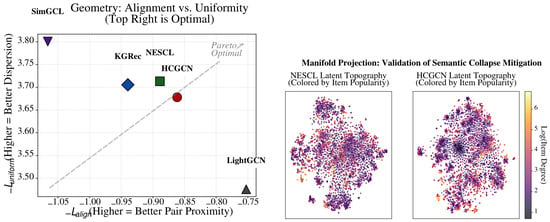
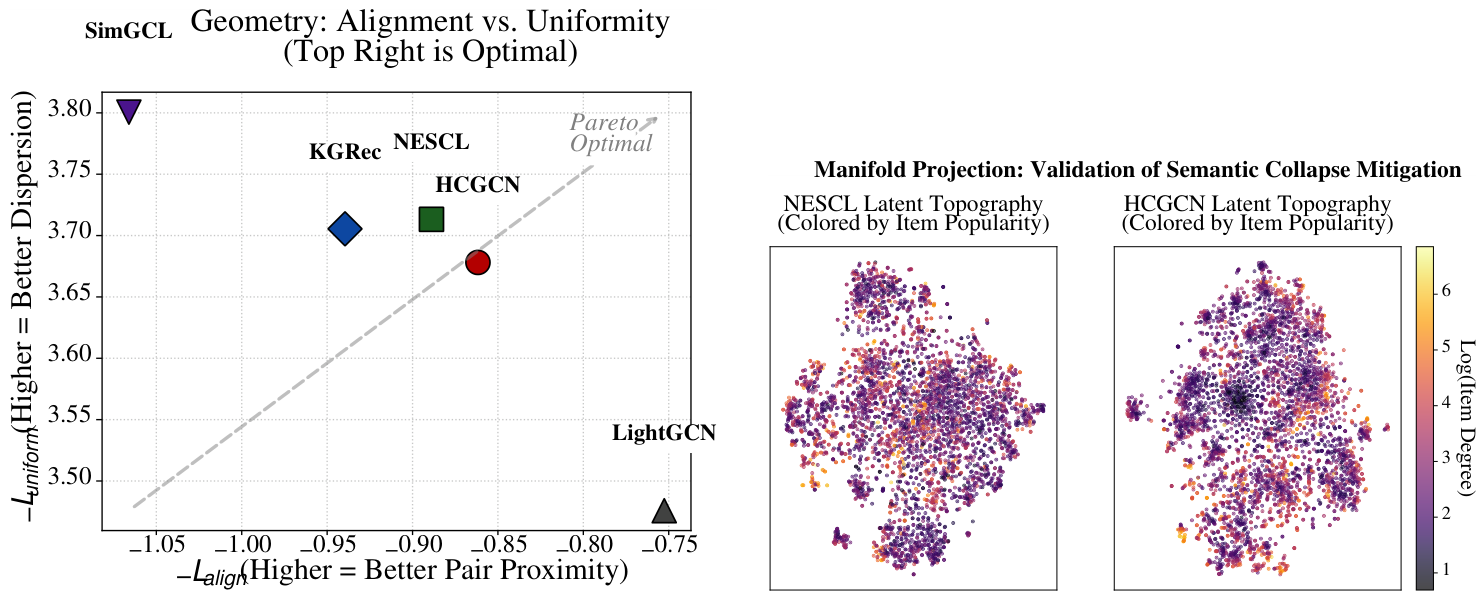
To gain an intuition about why the numbers improve, we project the learnt latent spaces on Amazon-Book and Yelp2018. As shown in Figure 1, the HCGCN promotes optimal alignment uniformity trade-offs (left) and maintains highly structured, popularity-aware semantic clusters under t-SNE projection (right) by using the Huber whitening penalty to safeguard legitimate correlations.
Figure 1.
Latent space visualization: (left) Alignment and uniformity metrics on Yelp2018 showing optimal dispersion; (right) t-SNE manifold projection on Amazon-Book showing structured, popularity-aware semantic clustering under the Huber covariance whitening penalty.
To quantitatively evaluate representation collapse, we compute the effective rank (, where is the Shannon entropy of the normalized eigenvalue distribution p) and the covariance condition number () of the user and item embedding tables on the Amazon-Book dataset. As reported in Table 4, LightGCN exhibits severe Dimensional Collapse, utilizing only about 66–68% of its 64-dimensional capacity, accompanied by high condition numbers (). SimGCL, in contrast, exhibits near-perfect effective rank () and extremely low condition numbers () due to its isotropic noise injection; however, this complete orthogonalization over-decorrelates legitimate collaborative structures, leading to suboptimal recommendation accuracy. NESCL improves over LightGCN but lacks direct covariance regulation. In contrast, our proposed HCGCN model utilizes over 90% of its 128-dimensional capacity (–119) while maintaining a moderate condition number (–14). This demonstrates that the Huber covariance whitening penalty successfully prevents representation collapse without over-decorrelating legitimate semantic community clusters.
Table 4.
Quantitative representation collapse metrics on Amazon-Book, comparing effective rank () and covariance condition number ().
6.4. Ablation Study and Hyperparameter Sensitivity Analysis
To isolate the contributions of the individual components of the HCGCN, we perform systematic ablation studies and parameter sensitivity sweeps on the Amazon-Book dataset.
6.4.1. Geometric Effect of Covariance Penalty Types
We first replace the Huber Covariance Whitening loss with a standard -squared penalty (Barlow Twins-type), keeping all other parameters constant. The two penalties induce qualitatively different latent geometries:
- Penalty (Barlow Twins-type): The parabolic curve penalizes all the off-diagonal covariances equally—causing small noise and large semantic overlaps. This breaks ranking confidence (NDCG@20 drops significantly) on scale-free manifolds because the correlation of legitimate communities is orthogonalized.
- Huber Penalty (HCGCN): The quadratic regime aggressively kills off noise below . The linear cap above prevents gradient explosion while retaining the macro-semantic topology.
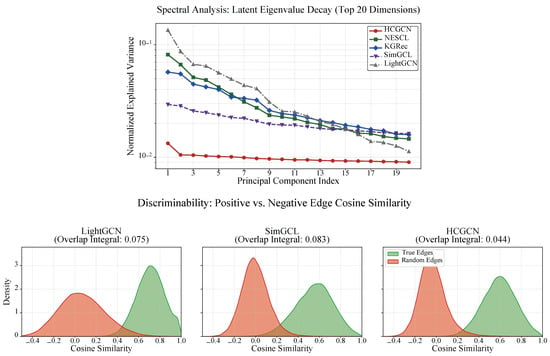
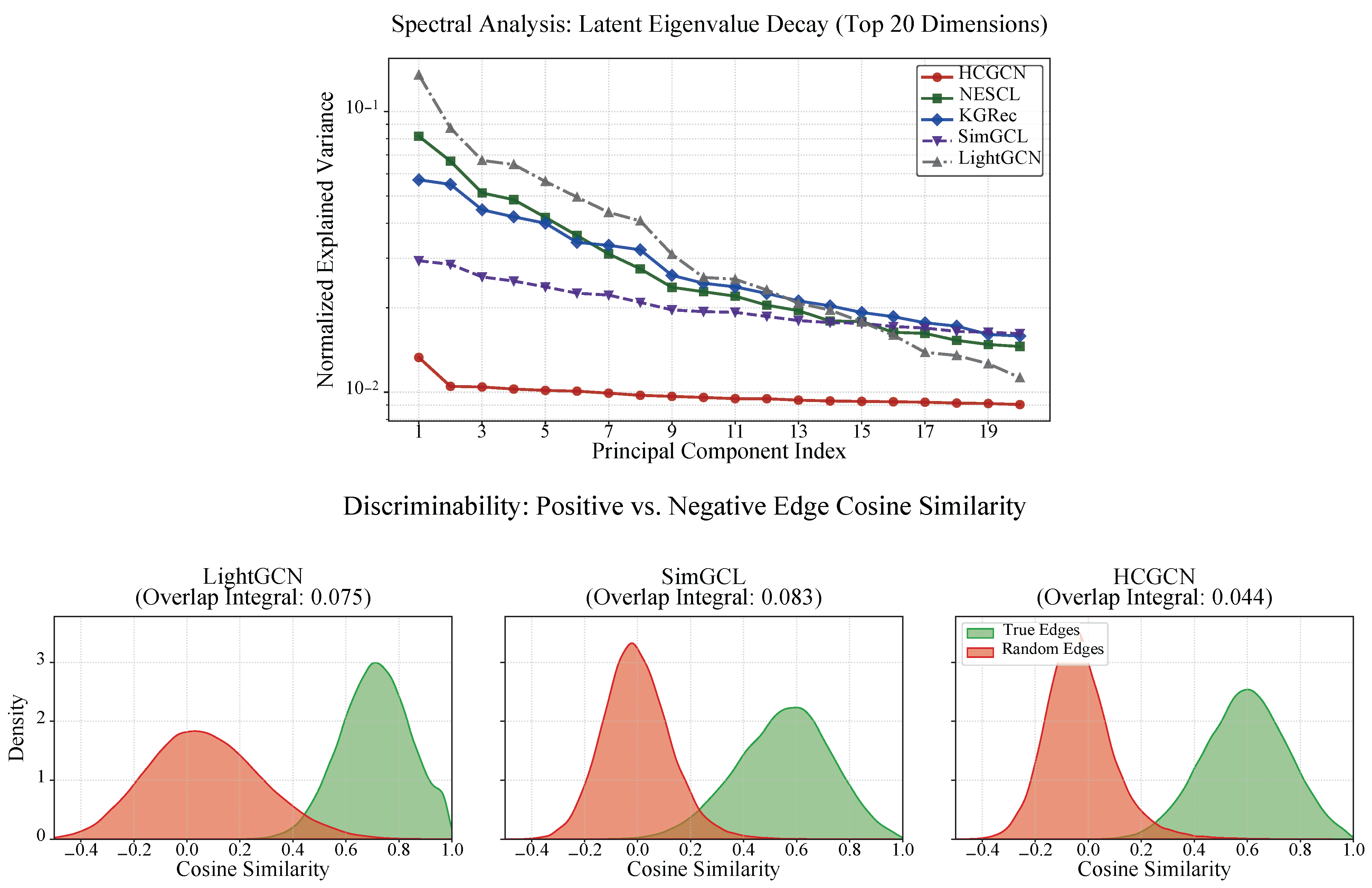
Furthermore, spectral analysis of eigenvalue decay and Kernel Density Estimation (KDE) of discriminability are shown in Figure 2, validating that the HCGCN maintains flatter spectra and robust separation between positive and negative pairs.
Figure 2.
Latent- space diagnostics on Amazon-Book: (top) spectral analysis of eigenvalue decay, showing a flatter spectrum for the HCGCN; (bottom) Kernel Density Estimation (KDE) of discriminability validating positive/negative interaction separation.
6.4.2. Gated Fusion Ablation
We examine the influence of the dual-view graph propagation and the learnable gated fusion mechanism by comparing the HCGCN against three architectural variants:
- Topology-Only: Propagates embeddings solely over the user–item interaction graph, discarding the CKG;
- CKG-Only: Discards the bipartite user–item interactions and propagates only over the relational CKG;
- Average Fusion: Statically averages the topological and relational representations at each propagation step rather than utilizing the learnable gating mechanism.
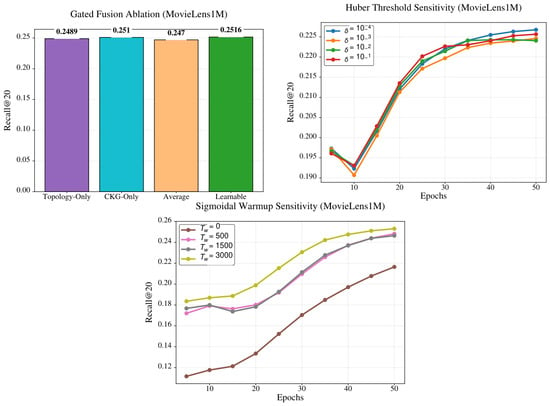
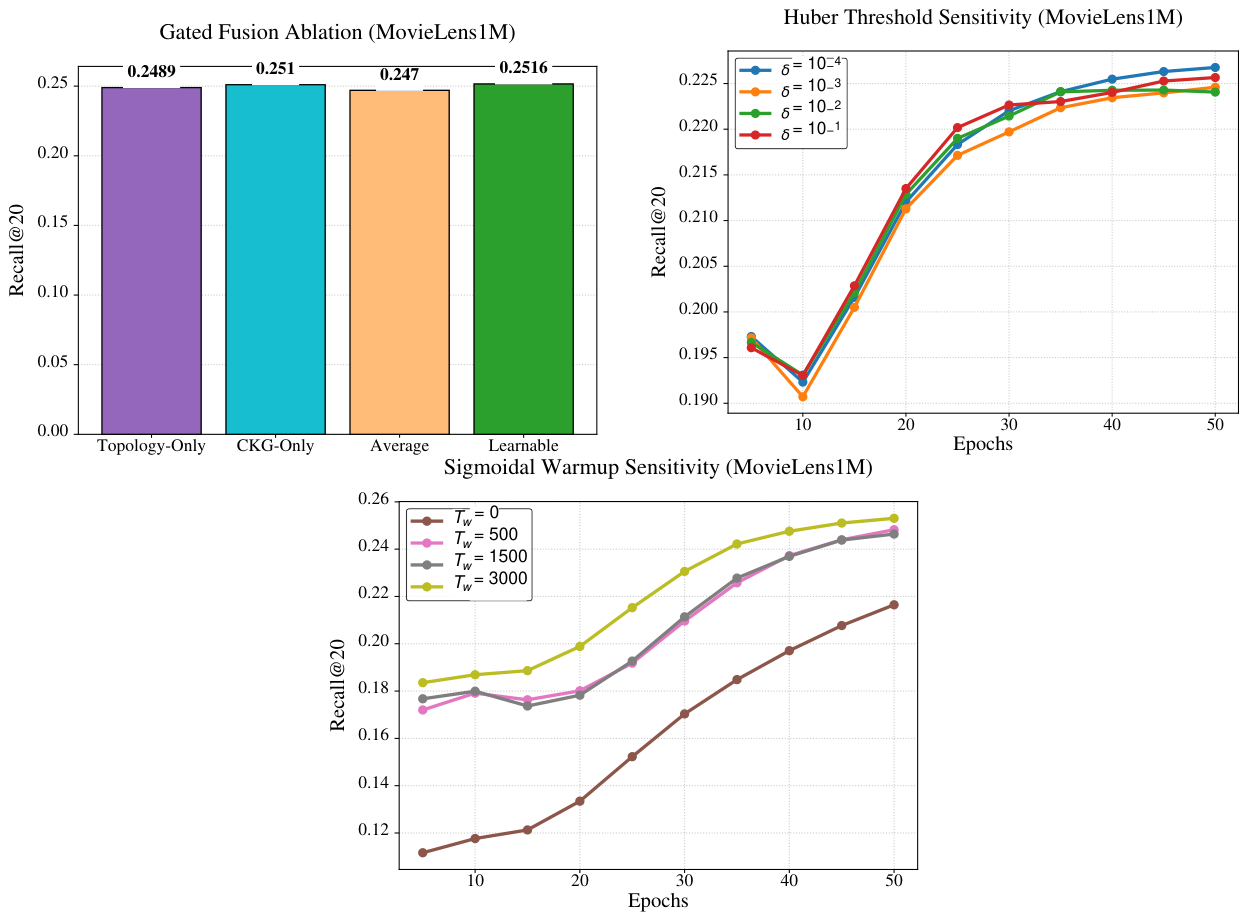
The empirical results at Epoch 50 show that learnable gated fusion achieves the highest performance (Recall@20 = 0.1670, NDCG@20 = 0.0900), followed by Topology-Only (Recall@20 = 0.1660, NDCG@20 = 0.0895) and CKG-Only (Recall@20 = 0.1655, NDCG@20 = 0.0895). Crucially, the static Average Fusion underperforms significantly, yielding the lowest score (Recall@20 = 0.1648, NDCG@20 = 0.0890). This demonstrates that static averaging acts as a noise-injection vector that dilutes the collaborative signal, making an adaptive, learnable sigmoid gating mechanism mathematically necessary to reconcile topological and relational views. The training trajectories of these gated fusion variants are illustrated in Figure 3 (left).
Figure 3.
Ablation and parameter sensitivity analysis on MovieLens-1M: (left) gated fusion variants, (middle) Huber Threshold () sensitivity sweep, and (right) Sigmoidal Warmup Steps () sensitivity sweep.
6.4.3. Huber Threshold Sensitivity ()
The Huber covariance loss is governed by the threshold parameter , which demarcates the transition from the quadratic () regime to the linear () regime. We sweep over the range to analyze its impact on representation learning. As shown in the experiments, the model displays high robustness across a wide range of values, peaking at and (Recall@20 = 0.1310 for , 0.1299 for ). If the threshold is set too loose (), the quadratic penalty dominates the off-diagonal entries, causing over-decorrelation that destroys legitimate community clusters. Conversely, setting the threshold too tight () forces an early transition into the linear regime, weakening the decorrelation pressure required to prevent Dimensional Collapse. We choose as the default setting, balancing noise rejection with semantic preservation. The sensitivity sweep over is plotted in Figure 3 (middle).
6.4.4. Sigmoidal Warmup Steps () Sensitivity
We investigate the impact of the sigmoidal warmup schedule () on optimization stability by sweeping steps. Statically activating the covariance regularization from step 0 () results in a severe performance degradation (Recall@20 drops to 0.1522, representing a 9% performance collapse compared to the optimal 0.1661 achieved at ). This provides empirical proof of gradient starvation: without a warmup period, the covariance whitening objective dominates early gradients and scatters the embedding space before the BPR loss can establish basic collaborative user–item associations. Conversely, setting the warmup period too long () delays the whitening constraint, slowing down convergence. A sigmoidal transition centered at steps optimizes the balance between initial structural alignment and latent covariance regulation. The optimization stability under different warmup lengths is shown in Figure 3 (right).
6.5. Robustness in Extreme Sparsity
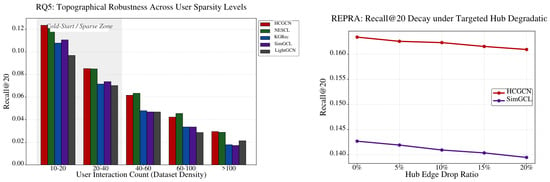
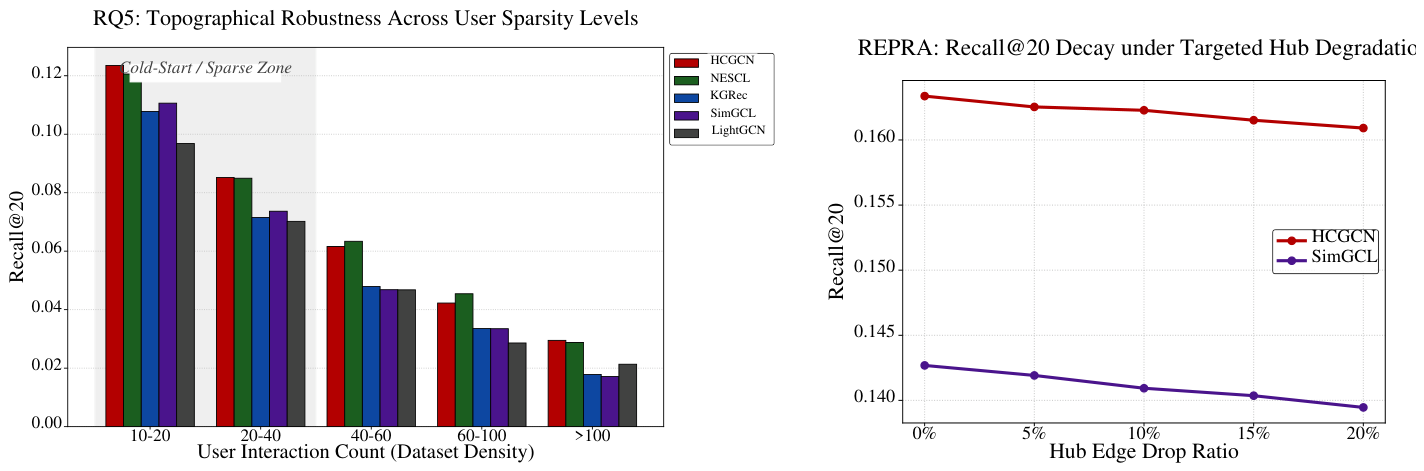
What is the performance of the HCGCN when user histories are very short? We stratify Amazon-Book users by interaction count and measure Recall@20 for each group, as shown in Figure 4 (left). Additionally, Figure 4 (right) demonstrates the robustness of the Huber whitening mechanism to target degradation (disconnection of high-degree hub nodes).
Figure 4.
Robustness analysis on Amazon-Book: (left) Performance at different user sparsity levels showing resilience in cold-start settings; (right) targeted hub degradation showing targeting resilience against hub disconnection.
7. Conclusions
The central thesis of this work is straightforward: the geometry of the covariance matrix is the limiting factor in self-supervised graph collaborative filtering. Exclusive spatial message-passing cannot alone rescue sparse bipartite manifolds, and the contrastive objectives proposed to facilitate this process—such as SGL’s structural perturbations [12] or SimGCL’s isotropic noise [13]—either destructively fracture the graph or spread perturbations haphazardly over the node degree spectrum. Furthermore, the rigid -squared decorrelation losses borrowed directly from computer vision paradigms (e.g., Barlow Twins [17], VICReg [18]) precipitate Semantic Collapse when transplanted to recommendation tasks, effectively erasing the overlapping community structures that collaborative filtering fundamentally relies on.
The HCGCN tackles this fundamental issue via a novel Huber Covariance Whitening module characterized by a split gradient behavior governed by a threshold : a quadratic regime below the threshold that aggressively stamps out spurious noise, and a linear regime above the threshold that safeguards genuine macro-semantic structure. By disentangling topological and relational signals through a dual-view gated propagation mechanism and bypassing BPR gradient starvation on scale-free graphs via a degree-attenuated warmup schedule, the HCGCN successfully resolves both Dimensional and Semantic Collapse without incurring the computational overhead associated with continuous-time dynamic modeling.
Comprehensive evaluations on the Yelp2018, Amazon-Book, and MovieLens datasets demonstrate consistent, significant improvements over five state-of-the-art baselines. These gains are particularly pronounced in cold-start scenarios, confirming that geometrically aware covariance regulation is critical for data-sparse regimes. Several promising avenues remain for future exploration. In this work, the threshold is treated as a static hyperparameter; adapting it dynamically—for instance, as a learned function of localized graph entropy—could yield further empirical gains. Moreover, extending this whitening paradigm to directed, heterogeneous multi-behavior interaction graphs represents a natural progression, one that will require a theoretical reformulation of the covariance matrix to accommodate diverse semantic edge types.
Author Contributions
Conceptualization, A.E.B. and A.E.; methodology, A.E.B., S.B.A. and H.B.A.; software, A.E.B. and M.H.; writing—original draft preparation, A.E.B.; writing—review and editing, A.E., S.B.A., M.H. and H.B.A. All authors have read and agreed to the published version of the manuscript.
Funding
This research received no external funding.
Institutional Review Board Statement
Not applicable.
Informed Consent Statement
Not applicable.
Data Availability Statement
The raw data supporting the conclusions of this article will be made available by the authors on request.
Acknowledgments
During the preparation of this manuscript, the authors used Gemini Pro (by Google) for the purpose of assisting in text refinement and structuring. The authors have reviewed and edited the output and take full responsibility for the content of this publication.
Conflicts of Interest
The authors declare no conflicts of interest.
References
- Koren, Y.; Bell, R.; Volinsky, C. Matrix factorization techniques for recommender systems. Computer 2009, 42, 30–37. [Google Scholar] [CrossRef] [Scilit]
- Wang, X.; He, X.; Cao, Y.; Liu, M.; Chua, T.S. KGAT: Knowledge Graph Attention Network for Recommendation. In Proceedings of the 25th ACM SIGKDD International Conference on Knowledge Discovery & Data Mining, Anchorage, AK, USA, 4–8 August 2019; pp. 950–958. [Google Scholar]
- Kipf, T.N.; Welling, M. Semi-Supervised Classification with Graph Convolutional Networks. In Proceedings of the International Conference on Learning Representations, Toulon, France, 24–26 April 2017. [Google Scholar]
- Hamilton, W.; Ying, Z.; Leskovec, J. Inductive representation learning on large graphs. In Proceedings of the Advances in Neural Information Processing Systems, Long Beach, CA, USA, 4–9 December 2017. [Google Scholar]
- Veličkovič, P.; Cucurull, G.; Casanova, A.; Romero, A.; Lio, P.; Bengio, Y. Graph Attention Networks. In Proceedings of the International Conference on Learning Representations, Vancouver, BC, Canada, 30 April–3 May 2018. [Google Scholar]
- Zhao, L.; Song, Y.; Xu, C.; Li, H.; Wang, G. T-GCN: A Temporal Graph Convolutional Network for Traffic Prediction. IEEE Trans. Intell. Transp. Syst. 2019, 21, 3848–3858. [Google Scholar] [CrossRef] [Scilit]
- Dang, W.; Wang, H.; Pan, S.; Zhang, P.; Zhou, C.; Chen, X.; Wang, J. Predicting Human Mobility via Graph Convolutional Dual-attentive Networks. In Proceedings of the Fifteenth ACM International Conference on Web Search and Data Mining, Online, 21–25 February 2022. [Google Scholar]
- Chen, L.; Wu, L.; Hong, R.; Zhang, K.; Wang, M. Revisiting graph based collaborative filtering: A linear residual graph convolutional network approach. In Proceedings of the AAAI Conference on Artificial Intelligence, New York, NY, USA, 7–12 February 2020. [Google Scholar]
- Li, Q.; Han, Z.; Wu, X.M. Deeper Insights into Graph Convolutional Networks for Semi-Supervised Learning. In Proceedings of the AAAI Conference on Artificial Intelligence, New Orleans, LA, USA, 2–7 February 2018. [Google Scholar]
- He, X.; Deng, K.; Wang, X.; Li, Y.; Zhang, Y.; Wang, M. LightGCN: Simplifying and Powering Graph Convolution Network for Recommendation. In Proceedings of the 43rd International ACM SIGIR Conference on Research and Development in Information Retrieval, Virtual Event, 25–30 July 2020. [Google Scholar]
- Wu, F.; Souza, A.; Zhang, T.; Fifty, C.; Yu, T.; Weinberger, K. Simplifying Graph Convolutional Networks. In Proceedings of the International Conference on Machine Learning, Long Beach, CA, USA, 9–15 June 2019. [Google Scholar]
- Wu, J.; Wang, X.; Feng, F.; He, X.; Chen, L.; Lian, J.; Xie, X. Self-supervised Graph Learning for Recommendation. In Proceedings of the 44th International ACM SIGIR Conference on Research and Development in Information Retrieval, Virtual Event, 11–15 July 2021. [Google Scholar]
- Yu, J.; Yin, H.; Xia, X.; Chen, T.; Li, L.; Huang, Z. Are Graph Augmentations Necessary? Simple Graph Contrastive Learning for Recommendation. In Proceedings of the 45th International ACM SIGIR Conference on Research and Development in Information Retrieval, Madrid, Spain, 11–15 July 2022. [Google Scholar]
- Wang, T.; Isola, P. Understanding contrastive representation learning through alignment and uniformity on the hypersphere. In Proceedings of the International Conference on Machine Learning, Virtual Event, 13–18 July 2020. [Google Scholar]
- Jing, L.; Vincent, P.; LeCun, Y.; Tian, Y. Understanding Dimensional Collapse in Contrastive Self-Supervised Learning. In Proceedings of the International Conference on Learning Representations, Virtual Event, 25–29 April 2022. [Google Scholar]
- Hua, T.; Wang, W.; Xue, Z.; Ren, S.; Wang, Y.; Zhao, H. On Feature Decorrelation in Self-Supervised Learning. In Proceedings of the IEEE/CVF International Conference on Computer Vision, Virtual Event, 11–17 October 2021. [Google Scholar]
- Zbontar, J.; Jing, L.; Misra, I.; LeCun, Y.; Deny, S. Barlow Twins: Self-Supervised Learning via Redundancy Reduction. In Proceedings of the International Conference on Machine Learning, Virtual Event, 18–24 July 2021. [Google Scholar]
- Bardes, A.; Ponce, J.; LeCun, Y. VICReg: Variance-Invariance-Covariance Regularization for Self-Supervised Learning. In Proceedings of the International Conference on Learning Representations, Virtual Event, 25–29 April 2022. [Google Scholar]
- Ma, J.; Zhou, C.; Cui, P.; Yang, H.; Zhu, W. Learning disentangled representations for recommendation. In Proceedings of the Advances in Neural Information Processing Systems, Vancouver, BC, Canada, 8–14 December 2019. [Google Scholar]
- Wang, X.; He, X.; Wang, M.; Feng, F.; Chua, T.S. Neural graph collaborative filtering. In Proceedings of the 42nd International ACM SIGIR Conference on Research and Development in Information Retrieval, Paris, France, 21–25 July 2019. [Google Scholar]
- Mao, X.; Zhu, J.; Wang, X.; He, X.; Qi, Y.; Chua, T.S. UltraGCN: Ultra Simplification of Graph Convolutional Networks for Recommendation. In Proceedings of the 30th ACM International Conference on Information & Knowledge Management, Virtual Event, 1–5 November 2021. [Google Scholar]
- Rendle, S.; Freudenthaler, C.; Gantner, Z.; Schmidt-Thieme, L. BPR: Bayesian personalized ranking from implicit feedback. In Proceedings of the Twenty-Fifth Conference on Uncertainty in Artificial Intelligence, Montreal, QC, Canada, 18–21 June 2009. [Google Scholar]
- Chen, T.; Kornblith, S.; Norouzi, M.; Hinton, G. A simple framework for contrastive learning of visual representations. In Proceedings of the International Conference on Machine Learning, Virtual Event, 13–18 July 2020. [Google Scholar]
- He, K.; Fan, H.; Wu, Y.; Xie, S.; Girshick, R. Momentum contrast for unsupervised visual representation learning. In Proceedings of the IEEE/CVF Conference on Computer Vision and Pattern Recognition, Virtual Event, 13–19 June 2020. [Google Scholar]
- Qiu, J.; Chen, Q.; Dong, Y.; Zhang, J.; Yang, H.; Ding, M.; Wang, K.; Tang, J. GCC: Graph contrastive coding for graph neural network pre-training. In Proceedings of the 26th ACM SIGKDD International Conference on Knowledge Discovery & Data Mining, Virtual Event, 23–27 August 2020. [Google Scholar]
- Yu, J.; Yin, H.; Xia, X.; Chen, T.; Cui, L.; Nguyen, Q.V.H. Self-supervised learning for recommender systems: A survey. IEEE Trans. Knowl. Data Eng. 2023, 36, 335–355. [Google Scholar] [CrossRef] [Scilit]
- Rong, Y.; Huang, W.; Xu, T.; Huang, J. DropEdge: Towards Deep Graph Convolutional Networks on Node Classification. In Proceedings of the International Conference on Learning Representations, Virtual Event, 26–30 April 2020. [Google Scholar]
- Yu, J.; Xia, X.; Chen, T.; Cui, L.; Hung, N.Q.V.; Yin, H. XSimGCL: Towards Extremely Simple Graph Contrastive Learning for Recommendation. IEEE Trans. Knowl. Data Eng. 2023, 36, 913–926. [Google Scholar]
- Sun, P.; Wu, L.; Zhang, K.; Chen, X.; Wang, M. Neighborhood-Enhanced Supervised Contrastive Learning for Collaborative Filtering. arXiv 2024, arXiv:2402.11523. [Google Scholar]
- Lin, Z.; Tian, C.; Hou, Y.; Zhao, W.X. Improving graph collaborative filtering with neighborhood-enriched contrastive learning. In Proceedings of the ACM Web Conference 2022, Virtual Event, 25–29 April 2022. [Google Scholar]
- Yan, Y.; Zhang, Y.; Zhou, L.; Zhang, F.; Wang, H. Acoustic signals-based probabilistic fault diagnosis for expansion joints of small and medium bridges using Bayesian ensemble learning. Eng. Struct. 2026, 354, 122379. [Google Scholar] [CrossRef] [Scilit]
- Veličkovič, P.; Fedus, W.; Hamilton, W.L.; Liø, P.; Bengio, Y.; Hjelm, R.D. Deep Graph Infomax. In Proceedings of the International Conference on Learning Representations, New Orleans, LA, USA, 6–9 May 2019. [Google Scholar]
- van den Oord, A.; Li, Y.; Vinyals, O. Representation learning with contrastive predictive coding. In Proceedings of the Advances in Neural Information Processing Systems, Montreal, QC, Canada, 3–8 December 2018. [Google Scholar]
- Gutmann, M.; Hyvärinen, A. Noise-contrastive estimation: A new estimation principle for unnormalized statistical models. In Proceedings of the Thirteenth International Conference on Artificial Intelligence and Statistics, Chia Laguna, Sardinia, Italy, 13–15 May 2010. [Google Scholar]
- Chen, J.; Dong, H.; Wang, X.; Feng, F.; Wang, M.; He, X. Bias and Debias in Recommender System: A Survey and Future Directions. ACM Trans. Inf. Syst. 2023, 41, 1–39. [Google Scholar] [CrossRef] [Scilit]
- Huber, P.J. Robust Estimation of a Location Parameter. Ann. Math. Stat. 1964, 35, 73–101. [Google Scholar] [CrossRef] [Scilit]
- Micikevicius, P.; Narang, S.; Alben, J.; Diamos, G.; Elsen, E.; Garcia, D.; Ginsburg, B.; Houston, M.; Kuchaiev, O.; Venkatesh, G.; et al. Mixed precision training. arXiv 2017, arXiv:1710.03740. [Google Scholar]
- Liao, R.; Zhang, Y.; Wang, H.; Zhao, T.; Wang, X. Multi-objective optimisation of surveillance camera placement for bridge–ship collision early-warning using an improved non-dominated sorting genetic algorithm. Adv. Eng. Inform. 2026, 69, 103918. [Google Scholar] [CrossRef] [Scilit]
- Kingma, D.P.; Ba, J. Adam: A method for stochastic optimization. arXiv 2014, arXiv:1412.6980. [Google Scholar]
- Yang, Y.; Huang, C.; Xia, L.; Li, C. Knowledge Graph Self-Supervised Rationalization for Recommendation. In Proceedings of the 29th ACM SIGKDD Conference on Knowledge Discovery and Data Mining, Long Beach, CA, USA, 6–10 August 2023. [Google Scholar]
- Chen, R.T.; Rubanova, Y.; Bettencourt, J.; Duvenaud, D.K. Neural ordinary differential equations. In Proceedings of the Advances in Neural Information Processing Systems, Montreal, QC, Canada, 3–8 December 2018. [Google Scholar]
- Akiba, T.; Sano, S.; Yanase, T.; Ohta, T.; Koyama, M. Optuna: A next-generation hyperparameter optimization framework. In Proceedings of the 25th ACM SIGKDD International Conference on Knowledge Discovery & Data Mining, Anchorage, AK, USA, 4–8 August 2019. [Google Scholar]

Disclaimer/Publisher’s Note: The statements, opinions and data contained in all publications are solely those of the individual author(s) and contributor(s) and not of MDPI and/or the editor(s). MDPI and/or the editor(s) disclaim responsibility for any injury to people or property resulting from any ideas, methods, instructions or products referred to in the content. |
© 2026 by the authors. Licensee MDPI, Basel, Switzerland. This article is an open access article distributed under the terms and conditions of the Creative Commons Attribution (CC BY) license.