


Abstract
This article develops a resilient learning-control architecture for heterogeneous unmanned aerial attack–defense teams subject to collision constraints, uncertain translational dynamics, interception, and complete vehicle loss. Each vehicle obeys a mass-dependent second-order quadrotor model with drag mismatch and external acceleration disturbances. Actor–critic adaptive dynamic programming supplies configuration-dependent attack and defense commands, while a robust relative-degree-two barrier filter minimally corrects the learned force. A continuously differentiable activation law removes unnecessary corrections away from the safety boundary and remains uniformly close to the standard positive-part filter. Interception and loss are modeled as hybrid active-set changes; defender reassignment is coordinated with a quintic command handover. The closed-loop analysis establishes robust same-faction collision avoidance for the idealized outer-loop translational model, bounded learning errors over finitely many reconfigurations, and uniform ultimate boundedness when a final nonterminal configuration persists with finite data rank. A five-attacker, three-defender study with heterogeneous masses and an externally destroyed defender achieves all five interceptions without target penetration.
1. Introduction
Unmanned aerial systems increasingly perform surveillance, escort, perimeter protection, and counter-swarm missions in which several vehicles must maneuver competitively around a protected region. Multi-agent target hunting, swarm interception, and pursuit-evasion decision making have consequently been studied with differential games, model-based guidance, and multi-agent reinforcement learning [1,2,3,4,5,6,7]. Target–attacker–defender formulations further describe role switching, territorial constraints, geometric capture, and sequential interception [8,9,10,11,12]. These methods illuminate adversarial decision making, but many analyses use point-mass kinematics, assume an intact team, or treat collision avoidance as a secondary mode.
Collision avoidance is particularly important when several vehicles maneuver near the same protected region. Vehicles assigned to nearby attackers can converge toward intersecting corridors, and a lost defender can force an immediate global reassignment. Model predictive control, differential-game penalties, and control barrier functions (CBFs) have all been used for collision avoidance [13,14,15,16,17,18,19,20,21,22]. CBF filters are particularly attractive because they can modify a mission controller only when safety is threatened. However, the position-separation barrier has relative degree two for a translational quadrotor, so a first-order guidance-level CBF does not certify the vehicle model actually simulated. Robustness is also needed when drag and acceleration disturbances are imperfectly known. The heterogeneous quadrotor model adopted here follows the force-level dynamics used in [23], rather than an ideal virtual-velocity plant.
Complete vehicle loss changes the structure of the closed-loop system. Fault-tolerant multi-agent results usually retain a controllable channel while compensating additive faults or loss of effectiveness [24,25,26,27,28]. Removing a vehicle changes the safety graph, the assignment set, and the active learning channels. The resulting closed loop is hybrid: continuous motion and adaptation are interrupted by interception, loss, and reassignment. A direct command replacement can create a large force change precisely when the engagement geometry is most congested.
Adaptive dynamic programming (ADP) offers an online route to nonlinear optimal regulation and tracking without solving the Hamilton–Jacobi–Bellman (HJB) equation analytically [29,30,31,32]. The safety filter modifies the control input applied to the vehicle, and changes in the active set can introduce jumps in the composite Lyapunov function. These effects must therefore be treated together. In this article, “attack–defense” describes the mission roles; the ADP layer solves configuration-dependent attacker regulation and defender tracking channels, not a coupled Nash or min–max equilibrium.
To address the above challenges, this article develops a resilient learning-control architecture for heterogeneous unmanned aerial attack–defense teams subject to collision constraints, uncertain translational dynamics, interception, and complete vehicle loss. The main contributions are summarized as follows:
(i) A robust exponential CBF (ECBF) is derived for same-faction position separation. A continuously differentiable regularization of the positive-part ECBF demand yields a minimum-norm quadratic program (QP) that exactly recovers the scheduled command away from an activation layer and differs locally from the positive-part solution by order epsilon.
(ii) Interception and loss are represented as finite active-set changes. Global reassignment is paired with a quintic handover that preserves endpoint continuity of the reassigned nominal force and gives an explicit inverse-handover-time rate term.
(iii) Flow/jump Lyapunov–barrier analysis proves robust configuration-dependent safety and bounded pretermination errors. The numerical study reports the observed interception times and target clearances, model-mismatch audit, positive-part and hard-switch comparisons, capture-radius sensitivity, and step-size convergence.
2. Problem Formulation
2.1. Hybrid Heterogeneous Quadrotor Dynamics
Consider N attackers and M defenders, , indexed by and . For faction , vehicle i has position , velocity , mass , and total translational force . Following the supplied heterogeneous quadrotor model [23],
where , is a diagonal drag matrix, and is an external acceleration disturbance. Write and . With a nominal drag matrix , the active-vehicle dynamics become
where
and .
Let be the activity indicator and . An intercepted attacker or destroyed vehicle is removed from the workspace and from the dynamics; its incident constraints and learning channels are deleted. The finite set contains all interception, destruction, and reassignment instants. Active sets and assignments are constant on each flow interval .
Assumption 1.
The masses are known and satisfy . On a prescribed compact velocity domain , the nominal fields are locally Lipschitz and the acceleration mismatch satisfies . The target is stationary and target-centered coordinates are used. The hover force is therefore removed from the optimized input as in (1)–(2).
Assumption 2.
The event set is finite, events are detected without delay, and at least one defender remains active before termination. Removed vehicles leave no persistent debris; otherwise their last locations must be retained as obstacle constraints. An unassigned defender uses a bounded, locally Lipschitz standby policy.
2.2. Mission Errors, Capture, and Assignment
Let be the protected target. Define
For an assigned pair , interception occurs when while . A new capture guard is enabled after the corresponding handover is complete. Target penetration occurs if an active attacker satisfies .
On a fixed configuration, the nominal task costs are
where every Q and R is positive definite.
Let , where assigns defender j to attacker i. At and after each event,
where contains one-to-one partial matchings of maximum cardinality, excludes inactive vehicles, and uses a fixed lexicographic tie breaker. Thus, surviving defenders can be globally rematched. An assigned defender uses ; an unassigned defender uses its standby policy. For compact time-history notation, let when and when defender j is unassigned.
2.3. Relative-Degree-Two Safe Set and Objective
For each unordered active same-faction pair , define
where is the required minimum separation between vehicles i and ℓ of faction s, and . Only same-faction pairs are constrained because attacker–defender proximity is required for capture. The high-order safe set is .
Assumption 3.
The initial condition lies in the interior of .
Problem 1.
Construct learned nominal force deviations, robust safety corrections, and handover laws such that: (i) same-faction position separation is preserved; (ii) the scheduled force is recovered when the safety filter is inactive; (iii) reassigned nominal forces are continuous at handover endpoints; and (iv) active task and weight-estimation errors remain bounded through finitely many events and are uniformly ultimately bounded (UUB) if a final nonterminal configuration persists with finite data rank.
3. Safety-Filtered Learning Control
3.1. Learning of Nominal Task Policies
On each flow interval , the active sets and assignment are fixed. Define , . For each , introduce the task error
where superscript b denotes the raw learner-level force command. The channel dynamics used by the learner are
The attacker channel is autonomous. For a defense channel, the measured attacker trajectory is an exogenous scheduling signal and and .
Thus, the defender problem is a nonautonomous tracking channel, as in the implementation, rather than an autonomous game-equilibrium channel. Its nominal value function is
where and . The associated HJB equation is
which yields
On a configuration-dependent approximation domain , let
where has a locally Lipschitz gradient, is the ideal weight, and is the residual approximation error. The critic and actor are chosen as
The raw behavior force is , where is bounded, piecewise locally Lipschitz, and has finite support relative to channel activation. For a defense channel, write . Thus, equals the pure actor outside probing intervals; the stacked scheduled command below additionally includes any handover blend. Exact safety-filter recovery refers to that stacked command, which equals the raw command outside handovers.
Define the Bellman error , where , . The history stack stores and . At the current weights, set and ; the stored Bellman errors are therefore recomputed, not frozen. The learning laws are
where . Here is the dynamic projection of the update direction onto the tangent cone of the compact convex set at the current estimate. It leaves invariant and satisfies for . Every estimate is initialized in its projection set.
Assumption 4.
For each fixed configuration, (9) admits a finite value function that is in , satisfies the HJB equation, and has an admissible minimizing policy on . The ideal weight is absolutely continuous on each flow interval. The quantities , , , , and are uniformly bounded, and . Let for an attacker channel and for a defense channel. There exist uniform constants and such that .
Assumption 5.
For each channel ν, fix a threshold . On each activation interval , let denote the first time t in that interval for which
where is the Gramian formed from the samples stored for channel ν at time t. If the threshold is never reached during the activation interval, set . Thus, is the rank-acquisition interval for that activation. Once the threshold is reached, the data-storage rule preserves the bound in (17) for the remainder of the activation interval. Assume that the union of all rank-acquisition intervals has finite total length and that every channel that remains active indefinitely reaches its threshold in finite time. Before (17) is satisfied, the projection operators keep the estimated weights in their prescribed compact sets. All potential channels are initialized at with empty stacks and projected weights. Inactive channels are frozen; reactivation retains their bounded learning states and resets only the activation/probe clock. Thus, the finite family of reset maps has a compact image.
3.2. Robust -Regularized ECBF Filter
Stack the active force deviations as and let be the safety correction. For pair , write , , and let be the nominal scheduled acceleration. The true second derivative of is
where the nonzero blocks of are and .
Choose . The robust ECBF condition is guaranteed if , where
The last term is the support-function bound for the unknown relative acceleration. It is conservative but directly auditable from mass, drag uncertainty, disturbance amplitude, and the velocity validity domain.
For , define
Lemma 1.
is continuously differentiable, , , and .
Proof.
On , . On , . The one-sided derivatives at both junctions agree, and the derivative on the middle interval is . □
After stacking and , the proposed safety filter is
The applied deviation force is . Let denote the solution obtained with .
Lemma 2.
On a compact high-order safe domain and bounded scheduled-force set, (21) is feasible and has a uniformly bounded feasible correction.
Proof.
If no pair is active the claim is immediate. Otherwise let and . Choose and set . Then, for every pair, . Mass and state compactness bound this correction. □
Lemma 2 establishes feasibility of the outer-loop QP (21) in the absence of actuator magnitude constraints. The collision-avoidance guarantee in Theorem 2 applies to the translational dynamics (1) under ideal realization of the commanded force by the attitude and thrust inner loop.
Assumption 6.
Each active unassigned defender lies in a compact robustly invariant standby set under its standby force plus every correction bounded by Lemma 2.
Assumption 7.
For each fixed configuration, the primal solution map
is locally Lipschitz with a uniform modulus on the prescribed compact set for q in the convex hull of and , . This primal condition permits redundant zero-demand rows.
For each fixed configuration, Lemma 2 establishes feasibility of (22), and the strongly convex objective yields a unique force correction. Define the direction by its blocks for all . For every pair , on the safe domain. Thus, the same direction strictly increases all active constraint margins. Under this strict feasible-direction condition, local Lipschitz continuity of the optimizer in follows if every subset of the constraint rows tight at the solution has constant rank in a neighborhood of the parameter point [33]. Assumption 7 requires a uniform local Lipschitz modulus over the prescribed compact domain.
Theorem 1.
The optimizer of (21) exists uniquely and is uniformly bounded. If for all active pairs, then . Under Assumption 7, it is locally Lipschitz in state and scheduled force, and
where .
Proof.
Feasibility, strict convexity, and Lemma 2 give existence, uniqueness, and boundedness. When all demands are at most , the QP right-hand side is zero and the unique minimum-norm solution is zero. Local Lipschitz continuity follows from Assumption 7. Finally, and the solution-map modulus give (23). □
For each pair, let denote the scalar ECBF demand. The regularized and positive-part laws coincide for and . As y increases from to zero, the positive-part demand remains zero, while the regularized demand increases smoothly from zero to . Across the full transition interval , the slope increases linearly from zero to one. The parameter therefore determines both the width of the transition interval and the maximum increase in each constraint demand. The corresponding change in the optimal force correction is bounded by (23).
3.3. Hybrid Safety and Quintic Target Handover
Suppose defender j is reassigned at to attacker . Let be the new raw actor force and define for . During ,
where . After the interval, .
Assumption 8.
Successive reallocation instants are separated by at least . The new raw force is absolutely continuous during handover and satisfies
No probe cutoff coincides with a handover endpoint.
Theorem 2.
Suppose Assumptions 1–3, 7 and A8 hold and the trajectory remains in the stated validity domains. Then: (i) all same-faction position constraints are robustly forward invariant until termination; (ii) applied forces are piecewise locally Lipschitz on fixed-configuration flows and the reassigned nominal force is continuous at both handover endpoints; and (iii) at differentiability points during handover,
Hybrid events may still cause finite changes in the overall stacked force because the vehicle and QP constraint sets change.
Proof.
For every active pair, QP feasibility and give . Substitution into (18), together with , yields
Hence, remains nonnegative. Since , also remains nonnegative. Positions and velocities do not jump at an event. Vehicle removal only deletes constraints, and reassignment does not add a same-faction pair, so the high-order safe set is preserved across jumps. Theorem 1 transfers local Lipschitz regularity from the states and scheduled forces to the correction. Finally, , , , and ; differentiating (24) proves (26). □
3.4. Learning Boundedness Under Finite Reconfigurations
Define and . Under the implemented controller,
For an attacker, . For an assigned defender outside handover, ; during handover,
Consequently, bounded gives . Consider
Two identities expose the terms created by behavior probing and the nonautonomous defender channel. Completing the square in the HJB gives
Moreover,
where . Historical scheduling mismatch is included in the bounded stored-data counterpart of .
Theorem 3.
Suppose Assumptions 1–8 hold. On a compact validity region, choose Young margins and define . Let the finite constants be those in (40) and (41) below. If
for every active channel, then, whenever all active history stacks satisfy (17), there exist uniform and over the finite configurations such that
At each hybrid event,
Let be the union of the rank-acquisition intervals defined in Assumption 5, and let denote its total length, with overlapping intervals counted once. If a channel is deactivated before reaching its threshold, its entire activation interval belongs to . On flows in , let on the validity region. On flows outside , every active channel satisfies (17), and (36) applies under (35). With ,
For each configuration , let denote (30) restricted to that configuration, let be its active unassigned defenders, and define . Assume that and every is compactly contained in the corresponding approximation and QP-regularity domains. Then every pretermination solution remains in that validity region.
If a final nonterminal configuration persists and its rank condition holds, choose after the last hybrid event and after every active channel in that configuration has acquired rank. For ,
Thus, the active errors are UUB. With , , , and .
Proof.
Equations (31) and (32), compact-domain bounds, and Young’s inequality give finite , , and such that
The projection inequality is applicable because lies in both projection sets. Using (33), the rank condition, and yields
An explicit admissible choice of the coefficients in (35) follows from the weight projection. By Assumption 4, both and belong to the compact set . Hence , where . Starting from any valid bounds in (40) and (41), replace and by and , respectively. The resulting bounds hold with . This choice increases the residual bound used in (36).
Here is the negative margin consumed when bounding the explicit residual, leakage cross term, and . Similarly,
where is absorbed into and . Condition (35) makes all three quadratic coefficients in the sum of these bounds positive. The value-function bounds in Assumption 4 then imply (36).
Across an event, physical states are continuous; removed terms disappear, while changes of configuration-dependent ideal quantities and newly activated bounded channels have a uniformly bounded contribution, proving (37). Projection and finite bound the rank-acquisition growth. The scalar comparison lemma gives (38). The stated strict product-set condition closes the compact-domain argument by continuation. Restarting the scalar comparison at , after which there are no jumps or rank-deficient intervals, gives (39) and the stated ultimate bound. □
Corollary 1.
Let begin a flow interval on which the rank condition holds and defender j is assigned to attacker i. Set from Assumption 4 and suppose . Define
If the assignment persists, the engagement does not terminate, and no jump other than interception of pair occurs on , the pair enters by its endpoint. If almost everywhere on this interval and
then the attacker’s target clearance remains above until the pair reaches the capture radius.
Proof.
The zero-time case is immediate. Otherwise, failure to enter by and the event-free comparison would give there. Since , this implies , a contradiction. The speed bound and (44) keep the attacker outside the capture guard’s target-clearance threshold until that time. □
Remark 1.
The parameter ϵ determines an deviation from the componentwise positive-part ECBF-QP. Only the blending-induced term of (26) scales as ; the raw-command rate contributes . In Theorem 3, handover enters through its bounded amplitude and finite duration, and no monotone improvement of the ultimate bound with is claimed.
4. Numerical Study
4.1. Reproducible Heterogeneous UAV Setup
Five attackers and three defenders evolve according to (1). The attacker masses are kg, as in [23]; defender masses are kg. Let denote the diagonal entries of in order, expressed in . For through , the respective triples are , , , , and . For through , they are , , and , respectively. True diagonal drag coefficients range from to N·s/m, and the controller uses . For vehicle i in faction , the external acceleration disturbance is
The amplitude vectors are and in . The corresponding angular frequencies are and in . The phase angles are and in radians, with indices starting at one within each faction. The robust filter uses a 6 m/s velocity-domain bound; the resulting values are computed from drag mismatch and the disturbance norm, not from the instantaneous disturbance.
The initial position matrices, whose columns index vehicles, are
and all initial velocities are zero. The target and capture radii are m and m. Same-faction separation distances are m and m. The ECBF parameters are s−1 and s−1, with m2/s2. A -m barrier buffer compensates the zero-order-held numerical implementation; all reported margins use the unbuffered distances.
Each six-state channel uses and . The attacker arrays are , , and . Defender values are , , and . The nine basis functions are the axis-separable squares and products , where position and velocity scales are 5 m and 1 m/s. Each channel stores 32 samples. The gains are , and the numerical rank threshold is . Finite multisine probes have initial amplitudes N and N for attacker and defender channels, respectively, decay at s−1, and end after 8 s. History replacement uses a scale-aware strict-improvement test on .
For each channel , let contain the coefficients of the nominal Riccati value function in the nine scaled basis functions above. The Riccati solution uses the vehicle mass, nominal drag matrix, and channel cost matrices Q and R. The initial weights are , . For , the offset is , where for channel and for channel . The actor and critic share the projection set , and their weights are updated using tangent-cone projected Euler steps.
In the nominal simulation, defender is externally removed at s. Reassignments use s, and a newly assigned capture guard is enabled after the handover. Fourth-order Runge–Kutta integration uses s. At each step, the translational model applies the total force command without post-QP saturation. Across all active vehicles and recorded samples in the nominal run with the proposed filter, the deviation-force magnitude peaked at N and the total commanded-force magnitude peaked at N.
The proposed method is compared with: (i) the same robust ECBF-QP using the nonsmooth positive part; (ii) a distance-hysteretic hard switch; (iii) the learned nominal controller without a safety filter; and (iv) the proposed filter without quintic handover. All cases use identical plants, learning states, event guards, and external loss.
The hard-switch baseline uses one hysteresis switch per faction, initially off. The switch turns on when the minimum distance between active vehicles in that faction is at or below and turns off when it is at or above . Between these thresholds, the switch retains its current state. The threshold pairs are m for the attackers and m for the defenders. The force correction is zero when the switch is off. When the switch is on, the minimum-norm QP uses the pairwise demand , where is the distance between the two vehicles in pair r and .
For the sampled records, define as the largest over vehicles active at both samples, and define by excluding intervals whose endpoint contains a hybrid event. These quantities distinguish ordinary sample-to-sample variation from event-associated command changes.
4.2. Interception Events and Safety Margins
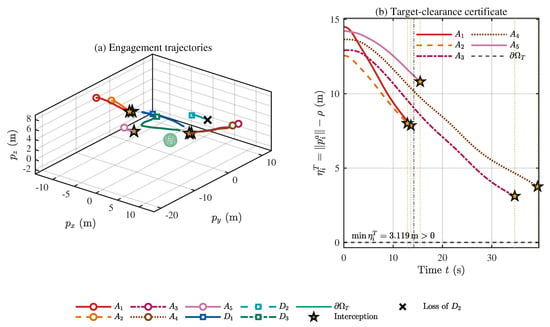
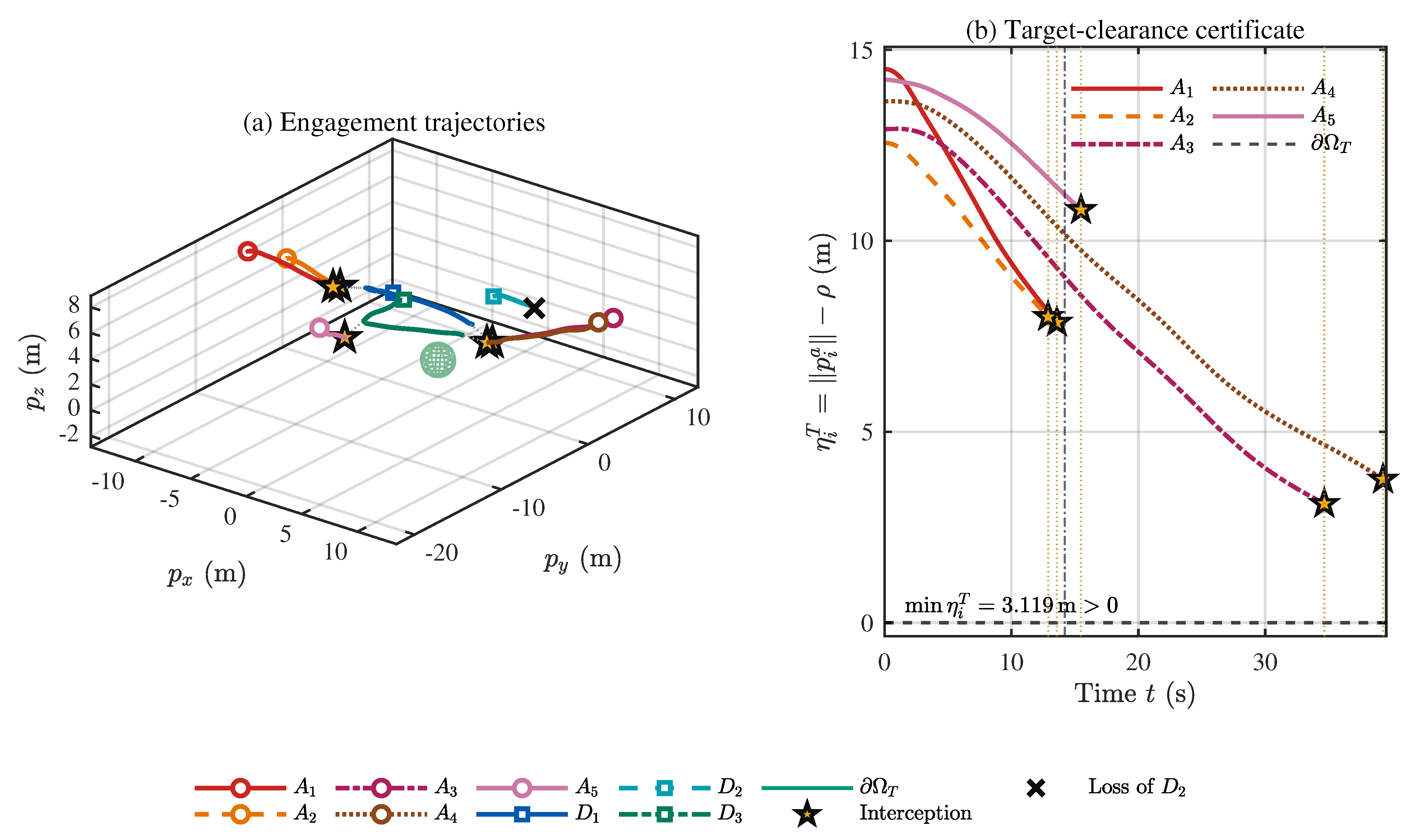
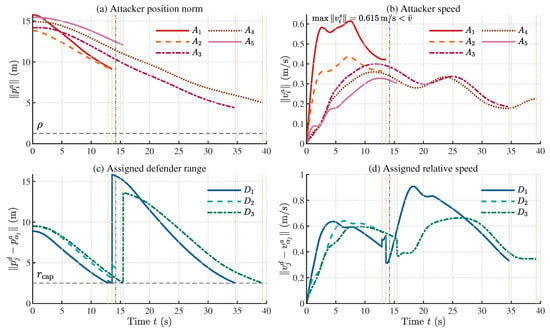
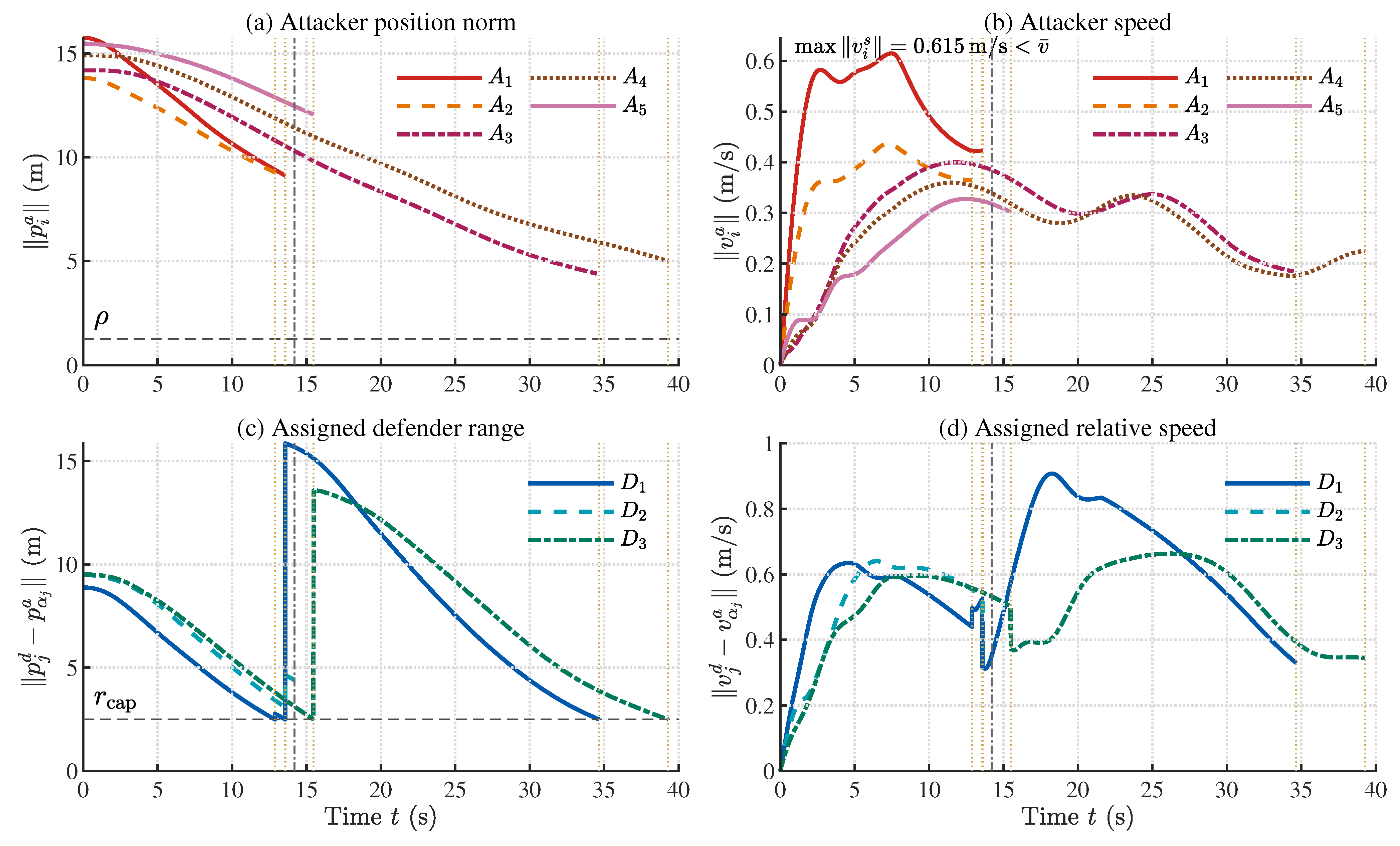
The proposed event sequence is , , , , , and , where time is in seconds. As shown in Figure 1, all five assigned-pair interceptions occurred before target penetration in the nominal simulation. The minimum target clearance among active attackers was m, and the largest absolute sampled capture-guard residual was m. Under the hypotheses of Corollary 1, the initial clearance condition (44) ensures that the attacker’s target clearance remains above until the pair reaches the capture radius. In the nominal run, intercepted at s even though the rank indicator for their channel remained below the threshold throughout the assignment, as reported in Table 1. Figure 2 makes the state evolution explicit: attacker speeds remain bounded, assigned ranges reach at capture, and changes in the displayed defender-error norm occur only when the reference attacker changes.
Figure 1.
Simulated trajectories and target clearances for the proposed controller. Circles and squares mark initial attacker and defender positions, pentagrams mark assigned-pair interceptions, and the cross marks the external loss of . The dashed line in panel (b) marks the target boundary . All five terminal markers lie above this boundary.
Table 1.
Channel-wise rank acquisition in the nominal run.
Figure 2.
Conventional state histories for the proposed controller: attacker position norms and speeds, and the position- and velocity-error norms of each defender relative to its currently assigned attacker . Discontinuities in panels (c,d) are changes of the tracking reference caused by reassignment, not jumps of the physical UAV states.
The minimum same-faction distance margin is m, the minimum sampled high-order barrier is , and the maximum QP primal residual is at machine zero. Moreover, the maximum speed is m/s, well inside the 6-m/s validity domain, and the largest actual acceleration mismatch divided by its design bound is . These checks close the assumptions used by the robust ECBF on the simulated trajectory. At all 1656 samples for which every demand is below and no handover is active, the computed correction is zero to machine precision, as predicted by Theorem 1.
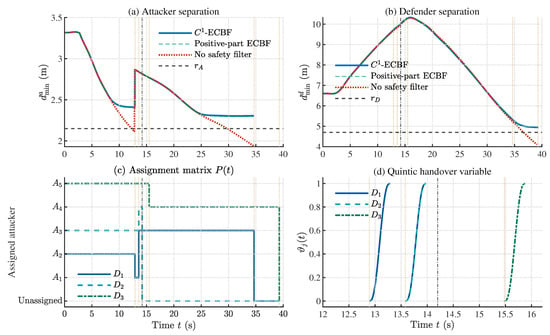
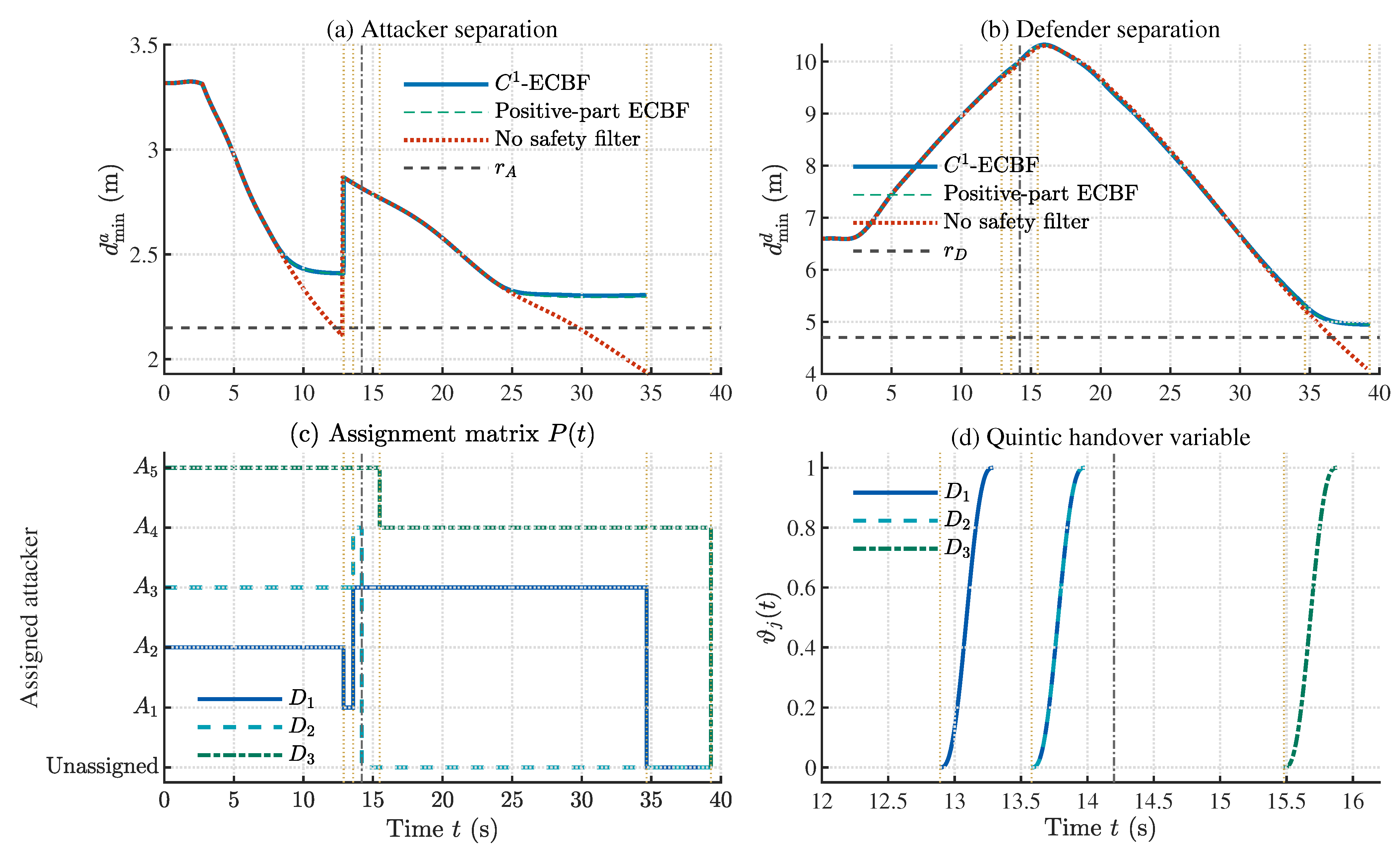
Figure 3 shows the separation histories, and Table 2 compares the five control methods. The nominal learner also captures every attacker, but violates the separation limits at 808 samples and reaches a m margin. The regularized and positive-part ECBFs both achieve five interceptions with zero sampled separation violations. The hard-switch method also maintains the required separation, but its largest off-event force increment reaches N.
Figure 3.
Safety and hybrid-configuration histories. Panels (a,b) compare the proposed -regularized ECBF, the positive-part ECBF, and the unfiltered nominal policy; panels (c,d) display the assignment matrix and the implemented quintic variables .
Table 2.
Deterministic comparison under identical UAV dynamics.
To examine the onset of the safety correction, we compared the two ECBF demand laws at the same states and nominal inputs along the regularized-filter trajectory. With , the demands differ only for , with a maximum difference of at . At 1024 samples, the largest demand over all active same-faction pairs satisfied . At these samples, the positive-part law gives zero demand for every pair and hence zero force correction. The regularized filter applied a nonzero correction, with a peak stacked norm of N across all active vehicles.
Remark 2.
It is worth emphasizing that the purpose of the regularization is not to improve overall mission effectiveness, but to achieve smoother activation of the safety correction near the constraint boundary. Specifically, the regularized demand is continuously differentiable, coincides with the conventional positive-part demand outside the transition layer, and has a uniformly bounded approximation error. Moreover, Theorem 1 establishes an explicit bound on the difference between the corresponding optimal force corrections. These properties provide a smooth transition of the safety demand while retaining a quantifiable deviation from the conventional ECBF filter. Therefore, the primary advantage of the proposed regularization lies in its improved activation regularity and analytical tractability, rather than enhanced interception performance.
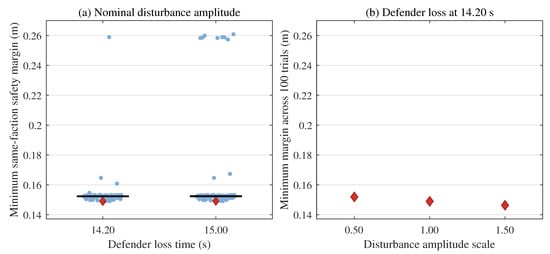
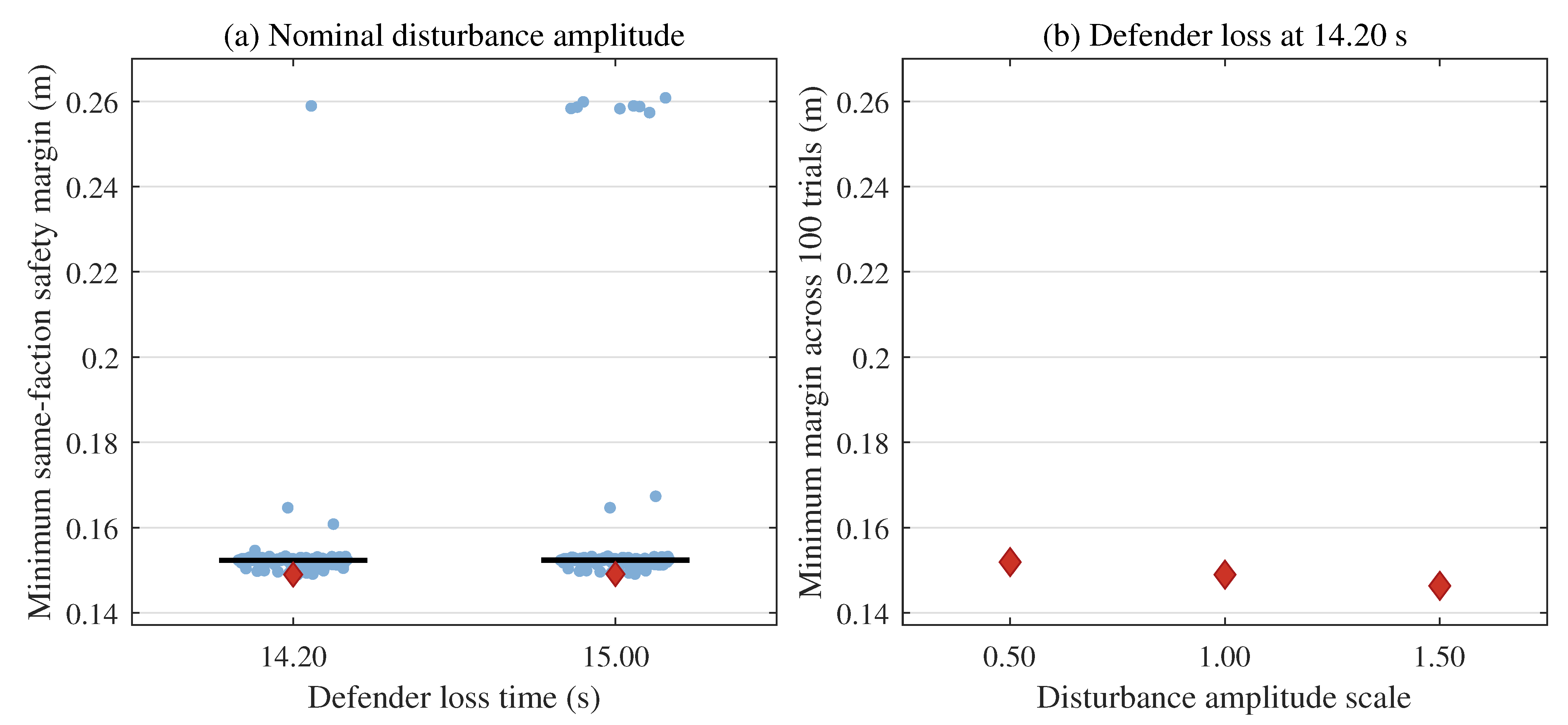
The Monte Carlo study examines the effects of initial configuration, defender-loss timing, disturbance amplitude on interception success, minimum safety margin, and target penetration. Each condition in Table 3 was evaluated over 100 trials. We perturbed the nominal position and velocity components of both teams with zero-mean Gaussian noise with standard deviations of m and m/s, respectively, and retained configurations satisfying the initial same-faction safety conditions. In the loss-time study, we varied the removal time of at the nominal disturbance amplitude. In the disturbance study, we fixed the removal time at s and scaled the disturbance amplitudes of both teams while keeping their frequencies and phases fixed.
Table 3.
Monte Carlo results for the proposed controller under different loss times and disturbance amplitudes (100 trials per condition).
Interception success is the percentage of trials in which all five attackers were intercepted. The minimum safety margin is the smallest sampled same-faction separation in excess of the prescribed separation distance, taken over all active same-faction pairs and all recorded samples in the 100 trials for each condition. Target penetration is the percentage of trials in which at least one attacker entered the protected target region.
Table 3 summarizes the results for five defender-loss times at the nominal disturbance amplitude and three disturbance levels with removed at s. Across all seven conditions, every trial completed all five interceptions, and no target penetration occurred. At the nominal disturbance amplitude, the minimum sampled same-faction safety margin ranged from to m across the five loss times.
Figure 4a shows the trial-level safety margins for the and s loss times. In both groups, most trials had a minimum sampled same-faction safety margin near m. Figure 4b shows that, with the loss time fixed at s, the minimum margin across 100 trials decreased from to m as the disturbance amplitude increased from to times its nominal value.
Figure 4.
Monte Carlo results for minimum same-faction safety margins. (a) At the nominal disturbance amplitude, each blue dot shows the minimum sampled margin in one trial with removed at the indicated time. Black bars mark the medians, and red diamonds mark the minima across 100 trials. (b) With removed at s, each red diamond shows the minimum sampled margin across 100 trials at the indicated disturbance amplitude scale.
Two additional deterministic trials examined the timing of reconfiguration events. With removed at or s, all five attackers were intercepted in each trial without target penetration. In both trials, the shortest interval between consecutive nonterminal reconfiguration events was less than the s handover duration.
Remark 3.
It should be emphasized that the demonstrated resilience to agent loss is limited to the tested single-defender removal scenarios. Specifically, all loss-related simulations consider the removal of defender , with variations in its removal time, initial conditions, and disturbance amplitudes. Although the hybrid formulation accommodates vehicle-removal events under Assumption 2, the numerical results do not establish resilience to arbitrary simultaneous or sequential multiple-agent losses. Further validation is also required to assess such scenarios under realistic flight-level dynamics, including actuator saturation, attitude dynamics, and sensing and communication delays.
4.3. Learning, Handover, and Numerical Audits
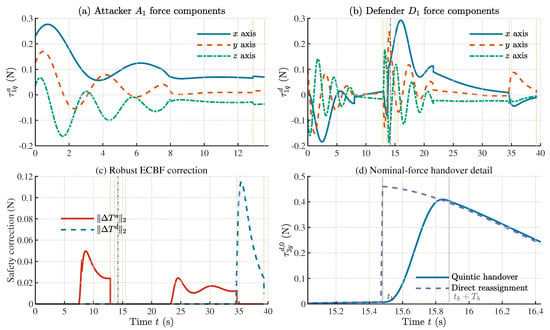
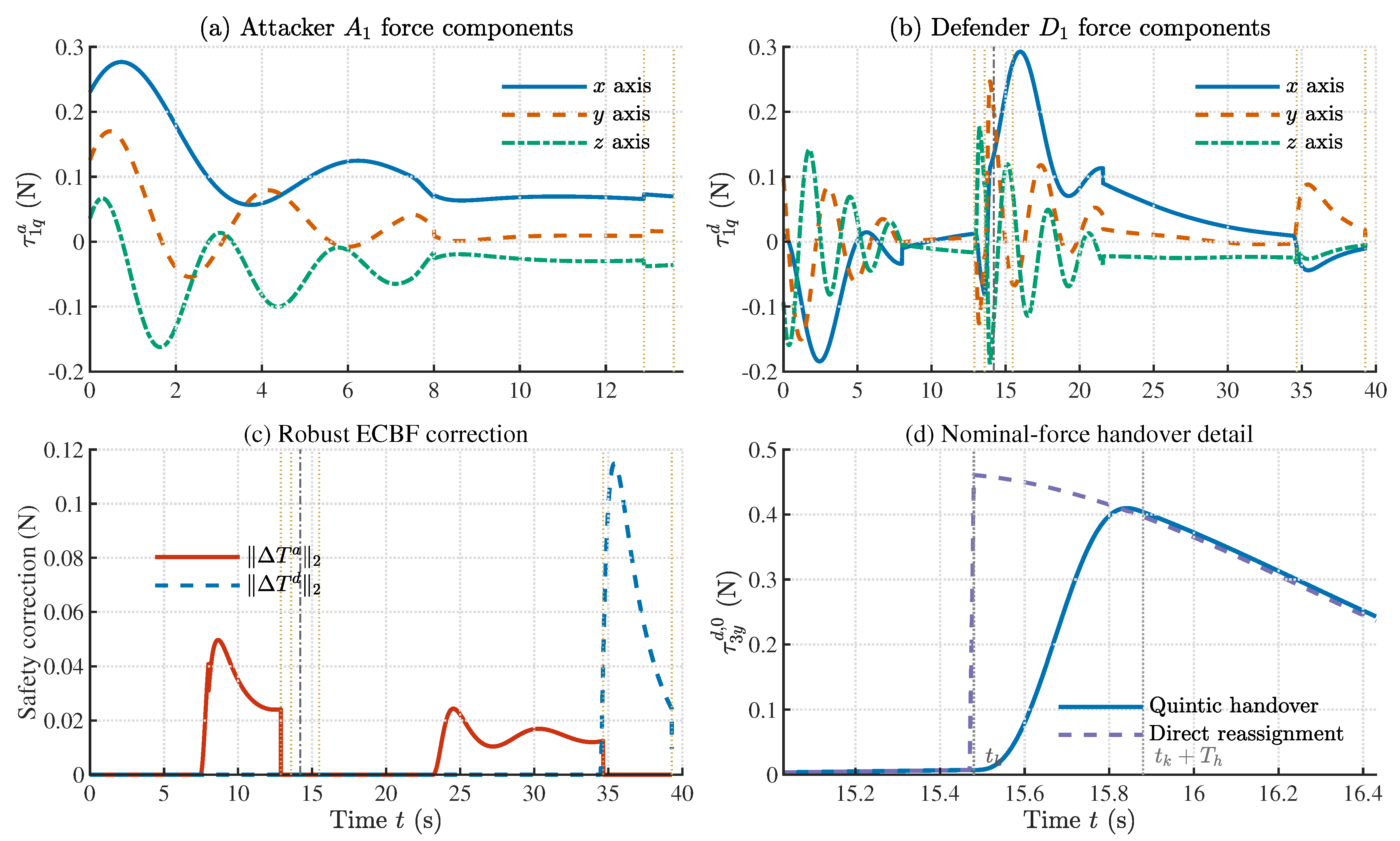
Figure 5 shows that removing the handover increases the largest event-associated force increment from to N, while leaving the continuous-flow indicator essentially unchanged. The minimum interval between consecutive nonterminal events was s, exceeding the handover duration s. Figure 3 shows the assignment changes and their quintic transitions. Assumption 8 requires successive reassignments to be at least apart. If the same defender is reassigned before its handover is complete, the intervening assignment ends before its capture guard is enabled. Even if the pair reaches the capture radius during that assignment, no interception event is triggered for that pair.
Figure 5.
Conventional control histories. Panels (a,b) show the applied force-deviation components and ; panel (c) separates the robust corrections and ; panel (d) displays the component with the largest direct-reassignment increment and the corresponding quintic handover.
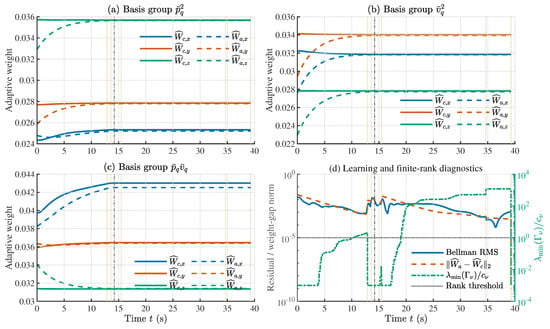
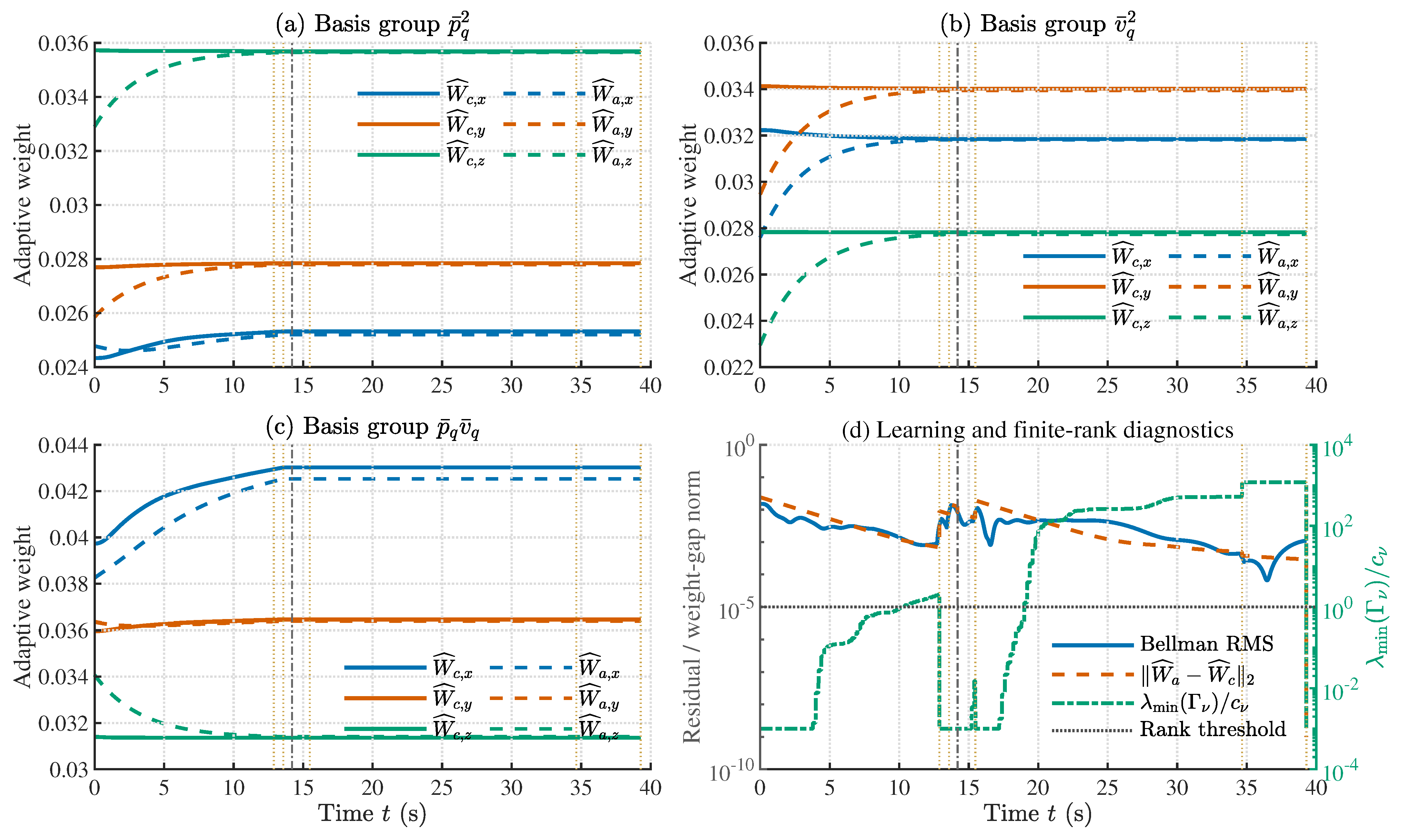
Figure 6 shows that the learning variables remain bounded throughout the engagement. The maximum weight norm is and the final Bellman RMS is . For attacker channel , the critic and actor distances to the nominal Riccati reference are and .
Figure 6.
Actor–critic histories for attacker channel . Panels (a–c) plot every critic and actor weight associated with the normalized basis groups , , and , . Panel (d) reports the Bellman RMS, actor–critic gap, and the minimum normalized Gramian eigenvalue over all currently active learning channels.
Immediately before mission completion, the minimum active normalized history-Gramian eigenvalue is , above the prescribed threshold. Table 1 reports the corresponding rank results for each channel over its activation interval. The “Reached by” column gives an upper bound on the first threshold-crossing time. It uses the earliest sample in that interval at which the minimum over all active channels reached or exceeded . A dash denotes deactivation before threshold crossing. The last column gives the minimum Gramian eigenvalue at the final update of each channel.
All five attacker channels and five of the seven defender–attacker channels reached the threshold during activation. The and channels remained active for 0.69 s and 0.62 s and collected 17 and 15 samples, respectively. Both exited below the threshold, so their full activation intervals belong to the rank-acquisition set . Across the nominal run, all active channels simultaneously satisfied (17) at the recorded samples from 10.20 to 12.88 s and from 19.00 to 39.28 s. For the compact-projection bounds in the proof of Theorem 3, the bounded actor-error terms are included in the residual constants, giving . With the implemented values and , the analysis margins give . The admissible interval in (35) is therefore . The choice satisfies this condition for every channel. The safety QP had zero recorded primal constraint violation at all sampled states. The regularity criterion for its solution map is given after Assumption 7.
Halving the integration step to 0.005 s preserves the interception order. The minimum safety margin changes from 0.1527128 to 0.1527064 m, the completion time from 39.290 to 39.270 s, and the minimum target clearance by 0.17%. The largest interception-time difference is 0.045 s. A capture-radius sweep gives complete interception for every m, with completion times 43.24, 41.07, 39.29, 37.56, and 35.88 s, respectively, and no target penetration. This result separates finite-horizon completion sensitivity from safety: the robust same-faction certificate remains independent of the capture radius.
Remark 4.
It should be noted that the two defender–attacker channels and did not reach the prescribed rank threshold during their activation intervals. Specifically, these channels were deactivated after 0.69 s and 0.62 s, respectively, having collected 17 and 15 samples. The former was deactivated following the interception of , whereas the latter was terminated by the external loss of . According to Assumption 5, their entire activation intervals are included in the rank-acquisition set , during which the projection operators keep the estimated weights bounded. Accordingly, Theorem 3 establishes boundedness over the finite pretermination process, including these rank-deficient intervals. However, its UUB conclusion is conditional on the persistence of a final nonterminal configuration in which all active channels satisfy the prescribed rank condition. Therefore, this conclusion does not extend to the two deactivated channels. The bounded learning trajectories observed in the numerical study should be interpreted as finite-horizon numerical results rather than an unconditional verification of UUB.
5. Conclusions
This article joined force-level actor–critic learning, a robust relative-degree-two ECBF-QP, and hybrid reassignment for heterogeneous unmanned aerial attack–defense teams. The hybrid safety analysis accommodates complete vehicle removal under the finite-event assumptions, while the numerical validation considers the removal of a single defender at different times. The quintic handover isolates continuous task reassignment from unavoidable active-set changes. In the nominal simulation, vehicle speeds and acceleration mismatches stayed within their design bounds. The team completed the remaining interceptions after the loss of a defender. Both controllers completed the mission, but only the safety-filtered controller maintained the required separation at every recorded sample. It should be emphasized that the collision-avoidance guarantee is limited to the idealized outer-loop translational model and does not directly extend to practical UAV systems with actuator saturation, attitude dynamics, or sensing and communication delays. Future work will extend the proposed framework to more general multiple-agent loss scenarios, incorporate actuator constraints, attitude dynamics, and sensing and communication delays, and further validate its effectiveness under realistic UAV flight conditions.
Author Contributions
Methodology, Z.M.; Validation, B.A., F.Z.; Data Curation, B.W.; Writing—Original Draft, B.A.; Writing—Review and Editing, Z.M., F.Z.; Supervision, B.W.; Project Administration, B.W.; Funding Acquisition, B.W. All authors have read and agreed to the published version of the manuscript.
Funding
This work was supported by the Zhejiang Provincial Natural Science Foundation of China under Grant ZCLQN25F0301 and by the Fundamental Research Funds for the Provincial Universities of Zhejiang under Grant 2025YW39.
Institutional Review Board Statement
Not applicable.
Informed Consent Statement
Not applicable.
Data Availability Statement
The original contributions presented in this study are included in the article. Further inquiries can be directed to the corresponding authors.
Conflicts of Interest
The authors declare no conflicts of interest.
Abbreviations
The following abbreviations are used in this manuscript:
| CBF | Control Barrier Functions |
| ADP | Adaptive Dynamic Programming |
| HJB | Hamilton–Jacobi–Bellman |
| ECBF | Exponential CBF |
| QP | Quadratic Program |
| UUB | Uniformly Ultimately Bounded |
| UAV | Unmanned Aerial Vehicle |
References
- Wei, W.; Wang, J.; Du, J.; Fang, Z.; Ren, Y.; Chen, C.L.P. Differential game-based deep reinforcement learning in underwater target hunting task. IEEE Trans. Neural Netw. Learn. Syst. 2025, 36, 462–474. [Google Scholar] [CrossRef] [Scilit]
- Sun, S.; Cai, D.; Zhang, H.-T.; Xing, N. Reinforcement learning-based MAS interception in antagonistic environments. IEEE/CAA J. Autom. Sin. 2024, 11, 270–272. [Google Scholar] [CrossRef] [Scilit]
- Zhang, Y.; Ding, M.; Du, Y.; Peng, F.; Wang, J.; Yang, Q. AAV swarm intelligent interception driven by mission-empowered mean-field gate recurrent reinforcement learning. IEEE Trans. Aerosp. Electron. Syst. 2025, 61, 6373–6389. [Google Scholar] [CrossRef] [Scilit]
- Peng, Z.; Wu, G.; Luo, B.; Wang, L. Multi-UAV cooperative pursuit strategy with limited visual field in urban airspace: A multi-agent reinforcement learning approach. IEEE/CAA J. Autom. Sin. 2025, 12, 1350–1367. [Google Scholar] [CrossRef] [Scilit]
- Wang, Y.; Zhang, H.; Wang, Z.; Yan, H. Nash–minmax strategies for multiagent pursuit–evasion games with reinforcement learning. IEEE Trans. Cybern. 2025, 55, 3320–3331. [Google Scholar] [CrossRef] [Scilit]
- Ruan, W.; Sun, Y.; Deng, Y.; Duan, H. Hawk-pigeon game tactics for unmanned aerial vehicle swarm target defense. IEEE Trans. Ind. Inform. 2023, 19, 11619–11629. [Google Scholar] [CrossRef] [Scilit]
- Wang, X.; Yang, M.; Wang, S.; Chao, T. Two-stage game guidance strategy with impact point for active defense aircraft in two-on-two engagement. IEEE Trans. Aerosp. Electron. Syst. 2025, 61, 710–729. [Google Scholar] [CrossRef] [Scilit]
- Liang, L.; Deng, F.; Lu, M.; Chen, J. Analysis of role switch for cooperative target defense differential game. IEEE Trans. Autom. Control 2021, 66, 902–909. [Google Scholar] [CrossRef] [Scilit]
- Liang, L.; Deng, F.; Wang, J.; Lu, M.; Chen, J. A reconnaissance penetration game with territorial-constrained defender. IEEE Trans. Autom. Control 2022, 67, 6295–6302. [Google Scholar] [CrossRef] [Scilit]
- Von Moll, A.; Pachter, M.; Shishika, D.; Fuchs, Z. Circular target defense differential games. IEEE Trans. Autom. Control 2023, 68, 4065–4078. [Google Scholar] [CrossRef] [Scilit]
- Lopez, V.G.; Lewis, F.L.; Wan, Y.; Sanchez, E.N.; Fan, L. Solutions for multiagent pursuit-evasion games on communication graphs: Finite-time capture and asymptotic behaviors. IEEE Trans. Autom. Control 2020, 65, 1911–1923. [Google Scholar] [CrossRef] [Scilit]
- Li, Y.; Hu, B.; Li, T.; Guan, Z.-H. Attack-defense game of heterogeneous multi-agent systems under actuator faults. IEEE Trans. Autom. Sci. Eng. 2025, 22, 14699–14711. [Google Scholar] [CrossRef] [Scilit]
- Yu, J.; Shi, Z.; Dong, X.; Li, Q.; Ren, Z. Secure cooperative guidance strategy for multimissile system with collision avoidance. IEEE Trans. Aerosp. Electron. Syst. 2025, 61, 1034–1047. [Google Scholar] [CrossRef] [Scilit]
- Du, Z.; Zhang, H.; Wang, Z.; Yan, H. Model predictive formation tracking-containment control for multi-UAVs with obstacle avoidance. IEEE Trans. Syst. Man Cybern. Syst. 2024, 54, 3404–3414. [Google Scholar] [CrossRef] [Scilit]
- Jankovic, M.; Santillo, M.A.; Wang, Y. Multiagent systems with CBF-based controllers: Collision avoidance and liveness from instability. IEEE Trans. Control Syst. Technol. 2024, 32, 705–712. [Google Scholar] [CrossRef] [Scilit]
- Yang, Y.; Zhang, Y.; Zou, W.; Chen, J.; Yin, Y.; Li, S.E. Synthesizing control barrier functions with feasible region iteration for safe reinforcement learning. IEEE Trans. Autom. Control 2024, 69, 2713–2720. [Google Scholar] [CrossRef] [Scilit]
- Lindemann, L.; Robey, A.; Jiang, L.; Das, S.; Tu, S.; Matni, N. Learning robust output control barrier functions from safe expert demonstrations. IEEE Open J. Control Syst. 2024, 3, 158–172. [Google Scholar] [CrossRef] [Scilit]
- Li, B.; Guo, Z.; Hu, C.; Zhu, S.; Wen, S. Safe control framework of multi-agent systems from a performance enhancement perspective. IEEE Trans. Autom. Sci. Eng. 2025, 22, 7622–7631. [Google Scholar] [CrossRef] [Scilit]
- Li, B.; Guo, Z.; Hu, C.; Zhu, S.; Wen, S. Safe formation control of uncertain multiagent systems from a Bayesian perspective. IEEE Trans. Autom. Control 2025, 70, 1929–1934. [Google Scholar] [CrossRef] [Scilit]
- Mylvaganam, T.; Sassano, M.; Astolfi, A. A differential game approach to multi-agent collision avoidance. IEEE Trans. Autom. Control 2017, 62, 4229–4235. [Google Scholar] [CrossRef] [Scilit]
- Cappello, D.; Garcin, S.; Mao, Z.; Sassano, M.; Paranjape, A.; Mylvaganam, T. A hybrid controller for multi-agent collision avoidance via a differential game formulation. IEEE Trans. Control Syst. Technol. 2021, 29, 1750–1757. [Google Scholar] [CrossRef] [Scilit]
- Ames, A.D.; Xu, X.; Grizzle, J.W.; Tabuada, P. Control barrier function based quadratic programs for safety critical systems. IEEE Trans. Autom. Control 2017, 62, 3861–3876. [Google Scholar] [CrossRef] [Scilit]
- Ma, Z.; Wang, Q. Bipartite consensus control of uncertain heterogeneous unmanned systems under communication failures. Nonlinear Dyn. 2026, 114, 263. [Google Scholar] [CrossRef] [Scilit]
- Zhang, T.; Yang, M.; Sun, W.; Yu, D.; Chen, C.L.P. Nonsingular practical fixed-time adaptive fuzzy consensus control of nonstrict-feedback nonlinear multiagent systems with actuator fault. IEEE Trans. Syst. Man Cybern. Syst. 2025, 55, 2834–2845. [Google Scholar] [CrossRef] [Scilit]
- Lin, H.; Dong, J.; Park, J.H. An artificial-delay-based looped functional for dynamic event-triggered fault-tolerant control of T–S fuzzy multi-agent systems. IEEE Trans. Autom. Sci. Eng. 2025, 22, 6050–6060. [Google Scholar] [CrossRef] [Scilit]
- Ren, H.R.; Ma, H.; Li, H.Y.; Wang, Z.Y. Adaptive fixed-time control of nonlinear MASs with actuator faults. IEEE/CAA J. Autom. Sin. 2023, 10, 1252–1262. [Google Scholar] [CrossRef] [Scilit]
- Dong, S.; Liu, K.; Liu, M.; Chen, G. Cooperative time-varying formation fuzzy tracking control of multiple heterogeneous uncertain marine surface vehicles with actuator failures. IEEE Trans. Cybern. 2024, 54, 667–678. [Google Scholar] [CrossRef] [Scilit]
- Jin, D.; Xiang, Z. Adaptive event-triggered fixed-time fault-tolerant consensus control for a class of multiagent systems. IEEE Trans. Syst. Man Cybern. Syst. 2024, 54, 4853–4862. [Google Scholar] [CrossRef] [Scilit]
- Vamvoudakis, K.G.; Lewis, F.L. Online actor-critic algorithm to solve the continuous-time infinite horizon optimal control problem. Automatica 2010, 46, 878–888. [Google Scholar] [CrossRef] [Scilit]
- Kamalapurkar, R.; Dinh, H.T.; Bhasin, S.; Dixon, W.E. Approximate optimal trajectory tracking for continuous-time nonlinear systems. Automatica 2015, 51, 40–48. [Google Scholar] [CrossRef] [Scilit]
- Wang, N.; Gao, Y.; Zhao, H.; Ahn, C.K. Reinforcement learning-based optimal tracking control of an unknown unmanned surface vehicle. IEEE Trans. Neural Netw. Learn. Syst. 2021, 32, 3034–3045. [Google Scholar] [CrossRef] [Scilit]
- Liu, D.; Mao, Z.; Jiang, B.; Shi, P.; Ma, Y. Optimal containment control of heterogeneous multiagent systems with unknown dynamics and actuator faults via fuzzy reinforcement learning. IEEE Trans. Fuzzy Syst. 2025, 33, 3331–3344. [Google Scholar] [CrossRef] [Scilit]
- Mestres, P.; Allibhoy, A.; Cortés, J. Regularity properties of optimization-based controllers. Eur. J. Control 2025, 81, 101098. [Google Scholar] [CrossRef] [Scilit]

Disclaimer/Publisher’s Note: The statements, opinions and data contained in all publications are solely those of the individual author(s) and contributor(s) and not of MDPI and/or the editor(s). MDPI and/or the editor(s) disclaim responsibility for any injury to people or property resulting from any ideas, methods, instructions or products referred to in the content. |
© 2026 by the authors. Licensee MDPI, Basel, Switzerland. This article is an open access article distributed under the terms and conditions of the Creative Commons Attribution (CC BY) license.