


Highlights
What are the main findings?
- 77 evidence-based recommendations across 13 domains establish an integrated burn emergency care framework.
- Evidence reveals a protocol-resource disconnect, where underrepresented ABC and system-level enablers critically determine acute outcomes
What are the implications of the main findings?
- Early burn care is system-based, requiring adaptive scene control and resource-calibrated interventions, not rigidity.
- ABC saves lives, while suboptimal interventions sustain life until transfer, yet require greater resource capacity.
Abstract
Background: Early management of adult burn injuries in resource-constrained environments—such as battlefields and primary care facilities—remains hindered by the absence of standardized, evidence-based protocols. This study aimed to systematically synthesize existing evidence and develop an integrated framework of actionable recommendations to optimize prehospital and early emergency care. Methods: A comprehensive evidence synthesis was conducted across 14 international and domestic bibliographic databases and authoritative repositories. Eligible sources included clinical practice guidelines, expert consensus statements, evidence summaries, and systematic reviews. Literature quality was appraised using validated instruments, and best-practice recommendations were extracted and thematically synthesized across the continuum of early burn care. Results: Fifty-nine high-quality studies yielded 77 recommendations across 13 domains, spanning from scene safety and burn process cessation through airway, breathing, and circulatory management to wound care, infection control, and transfer preparation. An integrated, context-adaptive framework was established to guide resource-calibrated interventions rather than rigid protocol adherence. Conclusions: These findings provide tiered guidance for frontline healthcare providers and inform the development of emergency care standards in resource-limited settings. Future research should prioritize field validation and contextual implementation to address barriers to evidence translation and enhance real-world applicability.
1. Introduction
Burn injuries represent one of the most devastating forms of trauma, causing extensive tissue damage and systemic complications through exposure to thermal, chemical, electrical, or radiation sources [1]. Globally, burns are a persistent public health burden, with an estimated 180,000 deaths annually and a disproportionate concentration in low- and middle-income countries (LMICs) [2,3,4]. According to the Global Burden of Disease 2019 study, approximately 9 million new burn cases occur each year, with mortality rates showing a worrisome upward trend in certain regions [5]. In addition to civilian contexts, burns remain a major cause of morbidity and mortality during armed conflicts [6]. Data from historical and contemporary military operations, including the current Russia–Ukraine conflict, consistently demonstrate the high incidence and severity of thermal injuries among combat casualties [7].
Improper first aid or delayed early burn management can directly increase complications and even mortality [8]. Evidence indicates that timely and standardized early management can significantly limit burn depth progression, reduce infection risk, and improve long-term prognosis [8]. However, in real-world primary care settings, early management of adult burn patients is often performed by general practitioners or community health workers, who lack specialized training and face constraints in equipment, medication, and access to specialized knowledge and evidence in burn treatment [9]. Meanwhile, primary care providers in resource-constrained settings often rely on empirical judgment or seek consultation from specialized burn physicians, lacking comprehensive and evidence-based guidance, which is plagued by issues such as low accuracy in burn injury assessment and the presence of hidden shock in burn cases [10]. This leads to wide variability in the quality of care and frequent reliance on empirical or outdated practices, potentially exacerbating injury severity and delaying recovery [11].
Despite the availability of numerous international guidelines and expert consensus documents [12], several systemic barriers hinder the effective translation of evidence into early clinical practice. First, recommendations for the early management phase are fragmented across different guidelines and chapters, lacking consolidation for time-sensitive decision-making. Second, most guidelines are designed for tertiary burn centers with optimal infrastructure, rendering many recommendations impractical for low-resource environments. Finally, limited cross-context validation and inadequate dissemination strategies have perpetuated the evidence–practice gap, leaving primary health care providers without accessible, standardized, and actionable frameworks.
To address this unmet need, the present study systematically integrates high-quality evidence (obtained through rigorous evidence evaluation and tracing the evidence level from original studies) from global guidelines, expert consensus, and systematic reviews to develop a concise, practice-oriented evidence summary for early management of adult burn patients. By emphasizing applicability in resource-limited contexts, this synthesis aims to provide an operational foundation for standardized emergency care, enhance the consistency of frontline responses, and inform future policy and protocol development for adult burn injury management.
2. Materials and Methods
This study followed the methodological framework of the Joanna Briggs Institute (JBI) for evidence synthesis and reporting of evidence summaries. The process was conducted in accordance with the updated 2021 JBI Manual for Evidence Implementation, complemented by the 5S evidence pyramid model for hierarchical retrieval of pre-appraised evidence sources [13,14].
2.1. Formulation of Research Questions
Research questions were formulated using the PIPOST framework, defining the following components: Population (P): adult patients with burn injuries (mainly thermal, or mixed types); Intervention (I): emergency care or early care interventions of burn injuries; Professional (P): healthcare providers or emergency responders involved in early management; Outcome (O): indicators of early care effectiveness (e.g., survival, infection prevention, stability of basic vital signs prior to transportation); Setting (S): primary care facilities, prehospital settings, or battlefield prior to specialized burn center transfer; Type of evidence (T): guidelines, expert consensus, evidence summaries, and systematic reviews.
2.2. Data Sources and Search Strategy
A comprehensive and systematic search was conducted across 14 authoritative electronic databases and institutional websites from inception to March 2025. These included major clinical guideline repositories, such as the National Institute for Health and Care Excellence (NICE), Registered Nurses Association of Ontario (RNAO), Agency for Healthcare Research and Quality (AHRQ), and Chinese Yimaitong website; literature databases, such as UpToDate, Cochrane Library, JBI Evidence—based Database, PubMed, Embase, Web of Science, China Knowledge Network (CNKI), China Biomedical Literature Database (CBM); as well as academic society official websites, such as International Society for Burn Injury (ISBI), and American Burn Association (ABA). Search terms were developed using both controlled vocabulary (MeSH/Emtree) and free-text terms, incorporating Boolean logic and truncations to capture British and American spellings. An English database search using PubMed with the search strategy was as follows: (“burns” OR “burn injuries” OR “thermal injuries” OR “burn*” OR “burn injury” OR “burn wound*”) AND (“emergency treatment” OR “first aid” OR “emergency care” OR “emergency nursing” OR “early care” OR “pre-hospital care” OR “prehospital management” OR “emergency care” OR “emergency management” OR “acute care” OR “resource-limited” OR “low-resource” OR “austere environment”) AND (“practice guidelines” OR “guideline” OR “consensus” OR ”expert consensus” OR “systematic review” OR “meta-analysis” OR “evidence-based practice” OR “evidence synthesis” OR “evidence summary” OR “recommendation*”). Equivalent search strategies were adapted for Embase (Emtree terms), Web of Science, Cochrane Library (MeSH descriptor explosions), and major Chinese databases. All retrieved records were exported into EndNote X9 and deduplicated automatically and manually. Other new studies were identified through citation searching.
2.3. Inclusion and Exclusion Criteria
Inclusion criteria for this study were (1) research topics that focus on burn emergency care plans, encompassing burn care measures, procedures, and decisions; (2) study subjects were limited to adult burn patients or casualties with burn injuries; (3) study types were practice guidelines, systematic reviews, evidence summaries, and expert consensus; (4) English and Chinese studies.
Exclusion criteria were (1) duplicate inclusion or verbatim translation of studies; (2) interpretation of studies; (3) content only concerning burn rehabilitation treatment or training; (4) studies not available through various channels; (5) existing updated versions of literature.
2.4. Screening and Selection Process
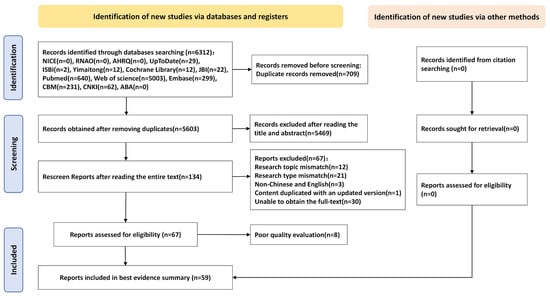
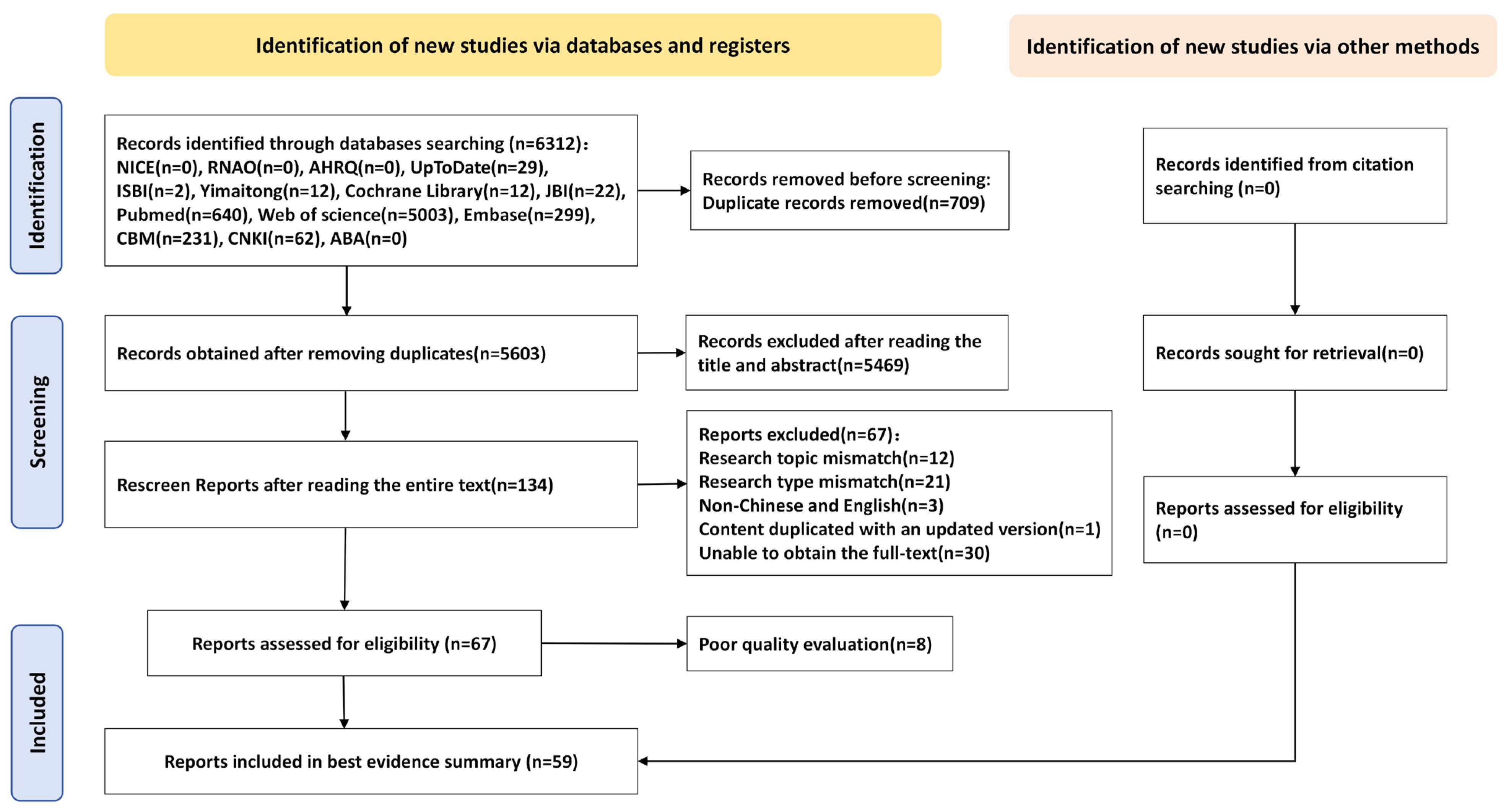
Two reviewers (HT and SY) independently screened all titles and abstracts. The full text of potentially relevant studies was retrieved and evaluated against eligibility criteria. Discrepancies were resolved through discussion or adjudication by a third senior reviewer (LG). The screening process followed the PRISMA 2020 flow (Figure 1).
Figure 1.
Flow chart of literature screening.
2.5. Quality Appraisal
Quality appraisal was conducted independently by three reviewers (HT, SY, and RZ) trained at the Fudan University JBI Center. Guidelines were assessed using the AGREE II instrument, which includes 23 items across six domains: scope and purpose, stakeholder involvement, rigor of development, clarity, applicability, and editorial independence. Each item was scored from 1 to 7, and standardized domain percentages were computed to categorize quality as level A (strong recommendation, ≥60% in all domains), level B (recommended, ≥30% in at least three domains), or level C (not recommended, <30% in three or more domains). Systematic reviews were appraised using the 11-item JBI checklist for systematic reviews and research syntheses, while expert consensus was evaluated using the JBI Evidence-Based Healthcare Evaluation Criteria (2016 edition). Given the lack of a validated instrument for assessing evidence summaries, we traced each summary back to its primary studies and applied the appraisal tools recommended in the 2016 JBI Evidence-Based Healthcare Center standards [15]. Inter-rater reliability was calculated using the intraclass correlation coefficient (ICC), with ICC ≥ 0.75 interpreted as excellent agreement.
2.6. Data Extraction
Data extraction was carried out using a pre-piloted Excel form. Two reviewers (HT and SY) independently captured the authors, publication dates, titles, and topics of the included studies, along with the study types (guidelines, expert consensus, systematic reviews, or evidence summaries), evidence entry content, and evidence levels. Any discrepancies were discussed until consensus was achieved, with arbitration by a senior investigator (ZZ) when required.
2.7. Evidence Synthesis and Integration
Evidence synthesis followed a hierarchical inductive approach. Recommendations were first grouped by clinical domain, such as airway management, circulatory resuscitation, pain control, wound care, and infection prevention. Overlapping evidence was merged by content similarity, and conflicting findings were resolved by prioritizing recent, high-quality, and methodologically rigorous sources. Evidence was stratified into first-line essential measures and second-line context-dependent measures to reflect clinical feasibility under varying resource conditions. Two reviewers (HT and SY) independently conducted the merging process to minimize subjective bias, comparing wording, conceptual overlap, and underlying evidence sources. Each independently merged dataset was then cross-checked for consistency. When discrepancies occurred—such as divergent interpretations of overlapping statements or inconsistent classification across domains—they were discussed in consensus meetings moderated by a senior reviewer (LG). Disagreements that could not be resolved through discussion were referred to a third methodological expert for arbitration. All merging decisions, rationale for inclusion or exclusion, and any modification of wording were documented in an audit trail maintained in Microsoft Excel and archived in the project repository. All final recommendations were tabulated and narratively summarized following JBI standards.
2.8. Quality Assurance and Peer Validation
Quality assurance was ensured through a structured peer-review process. Reviewers were required to meet the following eligibility criteria: a minimum of 10 years of experience in burn medicine or specialized/critical care nursing; possession of a senior professional title or a postgraduate degree; and voluntary participation in the study. In accordance with the JBI recommendation system, evidence was categorized into two levels: A-level (strong recommendation) and B-level (weak recommendation) [15]. The research team first conducted a preliminary appraisal of the strength of each of the 77 aggregated evidence statements. Subsequently, an online external expert-consultation workshop was held, in which five senior burn or trauma emergency-care specialists independently reviewed the initial ratings. Discrepancies between expert assessments and the preliminary evaluations were addressed through group deliberation and resolved by adjudication from the team leader. Each evidence statement was examined for feasibility, clarity, and contextual relevance (especially the applicability of developed-world evidence to resource-limited contexts). Expert feedback was incorporated into the final synthesis through iterative consensus rounds.
3. Results
3.1. Study Selection and Characteristics
A total of 6312 records were retrieved through the database and manual searches. After removal of 709 duplicates, 5603 unique citations were screened by title and abstract. Of these, 104 full-text articles were reviewed, and 67 publications ultimately met the inclusion criteria. The included literature comprised 10 clinical practice guidelines [12,16,17,18,19,20,21,22,23,24], 26 expert consensus statements [25,26,27,28,29,30,31,32,33,34,35,36,37,38,39,40,41,42,43,44,45,46,47,48,49,50], 24 systematic reviews [51,52,53,54,55,56,57,58,59,60,61,62,63,64,65,66,67,68,69,70,71,72,73,74], and 7 evidence summaries [75,76,77,78,79,80,81]. The PRISMA 2020 flow diagram for study selection is shown in Figure 1. The primary research locations spanned 20 countries across five continents. China contributed the largest number of studies (n = 19) [25,26,27,29,30,31,32,36,43,45,46,54,65,68,75,76,78,79,80], followed by the United States (n = 12) [12,16,17,21,23,33,37,38,39,40,41,77], Australia (n = 9) [28,34,35,47,63,69,71,72,81], and the United Kingdom (n = 5) [19,20,44,50,67]. The remaining 21 studies were conducted across 16 other countries. The literature included both civilian and military burn-care contexts. Most studies (82.09%) were published after 2015, and 40.30% of these were published in the past five years. General characteristics of the included studies are shown in File S2.
3.2. Quality Appraisal of Included Evidence
Methodological appraisal demonstrated overall moderate-to-high quality among the included studies, though inter-source variability was evident. After literature screening, 10 guidelines were selected for quality assessment using the AGREE II instrument (Table 1). Among them, 9 were classified as a level B rating [12,16,17,18,19,21,22,23,24] and 1 as level C (indicating poor quality), thus being excluded. Ultimately, 9 guidelines were included for evidence item extraction. The strongest performing domains were “scope and purpose” and “clarity of presentation,” while “applicability” and “editorial independence” exhibited lower scores, reflecting ongoing challenges in operationalization and conflict-of-interest management. Interrater reliability across reviewers reached ICC = 0.844, indicating strong agreement.
Table 1.
Quality evaluation results of guidelines (n = 10).
Among the 26 expert consensus statements, 14 received “Yes” for all evaluation criteria, reflecting high methodological rigor [25,26,27,29,30,31,32,33,36,38,39,40,44,48]; ten were of moderate quality [28,34,35,37,41,43,45,46,47,50], mainly limited by insufficient reporting of evidence sources or the Delphi process, and two were excluded due to poor transparency and outdated evidence [42,49].
Twenty-four systematic reviews were appraised using the JBI 11-item checklist (Table 2). Six reviews were rated as high quality [51,54,58,62,65,66], thirteen as moderate quality [53,55,57,59,60,61,64,68,70,71,72,73,74], and five as low quality and excluded [52,55,56,63,67,69]. High-quality reviews consistently employed comprehensive search strategies and transparent data extraction processes.
Table 2.
Quality evaluation results of included systematic reviews (n = 24).
The seven evidence summaries were all retained, having demonstrated adequate methodological reporting and clear linkage between evidence sources and recommendations [75,76,77,78,79,80,81].
3.3. Summary of Evidence and Practice Recommendation Results
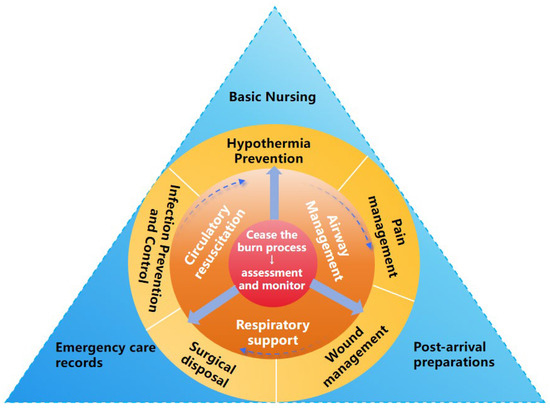
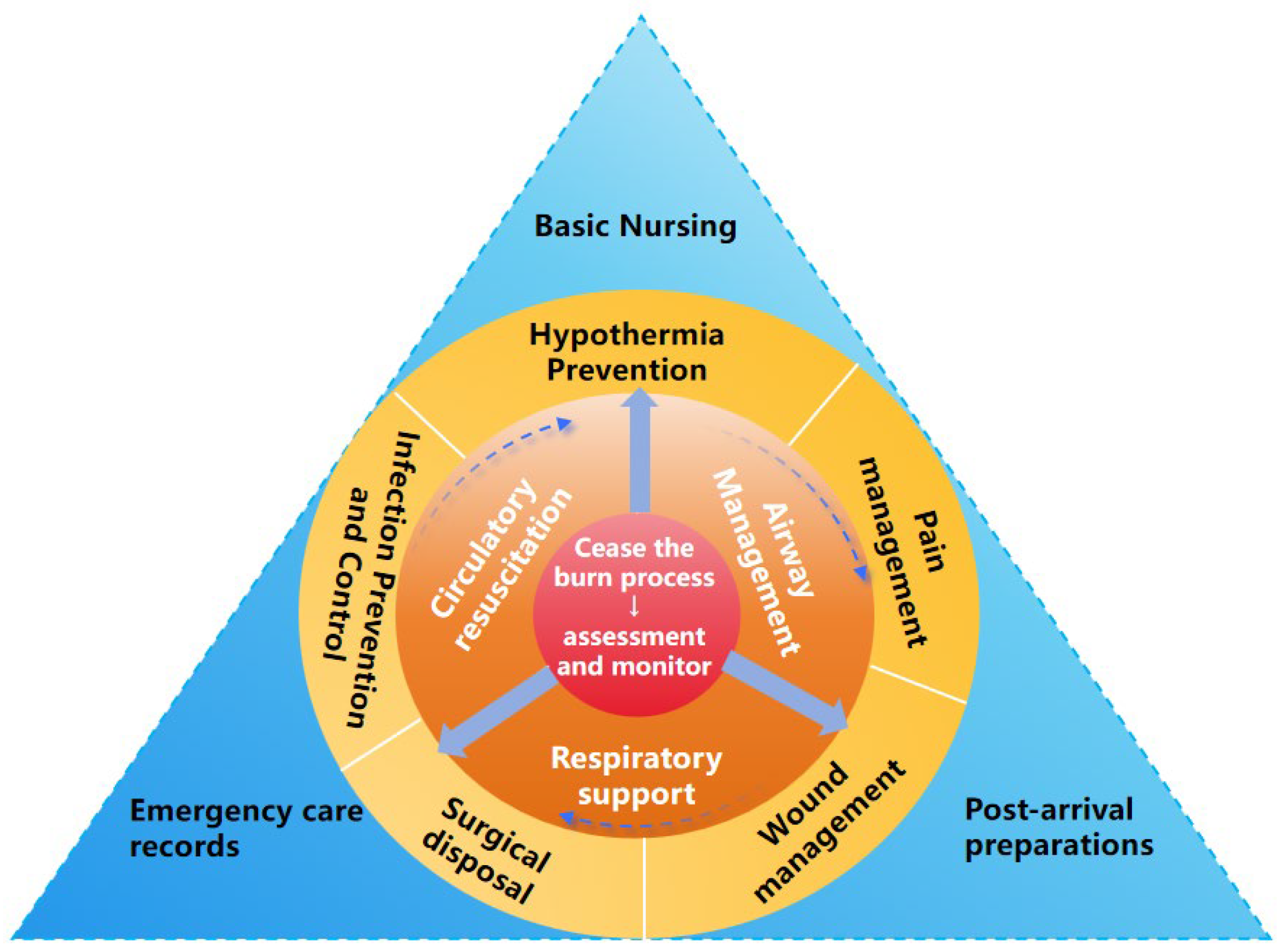
Following critical appraisal, 59 articles met the inclusion criteria for evidence extraction and synthesis. From these studies, the research team derived 77 evidence statements, which were organized into 13 overarching themes representing key components of early management prior to specialized burn care. These themes encompassed cessation of the burn process, early assessment and monitoring, airway management, respiratory support, circulatory resuscitation, prevention of hypothermia, pain control, wound care, infection prevention, surgical management, nursing care, documentation, and patient transfer. The synthesized evidence is presented in Table 3. Based on methodological quality and contextual feasibility, all synthesized recommendations were stratified into one core and three hierarchical levels. The core interventions were the immediate cessation of the burn process coupled with prompt assessment and monitoring, an unequivocally non-negotiable emergency. The first-tier comprised essential, time-sensitive interventions universally applicable across clinical contexts, including airway management, respiratory support, and circulatory resuscitation. The second level encompassed context-dependent interventions, such as hypothermia prevention, pain management, wound protection, surgical decompression, and infection control—whose applicability depends on available infrastructure and personnel expertise. The third layer encompassed essential interventions or procedures, including basic nursing care, emergency care documentation, and post-arrival and transfer preparations. The hierarchical relationship and priority order among the topics formed the basic framework of early management of adult burn patients, shown in Figure 2.
Table 3.
Summary of best evidence for early management of adult burn injury patients.
Figure 2.
Framework of early management of adult burn patients. Note: The framework is arranged in concentric circles from the center outward to distinguish the priority of various measures for early management of adult burn patients. Different colors represent distinct levels: red denotes the core interventions; orange circles indicate the first level; yellow represents the second level; and blue signifies the third layer. Blue solid arrows illustrate the sequential progression of handling measures from inside to outside, while blue dashed arrows suggest that the ABC emergency response measures may be implemented in a cyclical manner without strictly fixed order.
4. Discussion
4.1. Safety and On-Site Control as Prerequisites for Effective Burn Injury Management
Ensuring scene safety and establishing on-site control are essential prerequisites for the effective management of burn victims. Continuous energy transfer—whether from residual heat, open flames, chemicals, or electrical currents—can significantly exacerbate tissue destruction [83,84]. Thus, the immediate removal of the injured individual from thermal or hazardous source represents the critical first step in early burn care and forms the foundation for all subsequent rescue procedures. This phase requires seamless coordination between fire-rescue personnel and trained first-aid responders. The evidence supporting these initial measures is substantial and largely consistent, typically implemented by primary health care providers such as pre-hospital emergency ambulance personnel, trained in basic life support rather than specialized burn care, and requiring relatively limited medical resources [85]. Given the inherent unpredictability of on-site conditions, responders must first ensure environmental safety to protect both themselves and the victim. Rescue preparations must take into account the substantial differences between field conditions and controlled hospital settings, underscoring the need for responders to demonstrate situational adaptability and strong self-protection awareness [86]. Special caution is required during the management of chemical burns, where the risk of secondary exposure to hazardous substances poses a direct threat to the safety of rescue teams. Despite the urgency of treatment, proper donning of personal protective equipment is essential [87,88]. Swift and gentle removal of the victim’s clothing, while preventing further tissue damage, constitutes a critical component of early care [19,22,28,34,76]. These measures not only establish the groundwork for subsequent professional interventions but also help reduce long-term morbidity and may facilitate the necessary window for definitive burn treatment [87,88].
4.2. Prioritizing ABC Emergencies Under Resource-Constrained Conditions
Under conditions of limited resources—such as battlefield environments or mass-casualty incidents—triage must prioritize the management of ABC emergencies that pose an immediate threat to life [89]. This approach is consistent with fundamental trauma care principles and aligns with the “platinum ten minutes” and “golden hour” concepts, which emphasize the critical importance of rapid intervention to prevent avoidable mortality [90,91]. As a specific category of trauma, burn injuries are frequently complicated by fatal inhalation insults, necessitating timely identification and decisive management [92,93]. In this study, we summarize a concise set of clinical indicators and complementary diagnostic procedures for evaluating inhalation injury [18,23,29,75]. However, the scarcity of emergency care resources can create ambiguity in clinical judgment. Several studies have therefore quantified the risk and severity of inhalation injury, providing pragmatic assessment tools based on operationally accessible clinical indicators for use in resource-limited settings [94]. These tools allow responders to implement stratified treatment strategies in a targeted and efficient manner. Given the limited availability of oxygen in many prehospital settings, patients with moderate-to-severe inhalation injury should be prioritized for high-flow oxygen therapy at 10–15 L/min [29,75]. If adequate oxygenation cannot be maintained, advanced airway interventions—such as insertion of a nasopharyngeal airway or emergency cricothyroidotomy even invasive ventilatory support must be initiated without delay [29,75]. This step, although lifesaving, poses substantial technical challenges for primary healthcare providers and underscores the need for dedicated training in advanced airway management [95].
Circulatory resuscitation constitutes another critical component of early burn care, requiring a structured and context-appropriate treatment plan. In resource-limited environments, oral rehydration may be suitable for patients with burns covering <20% TBSA [19,25,32,41]. In contrast, patients with extensive burns (≥20% or ≥40% TBSA) should receive intravenous fluid resuscitation [18,19,22,23,25,28,41]. When intravenous access cannot be established promptly, intraosseous infusion provides a reliable alternative for fluid administration [19]. Regarding the volume of fluid resuscitation, the modified Brooke and Parkland formulas continue to serve as international standards in specialized burn centers [96]. However, our findings indicate the ten-fold formula suits the initial prehospital phase, especially for non-specialist frontline responders and existing studies confirm comparable accuracy to the two formulas mentioned above [25]. The formula’s simplicity—providing a consistent hourly fluid rate independent of weight variations—facilitates rapid calculation, minimizes dosing errors, and has demonstrated effectiveness in early resuscitation, supporting its broader dissemination [82]. In conclusion, prioritizing the assessment and management of life-threatening ABC conditions enables emergency personnel to convert the narrow window of critical intervention into meaningful survival gains. This strategy reduces the risk of secondary complications and lowers overall mortality among severely burned patients [97,98].
4.3. The Effectiveness of Burn Emergency Care Depends on Context-Adaptive, Resource-Based Interventions and Timely Transfer
While ABC management is focused on “saving lives,” subsequent interventions aim to “prolong life” and stabilize the patient for definitive treatment [24]. This phase requires context-adaptive implementation based on available resources rather than attempting comprehensive, hospital-level care in the field. Our evidence synthesis identifies several key domains for ongoing management—including hypothermia prevention, analgesia, wound care, infection control, and essential surgical measures—but emphasizes that successful practice depends on timely, situation-specific adjustments.
Burn patients, particularly those with extensive injuries (burns ≥ 20%) or concurrent seawater immersion, are highly susceptible to hypothermia due to loss of the skin barrier and evaporative heat loss—factors strongly associated with increased mortality [19,99,100]. In naval or maritime combat environments where seawater immersion is common and medical resources may be scarce, integrating continuous temperature monitoring with insulation or active rewarming strategies becomes essential [101]. These measures must be executed using whatever materials or equipment such as bedding and survival blankets are immediately available. Pain management for burn patients—including thresholds for intervention, modality selection, and stepwise analgesic escalation—generally follows established analgesic principles. The major challenge in resource-limited settings is the limited availability of potent opioid analgesics such as morphine [102]. During drug shortages, substituting agents such as ibuprofen or employing non-pharmacological interventions (e.g., psychological support, distraction, positioning) can offer meaningful relief from pain and anxiety when opioids are unavailable [103].
Current evidence generally supports the early application of cold therapy (ideally initiated within 10 min and no later than 3 h post-injury) using running water for approximately 20 min as a primary intervention for burns involving limited TBSA (often defined as <20%), with the understanding that the duration and feasibility of this approach should be adjusted based on available water resources and other operational constraints at the scene, followed by appropriate wound protection [19,25,26,33]. However, the choice of dressing for initial wound coverage remains a contentious issue and is heavily influenced by local resource availability. Determining the optimal dressing for burns of varying depths is a complex clinical decision, and no unified consensus currently exists. In resource-constrained settings, silver sulfadiazine (SSD) remains widely used—particularly for deep burns and exposure therapy—due to its affordability and broad antimicrobial properties [18,21,38,77]. Emerging evidence, however, suggests that certain novel dressings such as silver-containing hydrofiber dressings, nanocrystalline silver dressings, amniotic membranes, and other biological dressings may provide superior infection control and promote faster wound healing compared with SSD [104,105]. Additional high-quality studies are required to validate these findings and inform definitive recommendations. In practice, dressing choices can be pre-planned or upgraded based on operational needs and logistical feasibility. Surgical interventions represent the most technically demanding component of early burn care and are profoundly constrained by environmental sterility and the availability of skilled personnel. Procedures such as escharotomy for circumferential burns require experienced burn or trauma specialists capable of balancing sterility, hemostasis, and patient stability under austere conditions [106]. For patients with extensive burns, the highest priority is rapid transfer to a specialized burn center for definitive care, provided that the patient’s immediate safety can be ensured. Effective coordination of transportation and optimal allocation of limited resources serve as critical elements in preventing further clinical deterioration and improving overall prognosis [38,41].
In summary, this discussion reinforces the proposed framework for early management of burn patients in resource-limited settings. The core intervention—immediate cessation of the burn process combined with prompt assessment and monitoring—emerges as an unequivocal, non-negotiable priority across all contexts. At the first tier, life-saving measures such as airway management, respiratory support, and circulatory resuscitation are broadly applicable and must be prioritized under any resource condition. The second tier includes context-dependent interventions—hypothermia prevention, pain management, wound protection, surgical decompression, and infection control—whose implementation should be guided by available infrastructure and personnel expertise rather than pursued universally in the field. Meanwhile, transfer preparations, as well as nursing care and documentation, support the continuity of care and safe transitions. Across these levels, the evidence demonstrates strong consensus on core and first-tier interventions, but reveals significant limitations regarding second-tier practices, where high-quality studies are comparatively scarce—particularly comparing wound dressings, opioid-sparing pain strategies, and field feasibility of escharotomy. Clinically, these findings reinforce the need for pragmatic, resource-tiered protocols that enable primary healthcare providers and first responders to deliver life-sustaining care within realistic operational constraints.
5. Conclusions
This study provides a comprehensive synthesis of the best evidence for early management of burn injuries, with particular emphasis on the distinctive challenges encountered in resource-limited environments, such as battlefield environments or primary care facilities. By consolidating recommendations across 13 key domains and organizing them into immediate, first-aid, secondary-aid, and full-process care phases, this review bridges existing evidence with real-world operational constraints. The resulting synthesis offers structured, evidence-informed guidance tailored for primary healthcare providers and emergency responders. Implementing these practices may optimize the early management of adult burn patients, preserve critical time for definitive specialized care, and ultimately reduce long-term morbidity. In addition, this work establishes a foundational framework that can support the development of standardized clinical decision-making protocols for early burn care across diverse, resource-constrained settings. This synthesis is limited by the fact that the majority of included guidelines and primary studies originate from high-income settings, leaving their direct applicability to resource-constrained or austere environments largely untested. Future work should examine in greater depth the implications of implementing, validating in real-world settings, and locally adapting the proposed recommendations, thereby facilitating their effective translation across diverse operational contexts.
Supplementary Materials
The following supporting information can be downloaded at: https://www.mdpi.com/article/10.3390/ebj7020034/s1. File S1: Literature retrieval process; File S2: General information of the included literature; File S3: Literature quality appraisal; File S4: ICC of included guidelines; File S5: Evidence quality assurance and peer validation.
Author Contributions
H.T. implemented the study and drafted the manuscript. S.Y. and R.Z. assisted in the implementation of the study, especially the literature quality evaluation and evidence extraction. Z.Z. supervised the entire process, edited and reviewed the manuscript. L.G. designed and helped with the implementation of the study, reviewed the manuscript, and funding acquisition. All authors have read and agreed to the published version of the manuscript.
Funding
This research was funded by the National Natural Science Foundation of China, grant number 72174205.
Institutional Review Board Statement
Not applicable.
Informed Consent Statement
Not applicable.
Data Availability Statement
No new data were created or analyzed in this study. Data sharing is not applicable to this article.
Acknowledgments
The authors express their gratitude to the expert consultation workshop for their efforts in evidence quality assurance and peer validation.
Conflicts of Interest
The authors declare no conflicts of interest.
Abbreviations
The following abbreviations are used in this manuscript:
| LMICs | Low- and middle-income countries |
| JBI | Joanna Briggs Institute |
| NICE | National Institute for Health and Care Excellence |
| RNAO | Registered Nurses Association of Ontario |
| AHRQ | Agency for Healthcare Research and Quality |
| CNKI | China Knowledge Network |
| CBM | China Biomedical Literature Database |
| ISBI | International Society for Burn Injury |
| ABA | American Burn Association |
| TBSA | Total body surface area |
| LDI | Laser Doppler imaging |
| NRS | Numerical Rating Scale |
| VAS | Visual Analogue Scale |
| CPOT | Critical Care Pain Observation Tool |
| SSD | Silver sulfadiazine |
References
- Wang, X. Field Nursing, 3rd ed.; People’s Medical Publishing House: Beijing, China, 2024; p. 93. [Google Scholar]
- World Health Organization. Burns. Available online: https://www.who.int/news-room/fact-sheets/detail/burns (accessed on 13 October 2023).
- Legrand, M.; Dépret, F.; Mallet, V. Management of Burns. N. Engl. J. Med. 2019, 381, 1188–1189. [Google Scholar] [CrossRef] [Scilit] [PubMed]
- Opriessnig, E.; Luze, H.; Smolle, C.; Draschl, A.; Zrim, R.; Giretzlehner, M.; Kamolz, L.P.; Nischwitz, S.P. Epidemiology of burn injury and the ideal dressing in global burn care—Regional differences explored. Burns 2023, 49, 1–14. [Google Scholar] [CrossRef] [Scilit] [PubMed]
- Yakupu, A.; Zhang, J.; Dong, W.; Song, F.; Dong, J.Y.; Lu, S.L. The epidemiological characteristic and trends of burns globally. BMC Public Health 2022, 22, 1596. [Google Scholar] [CrossRef] [Scilit]
- Savell, S.C.; Howard, J.T.; VanFosson, C.A.; Medellín, K.L.; Staudt, A.M.; Rizzo, J.A.; Maddry, L.J.K.; Cancio, L.C. A Retrospective Cohort Study of Burn Casualties Transported by the US Army Burn Flight Team and US Air Force Critical Care Air Transport Teams. Mil. Med. 2024, 189, 813–819. [Google Scholar] [CrossRef] [Scilit]
- Zong, Z.W.; Li, N. Characteristics of naval casualties in Malvinas Warand World WarII and its enlightenment for naval combat casualty care of our navy. J. Third Mil. Med. Univ. 2017, 39, 2341–2344. [Google Scholar] [CrossRef]
- Harish, V.; Tiwari, N.; Fisher, O.M.; Li, Z.; Maitz, P.K.M. First aid improves clinical outcomes in burn injuries: Evidence from a cohort study of 4918 patients. Burns 2019, 45, 433–439. [Google Scholar] [CrossRef] [Scilit]
- Oprita, B.; Burlacu, G.; Ispas, V.M.; Serban, I.A.; Oprita, R. Emergency Treatment of Burns in Adults-Characteristics of Adult Patients and Acute/Pre-Hospital Burn Management. Eur. Burn J. 2025, 6, 19. [Google Scholar] [CrossRef] [Scilit]
- Studer, N.M.; Driscoll, I.R.; Daly, I.M.; Graybill, J.C. Care of the Burn Casualty in the Prolonged Field Care Environment. J. Spec. Oper. Med. 2015, 15, 86–93. [Google Scholar] [CrossRef] [Scilit] [PubMed]
- Rwanda912 RIGHT Group. Mapping the processes and information flows of a prehospital emergency care system in Rwanda: A process mapping exercise. BMJ Open 2024, 14, e85064. [Google Scholar] [CrossRef] [Scilit]
- Romanowski, K.S.; Carson, J.; Pape, K.; Bernal, E.; Sharar, S.; Wiechman, S.; Carter, D.; Liu, Y.M.; Nitzschke, S.; Bhalla, P.; et al. American Burn Association Guidelines on the Management of Acute Pain in the Adult Burn Patient: A Review of the Literature, a Compilation of Expert Opinion, and Next Steps. J. Burn Care Res. 2020, 41, 1129–1151. [Google Scholar] [CrossRef] [Scilit]
- Munn, Z.; Lockwood, C.; Moola, S. The Development and Use of Evidence Summaries for Point of Care Information Systems: A Streamlined Rapid Review Approach. Worldviews Evid. Based Nurs. 2015, 12, 131–138. [Google Scholar] [CrossRef] [Scilit]
- Xing, W.; Zhu, Z.; Zhou, Y.; Chen, Y.; Hu, Y. Promoting the Transformation of Evidence into Clinical Practice: Making and Writing Evidence Summary. J. Nurses Train. 2020, 35, 358–380. [Google Scholar] [CrossRef]
- Chunqing, W.; Yan, H. JBI Evidence Pre-Classification and Evidence Rank System (2014 Edition). J. Nurses Train. 2015, 30, 964–967. [Google Scholar]
- Cartotto, R.; Johnson, L.S.; Savetamal, A.; Greenhalgh, A.; Kubasiak, J.C.; Pham, T.N.; Rizzo, J.A.; Sen, S.; Main, E. American Burn Association Clinical Practice Guidelines on Burn Shock Resuscitation. J. Burn Care Res. 2024, 45, 565–589. [Google Scholar] [CrossRef] [Scilit]
- Cartotto, R.; Johnson, L.; Rood, J.M.; Lorello, D.; Matherly, A.; Parry, I.; Romanowski, K.; Wiechman, S.; Bettencourt, A.; Carson, J.S.; et al. Clinical Practice Guideline Early Mobilization and Rehabilitation of Critically III Burn Patients. J. Burn Care Res. 2023, 44, 1–15. [Google Scholar] [CrossRef] [Scilit] [PubMed]
- Yoshino, Y.; Hashimoto, A.; Ikegami, R.; Irisawa, R.; Kanoh, H.; Sakurai, E.; Nakanishi, T.; Maekawa, T.; Tachibana, T.; Amano, M.; et al. Wound, pressure ulcer and burn guidelines—6: Guidelines for the management of burns, second edition. J. Dermatol. 2020, 47, 1207–1235. [Google Scholar] [CrossRef] [Scilit] [PubMed]
- Battaloglu, E.; Greasley, L.; Leon-Villapalos, J.; Young, A.; Porter, K. British Burn Association. Management of Burns in Pre-Hospital Trauma Care. 2019. Available online: https://fphc.rcsed.ac.uk/media/2621/burns-consensus-2019.pdf (accessed on 15 March 2025).
- Stiles, K.; Goodwin, N. British Burn Association First Aid Clinical Practice Guidelines. 2018. Available online: https://www.britishburnassociation.org/wp-content/uploads/2017/07/NBCR2001.pdf (accessed on 1 March 2025).
- ISBI Practice Guidelines Committee; Advisory Subcommittee; Steering Subcommittee. ISBI Practice Guidelines for Burn Care, Part 2. Burns 2018, 44, 1617–1706. [Google Scholar] [CrossRef] [Scilit] [PubMed]
- European Burns Association. European Practice Guidelines for Burn Care: Minimum Level of Burn Care Provision in Europe. 2017. Available online: https://www.euroburn.org/wp-content/uploads/EBA-Guidelines-Version-4-2017.pdf (accessed on 12 March 2025).
- ISBI Practice Guidelines Committee. ISBI Practice Guidelines for Burn Care. Burns 2016, 42, 953–1021. [Google Scholar] [CrossRef] [Scilit]
- Van de Velde, S.; Broos, P.; Van Bouwelen, M.; De Win, R.; Sermon, A.; Verduyckt, J.; Van Tichelen, A.; Lauwaert, D.; Vantroyen, B.; Tobback, C.; et al. European first aid guidelines. Resuscitation 2007, 72, 240–251. [Google Scholar] [CrossRef] [Scilit]
- Li, J.Q.; Hu, X.Y.; Ji, S.Z.; Fang, H. Expert consensus on early treatment of burns in ship environment (2024 edition). Nav. Med. J. 2025, 1, 1–5. [Google Scholar] [CrossRef]
- Chinese Burn Association; Tissue Repair of Burns and Trauma Committee; Cross-Straits Medicine Exchange Association of China. Expert consensus on the treatment of second-degree burn wounds (2024 edition) I: Pre-hospital first aid and non-surgical treatment. Chin. J. Burn. Wounds 2024, 40, 1–18. [Google Scholar] [CrossRef] [Scilit]
- Chinese Burn Association; Tissue Repair of Burns and Trauma Committee; Cross-Straits Medicine Exchange Association of China. Expert consensus on the treatment of second-degree burn wounds (2024 edition) II: Surgical treatment and infection prevention and treatment. Chin. J. Burn. Wounds 2024, 40, 101–118. [Google Scholar] [CrossRef] [Scilit]
- NSW ACI: Clinical Guidelines for Minor Burn Management, 4th ed. 2024. Available online: https://aci.health.nsw.gov.au/__data/assets/pdf_file/0005/162635/ACI-Minor-burns-management-guidelines.pdf (accessed on 1 March 2025).
- Feng, P.; Li, N.; Wang, Y.; Zhang, Y. Expert consensus on care of artificial airway for inhalation injury. Nav. Med. J. 2023, 44, 1–6. [Google Scholar] [CrossRef]
- The Burn and Trauma Branch of Chinese Geriatrics Society; Critical Care Group of Chinese Burn Association. National expert consensus on proneposition therapy in adult burn patients (2022 version). Chin. J. Burn. Wounds 2022, 38, 601–609. [Google Scholar] [CrossRef] [Scilit]
- Chinese Burn Association. National expert consensus on the clinical application of eschar dermabrasion in bum wounds (2021 version). Chin. J. Burn. 2021, 37, 501–507. [Google Scholar]
- The Burn and Trauma Branch of Cliinrse Geriatrics Society. National experts consensus on prevention and treatment of burn shock (2020 version). Chin. J. Burn. 2020, 36, 786–792. [Google Scholar]
- Legrand, M.; Barraud, D.; Constant, I.; Devauchelle, P.; Donat, N.; Fontaine, M.; Goffinet, L.; Hoffmann, C.; Jeanne, M.; Jonqueres, J.; et al. Management of severe thermal burns in the acute phase in adults and children. Anaesth. Crit. Care Pain Med. 2020, 39, 253–267. [Google Scholar] [CrossRef] [Scilit]
- NSW ACI: Clinical Guidelines for Burn Patient Management, 4th ed. 2020. Available online: https://aci.health.nsw.gov.au/__data/assets/pdf_file/0004/162634/ACI-Transfer-and-retrieval-of-burn-patients.pdf (accessed on 12 March 2025).
- ACI: Clinical Quidelines for Escharotomy for Burn Patients, 2nd ed.; Amended 2019. 2019. Available online: https://qte.csds.qld.edu.au/wp-content/uploads/sites/7/2024/09/ACI-Escharotomy-for-Burn-Patients.pdf (accessed on 1 March 2025).
- The Burn and Trauma Branch of Chinese Geriatrics Society. National experts consensus on tracheotomy and intubation for burn patients (2018 version). Chin. J. Burn. 2018, 34, 782–785. [Google Scholar] [CrossRef]
- Driscoll, I.R.; Mann-Salinas, E.A.; Boyer, N.L.; Pamplin, J.C.; Serio-Melvin, M.L.; Salinas, J.; Borgman, M.A.; Sheridan, R.L.; Melvin, L.L.; Peterson, W.C.; et al. Burn Casualty Care in the Deployed Setting. Mil. Med. 2018, 183, 161–167. [Google Scholar] [CrossRef] [Scilit]
- Cancio, L.C.; Barillo, D.J.; Kearns, R.D.; Holmes, J.H., IV; Conlon, K.M.; Matherly, A.F.; Cairns, B.A.; Hickerson, W.L.; Palmieri, T. Guidelines for Burn Care Under Austere Conditions: Surgical and Nonsurgical Wound Management. J. Burn Care Res. 2017, 38, 203–214. [Google Scholar] [CrossRef] [Scilit]
- Young, A.W.; Graves, C.; Kowalske, K.J.; Perry, D.A.; Ryan, C.M.; Sheridan, R.L.; Valenta, A.; Conlon, K.M.; Jeng, J.C.; Palmieri, T. Guideline for Burn Care Under Austere Conditions: Special Care Topics. J. Burn Care Res. 2017, 38, E497–E509. [Google Scholar] [CrossRef] [Scilit]
- Cancio, L.C.; Sheridan, R.L.; Dent, R.; Hjalmarson, S.G.; Gardner, E.; Matherly, A.F.; Bebarta, V.S.; Palmieri, T. Guidelines for Burn Care Under Austere Conditions: Special Etiologies: Blast, Radiation, and Chemical Injuries. J. Burn Care Res. 2017, 38, e482–e496. [Google Scholar] [CrossRef] [Scilit] [PubMed]
- Kearns, R.D.; Conlon, K.M.; Matherly, A.F.; Chung, K.K.; Bebarta, V.S.; Hansen, J.J.; Cancio, L.C.; Peck, M.; Palmieri, T.L. Guidelines for Burn Care Under Austere Conditions: Introduction to Burn Disaster, Airway and Ventilator Management, and Fluid Resuscitation. J. Burn Care Res. 2016, 37, E427–E439. [Google Scholar] [CrossRef] [Scilit]
- Yasti, A.C.; Senel, E.; Saydam, M.; Özok, G.; Çoruh, A.; Yorgancı, K. Guideline and treatment algorithm for burn injuries. Ulus. Travma Ve Acil Cerrahi Derg.-Turk. J. Trauma Emerg. Surg. 2015, 21, 79–89. [Google Scholar] [CrossRef] [Scilit]
- Luo, G.; Tan, J.; Peng, Y.; Wu, J.; Huang, Y.S.; Peng, D.Z.; Wang, X.; Hu, D.H.; Xie, S.T.; Zhang, G.A.; et al. Guideline for diagnosis, prophylaxis and treatment of invasive fungal infection post burn injury in China 2013. Burn. Trauma 2014, 2, 45–52. [Google Scholar] [CrossRef] [Scilit]
- Wounds International. International Best Practice Guidelines: Effective Skin and Wound Management of Non-Complex Burns; Wounds International: London, UK, 2014. [Google Scholar]
- Editorial Board of Chinese Journal of Burns. Guidelines for pain management in adult burns (2013 edition). Chin. J. Burn. 2013, 29, 225–231. [Google Scholar] [CrossRef]
- Chinese Medical Doctor Association. Diagnostic criteria and treatment guidelines for burn infections (2012 edition). Chin. J. Burn. 2012, 28, 401–403. [Google Scholar] [CrossRef]
- NSW ACI: Clinical Practice Guidelines on Nutrition Burn Patient Management. 2011. Available online: https://aci.health.nsw.gov.au/__data/assets/pdf_file/0009/162639/ACI-Clinical-practice-guidelines-nutrition-burn-patient-management.pdf (accessed on 1 March 2025).
- Alsbjörn, B.; Gilbert, P.; Hartmann, B.; Ka´zmierski, M.; Monstrey, S.; Palao, R.; Roberto, M.A.; Trier, A.V.; Voinchet, V. Guidelines for the management of partial-thickness burns in a general hospital or community setting--recommendations of a European working party. Burns 2007, 33, 155–160. [Google Scholar] [CrossRef] [Scilit]
- Haberal, M. Guidelines for dealing with disasters involving large numbers of extensive burns. Burn. J. Int. Soc. Burn Inj. 2006, 32, 933–939. [Google Scholar] [CrossRef] [Scilit]
- Allison, K.; Porter, K. Consensus on the prehospital approach to burns patient management. Emerg. Med. J. 2004, 21, 112–114. [Google Scholar] [CrossRef] [Scilit] [PubMed]
- Hsiao, K.H.; Kalanzi, J.; Watson, S.B.; Murthy, S.; Movsisyan, A.; Kothari, K.; Salio, F.; Relan, P. Adapted approaches to initial fluid management of patients with major burns in resource-limited settings: A systematic review. Burn. Open 2024, 8, 100365. [Google Scholar] [CrossRef] [Scilit]
- Sarda, N.N.; Hingway, S. Screening and Phasewise Management of Burn Injuries. Cureus 2024, 16, e54915. [Google Scholar] [CrossRef] [Scilit]
- Hsiao, K.H.; Kalanzi, J.; Watson, S.B.; Murthy, S.; Movsisyan, A.; Kothari, K.; Salio, F.; Relan, P. Oral/enteral fluid resuscitation in the initial management of major burns: A systematic review and meta-analysis of human and animal studies. Burn. Open 2024, 8, 100364. [Google Scholar] [CrossRef] [Scilit]
- Li, W.J.; You, A.J.; Zhou, J.L.; Fang, S.J.; Li, C. Effects of different dressings in the treatment of burn wounds: A network meta-analysis. Chin. J. Tissue Eng. Res. 2023, 27, 1141–1148. [Google Scholar] [CrossRef]
- Hafizurrachman, M.; Menna, C.; Lesmana, E. Traditional First Aid for Burn Injuries in the 21st Century. Ann. Plast. Surg. 2023, 91, 337–347. [Google Scholar] [CrossRef] [Scilit] [PubMed]
- Abazari, O.; Ghaffari, A.; Rashidzadeh, H.; Badeleh, S.M.; Maleki, Y. A Systematic Review on Classification, Identification, and Healing Process of Burn Wound Healing. Int. J. Low. Extrem. Wounds 2022, 21, 18–30. [Google Scholar] [CrossRef] [Scilit] [PubMed]
- Knappskog, K.; Andersen, N.G.; Guttormsen, A.B.; Onarheim, H.; Almeland, S.K.; Beitland, S. Vasoactive and/or inotropic drugs in initial resuscitation of burn injuries: A systematic review. Acta Anaesthesiol. Scand. 2022, 66, 795–802. [Google Scholar] [CrossRef] [Scilit]
- Miroshnychenko, A.; Kim, K.; Rochwerg, B.; Voineskos, S. Comparison of early surgical intervention to delayed surgical intervention for treatment of thermal burns in adults: A systematic review and meta-analysis. Burn. Open 2021, 5, 67–77. [Google Scholar] [CrossRef] [Scilit]
- Ziegler, B.; Fischer, S.; Pieper, D.; Mathes, T.; Kneser, U.; Hirche, C. Evidence and Trends in Burn Wound Debridement: An Evidence Map. Plast. Surg. 2020, 28, 232–242. [Google Scholar] [CrossRef] [Scilit]
- Harshman, J.; Roy, M.; Cartotto, R. Emergency Care of The Burn Patient Before the Burn Center: A Systematic Review and Meta-analysis. J. Burn Care Res. 2019, 40, 166–188. [Google Scholar] [CrossRef] [Scilit] [PubMed]
- Jaspers, M.E.H.; van Haasterecht, L.; van Zuijlen, P.P.M.; Mokkink, L.B. A systematic review on the quality of measurement techniques for the assessment of burn wound depth or healing potential. Burns 2019, 45, 261–281. [Google Scholar] [CrossRef] [Scilit]
- Kwa, K.A.A.; Goeic, H.; Breedervelda, R.S.; Middelkoop, E.; van der Vlies, Z.H.; van Baar, M.E. A systematic review on surgical and nonsurgical debridement techniques of burn wounds. J. Plast. Reconstr. Aesthet. Surg. 2019, 72, 1752–1762. [Google Scholar] [CrossRef] [Scilit] [PubMed]
- Reid, A.; Ha, J.F. Inhalational injury and the larynx: A review. Burns 2019, 45, 1266–1274. [Google Scholar] [CrossRef] [Scilit]
- Nímia, H.H.; Carvalho, V.F.; Isaac, C.; Souza, F.Á.; Gemperli, R.; Paggiaro, A.O. Comparative study of Silver Sulfadiazine with other materials for healing and infection prevention in burns: A systematic review and meta-analysis. Burns 2018, 45, 282–292. [Google Scholar] [CrossRef] [Scilit]
- Kao, Y.; Loh, E.; Hsu, C.; Lin, H.J.; Huang, C.C.; Chou, Y.Y.; Lien, C.C.; Tam, K.W. Fluid Resuscitation in Patients with Severe Burns: A Meta-analysis of Randomized Controlled Trials. Acad. Emerg. Med. 2018, 3, 320–329. [Google Scholar] [CrossRef] [Scilit]
- Scheffler, M.; Koranyi, S.; Meissner, W.; Strauß, B.; Rosendahl, J. Efficacy of non-pharmacological interventions for procedural pain reliefin adults undergoing burn wound care: A systematic review and meta-analysis of randomized controlled trials. Burns 2018, 44, 1709–1720. [Google Scholar] [CrossRef] [Scilit] [PubMed]
- Deutsch, C.J.; Tan, A.; Smailes, S.; Dziewulski, P. The diagnosis and management of inhalation injury: An evidence based approach. Burns 2018, 44, 1040–1051. [Google Scholar] [CrossRef] [Scilit] [PubMed]
- Yang, C.; Xu, X.; He, G. Efficacy and feasibility of opioids for burn analgesia: An evidence-based qualitative review of randomized controlled trials. Burns 2018, 44, 241–248. [Google Scholar] [CrossRef] [Scilit]
- Morgan, M.; Deuis, J.R.; Frøsig-Jørgensen, M.; Lewis, R.J.; Cabot, P.J.; Gray, P.D.; Vetter, I. Burn Pain: A Systematic and Critical Review of Epidemiology, Pathophysiology, and Treatment. Pain Med. 2017, 19, 708–734. [Google Scholar] [CrossRef] [Scilit]
- Ramos, G.; Cornistein, W.; Cerino, G.T.; Nacif, G. Systemic antimicrobial prophylaxis in burn patients: Systematic review. J. Hosp. Infect. 2017, 97, 105–114. [Google Scholar] [CrossRef] [Scilit]
- Goodwin, N.S.; Spinks, A.; Wasiak, J. The efficacy of hydrogel dressings as a first aid measure for burn wound management in the pre-hospital setting: A systematic review of the literature. Int. Wound J. 2016, 13, 519–525. [Google Scholar] [CrossRef] [Scilit]
- Wasiak, J.; Cleland, H.; Campbell, F.; Spinks, A. Dressings for superficial and partial thickness burns. In Cochrane Database of Systematic Reviews; John Wiley & Sons, Ltd.: Hoboken, NJ, USA, 2013. [Google Scholar] [CrossRef] [Scilit]
- Aziz, Z.; Abu, S.F.; Chong, N.J. A systematic review of silver-containing dressings and topical silver agents (used with dressings) for burn wounds. Burns 2012, 38, 307–318. [Google Scholar] [CrossRef] [Scilit]
- Avni, T.; Levcovich, A.; Ad-El, D.D.; Leibovici, L.; Paul, M. Prophylactic antibiotics for burns patients: Systematic review and meta-analysis. BMJ 2010, 340, c241. [Google Scholar] [CrossRef] [Scilit]
- Chen, W.Y.; Feng, P.; Zhang, L.J.; Jia, D.D.; Gu, L.Y. Best Evidence Summary of Airway Management in Inhalation Injury. MilNurs 2023, 40, 36–40. [Google Scholar] [CrossRef]
- Liu, G.Z.; Jiang, Q.X.; Sun, L. Summary of the best evidence for emergency wound management in adult burn patients. J. Trauma Surg. 2023, 11, 856–862. [Google Scholar] [CrossRef]
- Garcia, J.A.G.; Chavez, A.M.G.; De Jesus Orozco Grados, J. Topical Antimicrobial Agents for the Prevention of Burn-Wound Infection. What Do International Guidelines Recommend? A Systematic Review. World J. Plast. Surg. 2022, 11, 3–12. [Google Scholar] [CrossRef] [Scilit] [PubMed]
- Chen, Y.H.; Meng, M.F.; Chen, L.J.; Liu, W.J. Summary of the best evidence for management of tracheotomy in burn patients with inhalation injury. J. Nurs. Sci. 2017, 32, 18–20. [Google Scholar] [CrossRef]
- Lu, F.C.; Shen, M.Y.; Shen, T.; Chen, H.Q.; Fu, Y.H.; Han, C.M. Evidence summary for postoperative hypothermia rewarming in adults with severe burns. Chin. J. Burn. 2020, 36, 582–586. [Google Scholar] [CrossRef]
- Chen, C.; Lu, W.; Fu, Q.M.; Chen, J.J.; Xie, F.; Du, Y.M. Nursing and management of wound procedural pain in adult burn patients: Evidence synthesis. J. Nurs. Sci. 2017, 32, 18–20. [Google Scholar] [CrossRef]
- Wasiak, J.; Cleland, H. Burns (minor thermal). BMJ Clin. Evid. 2009. Available online: http://www.ncbi.nlm.nih.gov/entrez/query.fcgi?cmd=Retrieve&db=pubmed&dopt=Abstract&list_uids=21718576&query_hl=1 (accessed on 15 March 2025).
- Shen, C.A.; Liu, X.Z.; Li, D.W.; Liu, Z.X.; Zhang, B.H. Establishment and application of the tenfold rehydration formula for emergency resuscitation of adult patients after extensive burns. Chin. J. Burn. Wounds 2022, 38, 236–241. [Google Scholar] [CrossRef] [Scilit]
- Moritz, A.R.; Henriques, F.C. Studies of Thermal Injury: II. The Relative Importance of Time and Surface Temperature in the Causation of Cutaneous Burns. Am. J. Pathol. 1947, 23, 695–720. [Google Scholar]
- Ye, H.; De, S. Thermal injury of skin and subcutaneous tissues: A review of experimental approaches and numerical models. Burns 2017, 43, 909–932. [Google Scholar] [CrossRef] [Scilit] [PubMed]
- Gianfaldoni, R.; Gianfaldoni, S.; Lotti, J.; Tchernev, G.; Wollina, U.; Lotti, T. The Importance of First Aid to Burned Patients: 30 Years of Experience at the Burns Centre in Pisa. Open Access Maced. J. Med. Sci. 2017, 5, 420–422. [Google Scholar] [CrossRef] [Scilit]
- Josuttis, D.; Kruse, M.; Plettig, P.; Lenz, I.K.; Gümbel, D.; Hartmann, B.; Kuepper, S.S.; Kuepper, V.; Schmittner, M.D. Prehospital treatment of severely burned patients: A retrospective analysis of patients admitted to the Berlin burn centre. Scand. J. Trauma Resusc. Emerg. Med. 2024, 32, 70. [Google Scholar] [CrossRef] [Scilit] [PubMed]
- Hongyu, T.; Jiping, W.; Lingling, W.; Wei, L. Development of the Emergency Care Plan for Mass Chemical Casualties in Hospitals. Nurs. J. Chin. PL A 2022, 37, 58–61. [Google Scholar] [CrossRef]
- Bitely, C.; Miller, B.; Glauser, J. EMS Disease Exposure, Transmission, and Prevention: A Review Article. Curr. Emerg. Hosp. Med. Rep. 2019, 7, 135–140. [Google Scholar] [CrossRef] [Scilit]
- Kotwal, R.S.; Montgomery, H.R.; Kotwal, B.M.; Champion, H.R.; Butler, F.K.; Mabry, R.L.; Cain, J.S.; Blackbourne, L.H.; Mechler, K.K.; Holcomb, J.B. Eliminating Preventable Death on the Battlefield. Arch. Surg. 2011, 146, 1350–1358. [Google Scholar] [CrossRef] [Scilit]
- Franke, A.; Bieler, D.; Friemert, B.; Schwab, R.; Kollig, E.; Güsgen, C. The First Aid and Hospital Treatment of Gunshot and Blast Injuries. Dtsch. Arztebl. Int. 2017, 114, 237–243. [Google Scholar] [CrossRef] [Scilit]
- Calland, V. Extrication of the seriously injured road crash victim. Emerg. Med. J. 2005, 22, 817–821. [Google Scholar] [CrossRef] [Scilit]
- Giurgiu, R.; Bordeanu-Diaconescu, E.; Grosu-Bularda, A.; Frunza, A.; Grama, S.; Costache, R.A.; Cristescu, C.I.; Neagu, T.P.; Lascar, I.; Hariga, C.S. The Impact of Face and Neck Burns on Respiratory Complications and Mortality. Eur. Burn J. 2025, 6, 27. [Google Scholar] [CrossRef] [Scilit]
- Eastridge, B.J.; Mabry, R.L.; Seguin, P.; Cantrell, J.; Tops, T.; Uribe, P.; Mallett, O.; Zubko, T.; Oetjen-Gerdes, L.; Rasmussen, T.E.; et al. Death on the battlefield (2001–2011): Implications for the future of combat casualty care. J. Trauma Acute Care Surg. 2012, 73, S431–S437. [Google Scholar] [CrossRef] [Scilit]
- Liu, M. Research on Establishing Standardized Methods for Early and Rapid Diagnosis of Inhalation Injuries. Chin. J. Inj. Repair Wound Health 2024, 19, 356–359. [Google Scholar]
- Twagirumugabe, T.; Gashame, D.F.; Uwamahoro, D.L.; Riviello, E. Advanced non-invasive respiratory support in resource-constrained settings: A narrative review. Crit. Care 2025, 29, 492. [Google Scholar] [CrossRef] [Scilit]
- Gupta, A.K.; Asirvatham, E.; Reddy, K.A.; Lamba, S. Fluid Resuscitation in Adult Burns. Curr. Med. Issues 2021, 19, 103–109. [Google Scholar] [CrossRef] [Scilit]
- Kang, D.; Yoo, K.Y. Fluid management in perioperative and critically ill patients. Acute Crit. Care 2019, 34, 235–245. [Google Scholar] [CrossRef] [Scilit]
- Su, K.; Xue, F.; Xue, Z.; Wan, L. Clinical characteristics and risk factors of early acute kidney injury in severely burned patients. Burns 2021, 47, 498–499. [Google Scholar] [CrossRef] [Scilit]
- Fisher, A.D.; April, M.D.; Schauer, S.G. An analysis of the incidence of hypothermia in casualties presenting to emergency departments in Iraq and Afghanistan. Am. J. Emerg. Med. 2020, 38, 2343–2346. [Google Scholar] [CrossRef] [Scilit]
- Bjertnæs, L.J.; Næsheim, T.O.; Reierth, E.; Suborov, E.V.; Kirov, M.Y.; Lebedinskii, K.M.; Tveita, T. Physiological Changes in Subjects Exposed to Accidental Hypothermia: An Update. Front Med. 2022, 9, 824395. [Google Scholar] [CrossRef] [Scilit]
- Zhou, J.W.; Chen, J.L.; Lei, L.; Wang, Y.W.; Pei, Y.K.; Xu, S.G. Research Progress of Temperature Monitoring Technology and Its Clinical Application. MEdical Recapitul. 2024, 30, 2384–2388, 2393. [Google Scholar] [CrossRef]
- World Health Organization. Left Behind in Pain: Extent and Causes of Global Variations in Access to Morphine for Medical Use and Actions to Improve Safe Access. 2023. Available online: https://iris.who.int/server/api/core/bitstreams/89d0bdfd-ce32-45f1-8375-b94da59dbcfc/content (accessed on 9 October 2025).
- Sharp, F.C.; Sayer, M.D.J. A technical diving-related burns case: Treatment in a remote location. Diving Hyperb. Med. 2017, 47, 127–130. [Google Scholar] [CrossRef] [Scilit]
- Juan, W.J.; Fan, Z.; Jing, L.; Yao, H.J.; Yan, W. Effect of silver-containing hydrofiber dressing on burn wound healing: A meta-analysis and systematic review. J. Cosmet. Dermatol. 2023, 5, 1685–1691. [Google Scholar] [CrossRef] [Scilit]
- Tenenhaus, M.; Rennekampff, H. Topical Agents and Dressings for Local Burn Wound Care. 2025. Available online: https://www.uptodate.com/contents/topical-agents-and-dressings-for-local-burn-wound-care (accessed on 10 October 2025).
- Huang, Y.S.; Chai, J.K.; Hu, D.H. Key Treatment Techniques and Prevention Guidelines for Burn Injuries; People’s Military Medical Publishing House: Beijing, China, 2015. [Google Scholar]

Disclaimer/Publisher’s Note: The statements, opinions and data contained in all publications are solely those of the individual author(s) and contributor(s) and not of MDPI and/or the editor(s). MDPI and/or the editor(s) disclaim responsibility for any injury to people or property resulting from any ideas, methods, instructions or products referred to in the content. |
© 2026 by the authors. Published by MDPI on behalf of the European Burns Association. Licensee MDPI, Basel, Switzerland. This article is an open access article distributed under the terms and conditions of the Creative Commons Attribution (CC BY) license.